






Infrared Spectroscopy
By: Dr. P. R. Padole
Infrared Spectroscopy
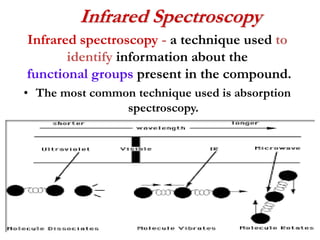
Infrared spectroscopy - a technique used to
identify information about the
functional groups present in the compound.
• The most common technique used is absorption
spectroscopy.
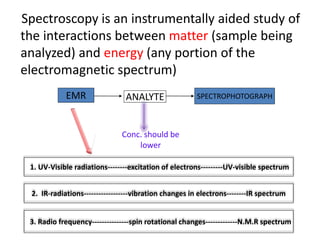
Spectroscopy is an instrumentally aided study of
the interactions between matter (sample being
analyzed) and energy (any portion of the
electromagnetic spectrum)
EMR ANALYTE SPECTROPHOTOGRAPH
1. UV-Visible radiations--------excitation of electrons---------UV-visible spectrum
2. IR-radiations------------------vibration changes in electrons--------IR spectrum
3. Radio frequency---------------spin rotational changes-------------N.M.R spectrum
Conc. should be
lower
Principle of IR spectroscopy:
Q.1) Describe the principle or theory of IR spectra?
Q.2) Explain, how the IR spectrum are presented (Diagram expected). Also name the solvents
used to scan the IR spectra. (W-12, 2 Mark)
Q.3) In which region of electromagnetic spectrum the vibrationals transitions are observed?
(S-16, ½ Mark)
(a) U.V. (b) Microwave (c) IR (d) Visible
Principle of IR spectroscopy:
Defination: The spectra produced due to,
(i) Absorption of IR radiation by molecule &
(ii) Vibrational energy level transition,
is called as Vibrational spectra or IR spectra.
It is observed in IR region in spectral range 4000-667 cm-1.
When IR absorption occur?
Rule-1) IR absorption only occurs when IR radiation
interacts with a molecule undergoing a change in dipole
moment as it vibrates or rotates.
Rule-2) Infrared absorption only occurs when the
incoming IR radiation has sufficient energy for the
transition to the next allowed vibrational state
Note: If the Rule-1 & 2, above are not met, no absorption can occur.
PRINCIPLE OF IR SPECTROSCOPY
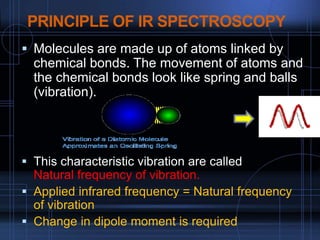
 Molecules are made up of atoms linked by
chemical bonds. The movement of atoms and
the chemical bonds look like spring and balls
(vibration).
 This characteristic vibration are called
Natural frequency of vibration.
 Applied infrared frequency = Natural frequency
of vibration
 Change in dipole moment is required
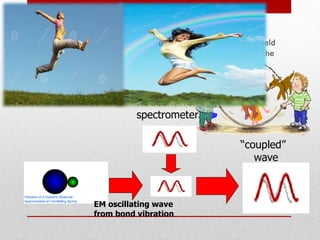
When a wave of infrared light encounters this oscillating EM field
generated by the oscillating dipole of the same frequency, the
two waves couple, and IR light is absorbed
The coupled wave now vibrates with twice the amplitude
IR beam from
spectrometer
EM oscillating wave
from bond vibration
“coupled”
wave
Infrared Absorption
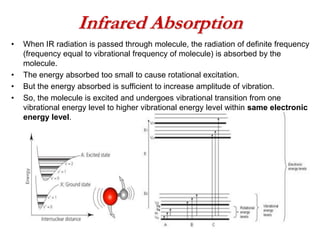
• When IR radiation is passed through molecule, the radiation of definite frequency
(frequency equal to vibrational frequency of molecule) is absorbed by the
molecule.
• The energy absorbed too small to cause rotational excitation.
• But the energy absorbed is sufficient to increase amplitude of vibration.
• So, the molecule is excited and undergoes vibrational transition from one
vibrational energy level to higher vibrational energy level within same electronic
energy level.
Principle of IR spectroscopy
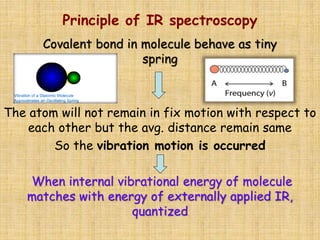
Covalent bond in molecule behave as tiny
spring
The atom will not remain in fix motion with respect to
each other but the avg. distance remain same
So the vibration motion is occurred
When internal vibrational energy of molecule
matches with energy of externally applied IR,
quantized
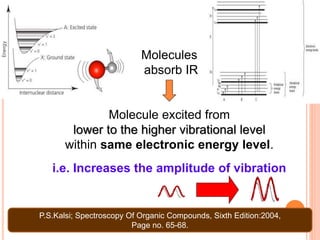
Molecules
absorb IR
Molecule excited from
lower to the higher vibrational level
within same electronic energy level.
i.e. Increases the amplitude of vibration
P.S.Kalsi; Spectroscopy Of Organic Compounds, Sixth Edition:2004,
Page no. 65-68.
Infrared Spectra
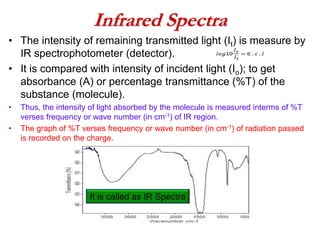
• The intensity of remaining transmitted light (It) is measure by
IR spectrophotometer (detector).
• It is compared with intensity of incident light (Io); to get
absorbance (A) or percentage transmittance (%T) of the
substance (molecule).
• Thus, the intensity of light absorbed by the molecule is measured interms of %T
verses frequency or wave number (in cm-1) of IR region.
• The graph of %T verses frequency or wave number (in cm-1) of radiation passed
is recorded on the charge.
It is called as IR Spectra
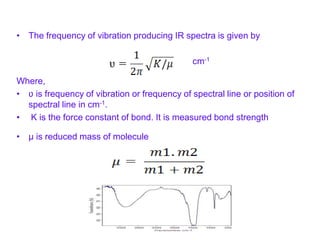
• The frequency of vibration producing IR spectra is given by
cm-1
Where,
• ʋ is frequency of vibration or frequency of spectral line or position of
spectral line in cm-1.
• K is the force constant of bond. It is measured bond strength
• μ is reduced mass of molecule
Types of Vibrational modes:
• Only those vibrational modes (vibration) which produces change
in dipole moment of molecule, absorbs IR radiation and show IR
spectra.
• So, the dipole moment of molecule must change during
vibration.
Q.1) What are the essential conditions for a compound to absorb IR radiation?
(S-11 & W-13, 2 Mark)
Q.2) Give reasons: Chlorine molecule does not absorb IR radiation. (S-11, 2 Mark)
Q.3) What are the conditions or absorption in IR region? (W-11, 2 Mark)
Q.4) Give the selection and essential condition (requirement) for a molecule to show IR
spectra?
Q.5) Give the necessary condition for a molecule to absorb IR radiation?
(or to become IR active).
Q.6) What are the conditions (requirement) for a substance to absorb in the IR region?
Which of the following compounds are IR active? (W-19, 4 Mark)
(i) CO2 (ii) H2O & (iii) NH3
Dipole moment:
For a molecule to show infrared absorpsions it must possess a
specific feature: an electric dipole moment of the molecule must
change during the vibration.
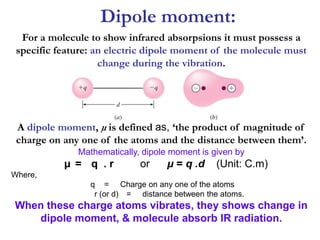
A dipole moment, µ is defined as, ‘the product of magnitude of
charge on any one of the atoms and the distance between them’.
Mathematically, dipole moment is given by
µ = q . r or µ = q .d (Unit: C.m)
Where,
q = Charge on any one of the atoms
r (or d) = distance between the atoms.
When these charge atoms vibrates, they shows change in
dipole moment, & molecule absorb IR radiation.
Essential conditions for a compound to absorb IR radiation:
The vibration frequency of the molecule must match (equal) with frequency of
IR radiation.
The dipole moment of molecule must change during vibration.
What is mean by IR Active Compounds??
If the vibration transition in molecule is capable of
change in dipole moment so the molecule is said to be
IR active.
e.g. I-Cl, C=O,CHCl3, H2O,etc.
What is mean by IR Inactive Compounds??
If the vibration transition in molecule is not producing
change in dipole moment so the molecule is said to be
IR inactive.
e.g. H2, Cl2, N2, O2, C=C, etc.
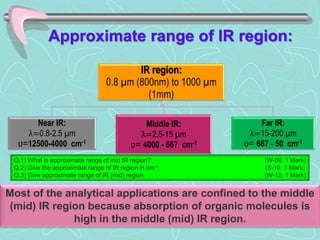
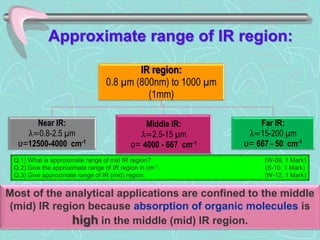
IR region:
0.8 µm (800nm) to 1000 µm
(1mm)
Near IR:
λ=0.8-2.5 µm
ʋ=12500-4000 cm-1
Middle IR:
λ=2.5-15 µm
ʋ= 4000 - 667 cm-1
Far IR:
λ=15-200 µm
ʋ= 667 - 50 cm-1
Most of the analytical applications are confined to the middle
(mid) IR region because absorption of organic molecules is
high in the middle (mid) IR region.
Approximate range of IR region:
Q.1) What is approximate range of mid IR region? (W-09, 1 Mark)
Q.2) Give the approximate range of IR region in cm-1. (S-10, 1 Mark)
Q.3) Give approximate range of IR (mid) region. (W-12, 1 Mark)
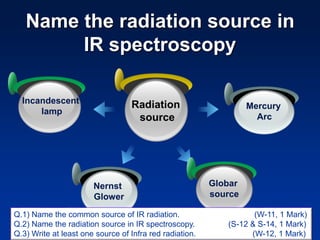
Name the radiation source in
IR spectroscopy
Radiation
source
Incandescent
lamp
Nernst
Glower
Mercury
Arc
Globar
source
Q.1) Name the common source of IR radiation. (W-11, 1 Mark)
Q.2) Name the radiation source in IR spectroscopy. (S-12 & S-14, 1 Mark)
Q.3) Write at least one source of Infra red radiation. (W-12, 1 Mark))
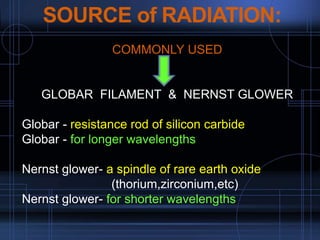
SOURCE of RADIATION:
•COMMONLY USED
•
•GLOBAR FILAMENT & NERNST GLOWER
Globar - resistance rod of silicon carbide
Globar - for longer wavelengths
Nernst glower- a spindle of rare earth oxide
(thorium,zirconium,etc)
Nernst glower- for shorter wavelengths
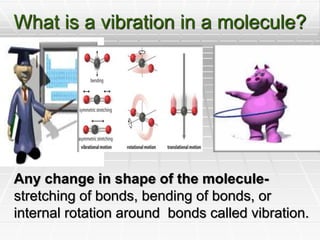
What is a vibration in a molecule?
Any change in shape of the molecule-
stretching of bonds, bending of bonds, or
internal rotation around bonds called vibration.
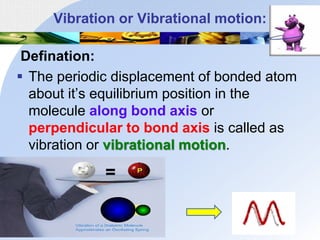
Vibration or Vibrational motion:
Defination:
 The periodic displacement of bonded atom
about it’s equilibrium position in the
molecule along bond axis or
perpendicular to bond axis is called as
vibration or vibrational motion.
=
Fundamental or Normal modes of Vibration:
Defination:
 The vibration motion in which all atom of
the molecule vibrate in phase
simultaneously and with same
frequency is called as normal or
fundamental mode of vibration.
Types of vibrational modes:
Q.1) Explain the various types of fundamental (normal) modes of vibration.
Q.2) Define and explain: (i) Stretching vibration & (ii) Bending vibration.
Q.3) Name the various type of vibration?
Q.4) What is bending vibration? (W-09, 1 Mark)
Q.5) Identify type of vibrations indicated in each of the following figures. (S-11, 2 Mark)
Q.6) Explain various types of stretching vibrations with suitable example. (W-11, 3 Mark)
Q.7) What are bending vibrations? Indicate in-plane and out-plane bending vibrations by
taking suitable example. (W-13, 2 Mark)
Q.8) Identify type of vibrations indicated in each of the following figures. (S-14, 2 Mark)
Q.9) Illustrate with diagrams the different types of bending vibrations. (S-13 & W-17, 4 Mark)
Q.10) What are stretching vibrations? (W-15, 1 Mark)
Q.11) Describe different types of bending vibrations in IR spectroscopy. (W-15, 4 Mark)
Q.12) Discuss the types of mode of vibrations in IR spectroscopy. (W-16, 4 Mark)
Q.13) Describe types of vibrational modes in IR spectroscopy. (W-18, 4 Mark)
Q.14) Explain the following terms with diagram: (S-19, 4 Mark)
(i) Scissoring & (ii) Twisting
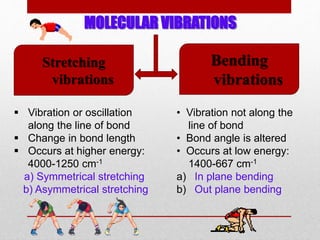
MOLECULAR VIBRATIONS
Bending
vibrations
Stretching
vibrations
 Vibration or oscillation
along the line of bond
 Change in bond length
 Occurs at higher energy:
4000-1250 cm-1
a) Symmetrical stretching
b) Asymmetrical stretching
• Vibration not along the
line of bond
• Bond angle is altered
• Occurs at low energy:
1400-667 cm-1
a) In plane bending
b) Out plane bending
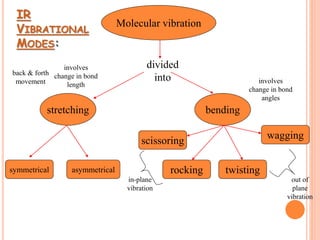
Molecular vibration
divided
into
stretching bending
back & forth
movement involves
change in bond
angles
symmetrical asymmetrical
scissoring
rocking twisting
wagging
in-plane
vibration
out of
plane
vibration
IR
VIBRATIONAL
MODES:
involves
change in bond
length
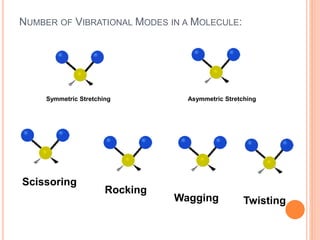
NUMBER OF VIBRATIONAL MODES IN A MOLECULE:
Symmetric Stretching Asymmetric Stretching
Scissoring
Rocking
Wagging Twisting
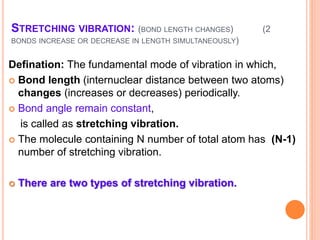
STRETCHING VIBRATION: (BOND LENGTH CHANGES) (2
BONDS INCREASE OR DECREASE IN LENGTH SIMULTANEOUSLY)
Defination: The fundamental mode of vibration in which,
 Bond length (internuclear distance between two atoms)
changes (increases or decreases) periodically.
 Bond angle remain constant,
is called as stretching vibration.
 The molecule containing N number of total atom has (N-1)
number of stretching vibration.
 There are two types of stretching vibration.
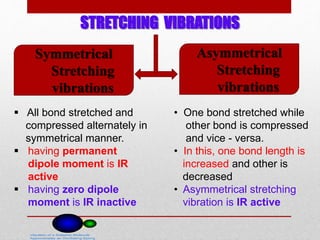
STRETCHING VIBRATIONS
Asymmetrical
Stretching
vibrations
Symmetrical
Stretching
vibrations
 All bond stretched and
compressed alternately in
symmetrical manner.
 having permanent
dipole moment is IR
active
 having zero dipole
moment is IR inactive
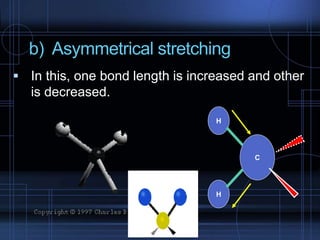
• One bond stretched while
other bond is compressed
and vice - versa.
• In this, one bond length is
increased and other is
decreased
• Asymmetrical stretching
vibration is IR active
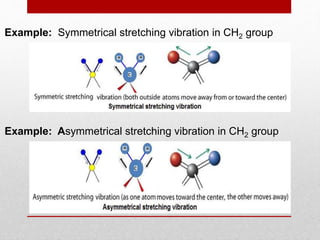
Example: Symmetrical stretching vibration in CH2 group
Example: Asymmetrical stretching vibration in CH2 group
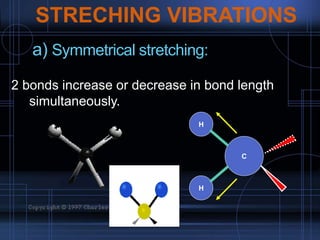
a) Symmetrical stretching:
2 bonds increase or decrease in bond length
simultaneously.
H
H
C
STRECHING VIBRATIONS
b) Asymmetrical stretching
 In this, one bond length is increased and other
is decreased.
H
H
C
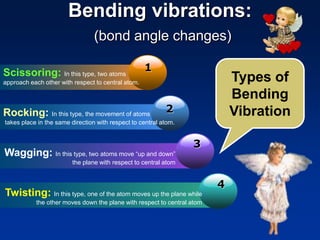
Bending vibrations:
(bond angle changes)
1Scissoring: In this type, two atoms
approach each other with respect to central atom.
2Rocking: In this type, the movement of atoms
takes place in the same direction with respect to central atom.
3
Wagging: In this type, two atoms move “up and down”
the plane with respect to central atom
4
Twisting: In this type, one of the atom moves up the plane while
the other moves down the plane with respect to central atom
Types of
Bending
Vibration
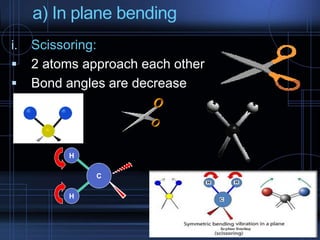
a) In plane bending
i. Scissoring:
 2 atoms approach each other
 Bond angles are decrease
H
H
CC
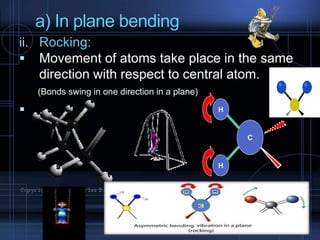
a) In plane bending
ii. Rocking:
 Movement of atoms take place in the same
direction with respect to central atom.
(Bonds swing in one direction in a plane)
 .
H
H
CC
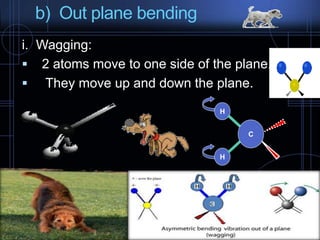
b) Out plane bending
i. Wagging:
 2 atoms move to one side of the plane.
 They move up and down the plane.
H
H
CC
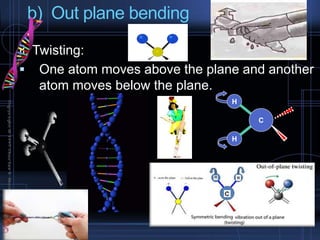
b) Out plane bending
ii. Twisting:
 One atom moves above the plane and another
atom moves below the plane.
H
H
CC
Company
LOGO
Fundamental modes of
vibration
PRP
Company name
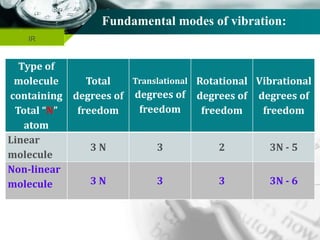
Fundamental modes of vibration:
Type of
molecule
containing
Total “N”
atom
Total
degrees of
freedom
Translational
degrees of
freedom
Rotational
degrees of
freedom
Vibrational
degrees of
freedom
Linear
molecule
3 N 3 2 3N - 5
Non-linear
molecule 3 N 3 3 3N - 6
IR
Company name
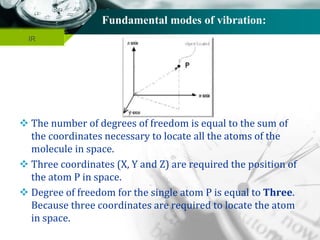
Fundamental modes of vibration:
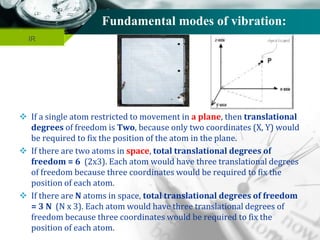
 The number of degrees of freedom is equal to the sum of
the coordinates necessary to locate all the atoms of the
molecule in space.
 Three coordinates (X, Y and Z) are required the position of
the atom P in space.
 Degree of freedom for the single atom P is equal to Three.
Because three coordinates are required to locate the atom
in space.
IR
Company name
Fundamental modes of vibration:
 If a single atom restricted to movement in a plane, then translational
degrees of freedom is Two, because only two coordinates (X, Y) would
be required to fix the position of the atom in the plane.
 If there are two atoms in space, total translational degrees of
freedom = 6 (2x3). Each atom would have three translational degrees
of freedom because three coordinates would be required to fix the
position of each atom.
 If there are N atoms in space, total translational degrees of freedom
= 3 N (N x 3). Each atom would have three translational degrees of
freedom because three coordinates would be required to fix the
position of each atom.
IR
Company name
Fundamental modes of vibration:
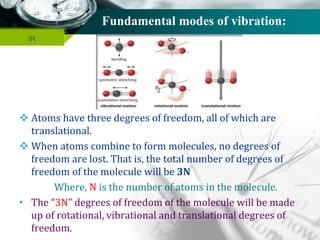
 Atoms have three degrees of freedom, all of which are
translational.
 When atoms combine to form molecules, no degrees of
freedom are lost. That is, the total number of degrees of
freedom of the molecule will be 3N
Where, N is the number of atoms in the molecule.
• The “3N” degrees of freedom of the molecule will be made
up of rotational, vibrational and translational degrees of
freedom.
IR
Company name
Fundamental modes of vibration:
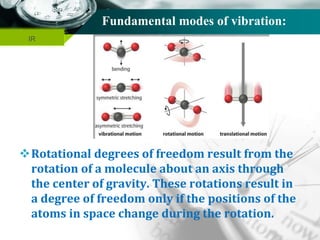
Rotational degrees of freedom result from the
rotation of a molecule about an axis through
the center of gravity. These rotations result in
a degree of freedom only if the positions of the
atoms in space change during the rotation.
IR
Company name
Fundamental modes of vibration:
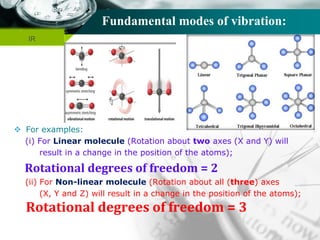
 For examples:
(i) For Linear molecule (Rotation about two axes (X and Y) will
result in a change in the position of the atoms);
Rotational degrees of freedom = 2
(ii) For Non-linear molecule (Rotation about all (three) axes
(X, Y and Z) will result in a change in the position of the atoms);
Rotational degrees of freedom = 3
IR
Company name
Fundamental modes of vibration:
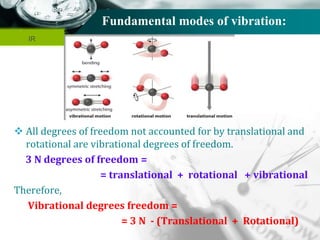
 All degrees of freedom not accounted for by translational and
rotational are vibrational degrees of freedom.
3 N degrees of freedom =
= translational + rotational + vibrational
Therefore,
Vibrational degrees freedom =
= 3 N - (Translational + Rotational)
IR
Company name
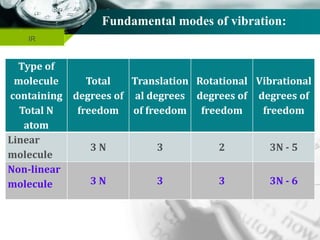
Fundamental modes of vibration:
Type of
molecule
containing
Total N
atom
Total
degrees of
freedom
Translation
al degrees
of freedom
Rotational
degrees of
freedom
Vibrational
degrees of
freedom
Linear
molecule
3 N 3 2 3N - 5
Non-linear
molecule 3 N 3 3 3N - 6
IR
Company name
Company name
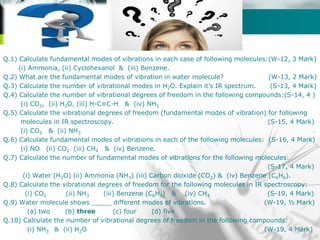
Q.1) Calculate fundamental modes of vibrations in each case of following molecules:(W-12, 3 Mark)
(i) Ammonia, (ii) Cyclohexanol & (iii) Benzene.
Q.2) What are the fundamental modes of vibration in water molecule? (W-13, 2 Mark)
Q.3) Calculate the number of vibrational modes in H2O. Explain it’s IR spectrum. (S-13, 4 Mark)
Q.4) Calculate the number of vibrational degrees of freedom in the following compounds:(S-14, 4 )
(i) CO2, (ii) H2O, (iii) H-C≡C-H & (iv) NH3
Q.5) Calculate the vibrational degrees of freedom (fundamental modes of vibration) for following
molecules in IR spectroscopy. (S-15, 4 Mark)
(i) CO2 & (ii) NH3
Q.6) Calculate fundamental modes of vibrations in each of the following molecules: (S-16, 4 Mark)
(i) NO (ii) CO2 (iii) CH4 & (iv) Benzene.
Q.7) Calculate the number of fundamental modes of vibrations for the following molecules:
(S-17, 4 Mark)
(i) Water (H2O) (ii) Ammonia (NH3) (iii) Carbon dioxide (CO2) & (iv) Benzene (C6H6).
Q.8) Calculate the vibrational degrees of freedom for the following molecules in IR spectroscopy:
(i) CO2 (ii) NH3 (iii) Benzene (C6H6) & (iv) CH4 (S-19, 4 Mark)
Q.9) Water molecule shows _____ different modes of vibrations. (W-19, ½ Mark)
(a) two (b) three (c) four (d) five
Q.10) Calculate the number of vibrational degrees of freedom in the following compounds:
(i) NH3 & (ii) H2O (W-19, 4 Mark)
Company name
Fundamental modes of vibration:
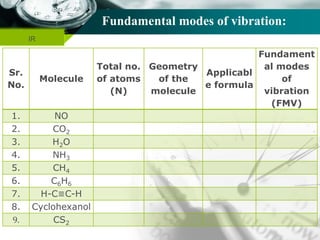
IR
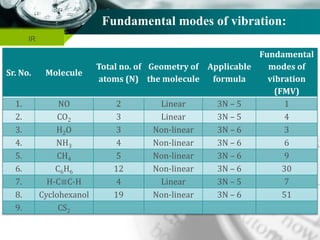
Sr. No. Molecule
Total no. of
atoms (N)
Geometry of
the molecule
Applicable
formula
Fundamental
modes of
vibration
(FMV)
1. NO 2 Linear 3N – 5 1
2. CO2 3 Linear 3N – 5 4
3. H2O 3 Non-linear 3N – 6 3
4. NH3 4 Non-linear 3N – 6 6
5. CH4 5 Non-linear 3N – 6 9
6. C6H6 12 Non-linear 3N – 6 30
7. H-C≡C-H 4 Linear 3N – 5 7
8. Cyclohexanol 19 Non-linear 3N – 6 51
9. CS2
Company name
Fundamental modes of vibration:
IR
Sr.
No.
Molecule
Total no.
of atoms
(N)
Geometry
of the
molecule
Applicabl
e formula
Fundament
al modes
of
vibration
(FMV)
1. NO
2. CO2
3. H2O
4. NH3
5. CH4
6. C6H6
7. H-C≡C-H
8. Cyclohexanol
9. CS2
IR region:
0.8 µm (800nm) to 1000 µm
(1mm)
Near IR:
λ=0.8-2.5 µm
ʋ=12500-4000 cm-1
Middle IR:
λ=2.5-15 µm
ʋ= 4000 - 667 cm-1
Far IR:
λ=15-200 µm
ʋ= 667 - 50 cm-1
Most of the analytical applications are confined to the middle
(mid) IR region because absorption of organic molecules is
high in the middle (mid) IR region.
Approximate range of IR region:
Q.1) What is approximate range of mid IR region? (W-09, 1 Mark)
Q.2) Give the approximate range of IR region in cm-1. (S-10, 1 Mark)
Q.3) Give approximate range of IR (mid) region. (W-12, 1 Mark)
Company name
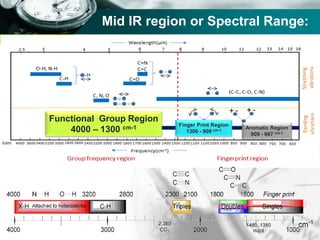
Mid IR region or Spectral Range:
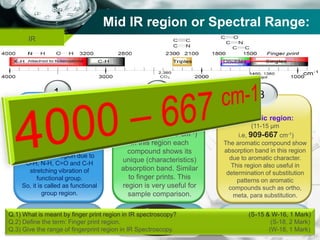
1
Functional group region:
( 2.5 to 7.7 µm
i.e.,4000-1300 cm-1)
The common functional
group show IR absorption
band in this region due to
O-H, N-H, C=O and C-H
stretching vibration of
functional group.
So, it is called as functional
group region.
2
Finger print region:
(7.7-11 µm
i.e.,1300 to 909 cm-1)
In this region each
compound shows its
unique (characteristics)
absorption band. Similar
to finger prints. This
region is very useful for
sample comparison.
3
Aromatic region:
(11-15 µm
i.e, 909-667 cm-1)
The aromatic compound show
absorption band in this region
due to aromatic character.
This region also useful in
determination of substitution
patterns on aromatic
compounds such as ortho,
meta, para substitution.
IR
Q.1) What is meant by finger print region in IR spectroscopy? (S-15 & W-16, 1 Mark)
Q.2) Define the term: Finger print region. (S-18, 2 Mark)
Q.3) Give the range of fingerprint region in IR Spectroscopy. (W-18, 1 Mark)
Company name
Mid IR region or Spectral Range:
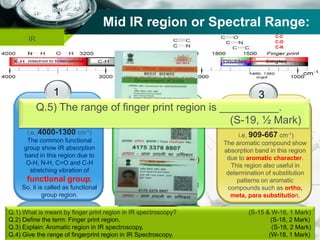
1
Functional group region:
( 2.5 to 7.7 µm
i.e.,4000-1300 cm-1)
The common functional
group show IR absorption
band in this region due to
O-H, N-H, C=O and C-H
stretching vibration of
functional group.
So, it is called as functional
group region.
2
Finger print region:
(7.7-11 µm
i.e.,1300 to 909 cm-1)
In this region each
compound shows its
unique (characteristics)
absorption band.
Similar to finger prints.
This region is very useful
for sample comparison.
3
Aromatic region:
(11-15 µm
i.e, 909-667 cm-1)
The aromatic compound show
absorption band in this region
due to aromatic character.
This region also useful in
determination of substitution
patterns on aromatic
compounds such as ortho,
meta, para substitution.
IR C-C
C-O
C-N
Q.1) What is meant by finger print region in IR spectroscopy? (S-15 & W-16, 1 Mark)
Q.2) Define the term: Finger print region. (S-18, 2 Mark)
Q.3) Explain: Aromatic region in IR spectroscopy. (S-18, 2 Mark)
Q.4) Give the range of fingerprint region in IR Spectroscopy. (W-18, 1 Mark)
Q.5) The range of finger print region is __________.
(S-19, ½ Mark)
Company name
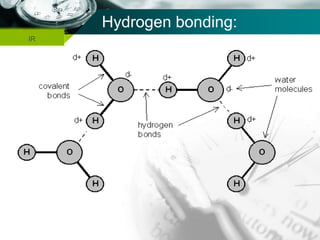
Hydrogen bonding:
IR
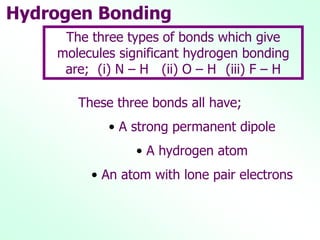
Hydrogen Bonding
These three bonds all have;
• A strong permanent dipole
• A hydrogen atom
• An atom with lone pair electrons
The three types of bonds which give
molecules significant hydrogen bonding
are; (i) N – H (ii) O – H (iii) F – H
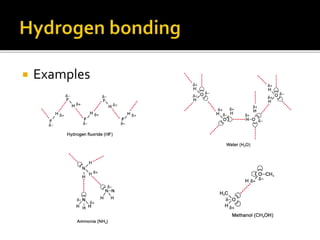
 Examples
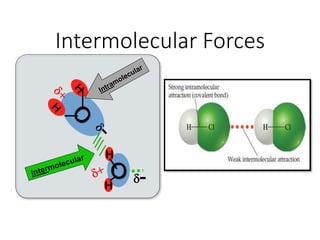
Intermolecular Forces
O -
H
H
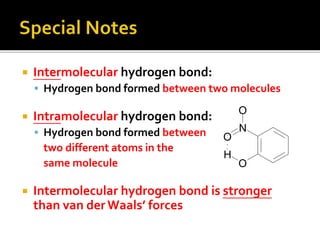
 Intermolecular hydrogen bond:
 Hydrogen bond formed between two molecules
 Intramolecular hydrogen bond:
 Hydrogen bond formed between
two different atoms in the
same molecule
 Intermolecular hydrogen bond is stronger
than van der Waals’ forces
N
O
O
O
H
INTRAMOLECULAR
HYDROGEN BONDING
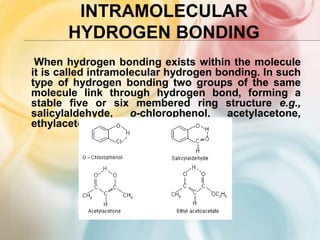
When hydrogen bonding exists within the molecule
it is called intramolecular hydrogen bonding. In such
type of hydrogen bonding two groups of the same
molecule link through hydrogen bond, forming a
stable five or six membered ring structure e.g.,
salicylaldehyde, o-chlorophenol, acetylacetone,
ethylacetoacetate etc.
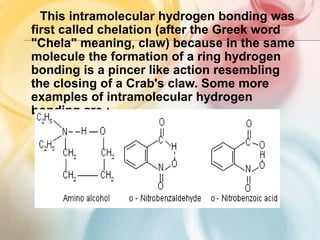
This intramolecular hydrogen bonding was
first called chelation (after the Greek word
"Chela" meaning, claw) because in the same
molecule the formation of a ring hydrogen
bonding is a pincer like action resembling
the closing of a Crab's claw. Some more
examples of intramolecular hydrogen
bonding are :
Company name
Mid IR region or Spectral Range:
Functional Group Region
4000 – 1300 cm-1 Finger Print Region
1300 - 909 cm-1
Aromatic Region
909 - 667 cm-1
Company name
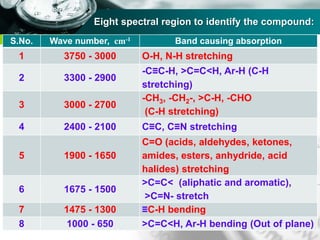
Eight spectral region to identify the compound:
S.No. Wave number, cm-1 Band causing absorption
1 3750 - 3000 O-H, N-H stretching
2 3300 - 2900
-C≡C-H, >C=C<H, Ar-H (C-H
stretching)

3 3000 - 2700
-CH3, -CH2-, >C-H, -CHO
(C-H stretching)

4 2400 - 2100 C≡C, C≡N stretching
5 1900 - 1650
C=O (acids, aldehydes, ketones,
amides, esters, anhydride, acid
halides) stretching
6 1675 - 1500
>C=C< (aliphatic and aromatic),
>C=N- stretch
7 1475 - 1300 ≡C-H bending
8 1000 - 650 >C=C<H, Ar-H bending (Out of plane)
Company name
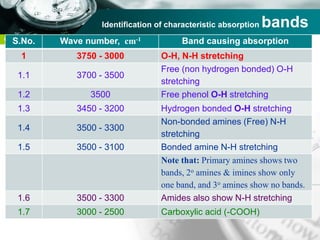
Identification of characteristic absorption bands
S.No. Wave number, cm-1 Band causing absorption
1 3750 - 3000 O-H, N-H stretching
1.1 3700 - 3500
Free (non hydrogen bonded) O-H
stretching
1.2 3500 Free phenol O-H stretching
1.3 3450 - 3200 Hydrogen bonded O-H stretching
1.4 3500 - 3300
Non-bonded amines (Free) N-H
stretching
1.5 3500 - 3100 Bonded amine N-H stretching
Note that: Primary amines shows two
bands, 2o amines & imines show only
one band, and 3o amines show no bands.
1.6 3500 - 3300 Amides also show N-H stretching
1.7 3000 - 2500 Carboxylic acid (-COOH)
Company name
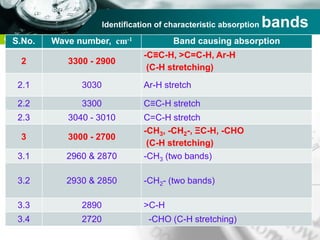
Identification of characteristic absorption bands
S.No. Wave number, cm-1 Band causing absorption
2 3300 - 2900
-C≡C-H, >C=C-H, Ar-H
(C-H stretching)
2.1 3030 Ar-H stretch
2.2 3300 C≡C-H stretch
2.3 3040 - 3010 C=C-H stretch
3 3000 - 2700
-CH3, -CH2-, ΞC-H, -CHO
(C-H stretching)
3.1 2960 & 2870 -CH3 (two bands)
3.2 2930 & 2850 -CH2- (two bands)
3.3 2890 >C-H
3.4 2720 -CHO (C-H stretching)
Company name
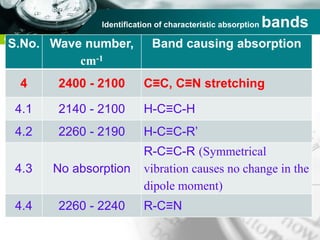
Identification of characteristic absorption bands
S.No. Wave number,
cm-1
Band causing absorption
4 2400 - 2100 C≡C, C≡N stretching
4.1 2140 - 2100 H-C≡C-H
4.2 2260 - 2190 H-C≡C-R’
4.3 No absorption
R-C≡C-R (Symmetrical
vibration causes no change in the
dipole moment)
4.4 2260 - 2240 R-C≡N
Company name
Identification of characteristic absorption bands
S.No. Wave number, cm-1 Band causing absorption
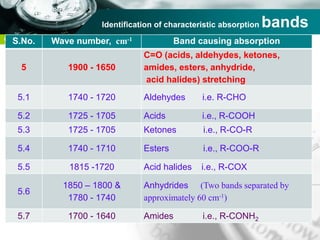
5 1900 - 1650
C=O (acids, aldehydes, ketones,
amides, esters, anhydride,
acid halides) stretching
5.1 1740 - 1720 Aldehydes i.e. R-CHO
5.2 1725 - 1705 Acids i.e., R-COOH
5.3 1725 - 1705 Ketones i.e., R-CO-R
5.4 1740 - 1710 Esters i.e., R-COO-R
5.5 1815 -1720 Acid halides i.e., R-COX
5.6
1850 – 1800 &
1780 - 1740
Anhydrides (Two bands separated by
approximately 60 cm-1)
5.7 1700 - 1640 Amides i.e., R-CONH2
Company name
Identification of characteristic absorption bands
S.No. Wave number, cm-1 Band causing absorption
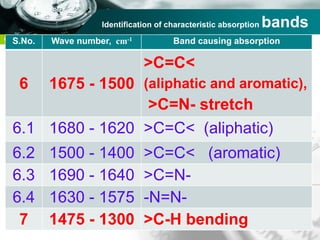
6 1675 - 1500
>C=C<
(aliphatic and aromatic),
>C=N- stretch
6.1 1680 - 1620 >C=C< (aliphatic)
6.2 1500 - 1400 >C=C< (aromatic)
6.3 1690 - 1640 >C=N-
6.4 1630 - 1575 -N=N-
7 1475 - 1300 >C-H bending
Company name
Identification of characteristic absorption bands:
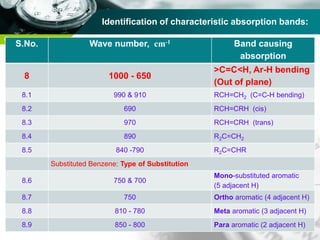
S.No. Wave number, cm-1 Band causing
absorption
8 1000 - 650
>C=C<H, Ar-H bending
(Out of plane)
8.1 990 & 910 RCH=CH2 (C=C-H bending)
8.2 690 RCH=CRH (cis)
8.3 970 RCH=CRH (trans)
8.4 890 R2C=CH2
8.5 840 -790 R2C=CHR
Substituted Benzene: Type of Substitution
8.6 750 & 700
Mono-substituted aromatic
(5 adjacent H)
8.7 750 Ortho aromatic (4 adjacent H)
8.8 810 - 780 Meta aromatic (3 adjacent H)
8.9 850 - 800 Para aromatic (2 adjacent H)
Company name
Company name
Company name
Company name
Problems on Interpretation of
Infrared Spectra:
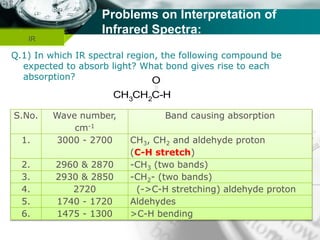
Q.1) In which IR spectral region, the following compound be
expected to absorb light? What bond gives rise to each
absorption?
IR
CH3CH2C-H
O
S.No. Wave number,
cm-1
Band causing absorption
1. 3000 - 2700 CH3, CH2 and aldehyde proton
(C-H stretch)
2. 2960 & 2870 -CH3 (two bands)
3. 2930 & 2850 -CH2- (two bands)
4. 2720 (->C-H stretching) aldehyde proton
5. 1740 - 1720 Aldehydes
6. 1475 - 1300 >C-H bending
 
R
O
HR
O
H
Company name
Problems on Interpretation of
Infrared Spectra:
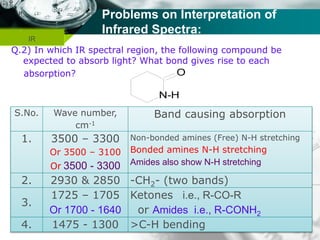
Q.2) In which IR spectral region, the following compound be
expected to absorb light? What bond gives rise to each
absorption?
IR
 
R
O
HR
O
H
N-H
O
S.No. Wave number,
cm-1
Band causing absorption
1. 3500 – 3300
Or 3500 – 3100
Or 3500 - 3300
Non-bonded amines (Free) N-H stretching
Bonded amines N-H stretching
Amides also show N-H stretching
2. 2930 & 2850 -CH2- (two bands)
3.
1725 – 1705
Or 1700 - 1640
Ketones i.e., R-CO-R
or Amides i.e., R-CONH2
4. 1475 - 1300 >C-H bending
 
R
O
R
Company name
Problems on Interpretation of
Infrared Spectra:
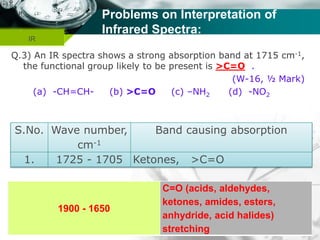
Q.3) An IR spectra shows a strong absorption band at 1715 cm-1,
the functional group likely to be present is >C=O .
(W-16, ½ Mark)
(a) -CH=CH- (b) >C=O (c) –NH2 (d) -NO2
IR
 
R
O
HR
O
H
S.No. Wave number,
cm-1
Band causing absorption
1. 1725 - 1705 Ketones, >C=O
 
R
O
R
1900 - 1650
C=O (acids, aldehydes,
ketones, amides, esters,
anhydride, acid halides)
stretching
Company name
Problems on Interpretation of
Infrared Spectra:
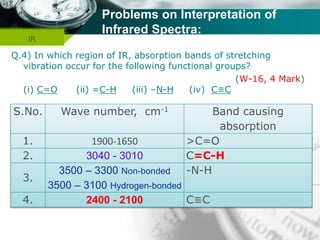
Q.4) In which region of IR, absorption bands of stretching
vibration occur for the following functional groups?
(W-16, 4 Mark)
(i) C=O (ii) =C-H (iii) –N-H (iv) C≡C
IR
 
R
O
HR
O
H
S.No. Wave number, cm-1 Band causing
absorption
1. 1900-1650 >C=O
2. 3040 - 3010 C=C-H
3.
3500 – 3300 Non-bonded
3500 – 3100 Hydrogen-bonded
-N-H
4. 2400 - 2100 C≡C
 
R
O
R
Company name
Problems on Interpretation of
Infrared Spectra:
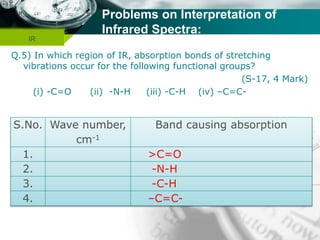
Q.5) In which region of IR, absorption bonds of stretching
vibrations occur for the following functional groups?
(S-17, 4 Mark)
(i) -C=O (ii) -N-H (iii) -C-H (iv) –C=C-
IR
 
R
O
HR
O
H
S.No. Wave number,
cm-1
Band causing absorption
1. >C=O
2. -N-H
3. -C-H
4. –C=C-
 
R
O
R
Company name
Problems on Interpretation of
Infrared Spectra:
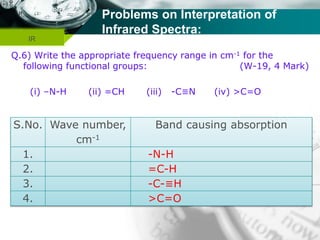
Q.6) Write the appropriate frequency range in cm-1 for the
following functional groups: (W-19, 4 Mark)
(i) –N-H (ii) =CH (iii) -C≡N (iv) >C=O
IR
 
R
O
HR
O
H
S.No. Wave number,
cm-1
Band causing absorption
1. -N-H
2. =C-H
3. -C-≡H
4. >C=O
 
R
O
R
Company
LOGO
Structure of H2O molecule:
Q.1) Explain different types of stretching vibrations in tri-atomic molecule.
(S-13, 3 Mark)
Q.2) Calculate the number of vibrational modes in H2O. Explain it’s IR spectrum.
(S-13, 4 Mark)
Q.3) Explain the structure of water molecule on the basis of IR spectroscopy.
(S-15 & W-19, 4 Mark)
Q.4) Describe IR spectrum of H2O molecule. (W-15, 4 Mark)
Q.5) What tupes of vibrational modes are expected in H2O molecule?
Discuss its spectrum. (W-18, 4 Mark)
Company name
Structure of Organic Compounds:
Structure of H2O molecule:
 The total fundamental mode of vibration of
non-linear, H2O molecule are (3N-6) =
= [(3 x 3) – 6] = 3
 Out of three fundamental mode of vibration;
The molecule containing N number of total
atom has (N-1) number of stretching vibration.
i.e., (3-1) = 2 vibration are stretching vibration
and one vibration is bending vibration.
 Out of two stretching vibration; one is
symmetrical stretching vibration and another is
asymmetrical stretching vibration.
IR
Company name
Structure of H2O molecule:
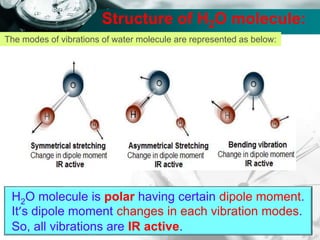
The modes of vibrations of water molecule are represented as below:
H2O molecule is polar having certain dipole moment.
It’s dipole moment changes in each vibration modes.
So, all vibrations are IR active.
Company name
Structure of H2O molecule:
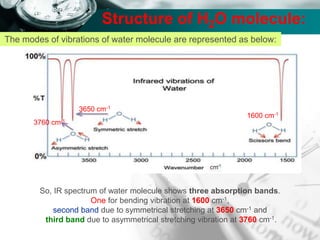
The modes of vibrations of water molecule are represented as below:
So, IR spectrum of water molecule shows three absorption bands.
One for bending vibration at 1600 cm-1,
second band due to symmetrical stretching at 3650 cm-1 and
third band due to asymmetrical stretching vibration at 3760 cm-1.
1600 cm-1
3650 cm-1
3760 cm-1
LOGOwww.themegallery.com
Structure of CO2 molecule:
Q.1) Discuss IR spectrum of carbon dioxide molecule. (W-09, 3 Mark)
Q.2) How many modes of vibrations the CO2 molecule will have? Which of them will be IR active?
(S-10 & W-14, 2-4 Mark)
Q.3) Give reasons: Carbon dioxide molecule shows only two IR bands in it’s IR spectrum inspite of it’s four
fundamental modes of vibrations.. (S-11, S-12 & W-13, 2 Mark)
Q.4) Describe IR spectrum of CO2 molecule. (W-14, 4 Mark)
Q.5) Calculate the number of vibrational modes in CO2. Discuss it on the basis of IR spectrum. (S-18, 4 Mark)
Q.6) Explain the structure of CO2 molecule on the basis of IR spectroscopy. (W-19, 2 Mark)
Company name
Structure of CO2 molecule:
The modes of vibrations of CO2 molecule are represented as below:
Structure of CO2 molecule: (Linear molecule)
 The Carbon dioxide (CO2) is a linear molecule.
 CO2 molecule has fundamental modes of vibration =(3N-5)
= [(3 x 3) - 5] = 4.
 Out of four fundamental mode of vibration;
The molecule containing N number of total atom has (N-1)
number of stretching vibration.
i.e., (3-1) = 2 vibration are stretching vibration and two
are bending vibration.
 Out of two stretching vibration; one is symmetrical
stretching vibration and another is asymmetrical stretching
vibration.
Company name
Structure of CO2 molecule:
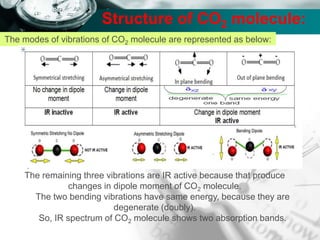
The modes of vibrations of CO2 molecule are represented as below:
The remaining three vibrations are IR active because that produce
changes in dipole moment of CO2 molecule.
The two bending vibrations have same energy, because they are
degenerate (doubly).
So, IR spectrum of CO2 molecule shows two absorption bands.
Company name
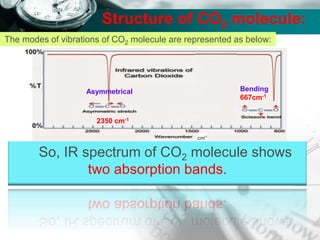
Structure of CO2 molecule:
The modes of vibrations of CO2 molecule are represented as below:
So, IR spectrum of CO2 molecule shows
two absorption bands.
2350 cm-1
Bending
667cm-1
Asymmetrical
Company name
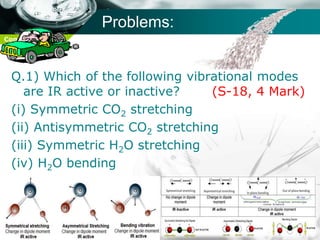
Problems:
Q.1) Which of the following vibrational modes
are IR active or inactive? (S-18, 4 Mark)
(i) Symmetric CO2 stretching
(ii) Antisymmetric CO2 stretching
(iii) Symmetric H2O stretching
(iv) H2O bending
Company name
Choice of solvent in IR spectra:
The essential condition or requirements (properties)
for a good solvent in IR spectroscopy are as given
below:
 The solvent should be transparent to IR radiation
( i.e., It should not be absorbed in IR region).
 It should not interact with the solute.
 It should be pure and the solute should be in it.
 It should be less polar or non polar.
Examples: CS2 and CCl4 are good solvents in IR
spectroscopy.
IR
Company name
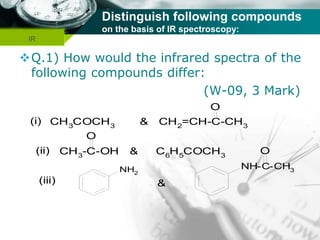
Distinguish following compounds
on the basis of IR spectroscopy:
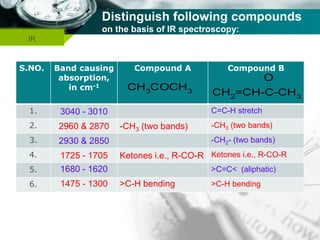
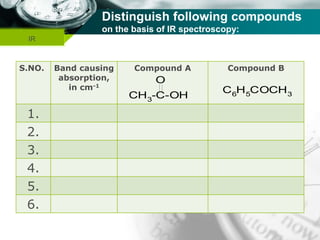
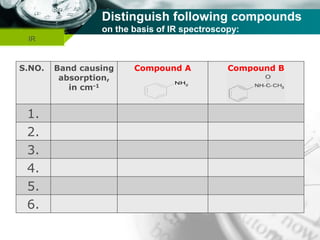
Q.1) How would the infrared spectra of the
following compounds differ:
(W-09, 3 Mark)
IR
(i) CH3
COCH3
& CH2
=CH-C-CH3
O
(ii) CH3
-C-OH & C6
H5
COCH3
O
(iii)
NH2
&
NH-C-CH3
O
Company name
Distinguish following compounds
on the basis of IR spectroscopy:
IR
S.NO. Band causing
absorption,
in cm-1
Compound A Compound B
1. 3040 - 3010 C=C-H stretch
2. 2960 & 2870 -CH3 (two bands) -CH3 (two bands)
3. 2930 & 2850 -CH2- (two bands)
4. 1725 - 1705 Ketones i.e., R-CO-R Ketones i.e., R-CO-R
5. 1680 - 1620 >C=C< (aliphatic)
6. 1475 - 1300 >C-H bending >C-H bending
(i) CH3
COCH3
& CH2
=CH-C-CH
O
(ii) CH3
-C-OH & C6
H5
COCH3
O
(iii)
NH2
&
N
(i) CH3
COCH3
& CH2
=CH-C-CH3
O
(ii) CH3
-C-OH & C6
H5
COCH3
O
(iii)
NH2
&
NH-C
O
Company name
Distinguish following compounds
on the basis of IR spectroscopy:
IR
S.NO. Band causing
absorption,
in cm-1
Compound A Compound B
1.
2.
3.
4.
5.
6.
(i) CH3
COCH3
& CH2
=CH-C-CH3
O
(ii) CH3
-C-OH & C6
H5
COCH3
O
(iii)
NH2
&
NH
(i) CH3
COCH3
& CH2
=CH-C-CH3
O
(ii) CH3
-C-OH & C6
H5
COCH3
O
(iii)
NH2
&
NH
Company name
Distinguish following compounds
on the basis of IR spectroscopy:
IR
S.NO. Band causing
absorption,
in cm-1
Compound A Compound B
1.
2.
3.
4.
5.
6.
(i) CH3
COCH3
& CH2
=CH-C-CH3
O
(ii) CH3
-C-OH & C6
H5
COCH3
O
(iii)
NH2
&
NH-C-CH3
O
Company name
Distinguish following compounds
on the basis of IR spectroscopy:
IR
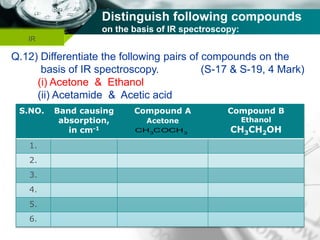
Q.12) Differentiate the following pairs of compounds on the
basis of IR spectroscopy. (S-17 & S-19, 4 Mark)
(i) Acetone & Ethanol
(ii) Acetamide & Acetic acid
S.NO. Band causing
absorption,
in cm-1
Compound A
Acetone
Compound B
Ethanol
CH3CH2OH
1.
2.
3.
4.
5.
6.
(i) CH3
COCH3
& CH2
=CH-C-CH3
O
(ii) CH3
-C-OH & C6
H5
COCH3
O
(iii)
NH2
&
NH-C-C
O
Company name
Distinguish following compounds
on the basis of IR spectroscopy:
IR
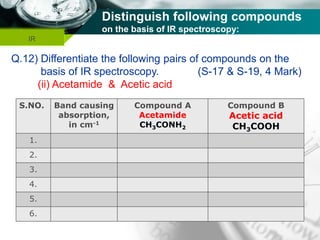
Q.12) Differentiate the following pairs of compounds on the
basis of IR spectroscopy. (S-17 & S-19, 4 Mark)
(ii) Acetamide & Acetic acid
S.NO. Band causing
absorption,
in cm-1
Compound A
Acetamide
CH3CONH2
Compound B
Acetic acid
CH3COOH
1.
2.
3.
4.
5.
6.
Company name
Distinguish following compounds
on the basis of IR spectroscopy:
IR
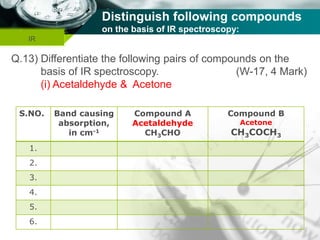
Q.13) Differentiate the following pairs of compounds on the
basis of IR spectroscopy. (W-17, 4 Mark)
(i) Acetaldehyde & Acetone
S.NO. Band causing
absorption,
in cm-1
Compound A
Acetaldehyde
CH3CHO
Compound B
Acetone
CH3COCH3
1.
2.
3.
4.
5.
6.
Company name
Distinguish following compounds
on the basis of IR spectroscopy:
IR
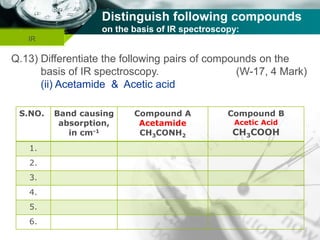
Q.13) Differentiate the following pairs of compounds on the
basis of IR spectroscopy. (W-17, 4 Mark)
(ii) Acetamide & Acetic acid
S.NO. Band causing
absorption,
in cm-1
Compound A
Acetamide
CH3CONH2
Compound B
Acetic Acid
CH3COOH
1.
2.
3.
4.
5.
6.
Company name
Distinguish following compounds
on the basis of IR spectroscopy:
IR
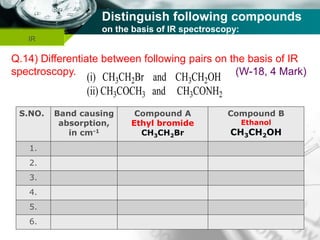
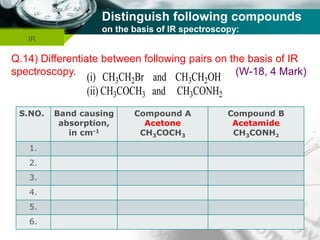
Q.14) Differentiate between following pairs on the basis of IR
spectroscopy. (W-18, 4 Mark)
S.NO. Band causing
absorption,
in cm-1
Compound A
Ethyl bromide
CH3CH2Br
Compound B
Ethanol
CH3CH2OH
1.
2.
3.
4.
5.
6.
(i) CH3CH2Br and CH3CH2OH
(ii) CH3COCH3 and CH3CONH2
Company name
Distinguish following compounds
on the basis of IR spectroscopy:
IR
Q.14) Differentiate between following pairs on the basis of IR
spectroscopy. (W-18, 4 Mark)
S.NO. Band causing
absorption,
in cm-1
Compound A
Acetone
CH3COCH3
Compound B
Acetamide
CH3CONH2
1.
2.
3.
4.
5.
6.
(i) CH3CH2Br and CH3CH2OH
(ii) CH3COCH3 and CH3CONH2
Company name
Distinguish following compounds
on the basis of IR spectroscopy:
IR
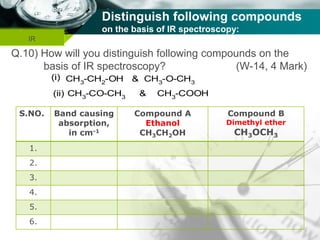
Q.10) How will you distinguish following compounds on the
basis of IR spectroscopy? (W-14, 4 Mark)
S.NO. Band causing
absorption,
in cm-1
Compound A
Ethanol
CH3CH2OH
Compound B
Dimethyl ether
CH3OCH3
1.
2.
3.
4.
5.
6.
(i) CH3-CH2-OH & CH3-O-CH3
(ii) CH3-CO-CH3 & CH3-COOH
Company name
Distinguish following compounds
on the basis of IR spectroscopy:
IR
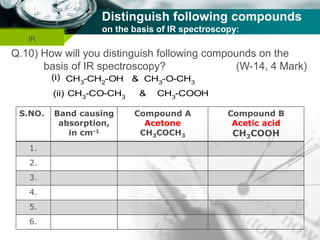
Q.10) How will you distinguish following compounds on the
basis of IR spectroscopy? (W-14, 4 Mark)
S.NO. Band causing
absorption,
in cm-1
Compound A
Acetone
CH3COCH3
Compound B
Acetic acid
CH3COOH
1.
2.
3.
4.
5.
6.
(i) CH3-CH2-OH & CH3-O-CH3
(ii) CH3-CO-CH3 & CH3-COOH
Company name
Distinguish following compounds
on the basis of IR spectroscopy:
IR
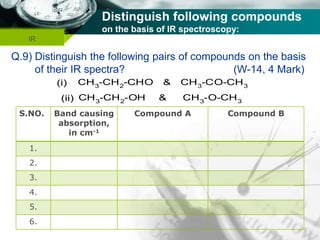
Q.9) Distinguish the following pairs of compounds on the basis
of their IR spectra? (W-14, 4 Mark)
(i) CH3-CH2-CHO & CH3-CO-CH3
(ii) CH3-CH2-OH & CH3-O-CH3
S.NO. Band causing
absorption,
in cm-1
Compound A Compound B
1.
2.
3.
4.
5.
6.
Company name
Distinguish following compounds
on the basis of IR spectroscopy:
IR
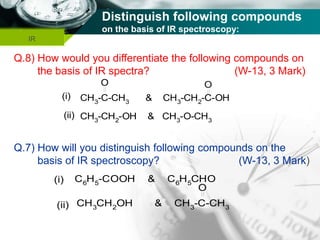
Q.8) How would you differentiate the following compounds on
the basis of IR spectra? (W-13, 3 Mark)
Q.7) How will you distinguish following compounds on the
basis of IR spectroscopy? (W-13, 3 Mark)
(i) CH3-C-CH3 & CH3-CH2-C-OH
(ii) CH3
-CH2
-OH & CH3
-O-CH3
O O
(i) C6
H5
-COOH & C6
H5
CHO
(ii) CH3
CH2
OH & CH3
-C-CH3
O
Company name
Distinguish following compounds
on the basis of IR spectroscopy:
IR
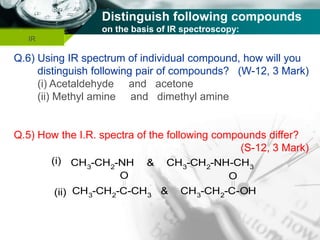
Q.6) Using IR spectrum of individual compound, how will you
distinguish following pair of compounds? (W-12, 3 Mark)
(i) Acetaldehyde and acetone
(ii) Methyl amine and dimethyl amine
Q.5) How the I.R. spectra of the following compounds differ?
(S-12, 3 Mark)
(i) CH3
-CH2
-NH & CH3
-CH2
-NH-CH3
(ii) CH3-CH2-C-CH3 & CH3-CH2-C-OH
O O
Company name
Distinguish following compounds
on the basis of IR spectroscopy:
IR
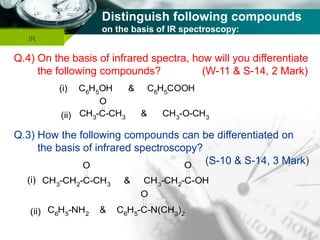
Q.4) On the basis of infrared spectra, how will you differentiate
the following compounds? (W-11 & S-14, 2 Mark)
Q.3) How the following compounds can be differentiated on
the basis of infrared spectroscopy?
(S-10 & S-14, 3 Mark)
(i) C6H5OH & C6H5COOH
(ii) CH3
-C-CH3
& CH3
-O-CH3
O
(i) CH3
-CH2
-C-CH3
& CH3
-CH2
-C-OH
O O
(ii) C6
H5
-NH2
& C6
H5
-C-N(CH3
)2
O
Company name
Distinguish following compounds
on the basis of IR spectroscopy:
IR
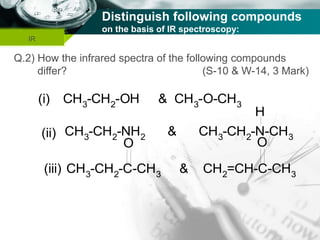
Q.2) How the infrared spectra of the following compounds
differ? (S-10 & W-14, 3 Mark)
(i) CH3-CH2-OH & CH3-O-CH3
(ii) CH3-CH2-NH2 & CH3-CH2-N-CH3
H
(iii) CH3-CH2-C-CH3 & CH2=CH-C-CH3
O O
I
R
R
I
A small truth to
make life 100%
Hard Work
H+A+R+D+W+O+R+K
8+1+18+4+23+15+18+11 = 98%
Knowledge
K+N+O+W+L+E+D+G+E
11+14+15+23+12+5+4+7+5 = 96%
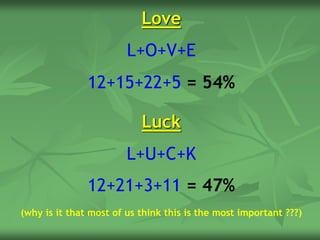
Love
L+O+V+E
12+15+22+5 = 54%
Luck
L+U+C+K
12+21+3+11 = 47%
(why is it that most of us think this is the most important ???)
Then what makes 100%?
Is it Money? ... NO ! ! !
M+O+N+E+Y
13+15+14+5+25 = 72%
Is it Leadership? ... NO ! ! !
L+E+A+D+E+R+S+H+I+P
12+5+1+4+5+18+19+9+16 = 89%
Every problem has a solution,
but only if we change our
attitude.
To go to the top and achieve
100%
We really need to go further...
ATTITUDE
A+T+T+I+T+U+D+E
1+20+20+9+20+21+4+5 = 100%
It is OUR ATTITUDE towards Life and
Work that makes OUR Life = 100%
Change Your Attitude …
… and You Change Your Life ! ! !
LOGO
LOGO
I
R
R
I

Ir spectroscopy by dr. pramod r. padole

  • 1.
  • 2.
    Infrared Spectroscopy Infrared spectroscopy- a technique used to identify information about the functional groups present in the compound. • The most common technique used is absorption spectroscopy.
  • 3.
    Spectroscopy is aninstrumentally aided study of the interactions between matter (sample being analyzed) and energy (any portion of the electromagnetic spectrum) EMR ANALYTE SPECTROPHOTOGRAPH 1. UV-Visible radiations--------excitation of electrons---------UV-visible spectrum 2. IR-radiations------------------vibration changes in electrons--------IR spectrum 3. Radio frequency---------------spin rotational changes-------------N.M.R spectrum Conc. should be lower
  • 4.
    Principle of IRspectroscopy: Q.1) Describe the principle or theory of IR spectra? Q.2) Explain, how the IR spectrum are presented (Diagram expected). Also name the solvents used to scan the IR spectra. (W-12, 2 Mark) Q.3) In which region of electromagnetic spectrum the vibrationals transitions are observed? (S-16, ½ Mark) (a) U.V. (b) Microwave (c) IR (d) Visible
  • 5.
    Principle of IRspectroscopy: Defination: The spectra produced due to, (i) Absorption of IR radiation by molecule & (ii) Vibrational energy level transition, is called as Vibrational spectra or IR spectra. It is observed in IR region in spectral range 4000-667 cm-1. When IR absorption occur? Rule-1) IR absorption only occurs when IR radiation interacts with a molecule undergoing a change in dipole moment as it vibrates or rotates. Rule-2) Infrared absorption only occurs when the incoming IR radiation has sufficient energy for the transition to the next allowed vibrational state Note: If the Rule-1 & 2, above are not met, no absorption can occur.
  • 6.
    PRINCIPLE OF IRSPECTROSCOPY  Molecules are made up of atoms linked by chemical bonds. The movement of atoms and the chemical bonds look like spring and balls (vibration).  This characteristic vibration are called Natural frequency of vibration.  Applied infrared frequency = Natural frequency of vibration  Change in dipole moment is required
  • 7.
    When a waveof infrared light encounters this oscillating EM field generated by the oscillating dipole of the same frequency, the two waves couple, and IR light is absorbed The coupled wave now vibrates with twice the amplitude IR beam from spectrometer EM oscillating wave from bond vibration “coupled” wave
  • 8.
    Infrared Absorption • WhenIR radiation is passed through molecule, the radiation of definite frequency (frequency equal to vibrational frequency of molecule) is absorbed by the molecule. • The energy absorbed too small to cause rotational excitation. • But the energy absorbed is sufficient to increase amplitude of vibration. • So, the molecule is excited and undergoes vibrational transition from one vibrational energy level to higher vibrational energy level within same electronic energy level.
  • 9.
    Principle of IRspectroscopy Covalent bond in molecule behave as tiny spring The atom will not remain in fix motion with respect to each other but the avg. distance remain same So the vibration motion is occurred When internal vibrational energy of molecule matches with energy of externally applied IR, quantized
  • 10.
    Molecules absorb IR Molecule excitedfrom lower to the higher vibrational level within same electronic energy level. i.e. Increases the amplitude of vibration P.S.Kalsi; Spectroscopy Of Organic Compounds, Sixth Edition:2004, Page no. 65-68.
  • 11.
    Infrared Spectra • Theintensity of remaining transmitted light (It) is measure by IR spectrophotometer (detector). • It is compared with intensity of incident light (Io); to get absorbance (A) or percentage transmittance (%T) of the substance (molecule). • Thus, the intensity of light absorbed by the molecule is measured interms of %T verses frequency or wave number (in cm-1) of IR region. • The graph of %T verses frequency or wave number (in cm-1) of radiation passed is recorded on the charge. It is called as IR Spectra
  • 12.
    • The frequencyof vibration producing IR spectra is given by cm-1 Where, • ʋ is frequency of vibration or frequency of spectral line or position of spectral line in cm-1. • K is the force constant of bond. It is measured bond strength • μ is reduced mass of molecule
  • 13.
    Types of Vibrationalmodes: • Only those vibrational modes (vibration) which produces change in dipole moment of molecule, absorbs IR radiation and show IR spectra. • So, the dipole moment of molecule must change during vibration. Q.1) What are the essential conditions for a compound to absorb IR radiation? (S-11 & W-13, 2 Mark) Q.2) Give reasons: Chlorine molecule does not absorb IR radiation. (S-11, 2 Mark) Q.3) What are the conditions or absorption in IR region? (W-11, 2 Mark) Q.4) Give the selection and essential condition (requirement) for a molecule to show IR spectra? Q.5) Give the necessary condition for a molecule to absorb IR radiation? (or to become IR active). Q.6) What are the conditions (requirement) for a substance to absorb in the IR region? Which of the following compounds are IR active? (W-19, 4 Mark) (i) CO2 (ii) H2O & (iii) NH3
  • 14.
    Dipole moment: For amolecule to show infrared absorpsions it must possess a specific feature: an electric dipole moment of the molecule must change during the vibration. A dipole moment, µ is defined as, ‘the product of magnitude of charge on any one of the atoms and the distance between them’. Mathematically, dipole moment is given by µ = q . r or µ = q .d (Unit: C.m) Where, q = Charge on any one of the atoms r (or d) = distance between the atoms. When these charge atoms vibrates, they shows change in dipole moment, & molecule absorb IR radiation.
  • 15.
    Essential conditions fora compound to absorb IR radiation: The vibration frequency of the molecule must match (equal) with frequency of IR radiation. The dipole moment of molecule must change during vibration. What is mean by IR Active Compounds?? If the vibration transition in molecule is capable of change in dipole moment so the molecule is said to be IR active. e.g. I-Cl, C=O,CHCl3, H2O,etc. What is mean by IR Inactive Compounds?? If the vibration transition in molecule is not producing change in dipole moment so the molecule is said to be IR inactive. e.g. H2, Cl2, N2, O2, C=C, etc.
  • 16.
    IR region: 0.8 µm(800nm) to 1000 µm (1mm) Near IR: λ=0.8-2.5 µm ʋ=12500-4000 cm-1 Middle IR: λ=2.5-15 µm ʋ= 4000 - 667 cm-1 Far IR: λ=15-200 µm ʋ= 667 - 50 cm-1 Most of the analytical applications are confined to the middle (mid) IR region because absorption of organic molecules is high in the middle (mid) IR region. Approximate range of IR region: Q.1) What is approximate range of mid IR region? (W-09, 1 Mark) Q.2) Give the approximate range of IR region in cm-1. (S-10, 1 Mark) Q.3) Give approximate range of IR (mid) region. (W-12, 1 Mark)
  • 17.
    Name the radiationsource in IR spectroscopy Radiation source Incandescent lamp Nernst Glower Mercury Arc Globar source Q.1) Name the common source of IR radiation. (W-11, 1 Mark) Q.2) Name the radiation source in IR spectroscopy. (S-12 & S-14, 1 Mark) Q.3) Write at least one source of Infra red radiation. (W-12, 1 Mark))
  • 18.
    SOURCE of RADIATION: •COMMONLYUSED • •GLOBAR FILAMENT & NERNST GLOWER Globar - resistance rod of silicon carbide Globar - for longer wavelengths Nernst glower- a spindle of rare earth oxide (thorium,zirconium,etc) Nernst glower- for shorter wavelengths
  • 22.
    What is avibration in a molecule? Any change in shape of the molecule- stretching of bonds, bending of bonds, or internal rotation around bonds called vibration.
  • 23.
    Vibration or Vibrationalmotion: Defination:  The periodic displacement of bonded atom about it’s equilibrium position in the molecule along bond axis or perpendicular to bond axis is called as vibration or vibrational motion. =
  • 24.
    Fundamental or Normalmodes of Vibration: Defination:  The vibration motion in which all atom of the molecule vibrate in phase simultaneously and with same frequency is called as normal or fundamental mode of vibration.
  • 26.
    Types of vibrationalmodes: Q.1) Explain the various types of fundamental (normal) modes of vibration. Q.2) Define and explain: (i) Stretching vibration & (ii) Bending vibration. Q.3) Name the various type of vibration? Q.4) What is bending vibration? (W-09, 1 Mark) Q.5) Identify type of vibrations indicated in each of the following figures. (S-11, 2 Mark) Q.6) Explain various types of stretching vibrations with suitable example. (W-11, 3 Mark) Q.7) What are bending vibrations? Indicate in-plane and out-plane bending vibrations by taking suitable example. (W-13, 2 Mark) Q.8) Identify type of vibrations indicated in each of the following figures. (S-14, 2 Mark) Q.9) Illustrate with diagrams the different types of bending vibrations. (S-13 & W-17, 4 Mark) Q.10) What are stretching vibrations? (W-15, 1 Mark) Q.11) Describe different types of bending vibrations in IR spectroscopy. (W-15, 4 Mark) Q.12) Discuss the types of mode of vibrations in IR spectroscopy. (W-16, 4 Mark) Q.13) Describe types of vibrational modes in IR spectroscopy. (W-18, 4 Mark) Q.14) Explain the following terms with diagram: (S-19, 4 Mark) (i) Scissoring & (ii) Twisting
  • 27.
    MOLECULAR VIBRATIONS Bending vibrations Stretching vibrations  Vibrationor oscillation along the line of bond  Change in bond length  Occurs at higher energy: 4000-1250 cm-1 a) Symmetrical stretching b) Asymmetrical stretching • Vibration not along the line of bond • Bond angle is altered • Occurs at low energy: 1400-667 cm-1 a) In plane bending b) Out plane bending
  • 28.
    Molecular vibration divided into stretching bending back& forth movement involves change in bond angles symmetrical asymmetrical scissoring rocking twisting wagging in-plane vibration out of plane vibration IR VIBRATIONAL MODES: involves change in bond length
  • 29.
    NUMBER OF VIBRATIONALMODES IN A MOLECULE: Symmetric Stretching Asymmetric Stretching Scissoring Rocking Wagging Twisting
  • 30.
    STRETCHING VIBRATION: (BONDLENGTH CHANGES) (2 BONDS INCREASE OR DECREASE IN LENGTH SIMULTANEOUSLY) Defination: The fundamental mode of vibration in which,  Bond length (internuclear distance between two atoms) changes (increases or decreases) periodically.  Bond angle remain constant, is called as stretching vibration.  The molecule containing N number of total atom has (N-1) number of stretching vibration.  There are two types of stretching vibration.
  • 31.
    STRETCHING VIBRATIONS Asymmetrical Stretching vibrations Symmetrical Stretching vibrations  Allbond stretched and compressed alternately in symmetrical manner.  having permanent dipole moment is IR active  having zero dipole moment is IR inactive • One bond stretched while other bond is compressed and vice - versa. • In this, one bond length is increased and other is decreased • Asymmetrical stretching vibration is IR active
  • 32.
    Example: Symmetrical stretchingvibration in CH2 group Example: Asymmetrical stretching vibration in CH2 group
  • 33.
    a) Symmetrical stretching: 2bonds increase or decrease in bond length simultaneously. H H C STRECHING VIBRATIONS
  • 34.
    b) Asymmetrical stretching In this, one bond length is increased and other is decreased. H H C
  • 35.
    Bending vibrations: (bond anglechanges) 1Scissoring: In this type, two atoms approach each other with respect to central atom. 2Rocking: In this type, the movement of atoms takes place in the same direction with respect to central atom. 3 Wagging: In this type, two atoms move “up and down” the plane with respect to central atom 4 Twisting: In this type, one of the atom moves up the plane while the other moves down the plane with respect to central atom Types of Bending Vibration
  • 36.
    a) In planebending i. Scissoring:  2 atoms approach each other  Bond angles are decrease H H CC
  • 37.
    a) In planebending ii. Rocking:  Movement of atoms take place in the same direction with respect to central atom. (Bonds swing in one direction in a plane)  . H H CC
  • 38.
    b) Out planebending i. Wagging:  2 atoms move to one side of the plane.  They move up and down the plane. H H CC
  • 39.
    b) Out planebending ii. Twisting:  One atom moves above the plane and another atom moves below the plane. H H CC
  • 40.
  • 41.
    Company name Fundamental modesof vibration: Type of molecule containing Total “N” atom Total degrees of freedom Translational degrees of freedom Rotational degrees of freedom Vibrational degrees of freedom Linear molecule 3 N 3 2 3N - 5 Non-linear molecule 3 N 3 3 3N - 6 IR
  • 42.
    Company name Fundamental modesof vibration:  The number of degrees of freedom is equal to the sum of the coordinates necessary to locate all the atoms of the molecule in space.  Three coordinates (X, Y and Z) are required the position of the atom P in space.  Degree of freedom for the single atom P is equal to Three. Because three coordinates are required to locate the atom in space. IR
  • 43.
    Company name Fundamental modesof vibration:  If a single atom restricted to movement in a plane, then translational degrees of freedom is Two, because only two coordinates (X, Y) would be required to fix the position of the atom in the plane.  If there are two atoms in space, total translational degrees of freedom = 6 (2x3). Each atom would have three translational degrees of freedom because three coordinates would be required to fix the position of each atom.  If there are N atoms in space, total translational degrees of freedom = 3 N (N x 3). Each atom would have three translational degrees of freedom because three coordinates would be required to fix the position of each atom. IR
  • 44.
    Company name Fundamental modesof vibration:  Atoms have three degrees of freedom, all of which are translational.  When atoms combine to form molecules, no degrees of freedom are lost. That is, the total number of degrees of freedom of the molecule will be 3N Where, N is the number of atoms in the molecule. • The “3N” degrees of freedom of the molecule will be made up of rotational, vibrational and translational degrees of freedom. IR
  • 45.
    Company name Fundamental modesof vibration: Rotational degrees of freedom result from the rotation of a molecule about an axis through the center of gravity. These rotations result in a degree of freedom only if the positions of the atoms in space change during the rotation. IR
  • 46.
    Company name Fundamental modesof vibration:  For examples: (i) For Linear molecule (Rotation about two axes (X and Y) will result in a change in the position of the atoms); Rotational degrees of freedom = 2 (ii) For Non-linear molecule (Rotation about all (three) axes (X, Y and Z) will result in a change in the position of the atoms); Rotational degrees of freedom = 3 IR
  • 47.
    Company name Fundamental modesof vibration:  All degrees of freedom not accounted for by translational and rotational are vibrational degrees of freedom. 3 N degrees of freedom = = translational + rotational + vibrational Therefore, Vibrational degrees freedom = = 3 N - (Translational + Rotational) IR
  • 48.
    Company name Fundamental modesof vibration: Type of molecule containing Total N atom Total degrees of freedom Translation al degrees of freedom Rotational degrees of freedom Vibrational degrees of freedom Linear molecule 3 N 3 2 3N - 5 Non-linear molecule 3 N 3 3 3N - 6 IR
  • 49.
  • 50.
    Company name Q.1) Calculatefundamental modes of vibrations in each case of following molecules:(W-12, 3 Mark) (i) Ammonia, (ii) Cyclohexanol & (iii) Benzene. Q.2) What are the fundamental modes of vibration in water molecule? (W-13, 2 Mark) Q.3) Calculate the number of vibrational modes in H2O. Explain it’s IR spectrum. (S-13, 4 Mark) Q.4) Calculate the number of vibrational degrees of freedom in the following compounds:(S-14, 4 ) (i) CO2, (ii) H2O, (iii) H-C≡C-H & (iv) NH3 Q.5) Calculate the vibrational degrees of freedom (fundamental modes of vibration) for following molecules in IR spectroscopy. (S-15, 4 Mark) (i) CO2 & (ii) NH3 Q.6) Calculate fundamental modes of vibrations in each of the following molecules: (S-16, 4 Mark) (i) NO (ii) CO2 (iii) CH4 & (iv) Benzene. Q.7) Calculate the number of fundamental modes of vibrations for the following molecules: (S-17, 4 Mark) (i) Water (H2O) (ii) Ammonia (NH3) (iii) Carbon dioxide (CO2) & (iv) Benzene (C6H6). Q.8) Calculate the vibrational degrees of freedom for the following molecules in IR spectroscopy: (i) CO2 (ii) NH3 (iii) Benzene (C6H6) & (iv) CH4 (S-19, 4 Mark) Q.9) Water molecule shows _____ different modes of vibrations. (W-19, ½ Mark) (a) two (b) three (c) four (d) five Q.10) Calculate the number of vibrational degrees of freedom in the following compounds: (i) NH3 & (ii) H2O (W-19, 4 Mark)
  • 51.
    Company name Fundamental modesof vibration: IR Sr. No. Molecule Total no. of atoms (N) Geometry of the molecule Applicable formula Fundamental modes of vibration (FMV) 1. NO 2 Linear 3N – 5 1 2. CO2 3 Linear 3N – 5 4 3. H2O 3 Non-linear 3N – 6 3 4. NH3 4 Non-linear 3N – 6 6 5. CH4 5 Non-linear 3N – 6 9 6. C6H6 12 Non-linear 3N – 6 30 7. H-C≡C-H 4 Linear 3N – 5 7 8. Cyclohexanol 19 Non-linear 3N – 6 51 9. CS2
  • 52.
    Company name Fundamental modesof vibration: IR Sr. No. Molecule Total no. of atoms (N) Geometry of the molecule Applicabl e formula Fundament al modes of vibration (FMV) 1. NO 2. CO2 3. H2O 4. NH3 5. CH4 6. C6H6 7. H-C≡C-H 8. Cyclohexanol 9. CS2
  • 53.
    IR region: 0.8 µm(800nm) to 1000 µm (1mm) Near IR: λ=0.8-2.5 µm ʋ=12500-4000 cm-1 Middle IR: λ=2.5-15 µm ʋ= 4000 - 667 cm-1 Far IR: λ=15-200 µm ʋ= 667 - 50 cm-1 Most of the analytical applications are confined to the middle (mid) IR region because absorption of organic molecules is high in the middle (mid) IR region. Approximate range of IR region: Q.1) What is approximate range of mid IR region? (W-09, 1 Mark) Q.2) Give the approximate range of IR region in cm-1. (S-10, 1 Mark) Q.3) Give approximate range of IR (mid) region. (W-12, 1 Mark)
  • 54.
    Company name Mid IRregion or Spectral Range: 1 Functional group region: ( 2.5 to 7.7 µm i.e.,4000-1300 cm-1) The common functional group show IR absorption band in this region due to O-H, N-H, C=O and C-H stretching vibration of functional group. So, it is called as functional group region. 2 Finger print region: (7.7-11 µm i.e.,1300 to 909 cm-1) In this region each compound shows its unique (characteristics) absorption band. Similar to finger prints. This region is very useful for sample comparison. 3 Aromatic region: (11-15 µm i.e, 909-667 cm-1) The aromatic compound show absorption band in this region due to aromatic character. This region also useful in determination of substitution patterns on aromatic compounds such as ortho, meta, para substitution. IR Q.1) What is meant by finger print region in IR spectroscopy? (S-15 & W-16, 1 Mark) Q.2) Define the term: Finger print region. (S-18, 2 Mark) Q.3) Give the range of fingerprint region in IR Spectroscopy. (W-18, 1 Mark)
  • 55.
    Company name Mid IRregion or Spectral Range: 1 Functional group region: ( 2.5 to 7.7 µm i.e.,4000-1300 cm-1) The common functional group show IR absorption band in this region due to O-H, N-H, C=O and C-H stretching vibration of functional group. So, it is called as functional group region. 2 Finger print region: (7.7-11 µm i.e.,1300 to 909 cm-1) In this region each compound shows its unique (characteristics) absorption band. Similar to finger prints. This region is very useful for sample comparison. 3 Aromatic region: (11-15 µm i.e, 909-667 cm-1) The aromatic compound show absorption band in this region due to aromatic character. This region also useful in determination of substitution patterns on aromatic compounds such as ortho, meta, para substitution. IR C-C C-O C-N Q.1) What is meant by finger print region in IR spectroscopy? (S-15 & W-16, 1 Mark) Q.2) Define the term: Finger print region. (S-18, 2 Mark) Q.3) Explain: Aromatic region in IR spectroscopy. (S-18, 2 Mark) Q.4) Give the range of fingerprint region in IR Spectroscopy. (W-18, 1 Mark) Q.5) The range of finger print region is __________. (S-19, ½ Mark)
  • 56.
  • 57.
    Hydrogen Bonding These threebonds all have; • A strong permanent dipole • A hydrogen atom • An atom with lone pair electrons The three types of bonds which give molecules significant hydrogen bonding are; (i) N – H (ii) O – H (iii) F – H
  • 58.
  • 59.
  • 60.
     Intermolecular hydrogenbond:  Hydrogen bond formed between two molecules  Intramolecular hydrogen bond:  Hydrogen bond formed between two different atoms in the same molecule  Intermolecular hydrogen bond is stronger than van der Waals’ forces N O O O H
  • 61.
    INTRAMOLECULAR HYDROGEN BONDING When hydrogenbonding exists within the molecule it is called intramolecular hydrogen bonding. In such type of hydrogen bonding two groups of the same molecule link through hydrogen bond, forming a stable five or six membered ring structure e.g., salicylaldehyde, o-chlorophenol, acetylacetone, ethylacetoacetate etc.
  • 62.
    This intramolecular hydrogenbonding was first called chelation (after the Greek word "Chela" meaning, claw) because in the same molecule the formation of a ring hydrogen bonding is a pincer like action resembling the closing of a Crab's claw. Some more examples of intramolecular hydrogen bonding are :
  • 63.
    Company name Mid IRregion or Spectral Range: Functional Group Region 4000 – 1300 cm-1 Finger Print Region 1300 - 909 cm-1 Aromatic Region 909 - 667 cm-1
  • 64.
    Company name Eight spectralregion to identify the compound: S.No. Wave number, cm-1 Band causing absorption 1 3750 - 3000 O-H, N-H stretching 2 3300 - 2900 -C≡C-H, >C=C<H, Ar-H (C-H stretching) 3 3000 - 2700 -CH3, -CH2-, >C-H, -CHO (C-H stretching) 4 2400 - 2100 C≡C, C≡N stretching 5 1900 - 1650 C=O (acids, aldehydes, ketones, amides, esters, anhydride, acid halides) stretching 6 1675 - 1500 >C=C< (aliphatic and aromatic), >C=N- stretch 7 1475 - 1300 ≡C-H bending 8 1000 - 650 >C=C<H, Ar-H bending (Out of plane)
  • 65.
    Company name Identification ofcharacteristic absorption bands S.No. Wave number, cm-1 Band causing absorption 1 3750 - 3000 O-H, N-H stretching 1.1 3700 - 3500 Free (non hydrogen bonded) O-H stretching 1.2 3500 Free phenol O-H stretching 1.3 3450 - 3200 Hydrogen bonded O-H stretching 1.4 3500 - 3300 Non-bonded amines (Free) N-H stretching 1.5 3500 - 3100 Bonded amine N-H stretching Note that: Primary amines shows two bands, 2o amines & imines show only one band, and 3o amines show no bands. 1.6 3500 - 3300 Amides also show N-H stretching 1.7 3000 - 2500 Carboxylic acid (-COOH)
  • 66.
    Company name Identification ofcharacteristic absorption bands S.No. Wave number, cm-1 Band causing absorption 2 3300 - 2900 -C≡C-H, >C=C-H, Ar-H (C-H stretching) 2.1 3030 Ar-H stretch 2.2 3300 C≡C-H stretch 2.3 3040 - 3010 C=C-H stretch 3 3000 - 2700 -CH3, -CH2-, ΞC-H, -CHO (C-H stretching) 3.1 2960 & 2870 -CH3 (two bands) 3.2 2930 & 2850 -CH2- (two bands) 3.3 2890 >C-H 3.4 2720 -CHO (C-H stretching)
  • 67.
    Company name Identification ofcharacteristic absorption bands S.No. Wave number, cm-1 Band causing absorption 4 2400 - 2100 C≡C, C≡N stretching 4.1 2140 - 2100 H-C≡C-H 4.2 2260 - 2190 H-C≡C-R’ 4.3 No absorption R-C≡C-R (Symmetrical vibration causes no change in the dipole moment) 4.4 2260 - 2240 R-C≡N
  • 68.
    Company name Identification ofcharacteristic absorption bands S.No. Wave number, cm-1 Band causing absorption 5 1900 - 1650 C=O (acids, aldehydes, ketones, amides, esters, anhydride, acid halides) stretching 5.1 1740 - 1720 Aldehydes i.e. R-CHO 5.2 1725 - 1705 Acids i.e., R-COOH 5.3 1725 - 1705 Ketones i.e., R-CO-R 5.4 1740 - 1710 Esters i.e., R-COO-R 5.5 1815 -1720 Acid halides i.e., R-COX 5.6 1850 – 1800 & 1780 - 1740 Anhydrides (Two bands separated by approximately 60 cm-1) 5.7 1700 - 1640 Amides i.e., R-CONH2
  • 69.
    Company name Identification ofcharacteristic absorption bands S.No. Wave number, cm-1 Band causing absorption 6 1675 - 1500 >C=C< (aliphatic and aromatic), >C=N- stretch 6.1 1680 - 1620 >C=C< (aliphatic) 6.2 1500 - 1400 >C=C< (aromatic) 6.3 1690 - 1640 >C=N- 6.4 1630 - 1575 -N=N- 7 1475 - 1300 >C-H bending
  • 70.
    Company name Identification ofcharacteristic absorption bands: S.No. Wave number, cm-1 Band causing absorption 8 1000 - 650 >C=C<H, Ar-H bending (Out of plane) 8.1 990 & 910 RCH=CH2 (C=C-H bending) 8.2 690 RCH=CRH (cis) 8.3 970 RCH=CRH (trans) 8.4 890 R2C=CH2 8.5 840 -790 R2C=CHR Substituted Benzene: Type of Substitution 8.6 750 & 700 Mono-substituted aromatic (5 adjacent H) 8.7 750 Ortho aromatic (4 adjacent H) 8.8 810 - 780 Meta aromatic (3 adjacent H) 8.9 850 - 800 Para aromatic (2 adjacent H)
  • 71.
  • 72.
  • 73.
  • 74.
    Company name Problems onInterpretation of Infrared Spectra: Q.1) In which IR spectral region, the following compound be expected to absorb light? What bond gives rise to each absorption? IR CH3CH2C-H O S.No. Wave number, cm-1 Band causing absorption 1. 3000 - 2700 CH3, CH2 and aldehyde proton (C-H stretch) 2. 2960 & 2870 -CH3 (two bands) 3. 2930 & 2850 -CH2- (two bands) 4. 2720 (->C-H stretching) aldehyde proton 5. 1740 - 1720 Aldehydes 6. 1475 - 1300 >C-H bending   R O HR O H
  • 75.
    Company name Problems onInterpretation of Infrared Spectra: Q.2) In which IR spectral region, the following compound be expected to absorb light? What bond gives rise to each absorption? IR   R O HR O H N-H O S.No. Wave number, cm-1 Band causing absorption 1. 3500 – 3300 Or 3500 – 3100 Or 3500 - 3300 Non-bonded amines (Free) N-H stretching Bonded amines N-H stretching Amides also show N-H stretching 2. 2930 & 2850 -CH2- (two bands) 3. 1725 – 1705 Or 1700 - 1640 Ketones i.e., R-CO-R or Amides i.e., R-CONH2 4. 1475 - 1300 >C-H bending   R O R
  • 76.
    Company name Problems onInterpretation of Infrared Spectra: Q.3) An IR spectra shows a strong absorption band at 1715 cm-1, the functional group likely to be present is >C=O . (W-16, ½ Mark) (a) -CH=CH- (b) >C=O (c) –NH2 (d) -NO2 IR   R O HR O H S.No. Wave number, cm-1 Band causing absorption 1. 1725 - 1705 Ketones, >C=O   R O R 1900 - 1650 C=O (acids, aldehydes, ketones, amides, esters, anhydride, acid halides) stretching
  • 77.
    Company name Problems onInterpretation of Infrared Spectra: Q.4) In which region of IR, absorption bands of stretching vibration occur for the following functional groups? (W-16, 4 Mark) (i) C=O (ii) =C-H (iii) –N-H (iv) C≡C IR   R O HR O H S.No. Wave number, cm-1 Band causing absorption 1. 1900-1650 >C=O 2. 3040 - 3010 C=C-H 3. 3500 – 3300 Non-bonded 3500 – 3100 Hydrogen-bonded -N-H 4. 2400 - 2100 C≡C   R O R
  • 78.
    Company name Problems onInterpretation of Infrared Spectra: Q.5) In which region of IR, absorption bonds of stretching vibrations occur for the following functional groups? (S-17, 4 Mark) (i) -C=O (ii) -N-H (iii) -C-H (iv) –C=C- IR   R O HR O H S.No. Wave number, cm-1 Band causing absorption 1. >C=O 2. -N-H 3. -C-H 4. –C=C-   R O R
  • 79.
    Company name Problems onInterpretation of Infrared Spectra: Q.6) Write the appropriate frequency range in cm-1 for the following functional groups: (W-19, 4 Mark) (i) –N-H (ii) =CH (iii) -C≡N (iv) >C=O IR   R O HR O H S.No. Wave number, cm-1 Band causing absorption 1. -N-H 2. =C-H 3. -C-≡H 4. >C=O   R O R
  • 80.
    Company LOGO Structure of H2Omolecule: Q.1) Explain different types of stretching vibrations in tri-atomic molecule. (S-13, 3 Mark) Q.2) Calculate the number of vibrational modes in H2O. Explain it’s IR spectrum. (S-13, 4 Mark) Q.3) Explain the structure of water molecule on the basis of IR spectroscopy. (S-15 & W-19, 4 Mark) Q.4) Describe IR spectrum of H2O molecule. (W-15, 4 Mark) Q.5) What tupes of vibrational modes are expected in H2O molecule? Discuss its spectrum. (W-18, 4 Mark)
  • 81.
    Company name Structure ofOrganic Compounds: Structure of H2O molecule:  The total fundamental mode of vibration of non-linear, H2O molecule are (3N-6) = = [(3 x 3) – 6] = 3  Out of three fundamental mode of vibration; The molecule containing N number of total atom has (N-1) number of stretching vibration. i.e., (3-1) = 2 vibration are stretching vibration and one vibration is bending vibration.  Out of two stretching vibration; one is symmetrical stretching vibration and another is asymmetrical stretching vibration. IR
  • 82.
    Company name Structure ofH2O molecule: The modes of vibrations of water molecule are represented as below: H2O molecule is polar having certain dipole moment. It’s dipole moment changes in each vibration modes. So, all vibrations are IR active.
  • 83.
    Company name Structure ofH2O molecule: The modes of vibrations of water molecule are represented as below: So, IR spectrum of water molecule shows three absorption bands. One for bending vibration at 1600 cm-1, second band due to symmetrical stretching at 3650 cm-1 and third band due to asymmetrical stretching vibration at 3760 cm-1. 1600 cm-1 3650 cm-1 3760 cm-1
  • 84.
    LOGOwww.themegallery.com Structure of CO2molecule: Q.1) Discuss IR spectrum of carbon dioxide molecule. (W-09, 3 Mark) Q.2) How many modes of vibrations the CO2 molecule will have? Which of them will be IR active? (S-10 & W-14, 2-4 Mark) Q.3) Give reasons: Carbon dioxide molecule shows only two IR bands in it’s IR spectrum inspite of it’s four fundamental modes of vibrations.. (S-11, S-12 & W-13, 2 Mark) Q.4) Describe IR spectrum of CO2 molecule. (W-14, 4 Mark) Q.5) Calculate the number of vibrational modes in CO2. Discuss it on the basis of IR spectrum. (S-18, 4 Mark) Q.6) Explain the structure of CO2 molecule on the basis of IR spectroscopy. (W-19, 2 Mark)
  • 85.
    Company name Structure ofCO2 molecule: The modes of vibrations of CO2 molecule are represented as below: Structure of CO2 molecule: (Linear molecule)  The Carbon dioxide (CO2) is a linear molecule.  CO2 molecule has fundamental modes of vibration =(3N-5) = [(3 x 3) - 5] = 4.  Out of four fundamental mode of vibration; The molecule containing N number of total atom has (N-1) number of stretching vibration. i.e., (3-1) = 2 vibration are stretching vibration and two are bending vibration.  Out of two stretching vibration; one is symmetrical stretching vibration and another is asymmetrical stretching vibration.
  • 86.
    Company name Structure ofCO2 molecule: The modes of vibrations of CO2 molecule are represented as below: The remaining three vibrations are IR active because that produce changes in dipole moment of CO2 molecule. The two bending vibrations have same energy, because they are degenerate (doubly). So, IR spectrum of CO2 molecule shows two absorption bands.
  • 87.
    Company name Structure ofCO2 molecule: The modes of vibrations of CO2 molecule are represented as below: So, IR spectrum of CO2 molecule shows two absorption bands. 2350 cm-1 Bending 667cm-1 Asymmetrical
  • 88.
    Company name Problems: Q.1) Whichof the following vibrational modes are IR active or inactive? (S-18, 4 Mark) (i) Symmetric CO2 stretching (ii) Antisymmetric CO2 stretching (iii) Symmetric H2O stretching (iv) H2O bending
  • 89.
    Company name Choice ofsolvent in IR spectra: The essential condition or requirements (properties) for a good solvent in IR spectroscopy are as given below:  The solvent should be transparent to IR radiation ( i.e., It should not be absorbed in IR region).  It should not interact with the solute.  It should be pure and the solute should be in it.  It should be less polar or non polar. Examples: CS2 and CCl4 are good solvents in IR spectroscopy. IR
  • 90.
    Company name Distinguish followingcompounds on the basis of IR spectroscopy: Q.1) How would the infrared spectra of the following compounds differ: (W-09, 3 Mark) IR (i) CH3 COCH3 & CH2 =CH-C-CH3 O (ii) CH3 -C-OH & C6 H5 COCH3 O (iii) NH2 & NH-C-CH3 O
  • 91.
    Company name Distinguish followingcompounds on the basis of IR spectroscopy: IR S.NO. Band causing absorption, in cm-1 Compound A Compound B 1. 3040 - 3010 C=C-H stretch 2. 2960 & 2870 -CH3 (two bands) -CH3 (two bands) 3. 2930 & 2850 -CH2- (two bands) 4. 1725 - 1705 Ketones i.e., R-CO-R Ketones i.e., R-CO-R 5. 1680 - 1620 >C=C< (aliphatic) 6. 1475 - 1300 >C-H bending >C-H bending (i) CH3 COCH3 & CH2 =CH-C-CH O (ii) CH3 -C-OH & C6 H5 COCH3 O (iii) NH2 & N (i) CH3 COCH3 & CH2 =CH-C-CH3 O (ii) CH3 -C-OH & C6 H5 COCH3 O (iii) NH2 & NH-C O
  • 92.
    Company name Distinguish followingcompounds on the basis of IR spectroscopy: IR S.NO. Band causing absorption, in cm-1 Compound A Compound B 1. 2. 3. 4. 5. 6. (i) CH3 COCH3 & CH2 =CH-C-CH3 O (ii) CH3 -C-OH & C6 H5 COCH3 O (iii) NH2 & NH (i) CH3 COCH3 & CH2 =CH-C-CH3 O (ii) CH3 -C-OH & C6 H5 COCH3 O (iii) NH2 & NH
  • 93.
    Company name Distinguish followingcompounds on the basis of IR spectroscopy: IR S.NO. Band causing absorption, in cm-1 Compound A Compound B 1. 2. 3. 4. 5. 6. (i) CH3 COCH3 & CH2 =CH-C-CH3 O (ii) CH3 -C-OH & C6 H5 COCH3 O (iii) NH2 & NH-C-CH3 O
  • 94.
    Company name Distinguish followingcompounds on the basis of IR spectroscopy: IR Q.12) Differentiate the following pairs of compounds on the basis of IR spectroscopy. (S-17 & S-19, 4 Mark) (i) Acetone & Ethanol (ii) Acetamide & Acetic acid S.NO. Band causing absorption, in cm-1 Compound A Acetone Compound B Ethanol CH3CH2OH 1. 2. 3. 4. 5. 6. (i) CH3 COCH3 & CH2 =CH-C-CH3 O (ii) CH3 -C-OH & C6 H5 COCH3 O (iii) NH2 & NH-C-C O
  • 95.
    Company name Distinguish followingcompounds on the basis of IR spectroscopy: IR Q.12) Differentiate the following pairs of compounds on the basis of IR spectroscopy. (S-17 & S-19, 4 Mark) (ii) Acetamide & Acetic acid S.NO. Band causing absorption, in cm-1 Compound A Acetamide CH3CONH2 Compound B Acetic acid CH3COOH 1. 2. 3. 4. 5. 6.
  • 96.
    Company name Distinguish followingcompounds on the basis of IR spectroscopy: IR Q.13) Differentiate the following pairs of compounds on the basis of IR spectroscopy. (W-17, 4 Mark) (i) Acetaldehyde & Acetone S.NO. Band causing absorption, in cm-1 Compound A Acetaldehyde CH3CHO Compound B Acetone CH3COCH3 1. 2. 3. 4. 5. 6.
  • 97.
    Company name Distinguish followingcompounds on the basis of IR spectroscopy: IR Q.13) Differentiate the following pairs of compounds on the basis of IR spectroscopy. (W-17, 4 Mark) (ii) Acetamide & Acetic acid S.NO. Band causing absorption, in cm-1 Compound A Acetamide CH3CONH2 Compound B Acetic Acid CH3COOH 1. 2. 3. 4. 5. 6.
  • 98.
    Company name Distinguish followingcompounds on the basis of IR spectroscopy: IR Q.14) Differentiate between following pairs on the basis of IR spectroscopy. (W-18, 4 Mark) S.NO. Band causing absorption, in cm-1 Compound A Ethyl bromide CH3CH2Br Compound B Ethanol CH3CH2OH 1. 2. 3. 4. 5. 6. (i) CH3CH2Br and CH3CH2OH (ii) CH3COCH3 and CH3CONH2
  • 99.
    Company name Distinguish followingcompounds on the basis of IR spectroscopy: IR Q.14) Differentiate between following pairs on the basis of IR spectroscopy. (W-18, 4 Mark) S.NO. Band causing absorption, in cm-1 Compound A Acetone CH3COCH3 Compound B Acetamide CH3CONH2 1. 2. 3. 4. 5. 6. (i) CH3CH2Br and CH3CH2OH (ii) CH3COCH3 and CH3CONH2
  • 100.
    Company name Distinguish followingcompounds on the basis of IR spectroscopy: IR Q.10) How will you distinguish following compounds on the basis of IR spectroscopy? (W-14, 4 Mark) S.NO. Band causing absorption, in cm-1 Compound A Ethanol CH3CH2OH Compound B Dimethyl ether CH3OCH3 1. 2. 3. 4. 5. 6. (i) CH3-CH2-OH & CH3-O-CH3 (ii) CH3-CO-CH3 & CH3-COOH
  • 101.
    Company name Distinguish followingcompounds on the basis of IR spectroscopy: IR Q.10) How will you distinguish following compounds on the basis of IR spectroscopy? (W-14, 4 Mark) S.NO. Band causing absorption, in cm-1 Compound A Acetone CH3COCH3 Compound B Acetic acid CH3COOH 1. 2. 3. 4. 5. 6. (i) CH3-CH2-OH & CH3-O-CH3 (ii) CH3-CO-CH3 & CH3-COOH
  • 102.
    Company name Distinguish followingcompounds on the basis of IR spectroscopy: IR Q.9) Distinguish the following pairs of compounds on the basis of their IR spectra? (W-14, 4 Mark) (i) CH3-CH2-CHO & CH3-CO-CH3 (ii) CH3-CH2-OH & CH3-O-CH3 S.NO. Band causing absorption, in cm-1 Compound A Compound B 1. 2. 3. 4. 5. 6.
  • 103.
    Company name Distinguish followingcompounds on the basis of IR spectroscopy: IR Q.8) How would you differentiate the following compounds on the basis of IR spectra? (W-13, 3 Mark) Q.7) How will you distinguish following compounds on the basis of IR spectroscopy? (W-13, 3 Mark) (i) CH3-C-CH3 & CH3-CH2-C-OH (ii) CH3 -CH2 -OH & CH3 -O-CH3 O O (i) C6 H5 -COOH & C6 H5 CHO (ii) CH3 CH2 OH & CH3 -C-CH3 O
  • 104.
    Company name Distinguish followingcompounds on the basis of IR spectroscopy: IR Q.6) Using IR spectrum of individual compound, how will you distinguish following pair of compounds? (W-12, 3 Mark) (i) Acetaldehyde and acetone (ii) Methyl amine and dimethyl amine Q.5) How the I.R. spectra of the following compounds differ? (S-12, 3 Mark) (i) CH3 -CH2 -NH & CH3 -CH2 -NH-CH3 (ii) CH3-CH2-C-CH3 & CH3-CH2-C-OH O O
  • 105.
    Company name Distinguish followingcompounds on the basis of IR spectroscopy: IR Q.4) On the basis of infrared spectra, how will you differentiate the following compounds? (W-11 & S-14, 2 Mark) Q.3) How the following compounds can be differentiated on the basis of infrared spectroscopy? (S-10 & S-14, 3 Mark) (i) C6H5OH & C6H5COOH (ii) CH3 -C-CH3 & CH3 -O-CH3 O (i) CH3 -CH2 -C-CH3 & CH3 -CH2 -C-OH O O (ii) C6 H5 -NH2 & C6 H5 -C-N(CH3 )2 O
  • 106.
    Company name Distinguish followingcompounds on the basis of IR spectroscopy: IR Q.2) How the infrared spectra of the following compounds differ? (S-10 & W-14, 3 Mark) (i) CH3-CH2-OH & CH3-O-CH3 (ii) CH3-CH2-NH2 & CH3-CH2-N-CH3 H (iii) CH3-CH2-C-CH3 & CH2=CH-C-CH3 O O
  • 109.
  • 110.
    A small truthto make life 100%
  • 112.
    Hard Work H+A+R+D+W+O+R+K 8+1+18+4+23+15+18+11 =98% Knowledge K+N+O+W+L+E+D+G+E 11+14+15+23+12+5+4+7+5 = 96%
  • 113.
    Love L+O+V+E 12+15+22+5 = 54% Luck L+U+C+K 12+21+3+11= 47% (why is it that most of us think this is the most important ???)
  • 114.
    Then what makes100%? Is it Money? ... NO ! ! ! M+O+N+E+Y 13+15+14+5+25 = 72% Is it Leadership? ... NO ! ! ! L+E+A+D+E+R+S+H+I+P 12+5+1+4+5+18+19+9+16 = 89%
  • 115.
    Every problem hasa solution, but only if we change our attitude. To go to the top and achieve 100% We really need to go further...
  • 116.
    ATTITUDE A+T+T+I+T+U+D+E 1+20+20+9+20+21+4+5 = 100% Itis OUR ATTITUDE towards Life and Work that makes OUR Life = 100%
  • 117.
    Change Your Attitude… … and You Change Your Life ! ! !
  • 119.
  • 120.
  • 124.