
BASIC UNDERSTANDING
OF
INFRARED SPECTROSCOPY
Introduction
Energy of a molecule = Electronic energy
+
Vibrational energy
+
Rotational energy
• Infrared spectroscopy is mainly concerned with the
study of Vibrational transitions.
• IR spectroscopy is concerned with the study of
absorption of infrared radiation, which causes
vibrational transition in the molecule. Hence, IR
spectroscopy also known as Vibrational spectroscopy.
• IR spectra mainly used in structure elucidation to
determine the functional groups.
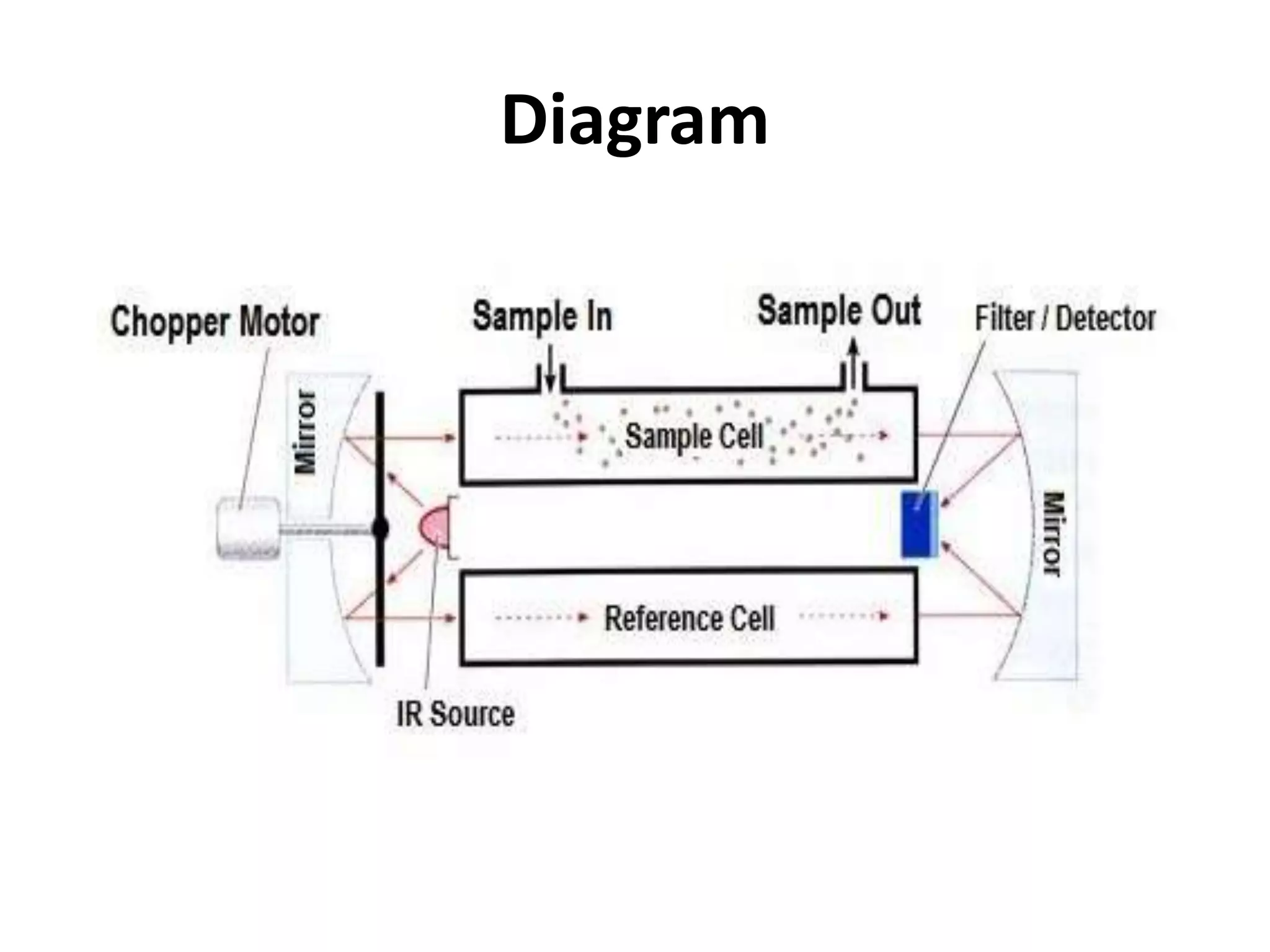
Diagram
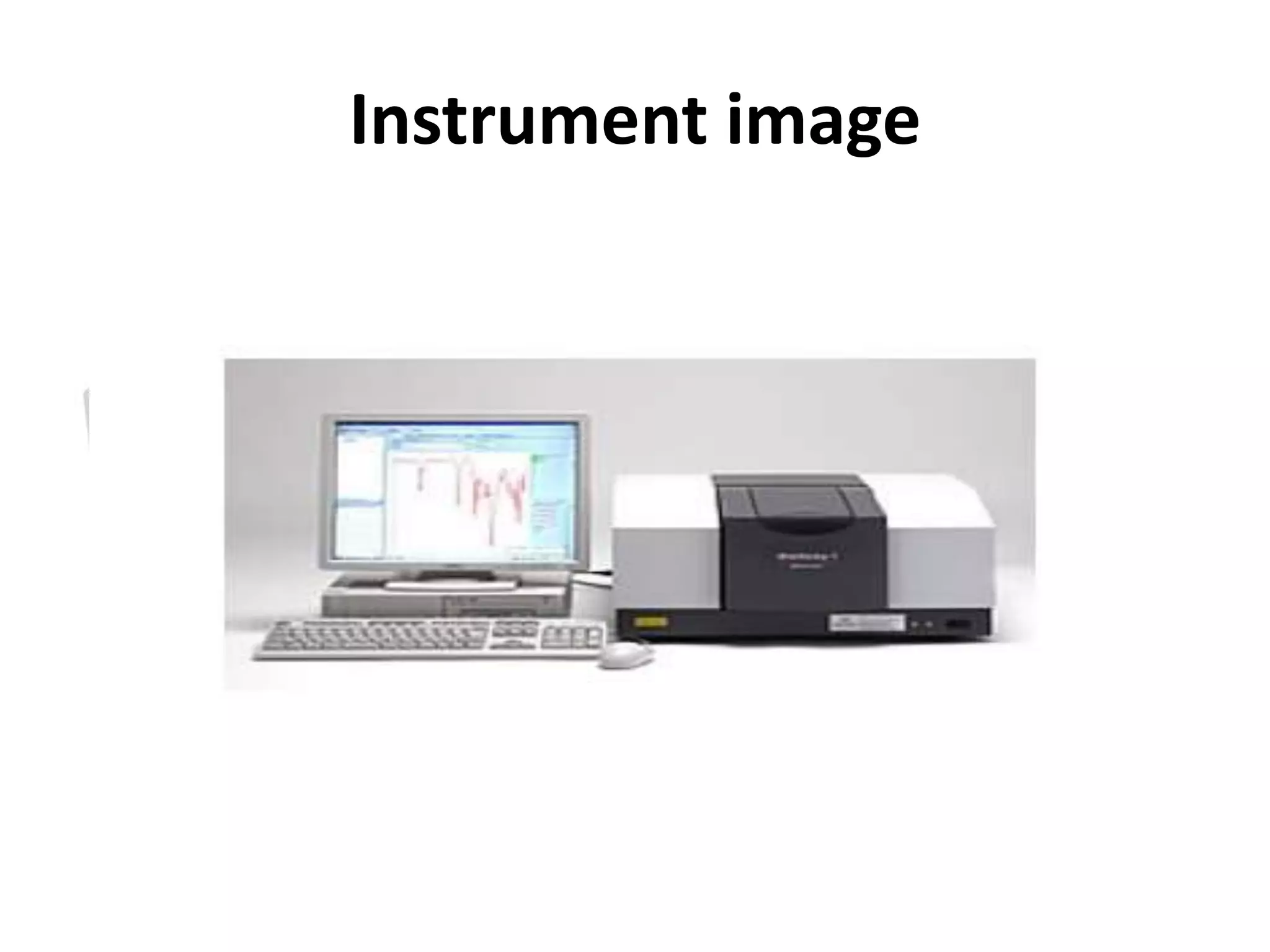
Instrument image
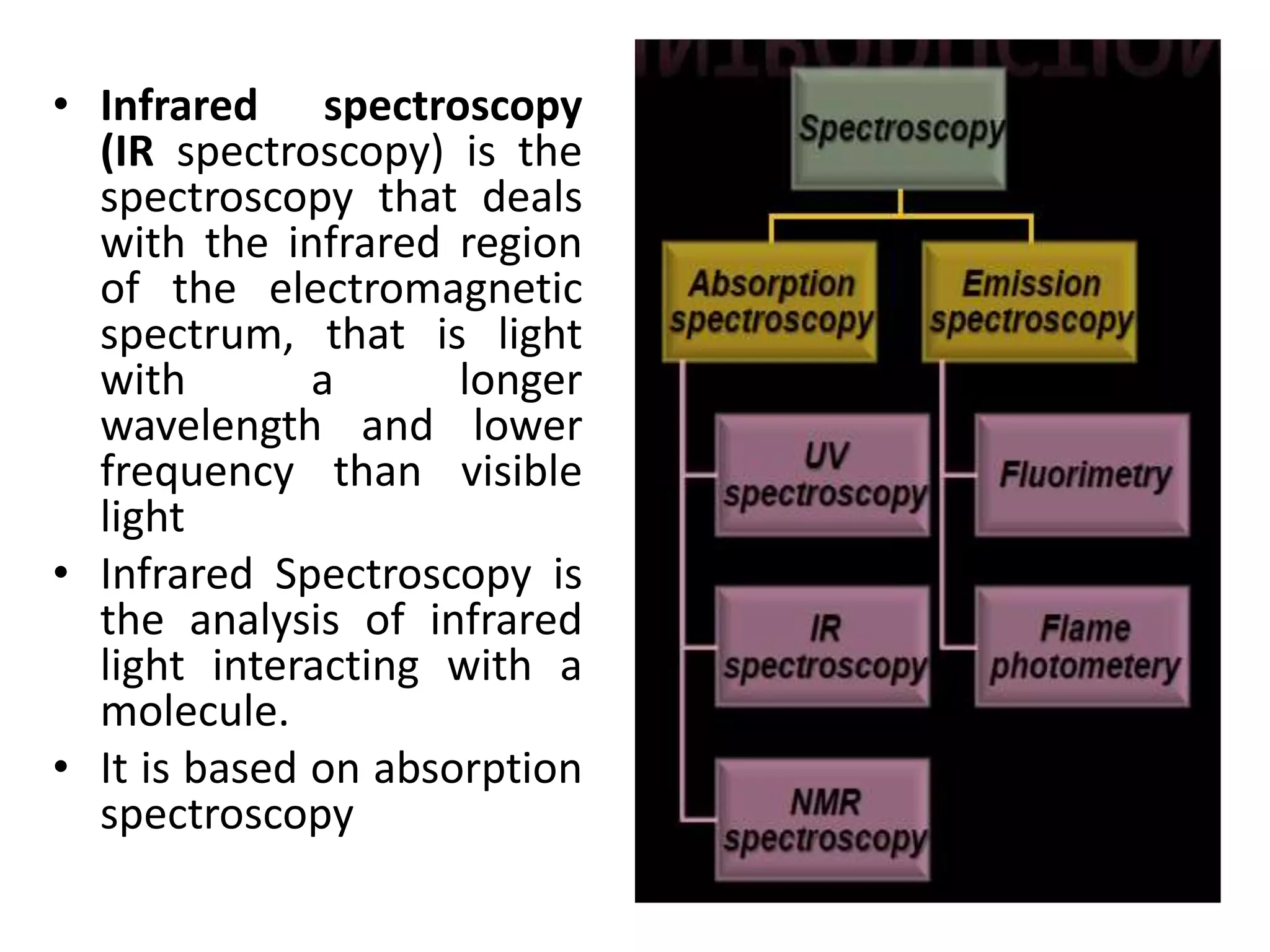
• Infrared spectroscopy
(IR spectroscopy) is the
spectroscopy that deals
with the infrared region
of the electromagnetic
spectrum, that is light
with a longer
wavelength and lower
frequency than visible
light
• Infrared Spectroscopy is
the analysis of infrared
light interacting with a
molecule.
• It is based on absorption
spectroscopy
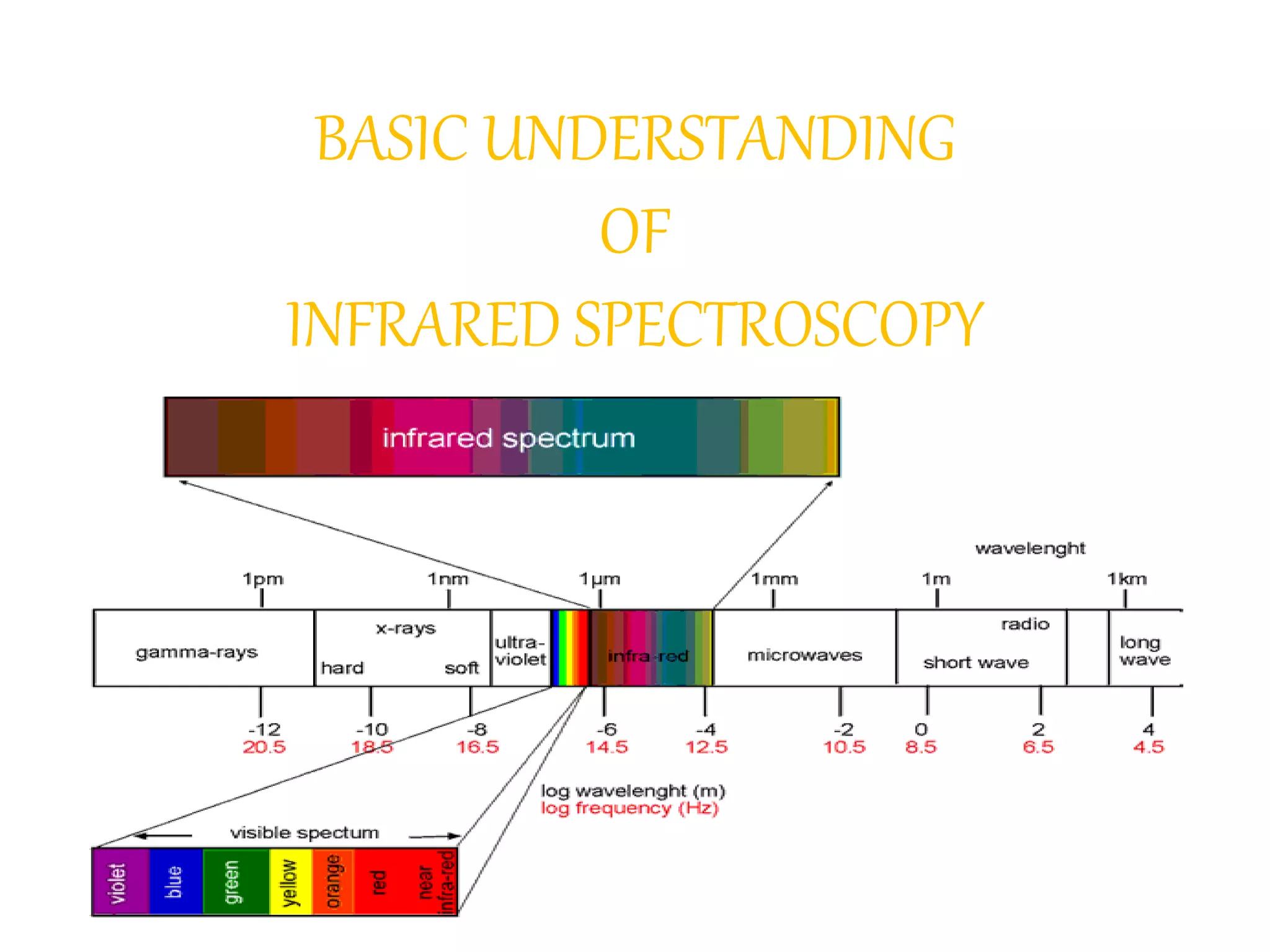
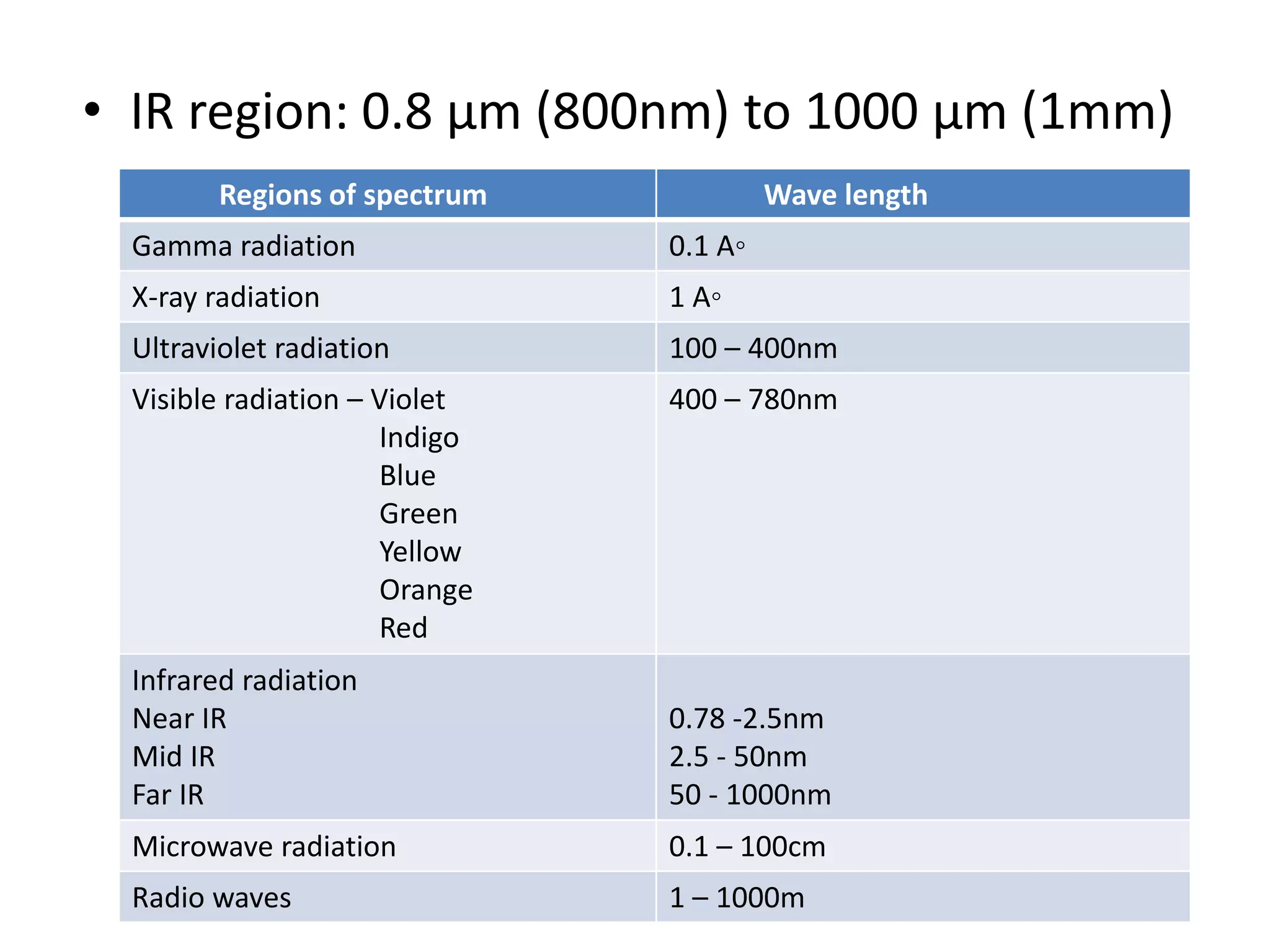
• IR region: 0.8 μm (800nm) to 1000 μm (1mm)
Regions of spectrum Wave length
Gamma radiation 0.1 A◦
X-ray radiation 1 A◦
Ultraviolet radiation 100 – 400nm
Visible radiation – Violet
Indigo
Blue
Green
Yellow
Orange
Red
400 – 780nm
Infrared radiation
Near IR
Mid IR
Far IR
0.78 -2.5nm
2.5 - 50nm
50 - 1000nm
Microwave radiation 0.1 – 100cm
Radio waves 1 – 1000m
Principle
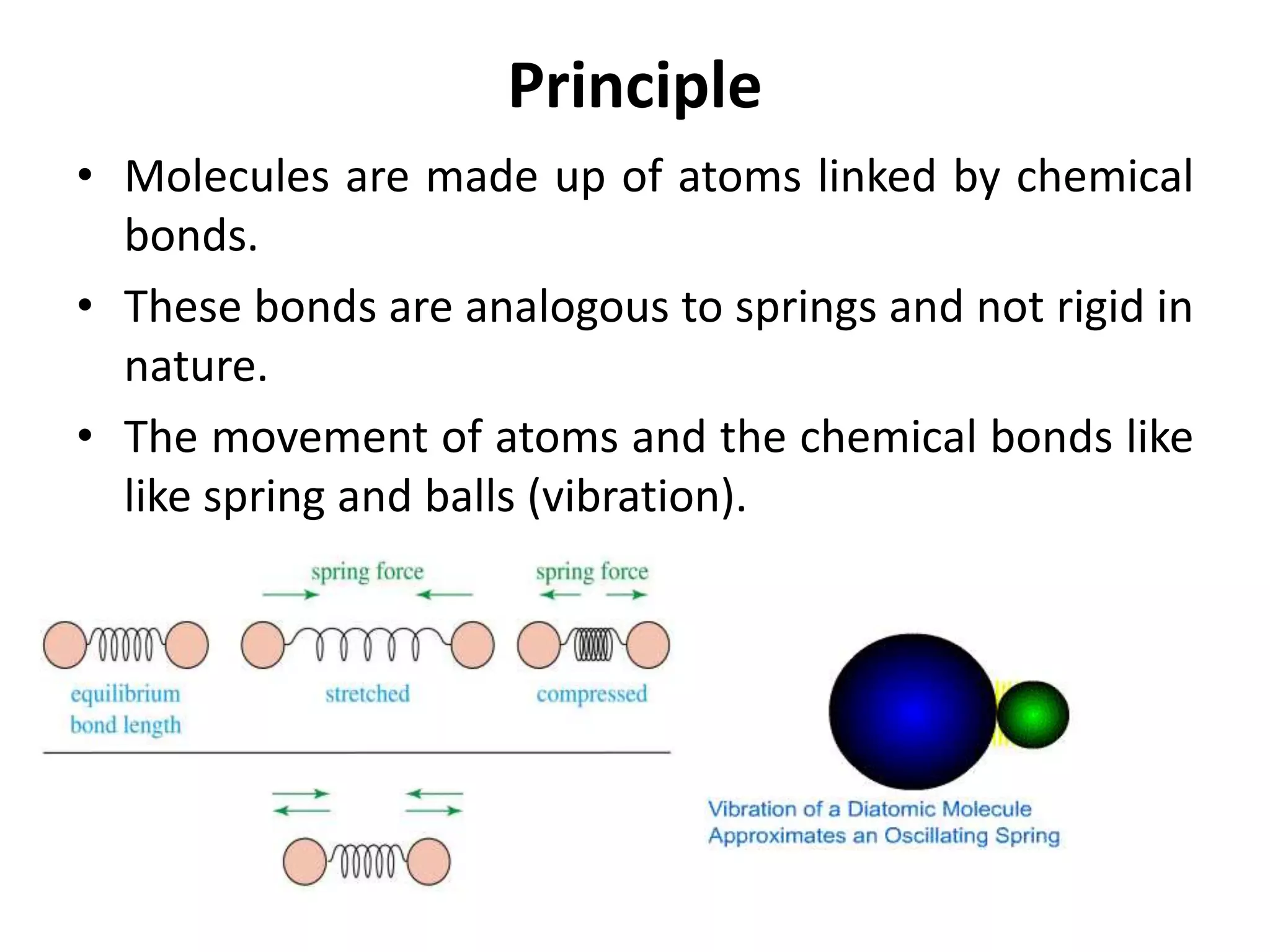
• Molecules are made up of atoms linked by chemical
bonds.
• These bonds are analogous to springs and not rigid in
nature.
• The movement of atoms and the chemical bonds like
like spring and balls (vibration).
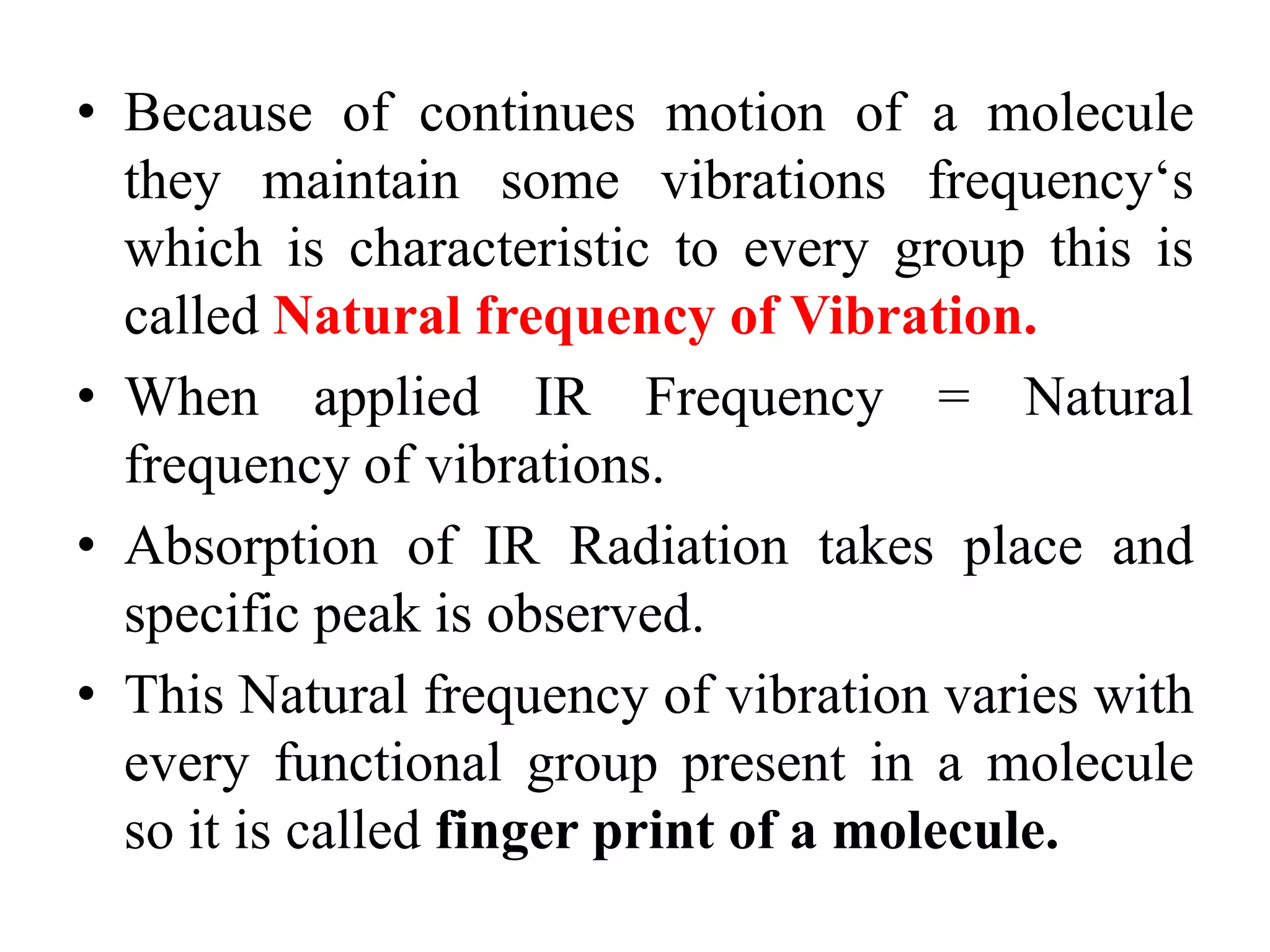
• Because of continues motion of a molecule
they maintain some vibrations frequency‘s
which is characteristic to every group this is
called Natural frequency of Vibration.
• When applied IR Frequency = Natural
frequency of vibrations.
• Absorption of IR Radiation takes place and
specific peak is observed.
• This Natural frequency of vibration varies with
every functional group present in a molecule
so it is called finger print of a molecule.
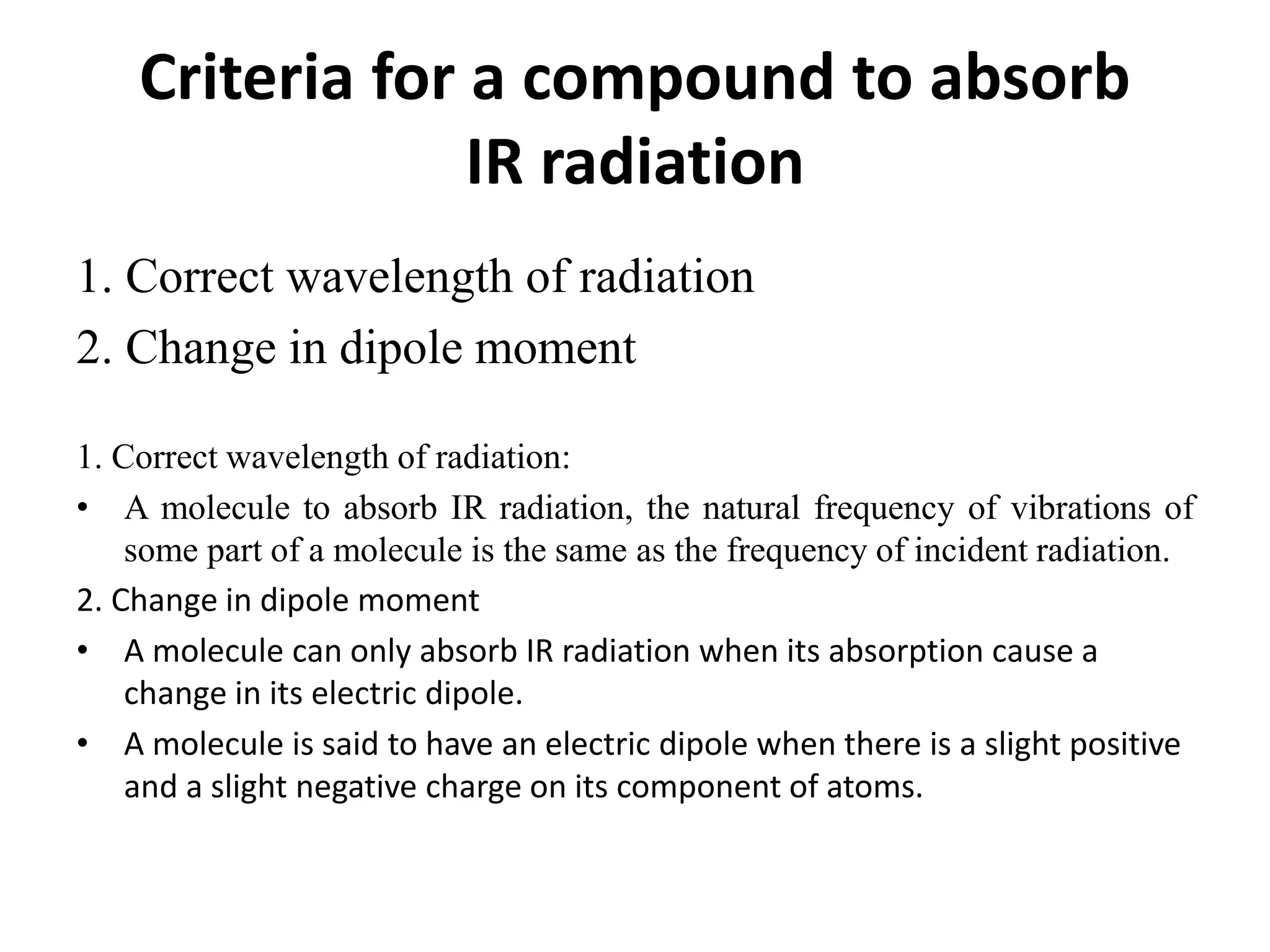
Criteria for a compound to absorb
IR radiation
1. Correct wavelength of radiation
2. Change in dipole moment
1. Correct wavelength of radiation:
• A molecule to absorb IR radiation, the natural frequency of vibrations of
some part of a molecule is the same as the frequency of incident radiation.
2. Change in dipole moment
• A molecule can only absorb IR radiation when its absorption cause a
change in its electric dipole.
• A molecule is said to have an electric dipole when there is a slight positive
and a slight negative charge on its component of atoms.
Molecular Vibrations
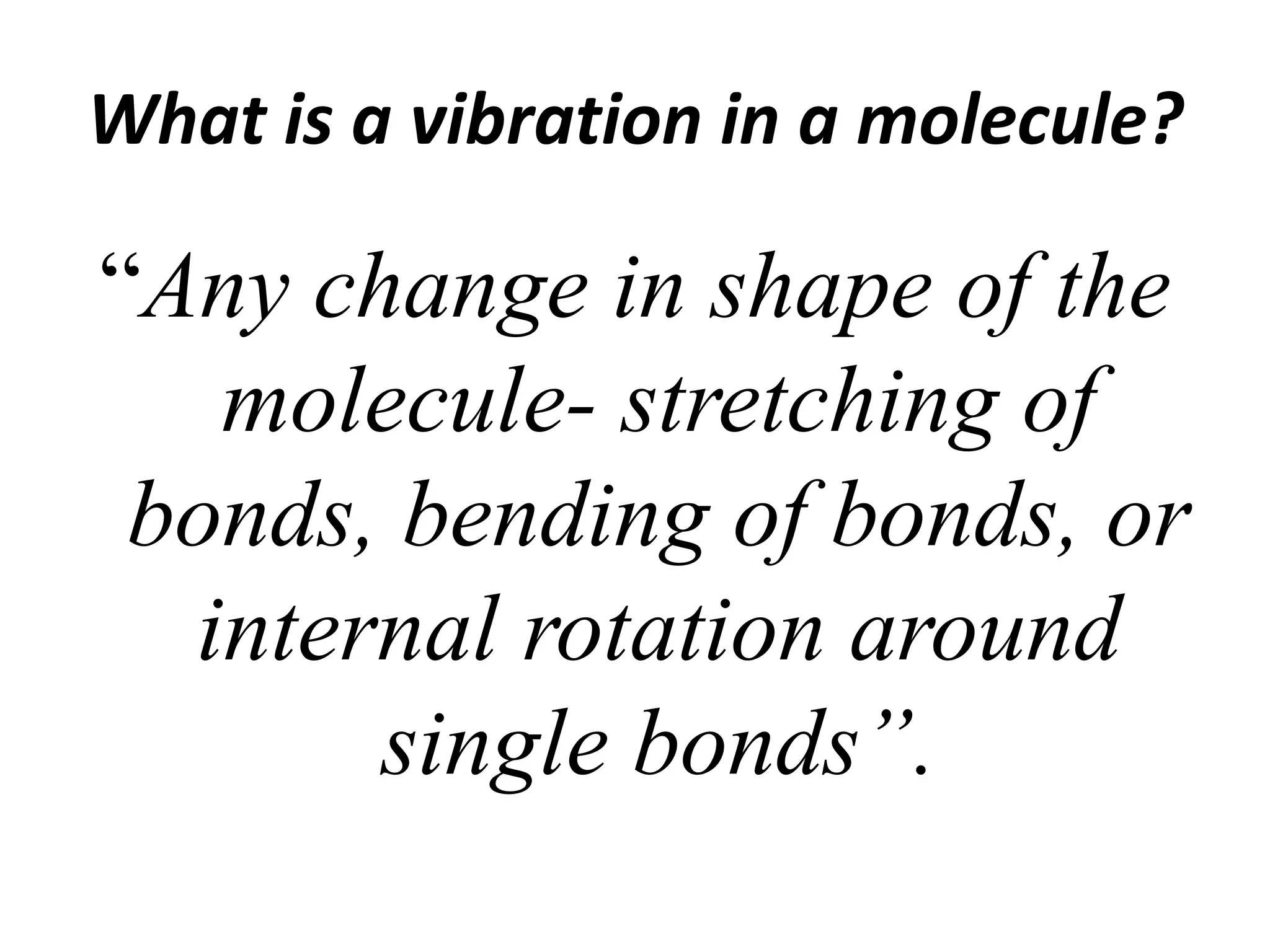
What is a vibration in a molecule?
“Any change in shape of the
molecule- stretching of
bonds, bending of bonds, or
internal rotation around
single bonds”.
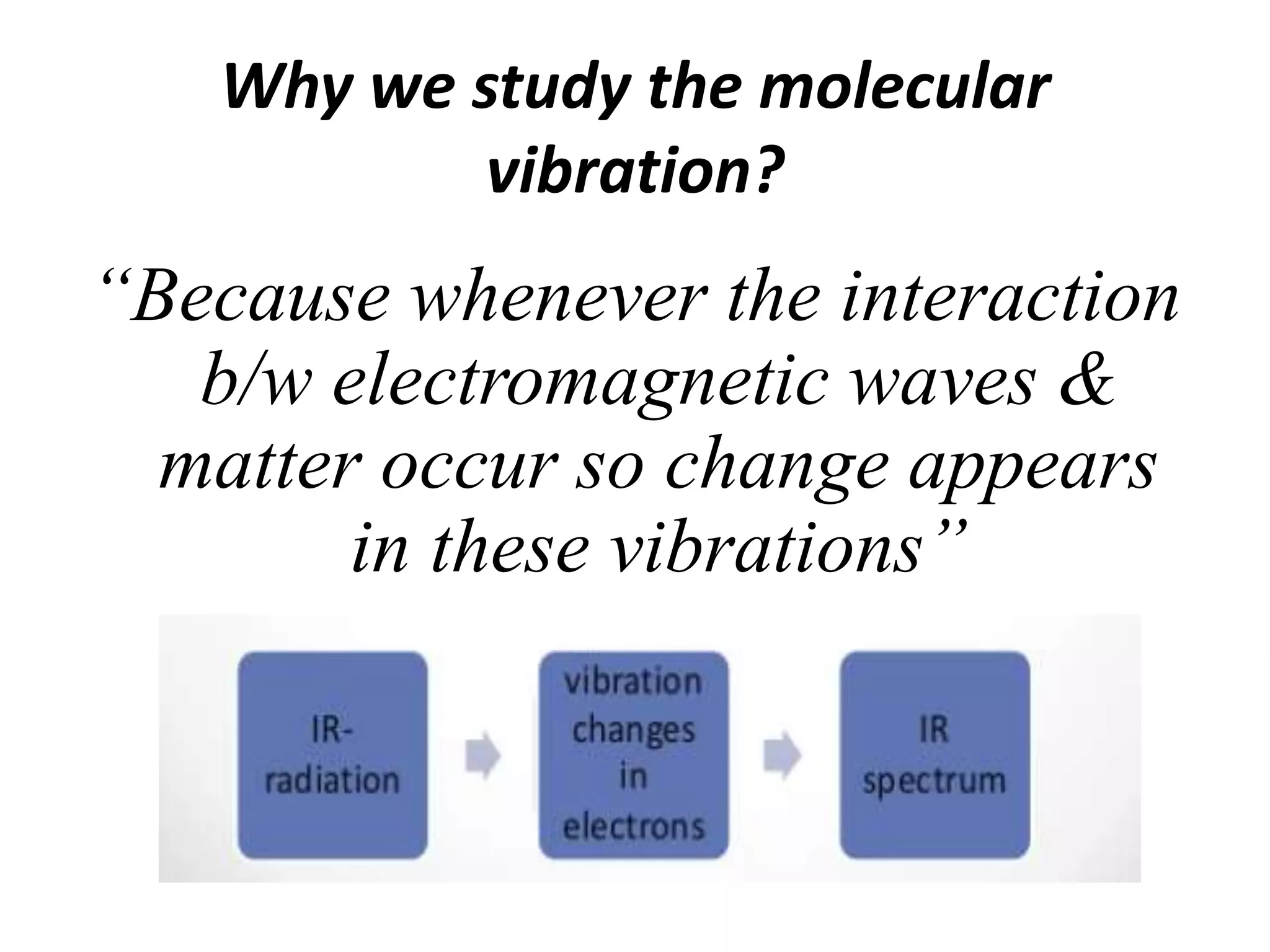
Why we study the molecular
vibration?
“Because whenever the interaction
b/w electromagnetic waves &
matter occur so change appears
in these vibrations”
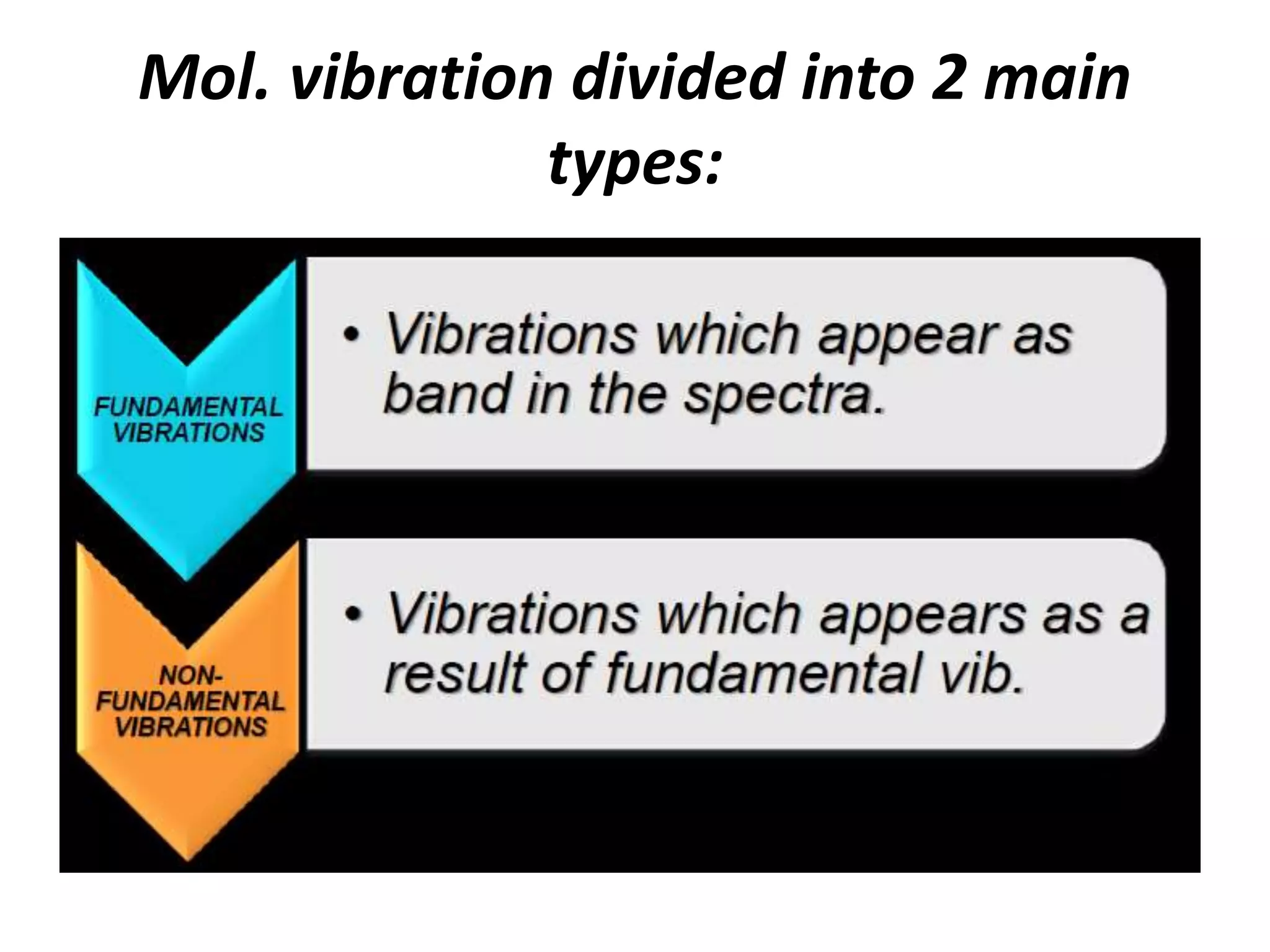
Mol. vibration divided into 2 main
types:
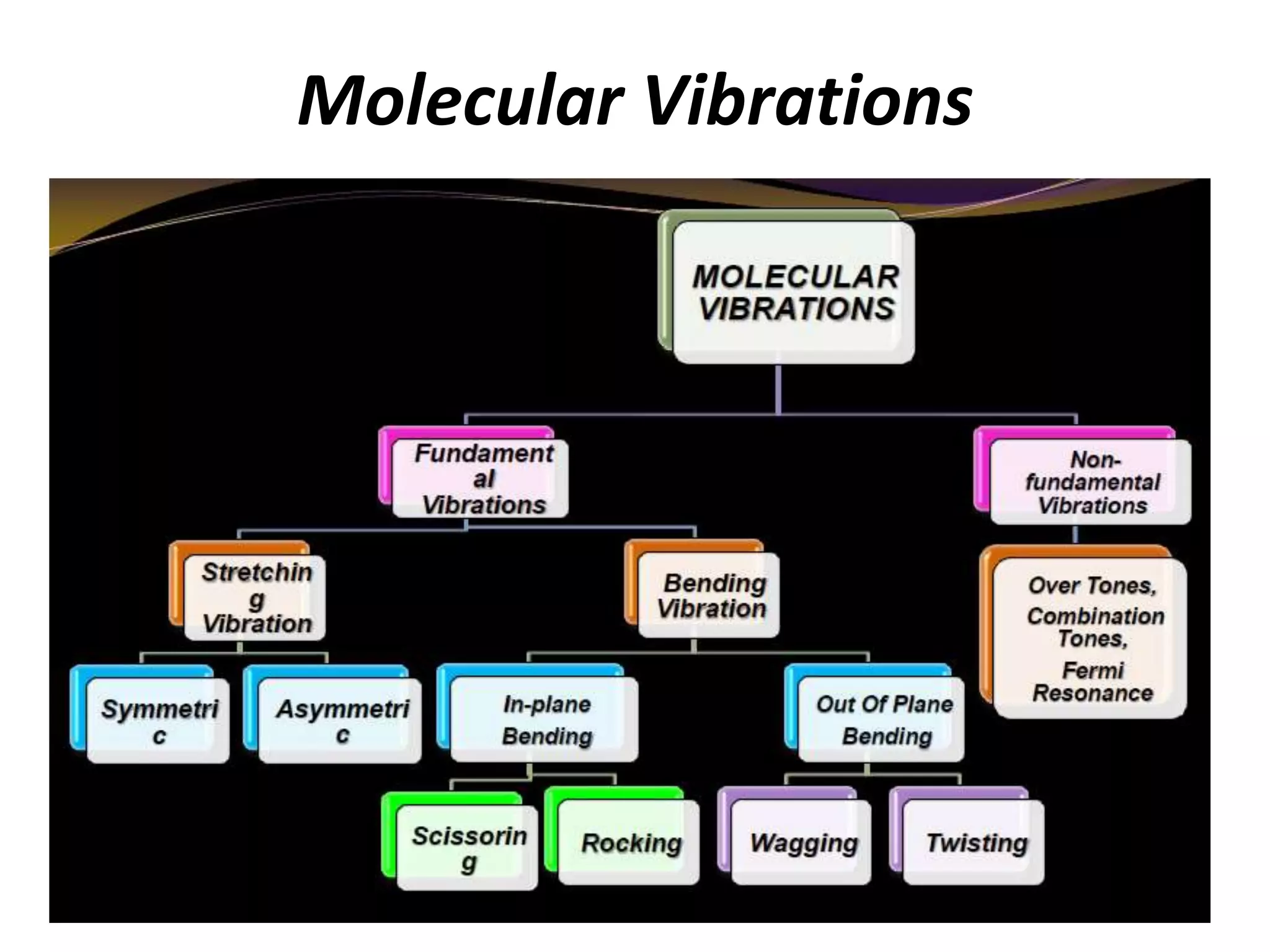
Fundamental vibration further
divided into two
1.Stretching vibrations
2.Bending vibrations.
1. Stretching
• i. Symmetric
• ii. Asymmetric
2. Bending
• i. Scissoring
• ii. Rocking
• iii. Wagging
• iv. Twisting
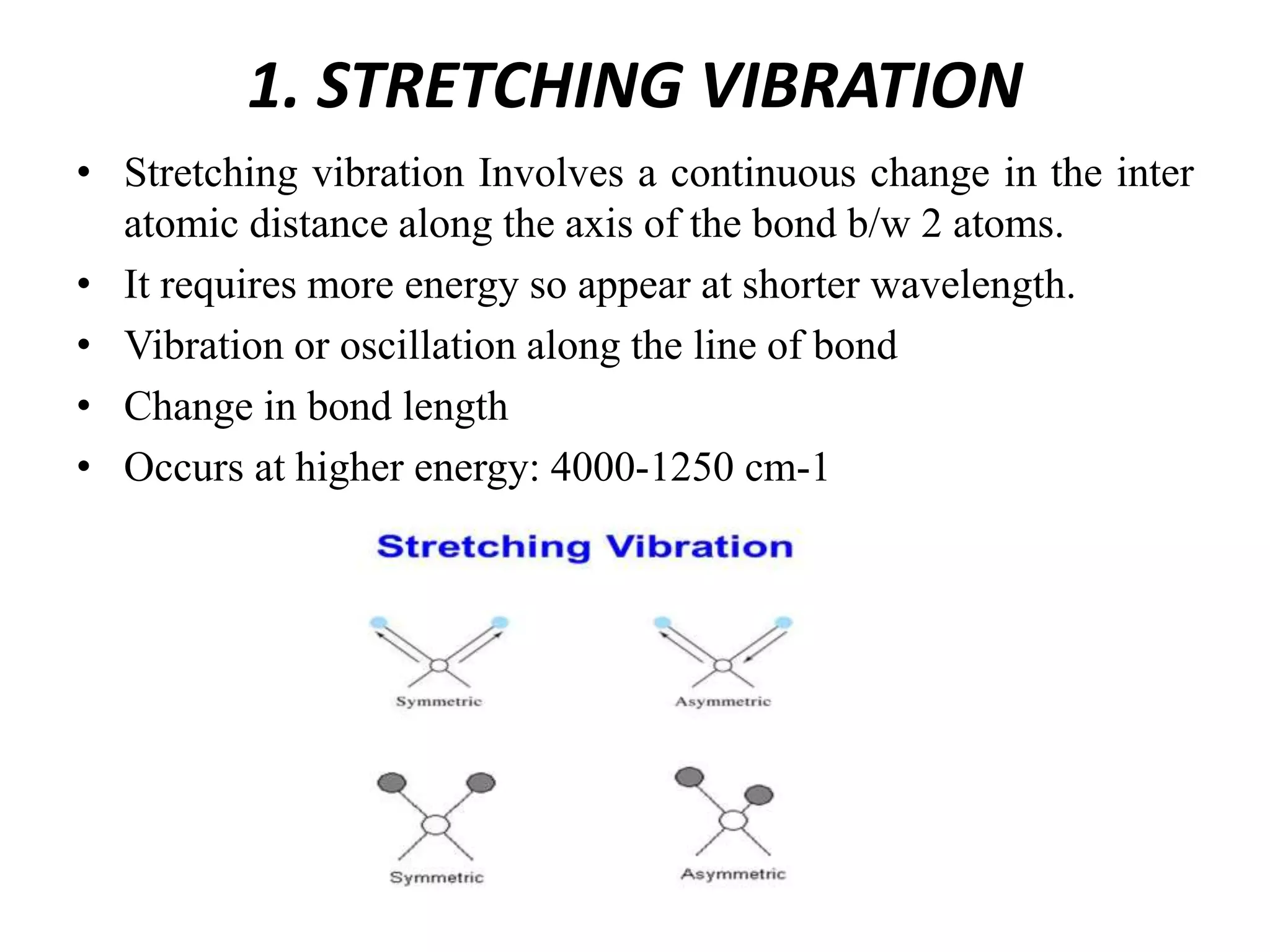
1. STRETCHING VIBRATION
• Stretching vibration Involves a continuous change in the inter
atomic distance along the axis of the bond b/w 2 atoms.
• It requires more energy so appear at shorter wavelength.
• Vibration or oscillation along the line of bond
• Change in bond length
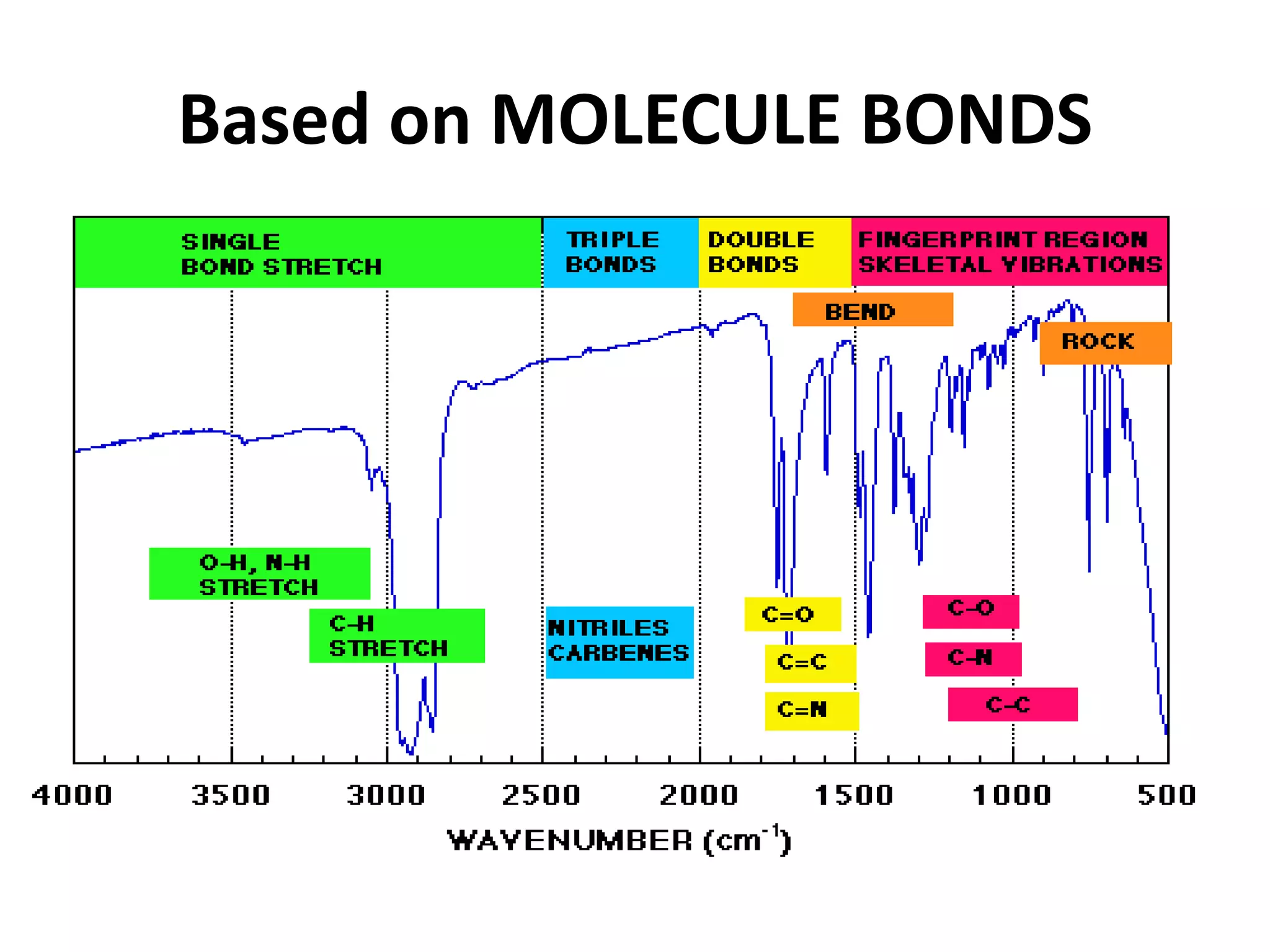
• Occurs at higher energy: 4000-1250 cm-1
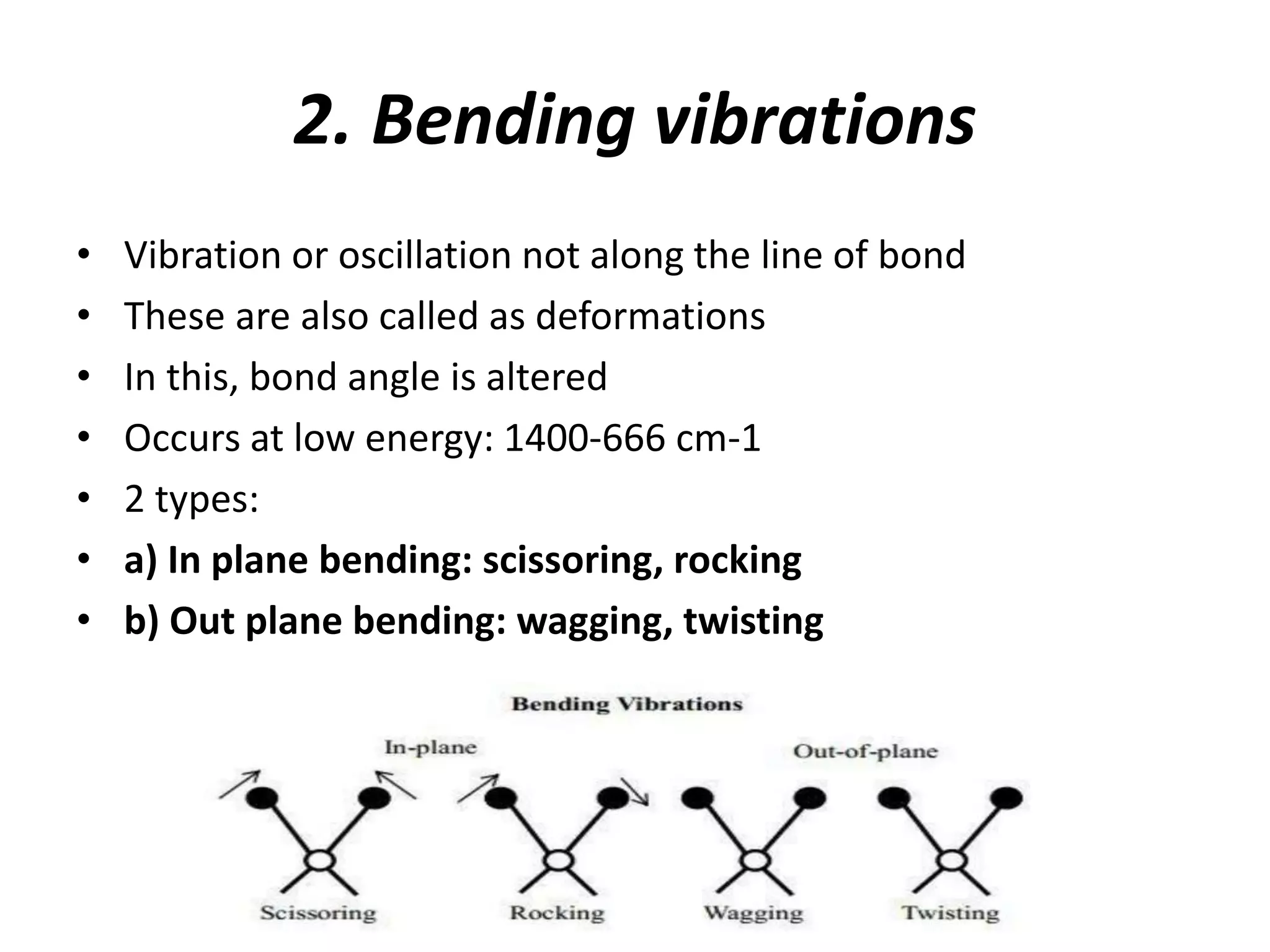
2. Bending vibrations
• Vibration or oscillation not along the line of bond
• These are also called as deformations
• In this, bond angle is altered
• Occurs at low energy: 1400-666 cm-1
• 2 types:
• a) In plane bending: scissoring, rocking
• b) Out plane bending: wagging, twisting
Video
• https://www.youtube.com/watch?v=ZWwLCn
uYRys
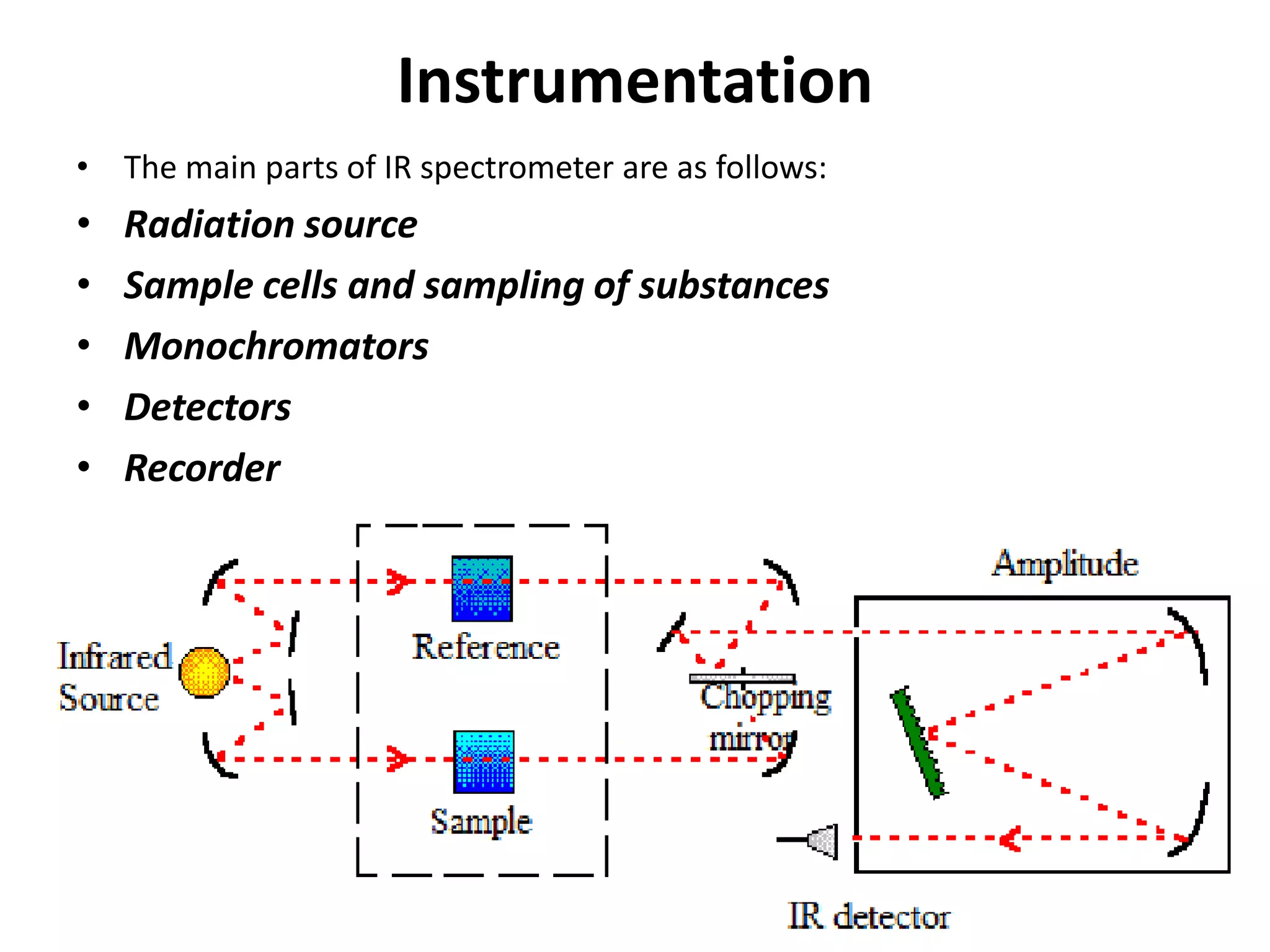
Instrumentation
• The main parts of IR spectrometer are as follows:
• Radiation source
• Sample cells and sampling of substances
• Monochromators
• Detectors
• Recorder
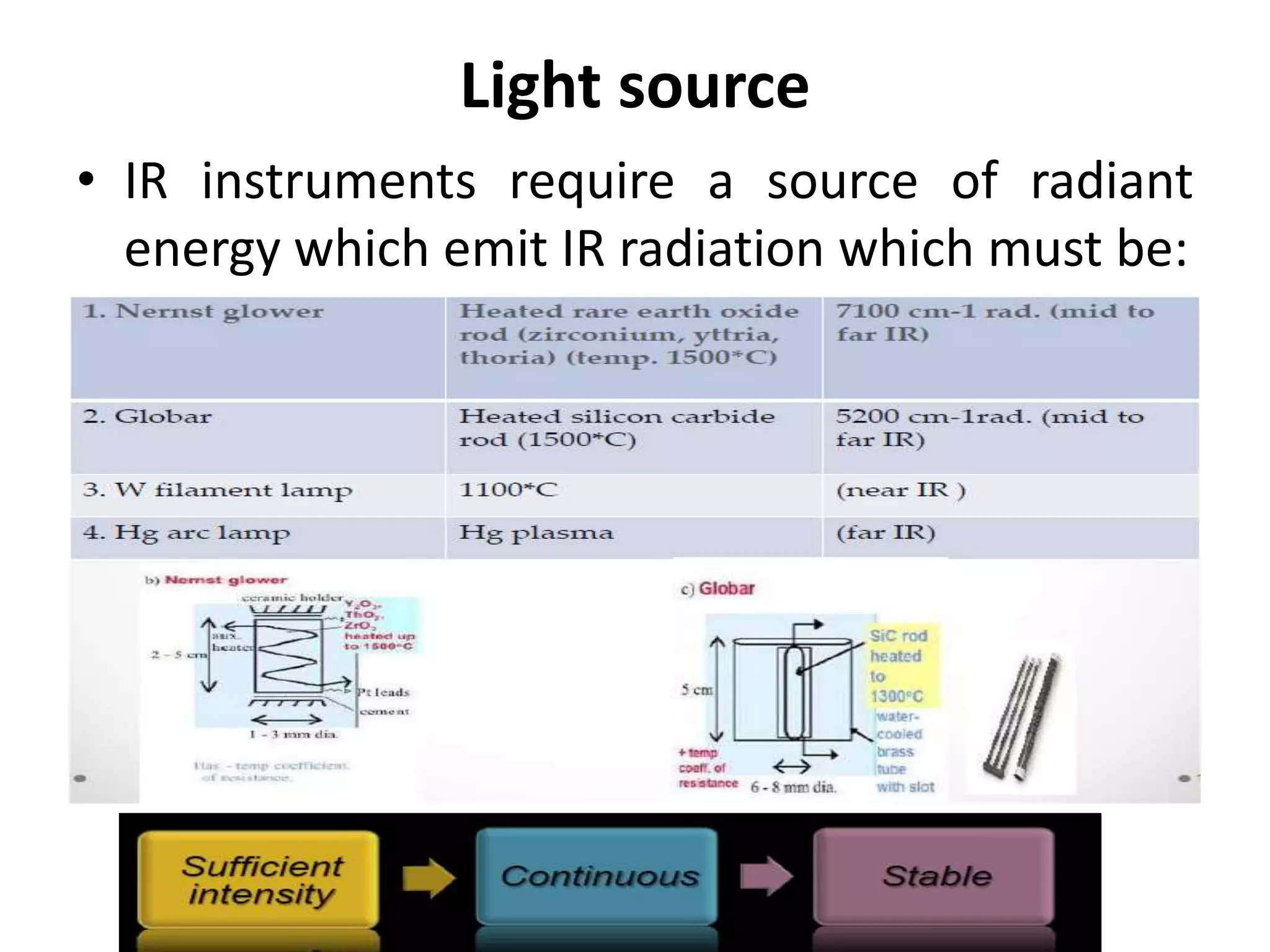
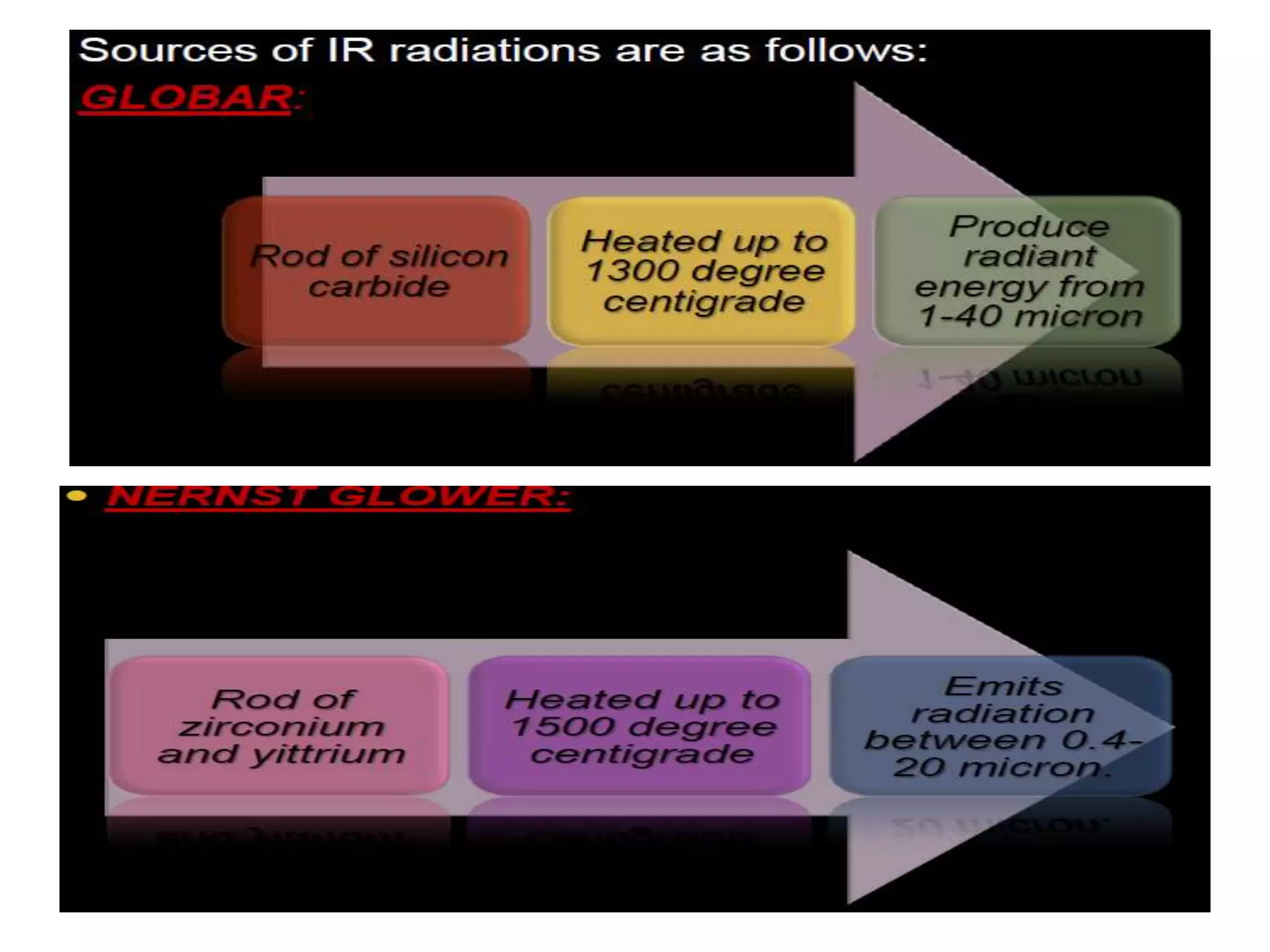
Light source
• IR instruments require a source of radiant
energy which emit IR radiation which must be:
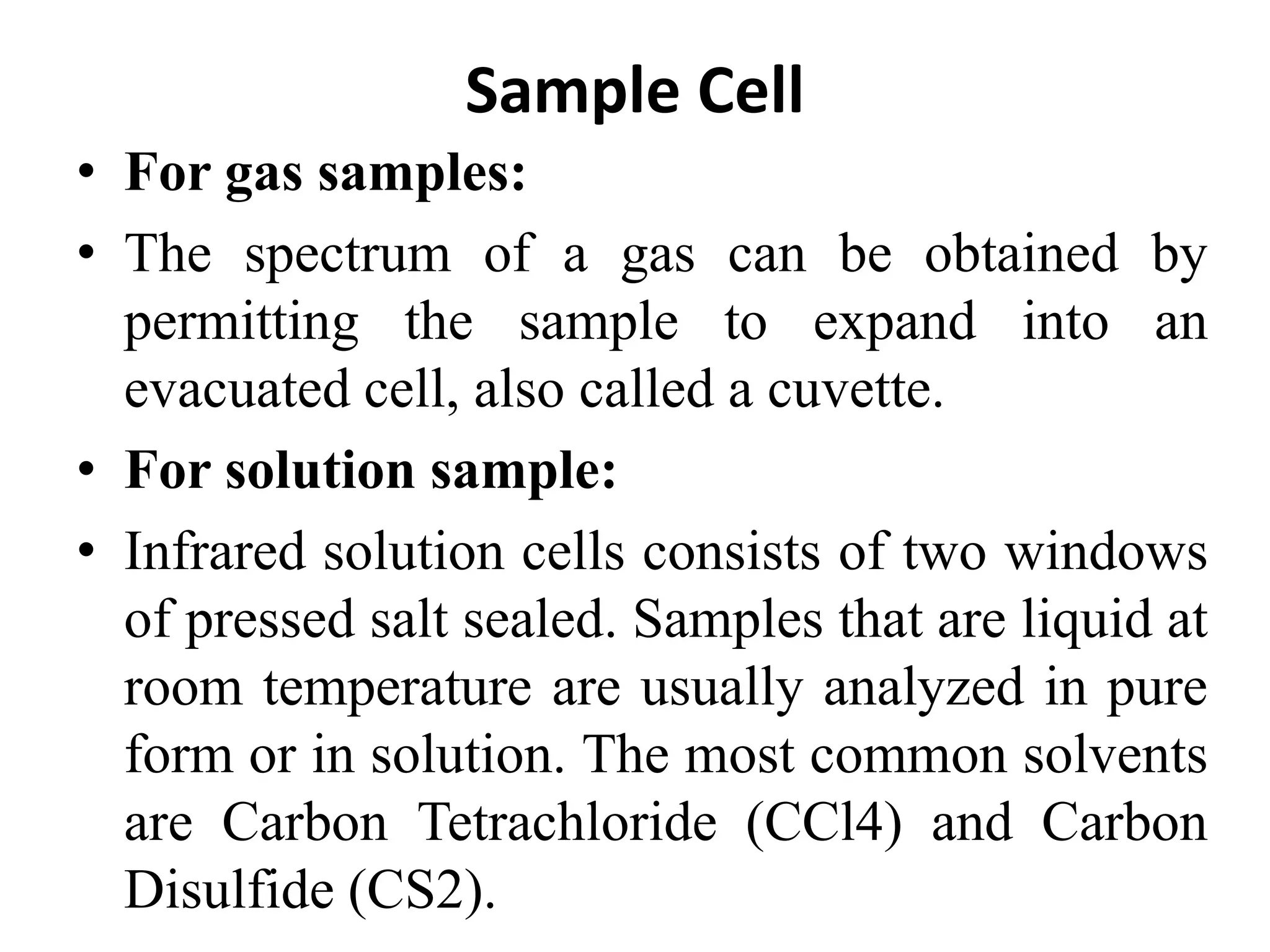
Sample Cell
• For gas samples:
• The spectrum of a gas can be obtained by
permitting the sample to expand into an
evacuated cell, also called a cuvette.
• For solution sample:
• Infrared solution cells consists of two windows
of pressed salt sealed. Samples that are liquid at
room temperature are usually analyzed in pure
form or in solution. The most common solvents
are Carbon Tetrachloride (CCl4) and Carbon
Disulfide (CS2).
• For solid sample:
• Solids reduced to small particles (less than 2
micron) can be examined as a thin paste or
mull. The mull is formed by grinding a 2-5
milligrams of the sample in the presence of
one or two drops of a hydrocarbon oil (nujol
oil). The resulting mull is then examined as a
film between flat salt plates.
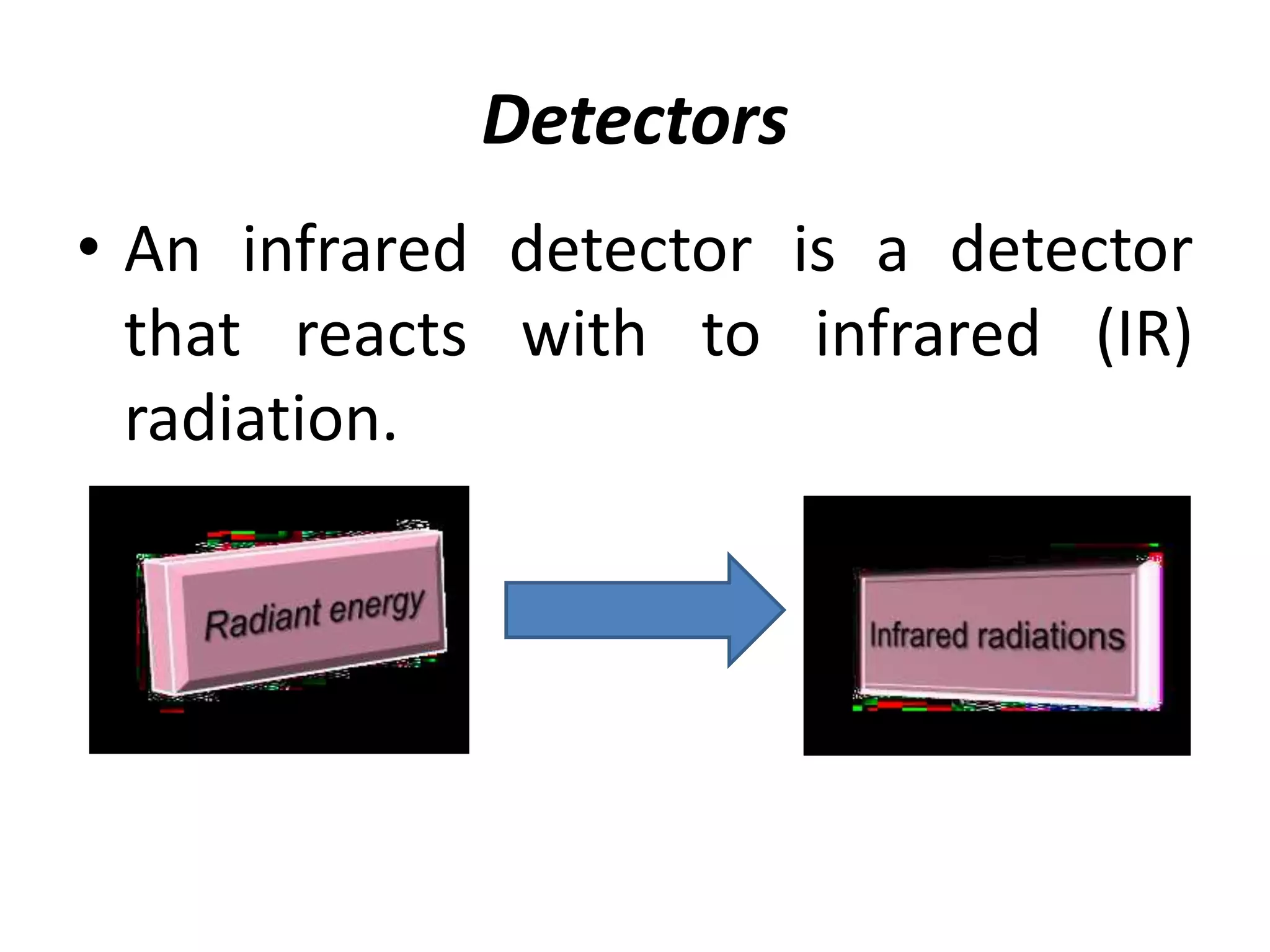
Detectors
• An infrared detector is a detector
that reacts with to infrared (IR)
radiation.
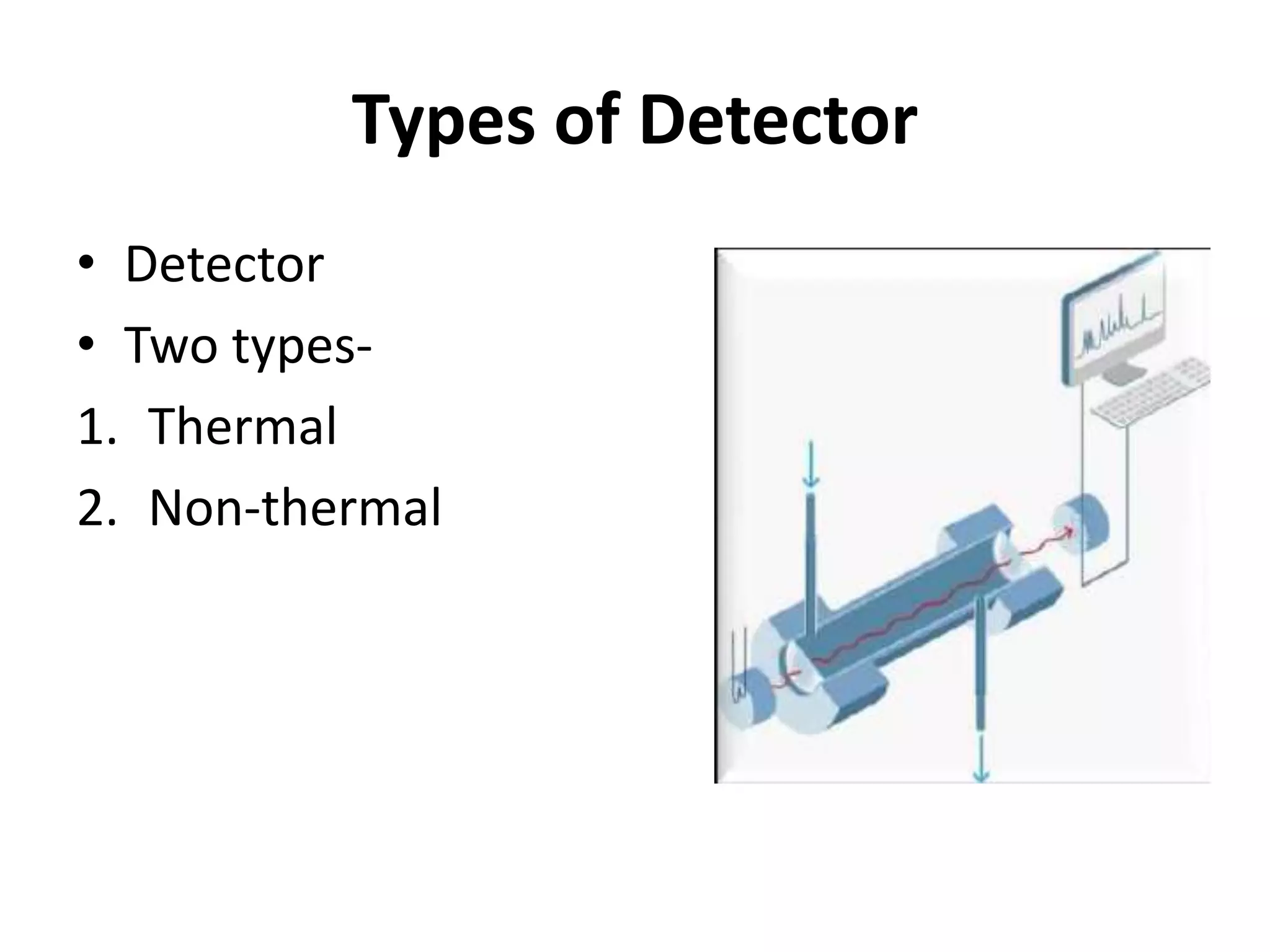
Types of Detector
• Detector
• Two types-
1. Thermal
2. Non-thermal
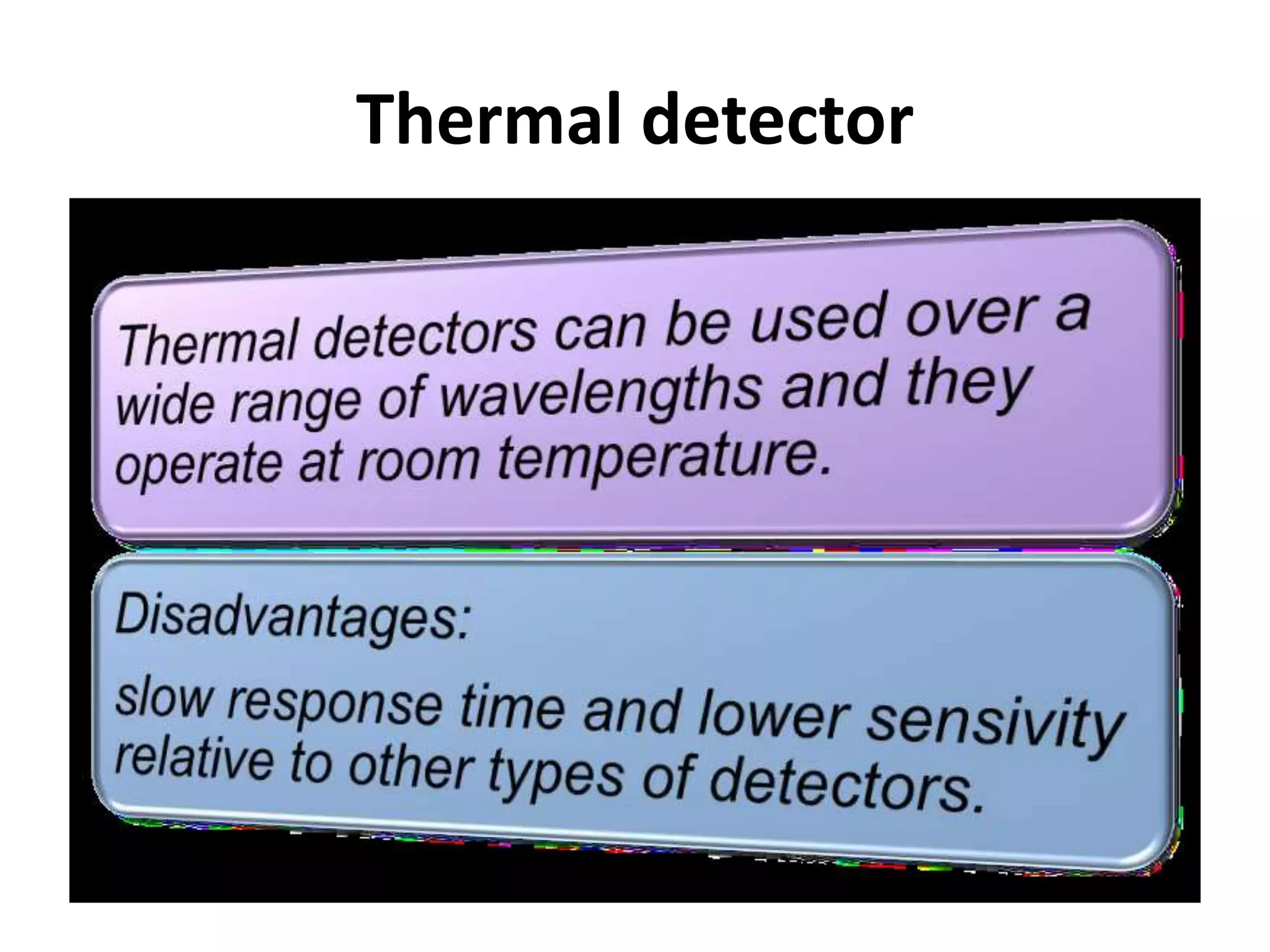
Thermal detector
Types of thermal detector
• There are four types of thermal detector.
• Bolometers
• Thermocouple and thermopile
• Pyro electric detector
• Golay cell
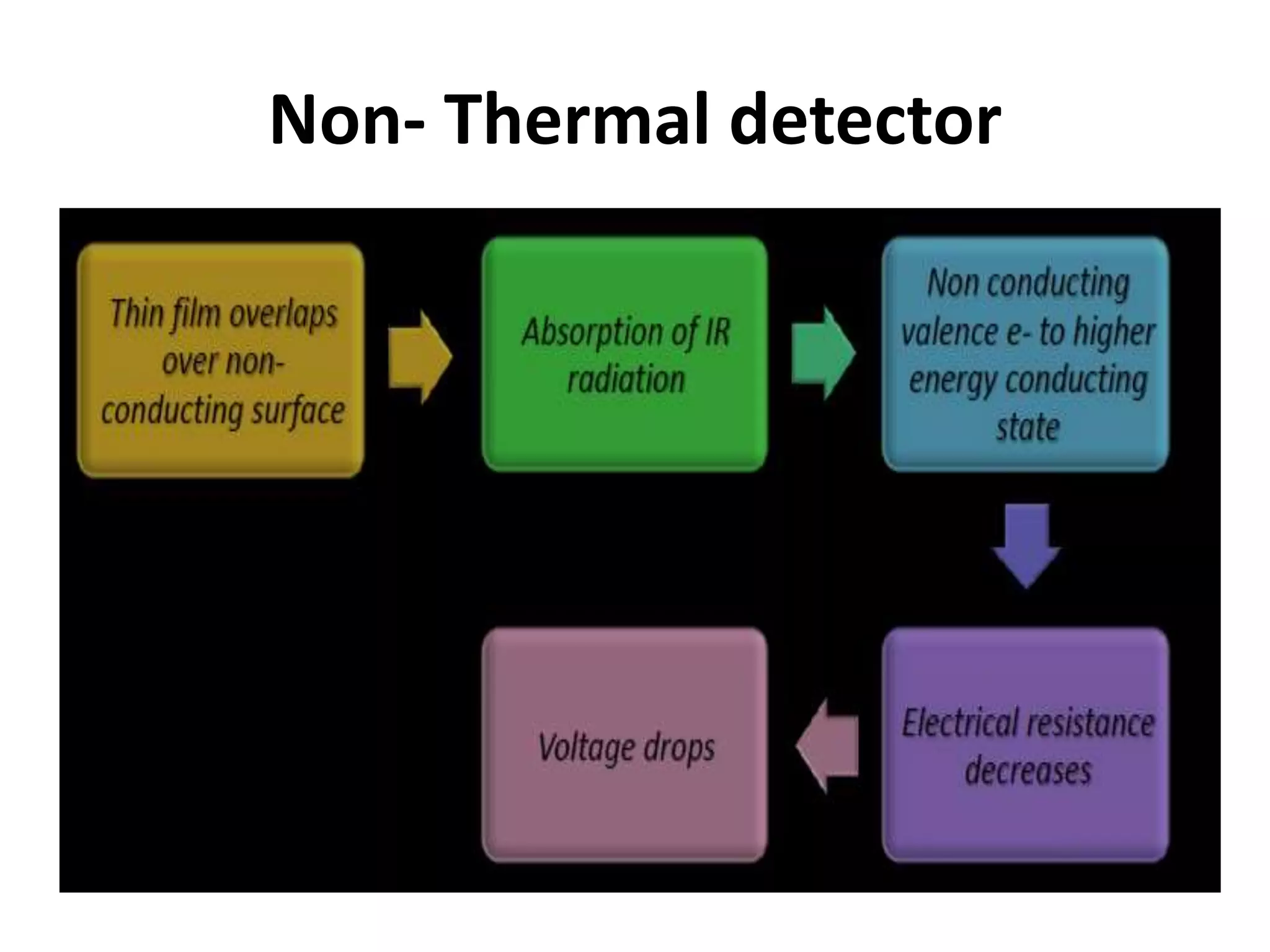
Non- Thermal detector
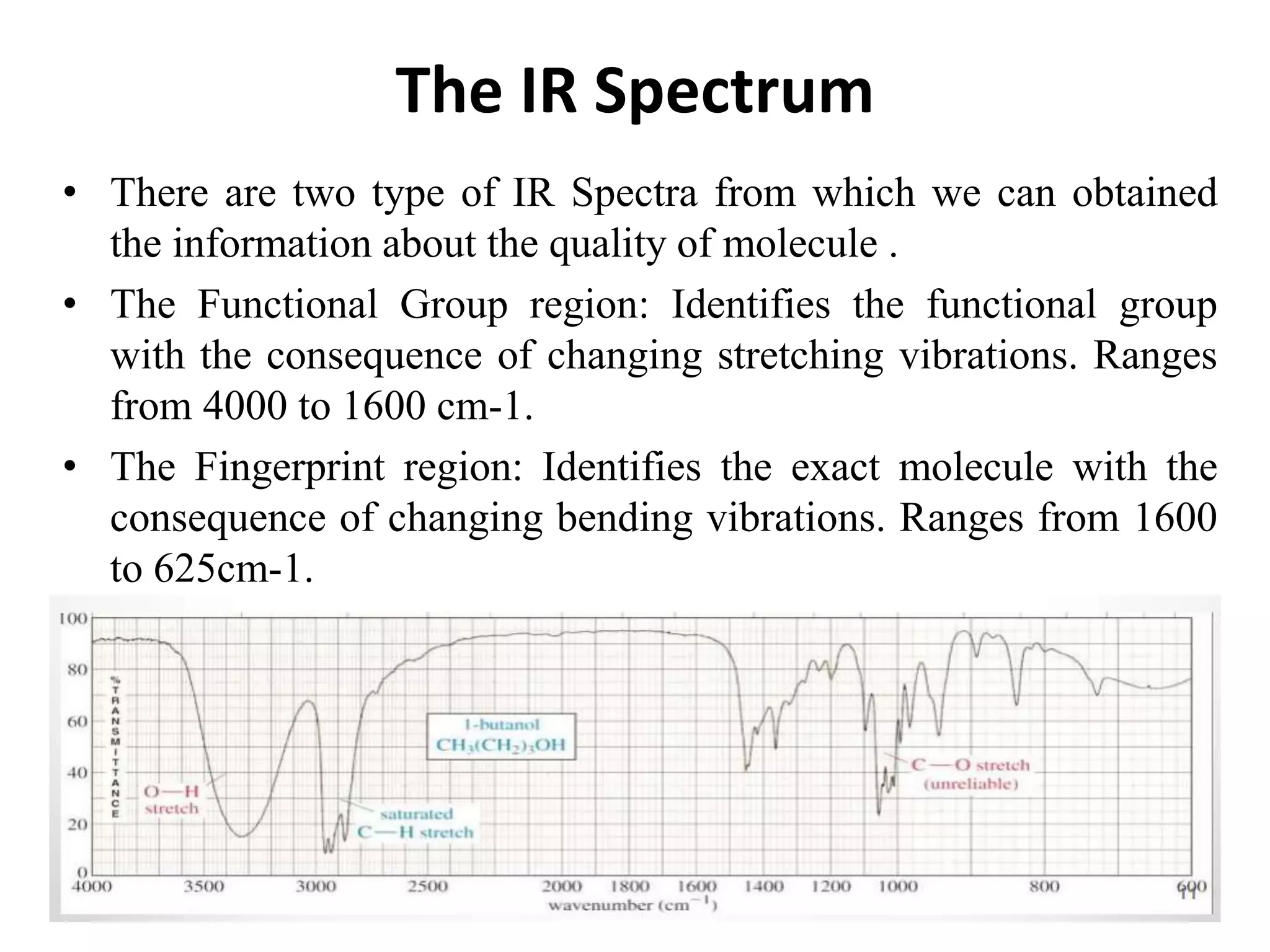
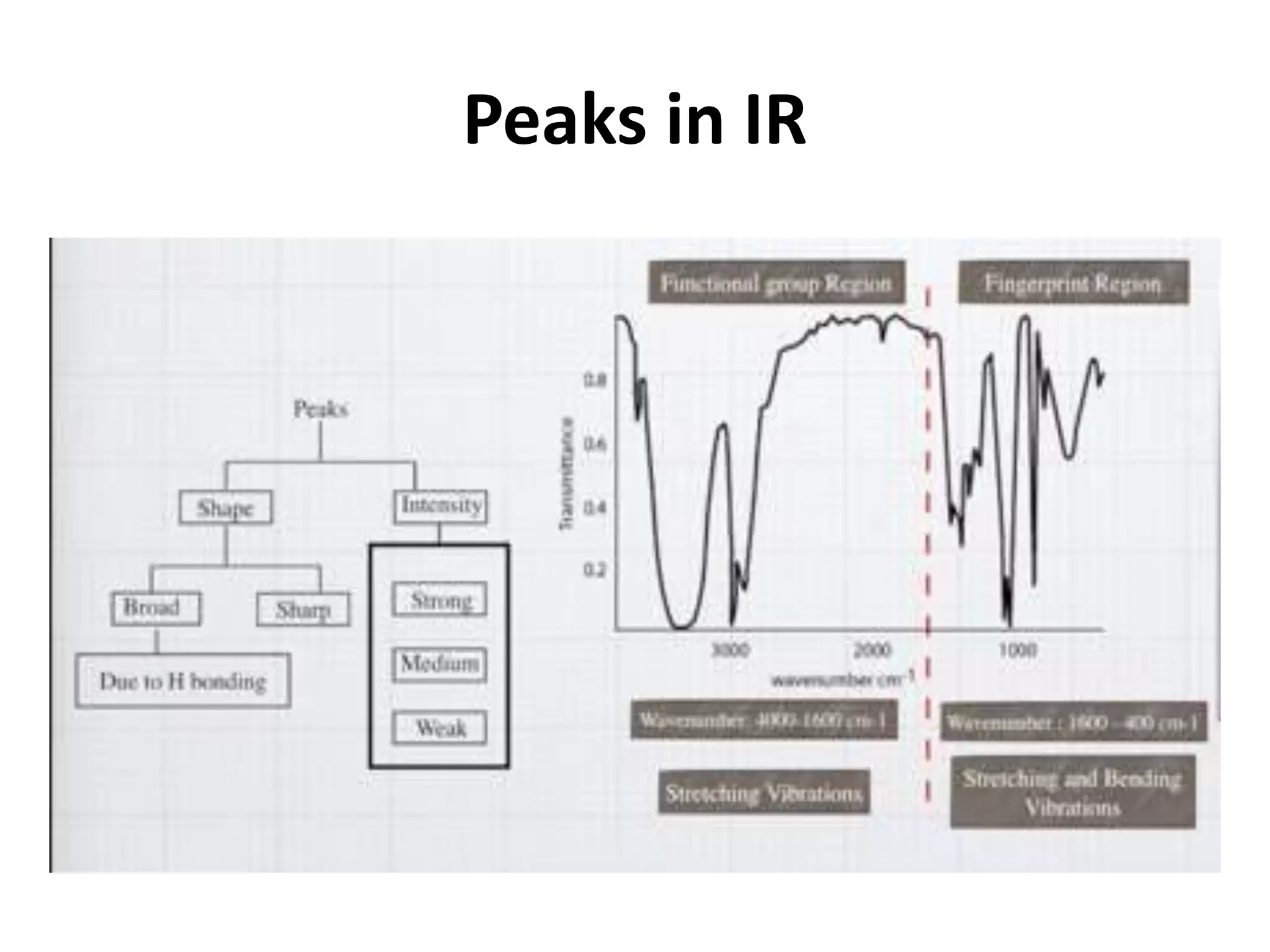
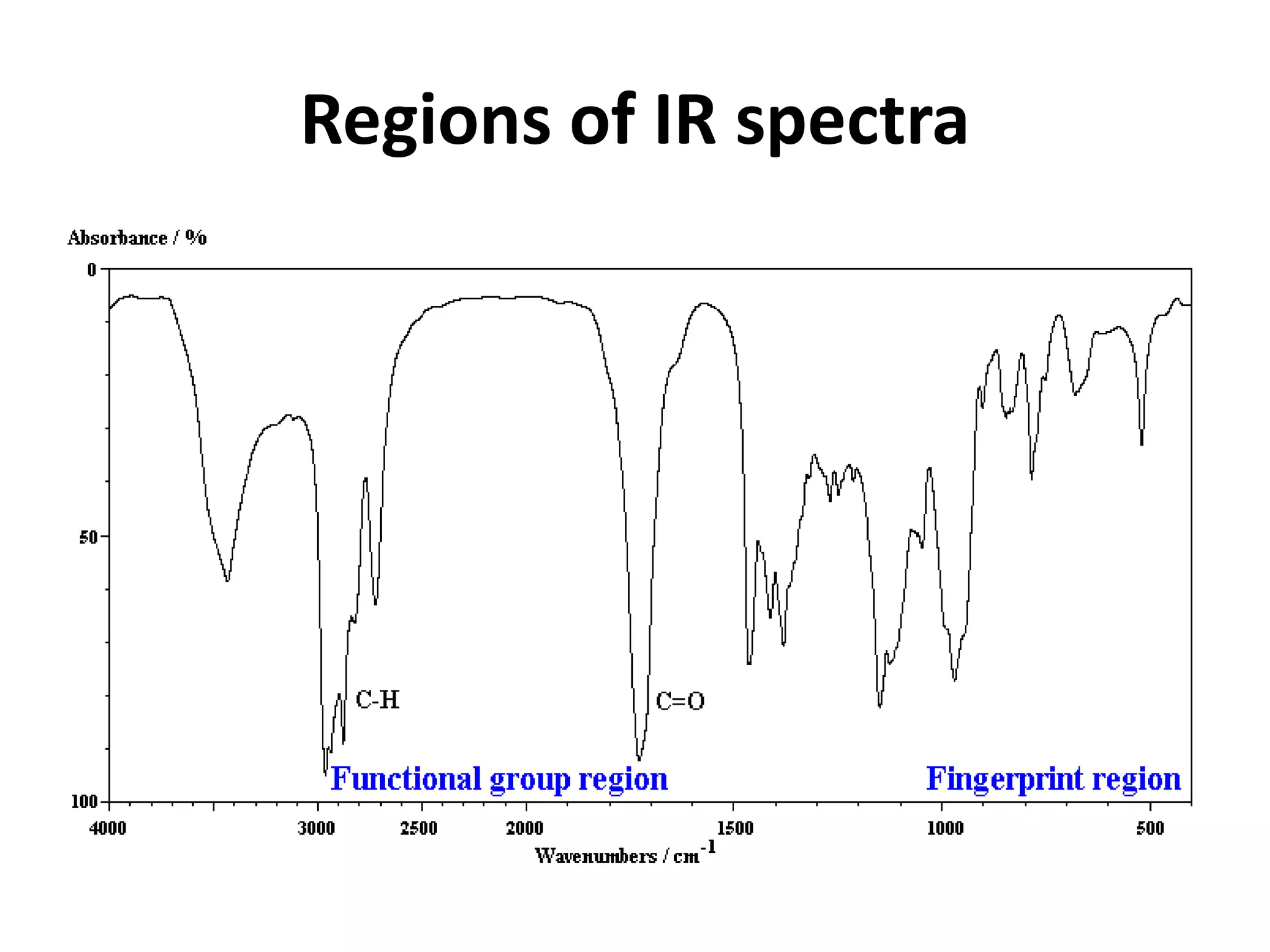
The IR Spectrum
• There are two type of IR Spectra from which we can obtained
the information about the quality of molecule .
• The Functional Group region: Identifies the functional group
with the consequence of changing stretching vibrations. Ranges
from 4000 to 1600 cm-1.
• The Fingerprint region: Identifies the exact molecule with the
consequence of changing bending vibrations. Ranges from 1600
to 625cm-1.
Why organic molecules?
•Organic groups differ from
one another both in the
strength of the bond and
the masses of the atom
involved.
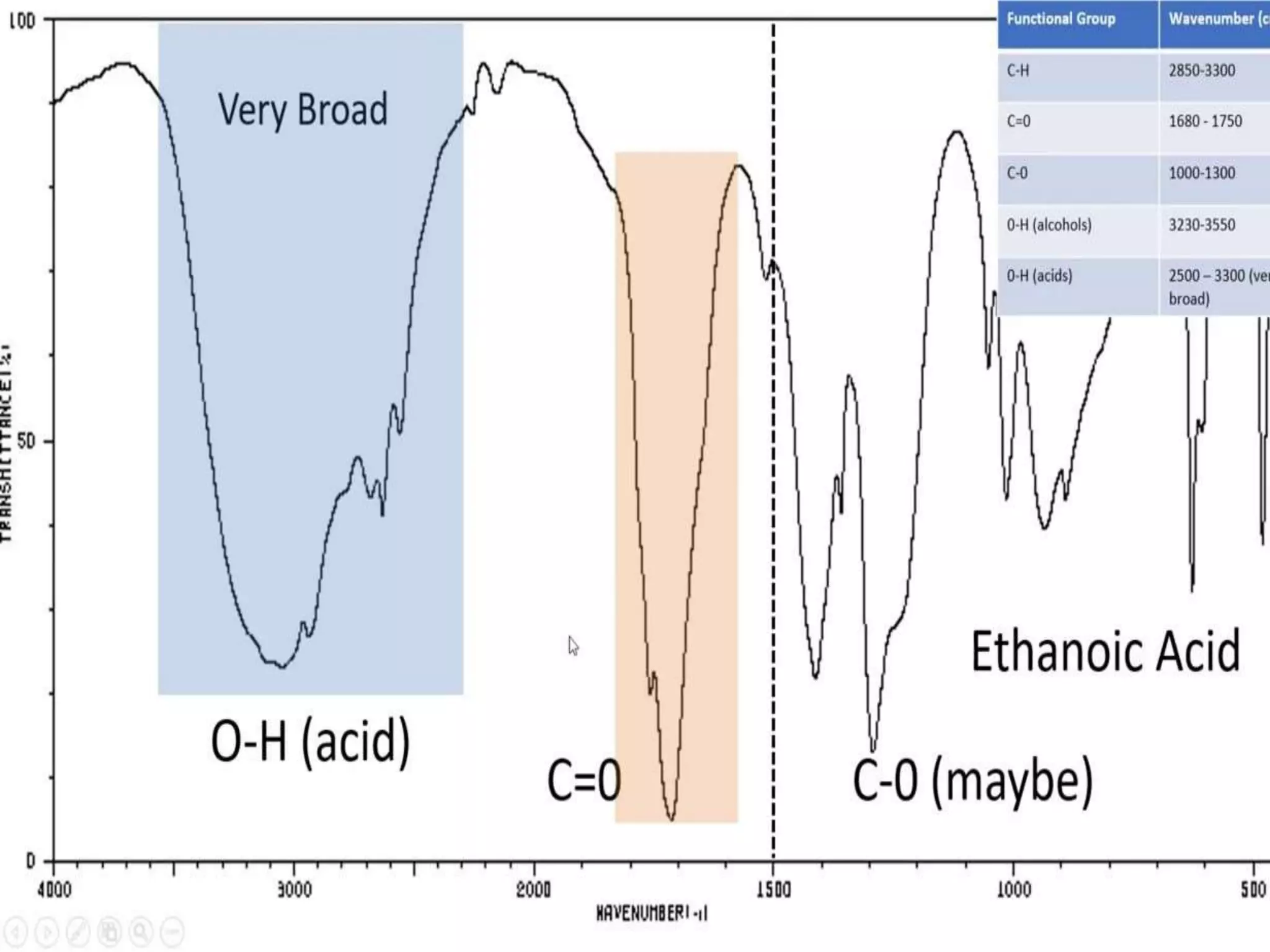
Peaks in IR
Regions of IR spectra
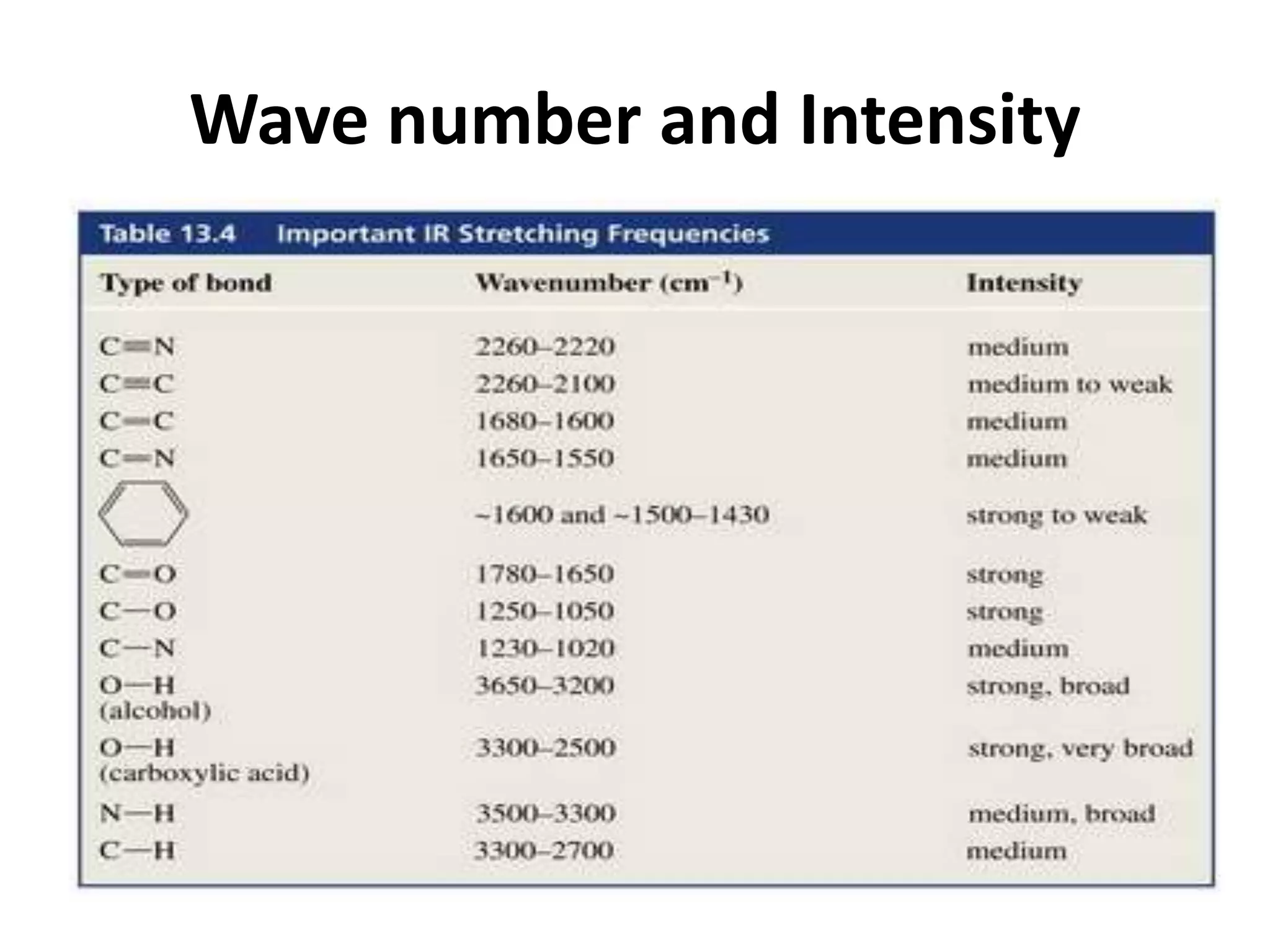
Based on MOLECULE BONDS
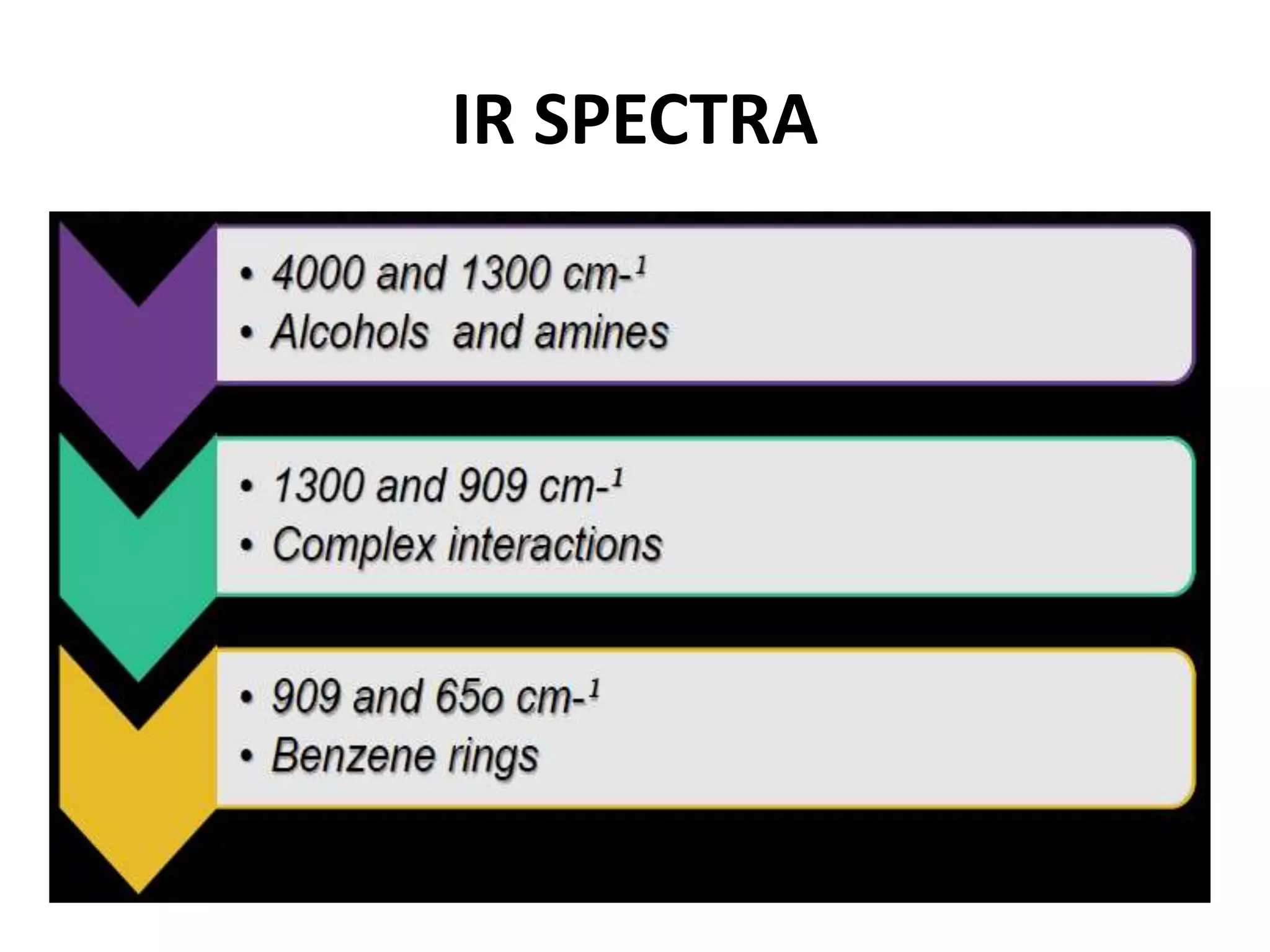
IR SPECTRA
Wave number and Intensity
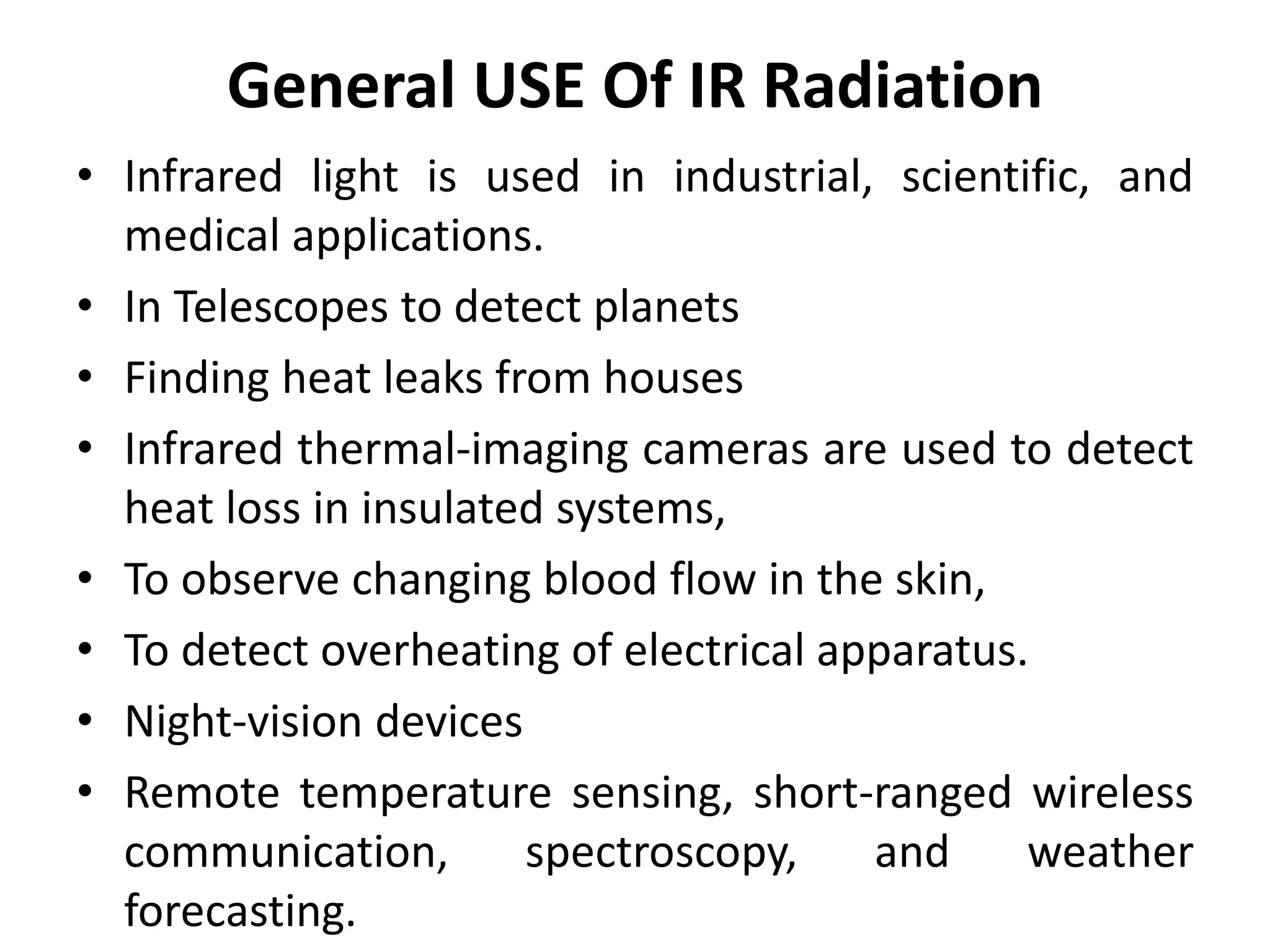
General USE Of IR Radiation
• Infrared light is used in industrial, scientific, and
medical applications.
• In Telescopes to detect planets
• Finding heat leaks from houses
• Infrared thermal-imaging cameras are used to detect
heat loss in insulated systems,
• To observe changing blood flow in the skin,
• To detect overheating of electrical apparatus.
• Night-vision devices
• Remote temperature sensing, short-ranged wireless
communication, spectroscopy, and weather
forecasting.
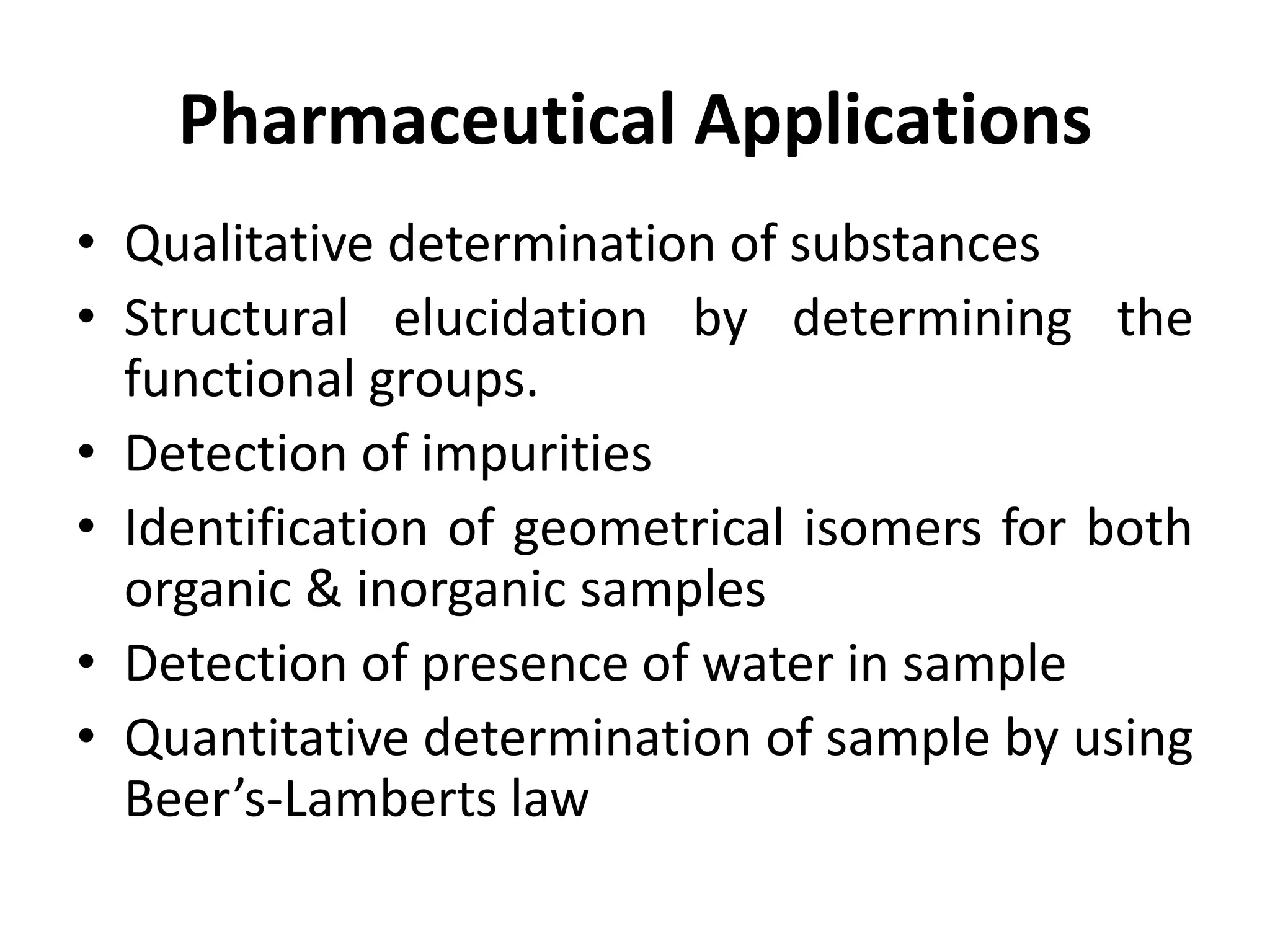
Pharmaceutical Applications
• Qualitative determination of substances
• Structural elucidation by determining the
functional groups.
• Detection of impurities
• Identification of geometrical isomers for both
organic & inorganic samples
• Detection of presence of water in sample
• Quantitative determination of sample by using
Beer’s-Lamberts law
References
• Chatwal G.R. . A textbook of ‘Instrumental
Method Of Chemical Analysis’.
• Günzler, H., & Gremlich, H. U. (2002). IR
spectroscopy. An introduction.
• Theophile, T. (Ed.). (2012). Infrared spectroscopy:
Materials science, engineering and technology.
BoD–Books on Demand.
• Wehling, R. L. (2010). Infrared spectroscopy.
In Food analysis (pp. 407-420). Springer, Boston,
MA.
Basic understanding of Infrared Spectroscopy

Basic understanding of Infrared Spectroscopy

  • 1.
  • 2.
    Introduction Energy of amolecule = Electronic energy + Vibrational energy + Rotational energy • Infrared spectroscopy is mainly concerned with the study of Vibrational transitions. • IR spectroscopy is concerned with the study of absorption of infrared radiation, which causes vibrational transition in the molecule. Hence, IR spectroscopy also known as Vibrational spectroscopy. • IR spectra mainly used in structure elucidation to determine the functional groups.
  • 3.
  • 4.
  • 5.
    • Infrared spectroscopy (IRspectroscopy) is the spectroscopy that deals with the infrared region of the electromagnetic spectrum, that is light with a longer wavelength and lower frequency than visible light • Infrared Spectroscopy is the analysis of infrared light interacting with a molecule. • It is based on absorption spectroscopy
  • 6.
    • IR region:0.8 μm (800nm) to 1000 μm (1mm) Regions of spectrum Wave length Gamma radiation 0.1 A◦ X-ray radiation 1 A◦ Ultraviolet radiation 100 – 400nm Visible radiation – Violet Indigo Blue Green Yellow Orange Red 400 – 780nm Infrared radiation Near IR Mid IR Far IR 0.78 -2.5nm 2.5 - 50nm 50 - 1000nm Microwave radiation 0.1 – 100cm Radio waves 1 – 1000m
  • 7.
    Principle • Molecules aremade up of atoms linked by chemical bonds. • These bonds are analogous to springs and not rigid in nature. • The movement of atoms and the chemical bonds like like spring and balls (vibration).
  • 8.
    • Because ofcontinues motion of a molecule they maintain some vibrations frequency‘s which is characteristic to every group this is called Natural frequency of Vibration. • When applied IR Frequency = Natural frequency of vibrations. • Absorption of IR Radiation takes place and specific peak is observed. • This Natural frequency of vibration varies with every functional group present in a molecule so it is called finger print of a molecule.
  • 9.
    Criteria for acompound to absorb IR radiation 1. Correct wavelength of radiation 2. Change in dipole moment 1. Correct wavelength of radiation: • A molecule to absorb IR radiation, the natural frequency of vibrations of some part of a molecule is the same as the frequency of incident radiation. 2. Change in dipole moment • A molecule can only absorb IR radiation when its absorption cause a change in its electric dipole. • A molecule is said to have an electric dipole when there is a slight positive and a slight negative charge on its component of atoms.
  • 10.
  • 11.
    What is avibration in a molecule? “Any change in shape of the molecule- stretching of bonds, bending of bonds, or internal rotation around single bonds”.
  • 12.
    Why we studythe molecular vibration? “Because whenever the interaction b/w electromagnetic waves & matter occur so change appears in these vibrations”
  • 13.
    Mol. vibration dividedinto 2 main types:
  • 14.
    Fundamental vibration further dividedinto two 1.Stretching vibrations 2.Bending vibrations. 1. Stretching • i. Symmetric • ii. Asymmetric 2. Bending • i. Scissoring • ii. Rocking • iii. Wagging • iv. Twisting
  • 15.
    1. STRETCHING VIBRATION •Stretching vibration Involves a continuous change in the inter atomic distance along the axis of the bond b/w 2 atoms. • It requires more energy so appear at shorter wavelength. • Vibration or oscillation along the line of bond • Change in bond length • Occurs at higher energy: 4000-1250 cm-1
  • 16.
    2. Bending vibrations •Vibration or oscillation not along the line of bond • These are also called as deformations • In this, bond angle is altered • Occurs at low energy: 1400-666 cm-1 • 2 types: • a) In plane bending: scissoring, rocking • b) Out plane bending: wagging, twisting
  • 17.
  • 18.
    Instrumentation • The mainparts of IR spectrometer are as follows: • Radiation source • Sample cells and sampling of substances • Monochromators • Detectors • Recorder
  • 19.
    Light source • IRinstruments require a source of radiant energy which emit IR radiation which must be:
  • 21.
    Sample Cell • Forgas samples: • The spectrum of a gas can be obtained by permitting the sample to expand into an evacuated cell, also called a cuvette. • For solution sample: • Infrared solution cells consists of two windows of pressed salt sealed. Samples that are liquid at room temperature are usually analyzed in pure form or in solution. The most common solvents are Carbon Tetrachloride (CCl4) and Carbon Disulfide (CS2).
  • 22.
    • For solidsample: • Solids reduced to small particles (less than 2 micron) can be examined as a thin paste or mull. The mull is formed by grinding a 2-5 milligrams of the sample in the presence of one or two drops of a hydrocarbon oil (nujol oil). The resulting mull is then examined as a film between flat salt plates.
  • 23.
    Detectors • An infrareddetector is a detector that reacts with to infrared (IR) radiation.
  • 24.
    Types of Detector •Detector • Two types- 1. Thermal 2. Non-thermal
  • 25.
  • 26.
    Types of thermaldetector • There are four types of thermal detector. • Bolometers • Thermocouple and thermopile • Pyro electric detector • Golay cell
  • 27.
  • 28.
    The IR Spectrum •There are two type of IR Spectra from which we can obtained the information about the quality of molecule . • The Functional Group region: Identifies the functional group with the consequence of changing stretching vibrations. Ranges from 4000 to 1600 cm-1. • The Fingerprint region: Identifies the exact molecule with the consequence of changing bending vibrations. Ranges from 1600 to 625cm-1.
  • 29.
    Why organic molecules? •Organicgroups differ from one another both in the strength of the bond and the masses of the atom involved.
  • 30.
  • 31.
  • 32.
  • 33.
  • 35.
    Wave number andIntensity
  • 36.
    General USE OfIR Radiation • Infrared light is used in industrial, scientific, and medical applications. • In Telescopes to detect planets • Finding heat leaks from houses • Infrared thermal-imaging cameras are used to detect heat loss in insulated systems, • To observe changing blood flow in the skin, • To detect overheating of electrical apparatus. • Night-vision devices • Remote temperature sensing, short-ranged wireless communication, spectroscopy, and weather forecasting.
  • 37.
    Pharmaceutical Applications • Qualitativedetermination of substances • Structural elucidation by determining the functional groups. • Detection of impurities • Identification of geometrical isomers for both organic & inorganic samples • Detection of presence of water in sample • Quantitative determination of sample by using Beer’s-Lamberts law
  • 38.
    References • Chatwal G.R.. A textbook of ‘Instrumental Method Of Chemical Analysis’. • Günzler, H., & Gremlich, H. U. (2002). IR spectroscopy. An introduction. • Theophile, T. (Ed.). (2012). Infrared spectroscopy: Materials science, engineering and technology. BoD–Books on Demand. • Wehling, R. L. (2010). Infrared spectroscopy. In Food analysis (pp. 407-420). Springer, Boston, MA.