Water and SOLUTIONS
water
• Water is a colourless,
  odorless and
  tasteless liquid.
• Water can exist in
  three state:
  - solid (ice)
  - liquid (water)
  - gas (steam)
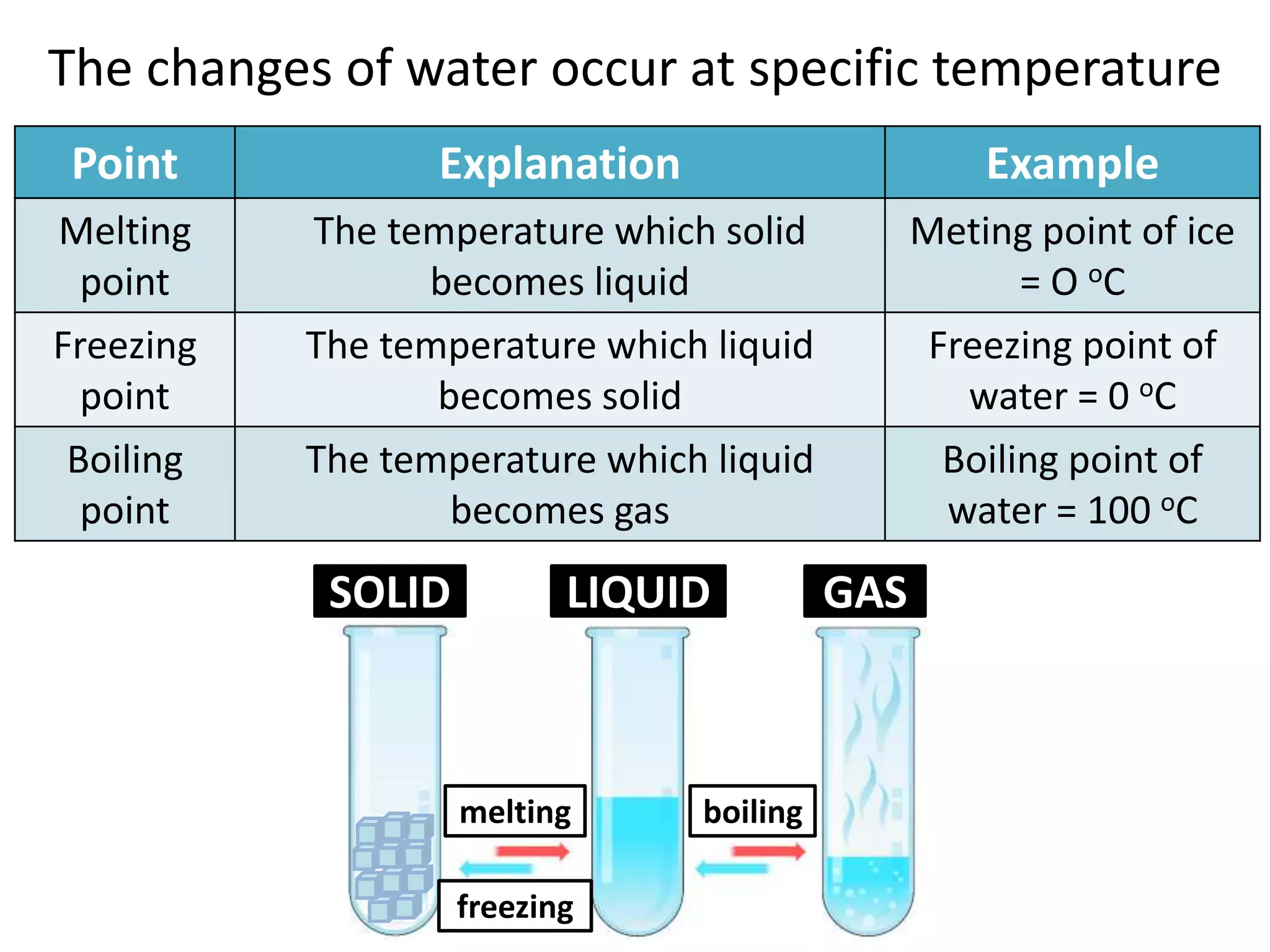
The changes of water occur at specific temperature
 Point            Explanation                       Example
Melting    The temperature which solid          Meting point of ice
  point          becomes liquid                        = O oC
Freezing   The temperature which liquid          Freezing point of
  point           becomes solid                    water = 0 oC
 Boiling   The temperature which liquid           Boiling point of
  point            becomes gas                    water = 100 oC
            SOLID          LIQUID         GAS


                    melting     boiling

                    freezing
Water test
    The presence of water can be determined by the
                  tests shown below:

    Water test                  Observation/Result
 The freezing point    The melting point of the water is 0 oC and
 and melting point      the boiling point of the water is 100 oC
                             (without any contamination)
 Anhydrous cobalt             Changes from blue to pink
  chloride paper
Anhydrous copper(II)          Changes from white to blue
     sulphate
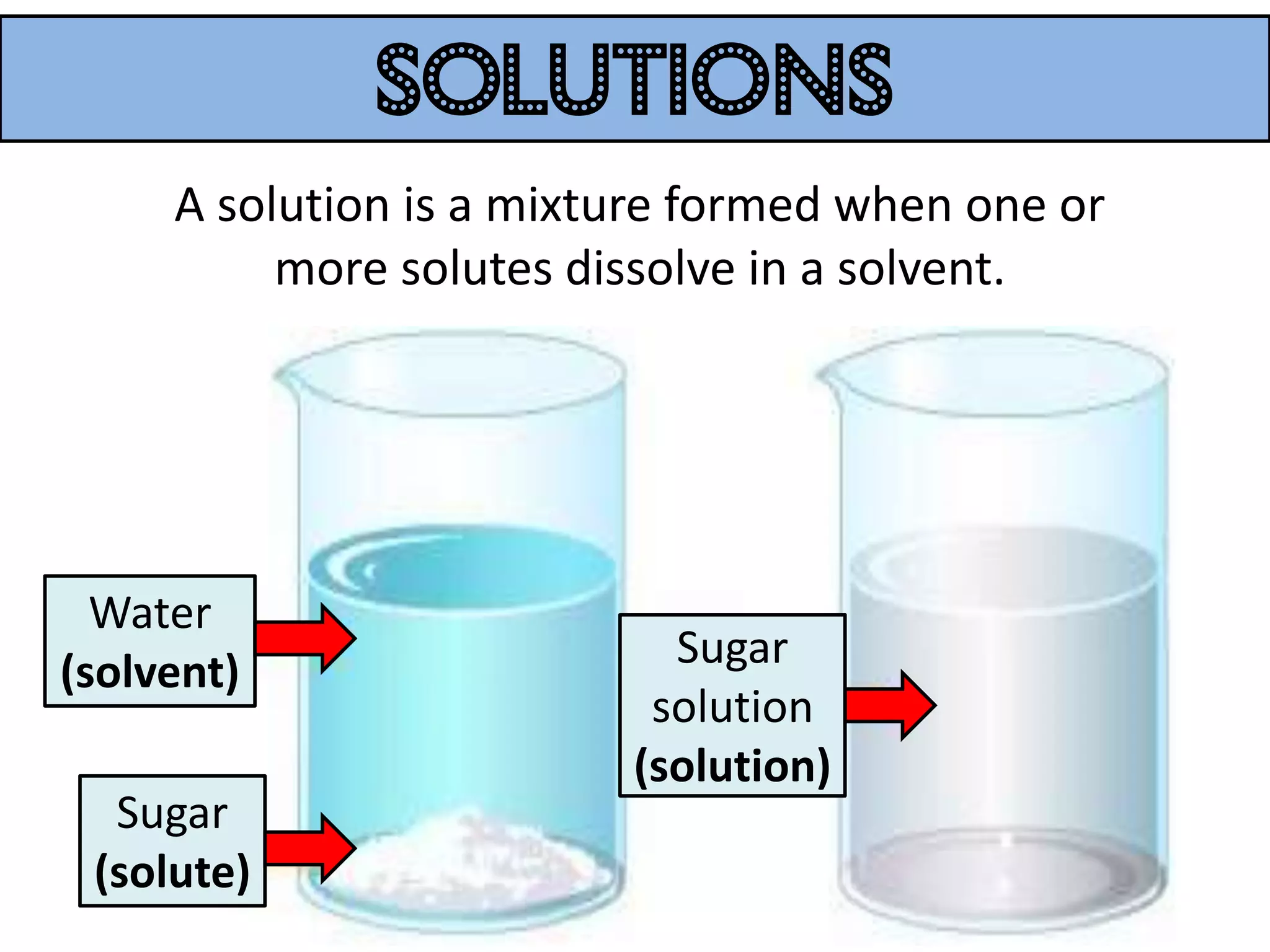
SOLUTIONS
     A solution is a mixture formed when one or
          more solutes dissolve in a solvent.


  Water
(solvent)                  Sugar
                          solution
                         (solution)
  Sugar
 (solute)
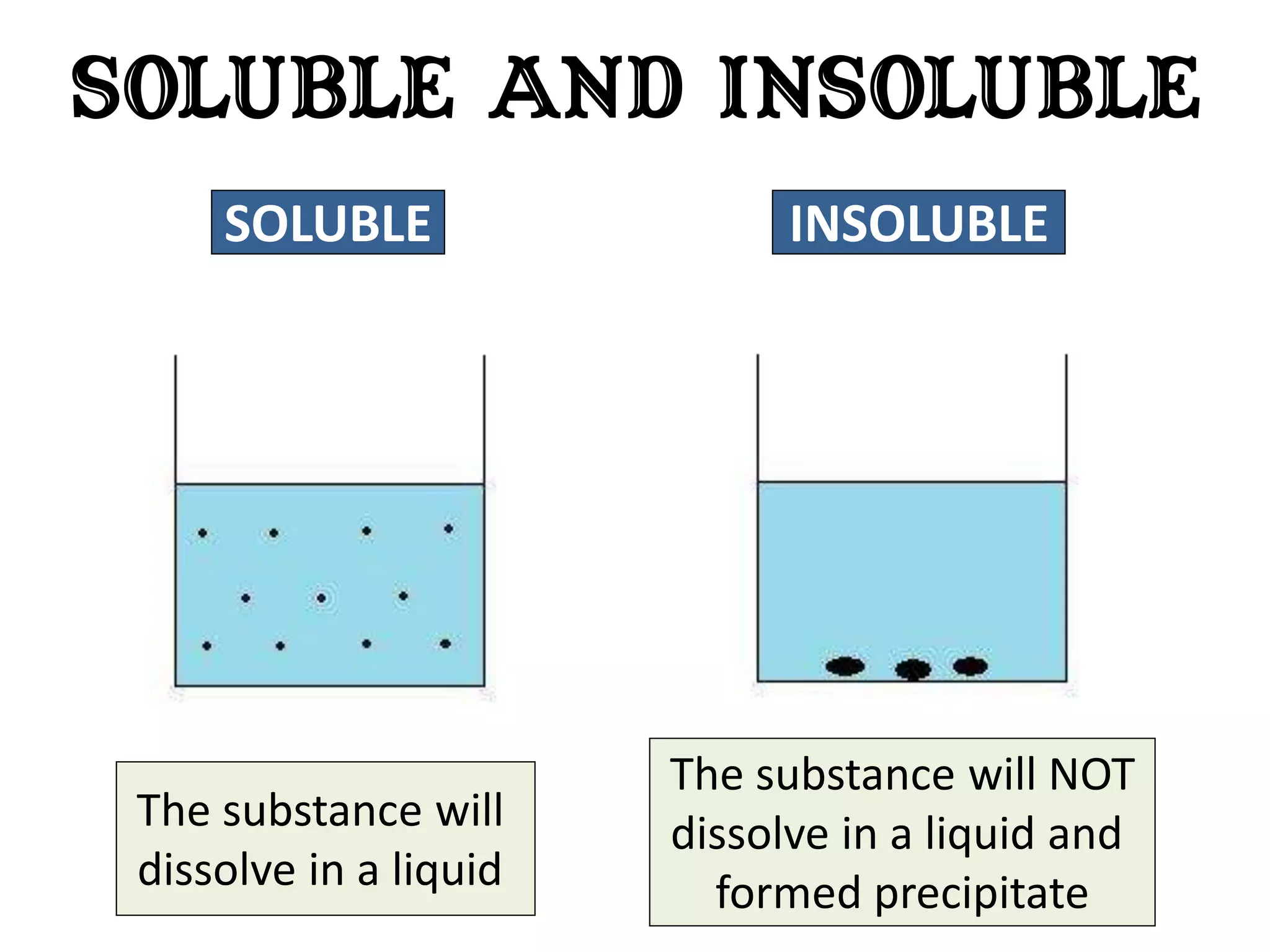
Soluble and Insoluble
     SOLUBLE                  INSOLUBLE


                        The substance will NOT
 The substance will     dissolve in a liquid and
 dissolve in a liquid     formed precipitate
When a solute dissolves
 in solvent, the solvent
breaks down the solutes
  into smaller particles
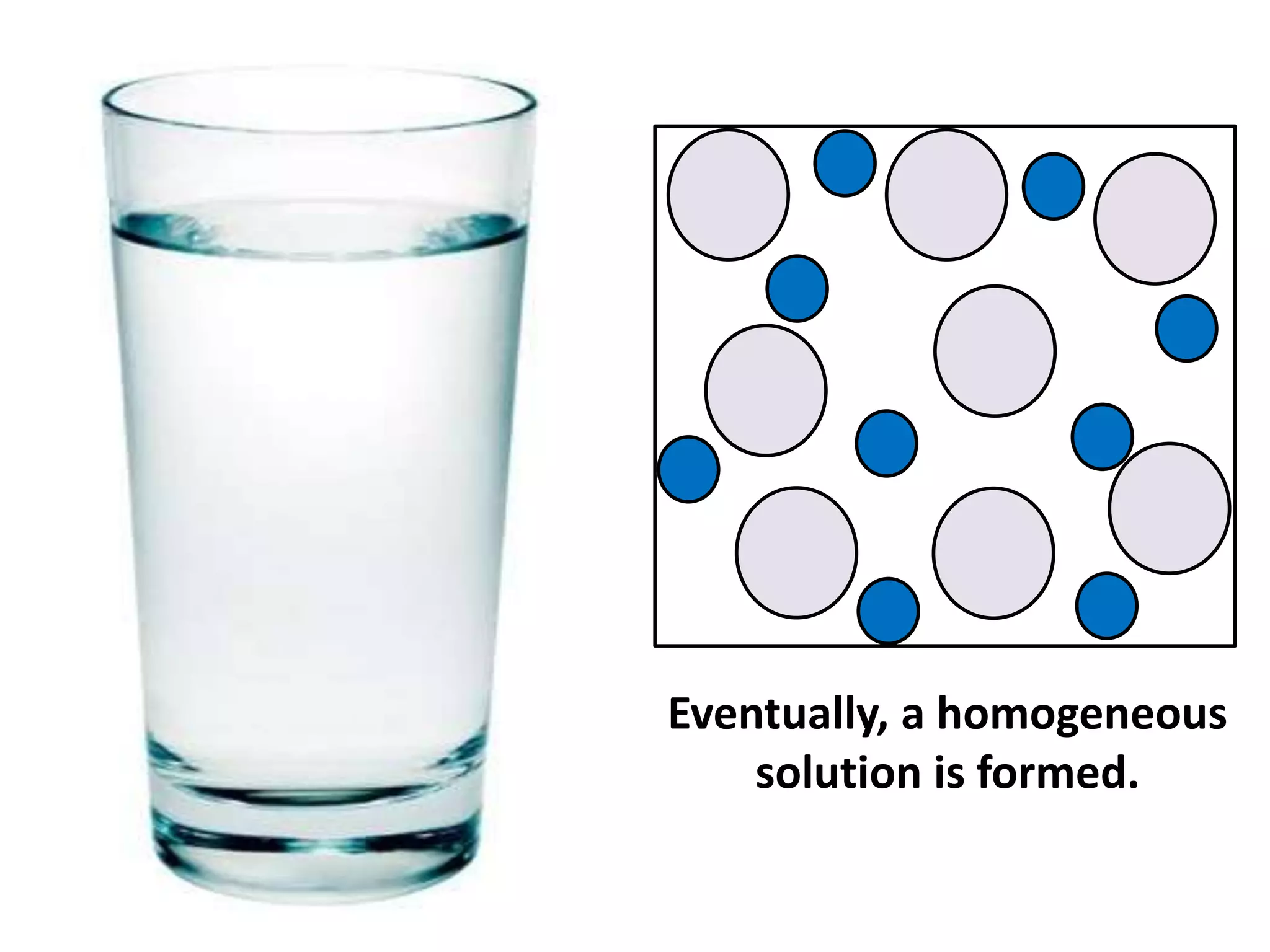
Eventually, a homogeneous
    solution is formed.
HOMOGENEOUS SOLUTION

SUGAR


           WATER       SOLUTION

   HETEROGENEOUS SOLUTION

CHALK


           WATER      SUSPENSION
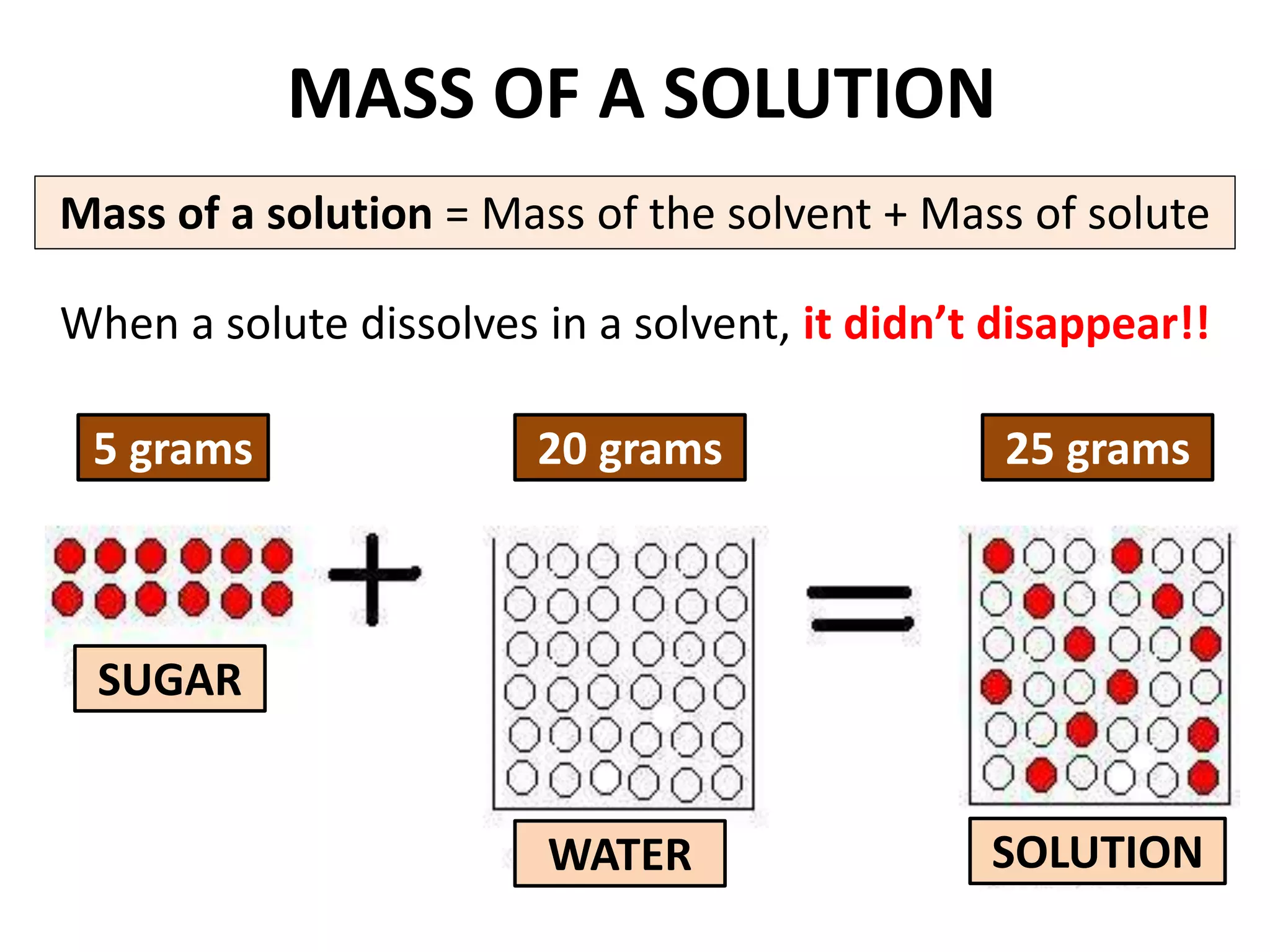
MASS OF A SOLUTION
Mass of a solution = Mass of the solvent + Mass of solute

When a solute dissolves in a solvent, it didn’t disappear!!

 5 grams                20 grams                25 grams


 SUGAR


                         WATER                 SOLUTION
solvents
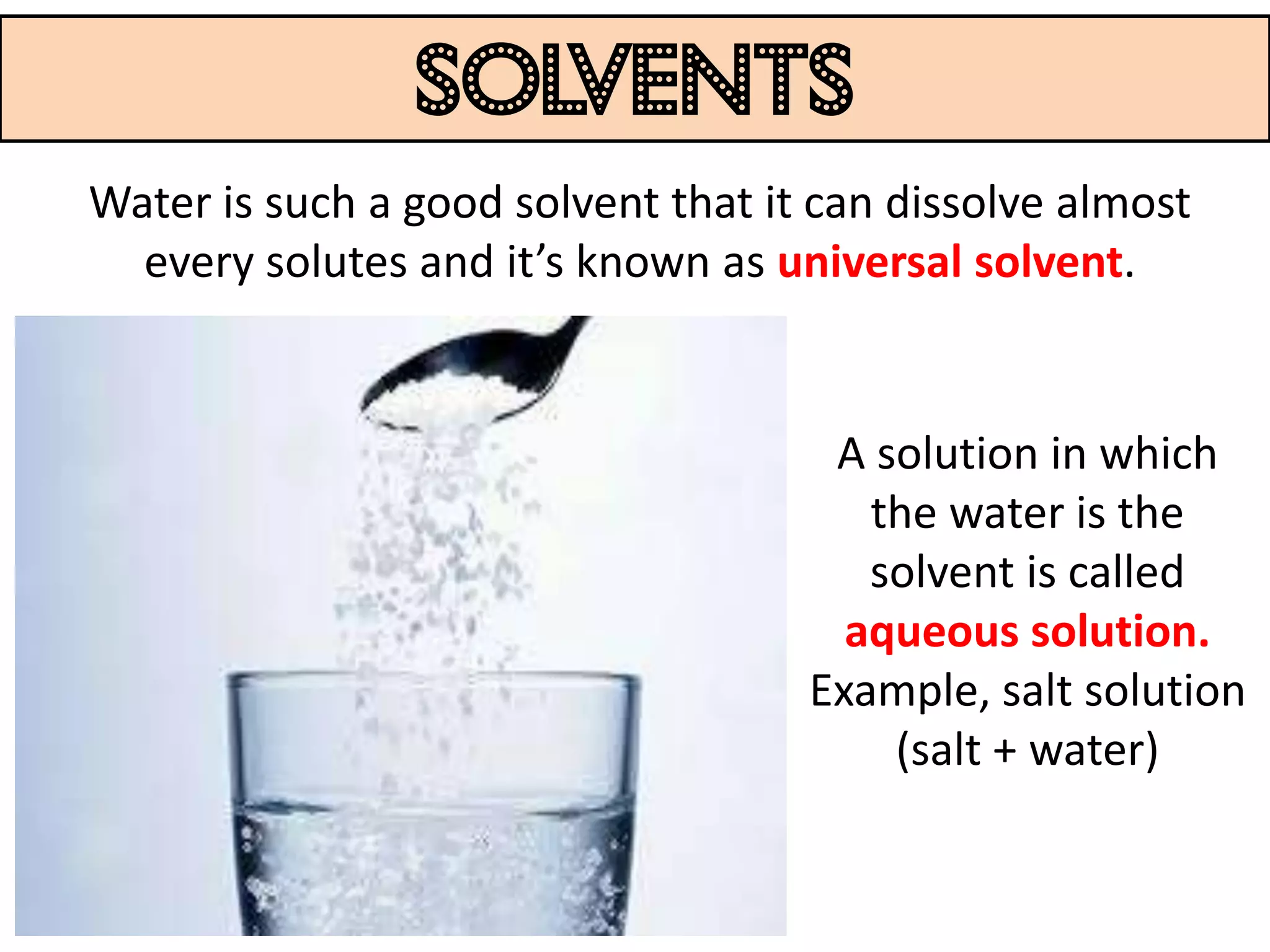
Water is such a good solvent that it can dissolve almost
  every solutes and it’s known as universal solvent.


                                     A solution in which
                                       the water is the
                                       solvent is called
                                      aqueous solution.
                                    Example, salt solution
                                        (salt + water)
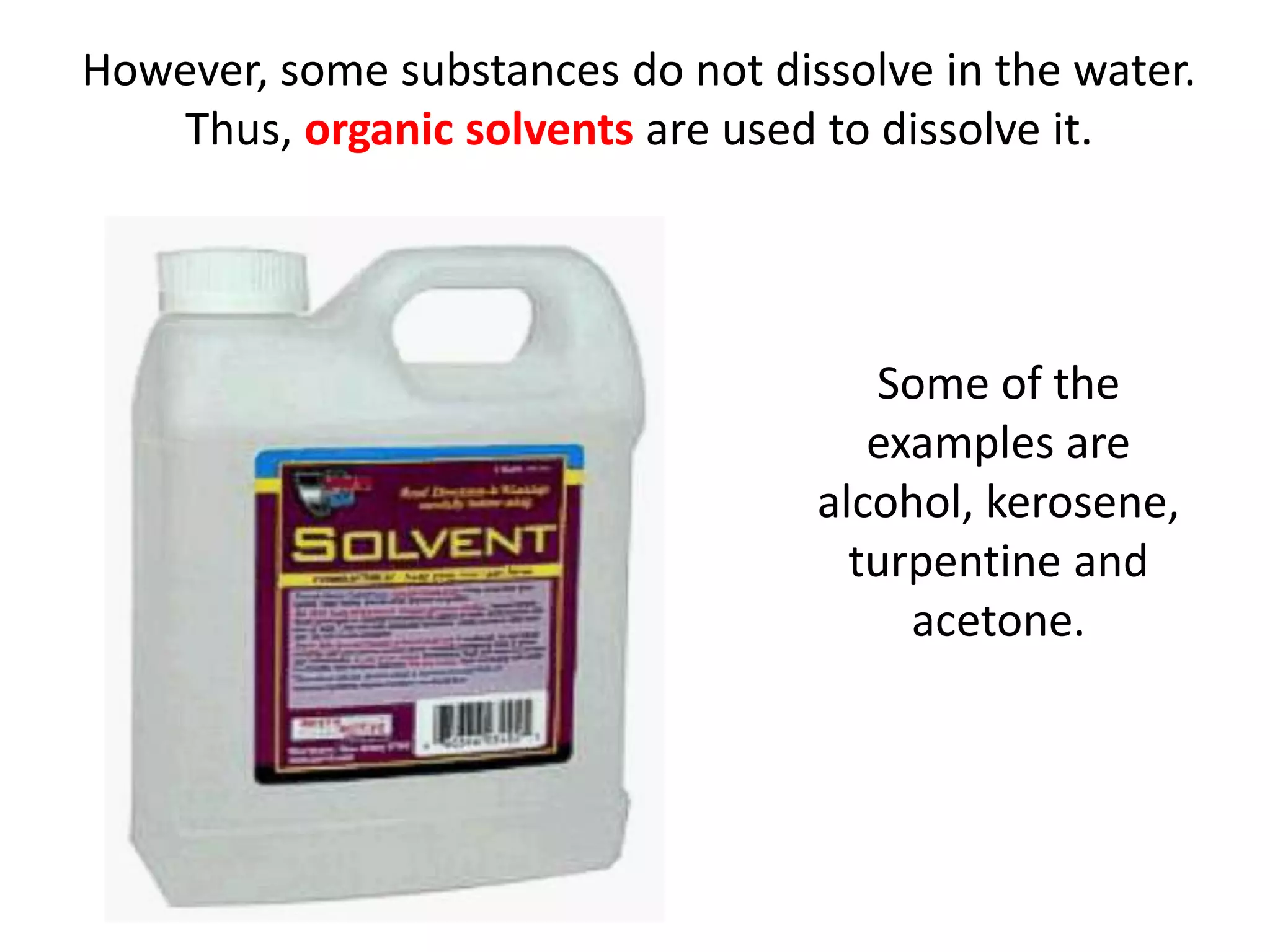
However, some substances do not dissolve in the water.
    Thus, organic solvents are used to dissolve it.


                                      Some of the
                                      examples are
                                   alcohol, kerosene,
                                     turpentine and
                                        acetone.
solutions
Diluted solution     Concentrated      Saturated solution
                       solution


                                                      Excess
                                                      solute


 Has very little Has a lot of solute Has the maximum
   solute in it            in it      amount of solute in it
Can dissolve a lot   Can dissolve a    Cannot dissolve any
  more solute      little more solute     more solute
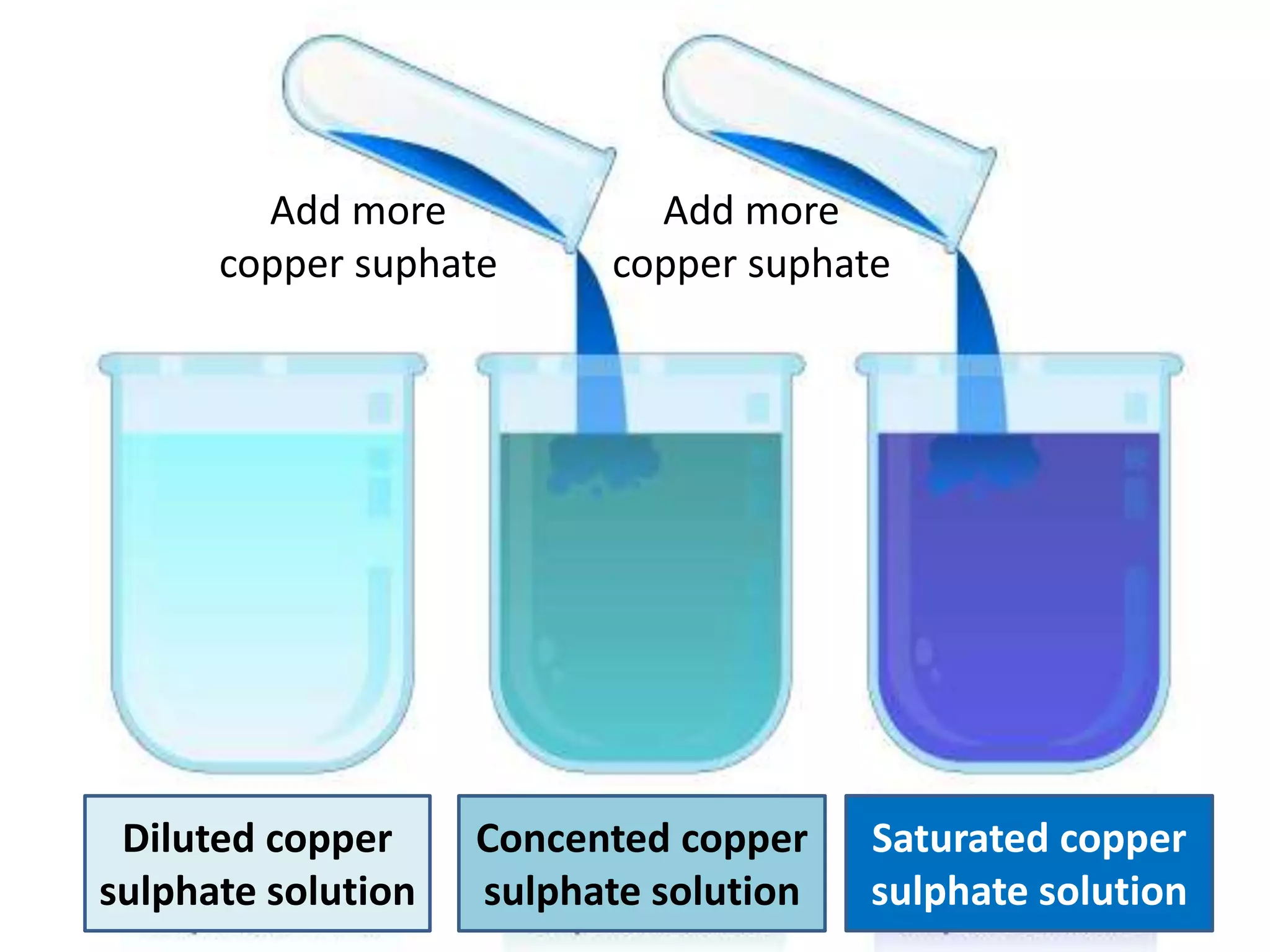
Add more            Add more
      copper suphate      copper suphate


 Diluted copper     Concented copper    Saturated copper
sulphate solution   sulphate solution   sulphate solution
CONCENTRATION OF A SOLUTION
• A concentration of a solution = grams per dm3 (g/dm3)

                  1 dm3 = 1000 cm3

Example 1,

Solution A contains 10.0g of solute in 1000cm3 solvent.

Concentration = mass of solutes (g)
               volume of solvent (dm3)

              = 10.0 g/1 dm3
              = 10.0 g/dm3
Example 2,

Solution B contains 5.0g of solute in 1000cm3 solvent.

Concentration = mass of solutes (g)
               volume of solvent (dm3)

              = 5.0 g/1 dm3
              = 5.0 g/dm3
Example 3,

Solution C contains 1.0g of solute in 100cm3 solvent.

Concentration = mass of solutes (g)
               volume of solvent (dm3)

              = 1.0 g/0.1 dm3
                                        1000 cm3 = 1 dm3
              = 10.0 g/dm3
                                        100 cm3 = 0.1dm3
Example 4,

Solution D contains 10.0g of solute in 10 000cm3 solvent.

Concentration = mass of solutes (g)
               volume of solvent (dm3)

              = 10 g/10 dm3
                                       1000 cm3 = 1 dm3
              = 1.0 g/dm3
                                      10 000 cm3 = 10dm3
Example 5,

Solution D contains 5.0g of solute in 100 cm3 solvent.

Concentration = mass of solutes (g)
               volume of solvent (dm3)

              = ?????
Example 6,

Solution E contains 0.1g of solute in 10 cm3 solvent.

Concentration = mass of solutes (g)
               volume of solvent (dm3)

              = ?????
Uses of solvents & solutions
(A) HOME Water is used for cooking, drinking, & cleaning.
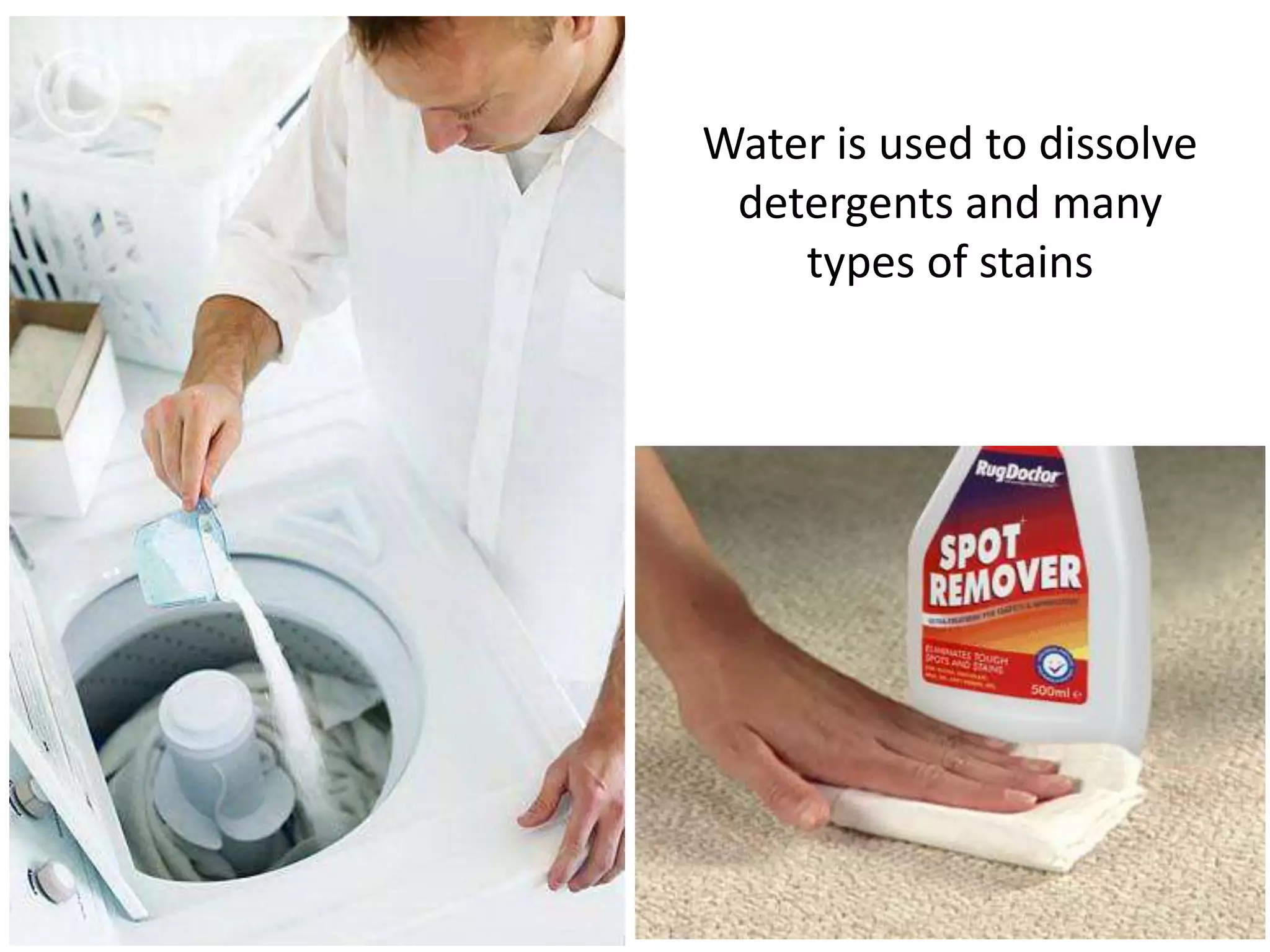
Water is used to dissolve
 detergents and many
    types of stains
Water is used to make
drinks and beverages.
Mineral salts and fertilizers are
(B) AGRICULTURE
                  dissolved in water so that plants
                          can absorb them.
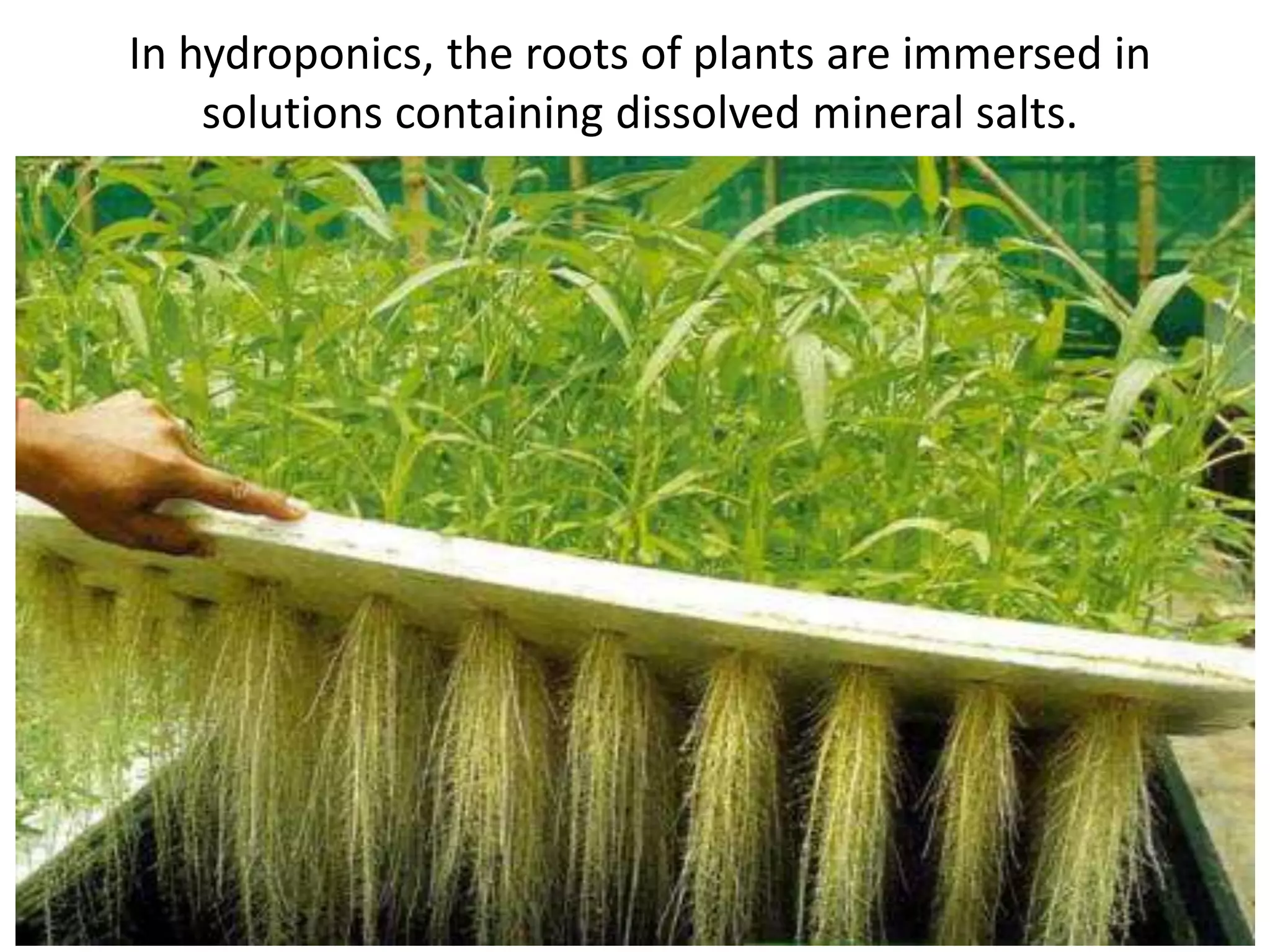
In hydroponics, the roots of plants are immersed in
    solutions containing dissolved mineral salts.
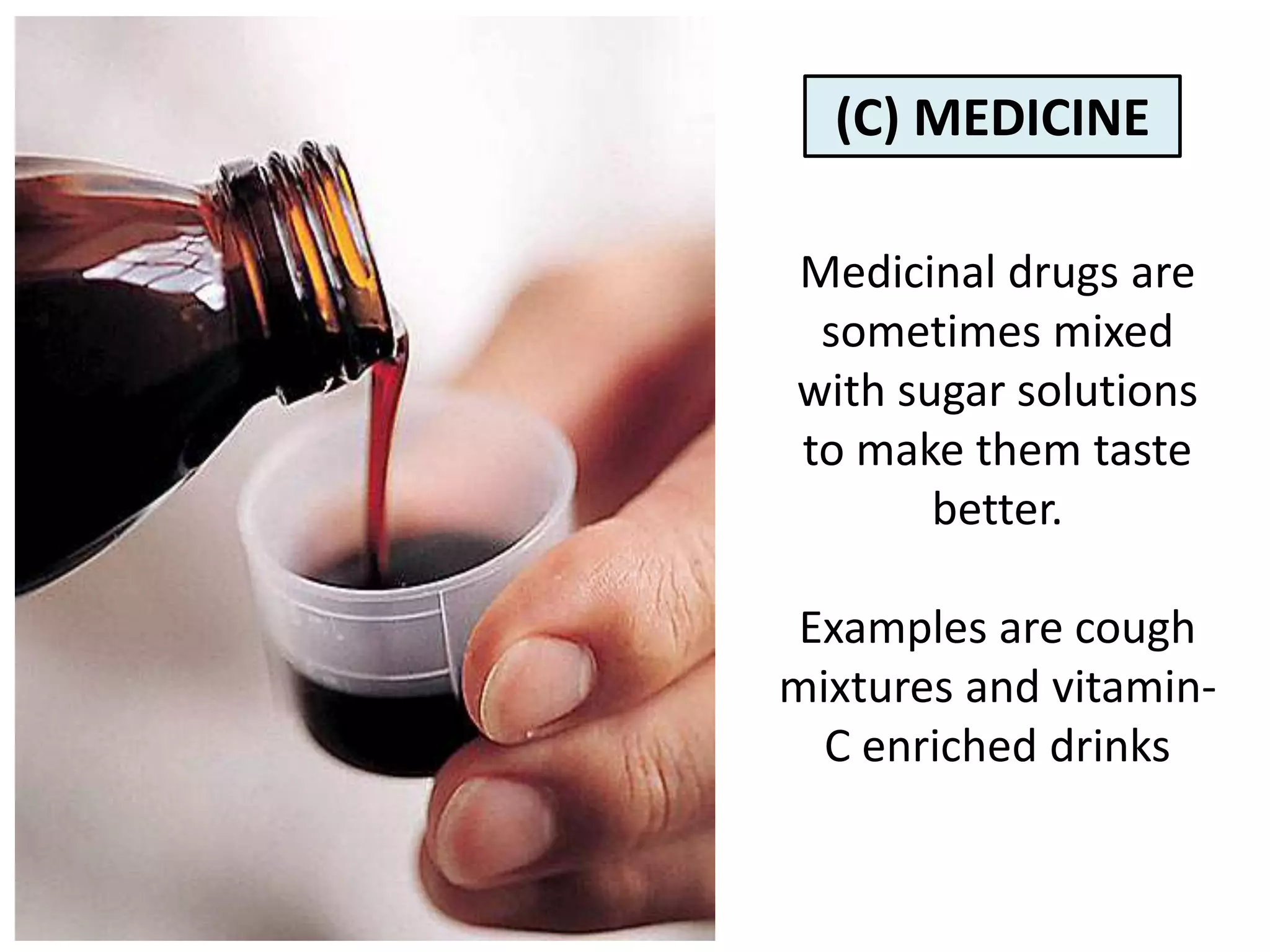
(C) MEDICINE

Medicinal drugs are
 sometimes mixed
with sugar solutions
to make them taste
       better.

 Examples are cough
mixtures and vitamin-
  C enriched drinks
(D) INDUSTRY

 Turpentine, alcohol
  and other types of
 solvents are used in
the manufacturing of
paints, inks and dyes.
SOLUBILITY
• A solvent can only dissolve a certain amount of
  solute.
• Solubility is the maximum amount of solute in
  grams that will dissolve in 100g of solvent.
• The solution produced is a saturated solution.


   Solubility = ______ g of solute /100g of solvent
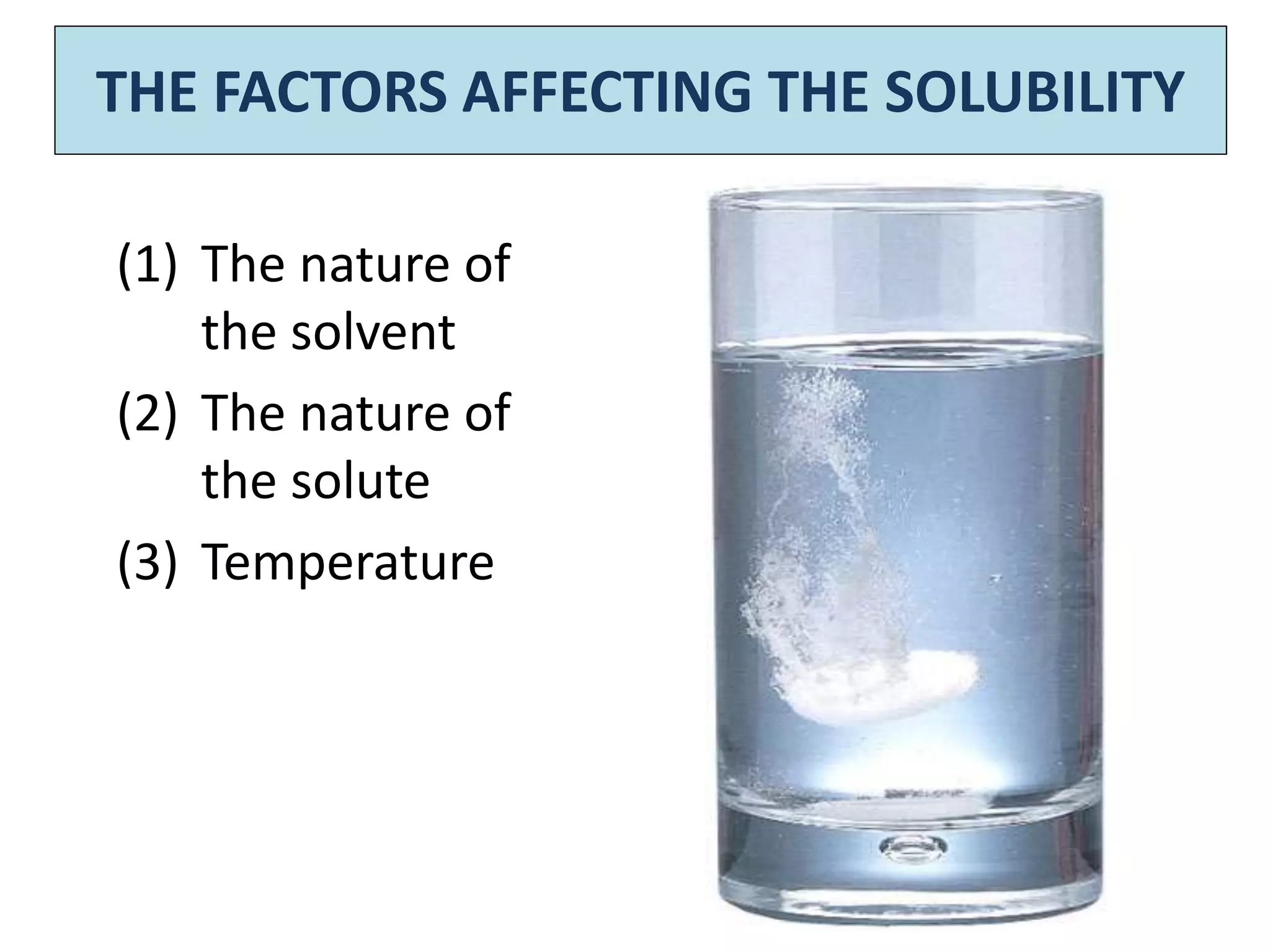
THE FACTORS AFFECTING THE SOLUBILITY

(1) The nature of
    the solvent
(2) The nature of
    the solute
(3) Temperature
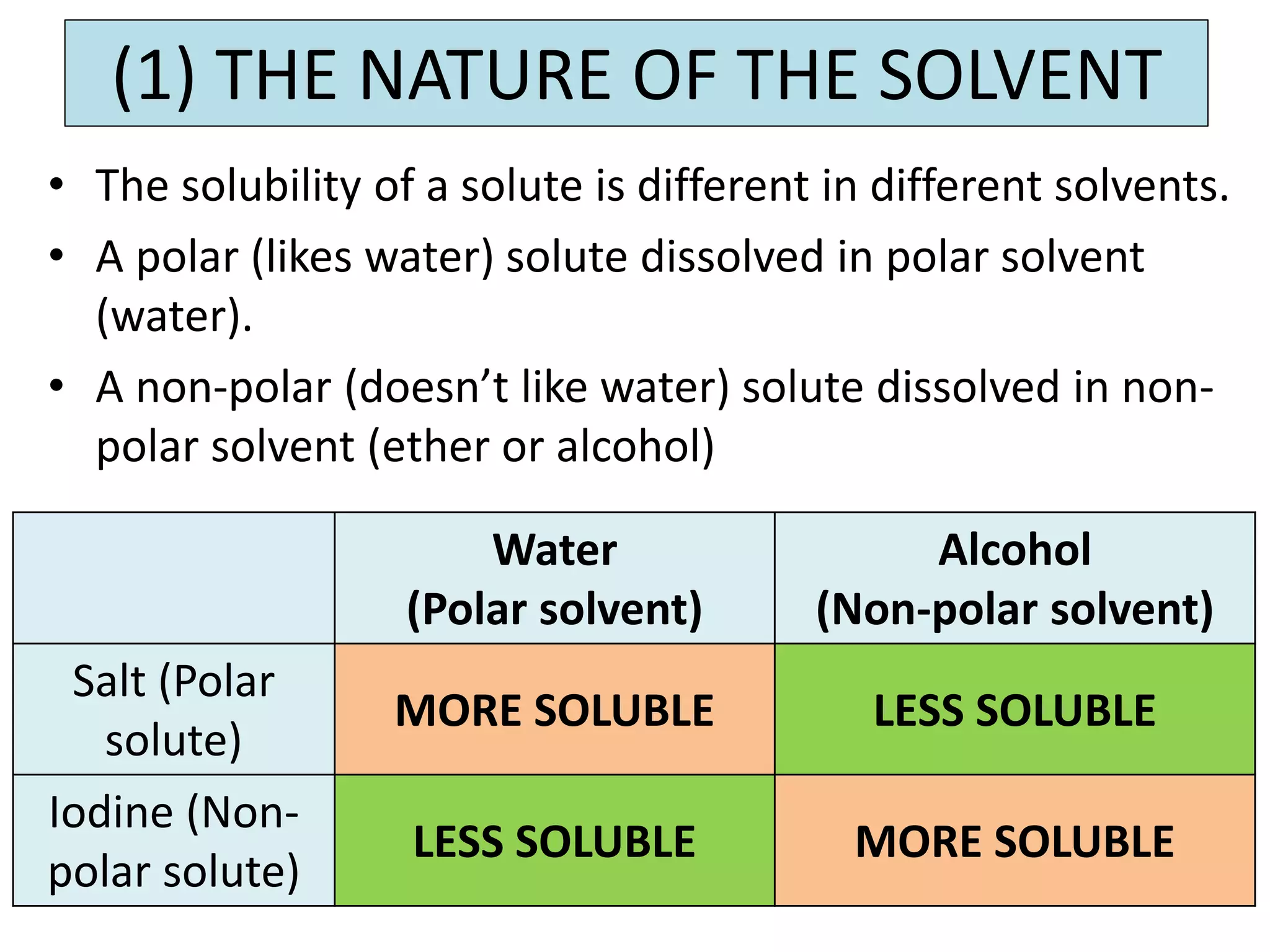
(1) THE NATURE OF THE SOLVENT
• The solubility of a solute is different in different solvents.
• A polar (likes water) solute dissolved in polar solvent
  (water).
• A non-polar (doesn’t like water) solute dissolved in non-
  polar solvent (ether or alcohol)

                       Water                  Alcohol
                   (Polar solvent)       (Non-polar solvent)
 Salt (Polar
                  MORE SOLUBLE              LESS SOLUBLE
   solute)
Iodine (Non-
                   LESS SOLUBLE            MORE SOLUBLE
polar solute)
Undissolved     Dissolved iodine
iodine in water      in alcohol
(2) THE NATURE OF THE SOLUTE
• Different solutes have different solubility in a given
  solvent.

             Solute             Solubility at 20oC
                               (g/100mL of water)
      Copper (II) sulphate              20
       Potassium nitrate                30
        Sodium chloride                 38

     ***Among the 3 solutes, sodium chloride
          is the most soluble in water.
(3) THE TEMPERATURE
• Generally in many
  cases solubility
  increases with the
  rise in temperature
• Decreases with the fall
  of temperature but it
  is not necessary in all
  cases.
• Gases are more
  soluble in cold solvent
  than in hot solvent.
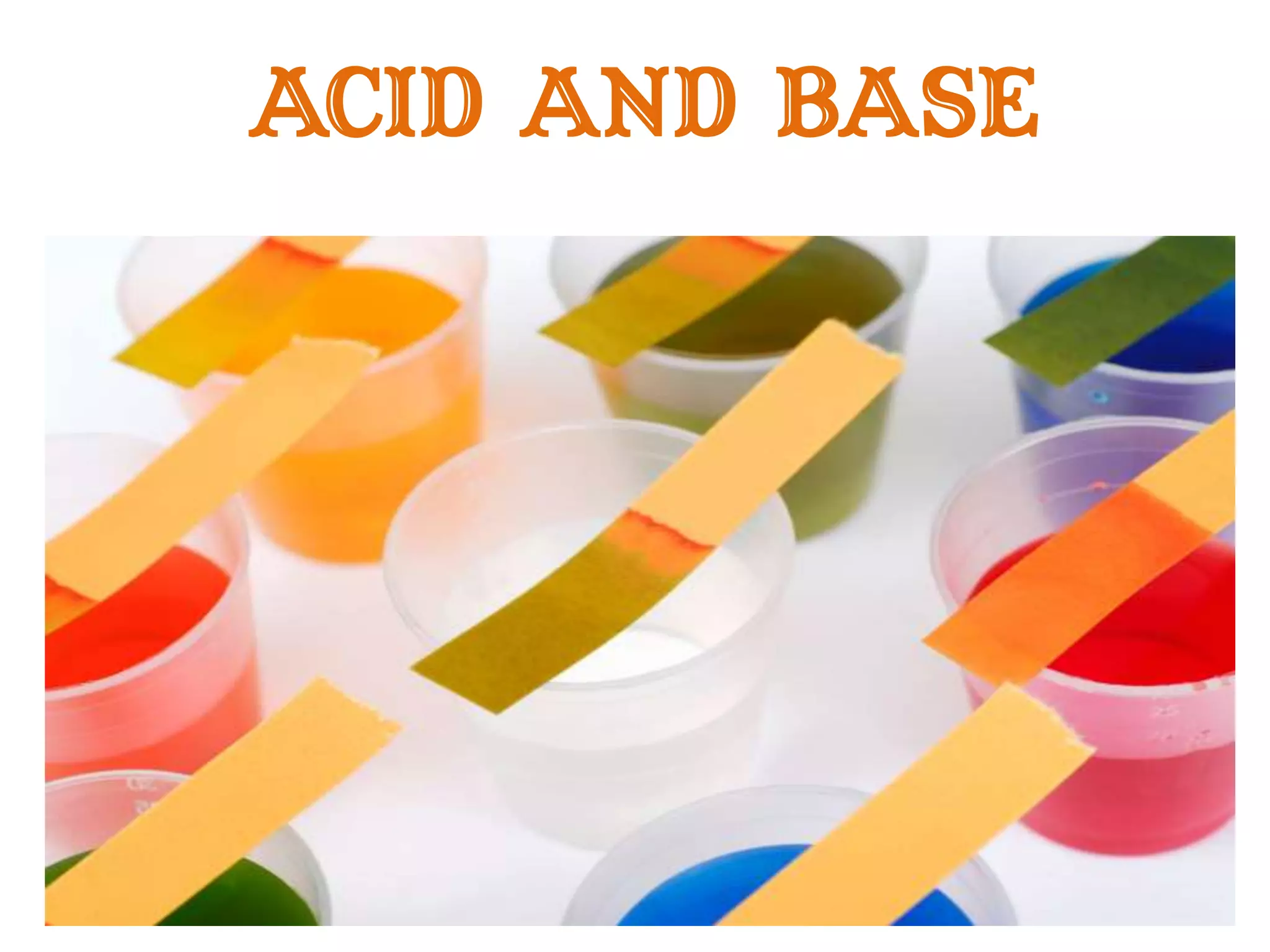
ACID AND BASE
acid
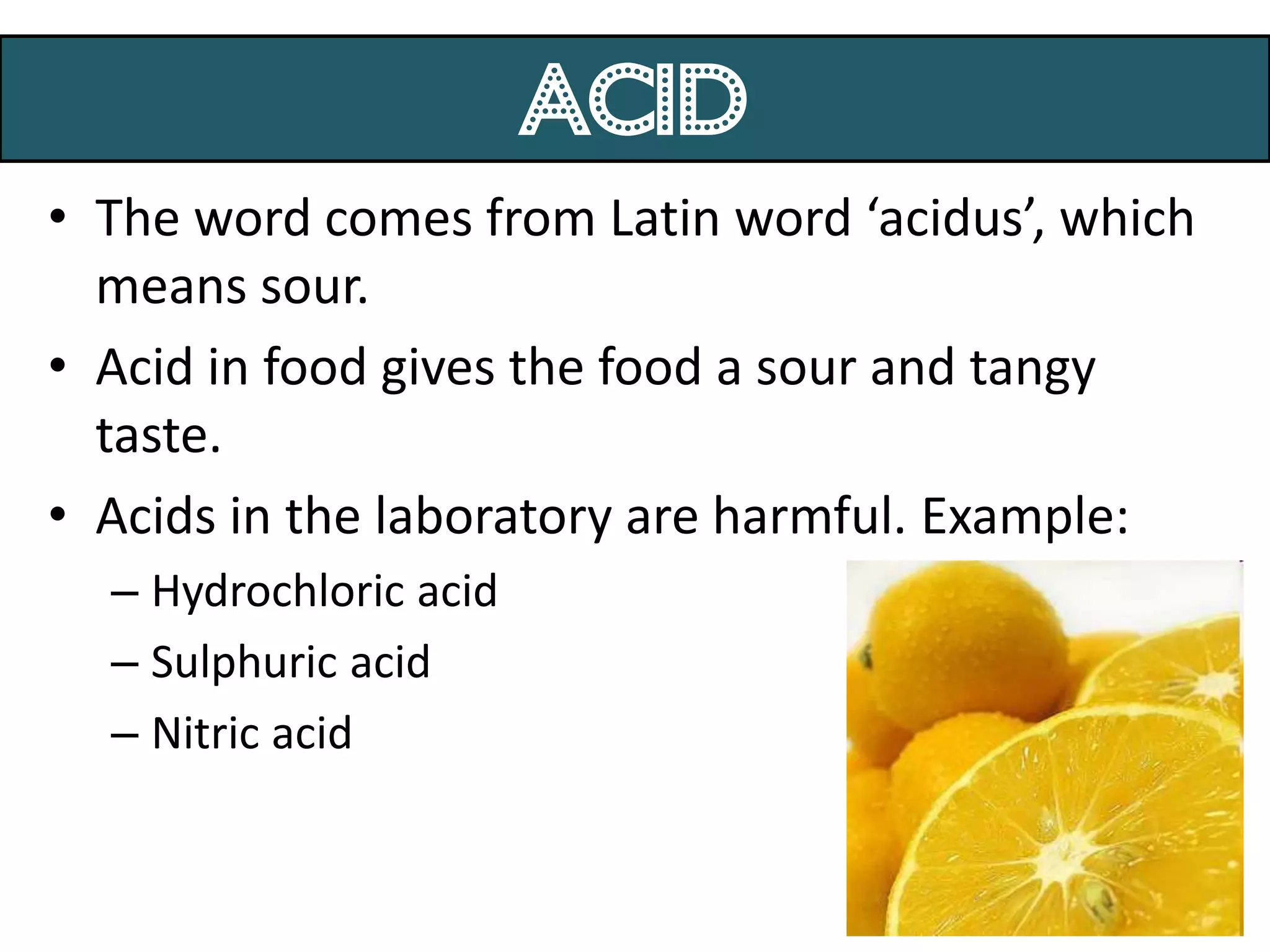
• The word comes from Latin word ‘acidus’, which
  means sour.
• Acid in food gives the food a sour and tangy
  taste.
• Acids in the laboratory are harmful. Example:
  – Hydrochloric acid
  – Sulphuric acid
  – Nitric acid
Properties of acid
         (a) Acids taste sour
(b) Strong acids are corrosive
If it comes into contact with the skin, it will burn.
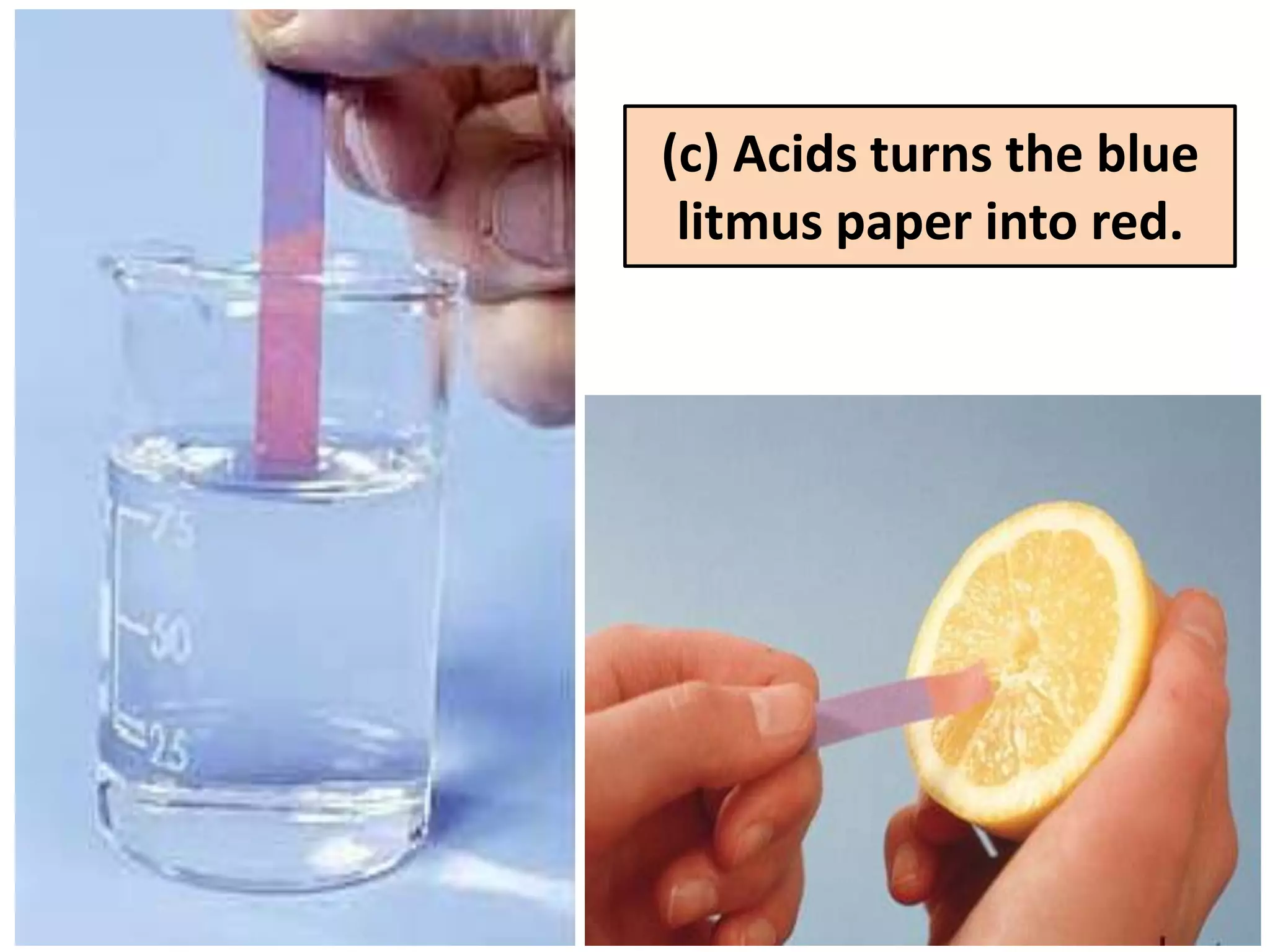
(c) Acids turns the blue
 litmus paper into red.
(d) Dilute acids react with reactive metals
           to form hydrogen gas.


                              Dilute + zinc
                           hydrochloric
             Bubbles of       acid
             hydrogen
                gas

                              zinc + hydrogen
                            chloride
To identify the gas
   produced: use a
    lighted splint.
    Hydrogen gas
    extinguished a
lighted splint with a
    “pop” sound.
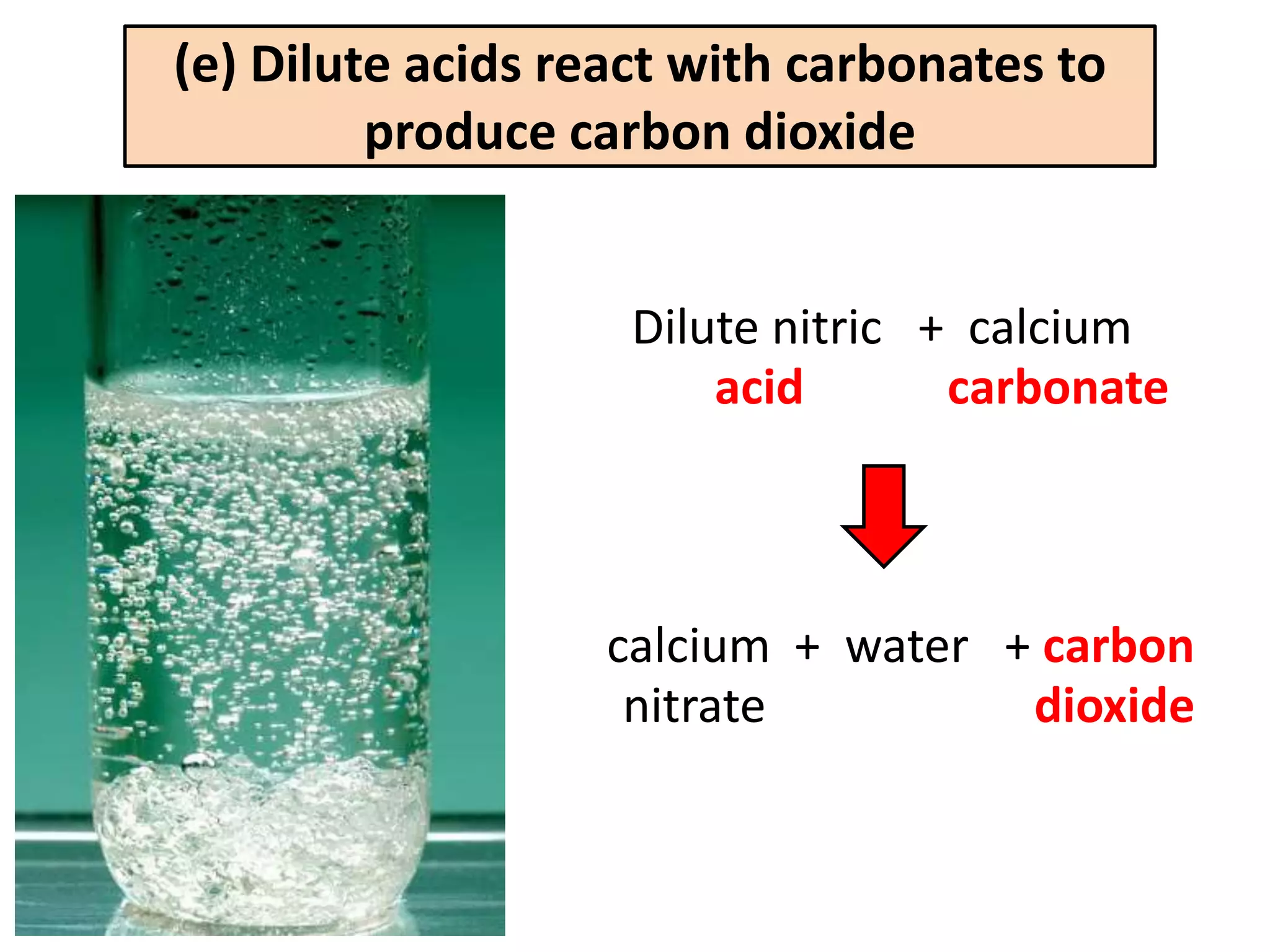
(e) Dilute acids react with carbonates to
         produce carbon dioxide


                    Dilute nitric + calcium
                        acid       carbonate


                   calcium + water + carbon
                    nitrate         dioxide
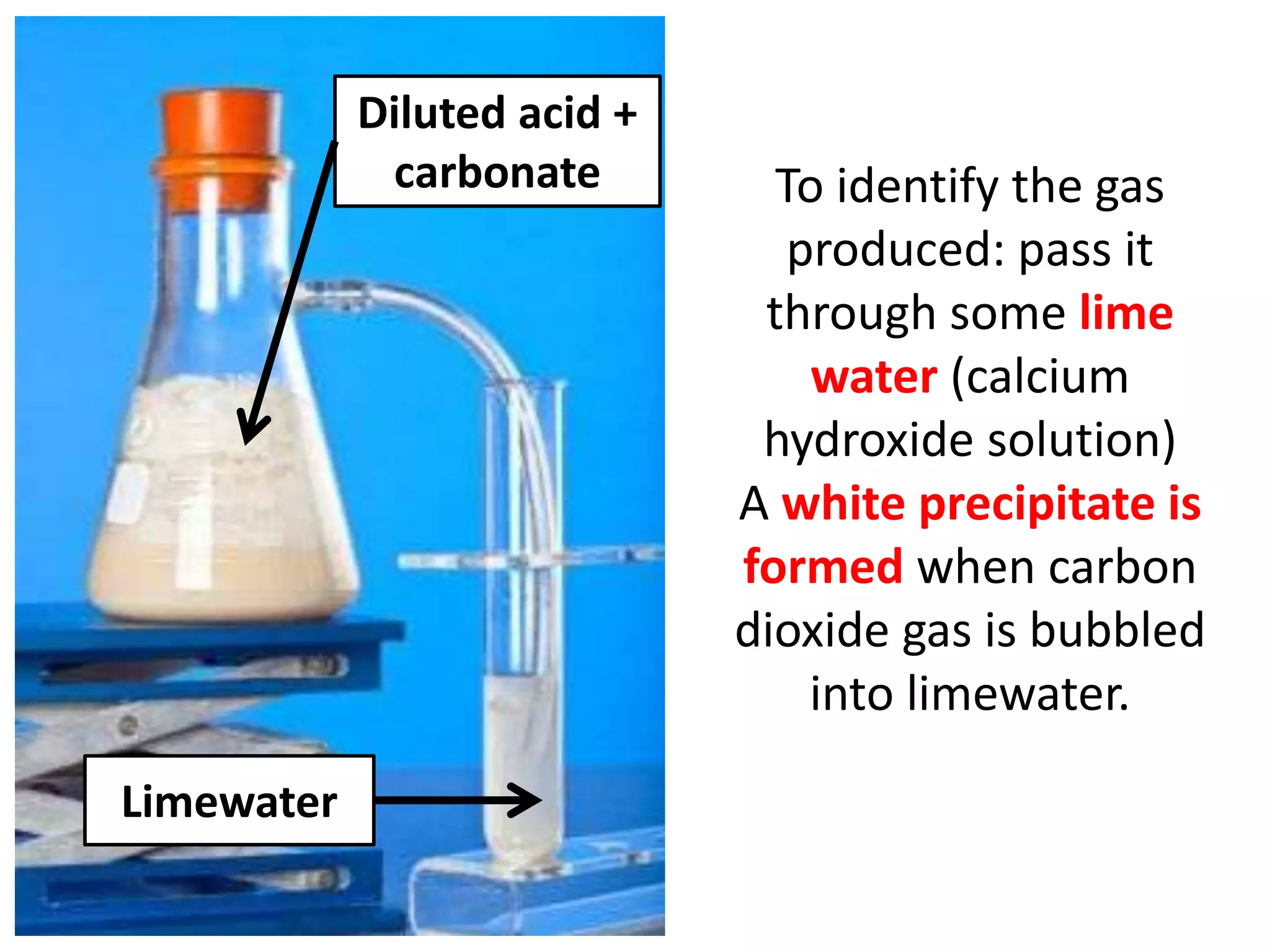
Diluted acid +
             carbonate         To identify the gas
                                produced: pass it
                              through some lime
                                 water (calcium
                              hydroxide solution)
                             A white precipitate is
                             formed when carbon
                             dioxide gas is bubbled
                                 into limewater.

Limewater
alkali
• Alkali is the chemical ‘opposite’ of acid
• Alkali are often used in many household
  cleaners such as detergents, soap and etc
• Alkalis that are commonly used in the
  laboratory are:
  – Ammonia solution
  – Sodium hydroxide
  – Potassium hydroxide
Properties of alkali
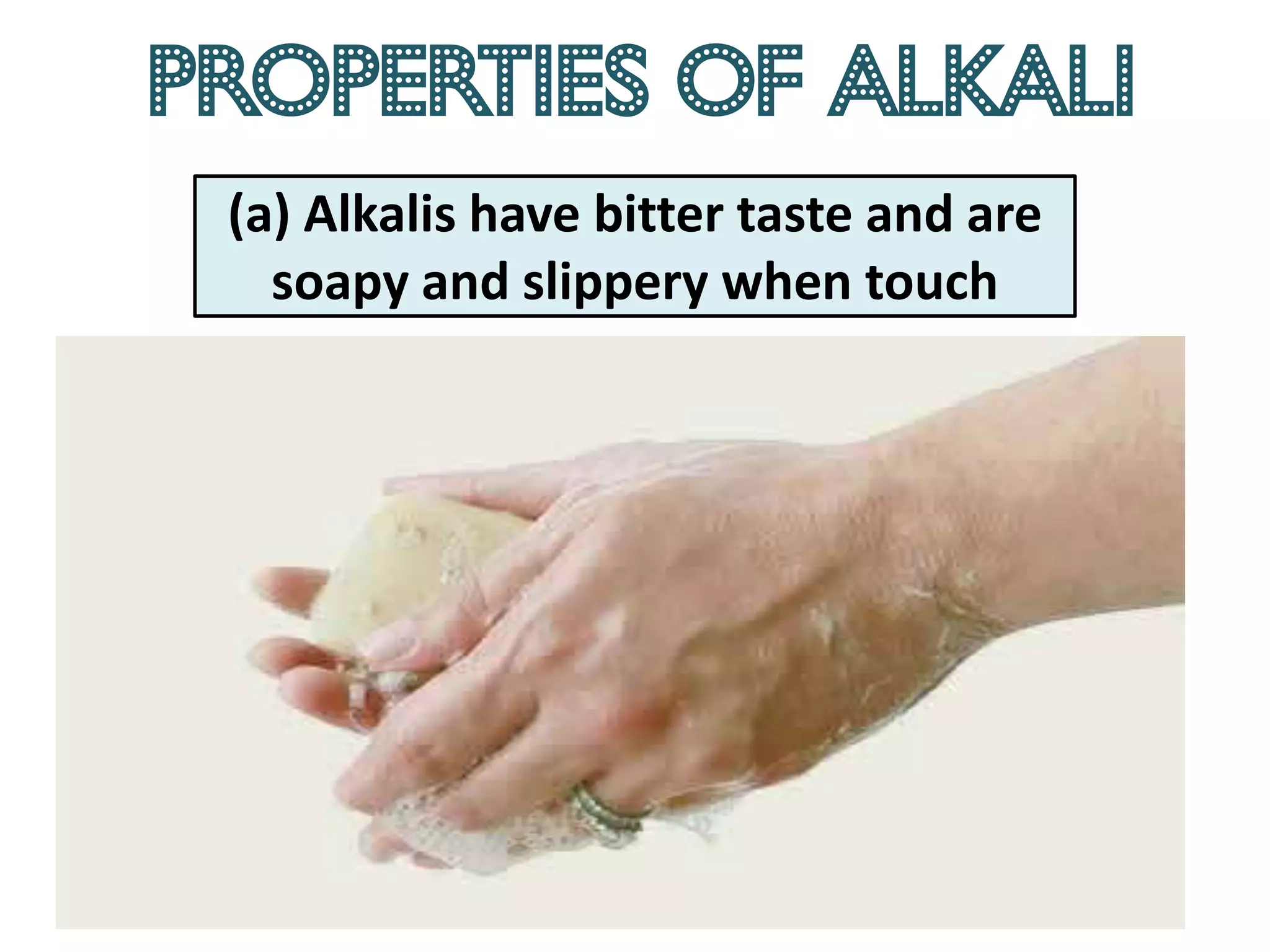
 (a) Alkalis have bitter taste and are
   soapy and slippery when touch
(b) Strong alkalis are corrosive.
Strong alkali like sodium hydroxide are highly corrosive
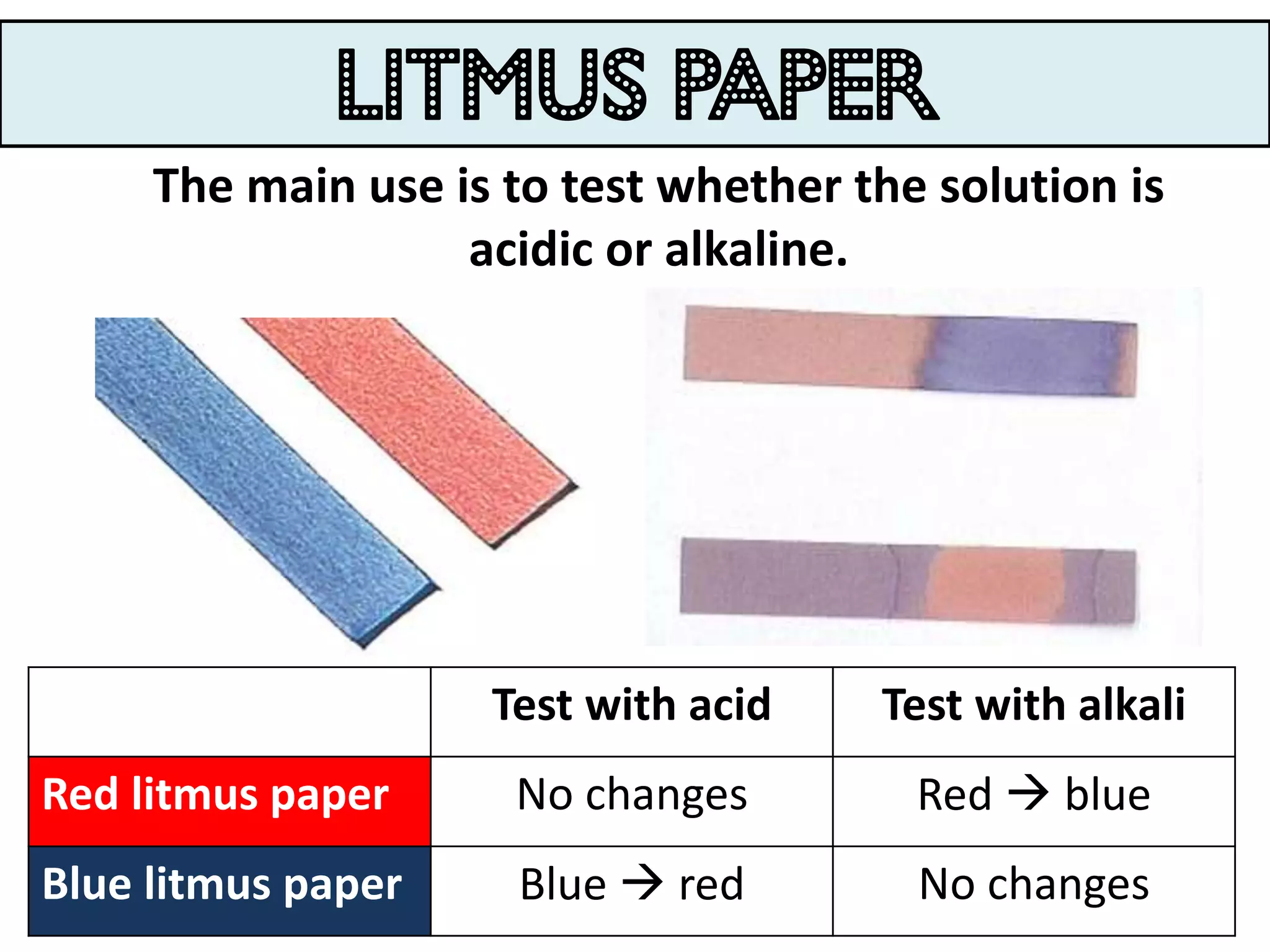
(c) Alkalis turn the red
litmus paper into blue
indicators
An indicator is a dye or a mixture of dyes which changes
color according to the acidity or alkalinity of a substance.
Litmus paper
     The main use is to test whether the solution is
                   acidic or alkaline.


                    Test with acid    Test with alkali
Red litmus paper     No changes         Red  blue
Blue litmus paper    Blue  red         No changes
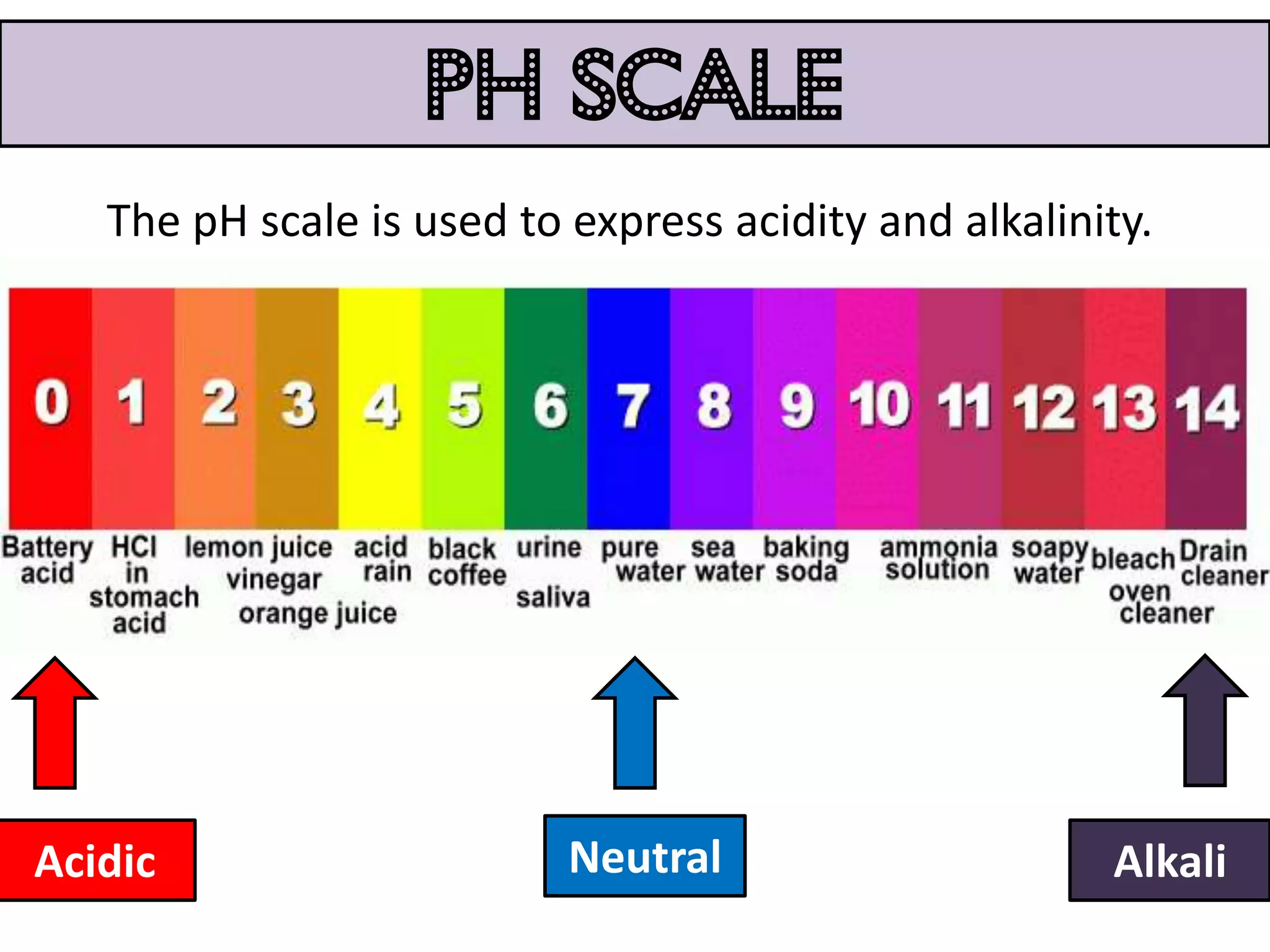
pH scale
   The pH scale is used to express acidity and alkalinity.


Acidic                     Neutral                     Alkali
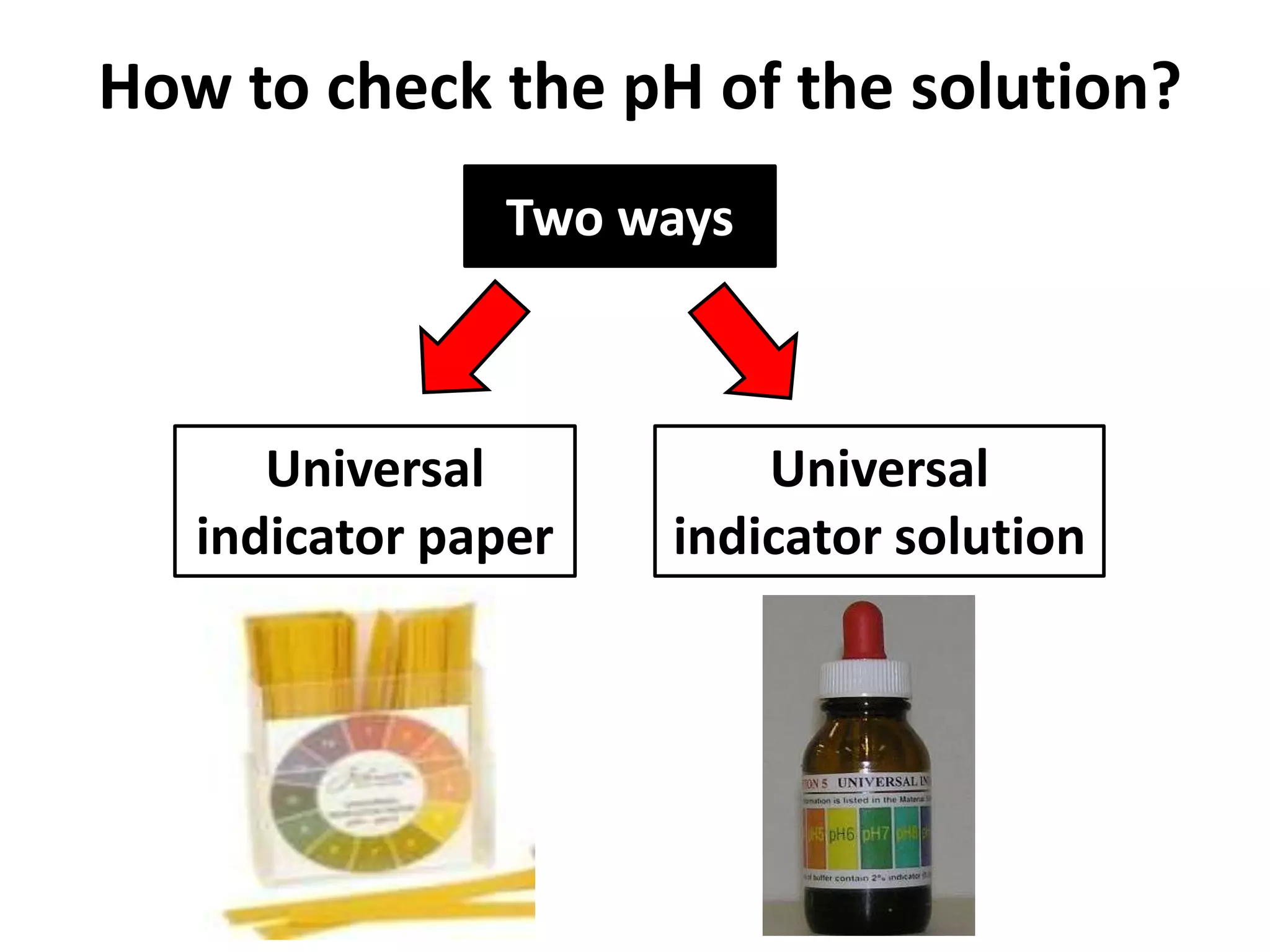
How to check the pH of the solution?
               Two ways


      Universal          Universal
   indicator paper   indicator solution
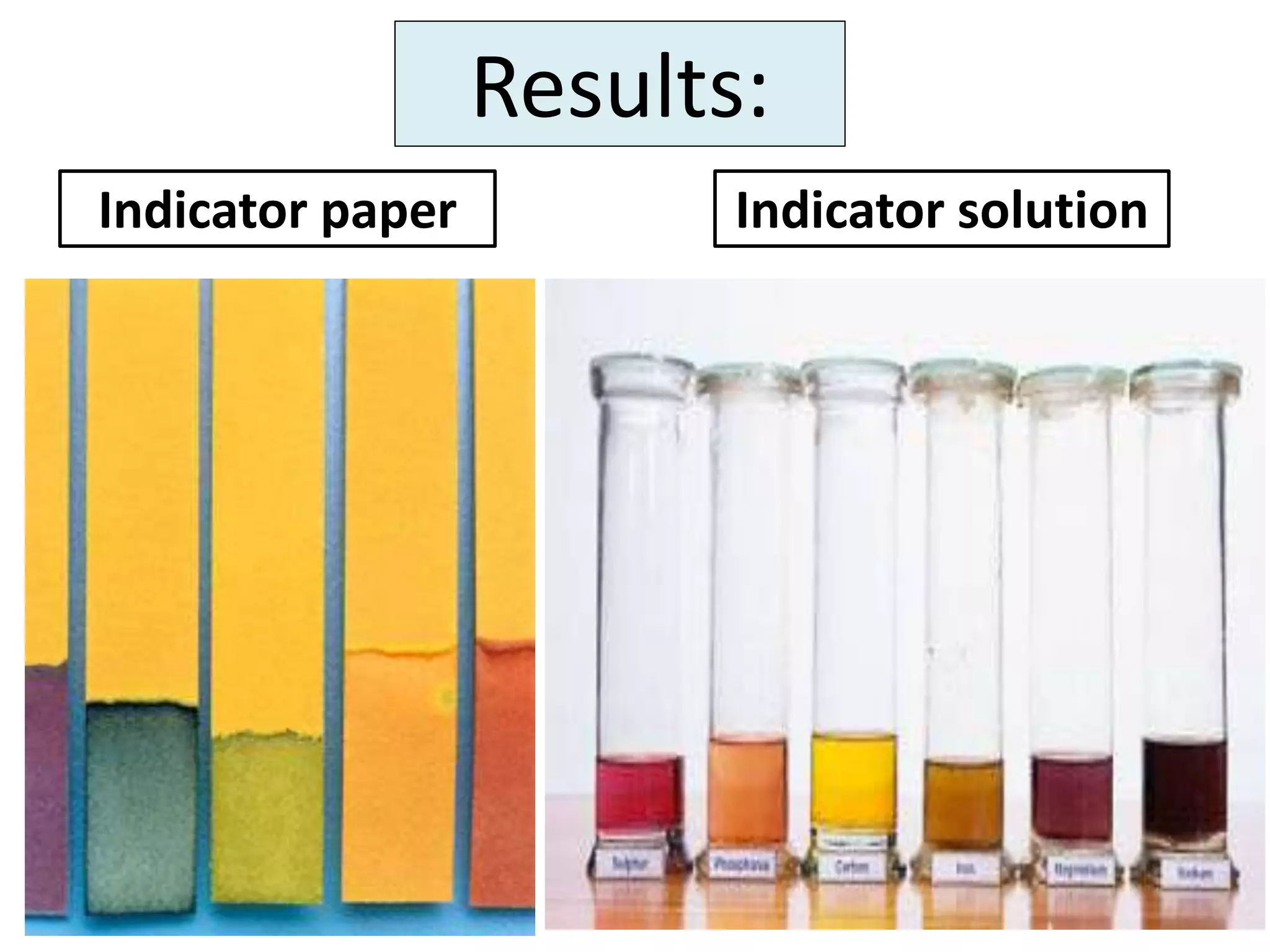
Results:
Indicator paper          Indicator solution
A pH meter
  is used to
measure the
pH values of
 substances
   quickly.
NEUTRALIZATION
 Acid +    Alkali             Salt +   Water


Acidic              Neutral             Alkali
ALKALI
         To neutralize an acid,
             an alkali is used.
          The alkali is dripped
           into a conical flask
          containing acid and
          stop once the color
            changes from red
          (acidic pH) to green
              (neutral pH).

ACID
ACID
         To neutralize an alkali,
              an acid is used.
           The acid is dripped
            into a conical flask
          containing alkali and
           stop once the color
           changes from dark
           blue (alkalic pH) to
           green (neutral pH).

ALKALI
USAGE OF NEUTRALIZATION
An alkali, magnesium hydroxide is used in the toothpaste to
 neutralize the acids produced by the bacteria in the mouth
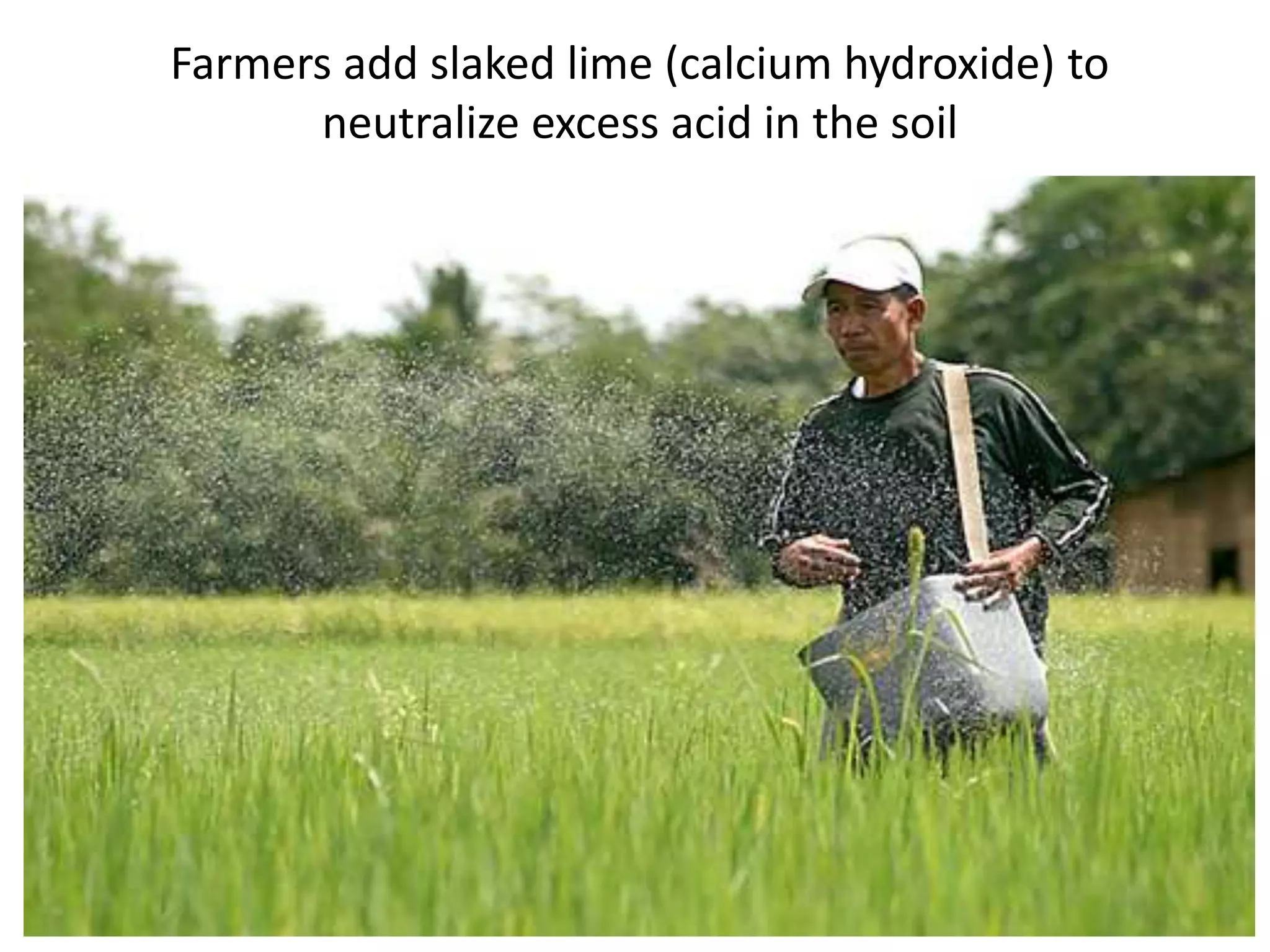
Farmers add slaked lime (calcium hydroxide) to
      neutralize excess acid in the soil
A mild alkali such as sodium hydrogen carbonate is
     used to treat a bee sting which is acidic.

Water and solutions

  • 1.
  • 2.
    water • Water isa colourless, odorless and tasteless liquid. • Water can exist in three state: - solid (ice) - liquid (water) - gas (steam)
  • 3.
    The changes ofwater occur at specific temperature Point Explanation Example Melting The temperature which solid Meting point of ice point becomes liquid = O oC Freezing The temperature which liquid Freezing point of point becomes solid water = 0 oC Boiling The temperature which liquid Boiling point of point becomes gas water = 100 oC SOLID LIQUID GAS melting boiling freezing
  • 4.
    Water test The presence of water can be determined by the tests shown below: Water test Observation/Result The freezing point The melting point of the water is 0 oC and and melting point the boiling point of the water is 100 oC (without any contamination) Anhydrous cobalt Changes from blue to pink chloride paper Anhydrous copper(II) Changes from white to blue sulphate
  • 5.
    SOLUTIONS A solution is a mixture formed when one or more solutes dissolve in a solvent. Water (solvent) Sugar solution (solution) Sugar (solute)
  • 6.
    Soluble and Insoluble SOLUBLE INSOLUBLE The substance will NOT The substance will dissolve in a liquid and dissolve in a liquid formed precipitate
  • 7.
    When a solutedissolves in solvent, the solvent breaks down the solutes into smaller particles
  • 8.
    Eventually, a homogeneous solution is formed.
  • 9.
    HOMOGENEOUS SOLUTION SUGAR WATER SOLUTION HETEROGENEOUS SOLUTION CHALK WATER SUSPENSION
  • 10.
    MASS OF ASOLUTION Mass of a solution = Mass of the solvent + Mass of solute When a solute dissolves in a solvent, it didn’t disappear!! 5 grams 20 grams 25 grams SUGAR WATER SOLUTION
  • 11.
    solvents Water is sucha good solvent that it can dissolve almost every solutes and it’s known as universal solvent. A solution in which the water is the solvent is called aqueous solution. Example, salt solution (salt + water)
  • 12.
    However, some substancesdo not dissolve in the water. Thus, organic solvents are used to dissolve it. Some of the examples are alcohol, kerosene, turpentine and acetone.
  • 13.
    solutions Diluted solution Concentrated Saturated solution solution Excess solute Has very little Has a lot of solute Has the maximum solute in it in it amount of solute in it Can dissolve a lot Can dissolve a Cannot dissolve any more solute little more solute more solute
  • 14.
    Add more Add more copper suphate copper suphate Diluted copper Concented copper Saturated copper sulphate solution sulphate solution sulphate solution
  • 15.
    CONCENTRATION OF ASOLUTION • A concentration of a solution = grams per dm3 (g/dm3) 1 dm3 = 1000 cm3 Example 1, Solution A contains 10.0g of solute in 1000cm3 solvent. Concentration = mass of solutes (g) volume of solvent (dm3) = 10.0 g/1 dm3 = 10.0 g/dm3
  • 16.
    Example 2, Solution Bcontains 5.0g of solute in 1000cm3 solvent. Concentration = mass of solutes (g) volume of solvent (dm3) = 5.0 g/1 dm3 = 5.0 g/dm3
  • 17.
    Example 3, Solution Ccontains 1.0g of solute in 100cm3 solvent. Concentration = mass of solutes (g) volume of solvent (dm3) = 1.0 g/0.1 dm3 1000 cm3 = 1 dm3 = 10.0 g/dm3 100 cm3 = 0.1dm3
  • 18.
    Example 4, Solution Dcontains 10.0g of solute in 10 000cm3 solvent. Concentration = mass of solutes (g) volume of solvent (dm3) = 10 g/10 dm3 1000 cm3 = 1 dm3 = 1.0 g/dm3 10 000 cm3 = 10dm3
  • 19.
    Example 5, Solution Dcontains 5.0g of solute in 100 cm3 solvent. Concentration = mass of solutes (g) volume of solvent (dm3) = ?????
  • 20.
    Example 6, Solution Econtains 0.1g of solute in 10 cm3 solvent. Concentration = mass of solutes (g) volume of solvent (dm3) = ?????
  • 21.
    Uses of solvents& solutions (A) HOME Water is used for cooking, drinking, & cleaning.
  • 22.
    Water is usedto dissolve detergents and many types of stains
  • 23.
    Water is usedto make drinks and beverages.
  • 24.
    Mineral salts andfertilizers are (B) AGRICULTURE dissolved in water so that plants can absorb them.
  • 25.
    In hydroponics, theroots of plants are immersed in solutions containing dissolved mineral salts.
  • 26.
    (C) MEDICINE Medicinal drugsare sometimes mixed with sugar solutions to make them taste better. Examples are cough mixtures and vitamin- C enriched drinks
  • 27.
    (D) INDUSTRY Turpentine,alcohol and other types of solvents are used in the manufacturing of paints, inks and dyes.
  • 28.
    SOLUBILITY • A solventcan only dissolve a certain amount of solute. • Solubility is the maximum amount of solute in grams that will dissolve in 100g of solvent. • The solution produced is a saturated solution. Solubility = ______ g of solute /100g of solvent
  • 29.
    THE FACTORS AFFECTINGTHE SOLUBILITY (1) The nature of the solvent (2) The nature of the solute (3) Temperature
  • 30.
    (1) THE NATUREOF THE SOLVENT • The solubility of a solute is different in different solvents. • A polar (likes water) solute dissolved in polar solvent (water). • A non-polar (doesn’t like water) solute dissolved in non- polar solvent (ether or alcohol) Water Alcohol (Polar solvent) (Non-polar solvent) Salt (Polar MORE SOLUBLE LESS SOLUBLE solute) Iodine (Non- LESS SOLUBLE MORE SOLUBLE polar solute)
  • 31.
    Undissolved Dissolved iodine iodine in water in alcohol
  • 32.
    (2) THE NATUREOF THE SOLUTE • Different solutes have different solubility in a given solvent. Solute Solubility at 20oC (g/100mL of water) Copper (II) sulphate 20 Potassium nitrate 30 Sodium chloride 38 ***Among the 3 solutes, sodium chloride is the most soluble in water.
  • 33.
    (3) THE TEMPERATURE •Generally in many cases solubility increases with the rise in temperature • Decreases with the fall of temperature but it is not necessary in all cases. • Gases are more soluble in cold solvent than in hot solvent.
  • 34.
  • 35.
    acid • The wordcomes from Latin word ‘acidus’, which means sour. • Acid in food gives the food a sour and tangy taste. • Acids in the laboratory are harmful. Example: – Hydrochloric acid – Sulphuric acid – Nitric acid
  • 36.
    Properties of acid (a) Acids taste sour
  • 37.
    (b) Strong acidsare corrosive If it comes into contact with the skin, it will burn.
  • 38.
    (c) Acids turnsthe blue litmus paper into red.
  • 39.
    (d) Dilute acidsreact with reactive metals to form hydrogen gas. Dilute + zinc hydrochloric Bubbles of acid hydrogen gas zinc + hydrogen chloride
  • 40.
    To identify thegas produced: use a lighted splint. Hydrogen gas extinguished a lighted splint with a “pop” sound.
  • 41.
    (e) Dilute acidsreact with carbonates to produce carbon dioxide Dilute nitric + calcium acid carbonate calcium + water + carbon nitrate dioxide
  • 42.
    Diluted acid + carbonate To identify the gas produced: pass it through some lime water (calcium hydroxide solution) A white precipitate is formed when carbon dioxide gas is bubbled into limewater. Limewater
  • 43.
    alkali • Alkali isthe chemical ‘opposite’ of acid • Alkali are often used in many household cleaners such as detergents, soap and etc • Alkalis that are commonly used in the laboratory are: – Ammonia solution – Sodium hydroxide – Potassium hydroxide
  • 44.
    Properties of alkali (a) Alkalis have bitter taste and are soapy and slippery when touch
  • 45.
    (b) Strong alkalisare corrosive. Strong alkali like sodium hydroxide are highly corrosive
  • 46.
    (c) Alkalis turnthe red litmus paper into blue
  • 47.
    indicators An indicator isa dye or a mixture of dyes which changes color according to the acidity or alkalinity of a substance.
  • 48.
    Litmus paper The main use is to test whether the solution is acidic or alkaline. Test with acid Test with alkali Red litmus paper No changes Red  blue Blue litmus paper Blue  red No changes
  • 49.
    pH scale The pH scale is used to express acidity and alkalinity. Acidic Neutral Alkali
  • 50.
    How to checkthe pH of the solution? Two ways Universal Universal indicator paper indicator solution
  • 51.
    Results: Indicator paper Indicator solution
  • 52.
    A pH meter is used to measure the pH values of substances quickly.
  • 53.
    NEUTRALIZATION Acid + Alkali Salt + Water Acidic Neutral Alkali
  • 54.
    ALKALI To neutralize an acid, an alkali is used. The alkali is dripped into a conical flask containing acid and stop once the color changes from red (acidic pH) to green (neutral pH). ACID
  • 55.
    ACID To neutralize an alkali, an acid is used. The acid is dripped into a conical flask containing alkali and stop once the color changes from dark blue (alkalic pH) to green (neutral pH). ALKALI
  • 56.
    USAGE OF NEUTRALIZATION Analkali, magnesium hydroxide is used in the toothpaste to neutralize the acids produced by the bacteria in the mouth
  • 57.
    Farmers add slakedlime (calcium hydroxide) to neutralize excess acid in the soil
  • 58.
    A mild alkalisuch as sodium hydrogen carbonate is used to treat a bee sting which is acidic.