Keith D Swenson VP, Fujitsu Computer Systems Technical Committee Chair, WfMC Workflow and BPM in the New Enterprise Architecture Welcome   to Transformation and Innovation 2007  The Business Transformation Conference Welcome
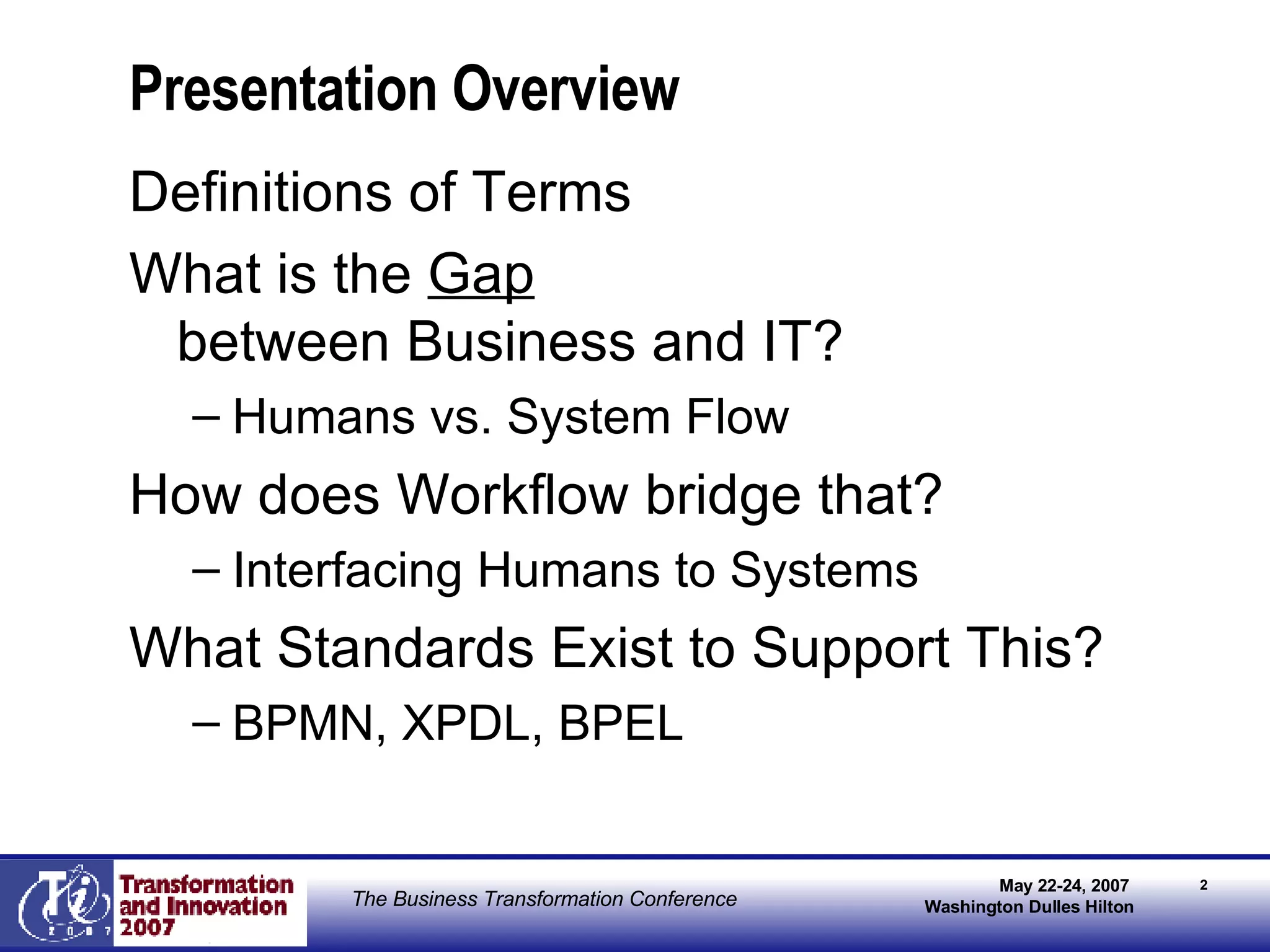
Presentation Overview Definitions of Terms What is the  Gap   between Business and IT? Humans vs. System Flow How does Workflow bridge that? Interfacing Humans to Systems What Standards Exist to Support This? BPMN, XPDL, BPEL
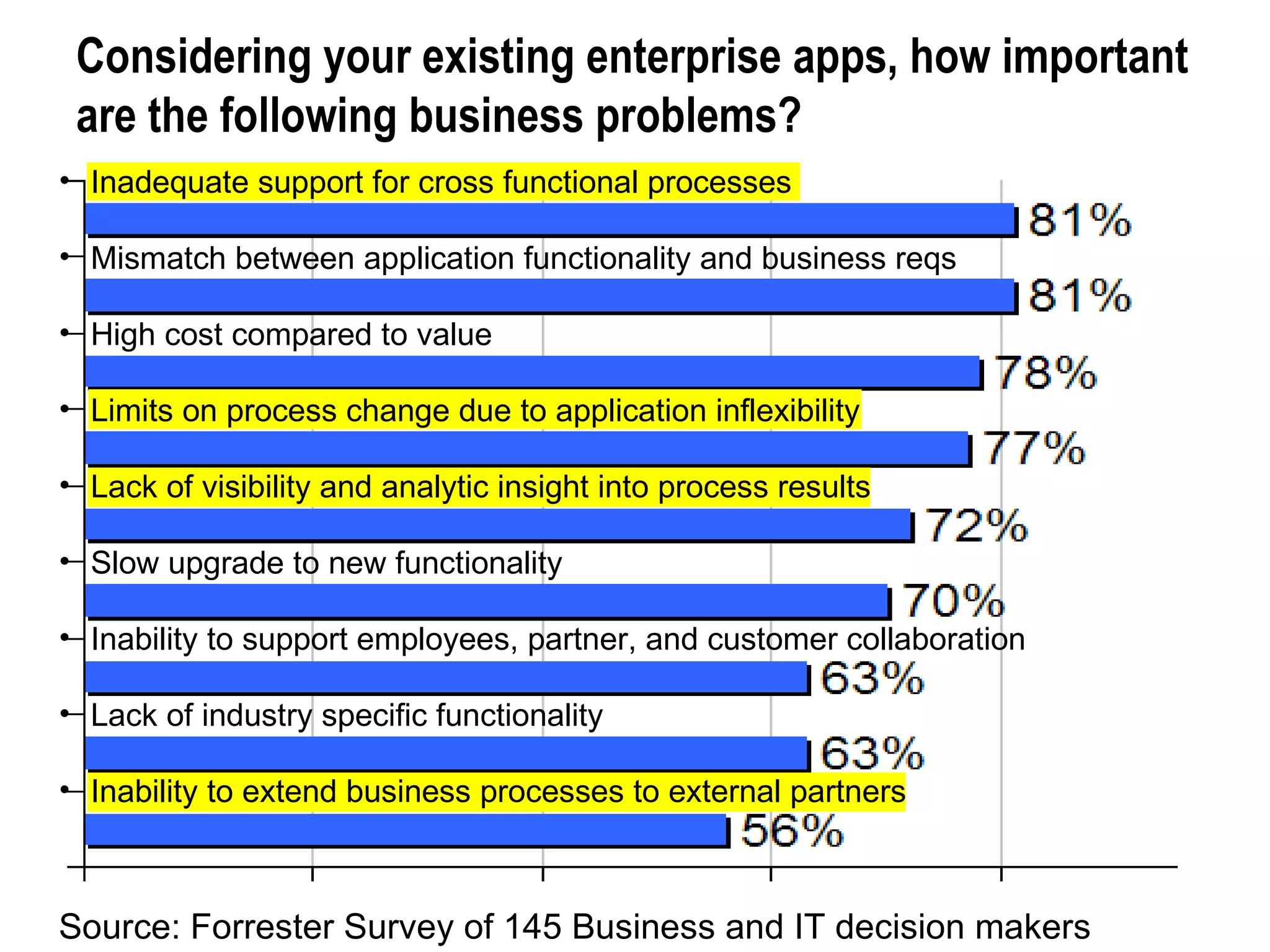
Considering your existing enterprise apps, how important are the following business problems? Source: Forrester Survey of 145 Business and IT decision makers Inadequate support for cross functional processes Mismatch between application functionality and business reqs High cost compared to value Limits on process change due to application inflexibility Lack of visibility and analytic insight into process results Slow upgrade to new functionality Inability to support employees, partner, and customer collaboration Lack of industry specific functionality Inability to extend business processes to external partners
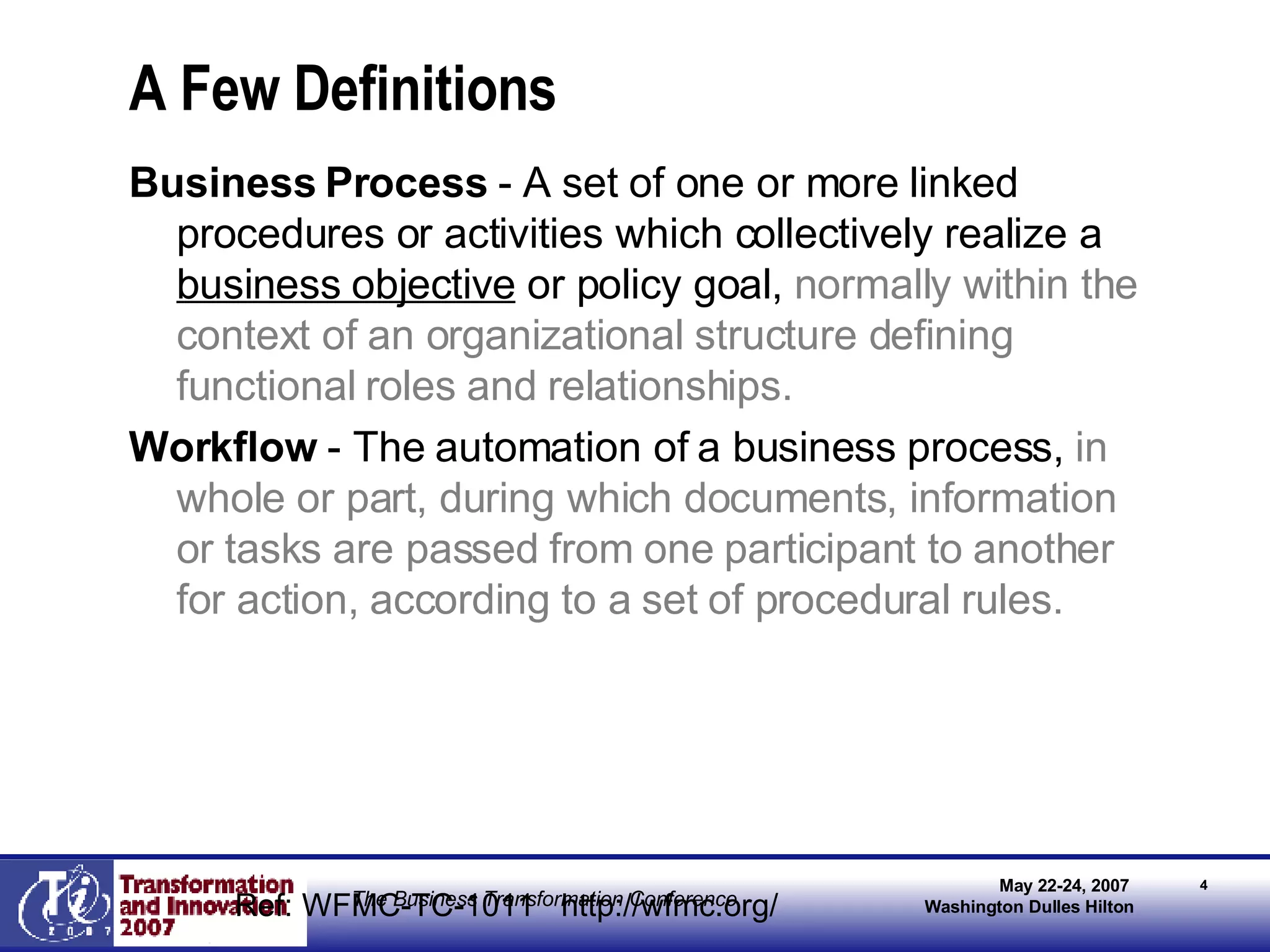
A Few Definitions Business Process  - A set of one or more linked procedures or activities which collectively realize a  business objective  or policy goal,  normally within the context of an organizational structure defining functional roles and relationships.   Workflow  - The automation of a business process,  in whole or part, during which documents, information or tasks are passed from one participant to another for action, according to a set of procedural rules. Ref: WFMC-TC-1011  http://wfmc.org/
A Few Definitions Process Definition  - The representation of a business process in a form which supports automated manipulation,  such as modeling, or enactment by a workflow management system.  The process definition consists of a network of activities and their relationships,  criteria to indicate the start and termination of the process, and information about the individual activities, such as participants, associated IT applications and data, etc.
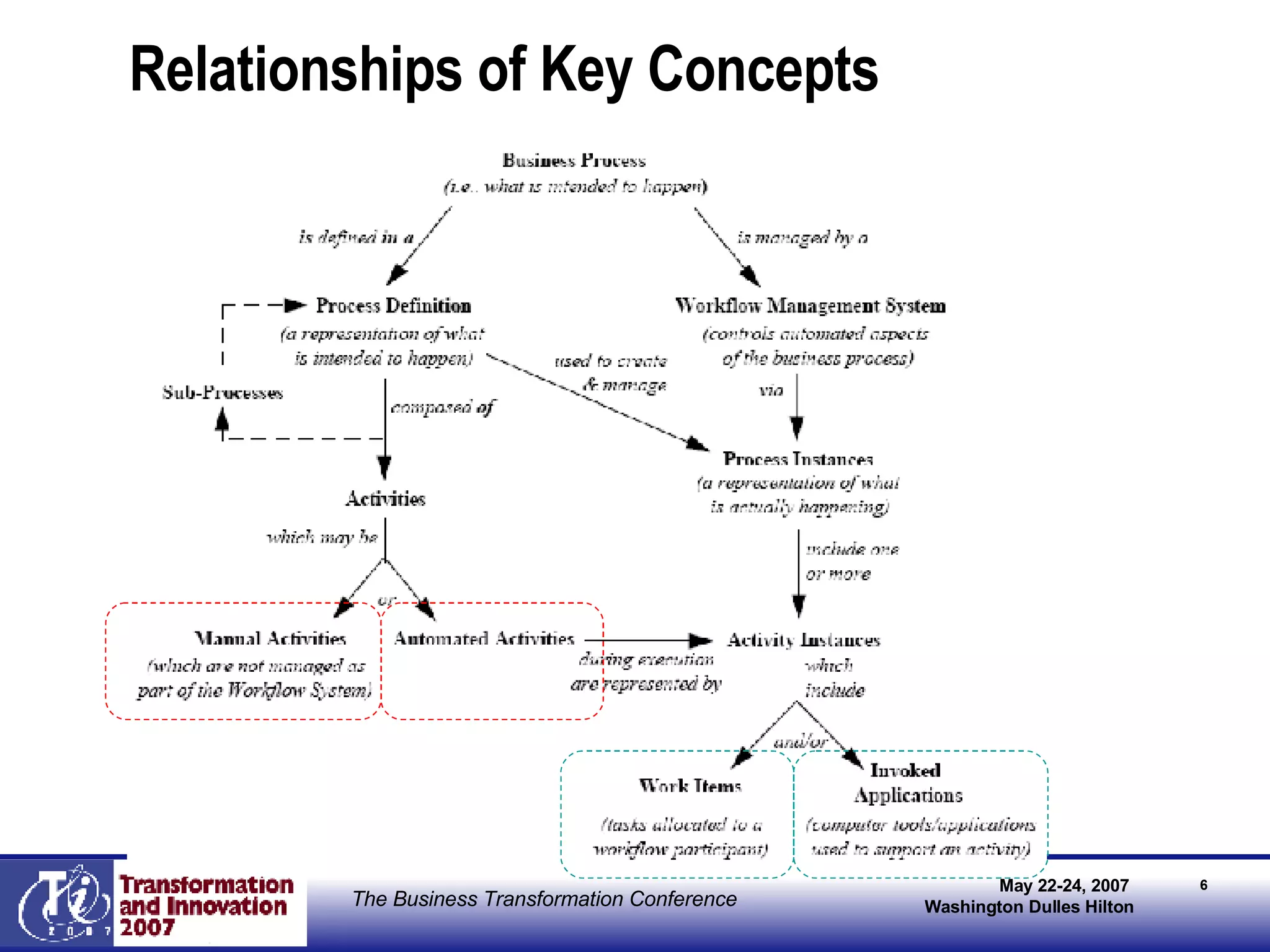
Relationships of Key Concepts
One Last Definition Business Process Management  – The  practice  of developing, running, performance measuring, and simulating  Business Processes to effect the continued improvement of those processes.  Business Process Management is concerned with the  lifecycle  of the Process Definition.
Unfortunately, Industry not Consistent WS-BPEL has received a lot of attention recently to the benefit of a few key vendors. Now people are learning the truth --  it handles only a small part of the space. While clearly important for Orchestration, positioned as something  business  related only confuses the market.
What is “Human” BPM? Because of all the inconsistent uses of the term “BPM” to mean only invoked web services, we now talk about “Human” BPM to stress the complete picture of both manual & automated activities. Workflow  also include the concept of manual & automated activities is used interchangeably with “Human” BPM.
What is the Gap Between Business & IT?
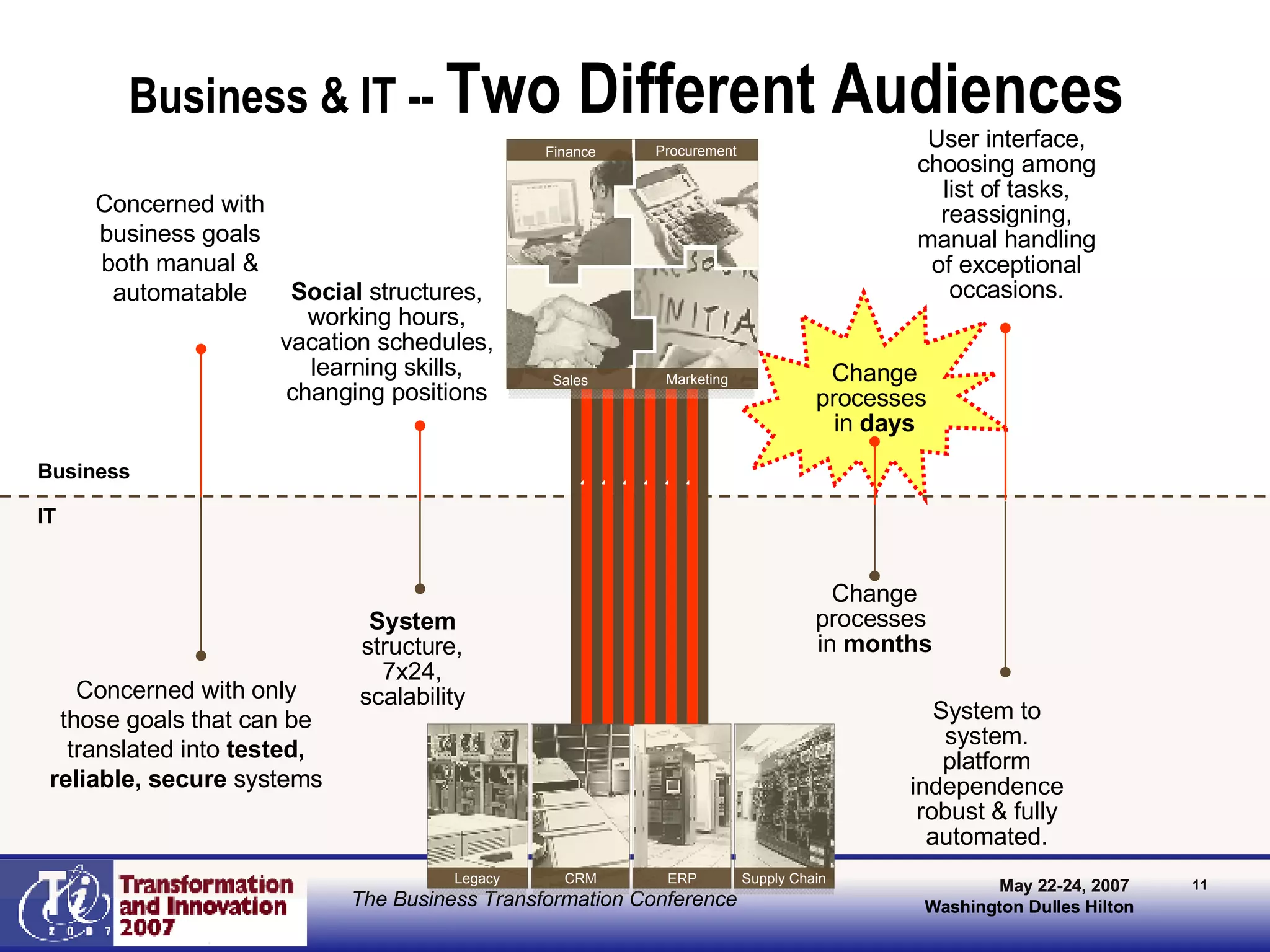
Business & IT --  Two Different Audiences Business IT Concerned with only those goals that can be translated into  tested, reliable, secure  systems Concerned with business goals both manual & automatable Social  structures, working hours, vacation schedules, learning skills, changing positions System structure, 7x24, scalability System to system. platform independence robust & fully automated. User interface, choosing among list of tasks, reassigning, manual handling of exceptional occasions. Change processes  in  days Change processes  in  months ? ? ? ? ? ? Legacy CRM ERP Supply Chain Sales Marketing Finance Procurement
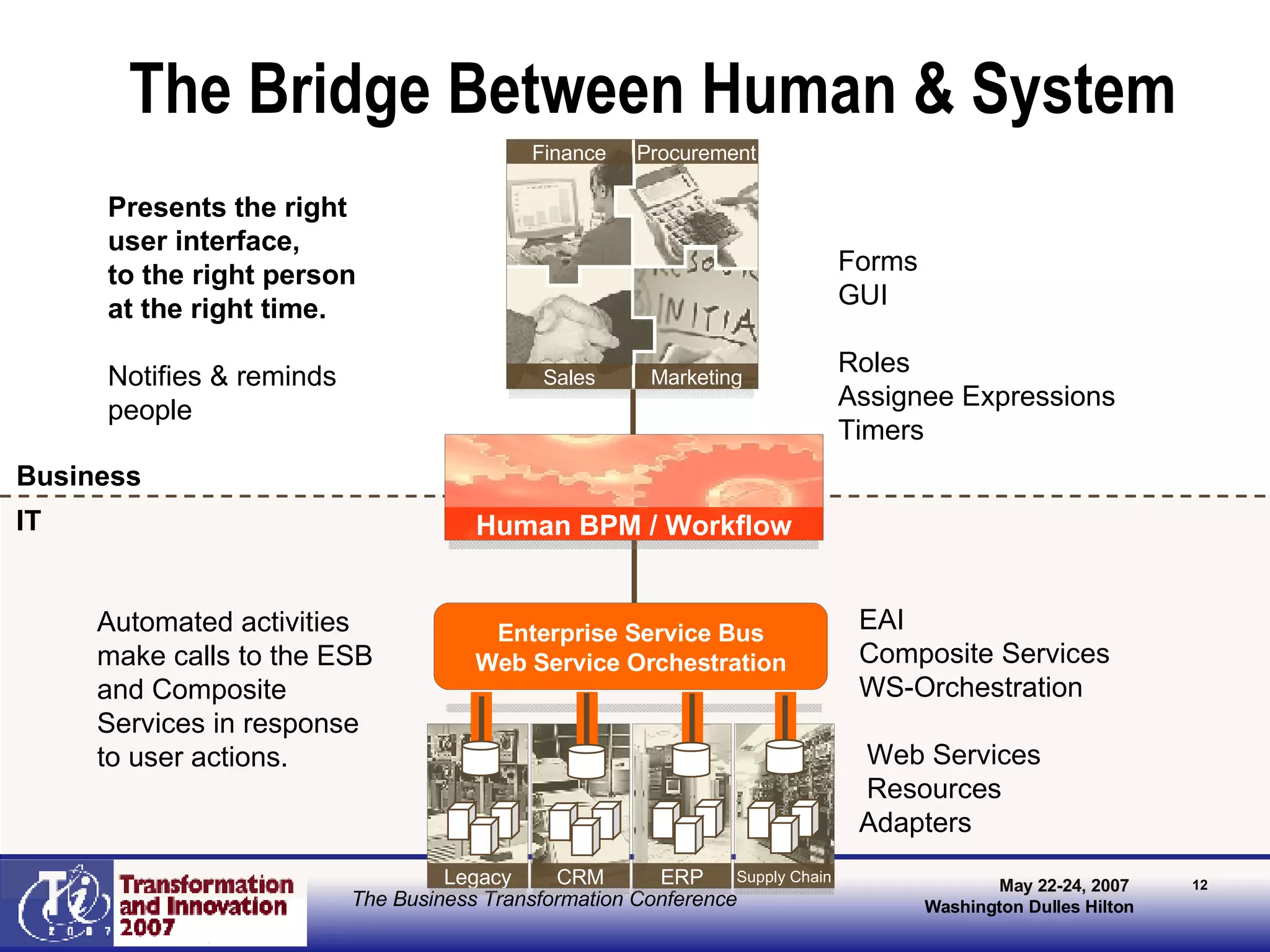
The Bridge Between Human & System CRM Legacy ERP Supply Chain Sales Marketing Finance Procurement Business IT Enterprise Service Bus Web Service Orchestration Presents the right user interface,  to the right person  at the right time. Notifies & reminds people Automated activities make calls to the ESB and Composite Services in response to user actions. EAI Composite Services WS-Orchestration Web Services Resources Adapters Forms GUI Roles Assignee Expressions Timers Human BPM / Workflow
What is the purpose of BPM / Workflow Place in the hands of business professionals the ability to modify their processes, with no involvement from the IT organization Michael Melenovsky, Gartner ... process changes are made by business professionals who need only limited knowledge of IT systems. In a growing number of cases, changes such as work item routing, business rule overrides, and parametric changes to approval levels, are made in real time to executing process. Janelle Hill, Gartner
Where is it Going? By 2009, 20 percent of business processes in the Global 2000 will be supported on BPMS[*]. These processes will be predominantly those that involve a lot of human work, that differentiate the company from its competitors and that are poorly supported by existing IT systems (0.7 probability). Janelle Hill, Gartner *  BPMS is defined as a suite that handles both human and system processes.
How Does Workflow Bridge the Gap?
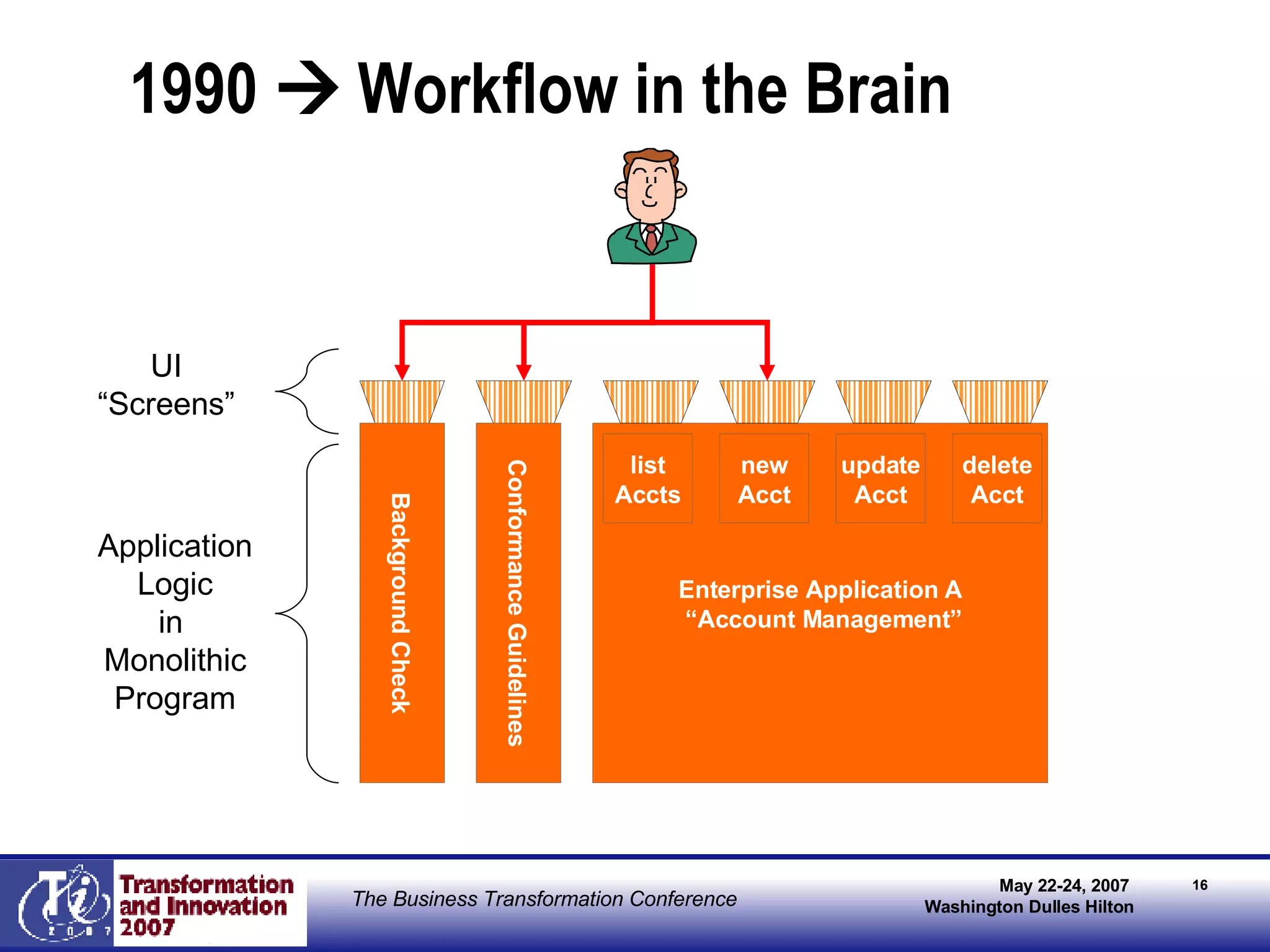
1990    Workflow in the Brain Enterprise Application A “ Account Management” Background Check Conformance Guidelines Application Logic in  Monolithic Program UI “Screens” list Accts new Acct update Acct delete Acct
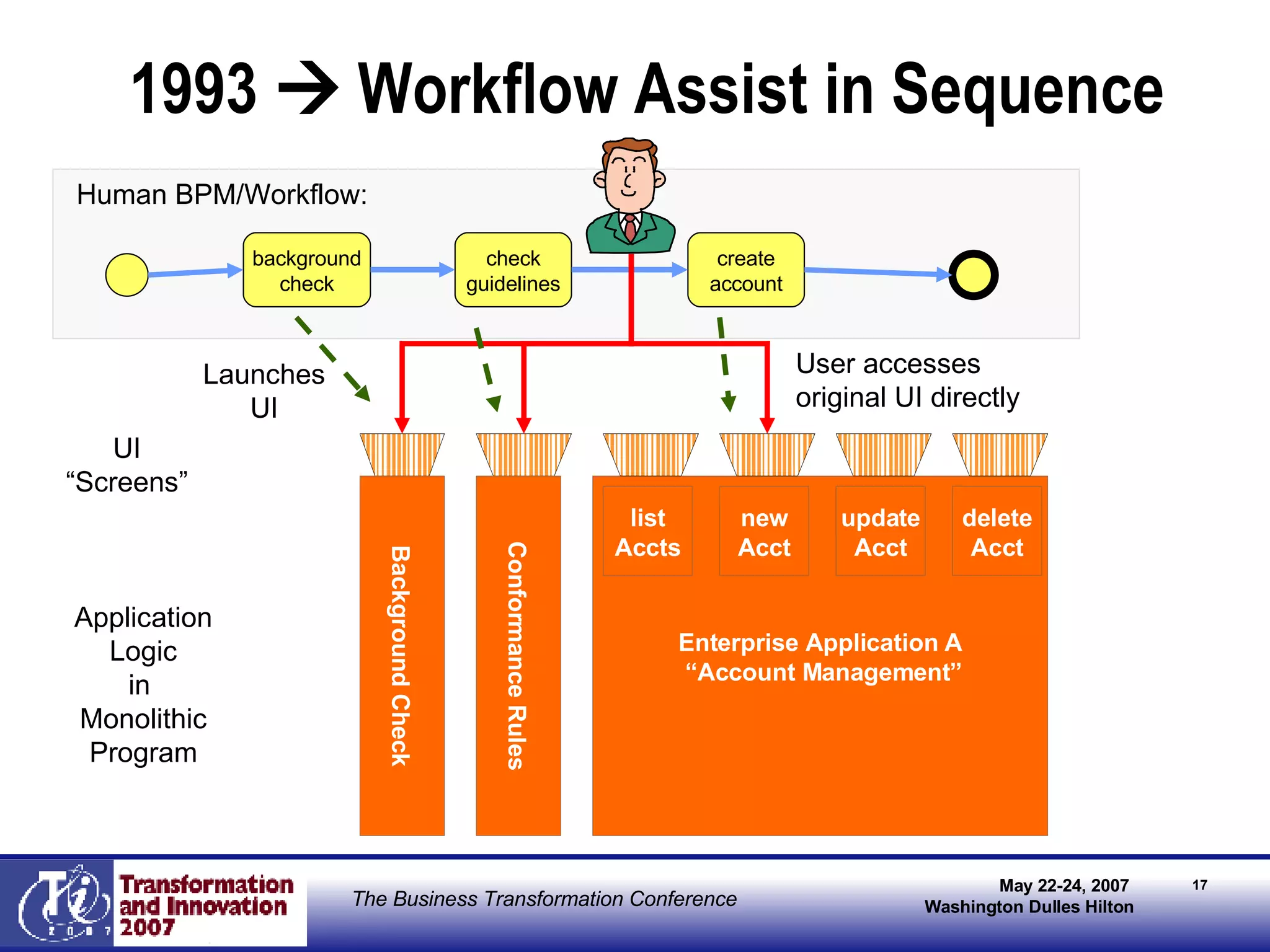
1993    Workflow Assist in Sequence Enterprise Application A “ Account Management” Background Check Conformance Rules Application Logic in  Monolithic Program UI “ Screens” list Accts new Acct update Acct delete Acct Launches UI User accesses original UI directly background check create account check guidelines Human BPM/Workflow:
1996    Distribute Work Enterprise Application A “ Account Management” Background Check Conformance Rules Application Logic in  Monolithic Program UI “ Screens” list Accts new Acct update Acct delete Acct background check create account check guidelines Launches
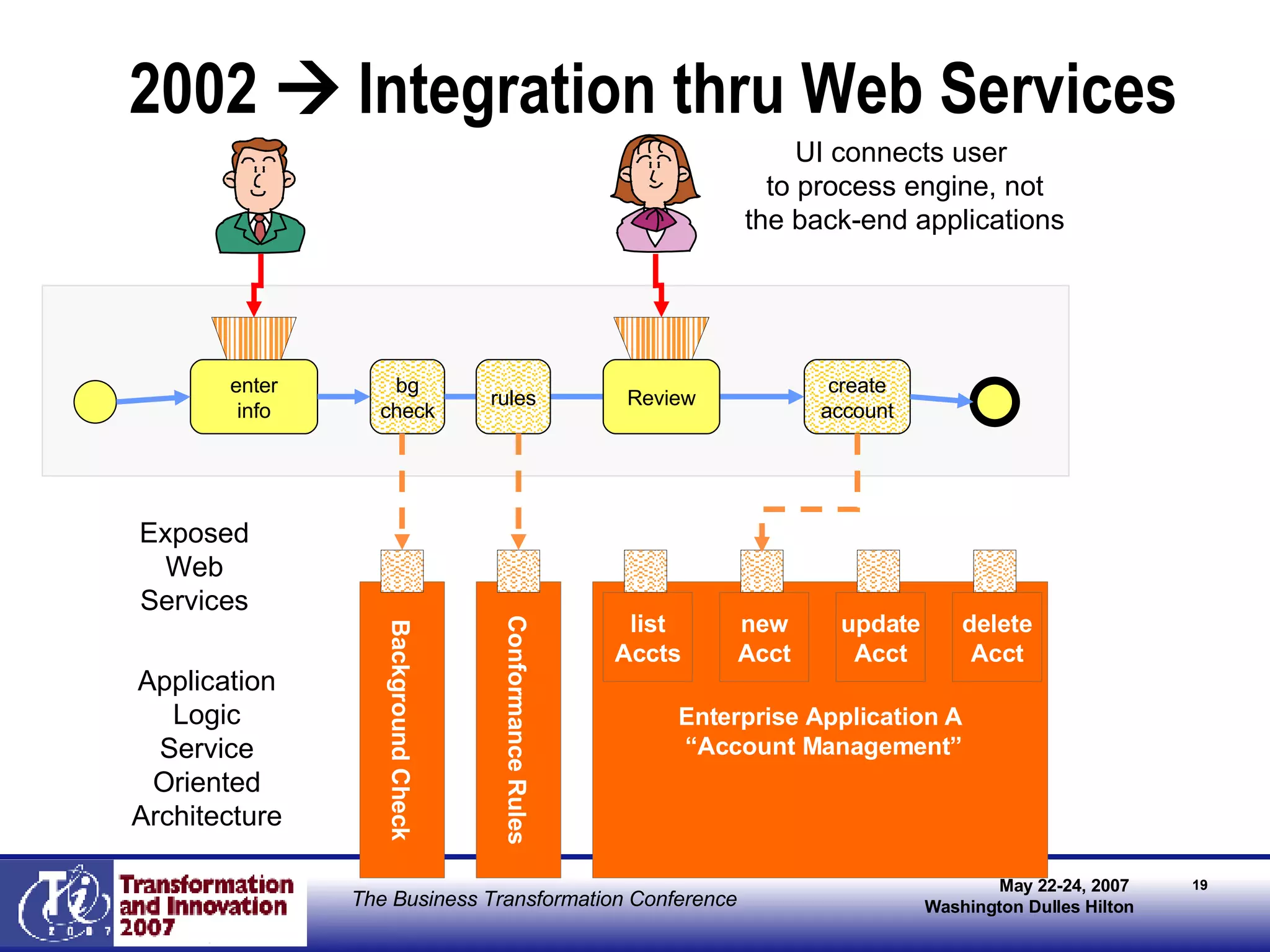
2002    Integration thru Web Services Enterprise Application A “ Account Management” Background Check Conformance Rules Application Logic Service Oriented Architecture Exposed Web Services list Accts new Acct update Acct delete Acct enter info create account bg check rules Review UI connects user  to process engine, not the back-end applications
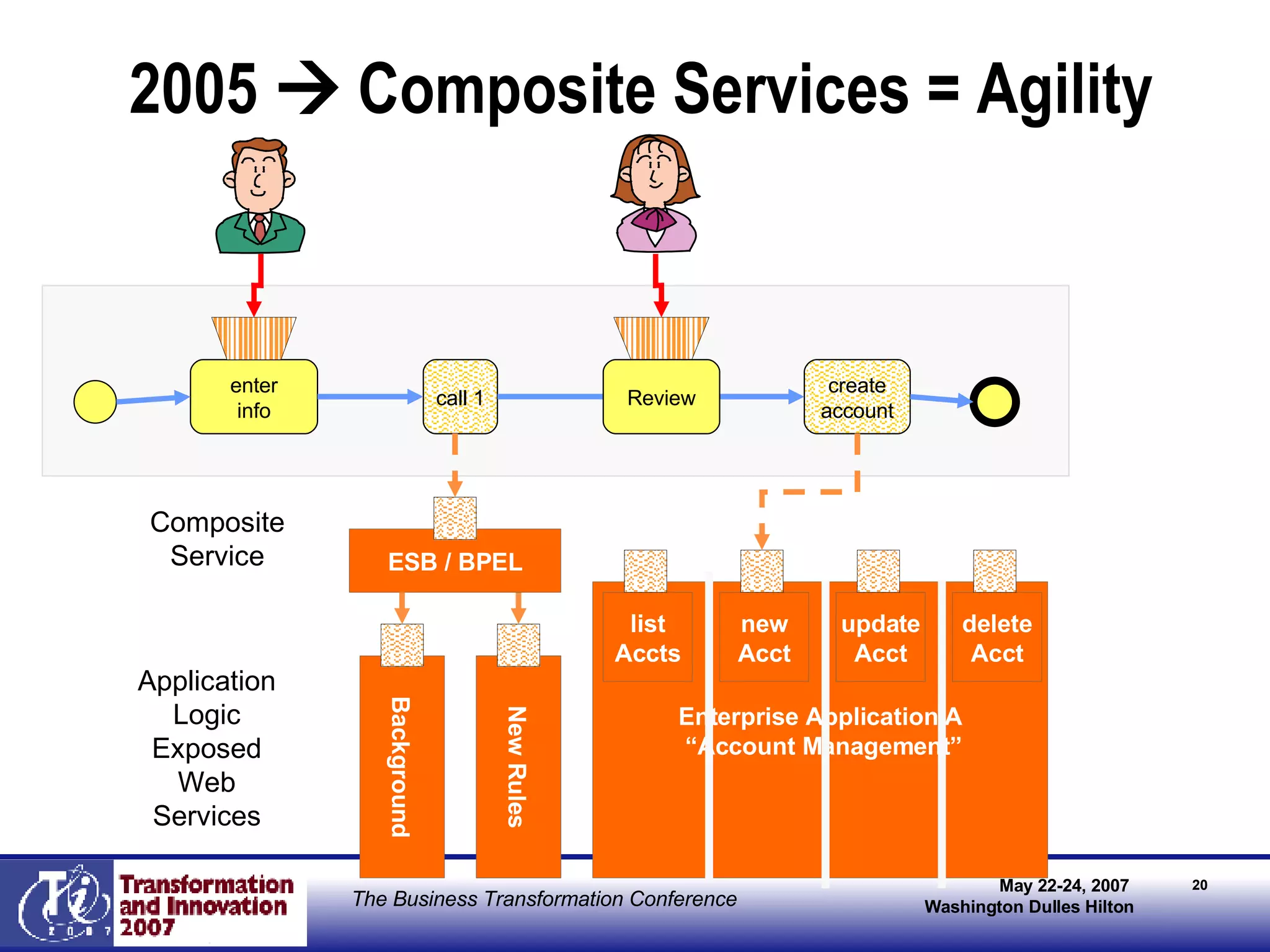
2005    Composite Services = Agility Old Rules Enterprise Application A “ Account Management” Background New Rules list Accts new Acct update Acct delete Acct enter info create account call 1 Review ESB / BPEL Application Logic Exposed Web Services Composite Service
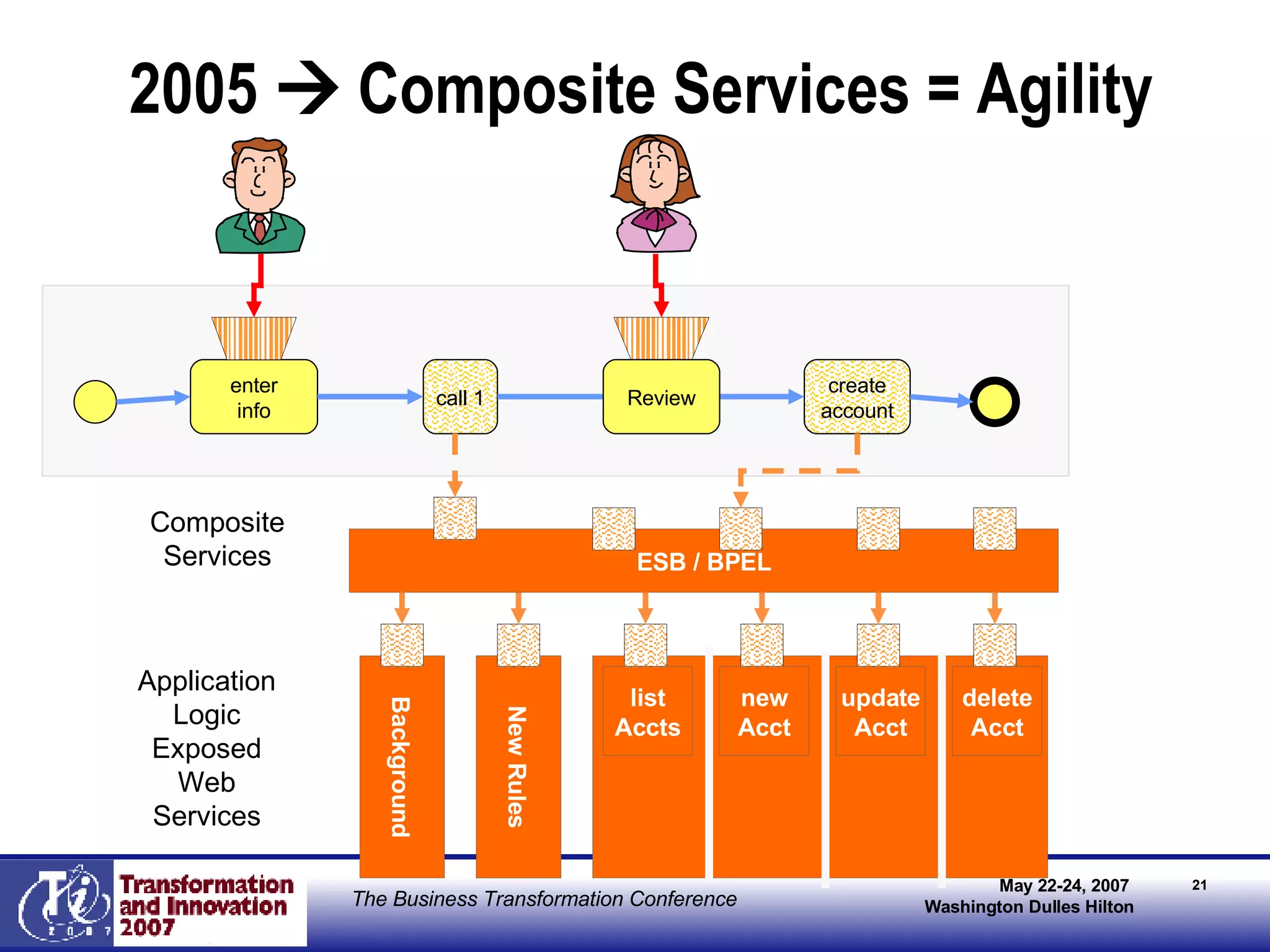
2005    Composite Services = Agility Old Rules Background New Rules list Accts new Acct update Acct delete Acct enter info create account call 1 Review ESB / BPEL Application Logic Exposed Web Services Composite Services
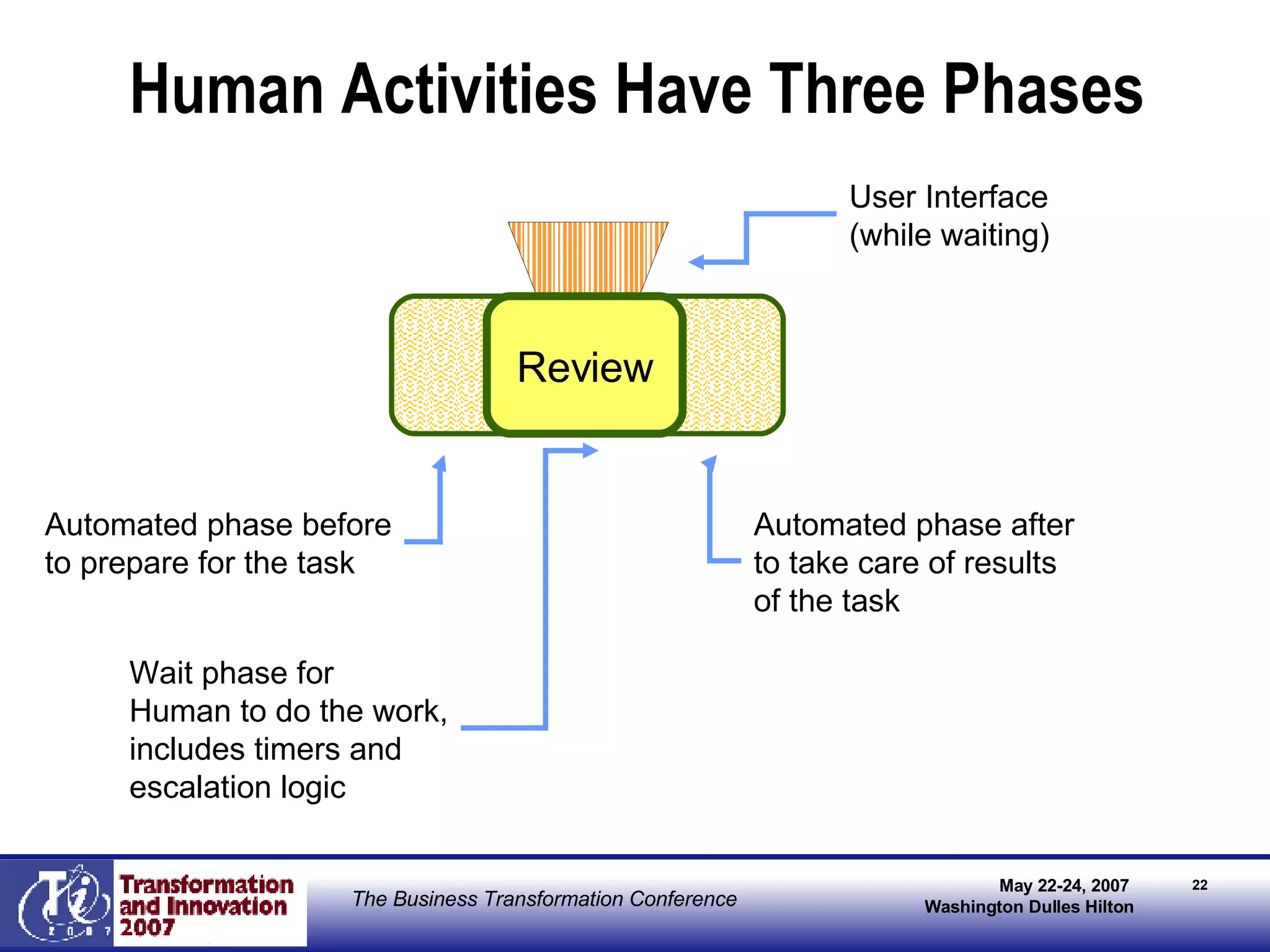
Human Activities Have Three Phases Review Automated phase before to prepare for the task Wait phase for  Human to do the work, includes timers and escalation logic Automated phase after to take care of results of the task User Interface (while waiting)
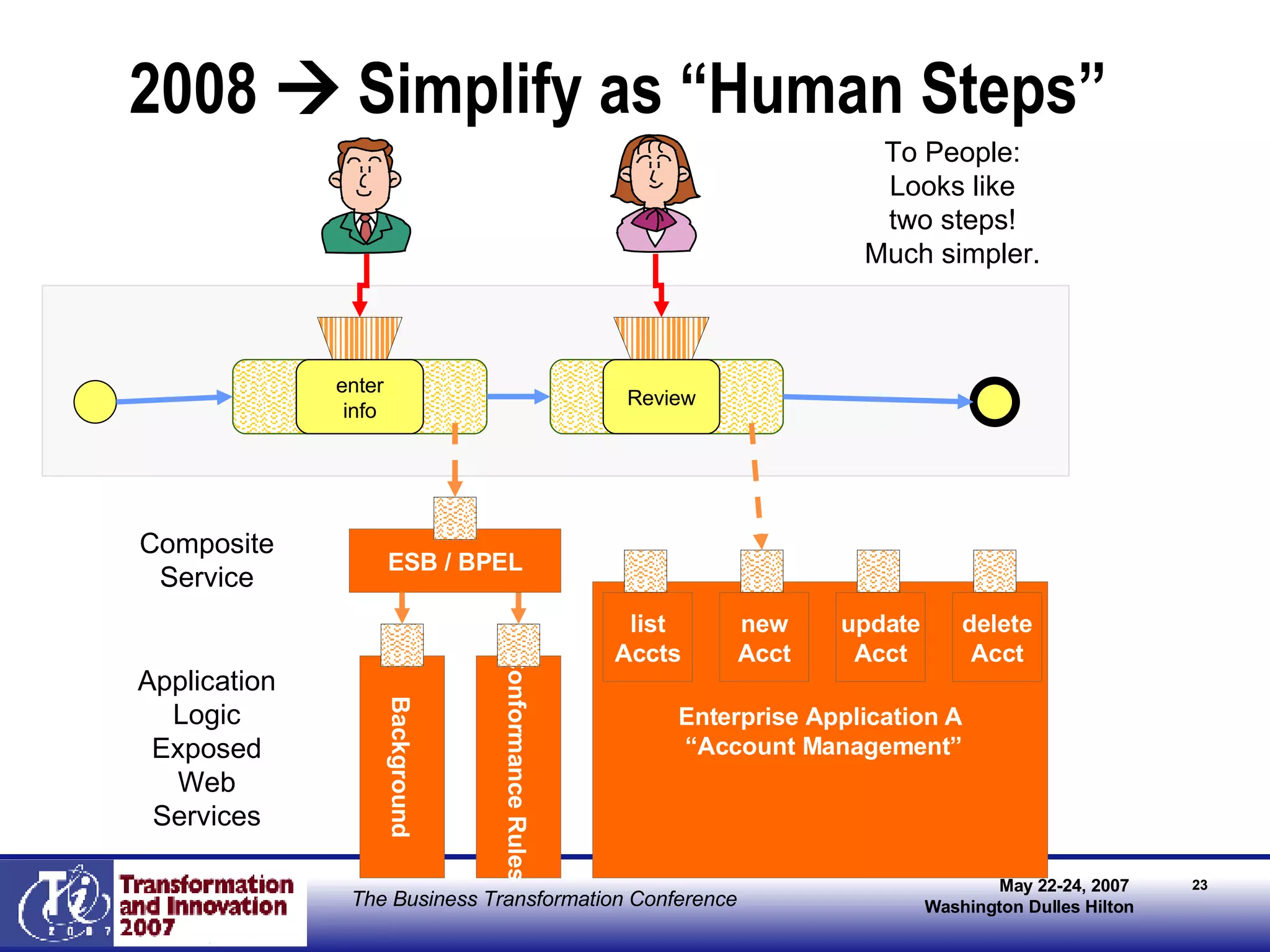
2008    Simplify as “Human Steps” Enterprise Application A “ Account Management” Background Conformance Rules Application Logic Exposed Web Services list Accts new Acct update Acct delete Acct call 1 Review ESB / BPEL enter info Composite Service To People: Looks like two steps! Much simpler.
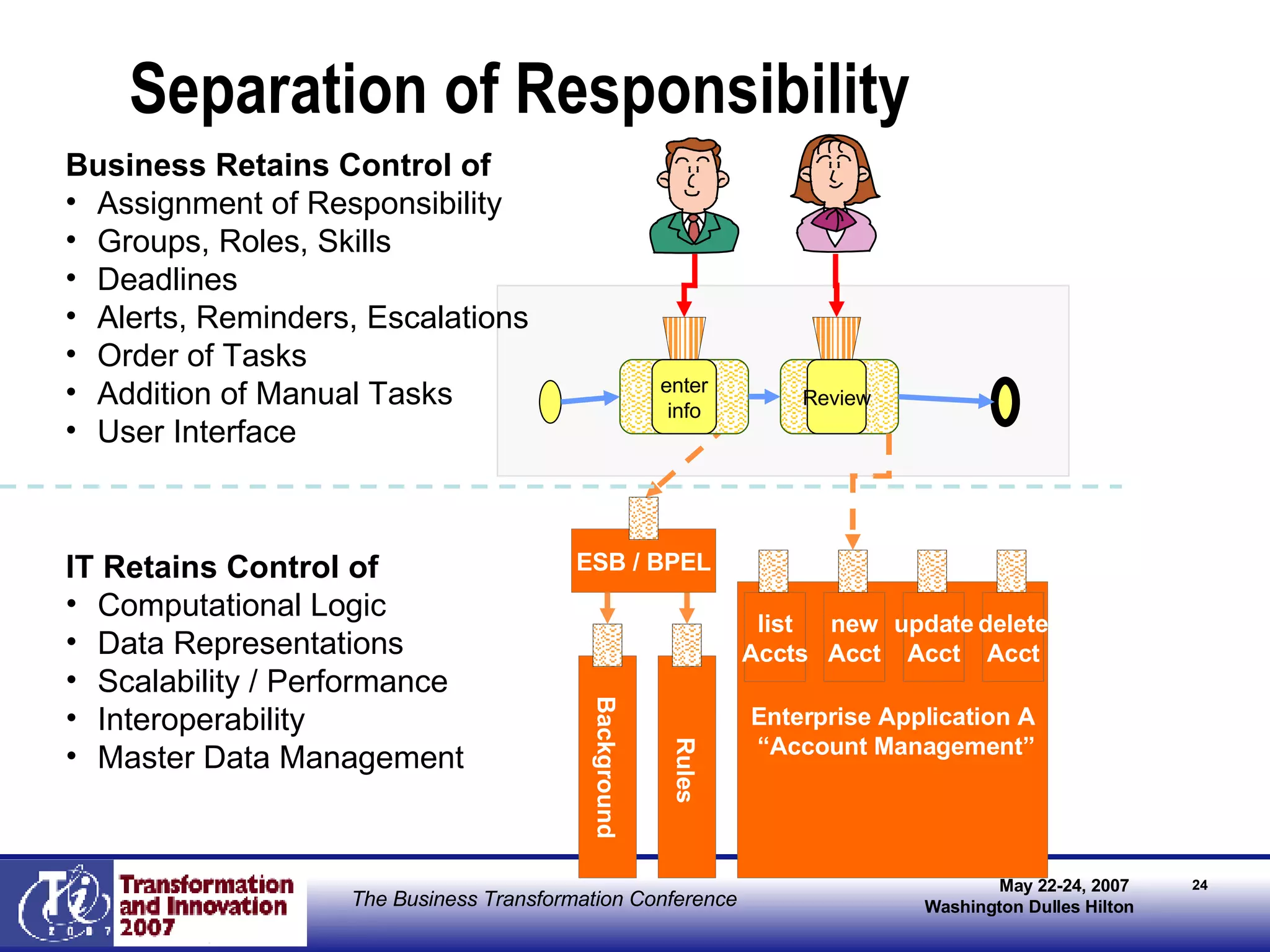
Separation of Responsibility Business Retains Control of Assignment of Responsibility Groups, Roles, Skills Deadlines Alerts, Reminders, Escalations Order of Tasks Addition of Manual Tasks User Interface IT Retains Control of Computational Logic Data Representations Scalability / Performance Interoperability Master Data Management Enterprise Application A “ Account Management” Background Rules list Accts new Acct update Acct delete Acct ESB / BPEL call 1 Review enter info
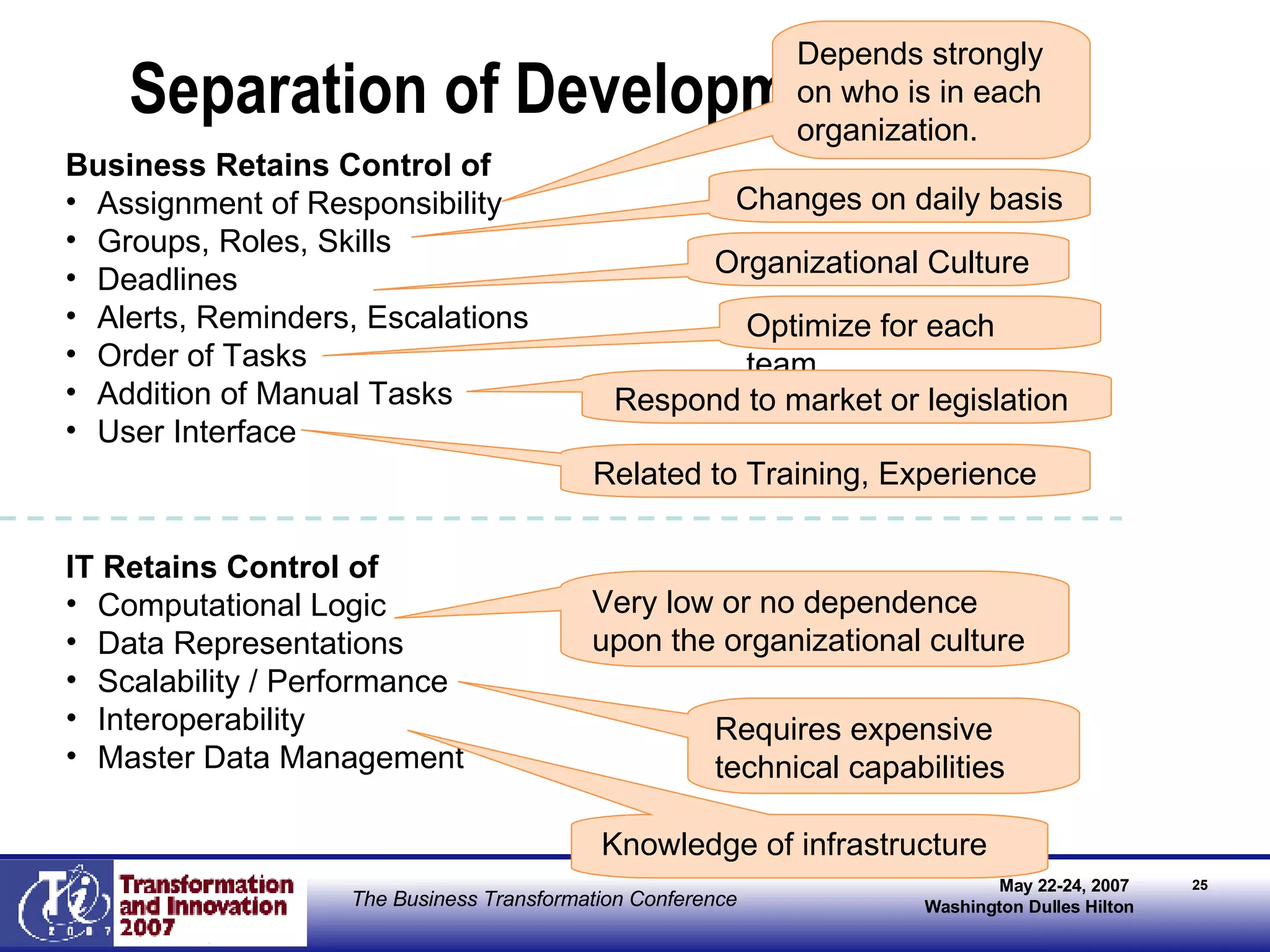
Separation of Development Business Retains Control of Assignment of Responsibility Groups, Roles, Skills Deadlines Alerts, Reminders, Escalations Order of Tasks Addition of Manual Tasks User Interface IT Retains Control of Computational Logic Data Representations Scalability / Performance Interoperability Master Data Management Depends strongly on who is in each organization. Changes on daily basis Organizational Culture Optimize for each team Respond to market or legislation Related to Training, Experience Requires expensive technical capabilities Very low or no dependence upon the organizational culture Knowledge of infrastructure Who? When? What? How?
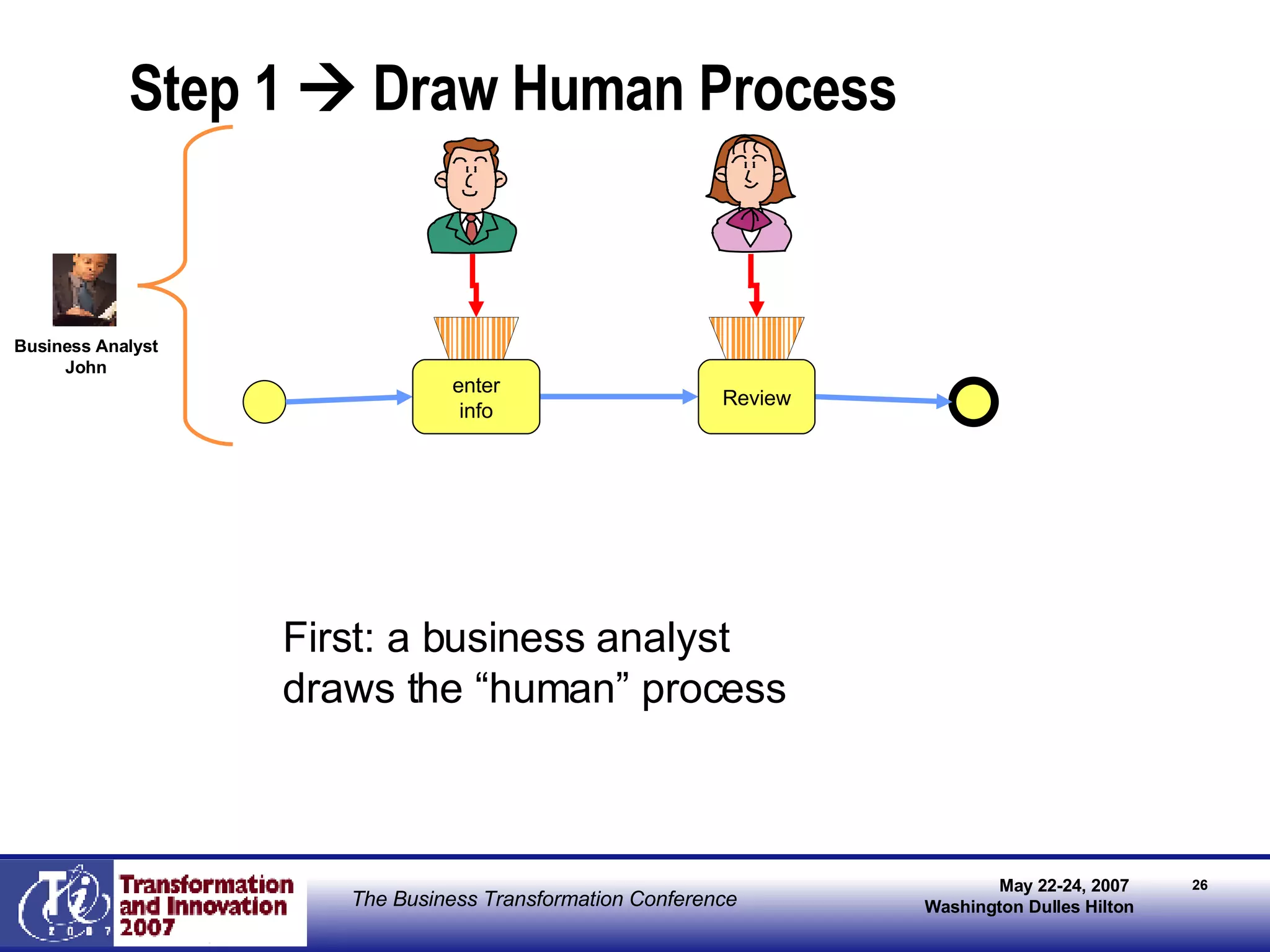
Step 1    Draw Human Process Review enter info First: a business analyst  draws the “human” process Business Analyst John
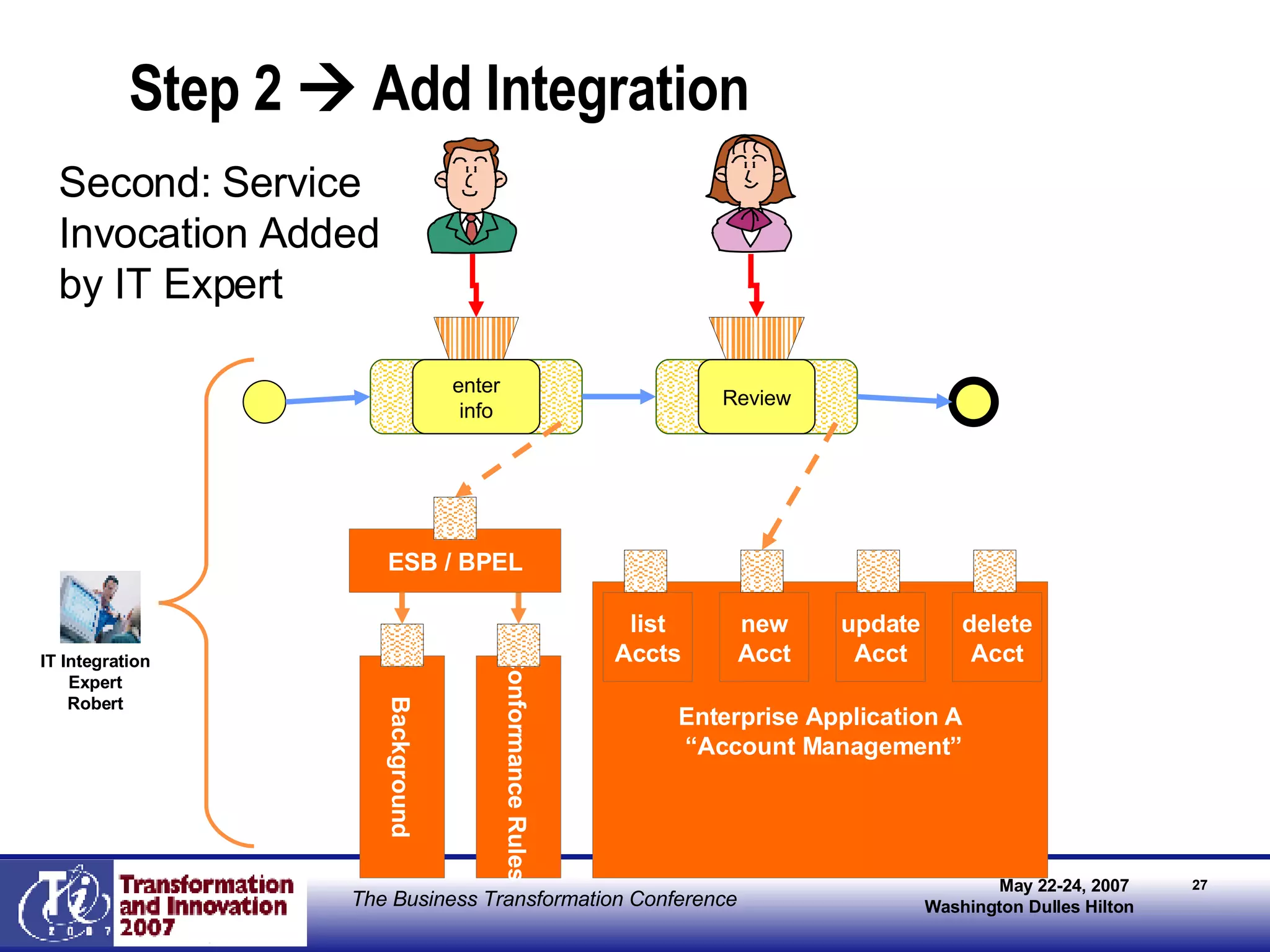
Step 2    Add Integration Enterprise Application A “ Account Management” Background Conformance Rules list Accts new Acct update Acct delete Acct call 1 Review ESB / BPEL enter info Second: Service Invocation Added by IT Expert IT Integration Expert Robert
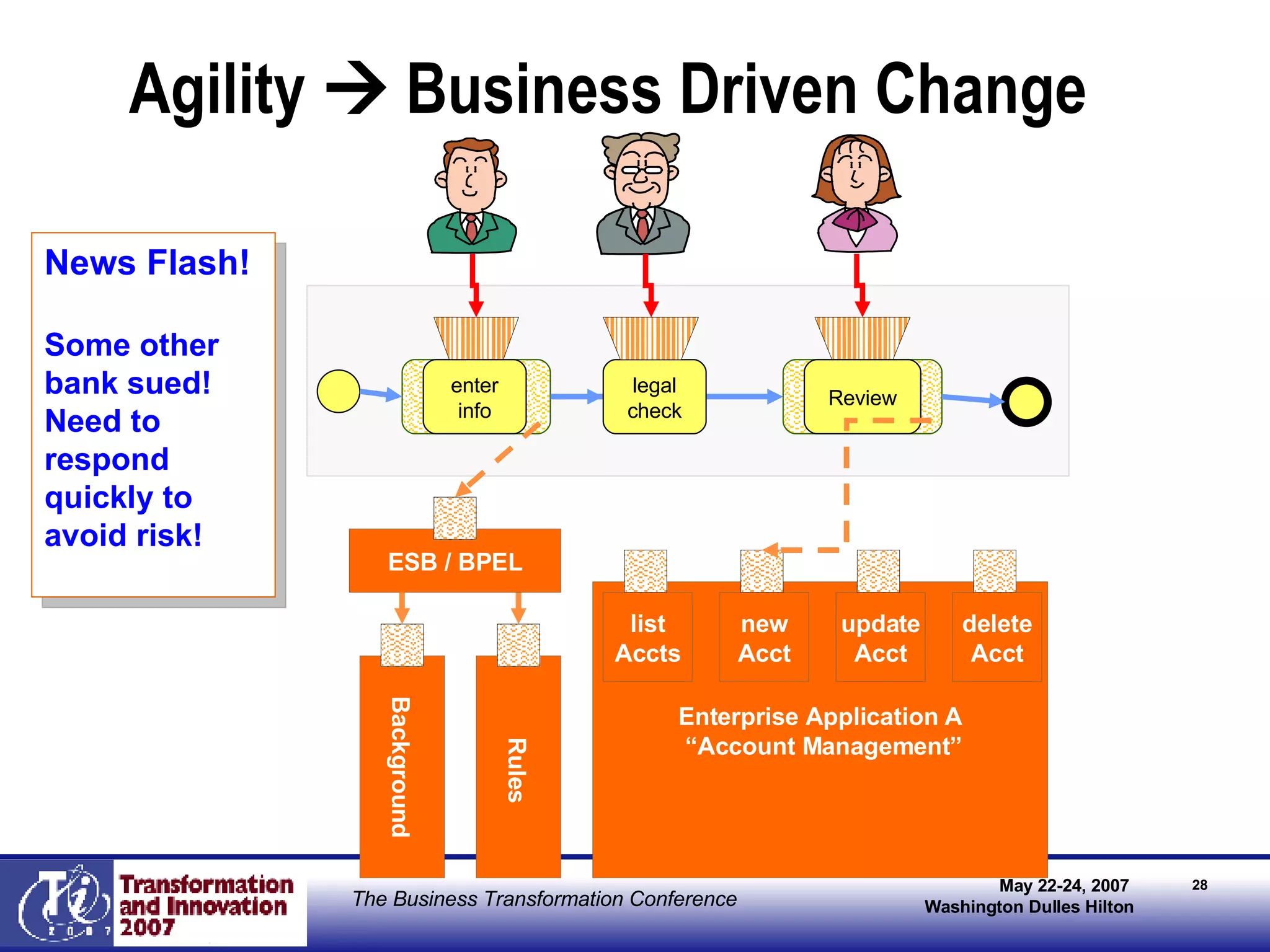
Agility    Business Driven Change Enterprise Application A “ Account Management” Background Rules list Accts new Acct update Acct delete Acct call 1 Review ESB / BPEL enter info News Flash! Some other bank sued! Need to  respond quickly to  avoid risk! legal check
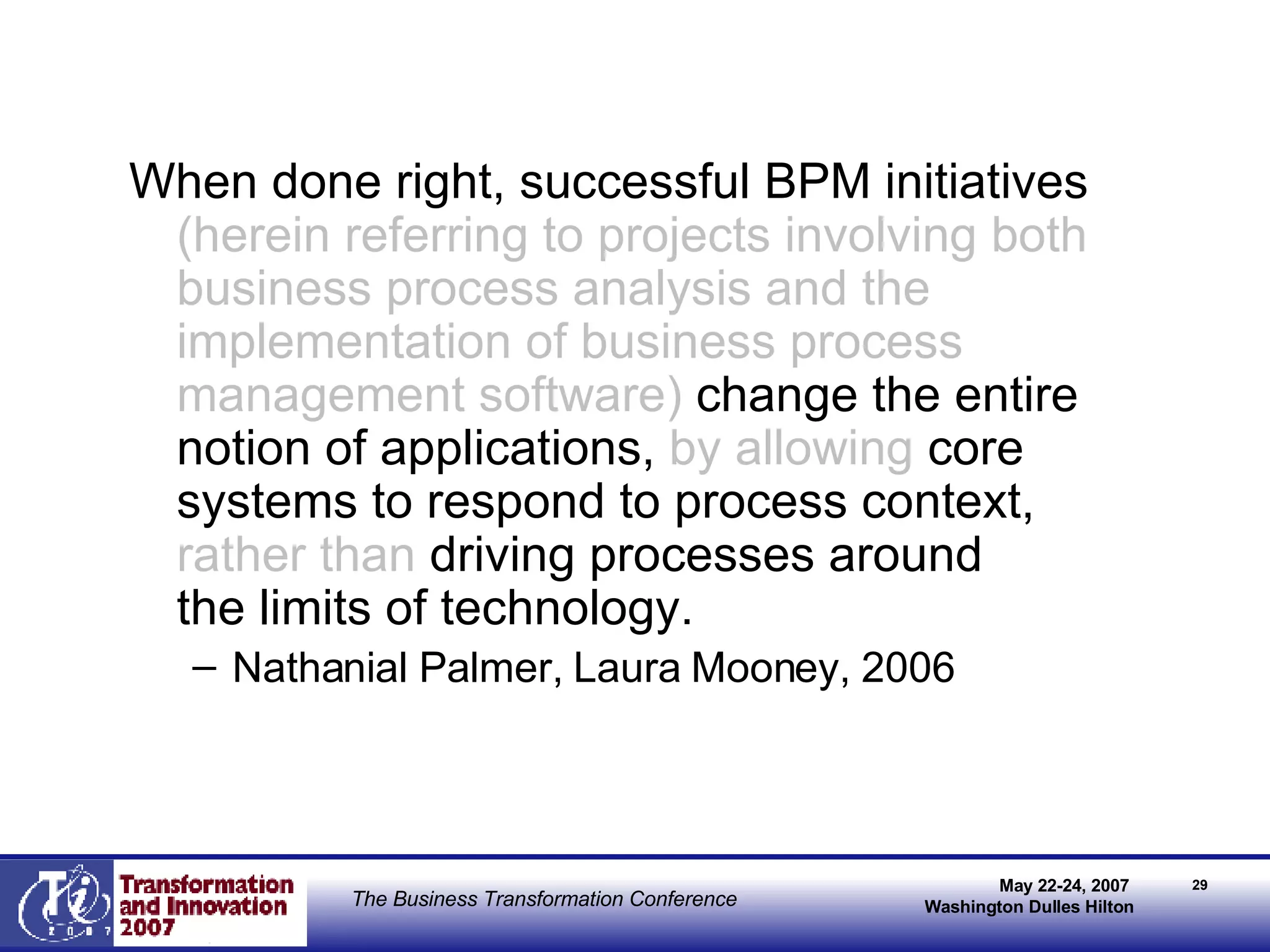
When done right, successful BPM initiatives  (herein referring to projects involving both business process analysis and the implementation of business process management software)  change the entire notion of applications,  by allowing  core systems to respond to process context,  rather than   driving processes around  the limits of technology. Nathanial Palmer, Laura Mooney, 2006
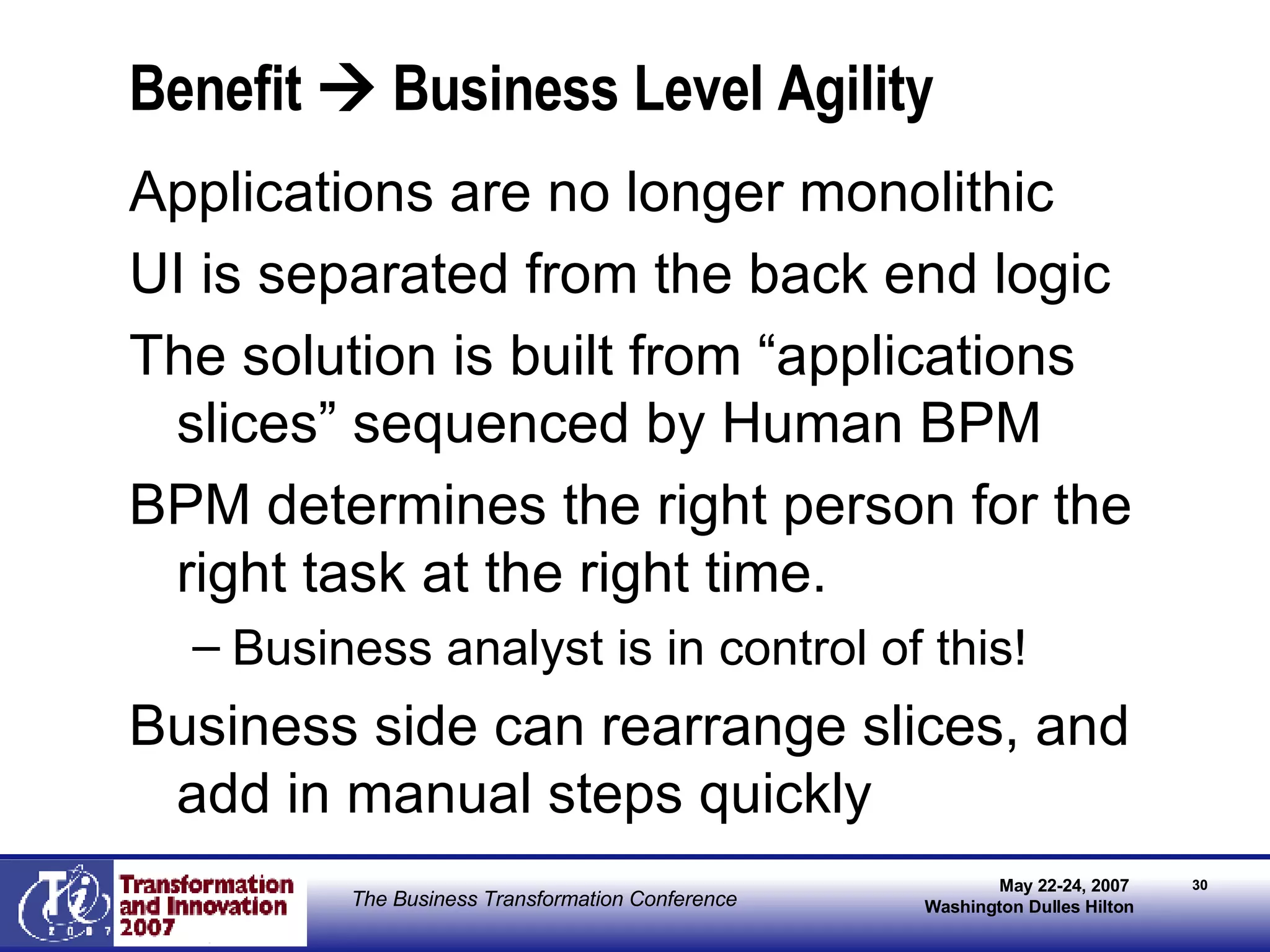
Benefit    Business Level Agility Applications are no longer monolithic UI is separated from the back end logic The solution is built from “applications slices” sequenced by Human BPM BPM determines the right person for the right task at the right time. Business analyst is in control of this! Business side can rearrange slices, and add in manual steps quickly
Standards Support
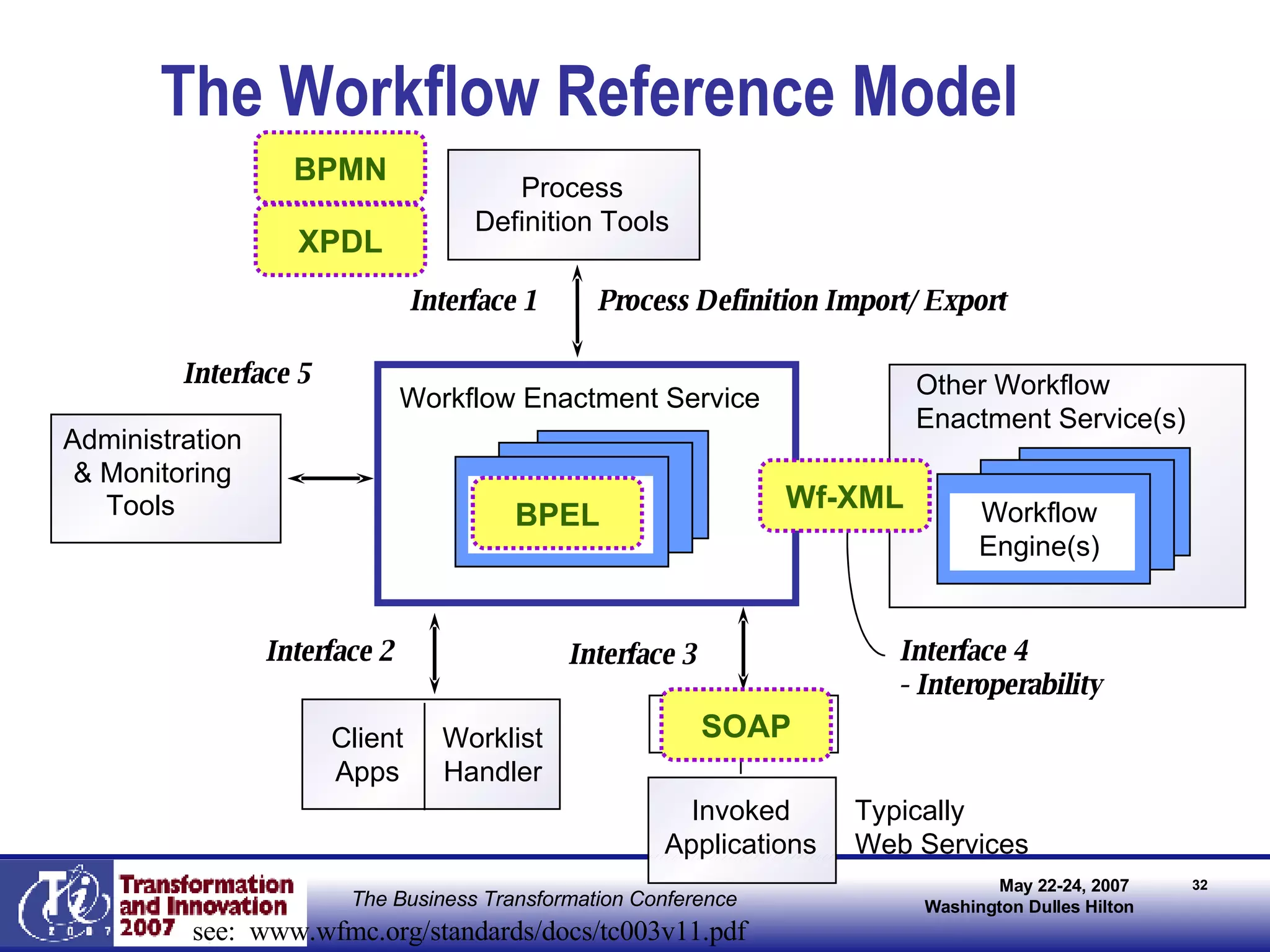
The Workflow Reference Model Process Definition Tools Interface 1 Interface 4  - Interoperability Interface 5 Workflow Enactment Service Other Workflow Enactment Service(s) Worklist Handler Interface 3 Interface 2 Invoked Applications Tool Agent Process Definition Import/Export Client Apps Typically Web Services Workflow Engine(s) see:  www.wfmc.org/standards/docs/tc003v11.pdf BPMN XPDL Wf-XML SOAP BPEL Administration  & Monitoring Tools Workflow Engine(s)
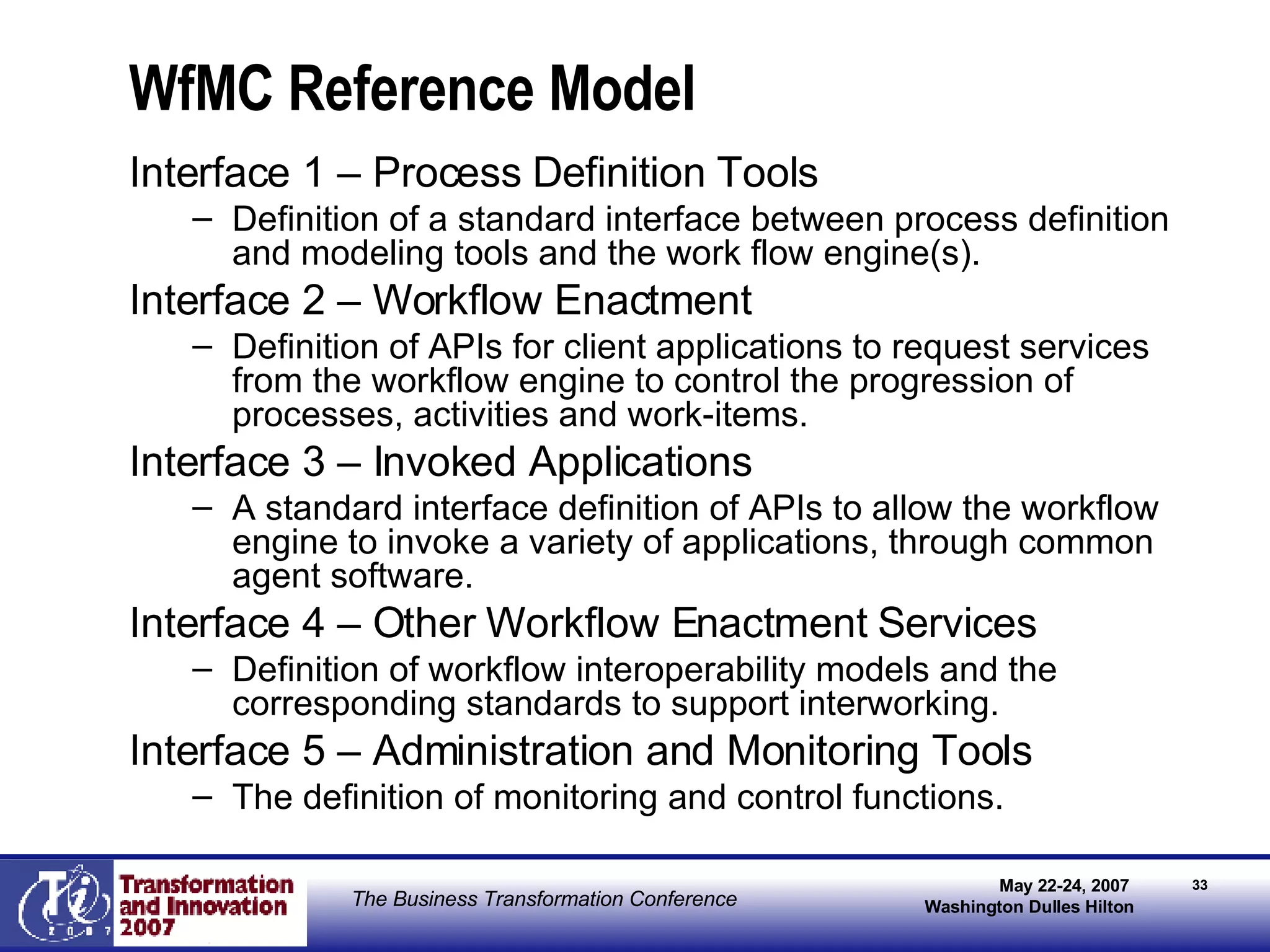
WfMC Reference Model Interface 1 – Process Definition Tools Definition of a standard interface between process definition and modeling tools and the work flow engine(s).  Interface 2 – Workflow Enactment Definition of APIs for client applications to request services from the workflow engine to control the progression of processes, activities and work-items.  Interface 3 – Invoked Applications A standard interface definition of APIs to allow the workflow engine to invoke a variety of applications, through common agent software.  Interface 4 – Other Workflow Enactment Services Definition of workflow interoperability models and the corresponding standards to support interworking. Interface 5 – Administration and Monitoring Tools The definition of monitoring and control functions.
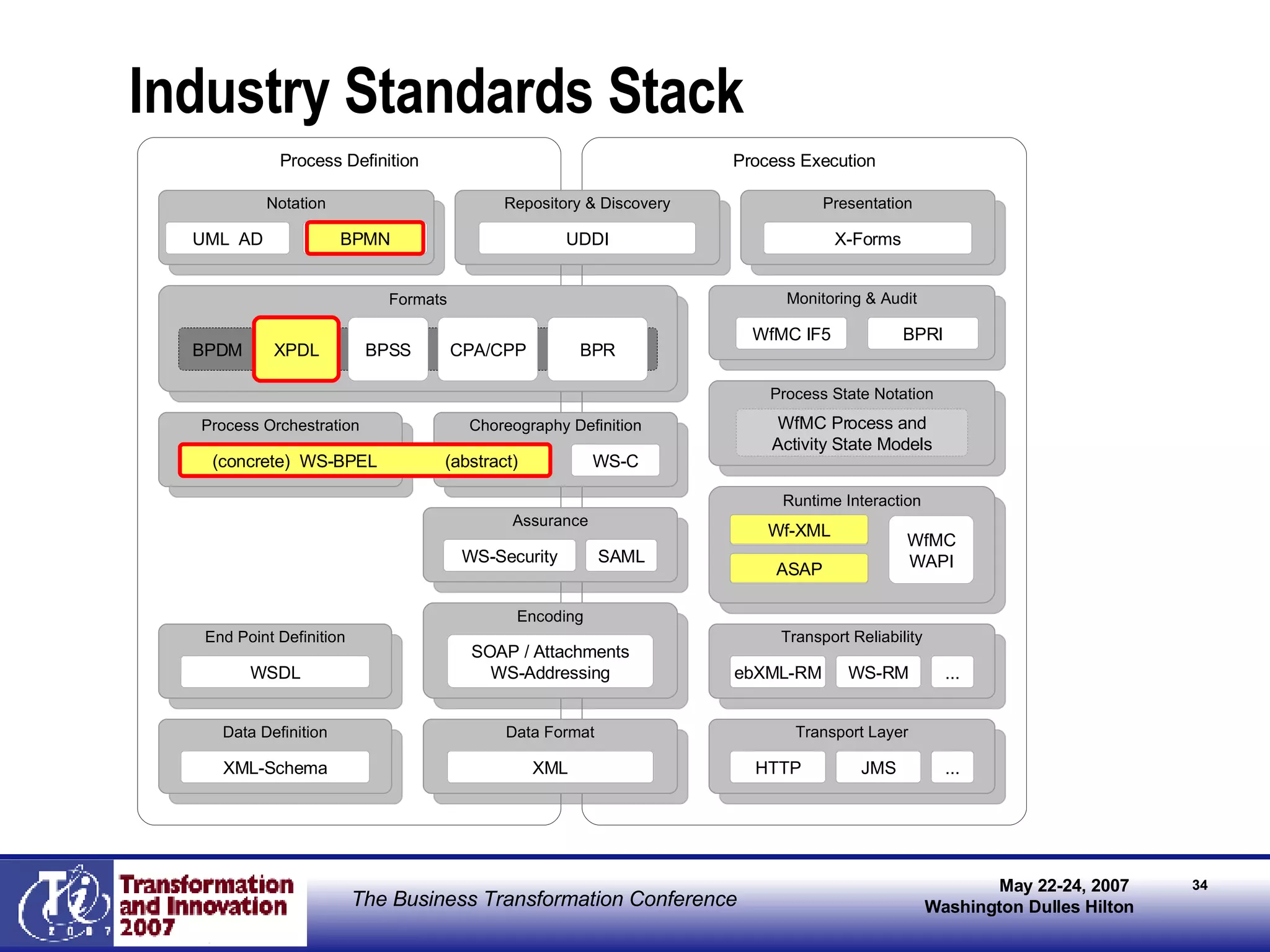
Industry Standards Stack Process Definition Process Execution Process Orchestration Choreography Definition WS-C (concrete)  WS-BPEL  (abstract) Monitoring & Audit WfMC IF5 Process State Notation WfMC Process and Activity State Models BPRI Wf-XML ASAP Notation UML  AD BPMN Repository & Discovery UDDI Assurance WS-Security SAML Formats BPDM XPDL BPSS CPA/CPP BPR Transport Reliability ebXML-RM WS-RM ... Transport Layer HTTP JMS ... Data Format XML Encoding SOAP / Attachments WS-Addressing Data Definition XML-Schema End Point Definition WSDL Runtime Interaction Wf-XML ASAP WfMC WAPI Presentation X-Forms (concrete)  WS-BPEL  (abstract) XPDL BPMN
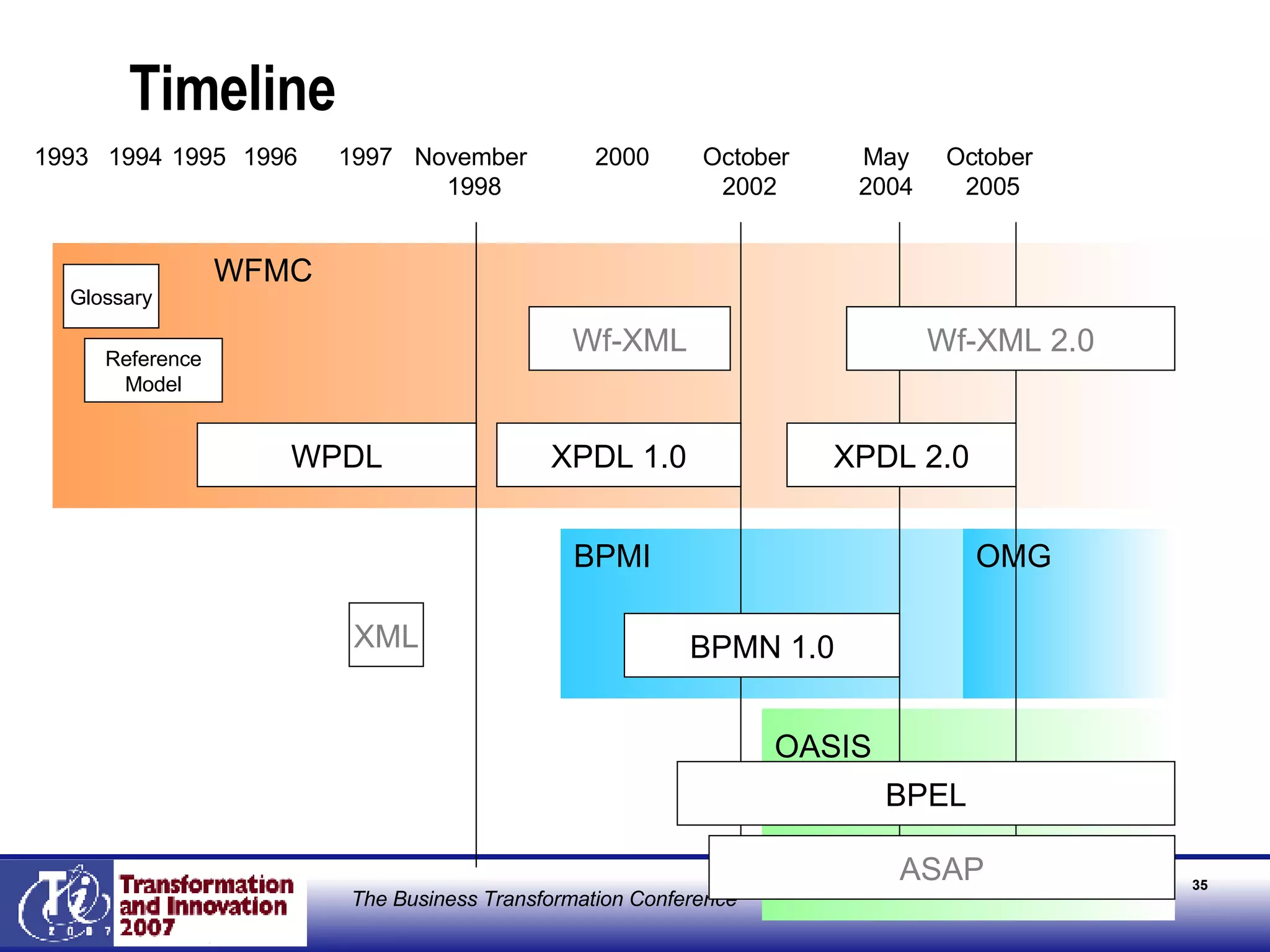
Timeline November  1998 October  2002 1997 XPDL 1.0 October  2005 May 2004 BPMN 1.0 1995 XPDL 2.0 WFMC BPMI 1993 OASIS OMG Reference Model Glossary XML WPDL 1996 1994 2000 BPEL Wf-XML Wf-XML 2.0 ASAP
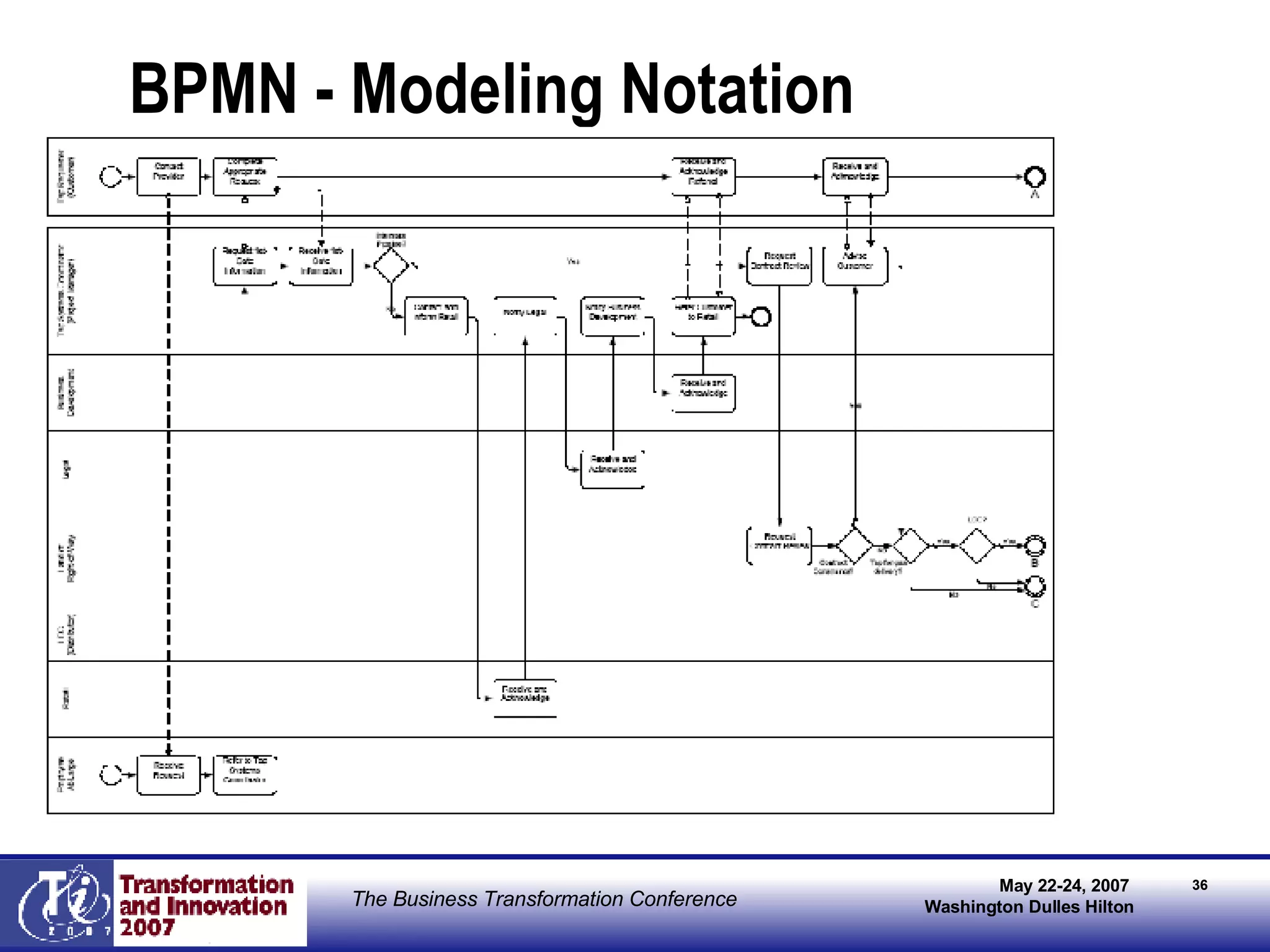
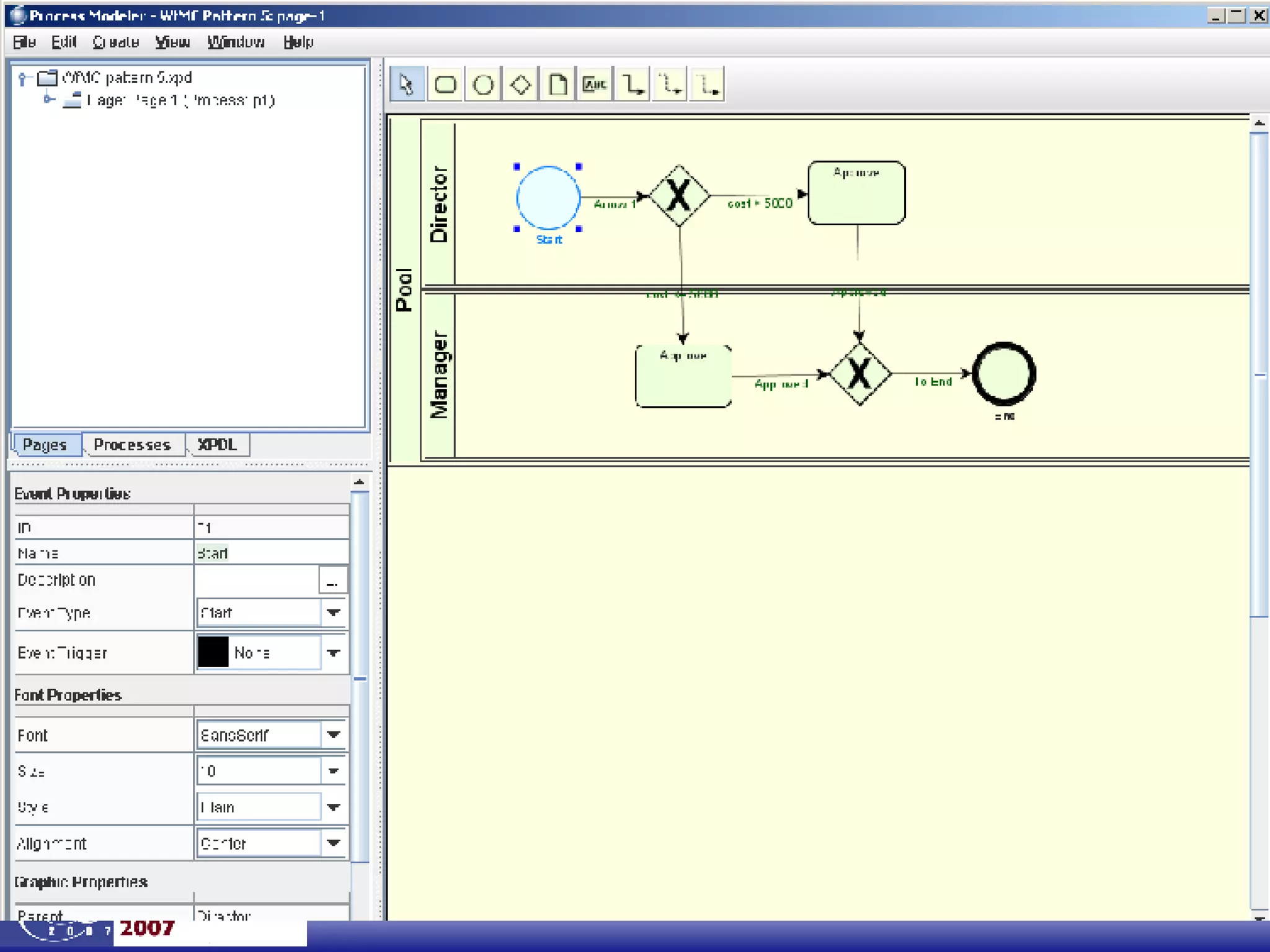
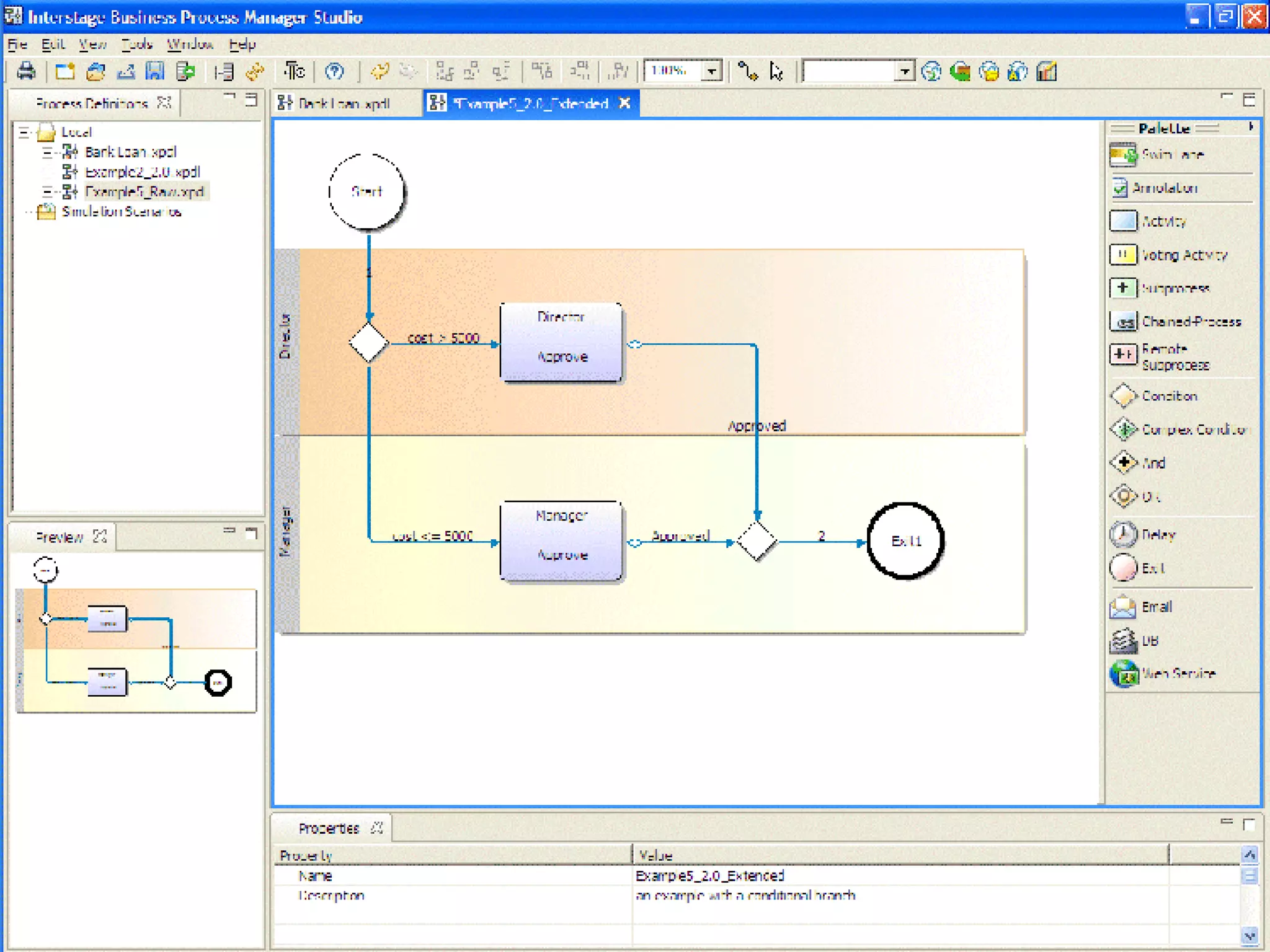
BPMN - Modeling Notation
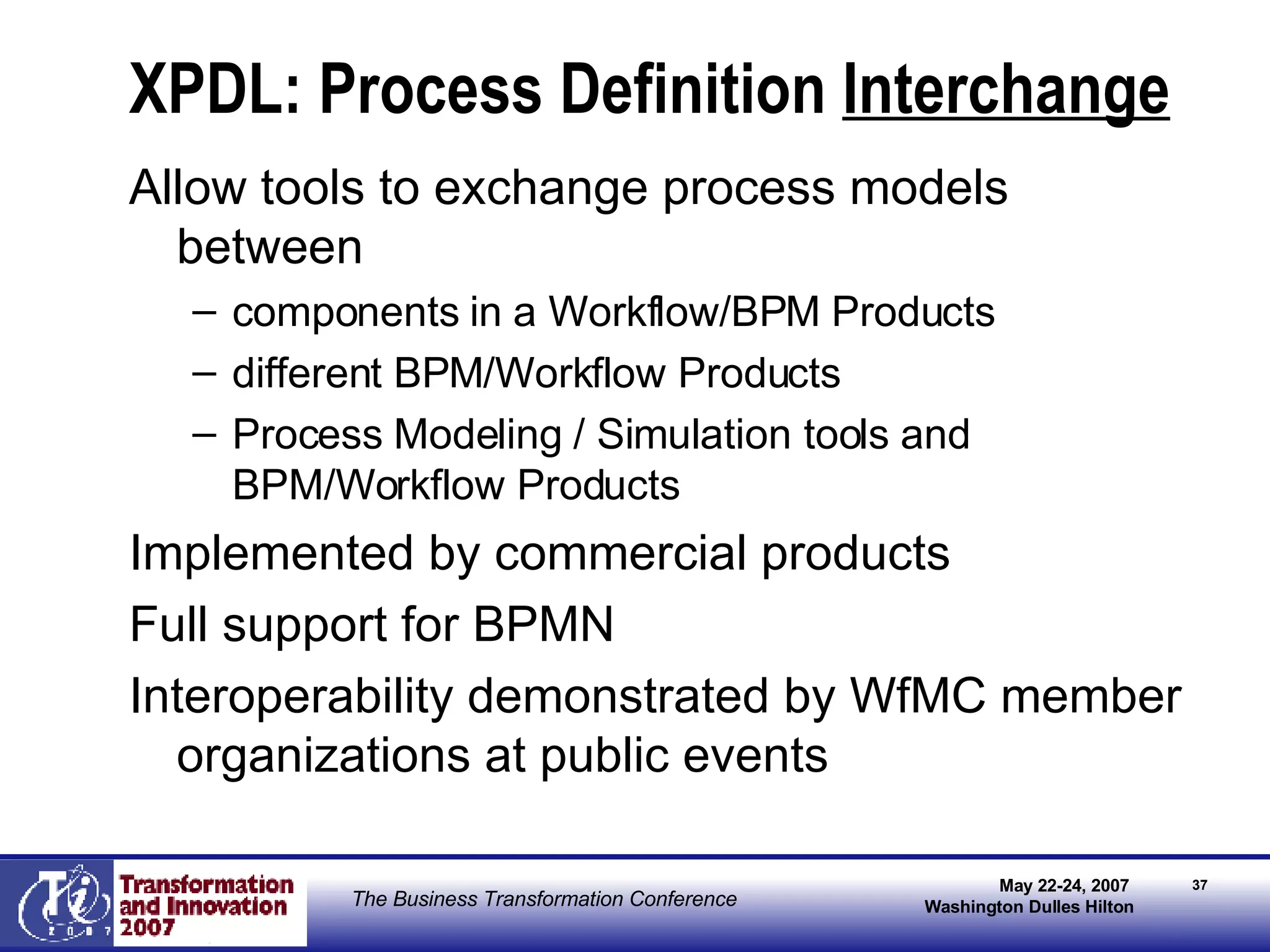
XPDL: Process Definition  Interchange Allow tools to exchange process models between  components in a Workflow/BPM Products different BPM/Workflow Products Process Modeling / Simulation tools and BPM/Workflow Products Implemented by commercial products Full support for BPMN Interoperability demonstrated by WfMC member organizations at public events


BPEL For BPM? “ From day one, BPM has sought to make process design directly accessible to business analysts, but today’s BPEL process models are for the most part undecipherable to non-programmers.” -   Bruce Silver, “The 2006 BPMS Report:  Understanding and Evaluating BPM Suites”
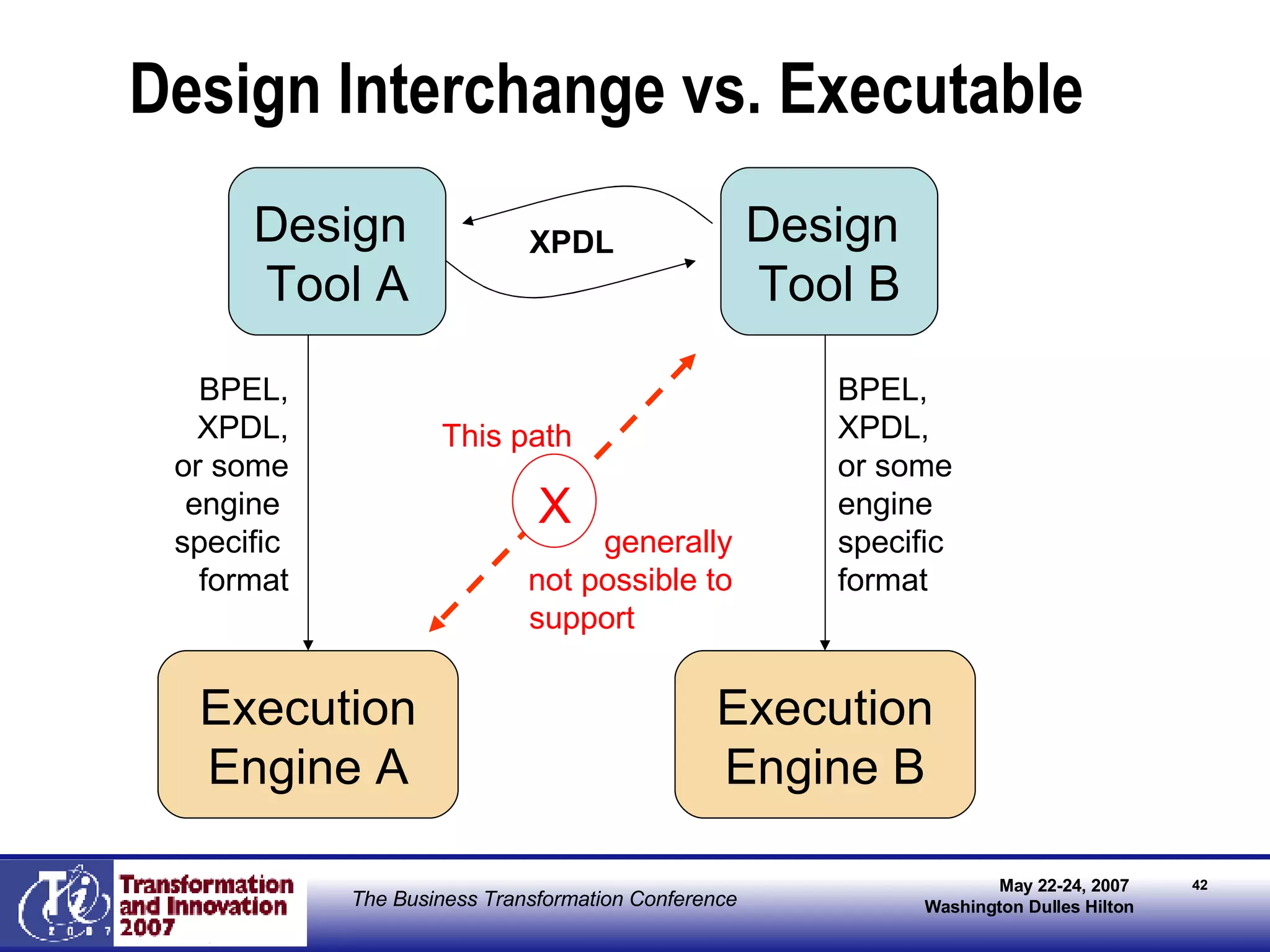
Design Interchange vs. Executable XPDL Design  Tool A Execution Engine A BPEL, XPDL, or some engine  specific  format Design  Tool B Execution Engine B BPEL, XPDL, or some engine  specific  format X This path  generally not possible to support
How BPEL and XPDL Relate BPEL is an “executable” language Includes only executable operations Does not contain the graphical diagram Many Engines have proprietary formats They have a design tool Even BPEL engines have proprietary extensions XPDL is a design interchange format that represents the graphical diagram Includes metadata about executable aspects It is generally not possible to design a process with a tool from one vendor and execute it in another vendor’s engine But exchange between  design tools  is possible
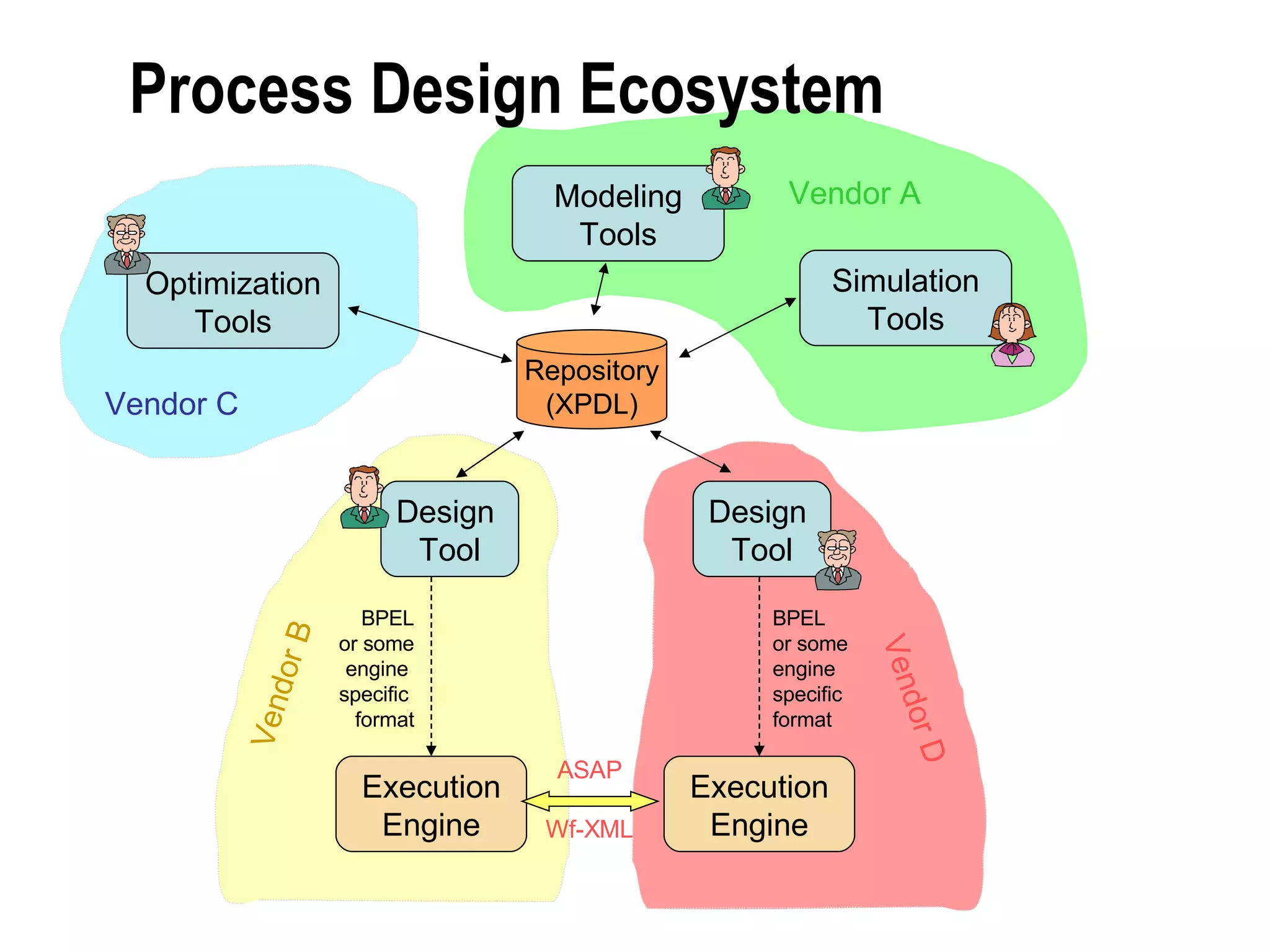
Process Design Ecosystem Design  Tool Design  Tool Modeling Tools Optimization Tools Simulation Tools Execution Engine Execution Engine BPEL or some engine  specific  format BPEL or some engine  specific  format Repository (XPDL) Vendor A Vendor D ASAP Wf-XML Vendor B Vendor C
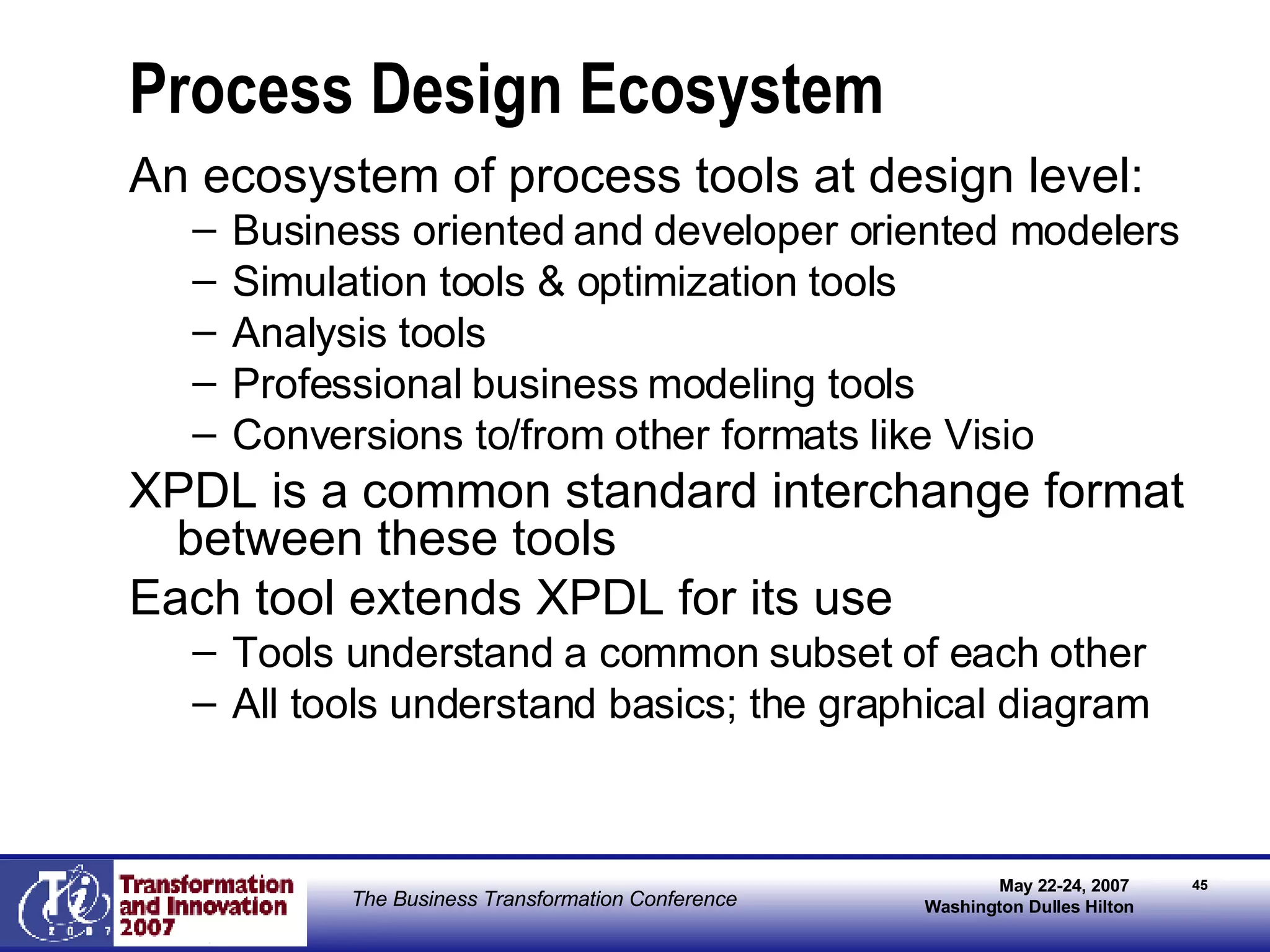
Process Design Ecosystem An ecosystem of process tools at design level: Business oriented and developer oriented modelers Simulation tools & optimization tools Analysis tools Professional business modeling tools Conversions to/from other formats like Visio XPDL is a common standard interchange format between these tools Each tool extends XPDL for its use Tools understand a common subset of each other All tools understand basics; the graphical diagram
XPDL Support in Market
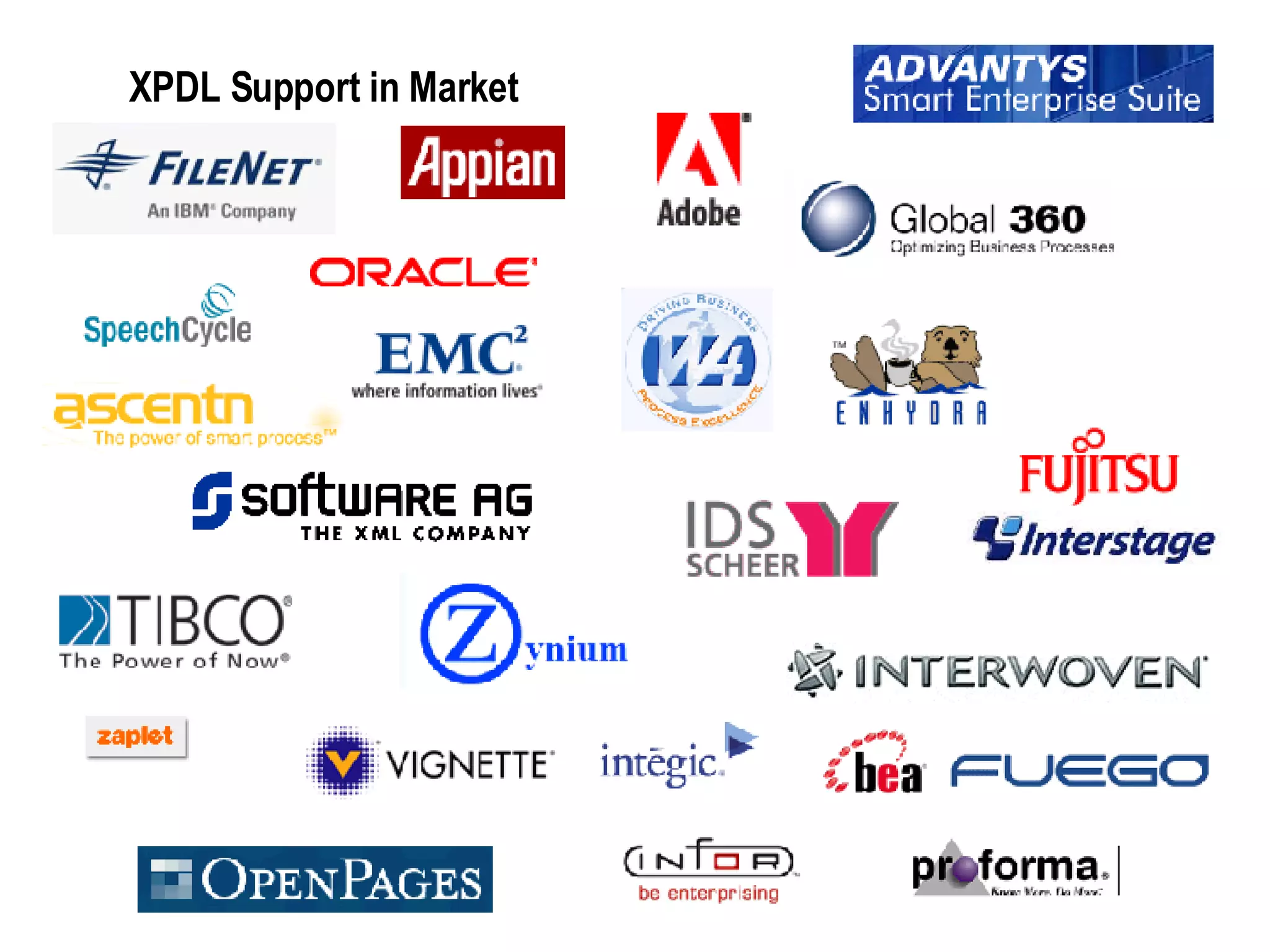
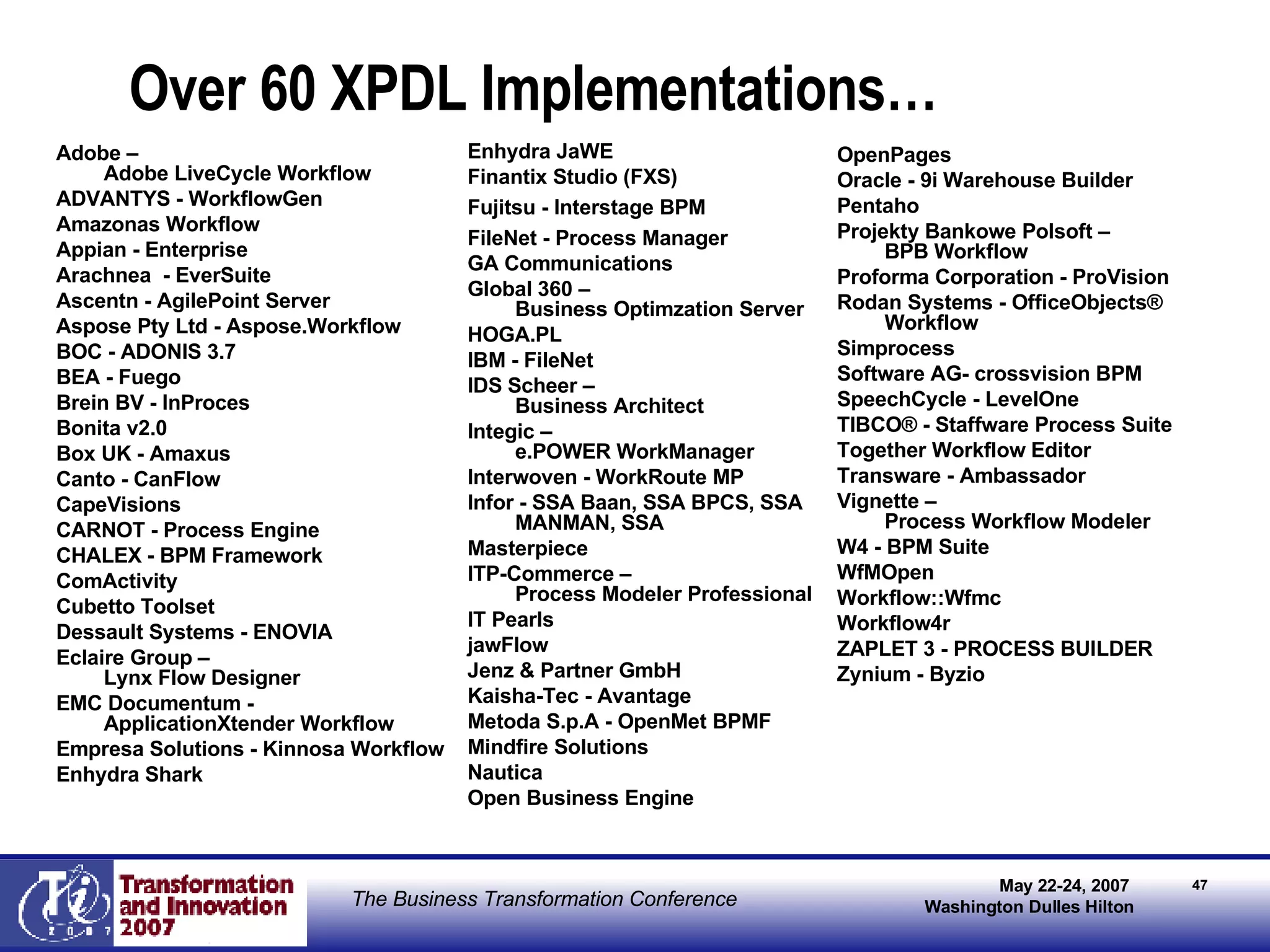
Over 60 XPDL Implementations… Adobe –  Adobe LiveCycle Workflow  ADVANTYS - WorkflowGen Amazonas Workflow Appian - Enterprise Arachnea  - EverSuite Ascentn - AgilePoint Server Aspose Pty Ltd - Aspose.Workflow BOC - ADONIS 3.7 BEA - Fuego Brein BV - InProces Bonita v2.0 Box UK - Amaxus Canto - CanFlow CapeVisions CARNOT - Process Engine CHALEX - BPM Framework ComActivity  Cubetto Toolset Dessault Systems - ENOVIA Eclaire Group – Lynx Flow Designer EMC Documentum - ApplicationXtender Workflow Empresa Solutions - Kinnosa Workflow Enhydra Shark OpenPages Oracle - 9i Warehouse Builder Pentaho Projekty Bankowe Polsoft –  BPB Workflow Proforma Corporation - ProVision Rodan Systems - OfficeObjects® Workflow Simprocess Software AG- crossvision BPM SpeechCycle - LevelOne TIBCO® - Staffware Process Suite Together Workflow Editor Transware - Ambassador Vignette –  Process Workflow Modeler W4 - BPM Suite WfMOpen Workflow::Wfmc Workflow4r ZAPLET 3 - PROCESS BUILDER Zynium - Byzio Enhydra JaWE Finantix Studio (FXS) Fujitsu - Interstage BPM FileNet - Process Manager GA Communications Global 360 –  Business Optimzation Server HOGA.PL IBM - FileNet IDS Scheer –  Business Architect Integic –  e.POWER WorkManager Interwoven - WorkRoute MP Infor - SSA Baan, SSA BPCS, SSA MANMAN, SSA Masterpiece ITP-Commerce –  Process Modeler Professional IT Pearls jawFlow Jenz & Partner GmbH Kaisha-Tec - Avantage Metoda S.p.A - OpenMet BPMF Mindfire Solutions Nautica  Open Business Engine
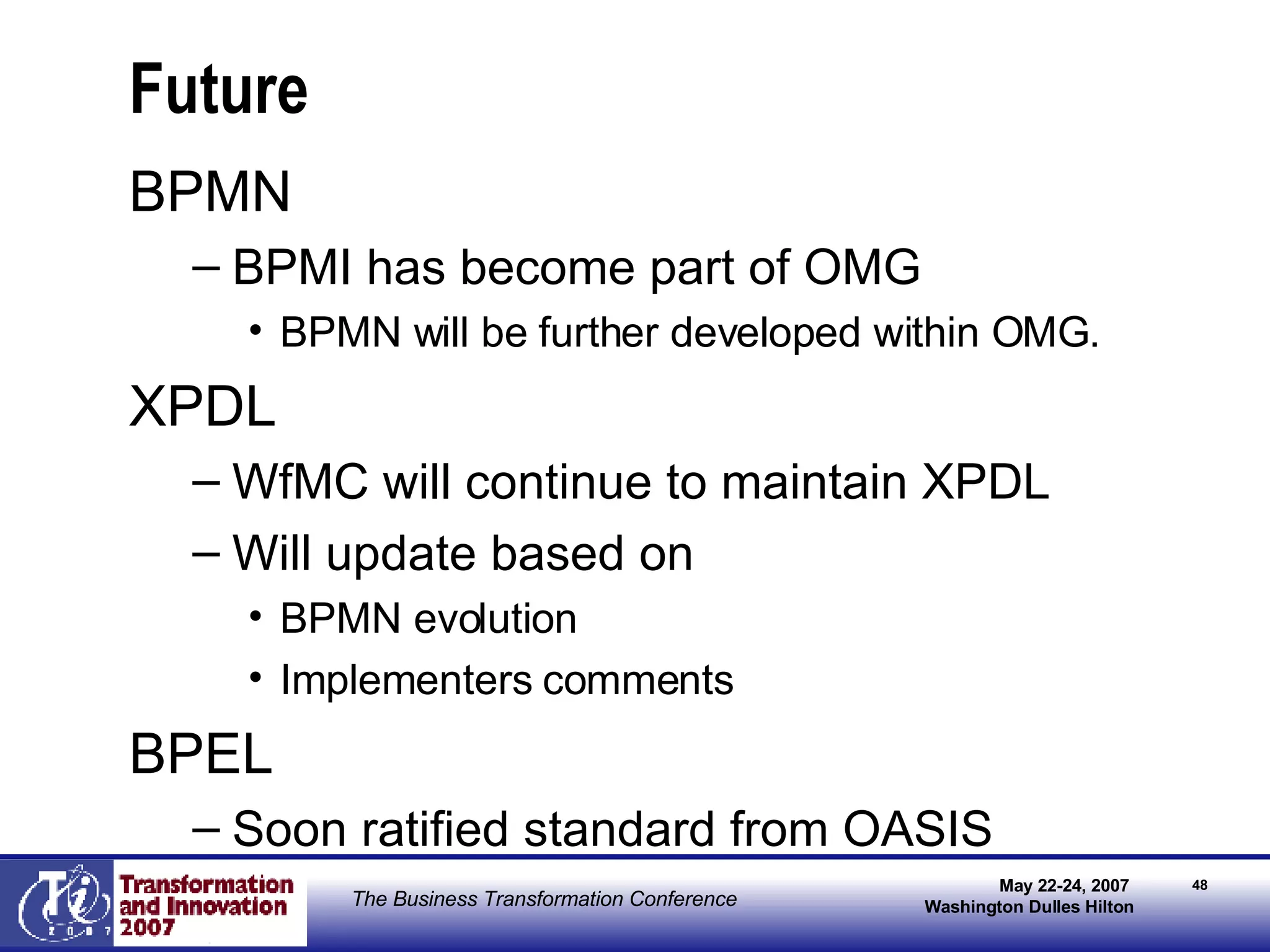
Future BPMN BPMI has become part of OMG BPMN will be further developed within OMG. XPDL WfMC will continue to maintain XPDL Will update based on  BPMN evolution Implementers comments BPEL Soon ratified standard from OASIS
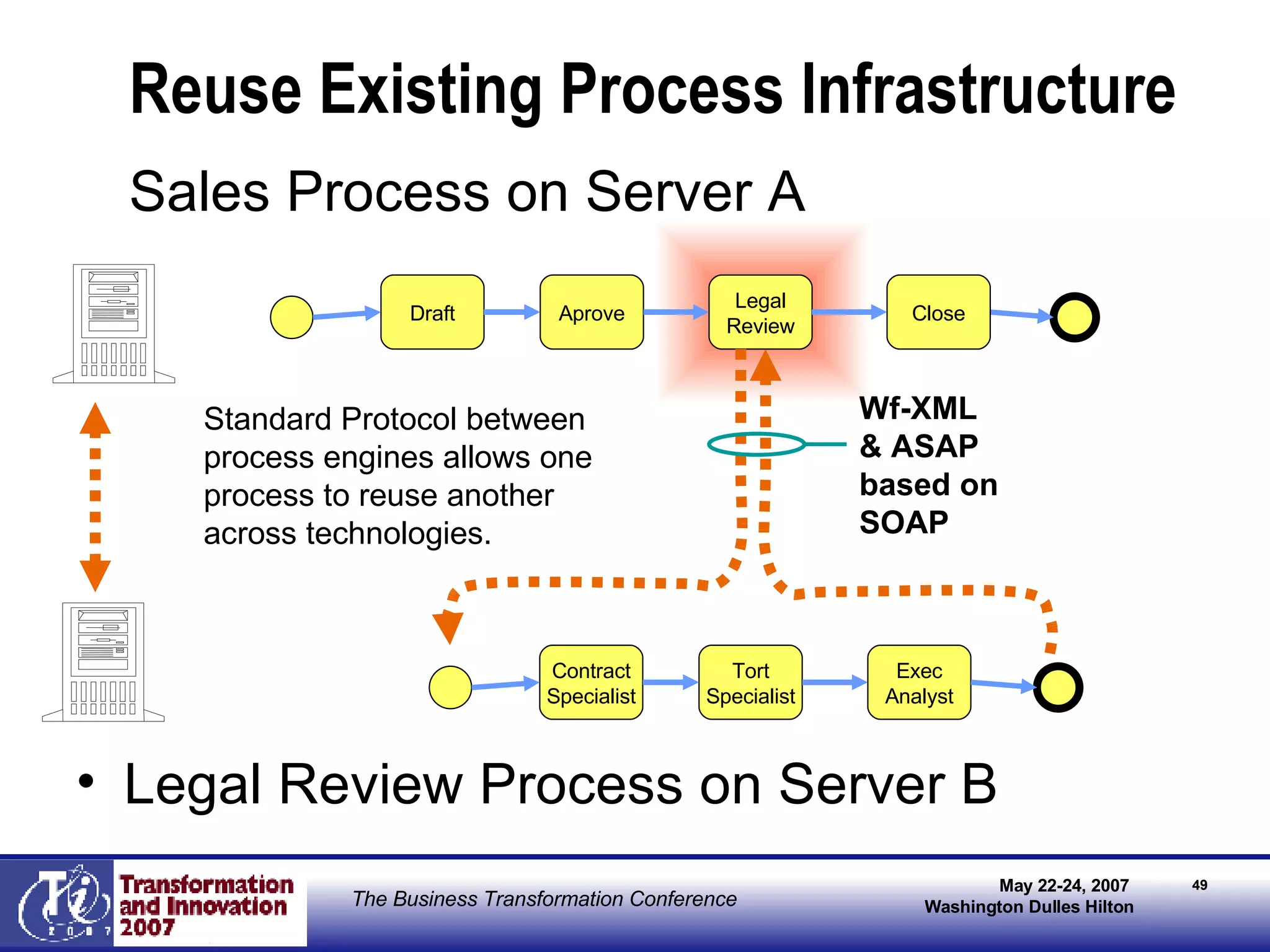
Reuse Existing Process Infrastructure Sales Process on Server A Legal Review Process on Server B Draft Aprove Legal Review Close Contract Specialist Tort Specialist Exec Analyst Wf-XML & ASAP based on  SOAP Standard Protocol between  process engines allows one process to reuse another across technologies.
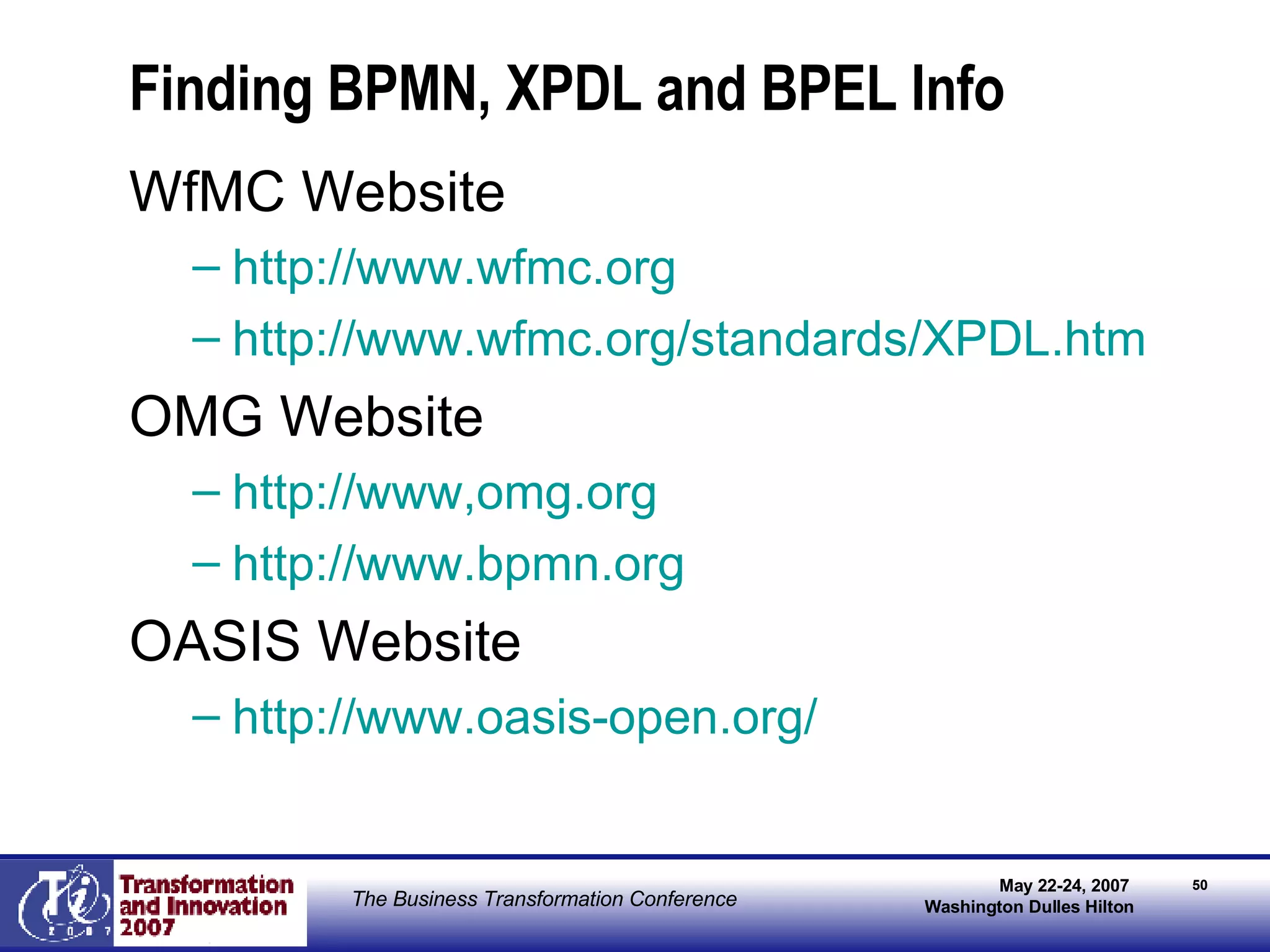
Finding BPMN, XPDL and BPEL Info WfMC Website http:// www.wfmc.org http:// www.wfmc.org/standards/XPDL.htm OMG Website http:// www,omg.org http:// www.bpmn.org OASIS Website http://www.oasis-open.org /
Finding XPDL-Related Information Workflow Handbook 2003:  XPDL and BPMN XPDL in Action Workflow Handbook 2004: Workflow Service Provider with XPDL  Workflow Handbook 2005:  A Comparison of XML Interchange Formats for Business Process Modelling Workflow Handbook 2006: XPDL 2.0: Integrating Process Interchange and BPMN Workflow Handbook 2007: BPM and Service-Oriented Architecture Teamed Together CDROM Companions  XPDL 2.0 specification with xpdl samples
Summary New  structure  for enterprise applications Separate “who” & “when” From “what” & “how” Key Benefits: Business Level Control & Agility Visibility: Monitoring & Tracking Reuse & Adapt Standards are key to interoperability BPMN – the graphical notation XPDL – the file format for design interchange
Thank  Y Kith D Swenson VP Fujtisu Computer Systems Technical Committee Chair, WfMC Contact Information: +1 408 859 1005 [email_address] ou Process Thought Leadership Thank  Y ou
BPEL 4 People A “White Paper” from IBM and SAP suggests A new activity called a “people activity” with deadlines, user interface forms A “people link” which associates people with this activity A couple roles, like process initiator and stakeholder An “accept” like capability What is missing? Ability to change processes while running and to do running process migration Precise definition of expression language for people No separation of business processes from IT processes Multiple Instance (Voting) Activities Still no graphical information Not yet even a proposed specification, still just concepts
XPDL and BPDM BPDM (Business Process Definition Metamodel) OMG’s effort to provide an interchange format between all possible process languages Still in early stages; first spec due in Dec 2006, months or years before a spec will be ratified. XPDL 2.0 Full support for all BPMN constructs Focus on the process diagram Ratified Oct 2005 Implementations available today

Workflow and BPM in the New Enterprise Architecture

  • 1.
    Keith D SwensonVP, Fujitsu Computer Systems Technical Committee Chair, WfMC Workflow and BPM in the New Enterprise Architecture Welcome to Transformation and Innovation 2007 The Business Transformation Conference Welcome
  • 2.
    Presentation Overview Definitionsof Terms What is the Gap between Business and IT? Humans vs. System Flow How does Workflow bridge that? Interfacing Humans to Systems What Standards Exist to Support This? BPMN, XPDL, BPEL
  • 3.
    Considering your existingenterprise apps, how important are the following business problems? Source: Forrester Survey of 145 Business and IT decision makers Inadequate support for cross functional processes Mismatch between application functionality and business reqs High cost compared to value Limits on process change due to application inflexibility Lack of visibility and analytic insight into process results Slow upgrade to new functionality Inability to support employees, partner, and customer collaboration Lack of industry specific functionality Inability to extend business processes to external partners
  • 4.
    A Few DefinitionsBusiness Process - A set of one or more linked procedures or activities which collectively realize a business objective or policy goal, normally within the context of an organizational structure defining functional roles and relationships. Workflow - The automation of a business process, in whole or part, during which documents, information or tasks are passed from one participant to another for action, according to a set of procedural rules. Ref: WFMC-TC-1011 http://wfmc.org/
  • 5.
    A Few DefinitionsProcess Definition - The representation of a business process in a form which supports automated manipulation, such as modeling, or enactment by a workflow management system. The process definition consists of a network of activities and their relationships, criteria to indicate the start and termination of the process, and information about the individual activities, such as participants, associated IT applications and data, etc.
  • 6.
  • 7.
    One Last DefinitionBusiness Process Management – The practice of developing, running, performance measuring, and simulating Business Processes to effect the continued improvement of those processes. Business Process Management is concerned with the lifecycle of the Process Definition.
  • 8.
    Unfortunately, Industry notConsistent WS-BPEL has received a lot of attention recently to the benefit of a few key vendors. Now people are learning the truth -- it handles only a small part of the space. While clearly important for Orchestration, positioned as something business related only confuses the market.
  • 9.
    What is “Human”BPM? Because of all the inconsistent uses of the term “BPM” to mean only invoked web services, we now talk about “Human” BPM to stress the complete picture of both manual & automated activities. Workflow also include the concept of manual & automated activities is used interchangeably with “Human” BPM.
  • 10.
    What is theGap Between Business & IT?
  • 11.
    Business & IT-- Two Different Audiences Business IT Concerned with only those goals that can be translated into tested, reliable, secure systems Concerned with business goals both manual & automatable Social structures, working hours, vacation schedules, learning skills, changing positions System structure, 7x24, scalability System to system. platform independence robust & fully automated. User interface, choosing among list of tasks, reassigning, manual handling of exceptional occasions. Change processes in days Change processes in months ? ? ? ? ? ? Legacy CRM ERP Supply Chain Sales Marketing Finance Procurement
  • 12.
    The Bridge BetweenHuman & System CRM Legacy ERP Supply Chain Sales Marketing Finance Procurement Business IT Enterprise Service Bus Web Service Orchestration Presents the right user interface, to the right person at the right time. Notifies & reminds people Automated activities make calls to the ESB and Composite Services in response to user actions. EAI Composite Services WS-Orchestration Web Services Resources Adapters Forms GUI Roles Assignee Expressions Timers Human BPM / Workflow
  • 13.
    What is thepurpose of BPM / Workflow Place in the hands of business professionals the ability to modify their processes, with no involvement from the IT organization Michael Melenovsky, Gartner ... process changes are made by business professionals who need only limited knowledge of IT systems. In a growing number of cases, changes such as work item routing, business rule overrides, and parametric changes to approval levels, are made in real time to executing process. Janelle Hill, Gartner
  • 14.
    Where is itGoing? By 2009, 20 percent of business processes in the Global 2000 will be supported on BPMS[*]. These processes will be predominantly those that involve a lot of human work, that differentiate the company from its competitors and that are poorly supported by existing IT systems (0.7 probability). Janelle Hill, Gartner * BPMS is defined as a suite that handles both human and system processes.
  • 15.
    How Does WorkflowBridge the Gap?
  • 16.
    1990  Workflow in the Brain Enterprise Application A “ Account Management” Background Check Conformance Guidelines Application Logic in Monolithic Program UI “Screens” list Accts new Acct update Acct delete Acct
  • 17.
    1993  Workflow Assist in Sequence Enterprise Application A “ Account Management” Background Check Conformance Rules Application Logic in Monolithic Program UI “ Screens” list Accts new Acct update Acct delete Acct Launches UI User accesses original UI directly background check create account check guidelines Human BPM/Workflow:
  • 18.
    1996  Distribute Work Enterprise Application A “ Account Management” Background Check Conformance Rules Application Logic in Monolithic Program UI “ Screens” list Accts new Acct update Acct delete Acct background check create account check guidelines Launches
  • 19.
    2002  Integration thru Web Services Enterprise Application A “ Account Management” Background Check Conformance Rules Application Logic Service Oriented Architecture Exposed Web Services list Accts new Acct update Acct delete Acct enter info create account bg check rules Review UI connects user to process engine, not the back-end applications
  • 20.
    2005  Composite Services = Agility Old Rules Enterprise Application A “ Account Management” Background New Rules list Accts new Acct update Acct delete Acct enter info create account call 1 Review ESB / BPEL Application Logic Exposed Web Services Composite Service
  • 21.
    2005  Composite Services = Agility Old Rules Background New Rules list Accts new Acct update Acct delete Acct enter info create account call 1 Review ESB / BPEL Application Logic Exposed Web Services Composite Services
  • 22.
    Human Activities HaveThree Phases Review Automated phase before to prepare for the task Wait phase for Human to do the work, includes timers and escalation logic Automated phase after to take care of results of the task User Interface (while waiting)
  • 23.
    2008  Simplify as “Human Steps” Enterprise Application A “ Account Management” Background Conformance Rules Application Logic Exposed Web Services list Accts new Acct update Acct delete Acct call 1 Review ESB / BPEL enter info Composite Service To People: Looks like two steps! Much simpler.
  • 24.
    Separation of ResponsibilityBusiness Retains Control of Assignment of Responsibility Groups, Roles, Skills Deadlines Alerts, Reminders, Escalations Order of Tasks Addition of Manual Tasks User Interface IT Retains Control of Computational Logic Data Representations Scalability / Performance Interoperability Master Data Management Enterprise Application A “ Account Management” Background Rules list Accts new Acct update Acct delete Acct ESB / BPEL call 1 Review enter info
  • 25.
    Separation of DevelopmentBusiness Retains Control of Assignment of Responsibility Groups, Roles, Skills Deadlines Alerts, Reminders, Escalations Order of Tasks Addition of Manual Tasks User Interface IT Retains Control of Computational Logic Data Representations Scalability / Performance Interoperability Master Data Management Depends strongly on who is in each organization. Changes on daily basis Organizational Culture Optimize for each team Respond to market or legislation Related to Training, Experience Requires expensive technical capabilities Very low or no dependence upon the organizational culture Knowledge of infrastructure Who? When? What? How?
  • 26.
    Step 1  Draw Human Process Review enter info First: a business analyst draws the “human” process Business Analyst John
  • 27.
    Step 2  Add Integration Enterprise Application A “ Account Management” Background Conformance Rules list Accts new Acct update Acct delete Acct call 1 Review ESB / BPEL enter info Second: Service Invocation Added by IT Expert IT Integration Expert Robert
  • 28.
    Agility  Business Driven Change Enterprise Application A “ Account Management” Background Rules list Accts new Acct update Acct delete Acct call 1 Review ESB / BPEL enter info News Flash! Some other bank sued! Need to respond quickly to avoid risk! legal check
  • 29.
    When done right,successful BPM initiatives (herein referring to projects involving both business process analysis and the implementation of business process management software) change the entire notion of applications, by allowing core systems to respond to process context, rather than driving processes around the limits of technology. Nathanial Palmer, Laura Mooney, 2006
  • 30.
    Benefit  Business Level Agility Applications are no longer monolithic UI is separated from the back end logic The solution is built from “applications slices” sequenced by Human BPM BPM determines the right person for the right task at the right time. Business analyst is in control of this! Business side can rearrange slices, and add in manual steps quickly
  • 31.
  • 32.
    The Workflow ReferenceModel Process Definition Tools Interface 1 Interface 4 - Interoperability Interface 5 Workflow Enactment Service Other Workflow Enactment Service(s) Worklist Handler Interface 3 Interface 2 Invoked Applications Tool Agent Process Definition Import/Export Client Apps Typically Web Services Workflow Engine(s) see: www.wfmc.org/standards/docs/tc003v11.pdf BPMN XPDL Wf-XML SOAP BPEL Administration & Monitoring Tools Workflow Engine(s)
  • 33.
    WfMC Reference ModelInterface 1 – Process Definition Tools Definition of a standard interface between process definition and modeling tools and the work flow engine(s). Interface 2 – Workflow Enactment Definition of APIs for client applications to request services from the workflow engine to control the progression of processes, activities and work-items. Interface 3 – Invoked Applications A standard interface definition of APIs to allow the workflow engine to invoke a variety of applications, through common agent software. Interface 4 – Other Workflow Enactment Services Definition of workflow interoperability models and the corresponding standards to support interworking. Interface 5 – Administration and Monitoring Tools The definition of monitoring and control functions.
  • 34.
    Industry Standards StackProcess Definition Process Execution Process Orchestration Choreography Definition WS-C (concrete) WS-BPEL (abstract) Monitoring & Audit WfMC IF5 Process State Notation WfMC Process and Activity State Models BPRI Wf-XML ASAP Notation UML AD BPMN Repository & Discovery UDDI Assurance WS-Security SAML Formats BPDM XPDL BPSS CPA/CPP BPR Transport Reliability ebXML-RM WS-RM ... Transport Layer HTTP JMS ... Data Format XML Encoding SOAP / Attachments WS-Addressing Data Definition XML-Schema End Point Definition WSDL Runtime Interaction Wf-XML ASAP WfMC WAPI Presentation X-Forms (concrete) WS-BPEL (abstract) XPDL BPMN
  • 35.
    Timeline November 1998 October 2002 1997 XPDL 1.0 October 2005 May 2004 BPMN 1.0 1995 XPDL 2.0 WFMC BPMI 1993 OASIS OMG Reference Model Glossary XML WPDL 1996 1994 2000 BPEL Wf-XML Wf-XML 2.0 ASAP
  • 36.
  • 37.
    XPDL: Process Definition Interchange Allow tools to exchange process models between components in a Workflow/BPM Products different BPM/Workflow Products Process Modeling / Simulation tools and BPM/Workflow Products Implemented by commercial products Full support for BPMN Interoperability demonstrated by WfMC member organizations at public events
  • 38.
  • 39.
  • 40.
  • 41.
    BPEL For BPM?“ From day one, BPM has sought to make process design directly accessible to business analysts, but today’s BPEL process models are for the most part undecipherable to non-programmers.” - Bruce Silver, “The 2006 BPMS Report: Understanding and Evaluating BPM Suites”
  • 42.
    Design Interchange vs.Executable XPDL Design Tool A Execution Engine A BPEL, XPDL, or some engine specific format Design Tool B Execution Engine B BPEL, XPDL, or some engine specific format X This path generally not possible to support
  • 43.
    How BPEL andXPDL Relate BPEL is an “executable” language Includes only executable operations Does not contain the graphical diagram Many Engines have proprietary formats They have a design tool Even BPEL engines have proprietary extensions XPDL is a design interchange format that represents the graphical diagram Includes metadata about executable aspects It is generally not possible to design a process with a tool from one vendor and execute it in another vendor’s engine But exchange between design tools is possible
  • 44.
    Process Design EcosystemDesign Tool Design Tool Modeling Tools Optimization Tools Simulation Tools Execution Engine Execution Engine BPEL or some engine specific format BPEL or some engine specific format Repository (XPDL) Vendor A Vendor D ASAP Wf-XML Vendor B Vendor C
  • 45.
    Process Design EcosystemAn ecosystem of process tools at design level: Business oriented and developer oriented modelers Simulation tools & optimization tools Analysis tools Professional business modeling tools Conversions to/from other formats like Visio XPDL is a common standard interchange format between these tools Each tool extends XPDL for its use Tools understand a common subset of each other All tools understand basics; the graphical diagram
  • 46.
  • 47.
    Over 60 XPDLImplementations… Adobe – Adobe LiveCycle Workflow ADVANTYS - WorkflowGen Amazonas Workflow Appian - Enterprise Arachnea - EverSuite Ascentn - AgilePoint Server Aspose Pty Ltd - Aspose.Workflow BOC - ADONIS 3.7 BEA - Fuego Brein BV - InProces Bonita v2.0 Box UK - Amaxus Canto - CanFlow CapeVisions CARNOT - Process Engine CHALEX - BPM Framework ComActivity Cubetto Toolset Dessault Systems - ENOVIA Eclaire Group – Lynx Flow Designer EMC Documentum - ApplicationXtender Workflow Empresa Solutions - Kinnosa Workflow Enhydra Shark OpenPages Oracle - 9i Warehouse Builder Pentaho Projekty Bankowe Polsoft – BPB Workflow Proforma Corporation - ProVision Rodan Systems - OfficeObjects® Workflow Simprocess Software AG- crossvision BPM SpeechCycle - LevelOne TIBCO® - Staffware Process Suite Together Workflow Editor Transware - Ambassador Vignette – Process Workflow Modeler W4 - BPM Suite WfMOpen Workflow::Wfmc Workflow4r ZAPLET 3 - PROCESS BUILDER Zynium - Byzio Enhydra JaWE Finantix Studio (FXS) Fujitsu - Interstage BPM FileNet - Process Manager GA Communications Global 360 – Business Optimzation Server HOGA.PL IBM - FileNet IDS Scheer – Business Architect Integic – e.POWER WorkManager Interwoven - WorkRoute MP Infor - SSA Baan, SSA BPCS, SSA MANMAN, SSA Masterpiece ITP-Commerce – Process Modeler Professional IT Pearls jawFlow Jenz & Partner GmbH Kaisha-Tec - Avantage Metoda S.p.A - OpenMet BPMF Mindfire Solutions Nautica Open Business Engine
  • 48.
    Future BPMN BPMIhas become part of OMG BPMN will be further developed within OMG. XPDL WfMC will continue to maintain XPDL Will update based on BPMN evolution Implementers comments BPEL Soon ratified standard from OASIS
  • 49.
    Reuse Existing ProcessInfrastructure Sales Process on Server A Legal Review Process on Server B Draft Aprove Legal Review Close Contract Specialist Tort Specialist Exec Analyst Wf-XML & ASAP based on SOAP Standard Protocol between process engines allows one process to reuse another across technologies.
  • 50.
    Finding BPMN, XPDLand BPEL Info WfMC Website http:// www.wfmc.org http:// www.wfmc.org/standards/XPDL.htm OMG Website http:// www,omg.org http:// www.bpmn.org OASIS Website http://www.oasis-open.org /
  • 51.
    Finding XPDL-Related InformationWorkflow Handbook 2003: XPDL and BPMN XPDL in Action Workflow Handbook 2004: Workflow Service Provider with XPDL  Workflow Handbook 2005: A Comparison of XML Interchange Formats for Business Process Modelling Workflow Handbook 2006: XPDL 2.0: Integrating Process Interchange and BPMN Workflow Handbook 2007: BPM and Service-Oriented Architecture Teamed Together CDROM Companions XPDL 2.0 specification with xpdl samples
  • 52.
    Summary New structure for enterprise applications Separate “who” & “when” From “what” & “how” Key Benefits: Business Level Control & Agility Visibility: Monitoring & Tracking Reuse & Adapt Standards are key to interoperability BPMN – the graphical notation XPDL – the file format for design interchange
  • 53.
    Thank YKith D Swenson VP Fujtisu Computer Systems Technical Committee Chair, WfMC Contact Information: +1 408 859 1005 [email_address] ou Process Thought Leadership Thank Y ou
  • 54.
    BPEL 4 PeopleA “White Paper” from IBM and SAP suggests A new activity called a “people activity” with deadlines, user interface forms A “people link” which associates people with this activity A couple roles, like process initiator and stakeholder An “accept” like capability What is missing? Ability to change processes while running and to do running process migration Precise definition of expression language for people No separation of business processes from IT processes Multiple Instance (Voting) Activities Still no graphical information Not yet even a proposed specification, still just concepts
  • 55.
    XPDL and BPDMBPDM (Business Process Definition Metamodel) OMG’s effort to provide an interchange format between all possible process languages Still in early stages; first spec due in Dec 2006, months or years before a spec will be ratified. XPDL 2.0 Full support for all BPMN constructs Focus on the process diagram Ratified Oct 2005 Implementations available today