Semantically-Enabled Business
Process Management
Ontology PSIG Meeting, June 18th, 2015
OMG Technical Meeting, Berlin, Germany
Adrian Paschke
Corporate Semantic Web (AG-CSW)
Institute for Computer Science,
Freie Universitaet Berlin
paschke@inf.fu-berlin.de
http://www.inf.fu-berlin.de/groups/ag-csw/
Overview
 Semantic Business Process Management
 Ontologies in BPM - Examples
 Rules in BPM - Examples
 Events in BPM - Examples
 Summary Key Benefits of SBPM
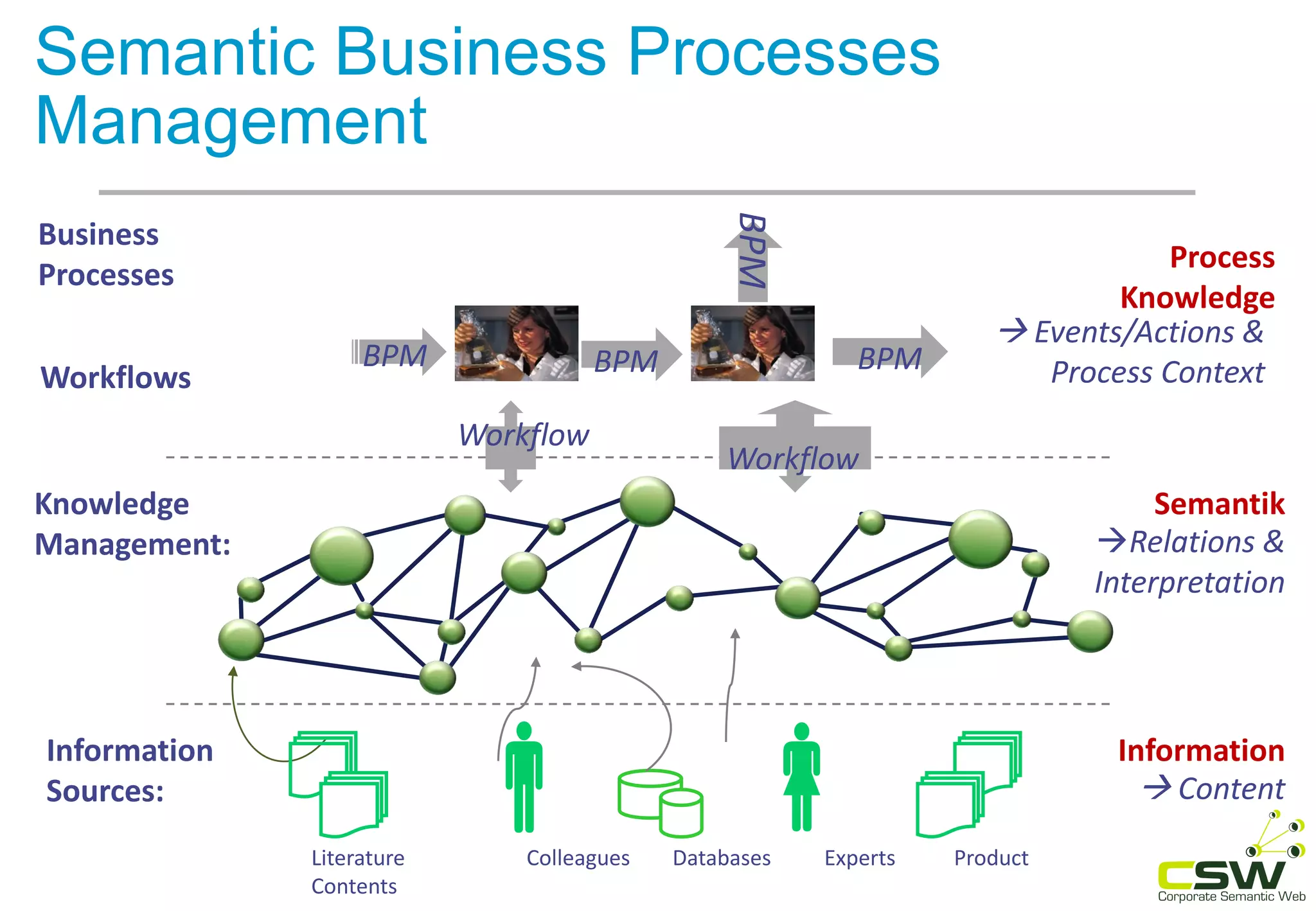
 Information
Sources:
Knowledge
Management:
Workflows
Process
Knowledge
Semantik
Information
 Events/Actions &
Process Context
Relations &
Interpretation
 Content
BPM BPMBPM
BPM
Workflow
Workflow
Literature Colleagues Databases Experts Product
Contents
Business
Processes
Semantic Business Processes
Management
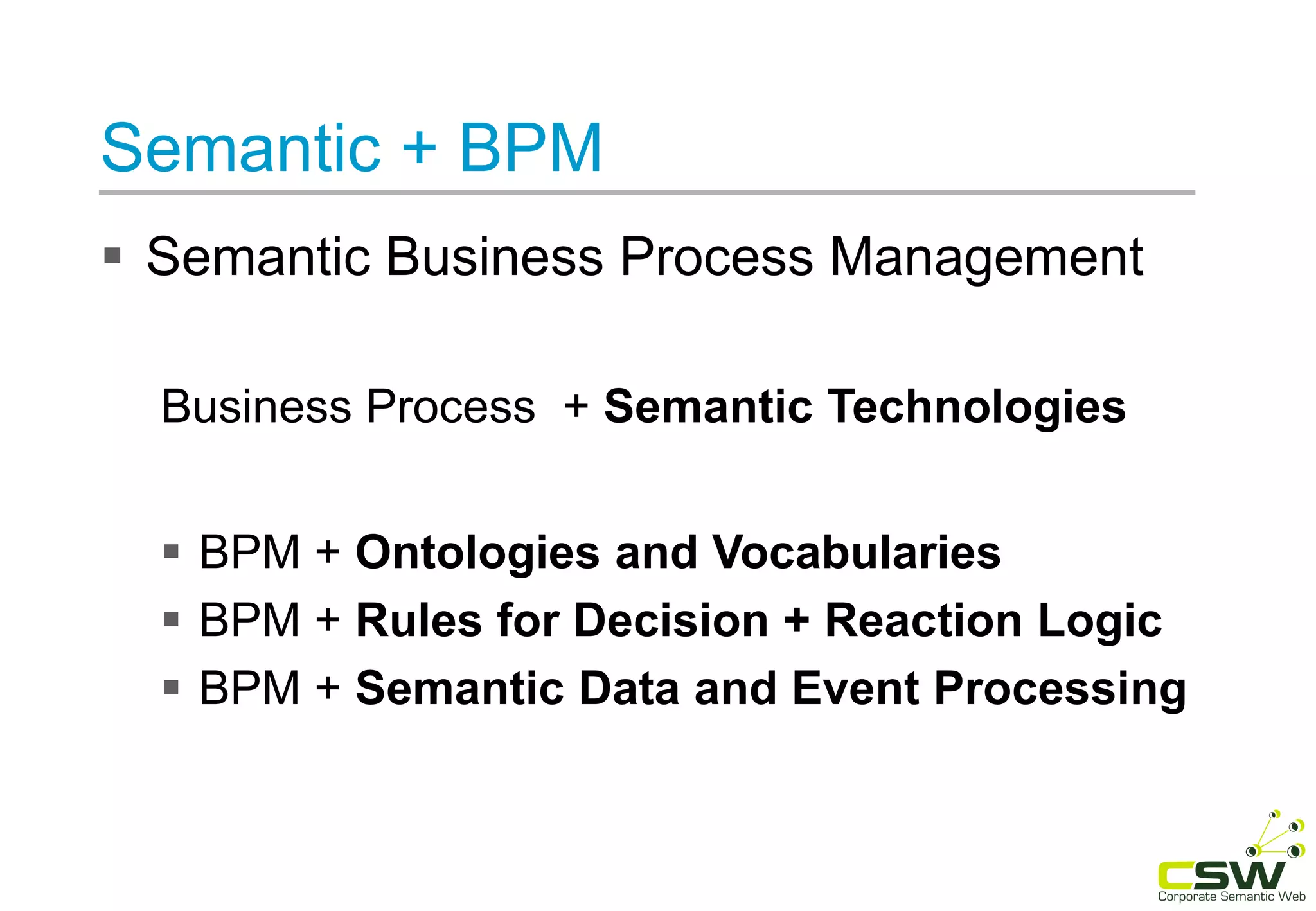
Semantic + BPM
 Semantic Business Process Management
Business Process + Semantic Technologies
 BPM + Ontologies and Vocabularies
 BPM + Rules for Decision + Reaction Logic
 BPM + Semantic Data and Event Processing
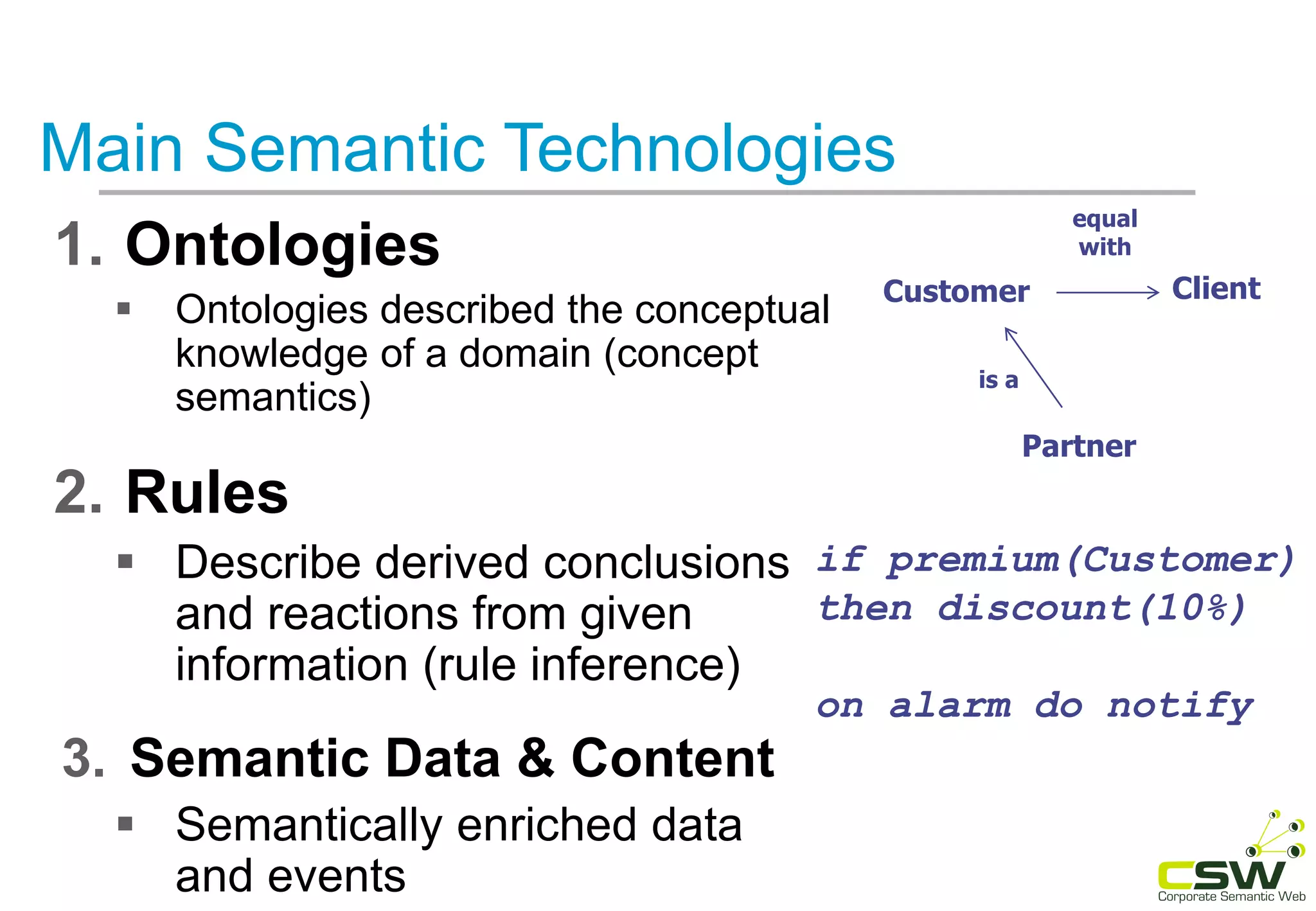
Main Semantic Technologies
1. Ontologies
 Ontologies described the conceptual
knowledge of a domain (concept
semantics)
2. Rules
 Describe derived conclusions
and reactions from given
information (rule inference)
3. Semantic Data & Content
 Semantically enriched data
and events
Partner
Customer
is a
equal
with
Client
if premium(Customer)
then discount(10%)
on alarm do notify
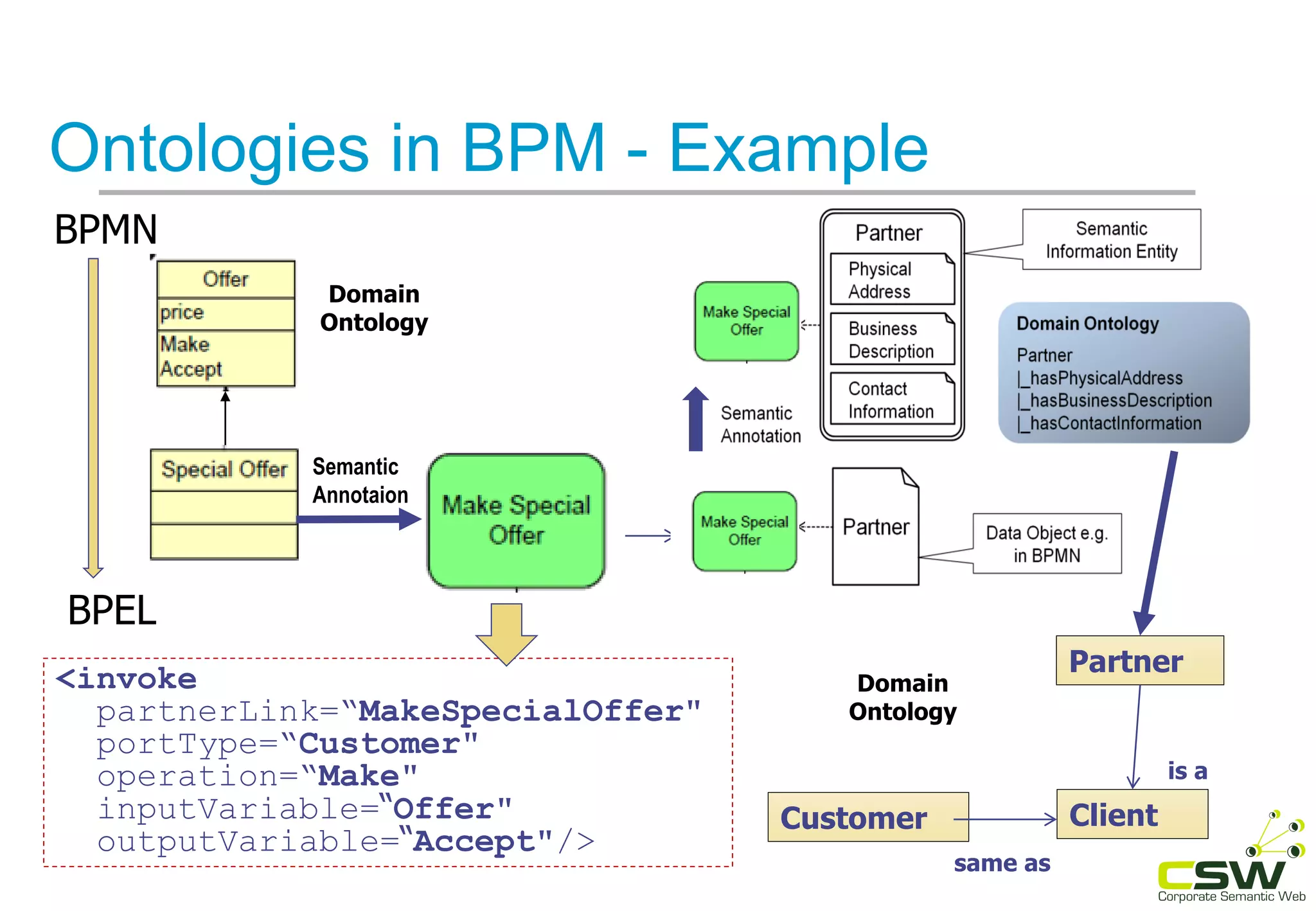
Partner
Customer
is a
same as
Client
<invoke
partnerLink=“MakeSpecialOffer"
portType=“Customer"
operation=“Make"
inputVariable=“Offer"
outputVariable=“Accept"/>
Semantic
Annotaion
BPEL
BPMN
Ontologies in BPM - Example
Domain
Ontology
Domain
Ontology
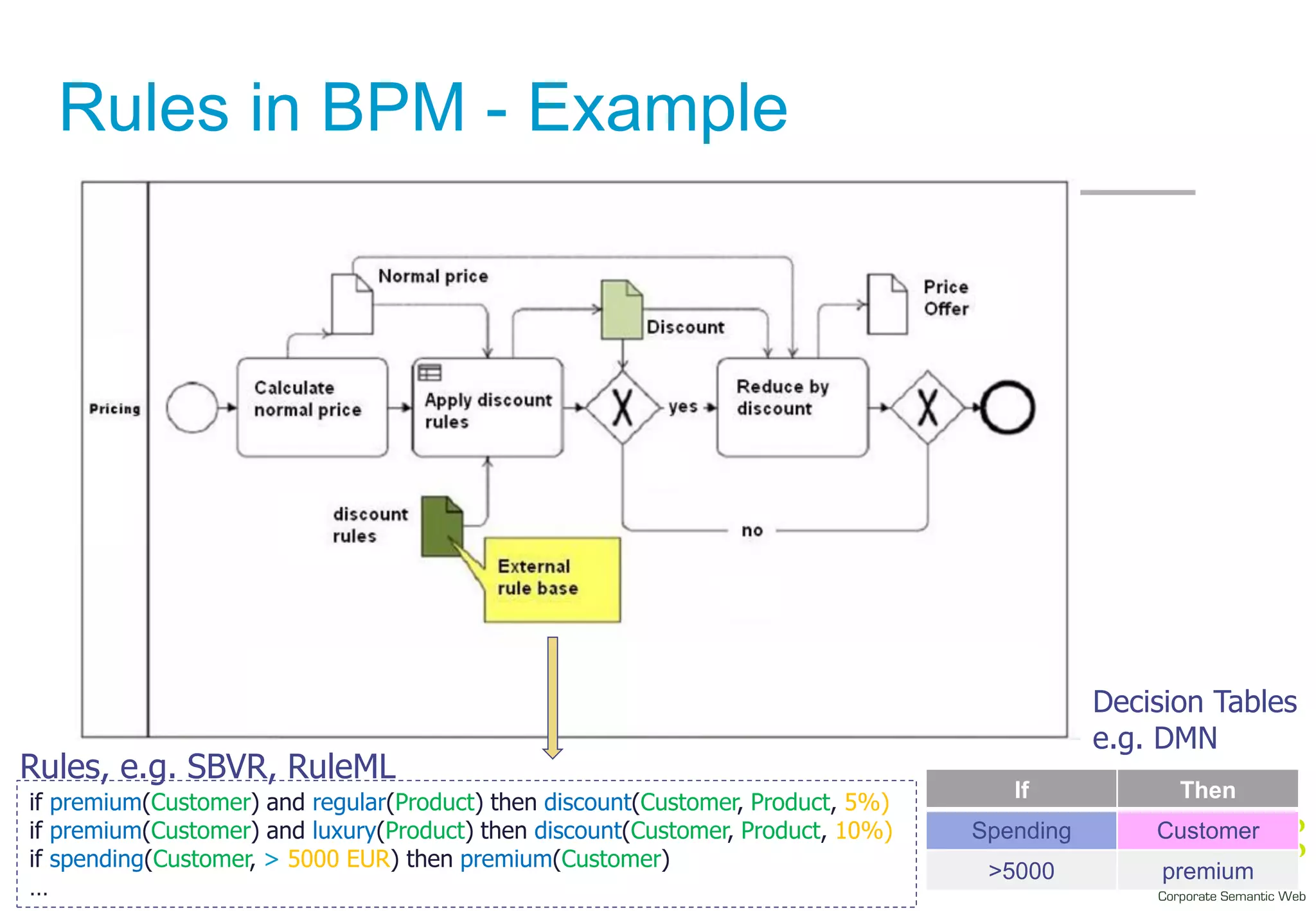
Rules in BPM - Example
if premium(Customer) and regular(Product) then discount(Customer, Product, 5%)
if premium(Customer) and luxury(Product) then discount(Customer, Product, 10%)
if spending(Customer, > 5000 EUR) then premium(Customer)
…
If Then
Spending Customer
>5000 premium
Rules, e.g. SBVR, RuleML
Decision Tables
e.g. DMN
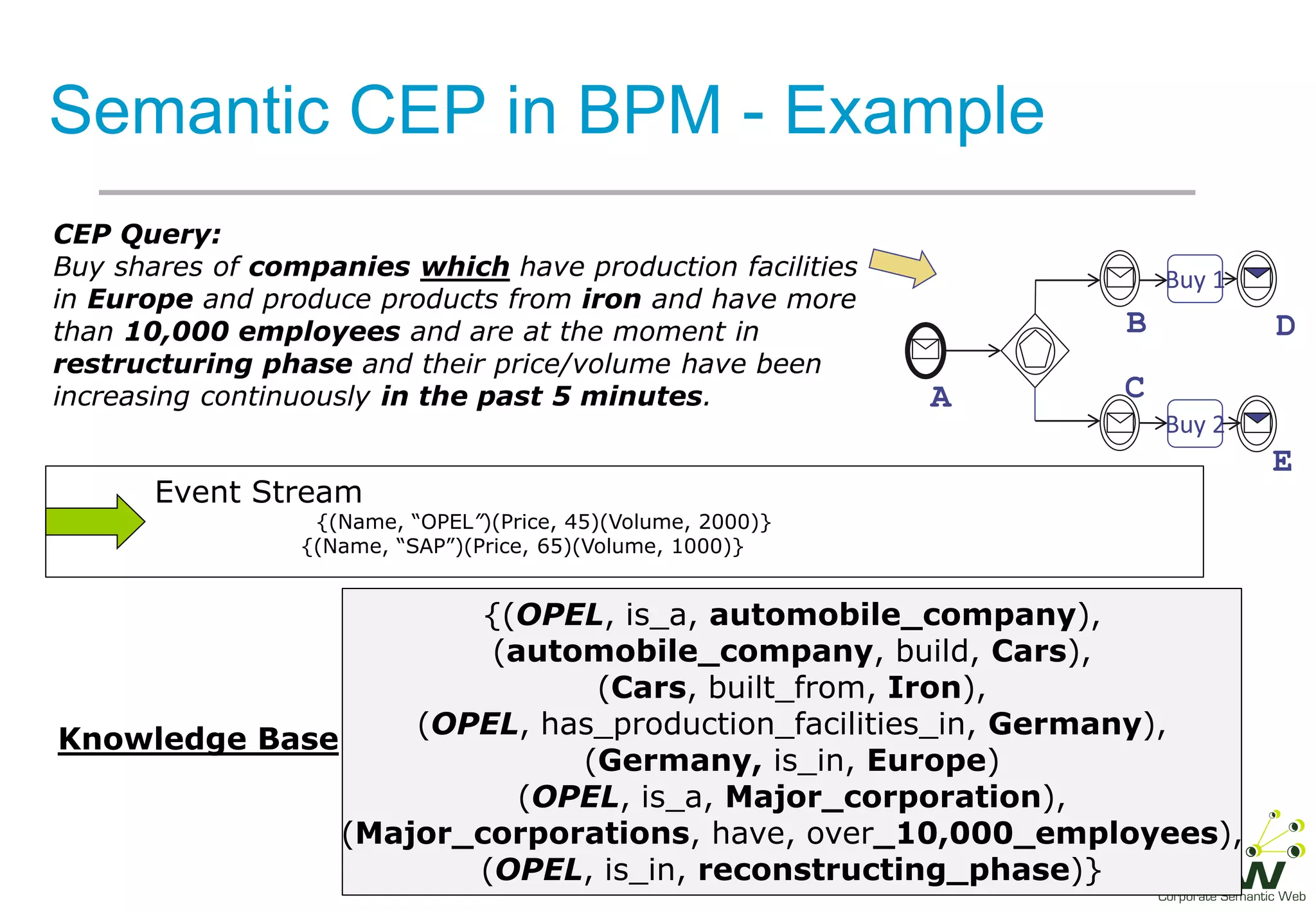
Event Stream
{(Name, “OPEL”)(Price, 45)(Volume, 2000)}
{(Name, “SAP”)(Price, 65)(Volume, 1000)}
CEP Query:
Buy shares of companies which have production facilities
in Europe and produce products from iron and have more
than 10,000 employees and are at the moment in
restructuring phase and their price/volume have been
increasing continuously in the past 5 minutes.
{(OPEL, is_a, automobile_company),
(automobile_company, build, Cars),
(Cars, built_from, Iron),
(OPEL, has_production_facilities_in, Germany),
(Germany, is_in, Europe)
(OPEL, is_a, Major_corporation),
(Major_corporations, have, over_10,000_employees),
(OPEL, is_in, reconstructing_phase)}
Knowledge Base
A
B
C
Buy 1
Buy 2
D
E
Semantic CEP in BPM - Example
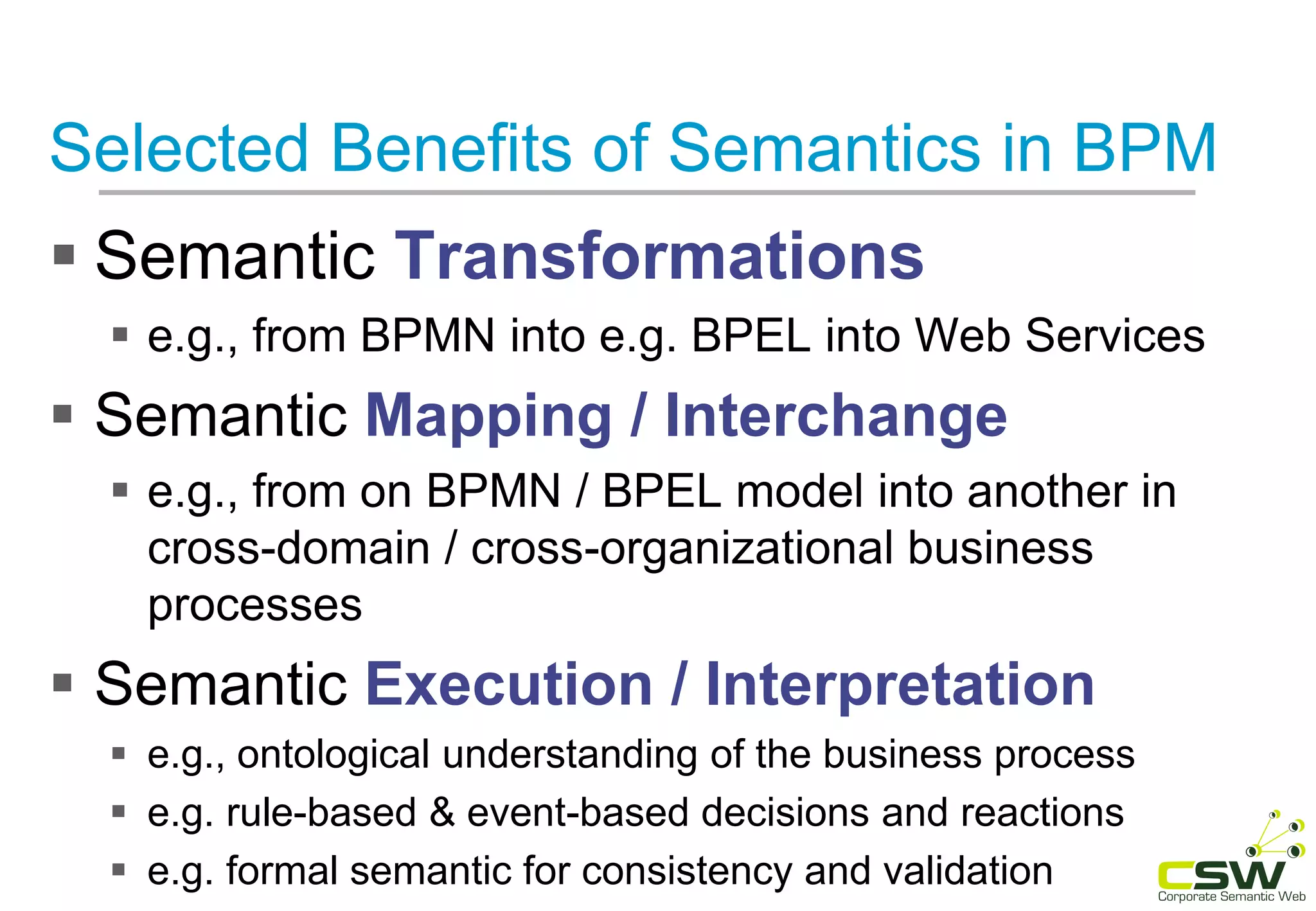
Selected Benefits of Semantics in BPM
 Semantic Transformations
 e.g., from BPMN into e.g. BPEL into Web Services
 Semantic Mapping / Interchange
 e.g., from on BPMN / BPEL model into another in
cross-domain / cross-organizational business
processes
 Semantic Execution / Interpretation
 e.g., ontological understanding of the business process
 e.g. rule-based & event-based decisions and reactions
 e.g. formal semantic for consistency and validation
Ontologies + BPM
Examples
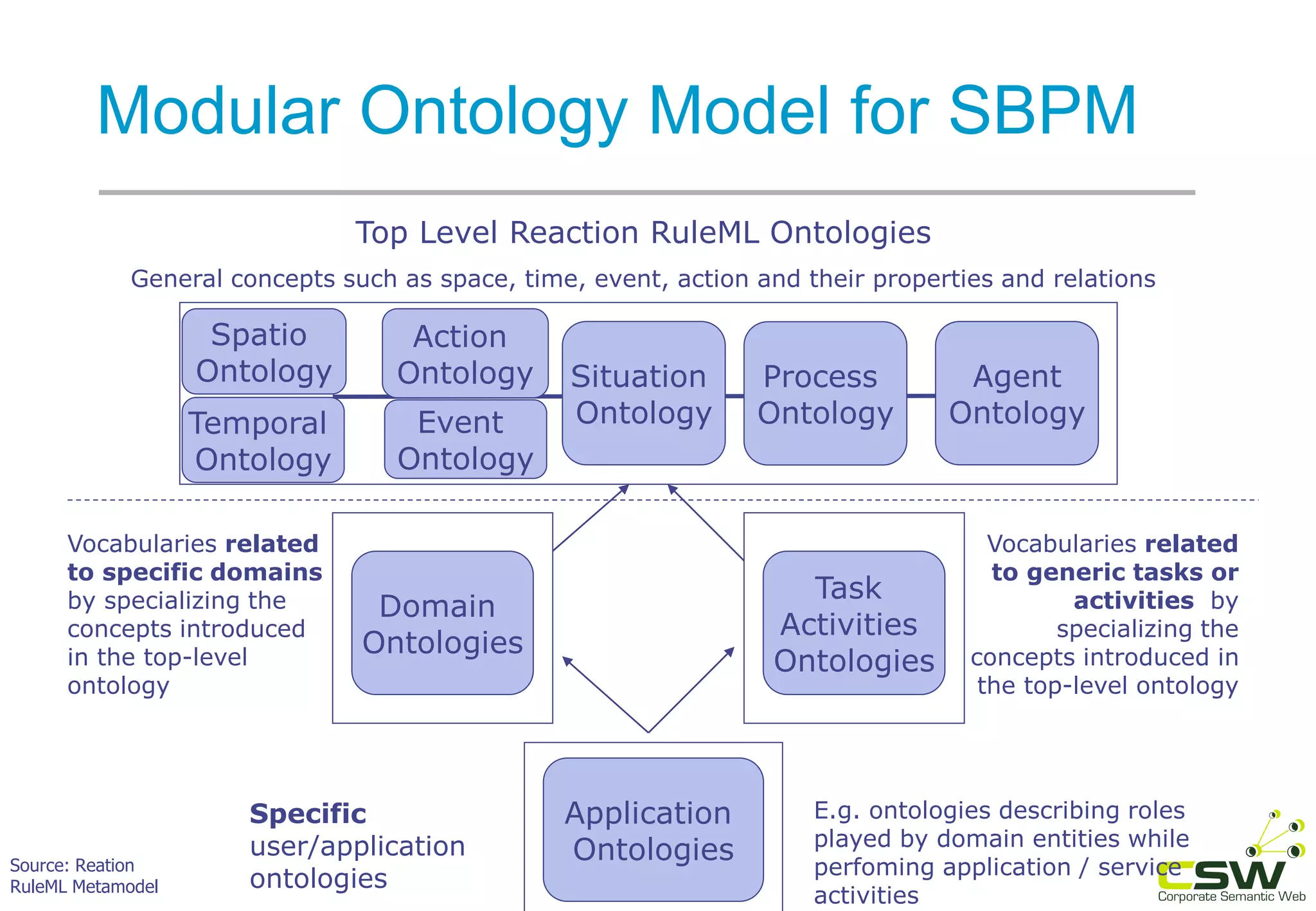
Top Level Reaction RuleML Ontologies
General concepts such as space, time, event, action and their properties and relations
Temporal
Ontology
Action
Ontology Process
Ontology
Agent
Ontology
Situation
Ontology
Domain
Ontologies
Vocabularies related
to specific domains
by specializing the
concepts introduced
in the top-level
ontology
Task
Activities
Ontologies
Vocabularies related
to generic tasks or
activities by
specializing the
concepts introduced in
the top-level ontology
Application
Ontologies
Specific
user/application
ontologies
E.g. ontologies describing roles
played by domain entities while
perfoming application / service
activities
Spatio
Ontology
Event
Ontology
Source: Reation
RuleML Metamodel
Modular Ontology Model for SBPM
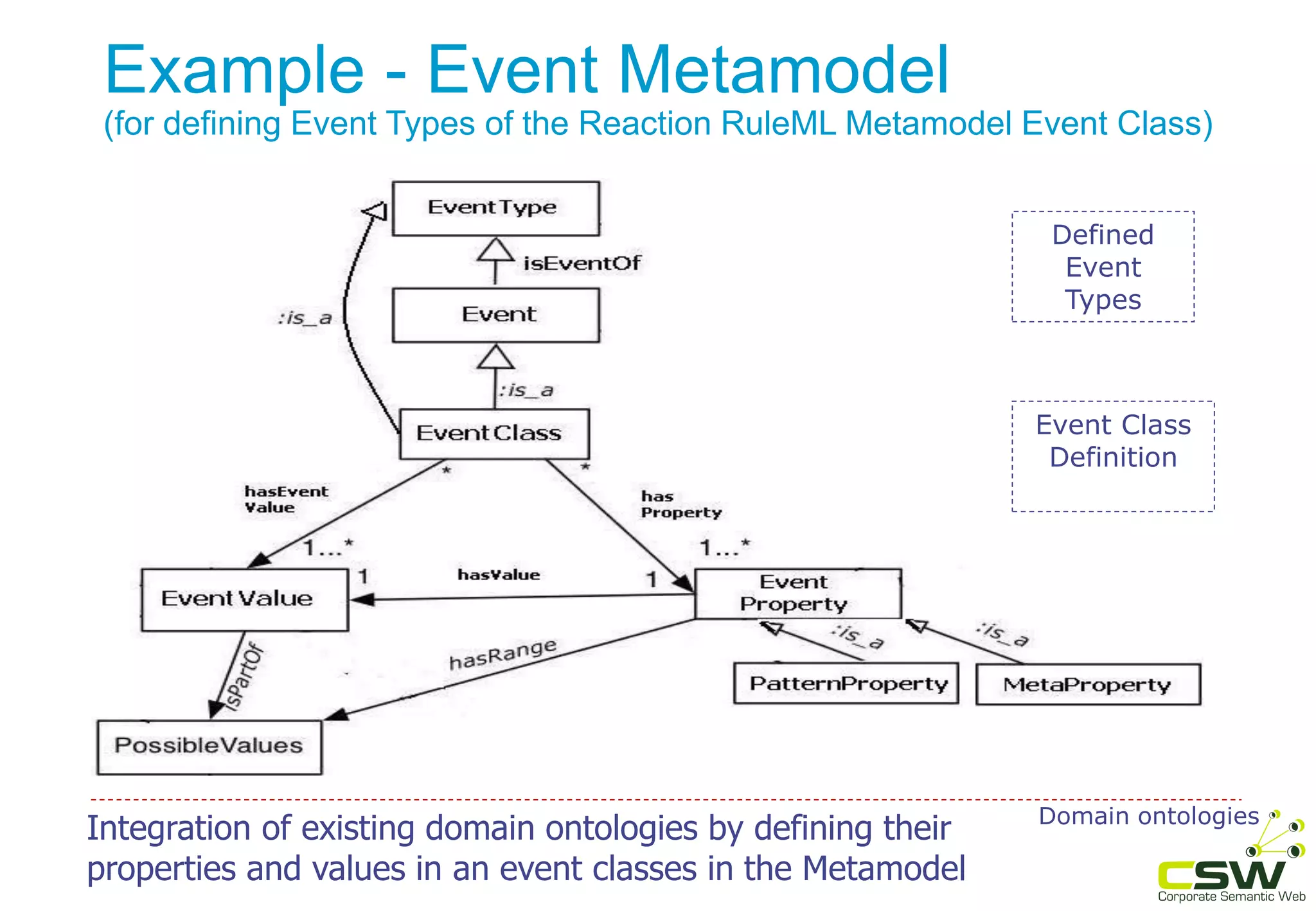
Example - Event Metamodel
(for defining Event Types of the Reaction RuleML Metamodel Event Class)
Defined
Event
Types
Event Class
Definition
Integration of existing domain ontologies by defining their
properties and values in an event classes in the Metamodel
Domain ontologies
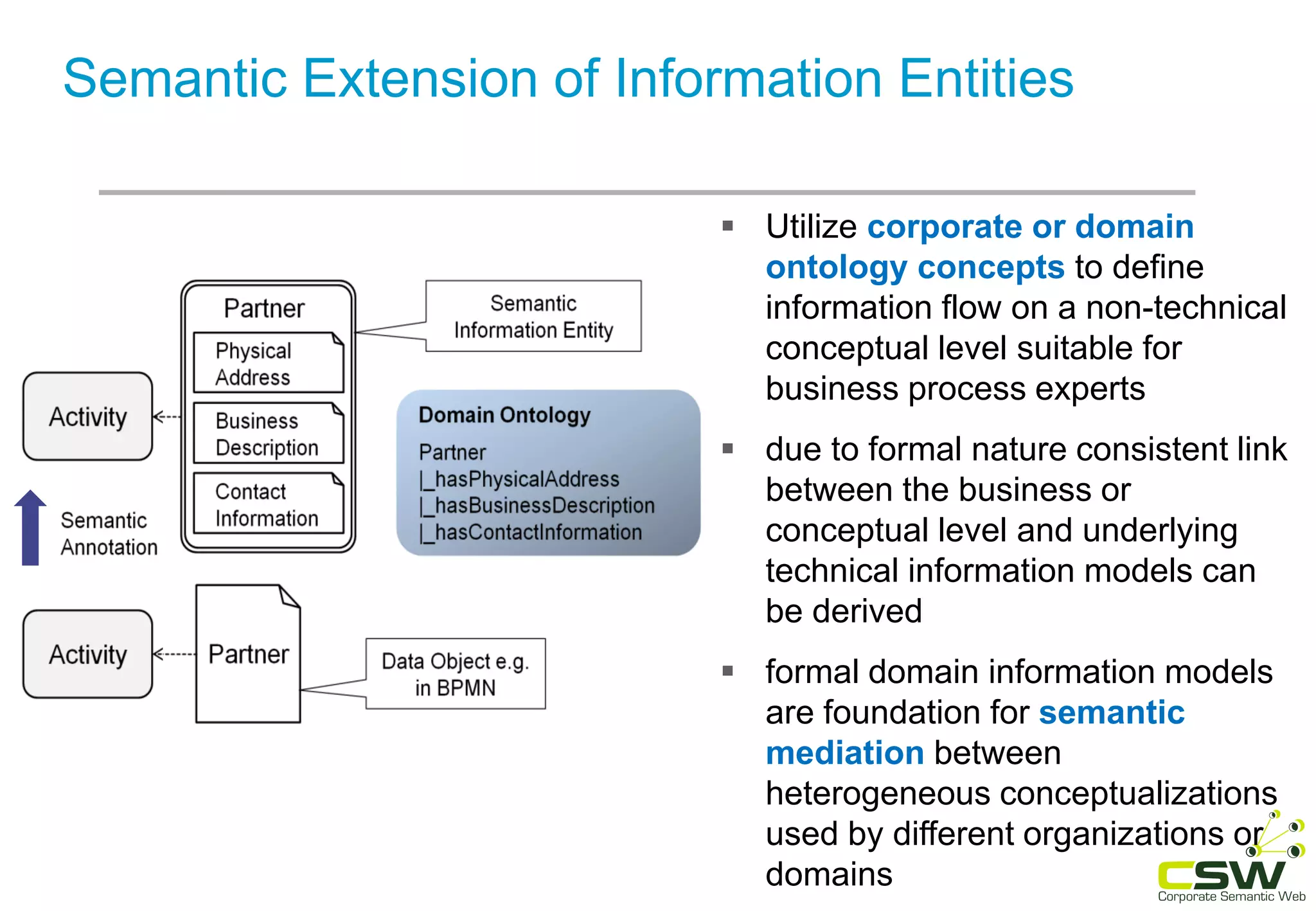
Semantic Extension of Information Entities
 Utilize corporate or domain
ontology concepts to define
information flow on a non-technical
conceptual level suitable for
business process experts
 due to formal nature consistent link
between the business or
conceptual level and underlying
technical information models can
be derived
 formal domain information models
are foundation for semantic
mediation between
heterogeneous conceptualizations
used by different organizations or
domains
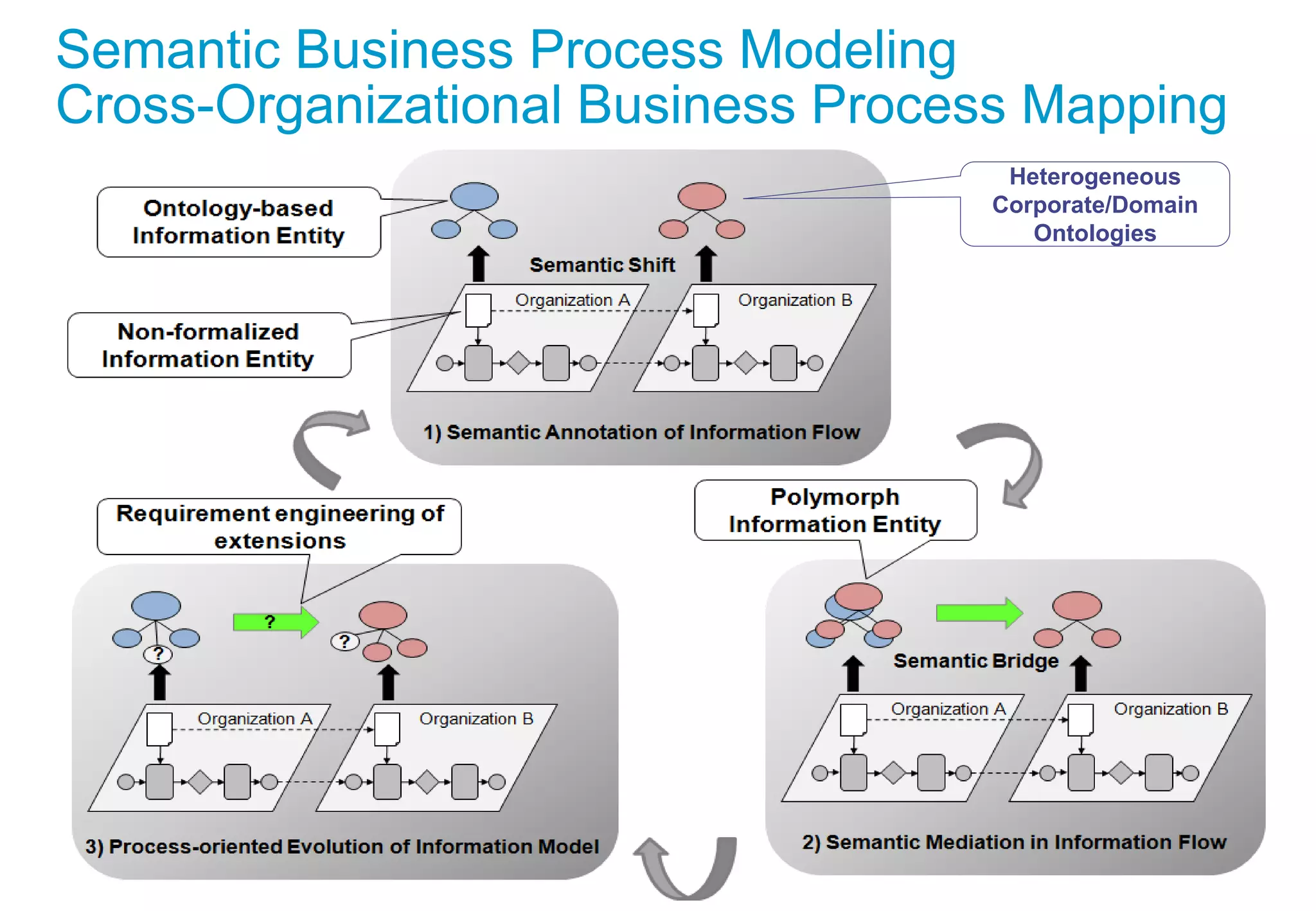
Semantic Business Process Modeling
Cross-Organizational Business Process Mapping
Heterogeneous
Corporate/Domain
Ontologies
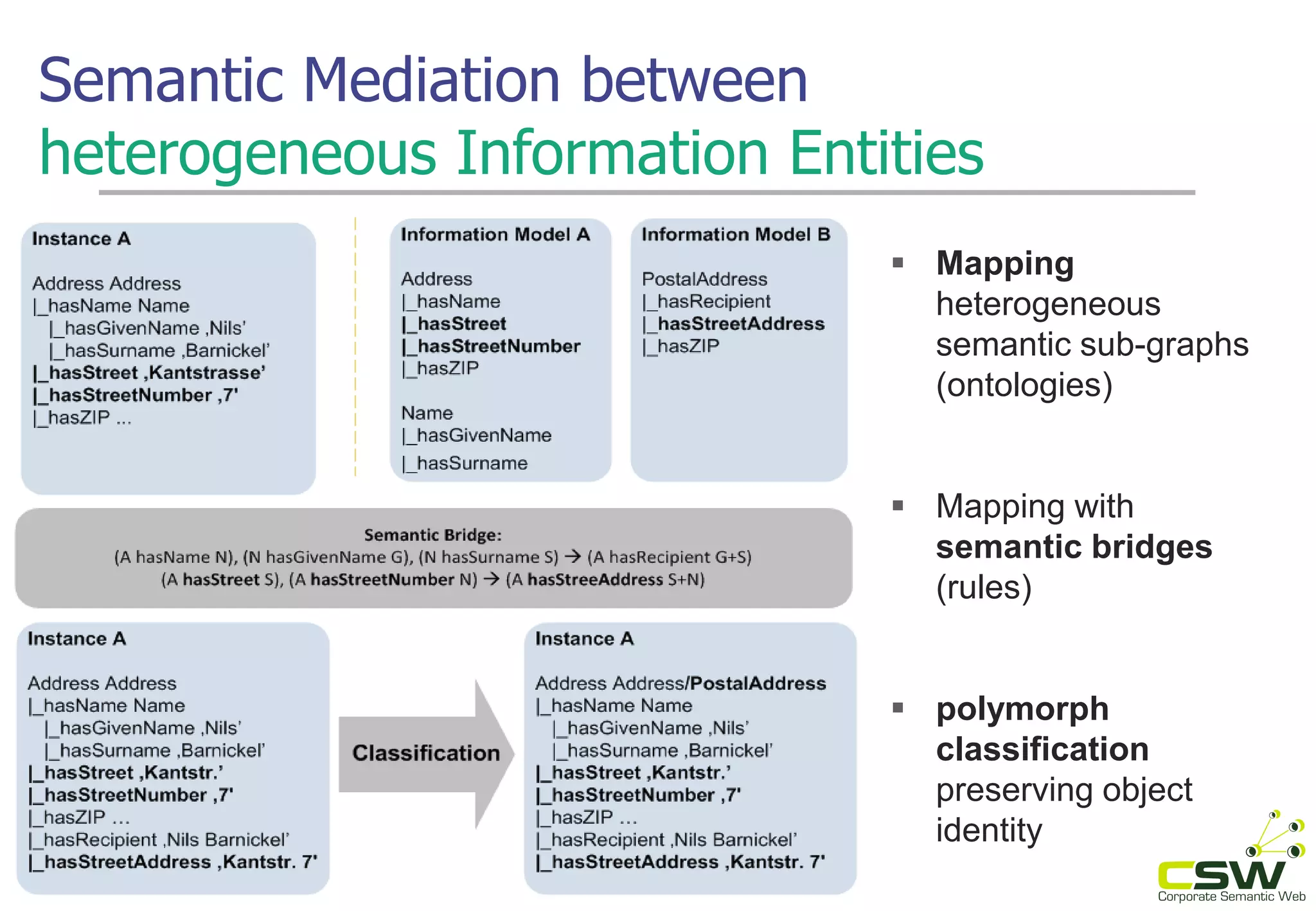
 Mapping
heterogeneous
semantic sub-graphs
(ontologies)
 Mapping with
semantic bridges
(rules)
 polymorph
classification
preserving object
identity
Semantic Mediation between
heterogeneous Information Entities
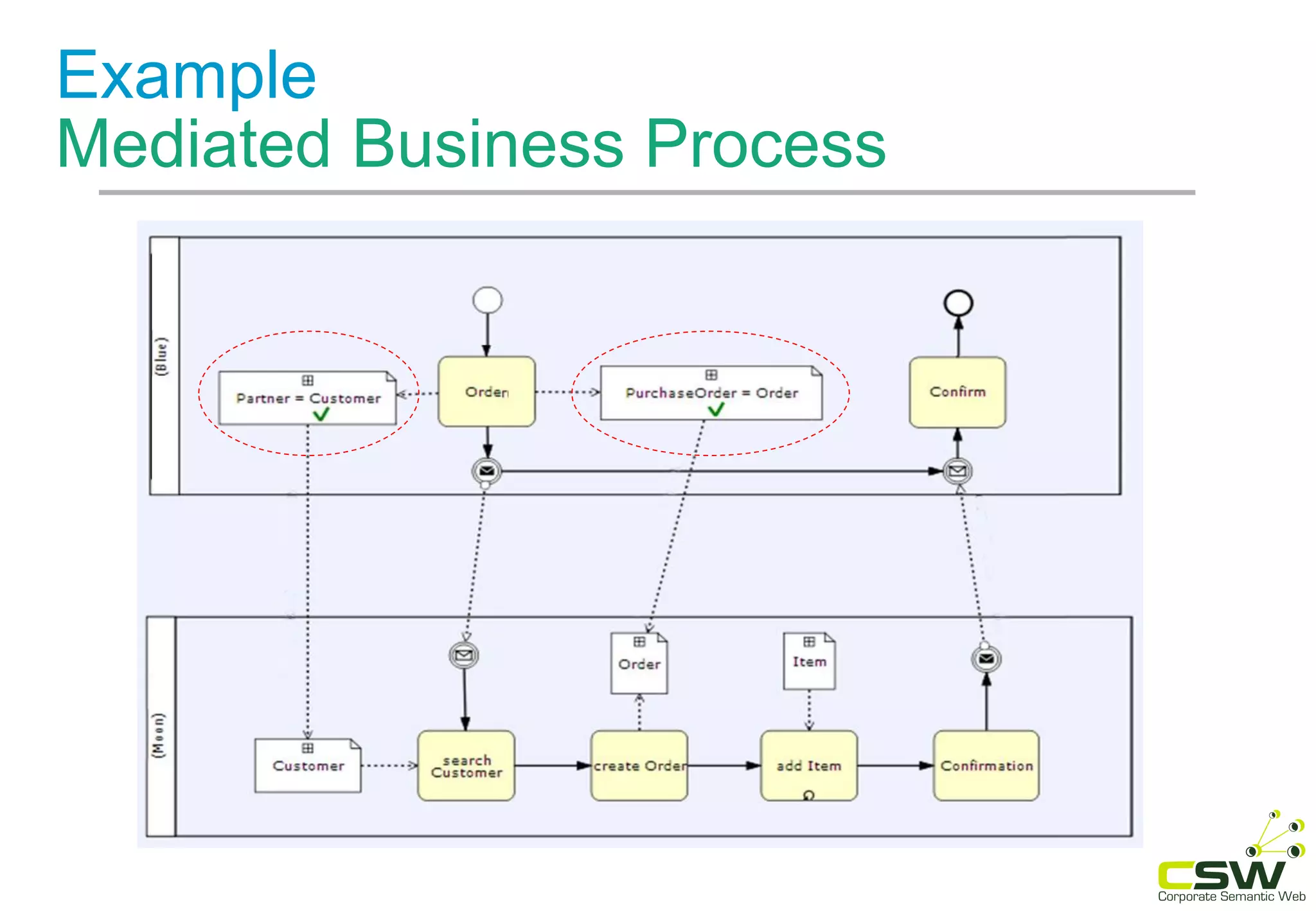
Example
Mediated Business Process
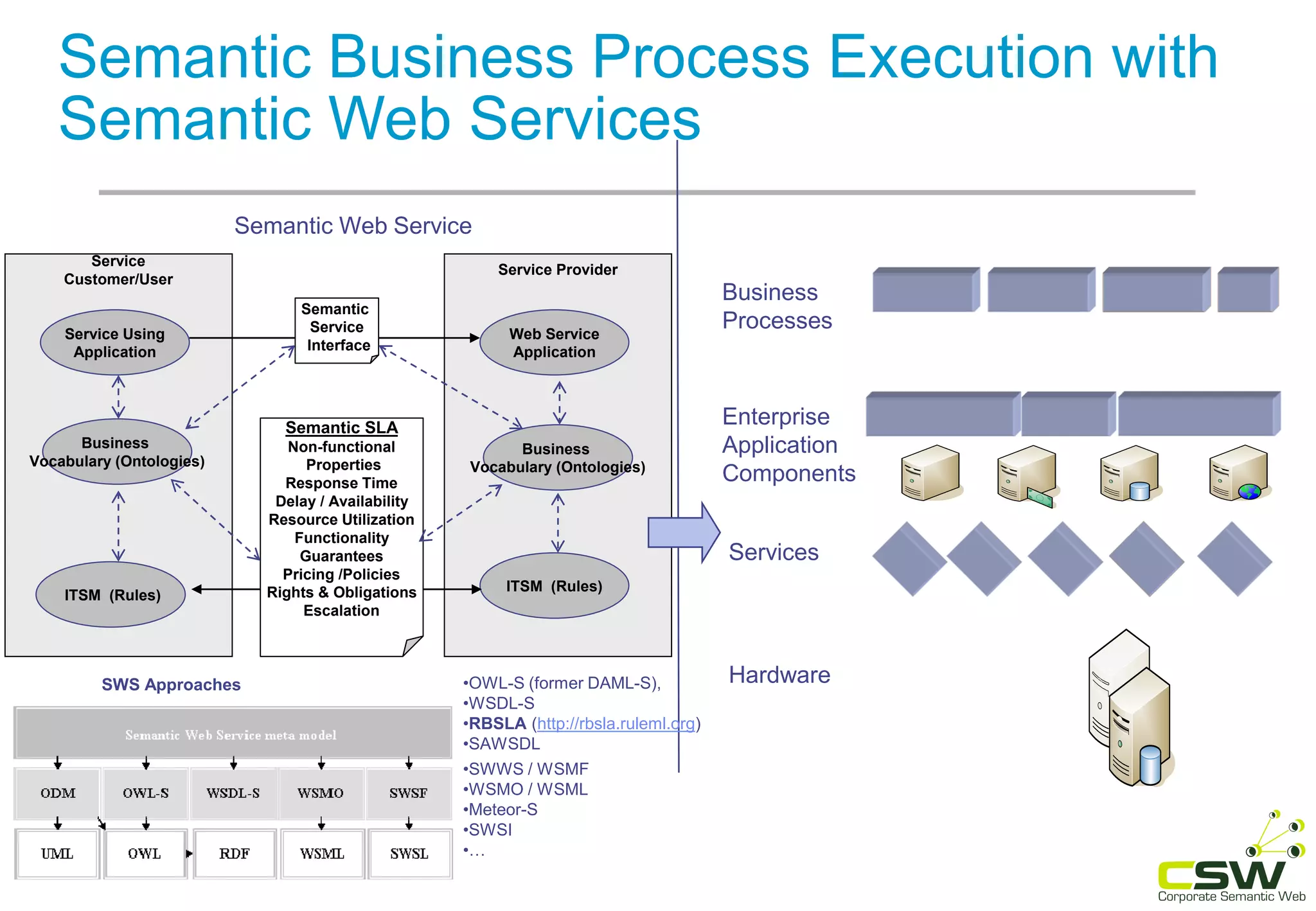
Semantic Business Process Execution with
Semantic Web Services
Business
Processes
Enterprise
Application
Components
Services
Hardware
Web Service
Application
Service Using
Application
Semantic
Service
Interface
ITSM (Rules)
ITSM (Rules)
Semantic SLA
Non-functional
Properties
Response Time
Delay / Availability
Resource Utilization
Functionality
Guarantees
Pricing /Policies
Rights & Obligations
Escalation
Service
Customer/User
Service Provider
Business
Vocabulary (Ontologies)
Business
Vocabulary (Ontologies)
Semantic Web Service
•OWL-S (former DAML-S),
•WSDL-S
•RBSLA (http://rbsla.ruleml.org)
•SAWSDL
•SWWS / WSMF
•WSMO / WSML
•Meteor-S
•SWSI
•…
SWS Approaches
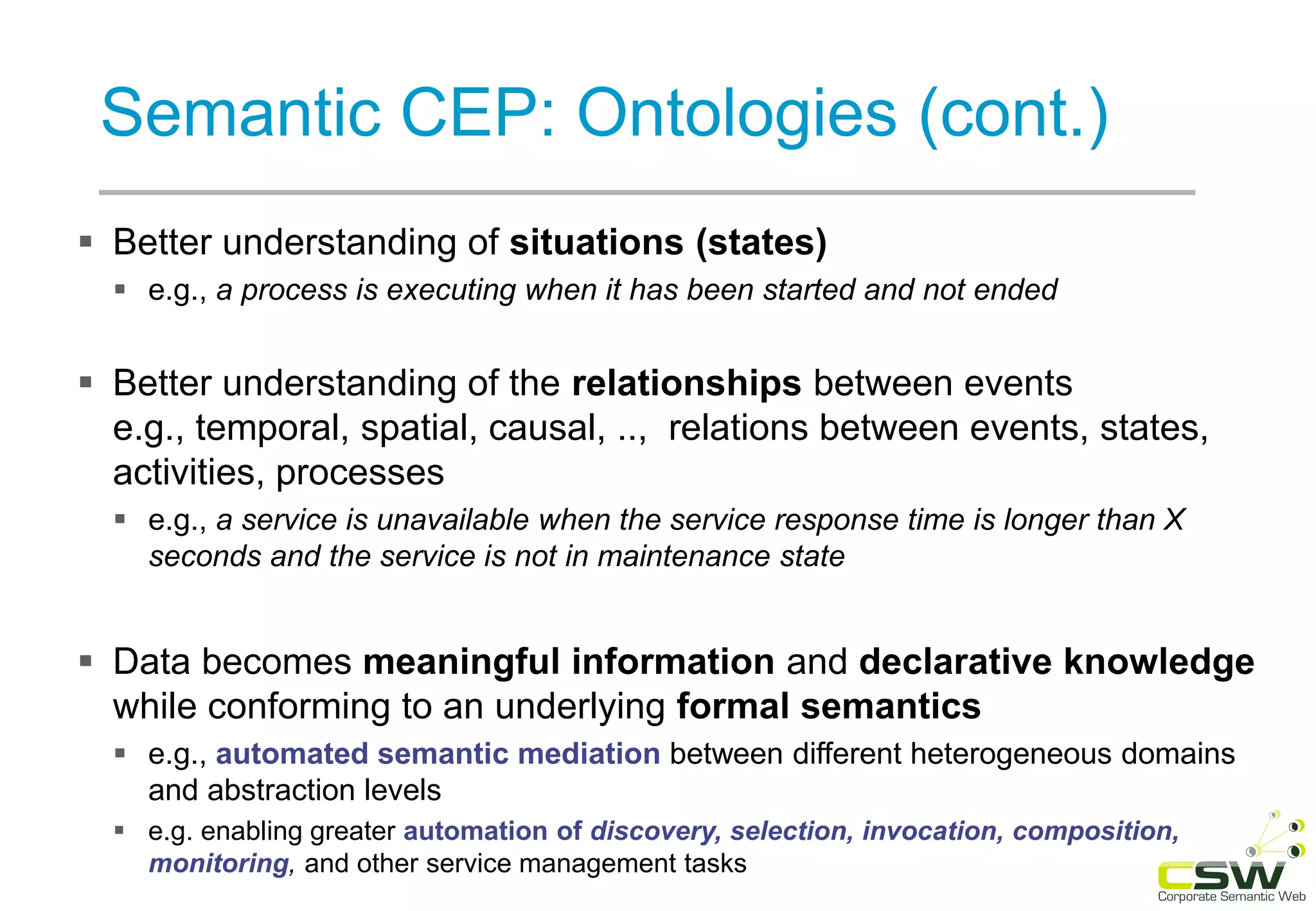
Semantic CEP: Ontologies (cont.)
 Better understanding of situations (states)
 e.g., a process is executing when it has been started and not ended
 Better understanding of the relationships between events
e.g., temporal, spatial, causal, .., relations between events, states,
activities, processes
 e.g., a service is unavailable when the service response time is longer than X
seconds and the service is not in maintenance state
 Data becomes meaningful information and declarative knowledge
while conforming to an underlying formal semantics
 e.g., automated semantic mediation between different heterogeneous domains
and abstraction levels
 e.g. enabling greater automation of discovery, selection, invocation, composition,
monitoring, and other service management tasks
Rules + BPM
Examples
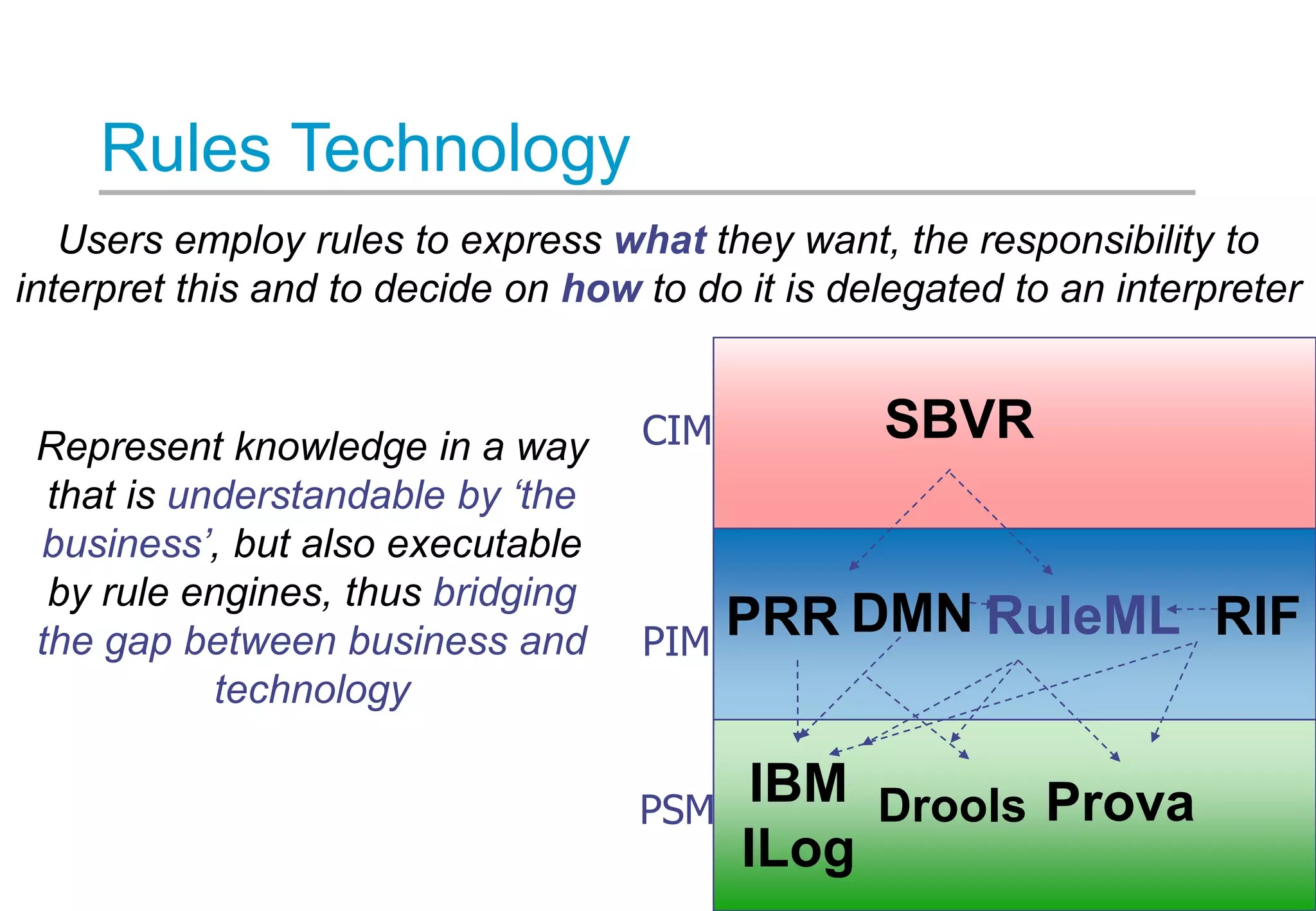
Rules Technology
Users employ rules to express what they want, the responsibility to
interpret this and to decide on how to do it is delegated to an interpreter
Represent knowledge in a way
that is understandable by ‘the
business’, but also executable
by rule engines, thus bridging
the gap between business and
technology
IBM
ILog
Drools Prova
PRR RuleML RIF
SBVRCIM
PIM
PSM
DMN
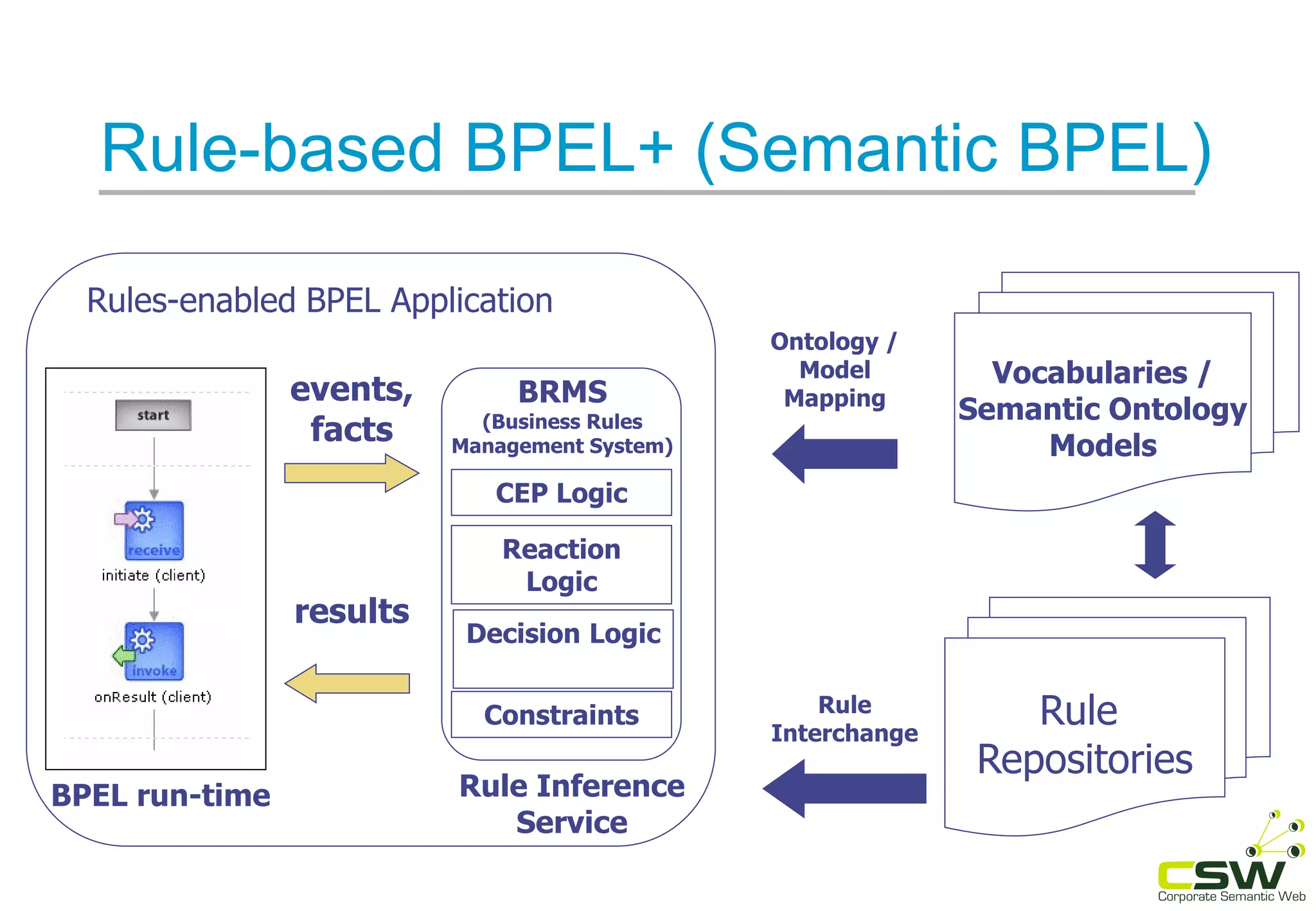
Rules-enabled BPEL Application
BPEL run-time
BRMS
(Business Rules
Management System)
events,
facts
results
CEP Logic
Reaction
Logic
Decision Logic
Constraints
Rule Inference
Service
Rule
Repositories
Vocabularies /
Semantic Ontology
Models
Rule
Interchange
Ontology /
Model
Mapping
Rule-based BPEL+ (Semantic BPEL)
Orchestrated BPEL + Choreography
Rule Workflow
Rules-enabled BPEL
Application
BPEL run-
time
BRMS
(Business Rules
Management
System)
events
, facts
results
CEP Logic
Reaction
Logic
Decision
Logic
Constraints
Rule Inference
Service
% receive query and delegate it to another party
rcvMsg(CID,esb, Requester, acl_query-ref, Query) :-
responsibleRole(Agent, Query),
sendMsg(Sub-CID,esb,Agent,acl_query-ref, Query),
rcvMsg(Sub-CID,esb,Agent,acl_inform-ref, Answer),
... (other goals)...
sendMsg(CID,esb,Requester,acl_inform-ref,Answer).
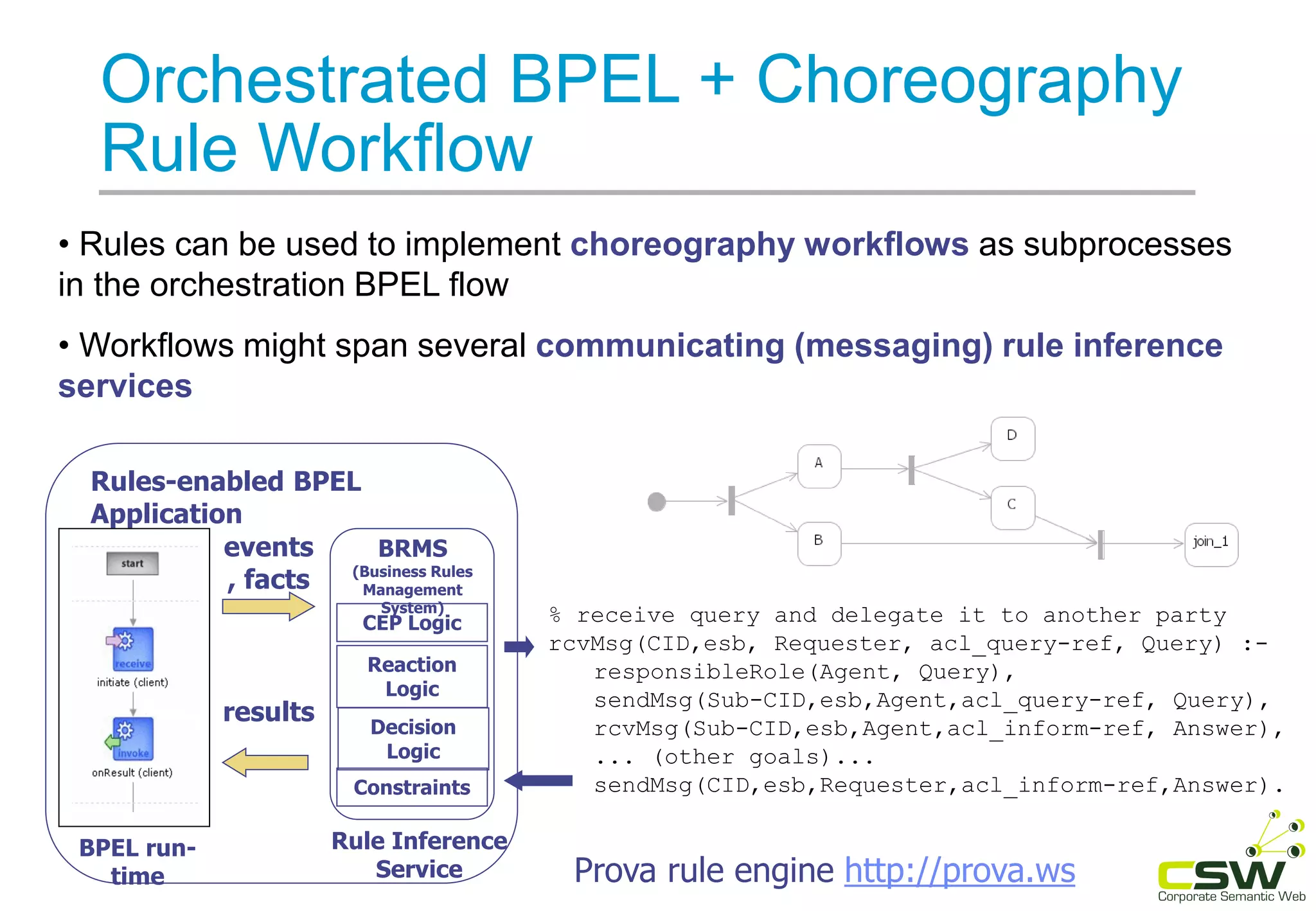
• Rules can be used to implement choreography workflows as subprocesses
in the orchestration BPEL flow
• Workflows might span several communicating (messaging) rule inference
services
Prova rule engine http://prova.ws
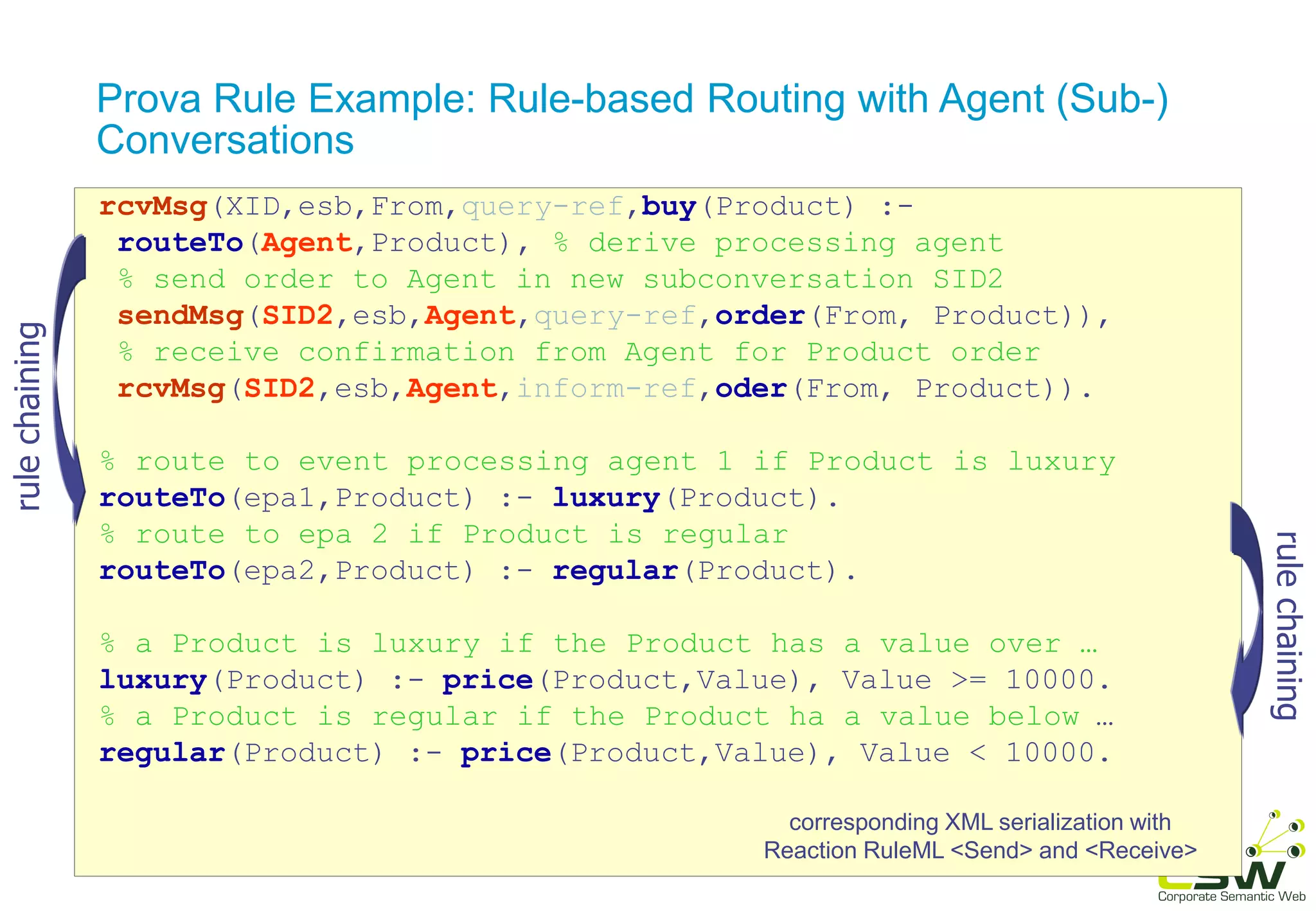
Prova Rule Example: Rule-based Routing with Agent (Sub-)
Conversations
rcvMsg(XID,esb,From,query-ref,buy(Product) :-
routeTo(Agent,Product), % derive processing agent
% send order to Agent in new subconversation SID2
sendMsg(SID2,esb,Agent,query-ref,order(From, Product)),
% receive confirmation from Agent for Product order
rcvMsg(SID2,esb,Agent,inform-ref,oder(From, Product)).
% route to event processing agent 1 if Product is luxury
routeTo(epa1,Product) :- luxury(Product).
% route to epa 2 if Product is regular
routeTo(epa2,Product) :- regular(Product).
% a Product is luxury if the Product has a value over …
luxury(Product) :- price(Product,Value), Value >= 10000.
% a Product is regular if the Product ha a value below …
regular(Product) :- price(Product,Value), Value < 10000.
corresponding XML serialization with
Reaction RuleML <Send> and <Receive>
rulechaining
rulechaining
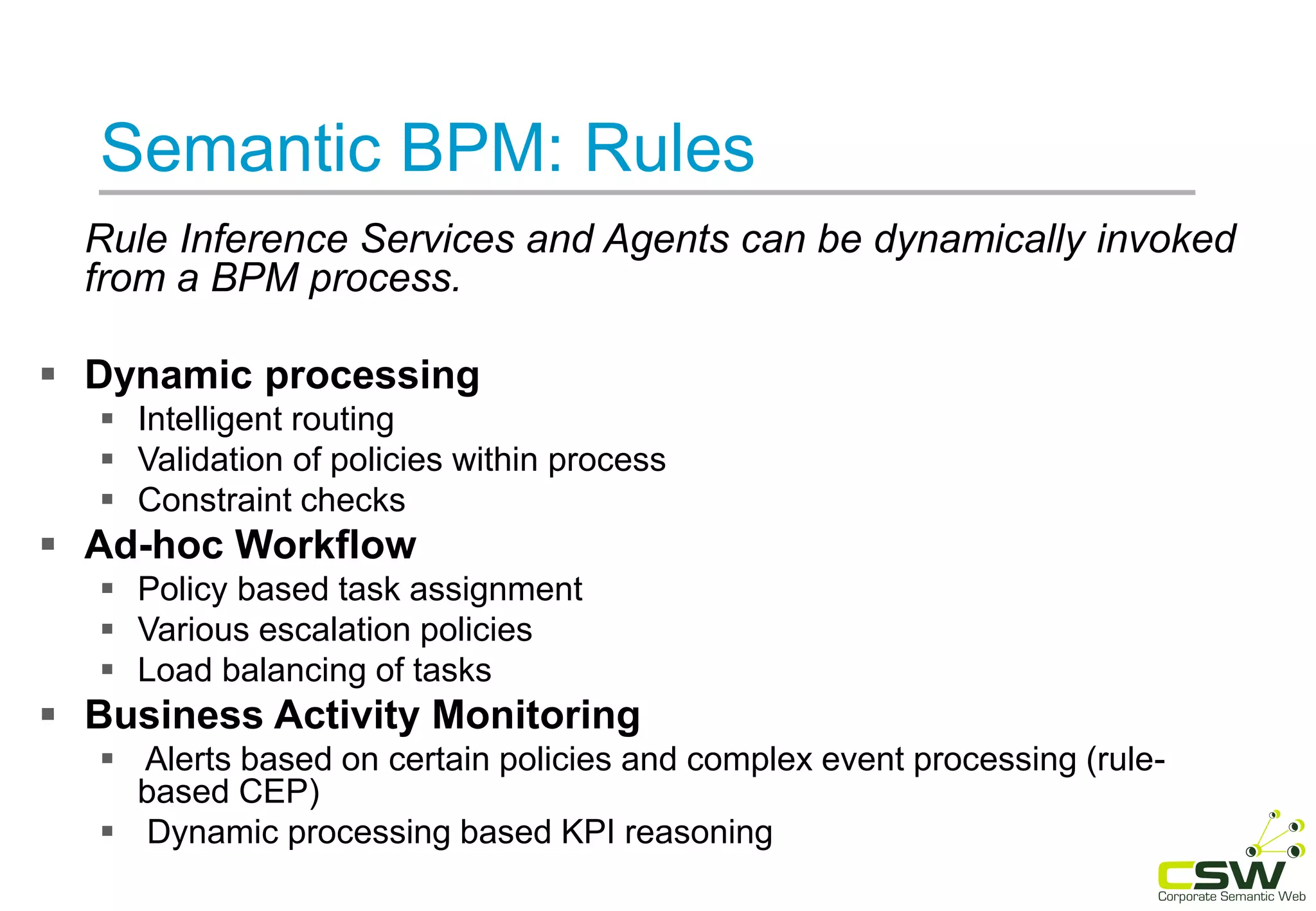
Semantic BPM: Rules
Rule Inference Services and Agents can be dynamically invoked
from a BPM process.
 Dynamic processing
 Intelligent routing
 Validation of policies within process
 Constraint checks
 Ad-hoc Workflow
 Policy based task assignment
 Various escalation policies
 Load balancing of tasks
 Business Activity Monitoring
 Alerts based on certain policies and complex event processing (rule-
based CEP)
 Dynamic processing based KPI reasoning
Event-Driven
Semantic BPM
Examples
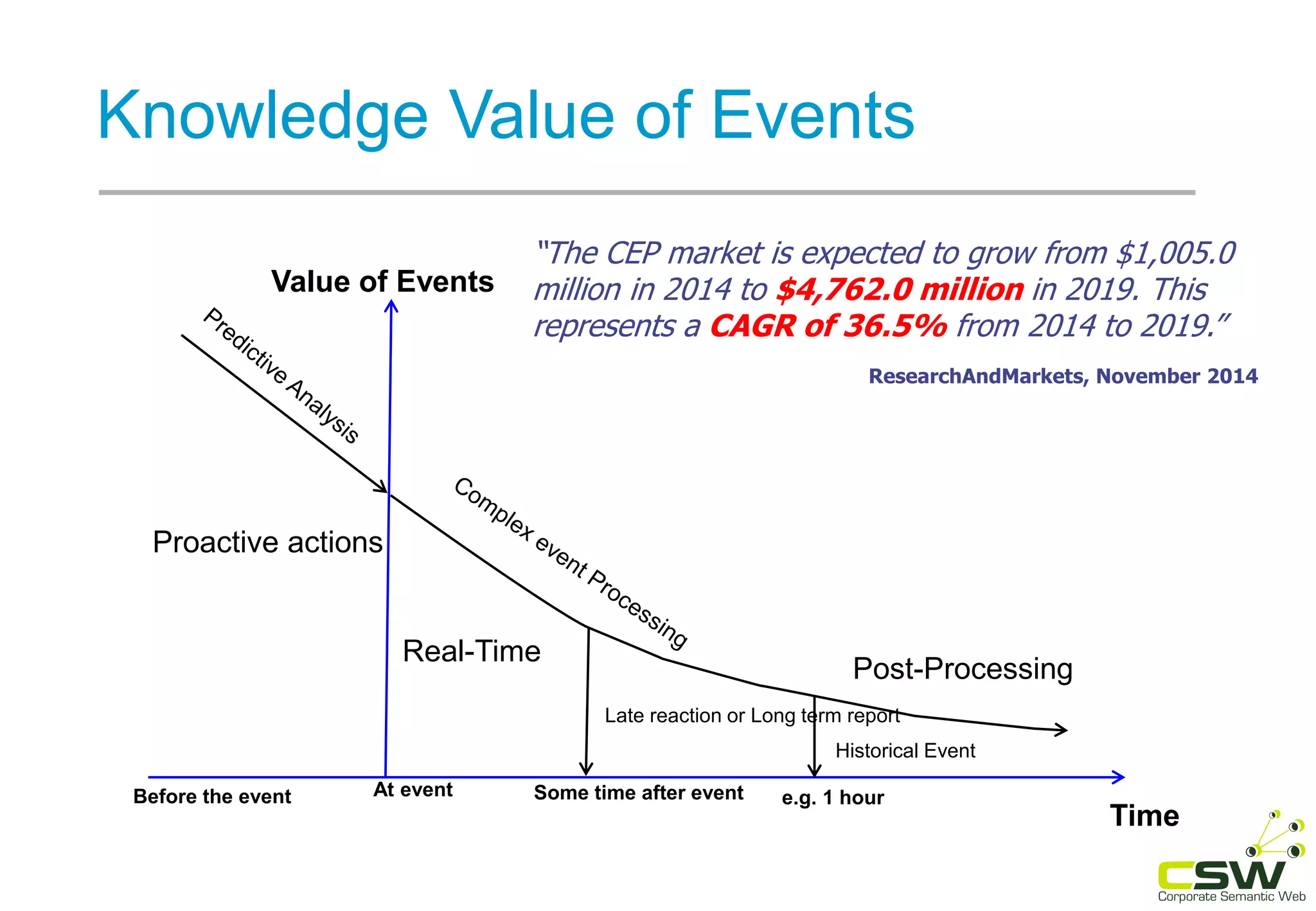
Knowledge Value of Events
Proactive actions
Value of Events
At eventBefore the event Some time after event e.g. 1 hour
Real-Time
Late reaction or Long term report
Historical Event
Post-Processing
Time
“The CEP market is expected to grow from $1,005.0
million in 2014 to $4,762.0 million in 2019. This
represents a CAGR of 36.5% from 2014 to 2019.”
ResearchAndMarkets, November 2014
Complex Events – What are they?
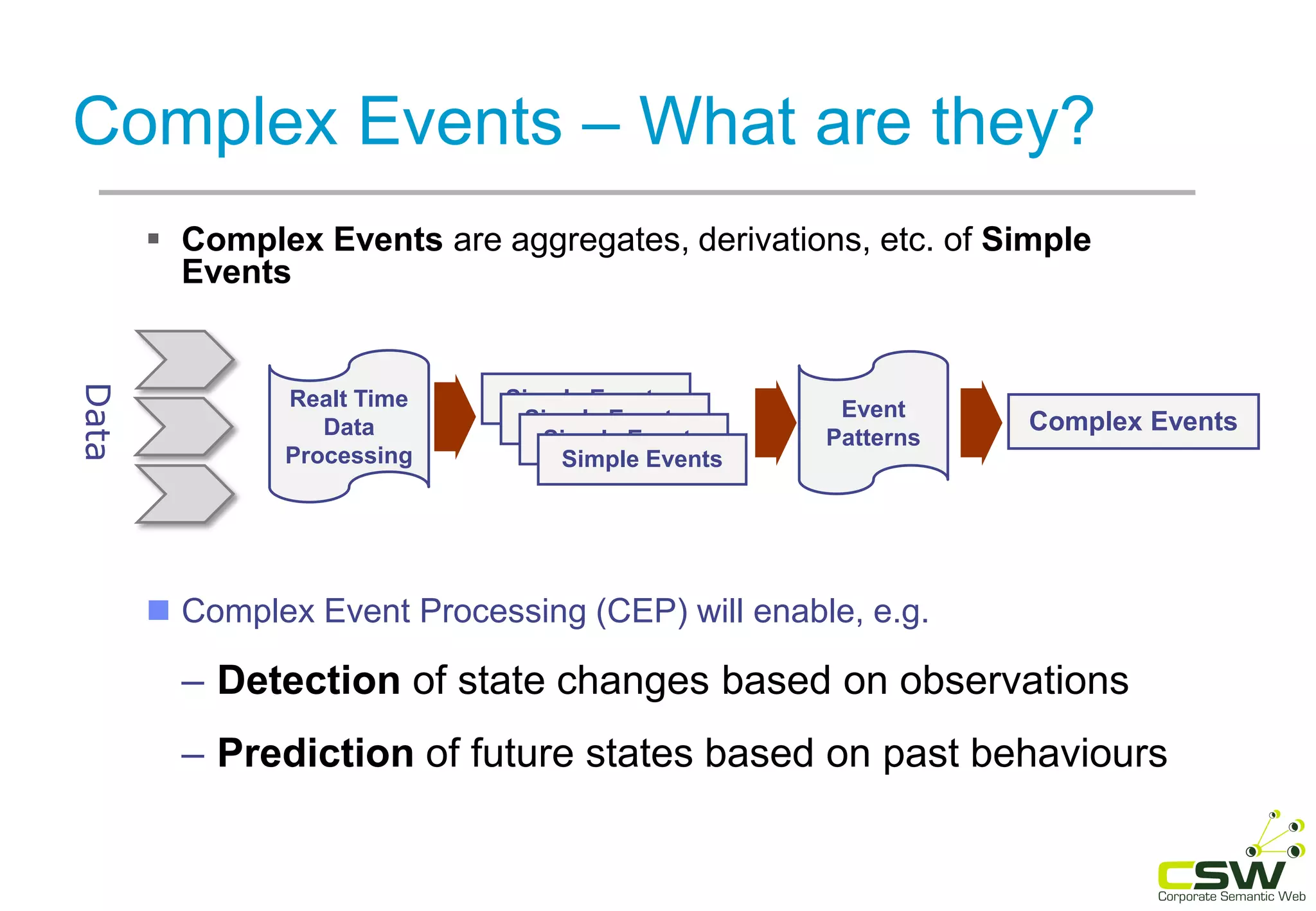
 Complex Events are aggregates, derivations, etc. of Simple
Events
Complex Events
Simple Events
Simple Events
Simple Events
Simple Events
Event
Patterns
 Complex Event Processing (CEP) will enable, e.g.
– Detection of state changes based on observations
– Prediction of future states based on past behaviours
Realt Time
Data
Processing
Data
Complex Event Processing
Event Cloud
(unordered events)
new auto pay
account login
account login
deposit
withdrawal
logout
account balance
transfer
deposit
new auto pay
enquiry
enquiry
logout
new auto pay
account login
account login
deposit
activity history
withdrawal
logout
transfer
deposit new auto pay
enquiry
enquiry
book
request
incident
A
B
C
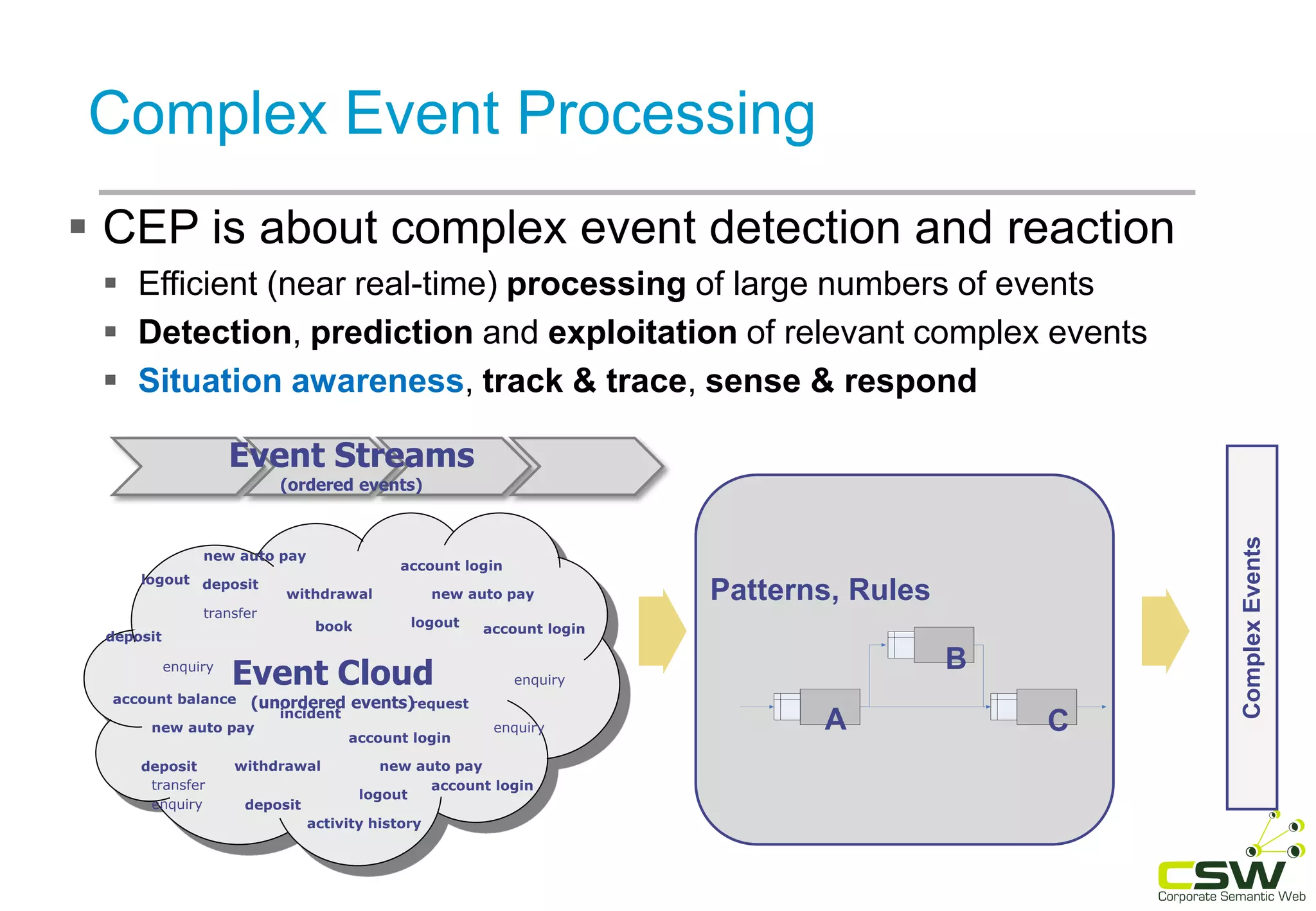
 CEP is about complex event detection and reaction
 Efficient (near real-time) processing of large numbers of events
 Detection, prediction and exploitation of relevant complex events
 Situation awareness, track & trace, sense & respond
ComplexEvents
Event Streams
(ordered events)
Patterns, Rules
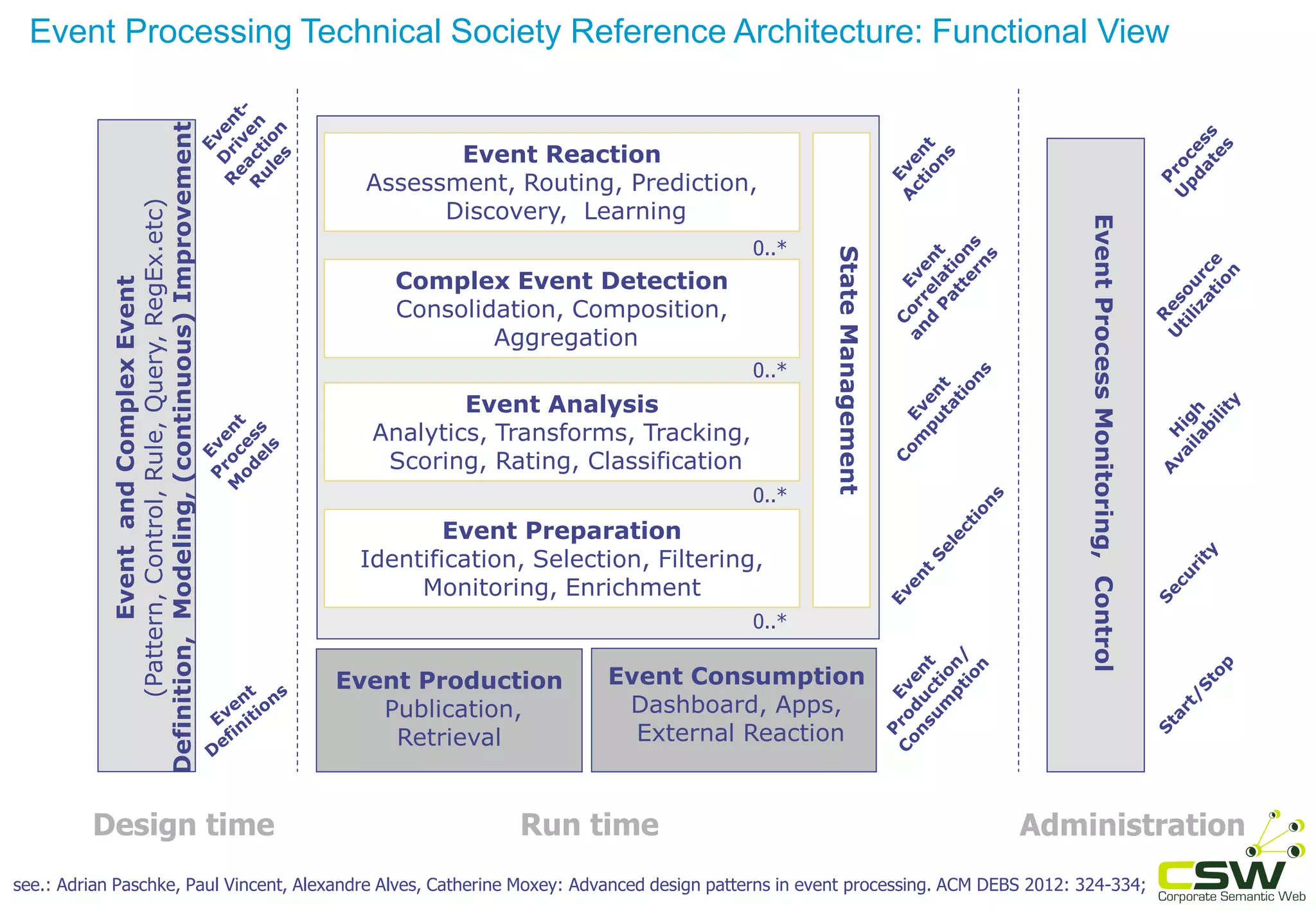
Event Processing Technical Society Reference Architecture: Functional View
Event Production
Publication,
Retrieval
EventProcessMonitoring,Control
Event Preparation
Identification, Selection, Filtering,
Monitoring, Enrichment
Complex Event Detection
Consolidation, Composition,
Aggregation
Event Reaction
Assessment, Routing, Prediction,
Discovery, Learning
Event Consumption
Dashboard, Apps,
External Reaction
Run time Administration
EventandComplexEvent
(Pattern,Control,Rule,Query,RegEx.etc)
Definition,Modeling,(continuous)Improvement
Design time
Event Analysis
Analytics, Transforms, Tracking,
Scoring, Rating, Classification
0..*
0..*
0..*
0..*
StateManagement
see.: Adrian Paschke, Paul Vincent, Alexandre Alves, Catherine Moxey: Advanced design patterns in event processing. ACM DEBS 2012: 324-334;
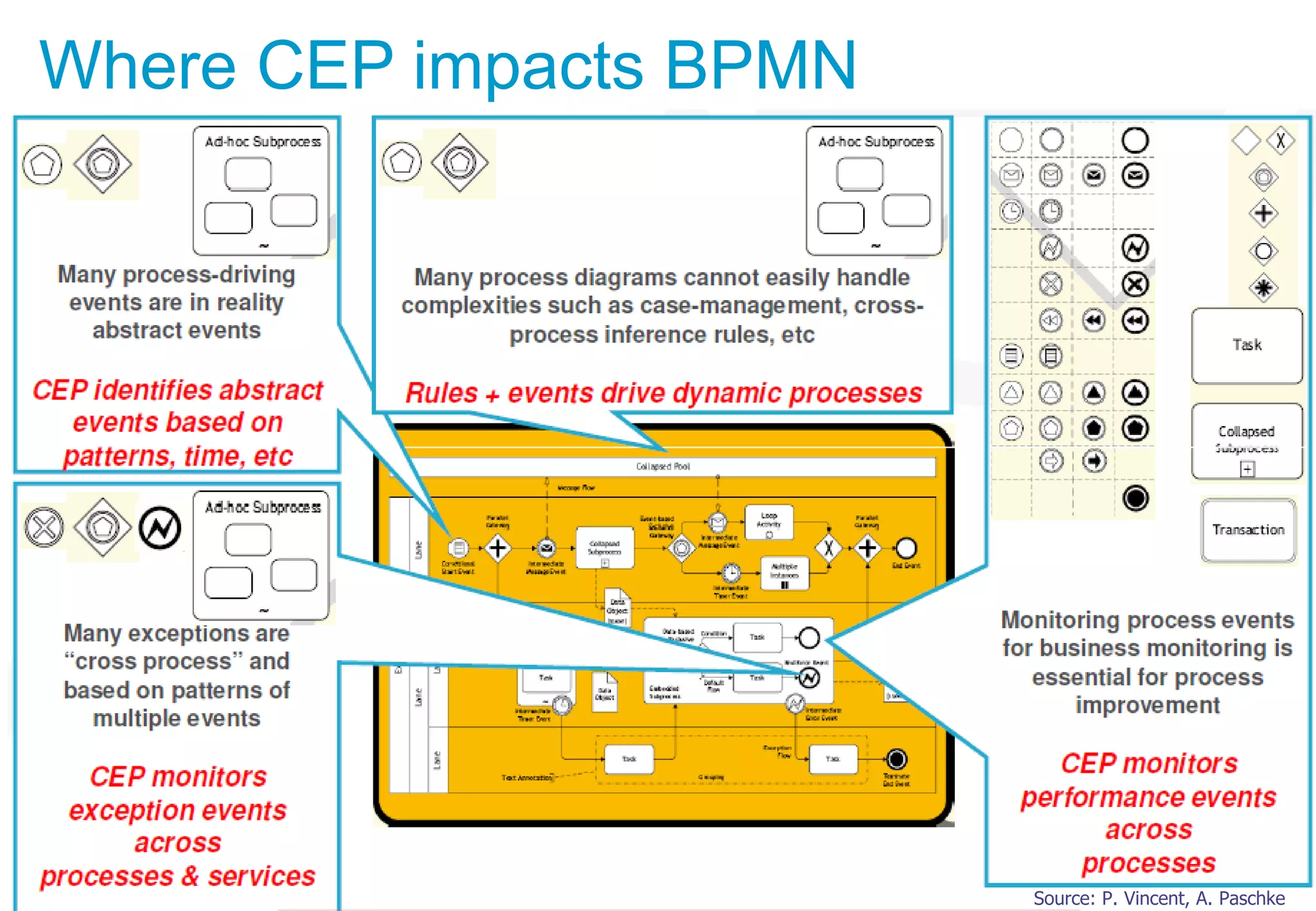
Where CEP impacts BPMN
Source: P. Vincent, A. Paschke
Summary
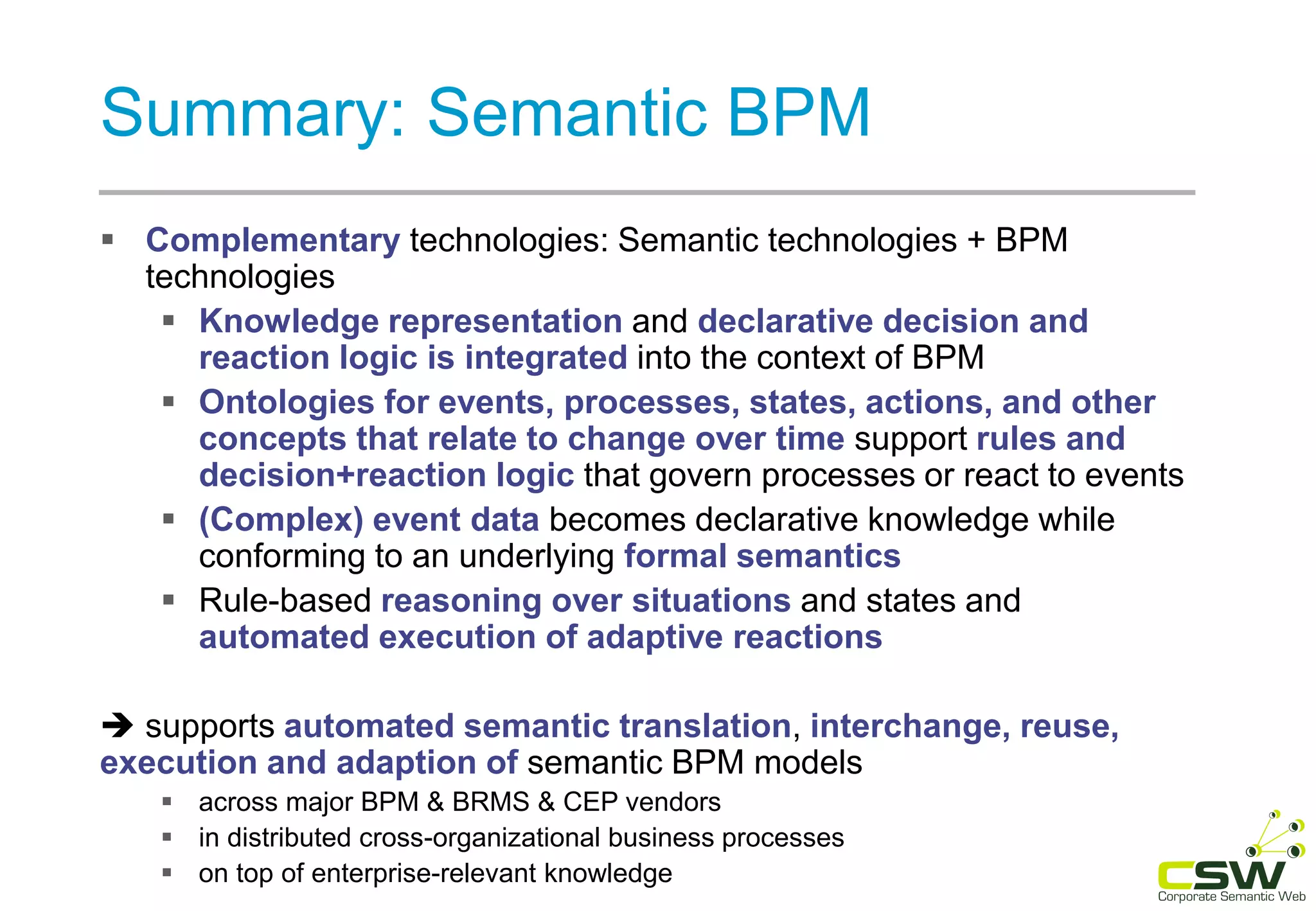
Summary: Semantic BPM
 Complementary technologies: Semantic technologies + BPM
technologies
 Knowledge representation and declarative decision and
reaction logic is integrated into the context of BPM
 Ontologies for events, processes, states, actions, and other
concepts that relate to change over time support rules and
decision+reaction logic that govern processes or react to events
 (Complex) event data becomes declarative knowledge while
conforming to an underlying formal semantics
 Rule-based reasoning over situations and states and
automated execution of adaptive reactions
 supports automated semantic translation, interchange, reuse,
execution and adaption of semantic BPM models
 across major BPM & BRMS & CEP vendors
 in distributed cross-organizational business processes
 on top of enterprise-relevant knowledge
Literature
 Adrian Paschke: A Semantic Rule and Event Driven Approach for Agile Decision-Centric Business Process Management.
ServiceWave 2011: 254-267
 Adrian Paschke, Kia Teymourian: Rule Based Business Process Execution with BPEL+, In Proceedings of I-Semantics '09, pages
588-601
 Nils Barnickel, Johannes Böttcher, Adrian Paschke:
Semantic Mediation of Information Flow in Cross-Organizational Business Process Modeling. SBPM 2010: 21-28
 Adrian Paschke: Reaction RuleML 1.0 for Rules, Events and Actions in Semantic Complex Event Processing, RuleML 2014, Springer
LNCS, Prague, Czech Republic, August, 18-20, 2014
 Zhili Zhao, Adrian Paschke: A Formal Model for Weakly-structured Scientific Workflows. SWAT4LS 2013
 Kia Teymourian, Gökhan Coskun, Adrian Paschke: Modular Upper-Level Ontologies for Semantic Complex Event Processing. WoMO
2010: 81-93
 Adrian Paschke: The Reaction RuleML Classification of the Event / Action / State Processing and Reasoning Space. CoRR
abs/cs/0611047 (2006), http://arxiv.org/ftp/cs/papers/0611/0611047.pdf
 Nils Barnickel, Johannes Böttcher, Adrian Paschke:
Incorporating semantic bridges into information flow of cross-organizational business process models. I-SEMANTICS 2010
 Adrian Paschke, Alexander Kozlenkov: A Rule-based Middleware for Business Process Execution. Multikonferenz
Wirtschaftsinformatik 2008 (MKWI 2008).
 Adrian Paschke, Paul Vincent, Alexandre Alves, Catherine Moxey: Advanced design patterns in event processing. DEBS 2012: 324-
334;
 Adrian Paschke and Harold Boley. Rule responder: Rule-based agents for the semantic-pragmatic web. International Journal on
Artificial Intelligence Tools, 20(6):1043-1081, 2011.
 Kia Teymourian, Olga Streibel, Adrian Paschke, Rehab Alnemr, Christoph Meinel: Towards Semantic Event-Driven Systems. NTMS
2009
 Zhili Zhao, Adrian Paschke: Rule Agent-Oriented Scientific Workflow Execution, S-BPM ONE 2013, Springer-Verlag, pp. 109-122,
Deggendorf, Germany, March 11-12, 2013
 Zhili Zhao, Adrian Paschke: Event-Driven Scientific Workflow Execution, Proceedings of Business Process Management Workshops
(BPM’12), Springer Berlin Heidelberg, vol. 132, pp. 390-401, Tallinn, Estonia, 2012
 Adrian Paschke, Zhili Zhao: Process Makna - A Semantic Wiki for Scientific Workflows. SWAT4LS 2010
 Adrian Paschke, Zhili Zhao: Rule Responder: A Rule-Based Semantic eScience Service Infrastructure. SWAT4LS 2010

Semantically-Enabled Business Process Management

  • 1.
    Semantically-Enabled Business Process Management OntologyPSIG Meeting, June 18th, 2015 OMG Technical Meeting, Berlin, Germany Adrian Paschke Corporate Semantic Web (AG-CSW) Institute for Computer Science, Freie Universitaet Berlin paschke@inf.fu-berlin.de http://www.inf.fu-berlin.de/groups/ag-csw/
  • 2.
    Overview  Semantic BusinessProcess Management  Ontologies in BPM - Examples  Rules in BPM - Examples  Events in BPM - Examples  Summary Key Benefits of SBPM
  • 3.
     Information Sources: Knowledge Management: Workflows Process Knowledge Semantik Information  Events/Actions& Process Context Relations & Interpretation  Content BPM BPMBPM BPM Workflow Workflow Literature Colleagues Databases Experts Product Contents Business Processes Semantic Business Processes Management
  • 4.
    Semantic + BPM Semantic Business Process Management Business Process + Semantic Technologies  BPM + Ontologies and Vocabularies  BPM + Rules for Decision + Reaction Logic  BPM + Semantic Data and Event Processing
  • 5.
    Main Semantic Technologies 1.Ontologies  Ontologies described the conceptual knowledge of a domain (concept semantics) 2. Rules  Describe derived conclusions and reactions from given information (rule inference) 3. Semantic Data & Content  Semantically enriched data and events Partner Customer is a equal with Client if premium(Customer) then discount(10%) on alarm do notify
  • 6.
  • 7.
    Rules in BPM- Example if premium(Customer) and regular(Product) then discount(Customer, Product, 5%) if premium(Customer) and luxury(Product) then discount(Customer, Product, 10%) if spending(Customer, > 5000 EUR) then premium(Customer) … If Then Spending Customer >5000 premium Rules, e.g. SBVR, RuleML Decision Tables e.g. DMN
  • 8.
    Event Stream {(Name, “OPEL”)(Price,45)(Volume, 2000)} {(Name, “SAP”)(Price, 65)(Volume, 1000)} CEP Query: Buy shares of companies which have production facilities in Europe and produce products from iron and have more than 10,000 employees and are at the moment in restructuring phase and their price/volume have been increasing continuously in the past 5 minutes. {(OPEL, is_a, automobile_company), (automobile_company, build, Cars), (Cars, built_from, Iron), (OPEL, has_production_facilities_in, Germany), (Germany, is_in, Europe) (OPEL, is_a, Major_corporation), (Major_corporations, have, over_10,000_employees), (OPEL, is_in, reconstructing_phase)} Knowledge Base A B C Buy 1 Buy 2 D E Semantic CEP in BPM - Example
  • 9.
    Selected Benefits ofSemantics in BPM  Semantic Transformations  e.g., from BPMN into e.g. BPEL into Web Services  Semantic Mapping / Interchange  e.g., from on BPMN / BPEL model into another in cross-domain / cross-organizational business processes  Semantic Execution / Interpretation  e.g., ontological understanding of the business process  e.g. rule-based & event-based decisions and reactions  e.g. formal semantic for consistency and validation
  • 10.
  • 11.
    Top Level ReactionRuleML Ontologies General concepts such as space, time, event, action and their properties and relations Temporal Ontology Action Ontology Process Ontology Agent Ontology Situation Ontology Domain Ontologies Vocabularies related to specific domains by specializing the concepts introduced in the top-level ontology Task Activities Ontologies Vocabularies related to generic tasks or activities by specializing the concepts introduced in the top-level ontology Application Ontologies Specific user/application ontologies E.g. ontologies describing roles played by domain entities while perfoming application / service activities Spatio Ontology Event Ontology Source: Reation RuleML Metamodel Modular Ontology Model for SBPM
  • 12.
    Example - EventMetamodel (for defining Event Types of the Reaction RuleML Metamodel Event Class) Defined Event Types Event Class Definition Integration of existing domain ontologies by defining their properties and values in an event classes in the Metamodel Domain ontologies
  • 13.
    Semantic Extension ofInformation Entities  Utilize corporate or domain ontology concepts to define information flow on a non-technical conceptual level suitable for business process experts  due to formal nature consistent link between the business or conceptual level and underlying technical information models can be derived  formal domain information models are foundation for semantic mediation between heterogeneous conceptualizations used by different organizations or domains
  • 14.
    Semantic Business ProcessModeling Cross-Organizational Business Process Mapping Heterogeneous Corporate/Domain Ontologies
  • 15.
     Mapping heterogeneous semantic sub-graphs (ontologies) Mapping with semantic bridges (rules)  polymorph classification preserving object identity Semantic Mediation between heterogeneous Information Entities
  • 16.
  • 17.
    Semantic Business ProcessExecution with Semantic Web Services Business Processes Enterprise Application Components Services Hardware Web Service Application Service Using Application Semantic Service Interface ITSM (Rules) ITSM (Rules) Semantic SLA Non-functional Properties Response Time Delay / Availability Resource Utilization Functionality Guarantees Pricing /Policies Rights & Obligations Escalation Service Customer/User Service Provider Business Vocabulary (Ontologies) Business Vocabulary (Ontologies) Semantic Web Service •OWL-S (former DAML-S), •WSDL-S •RBSLA (http://rbsla.ruleml.org) •SAWSDL •SWWS / WSMF •WSMO / WSML •Meteor-S •SWSI •… SWS Approaches
  • 18.
    Semantic CEP: Ontologies(cont.)  Better understanding of situations (states)  e.g., a process is executing when it has been started and not ended  Better understanding of the relationships between events e.g., temporal, spatial, causal, .., relations between events, states, activities, processes  e.g., a service is unavailable when the service response time is longer than X seconds and the service is not in maintenance state  Data becomes meaningful information and declarative knowledge while conforming to an underlying formal semantics  e.g., automated semantic mediation between different heterogeneous domains and abstraction levels  e.g. enabling greater automation of discovery, selection, invocation, composition, monitoring, and other service management tasks
  • 19.
  • 20.
    Rules Technology Users employrules to express what they want, the responsibility to interpret this and to decide on how to do it is delegated to an interpreter Represent knowledge in a way that is understandable by ‘the business’, but also executable by rule engines, thus bridging the gap between business and technology IBM ILog Drools Prova PRR RuleML RIF SBVRCIM PIM PSM DMN
  • 21.
    Rules-enabled BPEL Application BPELrun-time BRMS (Business Rules Management System) events, facts results CEP Logic Reaction Logic Decision Logic Constraints Rule Inference Service Rule Repositories Vocabularies / Semantic Ontology Models Rule Interchange Ontology / Model Mapping Rule-based BPEL+ (Semantic BPEL)
  • 22.
    Orchestrated BPEL +Choreography Rule Workflow Rules-enabled BPEL Application BPEL run- time BRMS (Business Rules Management System) events , facts results CEP Logic Reaction Logic Decision Logic Constraints Rule Inference Service % receive query and delegate it to another party rcvMsg(CID,esb, Requester, acl_query-ref, Query) :- responsibleRole(Agent, Query), sendMsg(Sub-CID,esb,Agent,acl_query-ref, Query), rcvMsg(Sub-CID,esb,Agent,acl_inform-ref, Answer), ... (other goals)... sendMsg(CID,esb,Requester,acl_inform-ref,Answer). • Rules can be used to implement choreography workflows as subprocesses in the orchestration BPEL flow • Workflows might span several communicating (messaging) rule inference services Prova rule engine http://prova.ws
  • 23.
    Prova Rule Example:Rule-based Routing with Agent (Sub-) Conversations rcvMsg(XID,esb,From,query-ref,buy(Product) :- routeTo(Agent,Product), % derive processing agent % send order to Agent in new subconversation SID2 sendMsg(SID2,esb,Agent,query-ref,order(From, Product)), % receive confirmation from Agent for Product order rcvMsg(SID2,esb,Agent,inform-ref,oder(From, Product)). % route to event processing agent 1 if Product is luxury routeTo(epa1,Product) :- luxury(Product). % route to epa 2 if Product is regular routeTo(epa2,Product) :- regular(Product). % a Product is luxury if the Product has a value over … luxury(Product) :- price(Product,Value), Value >= 10000. % a Product is regular if the Product ha a value below … regular(Product) :- price(Product,Value), Value < 10000. corresponding XML serialization with Reaction RuleML <Send> and <Receive> rulechaining rulechaining
  • 24.
    Semantic BPM: Rules RuleInference Services and Agents can be dynamically invoked from a BPM process.  Dynamic processing  Intelligent routing  Validation of policies within process  Constraint checks  Ad-hoc Workflow  Policy based task assignment  Various escalation policies  Load balancing of tasks  Business Activity Monitoring  Alerts based on certain policies and complex event processing (rule- based CEP)  Dynamic processing based KPI reasoning
  • 25.
  • 26.
    Knowledge Value ofEvents Proactive actions Value of Events At eventBefore the event Some time after event e.g. 1 hour Real-Time Late reaction or Long term report Historical Event Post-Processing Time “The CEP market is expected to grow from $1,005.0 million in 2014 to $4,762.0 million in 2019. This represents a CAGR of 36.5% from 2014 to 2019.” ResearchAndMarkets, November 2014
  • 27.
    Complex Events –What are they?  Complex Events are aggregates, derivations, etc. of Simple Events Complex Events Simple Events Simple Events Simple Events Simple Events Event Patterns  Complex Event Processing (CEP) will enable, e.g. – Detection of state changes based on observations – Prediction of future states based on past behaviours Realt Time Data Processing Data
  • 28.
    Complex Event Processing EventCloud (unordered events) new auto pay account login account login deposit withdrawal logout account balance transfer deposit new auto pay enquiry enquiry logout new auto pay account login account login deposit activity history withdrawal logout transfer deposit new auto pay enquiry enquiry book request incident A B C  CEP is about complex event detection and reaction  Efficient (near real-time) processing of large numbers of events  Detection, prediction and exploitation of relevant complex events  Situation awareness, track & trace, sense & respond ComplexEvents Event Streams (ordered events) Patterns, Rules
  • 29.
    Event Processing TechnicalSociety Reference Architecture: Functional View Event Production Publication, Retrieval EventProcessMonitoring,Control Event Preparation Identification, Selection, Filtering, Monitoring, Enrichment Complex Event Detection Consolidation, Composition, Aggregation Event Reaction Assessment, Routing, Prediction, Discovery, Learning Event Consumption Dashboard, Apps, External Reaction Run time Administration EventandComplexEvent (Pattern,Control,Rule,Query,RegEx.etc) Definition,Modeling,(continuous)Improvement Design time Event Analysis Analytics, Transforms, Tracking, Scoring, Rating, Classification 0..* 0..* 0..* 0..* StateManagement see.: Adrian Paschke, Paul Vincent, Alexandre Alves, Catherine Moxey: Advanced design patterns in event processing. ACM DEBS 2012: 324-334;
  • 30.
    Where CEP impactsBPMN Source: P. Vincent, A. Paschke
  • 31.
  • 32.
    Summary: Semantic BPM Complementary technologies: Semantic technologies + BPM technologies  Knowledge representation and declarative decision and reaction logic is integrated into the context of BPM  Ontologies for events, processes, states, actions, and other concepts that relate to change over time support rules and decision+reaction logic that govern processes or react to events  (Complex) event data becomes declarative knowledge while conforming to an underlying formal semantics  Rule-based reasoning over situations and states and automated execution of adaptive reactions  supports automated semantic translation, interchange, reuse, execution and adaption of semantic BPM models  across major BPM & BRMS & CEP vendors  in distributed cross-organizational business processes  on top of enterprise-relevant knowledge
  • 33.
    Literature  Adrian Paschke:A Semantic Rule and Event Driven Approach for Agile Decision-Centric Business Process Management. ServiceWave 2011: 254-267  Adrian Paschke, Kia Teymourian: Rule Based Business Process Execution with BPEL+, In Proceedings of I-Semantics '09, pages 588-601  Nils Barnickel, Johannes Böttcher, Adrian Paschke: Semantic Mediation of Information Flow in Cross-Organizational Business Process Modeling. SBPM 2010: 21-28  Adrian Paschke: Reaction RuleML 1.0 for Rules, Events and Actions in Semantic Complex Event Processing, RuleML 2014, Springer LNCS, Prague, Czech Republic, August, 18-20, 2014  Zhili Zhao, Adrian Paschke: A Formal Model for Weakly-structured Scientific Workflows. SWAT4LS 2013  Kia Teymourian, Gökhan Coskun, Adrian Paschke: Modular Upper-Level Ontologies for Semantic Complex Event Processing. WoMO 2010: 81-93  Adrian Paschke: The Reaction RuleML Classification of the Event / Action / State Processing and Reasoning Space. CoRR abs/cs/0611047 (2006), http://arxiv.org/ftp/cs/papers/0611/0611047.pdf  Nils Barnickel, Johannes Böttcher, Adrian Paschke: Incorporating semantic bridges into information flow of cross-organizational business process models. I-SEMANTICS 2010  Adrian Paschke, Alexander Kozlenkov: A Rule-based Middleware for Business Process Execution. Multikonferenz Wirtschaftsinformatik 2008 (MKWI 2008).  Adrian Paschke, Paul Vincent, Alexandre Alves, Catherine Moxey: Advanced design patterns in event processing. DEBS 2012: 324- 334;  Adrian Paschke and Harold Boley. Rule responder: Rule-based agents for the semantic-pragmatic web. International Journal on Artificial Intelligence Tools, 20(6):1043-1081, 2011.  Kia Teymourian, Olga Streibel, Adrian Paschke, Rehab Alnemr, Christoph Meinel: Towards Semantic Event-Driven Systems. NTMS 2009  Zhili Zhao, Adrian Paschke: Rule Agent-Oriented Scientific Workflow Execution, S-BPM ONE 2013, Springer-Verlag, pp. 109-122, Deggendorf, Germany, March 11-12, 2013  Zhili Zhao, Adrian Paschke: Event-Driven Scientific Workflow Execution, Proceedings of Business Process Management Workshops (BPM’12), Springer Berlin Heidelberg, vol. 132, pp. 390-401, Tallinn, Estonia, 2012  Adrian Paschke, Zhili Zhao: Process Makna - A Semantic Wiki for Scientific Workflows. SWAT4LS 2010  Adrian Paschke, Zhili Zhao: Rule Responder: A Rule-Based Semantic eScience Service Infrastructure. SWAT4LS 2010