1
Business Process Management:
The Next Generation
Although the past five years have witnessed great progress in the theory and practice of business
process management, deployments have so far been mostly tactical. Reviewing the case studies
that abound at BPM vendors’ Web sites, many business processes have been revamped and
there are ROI stories to tell. That’s good; but typical BPM deployments to date have been limited
in scope, applying to improvements in specific business functions. And it’s not always clear what
the case studies mean by BPM. Is it streamlining administrative processes, building composite
applications, simplifying application integration, or deploying configurable templates to deal with
specific needs such as Sarbanes-Oxley compliance? Sure, ROI can be demonstrated and
departmental performance improved, but where’s the breakthrough that can help the company
win in the brave new world of globalization and extreme competition?
As long as BPM deployments remain tactical, BPM is likely to become just another technique for
squeezing out costs and making incremental performance improvements in functional
departments. Today, however, what executive wants to settle for small internal gains in
Department X or Department Y, when there’s a battle for survival raging? The full potential of
BPM is about “enterprise business processes” and “value-chain business processes,” not
technical improvements here or there, or streamlining individual functions in the company.
Tactical BPM only offers a way of improving what a company already does, which, though good,
can mean clinging to the past. BPM’s full potential offers a strategic capability for achieving
breakout competitive advantage through process innovation. For that to happen, the scope and
complexity increases exponentially as companies progress from point-solution BPM to enterprise
BPM where cross-functional processes are taken on, and then on to value-chain BPM where
totally new cross-company processes emerge and must be managed.
The shortcomings of the many current flavors of BPM solutions (EAI/BPM, Workflow/BPM,
Business Rules/BPM, and federations of these approaches) will appear as a company moves
beyond the tactical solutions and on to the value chain. Today, competition is about setting the
pace of innovation in your industry. It’s about forming new multi-company alliances (sometimes
even with competitors) to innovate new value delivery systems that span your suppliers’ suppliers
and your customers’ customers. It’s about competing for the future in the new era of extreme
competition, where the customer is no longer King; the customer is now a Dictator that demands
you go to the ends of the earth to provide cheaper, better, faster products and services. This is
the stuff of strategic deployments of BPM.
BPM: The Next Generation
To move on to strategic BPM, the next generation, five capabilities will become the focus:
1) the BPMS, 2) Process-Oriented Architecture and Methods, 3) Human Interaction Management,
4) Complex Event Processing, and 5) Agent Technology.
2
1. The BPMS.
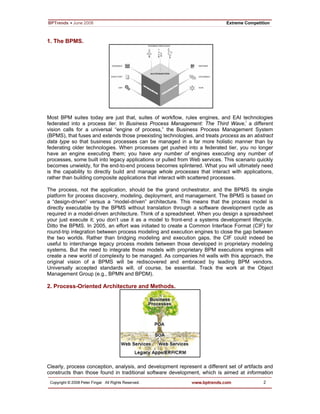
Most BPM suites today are just that, suites of workflow, rules engines, and EAI technologies
federated into a process tier. In Business Process Management: The Third Wave,i
a different
vision calls for a universal “engine of process,” the Business Process Management System
(BPMS), that fuses and extends those preexisting technologies, and treats process as an abstract
data type so that business processes can be managed in a far more holistic manner than by
federating older technologies. When processes get pushed into a federated tier, you no longer
have an engine executing them; you have any number of engines executing any number of
processes, some built into legacy applications or pulled from Web services. This scenario quickly
becomes unwieldy, for the end-to-end process becomes splintered. What you will ultimately need
is the capability to directly build and manage whole processes that interact with applications,
rather than building composite applications that interact with scattered processes.
The process, not the application, should be the grand orchestrator, and the BPMS its single
platform for process discovery, modeling, deployment, and management. The BPMS is based on
a “design-driven” versus a “model-driven” architecture. This means that the process model is
directly executable by the BPMS without translation through a software development cycle as
required in a model-driven architecture. Think of a spreadsheet. When you design a spreadsheet
your just execute it; you don’t use it as a model to front-end a systems development lifecycle.
Ditto the BPMS. In 2005, an effort was initiated to create a Common Interface Format (CIF) for
round-trip integration between process modeling and execution engines to close the gap between
the two worlds. Rather than bridging modeling and execution gaps, the CIF could indeed be
useful to interchange legacy process models between those developed in proprietary modeling
systems. But the need to integrate those models with proprietary BPM executions engines will
create a new world of complexity to be managed. As companies hit walls with this approach, the
original vision of a BPMS will be rediscovered and embraced by leading BPM vendors.
Universally accepted standards will, of course, be essential. Track the work at the Object
Management Group (e.g., BPMN and BPDM).
2. Process-Oriented Architecture and Methods.
Clearly, process conception, analysis, and development represent a different set of artifacts and
constructs than those found in traditional software development, which is aimed at information
3
management, not process management. In his landmark book, Business Process Management:
A Rigorous Approach, Martyn Ould explains, “The key thing about a paradigm shift is that old
ways of thinking just won’t work in the new world. If your structural engineers have only had mud
to work with in the past, their ways of specifying and designing buildings will be fine for mud
buildings but they won’t make a lot of sense when the steel girder appears on the scene.Today’s
dedicated follower of fashion in information system development is likely to be speaking UML and
using one of the various development approaches based on the UML. [But] we cannot view
business process management systems as just another sort of information system.” Information-
oriented languages and information-oriented methods have evolved around a world of storing,
retrieving, and updating information, not the dynamic world of process. Ould elaborates, “Simply
extending our information-based methods simply won’t work – they don’t have the necessary
concepts at their heart. We’re moving from the Information Age to the Process Age. We need
purpose-built methods for working with processes to replace our methods for working with
information.”
The process-managed enterprise demands that the center of automation be shifted from
information processing to process processing. Ould continues, “The traditional paradigm views
organisations as things that work with information, so our systems have been about looking after
information. In the past we have specified our information systems in terms of what data they will
store and how we can access it and change it and move it around. And we have designed our
information systems in terms of data representations and operations on data.”
Processes need an architecture and a paradigm of their own, not a data-oriented information
systems paradigm. Further, just as spreadsheets are placed directly in the hands of
businesspeople without the need for a cadre of support technicians, BPMS capabilities can be
turned over to Business Analysts. Whoa! That doesn’t mean handing over complex systems of
record to end users. But wait, if the creation or major modification of a business process touches
on the back-office systems of record, that’s the world of the IT Developer. If it doesn’t, and is
aimed at business people getting their work done, then a whole new world of simplified Web 2.0
opportunities open up. As business people increasingly adopt Web 2.0 work tools, outside IT’s
jurisdiction, that are as easy as using consumer IT offerings like Skype, Google Apps, and
various project management tools, (without the need for IT involvement) they will increasingly
demand such tools for managing their business processes. Thus, the line in the sand between IT
Developers and Business Analysts will shift to a grey area. That is, Business Analysts may move
up a bracket in process management, from lightweight to middleweight processes, leaving only
the heavyweight stuff to IT specialists. Just as companies have spreadsheet “power users”
outside IT departments, Business Analysts may evolve into Web 2.0 “BPMS power users” Web
2.0 BPM Tools.
While new “service-oriented” techniques for software development offer flexible, loosely-coupled
approaches to computing, these advances, while good, are aimed at technical people who build
and manage information systems, e.g., programmers, not business analysts who want to build
and manage business processes. There aren't enough programmers in the world to design and
code the needed process-oriented systems using conventional software development, even with
the aid of service-oriented software techniques.
So, think of Web services and Service-Oriented Architecture (SOA) as an underlying technical
operating system for the Process-Oriented Architecture (POA) and the BPMS. The new paradigm
of business process management needs new methods for thinking about collaborative processes
in ways that build on the concepts of collaboration, evolution, and business context, not program
calls, WSDL, and SOAP. To this end, a long-established modeling framework called Role Activity
Theory and Role Activity Diagramming (RAD) techniques, in line with Ould’s concepts of process-
oriented architecture, are needed to supersede information-oriented approaches to process
modeling and analysis. This shift from the Information Age to the Process Age, in terms of
architecture and methods, will serve as a cornerstone of BPM, the next generation.
4
3. Human Interaction Management.
Most of today’s BPM solutions can take care of 80% of the mechanistic, predetermined system-
to-system scenarios with predefined workflow and inter-application transaction management.
Such capabilities are needed to help a company put its “house in order” with application
integration. However, when you consider collaborative activities and the fact that, as Xerox’s
former Chief Scientist, John Seely Brown, explains, “processes don't do work, people do,” BPM’s
missing link is made visible.
There’s no doubt that what’s now needed isn’t more and more software for animating computers;
it’s software for animating human interactions across end-to-end business processes, where work
teams may be scattered across the globe. While interwoven with mechanistic processes, human-
driven processes span your suppliers, your suppliers’ suppliers, your employees, your customers,
and your customers’ customers, forming the DNA of a complete value delivery system. It’s now
time to shift the BPM spotlight onto those human-driven processes. That means fusing traditional
collaboration and information tools (groupware, knowledge management, workflow, and system-
to-system BPM) and extending them with a complete theory of human work if we are to build
systems that can support the way people actually work, versus treating them as cogs in an
information machine.
The Human Interaction Management System needs formal foundations – and these include role-
activity theory, Petri nets, Pi calculus, first-order predicate logic, the computer science of speech
acts and conversations for action, autopoeisis, and other principles drawn from cognitive theory,
psychology, learning theory, biology, and social systems theory. Whew! For the business user,
this level of detail is, of course, overkill – and such underpinnings must be completely hidden in
daily use of a Human Interaction Management System. However, they are essential to its ability
to handle the true dynamics of human collaborative activity. In short, a complete theory of how
humans actually work must underpin Human Interaction Management. In a groundbreaking work,
Human Interactions: The Heart and Soul of Business Process Management,ii
Keith Harrison-
Broninski writes, “We must find a way of thinking about human-driven processes that allows
controlled management of change – something that is innate in all interaction work, as human-
driven work processes evolve continuously throughout their lifetime.”
4. Complex Event Processing.
Modern information systems are event-driven, where an event can be as simple as clicking a
mouse button. According to Gartner research, event-driven business applications can be sorted
5
into four categories: 1. Simple event-driven (or message-driven) applications where application
programs explicitly send and receive messages directly to and from each other. 2. Event-driven
applications that are mediated by integration brokers that transform and route simple event
messages according to logical rules. 3. Event-driven applications that are directed by business
process management (BPM) engines that manage the end-to-end flow of a multistep process
using special, BPM-oriented types of events. 4. Complex event processing (CEP) applications,
where a sophisticated event manager logically evaluates multiple events to enable decoupled,
parallel, asynchronous processing or business activity monitoring (BAM).
Complex event processing is most effective when event messages carry information relating
individual events with other events and causal information on how an event came about. As
described in the landmark book on complex event processing, The Power of Events, by Stanford
professor, David Luckham, some CEP messages may not even carry business data swapped
between applications. Instead, they contain information about low-level events that, when
aggregated into patterns, can reveal high-level business intelligence. As an everyday example
(unfortunately), consider how the intelligence agencies filter low-level noise among terrorist
groups to derive meaningful information used to set terrorist alert levels for law enforcement
agencies. In a business context, Luckham asserts that low-level events that occur in “the cloud”
of network-based business interactions can yield valuable business intelligence.
By using complex event processing for business activity monitoring, CEP can close the loop
between BAM and the business process management system that, in turn, can act on the
business intelligence. As companies extend BPM outside their walls and on to the complex
business ecosystem across the value chain, the value of CEP becomes an obvious lynchpin for
business activity monitoring and real-time process analytics. Think of CEP as a Business
Intelligence 2.0.
5. Agent Technology.
To manage the inherent complexity in enterprise or value-chain business processes, smart
companies will demand smart processes that go far beyond today’s typical business rules
engines. But “smart” doesn’t mean some Orwellian thinking machine, it means agent technology.
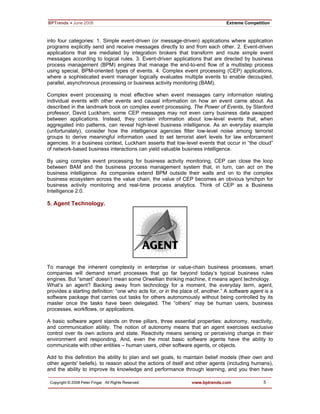
What’s an agent? Backing away from technology for a moment, the everyday term, agent,
provides a starting definition: “one who acts for, or in the place of, another.” A software agent is a
software package that carries out tasks for others autonomously without being controlled by its
master once the tasks have been delegated. The “others” may be human users, business
processes, workflows, or applications.
A basic software agent stands on three pillars, three essential properties: autonomy, reactivity,
and communication ability. The notion of autonomy means that an agent exercises exclusive
control over its own actions and state. Reactivity means sensing or perceiving change in their
environment and responding. And, even the most basic software agents have the ability to
communicate with other entities – human users, other software agents, or objects.
Add to this definition the ability to plan and set goals, to maintain belief models (their own and
other agents' beliefs), to reason about the actions of itself and other agents (including humans),
and the ability to improve its knowledge and performance through learning, and you then have
6
the core ingredients of an “intelligent agent.” An intelligent agent represents a distinct category of
software that incorporates local knowledge about its own and other agents' tasks and resources,
allowing it to operate autonomously or as a part of a community of co-operative problem solvers
(including human users), each agent having its own roles and responsibilities.
Agents can be integrated into BPM frameworks that contain, in one package, specific problem-
solving functions, data, and control. Intelligent agents support a natural merging of BPM and
knowledge-based technologies. Intelligent agents can facilitate the incorporation of reasoning
capabilities (e.g., encapsulation of business rules within agents). They permit the inclusion of
learning and self improvement capabilities at both infrastructure (adaptive routing) and application
(adaptive user interfaces) levels. Intelligent user interfaces (supporting task-centered user
interfaces and intelligent assistance to end-users) can be a boon to productivity in a complex
world of multi-company business processes.
To manage the inherent complexity in inter-enterprise or value-chain business processes, smart
companies will demand ever smarter processes that go far beyond today’s typical business rules
engines. Distributed, multiagent systems represent a requisite shift to Business Rules 2.0. In
short, with the complexity of tasks inherent in multi-company business processes, we will
certainly need a little help from our knowledgeable friends, software agents.
Takaway: Complexity Busters
As the business world moves beyond the tinkering phase with tactical BPM point solutions and on
to multi-enterprise process management for true process and value-chain innovation, complexity
will explode. Thus, BPM, the next generation, will require the complexity buster of the BPMS,
incorporating process-oriented architecture and methods, human interaction management,
complex event processing, and agent technology. No, this isn’t some mad computer scientist’s
dream; it’s what’s required by the messy and complex real world of business.
Don’t be surprised to find skunk works in progress among the leading BPM vendors who are
successfully selling tactical solutions today, but know what’s required for BPM to become a true
source of strategic competitive advantage. And, on a final note, these vendors no doubt have
their heads in the clouds (Cloud Computing), for end-to-end business processes aren’t “owned”
by any one company; they are collaborations of multiple companies that hear the beat of their
own drummers and operate on their own clocks. Thus, Cloud Computing will become a strategic
platform for 21st
century business hosting the next generation of BPM.
# # #
i
www.bpm3.com
ii
www.mkpress.com/hi

Next generation BPM

  • 1.
    1 Business Process Management: TheNext Generation Although the past five years have witnessed great progress in the theory and practice of business process management, deployments have so far been mostly tactical. Reviewing the case studies that abound at BPM vendors’ Web sites, many business processes have been revamped and there are ROI stories to tell. That’s good; but typical BPM deployments to date have been limited in scope, applying to improvements in specific business functions. And it’s not always clear what the case studies mean by BPM. Is it streamlining administrative processes, building composite applications, simplifying application integration, or deploying configurable templates to deal with specific needs such as Sarbanes-Oxley compliance? Sure, ROI can be demonstrated and departmental performance improved, but where’s the breakthrough that can help the company win in the brave new world of globalization and extreme competition? As long as BPM deployments remain tactical, BPM is likely to become just another technique for squeezing out costs and making incremental performance improvements in functional departments. Today, however, what executive wants to settle for small internal gains in Department X or Department Y, when there’s a battle for survival raging? The full potential of BPM is about “enterprise business processes” and “value-chain business processes,” not technical improvements here or there, or streamlining individual functions in the company. Tactical BPM only offers a way of improving what a company already does, which, though good, can mean clinging to the past. BPM’s full potential offers a strategic capability for achieving breakout competitive advantage through process innovation. For that to happen, the scope and complexity increases exponentially as companies progress from point-solution BPM to enterprise BPM where cross-functional processes are taken on, and then on to value-chain BPM where totally new cross-company processes emerge and must be managed. The shortcomings of the many current flavors of BPM solutions (EAI/BPM, Workflow/BPM, Business Rules/BPM, and federations of these approaches) will appear as a company moves beyond the tactical solutions and on to the value chain. Today, competition is about setting the pace of innovation in your industry. It’s about forming new multi-company alliances (sometimes even with competitors) to innovate new value delivery systems that span your suppliers’ suppliers and your customers’ customers. It’s about competing for the future in the new era of extreme competition, where the customer is no longer King; the customer is now a Dictator that demands you go to the ends of the earth to provide cheaper, better, faster products and services. This is the stuff of strategic deployments of BPM. BPM: The Next Generation To move on to strategic BPM, the next generation, five capabilities will become the focus: 1) the BPMS, 2) Process-Oriented Architecture and Methods, 3) Human Interaction Management, 4) Complex Event Processing, and 5) Agent Technology.
  • 2.
    2 1. The BPMS. MostBPM suites today are just that, suites of workflow, rules engines, and EAI technologies federated into a process tier. In Business Process Management: The Third Wave,i a different vision calls for a universal “engine of process,” the Business Process Management System (BPMS), that fuses and extends those preexisting technologies, and treats process as an abstract data type so that business processes can be managed in a far more holistic manner than by federating older technologies. When processes get pushed into a federated tier, you no longer have an engine executing them; you have any number of engines executing any number of processes, some built into legacy applications or pulled from Web services. This scenario quickly becomes unwieldy, for the end-to-end process becomes splintered. What you will ultimately need is the capability to directly build and manage whole processes that interact with applications, rather than building composite applications that interact with scattered processes. The process, not the application, should be the grand orchestrator, and the BPMS its single platform for process discovery, modeling, deployment, and management. The BPMS is based on a “design-driven” versus a “model-driven” architecture. This means that the process model is directly executable by the BPMS without translation through a software development cycle as required in a model-driven architecture. Think of a spreadsheet. When you design a spreadsheet your just execute it; you don’t use it as a model to front-end a systems development lifecycle. Ditto the BPMS. In 2005, an effort was initiated to create a Common Interface Format (CIF) for round-trip integration between process modeling and execution engines to close the gap between the two worlds. Rather than bridging modeling and execution gaps, the CIF could indeed be useful to interchange legacy process models between those developed in proprietary modeling systems. But the need to integrate those models with proprietary BPM executions engines will create a new world of complexity to be managed. As companies hit walls with this approach, the original vision of a BPMS will be rediscovered and embraced by leading BPM vendors. Universally accepted standards will, of course, be essential. Track the work at the Object Management Group (e.g., BPMN and BPDM). 2. Process-Oriented Architecture and Methods. Clearly, process conception, analysis, and development represent a different set of artifacts and constructs than those found in traditional software development, which is aimed at information
  • 3.
    3 management, not processmanagement. In his landmark book, Business Process Management: A Rigorous Approach, Martyn Ould explains, “The key thing about a paradigm shift is that old ways of thinking just won’t work in the new world. If your structural engineers have only had mud to work with in the past, their ways of specifying and designing buildings will be fine for mud buildings but they won’t make a lot of sense when the steel girder appears on the scene.Today’s dedicated follower of fashion in information system development is likely to be speaking UML and using one of the various development approaches based on the UML. [But] we cannot view business process management systems as just another sort of information system.” Information- oriented languages and information-oriented methods have evolved around a world of storing, retrieving, and updating information, not the dynamic world of process. Ould elaborates, “Simply extending our information-based methods simply won’t work – they don’t have the necessary concepts at their heart. We’re moving from the Information Age to the Process Age. We need purpose-built methods for working with processes to replace our methods for working with information.” The process-managed enterprise demands that the center of automation be shifted from information processing to process processing. Ould continues, “The traditional paradigm views organisations as things that work with information, so our systems have been about looking after information. In the past we have specified our information systems in terms of what data they will store and how we can access it and change it and move it around. And we have designed our information systems in terms of data representations and operations on data.” Processes need an architecture and a paradigm of their own, not a data-oriented information systems paradigm. Further, just as spreadsheets are placed directly in the hands of businesspeople without the need for a cadre of support technicians, BPMS capabilities can be turned over to Business Analysts. Whoa! That doesn’t mean handing over complex systems of record to end users. But wait, if the creation or major modification of a business process touches on the back-office systems of record, that’s the world of the IT Developer. If it doesn’t, and is aimed at business people getting their work done, then a whole new world of simplified Web 2.0 opportunities open up. As business people increasingly adopt Web 2.0 work tools, outside IT’s jurisdiction, that are as easy as using consumer IT offerings like Skype, Google Apps, and various project management tools, (without the need for IT involvement) they will increasingly demand such tools for managing their business processes. Thus, the line in the sand between IT Developers and Business Analysts will shift to a grey area. That is, Business Analysts may move up a bracket in process management, from lightweight to middleweight processes, leaving only the heavyweight stuff to IT specialists. Just as companies have spreadsheet “power users” outside IT departments, Business Analysts may evolve into Web 2.0 “BPMS power users” Web 2.0 BPM Tools. While new “service-oriented” techniques for software development offer flexible, loosely-coupled approaches to computing, these advances, while good, are aimed at technical people who build and manage information systems, e.g., programmers, not business analysts who want to build and manage business processes. There aren't enough programmers in the world to design and code the needed process-oriented systems using conventional software development, even with the aid of service-oriented software techniques. So, think of Web services and Service-Oriented Architecture (SOA) as an underlying technical operating system for the Process-Oriented Architecture (POA) and the BPMS. The new paradigm of business process management needs new methods for thinking about collaborative processes in ways that build on the concepts of collaboration, evolution, and business context, not program calls, WSDL, and SOAP. To this end, a long-established modeling framework called Role Activity Theory and Role Activity Diagramming (RAD) techniques, in line with Ould’s concepts of process- oriented architecture, are needed to supersede information-oriented approaches to process modeling and analysis. This shift from the Information Age to the Process Age, in terms of architecture and methods, will serve as a cornerstone of BPM, the next generation.
  • 4.
    4 3. Human InteractionManagement. Most of today’s BPM solutions can take care of 80% of the mechanistic, predetermined system- to-system scenarios with predefined workflow and inter-application transaction management. Such capabilities are needed to help a company put its “house in order” with application integration. However, when you consider collaborative activities and the fact that, as Xerox’s former Chief Scientist, John Seely Brown, explains, “processes don't do work, people do,” BPM’s missing link is made visible. There’s no doubt that what’s now needed isn’t more and more software for animating computers; it’s software for animating human interactions across end-to-end business processes, where work teams may be scattered across the globe. While interwoven with mechanistic processes, human- driven processes span your suppliers, your suppliers’ suppliers, your employees, your customers, and your customers’ customers, forming the DNA of a complete value delivery system. It’s now time to shift the BPM spotlight onto those human-driven processes. That means fusing traditional collaboration and information tools (groupware, knowledge management, workflow, and system- to-system BPM) and extending them with a complete theory of human work if we are to build systems that can support the way people actually work, versus treating them as cogs in an information machine. The Human Interaction Management System needs formal foundations – and these include role- activity theory, Petri nets, Pi calculus, first-order predicate logic, the computer science of speech acts and conversations for action, autopoeisis, and other principles drawn from cognitive theory, psychology, learning theory, biology, and social systems theory. Whew! For the business user, this level of detail is, of course, overkill – and such underpinnings must be completely hidden in daily use of a Human Interaction Management System. However, they are essential to its ability to handle the true dynamics of human collaborative activity. In short, a complete theory of how humans actually work must underpin Human Interaction Management. In a groundbreaking work, Human Interactions: The Heart and Soul of Business Process Management,ii Keith Harrison- Broninski writes, “We must find a way of thinking about human-driven processes that allows controlled management of change – something that is innate in all interaction work, as human- driven work processes evolve continuously throughout their lifetime.” 4. Complex Event Processing. Modern information systems are event-driven, where an event can be as simple as clicking a mouse button. According to Gartner research, event-driven business applications can be sorted
  • 5.
    5 into four categories:1. Simple event-driven (or message-driven) applications where application programs explicitly send and receive messages directly to and from each other. 2. Event-driven applications that are mediated by integration brokers that transform and route simple event messages according to logical rules. 3. Event-driven applications that are directed by business process management (BPM) engines that manage the end-to-end flow of a multistep process using special, BPM-oriented types of events. 4. Complex event processing (CEP) applications, where a sophisticated event manager logically evaluates multiple events to enable decoupled, parallel, asynchronous processing or business activity monitoring (BAM). Complex event processing is most effective when event messages carry information relating individual events with other events and causal information on how an event came about. As described in the landmark book on complex event processing, The Power of Events, by Stanford professor, David Luckham, some CEP messages may not even carry business data swapped between applications. Instead, they contain information about low-level events that, when aggregated into patterns, can reveal high-level business intelligence. As an everyday example (unfortunately), consider how the intelligence agencies filter low-level noise among terrorist groups to derive meaningful information used to set terrorist alert levels for law enforcement agencies. In a business context, Luckham asserts that low-level events that occur in “the cloud” of network-based business interactions can yield valuable business intelligence. By using complex event processing for business activity monitoring, CEP can close the loop between BAM and the business process management system that, in turn, can act on the business intelligence. As companies extend BPM outside their walls and on to the complex business ecosystem across the value chain, the value of CEP becomes an obvious lynchpin for business activity monitoring and real-time process analytics. Think of CEP as a Business Intelligence 2.0. 5. Agent Technology. To manage the inherent complexity in enterprise or value-chain business processes, smart companies will demand smart processes that go far beyond today’s typical business rules engines. But “smart” doesn’t mean some Orwellian thinking machine, it means agent technology. What’s an agent? Backing away from technology for a moment, the everyday term, agent, provides a starting definition: “one who acts for, or in the place of, another.” A software agent is a software package that carries out tasks for others autonomously without being controlled by its master once the tasks have been delegated. The “others” may be human users, business processes, workflows, or applications. A basic software agent stands on three pillars, three essential properties: autonomy, reactivity, and communication ability. The notion of autonomy means that an agent exercises exclusive control over its own actions and state. Reactivity means sensing or perceiving change in their environment and responding. And, even the most basic software agents have the ability to communicate with other entities – human users, other software agents, or objects. Add to this definition the ability to plan and set goals, to maintain belief models (their own and other agents' beliefs), to reason about the actions of itself and other agents (including humans), and the ability to improve its knowledge and performance through learning, and you then have
  • 6.
    6 the core ingredientsof an “intelligent agent.” An intelligent agent represents a distinct category of software that incorporates local knowledge about its own and other agents' tasks and resources, allowing it to operate autonomously or as a part of a community of co-operative problem solvers (including human users), each agent having its own roles and responsibilities. Agents can be integrated into BPM frameworks that contain, in one package, specific problem- solving functions, data, and control. Intelligent agents support a natural merging of BPM and knowledge-based technologies. Intelligent agents can facilitate the incorporation of reasoning capabilities (e.g., encapsulation of business rules within agents). They permit the inclusion of learning and self improvement capabilities at both infrastructure (adaptive routing) and application (adaptive user interfaces) levels. Intelligent user interfaces (supporting task-centered user interfaces and intelligent assistance to end-users) can be a boon to productivity in a complex world of multi-company business processes. To manage the inherent complexity in inter-enterprise or value-chain business processes, smart companies will demand ever smarter processes that go far beyond today’s typical business rules engines. Distributed, multiagent systems represent a requisite shift to Business Rules 2.0. In short, with the complexity of tasks inherent in multi-company business processes, we will certainly need a little help from our knowledgeable friends, software agents. Takaway: Complexity Busters As the business world moves beyond the tinkering phase with tactical BPM point solutions and on to multi-enterprise process management for true process and value-chain innovation, complexity will explode. Thus, BPM, the next generation, will require the complexity buster of the BPMS, incorporating process-oriented architecture and methods, human interaction management, complex event processing, and agent technology. No, this isn’t some mad computer scientist’s dream; it’s what’s required by the messy and complex real world of business. Don’t be surprised to find skunk works in progress among the leading BPM vendors who are successfully selling tactical solutions today, but know what’s required for BPM to become a true source of strategic competitive advantage. And, on a final note, these vendors no doubt have their heads in the clouds (Cloud Computing), for end-to-end business processes aren’t “owned” by any one company; they are collaborations of multiple companies that hear the beat of their own drummers and operate on their own clocks. Thus, Cloud Computing will become a strategic platform for 21st century business hosting the next generation of BPM. # # # i www.bpm3.com ii www.mkpress.com/hi