Jon Pyke Chairman Workflow Management Coalition Founder and CEO The Process Factory SessionTitle: Understanding your Organization’s Processes Welcome   to Transformation and Innovation 2007  The Business Transformation Conference Welcome
A Definition Business Process Management (BPM)   is a natural and holistic management approach to operating business that produces a highly efficient, agile, innovative, and adaptive organization that far exceeds that achievable through traditional management approaches.  
What’s it really all about? Wikipedia defines Business Process Management thus: “ The term  Business Process Management  (or  BPM ) is a set of activities which organizations can perform to either optimize their business processes or adapt them to new organizational needs. As these activities are usually aided by software tools, the term BPM is synonymously used to refer to the software tools themselves.”
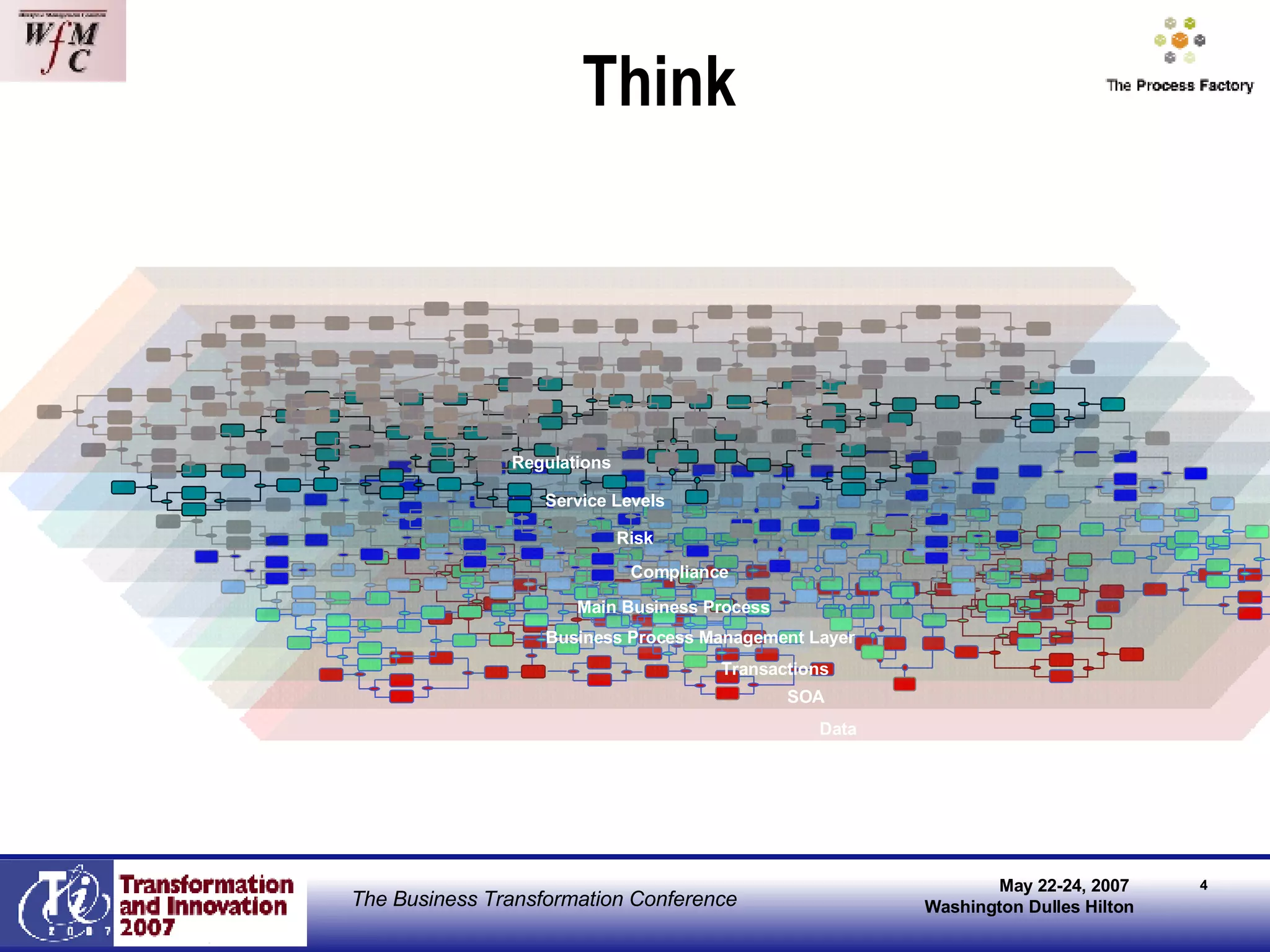
Think Data SOA Transactions Business Process Management Layer Main Business Process Compliance Risk Service Levels Regulations
Why we do BPM * Makes it easier to improve business processes and create new ones Enables the automation of processes across the  entire  organization and beyond Provides managers with real-time information on performance Allows organizations to take full advantage of new computing services. Puts existing and new processes under the direct control of business managers – no technology * Source: Understanding your organization’s Processes – Pyke et al - CUP
Business Process Management It’s about People It’s about Business It’s about managing performance It’s about improved control It’s not about SOA!!! It’s not about Web Services Yucky technical stuff The business need
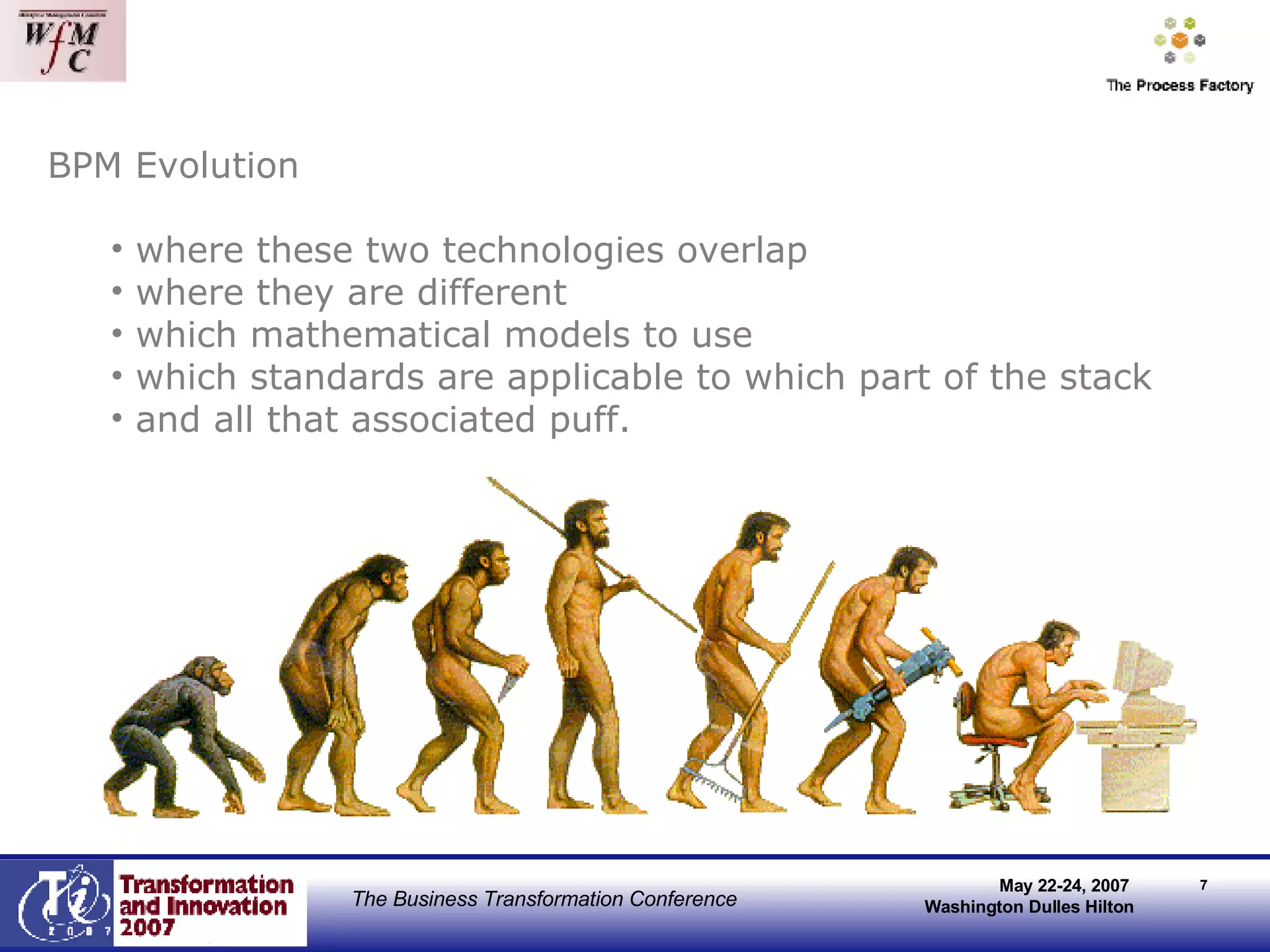
BPM Evolution where these two technologies overlap where they are different  which mathematical models to use which standards are applicable to which part of the stack and all that associated puff.
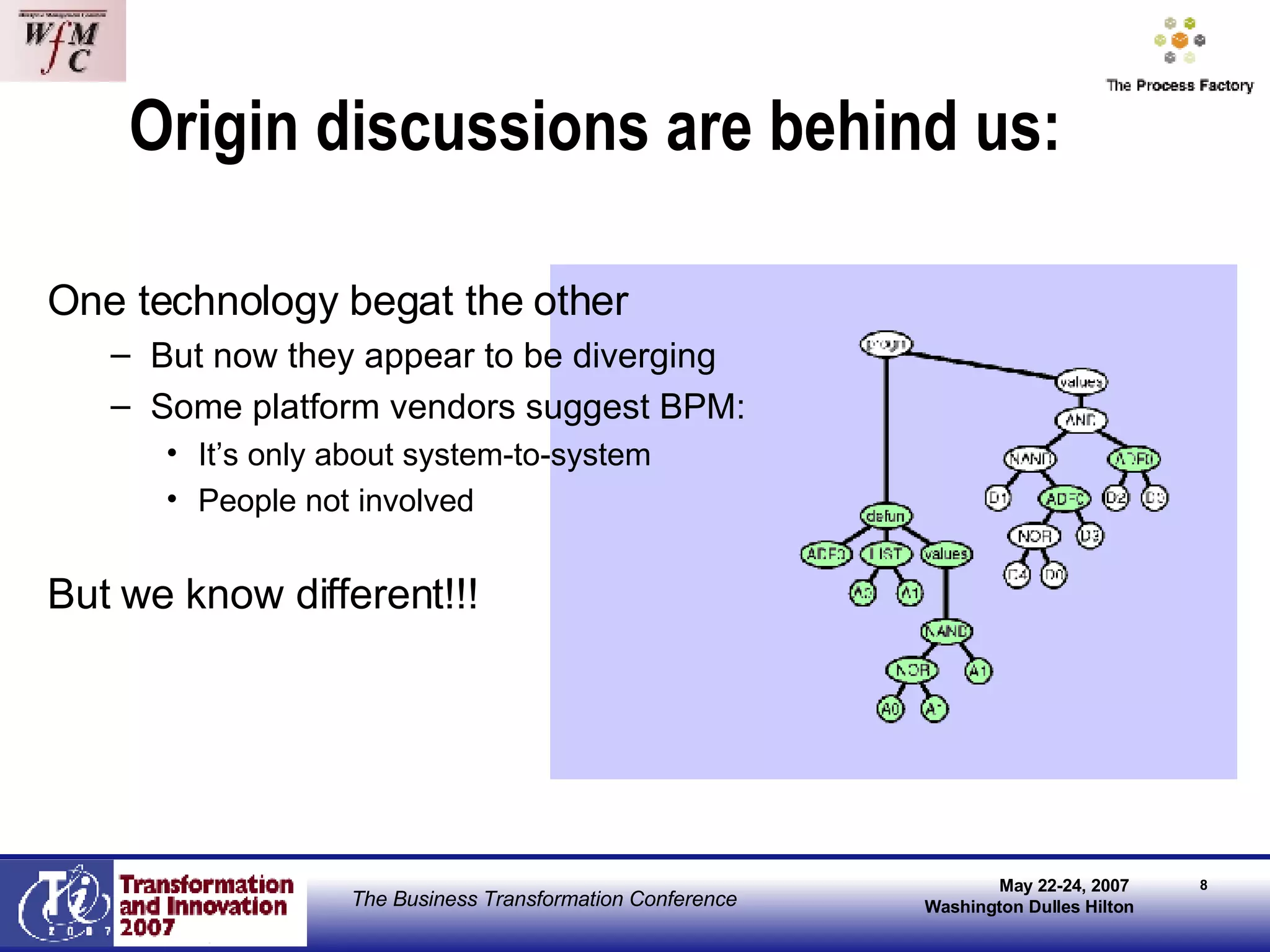
Origin discussions are behind us: One technology begat the other But now they appear to be diverging Some platform vendors suggest BPM: It’s only about system-to-system People not involved But we know different!!!
It sucks Workflow sucks because poor assumptions Too inflexible People don’t tend to work that way The unexpected is ever present Not any of my products you understand
It sucks BPM sucks because it ignores carbon But it’s good because of heritage Systems do as you expect BPEL4PEOPLE won’t fix the problem
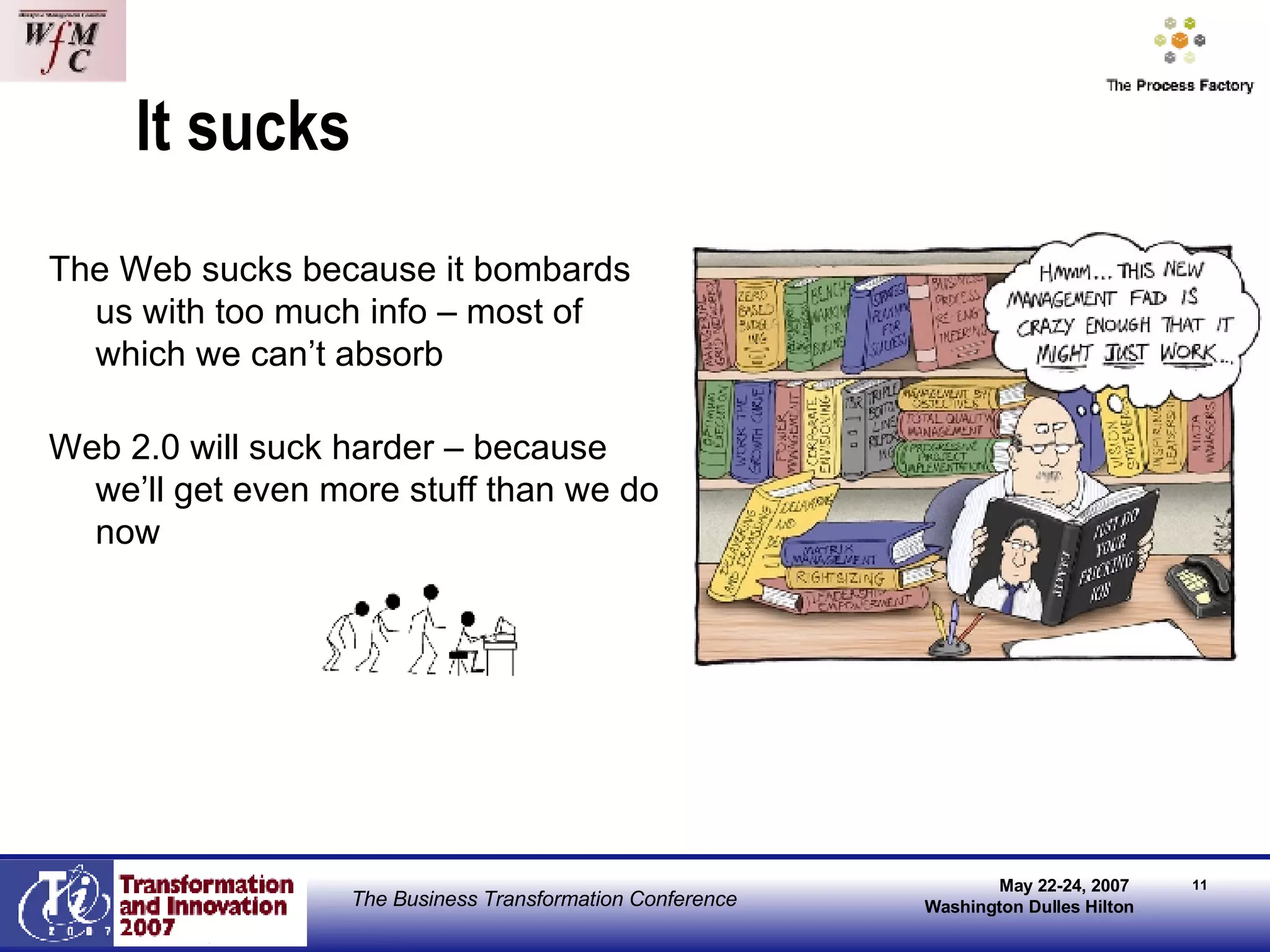
It sucks The Web sucks because it bombards us with too much info – most of which we can’t absorb Web 2.0 will suck harder – because we’ll get even more stuff than we do now
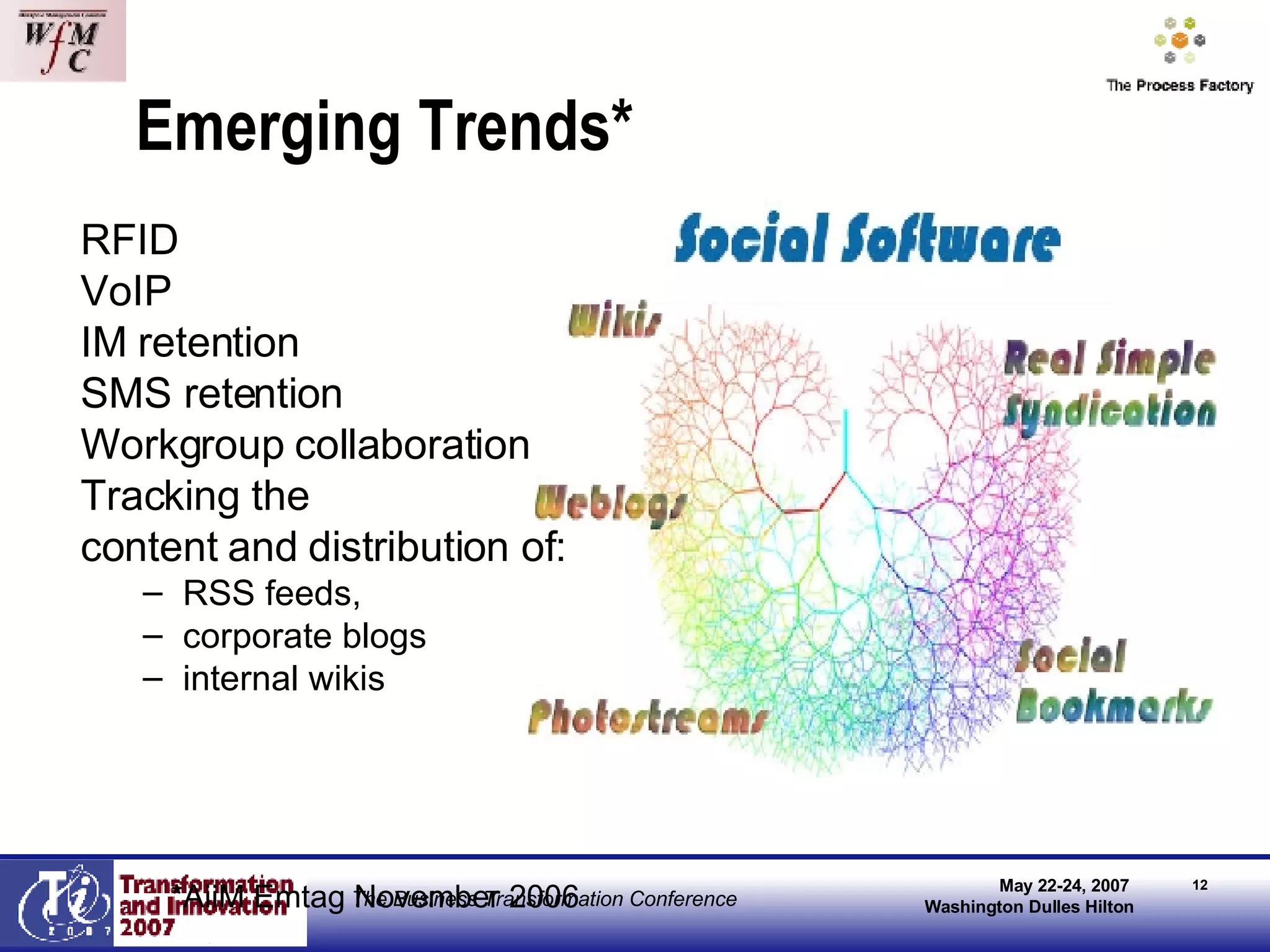
Emerging Trends* RFID  VoIP  IM retention SMS retention Workgroup collaboration  Tracking the  content and distribution of: RSS feeds,  corporate blogs  internal wikis *AiiM Emtag November 2006
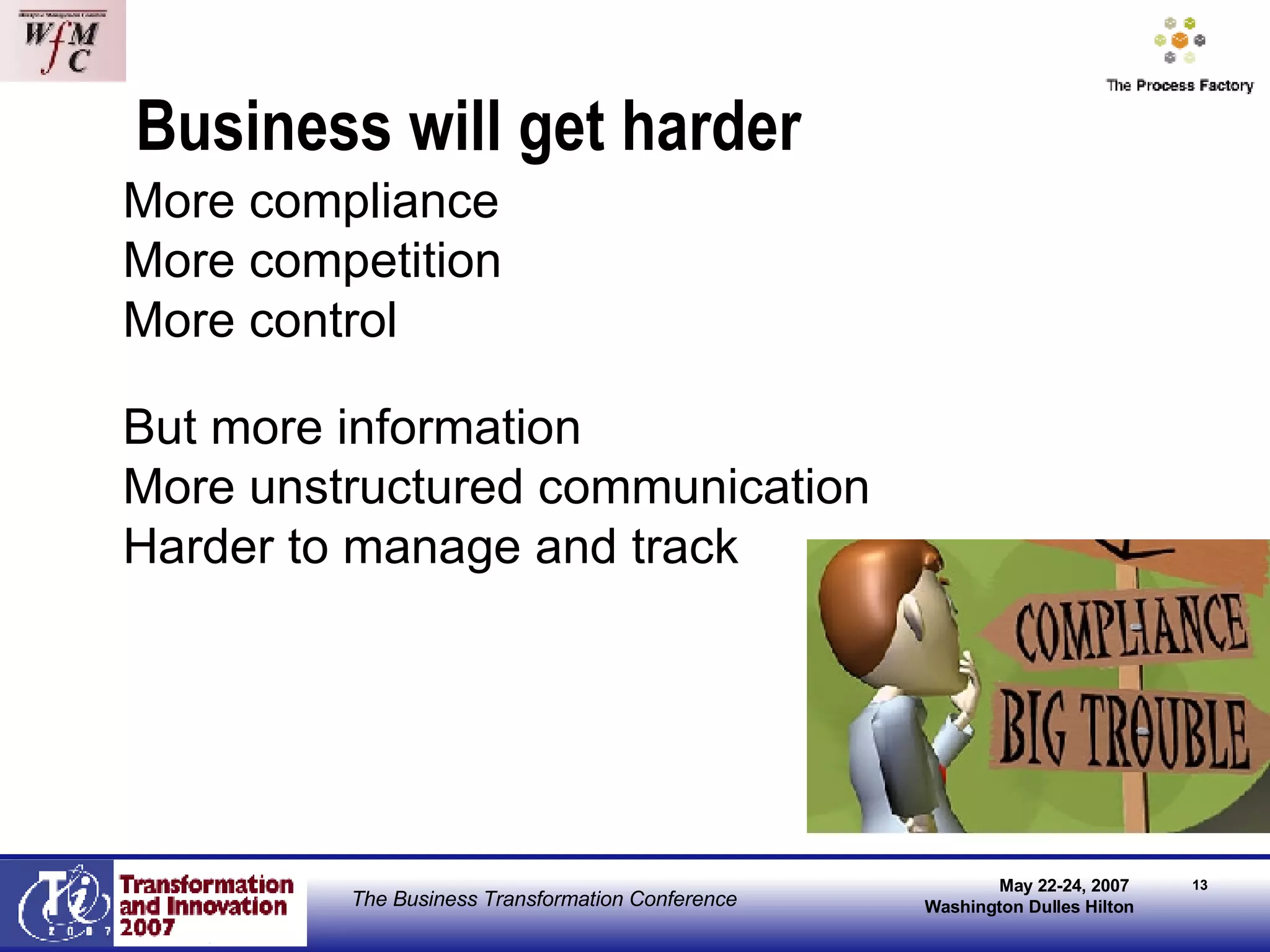
Business will get harder More compliance More competition More control But more information More unstructured communication Harder to manage and track
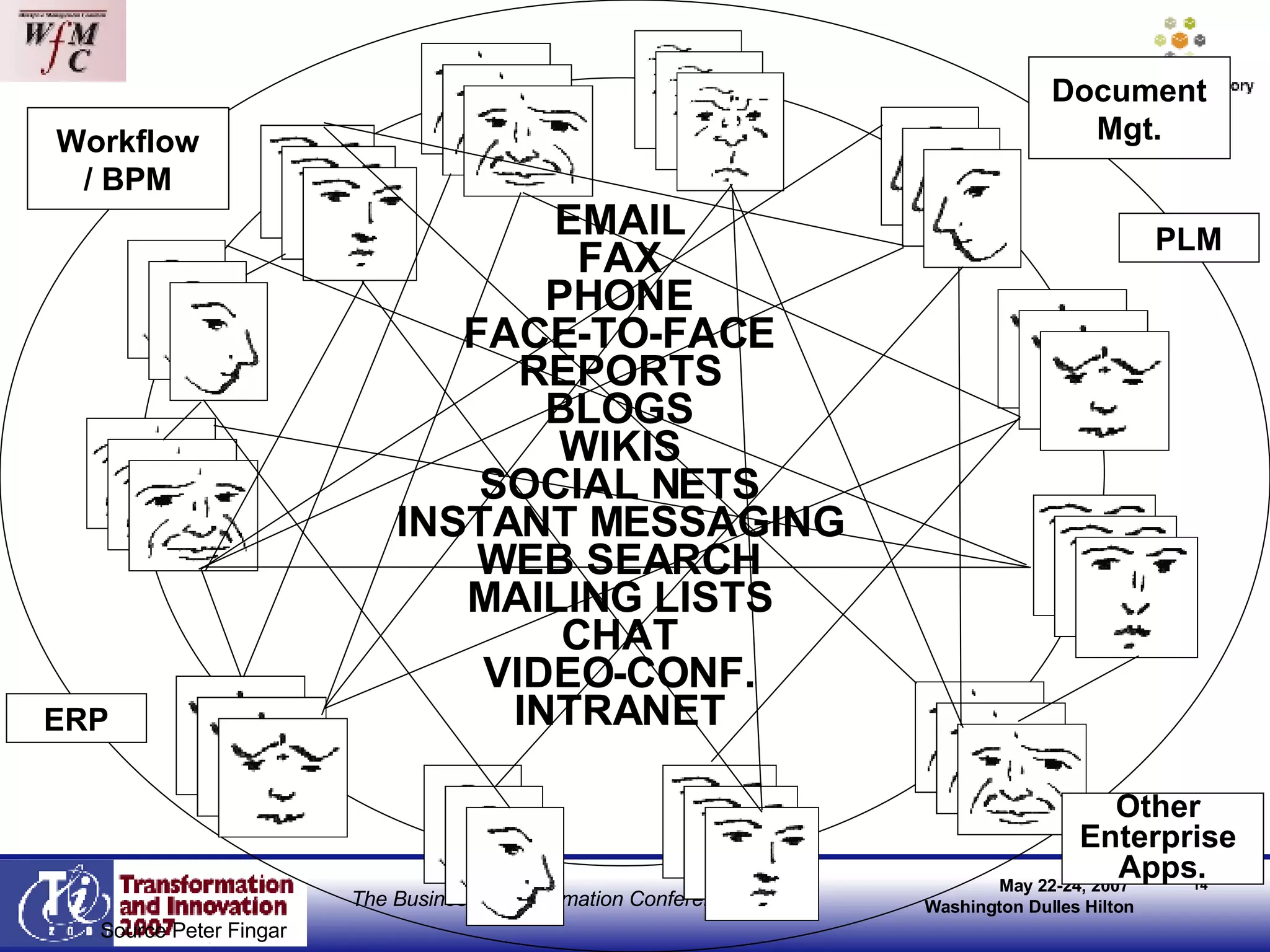
EMAIL FAX PHONE FACE-TO-FACE REPORTS BLOGS WIKIS SOCIAL NETS INSTANT MESSAGING WEB SEARCH MAILING LISTS CHAT VIDEO-CONF. INTRANET Source Peter Fingar ERP Workflow / BPM Document Mgt. Other  Enterprise  Apps. PLM
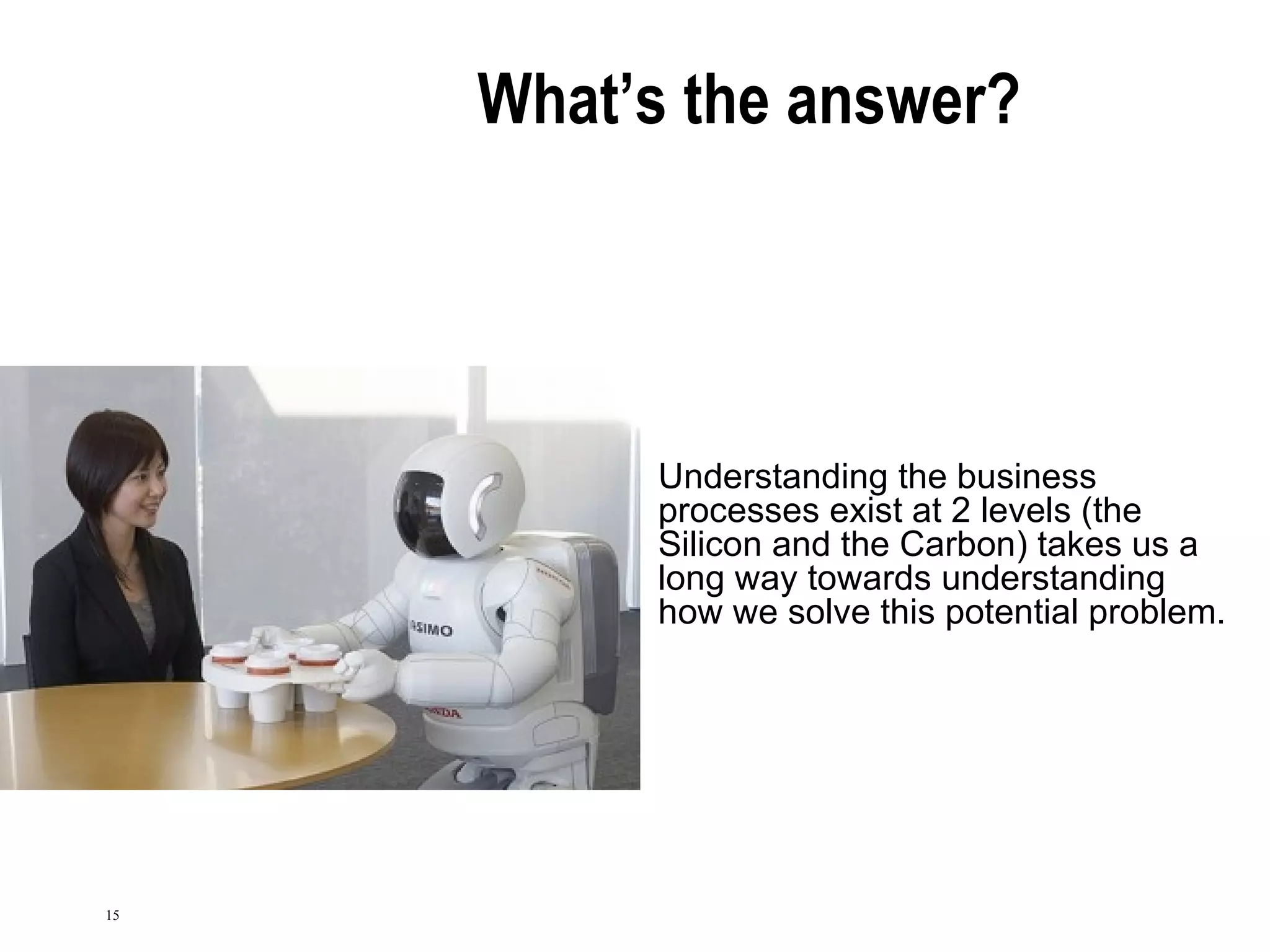
What’s the answer? Understanding the business processes exist at 2 levels (the Silicon and the Carbon) takes us a long way towards understanding how we solve this potential problem.
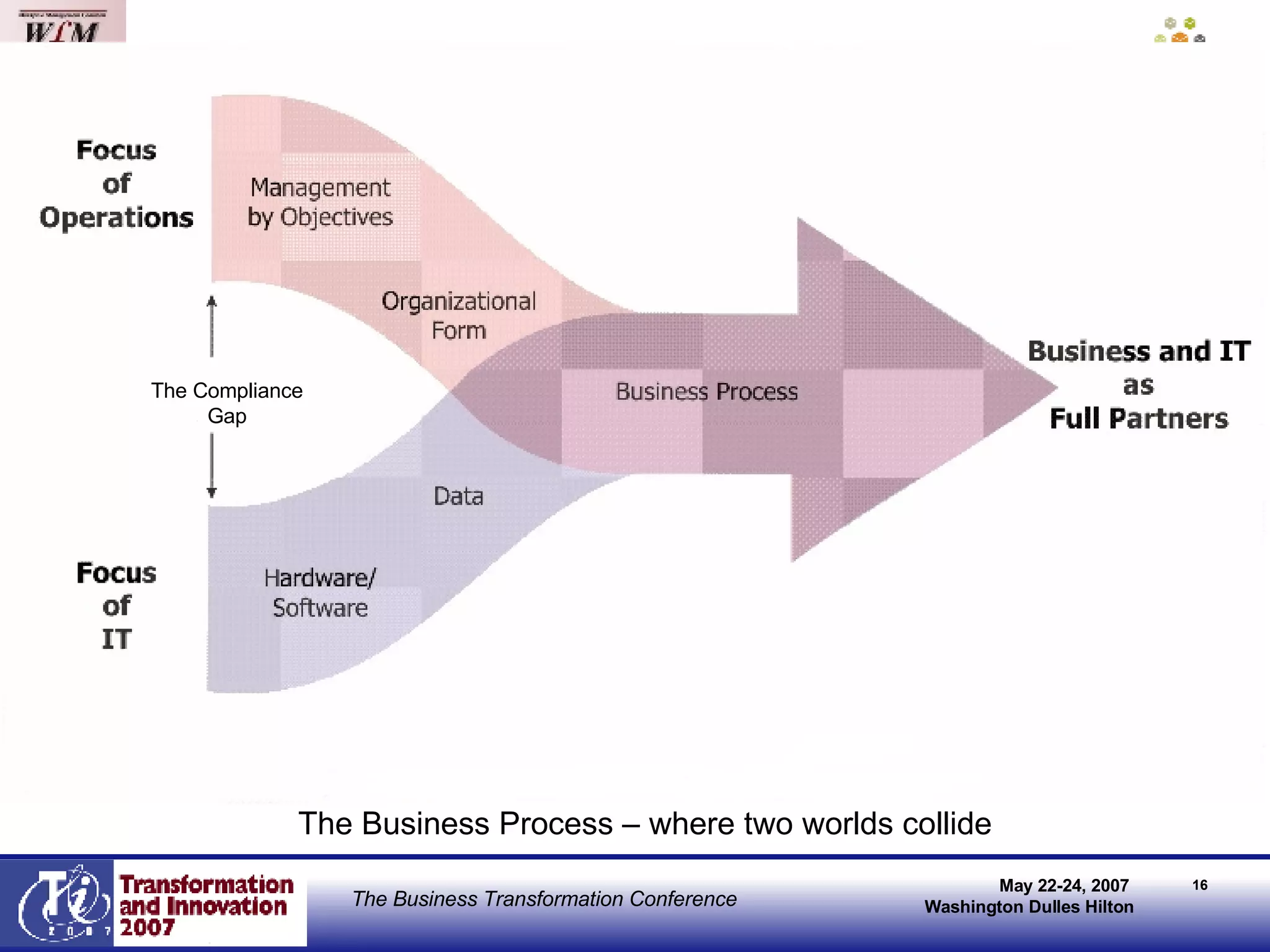
The Compliance Gap The Business Process – where two worlds collide
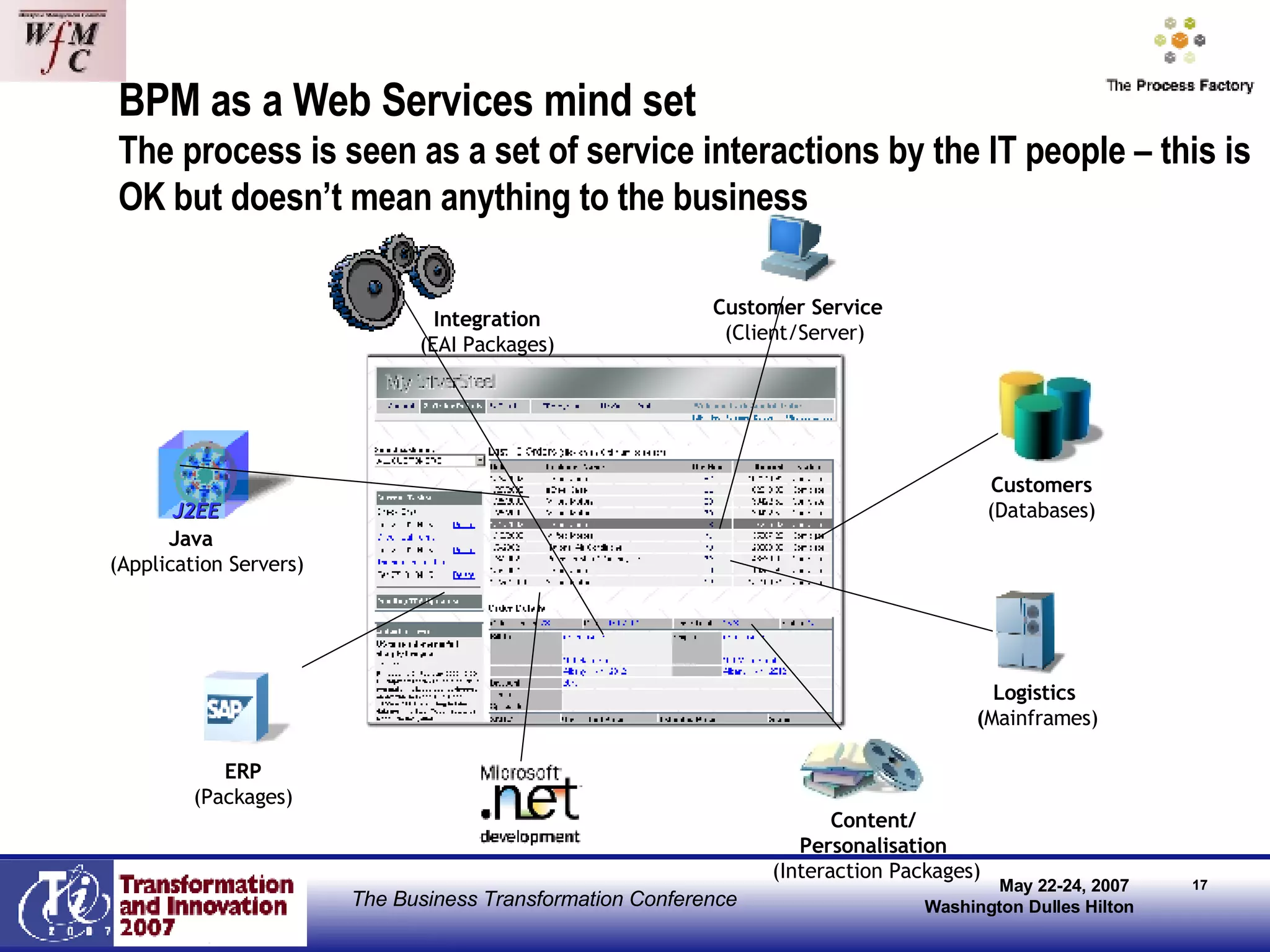
BPM as a Web Services mind set The process is seen as a set of service interactions by the IT people – this is OK but doesn’t mean anything to the business Logistics  ( Mainframes) Customers (Databases) Content/ Personalisation (Interaction Packages) Customer Service (Client/Server)  Integration (EAI Packages) ERP (Packages) Java (Application Servers) J2EE
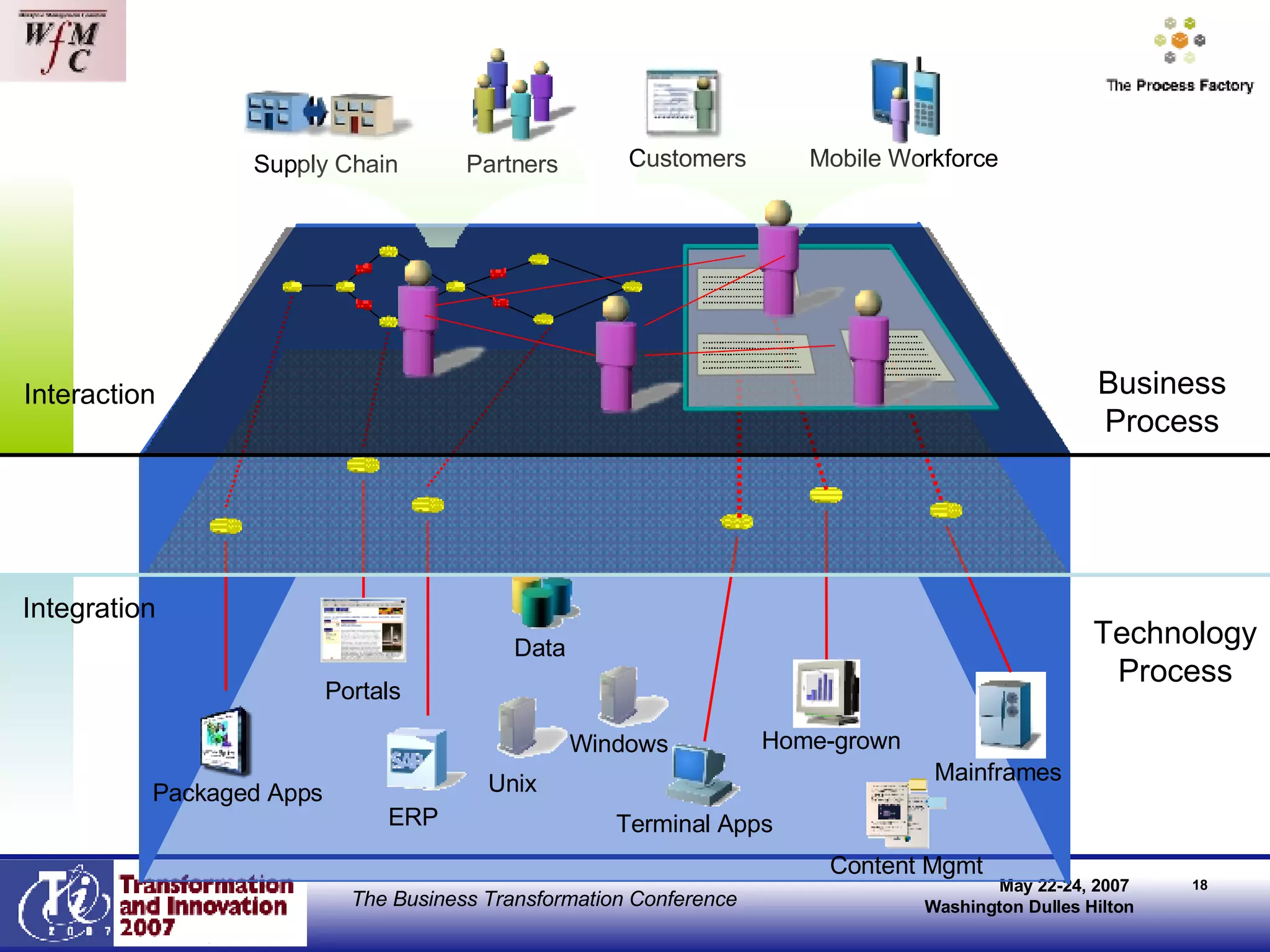
Business Process Technology Process Portals ERP Packaged Apps Home-grown Content Mgmt Mainframes Data Windows Terminal Apps Unix Supply Chain Partners Mobile Workforce Customers Interaction Integration
Knowledge Intensive BPM Process based technology that understands the needs of people and supports the inherent “spontaneity” of the human mind is the next logical step, and we might be tempted to name this potential paradigm shift “Knowledge Intensive Business Processes”.  All we know and love about BPM still valid SOA, Web Services, Systems to Systems etc. IC-BPMS But Human side is not simply forms routing and work queues You’re managing cases!!!!
Knowledge Intensive BPM The key differentiating factor of a case handling environment is the ability to run multiple procedures against a given case of work—the primacy is with the case rather than the process that is used to support a work item  Case Handling systems leverage the capability to associate virtually any number of objects within the context of a case Processes, documents, attributes, resources, assets  Processes tend to “unfold” rather than rely on a priori design time decisions (but within the context of an overall framework)
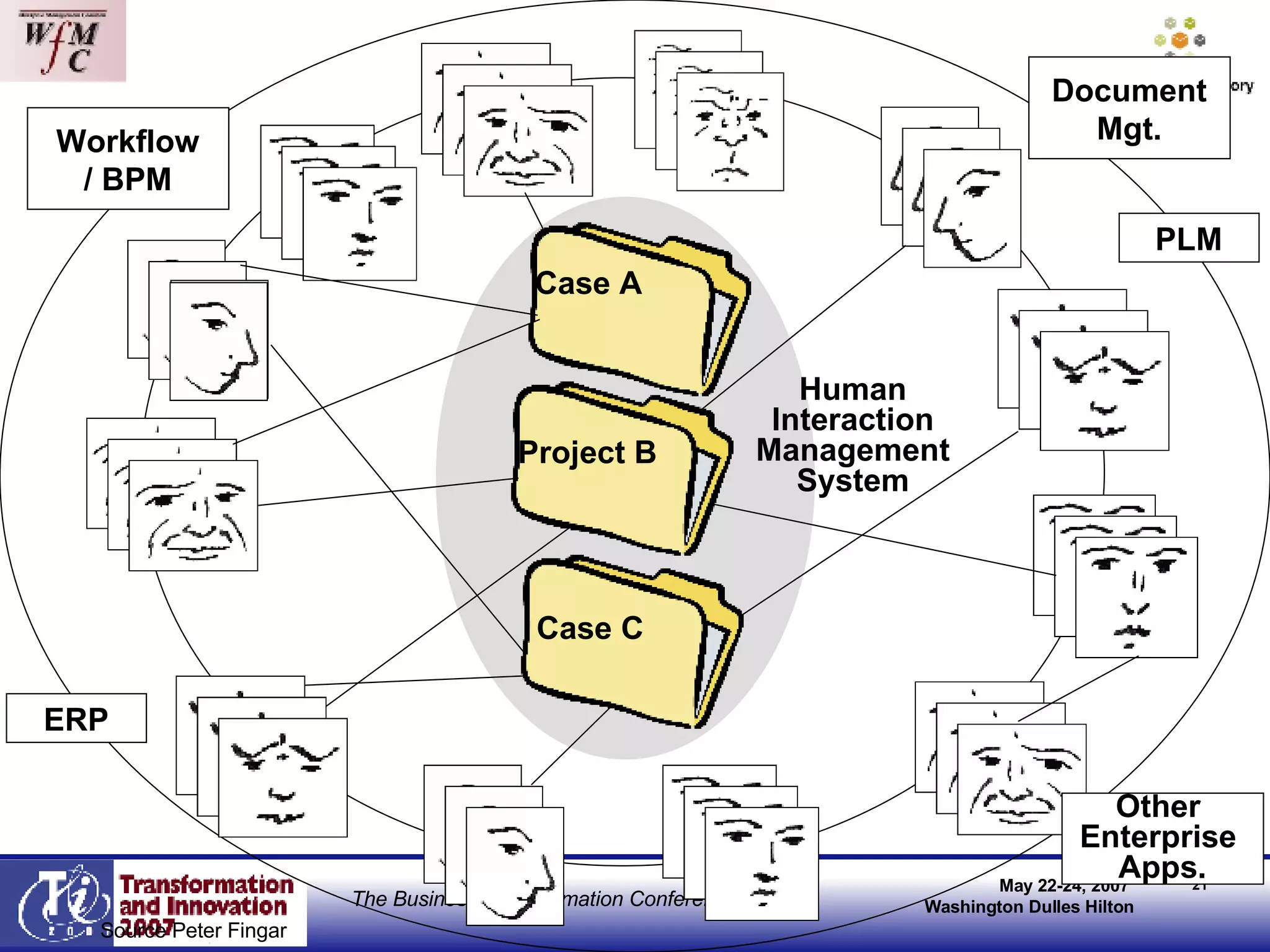
Human Interaction Management System Case A Case C Project B Source Peter Fingar ERP Workflow / BPM Document Mgt. Other  Enterprise  Apps. PLM
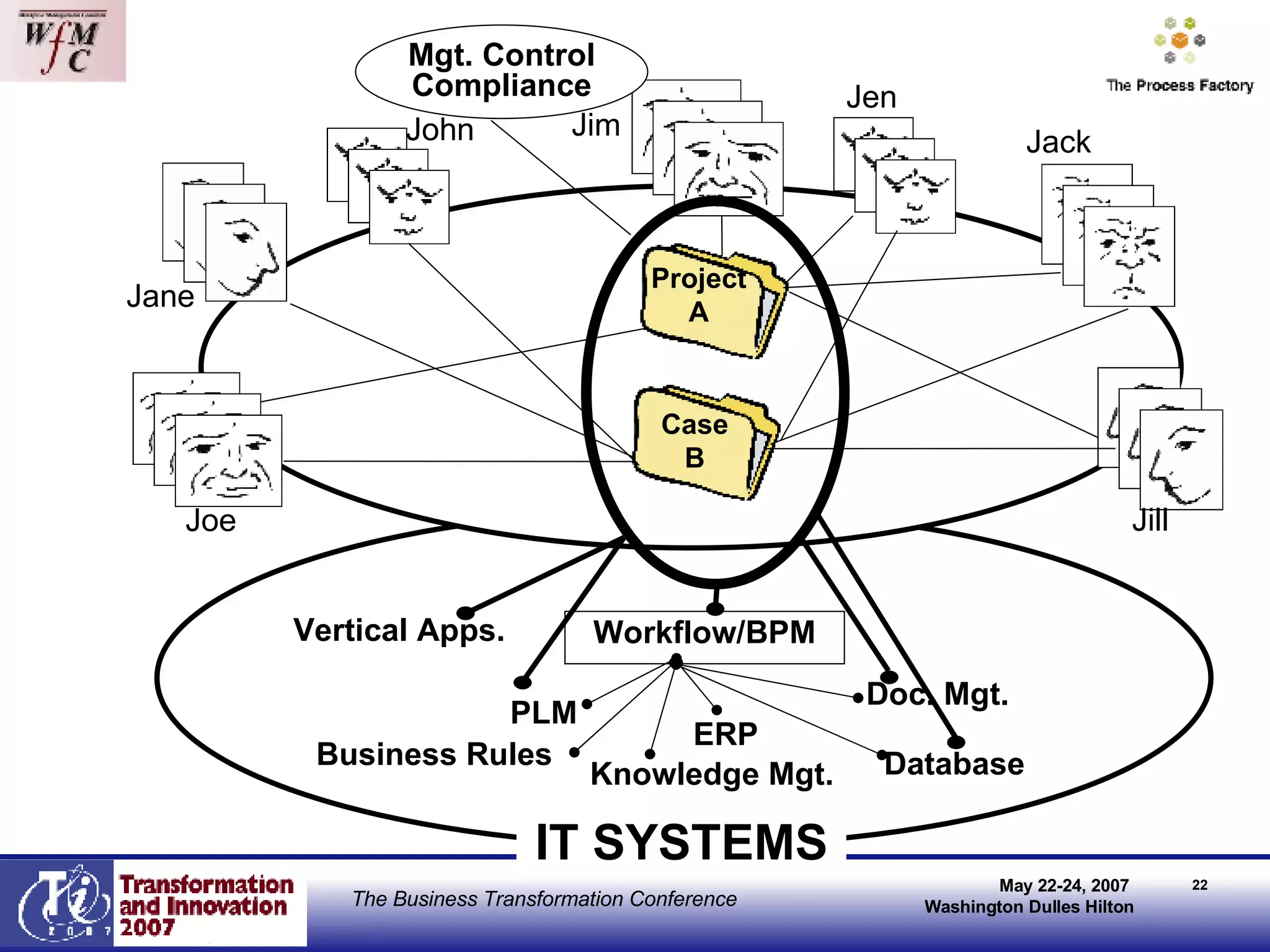
Vertical Apps. Doc. Mgt. Workflow/BPM ERP PLM Business Rules Knowledge Mgt. Database IT SYSTEMS Project A Case B Joe Jim Jane Jill Jack John Jen Mgt. Control Compliance
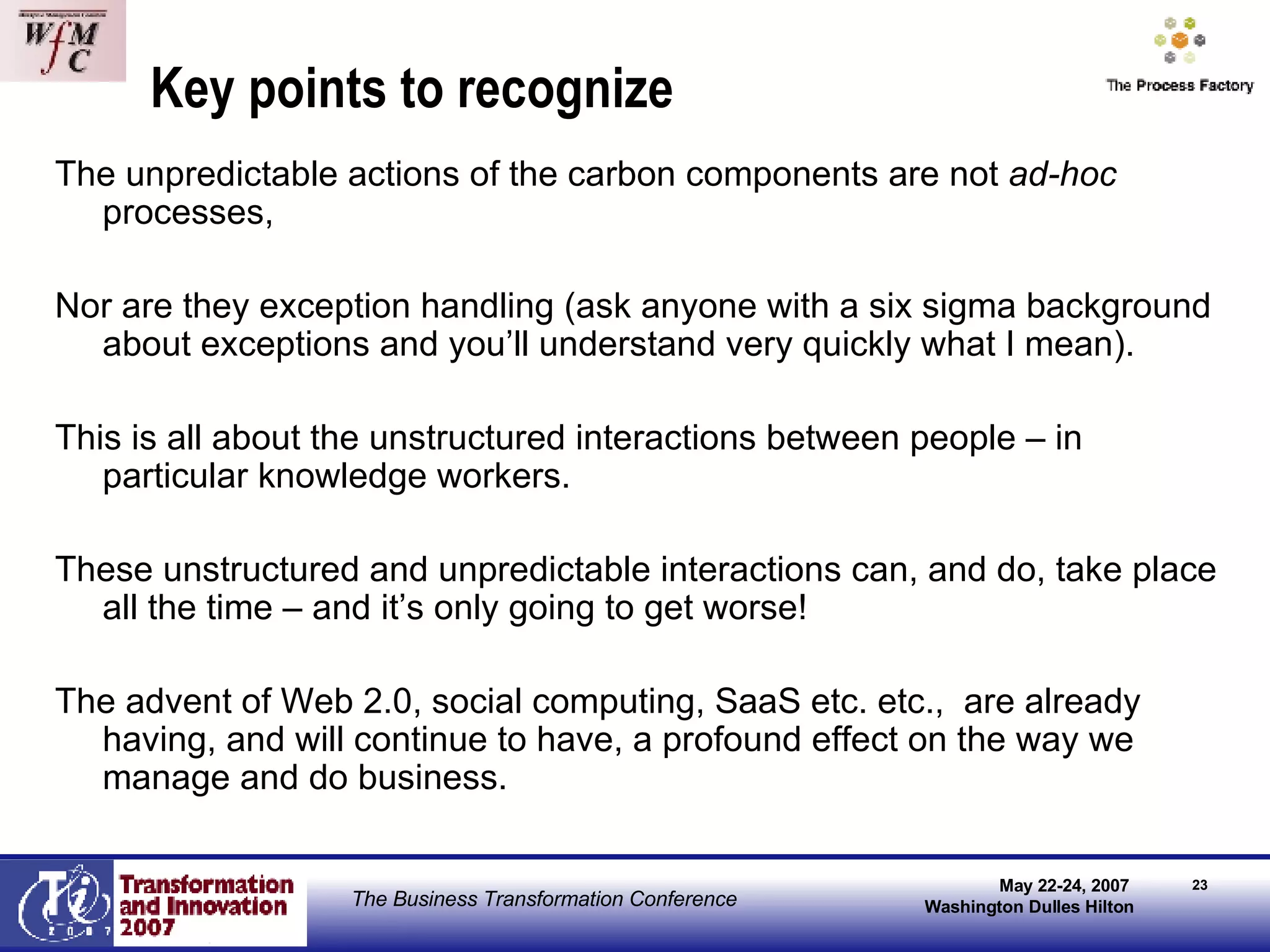
Key points to recognize The unpredictable actions of the carbon components are not  ad-hoc  processes, Nor are they exception handling (ask anyone with a six sigma background about exceptions and you’ll understand very quickly what I mean).  This is all about the unstructured interactions between people – in particular knowledge workers.  These unstructured and unpredictable interactions can, and do, take place all the time – and it’s only going to get worse!  The advent of Web 2.0, social computing, SaaS etc. etc.,  are already having, and will continue to have, a profound effect on the way we manage and do business.
Thank  Y Jon Pyke Chairman Workflow Management Coalition Founder and CEO The Process Factory Contact Information: [email_address] ou www.theprocessfactory.com www.wfmc.org Thank  Y ou

Jon Pyke Keynote Address

  • 1.
    Jon Pyke ChairmanWorkflow Management Coalition Founder and CEO The Process Factory SessionTitle: Understanding your Organization’s Processes Welcome to Transformation and Innovation 2007 The Business Transformation Conference Welcome
  • 2.
    A Definition BusinessProcess Management (BPM) is a natural and holistic management approach to operating business that produces a highly efficient, agile, innovative, and adaptive organization that far exceeds that achievable through traditional management approaches.  
  • 3.
    What’s it reallyall about? Wikipedia defines Business Process Management thus: “ The term Business Process Management (or BPM ) is a set of activities which organizations can perform to either optimize their business processes or adapt them to new organizational needs. As these activities are usually aided by software tools, the term BPM is synonymously used to refer to the software tools themselves.”
  • 4.
    Think Data SOATransactions Business Process Management Layer Main Business Process Compliance Risk Service Levels Regulations
  • 5.
    Why we doBPM * Makes it easier to improve business processes and create new ones Enables the automation of processes across the entire organization and beyond Provides managers with real-time information on performance Allows organizations to take full advantage of new computing services. Puts existing and new processes under the direct control of business managers – no technology * Source: Understanding your organization’s Processes – Pyke et al - CUP
  • 6.
    Business Process ManagementIt’s about People It’s about Business It’s about managing performance It’s about improved control It’s not about SOA!!! It’s not about Web Services Yucky technical stuff The business need
  • 7.
    BPM Evolution wherethese two technologies overlap where they are different which mathematical models to use which standards are applicable to which part of the stack and all that associated puff.
  • 8.
    Origin discussions arebehind us: One technology begat the other But now they appear to be diverging Some platform vendors suggest BPM: It’s only about system-to-system People not involved But we know different!!!
  • 9.
    It sucks Workflowsucks because poor assumptions Too inflexible People don’t tend to work that way The unexpected is ever present Not any of my products you understand
  • 10.
    It sucks BPMsucks because it ignores carbon But it’s good because of heritage Systems do as you expect BPEL4PEOPLE won’t fix the problem
  • 11.
    It sucks TheWeb sucks because it bombards us with too much info – most of which we can’t absorb Web 2.0 will suck harder – because we’ll get even more stuff than we do now
  • 12.
    Emerging Trends* RFID VoIP IM retention SMS retention Workgroup collaboration Tracking the content and distribution of: RSS feeds, corporate blogs internal wikis *AiiM Emtag November 2006
  • 13.
    Business will getharder More compliance More competition More control But more information More unstructured communication Harder to manage and track
  • 14.
    EMAIL FAX PHONEFACE-TO-FACE REPORTS BLOGS WIKIS SOCIAL NETS INSTANT MESSAGING WEB SEARCH MAILING LISTS CHAT VIDEO-CONF. INTRANET Source Peter Fingar ERP Workflow / BPM Document Mgt. Other Enterprise Apps. PLM
  • 15.
    What’s the answer?Understanding the business processes exist at 2 levels (the Silicon and the Carbon) takes us a long way towards understanding how we solve this potential problem.
  • 16.
    The Compliance GapThe Business Process – where two worlds collide
  • 17.
    BPM as aWeb Services mind set The process is seen as a set of service interactions by the IT people – this is OK but doesn’t mean anything to the business Logistics ( Mainframes) Customers (Databases) Content/ Personalisation (Interaction Packages) Customer Service (Client/Server) Integration (EAI Packages) ERP (Packages) Java (Application Servers) J2EE
  • 18.
    Business Process TechnologyProcess Portals ERP Packaged Apps Home-grown Content Mgmt Mainframes Data Windows Terminal Apps Unix Supply Chain Partners Mobile Workforce Customers Interaction Integration
  • 19.
    Knowledge Intensive BPMProcess based technology that understands the needs of people and supports the inherent “spontaneity” of the human mind is the next logical step, and we might be tempted to name this potential paradigm shift “Knowledge Intensive Business Processes”. All we know and love about BPM still valid SOA, Web Services, Systems to Systems etc. IC-BPMS But Human side is not simply forms routing and work queues You’re managing cases!!!!
  • 20.
    Knowledge Intensive BPMThe key differentiating factor of a case handling environment is the ability to run multiple procedures against a given case of work—the primacy is with the case rather than the process that is used to support a work item Case Handling systems leverage the capability to associate virtually any number of objects within the context of a case Processes, documents, attributes, resources, assets Processes tend to “unfold” rather than rely on a priori design time decisions (but within the context of an overall framework)
  • 21.
    Human Interaction ManagementSystem Case A Case C Project B Source Peter Fingar ERP Workflow / BPM Document Mgt. Other Enterprise Apps. PLM
  • 22.
    Vertical Apps. Doc.Mgt. Workflow/BPM ERP PLM Business Rules Knowledge Mgt. Database IT SYSTEMS Project A Case B Joe Jim Jane Jill Jack John Jen Mgt. Control Compliance
  • 23.
    Key points torecognize The unpredictable actions of the carbon components are not ad-hoc processes, Nor are they exception handling (ask anyone with a six sigma background about exceptions and you’ll understand very quickly what I mean). This is all about the unstructured interactions between people – in particular knowledge workers. These unstructured and unpredictable interactions can, and do, take place all the time – and it’s only going to get worse! The advent of Web 2.0, social computing, SaaS etc. etc., are already having, and will continue to have, a profound effect on the way we manage and do business.
  • 24.
    Thank YJon Pyke Chairman Workflow Management Coalition Founder and CEO The Process Factory Contact Information: [email_address] ou www.theprocessfactory.com www.wfmc.org Thank Y ou