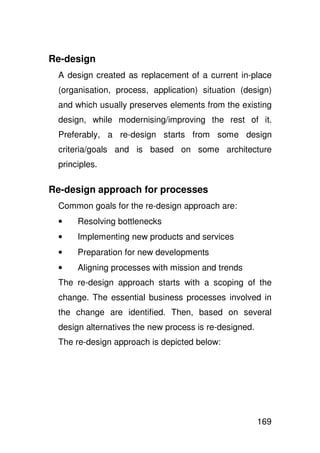
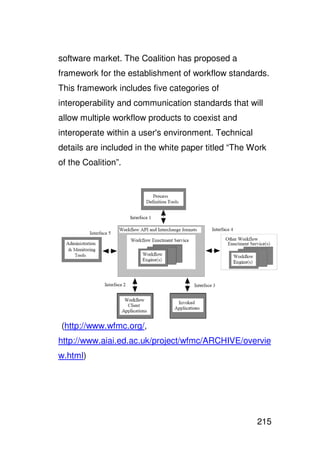
(Draft)


          1
Business Process Management (BPM) has been on the
radar of a growing number of organisations over the last
couple    of    years.   People   who   have   followed   the
development of BPM have seen it expand from a “tooling
and service” definition to a full fledged “management
discipline”. Most people and organisations who now talk
and write about BPM take the holistic view that a business
process    is   about    the interaction   between   people,
organisations and systems in order to deliver a “value” in
the form of a product or service for a customer.
This current view on BPM has made the discussion about
BPM a bit more complex as the background of the people
differ. Today’s BPM discussion brings together people like
e.g. business managers, hard core IT folks, people with a
workflow, process improvement, quality or business
intelligence background. The different backgrounds have
also influence on the increasing number of models and
standards used to describe BPM.
As chairman of the BPM-Forum and the Process
Community I have followed numerous discussions and
presentations on BPM. I have observed that most


                                                           2
presentations skip a BPM definition and the people
assume a common understanding. Even when one is
given, it will differ from the next one. For me this is one of
the main reasons why BPM is not delivering its full
potential to the market yet.
Therefore, I very much applaud this book as it will help
ease the discussion about BPM by providing a set of
definitions which can be used within you organisation and
outside in presentations, articles and discussions so all
will benefit from the value BPM can bring. There are
numerous standards, models and definitions in the market
you can use. All are ok, as long as you use just one for
your discussion and this book will give you a good
alternative.


Frits Bussemaker
Chairman BPM-Forum
Chairman ProcessCommunity


                                                            3
Business Process Management (BPM) concerns the goal-
driven design, management and execution of business
processes. Many organisations currently manage or plan
to start managing their business processes: 82% of the
European CEOs consider BPM to be “very important to
their organisation … motivated by the need to work
smarter,   better   and   faster     in a   rapidly   changing
marketplace” (EFQM survey).
The reasons for this are quite obvious. A better grip on
business processes also means better results for clients,
decrease in costs and enhancement of the process
performance.    Nevertheless, only few organisations are
outstanding    in   applying   the    BPM     principles   and
techniques. This can be often explained by insufficient
domain specific knowledge, competencies and expertise
which are required in order to be able to translate general
business goals into a clear vision with respect to business
processes. For a implementing successfully such a vision
in practice it is critical that the process stakeholders share
the same understanding of the most important BPM-
related concepts. Nevertheless, literature sources and


                                                            4
practitioners use attribute different semantics/definitions to
a   term   or   they   use   different   terms   (sometimes
interchangeably) to designate the same concept. This has
become a constant source of confusions and ambiguities.
This situation is further worsened by the variety of
abbreviations that can be found in abundance in many
scientific and professional publications and which are
often familiar only to experts. Therefore we felt compelled
to set the records straight and collect and explain in this
document the most important concepts related to
business process methods, techniques and tools. This
booklet is useful BPM “dictionary” for managers, process
owners,     process      developers,     consultants     and
enterprise architects.
We would like to acknowledge here the contribution of
many colleagues and of several organisations to the
development of this document, such as Telematica
Instituut, the BPM-forum Nederland, the Belastingdienst
and the ING Group. Furthermore, this document is based
on state-of-the-art BPM-literature.


                                                            5
ABC
 Activity-based Costing
ABM
 Activity-based Management
AO
 Administrative Organisation
APM
 Application Portfolio Management
BFA
 Business function architecture
BO
 Back Office
BP
 Business process
BPA
 Business Process Automation


BPDM
 Business Process Definition Metamodel


                                         6
BPE
 Business Process Engineering
BPEL
 Business Process Execution Language
BPEL4WS
 Business Process Execution Language for Web
 Services
BPM
 Business Process Management
BPMI
 Business Process Management Initiative
BPML
 Business Process Modelling Language
BPMN
 Business Process Modelling Notation
BPR
 Business Process Redesign (Re-engineering)
BSC
 Balanced Scorecard
CMM
 Capability Maturity Model


                                               7
CMMI
 Capability Maturity Model Integrated
COPAFIJTH
 Commerce, Organisation, Personnel, Administration
 Organisation, Finance, Information, Juridical aspects,
 Technology, Housing
CRM
 Customer Relationship Management
CRUD
 Create, Read, Update, Delete
CSF
 Critical success factor
DEMO
 Design & Engineering Methodology for Organisations
DPE
 Departmental Process Expert
DPS
 Detail process schema
DPU
 Defects per Unit
EA
 Enterprise architecture


                                                          8
EAI
 Enterprise Application Integration
EFQM
 European Foundation for Quality Management
EPC
 Event Process Chains
ERP
 Enterprise Resource Planning
FO
 Front Office
FS
 Functional Specification
FTE
 Full Time Equivalent
HACCP
 Hazard Analysis Critical Control Points
HPS
 Hierarchical Process Schema
IA
 Information architecture
IC
 Internal Control


                                              9
IDEF
  Integrated Definition
IPO
  Input, Process, Output
ISO
  International Organisation for Standardization
ITIL
  Information Technology Infrastructure Library
JIT
  Just-in-Time
KPI
  Key Performance Indicator
KRI
  Key Risk Indicator
MBO
  Management by Objectives
MCA
  Mutual Collaboration Agreement
MCS
  Management Control System
MDA
  Model Driven Architecture


                                                   10
OASIS
     Organisation for the Advancement of Structured Information
     Standards
OMG
     Object Management Group
ORM
1.     Operational Risk Management
2.     Object Role Modelling
OVA
     Overhead Value Analysis
PDCA
     Plan, Do, Check, Act
PI
     Performance indicator
PMC
     Product-market combination
PRINCE®
     PRojects IN Controlled Environments
RADAR
     Results, Approach, Deployment, Assessment, Review


                                                        11
RASCI
 Responsible,   Accountable,     Supportive,   Consulted,
 Informed
SCM
 Supply Chain Management
SLA
 Service Level Agreement
SMART
 Specific, Measurable, Achievable, Relevant and Time-
 bound
SOA
 Service Oriented Architecture
SOX
 Sarbanes-Oxley Act
SSC
 Shared Service Centre
SWOT
 Strengths, Weaknesses, Opportunities, Threats
TP
 Third Party
TQM
 Total Quality Management


                                                      12
UML
 Unified Modelling Language
WBS
 Work Breakdown Structure
WFM
 Workflow Management
WfMC
 Workflow Management Coalition
WS-BPEL
 Web Services Business Process Execution Language
XML
 Extensible Markup Language
XPDL
 XML Process Definition Language
YAWL
 Yet Another Workflow Language


                                                13
14
15
Abstraction
  Leaving out details and exceptions related to the
  aspects which are not of importance for the main goal.

Abstraction level
  The amount of detail included in the description of a
  system (organisation, application, process) and its
  environment, in particular when determining which
  properties and which subsystems will be included in the
  description.

Action
  See ‘activity’.

Activity (action)
  1. A set of operations that belong together. An activity
    is regarded as having an atomic character in terms of
    time, place and operation(s) involved. Activities are
    used as a means to refine the specification of
    business processes. Thus, several activities can be
    distinguished in a business process together with
    their relationships.


                                                       16
2. Clustering of operations, based on op basis van
    efficiency and effectiveness criteria, which are
    executed by one or more actors.
  3. A description of a piece of work that forms one
    logical step within a process. An activity may be a
    manual activity, which does not support computer
    automation, or a workflow (automated) activity. A
    workflow activity requires human and/or machine
    resources(s) to support process execution; where
    human resource is required an activity is allocated to
    a workflow participant. (www.wfmc.org)

Activity-based costing (ABC)
  1. A method for estimating the resources required to
  operate an organisation' business processes, produce
                         s
  its products and serve its customers.
  In a business organisation, the ABC methodology
  assigns an organisation' resource costs through
                         s
  activities to the products and services provided to its
  customers. It is generally used as a tool for
  understanding    product   and   customer    cost   and
  profitability. As such, ABC has predominantly been
  used to support strategic decisions such as pricing,


                                                       17
outsourcing and identification and measurement of
 process improvement initiatives.
 (http://en.wikipedia.org/wiki/Activity-based_costing)
 Thus, the principle behind ABC is that activities, and not
 the   products,   are      generating   costs.   Also   see
 ‘Quantitative analysis’.
 2. A process-oriented approach to accounting that
 starts by determining how much it costs to perform
 each activity and then adds up activity costs to
 determine process costs, an so forth. The idea is that
 you add together all the costs in a complete value
 chain, subtract the costs from the income for the
 product or service produced by the value chain, and
 determine the profit on the process.
  (http://www.bptrends.com/resources_glossary.cfm)

Activity-based management (ABM)
 Establishes a relation with the ‘customer value’ by
 determining per process step the costs with which
 added-value is delivered to the client.

Actor diagram
 Representation in the form of a diagram of the
 departments, units, divisions, groups, functions, roles,


                                                         18
people and/or systems involved in a process, together
  with   the    relationships     between    them    and    the
  information, products and services they exchange.

Actors
  Indicate who is involved in a process. The following
  types of actors can be distinguished: (business)
  functions, roles, and resources (people and systems).

Actor table
  A table specifying the mapping between actors and
  activities.


Administrative information management
  The systematic collection, storage and processing of
  data    which    serves       the   information   needs    of
  management, control and accountability processes in
  an organisation.

Administrative structure
  All the organisational measures taken within an
  organisation with respect to the data processing
  processes that concern the provisioning of information
  for


                                                            19
the management and functioning of that organisation
   the identification of responsibilities to be performed,
   grouping of responsibilities into departments or
   divisions,   and     specifying    of    organisational
   relationships.

Administrative process
 A sequence of successive activities during which
 certain   administrative   operations     are   executed.
 Administrative processes do not produce any output
 directly for the external client, but are essential for
 running the business. Examples hereof are: strategic
 planning, budgeting and performance monitoring.

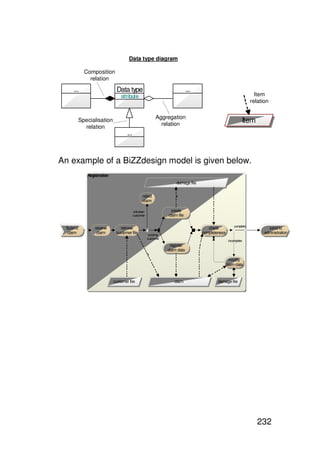
Aggregation
 The aggregation relationship relates an aggregate
 object with an object that is part of the aggregation. In
 contrast to the composition relationship, an object can
 be part of more than one aggregation.

Analysis approach for processes
 Such an approach structures the COPAFIJTH-broad
 analysis of the as-is situation of an organisation. More
 precisely it consists of the scoping of the change


                                                       20
process, the identification of the analysis means and of
  the specification, analysis and evaluation of the
  necessary process models. The analysis approach is
  depicted below.
    CSF, boundary conditions, indicators

           1        Scope
    Goal and scope

           2        Determine means
    Which analysis?, what to model?        1   Determine
                                               modelling goal
           3        Modelling
                                           2   Determine
    One or more models                         model type
                                           3   Elaborate
           4        Analysis                   model
                                                            …
    Facts from the analysis
           5        Evaluate

    Bottlenecks, causes, symptoms


Analysis object
  Processes that are subject to analysis.

Analysis reasoning-tool
  A tool that helps the analyst to come from analysis
  goals to the identification of appropriate analysis means


                                                            21
(e.g., techniques, tools), using a structured collection of
  aspects on a step-wise manner.


AND-join (conjunction)
  1.   A symbol that is used in behaviour modelling to
       express the fact that an activity following an and-
       join may begin only when all activities preceding
       that and-join have been completed.
  2.   A point in the workflow where two or more parallel
       executing    activities   converge   into   a   single
       common thread of control. (www.wfmc.org)

AND-split (parallelism)
  1.   A symbol that is used in behaviour modelling to
       express the fact that all activities following an and-
       split may begin independently from each other
       (i.e., in parallel) after the activity preceding that
       and-split have been completed.
  2.   A point within the workflow where a single thread
       of control splits into two or more threads which are
       executed in parallel within the workflow, allowing
       multiple activities to be executed simultaneously.
       (www.wfmc.org)


                                                          22
Application
  A software system that supports specific business
  processes and the people involved by processing the
  data flow that corresponds to those processes.

Application architecture
  Describes the components of the business application
  portfolio and their corresponding relationships.

Application function
  A functional component coordinating, supporting and/or
  realising the automation of one or more business
  functions.

Application interface
  A functional component of an application through which
  (a part of) the functionality and data is made available
  to other applications (‘client applications’), or through
  which (a part of) the functionality and data of other
  applications is accessed.

Application design
  Blueprint of an application, in which the functional
  requirements    are   distributed   over   the   functional


                                                          23
components. Each of these functional components is
  further worked out in technical design, which specifies
  how that component must be realised. Furthermore,
  some choices must be made with respect to supporting
  technologies to be used and with respect to which
  existing (software) components will be reused and
  which have to be built from scratch. Thus, an
  application design establishes the relation between the
  ‘what and the ‘how’.

Application Programming Interface (API)
  A component of an information system allowing other
  software applications to exchange data with the system.

Application system
  See ’application’.


ArchiMate-project
  ArchiMate was an initiative of a consortium of
  companies and knowledge institutes. The Telematica
  Instituut, Ordina, Radboud University Nijmegen, the
  Leiden Institute for Advanced Computer Science
  (LIACS) and the Centre for Mathematics and Computer
  Science (CWI) have done research.

                                                      24
By means of an architecture language and visualization
techniques that show the coherence and relations
among the several domains, ArchiMate provides the
architect with univocal instruments to support and
improve the architecture process integration of domains
and to achieve the integration of different architecture
domains. The core result of ArchiMate is a design
language that consists of:
  A generic collection of concepts and the notation of
  these concepts as a visual language;
  An accurate definition of the semantics (formal
  denotation) of these concepts, so that it becomes
  clear what a model means;
  A visual notation that resembles widely accepted
  notations such as UML, BPMN and Testbed, to
  connect to existing work practices.
Besides this, ArchiMate offers various techniques that
make use of language, aimed at visualisation, analysis,
design and use of architectures
The results of the ArchiMate project have been
validated and applied in practice by the companies
involved: ABN AMRO, Belastingdienst and Stichting
Pensioenfonds ABP. This unique combination of
knowledge and experience shows the potential strength

                                                     25
of architectures even more. The ArchiMate language is
  governed currently by the ArchiMate Forum which has
  recently become part of The Open Group.

Architect
  A person, team or organisation responsible for the
  (development of an) architecture.

Architecture (ANSI/IEEE 1471-2000 standard)
  The fundamental organisation of a system, embodied in
  its components, their relationships to each other and
  the environment, and the principles governing its design
  and evolution.

Architecture model
  A blueprint (at overview level and COPAFIJTH-broad)
  of all the business systems under consideration. Such a
  model describes globally the essential components of
  the business systems by means of diagrams and the
  relationships between them in sufficient detail to
  facilitate decision making concerning the introduction,
  for   example,    of    new    business     functionality
  (COPAFIJTH-broad).


                                                        26
Asynchronous process
  A process in which one activity sends a message to
  another, but does not wait until it gets a response. For
  example, having a dialog with another person is a
  synchronous process. Sending an e-mail is an
  asynchronous process.

Attributes
  Properties of items and (inter)actions which express
  (dynamically established) facts regarding items en
  actions, such as, name and address, or damage
  estimated value.

Audit
  See ‘process audit’.


Audit data
  A historical record of the progress of a process instance
  from start to completion or termination. Such data
  normally incorporates information on the state
  transitions of the process instance. (www.wfmc.org)

Auditee
  See ‘process auditee’.


                                                        27
Auditor
  See ‘process auditor’.

Authorisation matrix
  Matrix which specifies people’s responsibilities (and
  competencies) with respect to the transactions they
  may carry out on information systems.


Autonomous task group
  See ‘self managing task group’.


                                                          28
Back office (BO)
  A part of an organisation that supports the delivery and
  sales of services and products to the clients but has no
  direct contact with the client.

Balanced Scorecard (BSC)
  A performance planning and measurement framework,
  with similar principles as Management by Objectives,
  which was publicized by Robert S. Kaplan and David P.
  Norton in the early 1990s. Having realized the
  shortcomings     of   traditional   management   control
  systems, Kaplan and Norton designed the Balanced
  Scorecard as a result of a one-year research project
  involving 12 companies. Since its introduction, the
  Balanced Scorecard has been placed            alongside
  approaches such as Activity Based Costing and Total
  Quality Management.
  Balanced scorecard is a tool to execute and monitor the
  organisational strategy by using a combination of
  financial and non financial measures. It is designed to
  translate vision and strategy into objectives and
  measures across four balanced perspectives: financial,

                                                       29
customers, internal business process and learning and
growth. It gives a framework ensuring that the strategy
is translated into a coherent set of performance
measures. A graphical representation of the Balanced
Scorecard is given below:


                                                    30
Basel II
  An agreement between the European banks aiming to
  create an international standard by setting up rigorous
  risk and capital management requirements designed to
  ensure that a bank holds capital reserves appropriate to
  the risk the bank exposes itself to through its lending
  and investment practices. In addition, the Basel II
  Framework is intended to promote a more forward-
  looking approach to capital supervision, one that
  encourages banks to identify the risks they may face,
  today and in the future, and to develop or improve their
  ability to manage those risks. As a result, it is intended
  to be more flexible and better able to evolve with
  advances in markets and risk management practices.
  For more information see:
  http://en.wikipedia.org/wiki/Basel_II
  http://www.bis.org/publ/bcbsca.htm.

Basic business model (BBM)
  A stable description of the task allocation within a (part
  of a) business and the corresponding relevant data.


                                                         31
Batch processing
 Term used to describe the functioning of (information
 processing) systems where a large amount of data/jobs
 is collected over a period of time before it is processed.
 Instead of processing every small ‘job’ as it arrives
 (which is called “real-time processing”), jobs are
 ‘queued’ or collected until the system is ready to
 process them all at once.


Behaviour description
 Description of the activities taking place and the way
 they relate to each other.

Behaviour block
 A concept that can be used in process modelling to add
 structure to a model. Thus, the model is divided into
 sub-processes (so-called behaviour blocks). These can
 be used, for example, to distinguish between different
 phases in the process.

Behaviour diagram
 Diagram type used to model and document the course
 of a process in terms of sequences activities.


                                                        32
Behaviour model
  Model describing the sequence of activities that are
  carried out. Also see ‘Behaviour diagram’.

Behaviour process
  A type of process that has its roots in group dynamics
  and focuses on the study of behaviour patterns
  embedded in organisations. The idea is that behaviour
  patterns are a reflection of the way individuals usually
  interact within an organisation. A distinction can be
  made between decision, communication and learning
  processes.

Benchmarking
  The    systematic      comparison      of   the    business
  performance of (a part of) an organisation with the
  performance of other similar (parts of) organisations.

Best practices
  Methods and ways of working for which there is
  empirical evidence that they best work in practice
  (deliver the best result, are the most efficient, etc.).


                                                             33
Bottleneck
 A fact that prevents an organisation/process to meet
 business goals, critical success factors or norms.

Bottom-up approach
 Process improvement approach in which the central
 idea (also promoted by the TQM paradigm) is that
 workers must be directly involved in the improvement of
 processes in which they are involved. Thus, they must
 not only execute their work but also think and
 understand why they are doing it the way they are
 doing it and how they can do it differently/better.


Bottom-up modelling
 A modelling style according to which one first models
 the ‘how’ (the operational model) and then the ‘what’
 (the logical model). In bottom-up modelling the current
 structure   of   the   organisation,   and   the   relevant
 processes are modelled first. Then from these models,
 a functional organisation of all processes is derived into
 a so-called logical model.


                                                         34
BPM approach
 Systematic approach for process innovation, analysis,
 (re)design and migration (and realisation). See also the
 definitions for Innovation approach, Analysis approach,
 (Re)design approach and Migration approach.


BPM context
 The products and services an organisation delivers are
 derived from its business strategy. These are often
 specified in terms of business goals. Their realisation is
 carried out during and through business processes. The
 execution of processes is made possible by a process-
 and COPAFIJTH- driven organisation. For an effective
 and efficient management of the organisation both the
 (internal) performance and the results must be
 monitored. To this purpose performance, risk and
 quality indicators must be defined, measured and
 compared with previously defined norms. A clear model
 of the management of the organisation must be further
 analysed based on measured indicators, in order to
 adjust and steer the improvement and re-design of
 processes. A graphical representation of the BPM
 context described above is given below:


                                                        35
Mission and goals


       Services and products                 goals

     organisation        processes

                    results            performance

                              Indicators:performance, risk, quality

                      norms             measures


BPMI (Business Process Management Initiative)
 Consortium of business process modelling tools
 vendors and user companies that are working together
 to develop an XML-based business process language
 (BPML), a notation for the language (BPMN) and a
 query language (BPQL). (www.bpmi.org).


BPM layered model
 In the BPM layered model we distinguish three layers
 with respect to the process-driven process
 management, namely:


                                                                      36
- the strategic aspects
- the tactical aspects
- the operational aspects.
The above-mentioned horizontal layers covering the
change process must be complemented with control
mechanisms facilitating its management and
monitoring. Obviously, management and monitoring are
a necessary at all levels: strategic (strategy), tactical
(design) and operational (execution).
The enforcement of control must occur both in a top-
down and bottom-up fashion. Inflicting control from the
strategic level to the execution level (i.e., top-down) will
result in the implementation of processes.
Inflicting control from the operational level towards the
strategic level (i.e., bottom-up) can be translated into
the governance processes. These will facilitate the
continuous improvement of the business processes,
while closing the loop initiated in the implementation.
More specifically, governance begins at the operational
level with tasks such as measuring and monitoring of
performance, risks and quality indicators. At the tactical
level, information coming from the operational level can
be processed by means of complex analyses. For
example, “impact-of-change’, costs-benefits and

                                                            37
performance analyses performed on the developed
 process models may generate relevant management
 information. The results produced can serve and
 motivate the decision making process occurring at the
 strategic level, whose main goals are the continuous
 improvement. As such, an important activity taking
 place at this level is the review process that checks the
 compliance of the existing processes with the
 organisation’s goals and strategy.
 A graphical representation of the BPM-layered model is
 given below.


                                                                                                                               Process cycle                                                                                           architectures
                                                                      Impact of                                                                  Strategie
                                                                                                                                                         Beschrijven
                                                                                                                                                                                  strategy                                               Bedrijfsfuncties
                                                                                                                                                                                                                                          Bedrijf sfun cties


                                                                       change
                                                                                                                                                 vorming
                                                                                                                                                       Inzicht                         Analyse
                                                                                                                                       Meten         BeheersenAnalyseren                                                Ap plicaties
                                                                                                                                                                                                                        Ap plicaties
                                                                                                                                                                                                                                          Processen en
                                                                                                                                                                                                                                          Processen en         Inf ormatie
                                                                                                                                                                                                                                                                Informatie
                                                                                                                                                                                                                                           organisatie
                                                                                                                                                                                                                                            organisat ie
                                                                                                                                                     Verbeteren
                                                                                                                                            Besturen         Her)ontwerpen
                                                                                                                                                               (


                     Design criteria
                                                                                                                                                    Implementeren
                                                                                                                                                                             Implem.                Keuze
                                                                                                                                                                                                                                            Techniek
                                                                                                                                                                                                                                            Techniek
                                                                                                                                                                                                                                                                              Process information
                     Strategy                                                                                                                                                                                                                                                 Management
                                                                                                                                                    strategy                                                                                                                 information
  Implementation


                    implementation
                                                                                                                                                                                                                                                                                                 Governance
                     governance                                                                                                                         optimise                                                        Measure/control
                                       al


                                                              (re)design                                                                                                           analyse
                                   tic


                                                                                                                                                                                   compare
                                   c


                                                                      afwij zen
                                                                  geen cl aim           aan maken


                                                                                                                                                                                                                                                                              Indicators:
                                ta


                                                                  best aande          scha ded ossi er
                                                                  klant


                                                                                                                                                                                   judge
                                       ontvan gen    op zoe ke n                                              co ntrol eren           compleet
                                         cl aim     klan tdo ssi er                                          compl eethei d
                                                                         best aande                                           incompl eet
                                                                         k ant
                                                                         l
                                                                                           in voe ren
                                                                                                                              aan vul len
                                                                                      cl ai mgeg even s
                                                                                                                                clai m


                                                                                                                                                                                                                                                                              • Performance
                    Change
                    Management
                                                                                                                                                      design                                                                                                                  • Risk
                                                                                                                                                                                                                                                                              • Quality
                    Implementation
                                                  al                                                                                                                                     operational process
                                                on
                                                                                                                    afwijzen


                                       i
                                                                                                               g een claim                                 aanmaken


                                     at
                                                                                                               b esta and e                              schadedossier
                                                                                                               kl ant


                                   er
                                                               ontvangen                             opzoeken                                                                     controleren              com pl eet
                                                                 claim                              klantdossier                                                                 compleetheid


                                op
                                                                                                                                 be staa nde                                                     i nco mpl ee t
                                                                                                                                 kla nt
                                                                                                                                                             invoeren

                                                                                                                                                                                                                                                                                            product/
                                                                                                                                                         claimgegevens                           aanvullen


                    SLA                                                                                                                                                                                                                                                        SLA
                                                                                                                                                                                                   claim


                   order                                                                                                                                                                                                                                                                    service
                                                                                                                                                 execution


BPM scan
 See ‘process management scan’.


                                                                                                                                                                                                                                                                                                    38
BPM software tools
  Software tools supporting the structured modelling,
  analysis, storage and reporting of business processes.
  Advanced BPM-software is used in at least the
  following application areas:
    1.   Modelling and decision support.
    2.   Visualisation and communication.
    3.   Calculations and simulation of alternatives.

Business administration (management)
  The steering and management of (primary and
  supporting)   business    processes   leading   to    the
  achievement of the business goals.

Business action rule
  A business rule that establishes when certain activities
  should take place. Two variants of action rules can be
  distinguished: condition-action rules (production rules)
  and event-condition-action (ECA) rules. Also see
  ‘business rule’.


                                                        39
Business architect
  The person responsible for the definition, development
  and implementation of the enterprise architecture. The
  business architect is also the guardian of architecture’s
  consistent application in all projects throughout the
  organisation.


Business architecture
  See ‘enterprise architecture (EA)’.

Business calculation rule
  A business rule that prescribes how a certain
  calculation must be done. Examples: calculation of the
  salary or of an insurance premium. Also see ‘business
  rule’.

Business derivation rule
  Derivation rules (deduction rules and computation
  rules) A business rule that is used to establish
  information that is used in a process. Also see
  ‘business rule’.


Business chain
  See ‘chain’.

                                                        40
Business function
  A part of an organisation that realises some added
  value for its environment. Each business function has a
  core competency it concentrates on. Examples hereof
  are: accounting, production, marketing, administration,
  etc.

Business function architecture (BFA)
  1. An architecture that specifies which set of business
    functions should exist in the organisation both in the
    as-is as in the to-be situation. It specifies the context
    in which processes operate and it can be useful
    during modelling and for making explicit the most
    important goals of an organisation.
  2. A (hierarchical) blueprint of (a part of) consisting of
    business functions and their underlying relationships.

Business goal
  A specific short- or long-term target towards which an
  organisation is striving. Goal setting usually also
  assumes the identification of deadlines and quantifiable
  measures for evaluating the success/failure in reaching
  the goal.

                                                          41
Business Modelling & Integration Domain Task
Force (BMIDTF)
 Group within the OMG responsible for the development
 of specifications of integrated models supporting the
 management      of   an   organisation.   The   OMG
 specification Business Process Modelling Notation
 (BPMN) is developed by this group. The BMIDTF is the
 result of the merger between the OMG BEIDTF and the
 Business Process Management Initiative.

Business Motivation Model (BMM)
 Model developed by the Business Rules Group for the
 structured    development,     communication     and
 management of business plans. The BMM is an OMG
 standard.


Business object
 A unit of information that has relevance from a
 business perspective.

Business process (BP)
 1. A part of a business chain that falls within the
   borders of an organisation. A business process

                                                   42
delivers a result and consists of several activities or
   sub processes. A business process and a chain
   coincide when the chain consist only of one
   organisation.
 2. The sequence of activities that take place between
   the request for a service/product and the delivery of
   that        service/product.     It   has        the   following
   characteristics:
           o      It has a concrete goal
           o      It is “from-client-to-client”: e.g., order-to-
                  delivery, order-to-cash, plan-to-produce,
                  build-to-order
           o      From trigger to result
           o      It has duration
           o      It can be cross-departmental.

Business Process Automation (BPA)
 The usage of computer systems and software for the
 (semi-)       automated      execution        of    a    process.
 Representative technologies for BPA are, among
 others, SOA, workflow management systems, ERP and
 EAI.


                                                                43
Business Process Engineering (BPE)
 A discipline that covers the innovation, analysis,
 (re)design,   documentation,   and    management    of
 business processes, organisation and of the supporting
 systems from the perspective of critical market
 indicators and en success factors.

Business Process Execution Language (BPEL)
 See ’ WS-BPEL’.

Business Process Execution Language for Web
Services (BPEL4WS)
 Outdated term, see ‘WS-BPEL’.


Business Process Improvement (BPI)
 Business      process   improvement     focuses    on
 incrementally improving existing processes. There are
 many approaches, including the currently popular Six
 Sigma approach. BPI is usually has a narrow scope
 and is repeated over and over again during the life of
 each process.


                                                    44
Business Process Management (BPM)
 1. The set of activities assuming the usage of specific
   methods, techniques and software in order to plan,
   control,   analyse,      describe,    model,   implement,
   execute,      maintain     and       change/improve   the
   independent process steps and the business process
   as a whole.
 2. Concerns the process-driven and COPAFIJTH-broad
   design and management of an organisation. The
   central principle is that processes must be made
   explicit, transparent and must be maintained and
   continuously improved.

Business Process Management Initiative (BPMI)
 Association of software suppliers and user-
 organisations of process modelling tools; it has evolved
 into OMG ‘s Business Modelling & Integration Domain
 Task Force (BMIDTF).


                                                         45
Business Process Management System (BPMS)
 Comprehensive software platform that supports
 •    the specification/modelling of end-to-end business
      processes;
 •    their deployment as applications accessible via the
      Web that are integrated with existing applications;
 •    the monitoring, analysis, control and improvement
      of business processes;
 •    the execution of processes in real time.
 Examples of BPMSs are Oracle BPA/SOA suites, IBM
 Websphere, Tibco, Microsoft BiZtalk, Mendix, etc.


Process Modelling Language (BPML)
 XML-based modelling language for the description of
 business processes. It was originally developed by the
 Business Process Management Initiative (BPMI). The
 development of BPML has stopped. Nevertheless, it
 has been incorporated in WS-BPEL.

Business Process Modelling Notation (BPMN)
 OMG standard defining a graphical notation for the
 specification of business processes. It was developed


                                                       46
by the BPMI (currently OMG’s Business Modelling &
 Integration Domain Task Force).


Business Process Modelling Tool
 A software tool that lets users (e.g., managers, process
 designers   or   analysts)   design   process    models/
 diagrams, analyse and report them. Simple tools only
 support diagramming. Professional Business Process
 Modelling Tools store each model element in a
 database so that they can be reused in other diagrams,
 analysed, or updated. Some professional tools support
 simulation or code generation. Examples of such tools
 are BiZZdesigner, ARIS, Casewise, Metastorm, iGrafx,
 Mega etc.


Business Process Redesign (re-engineering)
 A radical re-design of the primary and supporting
 processes. The goal is to realise a concrete/significant
 performance improvement in terms of efficiency and
 effectiveness.

Business rule
 1.   Operational guidelines that are the translation of
      the business strategy, legislation and policies.

                                                         47
2.   “A statement that defines or constrains some
     aspect of the business. It is intended to assert
     business structure, or to control or influence the
     behaviour of the business.” (Business Rules
     Group)
3.   Any   guideline       regarding   behaviour,   actions,
     execution and procedures that must be followed
     during an activity.
4.   A statement describing a business policy or
     decision     procedure.       Some       programming
     languages run business rules together into very
     complex algorithms. In business process analysis,
     each rule is usually stated independently, in the
     general format: If A and B, Then C. Workflow tools
     and detailed process diagrams both depend on
     business rules to specify how decisions are made.
     We generally associate business rules with
     activities. A decision diamond is adequate to show
     what happens if a loan is accepted or rejected, but
     dozens or even hundreds of business rules may
     need to be defined to clarify what a loan should be
     accepted or rejected. Training programs, job aids,
     software systems and knowledge management
     systems aim to document business rules either to

                                                         48
automate the decision process or to and make the
      rules    available       to   other   decision    makers.
      (www.bptrends.com/resources_glossary.cfm)


Business rule management system
 Software     sytem     that     supports   the   specification,
 execution, management and storage of business rules.
 Examples      hereof      are      ILOG    JRule,     Corticon,
 MicrosoftBizTalk, Rule Burst, InRule, PegaRule, etc.,


                                                             49
Capability Maturity Model (CMM)
  A model that gives insight in the development level and
  the maturity of a software manufacturer. The model
  describes how such an organisation deals with
  (software) development processes and distinguishes
  between five levels.
  A graphical depiction of CMM is given below:


                               Optimised
                           continuous process
                           continiousprocess
                         improvementadopted

                      Managed process and quality
                     outcome measures implemented

                   Defined processes organised,
                   documentedand standardised

         Repeatableprojectmanagementtools implemented


    Initial ad hoc management: processes not well defined or documented


                                                                          50
Capability Maturity Model Integrated (CMMI)
  A model that integrates the CMM models for software
  development,     electronics   and    integrated   product
  development in an unified model. Together with
  evaluation methodology and training material, the
  CMMI offers support for process improvement in the
  above-mentioned areas, both in the industry and within
  governmental organisations.

Capacity calculation
  The calculation of the necessary capacity of resources
  (e.g., actors, roles, functions, applications en networks)
  required for the execution of a certain process.

Chain (business chain, network of business processes)
  A chain in which, usually, different organisations
  participate in order to deliver a product or service.

Chain level
  Level at which the motivation, the architecture and the
  results/goals for that chain are defined.


                                                          51
Chain-orientation
  Organising and managing an organisation having as
  starting point the participation and functioning of the
  organisation in a chain.

Chain orchestrator
  System or organisation responsible, over a whole
  chain, for the collaboration of the different components
  (sub-systems or organisations) participating in the
  chain. The chain orchestrator also specifies together
  with process managers the service level agreements
  (SLAs).

Change management
  1. The management of change is the continuous
    seeking and realisation of improvements.
  2. Change management means to plan, initiate, realize,
    control, and finally stabilize change processes on
    both, corporate and personal level.
  3. Change management means making of changes in a
    planned and systematic fashion. For an organisation,
    change     management       means     defining    and
    implementing procedures and/or technologies to deal


                                                       52
with changes in the business environment and to
   profit from changing opportunities.

Change processes
 This type of processes relies on the idea that business
 processes and organisational strategies and structures
 evolve over time. Change processes are continuous,
 steady, ongoing and of dynamic nature. Change
 processes may be triggered by the adoption of new
 corporate strategies or changing external conditions.

Class
 Set of objects for which the common attributes and the
 behaviour are described.


Class diagram
 A UML diagram used for the design of object-oriented
 software systems, and, more generally, to describe any
 set of logical classes and their relations.
 (www.bptrends.com/resources_glossary.cfm)


                                                         53
Client
  Department or external organisation/person which is
  the beneficiary of the output of a process.


Client contacts
  The number of client-contacts is defined as the number
  of times an organisation is in contact with the client
  during a use-case. We distinguish incoming and
  outgoing client-contacts depending on the party that
  have initiated the contact (i.e., the client or the
  organisation). Important features related to client-
  contacts are the efficiency of the contacts and
  frequency. Both can be analysed model-wise. Process
  models      may   reveal   if    there   are   unnecessary
  redirections or whether clients have enough freedom in
  choosing the communication media and distribution
  channels.

Client differentiation
  The extent to which during a process (or in offered
  services) a distinction is made between different
  categories / types of clients.


                                                         54
Client orientation
  The extent to which an organisation adjusts itself to
  individual customers.

Client process
  A process, in which all steps followed by the client are
  modelled.

Client satisfaction
  An organisational measure defined as the extent to
  which the needs and expectations of clients are met,
  and which is usually measured by means of a survey.
  Performance indicators (such as, response time,
  processing time, waiting time and fault rate), client
  friendliness (defined as the general attitude of an
  organisation towards its clients) and client orientation
  (defined as the extent to which the organisation adapts
  itself to its individual customers) may have an important
  impact on client satisfaction.


Client-supplier relation
  Relationship between two organisation in which a
  product or service is bought by the ‘client’ organisation


                                                        55
from a ‘supplying’ organisation to use it as input in its
  own processes.


Client value profile
  Model that distinguishes between three ways for an
  organisation to create added value for its clients:
  1. Operational excellence (best total cost).
  2. Product innovation (best product).
  3. Customer intimacy (best total solution).


Cluster
  A collection of related processes that concern a
  common aspect, focus area, goal etc.

Communication process
  The process in which information is exchanged and
  understood, mostly in order to motivate and influence a
  certain behaviour.
  The exchange of information is essential both during
  the interaction between individuals and the information
  gathering activities. Communication activities can be
  defined as the formal or informal information exchange
  between all stakeholders in an BPE project. The main


                                                        56
type of behaviour participating parties may expose
 during a communication activity are:
 Knowledge acquisition – this refers to the acquisition of
 knowledge that allows all parties to have a shared
 understanding and a common vision of the future
 processes. This knowledge must focus both on the
 internal organisation of the new processes and on its
 context from the social, work practice, business and
 technical points of view. However, the selection of a
 particular viewpoint very much depends on the
 participating stakeholders and on the goal of the
 communication activity.
 Knowledge negotiating (sharing) – Requirements for
 the new processes need to be negotiated as part of an
 iterative process that allows the understanding of each
 other’s position.
 Acceptance – Acceptance of the new processes as a
 consequence of both parties feeling confident that the
 new processes fulfil their expectations.


Competence
 The ability of an individual (part of an organisation) to
 properly perform a specific (type of) activity.


                                                       57
Competitive position
  The position of a company with respect to other similar
  organisations, delivering the same type of product
  and/or services. It is determined based on the market
  position, market share and the client acquisition
  dynamics. Aspects, such as, the future perspective of
  the organisation with respect to competitors is also
  considered. These elements are also addressed in the
  COPAFIJTH      framework    under    the   sub-aspects
  ‘positioning’ and relationship with the client. See
  COPAFIJTH.


Competitive advantage
  Situation that occurs when one company can make
  more profits selling its products or services than its
  competitors. It occurs because the products or services
  of that company are more valuable, of better quality,
  unique, having more desirable features or design, or
  they are sold for less than their competitors because
  they are a more efficient producer. Many people
  associate competitive advantage with the model
  provided in Michael Porter' Competitive Advantage
                            s
  (1985).

                                                      58
Completion time
 The amount of time a process requires from the
 moment the trigger fires to the moment the process is
 completed. It is a time-measure which is usually used to
 evaluate the performance of the process execution and
 derive measures that quantify the client satisfaction the
 (response time).

Completion time analysis
 The calculation of the completion time of a process.
 Contrary to critical path analysis, in the calculation of
 the completion time the probability distribution is taken
 into account.

Component
 Independent, replaceable and reusable part of system
 or model.

Conditional processes
 See ‘management processes’.

Context model
 Describes a system (organisation, application, process)
 in relation with its environment, by specifying the

                                                       59
interactions between the system and the environment
  and how information between them is exchanged.


Control
  Having knowledge of and grip on processes.

Control flow
  The steering of the course of a process by means of
  (logical) conditions.

Conventions
  Generally accepted rules.

Conversion measurements
  See ‘throughput-measurements’.

COPAFIJTH
  The COPAFIJTH method (Commerce, Organisation,
  Personnel,     Administration,    Finance,   Information,
  Juridical aspects, Technology and Housing) identifies
  organisational aspects relevant for business process
  engineering projects: It consists of:
    Commerce: Analyses the extent to which a company
    is successful in achieving an agreement between the


                                                        60
relations the organisation has with its environment
(clients, competitors, interest groups, etc.) and the
mission      and    business    goals    the      organisation
pursues.      Sub-aspects:       Competitive          position,
Positioning, Relation with clients.
Organisation: Analyses the extent to which the
business processes are optimally supported by the
chosen organisation form. Sub-aspects: Structure,
Culture, Flexibility.
Personnel:         Analyses the extent to which the
available knowledge, experience and skills of the
employees are optimally used. Sub-aspects: Job
profile, Personal skills, Job assignment.
Administration:               Analyses      the      business
processes within an organisation.           We distinguish
between processes realizing the delivery of goods
and    services      (primary    processes),        supporting
administrative processes (secondary processes) and
management, supervision and control processes
(tertiary processes). Sub-aspects: Process structure,
Process description, Process management, Task
structure.
Finance:           Analyses     the     financial     position
/situation of a company and the financial aspects that

                                                            61
are relevant for its management. Sub- aspects:

Financial position, Operational costs.

Information:     Analyses the extent to which the
information needs of an organisation are met
effectively by internal information flows.      Sub-
aspects: Information needs, Information provisioning,
Information alignment.
Juridical aspects: Analyses the extent to which
business processes and products comply with the
existing laws and regulations and the extent to which
the organisation is able to deal with changing legal
requirements. Sub-aspects: Legal dependencies.
Technology: Analyses the extent to which the
execution of business processes is effectively and
efficiently supported by the usage of available
technological       means.   Sub-aspects:    Quality,
Suitability, Flexibility.
Housing:         Analyses the extent to which the
execution of business processes is effectively and
efficiently supported by the buildings and office
premises. Sub-aspects: Geography, Ergonomics.


                                                  62
Core competency
  A combination of specific, integrated, coordinated and
  applied knowledgeVerwijst naar een combinatie van
  specifieke,    geïntegreerde,      gecoördineerde        en
  toegepaste kennis, vaardigheden en attitudes van een
  organisatie. Zo’n competentie is uniek, verschaft
  duurzaam concurrentievoordeel en is essentieel voor
  het realiseren van de strategische intentie.

Core model
  A common vision on a certain subject/domain shared
  by several organisations. Well known examples are the
  core   models      regarding    the    human     resource
  management and financial information systems within
  the government.

Core process
  Process or service that delivers a product or service to
  external clients. It is usually a process of magnitude
  and critical for the organisation of for a department.


Critical path analysis
  Analysis technique that determines which actions in a
  behaviour model dominate the completion time of the

                                                           63
process modelled in that model and what is the total
  duration of that path.

Critical success factors
  Factors that are an indication of the business aspects in
  which the organisation wants to excel and the ways in
  which the organisation differentiates itself from its
  competitors.
  Examples       of   critical    success   factors    are    good
  communication with the client’ and low execution costs.


Critical processes
  Processes which are determinant for the success or
  failure of an organisation. Critical processes are
  processes that may bring health, environment, client
  satisfaction, client loyalty in danger or may cause large
  financial loses.

Cross-function processes
  Processes that cross the borders of the functional
  departments. Different parts of the such a process are
  executed    by      different    departments,       thus,   each
  contributing to the realisation of the end-results of the
  process.

                                                               64
Cross-impact analysis
 Analysis that establishes whether different effects
 influence/depend on each other. These dependencies
 are expressed by means of a matrix.


Cross-organisational business process
 A    business   process    that    flows   across   several
 organisations or strategic business units, typically in a
 business/supply chain or network. IT-supported cross-
 organisational processes have become common in the
 1990s, due to the diffusion of Enterprise Requirements
 Planning (ERP) systems and electronic communication
 technologies. The distributed and cooperative nature of
 these processes imposes specific requirements with
 respect    to   the   design/modelling,      execution   &
 coordination and management of such processes, that
 are eventually translated at the application level into
 interoperability and EAI issues.


CRUD-matrix
     Specifies what types of operations can be applied to
     items, namely: create, read, update and delete.


                                                          65
The relationships between activities in a process and
   items are expressed in terms of ‘item relations’. Four
   types of item relations corresponding to the four
   CRUD operations are distinguished. The item
   relations are often represented in the form of a
   CRUD-matrix.

Customer Relationship Management (CRM)
 1. The management of all the client-related business
   processes in an organisation.
 2. The continuous development and evolution of
   relationships with individual clients in order to identify
   the    mutual     benefits    following    from    these
   relationships.


                                                          66
Data architecture
  Indicates how data used/produced during processes
  should be divided into relatively autonomous structures,
  for example based on dependencies, administration,
  exploitation, responsibilities, etc.

Data flow
  Stream of data generated by a process or a system.


Data infrastructure
  An infrastructure consisting of all data and data
  storages, which are shared and used by all/several
  information systems in an organisation.


Data modelling
  The analysis (e.g., identification and naming) of data
  objects that are used in a business or other context, the
  identification of the relationships among these data
  objects and the visual representation of these objects
  and relationships in the form of a diagram.


                                                        67
Most data modelling approaches use squares or
  rectangles to represent each individual data item and
  arrows or edges for representing the relationships
  between them. Well known notations for data modelling
  are UML class diagrams and Enterprise Relationship
  Diagrams.

Data-oriented modelling
  Modelling style according to which one first models the
  items, and the possible operations on them and
  constraints related to them. Thus, first the items and the
  information flows in the organisation are modelled and
  then the actors and their behaviour.

Decomposition
  Division of a system in sub-systems based on a well
  defined criterion.


Deming cycle (also: Deming circle or PDCA cycle)
  A model to monitor the activities within an organisation.
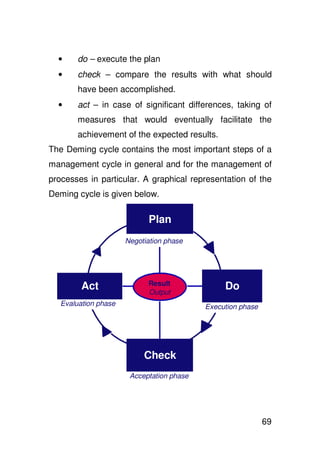
  The four related central concepts of the Deming cycle
  are:
  •      plan - making a plan that includes the results to be
         achieved

                                                          68
•     do – execute the plan
  •     check – compare the results with what should
        have been accomplished.
  •     act – in case of significant differences, taking of
        measures that would eventually facilitate the
        achievement of the expected results.
The Deming cycle contains the most important steps of a
management cycle in general and for the management of
processes in particular. A graphical representation of the
Deming cycle is given below.
                          Afspreken
                            Plan
                            Plan
                            Plannen
                            Plannen
                      Negotiation phase
                      Onderhandelingsfase


      Handelen                                   Doen
                           Resultaat
                            Result
         Act                                      Do
                                                  Do
         Act                Output
                            Output
                                                Uitvoeren
                                                Uitvoeren
   Evaluation phase
     Evaluatiefase                          Execution phase
                                             Uitvoeringsfase


                           Evalueren
                           Check
                             Control
                             Control
                       Acceptation phase
                         Acceptatiefase


                                                               69
DEMO (Design and Engineering Methodology for
Organisations)
  Method for business process modelling based on the
  language    action   perspective, developed      at    Delft
  University of Technology. In DEMO, a business process
  is a chain of transactions, and the result of a transaction
  can be described as a fact. DEMO used the Object
  Role Modelling technique for describing facts.


Departmental Process Expert (DPE)
  Person that monitors (within a particular department)
  the correct execution of business processes.          In this
  way the DPE supports the process owner. Nevertheless
  the process owner bears the responsibility for the BP
  correctness.

Design
  Representation of a desired system that consists of one
  or more models.

Design approach for processes
  See re-design approach for processes.


                                                            70
Design specification
  A description of the components of a system and of the
  way these components work together. Often design
  specifications expressed in terms of by means of
  models.

Design decision
  A decision during a design process, often based on
  some design criterion or principle.


Design essence
  Identifies the facts/conditions that must hold in any case
  for   the   process    which   is     re-designed.   These
  facts/conditions constitute the starting point of the
  process design, which will be further detailed.

Design pattern
  A general repeatable solution (based on experience) to
  a commonly-occurring (process) design problem.

Designing
  The development of a new system (organisation,
  process, application) based on design criteria and
  architectural principles.

                                                         71
Detail process schema
  See ‘process description’.


Diamond symbol
  Symbol used in flow diagrams to represent choices and
  parallel flows.

Distribution channel
  That part of the organisation that is positioned between
  the client and the actor that executes the actual work,
  i.e., the primary processes. Examples of distribution
  channel are CRM department, independent advisors, or
  the front office.


Documentation field
  In a documentation field one may find supplementary
  information/instructions regarding (associated with) a
  certain process element.


Domain
  1.   A focus-area or an aspect-area, e.g., primary
       processes domain, application domain.


                                                       72
2.   The set of possible value a parameter or attribute
      may take, e.g., the domain of the ‘age’ attribute is
      a number between 0 and 120


Dutch BPM forum
 Independent platform for the exchange of knowledge,
 experience, best practices and solutions in the area of
 BPM.


                                                       73
E-business
  Doing business electronically, for example by using the
  Internet or other electronic networks. The term e-
  business is used first by IBM and covers more than just
  e-commerce. E-business covers the whole value chain
  and aims at the automation of the procurement and
  sales and collaboration with partners. The term e-
  business to also designate information technology
  platforms used for e-business.

E-commerce
  The use of Internet as market and as a new distribution
  channel for products and services. E-commerce is
  mostly seen as part of the e-business strategy of an
  organisation.

Effectiveness
  Also defined as ‘Doing the right things’. The extent to
  which products and services (the output of a process)
  meet the requirements and expectations of clients. If
  this is indeed the case, then the process is regarded as
  being effective. At the organisation level, effectiveness

                                                        74
is seen as the ability of a company, business unit or
  task group the do the right things in order to achieve
  certain goals with available means and human
  resources. Thus, any effectiveness analysis focuses on
  the combination of people, means and market.
  Examples of effectiveness process indicators are
  ‘supplier reliability’, ‘delivery time’, etc.

Efficacy
  See ‘efficiency’.

Efficiency
  Also defined as ‘Doing the things right’. A broad
  interpretation of this is to define efficiency as making
  use optimally from the available resources (people and
  means). The core question in a global efficiency
  analysis is: ‘do we use the right combination of
  available resources in order to achieve the goals that
  have been set with costs as low as possible?’
  Examples      of    efficiency    process       indicators   are
  ‘completion time’, ‘operational costs’, etc.

EFQM
See European Foundation for Quality Management.


                                                               75
Enterprise     Alignment      (Enterprise    Alignment
Cycle)
  Refers to the ongoing process every company goes
  through to keep the elements of the organisation
  aligned with the organisation' strategy and goals.
                               s
  Vertical alignment is used to assure that process and
  activity measures and the measures used to evaluate
  managerial performance are all aligned with corporate
  goals. Horizontal alignment, or process improvement,
  focuses in assuring that all of the activities that take
  place in a process are aligned with the goals of the
  process. In most organisations, change is constant and
  thus, the organisation is always working to realign,
  vertically and horizontally, to keep everything in sync
  with the changing strategy and aims of the organisation.
  (www.bptrends.com/resources_glossary.cfm)


Enterprise Application Integration (EAI)
  Methods and means that can be used to modernise,
  consolidate, integrate and coordinate the software
  application in an organisation.


                                                       76
Enterprise architecture (EA) (business architecture)
  Enterprise Architecture (EA) is the complete, consistent
  and coherent set of methods, rules, models and tools
  which       will     guide    the   (re)design,   migration,
  implementation and governance of business processes,
  organisational structures, information systems and the
  technical infrastructure of an organisation according to
  a vision.

Enterprise Resource Planning (ERP)
  Refers to the internal planning of the business, logistics
  and human resources. All the software systems
  supporting         the   ERP-processes   are   called   ERP-
  systems.


Enterprise Service Bus
  Architectural pattern that provides a solution for the
  communication between service providers and service
  consumers and it is typically used as application
  integration solution in SOAs.


                                                            77
Environmental actors
 Actors, within or outside an organisation (‘in the
 environment’) playing a role in a business process (e.g.,
 clients, suppliers or intermediaries).


Ergonomics
 The extent to which the way offices are furnished is
 suitable for supporting the execution of processes.

ERP-systems
 Applications supporting the business processes in the
 back-office.

Essence model
 A model in which only the essential process activities
 are modelled together with (only) the essential
 precedence relationships between them.


European Foundation for Quality Management
(EFQM)
 A    non-profit    collaboration    between   European
 companies. Founded in 1988, it stimulates and
 promotes Total Quality Management as fundamental


                                                        78
method to strengthen the position of the European
  company on the global market.


Event
  1.    A perceivable phenomenon that takes place at a
        certain moment in time.
  2.    An occurrence of a particular condition (which may
        be   internal   or   external    to   the   workflow
        management system) which causes the workflow
        management software to take one or more
        actions. For example the arrival of a particular type
        of email message may cause the workflow system
        to start an instance of a specific process definition.
        (www.wfmc.org)

Execution costs
  See ‘operational costs’.

Extensible Markup Language (XML)
  Language for structuring data according to a schema
  (also described in XML). XML is an open standard of
  the World Wide Web Consortium. Other open
  standards, such as, BPEL and SOAP make use of XML
  as underlying language.

                                                           79
Extreme design
 Modelling style according to which the process design
 is fully subordinated to one or a few design criteria; the
 idea is to stimulate the creativity, when creating a
 design that optimizes a single criterium.


                                                        80
Fall back scenario
  Alternative   scenario       that   is   executed   if   the
  current/primary scenario fails to be implemented o rit
  turns out not be feasible.

Fault percentage
  The number of services/products delivered to clients,
  which do not meet the quality requirements.

Flexibility
  The extent to which a process can be easily and rapidly
  changed in order to meet changing client requirements
  or new products or services.

Flow diagram
  See ‘flowchart’.


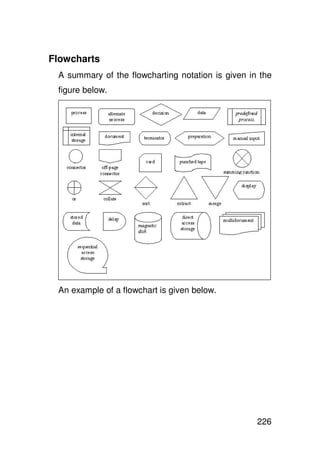
Flowchart (flow diagram, flow schema)
  A diagrammatic technique that uses a standardised
  notation to describe the course of certain process.


                                                           81
Follow-up of an audit
  Consists of:
    Taking       measures   by   managers/employees        as
    consequence of an audit.
    Discussing      these   measures    with   the   quality
    coordinator/auditor.
    Monitoring the implementation of the new way of
    working.
    Control the effectiveness of taken measures.

Format
  The manner in which the process is specified
  determines which aspects of the process are described
  and how (lay-out, communication).

Front Office (FO)
  Part of an organisation through which clients get in
  contact with the product and services delivered by that
  organisation.


FTE (Full Time Equivalent)
  Time equivalent of a full-time position (in general 40
  hours/week).


                                                           82
Function
  The desired contribution of an organisation to the
  environment, while abstracting from the manner in
  which this contribution is realised.

Function allocation
  Refers to the mapping between available persons and
  function profiles. Thus, a clear overview of the functions
  that occupied can be created.


Function description
  A description of the tasks that should be carried out by
  an employee or of the competencies a person
  occupying a certain position in the organisation must
  fulfil. By an exhaustive function description the structure
  of the organisation up to the employee level is worked
  out.

Function model
  A hierarchically ordered collection of functions that
  cover a certain part of an organisation. Also describes
  the contribution of (a part of) an organisation to the
  environment.


                                                          83
Function orientation
  Paradigm promoting the organisation of a company
  based on business functions. In this case the
  departments are organised around critical functions,
  such     as:   procurement,   human        resources,      CRM,
  manufacturing, etc. See also ‘process orientation’.

Function-process matrix
  Matrix    in   which     on   the     horizontal    axis     the
  functions/departments are represented and on the
  vertical axis the business processes/value chains are
  represented. Thus one has an overview on which
  functions are involved in which business processes.

Function profile
  Description     of   a   function   in    terms     of     tasks,
  responsibilities, competencies required for a certain
  function/position.         Function      profiles   are    often
  formulated based on the general structure of the
  organisation and based on the tasks, responsibilities,
  competencies derived from the functions that are
  necessary for the execution of business processes.


                                                                84
Functional design
  A design, structured and documented in a document
  such that it can serve as basis for a request for quotes,
  i.e., an offer (quote) can be made for the realisation of
  the product described in the functional design and the
  beneficiary of that product can decide if the product
  complies to the functional design.

Functional analysis
  Techniques for the validation of a model. By using
  functional analysis it is possible to identify which steps
  must occur in a process, in which order and if there are
  any exceptions.

Functional component
  A distinct component of a software application that has
  a well defined function for the organisation.


Functional process
  Process that falls entirely within a functional area or
  department. The functional/departmental borders are
  also the process borders, which is completely carried
  out internaly by that department/function.


                                                         85
Functional specification (FS)
  A description of the support that must be provided by
  an information system or software application to a
  particular business process.

Functionary
  Person to which a set of process tasks and
  responsibilities is assigned.


                                                    86
Generic process
 Process applicable in more situations or organisations,
 independently from the concrete product concerned in
 that process.

Generic process component
 A part of a process applicable in more situations or
 organisations, independently from the concrete product
 concerned in that process. Example hereof are the
 process components for scanning or registering of mail,
 or for a risk estimation.

Geography
 Refers to the geographic distribution of means (people,
 systems, buildings). Special attention is paid to the
 relation between the geographic distribution and the
 efficient execution of the various tasks in processes.

Global process schema
 Diagramming technique that describes schematically
 and globally (using symbols) the course of a process.


                                                          87
Often a global process schema is combined with a
 textual description of the contents of a process step.

Goal
 The result the execution of a specific process or activity
 is aiming at.

Governance level
 In general a distinction is made between three
 governance levels: strategic, tactical and operational.

Governance process
 Process that aims to facilitate the execution of policies
 trough planning, control, evaluation and steering.

Growth model
 A multi-level organisational development model. The
 idea is that each level indicates a certain maturity
 phase of the organisation. Furthermore, reaching a
 following level is only possible if the organisation fulfils
 to a large extent all the requirements corresponding to
 the current level.


                                                           88
Hazard Analysis Critical Control Points
                                                            !
(HACCP)
  A management and norm system for the monitoring the
  food safety.

Hierarchic process schema
  A diagramming technique that shows the hierarchical
  division of the existing processes in an organisation.

Hierarchy diagram
  Diagram    showing    the   hierarchical   lines   in    an
  organisation (i.e., indicates who must report, is
  responsible for the behaviour of or can delegate work to
  whom).


                                                           89
ICT architecture
  The    discipline     focusing   on   the   design   and
  implementation of applications and information systems
  in an organisation.

IDEF (Integrated Definition / ICAM Definition
languages)
  Family of modelling techniques (“definition languages”),
  originally developed by the US Department of Defence.
  The most widely recognised of these languages are
  IDEF0 for function modelling and IDEF1/IDEF1X for
  information modelling. IDEF was broadly adopted by
  various organisations because of its compactness and
  it has been widely used by CASE vendors in the late
  Eighties.

Impact-of-change (analysis)
  Type of analysis that identifies which parts of an
  organisation will be affected by a change and what are
  the effects of that change. Based on bottlenecks,
  priorities and constraints and using specific analysis
  techniques the consequences and scope of a certain

                                                       90
change can be estimated. Also see the re-design
 approach.
 A graphical representation of the different change levels
 is given below.


 Redesign of value chain


 Redesign of business


 Redesign of process


 Improvement of
 (sub) process


Small
improvements


Implementation
 The set up of an organisation and of its management. It
 assumes the creation of models describing and
 documenting on different detail levels (processes, sub-
 processes, procedures) the design and functioning of
 the organisation.      Such models must facilitate the

                                                       91
analysis of key performance indicators, such as,
  delivery time, quality and risk indicators, which in turn
  allow the identification of possible improvements. These
  possible improvements lead eventually to change and
  implementation management.

Implementation model
  Model    that     describes    how    processes     must   be
  operationalised. Refers to physical issues, such as,
  people      and    machines,      operations,     tasks    and
  procedures, and their allocation.


Indicators
  Process-specific measures that must be measured in
  order to quantify and calculate the performance, risk
  and quality of a process. They are an indication of the
  manner in which the process behaves. In practice an
  indicator   is    often   a   ratio   (with   nominator    and
  denominator). It shows a trend and it assumes
  continuous, progressing measurements. We distinguish
  three types of indicators: performance indicators (PIs),
  risk indicators (RIs) and quality indicators.
  Examples of indicators are: completion time, delivery
  reliability and fault rate.

                                                             92
Information alignment
  An indication of the extent to which the information
  provisioning     meets      the    information     need.   The
  information alignment has to be analysed from two
  perspectives (for both information provisioning and
  information need): the information content and the
  information streams.

Information architecture
  Architecture     that   describes    how    the    information
  provisioning can be designed and deployed in order to
  support business processes in relatively autonomous
  organisational     areas,    and     how    the    information
  provisioning in these areas relate to each-other and
  how   together      they    form     the   total   information
  provisioning.

Information need
  Information needed for the optimal execution of
  business processes. The information need can be
  derived from the process course (what information is
  needed for the execution of a certain process), the
  process structure (what information is needed for


                                                              93
coupling/coordinating processes to/with each other;
  management information is of relevance here) and from
  the organisation structure (what information is needed
  in order to let the organisation function as a whole).
  Furthermore, legal stipulations may also determine the
  need for information.

Information provisioning
  Indicates which information is available and how it is
  accessible and administered. Information technology
  plays an important role in information provisioning. For
  analysis purposes one can use check-lists and models,
  for example to give insight into the exchange of
  information with clients and suppliers. Therefore the
  accuracy, timeliness, completness etc. of the available
  information are very important.

Information stream
  The exchange of information within and between
  organisations, systems and processes.

Information support
  A   medium    or   object   on    which   information   is
  stored/preserved, such as forms, CDs, tapes, etc.


                                                          94
Information system
  A structured whole of people, means (e.g., application
  code) and activities, supporting business processes
  with the provisioning, processing and administration of
  needed information/data.


Information technology (IT)
  Generic name for department or function that analyses,
  creates, maintains and supports applications and
  databases used by an organisation.

Infrastructure
  A collection of more or less similar and collectively used
  (basic) facilities together with their services, standards,
  rules and guidelines for usage.

Infrastructure architecture
  Architecture of the technical infrastructure of an
  enterprise (basic systems for the collective use of
  everybody in the organisation). Typical examples
  hereof are operating systems, hardware, middleware,
  data communication (such as internet connection),
  networks.


                                                          95
INK
 Abbreviation that stands for the Instituut Nederlandse
 Kwaliteit (The Institute of Dutch Quality). It is a
 foundation that aims at enhancing the quality of
 business management, based on the INK management
 model. It has been founded in 1991 as result of an
 initiative of the Ministry of Economic Affairs.

INK-management model
 Coherent management model in which all the important
 characteristics of an organisation are addressed. It is
 an overview of the nine focal areas of organisations
 (sub-divided into organisational areas and results
 areas) that are critical for the business excellence and
 success of an organisation. A graphical representation
 of this model is given below.


                                                      96
structure

                   organisation                                 result

                   employees                        Appreciation
                                                    by employees


                       strategy                     Appreciation by
     leadership           &                           clients and
                                    processes                              end-
                       policies                        suppliers
                                                                          results


                       means                        Appreciation by
                                                      employees


                                  learning & improving

 The development phases in the INK-model are:

    Phase I            Phase II      Phase III           Phase IV         Phase V
                                                         afnemer
                                                          client          samenleving
                                                                            Society


                                                         Phase
                                                         Fase IIIIII       Phase IV
                                                                           Fase IV
                          R

                                           R
                                                         leverancier
                                                          supplier


     Activity          Process         System              Chain         Transformation
    oriented           oriented        oriented           oriented          oriented


Innovation approach for processes
 A step-wise plan and systematic approach for the
 discovery        of      innovation           opportunities             within     an
 organisation. It starts with the formulation of motivation
 from a business strategy perspective. The result is a


                                                                                    97
portfolio of worked out innovation ideas. The innovation
  approach is depicted below.
                      general business goals, motivation & strategy
                                       1      Analyse start situation
    understanding the goals and stakeholders, description of the context of
   the organisation, start with the gathering of information & knowledge
                                       2      Create awareness
   overview of innovation, awareness w.r.t. the role of innovation, motivation &
   commitment for innovation, recognition of the need for facilitating measure

                                       3      Determine focus
               motivation of the focus, description of the focus
                                       4      Generate ideas

                           set of documented ideas
                                       5       Evaluate

                Innovation goals: portfolio of innovative ideas


Input
  Necessary information for the execution of (a part of a)
  process.


Input measurements
  Measurements that indicate the quality of the input data
  fed into a process. These measurements can be used
  to evaluate if a process receives the right input in order
  to start and produce a good result.


                                                                            98
Implementation
  The set-up of an organisation and of its management. It
  assumes the creation of models describing and
  documenting on different detail levels (processes, sub-
  processes, procedures) the design and functioning of
  the organisation.     Such models must facilitate the
  analysis of key performance indicators, such as,
  delivery time, quality and risk indicators, which in turn
  allow the identification of possible improvements. These
  possible improvements lead eventually to change and
  implementation management.

Implementation model
  Model    that   describes    how    processes     must   be
  operationalised. Refers to physical issues, such as,
  people    and    machines,       operations,    tasks    and
  procedures, and their allocation.

Instituut Nederlandse Kwaliteit
  See ‘INK’.

Instructions
  Prescriptions, protocols, etc.


                                                           99
Integrated definition
  See ‘IDEF’.

Interaction
  A common activity, carried out by two or more parties,
  and in which each party is responsible for its part in the
  interaction: passing over information, coordinating with
  other participants in the interaction in order to achieve
  together the expected result.

Interaction model
  1. The IT interaction model is a holistic view of
  Management Information Systems in the context of the
  organisation. According to Mark S. Silver, the model
  addresses the interaction of an information system'
                                                    s
  features with five elements of the organisation:
  •    its external environment,
  •    its strategy,
  •    its structure and culture,
  •    its business processes, and
  •    its IT infrastructure.
  The model considers the consequences of this
  interaction   for    system     use,   for   organisational
  performance, for the organisation' personnel, and for
                                   s

                                                         100
the firm' future flexibility. Moreover, the model relates
          s
  various aspects of the interaction process to the phases
  of the development and implementation lifecycles.
  (Wikipedia)
  2. Model that gives insight in the functioning of an
  organisation area under change. It also gives an
  overview of the data collections relevant for that area
  and of their underlying relationships.

Interaction point
  A    component      of a     system (actor,     organisation,
  application, role) where interactions can take place,
  such as, the counter of an office or the interface of an
  application.
Interdependency
  Underlying relationship between two activities in a
  process that imposes a certain execution order.

Interface
  1. Component        of   a   system   (actor,   organisation,
      application, role) that provides access to the services
      offered by that system or through which that system
      can access services offered by other systems or
      applications.

                                                           101
2. Connection        point    between     independent         (sub-)
    processes, where the output if one process is passed
    as input to the other process.

Interface model
  Model used to describe the services/products offered to
  clients by an organisation. A physical interface model
  also     describes           the     realisation      of       these
  services/products while focusing on the physical
  properties such as location, communication medium,
  time, etc.


Internal client-supplier relation
  Relationship    between            two   departments         in    an
  organisation    in     which       one   department        (supplier)
  delivers a product or service to the other department
  (internal client), which is subsequently used as input in
  the client’s processes.

Internal control (IC)
  All the control procedures and tests that are carried out
  by the management team of an organisation in general
  on business processes and in particular on information
  systems and on administration. These cover both the

                                                                    102
internal control procedures built in administrative
  processes and the control procedures that are carried
  out by independent control functions/bodies.


International Organisation for Standardization
(ISO)
  Network of national standardisation institutes which
  develops international standards.

IPO-schema
  Technique for the description of processes in which a
  page is divided in three columns. In each column, by
  means of text or symbols a structured description of the
  input, process steps and output of a process is given.


ISO 9000
  An international standard for how organisations should
  document their processes. It encourages organisations
  to create a well-defined process architecture.


                                                         103
ISO 9000:2000
    The principles of quality management systems and the
    definitions of the corresponding fundamental terms.

ISO 9001:2000
    Requirements for quality management systems which
    must be used by organisations in order to demonstrate
    that they are capable of delivering products and
    services that comply with existing laws and meet the
    needs of the clients.
    A graphical representation of the ISO 9001:2000 model
    is given below:
                                                Continuous improvement of
                                                Quality management systems


                                         Direction
                                         Directie
 Client requirements


                                       responsibility
                                   verantwoordelijkheid
                                                                             Client satisfaction


                       Management                Measure,analyse
                                                  Meting, analyse
                       van middelen
                         of means                 and improve
                                                  en verbetering


                                        Realisation of
                                       Realiseren van
                                      products/services
                                       product/dienst
                           input                          output

                                   quality management
                                   kwaliteitsmanagement-
                                           system
                                           systeem


                                                                                    104
ISO 9004:2000
 Standard for the definition of a quality management
 system,        covering   also   the   continuous   quality
 improvement process (e.g., contains guidelines for
 performance improvement).

ISO 19011:2002
 Standard specification and guidelines for carrying out
 quality and milieu management system audits.


Item domain
 Description of the information that is used or produced
 during processes and the way this information is used
 by specific activities.

Item
 BiZZdesigner concept representing data used/produced
 by actors while executing some piece of behaviour.
 Items play an important role in information-intensive
 processes.
 Examples hereof are a form, a request, an offer or a
 client file.


                                                       105
Iteration
  A process/workflow activity cycle involving the repetitive
  execution of one (or more) process/workflow activity(s)
  until a condition is met. (www.wfmc.org)

ITIL
  The Information Technology Infrastructure Library (ITIL)
  is a set of concepts and techniques for managing
  information technology (IT) infrastructure, development,
  and operations.
  ITIL is published in a series of books, each of which
  cover an IT management topic. The names ITIL and IT
  Infrastructure Library are registered trademarks of the
  United Kingdom' Office of Government Commerce
                s
  (OGC). ITIL gives a detailed description of a number of
  important IT practices with comprehensive checklists,
  tasks and procedures that can be tailored to any IT
  organisation. (Source: Wikipedia)


                                                        106
"
Juridical dependency
  Dependency of processes on laws and regulations.
  Here we refer at stipulations concerning certification,
  privacy,       security,   and   labour   law.   The   juridical
  dependency decreases with the increase in process
  flexibility.

Just-in-Time (JIT)
  Refers to the procurement of materials in the right
  quantities, at the right moment and in the right place.
  Originated in the Japanese approach for manufacturing
  organisations, has as main goal serving clients
  optimally while maintaining the stocks at a minimum
  level. The idea is that JIT leads to short completion
  times and low stocks and increases the transparency of
  the manufacturing process.


                                                             107
#
    Kaizen
      Japanese term that literally means ‘improvement’ (also
      known as the Japanese version of TQM). The concept
      is used to designate the continuous effort to improve
      processes to which everything and everybody in the
      organisation is committed.

    Key Performance Indicator
      Essential performance indicator usually derived from
      critical success factors.

    Key Risk Indicator
      Measure indicating in an early stage if there is a chance
      that something will go wrong in a process. A KRI is
      always coupled to risk which may occur in that process.

    Key-user
      User having extensive experience with a certain tool
      and is the contact person for the daily problems with
      that tool. The key-user also offers support to process
      designers. This role is often played by a process
      architect or an experienced process designer.


                                                           108
Laws and regulations
  Laws and regulations (internal and external) to which
  (the execution of) a process must comply.


Legacy system
  An (outdated) information system, that often is also
  critical   and   supports   core   competencies   in   the
  organisation, and with which new applications must
  integrate/interoperate.


Level of instructions
  Concerns the workplace/ work floor; is prescriptive and
  consists of protocols, work instructions, etc.

Library of models
  A central storage facility for models and/or components,
  generally accessible for many users. Most libraries
  provide services such as version and configuration
  management,        check-in/check-out      and    locking
  mechanisms, etc.


                                                         109
Logical model
  Model that represents/describes the functional and
  logical structure of business processes. A logical model
  does not address aspects, such as, time, place, people
  or machines.

Logistics
  All the preparation processes and (management)
  operations     in    an   organisation     for   needed       for
  administering       and   procuring     supplies       that   are
  necessary for the production/delivery of products and
  services.

Logistics management
  The management of the workflows in the operational
  processes.     Decision making concerning supplies,
  completion     times,     etc.   are   typical   for    logistics
  management.


                                                                110
Main process
Process realising the main functions of an organisation,
such as, procurement, production and sales. Main
processes are sub-divided into sub-processes according
to their complexity

Manage (giving direction, leading, steer, govern)
  1. Defining the borders, rules and triggers that apply to
     a process.
  2. Important aspects of process management are,
     among others, the identification of responsibilities,
     the coordination of the development, monitoring of
     performance and quality, etc.
  3. Also concerns the identification of process norms
     and the activities that will ensure that those norms
     will be met. Management is a continuous activity
     which cover the following cyclic sub activities:
     - establish norms
     - measuring
     - compare process results with norms
     -steer.


                                                        111
Management
 The design, management and maintenance of an
 organisation and of business processes within that
 organisation in order to archive the planned goals as
 stated in its business strategy and mission.

Management by Objectives (MBO)
 Ideas introduced in 1954 by F. Drucker. The central
 idea is the identification of goals derived from the
 expected results. The arguments for this idea are that
 employees should not be continuously told what they
 have to do and how they have to do it. Instead they
 should be told what are the specific goals and the
 corresponding    means,     competencies       and   quality
 requirements. Subsequently, it would be the task of the
 employees to decide how they can achieve those goals
 as efficient and effective as possible.

Management Control System (MCS)
 A system which gathers and uses information to
 evaluate the performance of different organisational
 resources like human, physical, financial and also the
 organisation as a whole considering the organisational

                                                        112
strategies. Finally, MCS influences the behaviour of
  organisational resources to implement organisational
  strategies. MCS might be formal or informal. The term
  ‘management     control’   was    given    of   its   current
  connotations by Robert N. Anthony.
  Anthony defined management control as the process by
  which managers influence other members of the
  organisation to implement the organisation’s strategies.
  Management     control     systems   are    tools     to   aid
  management for steering an organisation toward its
  strategic objectives. (Source: Wikipedia)

Management processes (steering, control, tertiary
processes)
  1. Processes that create the facilitating conditions for
    the execution of primary and secondary processes.
  2. Processes consisting of activities of managers
    supporting and steering the primary and secondary
    processes.
  3. Processes for the steering of an organisation (policy
    cycle, planning and control).


                                                             113
Management reporting
 Providing insight (expressed in terms of indicators’
 values) in the performance of certain business
 units/departments.
 In management reports are often mentioned elements
 regarding the vision and strategy for longer or shorter
 term.

Mapping
 See ‘process-mapping’.

McKinsey model
 See ‘Seven-S-model’.

Measure
 Unit used to measure a performance indicator (PI) and
 to compare it with a norm.


(Taking) Measures
 Describing the way to be followed in order to achieve a
 desired situation.


                                                    114
Metamodel
 A formal model that defines the concepts of a
 (modelling) language and of the relationships that are
 allowed between instances of these concepts.

Migration approach for processes
 Approach for the implementation of the developed re-
 design (i.e., of the results of the re-design phase):
 planning the migration process, developing the (new)
 products and services, implementing/carrying out the
 change.
 A graphical representation of the migration approach is
 given below.
                              Choosen (re)design, commitment
   Impact of Change analyse


                                     1      Plan migration roadmap
                                Realise plan

                                     2      Develop products
                              Business rules, functional description, software

                                     3      Implement change
                              Running processes


                                                                       115
Mission
 The primary function of an organisation; the reason of
 its existence.

Model
 Simplified representation of certain aspects of a real
 process, concept or system. A model always serves
 one or more goals. A model will reproduce as accurate
 as     possible   only   those   aspects   of   the   real
 process/concept/system that are relevant for the
 defined goals.

Model Driven Architecture (MDA)
 MDA has emerged as a new approach for the design
 and realisation of software and has eventually evolved
 in a collection of standards that raise the level of
 abstraction at which software solutions are specified.
 Thus, MDA fosters a design process and tools that
 support the specification of software in languages such
 as UML rather than in programming languages like
 Java.
 The central idea is that design models at different levels
 of abstraction are derived from each other through
 model transformations. More specifically, different

                                                       116
platform-specific models (PSMs) can be derived (semi-)
 automatically from the same platform-independent
 model (PIM), making use of information contained by a
 platform model. More recently, MDA has extended its
 focus   to    more   business-oriented       concepts   and
 languages, reflecting the growing awareness that it is
 important to take into account business considerations
 in software development decisions. For this purpose,
 MDA     has   been   extended    with    a     computation-
 independent model (CIM) layer.

Modelling
 Determining the order in which models are created the
 actual creation of those models. The basic steps of
 process-oriented modelling are depicted below.


                                                         117
Basic steps for process-oriented modelling

           Identify and scope process
    P1     a) Select work stream
           b) Determine trigger and result

           Refine process
   P2      a) Extend process with secondary activties and exceptions
           b) Describe process in more detail

           Structure process
    P3     Divide process into sub-processes by logically grouping
           actions tghat belong with each other, e.g., because they
           belong to the same process phase
           Assign actors to process
    P4     a) Identify actors
           b) Assign actors to activities


Modelling conventions
 Generally accepted rules concerning modelling.


Modelling goal
 The purpose that a process model eventually must
 serve. Such a purpose may be, for example, carrying
 out a cost analysis, describing the course of a process
 or communicating a change in an existing process. It is
 important to clearly identify the modelling goal before
 starting modelling, since the modelling goal may be
 critical for the selection of a certain model type. If the


                                                                      118
wrong model type was selected, then there is a great
 risk that the questions the model was supposed to
 answer will remain unanswered or the resulted model
 will not be suitable for communication purposes.


Modelling template
 A selection of modelling techniques and symbols from a
 larger set.


Model type
 Model with prescribed contents or structure that is
 known to be suitable for certain analysis or design
 goals.

Mutual Collaboration Agreement (MCA)
 Informal contract between a supplier and a client that is
 established in case the supplier’s performance is not
 measurable. Such a contract specifies how the parties
 will work together in the given situation.


                                                      119
$
    Nolan’s stages-of-growth model
      The stages-of-growth model is a theoretical model for
      the growth of information technology (IT) in a business
      or similar organisation. It was developed by Richard L.
      Nolan during the 1970s.      The model proposes that
      evolution of IT in organisations begins slowly in Stage I,
      the "initiation" stage. This stage is marked by "hands
      off" user awareness and an emphasis on functional
      applications to reduce costs. Stage I is followed by
      further growth of IT in the "contagion" stage. In this
      stage there is a proliferation of applications as well as
      the potential for more problems to arise. During Stage
      III a need for "control" arises. Centralized controls are
      put in place and a shift occurs from management of
      computers to management of data resources. Next, in
      Stage IV, "integration" of diverse technological solutions
      evolves. Management of data allows development
      without increasing IT expenditures in Stage V. Finally,
      in Stage VI, "maturity", high control is exercised by
      using all the information from the previous stages.
      (Source: Wikipedia)


                                                            120
Norm system
 A quantitative definition of a set of related indicators.
 Examples of norm systems are ISO and Hazard
 Analysis and Critical Control Points (HACCP).


Norm
 A minimal or maximal value or a range in which the
 measured values of a certain performance indicator
 must have.
 If related to a certain time frame norms can be used to
 formulate (quantitatively) business goals.


Non-Value Adding Activity
 Process or activity that neither adds value to a final
 product or service, nor enables activities that add value.
 In most cases these activities are left over from older
 processes and somehow continue even though they
 are no longer necessary and they add noting to a
 specific process.
 (www.bptrends.com/resources_glossary.cfm)


                                                          121
%
Object
 1.   A coherent, self-contained (logical or physical)
      piece of information that is suitable for automated
      processing and/or has relevance from a business
      perspective.
 2.   An instance (or instantiation) of a class (in object-
      oriented programming).

Object Management Group (OMG)
 A non-profit organisation and international consortium
 of companies that work together to create standards for
 advanced software engineering technologies. The OMG
 developed and maintains standards, such as CORBA,
 the Unified Modeling Language (UML) for diagramming
 software and business systems, and the Model Driven
 Architecture (MDA) a systematic way of maintaining
 reusable software components and using them to
 generate code for specific applications. For more
 information see www.omg.org.


                                                       122
Object model
 1.    A collection of objects (or classes) through which a
       program can examine and manipulate some
       specific parts of its world. In other words, the
       object-oriented interface to some service or
       system. Such an interface is said to be the object
       model of the represented service or system.
 2.    A structured description of objects.

Object Role Modelling (ORM)
 A    powerful   method    for designing      and   querying
 conceptual data models, in which an application is
 described in terms that are also easy to understand for
 non-technical users.


Operation
 The smallest component of a process step executed at
 a certain moment by one person/system in one place
 (i.e., it is a unit of work in terms of time, place and
 operation and which is recognized as such by an
 employee). In case the activity is part of an automated
 process, the activity coincides with a system function.
 Very often their content is very specific and therefore
 they are regarded as work instructions.

                                                        123
An example of operation is ‘check social security
  number’.

Operational costs (execution costs)
  The costs of the execution of a process. The usage of
  resources    (people      and   means)    determines    the
  operational costs of a process. Resources have certain
  costs per time unit. Furthermore resources are
  assigned to activities which have a duration. The
  determination of the costs of a resource per time unit
  may depend on variable costs and fixed costs. The
  precise calculation of costs can be done using different
  methodologies, such as activity-based costing (ABC).

Operational goal
  Goal focused on and related to the execution or
  management of processes or of the organisation on the
  operational level.

Operationalisation
  The    execution     of   processes      and   of   process
  management (i.e., identification of external triggers that
  initiate business processes, execution of activities
  according to the process specification, and ensuring the


                                                         124
process performance according to the agreed service
  level agreements (SLA’s).


Operational process
  Process during which products and services are
  produced for and delivered to the external client.
  Examples of this are: development of new products and
  services,    manufacturing      processes,     logistics   and
  distribution.

Operational risk
  The risk of having loses as a consequence of failing
  internal processes, people or systems or as a
  consequence of external events.

Operational Risk Management (ORM)
  Managing        operational   risks   having   as   goal   the
  maintenance of an acceptable (controllable) risk level
  and    the      avoidance     (as     much     as   possible)
  unidentified/unpredictable risks.

Organisational chart
  Diagram representing the division of an organisation in
  units, departments and sub-departments. Traditional


                                                             125
way of showing the relationships between departmental
 and functional units or the reporting relationships
 between managers within an organisation.


Organisational foundations
 The focus areas that a manager must particularly
 consider when administering an organisation are::
   Strategy (Value & Development)
   Structure (processes & organisation)
   Culture (leadership & values)
   People (competence development)
   Means (ICT, money, facilities)
   Results (products & effects)
 A grafical representation of the foundations is given
 below:


                                                     126
Steerability

                                                                 Products Effects
                                                                 Producten Effecten


                                                Structurer
                                                                   Results
                                                                   Resultaten
                                                                       Wat
                                                                      What
                 Organisation Processes
                            Organisatie
 Manageability


                                                                                                  Leadership
                                          Structure


                                                                                                               waarden
                                                                                                                Basis
                                                                                                                Basis
                                                           Hoe


                                                                                                                         Livability
                                                                                        Culture
                                                                                                  Cultuur
                                                         How


                                                                                                         -
                                                                                                         -
                                                                  Strategy
                                                                  Strategie


                                                                                      How
                                                                                         Hoe

                                                                                                       values
                                                                   With what
                                                                   Waarmee
                                                                   Means
                                                                   Middelen
                                                                 People
                                                                 Mensen    Means
                                                                           Middelen


                                                                   Feasibility


Organisational management
 Determining                                      the            desired   performance            of            the
 organisation on all levels and for short, medium and
 long term, monitoring the progress in this respect and
 steering those parts of the organisation which do not
 perform according to the set performance goals.


                                                                                                               127
Organisational model
  Model that describes the hierarchical relationships
  between the parts (e.g., units, departments, etc.) of an
  organisation , their structure, composition and tasks.

Organisational part
  Clearly distinguishable organisational unit (e.g., unit,
  department, group etc.), which is responsible for the
  execution of a work process.

Organisational procedure
  Prescription such as a business rule, job/function
  description and administrative organisation
  documentation.


Organisational role
  See role.


Organisational structure
  The division of an organisation in departments and sub-
  departments and the authority lines (reporting and
  responsibilities). There are two perspectives from which
  the organisational structure can be regarded: the


                                                       128
process perspective and the function perspective. In the
  first case we relate the organisational structure with the
  process structure, while in the second case the
  combination of people/units and functions they have
  (i.e., the ‘function allocation’) is of relevance.

Organisation for the Advancement of Structured
Information Standards (OASIS)
  International     organisation      that    facilitates   the
  development and usage of e-business standards.

OR-join
  1.   A symbol that is used in behaviour modelling to
       express the fact that an activity following an OR-
       join may have several causes. For example,
       ‘accept claim’ or ‘reject claim’ may both be the
       reason to ‘inform client’.
  2.   A point within the workflow where two or more
       alternative workflow branches re-converge to a
       single common activity as the next step within the
       workflow. (www.wfmc.org)


                                                            129
OR-split (choice)
  1.   A symbol that is used in behaviour modelling to
       express the fact that at the place of an OR-spilt a
       choice must be made in the process between a
       number of alternative activities following that or-
       split.
  2.   A point within the workflow where a single thread
       of control makes a decision upon which branch to
       take when encountered with multiple alternative
       workflow branches. (www.wfmc.org)

Overhead Value Analysis (OVA)
  Methodology (developed by McKinsey) for the analysis
  of overhead costs and of the effectiveness of indirect
  activities. In this type of analysis the costs of indirect
  activities are weighted against the contribution these
  activities have to the primary processes and to
  business output of the organisation. The outcome of
  such an analysis usually consists of the identification of
  the sources of unnecessary spending and of cost cuts.

Output
  The result (i.e., end-product) of a (pert of a) process.


                                                         130
Output measurement
 Measurement of the end results of a process. These
 are mostly used to establish if the actual results of a
 process conform to the expectations. These are
 especially relevant in process sequences where the
 output of a process may also be the input for the next
 one.


Outsourcing
 Occurs when one company hires another company to
 manage, maintain and run some portion of its business.
 For example, many companies outsource standard
 software applications.


                                                    131
Pattern
  Model or component of a model representing a solution
  proved to be efficient to a commonly recurring problem.
  Patterns can be used both for design and analysis
  purposes.


Parallel Process
  A process in which two or more sequences of activities
  are going on simultaneously.

PDCA-circle
  See ‘Deming-circle’.


Performance measure
  See ‘performance indicator’.

Performance indicator (PI)
  1. A measure related to a certain critical success factor,
  based on which the performance of the process in
  which the measure has been measured can be


                                                        132
evaluated. In order to define measures quantitatively,
 norms are used.
 A PI can fall in one of the following categories:
 efficiency   indicators    (costs/    number     of     FTEs/
 completion time), effectiveness indicators (quality/
 internal client satisfaction). Also see ‘indicators’.
 2. A measurement system that consists of a measure
 expressing/representing a certain process performance
 aspect and a measurement method, which is a
 procedure describing the necessary steps to be
 followed in order to collect the data that eventually
 indicates the level the above-mentioned measure takes.

Performance management model
 Model in which critical success factors identified and
 defined.

Performance monitoring process
 See ‘process monitoring’.

Performance norm
 Norm concerning a performance indicator.


                                                          133
Petri net
  Mathematical modelling language for the description of
  discrete distributed systems. Many extensions have
  been proposed to Petri nets. The term high-level Petri
  net is used for many Petri net formalisms that extend
  the basic formalism, including coloured Petri nets and
  hierarchical Petri nets. There are several examples of
  the use of (in particular high-level) Petri nets for
  modelling business processes or workflows, or for
  formalising other process modelling languages.


Pilot
  The execution, often using a smaller scale and
  temporary model of a system, of an experiment, test or
  simulation   with   the      goal   of   validating   certain
  assumptions about the functioning of that system.

Plateau
  Intermediary phase in the realisation of a large scale
  change process (e.g., the realisation of a new
  enterprise architecture, the replacement of a critical
  information system, etc.).


                                                           134
Porter’s value chain model
  A technique for the identification and classification of
  business processes, in which processes that have
  added value as primary processes are emphasized.
  Porter’s model constitutes a solid basis for the
  optimisation of the critical processes and the analysis of
  the contribution of the secondary processes to the
  primary processes.      A graphical representation of
  Porter’s model is given below.


  The product and service portfolio helps organisations
  have an overview of their offering and market and
  facilitate the design and management of business


                                                        135
processes such the realisation of the portfolio is
  achieved. It is therefore an important starting point for
  the process architecture.

Portfolio management
  The management of all existing and planned projects
  aiming to achieve the business goals with the available
  capacity.

Positioning
  The way an organisation is positioned in its market. It is
  determined by the organisation’s product and service
  offering, by the client group and by the relation with the
  client.

Precedence
  Sequencing/order (of activities) imposed by a certain
  priority.

Precedence-analysis
  A technique for the detection of critical dependencies
  between (inter)actions.


                                                        136
Prescription
  A   rule     that    indicates   how       and   under      which
  circumstances a strategy, method, techniques or
  means can or must be used.

Primary activity
  Value-adding activity.
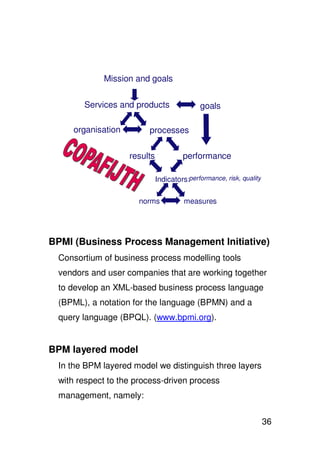
Primary process
  Process resulting in a product or service for an external
  client. This type of processes contributes directly to the
  goal and mission of the organisation. Examples of such
  processes in an insurance company are: processing of
  a damage claim or closing a new insurance policy.


Problem owner
  Person responsible for finding a solution for a
  bottleneck.

Procedure
  Structured     set    of   instructions,    prescriptions    and
  protocols at the level of a work place. Procedures
  determine and give structure to a process. They specify
  which operations must be executed, in which order and

                                                               137
who is responsible for their execution. A good
 procedure describes a routine for achieving certain
 business goals in the most efficient way.

Process
   "A specific ordering of work activities across time and
   place, with a beginning, and end, and clearly
   identified inputs and outputs: a structure for action."
   (Thomas H. Davenport)
   “A business process is a set of logically related tasks
   performed to achieve a well-defined business
   outcome” (Thomas H. Davenport)
   The sequence of activities that take place between
   the request for a service/product (trigger) and the
   delivery of that service/product.
 Example of processes the processing of a damage
 claim, carrying out an operation on a patient, or issuing
 and sending a bill.

Process acceptance test
 The execution beforehand and based on process
 specification of validation checks (also see “process
 validation).


                                                      138
Process analyst (business analyst)
  Person responsible for the modelling, analysis and
  description of processes.

Process architect
  Person that develops process architecture and is an
  expert in the area of process methods and tools. A
  process architect is able to manage and carry out the
  whole process from analysis to process execution and
  can distinguish and handle various methodological
  problems and aspects.

Process architecture
  1. Schemas and drawing that represent the vision
    regarding   the    relationships,        dependencies     and
    structure of the main business processes in an
    organisation.
  2. Describes the (sub)processes that contribute to the
    realisation of a product or service and their
    underlying relationships. Secondary and tertiary
    processes may also be described in such a process
    architecture.     Furthermore,      it    may   contain     a
    classification a classification/specification of the
    triggers of the above mentioned processes. The

                                                              139
process architecture constitutes the basis for the
   information and application architecture.
 3. “A process architecture is a written or diagrammatic
   summary     of   the   value   chains   and   business
   processes supported by a given organisation. A good
   process architecture shows how value chains and
   business processes are related to each other and to
   the strategic goals of the organisation. […] It' a high-
                                                  s
   level architecture of all of the processes in the
   organisation.”
   (www.bptrends.com/resources_glossary.cfm)

Process architecture model
 Reference model that defines and instantiates the core
 concepts such as value chain, process, procedure,
 work, operation and application service, such that they
 can be referred to. Furthermore, it makes the role of
 the supporting technology explicit. It is therefore a way
 to align business processes with IT support.
 A graphical representation of the process architecture
 model is given below.


                                                       140
Value chain


                                    Processes


                                    Procedures


                                      Work


                                    Operations


                                Application services


Process audit (process test)
  Independent analysis concerning the functioning of a
  process. The goal is to establish whether the process
  complies   with   the   process   documentation      and
  description and whether the process meets certain
  quality requirements (especially with respect to process
  management).


                                                       141
Process auditee
 Employee interviewed during a process audit.

Process auditor
 Person responsible for carrying out an audit and is
 neutral with respect to the audited process. The auditor
 examines first the process description and other
 relevant documents. Subsequently, he interviews the
 involved people, while checking if the actual process
 complies with the process description.

Process borders
 Set of constraints, under which the process must be
 executed. These are usually documented in documents
 such    as   SLA’s,    indicators,   procedures,    work
 instructions, competencies, process descriptions and
 codes of conduct.

Process costs
 The consequence of the consumption of the necessary
 resources (e.g., people, materials, systems, etc.) during
 process execution. Processes and process activities
 have no costs themselves. Their execution however


                                                      142
assumes the use or consumption of certain resources
 which generates costs. Therefore in process models
 costs are mostly assigned to resources as resource
 costs (or tariff), the cost per time unit for using the
 resource. However costs that are not modelled
 separately are assigned to activities and are called
 operational costs. The calculation of the operational
 costs is often done outside the process.


Process cycle
 Within organisations the continuous renewal and
 change of processes is carried out on a cyclic manner.
 In general, during a process cycle one may distinguish
 between   three   phases:   identify   and   understand,
 manage and improve.
 A graphical representation of a process cycle is given
 below.


                                                     143
Strategy
                                        Description
                       definition

                                    identify &
                                    understand        Analysis
          Measure
                                    manage
                                improve
                Manage                            ((Re)design

                               Implement


Process description (detail process schema, workflow
description).
  1. A documented expression of a set of activities
     performed to achieve a given purpose. (CMMI V1.2)
  2. An operational definition of the major components of
     a process. The description specifies, in a complete,
     precise, and verifiable manner, the requirements,
     design, behaviour, or other characteristics of a
     process.     It   also   may       include    procedures    for
     determining whether these provisions have been
     satisfied. Process descriptions can be found at the
     activity, project, or organisational level. (CMMI V1.2)
  There are two methods that can be used to produce a
  process description:


                                                                 144
•    Graphical, by using a formal modelling notation
      and diagramming techniques (flowcharts, Petri
      nets,   activity   diagrams,   BiZZdesigner,   IDEF,
      BPMN)
 •    Narrative description.


Process designer
 Person that specifies business processes. The process
 designer models and describes the business processes
 up to the level of work instructions. Nevertheless, the
 process designer is not responsible for the content of
 the modelled processes. This responsibility belongs to
 the process manager.

Process documentation
 Documentation that belongs to a certain process and
 supplements the process specification/model with
 information by coupling this specification (through
 documentation fields) to documents, html pages,
 presentations, web sites, etc.


                                                      145
Process-driven management
 A management method that aims at continuous process
 improvement based on the monitoring of processes.
 Especially core processes are rigorously screened.

Process engine
 A software application that coordinates and monitors
 the (distributed) execution of automated process flows.


Process essence
 Representation of the essential activities, actors, items
 and their relations. This type of model (and modelling
 style) is mostly used during process redesign.

Process evaluation
 Assessment of the performance of a process. It
 assumes the application of an performance analysis
 method and the comparison of the result with previously
 defined norms. Also see ‘process monitoring’.


                                                      146
Process execution
  The   time   period   during   which   the   process    is
  operational, with process instances being created and
  managed. (www.wfmc.org)


Process fit
  The extent to which the different process elements are
  integrated/fit together in a whole. Organisations with a
  good ‘process fit’ have achieved that through a good
  integration of processes around a specific strategic
  focus. It' easy for competitors to copy standard
           s
  processes, but it' very hard for competitors to duplicate
                   s
  business process with a high degree of fit. Process fit is
  a concept associated with Michael Porter.

Process flow
  The way in which the elements of a business process
  are uniquely integrated. It can be internal (describing
  the structure of a process) and external (describing the
  relationships between processes).


                                                         147
Process flower
 The process flower is an example of a model that
 distinguishes     between   several   different   business
 process focus areas (i.e., the petals):
   AO & IC
   Quality management
   Process management
   Risk management:
   Application design.

 A graphical representation of the process flower model
 is given below.


                                                       148
Application
                           Applicatie
                            ontwerp
                            design
                             • functionele
                               functional                Process
                                                         Proces-
                             requirements             management
                                                        besturing
                         • functioneel ontwerp
                           functional design             •SLA’s
                           technischdesign
                           technical ontwerp       •Worklod distribution
                                                   •werklastverdeling
                                                   •logistic design
                                                   •logistiek ontwerp
   Kwaliteitszorg
 Quality management                                   •indicators
                                                      •indicatoren
    • kwaliteitsbeheersing
      Quality control              Processes
                                   Processen
 • instruments: INK, ISO, BSC
   instrumenten:
                                                     Risk
                                                     Risico-
       • Deming circle
                                                   management
                             AO & IC               • risicobeheersing
                                                     Risk control
                                                  • beheersmaatregelen
                                                    Control measures
                           • vastlegging assign
                             Identify and
                   (hulpmiddelen & technieken)
                     means & techniques               • risicomatrix
                                                        Risk matrix

                             • analyse
                               analysis
                             • design
                               ontwerp


Process goal
 Results an organisation want to achieve through a
 process. Besides it explains why the process should
 take place.


                                                                        149
Process hierarchy
  The hierarchical structure of the existing processes
  within an organisation.


Process improvement
  1. Periodical examination and, if necessary, change of
    all processes and way of working in an organisation.
  2. Continuous improvement of evaluated business
    processes.
  The Deming-circle is often used as method to support
  process improvement.


Process indicator (process performance indicator)
  See ‘indicators’.

Process information
  Information necessary for the assessment of process
  performance indicators.


Process instance
  1. A process diagram describes a generic sequence of
  events. An instance describes an actual process which
  includes data, real actions, and specific decisions.

                                                     150
Workflow systems and simulation systems both keep
  track of the data from the execution of specific process
  instances in order to determine things like how long the
  process actually takes, who handled a specific instance
  or how much it cost. In the case of simulation systems,
  someone has to supply information about a set of
  actual instances.
  (www.bptrends.com/resources_glossary.cfm)
  2. The representation of a single enactment of a
  process. Each instance represents a separate thread of
  execution of the process, which may be controlled
  independently and will have its own internal state and
  externally visible identity, which may be used as a
  handle, for example, to record or retrieve audit data
  relating to the individual enactment. (www.wfmc.org)


Process-IT matrix
  A matrix created by listing processes on the horizontal
  axis and IT applications or other (IT) architectural
  elements on the vertical axis. This matrix shows what IT
  applications, databases and other resources are
  required to support each process. […] This is an
  excellent tool for prioritizing IT projects.


                                                      151
(www.bptrends.com/resources_glossary.cfm)


Process lane (pool, lane, swimlane)
  A division of a process in horizontal lanes meant to
  show which activities in the process are carried out by a
  particular actor involved in the process. Each lane
  represent a different actor.

Process logic
  The coherent succession of activities in a process.


Process management
  See ‘Business Process Management (BPM)’.

Process management control
  1. The design and implementation of a process such
    that it is predictable to the extent that it inevitably
    produce the expected result.
  2. Knowing, monitoring and timely controlling/steering
    the parameters that influence the outcome of a
    process.
  A graphical representation of process management
  control cycle is given below.


                                                        152
Process
                           Proces
                           design
                           ontwerp


   Inrichten
   Process               Besturen
                         Process                  Meten
                                                 Process
implementation
    proces              management
                          proces                monitoring
                                                 proces


                           Uitvoeren
                            Process
                           execution
                             proces


Process management scan (BPM-scan)
  Gives an indication of the extent to which business
  processes are the organising principle within an
  organisation.    Using      questionnaires    and    other
  measuring instruments, the current maturity level (the
  so-called ‘ist’-situation) of the organisation with respect
  to its process orientation can be assessed. Based on
  this maturity assessment the management can make
  plans for the development towards the next maturity
  level. An example of a BPM-scan is the BiZZscan®.


                                                         153
Process manager
•     Person responsible for the management of process
      models and agrees with architects and designers
      upon the procedures for their modification and
      maintenance and keeps a possible process library
      up-to-date.
•     Person responsible for development and steering of
      work processes and makes sure that the service
      level agreements (SLAs) are realised.

Process mapping
    Translating intangible process knowledge into tangible,
    formal and concrete descriptions of processes using
    some flow diagramming notation.

Process measurement
    The activity of measuring particular indicators for a
    process   (such   as,   completion    time,   costs,   risk
    indicators, etc.) during the process execution.

Process mining
    Techniques for the analysis of business processes
    based on event logs, often used when no formal
    description of the process can be obtained by other


                                                           154
means,        or   when   the    quality   of   an   existing
 documentation is questionable. For example, the audit
 trails   of    a   workflow     management      system,   the
 transaction logs of an enterprise resource planning
 system, and the electronic patient records in a hospital
 can be used to discover models describing processes,
 organizations, and products.
 .
Process model
 Schematic description using a specific modelling
 notation of a real business process that specifies the
 resources used for the process execution, the steps
 that have to be followed in order to carry out the
 process and the information used and produced during
 the process execution.

Process modelling tool
 See ‘Business process modelling tool’.


Process monitor
 Person monitoring a process. However, the process
 monitor does not have responsibilities/competencies
 concerning the course of the monitored process.


                                                           155
He/she is only carrying out measurements, collecting
  feed-back and reporting this information to superior or a
  quality manager.

Process monitoring
  The   collection   of     measurements       concerning        the
  evolution of the execution of business processes. This
  data can be processed and fed as input for various
  analysis techniques. A synthesis of analysis results
  may    serve    as       decision     support   for     process
  improvements by the managers and responsible
  workers.


Process orientation
  Paradigm promoting the organisation of a company
  based on business process, in which the delivery of
  internal and external products and services form the
  structuring principle.
  Also see ‘function orientation’.

Process oriented modelling
  Modelling style according to which the starting point for
  process    modelling      are   the    activities     within    an
  organisation, which are specified, while abstracting

                                                                 156
from involved information, actors and other resources.
  After this, the involved persons, departments and
  systems are modelled as well in actor diagrams.

Process owner
  Person responsible for (the results of, the output of) a
  process. The process owner is competent to intervene,
  if necessary, in the process to steer its course.

Process performance-indicator
  See ‘process indicator’.

Process performance
  Consists of costs, time, quality and risks.

Process report
  User friendly description of a process and of the
  corresponding documentation.

Process responsibility
  The state of being responsible, accountable, or
  answerable for a process. It is coupled to process
  ownership and it covers the process development,
  process implementation and process management.


                                                      157
Process reviewer
  Person having a coordinating and controlling role.
  Takes care of technical aspects of process modelling
  and consults the process manager with respect to the
  process content.

Process quality
  The extent to which a process complies to previously
  defined norms.

Process simulation
  Running a model of a new/future/existing process in
  order to examine the correctness of the execution, the
  performance of that process and to discover possible
  bottlenecks in the process.      Process simulations are
  always based on process models (mock-ups of the
  future process).


Process steering
  Determining    and   adjusting    the   goals   and   the
  implementation of processes. Process steering is only
  possible the adjustments that to be made are aligned
  and fit the processes to be steered.


                                                        158
Process step
   A part of process can be executed without interruption
   by a person or machine, e.g. ‘check client information’.

Process structure
   The        process    structure          describes       coherently   the
   relationships and dependencies between primary,
   secondary and tertiary processes.
   A graphical representation of the process structure in
   given below:
                              management

                          Plannen
                           Plan             Rapport
                                             Report
                          kaders              tage


  Result
  Resultaat               Sub-          Sub-            Sub-        Resultaat
                                                                     Result
   input
    input                proces
                        process      process
                                       proces          proces
                                                      process        output
                                                                      output


supplier                                                            client


                          People
                          Mensen        Middelen
                                         Means

                                  support


                                                                         159
Process task
  Coherent collection of activities from a business
  process, which can be assigned to an actor (human or
  machine) in order to realise one or more business
  functions.

Process test
  See ‘process audit’.


Process validation
  Making sure (and documenting this) that a certain
  process results into a product or service that complies
  to predefined specifications and quality norms.


Process thinking
  1.   A person’s ability to put his/her activities in relation
       with processes.
  2.   “A subset of systems thinking. Conceptualizing
       groups of activities as processes and seeking to
       understand how all of the processes in the
       organisation work together to take inputs and
       produce     products,     services     and     profits.”
       (www.bptrends.com/resources_glossary.cfm)


                                                          160
Process-wise
  Way of organising the activities with an organisation,
  which take place in a certain order determined by
  underlying dependencies and which are grouped
  logically into processes around delivered products and
  services. Characteristic for this way of working is the
  fact the whole organisation must be able to think in
  terms of processes and be committed to them:
  following, managing and improving them continuously.
  Also see ‘process orientation’.

Product
  The physical end result of a (business) process in
  which is delivered to a client.


Production cell
  See ‘independent task group’.


Productivity model
  A model that shows how the productivity of an
  organisation    depends      on   its   efficiency   and
  effectiveness. The principle behind this model is doing


                                                       161
the right things right. The core question addressed is
  how to design processes such that the output (for the
  client) is maximised, while the costs (consumed
  resources) are minimised.


Product/market combinations (PMC’s)
  Describes which of the currently offered products are
  aimed at/offered to which current client-groups.


Products and services portfolio
  Describes (a part of) the products and services an
  organisation offers to its environment. It also specifies
  •    the   channels      through   which   products    are
       offered/delivered
  •    the target groups for which products are meant
  •    the (evolution of the) expected number of
       products/service that the market can absorb.
Project portfolio
  Collection of projects and/or programs (possibly sharing
  the same resources) that together will realise one or
  more (strategic) organisational goals.


                                                         162
Program
  A collection of interdependent projects that is set up in
  order to achieve some specified goal of strategic
  importance.


Project
  A collection of interdependent activities that together
  must    lead   (under   specified     conditions)   to   the
  achievement of well defined result.


                                                           163
&
Quality
  The extent to which delivered products/services meet
  the requirements and expectations of customers.

Quality assurance
  1. The continuous change and improvement of an
    organisation based on a well formulated policy,
    containing concrete and feasible goals, that are
    translated to all levels, all stages and all processes.
    The term '
             integral quality assurance'indicates that
    quality assurance occurs in all areas/parts of the
    organisation.
  2. A whole of techniques, and management systems
    that focus on the continuous improvement of the
    effectiveness,     efficiency    and     adaptability    of
    organisational processes, while enhancing the client
    satisfaction, productivity and flexibility.
  3. The    organisational      structure,    responsibilities,
    procedures, processes and facilities for implementing
    the quality policies.


                                                            164
Quality guaranty
  The development, deployment, testing and evaluation
  of a quality management system.

Quality management
  Taking measures to ensure that the expectations and
  needs of customers are met. Quality management has
  as main goal to ensure that organisations are able to
  realise their strategic goals.


Quality management system
  A quality management system consists at least of:
    A number of process descriptions, including the
    corresponding work instructions.
    Periodical internal audits during which the following
    aspects are assessed:
    - whether work is carried out according to process
    descriptions; and
    - whether processes still meet their goals (whether
    they are still actual).
    A commitment for monitoring and steering the
    realisation of process improvements.


                                                       165
Quantitative analysis (of processes)
  Analysis of measurable and quantifiable aspects of
  business processes.
  Examples of such aspects are costs, time, risk
  probabilities, client satisfaction. Also see indicator and
  norm.

Queue
  The number of transactions or requests waiting to be
  processed by a system. For example, the number of
  items of a certain type (e.g., damage claims) that have
  to be processed by an organisation or department (e.g.,
  insurance company).

Quick wins
  Improvements that, although, can be quickly and easily
  implemented lead to visible benefits.


                                                        166
'
RACI-method (RACI tables)
 RACI tables (Responsible, Accountable, Consulted,
 Informed) is a method used to identify the roles and
 authority of players in a process/project. It can also help
 determine       the   process/project'
                                      s       sphere      of
 influence/control across all lines of business:
 Responsible: Refers to the person(s) responsible for
 the deliverables produced that is, the "executor(s)."
 Accountable: Characterizes the person with the ultimate
 decision-making authority that is, the "overseer."
 Consulted: Refers to the person(s) who must be
 consulted before action is taken - that is, the
 "advisor(s)." This is a two-way communication that
 occurs before an activity is completed.
 Informed: Characterizes those who should be informed
 that a decision is being made or an action is being
 taken, even though they have no control over the
 decision or action. This is a one-way communication
 that may occur after an activity has been completed.
 Typically, this is how senior management-level players
 are involved.


                                                         167
RADAR (Results, Approach, Deployment, Assessment
and Review)
  Approach/methodology through which an organisation
  can systematically determines its goals (results), the
  approach to achieve those goals (approach), and follow
  that approach (deploy). Subsequently, results are
  monitored (assess) and the approach is systematically
  improved (review).

Reasoning tree
  Describes how an analysed goal relates to the other
  goals and aspects of a business process. It is a
  graphical representation of a line of reasoning.


                                                     168
Re-design
 A design created as replacement of a current in-place
 (organisation, process, application) situation (design)
 and which usually preserves elements from the existing
 design, while modernising/improving the rest of it.
 Preferably, a re-design starts from some design
 criteria/goals and is based on some architecture
 principles.

Re-design approach for processes
 Common goals for the re-design approach are:
 •    Resolving bottlenecks
 •    Implementing new products and services
 •    Preparation for new developments
 •    Aligning processes with mission and trends
 The re-design approach starts with a scoping of the
 change. The essential business processes involved in
 the change are identified. Then, based on several
 design alternatives the new process is re-designed.
 The re-design approach is depicted below:


                                                       169
Bottlenecks, CSF, boundary conditions, norms

                                    1     Determine scope
   Impact of Change analysis


                               Target, scope, approach

                                    2     Determine essentials
                               Design-essentials

                                    3     Design
                               Alternative processes

                                    4     Compare and choose
                               Chosen redesign, commitment


Redirection
  Contacts with the client during which the client is
  referred to another worker (during a first contact, a
  client receives the phone number of another employee
  he/she must call). In general are considered to be
  useless because such contacts do not add value to the
  process, from the client point of view.


Reference-architecture
  An architecture consisting of a set of components that
  together conform and, therefore, implement a certain
  reference model.


                                                                              170
Reference model
     Model describing a high-level solution for a class of
     problems. For example, a reference model is a
     standardised description of a type of organisations
     regarding a certain aspect. A reference model can
     have both a prescriptive and descriptive character.
     A generally accepted abstract representation of a
     type of system, which allows users to build a
     common understanding of that type of systems.

Reporting model
 A prescriptive manner of reporting which determines
 both the content and the form of a report.

Requirement
 A    collection    of   demands       to     which     a     new
 system/process/product      must      comply         after   the
 implementation.

Resource-oriented modelling
 Modelling style according to which the starting point for
 modelling    are    functions   and        resources    in   the
 organisation and their dependencies. Thus, first actors


                                                              171
are modelled, and only after the items and the
 behaviour.


Resource
 ‘Physical’ actor, (e.g., existing or planned person or
 (information) system) being characterised by physical
 limitation with respect to capacity and location.
 Resources play an important role in any organisation by
 being eventually responsible for the execution of all
 processes in that organisation.

Response time
 The time between issuing a request and receiving the
 result; the response time is the sum of the processing
 time and waiting times         (synchronisation losses).
 Examples are the time between the moment that a
 customer arrives at a counter and the moment of
 completion of the service, or the time between sending
 a letter and receiving an answer.
 Also in the supporting IT-applications the response time
 plays an important role; a well-known example is the
 (mean) time between a database query and the
 presentation of its results.


                                                     172
Responsibility
  Obligation to make sure that something works, or is
  carried out properly and to be accountable for it.

Risk
  A present or future threat that has (potential) negative
  influences for the organisation. Factors that have an
  influence on the severity of the risk are the process
  complexity, the number of transactions, the quality of
  the employees assigned for to execute the process and
  the quality of the technical means supporting the
  process.

Risk analysis
  Technique that aims to identify and evaluate the risks in
  a process (change). The most important result of such
  an analysis is an inventarisation of the most important
  risks in a process improvement/change project.

Risk estimation
  Measurement that indicates the probability for a risk to
  occur. The estimated value expresses how high the
  probability for a particular risk area and a particular
  process element.


                                                       173
Risk management
 The identification, analysis and evaluation at different
 levels in an organisation of risks (financial, material,
 personnel, etc.) and the implementation of measures
 that are meant to increase the operational effectiveness
 and diminish the probability of damage and losses
 caused by the identified risks. Eventually, the goal of
 risk management is to keep possible risks under
 control.

Risk management process
 Process that makes risks recognisable and sets
 priorities in the selection of risks that will be diminished
 by the application of suitable measures. A continuous
 flow of information supporting this decision making
 process    is   generated    in   order   to   prevent/limit
 unnecessary process and project interruptions and
 losses.
 A graphical representation of a risk management
 process is given below:


                                                        174
Define scope
                              Afbakenen


           Implement                          Identificeren
                                                 Identify
            Beheersen
           measures                            risico’s en
                                               risks and
                                                  niveau
                                                   level


                Kiezen te            Vaststellen
               Select                 Establish
                 nemen                mogelijke
               measures               possible
               maatregelen            beheers-
                                      measures
                                     maatregelen


Risk manager
•     Person responsible for the inventarisation of possible
      risks and for taking measures that minimise them.
      Plays    an   important      role     when   the   process
      improvement concerns the minimization of risks.
•     Risk management software tool commercialised by
      BiZZdesign.

Risk matrix
    Matrix (5x5) in which the two dimensions are the impact
    of a risk factor and the probability for that risk to occur.


                                                              175
The matrix is a simple instrument to make risks explicit
              and manageable. Thus appropriate measures can be
              taken for high impact/probability risks. A graphical
              representation of a risk matrix is given below:
                   nil         minor               average        high          disastrous


                                                                                     0       almost sure

                                                                          net
                                                                        dig
                                                                      rire en                probable
                                                                   cu rgel
                                                                   hu u es
                                                                       te
                                                                     asr
                                                                  me
                                                                   a
PROBABILITY


                               2a
                                            measures
                                            te nemen
                                                           1                                 possible
                                        to be taken
                                        maatregelen
                                                     ens
                                                   sure
                                                 aem
                                             men gelen
                                             te e
                                                atr                                          improbable
                                           mran
                               2b           u
                                         asm n
                                              es
                                              e
                                        ne len
                                     me teg e
                                     te a k
                                        atr
                                         e
                                     ob
                                    tma

                         2c                                                                  rarely

                     IMPACT


Risk measure
              Measure that aims to prevent an identified risk.

Role
              1.         A    responsibility               that    can          be   assigned           to
                         individuals.             Roles are packages of tasks that
                         someone must fulfil. Activities are allocated to
                         persons based on the roles these persons can
                         play. Roles are used to describe an organisation
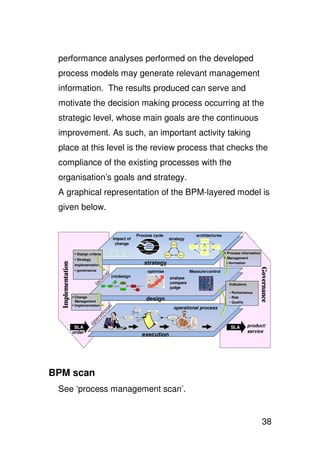
                         generically from the process perspective. Typical
                         examples of roles are process manager, team

                                                                                                      176
leader, evaluator, process reviewer, risk manager,
       process       owner,   process     designer,   process
       architect, etc. One person may fulfil/play several
       different roles. Compared with actors, roles have
       as supplementary properties a description of the
       responsibilities for that role and an indication of
       the role (person) the role must report to.
  2.   A group of participants exhibiting a specific set of
       attributes,       qualifications     and/or      skills.
       (www.wfmc.org)


Rule cycle
  Lies at the foundation of any process. The purpose of
  such a methodology is to continuously monitor whether
  the result of a process actually coincides with the
  expected result. The most popular rule cycle is the
  Deming-circle (PDCA-circle).


                                                          177
(
    Sarbanes-Oxley Act (SOX)
      A law in the US which was introduced as a reaction to
      several book-keeping scandals. The law requires that
      all CEOs and CFOs of listed companies, having
      revenues higher than 75 million dollar, must submit
      their financial reports to a certification process that will
      assess their accuracy. Furthermore, external inspectors
      must check the statements of the management team
      and the effectiveness of the internal control systems for
      financial processes and reporting mechanisms.

    Scan
      See process management scan.


    Secondary activities
      Supporting and informing activities.

    Secondary flow
      Sequences of actions or interactions that concern
      secondary issues and exceptions in a process.


                                                             178
Secondary process (supporting process)
  1. Processes which deliver services to internal clients
     (and thus contribute only indirectly to the services
     delivered to external clients). These processes
     support the primary processes.
  2. Processes which are necessary for the creation,
     maintenance and destruction of primary processes.
  Examples of supporting processes are:              human
  resource    management       processes,     procurement
  processes, housing, book-keeping, etc.


Self-managing task group (self-managing team,
production cell, cluster, autonomous (task) group)
  A stable group of employees that bear together the
  responsibility for a whole process or for a segment of a
  process that can be clearly defined. They deliver well
  defined service or product to an internal or external
  client. Self-managing team plan and monitor the
  progress, solve the daily problems, determine specific
  goals, improve the processes they execute and are
  responsible for the quality of the delivered products and
  services.


                                                       179
Self-managing teams
  See ‘self-managing task group’.


Semantics of Business Vocabulary and
Business Rules (SBVR)
  OMG-specification concerning the semantics, business
  vocabulary, facts and rules and is meant to simplify and
  standardise the exchange of information between
  organisations.

Service
  The (automated) execution of certain activities for a
  client. These are the products of processes in which the
  client is involved.

Service level
  Term      used        to    describe   the     expected
  performance/quality of the services provided by an
  organisation or a system.

Service level agreement (SLA)
  A formal contract between a service provider and a
  service consumer, in which formal agreements are
  made with respect to the provisioning of that service,

                                                      180
such   as     availability,   reliability,   completion   time,
  responsibility, etc. An SLA only refers to measurable
  indicators.

Service management model
  Model that describes which products and services are
  realised by business and work processes. Furthermore,
  a service management model also specifies the target
  groups (clients) for the above-mentioned products and
  services.

Service Oriented Architecture (SOA)
  (IT) architecture based on loosely coupled services. In
  a SOA an important role is played by so-called
  orchestrations, which are formally defined processes
  which can be executed by specialized software for
  controlling the flow of independent (web-)services
  invocations. BPEL is a specification language used for
  the definition of such processes. Messages between
  the different services are exchanged according to open
  standards, such as SOAP.


                                                             181
Seven-S-model (McKinsey-model)
  Model that describes important dimensions of an
  organisation:
  1. Shared values: values shared by people in the
     organisation and which are representative for that
     organisation.
  2. Strategy: the goals an organisation aims at and the
     steps the organisation will pursue in order to reach
     those goals.
  3. Structure: the organisation of an organisation,
     defining, among others, the distribution of tasks, the
     hierarchy and the coordination of tasks.
  4. Staff: the personnel aspects, such as, rewarding
     system, training, motivation and behaviour.
  5. Systems: the formal and informal rules.
  6. Skills: the most important, differentiating skills and
     competencies of the organisation.
  7. Style: how people behave and work together.
A graphical representation of the model is given below.


                                                       182
Structure

   Strategy                                 Systems

                        Shared
                        values

    Skills                                   Style

                          Staff


Shadow execution
 A trial method through which new processes and/or
 systems are first tested for a while and run in parallel
 with the old processes and/or systems.

Shared Service Centre (SSC)
 A Shared Service Centre (SSC) is central facility shared
 by multiple (internal) clients and providing a specialised
 type of service and know-how to all of them. Thus, they
 serve the whole organisation by bulk-processing the
 same type of data and executing highly standardised
 processes. Since the SSC has mostly internal clients,


                                                       183
the relationship with them is regulated by (SLA’s) and
 by a calculation of the costs made.

Simulation

 A technique that uses a model to make predictions
 about the behaviour of a system or process. There are
 different types of simulation, some more informal and
 some more formal. Process simulation tools normally
 assign values to activities and then a number of cases
 to see how the business process will respond. The
 simulation of complex processes can often reveal
 outcomes    that   the    developers   don' anticipate.
                                           t
 (www.bptrends.com/resources_glossary.cfm)

Simulator
 A device or computer systems on which (process)
 simulations can be run.

Six Sigma
 Movement, methodology and technique in which the
 core concept is the process improvement. Relies
 heavily on statistical techniques to measure success.
 More precisely, Six Sigma promotes the idea that
 organisations should strive for processes in which


                                                    184
variability is minimized, such that they are at, at least,
 six times the standard deviations (sigma) distance from
 the specification boundaries. The argument is that
 through a real understanding of the variability sources
 one can effectively improve processes. Consequently,
 process improvements can be expressed in terms of
 quality and time-cycle, which will also lead a higher
 client satisfaction.
 Also see quantitative analysis.

Six Sigma roadmap
 Methodology for quality improvement that prescribes
 the following steps:
 1. Identify the most important processes and most
   important clients.
 2. Define the client needs and requirements.
 3. Measure the current performance.
 4. Prioritise, analyse and implement the improvements
   to be carried out.
 5. Facilitate the broad diffusion of the Six Sigma-system
   in the organisation.


                                                       185
SMART
 Abbreviation summarising a number of requirements
 that must be satisfied by an organisation’s business
 goals:
   Specific: goals must be specified in concrete and
   specific terms.
   Measurable: it must be clear how to establish if a
   goal has been achieved.
   Acceptable: the organisation must willingly work
   towards that goal.
   Realistic: it must be feasible to reach that goal with
   the existing resources.
   Time-based: a deadline must be set for reaching the
   goal.

SOAP
 An XML-based open standard for the exchange of
 messages    between    web-services.    Originally,   the
 abbreviation stood for Simple Object Access Protocol,
 and more recently for Service Oriented Access
 Protocol; nevertheless now, officially, the name of the
 standard is SOAP.


                                                       186
SqEME
 SqEME® is an open standard for developing a
 processed centred architecture of an enterprise. It may
 be reproduced freely by any organisation wishing to use
 it to develop a governance structure on the quality of
 their business processes.


 SqEME® Process Management is a method that
 enables discussing the design of the organisation in an
 unambiguous way. Processes have to hold a prominent
 place in observing organisations: how are the different
 parts of the organisation tuned to each other and how
 does the messaging in between take place?
 SqEME uses two sets of windows: One set to be able
 to use SqEME as a methodology for analysis. SqEME®
 calls this ‘windows’, by means of which one seeks for
 the Constitution, Chemistry, Correspondence and
 Construction of the enterprise (see figure below).


                                                      187
The second set of windows facilitates the use of
SqEME as a method for process management. The
windows for SqEME® Process Management (shown in
the figure below) are named: Business Activities,
Messaging, Dashboard and Deployment.


                                                    188
SqEME® as a methodology views processes from four
  different perspectives.
  (http://www.sqeme.nl/english/default.php;
  http://www.sqeme.nl/Documents/SqEME_White_Paper.
  pdf)


Stakeholder
  An     individual,   team   or   organisation   having    an
  interest/concern in a system.

Strategise (setting the direction, goal setting)
  Determining the course and business goals for an
  organisation. The central question is ‘what do we want

                                                           189
to achieve?’ Strategising has important consequences
  for the design of architectures, the business-IT
  alignment, the estimation and analysis of the ‘impact-of-
  change’, and the definition of the scope for process
  (re)design, also from the perspective of the global
  value-chain.

Strategy
  The goals an organisation aims at and the steps the
  organisation will pursue in order to reach those goals.

Steering information
  Rules and regulations for the control and management
  of processes.


Steering model
  Model that describes the principles, the steering
  instruments, the decision making process and the
  steering information that is needed for governing a
  process.

Sub-optimal
  The phenomenon occurring when local optimisation
  leads to s result that is far from the global optimum.


                                                       190
This type of situation a real danger for architects, that
 normally design only small pieces of architecture (that
 might be optimal) and can easily loose the global
 perspective.

Sub-process
 A process, which is part of another process.


Supplier
 The department or the external organisation which
 delivers the input for a process.

Supply Chain Management (SCM)
 The planning, optimisation and management of the
 supply, information en material streams throughout the
 whole supply chain.

Supporting processes
 See ‘secondary processes’.


Swimlane
 See ‘process lane’.


                                                      191
SWOT-analysis
 Analysis technique that examines the internal strong
 and weak points of an organisation and compares them
 with the external opportunities and threats.

SWOT-matrix
 A means to represent the strengths and weaknesses,
 the opportunities and threats of an organisation and
 relate them to each other. This results in four strategic
 alternatives.
 A graphical representation of the SWOT-matrix is given
 below:
                                       EXTERNAL
                 Opportunities
                   Kansen               Analysis       Threats


                 Does this strength
                  Stelt deze sterkte               Does this strength
                                                     Stelt deze sterkte
                 allow us staat om
                    ons in to take                 allow us to
  Strengths
  Sterkten       advantage of this
                     deze kans te                    deze bedreiging af
                                                   adequately respond
                 opportunity?
                      benutten?                    to this threat?

INTERNAL                                SWOT
                                        SWOT
 Analysis

                 Is Verhindert deze
                    this weakness                  Is this weakness
 Weaknesses
  Zwakten        preventing us to
                    zwakte om deze
                                                   preventing usdeze
                                                      Verhindert to
                 take advantage of                 adequately respond
                  kans te benutten?                to this threat?
                 this opportunity?


                                        CSF’s

                                                                          192
Synchronous Process
  In a synchronous process, one activity sends a
 message to another and then waits for a response
 before proceeding. See also ‘asynchronous process’.


System
 1. A set of inter-connected tangible and intangible
   elements together with their interaction with the
   environment.
 2. A whole of operations between elements.
 3. A collection of components, which together realise
   certain functions. These functions can be both of
   technical and non-technical (e.g., organisational,
   human) nature.
 4. A business, software or technical system.

System architecture
 1. The conceptual design that defines the structure
   and/or behaviour of a system.
 2. The fundamental organisation of a system, embodied
   in its components, their relationships to each other
   and the environment, and the principles governing its
   design and evolution. From ANSI/IEEE 1471-2000.


                                                    193
3. A formal description of a system, or a detailed plan of
   the system        at component level to guide its
   implementation. TOGAF
 4. The structure of components, their interrelationships,
   and the principles and guidelines governing their
   design and evolution over time. TOGAF
 5. A description of the applications and information
   necessary in an organisation in order to achieve its
   business goals according to prescribed policies and
   of    their   role,   relationships    and   dependencies
   between them.

System design
 Systematic approach for the design of system.


Systemic approach
 An     interdisciplinary,   holistic    approach   in   which
 processes are regarded as a system which interacts
 with other complex systems.

System model
 Model that describes which information systems
 support the work processes, activities and operations.
 The system model gives an indication of what

                                                          194
information    systems   are   necessary   in   order    to
automate/support the various business processes.
Such a specification can be used, for example, as input
an impact analysis when an information system must
be replaced.


                                                        195
)   Tabaksblatt Code
      Dutch code of conduct regulating the area of corporate
      governance     (i.e.,   the   effective   management    of
      organisations). The Tabaksblatt code ensures that the
      rewarding decisions in an organisation listed at the
      stock exchange are balanced and transparent, and the
      value of the rewards is dependent on the long tern
      performance criteria. Furthermore, the shareholders
      have more control on the rewarding policy.


    Task
      Piece of behaviour that can be attributed to one or more
      actors. A task is, for example, a bundle of work that is
      given to person for execution. Tasks are specialisations
      of activities and behaviour blocks. Next to the
      information carried by blocks and activities, tasks have
      a number of other properties:
        The roles required for the execution of a task,
        The locations where the task can be executed.

    Task allocation
      The allocation of tasks to actors.


                                                             196
Task differentiation
  The variety of functions in someone’s task (e.g., job)
  profile.

Task group (autonomous)
  See ‘self-managing task group’.

Target-actors
  Components of an organisation which are relevant from
  the perspective of the modelling goal.

Target group
  Group of people who are (expected to be) the
  beneficiary of a certain service or product.


Technical infrastructure
  Hardware, networks, system software and operating
  systems.

Tertiary activities
  Steering and controlling activities.

Tertiary processes
  See ‘management processes’.

                                                    197
Testbed Studio
  See ‘BiZZdesigner’.

Tester
  See ‘auditor’.

Testing frame
  Set of norms and criteria specific to a certain testing
  situation/context.

Third Party
  Independent certification authority that is able to assess
  whether processes within an organisation comply to
  certain predefined criteria.

Throughput-measurements (conversion
measurements, ‘in-process’ measurements)
  Indicators that are used to establish whether the right
  processing takes place. In particular we refer to process
  indicators regarding the correct transformation of the
  process input into output.


                                                            198
Time-to-market
 The    ability        of   an     organisation        to     rapidly
 develop/implement and put new products/services on
 the market.

Top down approach
 Approach that advocated the use of external know-how
 for carrying out the process specification. Persons
 involved in processes are interviewed. Based on data
 collected during these interviews, external experts will
 write the process specifications. Subsequently, these
 descriptions are disseminated within the organisation
 and presented to employees. Finally, the management
 will adjust, if necessary the existing processes.

Top-down modelling
 Modelling style according to which first the logical
 functioning      of    business    processes     is        modelled.
 Subsequently, physical resources (such as people and
 machines) are added to the models.

Total Quality Management (TQM)
 A movement, an industrial discipline and a set of
 techniques for the improvement of the process quality.


                                                                 199
TQM puts emphasis on continuous measurements and
 statistical techniques for supporting the improvement
 process. TQM is often associated with the Deming-
 circle and with Edwards Deming.


Transaction
 An agreement, communication, or movement carried
 out between separate entities or objects, often involving
 the exchange of items of value, such as information,
 goods, services and money.

Transformation
 The transformation and processing by adding value of
 the input into output.

TRC-matrix
 Matrix   in   which      for   each   activity   the   tasks,
 responsibilities and competencies are defined.


Tree diagram
 Structures (processes in) an organisation hierarchically.
 This method is also used to describe the administrative
 structure of an organisation.


                                                          200
Trigger
  The initiating activity which fires a business process.

Trigger model
  Techniques for defining different roles, responsibilities,
  decisions and activities. A trigger model helps a group
  of stakeholders to agree in detail upon the way in which
  a job must be handled. Trigger models are graphical
  models, divided into columns. Each column represents
  a responsible role.


                                                        201
Unified Modelling Language (UML)                      *
 Modelling language standardised by the OMG, primarily
 aimed at system development using object-oriented
 analysis and design. UML discerns a number of types
 of diagrams that can be used to describe the structure
 and behaviour of applications. Version 2.0 of UML,
 adopted in 2004, has a number of additional diagrams
 compared to earlier versions. Frequently used diagram
 types are class diagrams, use case diagrams, activity
 diagrams and sequence diagrams.


Use Case Diagram
 One type of UML diagram. Often used by software
 developers to define the software requirements for a
 system. Use case diagrams focus on scenarios that
 describe how users use the application.


User data model
 A graphical model of a conceptual dat model.


                                                   202
Utilisation
  A   resource-oriented time-measure       that   gives    an
  indication   about   the   processing   capacity   of    an
  organisation, the resource allocation effectiveness, and
  about the efficiency with which the different resources
  (actors) are used. Utilisation is the percentage of the
  operational time that a resource is busy. A high
  utilisation can be an indication of the fact that the
  resource is a potential bottleneck, and that increasing
  that resource’s capacity (or adding an extra resource)
  can lead to a relatively high performance improvement.
  In case of humans, the utilisation can be used as a
  more or less objective measure for the work stress. In
  information systems architectures, a typical example of
  the utilisation is the network load.


                                                          203
+   Value chain
     1.   A succession of activities through which value is
          created for clients. The composition of a value
          chain makes the strategic position of the chain
          partners transparent. In the value chain each
          organisation is a link in the chain and contributes
          with value to the chain.
     2.   A very large-scale business process that is
          initiated by a customer request, or by the decision
          of the company to enter a new line of business,
          and results in the delivery of a process or service
          to a customer. A value chain includes everything
          that contributes to the output. By adding up all of
          the costs of each activity in a value chain, and
          subtracting the total from the sale price, an
          organisation can determine the profit margin on
          the value chain. Most organisations support from 3
          to 15 value chains. Many managers associate
          value chains with the description provided in
          Michael Porter' Competitive Advantage (1985).
                        s
          (www.bptrends.com/resources_glossary.cfm)


                                                         204
Value cycle
  Technique to represent schematically the relationship
  and dependencies between money and the stream of
  goods in an organisation.
  A graphical example of a simple value cycle is given
  below:
                                      Stream of goods


                   Procu-
                   Inkoop       Voorraad
                                 Supply     Verkoop
                                              Sales
                   rement


  Supplier
Leverancier    Crediteuren
                Creditors       Admini-     Debiteuren      Klant
                                                            Client
                                             Debtors
                                stratie
                                stration


                    Pay
                  Betalen         Kas/
                                  Bank     Receive
                                           Ontvangen
                                  Bank


                 Money stream


Value engineering
  Examination, using value analysis, of a product/service
  that has as goal to determine if that product/service can
  be simplified by removing those components that do not
  contribute     directly    to      the    functionality   of   that
  product/service.


                                                                 205
Value network
  A network of independent entities (organisations) that
  work together in order to create some economic value,
  for example, in the form of a service or a product. A
  value network resembles a value chain, except for the
  fact that the relationships between the collaborating
  partners are more complex.


Vendor-rating
  Evaluation of the quality of the delivered goods/services
  by a supplier based on periodical evaluations given by
  customers.

Verification
  The activity during which is established whether a
  process,     product   or   measurement    complies    to
  requirements that have been previously set.

View
  Part of a system/architecture description that addresses
  a set of related concerns of one or more stakeholders.
  Examples of views are the overview of the applications
  and their relationships or of the maintenance costs for
  each application.

                                                        206
Viewpoint
  A viewpoint describes how a view should be made in
  terms of content (e.g., concepts and relation types),
  models, analysis and visualisations techniques,
  relations with stakeholders, etc. Different stakeholders
  have different interests, operate with different concepts,
  have different views and require different viewpoints. A
  metaphor explains well the distinction between
  viewpoint and view is that of a torch and what one sees
  using the torch. Simply put, a view is what you see from
  the system, and a viewpoint is where you are looking
  from.

Vision
  The strategic course the organisation should follow,
  expressed in terms of long term goals and general
  principles. It will also explain in which way and to what
  extent the interest and goals         of the important
  stakeholders are served by the organisation.

Visualisation
  Making visible certain properties or relationships in
  models.


                                                          207
,
Waiting time
    The amount of time an activity has to wait until other
    activities are completed (also called synchronization
    losses). In the case of business processes these are
    places in the process where for a certain reason work
    must be stopped (and time is waisted) until some
    resources become available. For example, work must
    be passed on to another person and there are no
    workers available to take over that work.

Web Service
    A generally fully automated service, which is delivered
    to internal or external clients and in which information is
    automatically exchanges making use of web-related
    standards, protocols and technologies, such        SOAP,
    WSDL, BPEL, etc.


                                                          208
Web Services Business Process Execution
Language (WS-BPEL)
 Open standard of OASIS for the description of business
 processes, base don XML. Processes specified in a
 WS-BPEL-document are specific to SOA and are
 automated. WS-BPEL specifications can be generated
 from high level process specifications/models, using
 appropriate tools.


WfMC Process Definition Meta-Model
 Meta-model proposed by the WfMC that identifies the
 top level entities within the Process Definition (see
 figure below). A Process Definition is, according to the
 WfMC, a representation of a business process in a form
 which supports automated manipulation, such as
 modelling, or enactment by a workflow management
 system.
 The process definition consists of a network of activities
 and their relationships, criteria to indicate the start and
 termination of the process, and information about the
 individual activities, such as participants, associated IT
 applications and data, etc. The WfMC Reference Model
 (see ‘WfMC Reference Model’) includes an interface for


                                                       209
the   import   and   export   of   Process   Definitions.(
  www.wfmc.org)


‘What-if’-analysis (scenario analysis)
  Analysis technique in which the focus lies on the
  influence a certain model change has on a selected
  indicator. The analysis is applied twice: once on the
  original model and once on the changed model.

Work Breakdown Structure (WBS)
   The schematic representation of the hierarchical
   decomposition of a set of activities that have to be
   executed according to a plan.


                                                       210
Work division rules
  Rules that determine for each task profile which
  competencies an employee must (at least) have in
  order to be allowed to carry out that task.


Workflow engine
  A software service or "engine" that provides the run
  time execution environment for a process instance.
  (www.wfmc.org)

Workflow management (WFM)
  The partial or total automation of business processes,
  which has as result the fact that documents, information
  and tasks are passed from one resource to another
  according to certain rules and procedures that are
  specified in the so-called workflow model.

Workflow Management Coalition (WFMC)
  A non-profit, international organisation that consists of
  workflow    management       systems    suppliers,   user
  organisations, analysts and academic research groups.
  Workflow Management Coalition (WfMC). For more
  information check www.wfmc.org.


                                                       211
Workflow management system
 System that communicates/passes on electronically to
 employees work-related tasks. Documents and data
 that are relevant for the execution of that task are also
 offered to the respective employee and applications
 that are necessary to process those documents and
 data are started automatically. Furthermore, the system
 controls the succession of operations and the division
 of work to people. A workflow management system is
 used to steer and control processes.


Workflow model
 Model of a procedure used by a process engine to
 control and monitoring the execution of a sequence of
 activities.

Workflow reference model
 An    architectural   representation   of      a    workflow
 management      system    which   identifies       the   most
 important system interfaces. It has been developed by
 the Workflow Management Coalition.


                                                          212
Work instructions
 Description of the operations that have tob e carried out
 in order to complete an activity.

Workload
 The number of transactions or requests that a system
 completes per time unit (for example, the average
 number of customers that is served per hour). Related
 to this is the maximum attainable throughput (also
 called the processing capacity, or in a more technically
 oriented context such as communication networks, the
 bandwidth), which depends on the number of available
 resources and their capacity.
 In the case of processes, the workload can be
 measured by examining the process flow and the
 allocation of activities to resources (e.g., actors). This
 gives insight in the combination of tasks and resources
 and in the amount of time resources spend to complete
 these tasks.

Work process
 A part of a business process that delivers a (part of a)
 service/product to another internal work process or to a
 client.

                                                       213
Work stream
 A process from trigger to end (trigger).

Work stream description
 See ‘process description’.


Workflow
 The automation of a business process, in whole or part,
 during which documents, information or tasks are
 passed from one participant to another for action,
 according to a set of procedural rules.
 (http://www.wfmc.org)


Workflow Management Coalition
 The Workflow Management Coalition, founded in
 August 1993, is a non-profit, international organisation
 of workflow vendors, users and analysts. The
 Coalition' mission is to promote the use of workflow
          s
 through the establishment of standards for software
 terminology, interoperability and connectivity between
 workflow products. Consisting of over 100 members,
 the Coalition has quickly become established as the
 primary standards body for this rapidly expanding

                                                       214
software market. The Coalition has proposed a
framework for the establishment of workflow standards.
This framework includes five categories of
interoperability and communication standards that will
allow multiple workflow products to coexist and
interoperate within a user' environment. Technical
                          s
details are included in the white paper titled “The Work
of the Coalition”.


(http://www.wfmc.org/,
http://www.aiai.ed.ac.uk/project/wfmc/ARCHIVE/overvie
w.html)


                                                     215
Workflow Management System
  A system that defines, creates and manages the
  execution of workflows through the use of software,
  running on one or more workflow engines, which is able
  to interpret the process definition, interact with workflow
  participants and, where required, invoke the use of IT
  tools and applications. (http://www.wfmc.org)


Workflow monitoring
  The ability to track and report on workflow events
  during workflow execution. (www.wfmc.com)

Workflow pattern
  A specialised form of a design pattern as defined in the
  area of software engineering, referring specifically to
  recurrent problems and proven solutions related to the
  development of workflow applications in particular, and
  more broadly, process-oriented applications.


World Wide Web Consortium (W3C)
  Standardisation organisation for web-related standards
  such as SOAP and XML.


                                                         216
-
XML (Extensible Markup Language)
    See Extensible Markup Language.


                                      217
Zero-measurement
 A measurement done in a start situation, meant to
 facilitate the ulterior comparison with a new situation.


Zachman framework
 In 1987, Zachman introduced his "Framework for
 Enterprise Architecture", although back then it was
 called      "Framework     for    Information     Systems
 Architecture".   The     framework   as    it   applies    to
 Enterprises is simply a logical structure for classifying
 and organizing the descriptive representations of an
 Enterprise that are significant to the management of the
 Enterprise as well as to the development of the
 Enterprise' systems. It was derived from analogous
           s
 structures that are found in the older disciplines of
 Architecture, Construction and Engineering that classify
 and organize the design deliverables created during the
 process of designing or producing complex physical
 products.


                                                           218
The figure above shows the "Framework for Enterprise
Architecture",   usually   known    as   the   Zachman
Framework. The Framework essentially depicts the
design artefacts that constitute the intersection between
the roles in the design process, (i.e., planner, owner,
designer, builder and subcontractor) and the product
abstractions, that is, WHAT (material) it is made of,
HOW (process) it works and WHERE (geometry) the
components are, with respect to each other. The three
additional interrogations WHO, WHEN and WHY have
been translated into additional columns of models that
have, respectively, the following semantics: WHO does
what work, WHEN do things happen and WHY are
various choices made.
Some of the Zachman’s Framework advantages are:


                                                     219
•   simplicity - it is easy to understand: not technical,
    purely logical.
•   comprehensiveness - it addresses the Enterprise
    in its entirety.
•   neutrality - it is defined totally independently of
    tools or methodologies and therefore any it can be
    used in combination with any tool or any
    methodology.
More about the Zachman Framework can be found at
the home page of the Zachman Institute for Framework
Advancement (ZIFA), http://www.zifa.com.


                                                     220
.
          .
BPMN
 A summary of the BPMN notation is given in the figures
 below (http://www.bpmn.org/).


                                                   221
222
223
Examples of BPMN models are given below
(http://www.squidoo.com/business-process-modeling).


                                                224
225
Flowcharts
 A summary of the flowcharting notation is given in the
 figure below.


 An example of a flowchart is given below.


                                                   226
227
Role Activity Diagrams (RAD)
  A summary of the RAD notation is given in the figure
  below.


  An example of an RAD is given below.


                                                  228
229
UML Activity Diagrams
 A summary of the UML activity diagram notation is
 given in the figure below.


 Examples of activity diagrams are given below.


                                                  230
BiZZdesigner modelling language
 A summary of the BiZZdesigner modelling language is
 given in the figure below.
                               Actor diagram
                                       Interaction
                                          point

                            Actor

                                           Interaction
                                             relation


                             Behaviour diagram
                                                                    Enable
                                                                    relation
                                                                                  End
                                            Trigger          Action             trigger


                                             Disable relation
  Entry
          Behaviour block     Exit
                                                          Increment
             interaction                                    relation
                             Interaction
                               relation                  Repeated
                                                          action


                                                      OR split                       OR join


                                                      AND split                      AND join


                                                                               231
Data type diagram

            Composition
              relation

    ...                       Data type                                       ...
                                attribute                                                                           Item
                                                                                                                  relation

                                                           Aggregation
          Specialisation
                                                             relation
                                                                                                            Item
            relation
                                    ...


An example of a BiZZdesign model is given below.
             Registration
                                                                      damage file


                                                reject               *
                                                claim

                                          unknown                 create
                                          customer               claim file

                                                                                                       complete
 Submit          receive       retrieve                                                check                              send to
  claim           claim      customer file            existing
                                                                                    completeness                        adminstration
                                                     customer
                                                                                                   incomplete
                                                                  register
                                                                 claim data
                                                     *
                                                                                                  modify
                                                                                                claim data


                            customer file                           claim                   damage file


                                                                                                                     232
PRO-FIT
          Support                                    Specialists

Member of clerical staff[5]                   Car damage specialist[2]


       Team leader                           Member of Car damage staff


        Member of                              Financial staff member
   Policy Administration


      Customer[*]                                      Assessor


     Insurance claim          Damage file
         insurance                status
          payment              assessment      Assessment report
            status             damageform        assessmentamount
           amount                 claim

                                                  Customer list
                                                     customers


     Insurance policy
       policynumber
        conditions                 File             Customer
         coverage                 claims                f ile
           object                 policies             name


   Car insurance policy
             LDW
       policyconditions
         licenceplate


                                                                          233
ARIS Event Process Chain (EPC) modelling
language
 A summary of the EPC notation is given in the figure
 below (wikipedia).


 An example of an ARIS EPC is given below.


                                                 234
235
' .                 . /0          1

ArchiMate-project
    archimate.telin.nl


BPM-forum Nederland
    www.bpm-forum.org

Business Modelling & Integration Domain Task
Force
    http://bmi.omg.org/

Business Process Trends
    www.bptrends.com/resources_glossary.cfm


Quality
    www.efqm.org
    www.ink.nl/bezoekers
    www.kwaliteit.pagina.nl


                                              236
Process Community
      www.processcommunity.org


Process Express
      www.processexpress.nl


S4U
      www.solutions4u.nl


SqEME®
      http://www.sqeme.nl/english/default.php


Southbeach Modeller
      http://www.southbeachinc.com/

Telematica Instituut
      www.telin.nl

The Workflow Management Coalition
      www.wfmc.org


                                                237
Berenschot (1999), Het managementmodellenboek,
zestig ideeën toegankelijk gemaakt, Elsevier Bedrijfs-
informatie BV, Den Haag.
BiZZdesign B.V. (2003), Handboek Business Process
Engineering, Enschede.
Dorr, D.C. (2002), Presteren met processen; proces-
management      voor   dienstverlenende   organisaties,
Kluwer Deventer.
Esseling, E.K.C., en H. van Nimwegen (1992),
Administratieve processen, Aanpak en technieken t.b.v.
vastlegging, analyse, ontwerp en beheer, Moret Ernst &
Young Management Consultants, Kluwer Bedrijfs-
wetenschappen, Deventer.
Hartog, Molenkamp en Otten (1992), Kwaliteit van
Administratieve Dienstverlening, Kluwer Bedrijfsweten-
schappen.
Joosten, S.M.M. (2002), Praktijkboek voor proces-
architecten, Koninklijke Van Gorcum BV, Assen.
Nieuwenhuis, M.A., The Art of Management, Deel 1:
strategie & structuur, 2003.


                                                   238
Noordam, P.G., J.B.B. van den Over, en M.C.
Kamermans (1996), Handen en voeten aan de Admini-
stratieve Organisatie, Vastleggen gericht op analyse,
ontwerp en beheersing, KPMG Consulting, Samsom
Bedrijfsinformatie BV, Alphen aan den Rijn/Diegem.
Sitter, L.U. de (2000), Synergetisch produceren, Human
Resources Mobilisation in de productie: een inleiding in
structuurbouw, Van Gorcum.
Torremans, H. (2003), Resultaatsturing via bedrijfs-
processen, in: Management Tools, vol. 3.


                                                     239

Business process management pocket guide

  • 1.
  • 2.
    Business Process Management(BPM) has been on the radar of a growing number of organisations over the last couple of years. People who have followed the development of BPM have seen it expand from a “tooling and service” definition to a full fledged “management discipline”. Most people and organisations who now talk and write about BPM take the holistic view that a business process is about the interaction between people, organisations and systems in order to deliver a “value” in the form of a product or service for a customer. This current view on BPM has made the discussion about BPM a bit more complex as the background of the people differ. Today’s BPM discussion brings together people like e.g. business managers, hard core IT folks, people with a workflow, process improvement, quality or business intelligence background. The different backgrounds have also influence on the increasing number of models and standards used to describe BPM. As chairman of the BPM-Forum and the Process Community I have followed numerous discussions and presentations on BPM. I have observed that most 2
  • 3.
    presentations skip aBPM definition and the people assume a common understanding. Even when one is given, it will differ from the next one. For me this is one of the main reasons why BPM is not delivering its full potential to the market yet. Therefore, I very much applaud this book as it will help ease the discussion about BPM by providing a set of definitions which can be used within you organisation and outside in presentations, articles and discussions so all will benefit from the value BPM can bring. There are numerous standards, models and definitions in the market you can use. All are ok, as long as you use just one for your discussion and this book will give you a good alternative. Frits Bussemaker Chairman BPM-Forum Chairman ProcessCommunity 3
  • 4.
    Business Process Management(BPM) concerns the goal- driven design, management and execution of business processes. Many organisations currently manage or plan to start managing their business processes: 82% of the European CEOs consider BPM to be “very important to their organisation … motivated by the need to work smarter, better and faster in a rapidly changing marketplace” (EFQM survey). The reasons for this are quite obvious. A better grip on business processes also means better results for clients, decrease in costs and enhancement of the process performance. Nevertheless, only few organisations are outstanding in applying the BPM principles and techniques. This can be often explained by insufficient domain specific knowledge, competencies and expertise which are required in order to be able to translate general business goals into a clear vision with respect to business processes. For a implementing successfully such a vision in practice it is critical that the process stakeholders share the same understanding of the most important BPM- related concepts. Nevertheless, literature sources and 4
  • 5.
    practitioners use attributedifferent semantics/definitions to a term or they use different terms (sometimes interchangeably) to designate the same concept. This has become a constant source of confusions and ambiguities. This situation is further worsened by the variety of abbreviations that can be found in abundance in many scientific and professional publications and which are often familiar only to experts. Therefore we felt compelled to set the records straight and collect and explain in this document the most important concepts related to business process methods, techniques and tools. This booklet is useful BPM “dictionary” for managers, process owners, process developers, consultants and enterprise architects. We would like to acknowledge here the contribution of many colleagues and of several organisations to the development of this document, such as Telematica Instituut, the BPM-forum Nederland, the Belastingdienst and the ING Group. Furthermore, this document is based on state-of-the-art BPM-literature. 5
  • 6.
    ABC Activity-based Costing ABM Activity-based Management AO Administrative Organisation APM Application Portfolio Management BFA Business function architecture BO Back Office BP Business process BPA Business Process Automation BPDM Business Process Definition Metamodel 6
  • 7.
    BPE Business ProcessEngineering BPEL Business Process Execution Language BPEL4WS Business Process Execution Language for Web Services BPM Business Process Management BPMI Business Process Management Initiative BPML Business Process Modelling Language BPMN Business Process Modelling Notation BPR Business Process Redesign (Re-engineering) BSC Balanced Scorecard CMM Capability Maturity Model 7
  • 8.
    CMMI Capability MaturityModel Integrated COPAFIJTH Commerce, Organisation, Personnel, Administration Organisation, Finance, Information, Juridical aspects, Technology, Housing CRM Customer Relationship Management CRUD Create, Read, Update, Delete CSF Critical success factor DEMO Design & Engineering Methodology for Organisations DPE Departmental Process Expert DPS Detail process schema DPU Defects per Unit EA Enterprise architecture 8
  • 9.
    EAI Enterprise ApplicationIntegration EFQM European Foundation for Quality Management EPC Event Process Chains ERP Enterprise Resource Planning FO Front Office FS Functional Specification FTE Full Time Equivalent HACCP Hazard Analysis Critical Control Points HPS Hierarchical Process Schema IA Information architecture IC Internal Control 9
  • 10.
    IDEF IntegratedDefinition IPO Input, Process, Output ISO International Organisation for Standardization ITIL Information Technology Infrastructure Library JIT Just-in-Time KPI Key Performance Indicator KRI Key Risk Indicator MBO Management by Objectives MCA Mutual Collaboration Agreement MCS Management Control System MDA Model Driven Architecture 10
  • 11.
    OASIS Organisation for the Advancement of Structured Information Standards OMG Object Management Group ORM 1. Operational Risk Management 2. Object Role Modelling OVA Overhead Value Analysis PDCA Plan, Do, Check, Act PI Performance indicator PMC Product-market combination PRINCE® PRojects IN Controlled Environments RADAR Results, Approach, Deployment, Assessment, Review 11
  • 12.
    RASCI Responsible, Accountable, Supportive, Consulted, Informed SCM Supply Chain Management SLA Service Level Agreement SMART Specific, Measurable, Achievable, Relevant and Time- bound SOA Service Oriented Architecture SOX Sarbanes-Oxley Act SSC Shared Service Centre SWOT Strengths, Weaknesses, Opportunities, Threats TP Third Party TQM Total Quality Management 12
  • 13.
    UML Unified ModellingLanguage WBS Work Breakdown Structure WFM Workflow Management WfMC Workflow Management Coalition WS-BPEL Web Services Business Process Execution Language XML Extensible Markup Language XPDL XML Process Definition Language YAWL Yet Another Workflow Language 13
  • 14.
  • 15.
  • 16.
    Abstraction Leavingout details and exceptions related to the aspects which are not of importance for the main goal. Abstraction level The amount of detail included in the description of a system (organisation, application, process) and its environment, in particular when determining which properties and which subsystems will be included in the description. Action See ‘activity’. Activity (action) 1. A set of operations that belong together. An activity is regarded as having an atomic character in terms of time, place and operation(s) involved. Activities are used as a means to refine the specification of business processes. Thus, several activities can be distinguished in a business process together with their relationships. 16
  • 17.
    2. Clustering ofoperations, based on op basis van efficiency and effectiveness criteria, which are executed by one or more actors. 3. A description of a piece of work that forms one logical step within a process. An activity may be a manual activity, which does not support computer automation, or a workflow (automated) activity. A workflow activity requires human and/or machine resources(s) to support process execution; where human resource is required an activity is allocated to a workflow participant. (www.wfmc.org) Activity-based costing (ABC) 1. A method for estimating the resources required to operate an organisation' business processes, produce s its products and serve its customers. In a business organisation, the ABC methodology assigns an organisation' resource costs through s activities to the products and services provided to its customers. It is generally used as a tool for understanding product and customer cost and profitability. As such, ABC has predominantly been used to support strategic decisions such as pricing, 17
  • 18.
    outsourcing and identificationand measurement of process improvement initiatives. (http://en.wikipedia.org/wiki/Activity-based_costing) Thus, the principle behind ABC is that activities, and not the products, are generating costs. Also see ‘Quantitative analysis’. 2. A process-oriented approach to accounting that starts by determining how much it costs to perform each activity and then adds up activity costs to determine process costs, an so forth. The idea is that you add together all the costs in a complete value chain, subtract the costs from the income for the product or service produced by the value chain, and determine the profit on the process. (http://www.bptrends.com/resources_glossary.cfm) Activity-based management (ABM) Establishes a relation with the ‘customer value’ by determining per process step the costs with which added-value is delivered to the client. Actor diagram Representation in the form of a diagram of the departments, units, divisions, groups, functions, roles, 18
  • 19.
    people and/or systemsinvolved in a process, together with the relationships between them and the information, products and services they exchange. Actors Indicate who is involved in a process. The following types of actors can be distinguished: (business) functions, roles, and resources (people and systems). Actor table A table specifying the mapping between actors and activities. Administrative information management The systematic collection, storage and processing of data which serves the information needs of management, control and accountability processes in an organisation. Administrative structure All the organisational measures taken within an organisation with respect to the data processing processes that concern the provisioning of information for 19
  • 20.
    the management andfunctioning of that organisation the identification of responsibilities to be performed, grouping of responsibilities into departments or divisions, and specifying of organisational relationships. Administrative process A sequence of successive activities during which certain administrative operations are executed. Administrative processes do not produce any output directly for the external client, but are essential for running the business. Examples hereof are: strategic planning, budgeting and performance monitoring. Aggregation The aggregation relationship relates an aggregate object with an object that is part of the aggregation. In contrast to the composition relationship, an object can be part of more than one aggregation. Analysis approach for processes Such an approach structures the COPAFIJTH-broad analysis of the as-is situation of an organisation. More precisely it consists of the scoping of the change 20
  • 21.
    process, the identificationof the analysis means and of the specification, analysis and evaluation of the necessary process models. The analysis approach is depicted below. CSF, boundary conditions, indicators 1 Scope Goal and scope 2 Determine means Which analysis?, what to model? 1 Determine modelling goal 3 Modelling 2 Determine One or more models model type 3 Elaborate 4 Analysis model … Facts from the analysis 5 Evaluate Bottlenecks, causes, symptoms Analysis object Processes that are subject to analysis. Analysis reasoning-tool A tool that helps the analyst to come from analysis goals to the identification of appropriate analysis means 21
  • 22.
    (e.g., techniques, tools),using a structured collection of aspects on a step-wise manner. AND-join (conjunction) 1. A symbol that is used in behaviour modelling to express the fact that an activity following an and- join may begin only when all activities preceding that and-join have been completed. 2. A point in the workflow where two or more parallel executing activities converge into a single common thread of control. (www.wfmc.org) AND-split (parallelism) 1. A symbol that is used in behaviour modelling to express the fact that all activities following an and- split may begin independently from each other (i.e., in parallel) after the activity preceding that and-split have been completed. 2. A point within the workflow where a single thread of control splits into two or more threads which are executed in parallel within the workflow, allowing multiple activities to be executed simultaneously. (www.wfmc.org) 22
  • 23.
    Application Asoftware system that supports specific business processes and the people involved by processing the data flow that corresponds to those processes. Application architecture Describes the components of the business application portfolio and their corresponding relationships. Application function A functional component coordinating, supporting and/or realising the automation of one or more business functions. Application interface A functional component of an application through which (a part of) the functionality and data is made available to other applications (‘client applications’), or through which (a part of) the functionality and data of other applications is accessed. Application design Blueprint of an application, in which the functional requirements are distributed over the functional 23
  • 24.
    components. Each ofthese functional components is further worked out in technical design, which specifies how that component must be realised. Furthermore, some choices must be made with respect to supporting technologies to be used and with respect to which existing (software) components will be reused and which have to be built from scratch. Thus, an application design establishes the relation between the ‘what and the ‘how’. Application Programming Interface (API) A component of an information system allowing other software applications to exchange data with the system. Application system See ’application’. ArchiMate-project ArchiMate was an initiative of a consortium of companies and knowledge institutes. The Telematica Instituut, Ordina, Radboud University Nijmegen, the Leiden Institute for Advanced Computer Science (LIACS) and the Centre for Mathematics and Computer Science (CWI) have done research. 24
  • 25.
    By means ofan architecture language and visualization techniques that show the coherence and relations among the several domains, ArchiMate provides the architect with univocal instruments to support and improve the architecture process integration of domains and to achieve the integration of different architecture domains. The core result of ArchiMate is a design language that consists of: A generic collection of concepts and the notation of these concepts as a visual language; An accurate definition of the semantics (formal denotation) of these concepts, so that it becomes clear what a model means; A visual notation that resembles widely accepted notations such as UML, BPMN and Testbed, to connect to existing work practices. Besides this, ArchiMate offers various techniques that make use of language, aimed at visualisation, analysis, design and use of architectures The results of the ArchiMate project have been validated and applied in practice by the companies involved: ABN AMRO, Belastingdienst and Stichting Pensioenfonds ABP. This unique combination of knowledge and experience shows the potential strength 25
  • 26.
    of architectures evenmore. The ArchiMate language is governed currently by the ArchiMate Forum which has recently become part of The Open Group. Architect A person, team or organisation responsible for the (development of an) architecture. Architecture (ANSI/IEEE 1471-2000 standard) The fundamental organisation of a system, embodied in its components, their relationships to each other and the environment, and the principles governing its design and evolution. Architecture model A blueprint (at overview level and COPAFIJTH-broad) of all the business systems under consideration. Such a model describes globally the essential components of the business systems by means of diagrams and the relationships between them in sufficient detail to facilitate decision making concerning the introduction, for example, of new business functionality (COPAFIJTH-broad). 26
  • 27.
    Asynchronous process A process in which one activity sends a message to another, but does not wait until it gets a response. For example, having a dialog with another person is a synchronous process. Sending an e-mail is an asynchronous process. Attributes Properties of items and (inter)actions which express (dynamically established) facts regarding items en actions, such as, name and address, or damage estimated value. Audit See ‘process audit’. Audit data A historical record of the progress of a process instance from start to completion or termination. Such data normally incorporates information on the state transitions of the process instance. (www.wfmc.org) Auditee See ‘process auditee’. 27
  • 28.
    Auditor See‘process auditor’. Authorisation matrix Matrix which specifies people’s responsibilities (and competencies) with respect to the transactions they may carry out on information systems. Autonomous task group See ‘self managing task group’. 28
  • 29.
    Back office (BO) A part of an organisation that supports the delivery and sales of services and products to the clients but has no direct contact with the client. Balanced Scorecard (BSC) A performance planning and measurement framework, with similar principles as Management by Objectives, which was publicized by Robert S. Kaplan and David P. Norton in the early 1990s. Having realized the shortcomings of traditional management control systems, Kaplan and Norton designed the Balanced Scorecard as a result of a one-year research project involving 12 companies. Since its introduction, the Balanced Scorecard has been placed alongside approaches such as Activity Based Costing and Total Quality Management. Balanced scorecard is a tool to execute and monitor the organisational strategy by using a combination of financial and non financial measures. It is designed to translate vision and strategy into objectives and measures across four balanced perspectives: financial, 29
  • 30.
    customers, internal businessprocess and learning and growth. It gives a framework ensuring that the strategy is translated into a coherent set of performance measures. A graphical representation of the Balanced Scorecard is given below: 30
  • 31.
    Basel II An agreement between the European banks aiming to create an international standard by setting up rigorous risk and capital management requirements designed to ensure that a bank holds capital reserves appropriate to the risk the bank exposes itself to through its lending and investment practices. In addition, the Basel II Framework is intended to promote a more forward- looking approach to capital supervision, one that encourages banks to identify the risks they may face, today and in the future, and to develop or improve their ability to manage those risks. As a result, it is intended to be more flexible and better able to evolve with advances in markets and risk management practices. For more information see: http://en.wikipedia.org/wiki/Basel_II http://www.bis.org/publ/bcbsca.htm. Basic business model (BBM) A stable description of the task allocation within a (part of a) business and the corresponding relevant data. 31
  • 32.
    Batch processing Termused to describe the functioning of (information processing) systems where a large amount of data/jobs is collected over a period of time before it is processed. Instead of processing every small ‘job’ as it arrives (which is called “real-time processing”), jobs are ‘queued’ or collected until the system is ready to process them all at once. Behaviour description Description of the activities taking place and the way they relate to each other. Behaviour block A concept that can be used in process modelling to add structure to a model. Thus, the model is divided into sub-processes (so-called behaviour blocks). These can be used, for example, to distinguish between different phases in the process. Behaviour diagram Diagram type used to model and document the course of a process in terms of sequences activities. 32
  • 33.
    Behaviour model Model describing the sequence of activities that are carried out. Also see ‘Behaviour diagram’. Behaviour process A type of process that has its roots in group dynamics and focuses on the study of behaviour patterns embedded in organisations. The idea is that behaviour patterns are a reflection of the way individuals usually interact within an organisation. A distinction can be made between decision, communication and learning processes. Benchmarking The systematic comparison of the business performance of (a part of) an organisation with the performance of other similar (parts of) organisations. Best practices Methods and ways of working for which there is empirical evidence that they best work in practice (deliver the best result, are the most efficient, etc.). 33
  • 34.
    Bottleneck A factthat prevents an organisation/process to meet business goals, critical success factors or norms. Bottom-up approach Process improvement approach in which the central idea (also promoted by the TQM paradigm) is that workers must be directly involved in the improvement of processes in which they are involved. Thus, they must not only execute their work but also think and understand why they are doing it the way they are doing it and how they can do it differently/better. Bottom-up modelling A modelling style according to which one first models the ‘how’ (the operational model) and then the ‘what’ (the logical model). In bottom-up modelling the current structure of the organisation, and the relevant processes are modelled first. Then from these models, a functional organisation of all processes is derived into a so-called logical model. 34
  • 35.
    BPM approach Systematicapproach for process innovation, analysis, (re)design and migration (and realisation). See also the definitions for Innovation approach, Analysis approach, (Re)design approach and Migration approach. BPM context The products and services an organisation delivers are derived from its business strategy. These are often specified in terms of business goals. Their realisation is carried out during and through business processes. The execution of processes is made possible by a process- and COPAFIJTH- driven organisation. For an effective and efficient management of the organisation both the (internal) performance and the results must be monitored. To this purpose performance, risk and quality indicators must be defined, measured and compared with previously defined norms. A clear model of the management of the organisation must be further analysed based on measured indicators, in order to adjust and steer the improvement and re-design of processes. A graphical representation of the BPM context described above is given below: 35
  • 36.
    Mission and goals Services and products goals organisation processes results performance Indicators:performance, risk, quality norms measures BPMI (Business Process Management Initiative) Consortium of business process modelling tools vendors and user companies that are working together to develop an XML-based business process language (BPML), a notation for the language (BPMN) and a query language (BPQL). (www.bpmi.org). BPM layered model In the BPM layered model we distinguish three layers with respect to the process-driven process management, namely: 36
  • 37.
    - the strategicaspects - the tactical aspects - the operational aspects. The above-mentioned horizontal layers covering the change process must be complemented with control mechanisms facilitating its management and monitoring. Obviously, management and monitoring are a necessary at all levels: strategic (strategy), tactical (design) and operational (execution). The enforcement of control must occur both in a top- down and bottom-up fashion. Inflicting control from the strategic level to the execution level (i.e., top-down) will result in the implementation of processes. Inflicting control from the operational level towards the strategic level (i.e., bottom-up) can be translated into the governance processes. These will facilitate the continuous improvement of the business processes, while closing the loop initiated in the implementation. More specifically, governance begins at the operational level with tasks such as measuring and monitoring of performance, risks and quality indicators. At the tactical level, information coming from the operational level can be processed by means of complex analyses. For example, “impact-of-change’, costs-benefits and 37
  • 38.
    performance analyses performedon the developed process models may generate relevant management information. The results produced can serve and motivate the decision making process occurring at the strategic level, whose main goals are the continuous improvement. As such, an important activity taking place at this level is the review process that checks the compliance of the existing processes with the organisation’s goals and strategy. A graphical representation of the BPM-layered model is given below. Process cycle architectures Impact of Strategie Beschrijven strategy Bedrijfsfuncties Bedrijf sfun cties change vorming Inzicht Analyse Meten BeheersenAnalyseren Ap plicaties Ap plicaties Processen en Processen en Inf ormatie Informatie organisatie organisat ie Verbeteren Besturen Her)ontwerpen ( Design criteria Implementeren Implem. Keuze Techniek Techniek Process information Strategy Management strategy information Implementation implementation Governance governance optimise Measure/control al (re)design analyse tic compare c afwij zen geen cl aim aan maken Indicators: ta best aande scha ded ossi er klant judge ontvan gen op zoe ke n co ntrol eren compleet cl aim klan tdo ssi er compl eethei d best aande incompl eet k ant l in voe ren aan vul len cl ai mgeg even s clai m • Performance Change Management design • Risk • Quality Implementation al operational process on afwijzen i g een claim aanmaken at b esta and e schadedossier kl ant er ontvangen opzoeken controleren com pl eet claim klantdossier compleetheid op be staa nde i nco mpl ee t kla nt invoeren product/ claimgegevens aanvullen SLA SLA claim order service execution BPM scan See ‘process management scan’. 38
  • 39.
    BPM software tools Software tools supporting the structured modelling, analysis, storage and reporting of business processes. Advanced BPM-software is used in at least the following application areas: 1. Modelling and decision support. 2. Visualisation and communication. 3. Calculations and simulation of alternatives. Business administration (management) The steering and management of (primary and supporting) business processes leading to the achievement of the business goals. Business action rule A business rule that establishes when certain activities should take place. Two variants of action rules can be distinguished: condition-action rules (production rules) and event-condition-action (ECA) rules. Also see ‘business rule’. 39
  • 40.
    Business architect The person responsible for the definition, development and implementation of the enterprise architecture. The business architect is also the guardian of architecture’s consistent application in all projects throughout the organisation. Business architecture See ‘enterprise architecture (EA)’. Business calculation rule A business rule that prescribes how a certain calculation must be done. Examples: calculation of the salary or of an insurance premium. Also see ‘business rule’. Business derivation rule Derivation rules (deduction rules and computation rules) A business rule that is used to establish information that is used in a process. Also see ‘business rule’. Business chain See ‘chain’. 40
  • 41.
    Business function A part of an organisation that realises some added value for its environment. Each business function has a core competency it concentrates on. Examples hereof are: accounting, production, marketing, administration, etc. Business function architecture (BFA) 1. An architecture that specifies which set of business functions should exist in the organisation both in the as-is as in the to-be situation. It specifies the context in which processes operate and it can be useful during modelling and for making explicit the most important goals of an organisation. 2. A (hierarchical) blueprint of (a part of) consisting of business functions and their underlying relationships. Business goal A specific short- or long-term target towards which an organisation is striving. Goal setting usually also assumes the identification of deadlines and quantifiable measures for evaluating the success/failure in reaching the goal. 41
  • 42.
    Business Modelling &Integration Domain Task Force (BMIDTF) Group within the OMG responsible for the development of specifications of integrated models supporting the management of an organisation. The OMG specification Business Process Modelling Notation (BPMN) is developed by this group. The BMIDTF is the result of the merger between the OMG BEIDTF and the Business Process Management Initiative. Business Motivation Model (BMM) Model developed by the Business Rules Group for the structured development, communication and management of business plans. The BMM is an OMG standard. Business object A unit of information that has relevance from a business perspective. Business process (BP) 1. A part of a business chain that falls within the borders of an organisation. A business process 42
  • 43.
    delivers a resultand consists of several activities or sub processes. A business process and a chain coincide when the chain consist only of one organisation. 2. The sequence of activities that take place between the request for a service/product and the delivery of that service/product. It has the following characteristics: o It has a concrete goal o It is “from-client-to-client”: e.g., order-to- delivery, order-to-cash, plan-to-produce, build-to-order o From trigger to result o It has duration o It can be cross-departmental. Business Process Automation (BPA) The usage of computer systems and software for the (semi-) automated execution of a process. Representative technologies for BPA are, among others, SOA, workflow management systems, ERP and EAI. 43
  • 44.
    Business Process Engineering(BPE) A discipline that covers the innovation, analysis, (re)design, documentation, and management of business processes, organisation and of the supporting systems from the perspective of critical market indicators and en success factors. Business Process Execution Language (BPEL) See ’ WS-BPEL’. Business Process Execution Language for Web Services (BPEL4WS) Outdated term, see ‘WS-BPEL’. Business Process Improvement (BPI) Business process improvement focuses on incrementally improving existing processes. There are many approaches, including the currently popular Six Sigma approach. BPI is usually has a narrow scope and is repeated over and over again during the life of each process. 44
  • 45.
    Business Process Management(BPM) 1. The set of activities assuming the usage of specific methods, techniques and software in order to plan, control, analyse, describe, model, implement, execute, maintain and change/improve the independent process steps and the business process as a whole. 2. Concerns the process-driven and COPAFIJTH-broad design and management of an organisation. The central principle is that processes must be made explicit, transparent and must be maintained and continuously improved. Business Process Management Initiative (BPMI) Association of software suppliers and user- organisations of process modelling tools; it has evolved into OMG ‘s Business Modelling & Integration Domain Task Force (BMIDTF). 45
  • 46.
    Business Process ManagementSystem (BPMS) Comprehensive software platform that supports • the specification/modelling of end-to-end business processes; • their deployment as applications accessible via the Web that are integrated with existing applications; • the monitoring, analysis, control and improvement of business processes; • the execution of processes in real time. Examples of BPMSs are Oracle BPA/SOA suites, IBM Websphere, Tibco, Microsoft BiZtalk, Mendix, etc. Process Modelling Language (BPML) XML-based modelling language for the description of business processes. It was originally developed by the Business Process Management Initiative (BPMI). The development of BPML has stopped. Nevertheless, it has been incorporated in WS-BPEL. Business Process Modelling Notation (BPMN) OMG standard defining a graphical notation for the specification of business processes. It was developed 46
  • 47.
    by the BPMI(currently OMG’s Business Modelling & Integration Domain Task Force). Business Process Modelling Tool A software tool that lets users (e.g., managers, process designers or analysts) design process models/ diagrams, analyse and report them. Simple tools only support diagramming. Professional Business Process Modelling Tools store each model element in a database so that they can be reused in other diagrams, analysed, or updated. Some professional tools support simulation or code generation. Examples of such tools are BiZZdesigner, ARIS, Casewise, Metastorm, iGrafx, Mega etc. Business Process Redesign (re-engineering) A radical re-design of the primary and supporting processes. The goal is to realise a concrete/significant performance improvement in terms of efficiency and effectiveness. Business rule 1. Operational guidelines that are the translation of the business strategy, legislation and policies. 47
  • 48.
    2. “A statement that defines or constrains some aspect of the business. It is intended to assert business structure, or to control or influence the behaviour of the business.” (Business Rules Group) 3. Any guideline regarding behaviour, actions, execution and procedures that must be followed during an activity. 4. A statement describing a business policy or decision procedure. Some programming languages run business rules together into very complex algorithms. In business process analysis, each rule is usually stated independently, in the general format: If A and B, Then C. Workflow tools and detailed process diagrams both depend on business rules to specify how decisions are made. We generally associate business rules with activities. A decision diamond is adequate to show what happens if a loan is accepted or rejected, but dozens or even hundreds of business rules may need to be defined to clarify what a loan should be accepted or rejected. Training programs, job aids, software systems and knowledge management systems aim to document business rules either to 48
  • 49.
    automate the decisionprocess or to and make the rules available to other decision makers. (www.bptrends.com/resources_glossary.cfm) Business rule management system Software sytem that supports the specification, execution, management and storage of business rules. Examples hereof are ILOG JRule, Corticon, MicrosoftBizTalk, Rule Burst, InRule, PegaRule, etc., 49
  • 50.
    Capability Maturity Model(CMM) A model that gives insight in the development level and the maturity of a software manufacturer. The model describes how such an organisation deals with (software) development processes and distinguishes between five levels. A graphical depiction of CMM is given below: Optimised continuous process continiousprocess improvementadopted Managed process and quality outcome measures implemented Defined processes organised, documentedand standardised Repeatableprojectmanagementtools implemented Initial ad hoc management: processes not well defined or documented 50
  • 51.
    Capability Maturity ModelIntegrated (CMMI) A model that integrates the CMM models for software development, electronics and integrated product development in an unified model. Together with evaluation methodology and training material, the CMMI offers support for process improvement in the above-mentioned areas, both in the industry and within governmental organisations. Capacity calculation The calculation of the necessary capacity of resources (e.g., actors, roles, functions, applications en networks) required for the execution of a certain process. Chain (business chain, network of business processes) A chain in which, usually, different organisations participate in order to deliver a product or service. Chain level Level at which the motivation, the architecture and the results/goals for that chain are defined. 51
  • 52.
    Chain-orientation Organisingand managing an organisation having as starting point the participation and functioning of the organisation in a chain. Chain orchestrator System or organisation responsible, over a whole chain, for the collaboration of the different components (sub-systems or organisations) participating in the chain. The chain orchestrator also specifies together with process managers the service level agreements (SLAs). Change management 1. The management of change is the continuous seeking and realisation of improvements. 2. Change management means to plan, initiate, realize, control, and finally stabilize change processes on both, corporate and personal level. 3. Change management means making of changes in a planned and systematic fashion. For an organisation, change management means defining and implementing procedures and/or technologies to deal 52
  • 53.
    with changes inthe business environment and to profit from changing opportunities. Change processes This type of processes relies on the idea that business processes and organisational strategies and structures evolve over time. Change processes are continuous, steady, ongoing and of dynamic nature. Change processes may be triggered by the adoption of new corporate strategies or changing external conditions. Class Set of objects for which the common attributes and the behaviour are described. Class diagram A UML diagram used for the design of object-oriented software systems, and, more generally, to describe any set of logical classes and their relations. (www.bptrends.com/resources_glossary.cfm) 53
  • 54.
    Client Departmentor external organisation/person which is the beneficiary of the output of a process. Client contacts The number of client-contacts is defined as the number of times an organisation is in contact with the client during a use-case. We distinguish incoming and outgoing client-contacts depending on the party that have initiated the contact (i.e., the client or the organisation). Important features related to client- contacts are the efficiency of the contacts and frequency. Both can be analysed model-wise. Process models may reveal if there are unnecessary redirections or whether clients have enough freedom in choosing the communication media and distribution channels. Client differentiation The extent to which during a process (or in offered services) a distinction is made between different categories / types of clients. 54
  • 55.
    Client orientation The extent to which an organisation adjusts itself to individual customers. Client process A process, in which all steps followed by the client are modelled. Client satisfaction An organisational measure defined as the extent to which the needs and expectations of clients are met, and which is usually measured by means of a survey. Performance indicators (such as, response time, processing time, waiting time and fault rate), client friendliness (defined as the general attitude of an organisation towards its clients) and client orientation (defined as the extent to which the organisation adapts itself to its individual customers) may have an important impact on client satisfaction. Client-supplier relation Relationship between two organisation in which a product or service is bought by the ‘client’ organisation 55
  • 56.
    from a ‘supplying’organisation to use it as input in its own processes. Client value profile Model that distinguishes between three ways for an organisation to create added value for its clients: 1. Operational excellence (best total cost). 2. Product innovation (best product). 3. Customer intimacy (best total solution). Cluster A collection of related processes that concern a common aspect, focus area, goal etc. Communication process The process in which information is exchanged and understood, mostly in order to motivate and influence a certain behaviour. The exchange of information is essential both during the interaction between individuals and the information gathering activities. Communication activities can be defined as the formal or informal information exchange between all stakeholders in an BPE project. The main 56
  • 57.
    type of behaviourparticipating parties may expose during a communication activity are: Knowledge acquisition – this refers to the acquisition of knowledge that allows all parties to have a shared understanding and a common vision of the future processes. This knowledge must focus both on the internal organisation of the new processes and on its context from the social, work practice, business and technical points of view. However, the selection of a particular viewpoint very much depends on the participating stakeholders and on the goal of the communication activity. Knowledge negotiating (sharing) – Requirements for the new processes need to be negotiated as part of an iterative process that allows the understanding of each other’s position. Acceptance – Acceptance of the new processes as a consequence of both parties feeling confident that the new processes fulfil their expectations. Competence The ability of an individual (part of an organisation) to properly perform a specific (type of) activity. 57
  • 58.
    Competitive position The position of a company with respect to other similar organisations, delivering the same type of product and/or services. It is determined based on the market position, market share and the client acquisition dynamics. Aspects, such as, the future perspective of the organisation with respect to competitors is also considered. These elements are also addressed in the COPAFIJTH framework under the sub-aspects ‘positioning’ and relationship with the client. See COPAFIJTH. Competitive advantage Situation that occurs when one company can make more profits selling its products or services than its competitors. It occurs because the products or services of that company are more valuable, of better quality, unique, having more desirable features or design, or they are sold for less than their competitors because they are a more efficient producer. Many people associate competitive advantage with the model provided in Michael Porter' Competitive Advantage s (1985). 58
  • 59.
    Completion time Theamount of time a process requires from the moment the trigger fires to the moment the process is completed. It is a time-measure which is usually used to evaluate the performance of the process execution and derive measures that quantify the client satisfaction the (response time). Completion time analysis The calculation of the completion time of a process. Contrary to critical path analysis, in the calculation of the completion time the probability distribution is taken into account. Component Independent, replaceable and reusable part of system or model. Conditional processes See ‘management processes’. Context model Describes a system (organisation, application, process) in relation with its environment, by specifying the 59
  • 60.
    interactions between thesystem and the environment and how information between them is exchanged. Control Having knowledge of and grip on processes. Control flow The steering of the course of a process by means of (logical) conditions. Conventions Generally accepted rules. Conversion measurements See ‘throughput-measurements’. COPAFIJTH The COPAFIJTH method (Commerce, Organisation, Personnel, Administration, Finance, Information, Juridical aspects, Technology and Housing) identifies organisational aspects relevant for business process engineering projects: It consists of: Commerce: Analyses the extent to which a company is successful in achieving an agreement between the 60
  • 61.
    relations the organisationhas with its environment (clients, competitors, interest groups, etc.) and the mission and business goals the organisation pursues. Sub-aspects: Competitive position, Positioning, Relation with clients. Organisation: Analyses the extent to which the business processes are optimally supported by the chosen organisation form. Sub-aspects: Structure, Culture, Flexibility. Personnel: Analyses the extent to which the available knowledge, experience and skills of the employees are optimally used. Sub-aspects: Job profile, Personal skills, Job assignment. Administration: Analyses the business processes within an organisation. We distinguish between processes realizing the delivery of goods and services (primary processes), supporting administrative processes (secondary processes) and management, supervision and control processes (tertiary processes). Sub-aspects: Process structure, Process description, Process management, Task structure. Finance: Analyses the financial position /situation of a company and the financial aspects that 61
  • 62.
    are relevant forits management. Sub- aspects: Financial position, Operational costs. Information: Analyses the extent to which the information needs of an organisation are met effectively by internal information flows. Sub- aspects: Information needs, Information provisioning, Information alignment. Juridical aspects: Analyses the extent to which business processes and products comply with the existing laws and regulations and the extent to which the organisation is able to deal with changing legal requirements. Sub-aspects: Legal dependencies. Technology: Analyses the extent to which the execution of business processes is effectively and efficiently supported by the usage of available technological means. Sub-aspects: Quality, Suitability, Flexibility. Housing: Analyses the extent to which the execution of business processes is effectively and efficiently supported by the buildings and office premises. Sub-aspects: Geography, Ergonomics. 62
  • 63.
    Core competency A combination of specific, integrated, coordinated and applied knowledgeVerwijst naar een combinatie van specifieke, geïntegreerde, gecoördineerde en toegepaste kennis, vaardigheden en attitudes van een organisatie. Zo’n competentie is uniek, verschaft duurzaam concurrentievoordeel en is essentieel voor het realiseren van de strategische intentie. Core model A common vision on a certain subject/domain shared by several organisations. Well known examples are the core models regarding the human resource management and financial information systems within the government. Core process Process or service that delivers a product or service to external clients. It is usually a process of magnitude and critical for the organisation of for a department. Critical path analysis Analysis technique that determines which actions in a behaviour model dominate the completion time of the 63
  • 64.
    process modelled inthat model and what is the total duration of that path. Critical success factors Factors that are an indication of the business aspects in which the organisation wants to excel and the ways in which the organisation differentiates itself from its competitors. Examples of critical success factors are good communication with the client’ and low execution costs. Critical processes Processes which are determinant for the success or failure of an organisation. Critical processes are processes that may bring health, environment, client satisfaction, client loyalty in danger or may cause large financial loses. Cross-function processes Processes that cross the borders of the functional departments. Different parts of the such a process are executed by different departments, thus, each contributing to the realisation of the end-results of the process. 64
  • 65.
    Cross-impact analysis Analysisthat establishes whether different effects influence/depend on each other. These dependencies are expressed by means of a matrix. Cross-organisational business process A business process that flows across several organisations or strategic business units, typically in a business/supply chain or network. IT-supported cross- organisational processes have become common in the 1990s, due to the diffusion of Enterprise Requirements Planning (ERP) systems and electronic communication technologies. The distributed and cooperative nature of these processes imposes specific requirements with respect to the design/modelling, execution & coordination and management of such processes, that are eventually translated at the application level into interoperability and EAI issues. CRUD-matrix Specifies what types of operations can be applied to items, namely: create, read, update and delete. 65
  • 66.
    The relationships betweenactivities in a process and items are expressed in terms of ‘item relations’. Four types of item relations corresponding to the four CRUD operations are distinguished. The item relations are often represented in the form of a CRUD-matrix. Customer Relationship Management (CRM) 1. The management of all the client-related business processes in an organisation. 2. The continuous development and evolution of relationships with individual clients in order to identify the mutual benefits following from these relationships. 66
  • 67.
    Data architecture Indicates how data used/produced during processes should be divided into relatively autonomous structures, for example based on dependencies, administration, exploitation, responsibilities, etc. Data flow Stream of data generated by a process or a system. Data infrastructure An infrastructure consisting of all data and data storages, which are shared and used by all/several information systems in an organisation. Data modelling The analysis (e.g., identification and naming) of data objects that are used in a business or other context, the identification of the relationships among these data objects and the visual representation of these objects and relationships in the form of a diagram. 67
  • 68.
    Most data modellingapproaches use squares or rectangles to represent each individual data item and arrows or edges for representing the relationships between them. Well known notations for data modelling are UML class diagrams and Enterprise Relationship Diagrams. Data-oriented modelling Modelling style according to which one first models the items, and the possible operations on them and constraints related to them. Thus, first the items and the information flows in the organisation are modelled and then the actors and their behaviour. Decomposition Division of a system in sub-systems based on a well defined criterion. Deming cycle (also: Deming circle or PDCA cycle) A model to monitor the activities within an organisation. The four related central concepts of the Deming cycle are: • plan - making a plan that includes the results to be achieved 68
  • 69.
    do – execute the plan • check – compare the results with what should have been accomplished. • act – in case of significant differences, taking of measures that would eventually facilitate the achievement of the expected results. The Deming cycle contains the most important steps of a management cycle in general and for the management of processes in particular. A graphical representation of the Deming cycle is given below. Afspreken Plan Plan Plannen Plannen Negotiation phase Onderhandelingsfase Handelen Doen Resultaat Result Act Do Do Act Output Output Uitvoeren Uitvoeren Evaluation phase Evaluatiefase Execution phase Uitvoeringsfase Evalueren Check Control Control Acceptation phase Acceptatiefase 69
  • 70.
    DEMO (Design andEngineering Methodology for Organisations) Method for business process modelling based on the language action perspective, developed at Delft University of Technology. In DEMO, a business process is a chain of transactions, and the result of a transaction can be described as a fact. DEMO used the Object Role Modelling technique for describing facts. Departmental Process Expert (DPE) Person that monitors (within a particular department) the correct execution of business processes. In this way the DPE supports the process owner. Nevertheless the process owner bears the responsibility for the BP correctness. Design Representation of a desired system that consists of one or more models. Design approach for processes See re-design approach for processes. 70
  • 71.
    Design specification A description of the components of a system and of the way these components work together. Often design specifications expressed in terms of by means of models. Design decision A decision during a design process, often based on some design criterion or principle. Design essence Identifies the facts/conditions that must hold in any case for the process which is re-designed. These facts/conditions constitute the starting point of the process design, which will be further detailed. Design pattern A general repeatable solution (based on experience) to a commonly-occurring (process) design problem. Designing The development of a new system (organisation, process, application) based on design criteria and architectural principles. 71
  • 72.
    Detail process schema See ‘process description’. Diamond symbol Symbol used in flow diagrams to represent choices and parallel flows. Distribution channel That part of the organisation that is positioned between the client and the actor that executes the actual work, i.e., the primary processes. Examples of distribution channel are CRM department, independent advisors, or the front office. Documentation field In a documentation field one may find supplementary information/instructions regarding (associated with) a certain process element. Domain 1. A focus-area or an aspect-area, e.g., primary processes domain, application domain. 72
  • 73.
    2. The set of possible value a parameter or attribute may take, e.g., the domain of the ‘age’ attribute is a number between 0 and 120 Dutch BPM forum Independent platform for the exchange of knowledge, experience, best practices and solutions in the area of BPM. 73
  • 74.
    E-business Doingbusiness electronically, for example by using the Internet or other electronic networks. The term e- business is used first by IBM and covers more than just e-commerce. E-business covers the whole value chain and aims at the automation of the procurement and sales and collaboration with partners. The term e- business to also designate information technology platforms used for e-business. E-commerce The use of Internet as market and as a new distribution channel for products and services. E-commerce is mostly seen as part of the e-business strategy of an organisation. Effectiveness Also defined as ‘Doing the right things’. The extent to which products and services (the output of a process) meet the requirements and expectations of clients. If this is indeed the case, then the process is regarded as being effective. At the organisation level, effectiveness 74
  • 75.
    is seen asthe ability of a company, business unit or task group the do the right things in order to achieve certain goals with available means and human resources. Thus, any effectiveness analysis focuses on the combination of people, means and market. Examples of effectiveness process indicators are ‘supplier reliability’, ‘delivery time’, etc. Efficacy See ‘efficiency’. Efficiency Also defined as ‘Doing the things right’. A broad interpretation of this is to define efficiency as making use optimally from the available resources (people and means). The core question in a global efficiency analysis is: ‘do we use the right combination of available resources in order to achieve the goals that have been set with costs as low as possible?’ Examples of efficiency process indicators are ‘completion time’, ‘operational costs’, etc. EFQM See European Foundation for Quality Management. 75
  • 76.
    Enterprise Alignment (Enterprise Alignment Cycle) Refers to the ongoing process every company goes through to keep the elements of the organisation aligned with the organisation' strategy and goals. s Vertical alignment is used to assure that process and activity measures and the measures used to evaluate managerial performance are all aligned with corporate goals. Horizontal alignment, or process improvement, focuses in assuring that all of the activities that take place in a process are aligned with the goals of the process. In most organisations, change is constant and thus, the organisation is always working to realign, vertically and horizontally, to keep everything in sync with the changing strategy and aims of the organisation. (www.bptrends.com/resources_glossary.cfm) Enterprise Application Integration (EAI) Methods and means that can be used to modernise, consolidate, integrate and coordinate the software application in an organisation. 76
  • 77.
    Enterprise architecture (EA)(business architecture) Enterprise Architecture (EA) is the complete, consistent and coherent set of methods, rules, models and tools which will guide the (re)design, migration, implementation and governance of business processes, organisational structures, information systems and the technical infrastructure of an organisation according to a vision. Enterprise Resource Planning (ERP) Refers to the internal planning of the business, logistics and human resources. All the software systems supporting the ERP-processes are called ERP- systems. Enterprise Service Bus Architectural pattern that provides a solution for the communication between service providers and service consumers and it is typically used as application integration solution in SOAs. 77
  • 78.
    Environmental actors Actors,within or outside an organisation (‘in the environment’) playing a role in a business process (e.g., clients, suppliers or intermediaries). Ergonomics The extent to which the way offices are furnished is suitable for supporting the execution of processes. ERP-systems Applications supporting the business processes in the back-office. Essence model A model in which only the essential process activities are modelled together with (only) the essential precedence relationships between them. European Foundation for Quality Management (EFQM) A non-profit collaboration between European companies. Founded in 1988, it stimulates and promotes Total Quality Management as fundamental 78
  • 79.
    method to strengthenthe position of the European company on the global market. Event 1. A perceivable phenomenon that takes place at a certain moment in time. 2. An occurrence of a particular condition (which may be internal or external to the workflow management system) which causes the workflow management software to take one or more actions. For example the arrival of a particular type of email message may cause the workflow system to start an instance of a specific process definition. (www.wfmc.org) Execution costs See ‘operational costs’. Extensible Markup Language (XML) Language for structuring data according to a schema (also described in XML). XML is an open standard of the World Wide Web Consortium. Other open standards, such as, BPEL and SOAP make use of XML as underlying language. 79
  • 80.
    Extreme design Modellingstyle according to which the process design is fully subordinated to one or a few design criteria; the idea is to stimulate the creativity, when creating a design that optimizes a single criterium. 80
  • 81.
    Fall back scenario Alternative scenario that is executed if the current/primary scenario fails to be implemented o rit turns out not be feasible. Fault percentage The number of services/products delivered to clients, which do not meet the quality requirements. Flexibility The extent to which a process can be easily and rapidly changed in order to meet changing client requirements or new products or services. Flow diagram See ‘flowchart’. Flowchart (flow diagram, flow schema) A diagrammatic technique that uses a standardised notation to describe the course of certain process. 81
  • 82.
    Follow-up of anaudit Consists of: Taking measures by managers/employees as consequence of an audit. Discussing these measures with the quality coordinator/auditor. Monitoring the implementation of the new way of working. Control the effectiveness of taken measures. Format The manner in which the process is specified determines which aspects of the process are described and how (lay-out, communication). Front Office (FO) Part of an organisation through which clients get in contact with the product and services delivered by that organisation. FTE (Full Time Equivalent) Time equivalent of a full-time position (in general 40 hours/week). 82
  • 83.
    Function Thedesired contribution of an organisation to the environment, while abstracting from the manner in which this contribution is realised. Function allocation Refers to the mapping between available persons and function profiles. Thus, a clear overview of the functions that occupied can be created. Function description A description of the tasks that should be carried out by an employee or of the competencies a person occupying a certain position in the organisation must fulfil. By an exhaustive function description the structure of the organisation up to the employee level is worked out. Function model A hierarchically ordered collection of functions that cover a certain part of an organisation. Also describes the contribution of (a part of) an organisation to the environment. 83
  • 84.
    Function orientation Paradigm promoting the organisation of a company based on business functions. In this case the departments are organised around critical functions, such as: procurement, human resources, CRM, manufacturing, etc. See also ‘process orientation’. Function-process matrix Matrix in which on the horizontal axis the functions/departments are represented and on the vertical axis the business processes/value chains are represented. Thus one has an overview on which functions are involved in which business processes. Function profile Description of a function in terms of tasks, responsibilities, competencies required for a certain function/position. Function profiles are often formulated based on the general structure of the organisation and based on the tasks, responsibilities, competencies derived from the functions that are necessary for the execution of business processes. 84
  • 85.
    Functional design A design, structured and documented in a document such that it can serve as basis for a request for quotes, i.e., an offer (quote) can be made for the realisation of the product described in the functional design and the beneficiary of that product can decide if the product complies to the functional design. Functional analysis Techniques for the validation of a model. By using functional analysis it is possible to identify which steps must occur in a process, in which order and if there are any exceptions. Functional component A distinct component of a software application that has a well defined function for the organisation. Functional process Process that falls entirely within a functional area or department. The functional/departmental borders are also the process borders, which is completely carried out internaly by that department/function. 85
  • 86.
    Functional specification (FS) A description of the support that must be provided by an information system or software application to a particular business process. Functionary Person to which a set of process tasks and responsibilities is assigned. 86
  • 87.
    Generic process Processapplicable in more situations or organisations, independently from the concrete product concerned in that process. Generic process component A part of a process applicable in more situations or organisations, independently from the concrete product concerned in that process. Example hereof are the process components for scanning or registering of mail, or for a risk estimation. Geography Refers to the geographic distribution of means (people, systems, buildings). Special attention is paid to the relation between the geographic distribution and the efficient execution of the various tasks in processes. Global process schema Diagramming technique that describes schematically and globally (using symbols) the course of a process. 87
  • 88.
    Often a globalprocess schema is combined with a textual description of the contents of a process step. Goal The result the execution of a specific process or activity is aiming at. Governance level In general a distinction is made between three governance levels: strategic, tactical and operational. Governance process Process that aims to facilitate the execution of policies trough planning, control, evaluation and steering. Growth model A multi-level organisational development model. The idea is that each level indicates a certain maturity phase of the organisation. Furthermore, reaching a following level is only possible if the organisation fulfils to a large extent all the requirements corresponding to the current level. 88
  • 89.
    Hazard Analysis CriticalControl Points ! (HACCP) A management and norm system for the monitoring the food safety. Hierarchic process schema A diagramming technique that shows the hierarchical division of the existing processes in an organisation. Hierarchy diagram Diagram showing the hierarchical lines in an organisation (i.e., indicates who must report, is responsible for the behaviour of or can delegate work to whom). 89
  • 90.
    ICT architecture The discipline focusing on the design and implementation of applications and information systems in an organisation. IDEF (Integrated Definition / ICAM Definition languages) Family of modelling techniques (“definition languages”), originally developed by the US Department of Defence. The most widely recognised of these languages are IDEF0 for function modelling and IDEF1/IDEF1X for information modelling. IDEF was broadly adopted by various organisations because of its compactness and it has been widely used by CASE vendors in the late Eighties. Impact-of-change (analysis) Type of analysis that identifies which parts of an organisation will be affected by a change and what are the effects of that change. Based on bottlenecks, priorities and constraints and using specific analysis techniques the consequences and scope of a certain 90
  • 91.
    change can beestimated. Also see the re-design approach. A graphical representation of the different change levels is given below. Redesign of value chain Redesign of business Redesign of process Improvement of (sub) process Small improvements Implementation The set up of an organisation and of its management. It assumes the creation of models describing and documenting on different detail levels (processes, sub- processes, procedures) the design and functioning of the organisation. Such models must facilitate the 91
  • 92.
    analysis of keyperformance indicators, such as, delivery time, quality and risk indicators, which in turn allow the identification of possible improvements. These possible improvements lead eventually to change and implementation management. Implementation model Model that describes how processes must be operationalised. Refers to physical issues, such as, people and machines, operations, tasks and procedures, and their allocation. Indicators Process-specific measures that must be measured in order to quantify and calculate the performance, risk and quality of a process. They are an indication of the manner in which the process behaves. In practice an indicator is often a ratio (with nominator and denominator). It shows a trend and it assumes continuous, progressing measurements. We distinguish three types of indicators: performance indicators (PIs), risk indicators (RIs) and quality indicators. Examples of indicators are: completion time, delivery reliability and fault rate. 92
  • 93.
    Information alignment An indication of the extent to which the information provisioning meets the information need. The information alignment has to be analysed from two perspectives (for both information provisioning and information need): the information content and the information streams. Information architecture Architecture that describes how the information provisioning can be designed and deployed in order to support business processes in relatively autonomous organisational areas, and how the information provisioning in these areas relate to each-other and how together they form the total information provisioning. Information need Information needed for the optimal execution of business processes. The information need can be derived from the process course (what information is needed for the execution of a certain process), the process structure (what information is needed for 93
  • 94.
    coupling/coordinating processes to/witheach other; management information is of relevance here) and from the organisation structure (what information is needed in order to let the organisation function as a whole). Furthermore, legal stipulations may also determine the need for information. Information provisioning Indicates which information is available and how it is accessible and administered. Information technology plays an important role in information provisioning. For analysis purposes one can use check-lists and models, for example to give insight into the exchange of information with clients and suppliers. Therefore the accuracy, timeliness, completness etc. of the available information are very important. Information stream The exchange of information within and between organisations, systems and processes. Information support A medium or object on which information is stored/preserved, such as forms, CDs, tapes, etc. 94
  • 95.
    Information system A structured whole of people, means (e.g., application code) and activities, supporting business processes with the provisioning, processing and administration of needed information/data. Information technology (IT) Generic name for department or function that analyses, creates, maintains and supports applications and databases used by an organisation. Infrastructure A collection of more or less similar and collectively used (basic) facilities together with their services, standards, rules and guidelines for usage. Infrastructure architecture Architecture of the technical infrastructure of an enterprise (basic systems for the collective use of everybody in the organisation). Typical examples hereof are operating systems, hardware, middleware, data communication (such as internet connection), networks. 95
  • 96.
    INK Abbreviation thatstands for the Instituut Nederlandse Kwaliteit (The Institute of Dutch Quality). It is a foundation that aims at enhancing the quality of business management, based on the INK management model. It has been founded in 1991 as result of an initiative of the Ministry of Economic Affairs. INK-management model Coherent management model in which all the important characteristics of an organisation are addressed. It is an overview of the nine focal areas of organisations (sub-divided into organisational areas and results areas) that are critical for the business excellence and success of an organisation. A graphical representation of this model is given below. 96
  • 97.
    structure organisation result employees Appreciation by employees strategy Appreciation by leadership & clients and processes end- policies suppliers results means Appreciation by employees learning & improving The development phases in the INK-model are: Phase I Phase II Phase III Phase IV Phase V afnemer client samenleving Society Phase Fase IIIIII Phase IV Fase IV R R leverancier supplier Activity Process System Chain Transformation oriented oriented oriented oriented oriented Innovation approach for processes A step-wise plan and systematic approach for the discovery of innovation opportunities within an organisation. It starts with the formulation of motivation from a business strategy perspective. The result is a 97
  • 98.
    portfolio of workedout innovation ideas. The innovation approach is depicted below. general business goals, motivation & strategy 1 Analyse start situation understanding the goals and stakeholders, description of the context of the organisation, start with the gathering of information & knowledge 2 Create awareness overview of innovation, awareness w.r.t. the role of innovation, motivation & commitment for innovation, recognition of the need for facilitating measure 3 Determine focus motivation of the focus, description of the focus 4 Generate ideas set of documented ideas 5 Evaluate Innovation goals: portfolio of innovative ideas Input Necessary information for the execution of (a part of a) process. Input measurements Measurements that indicate the quality of the input data fed into a process. These measurements can be used to evaluate if a process receives the right input in order to start and produce a good result. 98
  • 99.
    Implementation Theset-up of an organisation and of its management. It assumes the creation of models describing and documenting on different detail levels (processes, sub- processes, procedures) the design and functioning of the organisation. Such models must facilitate the analysis of key performance indicators, such as, delivery time, quality and risk indicators, which in turn allow the identification of possible improvements. These possible improvements lead eventually to change and implementation management. Implementation model Model that describes how processes must be operationalised. Refers to physical issues, such as, people and machines, operations, tasks and procedures, and their allocation. Instituut Nederlandse Kwaliteit See ‘INK’. Instructions Prescriptions, protocols, etc. 99
  • 100.
    Integrated definition See ‘IDEF’. Interaction A common activity, carried out by two or more parties, and in which each party is responsible for its part in the interaction: passing over information, coordinating with other participants in the interaction in order to achieve together the expected result. Interaction model 1. The IT interaction model is a holistic view of Management Information Systems in the context of the organisation. According to Mark S. Silver, the model addresses the interaction of an information system' s features with five elements of the organisation: • its external environment, • its strategy, • its structure and culture, • its business processes, and • its IT infrastructure. The model considers the consequences of this interaction for system use, for organisational performance, for the organisation' personnel, and for s 100
  • 101.
    the firm' futureflexibility. Moreover, the model relates s various aspects of the interaction process to the phases of the development and implementation lifecycles. (Wikipedia) 2. Model that gives insight in the functioning of an organisation area under change. It also gives an overview of the data collections relevant for that area and of their underlying relationships. Interaction point A component of a system (actor, organisation, application, role) where interactions can take place, such as, the counter of an office or the interface of an application. Interdependency Underlying relationship between two activities in a process that imposes a certain execution order. Interface 1. Component of a system (actor, organisation, application, role) that provides access to the services offered by that system or through which that system can access services offered by other systems or applications. 101
  • 102.
    2. Connection point between independent (sub-) processes, where the output if one process is passed as input to the other process. Interface model Model used to describe the services/products offered to clients by an organisation. A physical interface model also describes the realisation of these services/products while focusing on the physical properties such as location, communication medium, time, etc. Internal client-supplier relation Relationship between two departments in an organisation in which one department (supplier) delivers a product or service to the other department (internal client), which is subsequently used as input in the client’s processes. Internal control (IC) All the control procedures and tests that are carried out by the management team of an organisation in general on business processes and in particular on information systems and on administration. These cover both the 102
  • 103.
    internal control proceduresbuilt in administrative processes and the control procedures that are carried out by independent control functions/bodies. International Organisation for Standardization (ISO) Network of national standardisation institutes which develops international standards. IPO-schema Technique for the description of processes in which a page is divided in three columns. In each column, by means of text or symbols a structured description of the input, process steps and output of a process is given. ISO 9000 An international standard for how organisations should document their processes. It encourages organisations to create a well-defined process architecture. 103
  • 104.
    ISO 9000:2000 The principles of quality management systems and the definitions of the corresponding fundamental terms. ISO 9001:2000 Requirements for quality management systems which must be used by organisations in order to demonstrate that they are capable of delivering products and services that comply with existing laws and meet the needs of the clients. A graphical representation of the ISO 9001:2000 model is given below: Continuous improvement of Quality management systems Direction Directie Client requirements responsibility verantwoordelijkheid Client satisfaction Management Measure,analyse Meting, analyse van middelen of means and improve en verbetering Realisation of Realiseren van products/services product/dienst input output quality management kwaliteitsmanagement- system systeem 104
  • 105.
    ISO 9004:2000 Standardfor the definition of a quality management system, covering also the continuous quality improvement process (e.g., contains guidelines for performance improvement). ISO 19011:2002 Standard specification and guidelines for carrying out quality and milieu management system audits. Item domain Description of the information that is used or produced during processes and the way this information is used by specific activities. Item BiZZdesigner concept representing data used/produced by actors while executing some piece of behaviour. Items play an important role in information-intensive processes. Examples hereof are a form, a request, an offer or a client file. 105
  • 106.
    Iteration Aprocess/workflow activity cycle involving the repetitive execution of one (or more) process/workflow activity(s) until a condition is met. (www.wfmc.org) ITIL The Information Technology Infrastructure Library (ITIL) is a set of concepts and techniques for managing information technology (IT) infrastructure, development, and operations. ITIL is published in a series of books, each of which cover an IT management topic. The names ITIL and IT Infrastructure Library are registered trademarks of the United Kingdom' Office of Government Commerce s (OGC). ITIL gives a detailed description of a number of important IT practices with comprehensive checklists, tasks and procedures that can be tailored to any IT organisation. (Source: Wikipedia) 106
  • 107.
    " Juridical dependency Dependency of processes on laws and regulations. Here we refer at stipulations concerning certification, privacy, security, and labour law. The juridical dependency decreases with the increase in process flexibility. Just-in-Time (JIT) Refers to the procurement of materials in the right quantities, at the right moment and in the right place. Originated in the Japanese approach for manufacturing organisations, has as main goal serving clients optimally while maintaining the stocks at a minimum level. The idea is that JIT leads to short completion times and low stocks and increases the transparency of the manufacturing process. 107
  • 108.
    # Kaizen Japanese term that literally means ‘improvement’ (also known as the Japanese version of TQM). The concept is used to designate the continuous effort to improve processes to which everything and everybody in the organisation is committed. Key Performance Indicator Essential performance indicator usually derived from critical success factors. Key Risk Indicator Measure indicating in an early stage if there is a chance that something will go wrong in a process. A KRI is always coupled to risk which may occur in that process. Key-user User having extensive experience with a certain tool and is the contact person for the daily problems with that tool. The key-user also offers support to process designers. This role is often played by a process architect or an experienced process designer. 108
  • 109.
    Laws and regulations Laws and regulations (internal and external) to which (the execution of) a process must comply. Legacy system An (outdated) information system, that often is also critical and supports core competencies in the organisation, and with which new applications must integrate/interoperate. Level of instructions Concerns the workplace/ work floor; is prescriptive and consists of protocols, work instructions, etc. Library of models A central storage facility for models and/or components, generally accessible for many users. Most libraries provide services such as version and configuration management, check-in/check-out and locking mechanisms, etc. 109
  • 110.
    Logical model Model that represents/describes the functional and logical structure of business processes. A logical model does not address aspects, such as, time, place, people or machines. Logistics All the preparation processes and (management) operations in an organisation for needed for administering and procuring supplies that are necessary for the production/delivery of products and services. Logistics management The management of the workflows in the operational processes. Decision making concerning supplies, completion times, etc. are typical for logistics management. 110
  • 111.
    Main process Process realisingthe main functions of an organisation, such as, procurement, production and sales. Main processes are sub-divided into sub-processes according to their complexity Manage (giving direction, leading, steer, govern) 1. Defining the borders, rules and triggers that apply to a process. 2. Important aspects of process management are, among others, the identification of responsibilities, the coordination of the development, monitoring of performance and quality, etc. 3. Also concerns the identification of process norms and the activities that will ensure that those norms will be met. Management is a continuous activity which cover the following cyclic sub activities: - establish norms - measuring - compare process results with norms -steer. 111
  • 112.
    Management The design,management and maintenance of an organisation and of business processes within that organisation in order to archive the planned goals as stated in its business strategy and mission. Management by Objectives (MBO) Ideas introduced in 1954 by F. Drucker. The central idea is the identification of goals derived from the expected results. The arguments for this idea are that employees should not be continuously told what they have to do and how they have to do it. Instead they should be told what are the specific goals and the corresponding means, competencies and quality requirements. Subsequently, it would be the task of the employees to decide how they can achieve those goals as efficient and effective as possible. Management Control System (MCS) A system which gathers and uses information to evaluate the performance of different organisational resources like human, physical, financial and also the organisation as a whole considering the organisational 112
  • 113.
    strategies. Finally, MCSinfluences the behaviour of organisational resources to implement organisational strategies. MCS might be formal or informal. The term ‘management control’ was given of its current connotations by Robert N. Anthony. Anthony defined management control as the process by which managers influence other members of the organisation to implement the organisation’s strategies. Management control systems are tools to aid management for steering an organisation toward its strategic objectives. (Source: Wikipedia) Management processes (steering, control, tertiary processes) 1. Processes that create the facilitating conditions for the execution of primary and secondary processes. 2. Processes consisting of activities of managers supporting and steering the primary and secondary processes. 3. Processes for the steering of an organisation (policy cycle, planning and control). 113
  • 114.
    Management reporting Providinginsight (expressed in terms of indicators’ values) in the performance of certain business units/departments. In management reports are often mentioned elements regarding the vision and strategy for longer or shorter term. Mapping See ‘process-mapping’. McKinsey model See ‘Seven-S-model’. Measure Unit used to measure a performance indicator (PI) and to compare it with a norm. (Taking) Measures Describing the way to be followed in order to achieve a desired situation. 114
  • 115.
    Metamodel A formalmodel that defines the concepts of a (modelling) language and of the relationships that are allowed between instances of these concepts. Migration approach for processes Approach for the implementation of the developed re- design (i.e., of the results of the re-design phase): planning the migration process, developing the (new) products and services, implementing/carrying out the change. A graphical representation of the migration approach is given below. Choosen (re)design, commitment Impact of Change analyse 1 Plan migration roadmap Realise plan 2 Develop products Business rules, functional description, software 3 Implement change Running processes 115
  • 116.
    Mission The primaryfunction of an organisation; the reason of its existence. Model Simplified representation of certain aspects of a real process, concept or system. A model always serves one or more goals. A model will reproduce as accurate as possible only those aspects of the real process/concept/system that are relevant for the defined goals. Model Driven Architecture (MDA) MDA has emerged as a new approach for the design and realisation of software and has eventually evolved in a collection of standards that raise the level of abstraction at which software solutions are specified. Thus, MDA fosters a design process and tools that support the specification of software in languages such as UML rather than in programming languages like Java. The central idea is that design models at different levels of abstraction are derived from each other through model transformations. More specifically, different 116
  • 117.
    platform-specific models (PSMs)can be derived (semi-) automatically from the same platform-independent model (PIM), making use of information contained by a platform model. More recently, MDA has extended its focus to more business-oriented concepts and languages, reflecting the growing awareness that it is important to take into account business considerations in software development decisions. For this purpose, MDA has been extended with a computation- independent model (CIM) layer. Modelling Determining the order in which models are created the actual creation of those models. The basic steps of process-oriented modelling are depicted below. 117
  • 118.
    Basic steps forprocess-oriented modelling Identify and scope process P1 a) Select work stream b) Determine trigger and result Refine process P2 a) Extend process with secondary activties and exceptions b) Describe process in more detail Structure process P3 Divide process into sub-processes by logically grouping actions tghat belong with each other, e.g., because they belong to the same process phase Assign actors to process P4 a) Identify actors b) Assign actors to activities Modelling conventions Generally accepted rules concerning modelling. Modelling goal The purpose that a process model eventually must serve. Such a purpose may be, for example, carrying out a cost analysis, describing the course of a process or communicating a change in an existing process. It is important to clearly identify the modelling goal before starting modelling, since the modelling goal may be critical for the selection of a certain model type. If the 118
  • 119.
    wrong model typewas selected, then there is a great risk that the questions the model was supposed to answer will remain unanswered or the resulted model will not be suitable for communication purposes. Modelling template A selection of modelling techniques and symbols from a larger set. Model type Model with prescribed contents or structure that is known to be suitable for certain analysis or design goals. Mutual Collaboration Agreement (MCA) Informal contract between a supplier and a client that is established in case the supplier’s performance is not measurable. Such a contract specifies how the parties will work together in the given situation. 119
  • 120.
    $ Nolan’s stages-of-growth model The stages-of-growth model is a theoretical model for the growth of information technology (IT) in a business or similar organisation. It was developed by Richard L. Nolan during the 1970s. The model proposes that evolution of IT in organisations begins slowly in Stage I, the "initiation" stage. This stage is marked by "hands off" user awareness and an emphasis on functional applications to reduce costs. Stage I is followed by further growth of IT in the "contagion" stage. In this stage there is a proliferation of applications as well as the potential for more problems to arise. During Stage III a need for "control" arises. Centralized controls are put in place and a shift occurs from management of computers to management of data resources. Next, in Stage IV, "integration" of diverse technological solutions evolves. Management of data allows development without increasing IT expenditures in Stage V. Finally, in Stage VI, "maturity", high control is exercised by using all the information from the previous stages. (Source: Wikipedia) 120
  • 121.
    Norm system Aquantitative definition of a set of related indicators. Examples of norm systems are ISO and Hazard Analysis and Critical Control Points (HACCP). Norm A minimal or maximal value or a range in which the measured values of a certain performance indicator must have. If related to a certain time frame norms can be used to formulate (quantitatively) business goals. Non-Value Adding Activity Process or activity that neither adds value to a final product or service, nor enables activities that add value. In most cases these activities are left over from older processes and somehow continue even though they are no longer necessary and they add noting to a specific process. (www.bptrends.com/resources_glossary.cfm) 121
  • 122.
    % Object 1. A coherent, self-contained (logical or physical) piece of information that is suitable for automated processing and/or has relevance from a business perspective. 2. An instance (or instantiation) of a class (in object- oriented programming). Object Management Group (OMG) A non-profit organisation and international consortium of companies that work together to create standards for advanced software engineering technologies. The OMG developed and maintains standards, such as CORBA, the Unified Modeling Language (UML) for diagramming software and business systems, and the Model Driven Architecture (MDA) a systematic way of maintaining reusable software components and using them to generate code for specific applications. For more information see www.omg.org. 122
  • 123.
    Object model 1. A collection of objects (or classes) through which a program can examine and manipulate some specific parts of its world. In other words, the object-oriented interface to some service or system. Such an interface is said to be the object model of the represented service or system. 2. A structured description of objects. Object Role Modelling (ORM) A powerful method for designing and querying conceptual data models, in which an application is described in terms that are also easy to understand for non-technical users. Operation The smallest component of a process step executed at a certain moment by one person/system in one place (i.e., it is a unit of work in terms of time, place and operation and which is recognized as such by an employee). In case the activity is part of an automated process, the activity coincides with a system function. Very often their content is very specific and therefore they are regarded as work instructions. 123
  • 124.
    An example ofoperation is ‘check social security number’. Operational costs (execution costs) The costs of the execution of a process. The usage of resources (people and means) determines the operational costs of a process. Resources have certain costs per time unit. Furthermore resources are assigned to activities which have a duration. The determination of the costs of a resource per time unit may depend on variable costs and fixed costs. The precise calculation of costs can be done using different methodologies, such as activity-based costing (ABC). Operational goal Goal focused on and related to the execution or management of processes or of the organisation on the operational level. Operationalisation The execution of processes and of process management (i.e., identification of external triggers that initiate business processes, execution of activities according to the process specification, and ensuring the 124
  • 125.
    process performance accordingto the agreed service level agreements (SLA’s). Operational process Process during which products and services are produced for and delivered to the external client. Examples of this are: development of new products and services, manufacturing processes, logistics and distribution. Operational risk The risk of having loses as a consequence of failing internal processes, people or systems or as a consequence of external events. Operational Risk Management (ORM) Managing operational risks having as goal the maintenance of an acceptable (controllable) risk level and the avoidance (as much as possible) unidentified/unpredictable risks. Organisational chart Diagram representing the division of an organisation in units, departments and sub-departments. Traditional 125
  • 126.
    way of showingthe relationships between departmental and functional units or the reporting relationships between managers within an organisation. Organisational foundations The focus areas that a manager must particularly consider when administering an organisation are:: Strategy (Value & Development) Structure (processes & organisation) Culture (leadership & values) People (competence development) Means (ICT, money, facilities) Results (products & effects) A grafical representation of the foundations is given below: 126
  • 127.
    Steerability Products Effects Producten Effecten Structurer Results Resultaten Wat What Organisation Processes Organisatie Manageability Leadership Structure waarden Basis Basis Hoe Livability Culture Cultuur How - - Strategy Strategie How Hoe values With what Waarmee Means Middelen People Mensen Means Middelen Feasibility Organisational management Determining the desired performance of the organisation on all levels and for short, medium and long term, monitoring the progress in this respect and steering those parts of the organisation which do not perform according to the set performance goals. 127
  • 128.
    Organisational model Model that describes the hierarchical relationships between the parts (e.g., units, departments, etc.) of an organisation , their structure, composition and tasks. Organisational part Clearly distinguishable organisational unit (e.g., unit, department, group etc.), which is responsible for the execution of a work process. Organisational procedure Prescription such as a business rule, job/function description and administrative organisation documentation. Organisational role See role. Organisational structure The division of an organisation in departments and sub- departments and the authority lines (reporting and responsibilities). There are two perspectives from which the organisational structure can be regarded: the 128
  • 129.
    process perspective andthe function perspective. In the first case we relate the organisational structure with the process structure, while in the second case the combination of people/units and functions they have (i.e., the ‘function allocation’) is of relevance. Organisation for the Advancement of Structured Information Standards (OASIS) International organisation that facilitates the development and usage of e-business standards. OR-join 1. A symbol that is used in behaviour modelling to express the fact that an activity following an OR- join may have several causes. For example, ‘accept claim’ or ‘reject claim’ may both be the reason to ‘inform client’. 2. A point within the workflow where two or more alternative workflow branches re-converge to a single common activity as the next step within the workflow. (www.wfmc.org) 129
  • 130.
    OR-split (choice) 1. A symbol that is used in behaviour modelling to express the fact that at the place of an OR-spilt a choice must be made in the process between a number of alternative activities following that or- split. 2. A point within the workflow where a single thread of control makes a decision upon which branch to take when encountered with multiple alternative workflow branches. (www.wfmc.org) Overhead Value Analysis (OVA) Methodology (developed by McKinsey) for the analysis of overhead costs and of the effectiveness of indirect activities. In this type of analysis the costs of indirect activities are weighted against the contribution these activities have to the primary processes and to business output of the organisation. The outcome of such an analysis usually consists of the identification of the sources of unnecessary spending and of cost cuts. Output The result (i.e., end-product) of a (pert of a) process. 130
  • 131.
    Output measurement Measurementof the end results of a process. These are mostly used to establish if the actual results of a process conform to the expectations. These are especially relevant in process sequences where the output of a process may also be the input for the next one. Outsourcing Occurs when one company hires another company to manage, maintain and run some portion of its business. For example, many companies outsource standard software applications. 131
  • 132.
    Pattern Modelor component of a model representing a solution proved to be efficient to a commonly recurring problem. Patterns can be used both for design and analysis purposes. Parallel Process A process in which two or more sequences of activities are going on simultaneously. PDCA-circle See ‘Deming-circle’. Performance measure See ‘performance indicator’. Performance indicator (PI) 1. A measure related to a certain critical success factor, based on which the performance of the process in which the measure has been measured can be 132
  • 133.
    evaluated. In orderto define measures quantitatively, norms are used. A PI can fall in one of the following categories: efficiency indicators (costs/ number of FTEs/ completion time), effectiveness indicators (quality/ internal client satisfaction). Also see ‘indicators’. 2. A measurement system that consists of a measure expressing/representing a certain process performance aspect and a measurement method, which is a procedure describing the necessary steps to be followed in order to collect the data that eventually indicates the level the above-mentioned measure takes. Performance management model Model in which critical success factors identified and defined. Performance monitoring process See ‘process monitoring’. Performance norm Norm concerning a performance indicator. 133
  • 134.
    Petri net Mathematical modelling language for the description of discrete distributed systems. Many extensions have been proposed to Petri nets. The term high-level Petri net is used for many Petri net formalisms that extend the basic formalism, including coloured Petri nets and hierarchical Petri nets. There are several examples of the use of (in particular high-level) Petri nets for modelling business processes or workflows, or for formalising other process modelling languages. Pilot The execution, often using a smaller scale and temporary model of a system, of an experiment, test or simulation with the goal of validating certain assumptions about the functioning of that system. Plateau Intermediary phase in the realisation of a large scale change process (e.g., the realisation of a new enterprise architecture, the replacement of a critical information system, etc.). 134
  • 135.
    Porter’s value chainmodel A technique for the identification and classification of business processes, in which processes that have added value as primary processes are emphasized. Porter’s model constitutes a solid basis for the optimisation of the critical processes and the analysis of the contribution of the secondary processes to the primary processes. A graphical representation of Porter’s model is given below. The product and service portfolio helps organisations have an overview of their offering and market and facilitate the design and management of business 135
  • 136.
    processes such therealisation of the portfolio is achieved. It is therefore an important starting point for the process architecture. Portfolio management The management of all existing and planned projects aiming to achieve the business goals with the available capacity. Positioning The way an organisation is positioned in its market. It is determined by the organisation’s product and service offering, by the client group and by the relation with the client. Precedence Sequencing/order (of activities) imposed by a certain priority. Precedence-analysis A technique for the detection of critical dependencies between (inter)actions. 136
  • 137.
    Prescription A rule that indicates how and under which circumstances a strategy, method, techniques or means can or must be used. Primary activity Value-adding activity. Primary process Process resulting in a product or service for an external client. This type of processes contributes directly to the goal and mission of the organisation. Examples of such processes in an insurance company are: processing of a damage claim or closing a new insurance policy. Problem owner Person responsible for finding a solution for a bottleneck. Procedure Structured set of instructions, prescriptions and protocols at the level of a work place. Procedures determine and give structure to a process. They specify which operations must be executed, in which order and 137
  • 138.
    who is responsiblefor their execution. A good procedure describes a routine for achieving certain business goals in the most efficient way. Process "A specific ordering of work activities across time and place, with a beginning, and end, and clearly identified inputs and outputs: a structure for action." (Thomas H. Davenport) “A business process is a set of logically related tasks performed to achieve a well-defined business outcome” (Thomas H. Davenport) The sequence of activities that take place between the request for a service/product (trigger) and the delivery of that service/product. Example of processes the processing of a damage claim, carrying out an operation on a patient, or issuing and sending a bill. Process acceptance test The execution beforehand and based on process specification of validation checks (also see “process validation). 138
  • 139.
    Process analyst (businessanalyst) Person responsible for the modelling, analysis and description of processes. Process architect Person that develops process architecture and is an expert in the area of process methods and tools. A process architect is able to manage and carry out the whole process from analysis to process execution and can distinguish and handle various methodological problems and aspects. Process architecture 1. Schemas and drawing that represent the vision regarding the relationships, dependencies and structure of the main business processes in an organisation. 2. Describes the (sub)processes that contribute to the realisation of a product or service and their underlying relationships. Secondary and tertiary processes may also be described in such a process architecture. Furthermore, it may contain a classification a classification/specification of the triggers of the above mentioned processes. The 139
  • 140.
    process architecture constitutesthe basis for the information and application architecture. 3. “A process architecture is a written or diagrammatic summary of the value chains and business processes supported by a given organisation. A good process architecture shows how value chains and business processes are related to each other and to the strategic goals of the organisation. […] It' a high- s level architecture of all of the processes in the organisation.” (www.bptrends.com/resources_glossary.cfm) Process architecture model Reference model that defines and instantiates the core concepts such as value chain, process, procedure, work, operation and application service, such that they can be referred to. Furthermore, it makes the role of the supporting technology explicit. It is therefore a way to align business processes with IT support. A graphical representation of the process architecture model is given below. 140
  • 141.
    Value chain Processes Procedures Work Operations Application services Process audit (process test) Independent analysis concerning the functioning of a process. The goal is to establish whether the process complies with the process documentation and description and whether the process meets certain quality requirements (especially with respect to process management). 141
  • 142.
    Process auditee Employeeinterviewed during a process audit. Process auditor Person responsible for carrying out an audit and is neutral with respect to the audited process. The auditor examines first the process description and other relevant documents. Subsequently, he interviews the involved people, while checking if the actual process complies with the process description. Process borders Set of constraints, under which the process must be executed. These are usually documented in documents such as SLA’s, indicators, procedures, work instructions, competencies, process descriptions and codes of conduct. Process costs The consequence of the consumption of the necessary resources (e.g., people, materials, systems, etc.) during process execution. Processes and process activities have no costs themselves. Their execution however 142
  • 143.
    assumes the useor consumption of certain resources which generates costs. Therefore in process models costs are mostly assigned to resources as resource costs (or tariff), the cost per time unit for using the resource. However costs that are not modelled separately are assigned to activities and are called operational costs. The calculation of the operational costs is often done outside the process. Process cycle Within organisations the continuous renewal and change of processes is carried out on a cyclic manner. In general, during a process cycle one may distinguish between three phases: identify and understand, manage and improve. A graphical representation of a process cycle is given below. 143
  • 144.
    Strategy Description definition identify & understand Analysis Measure manage improve Manage ((Re)design Implement Process description (detail process schema, workflow description). 1. A documented expression of a set of activities performed to achieve a given purpose. (CMMI V1.2) 2. An operational definition of the major components of a process. The description specifies, in a complete, precise, and verifiable manner, the requirements, design, behaviour, or other characteristics of a process. It also may include procedures for determining whether these provisions have been satisfied. Process descriptions can be found at the activity, project, or organisational level. (CMMI V1.2) There are two methods that can be used to produce a process description: 144
  • 145.
    Graphical, by using a formal modelling notation and diagramming techniques (flowcharts, Petri nets, activity diagrams, BiZZdesigner, IDEF, BPMN) • Narrative description. Process designer Person that specifies business processes. The process designer models and describes the business processes up to the level of work instructions. Nevertheless, the process designer is not responsible for the content of the modelled processes. This responsibility belongs to the process manager. Process documentation Documentation that belongs to a certain process and supplements the process specification/model with information by coupling this specification (through documentation fields) to documents, html pages, presentations, web sites, etc. 145
  • 146.
    Process-driven management Amanagement method that aims at continuous process improvement based on the monitoring of processes. Especially core processes are rigorously screened. Process engine A software application that coordinates and monitors the (distributed) execution of automated process flows. Process essence Representation of the essential activities, actors, items and their relations. This type of model (and modelling style) is mostly used during process redesign. Process evaluation Assessment of the performance of a process. It assumes the application of an performance analysis method and the comparison of the result with previously defined norms. Also see ‘process monitoring’. 146
  • 147.
    Process execution The time period during which the process is operational, with process instances being created and managed. (www.wfmc.org) Process fit The extent to which the different process elements are integrated/fit together in a whole. Organisations with a good ‘process fit’ have achieved that through a good integration of processes around a specific strategic focus. It' easy for competitors to copy standard s processes, but it' very hard for competitors to duplicate s business process with a high degree of fit. Process fit is a concept associated with Michael Porter. Process flow The way in which the elements of a business process are uniquely integrated. It can be internal (describing the structure of a process) and external (describing the relationships between processes). 147
  • 148.
    Process flower Theprocess flower is an example of a model that distinguishes between several different business process focus areas (i.e., the petals): AO & IC Quality management Process management Risk management: Application design. A graphical representation of the process flower model is given below. 148
  • 149.
    Application Applicatie ontwerp design • functionele functional Process Proces- requirements management besturing • functioneel ontwerp functional design •SLA’s technischdesign technical ontwerp •Worklod distribution •werklastverdeling •logistic design •logistiek ontwerp Kwaliteitszorg Quality management •indicators •indicatoren • kwaliteitsbeheersing Quality control Processes Processen • instruments: INK, ISO, BSC instrumenten: Risk Risico- • Deming circle management AO & IC • risicobeheersing Risk control • beheersmaatregelen Control measures • vastlegging assign Identify and (hulpmiddelen & technieken) means & techniques • risicomatrix Risk matrix • analyse analysis • design ontwerp Process goal Results an organisation want to achieve through a process. Besides it explains why the process should take place. 149
  • 150.
    Process hierarchy The hierarchical structure of the existing processes within an organisation. Process improvement 1. Periodical examination and, if necessary, change of all processes and way of working in an organisation. 2. Continuous improvement of evaluated business processes. The Deming-circle is often used as method to support process improvement. Process indicator (process performance indicator) See ‘indicators’. Process information Information necessary for the assessment of process performance indicators. Process instance 1. A process diagram describes a generic sequence of events. An instance describes an actual process which includes data, real actions, and specific decisions. 150
  • 151.
    Workflow systems andsimulation systems both keep track of the data from the execution of specific process instances in order to determine things like how long the process actually takes, who handled a specific instance or how much it cost. In the case of simulation systems, someone has to supply information about a set of actual instances. (www.bptrends.com/resources_glossary.cfm) 2. The representation of a single enactment of a process. Each instance represents a separate thread of execution of the process, which may be controlled independently and will have its own internal state and externally visible identity, which may be used as a handle, for example, to record or retrieve audit data relating to the individual enactment. (www.wfmc.org) Process-IT matrix A matrix created by listing processes on the horizontal axis and IT applications or other (IT) architectural elements on the vertical axis. This matrix shows what IT applications, databases and other resources are required to support each process. […] This is an excellent tool for prioritizing IT projects. 151
  • 152.
    (www.bptrends.com/resources_glossary.cfm) Process lane (pool,lane, swimlane) A division of a process in horizontal lanes meant to show which activities in the process are carried out by a particular actor involved in the process. Each lane represent a different actor. Process logic The coherent succession of activities in a process. Process management See ‘Business Process Management (BPM)’. Process management control 1. The design and implementation of a process such that it is predictable to the extent that it inevitably produce the expected result. 2. Knowing, monitoring and timely controlling/steering the parameters that influence the outcome of a process. A graphical representation of process management control cycle is given below. 152
  • 153.
    Process Proces design ontwerp Inrichten Process Besturen Process Meten Process implementation proces management proces monitoring proces Uitvoeren Process execution proces Process management scan (BPM-scan) Gives an indication of the extent to which business processes are the organising principle within an organisation. Using questionnaires and other measuring instruments, the current maturity level (the so-called ‘ist’-situation) of the organisation with respect to its process orientation can be assessed. Based on this maturity assessment the management can make plans for the development towards the next maturity level. An example of a BPM-scan is the BiZZscan®. 153
  • 154.
    Process manager • Person responsible for the management of process models and agrees with architects and designers upon the procedures for their modification and maintenance and keeps a possible process library up-to-date. • Person responsible for development and steering of work processes and makes sure that the service level agreements (SLAs) are realised. Process mapping Translating intangible process knowledge into tangible, formal and concrete descriptions of processes using some flow diagramming notation. Process measurement The activity of measuring particular indicators for a process (such as, completion time, costs, risk indicators, etc.) during the process execution. Process mining Techniques for the analysis of business processes based on event logs, often used when no formal description of the process can be obtained by other 154
  • 155.
    means, or when the quality of an existing documentation is questionable. For example, the audit trails of a workflow management system, the transaction logs of an enterprise resource planning system, and the electronic patient records in a hospital can be used to discover models describing processes, organizations, and products. . Process model Schematic description using a specific modelling notation of a real business process that specifies the resources used for the process execution, the steps that have to be followed in order to carry out the process and the information used and produced during the process execution. Process modelling tool See ‘Business process modelling tool’. Process monitor Person monitoring a process. However, the process monitor does not have responsibilities/competencies concerning the course of the monitored process. 155
  • 156.
    He/she is onlycarrying out measurements, collecting feed-back and reporting this information to superior or a quality manager. Process monitoring The collection of measurements concerning the evolution of the execution of business processes. This data can be processed and fed as input for various analysis techniques. A synthesis of analysis results may serve as decision support for process improvements by the managers and responsible workers. Process orientation Paradigm promoting the organisation of a company based on business process, in which the delivery of internal and external products and services form the structuring principle. Also see ‘function orientation’. Process oriented modelling Modelling style according to which the starting point for process modelling are the activities within an organisation, which are specified, while abstracting 156
  • 157.
    from involved information,actors and other resources. After this, the involved persons, departments and systems are modelled as well in actor diagrams. Process owner Person responsible for (the results of, the output of) a process. The process owner is competent to intervene, if necessary, in the process to steer its course. Process performance-indicator See ‘process indicator’. Process performance Consists of costs, time, quality and risks. Process report User friendly description of a process and of the corresponding documentation. Process responsibility The state of being responsible, accountable, or answerable for a process. It is coupled to process ownership and it covers the process development, process implementation and process management. 157
  • 158.
    Process reviewer Person having a coordinating and controlling role. Takes care of technical aspects of process modelling and consults the process manager with respect to the process content. Process quality The extent to which a process complies to previously defined norms. Process simulation Running a model of a new/future/existing process in order to examine the correctness of the execution, the performance of that process and to discover possible bottlenecks in the process. Process simulations are always based on process models (mock-ups of the future process). Process steering Determining and adjusting the goals and the implementation of processes. Process steering is only possible the adjustments that to be made are aligned and fit the processes to be steered. 158
  • 159.
    Process step A part of process can be executed without interruption by a person or machine, e.g. ‘check client information’. Process structure The process structure describes coherently the relationships and dependencies between primary, secondary and tertiary processes. A graphical representation of the process structure in given below: management Plannen Plan Rapport Report kaders tage Result Resultaat Sub- Sub- Sub- Resultaat Result input input proces process process proces proces process output output supplier client People Mensen Middelen Means support 159
  • 160.
    Process task Coherent collection of activities from a business process, which can be assigned to an actor (human or machine) in order to realise one or more business functions. Process test See ‘process audit’. Process validation Making sure (and documenting this) that a certain process results into a product or service that complies to predefined specifications and quality norms. Process thinking 1. A person’s ability to put his/her activities in relation with processes. 2. “A subset of systems thinking. Conceptualizing groups of activities as processes and seeking to understand how all of the processes in the organisation work together to take inputs and produce products, services and profits.” (www.bptrends.com/resources_glossary.cfm) 160
  • 161.
    Process-wise Wayof organising the activities with an organisation, which take place in a certain order determined by underlying dependencies and which are grouped logically into processes around delivered products and services. Characteristic for this way of working is the fact the whole organisation must be able to think in terms of processes and be committed to them: following, managing and improving them continuously. Also see ‘process orientation’. Product The physical end result of a (business) process in which is delivered to a client. Production cell See ‘independent task group’. Productivity model A model that shows how the productivity of an organisation depends on its efficiency and effectiveness. The principle behind this model is doing 161
  • 162.
    the right thingsright. The core question addressed is how to design processes such that the output (for the client) is maximised, while the costs (consumed resources) are minimised. Product/market combinations (PMC’s) Describes which of the currently offered products are aimed at/offered to which current client-groups. Products and services portfolio Describes (a part of) the products and services an organisation offers to its environment. It also specifies • the channels through which products are offered/delivered • the target groups for which products are meant • the (evolution of the) expected number of products/service that the market can absorb. Project portfolio Collection of projects and/or programs (possibly sharing the same resources) that together will realise one or more (strategic) organisational goals. 162
  • 163.
    Program Acollection of interdependent projects that is set up in order to achieve some specified goal of strategic importance. Project A collection of interdependent activities that together must lead (under specified conditions) to the achievement of well defined result. 163
  • 164.
    & Quality Theextent to which delivered products/services meet the requirements and expectations of customers. Quality assurance 1. The continuous change and improvement of an organisation based on a well formulated policy, containing concrete and feasible goals, that are translated to all levels, all stages and all processes. The term ' integral quality assurance'indicates that quality assurance occurs in all areas/parts of the organisation. 2. A whole of techniques, and management systems that focus on the continuous improvement of the effectiveness, efficiency and adaptability of organisational processes, while enhancing the client satisfaction, productivity and flexibility. 3. The organisational structure, responsibilities, procedures, processes and facilities for implementing the quality policies. 164
  • 165.
    Quality guaranty The development, deployment, testing and evaluation of a quality management system. Quality management Taking measures to ensure that the expectations and needs of customers are met. Quality management has as main goal to ensure that organisations are able to realise their strategic goals. Quality management system A quality management system consists at least of: A number of process descriptions, including the corresponding work instructions. Periodical internal audits during which the following aspects are assessed: - whether work is carried out according to process descriptions; and - whether processes still meet their goals (whether they are still actual). A commitment for monitoring and steering the realisation of process improvements. 165
  • 166.
    Quantitative analysis (ofprocesses) Analysis of measurable and quantifiable aspects of business processes. Examples of such aspects are costs, time, risk probabilities, client satisfaction. Also see indicator and norm. Queue The number of transactions or requests waiting to be processed by a system. For example, the number of items of a certain type (e.g., damage claims) that have to be processed by an organisation or department (e.g., insurance company). Quick wins Improvements that, although, can be quickly and easily implemented lead to visible benefits. 166
  • 167.
    ' RACI-method (RACI tables) RACI tables (Responsible, Accountable, Consulted, Informed) is a method used to identify the roles and authority of players in a process/project. It can also help determine the process/project' s sphere of influence/control across all lines of business: Responsible: Refers to the person(s) responsible for the deliverables produced that is, the "executor(s)." Accountable: Characterizes the person with the ultimate decision-making authority that is, the "overseer." Consulted: Refers to the person(s) who must be consulted before action is taken - that is, the "advisor(s)." This is a two-way communication that occurs before an activity is completed. Informed: Characterizes those who should be informed that a decision is being made or an action is being taken, even though they have no control over the decision or action. This is a one-way communication that may occur after an activity has been completed. Typically, this is how senior management-level players are involved. 167
  • 168.
    RADAR (Results, Approach,Deployment, Assessment and Review) Approach/methodology through which an organisation can systematically determines its goals (results), the approach to achieve those goals (approach), and follow that approach (deploy). Subsequently, results are monitored (assess) and the approach is systematically improved (review). Reasoning tree Describes how an analysed goal relates to the other goals and aspects of a business process. It is a graphical representation of a line of reasoning. 168
  • 169.
    Re-design A designcreated as replacement of a current in-place (organisation, process, application) situation (design) and which usually preserves elements from the existing design, while modernising/improving the rest of it. Preferably, a re-design starts from some design criteria/goals and is based on some architecture principles. Re-design approach for processes Common goals for the re-design approach are: • Resolving bottlenecks • Implementing new products and services • Preparation for new developments • Aligning processes with mission and trends The re-design approach starts with a scoping of the change. The essential business processes involved in the change are identified. Then, based on several design alternatives the new process is re-designed. The re-design approach is depicted below: 169
  • 170.
    Bottlenecks, CSF, boundaryconditions, norms 1 Determine scope Impact of Change analysis Target, scope, approach 2 Determine essentials Design-essentials 3 Design Alternative processes 4 Compare and choose Chosen redesign, commitment Redirection Contacts with the client during which the client is referred to another worker (during a first contact, a client receives the phone number of another employee he/she must call). In general are considered to be useless because such contacts do not add value to the process, from the client point of view. Reference-architecture An architecture consisting of a set of components that together conform and, therefore, implement a certain reference model. 170
  • 171.
    Reference model Model describing a high-level solution for a class of problems. For example, a reference model is a standardised description of a type of organisations regarding a certain aspect. A reference model can have both a prescriptive and descriptive character. A generally accepted abstract representation of a type of system, which allows users to build a common understanding of that type of systems. Reporting model A prescriptive manner of reporting which determines both the content and the form of a report. Requirement A collection of demands to which a new system/process/product must comply after the implementation. Resource-oriented modelling Modelling style according to which the starting point for modelling are functions and resources in the organisation and their dependencies. Thus, first actors 171
  • 172.
    are modelled, andonly after the items and the behaviour. Resource ‘Physical’ actor, (e.g., existing or planned person or (information) system) being characterised by physical limitation with respect to capacity and location. Resources play an important role in any organisation by being eventually responsible for the execution of all processes in that organisation. Response time The time between issuing a request and receiving the result; the response time is the sum of the processing time and waiting times (synchronisation losses). Examples are the time between the moment that a customer arrives at a counter and the moment of completion of the service, or the time between sending a letter and receiving an answer. Also in the supporting IT-applications the response time plays an important role; a well-known example is the (mean) time between a database query and the presentation of its results. 172
  • 173.
    Responsibility Obligationto make sure that something works, or is carried out properly and to be accountable for it. Risk A present or future threat that has (potential) negative influences for the organisation. Factors that have an influence on the severity of the risk are the process complexity, the number of transactions, the quality of the employees assigned for to execute the process and the quality of the technical means supporting the process. Risk analysis Technique that aims to identify and evaluate the risks in a process (change). The most important result of such an analysis is an inventarisation of the most important risks in a process improvement/change project. Risk estimation Measurement that indicates the probability for a risk to occur. The estimated value expresses how high the probability for a particular risk area and a particular process element. 173
  • 174.
    Risk management Theidentification, analysis and evaluation at different levels in an organisation of risks (financial, material, personnel, etc.) and the implementation of measures that are meant to increase the operational effectiveness and diminish the probability of damage and losses caused by the identified risks. Eventually, the goal of risk management is to keep possible risks under control. Risk management process Process that makes risks recognisable and sets priorities in the selection of risks that will be diminished by the application of suitable measures. A continuous flow of information supporting this decision making process is generated in order to prevent/limit unnecessary process and project interruptions and losses. A graphical representation of a risk management process is given below: 174
  • 175.
    Define scope Afbakenen Implement Identificeren Identify Beheersen measures risico’s en risks and niveau level Kiezen te Vaststellen Select Establish nemen mogelijke measures possible maatregelen beheers- measures maatregelen Risk manager • Person responsible for the inventarisation of possible risks and for taking measures that minimise them. Plays an important role when the process improvement concerns the minimization of risks. • Risk management software tool commercialised by BiZZdesign. Risk matrix Matrix (5x5) in which the two dimensions are the impact of a risk factor and the probability for that risk to occur. 175
  • 176.
    The matrix isa simple instrument to make risks explicit and manageable. Thus appropriate measures can be taken for high impact/probability risks. A graphical representation of a risk matrix is given below: nil minor average high disastrous 0 almost sure net dig rire en probable cu rgel hu u es te asr me a PROBABILITY 2a measures te nemen 1 possible to be taken maatregelen ens sure aem men gelen te e atr improbable mran 2b u asm n es e ne len me teg e te a k atr e ob tma 2c rarely IMPACT Risk measure Measure that aims to prevent an identified risk. Role 1. A responsibility that can be assigned to individuals. Roles are packages of tasks that someone must fulfil. Activities are allocated to persons based on the roles these persons can play. Roles are used to describe an organisation generically from the process perspective. Typical examples of roles are process manager, team 176
  • 177.
    leader, evaluator, processreviewer, risk manager, process owner, process designer, process architect, etc. One person may fulfil/play several different roles. Compared with actors, roles have as supplementary properties a description of the responsibilities for that role and an indication of the role (person) the role must report to. 2. A group of participants exhibiting a specific set of attributes, qualifications and/or skills. (www.wfmc.org) Rule cycle Lies at the foundation of any process. The purpose of such a methodology is to continuously monitor whether the result of a process actually coincides with the expected result. The most popular rule cycle is the Deming-circle (PDCA-circle). 177
  • 178.
    ( Sarbanes-Oxley Act (SOX) A law in the US which was introduced as a reaction to several book-keeping scandals. The law requires that all CEOs and CFOs of listed companies, having revenues higher than 75 million dollar, must submit their financial reports to a certification process that will assess their accuracy. Furthermore, external inspectors must check the statements of the management team and the effectiveness of the internal control systems for financial processes and reporting mechanisms. Scan See process management scan. Secondary activities Supporting and informing activities. Secondary flow Sequences of actions or interactions that concern secondary issues and exceptions in a process. 178
  • 179.
    Secondary process (supportingprocess) 1. Processes which deliver services to internal clients (and thus contribute only indirectly to the services delivered to external clients). These processes support the primary processes. 2. Processes which are necessary for the creation, maintenance and destruction of primary processes. Examples of supporting processes are: human resource management processes, procurement processes, housing, book-keeping, etc. Self-managing task group (self-managing team, production cell, cluster, autonomous (task) group) A stable group of employees that bear together the responsibility for a whole process or for a segment of a process that can be clearly defined. They deliver well defined service or product to an internal or external client. Self-managing team plan and monitor the progress, solve the daily problems, determine specific goals, improve the processes they execute and are responsible for the quality of the delivered products and services. 179
  • 180.
    Self-managing teams See ‘self-managing task group’. Semantics of Business Vocabulary and Business Rules (SBVR) OMG-specification concerning the semantics, business vocabulary, facts and rules and is meant to simplify and standardise the exchange of information between organisations. Service The (automated) execution of certain activities for a client. These are the products of processes in which the client is involved. Service level Term used to describe the expected performance/quality of the services provided by an organisation or a system. Service level agreement (SLA) A formal contract between a service provider and a service consumer, in which formal agreements are made with respect to the provisioning of that service, 180
  • 181.
    such as availability, reliability, completion time, responsibility, etc. An SLA only refers to measurable indicators. Service management model Model that describes which products and services are realised by business and work processes. Furthermore, a service management model also specifies the target groups (clients) for the above-mentioned products and services. Service Oriented Architecture (SOA) (IT) architecture based on loosely coupled services. In a SOA an important role is played by so-called orchestrations, which are formally defined processes which can be executed by specialized software for controlling the flow of independent (web-)services invocations. BPEL is a specification language used for the definition of such processes. Messages between the different services are exchanged according to open standards, such as SOAP. 181
  • 182.
    Seven-S-model (McKinsey-model) Model that describes important dimensions of an organisation: 1. Shared values: values shared by people in the organisation and which are representative for that organisation. 2. Strategy: the goals an organisation aims at and the steps the organisation will pursue in order to reach those goals. 3. Structure: the organisation of an organisation, defining, among others, the distribution of tasks, the hierarchy and the coordination of tasks. 4. Staff: the personnel aspects, such as, rewarding system, training, motivation and behaviour. 5. Systems: the formal and informal rules. 6. Skills: the most important, differentiating skills and competencies of the organisation. 7. Style: how people behave and work together. A graphical representation of the model is given below. 182
  • 183.
    Structure Strategy Systems Shared values Skills Style Staff Shadow execution A trial method through which new processes and/or systems are first tested for a while and run in parallel with the old processes and/or systems. Shared Service Centre (SSC) A Shared Service Centre (SSC) is central facility shared by multiple (internal) clients and providing a specialised type of service and know-how to all of them. Thus, they serve the whole organisation by bulk-processing the same type of data and executing highly standardised processes. Since the SSC has mostly internal clients, 183
  • 184.
    the relationship withthem is regulated by (SLA’s) and by a calculation of the costs made. Simulation A technique that uses a model to make predictions about the behaviour of a system or process. There are different types of simulation, some more informal and some more formal. Process simulation tools normally assign values to activities and then a number of cases to see how the business process will respond. The simulation of complex processes can often reveal outcomes that the developers don' anticipate. t (www.bptrends.com/resources_glossary.cfm) Simulator A device or computer systems on which (process) simulations can be run. Six Sigma Movement, methodology and technique in which the core concept is the process improvement. Relies heavily on statistical techniques to measure success. More precisely, Six Sigma promotes the idea that organisations should strive for processes in which 184
  • 185.
    variability is minimized,such that they are at, at least, six times the standard deviations (sigma) distance from the specification boundaries. The argument is that through a real understanding of the variability sources one can effectively improve processes. Consequently, process improvements can be expressed in terms of quality and time-cycle, which will also lead a higher client satisfaction. Also see quantitative analysis. Six Sigma roadmap Methodology for quality improvement that prescribes the following steps: 1. Identify the most important processes and most important clients. 2. Define the client needs and requirements. 3. Measure the current performance. 4. Prioritise, analyse and implement the improvements to be carried out. 5. Facilitate the broad diffusion of the Six Sigma-system in the organisation. 185
  • 186.
    SMART Abbreviation summarisinga number of requirements that must be satisfied by an organisation’s business goals: Specific: goals must be specified in concrete and specific terms. Measurable: it must be clear how to establish if a goal has been achieved. Acceptable: the organisation must willingly work towards that goal. Realistic: it must be feasible to reach that goal with the existing resources. Time-based: a deadline must be set for reaching the goal. SOAP An XML-based open standard for the exchange of messages between web-services. Originally, the abbreviation stood for Simple Object Access Protocol, and more recently for Service Oriented Access Protocol; nevertheless now, officially, the name of the standard is SOAP. 186
  • 187.
    SqEME SqEME® isan open standard for developing a processed centred architecture of an enterprise. It may be reproduced freely by any organisation wishing to use it to develop a governance structure on the quality of their business processes. SqEME® Process Management is a method that enables discussing the design of the organisation in an unambiguous way. Processes have to hold a prominent place in observing organisations: how are the different parts of the organisation tuned to each other and how does the messaging in between take place? SqEME uses two sets of windows: One set to be able to use SqEME as a methodology for analysis. SqEME® calls this ‘windows’, by means of which one seeks for the Constitution, Chemistry, Correspondence and Construction of the enterprise (see figure below). 187
  • 188.
    The second setof windows facilitates the use of SqEME as a method for process management. The windows for SqEME® Process Management (shown in the figure below) are named: Business Activities, Messaging, Dashboard and Deployment. 188
  • 189.
    SqEME® as amethodology views processes from four different perspectives. (http://www.sqeme.nl/english/default.php; http://www.sqeme.nl/Documents/SqEME_White_Paper. pdf) Stakeholder An individual, team or organisation having an interest/concern in a system. Strategise (setting the direction, goal setting) Determining the course and business goals for an organisation. The central question is ‘what do we want 189
  • 190.
    to achieve?’ Strategisinghas important consequences for the design of architectures, the business-IT alignment, the estimation and analysis of the ‘impact-of- change’, and the definition of the scope for process (re)design, also from the perspective of the global value-chain. Strategy The goals an organisation aims at and the steps the organisation will pursue in order to reach those goals. Steering information Rules and regulations for the control and management of processes. Steering model Model that describes the principles, the steering instruments, the decision making process and the steering information that is needed for governing a process. Sub-optimal The phenomenon occurring when local optimisation leads to s result that is far from the global optimum. 190
  • 191.
    This type ofsituation a real danger for architects, that normally design only small pieces of architecture (that might be optimal) and can easily loose the global perspective. Sub-process A process, which is part of another process. Supplier The department or the external organisation which delivers the input for a process. Supply Chain Management (SCM) The planning, optimisation and management of the supply, information en material streams throughout the whole supply chain. Supporting processes See ‘secondary processes’. Swimlane See ‘process lane’. 191
  • 192.
    SWOT-analysis Analysis techniquethat examines the internal strong and weak points of an organisation and compares them with the external opportunities and threats. SWOT-matrix A means to represent the strengths and weaknesses, the opportunities and threats of an organisation and relate them to each other. This results in four strategic alternatives. A graphical representation of the SWOT-matrix is given below: EXTERNAL Opportunities Kansen Analysis Threats Does this strength Stelt deze sterkte Does this strength Stelt deze sterkte allow us staat om ons in to take allow us to Strengths Sterkten advantage of this deze kans te deze bedreiging af adequately respond opportunity? benutten? to this threat? INTERNAL SWOT SWOT Analysis Is Verhindert deze this weakness Is this weakness Weaknesses Zwakten preventing us to zwakte om deze preventing usdeze Verhindert to take advantage of adequately respond kans te benutten? to this threat? this opportunity? CSF’s 192
  • 193.
    Synchronous Process In a synchronous process, one activity sends a message to another and then waits for a response before proceeding. See also ‘asynchronous process’. System 1. A set of inter-connected tangible and intangible elements together with their interaction with the environment. 2. A whole of operations between elements. 3. A collection of components, which together realise certain functions. These functions can be both of technical and non-technical (e.g., organisational, human) nature. 4. A business, software or technical system. System architecture 1. The conceptual design that defines the structure and/or behaviour of a system. 2. The fundamental organisation of a system, embodied in its components, their relationships to each other and the environment, and the principles governing its design and evolution. From ANSI/IEEE 1471-2000. 193
  • 194.
    3. A formaldescription of a system, or a detailed plan of the system at component level to guide its implementation. TOGAF 4. The structure of components, their interrelationships, and the principles and guidelines governing their design and evolution over time. TOGAF 5. A description of the applications and information necessary in an organisation in order to achieve its business goals according to prescribed policies and of their role, relationships and dependencies between them. System design Systematic approach for the design of system. Systemic approach An interdisciplinary, holistic approach in which processes are regarded as a system which interacts with other complex systems. System model Model that describes which information systems support the work processes, activities and operations. The system model gives an indication of what 194
  • 195.
    information systems are necessary in order to automate/support the various business processes. Such a specification can be used, for example, as input an impact analysis when an information system must be replaced. 195
  • 196.
    ) Tabaksblatt Code Dutch code of conduct regulating the area of corporate governance (i.e., the effective management of organisations). The Tabaksblatt code ensures that the rewarding decisions in an organisation listed at the stock exchange are balanced and transparent, and the value of the rewards is dependent on the long tern performance criteria. Furthermore, the shareholders have more control on the rewarding policy. Task Piece of behaviour that can be attributed to one or more actors. A task is, for example, a bundle of work that is given to person for execution. Tasks are specialisations of activities and behaviour blocks. Next to the information carried by blocks and activities, tasks have a number of other properties: The roles required for the execution of a task, The locations where the task can be executed. Task allocation The allocation of tasks to actors. 196
  • 197.
    Task differentiation The variety of functions in someone’s task (e.g., job) profile. Task group (autonomous) See ‘self-managing task group’. Target-actors Components of an organisation which are relevant from the perspective of the modelling goal. Target group Group of people who are (expected to be) the beneficiary of a certain service or product. Technical infrastructure Hardware, networks, system software and operating systems. Tertiary activities Steering and controlling activities. Tertiary processes See ‘management processes’. 197
  • 198.
    Testbed Studio See ‘BiZZdesigner’. Tester See ‘auditor’. Testing frame Set of norms and criteria specific to a certain testing situation/context. Third Party Independent certification authority that is able to assess whether processes within an organisation comply to certain predefined criteria. Throughput-measurements (conversion measurements, ‘in-process’ measurements) Indicators that are used to establish whether the right processing takes place. In particular we refer to process indicators regarding the correct transformation of the process input into output. 198
  • 199.
    Time-to-market The ability of an organisation to rapidly develop/implement and put new products/services on the market. Top down approach Approach that advocated the use of external know-how for carrying out the process specification. Persons involved in processes are interviewed. Based on data collected during these interviews, external experts will write the process specifications. Subsequently, these descriptions are disseminated within the organisation and presented to employees. Finally, the management will adjust, if necessary the existing processes. Top-down modelling Modelling style according to which first the logical functioning of business processes is modelled. Subsequently, physical resources (such as people and machines) are added to the models. Total Quality Management (TQM) A movement, an industrial discipline and a set of techniques for the improvement of the process quality. 199
  • 200.
    TQM puts emphasison continuous measurements and statistical techniques for supporting the improvement process. TQM is often associated with the Deming- circle and with Edwards Deming. Transaction An agreement, communication, or movement carried out between separate entities or objects, often involving the exchange of items of value, such as information, goods, services and money. Transformation The transformation and processing by adding value of the input into output. TRC-matrix Matrix in which for each activity the tasks, responsibilities and competencies are defined. Tree diagram Structures (processes in) an organisation hierarchically. This method is also used to describe the administrative structure of an organisation. 200
  • 201.
    Trigger Theinitiating activity which fires a business process. Trigger model Techniques for defining different roles, responsibilities, decisions and activities. A trigger model helps a group of stakeholders to agree in detail upon the way in which a job must be handled. Trigger models are graphical models, divided into columns. Each column represents a responsible role. 201
  • 202.
    Unified Modelling Language(UML) * Modelling language standardised by the OMG, primarily aimed at system development using object-oriented analysis and design. UML discerns a number of types of diagrams that can be used to describe the structure and behaviour of applications. Version 2.0 of UML, adopted in 2004, has a number of additional diagrams compared to earlier versions. Frequently used diagram types are class diagrams, use case diagrams, activity diagrams and sequence diagrams. Use Case Diagram One type of UML diagram. Often used by software developers to define the software requirements for a system. Use case diagrams focus on scenarios that describe how users use the application. User data model A graphical model of a conceptual dat model. 202
  • 203.
    Utilisation A resource-oriented time-measure that gives an indication about the processing capacity of an organisation, the resource allocation effectiveness, and about the efficiency with which the different resources (actors) are used. Utilisation is the percentage of the operational time that a resource is busy. A high utilisation can be an indication of the fact that the resource is a potential bottleneck, and that increasing that resource’s capacity (or adding an extra resource) can lead to a relatively high performance improvement. In case of humans, the utilisation can be used as a more or less objective measure for the work stress. In information systems architectures, a typical example of the utilisation is the network load. 203
  • 204.
    + Value chain 1. A succession of activities through which value is created for clients. The composition of a value chain makes the strategic position of the chain partners transparent. In the value chain each organisation is a link in the chain and contributes with value to the chain. 2. A very large-scale business process that is initiated by a customer request, or by the decision of the company to enter a new line of business, and results in the delivery of a process or service to a customer. A value chain includes everything that contributes to the output. By adding up all of the costs of each activity in a value chain, and subtracting the total from the sale price, an organisation can determine the profit margin on the value chain. Most organisations support from 3 to 15 value chains. Many managers associate value chains with the description provided in Michael Porter' Competitive Advantage (1985). s (www.bptrends.com/resources_glossary.cfm) 204
  • 205.
    Value cycle Technique to represent schematically the relationship and dependencies between money and the stream of goods in an organisation. A graphical example of a simple value cycle is given below: Stream of goods Procu- Inkoop Voorraad Supply Verkoop Sales rement Supplier Leverancier Crediteuren Creditors Admini- Debiteuren Klant Client Debtors stratie stration Pay Betalen Kas/ Bank Receive Ontvangen Bank Money stream Value engineering Examination, using value analysis, of a product/service that has as goal to determine if that product/service can be simplified by removing those components that do not contribute directly to the functionality of that product/service. 205
  • 206.
    Value network A network of independent entities (organisations) that work together in order to create some economic value, for example, in the form of a service or a product. A value network resembles a value chain, except for the fact that the relationships between the collaborating partners are more complex. Vendor-rating Evaluation of the quality of the delivered goods/services by a supplier based on periodical evaluations given by customers. Verification The activity during which is established whether a process, product or measurement complies to requirements that have been previously set. View Part of a system/architecture description that addresses a set of related concerns of one or more stakeholders. Examples of views are the overview of the applications and their relationships or of the maintenance costs for each application. 206
  • 207.
    Viewpoint Aviewpoint describes how a view should be made in terms of content (e.g., concepts and relation types), models, analysis and visualisations techniques, relations with stakeholders, etc. Different stakeholders have different interests, operate with different concepts, have different views and require different viewpoints. A metaphor explains well the distinction between viewpoint and view is that of a torch and what one sees using the torch. Simply put, a view is what you see from the system, and a viewpoint is where you are looking from. Vision The strategic course the organisation should follow, expressed in terms of long term goals and general principles. It will also explain in which way and to what extent the interest and goals of the important stakeholders are served by the organisation. Visualisation Making visible certain properties or relationships in models. 207
  • 208.
    , Waiting time The amount of time an activity has to wait until other activities are completed (also called synchronization losses). In the case of business processes these are places in the process where for a certain reason work must be stopped (and time is waisted) until some resources become available. For example, work must be passed on to another person and there are no workers available to take over that work. Web Service A generally fully automated service, which is delivered to internal or external clients and in which information is automatically exchanges making use of web-related standards, protocols and technologies, such SOAP, WSDL, BPEL, etc. 208
  • 209.
    Web Services BusinessProcess Execution Language (WS-BPEL) Open standard of OASIS for the description of business processes, base don XML. Processes specified in a WS-BPEL-document are specific to SOA and are automated. WS-BPEL specifications can be generated from high level process specifications/models, using appropriate tools. WfMC Process Definition Meta-Model Meta-model proposed by the WfMC that identifies the top level entities within the Process Definition (see figure below). A Process Definition is, according to the WfMC, a representation of a business process in a form which supports automated manipulation, such as modelling, or enactment by a workflow management system. The process definition consists of a network of activities and their relationships, criteria to indicate the start and termination of the process, and information about the individual activities, such as participants, associated IT applications and data, etc. The WfMC Reference Model (see ‘WfMC Reference Model’) includes an interface for 209
  • 210.
    the import and export of Process Definitions.( www.wfmc.org) ‘What-if’-analysis (scenario analysis) Analysis technique in which the focus lies on the influence a certain model change has on a selected indicator. The analysis is applied twice: once on the original model and once on the changed model. Work Breakdown Structure (WBS) The schematic representation of the hierarchical decomposition of a set of activities that have to be executed according to a plan. 210
  • 211.
    Work division rules Rules that determine for each task profile which competencies an employee must (at least) have in order to be allowed to carry out that task. Workflow engine A software service or "engine" that provides the run time execution environment for a process instance. (www.wfmc.org) Workflow management (WFM) The partial or total automation of business processes, which has as result the fact that documents, information and tasks are passed from one resource to another according to certain rules and procedures that are specified in the so-called workflow model. Workflow Management Coalition (WFMC) A non-profit, international organisation that consists of workflow management systems suppliers, user organisations, analysts and academic research groups. Workflow Management Coalition (WfMC). For more information check www.wfmc.org. 211
  • 212.
    Workflow management system System that communicates/passes on electronically to employees work-related tasks. Documents and data that are relevant for the execution of that task are also offered to the respective employee and applications that are necessary to process those documents and data are started automatically. Furthermore, the system controls the succession of operations and the division of work to people. A workflow management system is used to steer and control processes. Workflow model Model of a procedure used by a process engine to control and monitoring the execution of a sequence of activities. Workflow reference model An architectural representation of a workflow management system which identifies the most important system interfaces. It has been developed by the Workflow Management Coalition. 212
  • 213.
    Work instructions Descriptionof the operations that have tob e carried out in order to complete an activity. Workload The number of transactions or requests that a system completes per time unit (for example, the average number of customers that is served per hour). Related to this is the maximum attainable throughput (also called the processing capacity, or in a more technically oriented context such as communication networks, the bandwidth), which depends on the number of available resources and their capacity. In the case of processes, the workload can be measured by examining the process flow and the allocation of activities to resources (e.g., actors). This gives insight in the combination of tasks and resources and in the amount of time resources spend to complete these tasks. Work process A part of a business process that delivers a (part of a) service/product to another internal work process or to a client. 213
  • 214.
    Work stream Aprocess from trigger to end (trigger). Work stream description See ‘process description’. Workflow The automation of a business process, in whole or part, during which documents, information or tasks are passed from one participant to another for action, according to a set of procedural rules. (http://www.wfmc.org) Workflow Management Coalition The Workflow Management Coalition, founded in August 1993, is a non-profit, international organisation of workflow vendors, users and analysts. The Coalition' mission is to promote the use of workflow s through the establishment of standards for software terminology, interoperability and connectivity between workflow products. Consisting of over 100 members, the Coalition has quickly become established as the primary standards body for this rapidly expanding 214
  • 215.
    software market. TheCoalition has proposed a framework for the establishment of workflow standards. This framework includes five categories of interoperability and communication standards that will allow multiple workflow products to coexist and interoperate within a user' environment. Technical s details are included in the white paper titled “The Work of the Coalition”. (http://www.wfmc.org/, http://www.aiai.ed.ac.uk/project/wfmc/ARCHIVE/overvie w.html) 215
  • 216.
    Workflow Management System A system that defines, creates and manages the execution of workflows through the use of software, running on one or more workflow engines, which is able to interpret the process definition, interact with workflow participants and, where required, invoke the use of IT tools and applications. (http://www.wfmc.org) Workflow monitoring The ability to track and report on workflow events during workflow execution. (www.wfmc.com) Workflow pattern A specialised form of a design pattern as defined in the area of software engineering, referring specifically to recurrent problems and proven solutions related to the development of workflow applications in particular, and more broadly, process-oriented applications. World Wide Web Consortium (W3C) Standardisation organisation for web-related standards such as SOAP and XML. 216
  • 217.
    - XML (Extensible MarkupLanguage) See Extensible Markup Language. 217
  • 218.
    Zero-measurement A measurementdone in a start situation, meant to facilitate the ulterior comparison with a new situation. Zachman framework In 1987, Zachman introduced his "Framework for Enterprise Architecture", although back then it was called "Framework for Information Systems Architecture". The framework as it applies to Enterprises is simply a logical structure for classifying and organizing the descriptive representations of an Enterprise that are significant to the management of the Enterprise as well as to the development of the Enterprise' systems. It was derived from analogous s structures that are found in the older disciplines of Architecture, Construction and Engineering that classify and organize the design deliverables created during the process of designing or producing complex physical products. 218
  • 219.
    The figure aboveshows the "Framework for Enterprise Architecture", usually known as the Zachman Framework. The Framework essentially depicts the design artefacts that constitute the intersection between the roles in the design process, (i.e., planner, owner, designer, builder and subcontractor) and the product abstractions, that is, WHAT (material) it is made of, HOW (process) it works and WHERE (geometry) the components are, with respect to each other. The three additional interrogations WHO, WHEN and WHY have been translated into additional columns of models that have, respectively, the following semantics: WHO does what work, WHEN do things happen and WHY are various choices made. Some of the Zachman’s Framework advantages are: 219
  • 220.
    simplicity - it is easy to understand: not technical, purely logical. • comprehensiveness - it addresses the Enterprise in its entirety. • neutrality - it is defined totally independently of tools or methodologies and therefore any it can be used in combination with any tool or any methodology. More about the Zachman Framework can be found at the home page of the Zachman Institute for Framework Advancement (ZIFA), http://www.zifa.com. 220
  • 221.
    . . BPMN A summary of the BPMN notation is given in the figures below (http://www.bpmn.org/). 221
  • 222.
  • 223.
  • 224.
    Examples of BPMNmodels are given below (http://www.squidoo.com/business-process-modeling). 224
  • 225.
  • 226.
    Flowcharts A summaryof the flowcharting notation is given in the figure below. An example of a flowchart is given below. 226
  • 227.
  • 228.
    Role Activity Diagrams(RAD) A summary of the RAD notation is given in the figure below. An example of an RAD is given below. 228
  • 229.
  • 230.
    UML Activity Diagrams A summary of the UML activity diagram notation is given in the figure below. Examples of activity diagrams are given below. 230
  • 231.
    BiZZdesigner modelling language A summary of the BiZZdesigner modelling language is given in the figure below. Actor diagram Interaction point Actor Interaction relation Behaviour diagram Enable relation End Trigger Action trigger Disable relation Entry Behaviour block Exit Increment interaction relation Interaction relation Repeated action OR split OR join AND split AND join 231
  • 232.
    Data type diagram Composition relation ... Data type ... attribute Item relation Aggregation Specialisation relation Item relation ... An example of a BiZZdesign model is given below. Registration damage file reject * claim unknown create customer claim file complete Submit receive retrieve check send to claim claim customer file existing completeness adminstration customer incomplete register claim data * modify claim data customer file claim damage file 232
  • 233.
    PRO-FIT Support Specialists Member of clerical staff[5] Car damage specialist[2] Team leader Member of Car damage staff Member of Financial staff member Policy Administration Customer[*] Assessor Insurance claim Damage file insurance status payment assessment Assessment report status damageform assessmentamount amount claim Customer list customers Insurance policy policynumber conditions File Customer coverage claims f ile object policies name Car insurance policy LDW policyconditions licenceplate 233
  • 234.
    ARIS Event ProcessChain (EPC) modelling language A summary of the EPC notation is given in the figure below (wikipedia). An example of an ARIS EPC is given below. 234
  • 235.
  • 236.
    ' . . /0 1 ArchiMate-project archimate.telin.nl BPM-forum Nederland www.bpm-forum.org Business Modelling & Integration Domain Task Force http://bmi.omg.org/ Business Process Trends www.bptrends.com/resources_glossary.cfm Quality www.efqm.org www.ink.nl/bezoekers www.kwaliteit.pagina.nl 236
  • 237.
    Process Community www.processcommunity.org Process Express www.processexpress.nl S4U www.solutions4u.nl SqEME® http://www.sqeme.nl/english/default.php Southbeach Modeller http://www.southbeachinc.com/ Telematica Instituut www.telin.nl The Workflow Management Coalition www.wfmc.org 237
  • 238.
    Berenschot (1999), Hetmanagementmodellenboek, zestig ideeën toegankelijk gemaakt, Elsevier Bedrijfs- informatie BV, Den Haag. BiZZdesign B.V. (2003), Handboek Business Process Engineering, Enschede. Dorr, D.C. (2002), Presteren met processen; proces- management voor dienstverlenende organisaties, Kluwer Deventer. Esseling, E.K.C., en H. van Nimwegen (1992), Administratieve processen, Aanpak en technieken t.b.v. vastlegging, analyse, ontwerp en beheer, Moret Ernst & Young Management Consultants, Kluwer Bedrijfs- wetenschappen, Deventer. Hartog, Molenkamp en Otten (1992), Kwaliteit van Administratieve Dienstverlening, Kluwer Bedrijfsweten- schappen. Joosten, S.M.M. (2002), Praktijkboek voor proces- architecten, Koninklijke Van Gorcum BV, Assen. Nieuwenhuis, M.A., The Art of Management, Deel 1: strategie & structuur, 2003. 238
  • 239.
    Noordam, P.G., J.B.B.van den Over, en M.C. Kamermans (1996), Handen en voeten aan de Admini- stratieve Organisatie, Vastleggen gericht op analyse, ontwerp en beheersing, KPMG Consulting, Samsom Bedrijfsinformatie BV, Alphen aan den Rijn/Diegem. Sitter, L.U. de (2000), Synergetisch produceren, Human Resources Mobilisation in de productie: een inleiding in structuurbouw, Van Gorcum. Torremans, H. (2003), Resultaatsturing via bedrijfs- processen, in: Management Tools, vol. 3. 239