
Where are we? Denis Gagné
Business Agility An organization’s systemic ability to fluidly marshal and re-configure resources in response to business requirements and opportunities.
The Context Imperatives of the New Economy Companies operate in a constant state of perpetual change and adaptation Cheaper, Better, Faster with Superior Service Alignment of IT Solutions with Business Priorities One of the biggest executive frustrations is the gap between the strategic vision and the operational execution.
The Problem Corporate Pains Adaptability Contextual change (the economy, market, customer expectations, etc.) occurs at an ever-faster pace.  In order to thrive, an organization must keep up to speed and adapt to its environment.  Evolution Evolve or perish.  In today’s competitive environment, constant re-engineering is a must. Almost instantaneous implementation of changes is key to success.  Standardized Repeatable Execution Execution is everything. Misunderstanding of key business processes inevitably results in inconsistent and inefficient execution.
The Problem IT Pains Stove Pipe Applications Manipulate Lagging Business Data using prepackaged Procedures aligned functionally Wet Cement Solutions Flexibility and Adaptability prior to Production. Living with a Data Centric Legacy
The Cost Constant Integration Syndrome. Organizations must adapt their Processes to reflect the Software Procedures.
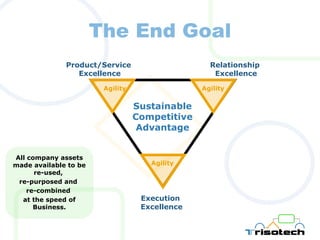
The End Goal All company assets made available to be re-used,  re-purposed and  re-combined  at the speed of Business. Execution  Excellence Relationship  Excellence Product/Service  Excellence Sustainable Competitive Advantage Agility Agility Agility
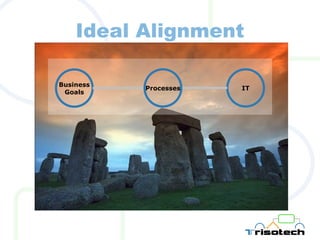
Ideal Alignment Business Goals IT Processes
The Interest in  Business Process Companies are as interested , today, in business processes as they were in the mid-nineties There are many reasons, but the bottom-line is that managers need a way to understand the company during a period of rapid change – and processes offer exactly that perspective.
Motivators ? Ensure accurate Data Entry or Document Creation Manage and Monitor of the Performance of Operations and Personnel Accelerate Process Cycle Time by Automating Repetitive Tasks Manage Exceptions to Automated Business Rules and Processes Change Business Rules and Logic of Enterprise  Software by Business Users (without IT) Visualize, Simulate and Trouble Shoot Business Process before committing to Software Development Efforts Enhance Best Practices and Required Procedures
What  «  they  »  are Saying “ Business Process Management (BPM) wins the "triple crown" of saving money, saving time and adding value. It also spans the business and technological gap to create synergy, with proven results”
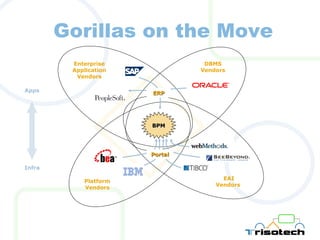
Gorillas on the Move Enterprise Application Vendors DBMS Vendors Platform Vendors EAI Vendors BPM ERP Portal Infra Apps
Process Automation Packaged Applications Custom Development Declarative Approach There are several process automation directions:
Packaged Applications Several vendors offer pre-packaged applications, organized to reflect common business processes. “ Best Practices” They argue that they developed their modules after studying what worked best at several client sites. Results in average processes In fact, these modules lead to a leveling of processes. Reverse analysis In effect you begin with the solution, and proceed to modify your existing processes to accommodate the inputs and outputs of the packaged application. All suffer from the Data Centric legacy.
Custom Development Custom The documented Business Process from Business Analysts is interpreted by IT Analysts and custom coded. Code Generation The Business Process is iteratively translated into various IT models leading to generated code. (Model Driven Architecture MDA). Usually UML based.  Claims of up to 70% of Code auto generated
Declarative Approach The Business Process Model is the System.  The System is the Business. Deterministic (Static) Production or transaction workflows.  The Information and control flow are pre-determined. Non-Deterministic (Dynamic) The information and control flow are Goal Oriented.
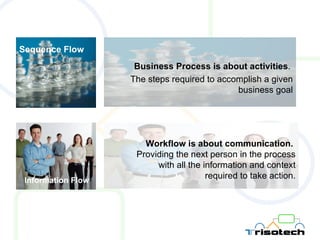
Sequence Flow Business Process is about activities .  The steps required to accomplish a given business goal Workflow is about communication.   Providing the next person in the process with all the information and context required to take action. Information Flow
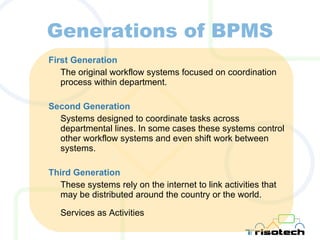
Generations of BPMS First Generation The original workflow systems focused on coordination process within department. Second Generation Systems designed to coordinate tasks across departmental lines. In some cases these systems control other workflow systems and even shift work between systems. Third Generation These systems rely on the internet to link activities that may be distributed around the country or the world. Services as Activities
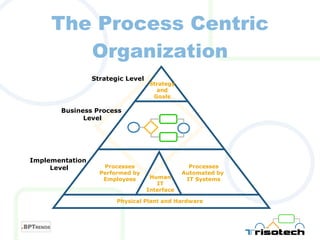
The Process Centric Organization Strategic Level Business Process Level Implementation Level Physical Plant and Hardware Strategy and Goals Processes Performed by Employees Processes Automated by  IT Systems Human IT Interface
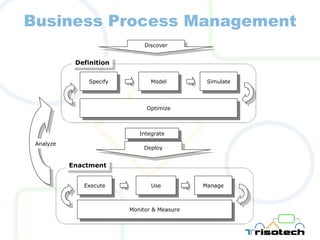
Business Process Management Model Specify Simulate Optimize Integrate Execute Use Manage Monitor & Measure Deploy Definition Enactment Discover Analyze
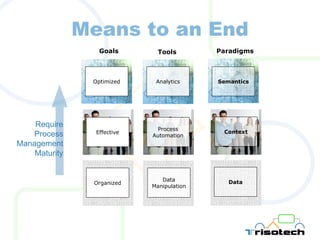
Means to an End Effective Organized Process Automation Data Manipulation Context Data Goals Tools Paradigms Require Process Management Maturity Optimized Analytics Semantics
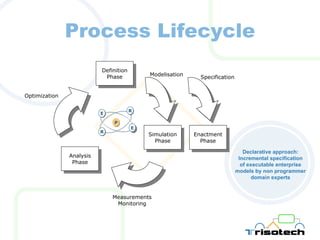
Process Lifecycle Definition Phase Analysis Phase Enactment Phase Specification Measurements Monitoring Optimization Simulation Phase Declarative approach: Incremental specification of executable enterprise models by non programmer domain experts Modelisation E E R R P
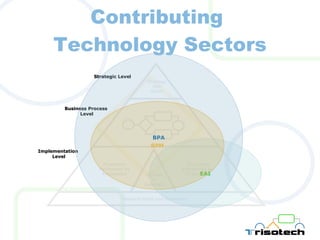
Contributing  Technology Sectors EAI BPM BPA Physical Plant and Hardware Strategy and Goals Processes Performed by Employees Processes Automated by  IT Systems Human IT Interface Strategic Level Business Process Level Implementation Level
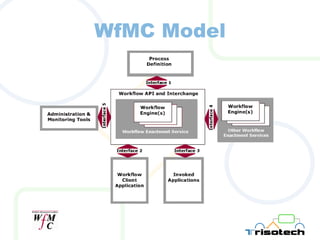
WfMC Model
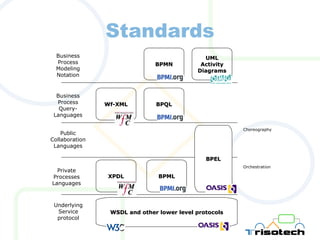
Standards Wf-XML Underlying Service protocol Private Processes Languages Public Collaboration Languages Business Process Query-Languages BPEL Business Process Modeling Notation BPMN XPDL BPML WSDL and other lower level protocols BPQL UML Activity Diagrams Orchestration Choreography
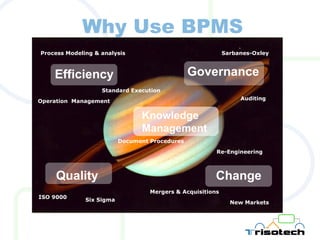
Why Use BPMS Efficiency Governance Quality Change Process Modeling & analysis Operation  Management Six Sigma ISO 9000 Mergers & Acquisitions New Markets Re-Engineering Auditing Sarbanes-Oxley Standard Execution Document Procedures Knowledge Management
The Benefits  you Get for Free The duration of the process is reduced dramatically. The process definition becomes transparent.  Everyone knows what they are doing and why, even when there is high staff turnover. Each process instance is transparent.  During the process run and afterwards you track who did what, when. The process is under control.  You can change the definition on the fly to improve it or to react to sudden changes in the environment.
Drivers for BPM  11 Money-Relevant Reasons to Start 1. Optimization Build Better New Processes Faster 2. Understanding Know What You’re Doing (Right or Wrong) Through Current Process Understanding 3. Continuity Avoid Friction During Mergers and Acquisitions 4.   Outsourcing Get Someone Else to Do the Dull Stuff With Business Process Outsourcing 5.   Implementation Buy Software and Implement Packages Better 6.   Control Get Control of Parallel Processes by Consolidating to Core Processes
7. Automation Get Idiot Work Away From People Through the Automation of Manual Processes 8. Coordination Value/Supply Chain Creation/Maintenance and Other Process Fusion 9.   Efficiency Do Things Better With Optimized Processes 10. Compliance Stay Out of Trouble by Staying Ahead of Compliance 11.   Innovation Move Faster Through Scenario Building for Agility and Policy Management Drivers for BPM  11 Money-Relevant Reasons to Start
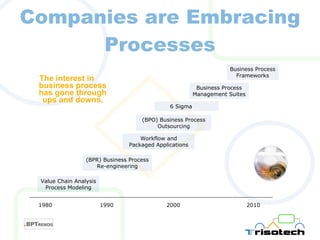
Companies are Embracing Processes The interest in business process has gone through ups and downs. 1980 1990 2000 2010 Value Chain Analysis Process Modeling (BPR) Business Process Re-engineering Workflow and Packaged Applications (BPO) Business Process Outsourcing 6 Sigma  Business Process Management Suites Business Process Frameworks
Where are we? Processes are now a driving force in business Process engineering is a respected discipline BPMI, OASIS, OMG, W3C, WfMC are working on process standards Practitioners understand that BPM goes beyond workflow Organizations are benefiting from process initiatives Process models are core assets with business-critical value Process execution has a proven Return on Investment (ROI) BPM and Web Services lower IT costs But lack of standards clarity is slowing adoption Slower product innovation Limited customer adoption Hindered market pollination
What We Offer An innovative technological framework for Modeling, Automating, Analyzing and Optimizing Business Processes all independently of back-office applications and legacy systems. A broad set of consulting services to meet the diverse needs of clients and help them create significant value while sustaining their business agility.
Technological  Vision Statement Enterprise Software Solutions must be delivered rapidly, using existing resources to expand current capabilities,  allowing agile evolution  to enable new capabilities, all in increments  driven by business value  rather than technical needs. Declarative approach: Incremental specification of executable enterprise models by non programmer domain experts
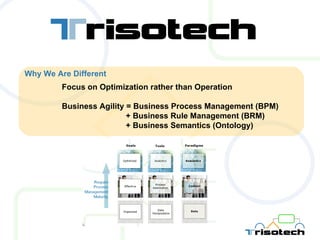
Why We Are Different Focus on Optimization rather than Operation Business Agility = Business Process Management (BPM)  + Business Rule Management (BRM)  + Business Semantics (Ontology)
Copy of this presentation  is available at  www.Trisotech.com

Business Process Modeling & Automation: Where are we?

  • 1.
    Where are we?Denis Gagné
  • 2.
    Business Agility Anorganization’s systemic ability to fluidly marshal and re-configure resources in response to business requirements and opportunities.
  • 3.
    The Context Imperativesof the New Economy Companies operate in a constant state of perpetual change and adaptation Cheaper, Better, Faster with Superior Service Alignment of IT Solutions with Business Priorities One of the biggest executive frustrations is the gap between the strategic vision and the operational execution.
  • 4.
    The Problem CorporatePains Adaptability Contextual change (the economy, market, customer expectations, etc.) occurs at an ever-faster pace. In order to thrive, an organization must keep up to speed and adapt to its environment. Evolution Evolve or perish.  In today’s competitive environment, constant re-engineering is a must. Almost instantaneous implementation of changes is key to success. Standardized Repeatable Execution Execution is everything. Misunderstanding of key business processes inevitably results in inconsistent and inefficient execution.
  • 5.
    The Problem ITPains Stove Pipe Applications Manipulate Lagging Business Data using prepackaged Procedures aligned functionally Wet Cement Solutions Flexibility and Adaptability prior to Production. Living with a Data Centric Legacy
  • 6.
    The Cost ConstantIntegration Syndrome. Organizations must adapt their Processes to reflect the Software Procedures.
  • 7.
    The End GoalAll company assets made available to be re-used, re-purposed and re-combined at the speed of Business. Execution Excellence Relationship Excellence Product/Service Excellence Sustainable Competitive Advantage Agility Agility Agility
  • 8.
    Ideal Alignment BusinessGoals IT Processes
  • 9.
    The Interest in Business Process Companies are as interested , today, in business processes as they were in the mid-nineties There are many reasons, but the bottom-line is that managers need a way to understand the company during a period of rapid change – and processes offer exactly that perspective.
  • 10.
    Motivators ? Ensureaccurate Data Entry or Document Creation Manage and Monitor of the Performance of Operations and Personnel Accelerate Process Cycle Time by Automating Repetitive Tasks Manage Exceptions to Automated Business Rules and Processes Change Business Rules and Logic of Enterprise Software by Business Users (without IT) Visualize, Simulate and Trouble Shoot Business Process before committing to Software Development Efforts Enhance Best Practices and Required Procedures
  • 11.
    What « they » are Saying “ Business Process Management (BPM) wins the "triple crown" of saving money, saving time and adding value. It also spans the business and technological gap to create synergy, with proven results”
  • 12.
    Gorillas on theMove Enterprise Application Vendors DBMS Vendors Platform Vendors EAI Vendors BPM ERP Portal Infra Apps
  • 13.
    Process Automation PackagedApplications Custom Development Declarative Approach There are several process automation directions:
  • 14.
    Packaged Applications Severalvendors offer pre-packaged applications, organized to reflect common business processes. “ Best Practices” They argue that they developed their modules after studying what worked best at several client sites. Results in average processes In fact, these modules lead to a leveling of processes. Reverse analysis In effect you begin with the solution, and proceed to modify your existing processes to accommodate the inputs and outputs of the packaged application. All suffer from the Data Centric legacy.
  • 15.
    Custom Development CustomThe documented Business Process from Business Analysts is interpreted by IT Analysts and custom coded. Code Generation The Business Process is iteratively translated into various IT models leading to generated code. (Model Driven Architecture MDA). Usually UML based. Claims of up to 70% of Code auto generated
  • 16.
    Declarative Approach TheBusiness Process Model is the System. The System is the Business. Deterministic (Static) Production or transaction workflows. The Information and control flow are pre-determined. Non-Deterministic (Dynamic) The information and control flow are Goal Oriented.
  • 17.
    Sequence Flow BusinessProcess is about activities . The steps required to accomplish a given business goal Workflow is about communication. Providing the next person in the process with all the information and context required to take action. Information Flow
  • 18.
    Generations of BPMSFirst Generation The original workflow systems focused on coordination process within department. Second Generation Systems designed to coordinate tasks across departmental lines. In some cases these systems control other workflow systems and even shift work between systems. Third Generation These systems rely on the internet to link activities that may be distributed around the country or the world. Services as Activities
  • 19.
    The Process CentricOrganization Strategic Level Business Process Level Implementation Level Physical Plant and Hardware Strategy and Goals Processes Performed by Employees Processes Automated by IT Systems Human IT Interface
  • 20.
    Business Process ManagementModel Specify Simulate Optimize Integrate Execute Use Manage Monitor & Measure Deploy Definition Enactment Discover Analyze
  • 21.
    Means to anEnd Effective Organized Process Automation Data Manipulation Context Data Goals Tools Paradigms Require Process Management Maturity Optimized Analytics Semantics
  • 22.
    Process Lifecycle DefinitionPhase Analysis Phase Enactment Phase Specification Measurements Monitoring Optimization Simulation Phase Declarative approach: Incremental specification of executable enterprise models by non programmer domain experts Modelisation E E R R P
  • 23.
    Contributing TechnologySectors EAI BPM BPA Physical Plant and Hardware Strategy and Goals Processes Performed by Employees Processes Automated by IT Systems Human IT Interface Strategic Level Business Process Level Implementation Level
  • 24.
  • 25.
    Standards Wf-XML UnderlyingService protocol Private Processes Languages Public Collaboration Languages Business Process Query-Languages BPEL Business Process Modeling Notation BPMN XPDL BPML WSDL and other lower level protocols BPQL UML Activity Diagrams Orchestration Choreography
  • 26.
    Why Use BPMSEfficiency Governance Quality Change Process Modeling & analysis Operation Management Six Sigma ISO 9000 Mergers & Acquisitions New Markets Re-Engineering Auditing Sarbanes-Oxley Standard Execution Document Procedures Knowledge Management
  • 27.
    The Benefits you Get for Free The duration of the process is reduced dramatically. The process definition becomes transparent. Everyone knows what they are doing and why, even when there is high staff turnover. Each process instance is transparent. During the process run and afterwards you track who did what, when. The process is under control. You can change the definition on the fly to improve it or to react to sudden changes in the environment.
  • 28.
    Drivers for BPM 11 Money-Relevant Reasons to Start 1. Optimization Build Better New Processes Faster 2. Understanding Know What You’re Doing (Right or Wrong) Through Current Process Understanding 3. Continuity Avoid Friction During Mergers and Acquisitions 4. Outsourcing Get Someone Else to Do the Dull Stuff With Business Process Outsourcing 5. Implementation Buy Software and Implement Packages Better 6. Control Get Control of Parallel Processes by Consolidating to Core Processes
  • 29.
    7. Automation GetIdiot Work Away From People Through the Automation of Manual Processes 8. Coordination Value/Supply Chain Creation/Maintenance and Other Process Fusion 9. Efficiency Do Things Better With Optimized Processes 10. Compliance Stay Out of Trouble by Staying Ahead of Compliance 11. Innovation Move Faster Through Scenario Building for Agility and Policy Management Drivers for BPM 11 Money-Relevant Reasons to Start
  • 30.
    Companies are EmbracingProcesses The interest in business process has gone through ups and downs. 1980 1990 2000 2010 Value Chain Analysis Process Modeling (BPR) Business Process Re-engineering Workflow and Packaged Applications (BPO) Business Process Outsourcing 6 Sigma Business Process Management Suites Business Process Frameworks
  • 31.
    Where are we?Processes are now a driving force in business Process engineering is a respected discipline BPMI, OASIS, OMG, W3C, WfMC are working on process standards Practitioners understand that BPM goes beyond workflow Organizations are benefiting from process initiatives Process models are core assets with business-critical value Process execution has a proven Return on Investment (ROI) BPM and Web Services lower IT costs But lack of standards clarity is slowing adoption Slower product innovation Limited customer adoption Hindered market pollination
  • 32.
    What We OfferAn innovative technological framework for Modeling, Automating, Analyzing and Optimizing Business Processes all independently of back-office applications and legacy systems. A broad set of consulting services to meet the diverse needs of clients and help them create significant value while sustaining their business agility.
  • 33.
    Technological VisionStatement Enterprise Software Solutions must be delivered rapidly, using existing resources to expand current capabilities, allowing agile evolution to enable new capabilities, all in increments driven by business value rather than technical needs. Declarative approach: Incremental specification of executable enterprise models by non programmer domain experts
  • 34.
    Why We AreDifferent Focus on Optimization rather than Operation Business Agility = Business Process Management (BPM) + Business Rule Management (BRM) + Business Semantics (Ontology)
  • 35.
    Copy of thispresentation is available at www.Trisotech.com