Hardik Rathod
Chemnitz University of Technology
Course of Studies M_Es
SS2015 Semester
Temperature Sensors
Seminar Automotive Sensors
Chair for Measurement and Sensor Technology
Univ.-Prof. Dr.-Ing. O. Kanoun
2
Contents
• Introduction
• Types and short discription
• Structure
• Working principle
• Application in Automotive Domain
• References
Seminar Automotive Sensors
Chair for Measurement and Sensor Technology
Univ.-Prof. Dr.-Ing. O. Kanoun
3
Introduction
• Physical, electronic, chemical, mechanical and biological systems are
affected by temperature
• Temperature is most often measured quantity
• Most commonly used in Food processing, environmental control, medical
devices, chemical handling and in Automotive
• Used to ensure that a process is either staying with certain range
Seminar Automotive Sensors
Chair for Measurement and Sensor Technology
Univ.-Prof. Dr.-Ing. O. Kanoun
4
Types
• Two types: 1. Contact
2. Non-contact
• Contact Temperature Sensors:
o Thermocouples
o Resistance Temperature Detectors (RTD)
o Thermistors
o Filled system thermometers
o Bimetallic thermometers
• Non-Contact Temperature Sensors:
o Pyrometer or
o Infrared Temperature sensors
Seminar Automotive Sensors
Chair for Measurement and Sensor Technology
Univ.-Prof. Dr.-Ing. O. Kanoun
5
Contact Temperature Sensors
Seminar Automotive Sensors
Chair for Measurement and Sensor Technology
Univ.-Prof. Dr.-Ing. O. Kanoun
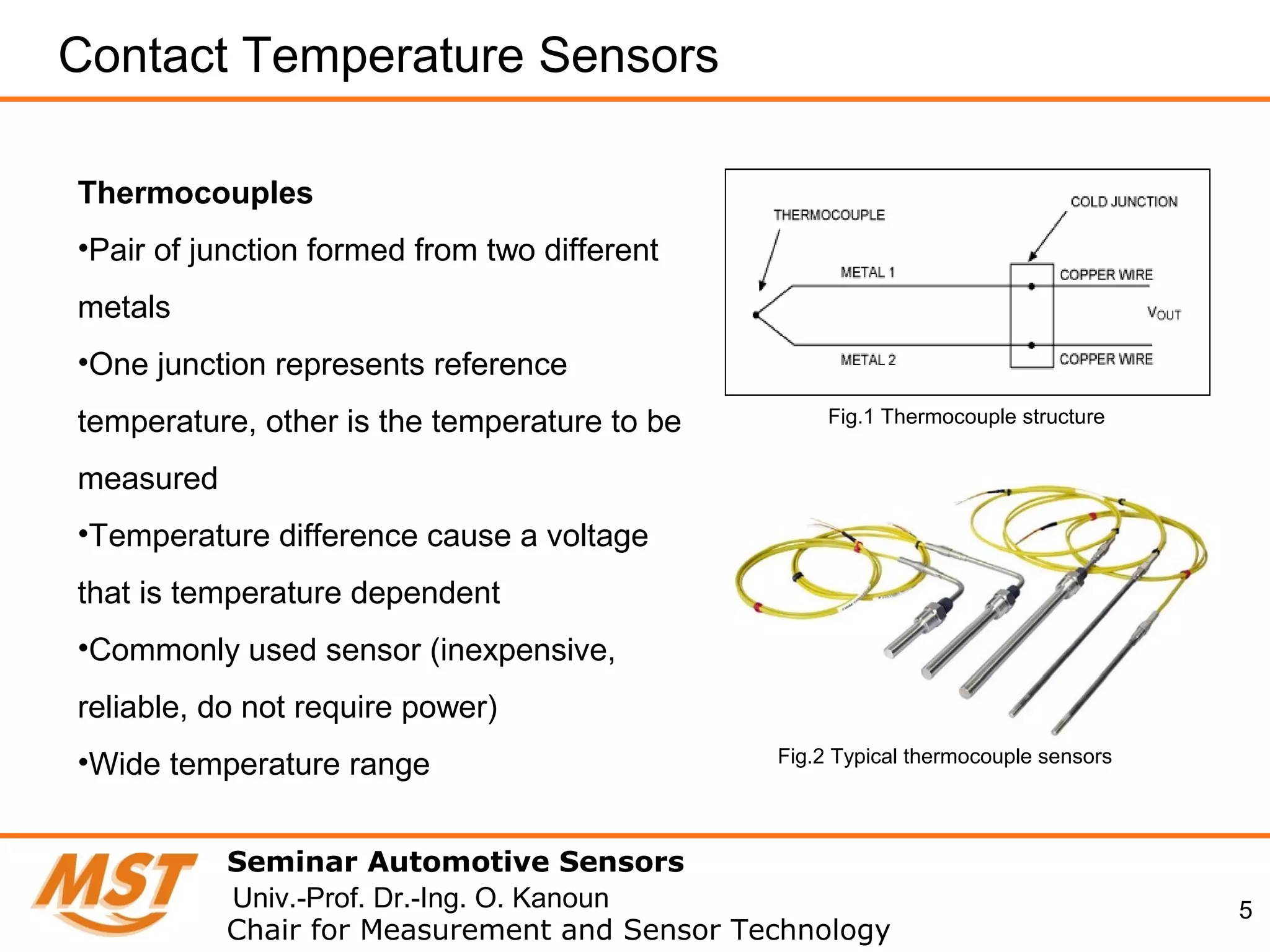
Thermocouples
•Pair of junction formed from two different
metals
•One junction represents reference
temperature, other is the temperature to be
measured
•Temperature difference cause a voltage
that is temperature dependent
•Commonly used sensor (inexpensive,
reliable, do not require power)
•Wide temperature range
Fig.1 Thermocouple structure
Fig.2 Typical thermocouple sensors
6
Contact Temperature Sensors
Seminar Automotive Sensors
Chair for Measurement and Sensor Technology
Univ.-Prof. Dr.-Ing. O. Kanoun
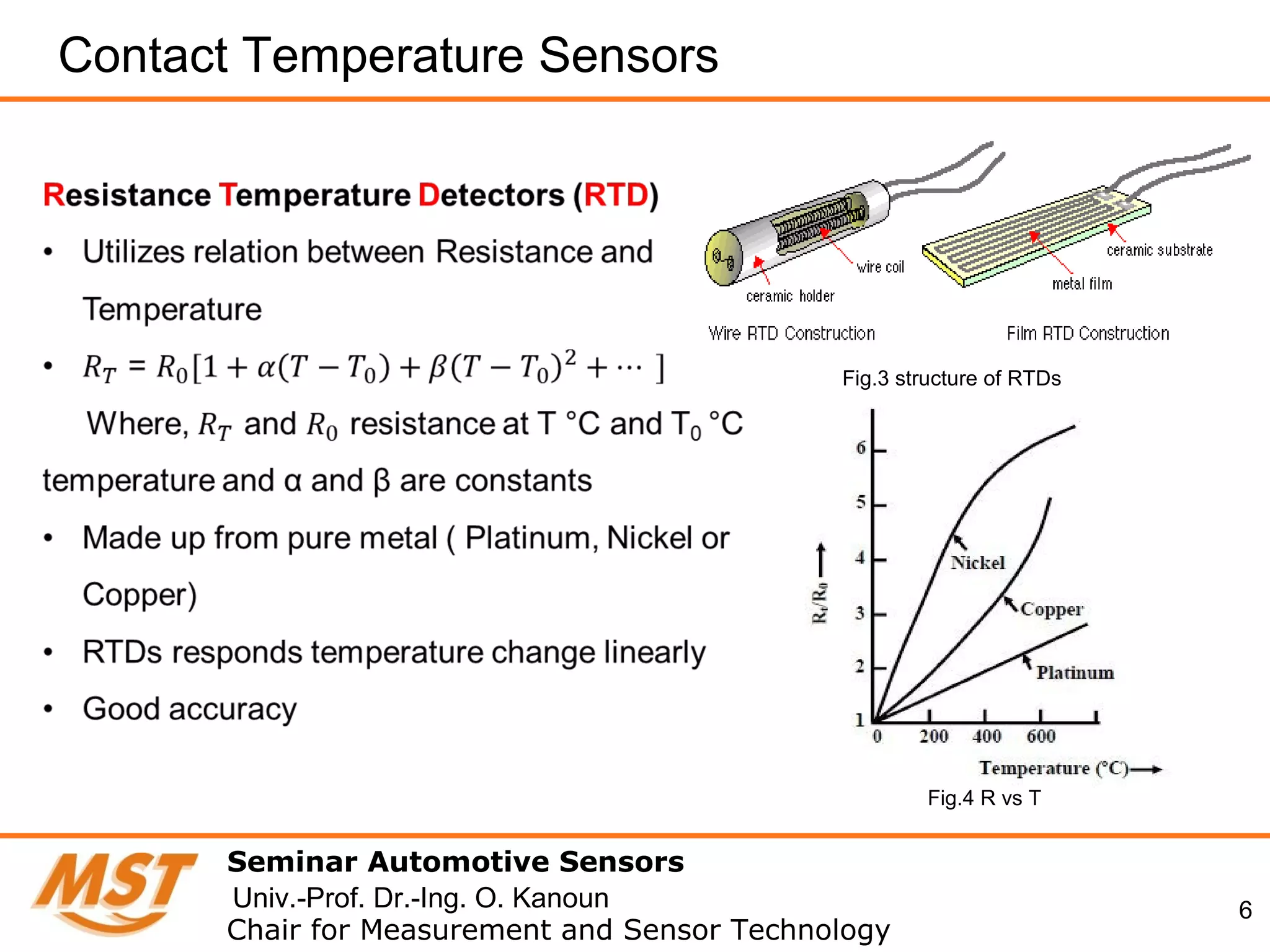
Fig.3 structure of RTDs
Fig.4 R vs T
7
Contact Temperature Sensors
Seminar Automotive Sensors
Chair for Measurement and Sensor Technology
Univ.-Prof. Dr.-Ing. O. Kanoun
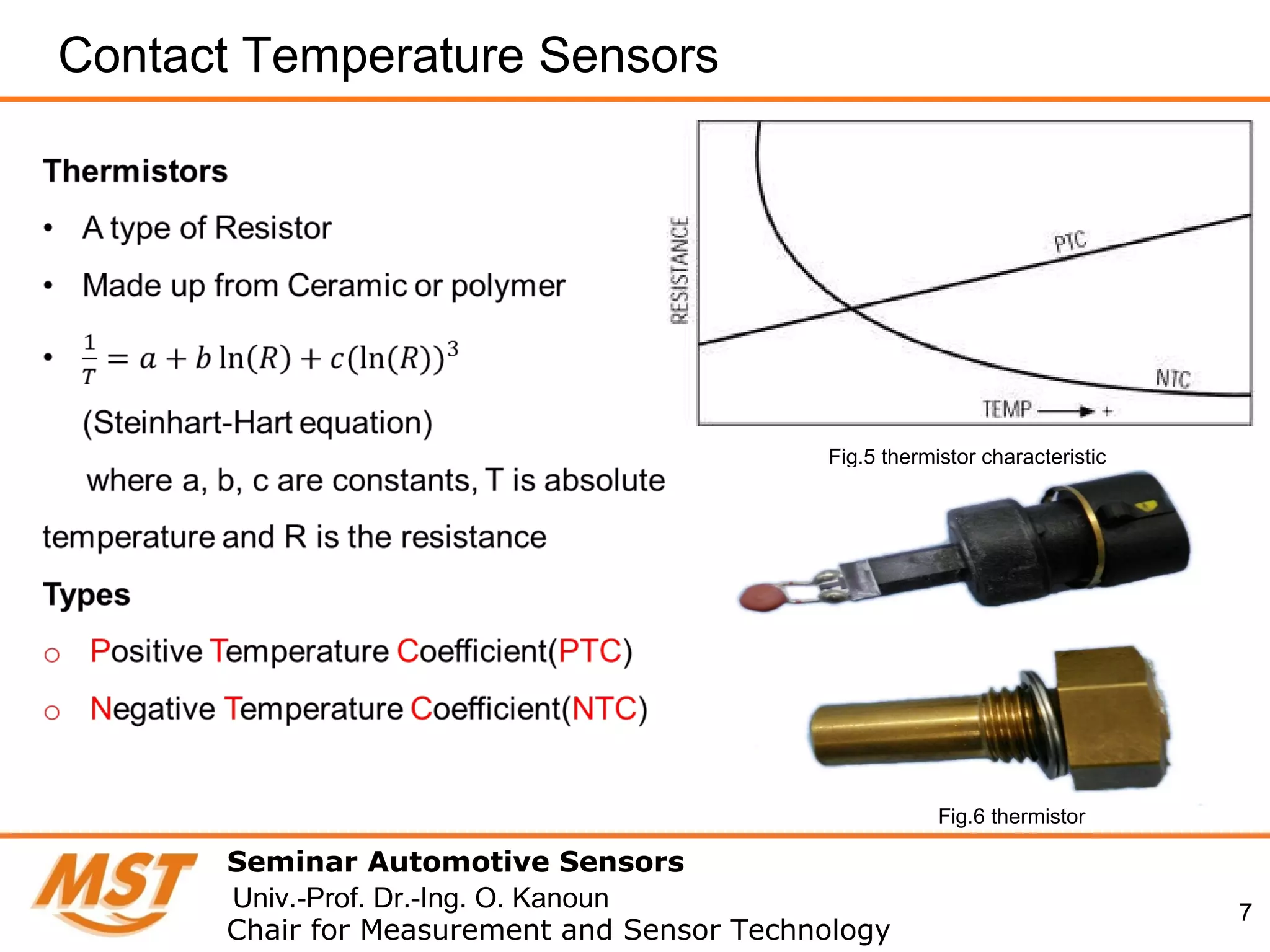
Fig.5 thermistor characteristic
Fig.6 thermistor
8
Contact Temperature Sensors
Seminar Automotive Sensors
Chair for Measurement and Sensor Technology
Univ.-Prof. Dr.-Ing. O. Kanoun
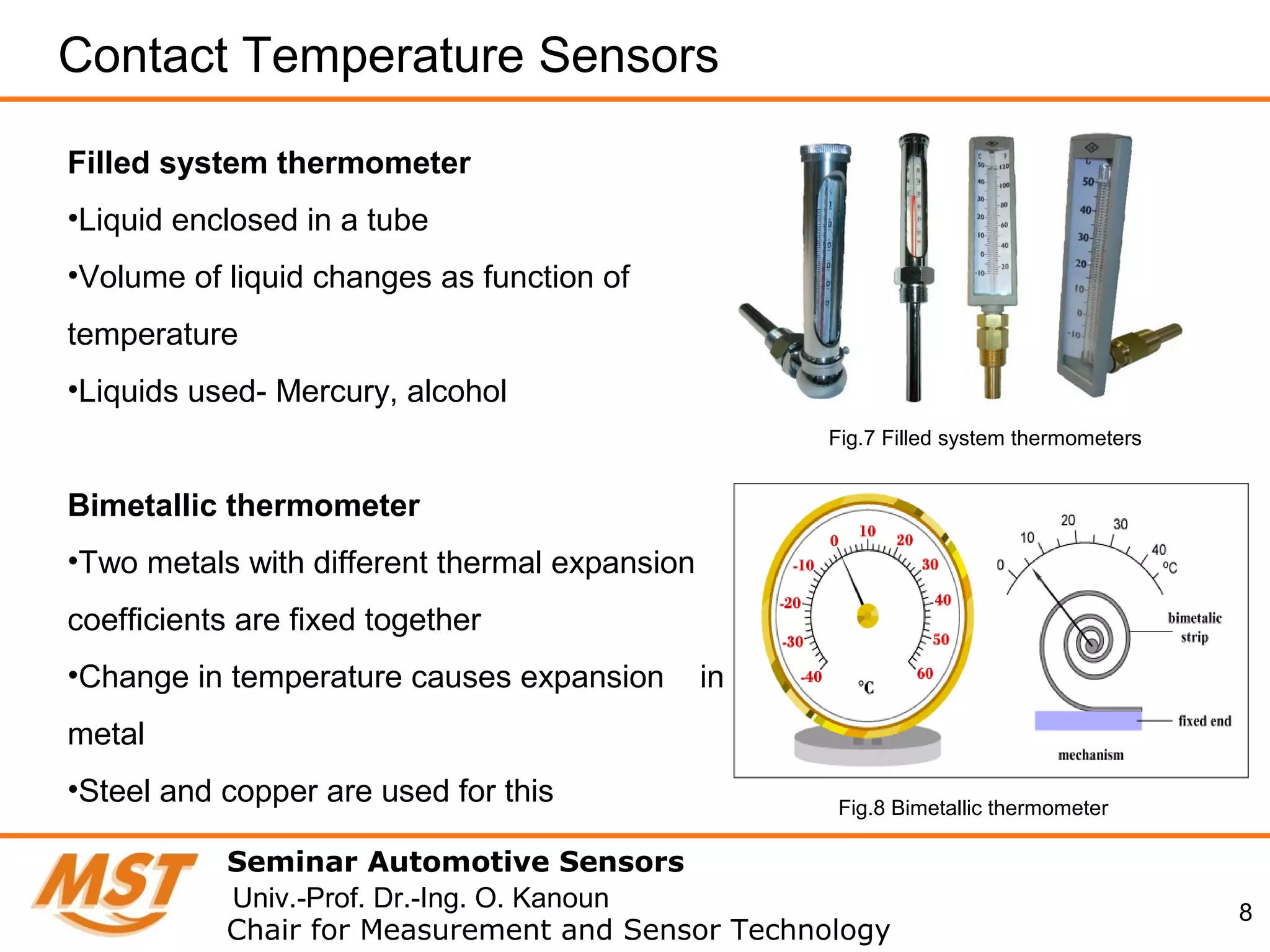
Filled system thermometer
•Liquid enclosed in a tube
•Volume of liquid changes as function of
temperature
•Liquids used- Mercury, alcohol
Bimetallic thermometer
•Two metals with different thermal expansion
coefficients are fixed together
•Change in temperature causes expansion in
metal
•Steel and copper are used for this
Fig.7 Filled system thermometers
Fig.8 Bimetallic thermometer
9
Non-contact Temperature Sensors
Seminar Automotive Sensors
Chair for Measurement and Sensor Technology
Univ.-Prof. Dr.-Ing. O. Kanoun
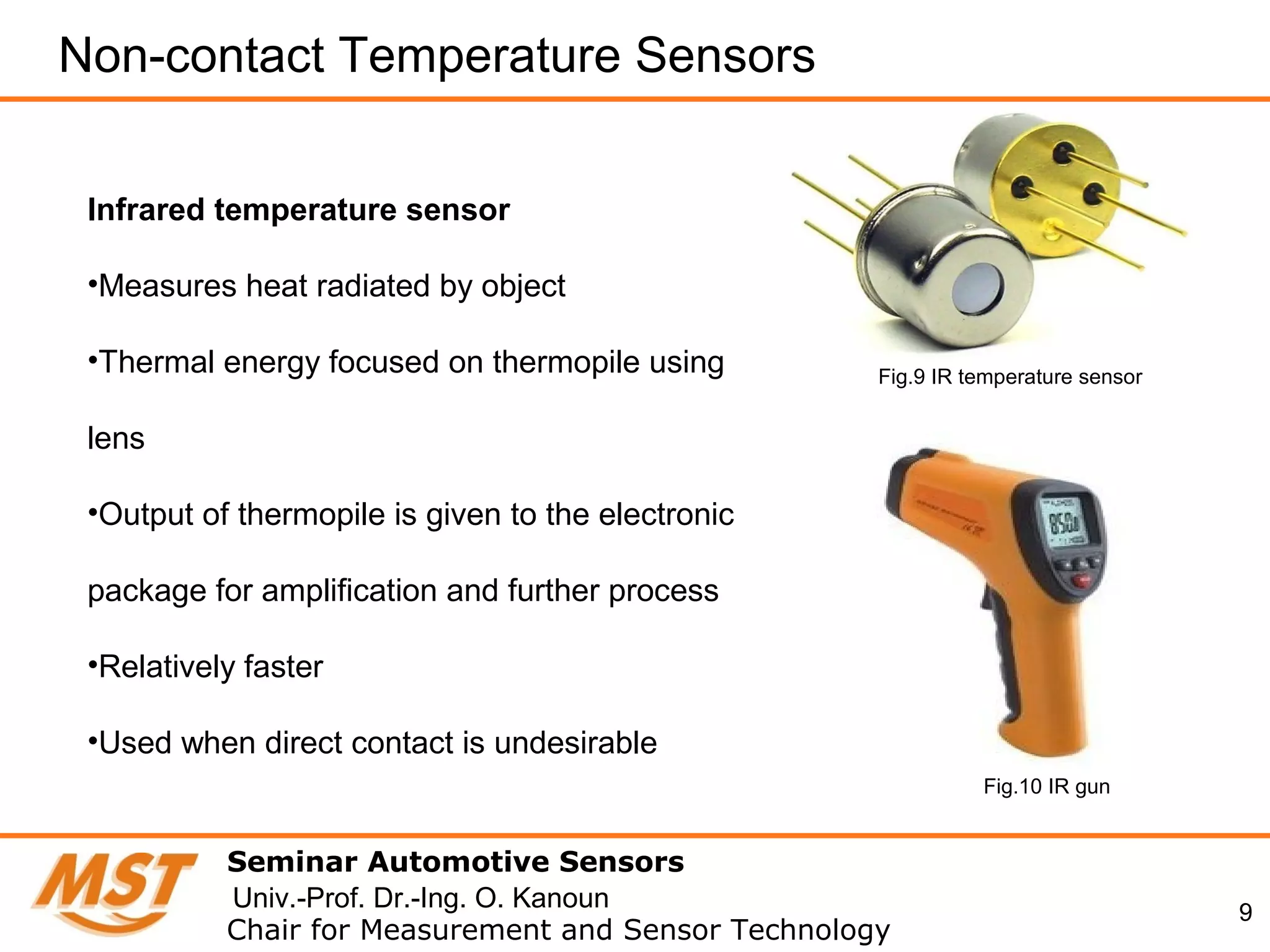
Infrared temperature sensor
•Measures heat radiated by object
•Thermal energy focused on thermopile using
lens
•Output of thermopile is given to the electronic
package for amplification and further process
•Relatively faster
•Used when direct contact is undesirable
Fig.9 IR temperature sensor
Fig.10 IR gun
10
Structure
Seminar Automotive Sensors
Chair for Measurement and Sensor Technology
Univ.-Prof. Dr.-Ing. O. Kanoun
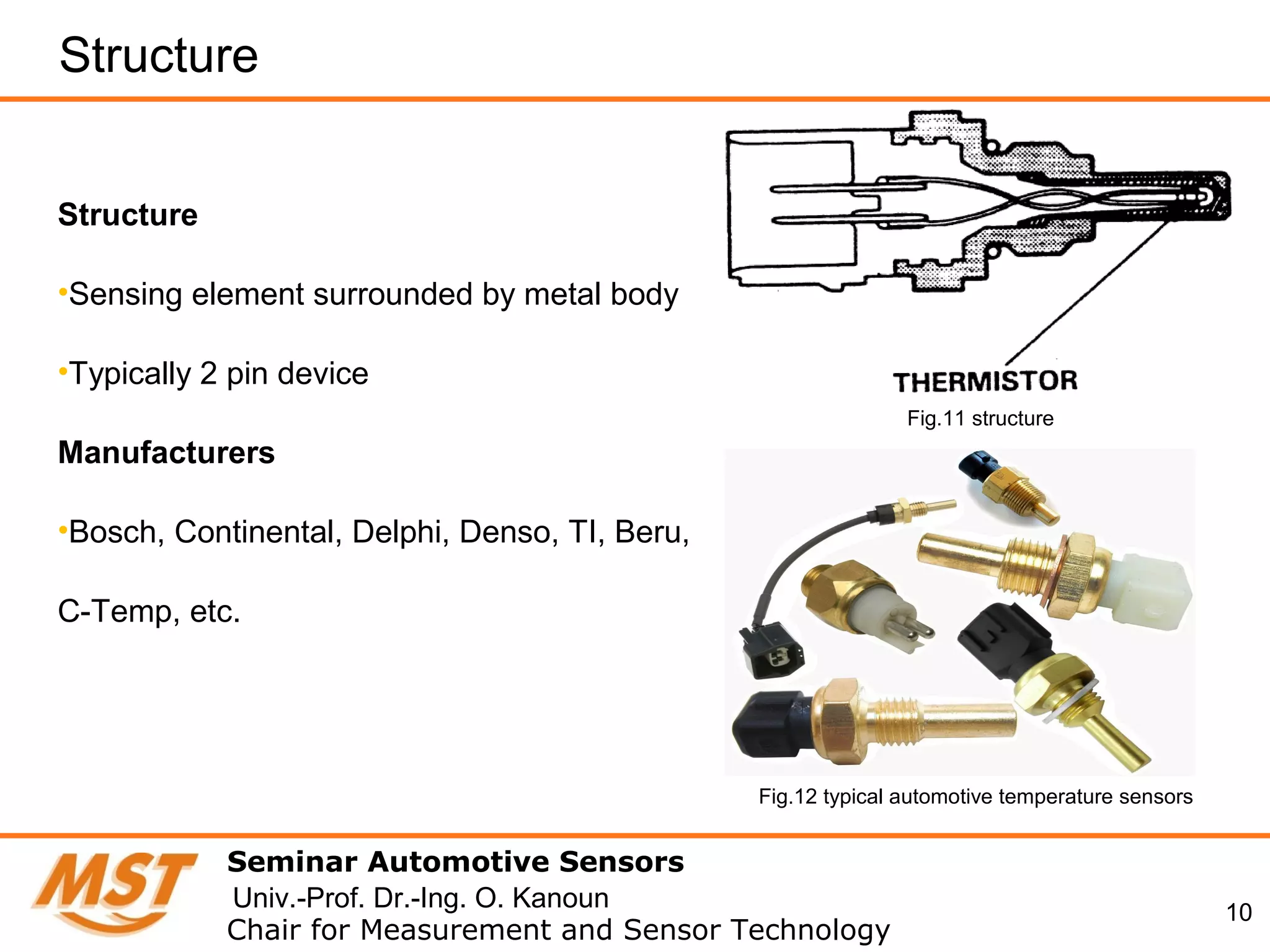
Structure
•Sensing element surrounded by metal body
•Typically 2 pin device
Manufacturers
•Bosch, Continental, Delphi, Denso, TI, Beru,
C-Temp, etc.
Fig.11 structure
Fig.12 typical automotive temperature sensors
11
Working principle
Seminar Automotive Sensors
Chair for Measurement and Sensor Technology
Univ.-Prof. Dr.-Ing. O. Kanoun
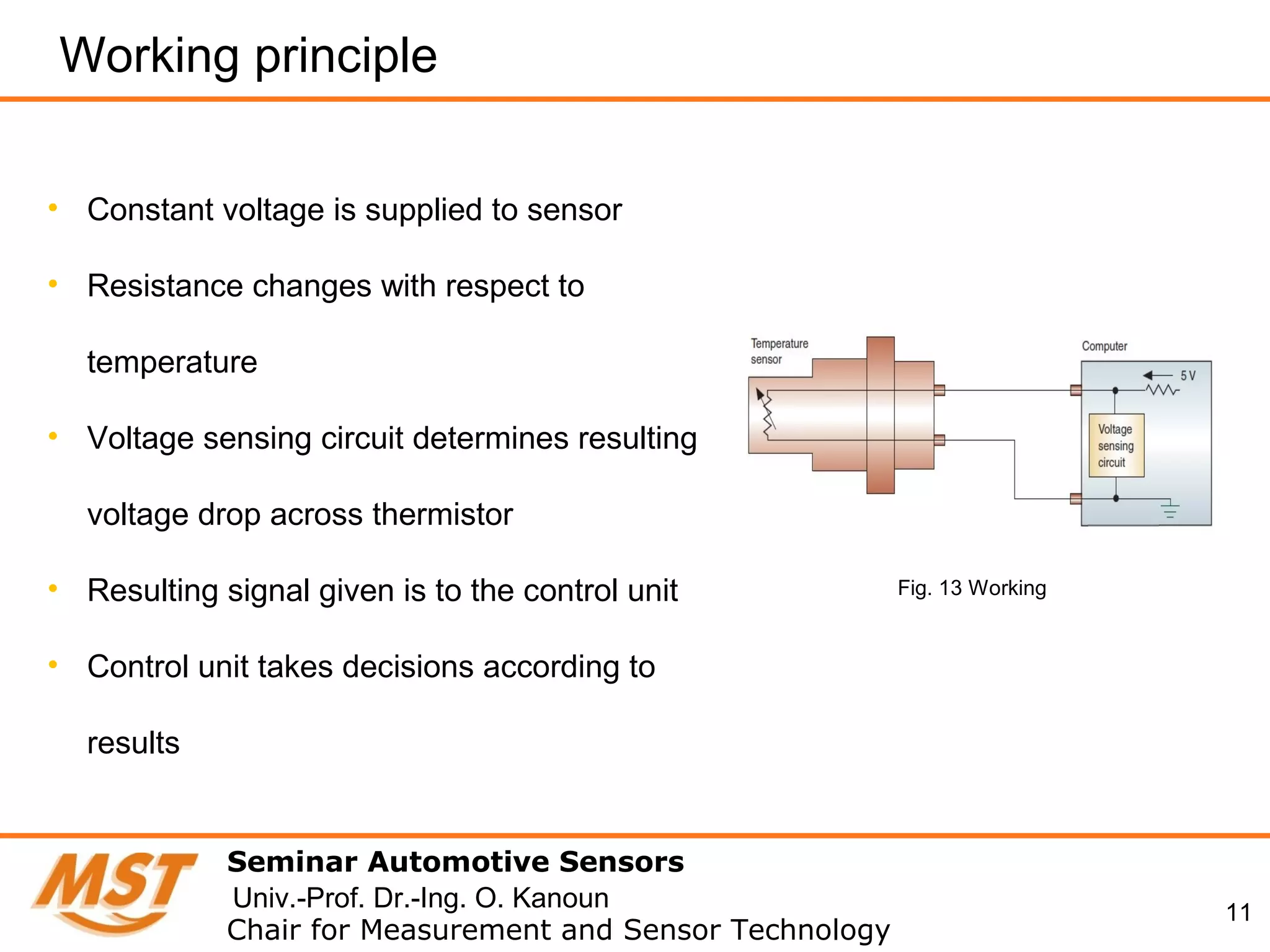
• Constant voltage is supplied to sensor
• Resistance changes with respect to
temperature
• Voltage sensing circuit determines resulting
voltage drop across thermistor
• Resulting signal given is to the control unit
• Control unit takes decisions according to
results
Fig. 13 Working
12
Application in Automotive domain
Seminar Automotive Sensors
Chair for Measurement and Sensor Technology
Univ.-Prof. Dr.-Ing. O. Kanoun
Coolant temperature Sensor
•Used to adjust fuel injection, ignition timing and cooling fan
Air temperature Sensor
•Installed in the intake air manifold
•Measures temperature of engine intake air
•Range -40 ˚C to +120 ˚C
Engine Oil temperature Sensor
•Calculates engine oil temperature (-40 ˚C to +170 ˚C)
Exhaust Gas temperature Sensor
•Employs platinum measuring resistor (-40 ˚C to +1000 ˚C)
•Used to regulate exhaust gas recirculation
•Mounted in exhaust system
13
Seminar Automotive Sensors
Chair for Measurement and Sensor Technology
Univ.-Prof. Dr.-Ing. O. Kanoun
Fuel temperature Sensor
•Located along fuel delivery system
•Provides fuel temperature (-40 ˚C to +160 ˚C)
Vehicle’s in-out temperature Sensor
•Exterior temperature sensor: located around front bumper area
•Cabin temperature sensor: near or within steering column
Gives signal to HVAC (heating, ventilation and air conditioning) system
Tire and Brake disc temperature Sensor
•Located around tire envelope
•IR temperature sensors employed
Application in Automotive domain
14
References
Seminar Automotive Sensors
Chair for Measurement and Sensor Technology
Univ.-Prof. Dr.-Ing. O. Kanoun
[1] The Michigan Chemical Process Dynamics and Controls open text book
https://controls.engin.umich.edu (20, April 2015)
[2] DeVale INDUSTRIES Inc. - http://www.devale.com (20, April 2015)
[3] AZO SENSORS - http://www.azosensors.com (25, April 2015)
[4] WATLOW, Sensor selection guide - http://watlow.com (25, April 2015)
[5] Engine coolant temperature sensor, Wikipedia - http://en.wikipedia.org
(25, April 2015)
[6] CVEL AUTOMOTIVE ELECTRONICS, The Clemson university vehicular
electronics laboratory- http://www.cvel.clemson.edu (10, May 2015 )
[7] FreeASEStudyGuides.com - http://www.freeasestudyguides.com (10, May
2015)
[8] Online Electrical Engineering, electrical4u.com - http://www.electrical4u.com
(10, May 2015)
15
References (Figure sources)
Seminar Automotive Sensors
Chair for Measurement and Sensor Technology
Univ.-Prof. Dr.-Ing. O. Kanoun
[Fig.1] Thermocouple structure: maxim integrated, http://www.maximintegrated.com
[Fig.2] Typical thermocouple sensors: Engine thermocouples,
http://www.fwmurphy.co.uk
[Fig.3] and [Fig.4] exsense electronics, http://www.exsense.cn
[Fig.5] and [Fig.6] EAGER learning,
http://eagerlearning.org/practice/sensors/temperature-sensor/
[Fig.7] Filled system thermometer – Liquid filled temperature sensors, FTB
instruments
[Fig.8] bimetallic thermometer, Physics world - http://www.hk-phy.org
[Fig.9] and [Fig.10] measurement specialties, http://www.meas-spec.com
[Fig.11] and [Fig.12] – AutoZone, http://www.autozone.com
[Fig.13] Working – AZO sensors, http://www.azosensors.com

Automotive Temperature sensors

  • 1.
    Hardik Rathod Chemnitz Universityof Technology Course of Studies M_Es SS2015 Semester Temperature Sensors Seminar Automotive Sensors Chair for Measurement and Sensor Technology Univ.-Prof. Dr.-Ing. O. Kanoun
  • 2.
    2 Contents • Introduction • Typesand short discription • Structure • Working principle • Application in Automotive Domain • References Seminar Automotive Sensors Chair for Measurement and Sensor Technology Univ.-Prof. Dr.-Ing. O. Kanoun
  • 3.
    3 Introduction • Physical, electronic,chemical, mechanical and biological systems are affected by temperature • Temperature is most often measured quantity • Most commonly used in Food processing, environmental control, medical devices, chemical handling and in Automotive • Used to ensure that a process is either staying with certain range Seminar Automotive Sensors Chair for Measurement and Sensor Technology Univ.-Prof. Dr.-Ing. O. Kanoun
  • 4.
    4 Types • Two types:1. Contact 2. Non-contact • Contact Temperature Sensors: o Thermocouples o Resistance Temperature Detectors (RTD) o Thermistors o Filled system thermometers o Bimetallic thermometers • Non-Contact Temperature Sensors: o Pyrometer or o Infrared Temperature sensors Seminar Automotive Sensors Chair for Measurement and Sensor Technology Univ.-Prof. Dr.-Ing. O. Kanoun
  • 5.
    5 Contact Temperature Sensors SeminarAutomotive Sensors Chair for Measurement and Sensor Technology Univ.-Prof. Dr.-Ing. O. Kanoun Thermocouples •Pair of junction formed from two different metals •One junction represents reference temperature, other is the temperature to be measured •Temperature difference cause a voltage that is temperature dependent •Commonly used sensor (inexpensive, reliable, do not require power) •Wide temperature range Fig.1 Thermocouple structure Fig.2 Typical thermocouple sensors
  • 6.
    6 Contact Temperature Sensors SeminarAutomotive Sensors Chair for Measurement and Sensor Technology Univ.-Prof. Dr.-Ing. O. Kanoun Fig.3 structure of RTDs Fig.4 R vs T
  • 7.
    7 Contact Temperature Sensors SeminarAutomotive Sensors Chair for Measurement and Sensor Technology Univ.-Prof. Dr.-Ing. O. Kanoun Fig.5 thermistor characteristic Fig.6 thermistor
  • 8.
    8 Contact Temperature Sensors SeminarAutomotive Sensors Chair for Measurement and Sensor Technology Univ.-Prof. Dr.-Ing. O. Kanoun Filled system thermometer •Liquid enclosed in a tube •Volume of liquid changes as function of temperature •Liquids used- Mercury, alcohol Bimetallic thermometer •Two metals with different thermal expansion coefficients are fixed together •Change in temperature causes expansion in metal •Steel and copper are used for this Fig.7 Filled system thermometers Fig.8 Bimetallic thermometer
  • 9.
    9 Non-contact Temperature Sensors SeminarAutomotive Sensors Chair for Measurement and Sensor Technology Univ.-Prof. Dr.-Ing. O. Kanoun Infrared temperature sensor •Measures heat radiated by object •Thermal energy focused on thermopile using lens •Output of thermopile is given to the electronic package for amplification and further process •Relatively faster •Used when direct contact is undesirable Fig.9 IR temperature sensor Fig.10 IR gun
  • 10.
    10 Structure Seminar Automotive Sensors Chairfor Measurement and Sensor Technology Univ.-Prof. Dr.-Ing. O. Kanoun Structure •Sensing element surrounded by metal body •Typically 2 pin device Manufacturers •Bosch, Continental, Delphi, Denso, TI, Beru, C-Temp, etc. Fig.11 structure Fig.12 typical automotive temperature sensors
  • 11.
    11 Working principle Seminar AutomotiveSensors Chair for Measurement and Sensor Technology Univ.-Prof. Dr.-Ing. O. Kanoun • Constant voltage is supplied to sensor • Resistance changes with respect to temperature • Voltage sensing circuit determines resulting voltage drop across thermistor • Resulting signal given is to the control unit • Control unit takes decisions according to results Fig. 13 Working
  • 12.
    12 Application in Automotivedomain Seminar Automotive Sensors Chair for Measurement and Sensor Technology Univ.-Prof. Dr.-Ing. O. Kanoun Coolant temperature Sensor •Used to adjust fuel injection, ignition timing and cooling fan Air temperature Sensor •Installed in the intake air manifold •Measures temperature of engine intake air •Range -40 ˚C to +120 ˚C Engine Oil temperature Sensor •Calculates engine oil temperature (-40 ˚C to +170 ˚C) Exhaust Gas temperature Sensor •Employs platinum measuring resistor (-40 ˚C to +1000 ˚C) •Used to regulate exhaust gas recirculation •Mounted in exhaust system
  • 13.
    13 Seminar Automotive Sensors Chairfor Measurement and Sensor Technology Univ.-Prof. Dr.-Ing. O. Kanoun Fuel temperature Sensor •Located along fuel delivery system •Provides fuel temperature (-40 ˚C to +160 ˚C) Vehicle’s in-out temperature Sensor •Exterior temperature sensor: located around front bumper area •Cabin temperature sensor: near or within steering column Gives signal to HVAC (heating, ventilation and air conditioning) system Tire and Brake disc temperature Sensor •Located around tire envelope •IR temperature sensors employed Application in Automotive domain
  • 14.
    14 References Seminar Automotive Sensors Chairfor Measurement and Sensor Technology Univ.-Prof. Dr.-Ing. O. Kanoun [1] The Michigan Chemical Process Dynamics and Controls open text book https://controls.engin.umich.edu (20, April 2015) [2] DeVale INDUSTRIES Inc. - http://www.devale.com (20, April 2015) [3] AZO SENSORS - http://www.azosensors.com (25, April 2015) [4] WATLOW, Sensor selection guide - http://watlow.com (25, April 2015) [5] Engine coolant temperature sensor, Wikipedia - http://en.wikipedia.org (25, April 2015) [6] CVEL AUTOMOTIVE ELECTRONICS, The Clemson university vehicular electronics laboratory- http://www.cvel.clemson.edu (10, May 2015 ) [7] FreeASEStudyGuides.com - http://www.freeasestudyguides.com (10, May 2015) [8] Online Electrical Engineering, electrical4u.com - http://www.electrical4u.com (10, May 2015)
  • 15.
    15 References (Figure sources) SeminarAutomotive Sensors Chair for Measurement and Sensor Technology Univ.-Prof. Dr.-Ing. O. Kanoun [Fig.1] Thermocouple structure: maxim integrated, http://www.maximintegrated.com [Fig.2] Typical thermocouple sensors: Engine thermocouples, http://www.fwmurphy.co.uk [Fig.3] and [Fig.4] exsense electronics, http://www.exsense.cn [Fig.5] and [Fig.6] EAGER learning, http://eagerlearning.org/practice/sensors/temperature-sensor/ [Fig.7] Filled system thermometer – Liquid filled temperature sensors, FTB instruments [Fig.8] bimetallic thermometer, Physics world - http://www.hk-phy.org [Fig.9] and [Fig.10] measurement specialties, http://www.meas-spec.com [Fig.11] and [Fig.12] – AutoZone, http://www.autozone.com [Fig.13] Working – AZO sensors, http://www.azosensors.com