Contents
• Wheatstone bridge
• Conventional types of temperature sensing,
• Response of thermometer
• Glass thermometer
• Bimetallic thermometer
• Filled system thermometer like pressure spring
thermometer
Wheatstone Bridge
• Originally developed by Charles Wheatstone to measure unknown
resistance values and as a means of calibrating measuring
instruments, voltmeters, ammeters, etc.
• Consists of four resistors that are connected in the shape of a
diamond with the supply source.
• Used to find the unknown resistance very precisely by comparing
with a known value of resistances, by balancing two legs of a bridge
circuit, one leg of which includes the unknown component. Its
operation is similar to the original potentiometer.
• Used in two ways:
o to measure the value of an unknown resistor by comparison to standard
resistors
o to detect small changes in a resistance transducer (e.g. thermistor)
How Does Wheatstone
Bridge works
• Firstly, determine the type of thermistor used in the
experiment. Measure the resistance of thermistor at room
temperature, then heat a little bit and observe the resistance
change as increasing or decreasing.
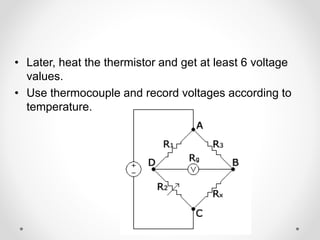
• Then, built a Wheatstone bridge including thermistor and pot.
*Rx is thermistor and R2 is pot.
• After that adjust the pot until the voltage between bridge is
zero at room temperature. This is done for calibration and
going on the procedure from a reference value.
• Later, heat the thermistor and get at least 6 voltage
values.
• Use thermocouple and record voltages according to
temperature.
Applications of
Wheatstone Bridge
• Used for measuring the very low resistance values
precisely.
• Wheatstone bridge along with operational amplifier is
used to measure the physical parameters like
temperature, strain, light, etc.
• Measure the quantities capacitance, inductance and
impedance using the variations on the Wheatstone
bridge.
Advantages and
Disadvantages
• Advantages
o It operates on null deflection
o measurement can be extremely precise for, or extremely sensitive to, a given
change in the thermistor's resistance.
• Disadvantages
o not applicable for high resistances
Thermocouples
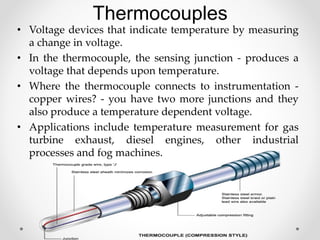
• Voltage devices that indicate temperature by measuring
a change in voltage.
• In the thermocouple, the sensing junction - produces a
voltage that depends upon temperature.
• Where the thermocouple connects to instrumentation -
copper wires? - you have two more junctions and they
also produce a temperature dependent voltage.
• Applications include temperature measurement for gas
turbine exhaust, diesel engines, other industrial
processes and fog machines.
Thermocouples
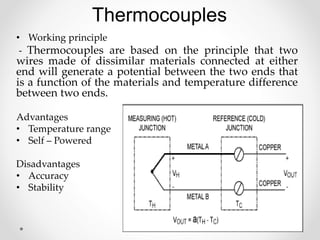
• Working principle
- Thermocouples are based on the principle that two
wires made of dissimilar materials connected at either
end will generate a potential between the two ends that
is a function of the materials and temperature difference
between two ends.
Advantages
• Temperature range
• Self – Powered
Disadvantages
• Accuracy
• Stability
Resistant Temperature
Detector(RTD)
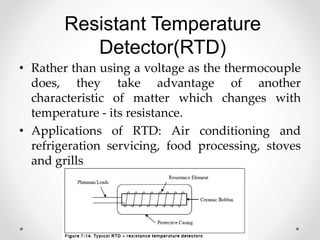
• Rather than using a voltage as the thermocouple
does, they take advantage of another
characteristic of matter which changes with
temperature - its resistance.
• Applications of RTD: Air conditioning and
refrigeration servicing, food processing, stoves
and grills
Resistant Temperature
Detector(RTD)
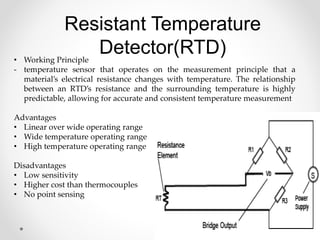
• Working Principle
- temperature sensor that operates on the measurement principle that a
material’s electrical resistance changes with temperature. The relationship
between an RTD’s resistance and the surrounding temperature is highly
predictable, allowing for accurate and consistent temperature measurement
Advantages
• Linear over wide operating range
• Wide temperature operating range
• High temperature operating range
Disadvantages
• Low sensitivity
• Higher cost than thermocouples
• No point sensing
Infrared Sensors
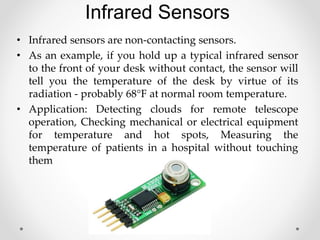
• Infrared sensors are non-contacting sensors.
• As an example, if you hold up a typical infrared sensor
to the front of your desk without contact, the sensor will
tell you the temperature of the desk by virtue of its
radiation - probably 68°F at normal room temperature.
• Application: Detecting clouds for remote telescope
operation, Checking mechanical or electrical equipment
for temperature and hot spots, Measuring the
temperature of patients in a hospital without touching
them
Infrared Sensors
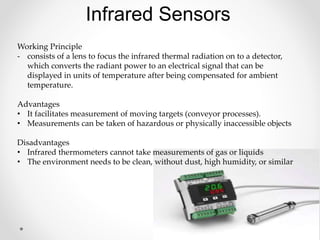
Working Principle
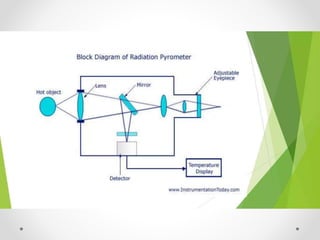
- consists of a lens to focus the infrared thermal radiation on to a detector,
which converts the radiant power to an electrical signal that can be
displayed in units of temperature after being compensated for ambient
temperature.
Advantages
• It facilitates measurement of moving targets (conveyor processes).
• Measurements can be taken of hazardous or physically inaccessible objects
Disadvantages
• Infrared thermometers cannot take measurements of gas or liquids
• The environment needs to be clean, without dust, high humidity, or similar
Bimetallic Devices
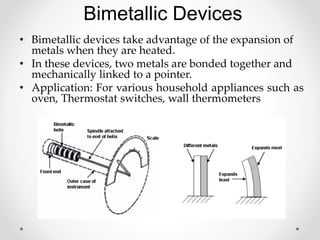
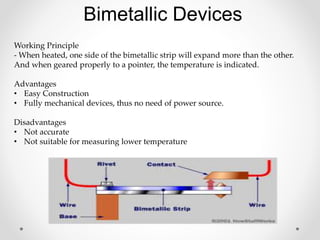
• Bimetallic devices take advantage of the expansion of
metals when they are heated.
• In these devices, two metals are bonded together and
mechanically linked to a pointer.
• Application: For various household appliances such as
oven, Thermostat switches, wall thermometers
Bimetallic Devices
Working Principle
- When heated, one side of the bimetallic strip will expand more than the other.
And when geared properly to a pointer, the temperature is indicated.
Advantages
• Easy Construction
• Fully mechanical devices, thus no need of power source.
Disadvantages
• Not accurate
• Not suitable for measuring lower temperature
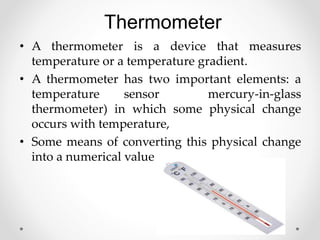
Thermometer
• A thermometer is a device that measures
temperature or a temperature gradient.
• A thermometer has two important elements: a
temperature sensor mercury-in-glass
thermometer) in which some physical change
occurs with temperature,
• Some means of converting this physical change
into a numerical value
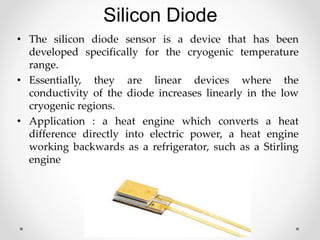
Silicon Diode
• The silicon diode sensor is a device that has been
developed specifically for the cryogenic temperature
range.
• Essentially, they are linear devices where the
conductivity of the diode increases linearly in the low
cryogenic regions.
• Application : a heat engine which converts a heat
difference directly into electric power, a heat engine
working backwards as a refrigerator, such as a Stirling
engine
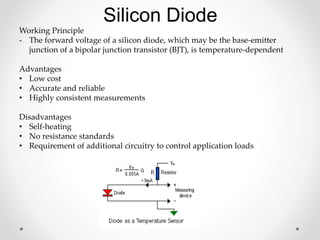
Working Principle
- The forward voltage of a silicon diode, which may be the base-emitter
junction of a bipolar junction transistor (BJT), is temperature-dependent
Advantages
• Low cost
• Accurate and reliable
• Highly consistent measurements
Disadvantages
• Self-heating
• No resistance standards
• Requirement of additional circuitry to control application loads
Silicon Diode
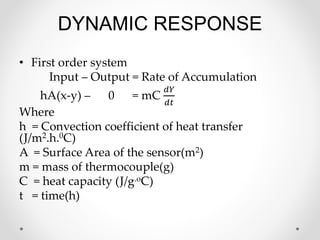
DYNAMIC RESPONSE
• First order system
Input – Output = Rate of Accumulation
hA(x-y) – 0 = mC
𝑑𝑌
𝑑𝑡
Where
h = Convection coefficient of heat transfer
(J/m2.h.0C)
A = Surface Area of the sensor(m2)
m = mass of thermocouple(g)
C = heat capacity (J/g.oC)
t = time(h)
Deviation Variables
hA [X-Y] = mC(
𝑑𝑌
𝑑𝑡
)
• 𝑚𝐶/ℎ𝐴= 𝜏
Taking Laplace Transform
X(s) – Y(s) = τsY(s) – Y(0) ;Y(0)=0
𝑌(𝑠)
𝑋(𝑠)
=
1
τ𝑠 + 1
=
𝑜𝑢𝑡𝑝𝑢𝑡
𝑖𝑛𝑝𝑢𝑡
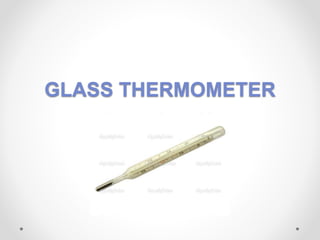
GLASS THERMOMETER
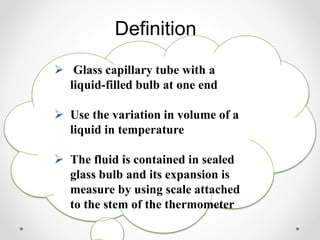
Definition
 Glass capillary tube with a
liquid-filled bulb at one end
 Use the variation in volume of a
liquid in temperature
 The fluid is contained in sealed
glass bulb and its expansion is
measure by using scale attached
to the stem of the thermometer
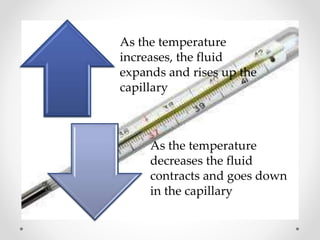
As the temperature
increases, the fluid
expands and rises up the
capillary
As the temperature
decreases the fluid
contracts and goes down
in the capillary
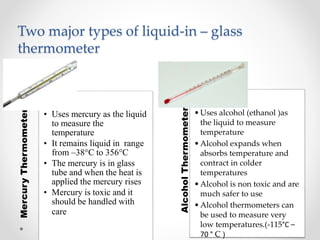
Mercury
Thermometer
• Uses mercury as the liquid
to measure the
temperature
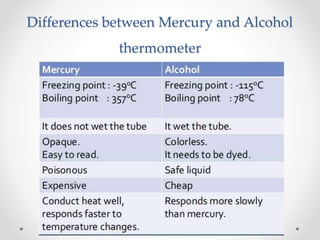
• It remains liquid in range
from –38°C to 356°C
• The mercury is in glass
tube and when the heat is
applied the mercury rises
• Mercury is toxic and it
should be handled with
care
Alcohol
Thermometer
•Uses alcohol (ethanol )as
the liquid to measure
temperature
•Alcohol expands when
absorbs temperature and
contract in colder
temperatures
•Alcohol is non toxic and are
much safer to use
•Alcohol thermometers can
be used to measure very
low temperatures.(-115°C –
70 ° C )
Two major types of liquid-in – glass
thermometer
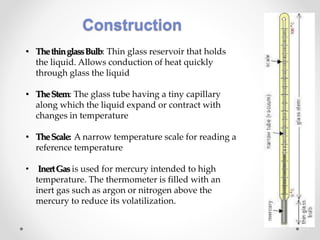
Construction
• ThethinglassBulb: Thin glass reservoir that holds
the liquid. Allows conduction of heat quickly
through glass the liquid
• TheStem: The glass tube having a tiny capillary
along which the liquid expand or contract with
changes in temperature
• TheScale: A narrow temperature scale for reading a
reference temperature
• InertGas is used for mercury intended to high
temperature. The thermometer is filled with an
inert gas such as argon or nitrogen above the
mercury to reduce its volatilization.
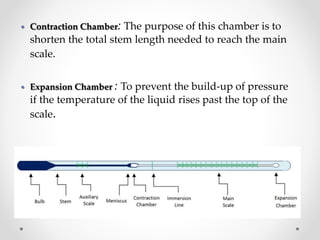
 Contraction Chamber: The purpose of this chamber is to
shorten the total stem length needed to reach the main
scale.
 Expansion Chamber : To prevent the build-up of pressure
if the temperature of the liquid rises past the top of the
scale.
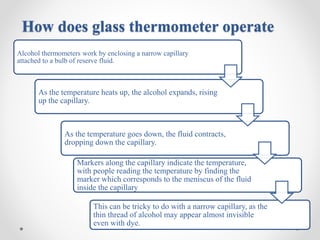
How does glass thermometer operate
Alcohol thermometers work by enclosing a narrow capillary
attached to a bulb of reserve fluid.
As the temperature goes down, the fluid contracts,
dropping down the capillary.
As the temperature heats up, the alcohol expands, rising
up the capillary.
Markers along the capillary indicate the temperature,
with people reading the temperature by finding the
marker which corresponds to the meniscus of the fluid
inside the capillary
This can be tricky to do with a narrow capillary, as the
thin thread of alcohol may appear almost invisible
even with dye.
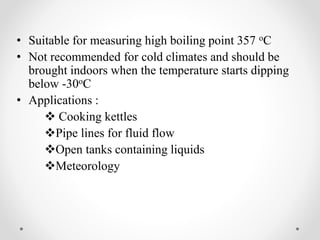
Mercury thermometer
~It is easy to see, have a
shining colour (silver)
~ It has regular expansion
~ Does not stick to the side
of the glass capillary tube
of a thermometer
~ Measure the temperature
quickly and accurately
~Very expensive
~It is a poisonous substance
~Unsuitable for measuring a
very low temperature because it
has high freezing point
• Suitable for measuring high boiling point 357 oC
• Not recommended for cold climates and should be
brought indoors when the temperature starts dipping
below -30oC
• Applications :
 Cooking kettles
Pipe lines for fluid flow
Open tanks containing liquids
Meteorology
Alcohol Thermometer
~ It can measure at low
temperature because its
freezing point is low (-
115°C)
~ It has regular expansion
~ Can measure the
temperature accurately
because it has large
expansion coefficient
~Cannot measure at high
temperature because its
boiling point is low
~It is colourless so must add
with dyestuff in order to
visible
• Alcohol has a very low freezing point of about −115 oC
suitable in thermometers to record very low
temperatures.
• Used in cold atmospheres such as freezers.
• Not suitable in vey hot atmospheres due to the low
boiling point (78 ͦC).
Differences between Mercury and Alcohol
thermometer
FILLED
SYSTEM
THERMOMETER
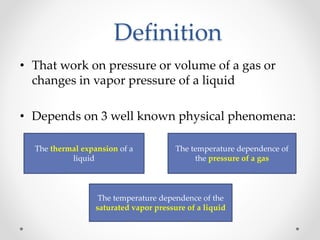
• That work on pressure or volume of a gas or
changes in vapor pressure of a liquid
• Depends on 3 well known physical phenomena:
The thermal expansion of a
liquid
The temperature dependence of
the pressure of a gas
The temperature dependence of the
saturated vapor pressure of a liquid
Definition
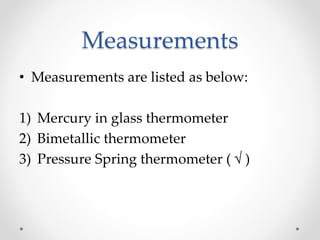
• Measurements are listed as below:
1) Mercury in glass thermometer
2) Bimetallic thermometer
3) Pressure Spring thermometer ( √ )
Measurements
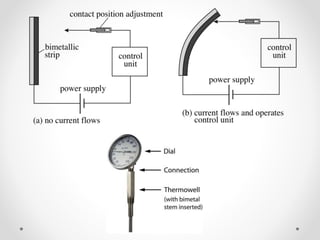
Bimetallic Thermometer
• Two metals whose coefficient of linear expansion
is different are welded and rolled together to the
desire thickness
• The actual movement of a bimetal is its flexivity
with one end fixed, a straight bimetal strip deflects
in proportion to its temperature, to the square of
its length and inversely with its thickens
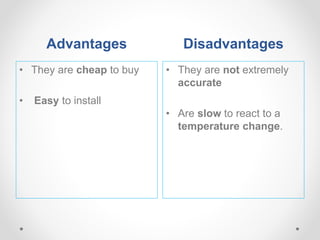
Advantages Disadvantages
• They are cheap to buy
• Easy to install
• They are not extremely
accurate
• Are slow to react to a
temperature change.
Pressure Spring Thermometer
Liquid filled – Class 1
Vapor pressure – Class 2
Gas filled – Class 3
Mercury filled – Class 4
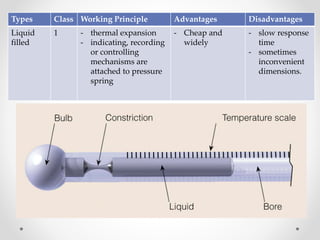
Types Class Working Principle Advantages Disadvantages
Liquid
filled
1 - thermal expansion
- indicating, recording
or controlling
mechanisms are
attached to pressure
spring
- Cheap and
widely
- slow response
time
- sometimes
inconvenient
dimensions.
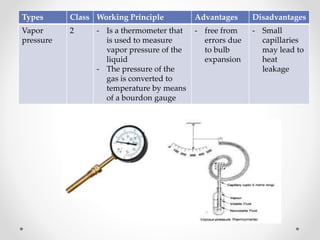
Types Class Working Principle Advantages Disadvantages
Vapor
pressure
2 - Is a thermometer that
is used to measure
vapor pressure of the
liquid
- The pressure of the
gas is converted to
temperature by means
of a bourdon gauge
- free from
errors due
to bulb
expansion
- Small
capillaries
may lead to
heat
leakage
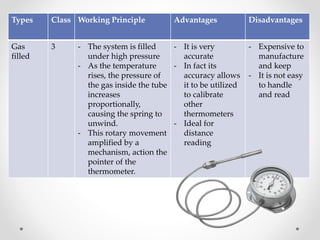
Types Class Working Principle Advantages Disadvantages
Gas
filled
3 - The system is filled
under high pressure
- As the temperature
rises, the pressure of
the gas inside the tube
increases
proportionally,
causing the spring to
unwind.
- This rotary movement
amplified by a
mechanism, action the
pointer of the
thermometer.
- It is very
accurate
- In fact its
accuracy allows
it to be utilized
to calibrate
other
thermometers
- Ideal for
distance
reading
- Expensive to
manufacture
and keep
- It is not easy
to handle
and read
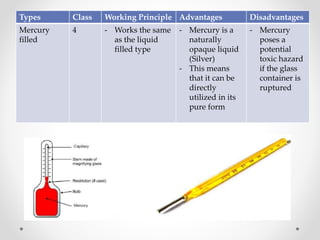
Types Class Working Principle Advantages Disadvantages
Mercury
filled
4 - Works the same
as the liquid
filled type
- Mercury is a
naturally
opaque liquid
(Silver)
- This means
that it can be
directly
utilized in its
pure form
- Mercury
poses a
potential
toxic hazard
if the glass
container is
ruptured
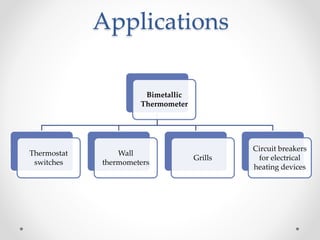
Bimetallic
Thermometer
Thermostat
switches
Wall
thermometers
Grills
Circuit breakers
for electrical
heating devices
Applications
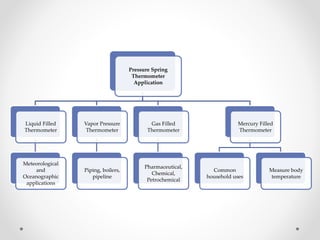
Pressure Spring
Thermometer
Application
Liquid Filled
Thermometer
Meteorological
and
Oceanographic
applications
Vapor Pressure
Thermometer
Piping, boilers,
pipeline
Gas Filled
Thermometer
Pharmaceutical,
Chemical,
Petrochemical
Mercury Filled
Thermometer
Common
household uses
Measure body
temperature
Temperature_Measurement

Temperature_Measurement

  • 1.
    Contents • Wheatstone bridge •Conventional types of temperature sensing, • Response of thermometer • Glass thermometer • Bimetallic thermometer • Filled system thermometer like pressure spring thermometer
  • 2.
    Wheatstone Bridge • Originallydeveloped by Charles Wheatstone to measure unknown resistance values and as a means of calibrating measuring instruments, voltmeters, ammeters, etc. • Consists of four resistors that are connected in the shape of a diamond with the supply source. • Used to find the unknown resistance very precisely by comparing with a known value of resistances, by balancing two legs of a bridge circuit, one leg of which includes the unknown component. Its operation is similar to the original potentiometer. • Used in two ways: o to measure the value of an unknown resistor by comparison to standard resistors o to detect small changes in a resistance transducer (e.g. thermistor)
  • 3.
    How Does Wheatstone Bridgeworks • Firstly, determine the type of thermistor used in the experiment. Measure the resistance of thermistor at room temperature, then heat a little bit and observe the resistance change as increasing or decreasing. • Then, built a Wheatstone bridge including thermistor and pot. *Rx is thermistor and R2 is pot. • After that adjust the pot until the voltage between bridge is zero at room temperature. This is done for calibration and going on the procedure from a reference value.
  • 4.
    • Later, heatthe thermistor and get at least 6 voltage values. • Use thermocouple and record voltages according to temperature.
  • 5.
    Applications of Wheatstone Bridge •Used for measuring the very low resistance values precisely. • Wheatstone bridge along with operational amplifier is used to measure the physical parameters like temperature, strain, light, etc. • Measure the quantities capacitance, inductance and impedance using the variations on the Wheatstone bridge.
  • 6.
    Advantages and Disadvantages • Advantages oIt operates on null deflection o measurement can be extremely precise for, or extremely sensitive to, a given change in the thermistor's resistance. • Disadvantages o not applicable for high resistances
  • 8.
    Thermocouples • Voltage devicesthat indicate temperature by measuring a change in voltage. • In the thermocouple, the sensing junction - produces a voltage that depends upon temperature. • Where the thermocouple connects to instrumentation - copper wires? - you have two more junctions and they also produce a temperature dependent voltage. • Applications include temperature measurement for gas turbine exhaust, diesel engines, other industrial processes and fog machines.
  • 9.
    Thermocouples • Working principle -Thermocouples are based on the principle that two wires made of dissimilar materials connected at either end will generate a potential between the two ends that is a function of the materials and temperature difference between two ends. Advantages • Temperature range • Self – Powered Disadvantages • Accuracy • Stability
  • 10.
    Resistant Temperature Detector(RTD) • Ratherthan using a voltage as the thermocouple does, they take advantage of another characteristic of matter which changes with temperature - its resistance. • Applications of RTD: Air conditioning and refrigeration servicing, food processing, stoves and grills
  • 11.
    Resistant Temperature Detector(RTD) • WorkingPrinciple - temperature sensor that operates on the measurement principle that a material’s electrical resistance changes with temperature. The relationship between an RTD’s resistance and the surrounding temperature is highly predictable, allowing for accurate and consistent temperature measurement Advantages • Linear over wide operating range • Wide temperature operating range • High temperature operating range Disadvantages • Low sensitivity • Higher cost than thermocouples • No point sensing
  • 12.
    Infrared Sensors • Infraredsensors are non-contacting sensors. • As an example, if you hold up a typical infrared sensor to the front of your desk without contact, the sensor will tell you the temperature of the desk by virtue of its radiation - probably 68°F at normal room temperature. • Application: Detecting clouds for remote telescope operation, Checking mechanical or electrical equipment for temperature and hot spots, Measuring the temperature of patients in a hospital without touching them
  • 13.
    Infrared Sensors Working Principle -consists of a lens to focus the infrared thermal radiation on to a detector, which converts the radiant power to an electrical signal that can be displayed in units of temperature after being compensated for ambient temperature. Advantages • It facilitates measurement of moving targets (conveyor processes). • Measurements can be taken of hazardous or physically inaccessible objects Disadvantages • Infrared thermometers cannot take measurements of gas or liquids • The environment needs to be clean, without dust, high humidity, or similar
  • 14.
    Bimetallic Devices • Bimetallicdevices take advantage of the expansion of metals when they are heated. • In these devices, two metals are bonded together and mechanically linked to a pointer. • Application: For various household appliances such as oven, Thermostat switches, wall thermometers
  • 15.
    Bimetallic Devices Working Principle -When heated, one side of the bimetallic strip will expand more than the other. And when geared properly to a pointer, the temperature is indicated. Advantages • Easy Construction • Fully mechanical devices, thus no need of power source. Disadvantages • Not accurate • Not suitable for measuring lower temperature
  • 16.
    Thermometer • A thermometeris a device that measures temperature or a temperature gradient. • A thermometer has two important elements: a temperature sensor mercury-in-glass thermometer) in which some physical change occurs with temperature, • Some means of converting this physical change into a numerical value
  • 17.
    Silicon Diode • Thesilicon diode sensor is a device that has been developed specifically for the cryogenic temperature range. • Essentially, they are linear devices where the conductivity of the diode increases linearly in the low cryogenic regions. • Application : a heat engine which converts a heat difference directly into electric power, a heat engine working backwards as a refrigerator, such as a Stirling engine
  • 18.
    Working Principle - Theforward voltage of a silicon diode, which may be the base-emitter junction of a bipolar junction transistor (BJT), is temperature-dependent Advantages • Low cost • Accurate and reliable • Highly consistent measurements Disadvantages • Self-heating • No resistance standards • Requirement of additional circuitry to control application loads Silicon Diode
  • 19.
    DYNAMIC RESPONSE • Firstorder system Input – Output = Rate of Accumulation hA(x-y) – 0 = mC 𝑑𝑌 𝑑𝑡 Where h = Convection coefficient of heat transfer (J/m2.h.0C) A = Surface Area of the sensor(m2) m = mass of thermocouple(g) C = heat capacity (J/g.oC) t = time(h)
  • 20.
    Deviation Variables hA [X-Y]= mC( 𝑑𝑌 𝑑𝑡 ) • 𝑚𝐶/ℎ𝐴= 𝜏 Taking Laplace Transform X(s) – Y(s) = τsY(s) – Y(0) ;Y(0)=0 𝑌(𝑠) 𝑋(𝑠) = 1 τ𝑠 + 1 = 𝑜𝑢𝑡𝑝𝑢𝑡 𝑖𝑛𝑝𝑢𝑡
  • 21.
  • 22.
    Definition  Glass capillarytube with a liquid-filled bulb at one end  Use the variation in volume of a liquid in temperature  The fluid is contained in sealed glass bulb and its expansion is measure by using scale attached to the stem of the thermometer
  • 23.
    As the temperature increases,the fluid expands and rises up the capillary As the temperature decreases the fluid contracts and goes down in the capillary
  • 24.
    Mercury Thermometer • Uses mercuryas the liquid to measure the temperature • It remains liquid in range from –38°C to 356°C • The mercury is in glass tube and when the heat is applied the mercury rises • Mercury is toxic and it should be handled with care Alcohol Thermometer •Uses alcohol (ethanol )as the liquid to measure temperature •Alcohol expands when absorbs temperature and contract in colder temperatures •Alcohol is non toxic and are much safer to use •Alcohol thermometers can be used to measure very low temperatures.(-115°C – 70 ° C ) Two major types of liquid-in – glass thermometer
  • 25.
    Construction • ThethinglassBulb: Thinglass reservoir that holds the liquid. Allows conduction of heat quickly through glass the liquid • TheStem: The glass tube having a tiny capillary along which the liquid expand or contract with changes in temperature • TheScale: A narrow temperature scale for reading a reference temperature • InertGas is used for mercury intended to high temperature. The thermometer is filled with an inert gas such as argon or nitrogen above the mercury to reduce its volatilization.
  • 26.
     Contraction Chamber:The purpose of this chamber is to shorten the total stem length needed to reach the main scale.  Expansion Chamber : To prevent the build-up of pressure if the temperature of the liquid rises past the top of the scale.
  • 27.
    How does glassthermometer operate Alcohol thermometers work by enclosing a narrow capillary attached to a bulb of reserve fluid. As the temperature goes down, the fluid contracts, dropping down the capillary. As the temperature heats up, the alcohol expands, rising up the capillary. Markers along the capillary indicate the temperature, with people reading the temperature by finding the marker which corresponds to the meniscus of the fluid inside the capillary This can be tricky to do with a narrow capillary, as the thin thread of alcohol may appear almost invisible even with dye.
  • 28.
    Mercury thermometer ~It iseasy to see, have a shining colour (silver) ~ It has regular expansion ~ Does not stick to the side of the glass capillary tube of a thermometer ~ Measure the temperature quickly and accurately ~Very expensive ~It is a poisonous substance ~Unsuitable for measuring a very low temperature because it has high freezing point
  • 29.
    • Suitable formeasuring high boiling point 357 oC • Not recommended for cold climates and should be brought indoors when the temperature starts dipping below -30oC • Applications :  Cooking kettles Pipe lines for fluid flow Open tanks containing liquids Meteorology
  • 30.
    Alcohol Thermometer ~ Itcan measure at low temperature because its freezing point is low (- 115°C) ~ It has regular expansion ~ Can measure the temperature accurately because it has large expansion coefficient ~Cannot measure at high temperature because its boiling point is low ~It is colourless so must add with dyestuff in order to visible
  • 31.
    • Alcohol hasa very low freezing point of about −115 oC suitable in thermometers to record very low temperatures. • Used in cold atmospheres such as freezers. • Not suitable in vey hot atmospheres due to the low boiling point (78 ͦC).
  • 32.
    Differences between Mercuryand Alcohol thermometer
  • 33.
  • 34.
    • That workon pressure or volume of a gas or changes in vapor pressure of a liquid • Depends on 3 well known physical phenomena: The thermal expansion of a liquid The temperature dependence of the pressure of a gas The temperature dependence of the saturated vapor pressure of a liquid Definition
  • 35.
    • Measurements arelisted as below: 1) Mercury in glass thermometer 2) Bimetallic thermometer 3) Pressure Spring thermometer ( √ ) Measurements
  • 37.
    Bimetallic Thermometer • Twometals whose coefficient of linear expansion is different are welded and rolled together to the desire thickness • The actual movement of a bimetal is its flexivity with one end fixed, a straight bimetal strip deflects in proportion to its temperature, to the square of its length and inversely with its thickens
  • 39.
    Advantages Disadvantages • Theyare cheap to buy • Easy to install • They are not extremely accurate • Are slow to react to a temperature change.
  • 40.
    Pressure Spring Thermometer Liquidfilled – Class 1 Vapor pressure – Class 2 Gas filled – Class 3 Mercury filled – Class 4
  • 41.
    Types Class WorkingPrinciple Advantages Disadvantages Liquid filled 1 - thermal expansion - indicating, recording or controlling mechanisms are attached to pressure spring - Cheap and widely - slow response time - sometimes inconvenient dimensions.
  • 42.
    Types Class WorkingPrinciple Advantages Disadvantages Vapor pressure 2 - Is a thermometer that is used to measure vapor pressure of the liquid - The pressure of the gas is converted to temperature by means of a bourdon gauge - free from errors due to bulb expansion - Small capillaries may lead to heat leakage
  • 43.
    Types Class WorkingPrinciple Advantages Disadvantages Gas filled 3 - The system is filled under high pressure - As the temperature rises, the pressure of the gas inside the tube increases proportionally, causing the spring to unwind. - This rotary movement amplified by a mechanism, action the pointer of the thermometer. - It is very accurate - In fact its accuracy allows it to be utilized to calibrate other thermometers - Ideal for distance reading - Expensive to manufacture and keep - It is not easy to handle and read
  • 44.
    Types Class WorkingPrinciple Advantages Disadvantages Mercury filled 4 - Works the same as the liquid filled type - Mercury is a naturally opaque liquid (Silver) - This means that it can be directly utilized in its pure form - Mercury poses a potential toxic hazard if the glass container is ruptured
  • 45.
  • 46.
    Pressure Spring Thermometer Application Liquid Filled Thermometer Meteorological and Oceanographic applications VaporPressure Thermometer Piping, boilers, pipeline Gas Filled Thermometer Pharmaceutical, Chemical, Petrochemical Mercury Filled Thermometer Common household uses Measure body temperature

Editor's Notes

  • #3 Rx is the unknown resistance to be measured; R1, R2 and R3 are resistors of known resistance and the resistance of R2 is adjustable. If the ratio of the two resistances in the known leg (R2 / R1) is equal to the ratio of the two in the unknown leg (Rx / R3), then the voltage between the two midpoints (B and D) will be zero and no current will flow through the galvanometer Vg. R2 is varied until this condition is reached. The direction of the current indicates whether R2 is too high or too low.
  • #19 Silicon bandgap temperature sensors are operated on a principle of temperature dependence of forward voltage of a silicon diode, which is represented by the following equation:      VBE = VG0(1 - T / T0) + VBE0(T / T0) + (nKT / q) ln(T0 / T) + (KT / q)ln(IC / IC0) where, n = a device-dependent constant q = charge on an electron K = Boltzmann's constant VBE0 = bandgap voltage at temperature T0 and current IC0 VG0 = bandgap voltage at absolute zero T = temperature in K Elimination of most of the variables in the above equation by comparing the bandgap voltages at two different currents, IC1 and IC2, results in the following equation:      ΔVBE = (KT / q)ln(IC1 / IC2) Thus, ΔVBE can be measured with an electronic circuit that is used to calculate the temperature of the diode. The output thus calculated remains stable up to about 200 to 250°C. More exotic materials like silicon carbide can be employed for temperatures above 250°C.
  • #29 It is known to have a high co-efficient of expansion - which basically means that even relatively minor changes in heat will be reflected by a change in the fluid's volume.
  • #35 Filled System, or just filled thermometers are those that work on pressure or volume change of a gas or changes in vapor pressure of a liquid.