INDUSTRIAL TRAINING PRESENTATION
ON
“STUDY ON TEMPERATURE MEASUREMENT OF CRUDE OIL BY THERMAL
SENSORS”
From IOCL, Mathura , UP
A presentation submitted in partial fulfilment of the requirements for the Award of the Degree of
BACHELOR OF TECHNOLOGY
IN
ELECTRONICS ENGINEERING
Submitted to- Presented by-
Dr. P.K Verma Shikhar Saxena
Assistant Professor Electronics Engineering
Department of Electronics Engineering 4th year (1684130042)
Electronics Engineering Department
Rajkiya Engineering College, Sonbhadra, UP (231206)
Outlines
• About IOCL
• Thermal Sensors
• Types Of Thermal Sensors
• Thermocouple Fundamentals
• Thermistor
• Thermocouples
• RTD
• Conclusion
• References
About IOCL
• Indian Oil Corporation (Indian Oil) is India's largest commercial enterprise, with a sales turnover
of Rs. 4,38,710 crore (USD 65,391 million) and profits of Rs. 19,106 crore (USD 2,848 million)
for the year 2016-17. The improvement in operational and financial performance for FY 2016-17
reflected in the market capitalization of the Company, which grew two-fold, from Rs. 95,564 crore
as on 31st March 2016 to Rs. 1,87,948 crore as on 31st March 2017.
• In view of its rising share price and market capitalisation, Indian Oil was included in the Nifty50
index (NSE benchmark index of 50 best performing corporates). Indian Oil is ranked 161st among
the world's largest corporates (and first among Indian enterprises) in the prestigious Fortune
‘Global 500’ listing for the year 2016.
About IOCL
Introduction:
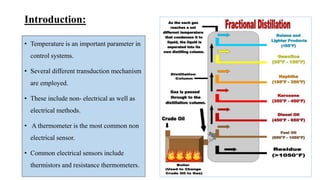
• Temperature is an important parameter in
control systems.
• Several different transduction mechanism
are employed.
• These include non- electrical as well as
electrical methods.
• A thermometer is the most common non
electrical sensor.
• Common electrical sensors include
thermistors and resistance thermometers.
Thermal Sensors:
• Also known as Temperature Sensor.
• A device that detects temperature.
• Thermal sensor is extremely rugged, low-cost, self-powered and can be used for long distance.
• There are many types of temperature sensors that have a wide range of applications.
• A temperature sensor plays an important role in many applications. For example, maintaining a
specific temperature is essential for equipment used to fabricate medical drugs, heat liquids, or
clean other equipment. For applications like these, the responsiveness and accuracy of the
detection circuit can be critical for quality control.
• A thermocouple is a voltage device that indicates temperature by measuring a change in the
voltage.
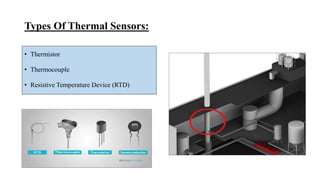
Types Of Thermal Sensors:
• Thermistor
• Thermocouple
• Resistive Temperature Device (RTD)
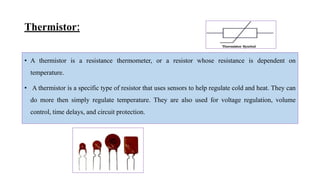
Thermistor:
• A thermistor is a resistance thermometer, or a resistor whose resistance is dependent on
temperature.
• A thermistor is a specific type of resistor that uses sensors to help regulate cold and heat. They can
do more then simply regulate temperature. They are also used for voltage regulation, volume
control, time delays, and circuit protection.
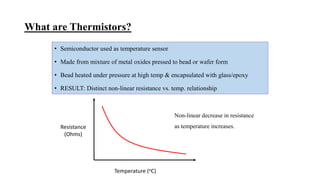
What are Thermistors?
• Semiconductor used as temperature sensor
• Made from mixture of metal oxides pressed to bead or wafer form
• Bead heated under pressure at high temp & encapsulated with glass/epoxy
• RESULT: Distinct non-linear resistance vs. temp. relationship
Temperature (oC)
Resistance
(Ohms)
Non-linear decrease in resistance
as temperature increases.
So Sensitive…
• Very large resistance change = small temp.
change
• 3 – 5% per oC (vs. 0.4% per oC for RTDs)
• Temp. changes as small as 0.1oC
• Significantly smaller in size
• Temp range: -100oC – 300oC (-120oF – 570oF)
• No Industrial Standards
• Base resistance range: 103 – 106 ohms
• Typically measured at 25oC vs. 0oC for RTDs
• TCRs vary widely
• Thermistor’s accuracy limited to small temp. range
Thermistor Standards
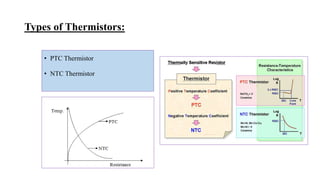
Types of Thermistors:
• PTC Thermistor
• NTC Thermistor
Thermocouples
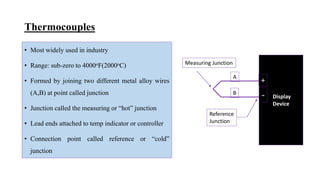
• Most widely used in industry
• Range: sub-zero to 4000oF(2000oC)
• Formed by joining two different metal alloy wires
(A,B) at point called junction
• Junction called the measuring or “hot” junction
• Lead ends attached to temp indicator or controller
• Connection point called reference or “cold”
junction
Display
Device
+
-
A
B
Reference
Junction
Measuring Junction
How does it work?
• Measuring junction is heated, small DC voltage (millivolts) generated in thermocouple wires
• Thermocouple converts thermal energy into electrical energy
• Note: thermocouple only generates a milli-voltage signal when there is temperature difference
between “hot” and “cold” junctions
• “cold” junction usually set to 32oF(0oC)
Types of Thermocouple:
1- Base Metal Thermocouple
• Type J (Mostly Used in IOCL)
• Type E, K, N, T, R, S, B.
2- Noble Metal Thermocouple
• Type R, S, B.
3- Refractory Metal Thermocouple
• Type C, G, D.
1. Steel Industry
2. Cement Industry
3. Pharmaceutical Industry
4. Petrochemical Industry
5. Nuclear Industry
6. Power Industry
7. Laboratories
8. Furnace Industry
Applications of Thermocouple:
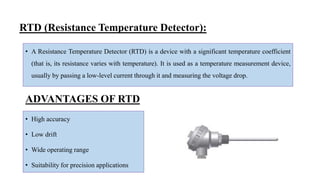
RTD (Resistance Temperature Detector):
• A Resistance Temperature Detector (RTD) is a device with a significant temperature coefficient
(that is, its resistance varies with temperature). It is used as a temperature measurement device,
usually by passing a low-level current through it and measuring the voltage drop.
• High accuracy
• Low drift
• Wide operating range
• Suitability for precision applications
ADVANTAGES OF RTD
Resistance Temperature Devices (RTD)
• Precision Temperature Sensors
• More accurate than thermocouple elements
• Maintain accuracy over longer period of time
• Range up to 1200oF (650oC)
• Styles
• Wire-Wound
• Thin film
• Kapton Insulated
How do RTDs work?
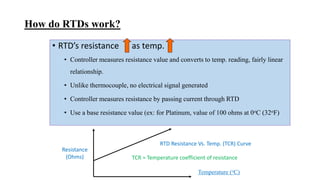
• RTD’s resistance as temp.
• Controller measures resistance value and converts to temp. reading, fairly linear
relationship.
• Unlike thermocouple, no electrical signal generated
• Controller measures resistance by passing current through RTD
• Use a base resistance value (ex: for Platinum, value of 100 ohms at 0oC (32oF)
Temperature (oC)
Resistance
(Ohms)
RTD Resistance Vs. Temp. (TCR) Curve
TCR = Temperature coefficient of resistance
RTD Vs. Thermocouples
• Advantages of RTDs
• Stability
• Repeatability
• Accuracy
• Disadvantages of RTDs
• Cost: Platinum = $$$, 2x more expensive
• Temp. Range limited
• Response Time slower, 2x-4x times slower
• Heat must transfer through epoxy or glass coating
• Entire RTD element must reach uniform temp. before accurate measurement taken.
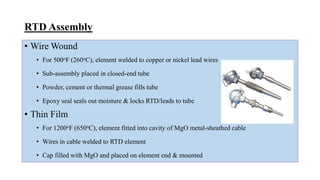
RTD Assembly
• Wire Wound
• For 500oF (260oC), element welded to copper or nickel lead wires
• Sub-assembly placed in closed-end tube
• Powder, cement or thermal grease fills tube
• Epoxy seal seals out moisture & locks RTD/leads to tube
• Thin Film
• For 1200oF (650oC), element fitted into cavity of MgO metal-sheathed cable
• Wires in cable welded to RTD element
• Cap filled with MgO and placed on element end & mounted
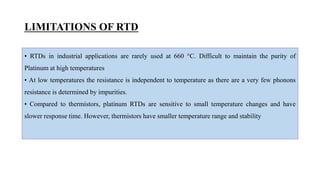
LIMITATIONS OF RTD
• RTDs in industrial applications are rarely used at 660 °C. Difficult to maintain the purity of
Platinum at high temperatures
• At low temperatures the resistance is independent to temperature as there are a very few phonons
resistance is determined by impurities.
• Compared to thermistors, platinum RTDs are sensitive to small temperature changes and have
slower response time. However, thermistors have smaller temperature range and stability
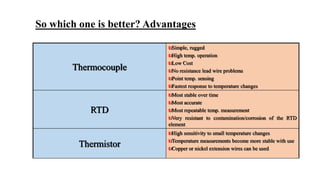
So which one is better? Advantages
Thermocouple
Simple, rugged
High temp. operation
Low Cost
No resistance lead wire problems
Point temp. sensing
Fastest response to temperature changes
RTD
Most stable over time
Most accurate
Most repeatable temp. measurement
Very resistant to contamination/corrosion of the RTD
element
Thermistor
High sensitivity to small temperature changes
Temperature measurements become more stable with use
Copper or nickel extension wires can be used
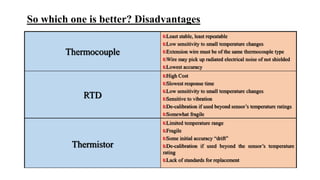
So which one is better? Disadvantages
Thermocouple
Least stable, least repeatable
Low sensitivity to small temperature changes
Extension wire must be of the same thermocouple type
Wire may pick up radiated electrical noise of not shielded
Lowest accuracy
RTD
High Cost
Slowest response time
Low sensitivity to small temperature changes
Sensitive to vibration
De-calibration if used beyond sensor’s temperature ratings
Somewhat fragile
Thermistor
Limited temperature range
Fragile
Some initial accuracy “drift”
De-calibration if used beyond the sensor’s temperature
rating
Lack of standards for replacement
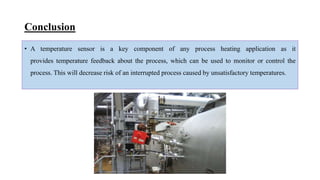
Conclusion
• A temperature sensor is a key component of any process heating application as it
provides temperature feedback about the process, which can be used to monitor or control the
process. This will decrease risk of an interrupted process caused by unsatisfactory temperatures.
References
• Physics of Semiconductor Devices (Third Edition) By S. M. Sze
• https://www.iocl.com/
• https://www.wikipedia.org/
FINAL PPT.pptx

FINAL PPT.pptx

  • 1.
    INDUSTRIAL TRAINING PRESENTATION ON “STUDYON TEMPERATURE MEASUREMENT OF CRUDE OIL BY THERMAL SENSORS” From IOCL, Mathura , UP A presentation submitted in partial fulfilment of the requirements for the Award of the Degree of BACHELOR OF TECHNOLOGY IN ELECTRONICS ENGINEERING Submitted to- Presented by- Dr. P.K Verma Shikhar Saxena Assistant Professor Electronics Engineering Department of Electronics Engineering 4th year (1684130042) Electronics Engineering Department Rajkiya Engineering College, Sonbhadra, UP (231206)
  • 2.
    Outlines • About IOCL •Thermal Sensors • Types Of Thermal Sensors • Thermocouple Fundamentals • Thermistor • Thermocouples • RTD • Conclusion • References
  • 3.
    About IOCL • IndianOil Corporation (Indian Oil) is India's largest commercial enterprise, with a sales turnover of Rs. 4,38,710 crore (USD 65,391 million) and profits of Rs. 19,106 crore (USD 2,848 million) for the year 2016-17. The improvement in operational and financial performance for FY 2016-17 reflected in the market capitalization of the Company, which grew two-fold, from Rs. 95,564 crore as on 31st March 2016 to Rs. 1,87,948 crore as on 31st March 2017. • In view of its rising share price and market capitalisation, Indian Oil was included in the Nifty50 index (NSE benchmark index of 50 best performing corporates). Indian Oil is ranked 161st among the world's largest corporates (and first among Indian enterprises) in the prestigious Fortune ‘Global 500’ listing for the year 2016.
  • 4.
  • 5.
    Introduction: • Temperature isan important parameter in control systems. • Several different transduction mechanism are employed. • These include non- electrical as well as electrical methods. • A thermometer is the most common non electrical sensor. • Common electrical sensors include thermistors and resistance thermometers.
  • 6.
    Thermal Sensors: • Alsoknown as Temperature Sensor. • A device that detects temperature. • Thermal sensor is extremely rugged, low-cost, self-powered and can be used for long distance. • There are many types of temperature sensors that have a wide range of applications. • A temperature sensor plays an important role in many applications. For example, maintaining a specific temperature is essential for equipment used to fabricate medical drugs, heat liquids, or clean other equipment. For applications like these, the responsiveness and accuracy of the detection circuit can be critical for quality control. • A thermocouple is a voltage device that indicates temperature by measuring a change in the voltage.
  • 7.
    Types Of ThermalSensors: • Thermistor • Thermocouple • Resistive Temperature Device (RTD)
  • 8.
    Thermistor: • A thermistoris a resistance thermometer, or a resistor whose resistance is dependent on temperature. • A thermistor is a specific type of resistor that uses sensors to help regulate cold and heat. They can do more then simply regulate temperature. They are also used for voltage regulation, volume control, time delays, and circuit protection.
  • 9.
    What are Thermistors? •Semiconductor used as temperature sensor • Made from mixture of metal oxides pressed to bead or wafer form • Bead heated under pressure at high temp & encapsulated with glass/epoxy • RESULT: Distinct non-linear resistance vs. temp. relationship Temperature (oC) Resistance (Ohms) Non-linear decrease in resistance as temperature increases.
  • 10.
    So Sensitive… • Verylarge resistance change = small temp. change • 3 – 5% per oC (vs. 0.4% per oC for RTDs) • Temp. changes as small as 0.1oC • Significantly smaller in size • Temp range: -100oC – 300oC (-120oF – 570oF) • No Industrial Standards • Base resistance range: 103 – 106 ohms • Typically measured at 25oC vs. 0oC for RTDs • TCRs vary widely • Thermistor’s accuracy limited to small temp. range Thermistor Standards
  • 11.
    Types of Thermistors: •PTC Thermistor • NTC Thermistor
  • 12.
    Thermocouples • Most widelyused in industry • Range: sub-zero to 4000oF(2000oC) • Formed by joining two different metal alloy wires (A,B) at point called junction • Junction called the measuring or “hot” junction • Lead ends attached to temp indicator or controller • Connection point called reference or “cold” junction Display Device + - A B Reference Junction Measuring Junction
  • 13.
    How does itwork? • Measuring junction is heated, small DC voltage (millivolts) generated in thermocouple wires • Thermocouple converts thermal energy into electrical energy • Note: thermocouple only generates a milli-voltage signal when there is temperature difference between “hot” and “cold” junctions • “cold” junction usually set to 32oF(0oC)
  • 14.
    Types of Thermocouple: 1-Base Metal Thermocouple • Type J (Mostly Used in IOCL) • Type E, K, N, T, R, S, B. 2- Noble Metal Thermocouple • Type R, S, B. 3- Refractory Metal Thermocouple • Type C, G, D. 1. Steel Industry 2. Cement Industry 3. Pharmaceutical Industry 4. Petrochemical Industry 5. Nuclear Industry 6. Power Industry 7. Laboratories 8. Furnace Industry Applications of Thermocouple:
  • 15.
    RTD (Resistance TemperatureDetector): • A Resistance Temperature Detector (RTD) is a device with a significant temperature coefficient (that is, its resistance varies with temperature). It is used as a temperature measurement device, usually by passing a low-level current through it and measuring the voltage drop. • High accuracy • Low drift • Wide operating range • Suitability for precision applications ADVANTAGES OF RTD
  • 16.
    Resistance Temperature Devices(RTD) • Precision Temperature Sensors • More accurate than thermocouple elements • Maintain accuracy over longer period of time • Range up to 1200oF (650oC) • Styles • Wire-Wound • Thin film • Kapton Insulated
  • 17.
    How do RTDswork? • RTD’s resistance as temp. • Controller measures resistance value and converts to temp. reading, fairly linear relationship. • Unlike thermocouple, no electrical signal generated • Controller measures resistance by passing current through RTD • Use a base resistance value (ex: for Platinum, value of 100 ohms at 0oC (32oF) Temperature (oC) Resistance (Ohms) RTD Resistance Vs. Temp. (TCR) Curve TCR = Temperature coefficient of resistance
  • 18.
    RTD Vs. Thermocouples •Advantages of RTDs • Stability • Repeatability • Accuracy • Disadvantages of RTDs • Cost: Platinum = $$$, 2x more expensive • Temp. Range limited • Response Time slower, 2x-4x times slower • Heat must transfer through epoxy or glass coating • Entire RTD element must reach uniform temp. before accurate measurement taken.
  • 19.
    RTD Assembly • WireWound • For 500oF (260oC), element welded to copper or nickel lead wires • Sub-assembly placed in closed-end tube • Powder, cement or thermal grease fills tube • Epoxy seal seals out moisture & locks RTD/leads to tube • Thin Film • For 1200oF (650oC), element fitted into cavity of MgO metal-sheathed cable • Wires in cable welded to RTD element • Cap filled with MgO and placed on element end & mounted
  • 20.
    LIMITATIONS OF RTD •RTDs in industrial applications are rarely used at 660 °C. Difficult to maintain the purity of Platinum at high temperatures • At low temperatures the resistance is independent to temperature as there are a very few phonons resistance is determined by impurities. • Compared to thermistors, platinum RTDs are sensitive to small temperature changes and have slower response time. However, thermistors have smaller temperature range and stability
  • 21.
    So which oneis better? Advantages Thermocouple Simple, rugged High temp. operation Low Cost No resistance lead wire problems Point temp. sensing Fastest response to temperature changes RTD Most stable over time Most accurate Most repeatable temp. measurement Very resistant to contamination/corrosion of the RTD element Thermistor High sensitivity to small temperature changes Temperature measurements become more stable with use Copper or nickel extension wires can be used
  • 22.
    So which oneis better? Disadvantages Thermocouple Least stable, least repeatable Low sensitivity to small temperature changes Extension wire must be of the same thermocouple type Wire may pick up radiated electrical noise of not shielded Lowest accuracy RTD High Cost Slowest response time Low sensitivity to small temperature changes Sensitive to vibration De-calibration if used beyond sensor’s temperature ratings Somewhat fragile Thermistor Limited temperature range Fragile Some initial accuracy “drift” De-calibration if used beyond the sensor’s temperature rating Lack of standards for replacement
  • 23.
    Conclusion • A temperaturesensor is a key component of any process heating application as it provides temperature feedback about the process, which can be used to monitor or control the process. This will decrease risk of an interrupted process caused by unsatisfactory temperatures.
  • 24.
    References • Physics ofSemiconductor Devices (Third Edition) By S. M. Sze • https://www.iocl.com/ • https://www.wikipedia.org/