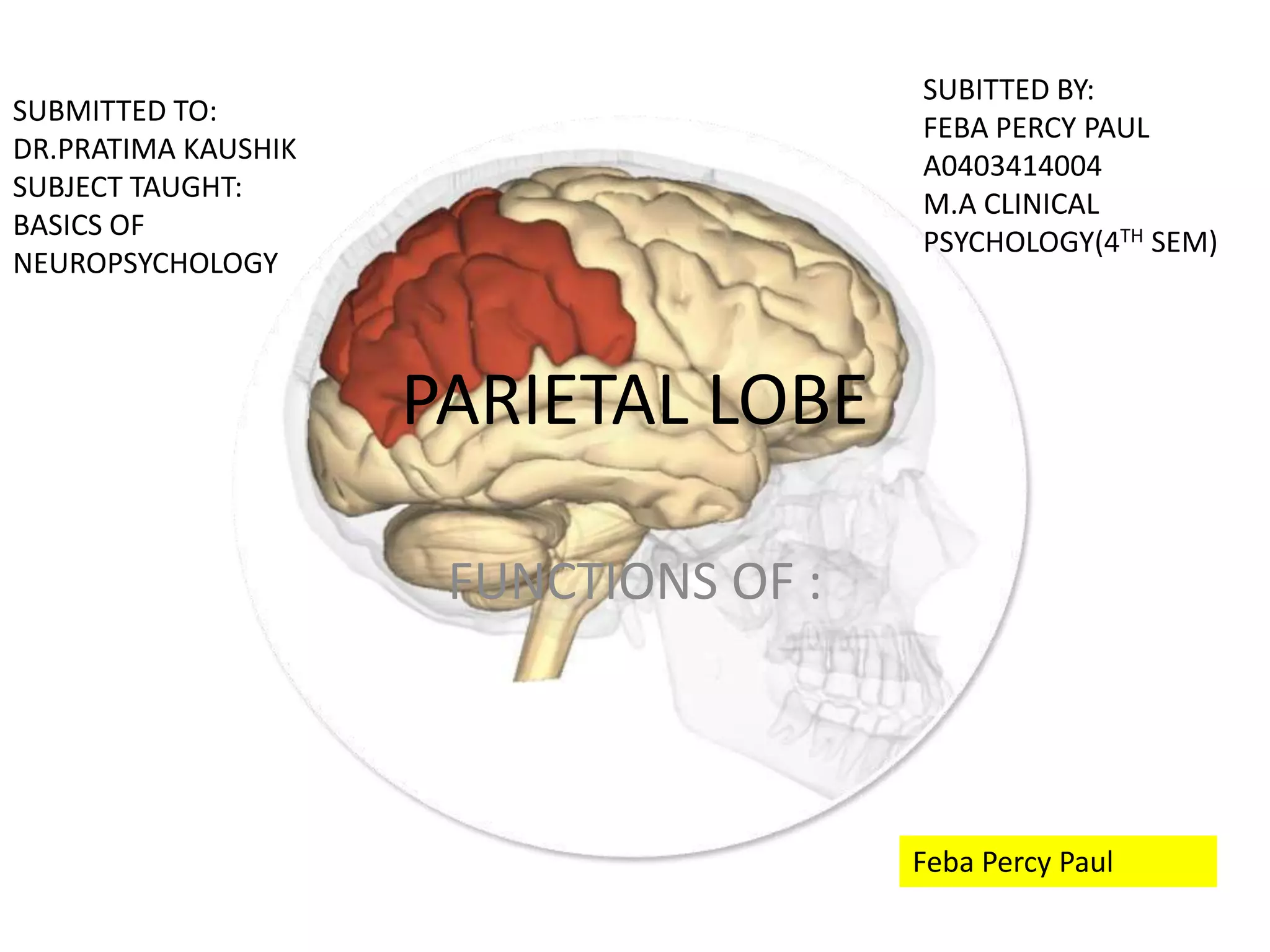
PARIETAL LOBE
FUNCTIONS OF :
SUBITTED BY:
FEBA PERCY PAUL
A0403414004
M.A CLINICAL
PSYCHOLOGY(4TH SEM)
SUBMITTED TO:
DR.PRATIMA KAUSHIK
SUBJECT TAUGHT:
BASICS OF
NEUROPSYCHOLOGY
Feba Percy Paul
Major functions
• Cognition
• Information Processing
• Touch Sensation (Pain, Temperature, etc.)
• Understanding Spatial Orientation
• Movement Coordination
• Speech
• Visual Perception
• Reading and Writing
• Mathematical Computation
Feba Percy Paul
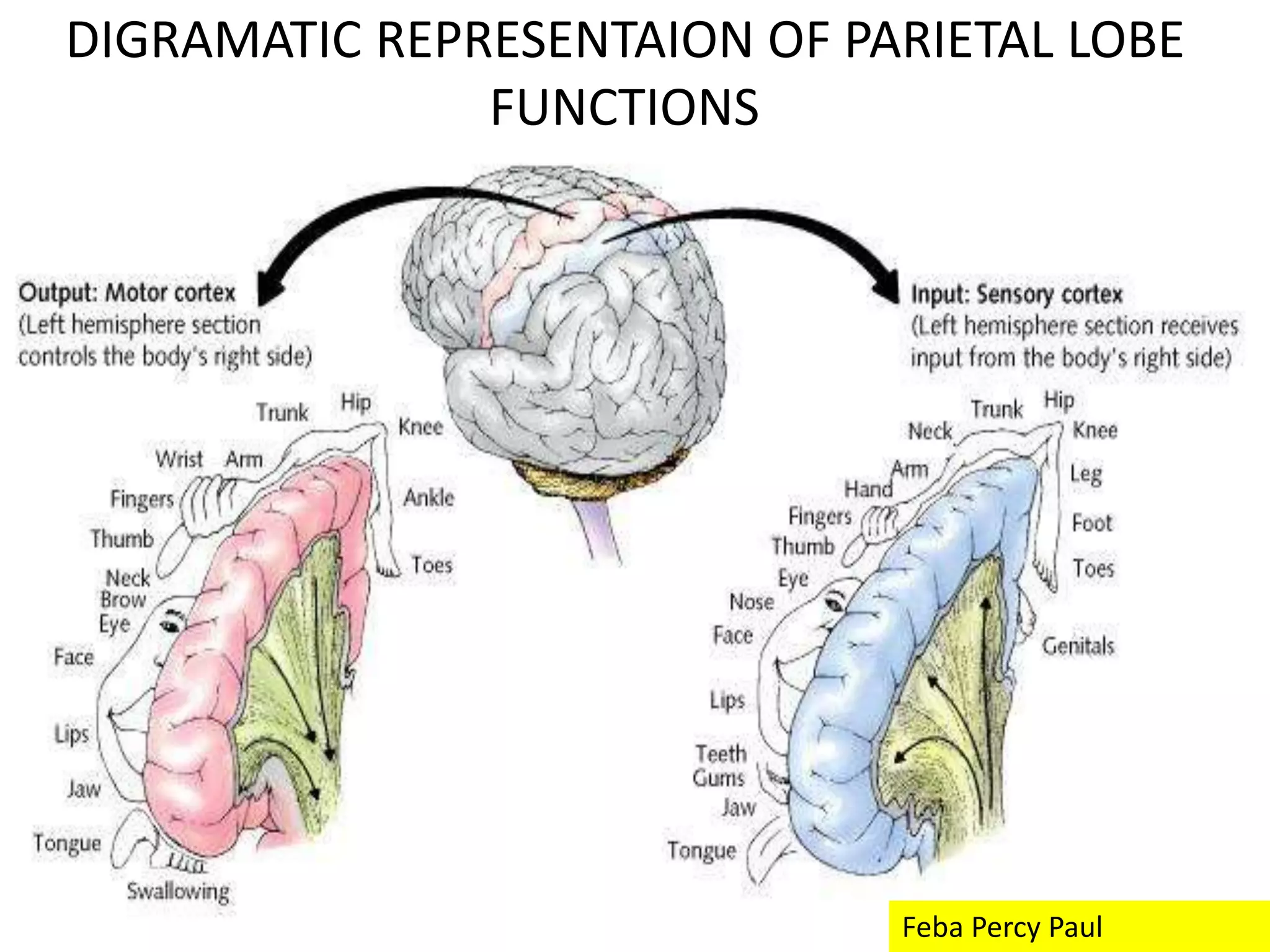
DIGRAMATIC REPRESENTAION OF PARIETAL LOBE
FUNCTIONS
Feba Percy Paul
Sensations
• One of the main functions is to receive and
process sensory information from all over the
body.
• The somatosensory cortex is found within
the parietal lobes and is essential for
processing touch sensations.
• For instance, the somatosensory cortex helps
us to identify the location of a touch
sensation and to discriminate between
sensations such as temperature and pain.
• Neurons in the parietal lobes receive touch,
visual and other sensory information from a
part of the brain called the thalamus.
• The thalamus relays nerve signals and
sensory information between the peripheral
nervous system and the cerebral cortex.
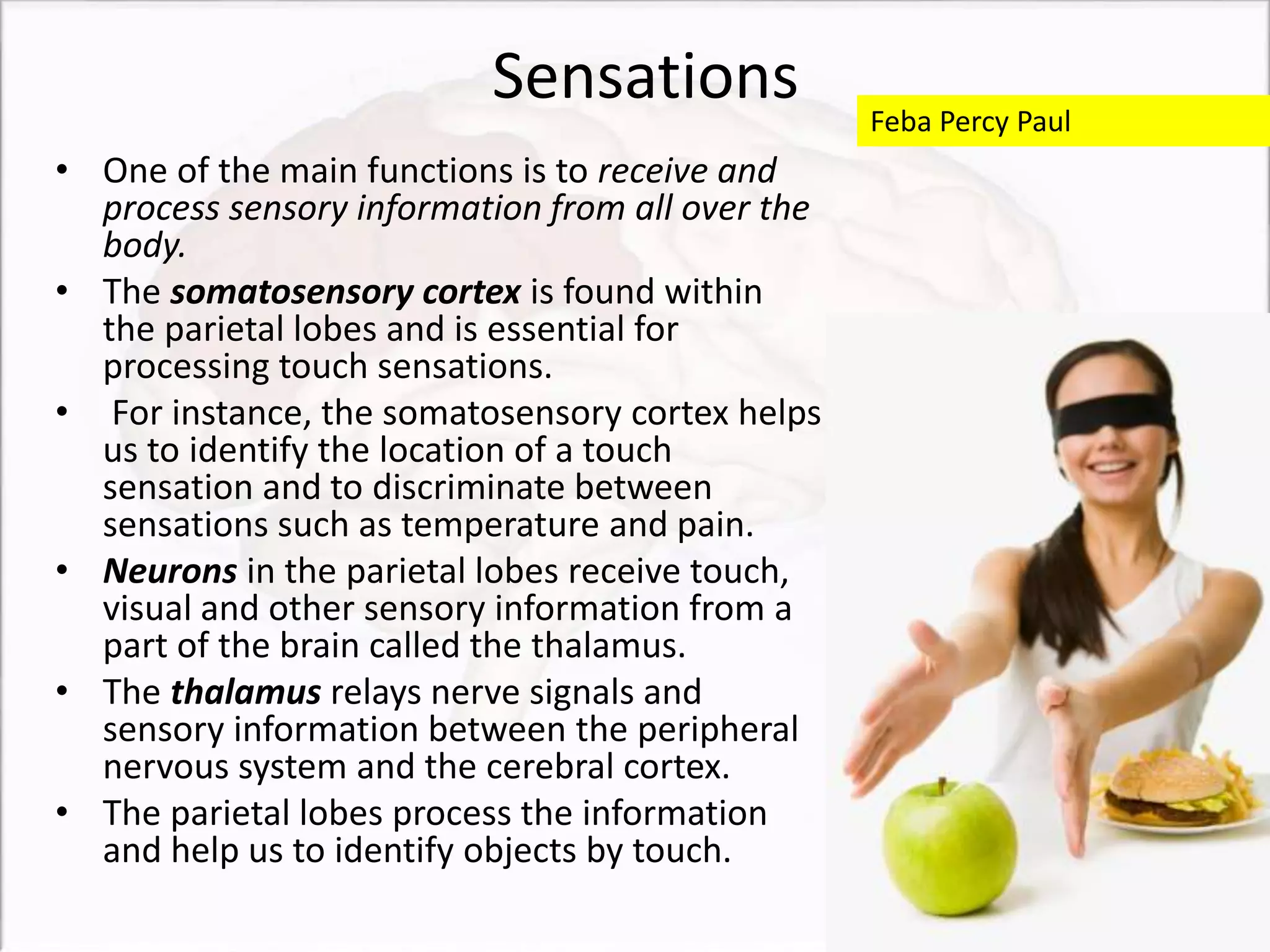
• The parietal lobes process the information
and help us to identify objects by touch.
Feba Percy Paul
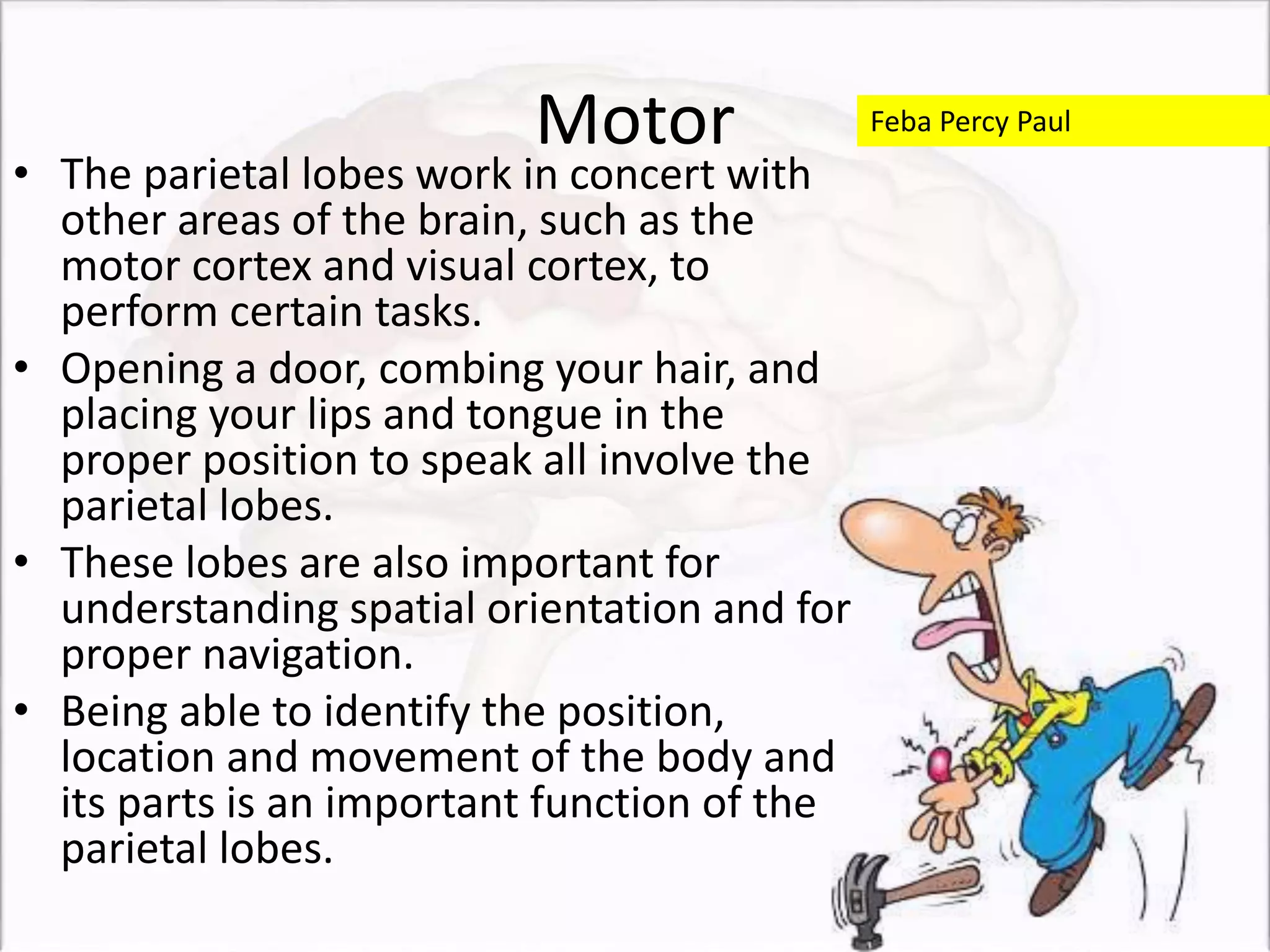
Motor
• The parietal lobes work in concert with
other areas of the brain, such as the
motor cortex and visual cortex, to
perform certain tasks.
• Opening a door, combing your hair, and
placing your lips and tongue in the
proper position to speak all involve the
parietal lobes.
• These lobes are also important for
understanding spatial orientation and for
proper navigation.
• Being able to identify the position,
location and movement of the body and
its parts is an important function of the
parietal lobes.
Feba Percy Paul
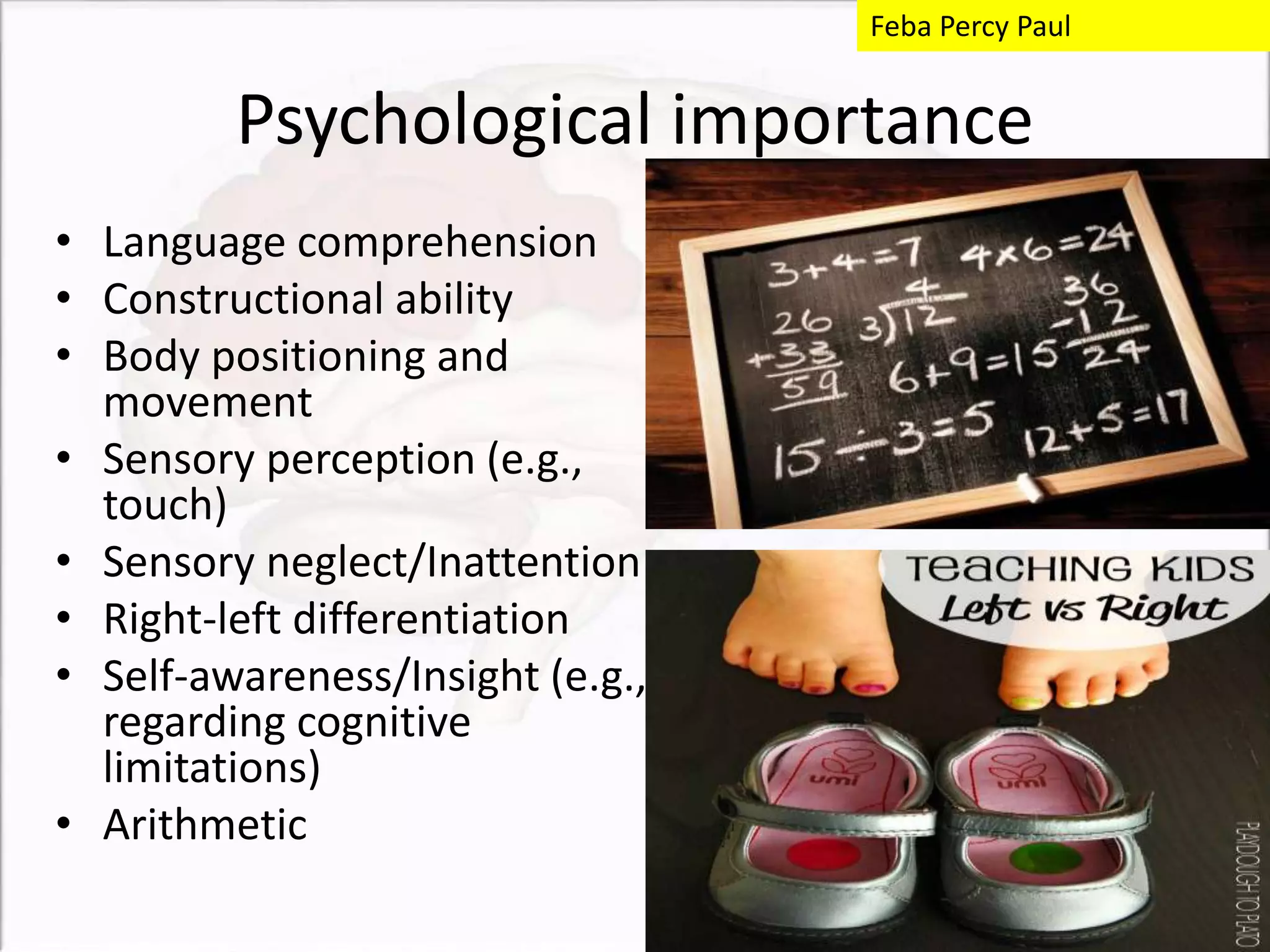
Psychological importance
• Language comprehension
• Constructional ability
• Body positioning and
movement
• Sensory perception (e.g.,
touch)
• Sensory neglect/Inattention
• Right-left differentiation
• Self-awareness/Insight (e.g.,
regarding cognitive
limitations)
• Arithmetic
Feba Percy Paul
Incase of damage
• Damage or injury to the parietal lobe can cause difficulties in language processing which
include the
• Inability to recall the correct names of everyday items, inability to write or spell, impaired
reading, and the inability to position the lips or tongue properly in order to speak.
Other problems that may result form damage to the parietal lobes include
1. difficulty in performing goal directed tasks,
2. difficulty in drawing and performing math calculations,
3. difficulty in identifying objects by touch or distinguishing between different types of
touch,
4. inability to distinguish left from right,
5. lack of hand-eye coordination, difficulty in understanding direction,
6. lack of body awareness,
7. difficulty in making exact movements,
8. inability to perform complex tasks in the proper order,
9. difficulty in localizing touch and
10. deficits in attention.
• Certain types of problems are associated with damage caused to either the left or right hemispheres
of the brain. Damage to the left parietal lobe typically results in difficulties in understanding language
and writing. Damage to the right parietal lobe results in difficulties with understanding spatial
orientation and navigation.
Feba Percy Paul
Summary
• The parietal lobes are one of the four main lobes or
regions of the cerebral cortex.
• The parietal lobes are positioned behind the frontal
lobes and above the temporal lobes.
• These lobes are important to the processing of
sensory information, understanding spatial
orientation and body awareness.
• The parietal lobe is where information such as taste,
temperature and touch are integrated, or processed.
• Humans would not be able to feel sensations of
touch or do simple coordination tas if the parietal
lobe was damaged
Feba Percy Paul
sources
• Mishkin M, Ungerleider LG. (1982) Contribution of striate
inputs to the visuospatial functions of parieto-preoccipital
cortex in monkeys. Behav Brain Res. 1982 Sep;6(1):57-
77.
• www.biologyabout.com
• www.brittanica.com
• www.studyblue.com
Feba Percy Paul
THANK YOU ! 
Feba Percy Paul

Functions of Parietal Lobe

  • 1.
    PARIETAL LOBE FUNCTIONS OF: SUBITTED BY: FEBA PERCY PAUL A0403414004 M.A CLINICAL PSYCHOLOGY(4TH SEM) SUBMITTED TO: DR.PRATIMA KAUSHIK SUBJECT TAUGHT: BASICS OF NEUROPSYCHOLOGY Feba Percy Paul
  • 2.
    Major functions • Cognition •Information Processing • Touch Sensation (Pain, Temperature, etc.) • Understanding Spatial Orientation • Movement Coordination • Speech • Visual Perception • Reading and Writing • Mathematical Computation Feba Percy Paul
  • 3.
    DIGRAMATIC REPRESENTAION OFPARIETAL LOBE FUNCTIONS Feba Percy Paul
  • 4.
    Sensations • One ofthe main functions is to receive and process sensory information from all over the body. • The somatosensory cortex is found within the parietal lobes and is essential for processing touch sensations. • For instance, the somatosensory cortex helps us to identify the location of a touch sensation and to discriminate between sensations such as temperature and pain. • Neurons in the parietal lobes receive touch, visual and other sensory information from a part of the brain called the thalamus. • The thalamus relays nerve signals and sensory information between the peripheral nervous system and the cerebral cortex. • The parietal lobes process the information and help us to identify objects by touch. Feba Percy Paul
  • 5.
    Motor • The parietallobes work in concert with other areas of the brain, such as the motor cortex and visual cortex, to perform certain tasks. • Opening a door, combing your hair, and placing your lips and tongue in the proper position to speak all involve the parietal lobes. • These lobes are also important for understanding spatial orientation and for proper navigation. • Being able to identify the position, location and movement of the body and its parts is an important function of the parietal lobes. Feba Percy Paul
  • 6.
    Psychological importance • Languagecomprehension • Constructional ability • Body positioning and movement • Sensory perception (e.g., touch) • Sensory neglect/Inattention • Right-left differentiation • Self-awareness/Insight (e.g., regarding cognitive limitations) • Arithmetic Feba Percy Paul
  • 7.
    Incase of damage •Damage or injury to the parietal lobe can cause difficulties in language processing which include the • Inability to recall the correct names of everyday items, inability to write or spell, impaired reading, and the inability to position the lips or tongue properly in order to speak. Other problems that may result form damage to the parietal lobes include 1. difficulty in performing goal directed tasks, 2. difficulty in drawing and performing math calculations, 3. difficulty in identifying objects by touch or distinguishing between different types of touch, 4. inability to distinguish left from right, 5. lack of hand-eye coordination, difficulty in understanding direction, 6. lack of body awareness, 7. difficulty in making exact movements, 8. inability to perform complex tasks in the proper order, 9. difficulty in localizing touch and 10. deficits in attention. • Certain types of problems are associated with damage caused to either the left or right hemispheres of the brain. Damage to the left parietal lobe typically results in difficulties in understanding language and writing. Damage to the right parietal lobe results in difficulties with understanding spatial orientation and navigation. Feba Percy Paul
  • 8.
    Summary • The parietallobes are one of the four main lobes or regions of the cerebral cortex. • The parietal lobes are positioned behind the frontal lobes and above the temporal lobes. • These lobes are important to the processing of sensory information, understanding spatial orientation and body awareness. • The parietal lobe is where information such as taste, temperature and touch are integrated, or processed. • Humans would not be able to feel sensations of touch or do simple coordination tas if the parietal lobe was damaged Feba Percy Paul
  • 9.
    sources • Mishkin M,Ungerleider LG. (1982) Contribution of striate inputs to the visuospatial functions of parieto-preoccipital cortex in monkeys. Behav Brain Res. 1982 Sep;6(1):57- 77. • www.biologyabout.com • www.brittanica.com • www.studyblue.com Feba Percy Paul
  • 10.
    THANK YOU ! Feba Percy Paul