Presenter :Dr S. Vidya sagar 
Moderator : Dr V. Sharbandhraj
Over view 
 Anatomic& physiological considerations 
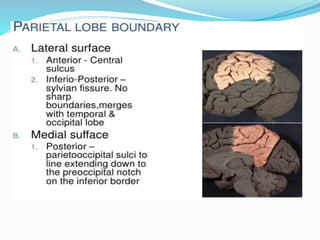
Boundaries 
Sulci &Gyri 
Brodmanns area 
Blood supply 
 Functions 
Rightlobe functions 
left lobe functions 
 Dysfunctions & Syndromes 
Either parietal lobe lesions 
Dominant &non dominant lesions
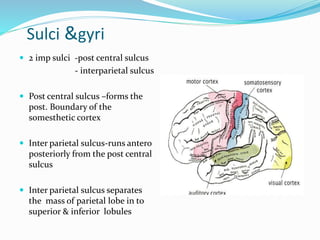
Sulci &gyri 
 2 imp sulci -post central sulcus 
- interparietal sulcus 
 Post central sulcus –forms the 
post. Boundary of the 
somesthetic cortex 
 Inter parietal sulcus-runs antero 
posteriorly from the post central 
sulcus 
 Inter parietal sulcus separates 
the mass of parietal lobe in to 
superior & inferior lobules
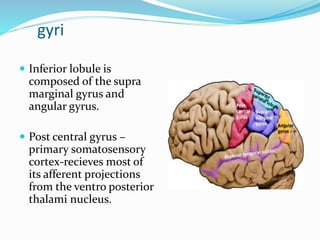
gyri 
 Inferior lobule is 
composed of the supra 
marginal gyrus and 
angular gyrus. 
 Post central gyrus – 
primary somatosensory 
cortex-recieves most of 
its afferent projections 
from the ventro posterior 
thalami nucleus.
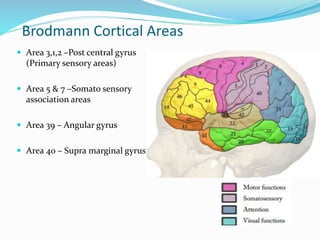
Brodmann Cortical Areas 
 Area 3,1,2 –Post central gyrus 
(Primary sensory areas) 
 Area 5 & 7 –Somato sensory 
association areas 
 Area 39 – Angular gyrus 
 Area 40 – Supra marginal gyrus
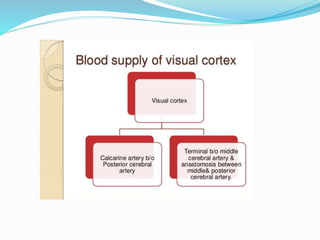
Blood Supply 
 Lateral – MCA 
 Artery of Rolandic fissure 
 Artery of inter parietal fissure 
 Artery of post parietal fissure 
 Inter opercular parietal artery 
 Artery to angular gyrus 
 Mesial - ACA mainly & PCA to a slight extent
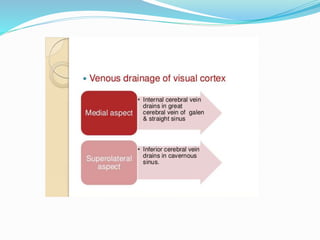
Venous drainage 
 Superficial middle cerebral vein –lies in lateral fissure 
 Vein of Trolard (superior anastomotic vein) - connects 
sup middle cerebral vein to SSS 
 Vein of Labbe’ ( inferior anastomotic 
vein ) - connects sup middle cerebral vein to 
Transverse sinus
Functions 
 PRIMARY SOMASTHETIC AREA - Body image representation 
(AREA 3,1,2 ) - tactile perception 
-somato sensory perception 
 SOMASTHETIC ASSOCIATION AREA -Body in space 
(AREA 5,7) -Tactile discrimination 
 SUPERIOR PARIETAL LOBULE AND AREA 7 
-3 D analysis of body space interactions (body schema) 
- Visual spatial properties 
- Visual attention 
-Motivation and grasping functions 
 INFERIOR PARIETAL LOBULE- Last to mature anatomically and 
functionally. So, the functions are late, to develop b/w 5 and 8 yrs age. 
( reading , calculations )
Either Hemisphere 
 1. Cortical sensations. 
 2. Integration of sensory , motor and attention signals (i.e 
disengage attention - do other activity -immediately 
reengage correctly) 
 3. Optic radiation passes through 
 4. Constructional ability – capacity to construct or draw 
3D/2D figures or shapes 
 5. Short term memory 
Lt. – immediate recall for digits and words 
Rt. – immediate recall for geometric patterns
Left hemisphere 
 1. Language – comprehension 
reading 
writing 
 2. Calculations – verbal rote calculations and 
recognition of signs. 
 3. Non verbal symbolization (pantomime)
right hemisphere 
 1. Constructional skills 
 2. spatial orientation 
 3. Perceptual functions (inattention/neglect of lt. hemispace)
CLINICAL EFFECTS OF PARIETAL LOBE LESIONS 
Either hemi sphere 
 • CORTICAL SENSORY SYNDROMES 
 • TOPOGRAPHICAL DISORIENTATION 
 • VISUOSPATIAL DIFFICULTIES 
 HEMINEGLECT 
 • Total hemi anesthesia with large acute lesion of Parietal 
lobe.white matter 
 Mild hemi paresis, unilateral muscular atrophy in children, 
hypotonia, poverty of movements, hemiataxia 
 Homonymous hemianopia [incongruent or congruent], 
 Neglect of the opposite isde of external space
CORTICAL SENSORY SYNDROMES 
Cortical defect is essentially one of sensory discrimination 
i.e impaired ability to integrate and localize stimuli. 
 1. Loss of position sense and passive movement. 
 2. Topagnosia – loss of localization of tactile, thermal and 
noxious stimuli. 
 3. Astereognosis-loss of ability to recognize object by 
touch. 
 4. Agraphesthesia. 
 5. Loss of ‘two point’ discrimination
HEMI NEGLECT 
 neglect on one side of body in dressing and grooming 
 Shave only one side or use only one sleeve of shirt 
 Deviation of head and eyes to side of lesion 
. 
 Torsion of body to the side of lesion. 
 Fail to use one side of body, even though paralysis is not present 
 Finds impossible to wear eye glasses. 
 Sensory extinction - is subtle form of neglect
DOMINANT PARIETAL LOBE 
 1. Disorders of language ( anomia, aphasia, alexia, agraphia 
 2. Gerstmann syndrome 
 3. Tactile agnosia (bimanual astereognosis) 
 4. Bilateral ideomotor and ideational apraxia. 
 5.VARIOUS FORMS OF DYSPHASIA
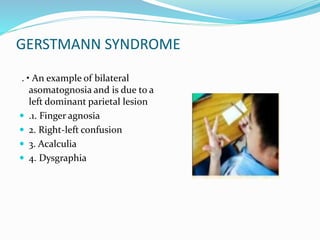
GERSTMANN SYNDROME 
. • An example of bilateral 
asomatognosia and is due to a 
left dominant parietal lesion 
 .1. Finger agnosia 
 2. Right-left confusion 
 3. Acalculia 
 4. Dysgraphia
NON DOMINANAT PARIETAL LOBE 
 Disturbed appreciation of the body image and of external 
space,particularly involving C/L side 
 The left limbs may fail to be recognised or may be dishonoured by the 
patient 
 If the patient is paralysed or hemianaesthetic, the disability may be 
ignored/refuted (anosognosia) 
 Hemisomatognosia(a part of the body may be felt to be absent 
 Neglect of the left half of the external space 
 Dressing dyspraxia 
 Visuospatial agnosia
NON DOMINANAT PARIETAL LOBE 
 1. Topographic disorientation 
 2. Topographic memory loss 
 3. Anosognosia /dressing apraxia 
 4. Constructional apraxia 
 5. Hemi-inattention 
 6. Apraxia of eye opening 
 7. Confusion
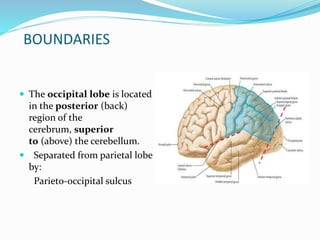
BOUNDARIES 
 The occipital lobe is located 
in the posterior (back) 
region of the 
cerebrum, superior 
to (above) the cerebellum. 
 Separated from parietal lobe 
by: 
Parieto-occipital sulcus
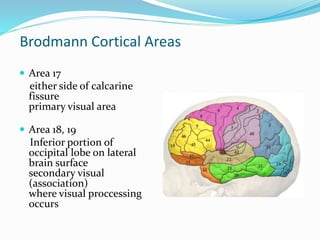
Brodmann Cortical Areas 
 Area 17 
either side of calcarine 
fissure 
primary visual area 
 Area 18, 19 
Inferior portion of 
occipital lobe on lateral 
brain surface 
secondary visual 
(association) 
where visual proccessing 
occurs
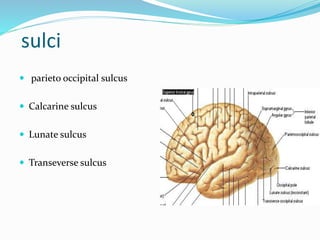
sulci 
 parieto occipital sulcus 
 Calcarine sulcus 
 Lunate sulcus 
 Transeverse sulcus
gyri 
 Cuneate gyrus 
 Lingual gyrus 
 Fusi form gyrus
Functions 
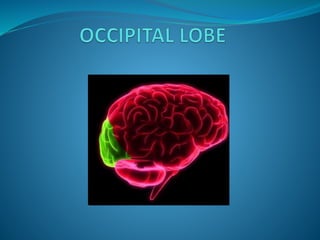
 Occipital lobe is visual processing centre of brain.
Effects of diseases of occipital lobe 
1)Effects of unilateral either righr or left 
 Contra lateral homonymous hemianopia,homonymous 
hemiachromatopsia 
 Elimentary(unformed)hallucinations 
2)Effects of left occipital disease 
 right homonymous hemianopia 
 Alexia and colour naming defect 
 Visual object agnosia
3)effect of right occipital disease 
 Left homonymous hemi anopia 
 Visual illusions,hallucinations 
 Loss of topographic memory and visual orientation 
4)Bilateral occipital disease 
 Cortical blindness 
 Anton syndrome (visual anosognosia,denial of cortical 
blindness) 
 Loss of perception of color 
 Prosopagnosia 
 Balint syndrome
BALINT SYNDROME 
 Triad of severe neurophysiological impairments 
-inability to perceive the visual field as a whole 
-difficulty in fixating eyes(occulomotor apraxia) 
-inability to move the hand to a specific object by 
using vision
 Thank you

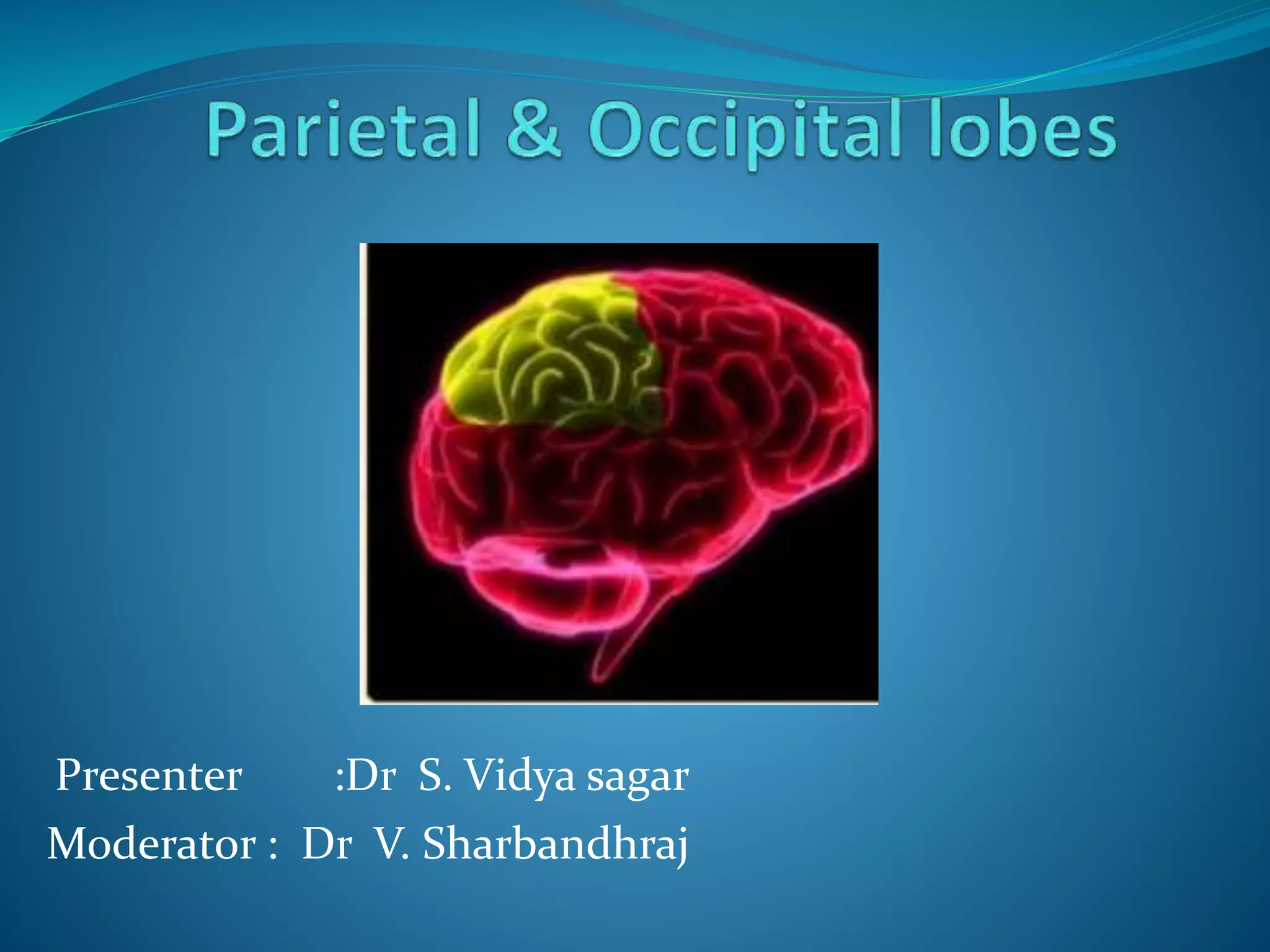
Parietal & occipital lobes

  • 1.
    Presenter :Dr S.Vidya sagar Moderator : Dr V. Sharbandhraj
  • 2.
    Over view Anatomic& physiological considerations Boundaries Sulci &Gyri Brodmanns area Blood supply  Functions Rightlobe functions left lobe functions  Dysfunctions & Syndromes Either parietal lobe lesions Dominant &non dominant lesions
  • 4.
    Sulci &gyri 2 imp sulci -post central sulcus - interparietal sulcus  Post central sulcus –forms the post. Boundary of the somesthetic cortex  Inter parietal sulcus-runs antero posteriorly from the post central sulcus  Inter parietal sulcus separates the mass of parietal lobe in to superior & inferior lobules
  • 5.
    gyri  Inferiorlobule is composed of the supra marginal gyrus and angular gyrus.  Post central gyrus – primary somatosensory cortex-recieves most of its afferent projections from the ventro posterior thalami nucleus.
  • 6.
    Brodmann Cortical Areas  Area 3,1,2 –Post central gyrus (Primary sensory areas)  Area 5 & 7 –Somato sensory association areas  Area 39 – Angular gyrus  Area 40 – Supra marginal gyrus
  • 7.
    Blood Supply Lateral – MCA  Artery of Rolandic fissure  Artery of inter parietal fissure  Artery of post parietal fissure  Inter opercular parietal artery  Artery to angular gyrus  Mesial - ACA mainly & PCA to a slight extent
  • 8.
    Venous drainage Superficial middle cerebral vein –lies in lateral fissure  Vein of Trolard (superior anastomotic vein) - connects sup middle cerebral vein to SSS  Vein of Labbe’ ( inferior anastomotic vein ) - connects sup middle cerebral vein to Transverse sinus
  • 9.
    Functions  PRIMARYSOMASTHETIC AREA - Body image representation (AREA 3,1,2 ) - tactile perception -somato sensory perception  SOMASTHETIC ASSOCIATION AREA -Body in space (AREA 5,7) -Tactile discrimination  SUPERIOR PARIETAL LOBULE AND AREA 7 -3 D analysis of body space interactions (body schema) - Visual spatial properties - Visual attention -Motivation and grasping functions  INFERIOR PARIETAL LOBULE- Last to mature anatomically and functionally. So, the functions are late, to develop b/w 5 and 8 yrs age. ( reading , calculations )
  • 10.
    Either Hemisphere 1. Cortical sensations.  2. Integration of sensory , motor and attention signals (i.e disengage attention - do other activity -immediately reengage correctly)  3. Optic radiation passes through  4. Constructional ability – capacity to construct or draw 3D/2D figures or shapes  5. Short term memory Lt. – immediate recall for digits and words Rt. – immediate recall for geometric patterns
  • 11.
    Left hemisphere 1. Language – comprehension reading writing  2. Calculations – verbal rote calculations and recognition of signs.  3. Non verbal symbolization (pantomime)
  • 12.
    right hemisphere 1. Constructional skills  2. spatial orientation  3. Perceptual functions (inattention/neglect of lt. hemispace)
  • 13.
    CLINICAL EFFECTS OFPARIETAL LOBE LESIONS Either hemi sphere  • CORTICAL SENSORY SYNDROMES  • TOPOGRAPHICAL DISORIENTATION  • VISUOSPATIAL DIFFICULTIES  HEMINEGLECT  • Total hemi anesthesia with large acute lesion of Parietal lobe.white matter  Mild hemi paresis, unilateral muscular atrophy in children, hypotonia, poverty of movements, hemiataxia  Homonymous hemianopia [incongruent or congruent],  Neglect of the opposite isde of external space
  • 14.
    CORTICAL SENSORY SYNDROMES Cortical defect is essentially one of sensory discrimination i.e impaired ability to integrate and localize stimuli.  1. Loss of position sense and passive movement.  2. Topagnosia – loss of localization of tactile, thermal and noxious stimuli.  3. Astereognosis-loss of ability to recognize object by touch.  4. Agraphesthesia.  5. Loss of ‘two point’ discrimination
  • 15.
    HEMI NEGLECT neglect on one side of body in dressing and grooming  Shave only one side or use only one sleeve of shirt  Deviation of head and eyes to side of lesion .  Torsion of body to the side of lesion.  Fail to use one side of body, even though paralysis is not present  Finds impossible to wear eye glasses.  Sensory extinction - is subtle form of neglect
  • 16.
    DOMINANT PARIETAL LOBE  1. Disorders of language ( anomia, aphasia, alexia, agraphia  2. Gerstmann syndrome  3. Tactile agnosia (bimanual astereognosis)  4. Bilateral ideomotor and ideational apraxia.  5.VARIOUS FORMS OF DYSPHASIA
  • 17.
    GERSTMANN SYNDROME .• An example of bilateral asomatognosia and is due to a left dominant parietal lesion  .1. Finger agnosia  2. Right-left confusion  3. Acalculia  4. Dysgraphia
  • 18.
    NON DOMINANAT PARIETALLOBE  Disturbed appreciation of the body image and of external space,particularly involving C/L side  The left limbs may fail to be recognised or may be dishonoured by the patient  If the patient is paralysed or hemianaesthetic, the disability may be ignored/refuted (anosognosia)  Hemisomatognosia(a part of the body may be felt to be absent  Neglect of the left half of the external space  Dressing dyspraxia  Visuospatial agnosia
  • 19.
    NON DOMINANAT PARIETALLOBE  1. Topographic disorientation  2. Topographic memory loss  3. Anosognosia /dressing apraxia  4. Constructional apraxia  5. Hemi-inattention  6. Apraxia of eye opening  7. Confusion
  • 21.
    BOUNDARIES  Theoccipital lobe is located in the posterior (back) region of the cerebrum, superior to (above) the cerebellum.  Separated from parietal lobe by: Parieto-occipital sulcus
  • 22.
    Brodmann Cortical Areas  Area 17 either side of calcarine fissure primary visual area  Area 18, 19 Inferior portion of occipital lobe on lateral brain surface secondary visual (association) where visual proccessing occurs
  • 23.
    sulci  parietooccipital sulcus  Calcarine sulcus  Lunate sulcus  Transeverse sulcus
  • 24.
    gyri  Cuneategyrus  Lingual gyrus  Fusi form gyrus
  • 27.
    Functions  Occipitallobe is visual processing centre of brain.
  • 28.
    Effects of diseasesof occipital lobe 1)Effects of unilateral either righr or left  Contra lateral homonymous hemianopia,homonymous hemiachromatopsia  Elimentary(unformed)hallucinations 2)Effects of left occipital disease  right homonymous hemianopia  Alexia and colour naming defect  Visual object agnosia
  • 29.
    3)effect of rightoccipital disease  Left homonymous hemi anopia  Visual illusions,hallucinations  Loss of topographic memory and visual orientation 4)Bilateral occipital disease  Cortical blindness  Anton syndrome (visual anosognosia,denial of cortical blindness)  Loss of perception of color  Prosopagnosia  Balint syndrome
  • 30.
    BALINT SYNDROME Triad of severe neurophysiological impairments -inability to perceive the visual field as a whole -difficulty in fixating eyes(occulomotor apraxia) -inability to move the hand to a specific object by using vision
  • 31.