THE LIMBIC SYSTEM
Moderated by – Dr Vishal Sinha
Presented by – Dr Urvashi
INTRODUCTION
 The term "limbic “ Latin word limbus, for
"border" or"edge“.
 Network of structures associated with
emotions, basic survival and sociosexual
behavioral patterns, motivation and learning
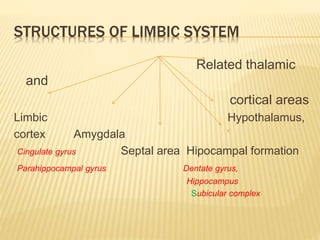
STRUCTURES OF LIMBIC SYSTEM
Related thalamic
and
cortical areas
Limbic Hypothalamus,
cortex Amygdala
Cingulate gyrus Septal area Hipocampal formation
Parahippocampal gyrus Dentate gyrus,
Hippocampus
Subicular complex
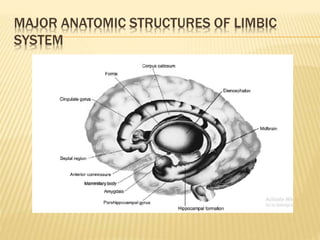
MAJOR ANATOMIC STRUCTURES OF LIMBIC
SYSTEM
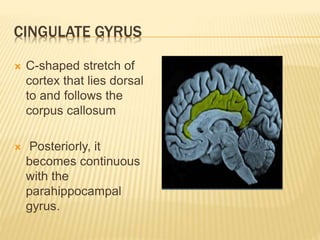
CINGULATE GYRUS
 C-shaped stretch of
cortex that lies dorsal
to and follows the
corpus callosum
 Posteriorly, it
becomes continuous
with the
parahippocampal
gyrus.
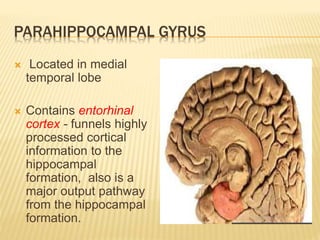
PARAHIPPOCAMPAL GYRUS
 Located in medial
temporal lobe
 Contains entorhinal
cortex - funnels highly
processed cortical
information to the
hippocampal
formation, also is a
major output pathway
from the hippocampal
formation.
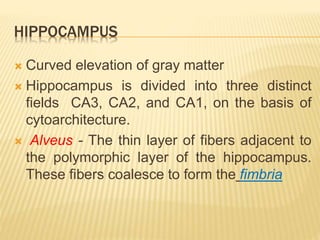
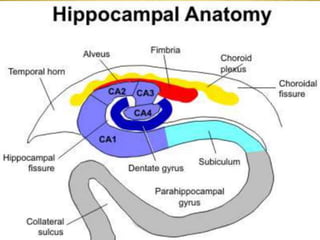
HIPPOCAMPUS
 Curved elevation of gray matter
 Hippocampus is divided into three distinct
fields CA3, CA2, and CA1, on the basis of
cytoarchitecture.
 Alveus - The thin layer of fibers adjacent to
the polymorphic layer of the hippocampus.
These fibers coalesce to form the fimbria
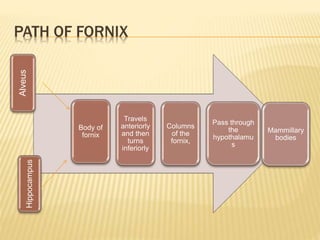
PATH OF FORNIXHippocampus
Alveus
Body of
fornix
Travels
anteriorly
and then
turns
inferiorly
Columns
of the
fornix,
Pass through
the
hypothalamu
s
Mammillary
bodies
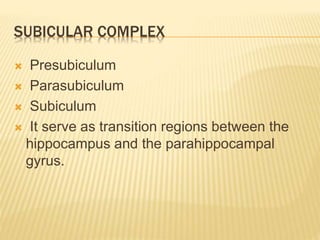
SUBICULAR COMPLEX
 Presubiculum
 Parasubiculum
 Subiculum
 It serve as transition regions between the
hippocampus and the parahippocampal
gyrus.
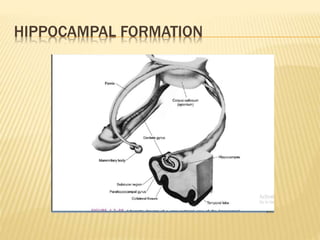
HIPPOCAMPAL FORMATION
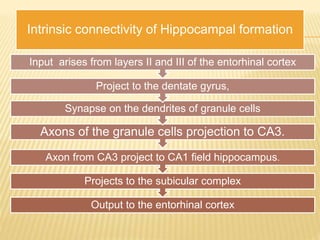
Intrinsic connectivity of Hippocampal formation
Output to the entorhinal cortex
Projects to the subicular complex
Axon from CA3 project to CA1 field hippocampus.
Axons of the granule cells projection to CA3.
Synapse on the dendrites of granule cells
Project to the dentate gyrus,
Input arises from layers II and III of the entorhinal cortex
AMYGDALA
 Called the “window” through which the limbic
system sees the place of the person in the world
 Make the person’s behavioral response
appropriate for each occasion
 Consists of group of nuclei which form several
distinct clusters:
 Basolateral complex,
 Centromedial group,
 olfactory group
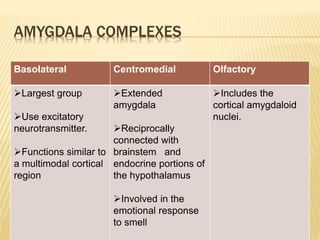
AMYGDALA COMPLEXES
Basolateral Centromedial Olfactory
Largest group
Use excitatory
neurotransmitter.
Functions similar to
a multimodal cortical
region
Extended
amygdala
Reciprocally
connected with
brainstem and
endocrine portions of
the hypothalamus
Involved in the
emotional response
to smell
Includes the
cortical amygdaloid
nuclei.
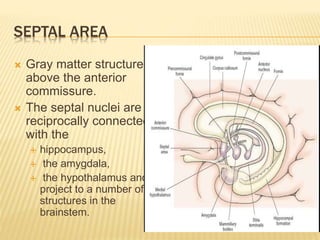
SEPTAL AREA
 Gray matter structure
above the anterior
commissure.
 The septal nuclei are
reciprocally connected
with the
 hippocampus,
 the amygdala,
 the hypothalamus and
project to a number of
structures in the
brainstem.
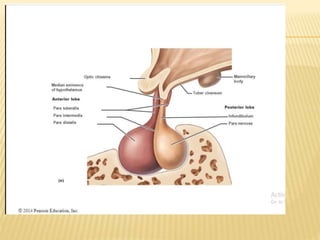
HYPOTHALAMUS
 Lies at the center of the limbic system
 Has two-way communicating pathways with
all levels of the limbic system.
 Bounded rostrally by the optic chiasm and
caudally mammillary bodies.
 TUBER CINEREUM - area of the
hypothalamus b/w mamillary bodies and
optic chiasma gives rise to the median
eminence
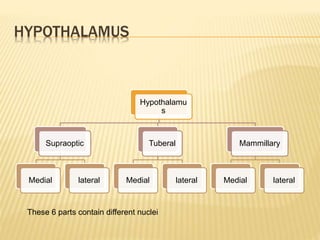
HYPOTHALAMUS
Hypothalamu
s
Supraoptic
Medial lateral
Tuberal
Medial lateral
Mammillary
Medial lateral
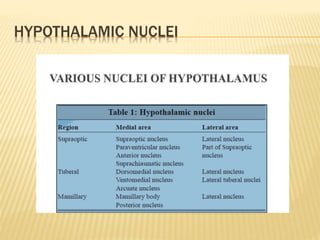
These 6 parts contain different nuclei
HYPOTHALAMIC NUCLEI
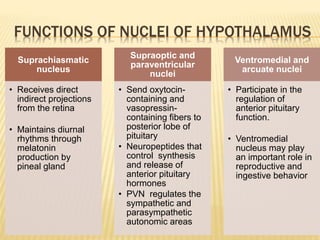
FUNCTIONS OF NUCLEI OF HYPOTHALAMUS
Suprachiasmatic
nucleus
• Receives direct
indirect projections
from the retina
• Maintains diurnal
rhythms through
melatonin
production by
pineal gland
Supraoptic and
paraventricular
nuclei
• Send oxytocin-
containing and
vasopressin-
containing fibers to
posterior lobe of
pituitary
• Neuropeptides that
control synthesis
and release of
anterior pituitary
hormones
• PVN regulates the
sympathetic and
parasympathetic
autonomic areas
Ventromedial and
arcuate nuclei
• Participate in the
regulation of
anterior pituitary
function.
• Ventromedial
nucleus may play
an important role in
reproductive and
ingestive behavior
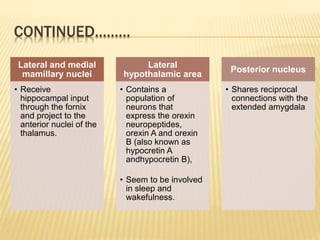
CONTINUED………
Lateral and medial
mamillary nuclei
• Receive
hippocampal input
through the fornix
and project to the
anterior nuclei of the
thalamus.
Lateral
hypothalamic area
• Contains a
population of
neurons that
express the orexin
neuropeptides,
orexin A and orexin
B (also known as
hypocretin A
andhypocretin B),
• Seem to be involved
in sleep and
wakefulness.
Posterior nucleus
• Shares reciprocal
connections with the
extended amygdala
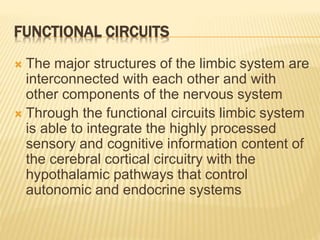
FUNCTIONAL CIRCUITS
 The major structures of the limbic system are
interconnected with each other and with
other components of the nervous system
 Through the functional circuits limbic system
is able to integrate the highly processed
sensory and cognitive information content of
the cerebral cortical circuitry with the
hypothalamic pathways that control
autonomic and endocrine systems
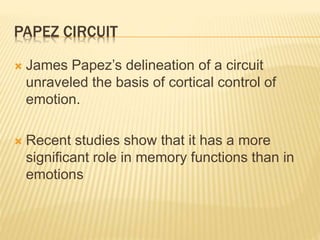
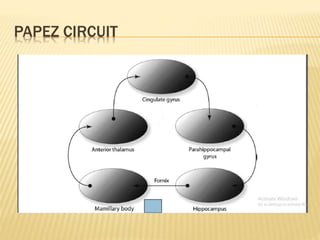
PAPEZ CIRCUIT
 James Papez’s delineation of a circuit
unraveled the basis of cortical control of
emotion.
 Recent studies show that it has a more
significant role in memory functions than in
emotions
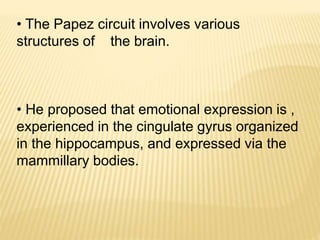
• The Papez circuit involves various
structures of the brain.
• He proposed that emotional expression is ,
experienced in the cingulate gyrus organized
in the hippocampus, and expressed via the
mammillary bodies.
PAPEZ CIRCUIT
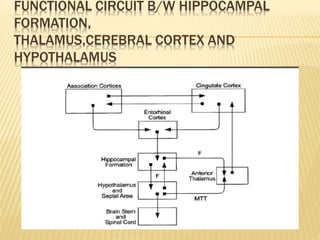
FUNCTIONAL CIRCUIT B/W HIPPOCAMPAL
FORMATION,
THALAMUS,CEREBRAL CORTEX AND
HYPOTHALAMUS
• Sensory information from the cingulate, the orbital
and temporal cortices, and the amygdala is
transmitted to the entorhinal cortex of the
parahippocampal gyrus and then to the
hippocampal formation.
• After traversing the intrinsic circuitry of the
hippocampal formation, information is projected
through the fornix either to the anterior thalamus,
which, in turn, projects to the limbic cortex, or to the
septal area and the hypothalamus.
• These latter two regions provide feedback to
the hippocampal formation through the fornix.
• In addition, the mammillary bodies of the
hypothalamus project to the anterior thalamus.
• Finally, the hypothalamus and the septal area
project to the brainstem and the spinal cord
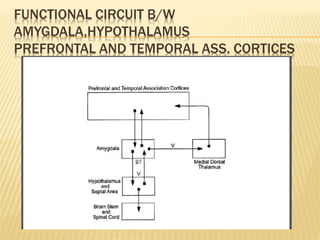
FUNCTIONAL CIRCUIT B/W
AMYGDALA,HYPOTHALAMUS
PREFRONTAL AND TEMPORAL ASS. CORTICES
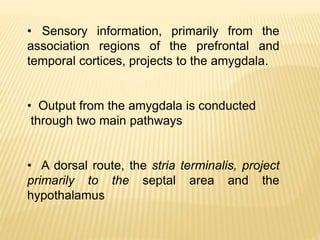
• Sensory information, primarily from the
association regions of the prefrontal and
temporal cortices, projects to the amygdala.
• Output from the amygdala is conducted
through two main pathways
• A dorsal route, the stria terminalis, project
primarily to the septal area and the
hypothalamus
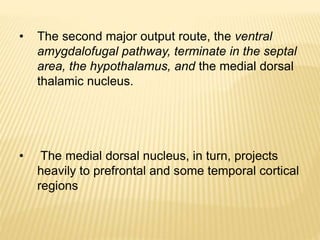
• The second major output route, the ventral
amygdalofugal pathway, terminate in the septal
area, the hypothalamus, and the medial dorsal
thalamic nucleus.
• The medial dorsal nucleus, in turn, projects
heavily to prefrontal and some temporal cortical
regions
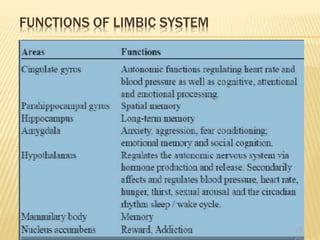
FUNCTIONS OF LIMBIC SYSTEM
APPETITE AND EATING BEHAVIOURS
 Amygdala plays a role in food choice and
emotional modulation of food intake
 The lateral nucleus of the hypothalamus is
the center for control of feeding whereas the
ventromedial nucleus functions as the satiety
center.
SLEEP AND DREAMS
 PET and MRI have shown that the limbic
system is one of the most active brain areas
during dreaming.
 The limbic system probably interweaves
unconscious emotions with our conscious
cognitive thoughts and perceptions
 Ties together emotions and memory during
REM sleep to form the content of dreams.
EMOTIONAL RESPONSES
FEAR
 Fear responses are produced by the
stimulation of the hypothalamus and
amygdala.
 Amygdala destruction abolishes fear and its
autonomic and endocrine responses.
 Amygdala is also involved in fear learning
AUTONOMIC AND ENDOCRINE RESPONSES TO
EMOTION
 Limbic stimulation causes changes in
respiration and blood pressure.
 The stimulation of the cingulate gyrus and
hypothalamus can elicit autonomic
responses.
RAGE AND PLACIDITY
 The destruction of the ventromedial
hypothalamic nuclei and septal nuclei in
animals may induce rage.
 Bilateral destruction of the amygdala results
in placidity.
 However, when the ventromedian nucleus is
destroyed after the destruction of the
amygdala, the placidity generated is
converted to rage.
REWARD AND PUNISHMENT
Reward centers: Along the course of the medial
forebrain bundle and lateral and ventromedial nuclei
of the hypothalamus
Punishment centers: Central gray area surrounding
the
aqueduct of sylvius in the mesencephalon and
extending upward into the periventricular zones of
the
hypothalmus and thalamus
SEXUAL BEHAVIOUR
 Medial preoptic area of the hypothalamus is
the central control of male sexual behavior.
ADDICTION AND MOTIVATION
 The reward circuitry underlying addictive
behavior includes amygdala and nucleus
accumbens.
 The amygdala plays a central role in cue-
induced relapse.
 Relapse associated with cues, stress and a
single dose of a drug of abuse results in
release of excitatory neurotransmitters in
brain areas like hippocampus and amygdala.
EMOTION AND MEMORY
Emotional memory
 Emotion has powerful influence on learning
and memory.
 Amygdala, prefrontal cortex and medial
temporal lobe, is involved in consolidation
and retrieval of emotional memories.
 Hippocampus is critical for long-term,
declarative memory storage
CONTINUED……….
Medial temporal lobe memory system
 Include the hippocampus and adjacent
cortex
 The parahippocampal regions (PHG) and the
entorhinal and perirhinal regions.
 Involved in the storage of new memories.
CONTINUED…………
Diencephalic memory system
 Consists of the hypothalamus, mammillary
body and the dorsomedial nucleus of
thalamus
 Important for the storage of recent memory
 Dysfunction of this circuit results in
Korsakoff's syndrome.
SOCIAL COGINITION
 Thought processes involved in
understanding and dealing with other people.
 Limbic structures involved are the cingulate
gyrus and amygdala.
OLFACTION
 The limbic structures are closely related to
the olfactory cortex.
 Amygdala is involved in the emotional
response to smell
 Entorhinal cortex, is concerned with
olfactory memories
CLINICAL IMPLICATIONS
 SCHIZOPHRENIA
Consistent reductions in hippocampal or
amygdala-hippocampal volumes that may be
lateralized to the left side.
 ADHD
Disrupted connections between the
amygdala and orbitofrontal cortex may
contribute to behavioral disinhibitiion
LIMBIC SYSTEM AND DEPRESSION
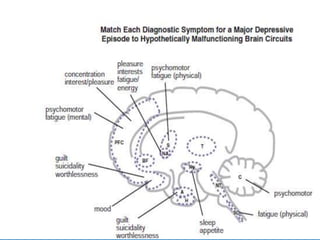
 The left amygdala, hippocampal formation,
and parahippocampal gyrus have increased
activity.
 Increased glucose metabolism has been
observed in several limbic regions, in
depression and with family history of mood
disorder
CONTINUED……..
 Anterior cingulate is overactive in people with
depression.
 A variety of treatments, such as
antidepressants, electroconvulsive therapy
(ECT), and repetitive transcranial magnetic
stimulation (rTMS),result in a decrease of
activity in this area.
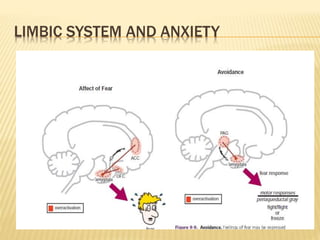
LIMBIC SYSTEM AND ANXIETY
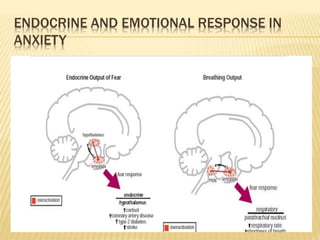
ENDOCRINE AND EMOTIONAL RESPONSE IN
ANXIETY
LIMBIC SYSTEM AND DEMENTIA
 Degenerative changes in the limbic system
likely have a role in neurodegenerative
diseases( particularly Pick's and Alzheimer's
disease.)
 Marked atrophy found in the dentate gyrus,
hippocampus and amygdala.
THANK YOU

Limbic system

  • 1.
    THE LIMBIC SYSTEM Moderatedby – Dr Vishal Sinha Presented by – Dr Urvashi
  • 2.
    INTRODUCTION  The term"limbic “ Latin word limbus, for "border" or"edge“.  Network of structures associated with emotions, basic survival and sociosexual behavioral patterns, motivation and learning
  • 3.
    STRUCTURES OF LIMBICSYSTEM Related thalamic and cortical areas Limbic Hypothalamus, cortex Amygdala Cingulate gyrus Septal area Hipocampal formation Parahippocampal gyrus Dentate gyrus, Hippocampus Subicular complex
  • 4.
    MAJOR ANATOMIC STRUCTURESOF LIMBIC SYSTEM
  • 5.
    CINGULATE GYRUS  C-shapedstretch of cortex that lies dorsal to and follows the corpus callosum  Posteriorly, it becomes continuous with the parahippocampal gyrus.
  • 6.
    PARAHIPPOCAMPAL GYRUS  Locatedin medial temporal lobe  Contains entorhinal cortex - funnels highly processed cortical information to the hippocampal formation, also is a major output pathway from the hippocampal formation.
  • 7.
    HIPPOCAMPUS  Curved elevationof gray matter  Hippocampus is divided into three distinct fields CA3, CA2, and CA1, on the basis of cytoarchitecture.  Alveus - The thin layer of fibers adjacent to the polymorphic layer of the hippocampus. These fibers coalesce to form the fimbria
  • 9.
    PATH OF FORNIXHippocampus Alveus Bodyof fornix Travels anteriorly and then turns inferiorly Columns of the fornix, Pass through the hypothalamu s Mammillary bodies
  • 10.
    SUBICULAR COMPLEX  Presubiculum Parasubiculum  Subiculum  It serve as transition regions between the hippocampus and the parahippocampal gyrus.
  • 11.
  • 12.
    Intrinsic connectivity ofHippocampal formation Output to the entorhinal cortex Projects to the subicular complex Axon from CA3 project to CA1 field hippocampus. Axons of the granule cells projection to CA3. Synapse on the dendrites of granule cells Project to the dentate gyrus, Input arises from layers II and III of the entorhinal cortex
  • 13.
    AMYGDALA  Called the“window” through which the limbic system sees the place of the person in the world  Make the person’s behavioral response appropriate for each occasion  Consists of group of nuclei which form several distinct clusters:  Basolateral complex,  Centromedial group,  olfactory group
  • 14.
    AMYGDALA COMPLEXES Basolateral CentromedialOlfactory Largest group Use excitatory neurotransmitter. Functions similar to a multimodal cortical region Extended amygdala Reciprocally connected with brainstem and endocrine portions of the hypothalamus Involved in the emotional response to smell Includes the cortical amygdaloid nuclei.
  • 15.
    SEPTAL AREA  Graymatter structure above the anterior commissure.  The septal nuclei are reciprocally connected with the  hippocampus,  the amygdala,  the hypothalamus and project to a number of structures in the brainstem.
  • 16.
    HYPOTHALAMUS  Lies atthe center of the limbic system  Has two-way communicating pathways with all levels of the limbic system.  Bounded rostrally by the optic chiasm and caudally mammillary bodies.  TUBER CINEREUM - area of the hypothalamus b/w mamillary bodies and optic chiasma gives rise to the median eminence
  • 18.
  • 19.
  • 20.
    FUNCTIONS OF NUCLEIOF HYPOTHALAMUS Suprachiasmatic nucleus • Receives direct indirect projections from the retina • Maintains diurnal rhythms through melatonin production by pineal gland Supraoptic and paraventricular nuclei • Send oxytocin- containing and vasopressin- containing fibers to posterior lobe of pituitary • Neuropeptides that control synthesis and release of anterior pituitary hormones • PVN regulates the sympathetic and parasympathetic autonomic areas Ventromedial and arcuate nuclei • Participate in the regulation of anterior pituitary function. • Ventromedial nucleus may play an important role in reproductive and ingestive behavior
  • 21.
    CONTINUED……… Lateral and medial mamillarynuclei • Receive hippocampal input through the fornix and project to the anterior nuclei of the thalamus. Lateral hypothalamic area • Contains a population of neurons that express the orexin neuropeptides, orexin A and orexin B (also known as hypocretin A andhypocretin B), • Seem to be involved in sleep and wakefulness. Posterior nucleus • Shares reciprocal connections with the extended amygdala
  • 22.
    FUNCTIONAL CIRCUITS  Themajor structures of the limbic system are interconnected with each other and with other components of the nervous system  Through the functional circuits limbic system is able to integrate the highly processed sensory and cognitive information content of the cerebral cortical circuitry with the hypothalamic pathways that control autonomic and endocrine systems
  • 23.
    PAPEZ CIRCUIT  JamesPapez’s delineation of a circuit unraveled the basis of cortical control of emotion.  Recent studies show that it has a more significant role in memory functions than in emotions
  • 24.
    • The Papezcircuit involves various structures of the brain. • He proposed that emotional expression is , experienced in the cingulate gyrus organized in the hippocampus, and expressed via the mammillary bodies.
  • 25.
  • 26.
    FUNCTIONAL CIRCUIT B/WHIPPOCAMPAL FORMATION, THALAMUS,CEREBRAL CORTEX AND HYPOTHALAMUS
  • 27.
    • Sensory informationfrom the cingulate, the orbital and temporal cortices, and the amygdala is transmitted to the entorhinal cortex of the parahippocampal gyrus and then to the hippocampal formation. • After traversing the intrinsic circuitry of the hippocampal formation, information is projected through the fornix either to the anterior thalamus, which, in turn, projects to the limbic cortex, or to the septal area and the hypothalamus.
  • 28.
    • These lattertwo regions provide feedback to the hippocampal formation through the fornix. • In addition, the mammillary bodies of the hypothalamus project to the anterior thalamus. • Finally, the hypothalamus and the septal area project to the brainstem and the spinal cord
  • 29.
  • 30.
    • Sensory information,primarily from the association regions of the prefrontal and temporal cortices, projects to the amygdala. • Output from the amygdala is conducted through two main pathways • A dorsal route, the stria terminalis, project primarily to the septal area and the hypothalamus
  • 31.
    • The secondmajor output route, the ventral amygdalofugal pathway, terminate in the septal area, the hypothalamus, and the medial dorsal thalamic nucleus. • The medial dorsal nucleus, in turn, projects heavily to prefrontal and some temporal cortical regions
  • 32.
  • 33.
    APPETITE AND EATINGBEHAVIOURS  Amygdala plays a role in food choice and emotional modulation of food intake  The lateral nucleus of the hypothalamus is the center for control of feeding whereas the ventromedial nucleus functions as the satiety center.
  • 34.
    SLEEP AND DREAMS PET and MRI have shown that the limbic system is one of the most active brain areas during dreaming.  The limbic system probably interweaves unconscious emotions with our conscious cognitive thoughts and perceptions  Ties together emotions and memory during REM sleep to form the content of dreams.
  • 35.
    EMOTIONAL RESPONSES FEAR  Fearresponses are produced by the stimulation of the hypothalamus and amygdala.  Amygdala destruction abolishes fear and its autonomic and endocrine responses.  Amygdala is also involved in fear learning
  • 36.
    AUTONOMIC AND ENDOCRINERESPONSES TO EMOTION  Limbic stimulation causes changes in respiration and blood pressure.  The stimulation of the cingulate gyrus and hypothalamus can elicit autonomic responses.
  • 37.
    RAGE AND PLACIDITY The destruction of the ventromedial hypothalamic nuclei and septal nuclei in animals may induce rage.  Bilateral destruction of the amygdala results in placidity.  However, when the ventromedian nucleus is destroyed after the destruction of the amygdala, the placidity generated is converted to rage.
  • 38.
    REWARD AND PUNISHMENT Rewardcenters: Along the course of the medial forebrain bundle and lateral and ventromedial nuclei of the hypothalamus Punishment centers: Central gray area surrounding the aqueduct of sylvius in the mesencephalon and extending upward into the periventricular zones of the hypothalmus and thalamus
  • 39.
    SEXUAL BEHAVIOUR  Medialpreoptic area of the hypothalamus is the central control of male sexual behavior.
  • 40.
    ADDICTION AND MOTIVATION The reward circuitry underlying addictive behavior includes amygdala and nucleus accumbens.  The amygdala plays a central role in cue- induced relapse.  Relapse associated with cues, stress and a single dose of a drug of abuse results in release of excitatory neurotransmitters in brain areas like hippocampus and amygdala.
  • 41.
    EMOTION AND MEMORY Emotionalmemory  Emotion has powerful influence on learning and memory.  Amygdala, prefrontal cortex and medial temporal lobe, is involved in consolidation and retrieval of emotional memories.  Hippocampus is critical for long-term, declarative memory storage
  • 42.
    CONTINUED………. Medial temporal lobememory system  Include the hippocampus and adjacent cortex  The parahippocampal regions (PHG) and the entorhinal and perirhinal regions.  Involved in the storage of new memories.
  • 43.
    CONTINUED………… Diencephalic memory system Consists of the hypothalamus, mammillary body and the dorsomedial nucleus of thalamus  Important for the storage of recent memory  Dysfunction of this circuit results in Korsakoff's syndrome.
  • 44.
    SOCIAL COGINITION  Thoughtprocesses involved in understanding and dealing with other people.  Limbic structures involved are the cingulate gyrus and amygdala.
  • 45.
    OLFACTION  The limbicstructures are closely related to the olfactory cortex.  Amygdala is involved in the emotional response to smell  Entorhinal cortex, is concerned with olfactory memories
  • 46.
    CLINICAL IMPLICATIONS  SCHIZOPHRENIA Consistentreductions in hippocampal or amygdala-hippocampal volumes that may be lateralized to the left side.  ADHD Disrupted connections between the amygdala and orbitofrontal cortex may contribute to behavioral disinhibitiion
  • 47.
    LIMBIC SYSTEM ANDDEPRESSION  The left amygdala, hippocampal formation, and parahippocampal gyrus have increased activity.  Increased glucose metabolism has been observed in several limbic regions, in depression and with family history of mood disorder
  • 48.
    CONTINUED……..  Anterior cingulateis overactive in people with depression.  A variety of treatments, such as antidepressants, electroconvulsive therapy (ECT), and repetitive transcranial magnetic stimulation (rTMS),result in a decrease of activity in this area.
  • 51.
  • 52.
    ENDOCRINE AND EMOTIONALRESPONSE IN ANXIETY
  • 53.
    LIMBIC SYSTEM ANDDEMENTIA  Degenerative changes in the limbic system likely have a role in neurodegenerative diseases( particularly Pick's and Alzheimer's disease.)  Marked atrophy found in the dentate gyrus, hippocampus and amygdala.
  • 54.