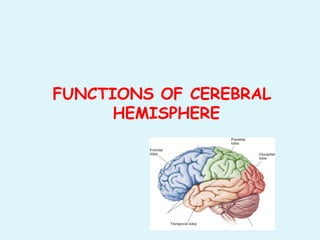
FUNCTIONS OF CEREBRAL
HEMISPHERE
❑ The cerebrum is the largest part of the brain
with two hemisphere, linked by commissural
fibres of corpus callosum.
❑ Each cerebral hemisphere contains externally
highly convoluted cortex of grey matter and
internal mass of white matter or medulla.
❑ The cerebral hemispheres contains motor and
sensory areas and the limbic system.
INTRODUCTION
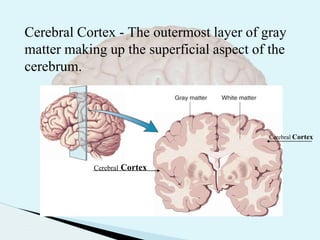
Cerebral Cortex
Cerebral Cortex
Cerebral Cortex - The outermost layer of gray
matter making up the superficial aspect of the
cerebrum.
⮚ Microscopically the cortex consists
of six layers or laminae lying
parallel to the surface
⮚ From outside to inside the layers
are:
I. Molecular layer
II. The external granular layer
III. Layer of pyramidal cell
IV. Internal granular layer
V. large pyramidal cell layer
VI. Layer of fusiform or
polymorphic cells.
Cerebral Cortex
� The incoming sensory signal excites neuronal
layer IV first; then the signal spreads toward
the surface of the cortex and also toward
deeper layers.
� 2.Layers I and II & III perform most of
intracortical association function.
� 3.The neurons in layers II and III making short
horizontal connections with adjacent cortical
areas.
� 4.The neurons in layers V and VI send output
signals to brain stem ,spinal cord (V) & thalamus
(VI)
CEREBRAL CORTEX LAYERS
� Primary Areas:
� The primary motor areas have direct connections
with specific muscles for causing discrete muscle
movements.
� The primary sensory areas detect specific sensations—
visual, auditory, or somatic—transmitted directly to the
brain from peripheral sensory organs.
� Association Areas They receive and analyze signals
simultaneously from multiple regions of both the motor
and sensory cortices as well as from subcortical
structures.
There are three main types of
functional areas in the cerebral cortex:
� These areas receive and analyze signals
simultaneously from multiple regions of both
the motor and sensory cortices as well as
from subcortical structures.
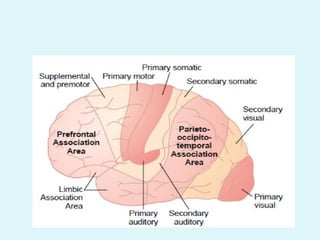
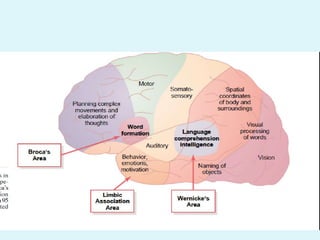
The most important association areas are
� (1) Parieto-occipito-temporal association
area
� (2) prefrontal association area
� (3) limbic association area.
ASSOCIATION AREAS
� 1. Analysis of the Spatial Coordinates of the
Body.
� 2. Language Comprehension.
� 3. Initial Processing of Visual Language
(Reading).
� 4. Area for Naming Objects.
PARIETO-OCCIPITOTEMPORAL
ASSOCIATION AREAS
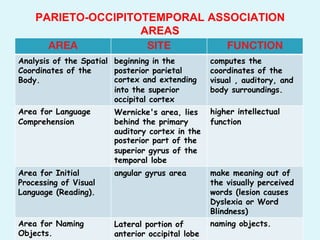
AREA SITE FUNCTION
Analysis of the Spatial
Coordinates of the
Body.
beginning in the
posterior parietal
cortex and extending
into the superior
occipital cortex
computes the
coordinates of the
visual , auditory, and
body surroundings.
Area for Language
Comprehension
Wernicke's area, lies
behind the primary
auditory cortex in the
posterior part of the
superior gyrus of the
temporal lobe
higher intellectual
function
Area for Initial
Processing of Visual
Language (Reading).
angular gyrus area make meaning out of
the visually perceived
words (lesion causes
Dyslexia or Word
Blindness)
Area for Naming
Objects.
Lateral portion of
anterior occipital lobe
naming objects.
PARIETO-OCCIPITOTEMPORAL ASSOCIATION
AREAS
� Is the anterior pole of frontal lobe.
� It contributes in the following functions:
1. Planning of complex pattern of movements.
2. Personality characteristics and social
relationship
3. Production of deep, more abstract and logically
sequenced thoughts which enable attainment of
goals
4. Working memory (ability to tie thoughts together in a
logical sequence by comparing many bits of information with
appropriate stored knowledge and be able to instantly recall this
information for future planning)
Lesions in this area lead to change in personality and behavior
Prefrontal Association Area
� Consists of anterior and inner portion of
temporal lobe.
� Is primarily concerned with emotion , behavior
and motivational drive for different tasks
most importantly learning.
� Lesion of this area may lead to decreased aggression , lack of
emotion , hyper sexuality & hyperphagia
Limbic Association Area
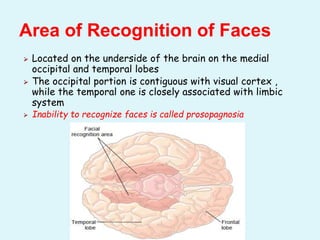
⮚ Located on the underside of the brain on the medial
occipital and temporal lobes
⮚ The occipital portion is contiguous with visual cortex ,
while the temporal one is closely associated with limbic
system
⮚ Inability to recognize faces is called prosopagnosia
Area of Recognition of Faces
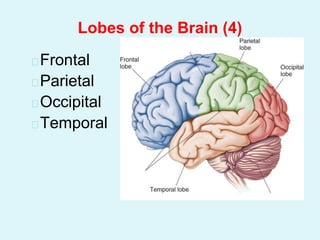
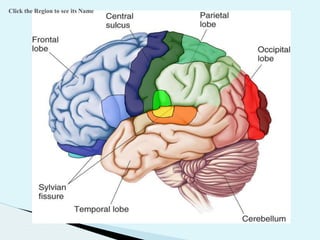
�Frontal
�Parietal
�Occipital
�Temporal
Lobes of the Brain (4)
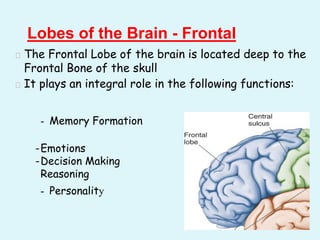
� The Frontal Lobe of the brain is located deep to the
Frontal Bone of the skull
� It plays an integral role in the following functions:
Lobes of the Brain - Frontal
- Memory Formation
-Emotions
-Decision Making
Reasoning
- Personality
Frontal Lobe - Cortical Regions
� Orbitofrontal Cortex – Site of Frontal Lobotomies
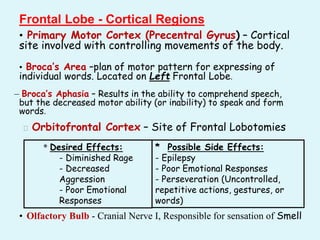
• Primary Motor Cortex (Precentral Gyrus) – Cortical
site involved with controlling movements of the body.
• Broca’s Area –plan of motor pattern for expressing of
individual words. Located on Left Frontal Lobe.
– Broca’s Aphasia – Results in the ability to comprehend speech,
but the decreased motor ability (or inability) to speak and form
words.
• Olfactory Bulb - Cranial Nerve I, Responsible for sensation of Smell
* Desired Effects:
- Diminished Rage
- Decreased
Aggression
- Poor Emotional
Responses
* Possible Side Effects:
- Epilepsy
- Poor Emotional Responses
- Perseveration (Uncontrolled,
repetitive actions, gestures, or
words)
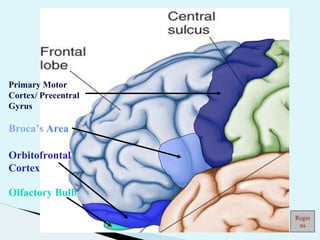
Primary Motor
Cortex/ Precentral
Gyrus
Broca’s Area
Orbitofrontal
Cortex
Olfactory Bulb
Regio
ns
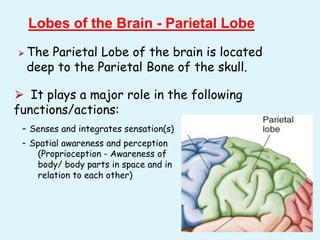
⮚ The Parietal Lobe of the brain is located
deep to the Parietal Bone of the skull.
Lobes of the Brain - Parietal Lobe
⮚ It plays a major role in the following
functions/actions:
- Senses and integrates sensation(s)
- Spatial awareness and perception
(Proprioception - Awareness of
body/ body parts in space and in
relation to each other)
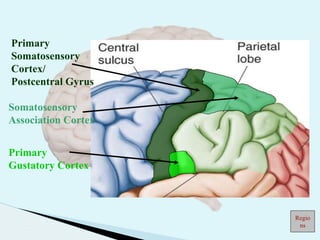
Parietal Lobe - Cortical Regions
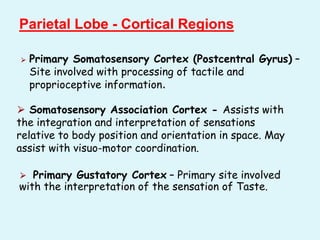
⮚ Primary Somatosensory Cortex (Postcentral Gyrus) –
Site involved with processing of tactile and
proprioceptive information.
⮚ Somatosensory Association Cortex - Assists with
the integration and interpretation of sensations
relative to body position and orientation in space. May
assist with visuo-motor coordination.
⮚ Primary Gustatory Cortex – Primary site involved
with the interpretation of the sensation of Taste.
Parietal Lobe
❑ Parietal lobe is essential for our feeling of touch,
warmth/heat , cold, pain , body position and
appreciation of shapes of palpated objects .
❑ When damaged , the person loses the ability to
recognize shapes of complex objects by palpation
(palpation = examination of objects by touch ) &
develops Sensory Inattention on opposite side
22
Primary
Somatosensory
Cortex/
Postcentral Gyrus
Primary
Gustatory Cortex
Somatosensory
Association Cortex
Regio
ns
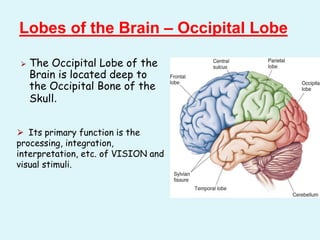
Lobes of the Brain – Occipital Lobe
⮚ The Occipital Lobe of the
Brain is located deep to
the Occipital Bone of the
Skull.
⮚ Its primary function is the
processing, integration,
interpretation, etc. of VISION and
visual stimuli.
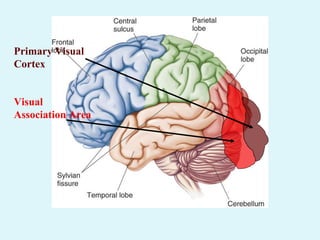
⮚ Primary Visual Cortex – This is the primary
area of the brain responsible for sight -
recognition of size, color, light, motion,
dimensions, etc.
Occipital Lobe – Cortical Regions
⮚ Visual Association Area – Interprets
information acquired through the primary
visual cortex.
Primary Visual
Cortex
Visual
Association Area
Lobes of the Brain – Temporal Lobe
⮚ The Temporal Lobes are located on the sides
of the brain, deep to the Temporal Bones of
the skull.
⮚ They play an integral role in
the following functions:
- Hearing
-Organization/Comprehensio
n of language
- Information Retrieval
(Memory and Memory Formation)
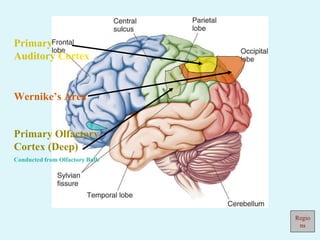
⮚ Primary Auditory Cortex – Responsible for hearing
Temporal Lobe – Cortical Regions
⮚ Primary Olfactory Cortex – Interprets the sense
of smell once it reaches the cortex via the olfactory
bulbs. (Not visible on the superficial cortex)
• Wernicke’s Area – Language comprehension. Located
on the Left Temporal Lobe.
❑ Lesion 🡪 may lead to:
✔- Wernicke’s Aphasia – Language comprehension
is inhibited. Words and sentences are not clearly
understood, and sentence formation may be
inhibited or non-sensical.
✔ Memory impairment
✔ & can be associated with temporal lobe epilepsy
29
Temporal Lobe
Primary
Auditory Cortex
Wernike’s Area
Primary Olfactory
Cortex (Deep)
Conducted from Olfactory Bulb
Regio
ns
Click the Region to see its Name
1. Each cerebral hemisphere receives sensory
information from, and sends motor
commands to, the opposite side of body
2. The 2 hemispheres have somewhat
different functions although their
structures are alike
3. Correspondence between a specific function
and a specific region of cerebral cortex is
not precise
4. No functional area acts alone; conscious
behavior involves the entire cortex
Functional Principles
of the Cerebral hemispheres
❖ Functional differences between left and right
hemispheres
⮚ In most people, left hemisphere (dominant
hemisphere) controls:
◦ reading, writing, and math, decision-making, logic,
speech and language (usually)
⮚ Right cerebral hemisphere relates to:
✔understanding & interpreting music,
✔Non verbal visual Experience
✔Spatial relation between the person & their
surroundings
✔Body language and intonation of peoples voices
Dominant & Nondominant
Hemisphere
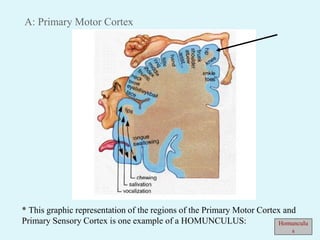
A: Primary Motor Cortex
* This graphic representation of the regions of the Primary Motor Cortex and
Primary Sensory Cortex is one example of a HOMUNCULUS: Homunculu
s

19-Cerebral hemisphere functions (1).pptx

  • 1.
  • 3.
    ❑ The cerebrumis the largest part of the brain with two hemisphere, linked by commissural fibres of corpus callosum. ❑ Each cerebral hemisphere contains externally highly convoluted cortex of grey matter and internal mass of white matter or medulla. ❑ The cerebral hemispheres contains motor and sensory areas and the limbic system. INTRODUCTION
  • 4.
    Cerebral Cortex Cerebral Cortex CerebralCortex - The outermost layer of gray matter making up the superficial aspect of the cerebrum.
  • 5.
    ⮚ Microscopically thecortex consists of six layers or laminae lying parallel to the surface ⮚ From outside to inside the layers are: I. Molecular layer II. The external granular layer III. Layer of pyramidal cell IV. Internal granular layer V. large pyramidal cell layer VI. Layer of fusiform or polymorphic cells. Cerebral Cortex
  • 6.
    � The incomingsensory signal excites neuronal layer IV first; then the signal spreads toward the surface of the cortex and also toward deeper layers. � 2.Layers I and II & III perform most of intracortical association function. � 3.The neurons in layers II and III making short horizontal connections with adjacent cortical areas. � 4.The neurons in layers V and VI send output signals to brain stem ,spinal cord (V) & thalamus (VI) CEREBRAL CORTEX LAYERS
  • 7.
    � Primary Areas: �The primary motor areas have direct connections with specific muscles for causing discrete muscle movements. � The primary sensory areas detect specific sensations— visual, auditory, or somatic—transmitted directly to the brain from peripheral sensory organs. � Association Areas They receive and analyze signals simultaneously from multiple regions of both the motor and sensory cortices as well as from subcortical structures. There are three main types of functional areas in the cerebral cortex:
  • 9.
    � These areasreceive and analyze signals simultaneously from multiple regions of both the motor and sensory cortices as well as from subcortical structures. The most important association areas are � (1) Parieto-occipito-temporal association area � (2) prefrontal association area � (3) limbic association area. ASSOCIATION AREAS
  • 10.
    � 1. Analysisof the Spatial Coordinates of the Body. � 2. Language Comprehension. � 3. Initial Processing of Visual Language (Reading). � 4. Area for Naming Objects. PARIETO-OCCIPITOTEMPORAL ASSOCIATION AREAS
  • 11.
    AREA SITE FUNCTION Analysisof the Spatial Coordinates of the Body. beginning in the posterior parietal cortex and extending into the superior occipital cortex computes the coordinates of the visual , auditory, and body surroundings. Area for Language Comprehension Wernicke's area, lies behind the primary auditory cortex in the posterior part of the superior gyrus of the temporal lobe higher intellectual function Area for Initial Processing of Visual Language (Reading). angular gyrus area make meaning out of the visually perceived words (lesion causes Dyslexia or Word Blindness) Area for Naming Objects. Lateral portion of anterior occipital lobe naming objects. PARIETO-OCCIPITOTEMPORAL ASSOCIATION AREAS
  • 13.
    � Is theanterior pole of frontal lobe. � It contributes in the following functions: 1. Planning of complex pattern of movements. 2. Personality characteristics and social relationship 3. Production of deep, more abstract and logically sequenced thoughts which enable attainment of goals 4. Working memory (ability to tie thoughts together in a logical sequence by comparing many bits of information with appropriate stored knowledge and be able to instantly recall this information for future planning) Lesions in this area lead to change in personality and behavior Prefrontal Association Area
  • 14.
    � Consists ofanterior and inner portion of temporal lobe. � Is primarily concerned with emotion , behavior and motivational drive for different tasks most importantly learning. � Lesion of this area may lead to decreased aggression , lack of emotion , hyper sexuality & hyperphagia Limbic Association Area
  • 15.
    ⮚ Located onthe underside of the brain on the medial occipital and temporal lobes ⮚ The occipital portion is contiguous with visual cortex , while the temporal one is closely associated with limbic system ⮚ Inability to recognize faces is called prosopagnosia Area of Recognition of Faces
  • 16.
  • 17.
    � The FrontalLobe of the brain is located deep to the Frontal Bone of the skull � It plays an integral role in the following functions: Lobes of the Brain - Frontal - Memory Formation -Emotions -Decision Making Reasoning - Personality
  • 18.
    Frontal Lobe -Cortical Regions � Orbitofrontal Cortex – Site of Frontal Lobotomies • Primary Motor Cortex (Precentral Gyrus) – Cortical site involved with controlling movements of the body. • Broca’s Area –plan of motor pattern for expressing of individual words. Located on Left Frontal Lobe. – Broca’s Aphasia – Results in the ability to comprehend speech, but the decreased motor ability (or inability) to speak and form words. • Olfactory Bulb - Cranial Nerve I, Responsible for sensation of Smell * Desired Effects: - Diminished Rage - Decreased Aggression - Poor Emotional Responses * Possible Side Effects: - Epilepsy - Poor Emotional Responses - Perseveration (Uncontrolled, repetitive actions, gestures, or words)
  • 19.
    Primary Motor Cortex/ Precentral Gyrus Broca’sArea Orbitofrontal Cortex Olfactory Bulb Regio ns
  • 20.
    ⮚ The ParietalLobe of the brain is located deep to the Parietal Bone of the skull. Lobes of the Brain - Parietal Lobe ⮚ It plays a major role in the following functions/actions: - Senses and integrates sensation(s) - Spatial awareness and perception (Proprioception - Awareness of body/ body parts in space and in relation to each other)
  • 21.
    Parietal Lobe -Cortical Regions ⮚ Primary Somatosensory Cortex (Postcentral Gyrus) – Site involved with processing of tactile and proprioceptive information. ⮚ Somatosensory Association Cortex - Assists with the integration and interpretation of sensations relative to body position and orientation in space. May assist with visuo-motor coordination. ⮚ Primary Gustatory Cortex – Primary site involved with the interpretation of the sensation of Taste.
  • 22.
    Parietal Lobe ❑ Parietallobe is essential for our feeling of touch, warmth/heat , cold, pain , body position and appreciation of shapes of palpated objects . ❑ When damaged , the person loses the ability to recognize shapes of complex objects by palpation (palpation = examination of objects by touch ) & develops Sensory Inattention on opposite side 22
  • 23.
  • 24.
    Lobes of theBrain – Occipital Lobe ⮚ The Occipital Lobe of the Brain is located deep to the Occipital Bone of the Skull. ⮚ Its primary function is the processing, integration, interpretation, etc. of VISION and visual stimuli.
  • 25.
    ⮚ Primary VisualCortex – This is the primary area of the brain responsible for sight - recognition of size, color, light, motion, dimensions, etc. Occipital Lobe – Cortical Regions ⮚ Visual Association Area – Interprets information acquired through the primary visual cortex.
  • 26.
  • 27.
    Lobes of theBrain – Temporal Lobe ⮚ The Temporal Lobes are located on the sides of the brain, deep to the Temporal Bones of the skull. ⮚ They play an integral role in the following functions: - Hearing -Organization/Comprehensio n of language - Information Retrieval (Memory and Memory Formation)
  • 28.
    ⮚ Primary AuditoryCortex – Responsible for hearing Temporal Lobe – Cortical Regions ⮚ Primary Olfactory Cortex – Interprets the sense of smell once it reaches the cortex via the olfactory bulbs. (Not visible on the superficial cortex) • Wernicke’s Area – Language comprehension. Located on the Left Temporal Lobe.
  • 29.
    ❑ Lesion 🡪may lead to: ✔- Wernicke’s Aphasia – Language comprehension is inhibited. Words and sentences are not clearly understood, and sentence formation may be inhibited or non-sensical. ✔ Memory impairment ✔ & can be associated with temporal lobe epilepsy 29 Temporal Lobe
  • 30.
    Primary Auditory Cortex Wernike’s Area PrimaryOlfactory Cortex (Deep) Conducted from Olfactory Bulb Regio ns
  • 31.
    Click the Regionto see its Name
  • 32.
    1. Each cerebralhemisphere receives sensory information from, and sends motor commands to, the opposite side of body 2. The 2 hemispheres have somewhat different functions although their structures are alike 3. Correspondence between a specific function and a specific region of cerebral cortex is not precise 4. No functional area acts alone; conscious behavior involves the entire cortex Functional Principles of the Cerebral hemispheres
  • 33.
    ❖ Functional differencesbetween left and right hemispheres ⮚ In most people, left hemisphere (dominant hemisphere) controls: ◦ reading, writing, and math, decision-making, logic, speech and language (usually) ⮚ Right cerebral hemisphere relates to: ✔understanding & interpreting music, ✔Non verbal visual Experience ✔Spatial relation between the person & their surroundings ✔Body language and intonation of peoples voices Dominant & Nondominant Hemisphere
  • 34.
    A: Primary MotorCortex * This graphic representation of the regions of the Primary Motor Cortex and Primary Sensory Cortex is one example of a HOMUNCULUS: Homunculu s