SLEEP PHYSIOLOGY
DR SHOBHIT GUPTA
WHAT IS SLEEP?
 Sleep: State of unconsciousness from which a subject can be
aroused by appropriate sensory or other stimuli.
 - Sleep may also be defined as a normal, periodic, inhibition of
the reticular Activating system.
 Awake: State of readiness/alertness & ability to react
consciously to various stimuli.
 Coma: State of unconsciousness from which a person cannot
be aroused by any external stimuli.
Why We Sleep
 Sleep Theory #1-To Rest : to gain relief from hyperactive
stage
 Sleep Theory #2-To Heal: Sleep also allow us to heal our
body. The immune system (our ability to fight with
diseases),
 Sleep Theory #-3Sleep deprivation affect our metabolism.
It also allow us to save our energy. Sleep deprivation may
serve as risk factors for obesity, hypertension, and diabetes
mellitus
 Sleep Theory #4- To Learn :Sleep may Help the human
brain get better organized- by filing away important
memories and discarding unwanted information.
Theories of sleep
Restoration theory:
Body wears out during the day and sleep is necessary to put it back in
shape.
* This is supported by findings that many of the major restorative functions in the
body like muscle growth, tissue repair, protein synthesis, and growth
hormone release occur mostly, or in some cases only, during sleep.
Preservation & protection theory:
Sleep preserve energy and it provides protection.
For example, both body temperature and caloric demand decrease during
sleep, as compared to wakefulness.
Behavioral and Physiological
Criteria of Wakefulness and Sleep.
Stages Of Sleep
 Sleep is divided into two independent states: NREM and
REM sleep based on physiological correlates
 In their 1968 criteria, Rechtschaffen and Kales (RK) divided
NREM sleep into stages 1, 2, 3, and 4.
 In 2007, this staging was modified by American Academy of
Sleep Medicine (AASM) Task Force, NREM sleep is now
divided into three stages: N1, N2, and N3
 RK stage 1 NREM - N1,
 RK stage 2 - N2,
 RK stages 3 and 4 were combined - N3.
 REM sleep can be subdivided into two stages: 1.Tonic-REM
2.Phasic-REM
EEG Morphologies, Frequencies,
and Landmarks Used in Sleep
Staging
 Sleep scoring and staging is a procedure whereby the sleep
recording is broken up into 30-second segments, “epochs,”
of a polysomnographic (PSG) tracing with a paper or
monitor speed of 10 mm/sec.
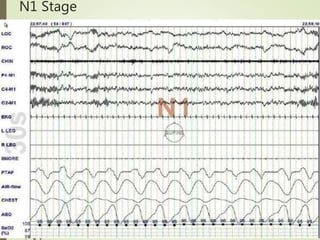
N1 Stage
 when eyes closed and relaxing and disappear when eyes are opened
 Decrease of alpha activity to less than 50% and low-amplitude beta and
theta activities.
 Alpha rhythm is best visualized in the posterior regions of the head (O2-
M1),
 Alpha rhythm is attenuated or replaced by low-amplitude, mixed-frequency
activity (4–7 Hz) for more than half of the epoch.
 EMG - less activity than in wake,
 Breathing becomes shallow,
 Heart rate becomes regular,
 Blood pressure falls,
 Patient exhibits little or no body movement
Awake
N1 Stage
N2 Stage
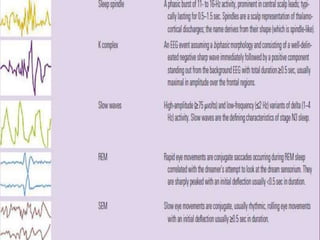
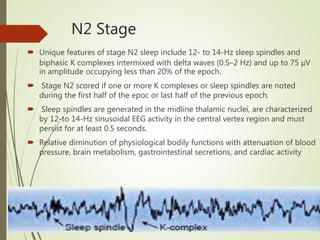
 Unique features of stage N2 sleep include 12- to 14-Hz sleep spindles and
biphasic K complexes intermixed with delta waves (0.5–2 Hz) and up to 75 μV
in amplitude occupying less than 20% of the epoch.
 Stage N2 scored if one or more K complexes or sleep spindles are noted
during the first half of the epoc or last half of the previous epoch.
 Sleep spindles are generated in the midline thalamic nuclei, are characterized
by 12-to 14-Hz sinusoidal EEG activity in the central vertex region and must
persist for at least 0.5 seconds.
 Relative diminution of physiological bodily functions with attenuation of blood
pressure, brain metabolism, gastrointestinal secretions, and cardiac activity
N2 Stage
N3 Stage
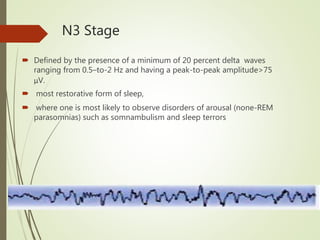
 Defined by the presence of a minimum of 20 percent delta waves
ranging from 0.5–to-2 Hz and having a peak-to-peak amplitude>75
μV.
 most restorative form of sleep,
 where one is most likely to observe disorders of arousal (none-REM
parasomnias) such as somnambulism and sleep terrors
N3
REM
 paradoxical sleep, or active sleep,
 REM are conjugate, irregular, sharply peaked eye movements.
 EEG -fast rhythms and theta activity, some of which may have a sawtooth
 appearance.
 EMG tone should be at the lowest level of any sleep stage.
 Physiological activity higher-
 1.BP and PR increase dramatically or may show intermittent fluctuations.
 2.Breathing becomes irregular and brain oxygen consumption increases.
 If patients are awakened from stage R sleep, they may often recall
dreaming
 Short REM sleep latency may point to a state of acute or cumulative sleep
deprivation
REM
Hypnogram
 Pictorial representation of the sleep stages from sleep onset to offset
 Helpful in staging and interpretation at baseline and prior to and following
treatment
Proportion of Time During the
Night That an Adult Spends in Various
Sleep Stages
Neuroanatomy and Neuromodulators
Influence Of Ascending System On
Thalamocortical Interactions According To
Behavior State
Sleep wake cycle
 2 kinds of activity
1. Slowly changing influence
a. Homeostatic drive
– some substance accumulate influence mechanism of sleep- possibly
Adenosine
b. Circadian rhythm –Change according to time of day
2.Rapidly Changing influence-Hypothalamus FLIP FLOP switch
Adenosine when
accumulate
Cholinergic group
of Neurons
Stimulate grp Nu
in Hypothalamus-
VLPO
Hypothalamic Circuits Regulating Circadian
Rhythm And Sleep
REM Sleep Motor Control
The “REM-on” regions consisting of the pre-coeruleus and sublaterodorsal
nucleus (SLD) activate two inhibitory pathways, referred to as the direct route
and indirect route
References
 Bradley 8th edition.
 Guyton & Hall 18th edition.
 PSG and Neurochemistry Source: Nir, Y., Tononi, G., 2010.
Dreaming and the brain: from phenomenology to
neurophysiology. Trends Cogn.Sci. 14(2), 88–100.
 Kryger, M.H., Avidan, A., Berry, R., 2013. Atlas of Clinical Sleep
Medicine, second ed. Saunders/Elsevier, Philadelphia
 Biology of Sleep Kryger MH, Avidan, AY, Berry, R. Atlas of
clinical sleep medicine. Second edition. ed. Philadelphia, PA.
 Boeve, B.F., Silber, M.H., Saper, C.B., et al., 2007.
Pathophysiology of REM sleep behaviour disorder and
relevance to neurodegenerative disease. Brain 130
SLEEP PHYSIOLOGY .pptx

SLEEP PHYSIOLOGY .pptx

  • 1.
  • 2.
    WHAT IS SLEEP? Sleep: State of unconsciousness from which a subject can be aroused by appropriate sensory or other stimuli.  - Sleep may also be defined as a normal, periodic, inhibition of the reticular Activating system.  Awake: State of readiness/alertness & ability to react consciously to various stimuli.  Coma: State of unconsciousness from which a person cannot be aroused by any external stimuli.
  • 3.
    Why We Sleep Sleep Theory #1-To Rest : to gain relief from hyperactive stage  Sleep Theory #2-To Heal: Sleep also allow us to heal our body. The immune system (our ability to fight with diseases),  Sleep Theory #-3Sleep deprivation affect our metabolism. It also allow us to save our energy. Sleep deprivation may serve as risk factors for obesity, hypertension, and diabetes mellitus  Sleep Theory #4- To Learn :Sleep may Help the human brain get better organized- by filing away important memories and discarding unwanted information.
  • 4.
    Theories of sleep Restorationtheory: Body wears out during the day and sleep is necessary to put it back in shape. * This is supported by findings that many of the major restorative functions in the body like muscle growth, tissue repair, protein synthesis, and growth hormone release occur mostly, or in some cases only, during sleep. Preservation & protection theory: Sleep preserve energy and it provides protection. For example, both body temperature and caloric demand decrease during sleep, as compared to wakefulness.
  • 5.
    Behavioral and Physiological Criteriaof Wakefulness and Sleep.
  • 6.
    Stages Of Sleep Sleep is divided into two independent states: NREM and REM sleep based on physiological correlates  In their 1968 criteria, Rechtschaffen and Kales (RK) divided NREM sleep into stages 1, 2, 3, and 4.  In 2007, this staging was modified by American Academy of Sleep Medicine (AASM) Task Force, NREM sleep is now divided into three stages: N1, N2, and N3
  • 7.
     RK stage1 NREM - N1,  RK stage 2 - N2,  RK stages 3 and 4 were combined - N3.  REM sleep can be subdivided into two stages: 1.Tonic-REM 2.Phasic-REM
  • 8.
    EEG Morphologies, Frequencies, andLandmarks Used in Sleep Staging
  • 10.
     Sleep scoringand staging is a procedure whereby the sleep recording is broken up into 30-second segments, “epochs,” of a polysomnographic (PSG) tracing with a paper or monitor speed of 10 mm/sec.
  • 11.
    N1 Stage  wheneyes closed and relaxing and disappear when eyes are opened  Decrease of alpha activity to less than 50% and low-amplitude beta and theta activities.  Alpha rhythm is best visualized in the posterior regions of the head (O2- M1),  Alpha rhythm is attenuated or replaced by low-amplitude, mixed-frequency activity (4–7 Hz) for more than half of the epoch.  EMG - less activity than in wake,  Breathing becomes shallow,  Heart rate becomes regular,  Blood pressure falls,  Patient exhibits little or no body movement
  • 12.
  • 13.
  • 14.
    N2 Stage  Uniquefeatures of stage N2 sleep include 12- to 14-Hz sleep spindles and biphasic K complexes intermixed with delta waves (0.5–2 Hz) and up to 75 μV in amplitude occupying less than 20% of the epoch.  Stage N2 scored if one or more K complexes or sleep spindles are noted during the first half of the epoc or last half of the previous epoch.  Sleep spindles are generated in the midline thalamic nuclei, are characterized by 12-to 14-Hz sinusoidal EEG activity in the central vertex region and must persist for at least 0.5 seconds.  Relative diminution of physiological bodily functions with attenuation of blood pressure, brain metabolism, gastrointestinal secretions, and cardiac activity
  • 15.
  • 16.
    N3 Stage  Definedby the presence of a minimum of 20 percent delta waves ranging from 0.5–to-2 Hz and having a peak-to-peak amplitude>75 μV.  most restorative form of sleep,  where one is most likely to observe disorders of arousal (none-REM parasomnias) such as somnambulism and sleep terrors
  • 17.
  • 18.
    REM  paradoxical sleep,or active sleep,  REM are conjugate, irregular, sharply peaked eye movements.  EEG -fast rhythms and theta activity, some of which may have a sawtooth  appearance.  EMG tone should be at the lowest level of any sleep stage.  Physiological activity higher-  1.BP and PR increase dramatically or may show intermittent fluctuations.  2.Breathing becomes irregular and brain oxygen consumption increases.  If patients are awakened from stage R sleep, they may often recall dreaming  Short REM sleep latency may point to a state of acute or cumulative sleep deprivation
  • 19.
  • 20.
    Hypnogram  Pictorial representationof the sleep stages from sleep onset to offset  Helpful in staging and interpretation at baseline and prior to and following treatment
  • 21.
    Proportion of TimeDuring the Night That an Adult Spends in Various Sleep Stages
  • 22.
  • 23.
    Influence Of AscendingSystem On Thalamocortical Interactions According To Behavior State
  • 25.
    Sleep wake cycle 2 kinds of activity 1. Slowly changing influence a. Homeostatic drive – some substance accumulate influence mechanism of sleep- possibly Adenosine b. Circadian rhythm –Change according to time of day 2.Rapidly Changing influence-Hypothalamus FLIP FLOP switch Adenosine when accumulate Cholinergic group of Neurons Stimulate grp Nu in Hypothalamus- VLPO
  • 26.
    Hypothalamic Circuits RegulatingCircadian Rhythm And Sleep
  • 27.
    REM Sleep MotorControl The “REM-on” regions consisting of the pre-coeruleus and sublaterodorsal nucleus (SLD) activate two inhibitory pathways, referred to as the direct route and indirect route
  • 28.
    References  Bradley 8thedition.  Guyton & Hall 18th edition.  PSG and Neurochemistry Source: Nir, Y., Tononi, G., 2010. Dreaming and the brain: from phenomenology to neurophysiology. Trends Cogn.Sci. 14(2), 88–100.  Kryger, M.H., Avidan, A., Berry, R., 2013. Atlas of Clinical Sleep Medicine, second ed. Saunders/Elsevier, Philadelphia  Biology of Sleep Kryger MH, Avidan, AY, Berry, R. Atlas of clinical sleep medicine. Second edition. ed. Philadelphia, PA.  Boeve, B.F., Silber, M.H., Saper, C.B., et al., 2007. Pathophysiology of REM sleep behaviour disorder and relevance to neurodegenerative disease. Brain 130

Editor's Notes

  • #5 1- This is further supported by findings that many of the major restorative functions in the body like muscle growth, tissue repair, protein synthesis, and growth hormone release occur mostly, or in some cases only, during sleep. 2- For example, both body temperature and caloric demand decrease during sleep, as compared to wakefulness.