Sampling
 Design
D.A. Asir John Samuel, BSc (Psy),
MPT (Neuro Paed), MAc, DYScEd,
           C/BLS, FAGE
Basic definitions
• Population
- Collection of all the units that are of interest
  to the investigator
• Sample
- Representative part of population
• Sampling
- Technique of selecting a representative group
  from a population
                 Dr. Asir John Samuel (PT), Lecturer, ACP   2
Why ?

• Only feasible method for collecting information

• Reduces demands on resources (time, finance,.)

• Results obtained more quickly

• Better accuracy of collected data

• Ethically acceptable

                  Dr. Asir John Samuel (PT), Lecturer, ACP   3
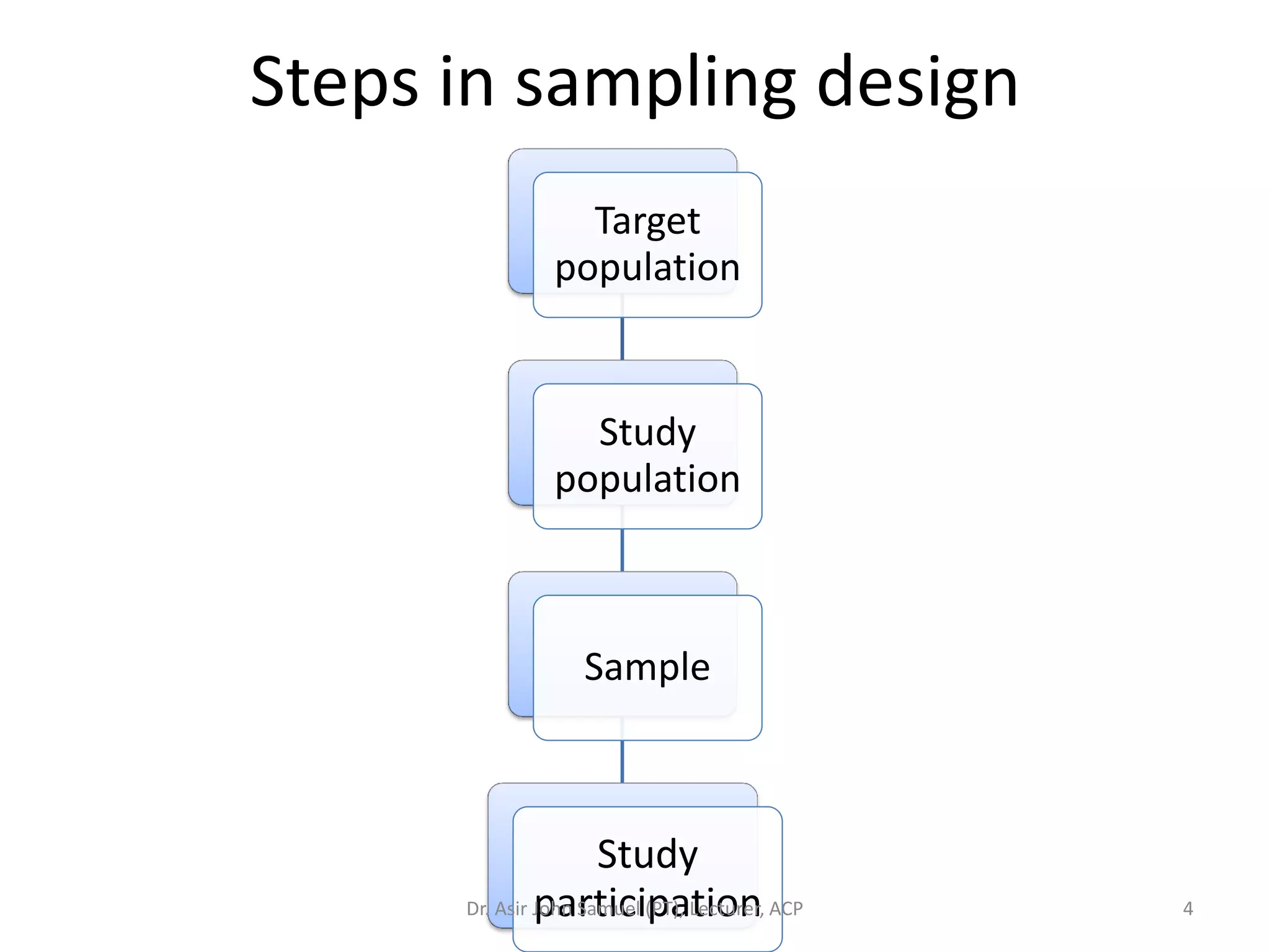
Steps in sampling design
                  Target
                population


                  Study
                population


                    Sample


                      Study
               participation
      Dr. Asir John Samuel (PT), Lecturer, ACP   4
Characteristic of good sample design
• True representation of population

• May result in small sampling error

• Each member in population should get an
  opportunity of being selected

• Systematic bias can be controlled in a better way

• Results should be capable of being extrapolated
                  Dr. Asir John Samuel (PT), Lecturer, ACP   5
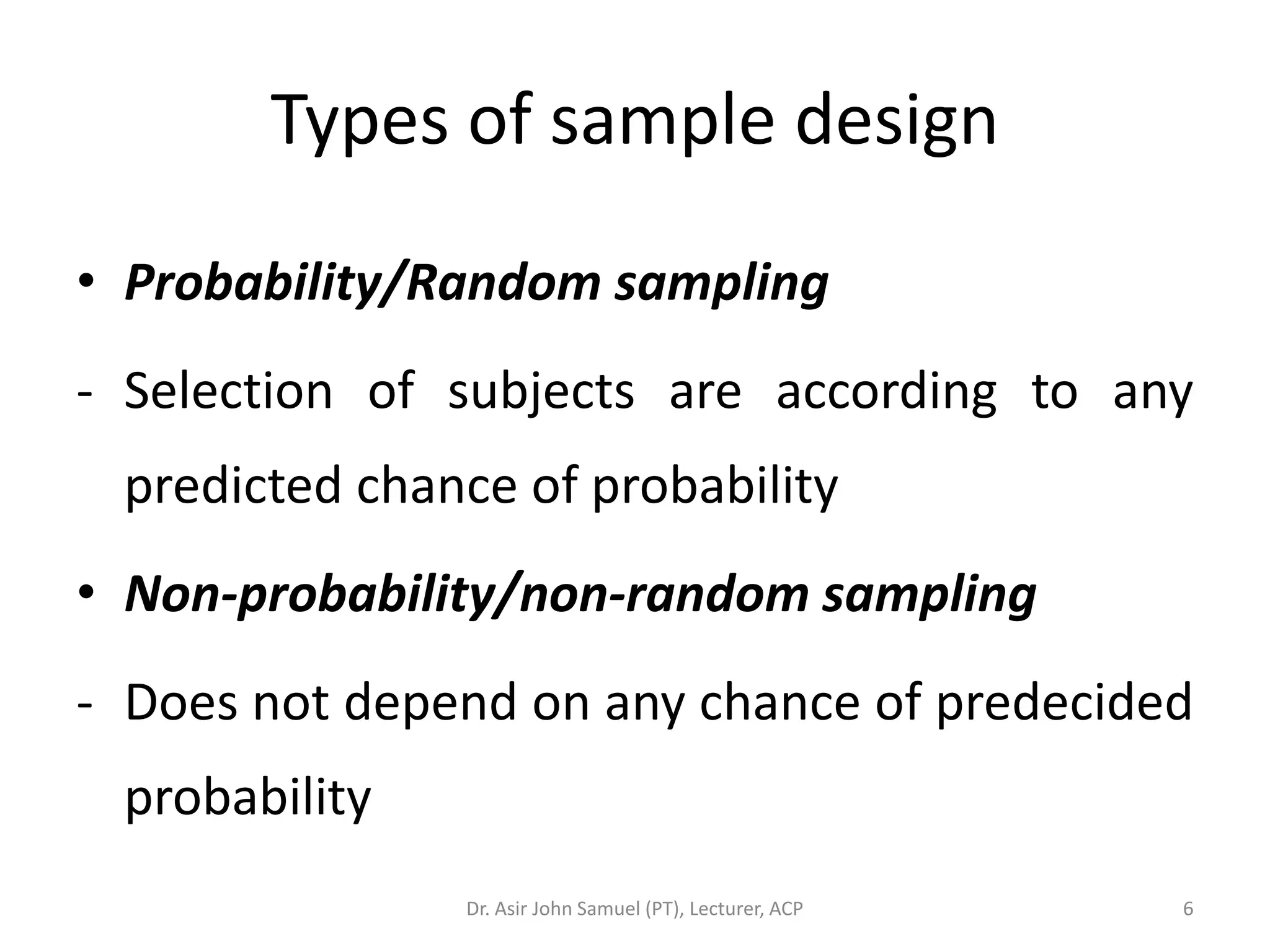
Types of sample design

• Probability/Random sampling
- Selection of subjects are according to any
 predicted chance of probability
• Non-probability/non-random sampling
- Does not depend on any chance of predecided
 probability
               Dr. Asir John Samuel (PT), Lecturer, ACP   6
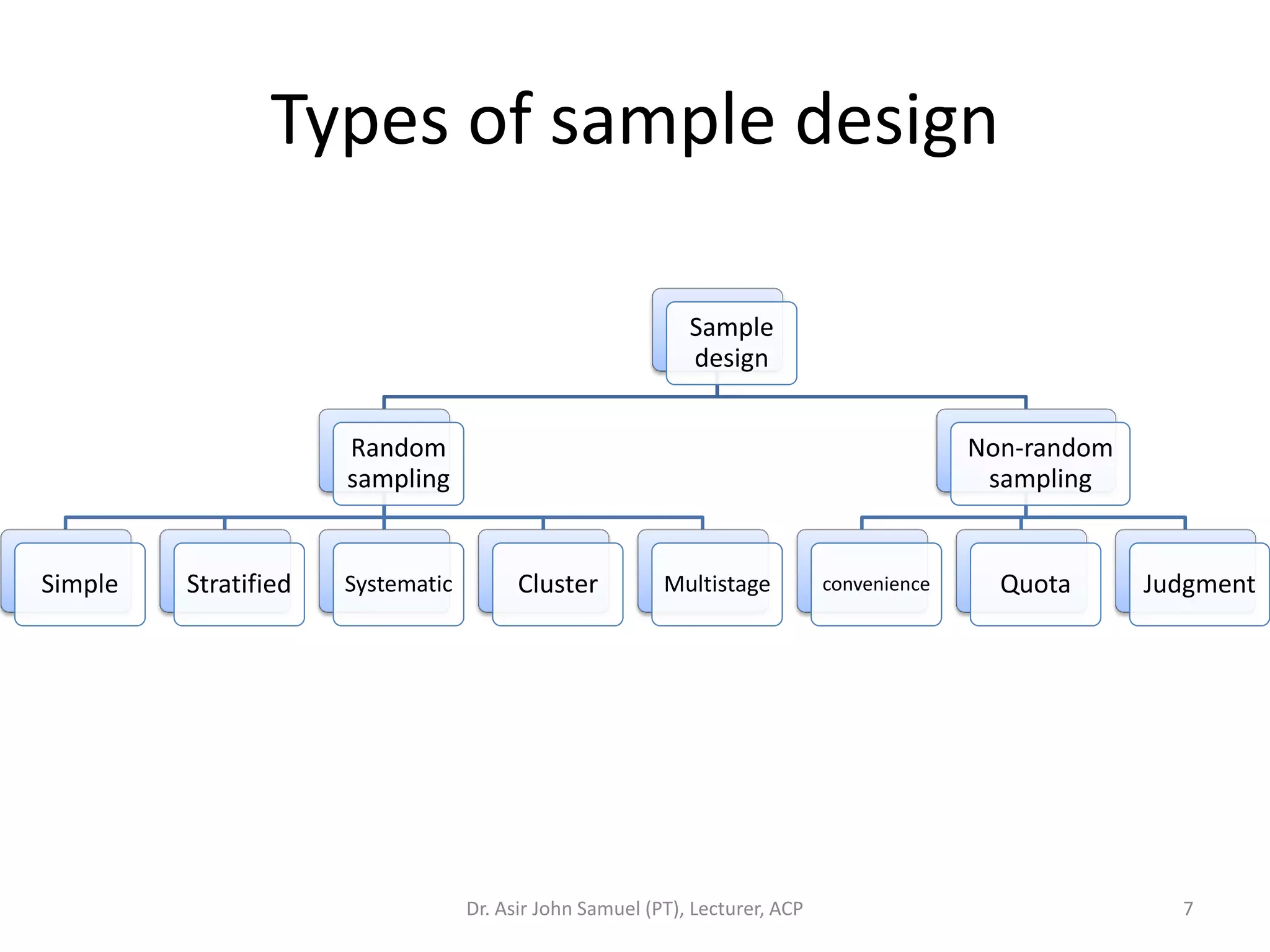
Types of sample design

                                                             Sample
                                                             design


                      Random                                                                Non-random
                      sampling                                                               sampling


Simple   Stratified   Systematic         Cluster          Multistage          convenience     Quota      Judgment


                                   Dr. Asir John Samuel (PT), Lecturer, ACP                                7
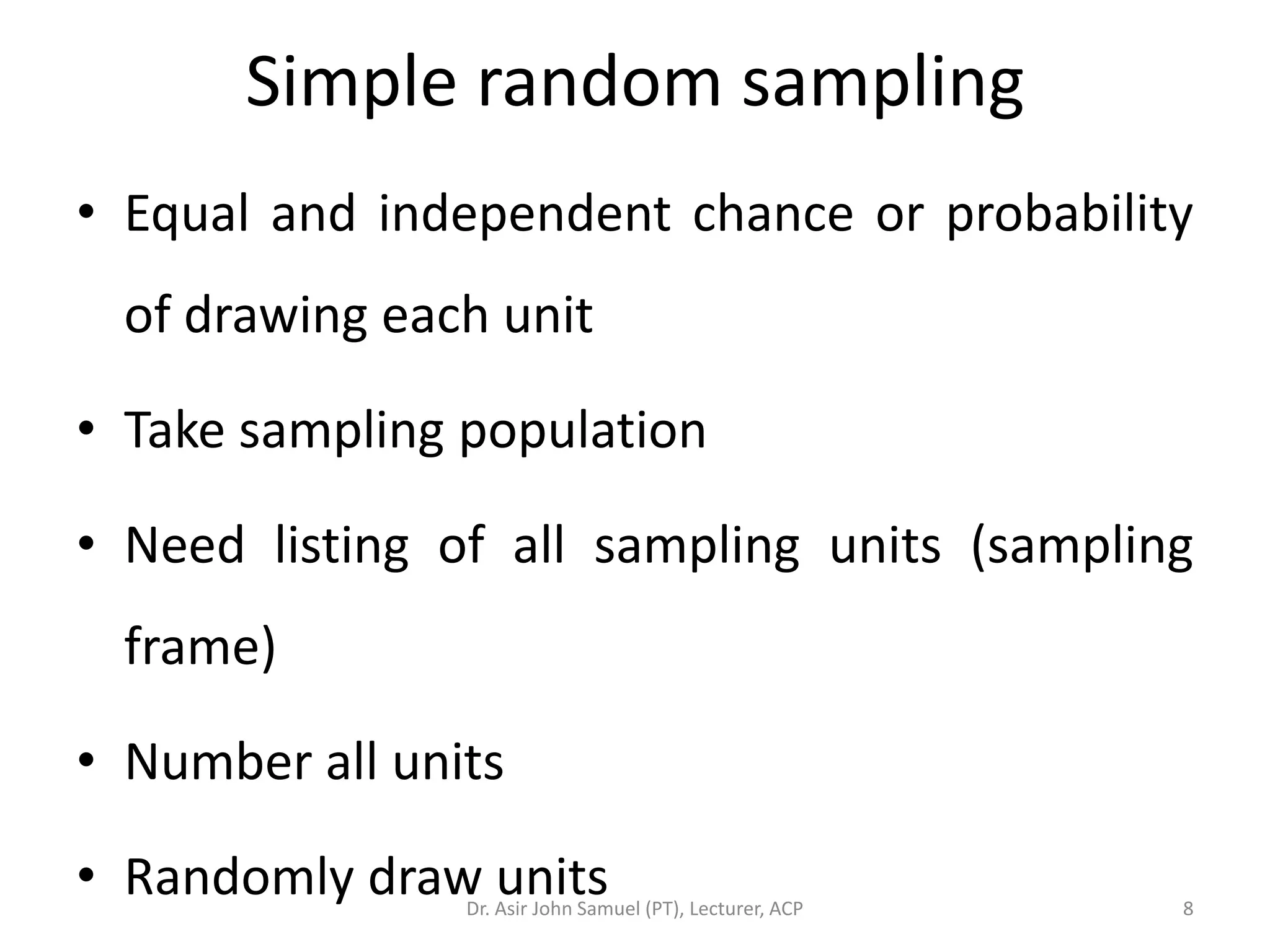
Simple random sampling
• Equal and independent chance or probability
  of drawing each unit

• Take sampling population

• Need listing of all sampling units (sampling
  frame)

• Number all units

• Randomly draw units
                Dr. Asir John Samuel (PT), Lecturer, ACP   8
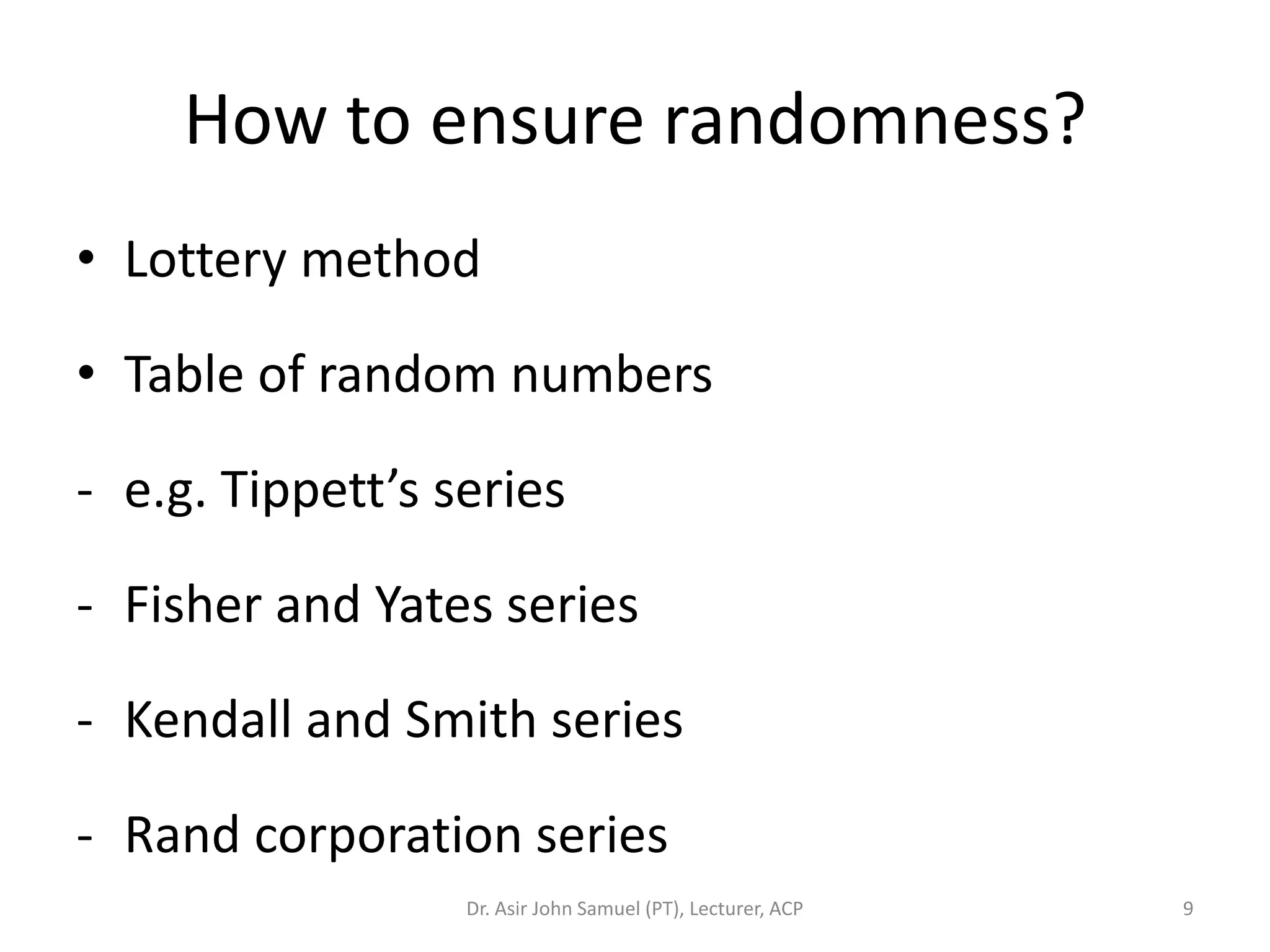
How to ensure randomness?
• Lottery method

• Table of random numbers

- e.g. Tippett’s series

- Fisher and Yates series

- Kendall and Smith series

- Rand corporation series
                  Dr. Asir John Samuel (PT), Lecturer, ACP   9
SRS - Merits

• No personal bias

• Easy to assess the accuracy


                Dr. Asir John Samuel (PT), Lecturer, ACP   10
SRS - Demerits

• Need a complete catalogue of universe

• Large size sample

• Widely dispersed


                Dr. Asir John Samuel (PT), Lecturer, ACP   11
Stratified Random Sampling

• Used for heterogeneous population

• Population is divided into homogeneous
 groups (strata), according to a characteristic of
 interest (e.g. sex, religion, location)

• Then a simple random sample is selected from
 each stratum
                 Dr. Asir John Samuel (PT), Lecturer, ACP   12
SRs - Merits

• More representative

• Greater accuracy

• Can   acquire        information                           about   whole
 population and individual strata


                  Dr. Asir John Samuel (PT), Lecturer, ACP               13
SRs - Demerits

• Careful stratification

• Random selection in each stratum

• Time consuming


                  Dr. Asir John Samuel (PT), Lecturer, ACP   14
Systematic Sampling

• Sampling units are selected in a systematic
 way, that is, every Kth unit in the population is
 selected
• First divide the population size by the,
 required sample size (sampling fraction). Let
 the sampling fraction be K

                Dr. Asir John Samuel (PT), Lecturer, ACP   15
Systematic Sampling

• Select a unit at random from the first K units
  and thereafter every Kth unit is selected

• If, N=1200

• And n=60

• Then, SF=20

                 Dr. Asir John Samuel (PT), Lecturer, ACP   16
SS - Merits

• Simple and convenient

• Less time and work


               Dr. Asir John Samuel (PT), Lecturer, ACP   17
SS - Demerits

• Need complete list of units

• Periodicity

• Less representation


                 Dr. Asir John Samuel (PT), Lecturer, ACP   18
Cluster Sampling

• The sampling units are groups or clusters

• The population is divided into clusters, and a
  sample of clusters are selected randomly

• All the units in the selected clusters are then
  examined or studied


                 Dr. Asir John Samuel (PT), Lecturer, ACP   19
Cluster Sampling

• It is always assumed that the individual items
  within each cluster are representation of
  population

• E.g. District, wards, schools, industries


                  Dr. Asir John Samuel (PT), Lecturer, ACP   20
CS - Merits

• Saving of travelling time and consequent
 reduction in cost

• Cuts down on the cost of preparing the
 sampling frame


                Dr. Asir John Samuel (PT), Lecturer, ACP   21
CS - Demerits

• Units close to each other may be very similar
  and so, less likely to represent the whole
  population

• Larger sampling error than simple random
  sampling


                Dr. Asir John Samuel (PT), Lecturer, ACP   22
Multistage Sampling
• Selection is done in stages until final sampling
  units are arrived

• At first stage, Random sampling of large sized
  sampling units are selected, from the selected
  1st stage sampling units another sampling
  units of smaller sampling units are selected,
  randomly       Dr. Asir John Samuel (PT), Lecturer, ACP   23
Multistage Sampling

• Continue until the final sampling units are
  selected

• E.g. Few states – District – Taulk


                  Dr. Asir John Samuel (PT), Lecturer, ACP   24
MS - Merits

• Cut down the cost of preparing the sampling
 frame


               Dr. Asir John Samuel (PT), Lecturer, ACP   25
MS - Demerits

• Sampling error is increased compared to
 simple random sampling


              Dr. Asir John Samuel (PT), Lecturer, ACP   26
Quota Sampling

• Interviewers are requested to find cases with

  particular types of people to interview


                 Dr. Asir John Samuel (PT), Lecturer, ACP   27
Judgment (Purposive Sampling)

• Researcher attempts to obtain sample that
 appear to be representative of the population
 selected by the researcher subjectively


                Dr. Asir John Samuel (PT), Lecturer, ACP   28
Convenience Sampling

• Sampling comprises subject who are simply
  avail in a convenient way to the researcher

• No randomness and likelihood of bias is high


                 Dr. Asir John Samuel (PT), Lecturer, ACP   29
Snowball Sampling

• Investigators start with a few subjects and
 then recruit more via word of mouth from the
 original participants


                Dr. Asir John Samuel (PT), Lecturer, ACP   30
Merits

• Easy

• Low cost

• Limited time

• Total list population


                 Dr. Asir John Samuel (PT), Lecturer, ACP   31
Demerits

• Selection bias

• Sample is not representation of population

• doesn’t allow generalization


                   Dr. Asir John Samuel (PT), Lecturer, ACP   32
Sample Size
Determination
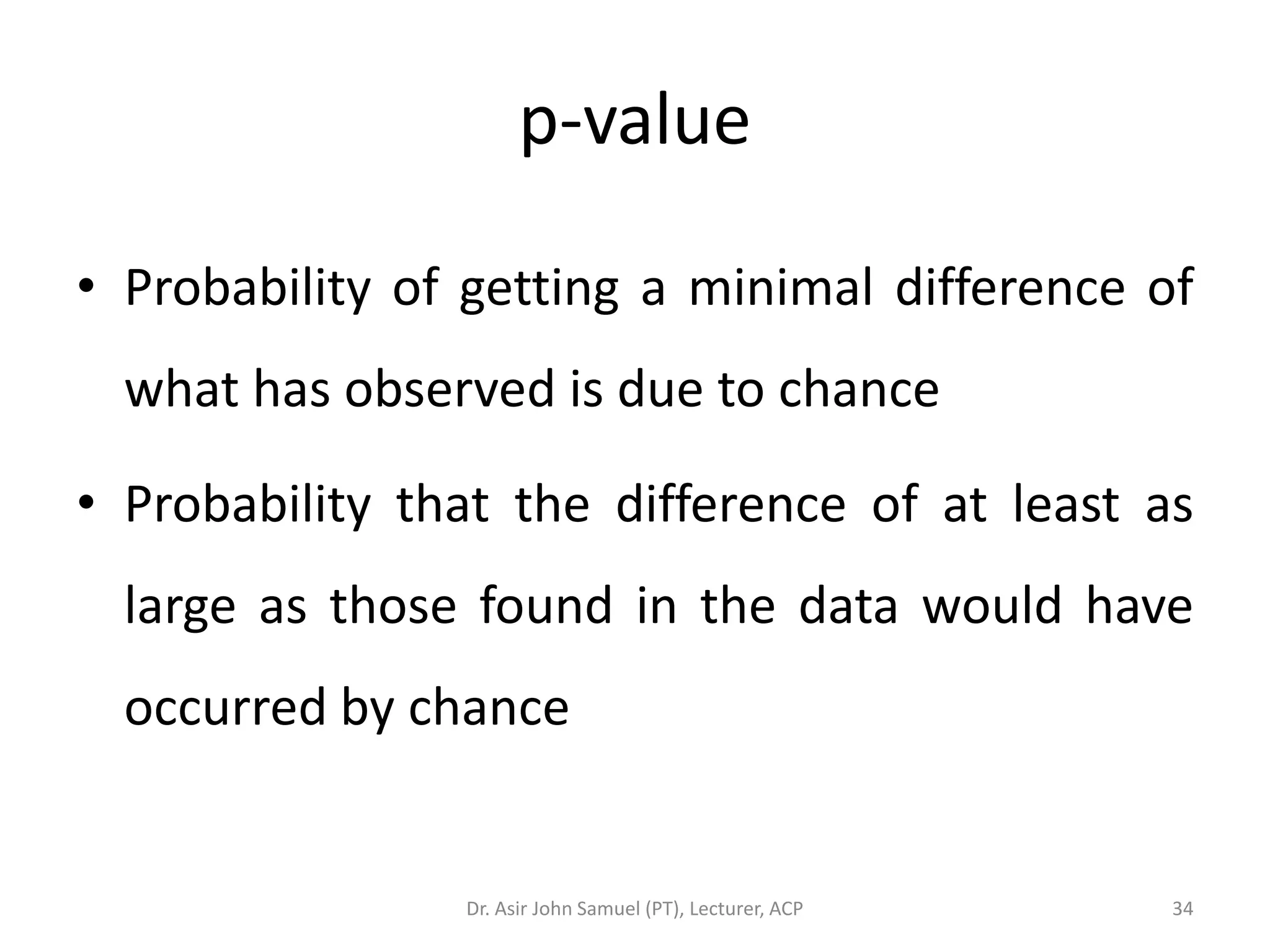
p-value

• Probability of getting a minimal difference of
  what has observed is due to chance

• Probability that the difference of at least as
  large as those found in the data would have
  occurred by chance


                Dr. Asir John Samuel (PT), Lecturer, ACP   34
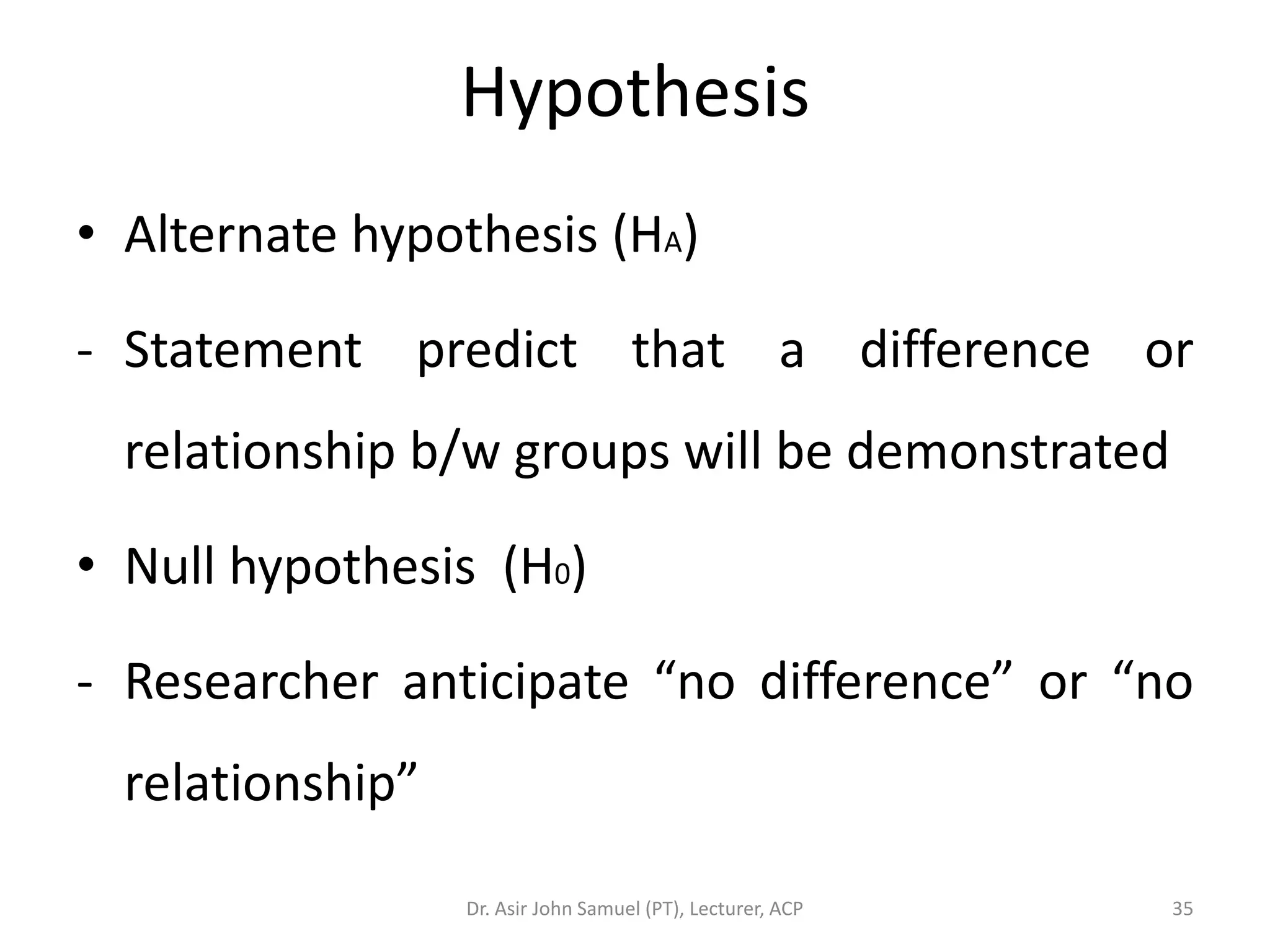
Hypothesis
• Alternate hypothesis (HA)

- Statement predict that a difference or
  relationship b/w groups will be demonstrated

• Null hypothesis (H0)

- Researcher anticipate “no difference” or “no
  relationship”

                  Dr. Asir John Samuel (PT), Lecturer, ACP   35
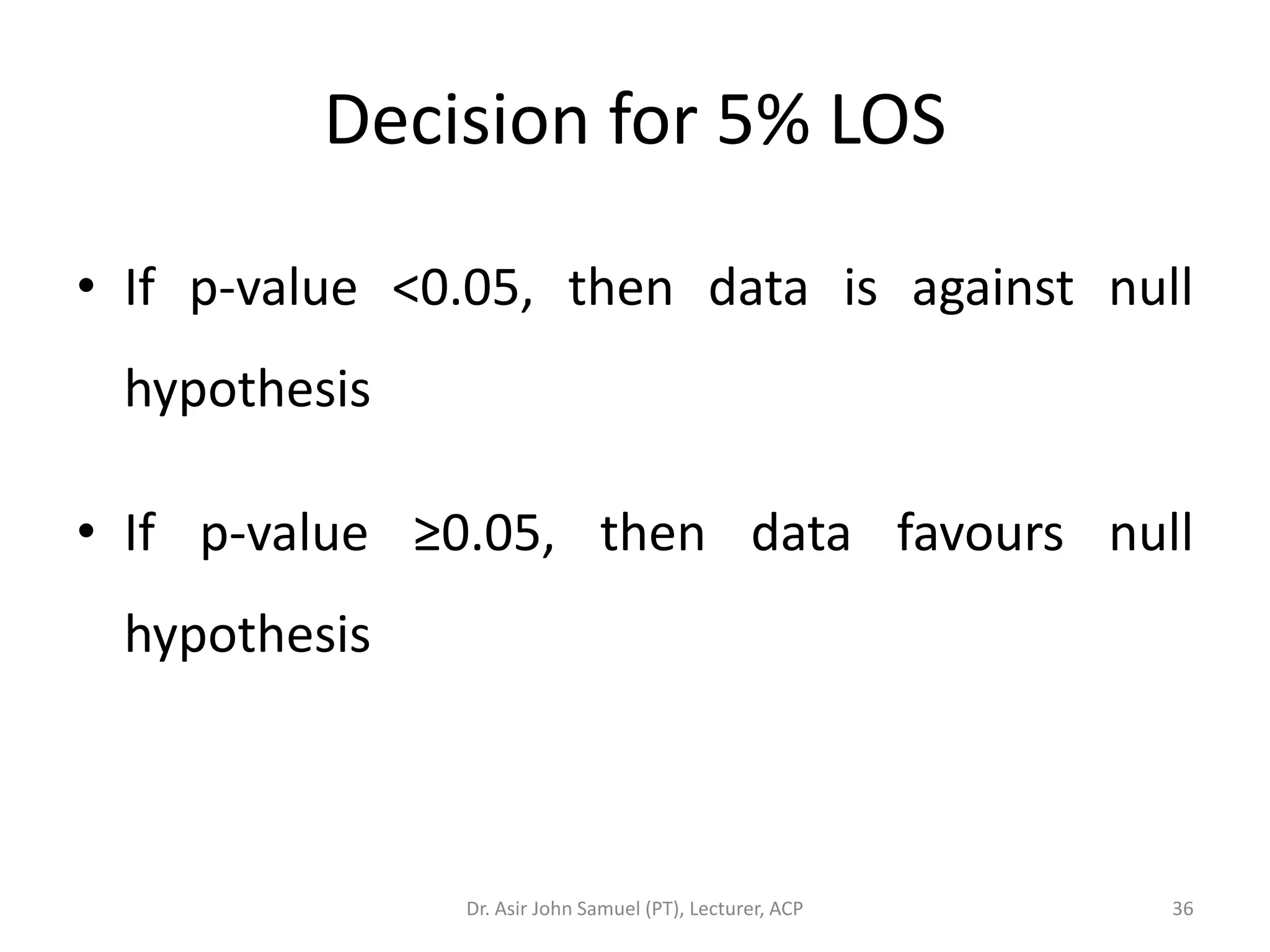
Decision for 5% LOS

• If p-value <0.05, then data is against null
 hypothesis

• If p-value ≥0.05, then data favours null
 hypothesis


               Dr. Asir John Samuel (PT), Lecturer, ACP   36
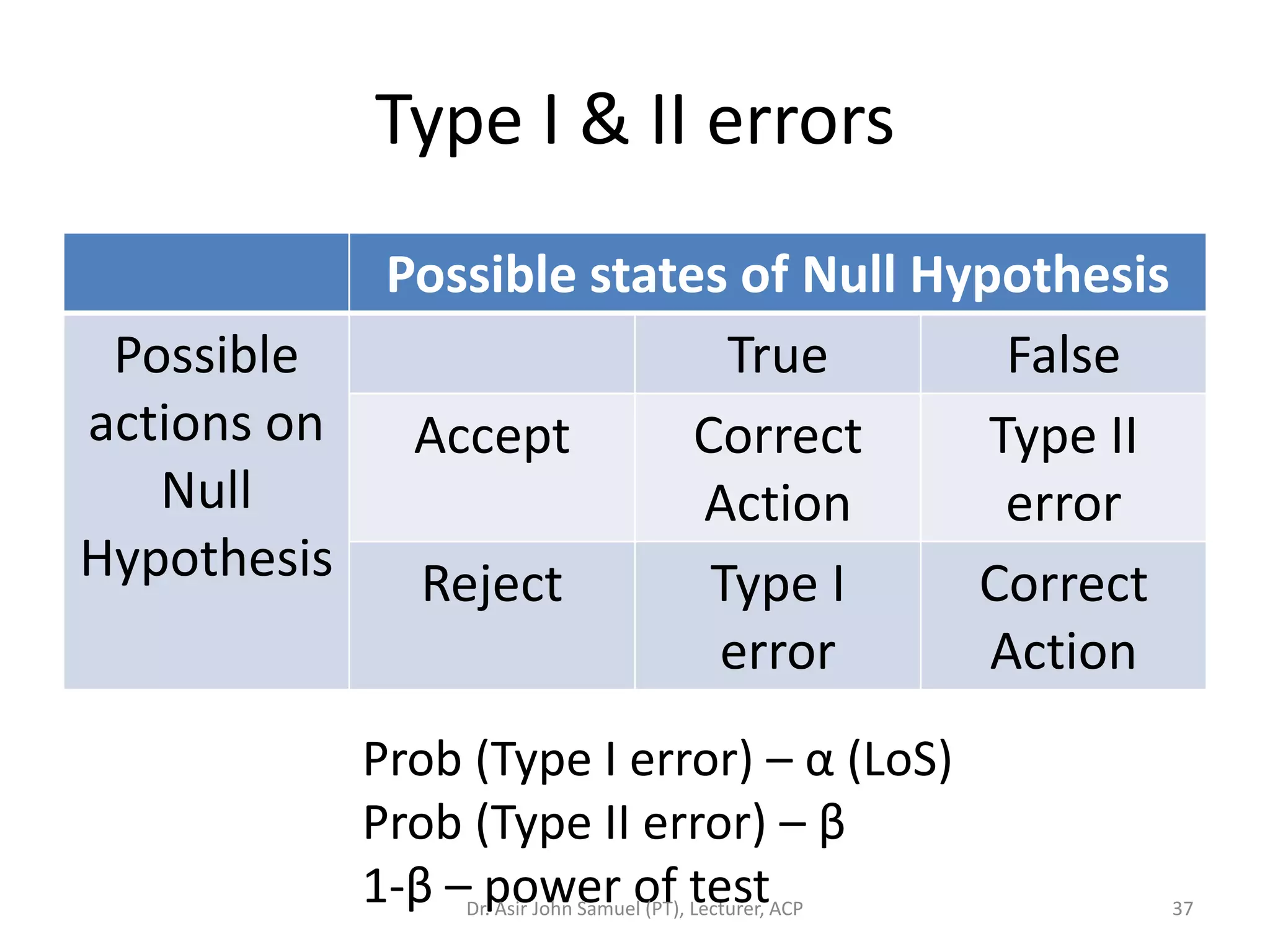
Type I & II errors
           Possible states of Null Hypothesis
 Possible                  True        False
actions on  Accept       Correct      Type II
   Null                  Action        error
Hypothesis  Reject        Type I     Correct
                          error       Action
           Prob (Type I error) – α (LoS)
           Prob (Type II error) – β
           1-β – power of test
                Dr. Asir John Samuel (PT), Lecturer, ACP   37
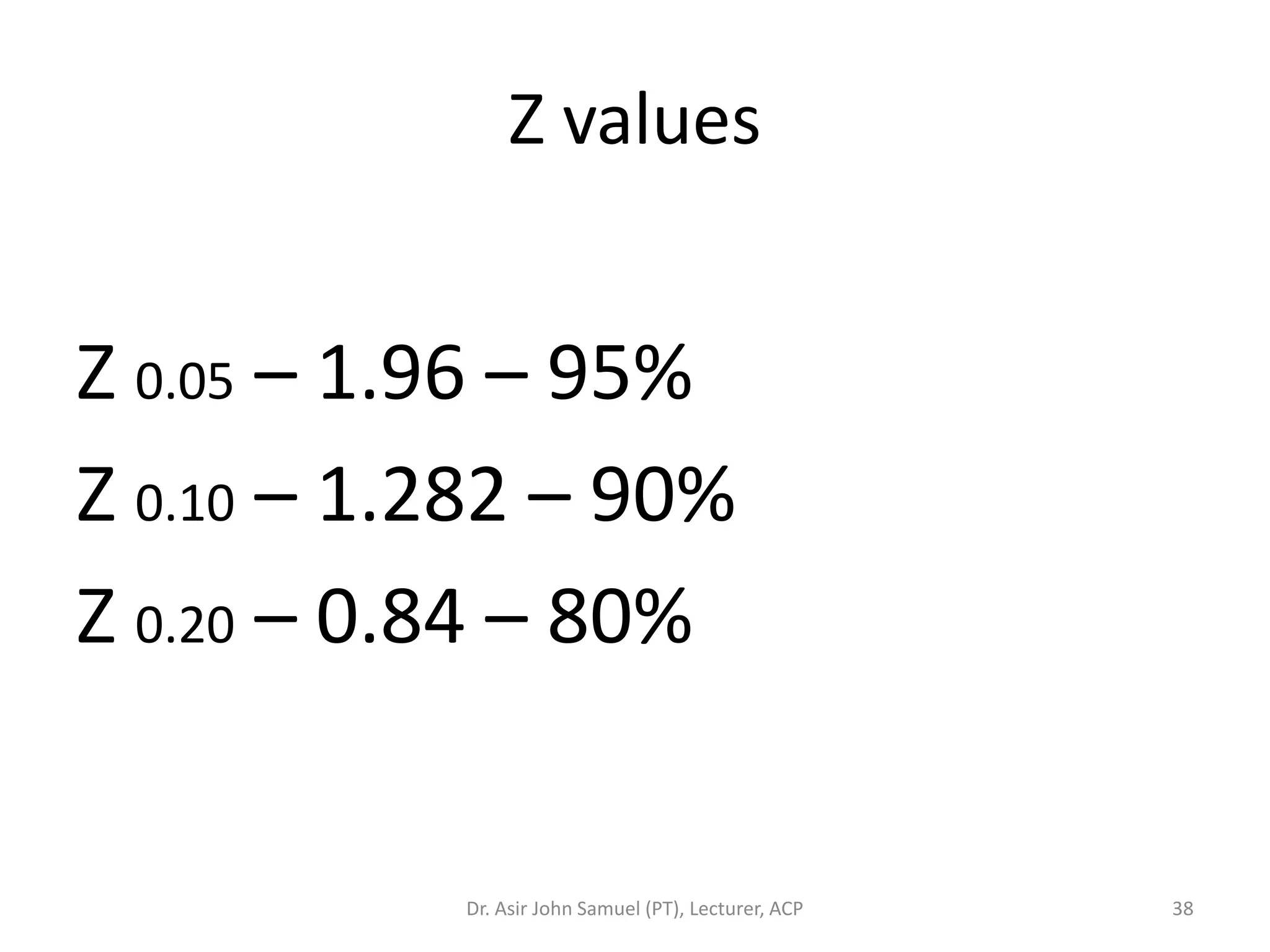
Z values


Z 0.05 – 1.96 – 95%
Z 0.10 – 1.282 – 90%
Z 0.20 – 0.84 – 80%


           Dr. Asir John Samuel (PT), Lecturer, ACP   38
Comparison of 2 means

           n= 2 [(Zα+Zβ)s/d]²

Zα – LoS
Zβ – power of study
s – pooled SD of the two sample
d – clinically significant difference


                  Dr. Asir John Samuel (PT), Lecturer, ACP   39
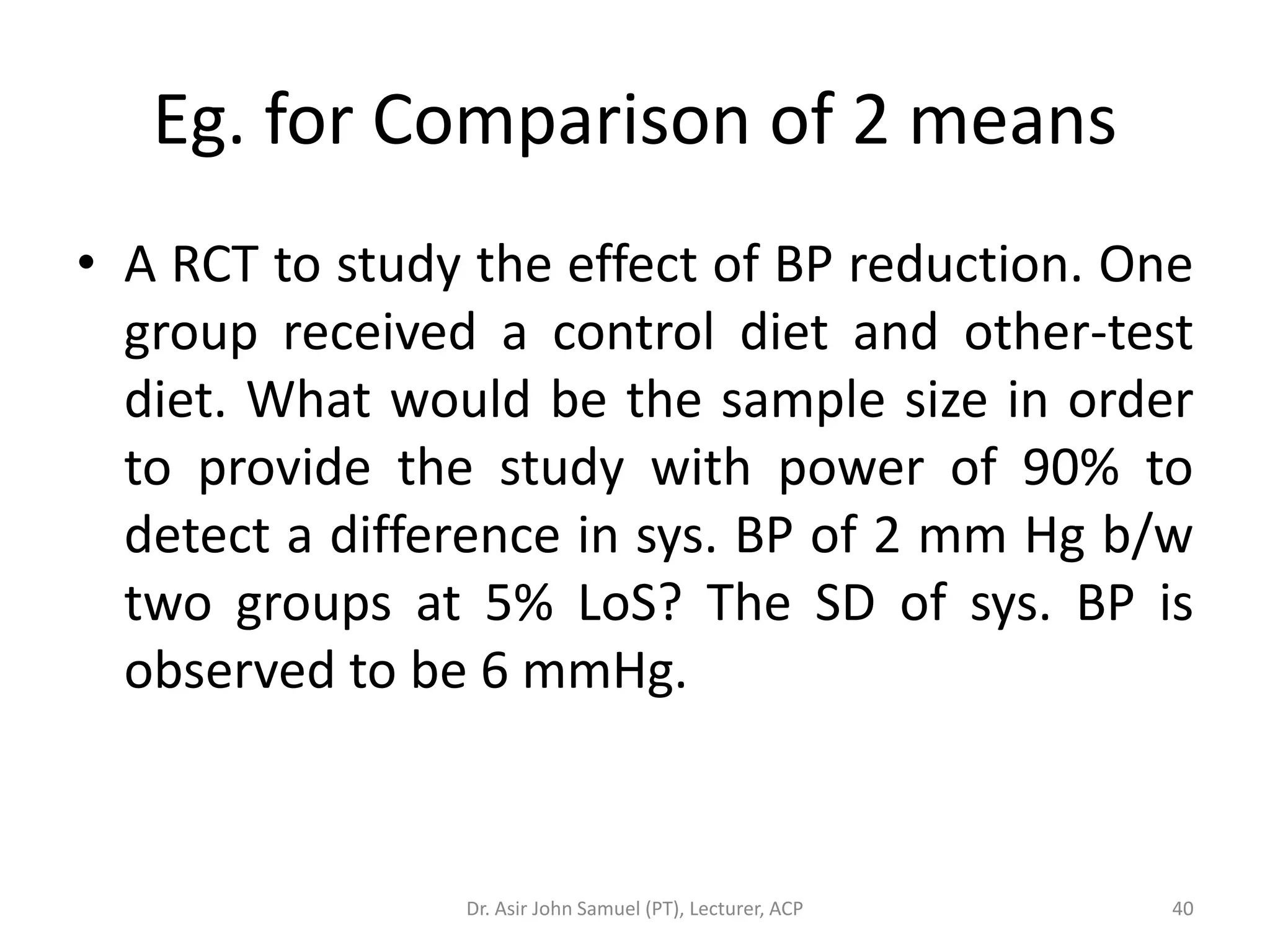
Eg. for Comparison of 2 means
• A RCT to study the effect of BP reduction. One
  group received a control diet and other-test
  diet. What would be the sample size in order
  to provide the study with power of 90% to
  detect a difference in sys. BP of 2 mm Hg b/w
  two groups at 5% LoS? The SD of sys. BP is
  observed to be 6 mmHg.


                Dr. Asir John Samuel (PT), Lecturer, ACP   40
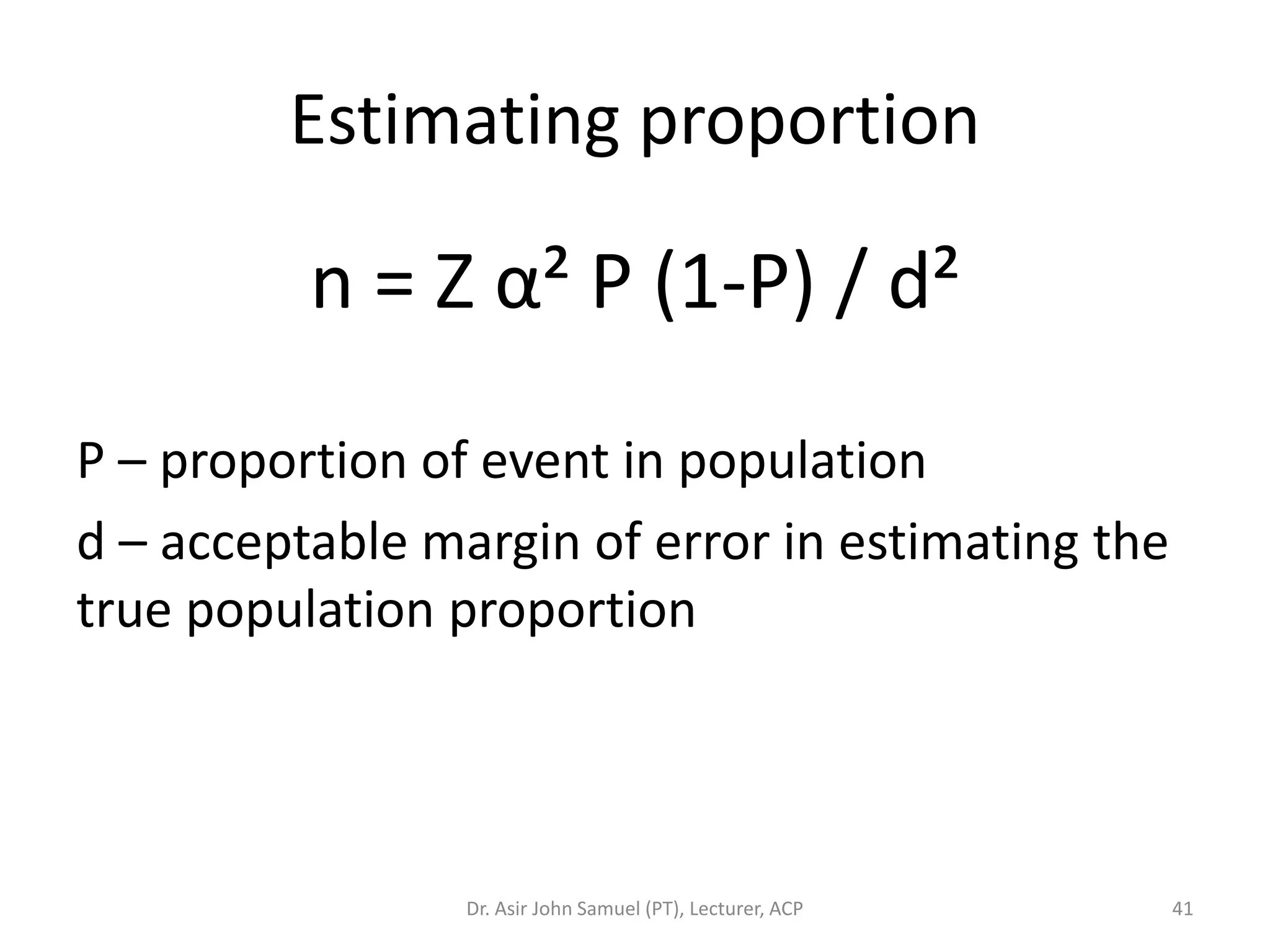
Estimating proportion

          n = Z α² P (1-P) / d²

P – proportion of event in population
d – acceptable margin of error in estimating the
true population proportion


                 Dr. Asir John Samuel (PT), Lecturer, ACP   41
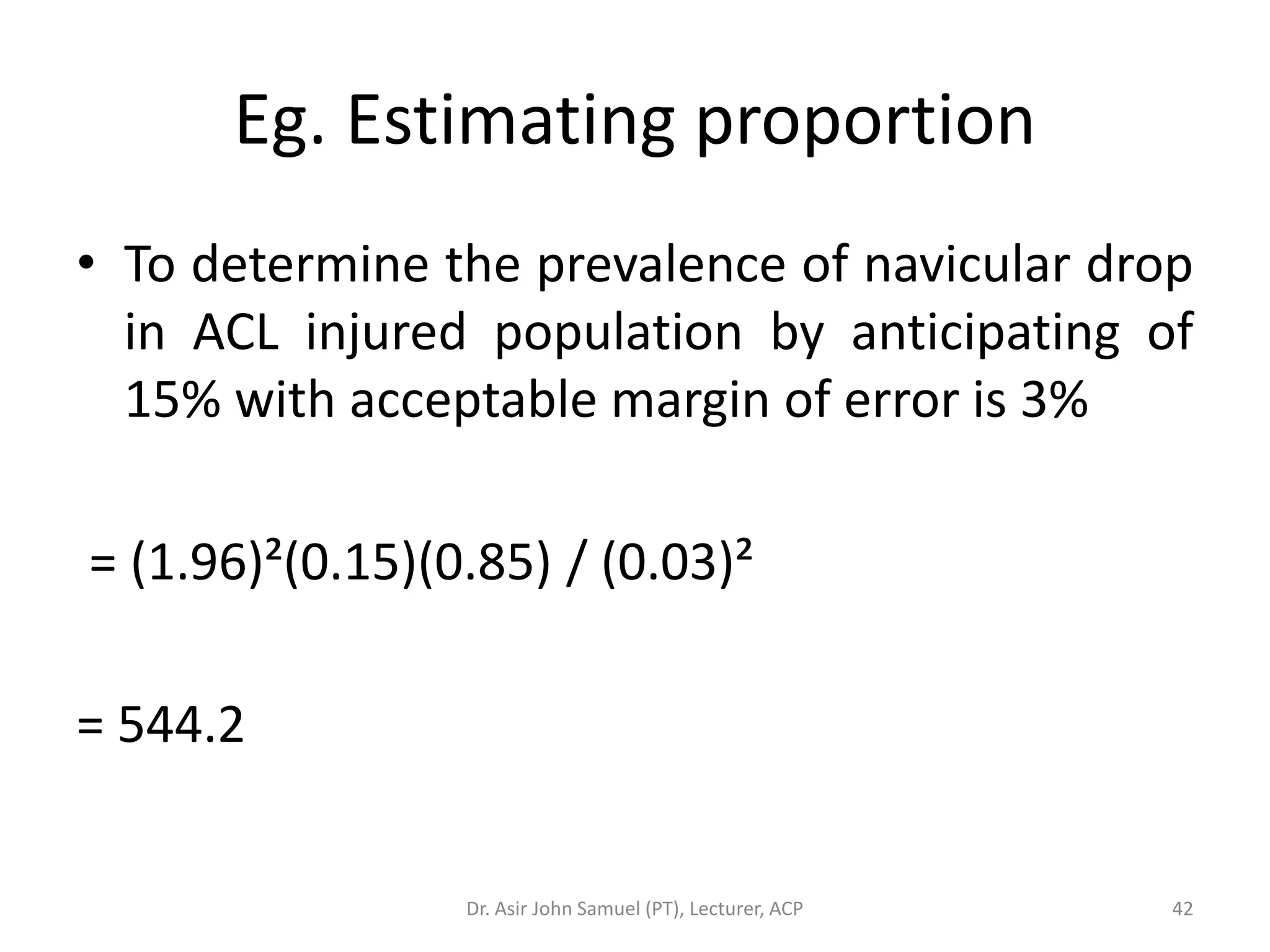
Eg. Estimating proportion
• To determine the prevalence of navicular drop
  in ACL injured population by anticipating of
  15% with acceptable margin of error is 3%

= (1.96)²(0.15)(0.85) / (0.03)²

= 544.2


                 Dr. Asir John Samuel (PT), Lecturer, ACP   42
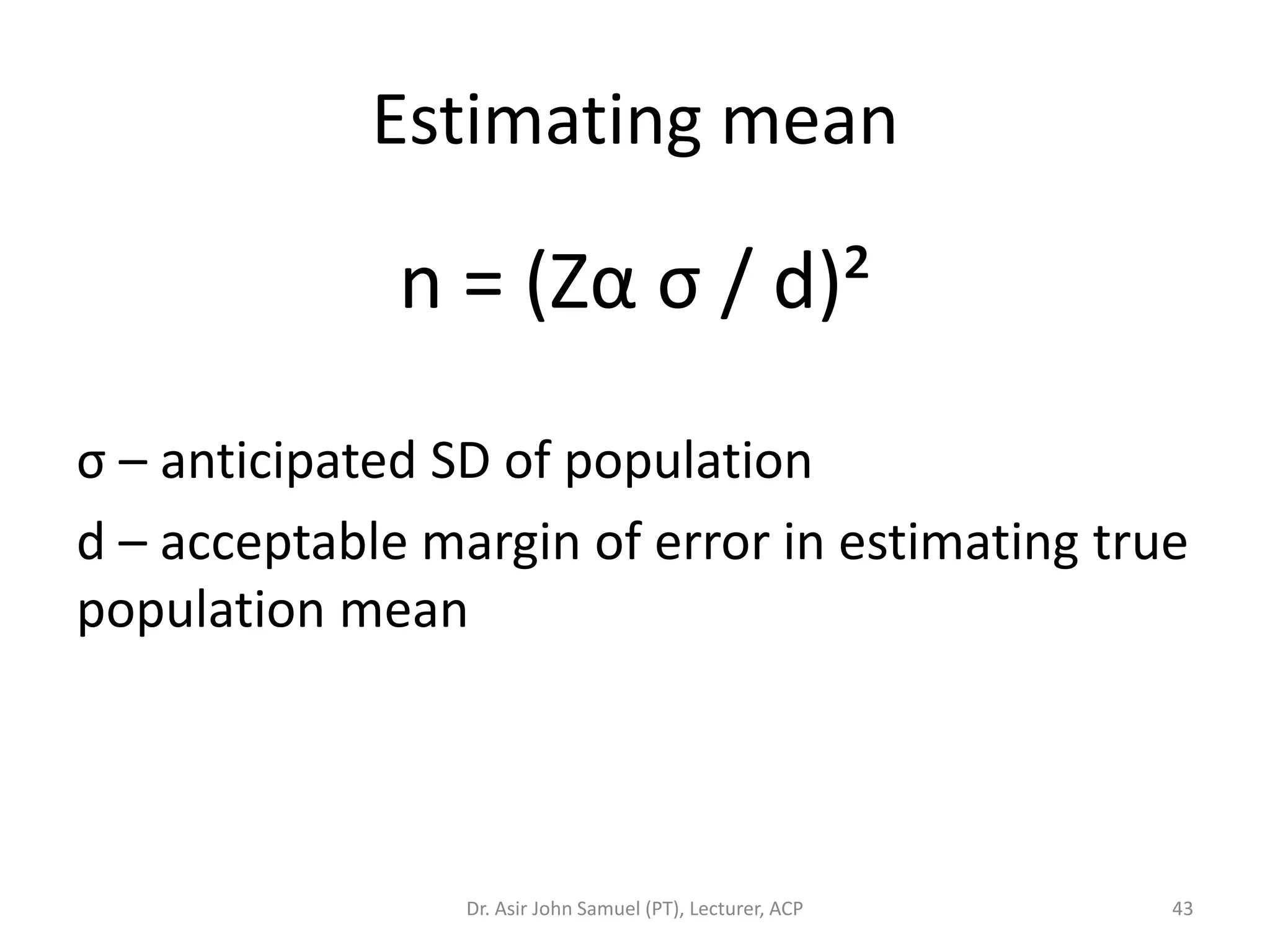
Estimating mean

              n = (Zα σ / d)²

σ – anticipated SD of population
d – acceptable margin of error in estimating true
population mean


                 Dr. Asir John Samuel (PT), Lecturer, ACP   43
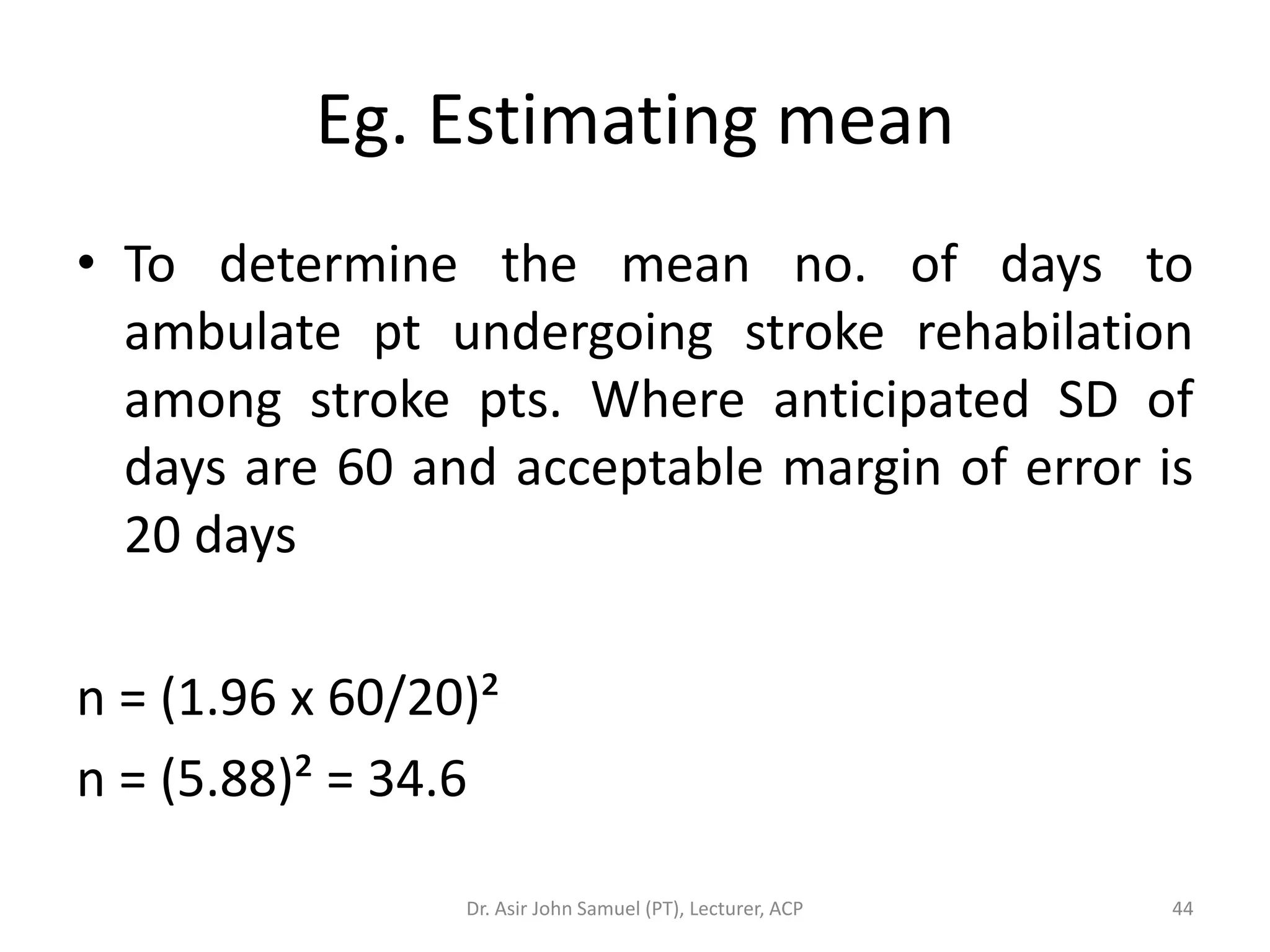
Eg. Estimating mean
• To determine the mean no. of days to
  ambulate pt undergoing stroke rehabilation
  among stroke pts. Where anticipated SD of
  days are 60 and acceptable margin of error is
  20 days

n = (1.96 x 60/20)²
n = (5.88)² = 34.6

                 Dr. Asir John Samuel (PT), Lecturer, ACP   44
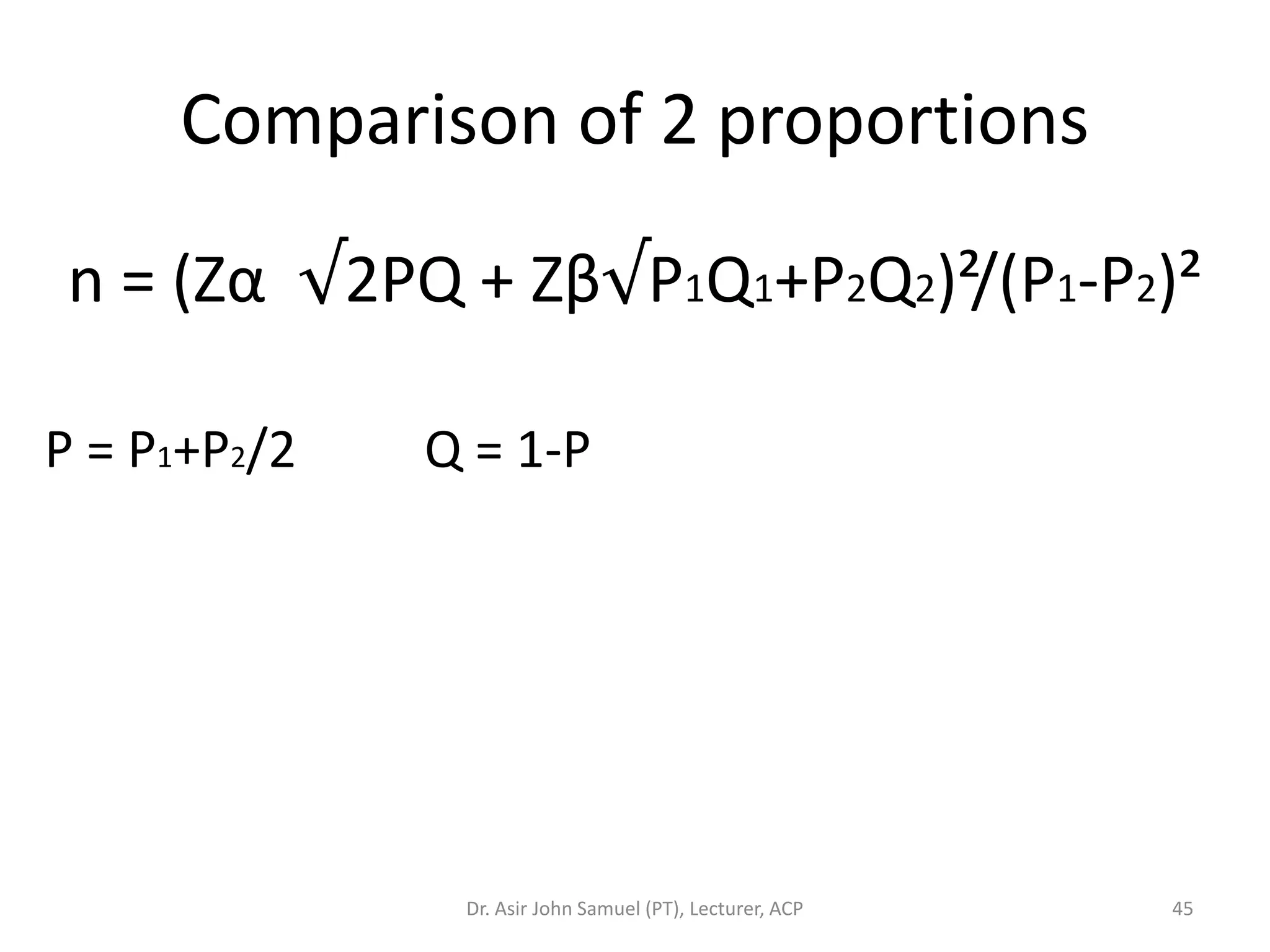
Comparison of 2 proportions

 n = (Zα √2PQ + Zβ√P1Q1+P2Q2)²/(P1-P2)²

P = P1+P2/2   Q = 1-P


               Dr. Asir John Samuel (PT), Lecturer, ACP   45
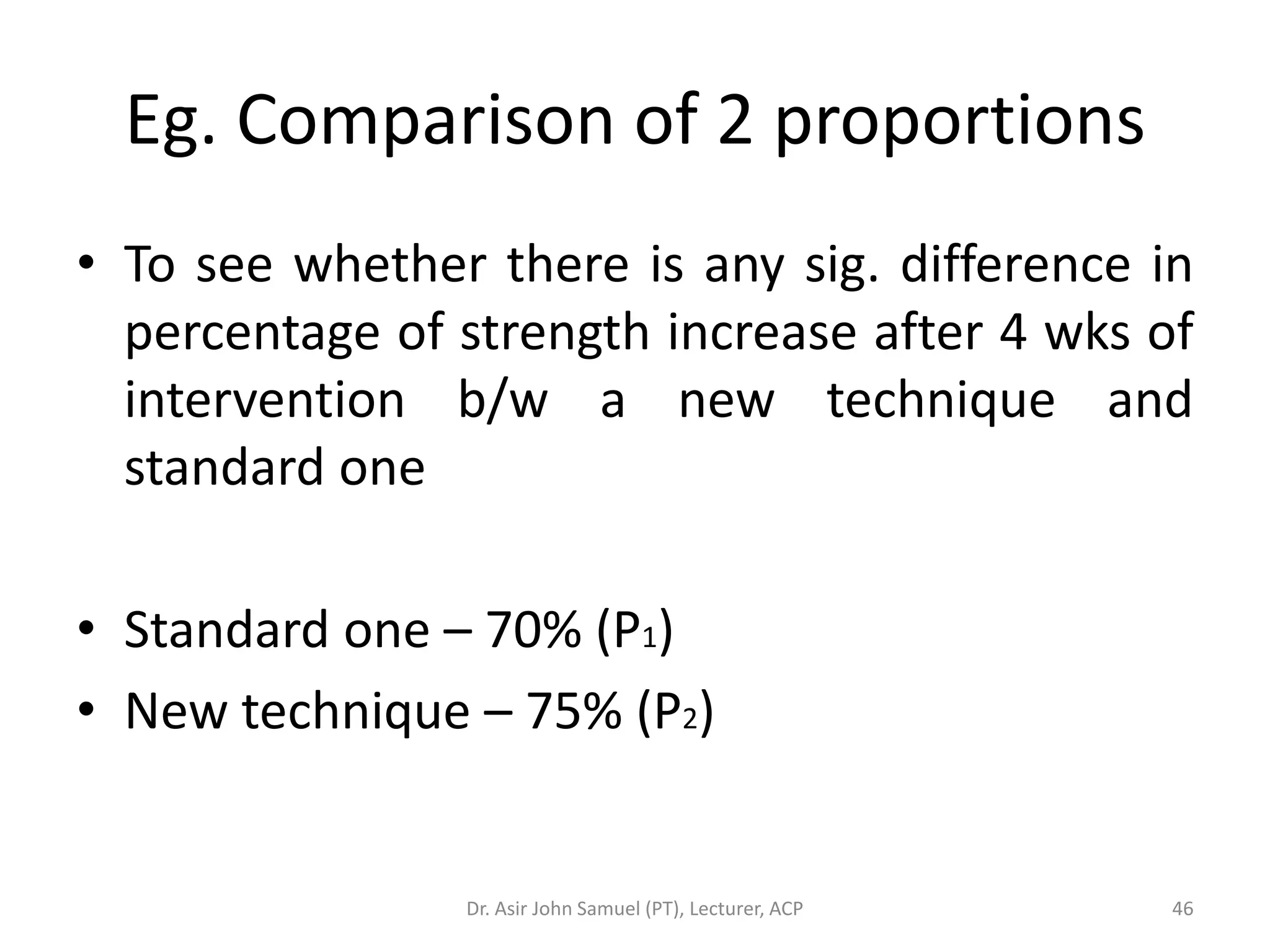
Eg. Comparison of 2 proportions
• To see whether there is any sig. difference in
  percentage of strength increase after 4 wks of
  intervention b/w a new technique and
  standard one

• Standard one – 70% (P1)
• New technique – 75% (P2)


                Dr. Asir John Samuel (PT), Lecturer, ACP   46

4.sampling design

  • 1.
    Sampling Design D.A. AsirJohn Samuel, BSc (Psy), MPT (Neuro Paed), MAc, DYScEd, C/BLS, FAGE
  • 2.
    Basic definitions • Population -Collection of all the units that are of interest to the investigator • Sample - Representative part of population • Sampling - Technique of selecting a representative group from a population Dr. Asir John Samuel (PT), Lecturer, ACP 2
  • 3.
    Why ? • Onlyfeasible method for collecting information • Reduces demands on resources (time, finance,.) • Results obtained more quickly • Better accuracy of collected data • Ethically acceptable Dr. Asir John Samuel (PT), Lecturer, ACP 3
  • 4.
    Steps in samplingdesign Target population Study population Sample Study participation Dr. Asir John Samuel (PT), Lecturer, ACP 4
  • 5.
    Characteristic of goodsample design • True representation of population • May result in small sampling error • Each member in population should get an opportunity of being selected • Systematic bias can be controlled in a better way • Results should be capable of being extrapolated Dr. Asir John Samuel (PT), Lecturer, ACP 5
  • 6.
    Types of sampledesign • Probability/Random sampling - Selection of subjects are according to any predicted chance of probability • Non-probability/non-random sampling - Does not depend on any chance of predecided probability Dr. Asir John Samuel (PT), Lecturer, ACP 6
  • 7.
    Types of sampledesign Sample design Random Non-random sampling sampling Simple Stratified Systematic Cluster Multistage convenience Quota Judgment Dr. Asir John Samuel (PT), Lecturer, ACP 7
  • 8.
    Simple random sampling •Equal and independent chance or probability of drawing each unit • Take sampling population • Need listing of all sampling units (sampling frame) • Number all units • Randomly draw units Dr. Asir John Samuel (PT), Lecturer, ACP 8
  • 9.
    How to ensurerandomness? • Lottery method • Table of random numbers - e.g. Tippett’s series - Fisher and Yates series - Kendall and Smith series - Rand corporation series Dr. Asir John Samuel (PT), Lecturer, ACP 9
  • 10.
    SRS - Merits •No personal bias • Easy to assess the accuracy Dr. Asir John Samuel (PT), Lecturer, ACP 10
  • 11.
    SRS - Demerits •Need a complete catalogue of universe • Large size sample • Widely dispersed Dr. Asir John Samuel (PT), Lecturer, ACP 11
  • 12.
    Stratified Random Sampling •Used for heterogeneous population • Population is divided into homogeneous groups (strata), according to a characteristic of interest (e.g. sex, religion, location) • Then a simple random sample is selected from each stratum Dr. Asir John Samuel (PT), Lecturer, ACP 12
  • 13.
    SRs - Merits •More representative • Greater accuracy • Can acquire information about whole population and individual strata Dr. Asir John Samuel (PT), Lecturer, ACP 13
  • 14.
    SRs - Demerits •Careful stratification • Random selection in each stratum • Time consuming Dr. Asir John Samuel (PT), Lecturer, ACP 14
  • 15.
    Systematic Sampling • Samplingunits are selected in a systematic way, that is, every Kth unit in the population is selected • First divide the population size by the, required sample size (sampling fraction). Let the sampling fraction be K Dr. Asir John Samuel (PT), Lecturer, ACP 15
  • 16.
    Systematic Sampling • Selecta unit at random from the first K units and thereafter every Kth unit is selected • If, N=1200 • And n=60 • Then, SF=20 Dr. Asir John Samuel (PT), Lecturer, ACP 16
  • 17.
    SS - Merits •Simple and convenient • Less time and work Dr. Asir John Samuel (PT), Lecturer, ACP 17
  • 18.
    SS - Demerits •Need complete list of units • Periodicity • Less representation Dr. Asir John Samuel (PT), Lecturer, ACP 18
  • 19.
    Cluster Sampling • Thesampling units are groups or clusters • The population is divided into clusters, and a sample of clusters are selected randomly • All the units in the selected clusters are then examined or studied Dr. Asir John Samuel (PT), Lecturer, ACP 19
  • 20.
    Cluster Sampling • Itis always assumed that the individual items within each cluster are representation of population • E.g. District, wards, schools, industries Dr. Asir John Samuel (PT), Lecturer, ACP 20
  • 21.
    CS - Merits •Saving of travelling time and consequent reduction in cost • Cuts down on the cost of preparing the sampling frame Dr. Asir John Samuel (PT), Lecturer, ACP 21
  • 22.
    CS - Demerits •Units close to each other may be very similar and so, less likely to represent the whole population • Larger sampling error than simple random sampling Dr. Asir John Samuel (PT), Lecturer, ACP 22
  • 23.
    Multistage Sampling • Selectionis done in stages until final sampling units are arrived • At first stage, Random sampling of large sized sampling units are selected, from the selected 1st stage sampling units another sampling units of smaller sampling units are selected, randomly Dr. Asir John Samuel (PT), Lecturer, ACP 23
  • 24.
    Multistage Sampling • Continueuntil the final sampling units are selected • E.g. Few states – District – Taulk Dr. Asir John Samuel (PT), Lecturer, ACP 24
  • 25.
    MS - Merits •Cut down the cost of preparing the sampling frame Dr. Asir John Samuel (PT), Lecturer, ACP 25
  • 26.
    MS - Demerits •Sampling error is increased compared to simple random sampling Dr. Asir John Samuel (PT), Lecturer, ACP 26
  • 27.
    Quota Sampling • Interviewersare requested to find cases with particular types of people to interview Dr. Asir John Samuel (PT), Lecturer, ACP 27
  • 28.
    Judgment (Purposive Sampling) •Researcher attempts to obtain sample that appear to be representative of the population selected by the researcher subjectively Dr. Asir John Samuel (PT), Lecturer, ACP 28
  • 29.
    Convenience Sampling • Samplingcomprises subject who are simply avail in a convenient way to the researcher • No randomness and likelihood of bias is high Dr. Asir John Samuel (PT), Lecturer, ACP 29
  • 30.
    Snowball Sampling • Investigatorsstart with a few subjects and then recruit more via word of mouth from the original participants Dr. Asir John Samuel (PT), Lecturer, ACP 30
  • 31.
    Merits • Easy • Lowcost • Limited time • Total list population Dr. Asir John Samuel (PT), Lecturer, ACP 31
  • 32.
    Demerits • Selection bias •Sample is not representation of population • doesn’t allow generalization Dr. Asir John Samuel (PT), Lecturer, ACP 32
  • 33.
  • 34.
    p-value • Probability ofgetting a minimal difference of what has observed is due to chance • Probability that the difference of at least as large as those found in the data would have occurred by chance Dr. Asir John Samuel (PT), Lecturer, ACP 34
  • 35.
    Hypothesis • Alternate hypothesis(HA) - Statement predict that a difference or relationship b/w groups will be demonstrated • Null hypothesis (H0) - Researcher anticipate “no difference” or “no relationship” Dr. Asir John Samuel (PT), Lecturer, ACP 35
  • 36.
    Decision for 5%LOS • If p-value <0.05, then data is against null hypothesis • If p-value ≥0.05, then data favours null hypothesis Dr. Asir John Samuel (PT), Lecturer, ACP 36
  • 37.
    Type I &II errors Possible states of Null Hypothesis Possible True False actions on Accept Correct Type II Null Action error Hypothesis Reject Type I Correct error Action Prob (Type I error) – α (LoS) Prob (Type II error) – β 1-β – power of test Dr. Asir John Samuel (PT), Lecturer, ACP 37
  • 38.
    Z values Z 0.05– 1.96 – 95% Z 0.10 – 1.282 – 90% Z 0.20 – 0.84 – 80% Dr. Asir John Samuel (PT), Lecturer, ACP 38
  • 39.
    Comparison of 2means n= 2 [(Zα+Zβ)s/d]² Zα – LoS Zβ – power of study s – pooled SD of the two sample d – clinically significant difference Dr. Asir John Samuel (PT), Lecturer, ACP 39
  • 40.
    Eg. for Comparisonof 2 means • A RCT to study the effect of BP reduction. One group received a control diet and other-test diet. What would be the sample size in order to provide the study with power of 90% to detect a difference in sys. BP of 2 mm Hg b/w two groups at 5% LoS? The SD of sys. BP is observed to be 6 mmHg. Dr. Asir John Samuel (PT), Lecturer, ACP 40
  • 41.
    Estimating proportion n = Z α² P (1-P) / d² P – proportion of event in population d – acceptable margin of error in estimating the true population proportion Dr. Asir John Samuel (PT), Lecturer, ACP 41
  • 42.
    Eg. Estimating proportion •To determine the prevalence of navicular drop in ACL injured population by anticipating of 15% with acceptable margin of error is 3% = (1.96)²(0.15)(0.85) / (0.03)² = 544.2 Dr. Asir John Samuel (PT), Lecturer, ACP 42
  • 43.
    Estimating mean n = (Zα σ / d)² σ – anticipated SD of population d – acceptable margin of error in estimating true population mean Dr. Asir John Samuel (PT), Lecturer, ACP 43
  • 44.
    Eg. Estimating mean •To determine the mean no. of days to ambulate pt undergoing stroke rehabilation among stroke pts. Where anticipated SD of days are 60 and acceptable margin of error is 20 days n = (1.96 x 60/20)² n = (5.88)² = 34.6 Dr. Asir John Samuel (PT), Lecturer, ACP 44
  • 45.
    Comparison of 2proportions n = (Zα √2PQ + Zβ√P1Q1+P2Q2)²/(P1-P2)² P = P1+P2/2 Q = 1-P Dr. Asir John Samuel (PT), Lecturer, ACP 45
  • 46.
    Eg. Comparison of2 proportions • To see whether there is any sig. difference in percentage of strength increase after 4 wks of intervention b/w a new technique and standard one • Standard one – 70% (P1) • New technique – 75% (P2) Dr. Asir John Samuel (PT), Lecturer, ACP 46