Measurement
        and
scaling techniques
D.A. Asir John Samuel, MPT (Neuro Paed),
 Lecturer, Alva’s college of Physiotherapy,
                 Moodbidri


            Dr.Asir John Samuel (PT), Lecturer, ACP
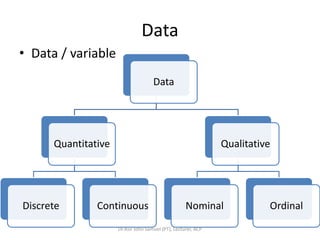
Data
• Data / variable
                                     Data


      Quantitative                                             Qualitative


Discrete       Continuous                           Nominal              Ordinal
                     Dr.Asir John Samuel (PT), Lecturer, ACP
Quantitative

• Discrete

- Takes only specified no.of values in a given
  range

- E.g. No. of birth


                  Dr.Asir John Samuel (PT), Lecturer, ACP
Quantitative


• Continuous

- Theoretically can take any value with in given
  range

- E.g. BP, Wt, Ht, age,


                  Dr.Asir John Samuel (PT), Lecturer, ACP
Qualitative

• Cannot be measured numerically


• Nominal

- No nature order among the categories

- E.g. gender, religion, etc.,

                  Dr.Asir John Samuel (PT), Lecturer, ACP
Qualitative

• Ordinal

- Natural ranking of categories

- E.g. severity of diseases, socioeconomic status,


                 Dr.Asir John Samuel (PT), Lecturer, ACP
Scales of measurement


                                 Scales


     Categorical                                             Numerical


Nominal       Ordinal                             Interval               Ratio
                   Dr.Asir John Samuel (PT), Lecturer, ACP
Nominal scale
• Lowest level of measurement
• Used for variable that are qualitative
• Variable is divided into several categories
• Frequently allow us to compare no.of items
  within each category
• No arithmetic operation are permitted
• E.g. gender, religion, etc.,
                  Dr.Asir John Samuel (PT), Lecturer, ACP
Ordinal scale
• Rank order the objects being measured
• Permissible operations are < = >
• No meaning of magnitude of difference
  between adjacent units on scale
• Does not have the property of equal intervals
  between adjacent units
• No arithmetic equation permitted
• E.g. pain score, disease severity, etc.,
                  Dr.Asir John Samuel (PT), Lecturer, ACP
Interval scale
• Have real number system properties of order
  and distance but lack origin

• Possess all the properties of the ordinal scale

• Equal intervals b/w adjacent units

• Does not have an absolute zero point

• Permissible arithmetic operation are - & +

• E.g. temp in Celsius, IQ score, etc.,
                  Dr.Asir John Samuel (PT), Lecturer, ACP
Ratio scale
• Exhibit all 3 components of real number
  system: order, distance and origin

• Highest level of measurement scale

• Possesses all the properties of interval scale

• Has an absolute zero point

• Permissible arithmetic operations are, -, +, x
  and /

• E.g. wt, ht, distance, etc.,
                  Dr.Asir John Samuel (PT), Lecturer, ACP
Sources of error in measurement

• Respondent

• Situation

• Measurer

• instrument


               Dr.Asir John Samuel (PT), Lecturer, ACP
Respondent

• Reluctant to express strong negative feelings

• May have very little knowledge but may not
  admit ignorance

• Result in an interview of guesses

• Limit ability to respond accurately and fully

                 Dr.Asir John Samuel (PT), Lecturer, ACP
Situation

• Any condition which places strain on interview

• Affects interviewer-respondent rapport

• Can distort responses by joining in or merely
  by being present


                Dr.Asir John Samuel (PT), Lecturer, ACP
Measurer

• Distort responses by rewording or reordering
  questions
• Behaviour, style and looks may encourage or
  discourage certain replies from respondents
• Incorrect coding
• Data-analysis stage
                 Dr.Asir John Samuel (PT), Lecturer, ACP
Instrument

• Defective measuring instrument

• Complex words

• Beyond comprehension

• Poor sampling


                  Dr.Asir John Samuel (PT), Lecturer, ACP
Technique of developing measurement
                tools
• Four-stage process

- Concept development

- Specification of concept dimensions

- Selection of indicators

- Formation of index

                 Dr.Asir John Samuel (PT), Lecturer, ACP
Meaning of Scaling

• A procedure for the assignment of numbers to
 a property of objects in order to impart some
 of the characteristics of numbers to the
 properties in question
• Quantitative measures of subjective abstract
 concepts

                Dr.Asir John Samuel (PT), Lecturer, ACP
By 2 ways

• Making judgement

• Constructing questionnaires


                Dr.Asir John Samuel (PT), Lecturer, ACP
Technique of developing
         measurement tools

• Concept development

• Specification of concept dimensions

• Selection of indicators

• Formation of index


                 Dr.Asir John Samuel (PT), Lecturer, ACP
Concept development

• First and foremost step

• Researcher should arrive at an understanding
  of major concepts pertaining to his study

• More apparent in theoretical studies than in
  the more pragmatic research


                 Dr.Asir John Samuel (PT), Lecturer, ACP
Specification of concept dimensions

• Specify the dimensions of the concepts
 developed in first stage

• Accomplished by,

- Deduction

- Correlation of individual dimensions with
 concept
                Dr.Asir John Samuel (PT), Lecturer, ACP
Selection of indicators

• Measuring each concept

• Specific questions, scales or devices by which
  respondent’s knowledge, opinion, expectation,
  etc are measured

• Researcher should consider several alternatives
  as there is seldom perfect measure
                Dr.Asir John Samuel (PT), Lecturer, ACP
Formation of index

• Combining several dimensions of concept or
 different measurement

• Provide scale values to responses and sum up
 the corresponding scores

• Has probability relation to what we really
 want to know
                Dr.Asir John Samuel (PT), Lecturer, ACP
Classification of scales
• Subject orientation

• Response form

• Degree of subjectivity

• Scale properties

• Number of dimensions

• Scale construction techniques
                  Dr.Asir John Samuel (PT), Lecturer, ACP
Subject orientation

• Measure characteristics of respondent who
  completes or to judge stimulus object

• Homogeneous stimuli are presented

• Between stimuli variation is small


                 Dr.Asir John Samuel (PT), Lecturer, ACP
Response form

• Classify scales as categorical and comparative

• Categorical scales – rating scales, used when
  respondent scores without direct ref. of other

• Comparative scales – ranking scales, used
  when comparing b/w two or more objects


                 Dr.Asir John Samuel (PT), Lecturer, ACP
Degree of subjectivity

• Subjective personal preferences or simply
  make non-preference judgement

• Choosing which person he favours

• Judge which person is more effective


                Dr.Asir John Samuel (PT), Lecturer, ACP
Scale properties

• Classify scales as,

• Nominal

• Ordinal

• Interval

• Ratio scales

                  Dr.Asir John Samuel (PT), Lecturer, ACP
Number of dimensions

• Unidimensional or multidimensional scales

• Measure only one attribute of respondent

• Describes concept of attribute space of ‘n’
 dimensions


                Dr.Asir John Samuel (PT), Lecturer, ACP
Scale construction techniques

• Arbitrary approach (based on assumption)

• Consensus approach

• Item analysis approach

• Cumulative scales

• Factor scales

                  Dr.Asir John Samuel (PT), Lecturer, ACP
Scaling techniques

• Arbitrary scales

• Differential scales/Thurstone-type scales

• Summated scales/Likert-type scales

• Cumulative scales

• Factor scales

                  Dr.Asir John Samuel (PT), Lecturer, ACP
Arbitrary scales

• Designed through researcher’s own subjective
 selection of items

• Collects few statements or items which he
 believes appropriate to a given topic


                Dr.Asir John Samuel (PT), Lecturer, ACP
Arbitrary scales-Merits

• Can be developed very easily and quickly

• Relatively less expensive

• Highly specific and adequate


                 Dr.Asir John Samuel (PT), Lecturer, ACP
Arbitrary scales-Demerits

• Do not have objective evidence

• Simply rely on researcher’s insight and
 competence


                Dr.Asir John Samuel (PT), Lecturer, ACP
Differential scales/Thurstone-type
                  scales
• Developed using consensus scale approach

• Selection is made by panel of judges

• Evaluate whether they are relevant to the
  topic area


                Dr.Asir John Samuel (PT), Lecturer, ACP
Summated scales/Likert-type scales
• Item analysis approach

• Particular item is evaluated on basis of how it
  discriminates b/w those persons whose total
  score is high and low

• Items   that    best                meet                 this   sort   of
  discrimination test are included in final
  statement      Dr.Asir John Samuel (PT), Lecturer, ACP
Summated scales/Likert-type scales

1. Strongly agree

2. Agree

3. Undecided

4. Disagree

5. Strongly disagree

                Dr.Asir John Samuel (PT), Lecturer, ACP
Advantages

• Easy to construct

• More reliable

• Respondent-centered

• Less time to construct


                  Dr.Asir John Samuel (PT), Lecturer, ACP
Disadvantages

• We can simply examine whether respondents
  are more or less favorable to a topic
• Interval is not equal
• Total score has little clear meaning
• What they think they should feel rather than
  how they do feel
                 Dr.Asir John Samuel (PT), Lecturer, ACP
Cumulative scales

• Louis Guttman’s scalogram analysis

• Statement in it form a cumulative series

• Favorable item and unfavorable item

• From total score one can estimate as to how a
  respondent      has                 answered             individual
  statement
                 Dr.Asir John Samuel (PT), Lecturer, ACP
Factor scales

• Developed through factor analysis

• Basis of intercorrelations of items


                 Dr.Asir John Samuel (PT), Lecturer, ACP

5.measurement

  • 1.
    Measurement and scaling techniques D.A. Asir John Samuel, MPT (Neuro Paed), Lecturer, Alva’s college of Physiotherapy, Moodbidri Dr.Asir John Samuel (PT), Lecturer, ACP
  • 2.
    Data • Data /variable Data Quantitative Qualitative Discrete Continuous Nominal Ordinal Dr.Asir John Samuel (PT), Lecturer, ACP
  • 3.
    Quantitative • Discrete - Takesonly specified no.of values in a given range - E.g. No. of birth Dr.Asir John Samuel (PT), Lecturer, ACP
  • 4.
    Quantitative • Continuous - Theoreticallycan take any value with in given range - E.g. BP, Wt, Ht, age, Dr.Asir John Samuel (PT), Lecturer, ACP
  • 5.
    Qualitative • Cannot bemeasured numerically • Nominal - No nature order among the categories - E.g. gender, religion, etc., Dr.Asir John Samuel (PT), Lecturer, ACP
  • 6.
    Qualitative • Ordinal - Naturalranking of categories - E.g. severity of diseases, socioeconomic status, Dr.Asir John Samuel (PT), Lecturer, ACP
  • 7.
    Scales of measurement Scales Categorical Numerical Nominal Ordinal Interval Ratio Dr.Asir John Samuel (PT), Lecturer, ACP
  • 8.
    Nominal scale • Lowestlevel of measurement • Used for variable that are qualitative • Variable is divided into several categories • Frequently allow us to compare no.of items within each category • No arithmetic operation are permitted • E.g. gender, religion, etc., Dr.Asir John Samuel (PT), Lecturer, ACP
  • 9.
    Ordinal scale • Rankorder the objects being measured • Permissible operations are < = > • No meaning of magnitude of difference between adjacent units on scale • Does not have the property of equal intervals between adjacent units • No arithmetic equation permitted • E.g. pain score, disease severity, etc., Dr.Asir John Samuel (PT), Lecturer, ACP
  • 10.
    Interval scale • Havereal number system properties of order and distance but lack origin • Possess all the properties of the ordinal scale • Equal intervals b/w adjacent units • Does not have an absolute zero point • Permissible arithmetic operation are - & + • E.g. temp in Celsius, IQ score, etc., Dr.Asir John Samuel (PT), Lecturer, ACP
  • 11.
    Ratio scale • Exhibitall 3 components of real number system: order, distance and origin • Highest level of measurement scale • Possesses all the properties of interval scale • Has an absolute zero point • Permissible arithmetic operations are, -, +, x and / • E.g. wt, ht, distance, etc., Dr.Asir John Samuel (PT), Lecturer, ACP
  • 12.
    Sources of errorin measurement • Respondent • Situation • Measurer • instrument Dr.Asir John Samuel (PT), Lecturer, ACP
  • 13.
    Respondent • Reluctant toexpress strong negative feelings • May have very little knowledge but may not admit ignorance • Result in an interview of guesses • Limit ability to respond accurately and fully Dr.Asir John Samuel (PT), Lecturer, ACP
  • 14.
    Situation • Any conditionwhich places strain on interview • Affects interviewer-respondent rapport • Can distort responses by joining in or merely by being present Dr.Asir John Samuel (PT), Lecturer, ACP
  • 15.
    Measurer • Distort responsesby rewording or reordering questions • Behaviour, style and looks may encourage or discourage certain replies from respondents • Incorrect coding • Data-analysis stage Dr.Asir John Samuel (PT), Lecturer, ACP
  • 16.
    Instrument • Defective measuringinstrument • Complex words • Beyond comprehension • Poor sampling Dr.Asir John Samuel (PT), Lecturer, ACP
  • 17.
    Technique of developingmeasurement tools • Four-stage process - Concept development - Specification of concept dimensions - Selection of indicators - Formation of index Dr.Asir John Samuel (PT), Lecturer, ACP
  • 18.
    Meaning of Scaling •A procedure for the assignment of numbers to a property of objects in order to impart some of the characteristics of numbers to the properties in question • Quantitative measures of subjective abstract concepts Dr.Asir John Samuel (PT), Lecturer, ACP
  • 19.
    By 2 ways •Making judgement • Constructing questionnaires Dr.Asir John Samuel (PT), Lecturer, ACP
  • 20.
    Technique of developing measurement tools • Concept development • Specification of concept dimensions • Selection of indicators • Formation of index Dr.Asir John Samuel (PT), Lecturer, ACP
  • 21.
    Concept development • Firstand foremost step • Researcher should arrive at an understanding of major concepts pertaining to his study • More apparent in theoretical studies than in the more pragmatic research Dr.Asir John Samuel (PT), Lecturer, ACP
  • 22.
    Specification of conceptdimensions • Specify the dimensions of the concepts developed in first stage • Accomplished by, - Deduction - Correlation of individual dimensions with concept Dr.Asir John Samuel (PT), Lecturer, ACP
  • 23.
    Selection of indicators •Measuring each concept • Specific questions, scales or devices by which respondent’s knowledge, opinion, expectation, etc are measured • Researcher should consider several alternatives as there is seldom perfect measure Dr.Asir John Samuel (PT), Lecturer, ACP
  • 24.
    Formation of index •Combining several dimensions of concept or different measurement • Provide scale values to responses and sum up the corresponding scores • Has probability relation to what we really want to know Dr.Asir John Samuel (PT), Lecturer, ACP
  • 25.
    Classification of scales •Subject orientation • Response form • Degree of subjectivity • Scale properties • Number of dimensions • Scale construction techniques Dr.Asir John Samuel (PT), Lecturer, ACP
  • 26.
    Subject orientation • Measurecharacteristics of respondent who completes or to judge stimulus object • Homogeneous stimuli are presented • Between stimuli variation is small Dr.Asir John Samuel (PT), Lecturer, ACP
  • 27.
    Response form • Classifyscales as categorical and comparative • Categorical scales – rating scales, used when respondent scores without direct ref. of other • Comparative scales – ranking scales, used when comparing b/w two or more objects Dr.Asir John Samuel (PT), Lecturer, ACP
  • 28.
    Degree of subjectivity •Subjective personal preferences or simply make non-preference judgement • Choosing which person he favours • Judge which person is more effective Dr.Asir John Samuel (PT), Lecturer, ACP
  • 29.
    Scale properties • Classifyscales as, • Nominal • Ordinal • Interval • Ratio scales Dr.Asir John Samuel (PT), Lecturer, ACP
  • 30.
    Number of dimensions •Unidimensional or multidimensional scales • Measure only one attribute of respondent • Describes concept of attribute space of ‘n’ dimensions Dr.Asir John Samuel (PT), Lecturer, ACP
  • 31.
    Scale construction techniques •Arbitrary approach (based on assumption) • Consensus approach • Item analysis approach • Cumulative scales • Factor scales Dr.Asir John Samuel (PT), Lecturer, ACP
  • 32.
    Scaling techniques • Arbitraryscales • Differential scales/Thurstone-type scales • Summated scales/Likert-type scales • Cumulative scales • Factor scales Dr.Asir John Samuel (PT), Lecturer, ACP
  • 33.
    Arbitrary scales • Designedthrough researcher’s own subjective selection of items • Collects few statements or items which he believes appropriate to a given topic Dr.Asir John Samuel (PT), Lecturer, ACP
  • 34.
    Arbitrary scales-Merits • Canbe developed very easily and quickly • Relatively less expensive • Highly specific and adequate Dr.Asir John Samuel (PT), Lecturer, ACP
  • 35.
    Arbitrary scales-Demerits • Donot have objective evidence • Simply rely on researcher’s insight and competence Dr.Asir John Samuel (PT), Lecturer, ACP
  • 36.
    Differential scales/Thurstone-type scales • Developed using consensus scale approach • Selection is made by panel of judges • Evaluate whether they are relevant to the topic area Dr.Asir John Samuel (PT), Lecturer, ACP
  • 37.
    Summated scales/Likert-type scales •Item analysis approach • Particular item is evaluated on basis of how it discriminates b/w those persons whose total score is high and low • Items that best meet this sort of discrimination test are included in final statement Dr.Asir John Samuel (PT), Lecturer, ACP
  • 38.
    Summated scales/Likert-type scales 1.Strongly agree 2. Agree 3. Undecided 4. Disagree 5. Strongly disagree Dr.Asir John Samuel (PT), Lecturer, ACP
  • 39.
    Advantages • Easy toconstruct • More reliable • Respondent-centered • Less time to construct Dr.Asir John Samuel (PT), Lecturer, ACP
  • 40.
    Disadvantages • We cansimply examine whether respondents are more or less favorable to a topic • Interval is not equal • Total score has little clear meaning • What they think they should feel rather than how they do feel Dr.Asir John Samuel (PT), Lecturer, ACP
  • 41.
    Cumulative scales • LouisGuttman’s scalogram analysis • Statement in it form a cumulative series • Favorable item and unfavorable item • From total score one can estimate as to how a respondent has answered individual statement Dr.Asir John Samuel (PT), Lecturer, ACP
  • 42.
    Factor scales • Developedthrough factor analysis • Basis of intercorrelations of items Dr.Asir John Samuel (PT), Lecturer, ACP