Sampling: Design and Procedures
            Presented by
         Dr. Sunil Chauhan   4
         Varun Jalan         14
         Keith Mascarenhas   24
         Krishna R           34
         Jigar Shah          44
         Adarsh Kumar        54
Some Definitions…
• POPULATION: The aggregate of all the elements , sharing
  some common set of characteristics , that comprises the
  universe for the purpose of the marketing research problem

• CENSUS: A complete enumeration of the elements of a
  population or study objects

• SAMPLE:A subgroup of the elements of the population
  selected for participation in the study
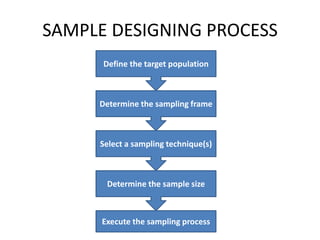
SAMPLE DESIGNING PROCESS
      Define the target population


     Determine the sampling frame


     Select a sampling technique(s)


       Determine the sample size


      Execute the sampling process
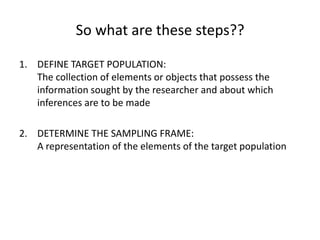
So what are these steps??

1. DEFINE TARGET POPULATION:
   The collection of elements or objects that possess the
   information sought by the researcher and about which
   inferences are to be made

2. DETERMINE THE SAMPLING FRAME:
   A representation of the elements of the target population
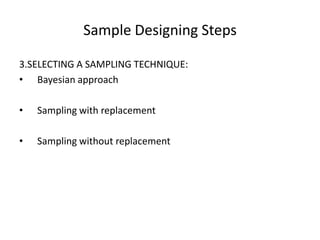
Sample Designing Steps

3.SELECTING A SAMPLING TECHNIQUE:
• Bayesian approach

•   Sampling with replacement

•   Sampling without replacement
Sample Designing Steps
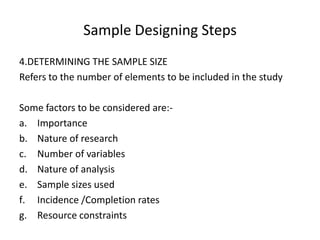
4.DETERMINING THE SAMPLE SIZE
Refers to the number of elements to be included in the study

Some factors to be considered are:-
a. Importance
b. Nature of research
c. Number of variables
d. Nature of analysis
e. Sample sizes used
f. Incidence /Completion rates
g. Resource constraints
Sample Designing Steps

5. EXECUTE THE SAMPLING PROCESS
• Detailed specifications are required for every stage
• Procedures should be specified for each stage and on how to
    conduct the data collection
• Contingency plans should be made in case of of non
    availability of sampling unit
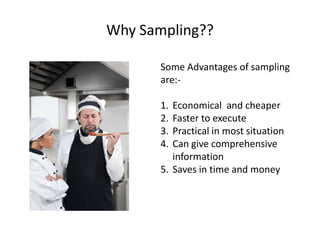
Why Sampling??

       Some Advantages of sampling
       are:-

       1. Economical and cheaper
       2. Faster to execute
       3. Practical in most situation
       4. Can give comprehensive
          information
       5. Saves in time and money
Non probability Techniques
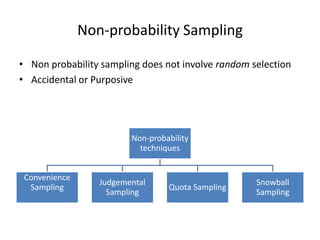
Non-probability Sampling

• Non probability sampling does not involve random selection
• Accidental or Purposive


                         Non-probability
                           techniques


 Convenience
                  Judgemental                       Snowball
  Sampling                        Quota Sampling
                    Sampling                        Sampling
Convenience Sampling

• ADVANTAGES
   – Easy access
   – Used in pilot studies

• DISADVANTAGES
   – Sampling bias, sample not representative
   – Poor external validity
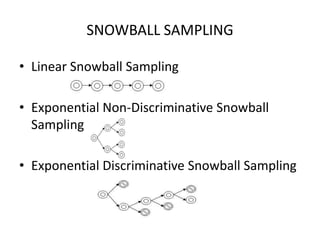
SNOWBALL SAMPLING

• Linear Snowball Sampling

• Exponential Non-Discriminative Snowball
  Sampling

• Exponential Discriminative Snowball Sampling
• ADVANTAGES OF SNOWBALL SAMPLING
   – The chain referral process allows the researcher to reach
     populations that are difficult to sample when using other
     sampling methods.
   – Cheap, simple and cost-efficient.
   – Little planning and fewer workforce compared to
     other sampling techniques

• DISADVANTAGES OF SNOWBALL SAMPLING
   – Little control over the sampling method
   – Representativeness of the sample is not guaranteed
JUDGMENTAL SAMPLING
• Involves selecting a group of people because
  they have particular traits that the researcher
  wants to study
• This type of sampling technique is also known
  as purposive sampling and authoritative
  sampling

• e.g. consumers of a particular product or
  service in some types of market research
• EXAMPLE OF JUDGMENTAL SAMPLING
  In a study wherein a researcher wants to know what it takes to graduate summa
  cum laude in college, the only people who can give the researcher first hand
  advise are the individuals who graduated summa cum laude. With this very
  specific and very limited pool of individuals that can be considered as a
  subject, the researcher must use judgmental sampling.

• WHEN TO USE JUDGMENTAL SAMPLING ??

• SETBACKS OF JUDGMENTAL SAMPLING.
are with the authority and in the sampling process

• WHEN TO USE QUOTA SAMPLES
QUOTA SAMPLING
  In quota sampling the selection of the sample is made by
  the interviewer, who has been given quotas to fill from
  specified sub-groups of the population.

STEP-BY-STEP QUOTA SAMPLING

EXAMPLE OF QUOTA SAMPLES
• In a study wherein the researcher likes to compare the
  academic performance of the different high school
  class levels, its relationship with gender and
  socioeconomic status, the researcher first identifies the
  subgroups.
• Usually, the subgroups are the characteristics
  or variables of the study. The researcher divides
  the entire population into class levels, intersected
  with gender and socioeconomic status. Then, he
  takes note of the proportions of these subgroups
  in the entire population and then samples each
  subgroup accordingly.

DISADVANTAGES OF QUOTA SAMPLES
• Only the selected traits of the population were
  taken into account in forming the subgroups
Probability Techniques

                              Probablity
                              techniques


 Simple Random     Systemic   Stratified
                                                  Cluster Sampling   Others
Sampling           Sampling   Sampling


                               Disproportionate


                                Proportionate
Simple Random Sampling


Simple random sampling is a method of
    probability sampling in which
   every unit has an equal nonzero
       chance of being selected
Systematic Random Sampling
   Systematic random sampling is a
               method of
          probability sampling
          in which the defined
      target population is ordered
       and the sample is selected
according to position using a skip interval
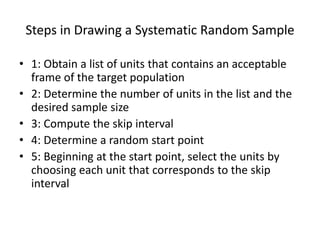
Steps in Drawing a Systematic Random Sample

• 1: Obtain a list of units that contains an acceptable
  frame of the target population
• 2: Determine the number of units in the list and the
  desired sample size
• 3: Compute the skip interval
• 4: Determine a random start point
• 5: Beginning at the start point, select the units by
  choosing each unit that corresponds to the skip
  interval
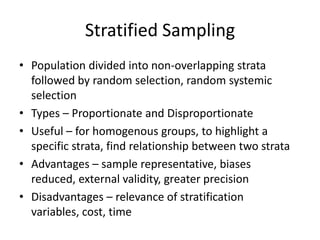
Stratified Sampling
• Population divided into non-overlapping strata
  followed by random selection, random systemic
  selection
• Types – Proportionate and Disproportionate
• Useful – for homogenous groups, to highlight a
  specific strata, find relationship between two strata
• Advantages – sample representative, biases
  reduced, external validity, greater precision
• Disadvantages – relevance of stratification
  variables, cost, time
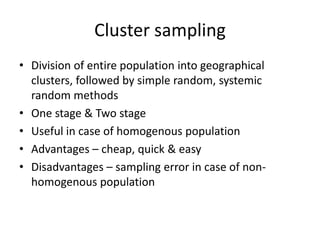
Cluster sampling
• Division of entire population into geographical
  clusters, followed by simple random, systemic
  random methods
• One stage & Two stage
• Useful in case of homogenous population
• Advantages – cheap, quick & easy
• Disadvantages – sampling error in case of non-
  homogenous population
Other Sampling Techniques


• Sequential Sampling


• Double Sampling
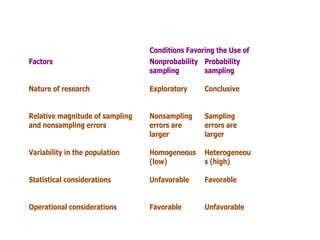
Conditions Favoring the Use of
Factors                          Nonprobability Probability
                                 sampling        sampling

Nature of research               Exploratory     Conclusive


Relative magnitude of sampling   Nonsampling     Sampling
and nonsampling errors           errors are      errors are
                                 larger          larger

Variability in the population    Homogeneous     Heterogeneou
                                 (low)           s (high)

Statistical considerations       Unfavorable     Favorable


Operational considerations       Favorable       Unfavorable
International Marketing Research
• Differing Respondents
    – US
        • Cereal:Children
        • Automobiles: Women
    – Middle East
        • Automobiles: Men
• Accessibility
    – Unnumbered & unidentified streets/houses
    – Cultural norms
        • Mexico
        • Saudi Arabia
• Sampling frame
    – Unavailability of information on target population
        • Lack of census
        • Red tape
    – Unavailable/inaccurate maps
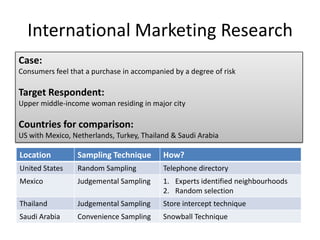
International Marketing Research
Case:
Consumers feel that a purchase in accompanied by a degree of risk

Target Respondent:
Upper middle-income woman residing in major city

Countries for comparison:
US with Mexico, Netherlands, Turkey, Thailand & Saudi Arabia

Location         Sampling Technique        How?
United States    Random Sampling           Telephone directory
Mexico           Judgemental Sampling      1. Experts identified neighbourhoods
                                           2. Random selection
Thailand         Judgemental Sampling      Store intercept technique
Saudi Arabia     Convenience Sampling      Snowball Technique
Internet Applications
       Example: ITOCHU Corporation
• Launched Internet sampling service, February 14, 2011

• Sampling resources
   – Yahoo! Japan
       • Yahoo Japan Corporation
   – Famiport multimedia terminals installed in approximately 8,100
     FamilyMart stores nationwide
       • FamilyMart Co., Ltd.
   – Famima.com Co., Ltd.
ITOCHU Corporation
• Features:

   – Identifies sampling target
     Issues coupon IDs to the potential purchaser group that is being
     targeted by the provider of the product based on surveys to which
     consumers have responded on the “Premono” site in Yahoo! Japan

   – Reduces sampling operating costs
     Coupon IDs are issued by e-mail and samples are handed over at
     FamilyMart stores, thus greatly reducing sampling operating costs
     such as distribution costs and labor costs.

   – Gathers marketing data related to sampling
     Uses the “Premono” site in Yahoo! Japan to conduct preliminary and
     follow-up questionnaire surveys of sampling targets, thereby providing
     effective marketing data to the provider of the product
ITOCHU Corporation
Thank You

Sampling techniques market research

  • 1.
    Sampling: Design andProcedures Presented by Dr. Sunil Chauhan 4 Varun Jalan 14 Keith Mascarenhas 24 Krishna R 34 Jigar Shah 44 Adarsh Kumar 54
  • 2.
    Some Definitions… • POPULATION:The aggregate of all the elements , sharing some common set of characteristics , that comprises the universe for the purpose of the marketing research problem • CENSUS: A complete enumeration of the elements of a population or study objects • SAMPLE:A subgroup of the elements of the population selected for participation in the study
  • 3.
    SAMPLE DESIGNING PROCESS Define the target population Determine the sampling frame Select a sampling technique(s) Determine the sample size Execute the sampling process
  • 4.
    So what arethese steps?? 1. DEFINE TARGET POPULATION: The collection of elements or objects that possess the information sought by the researcher and about which inferences are to be made 2. DETERMINE THE SAMPLING FRAME: A representation of the elements of the target population
  • 5.
    Sample Designing Steps 3.SELECTINGA SAMPLING TECHNIQUE: • Bayesian approach • Sampling with replacement • Sampling without replacement
  • 6.
    Sample Designing Steps 4.DETERMININGTHE SAMPLE SIZE Refers to the number of elements to be included in the study Some factors to be considered are:- a. Importance b. Nature of research c. Number of variables d. Nature of analysis e. Sample sizes used f. Incidence /Completion rates g. Resource constraints
  • 7.
    Sample Designing Steps 5.EXECUTE THE SAMPLING PROCESS • Detailed specifications are required for every stage • Procedures should be specified for each stage and on how to conduct the data collection • Contingency plans should be made in case of of non availability of sampling unit
  • 8.
    Why Sampling?? Some Advantages of sampling are:- 1. Economical and cheaper 2. Faster to execute 3. Practical in most situation 4. Can give comprehensive information 5. Saves in time and money
  • 9.
  • 10.
    Non-probability Sampling • Nonprobability sampling does not involve random selection • Accidental or Purposive Non-probability techniques Convenience Judgemental Snowball Sampling Quota Sampling Sampling Sampling
  • 11.
    Convenience Sampling • ADVANTAGES – Easy access – Used in pilot studies • DISADVANTAGES – Sampling bias, sample not representative – Poor external validity
  • 12.
    SNOWBALL SAMPLING • LinearSnowball Sampling • Exponential Non-Discriminative Snowball Sampling • Exponential Discriminative Snowball Sampling
  • 13.
    • ADVANTAGES OFSNOWBALL SAMPLING – The chain referral process allows the researcher to reach populations that are difficult to sample when using other sampling methods. – Cheap, simple and cost-efficient. – Little planning and fewer workforce compared to other sampling techniques • DISADVANTAGES OF SNOWBALL SAMPLING – Little control over the sampling method – Representativeness of the sample is not guaranteed
  • 14.
    JUDGMENTAL SAMPLING • Involvesselecting a group of people because they have particular traits that the researcher wants to study • This type of sampling technique is also known as purposive sampling and authoritative sampling • e.g. consumers of a particular product or service in some types of market research
  • 15.
    • EXAMPLE OFJUDGMENTAL SAMPLING In a study wherein a researcher wants to know what it takes to graduate summa cum laude in college, the only people who can give the researcher first hand advise are the individuals who graduated summa cum laude. With this very specific and very limited pool of individuals that can be considered as a subject, the researcher must use judgmental sampling. • WHEN TO USE JUDGMENTAL SAMPLING ?? • SETBACKS OF JUDGMENTAL SAMPLING. are with the authority and in the sampling process • WHEN TO USE QUOTA SAMPLES
  • 16.
    QUOTA SAMPLING In quota sampling the selection of the sample is made by the interviewer, who has been given quotas to fill from specified sub-groups of the population. STEP-BY-STEP QUOTA SAMPLING EXAMPLE OF QUOTA SAMPLES • In a study wherein the researcher likes to compare the academic performance of the different high school class levels, its relationship with gender and socioeconomic status, the researcher first identifies the subgroups.
  • 17.
    • Usually, thesubgroups are the characteristics or variables of the study. The researcher divides the entire population into class levels, intersected with gender and socioeconomic status. Then, he takes note of the proportions of these subgroups in the entire population and then samples each subgroup accordingly. DISADVANTAGES OF QUOTA SAMPLES • Only the selected traits of the population were taken into account in forming the subgroups
  • 18.
    Probability Techniques Probablity techniques Simple Random Systemic Stratified Cluster Sampling Others Sampling Sampling Sampling Disproportionate Proportionate
  • 19.
    Simple Random Sampling Simplerandom sampling is a method of probability sampling in which every unit has an equal nonzero chance of being selected
  • 20.
    Systematic Random Sampling Systematic random sampling is a method of probability sampling in which the defined target population is ordered and the sample is selected according to position using a skip interval
  • 21.
    Steps in Drawinga Systematic Random Sample • 1: Obtain a list of units that contains an acceptable frame of the target population • 2: Determine the number of units in the list and the desired sample size • 3: Compute the skip interval • 4: Determine a random start point • 5: Beginning at the start point, select the units by choosing each unit that corresponds to the skip interval
  • 22.
    Stratified Sampling • Populationdivided into non-overlapping strata followed by random selection, random systemic selection • Types – Proportionate and Disproportionate • Useful – for homogenous groups, to highlight a specific strata, find relationship between two strata • Advantages – sample representative, biases reduced, external validity, greater precision • Disadvantages – relevance of stratification variables, cost, time
  • 23.
    Cluster sampling • Divisionof entire population into geographical clusters, followed by simple random, systemic random methods • One stage & Two stage • Useful in case of homogenous population • Advantages – cheap, quick & easy • Disadvantages – sampling error in case of non- homogenous population
  • 24.
    Other Sampling Techniques •Sequential Sampling • Double Sampling
  • 25.
    Conditions Favoring theUse of Factors Nonprobability Probability sampling sampling Nature of research Exploratory Conclusive Relative magnitude of sampling Nonsampling Sampling and nonsampling errors errors are errors are larger larger Variability in the population Homogeneous Heterogeneou (low) s (high) Statistical considerations Unfavorable Favorable Operational considerations Favorable Unfavorable
  • 26.
    International Marketing Research •Differing Respondents – US • Cereal:Children • Automobiles: Women – Middle East • Automobiles: Men • Accessibility – Unnumbered & unidentified streets/houses – Cultural norms • Mexico • Saudi Arabia • Sampling frame – Unavailability of information on target population • Lack of census • Red tape – Unavailable/inaccurate maps
  • 27.
    International Marketing Research Case: Consumersfeel that a purchase in accompanied by a degree of risk Target Respondent: Upper middle-income woman residing in major city Countries for comparison: US with Mexico, Netherlands, Turkey, Thailand & Saudi Arabia Location Sampling Technique How? United States Random Sampling Telephone directory Mexico Judgemental Sampling 1. Experts identified neighbourhoods 2. Random selection Thailand Judgemental Sampling Store intercept technique Saudi Arabia Convenience Sampling Snowball Technique
  • 28.
    Internet Applications Example: ITOCHU Corporation • Launched Internet sampling service, February 14, 2011 • Sampling resources – Yahoo! Japan • Yahoo Japan Corporation – Famiport multimedia terminals installed in approximately 8,100 FamilyMart stores nationwide • FamilyMart Co., Ltd. – Famima.com Co., Ltd.
  • 29.
    ITOCHU Corporation • Features: – Identifies sampling target Issues coupon IDs to the potential purchaser group that is being targeted by the provider of the product based on surveys to which consumers have responded on the “Premono” site in Yahoo! Japan – Reduces sampling operating costs Coupon IDs are issued by e-mail and samples are handed over at FamilyMart stores, thus greatly reducing sampling operating costs such as distribution costs and labor costs. – Gathers marketing data related to sampling Uses the “Premono” site in Yahoo! Japan to conduct preliminary and follow-up questionnaire surveys of sampling targets, thereby providing effective marketing data to the provider of the product
  • 30.
  • 31.