Sampling Design
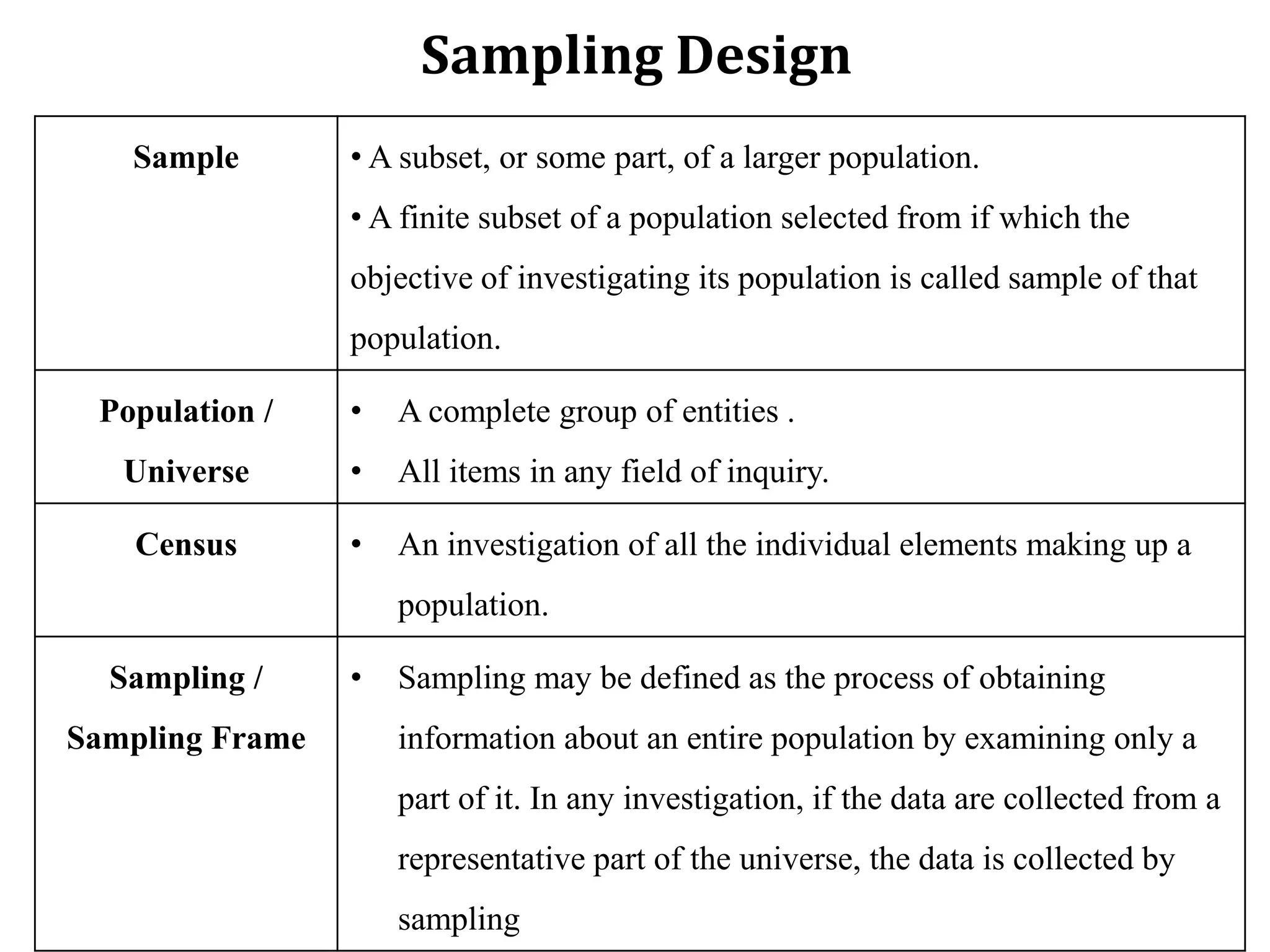
Sample • A subset, or some part, of a larger population.
• A finite subset of a population selected from if which the
objective of investigating its population is called sample of that
population.
Population /
Universe
• A complete group of entities .
• All items in any field of inquiry.
Census • An investigation of all the individual elements making up a
population.
Sampling /
Sampling Frame
• Sampling may be defined as the process of obtaining
information about an entire population by examining only a
part of it. In any investigation, if the data are collected from a
representative part of the universe, the data is collected by
sampling
Sampling Design
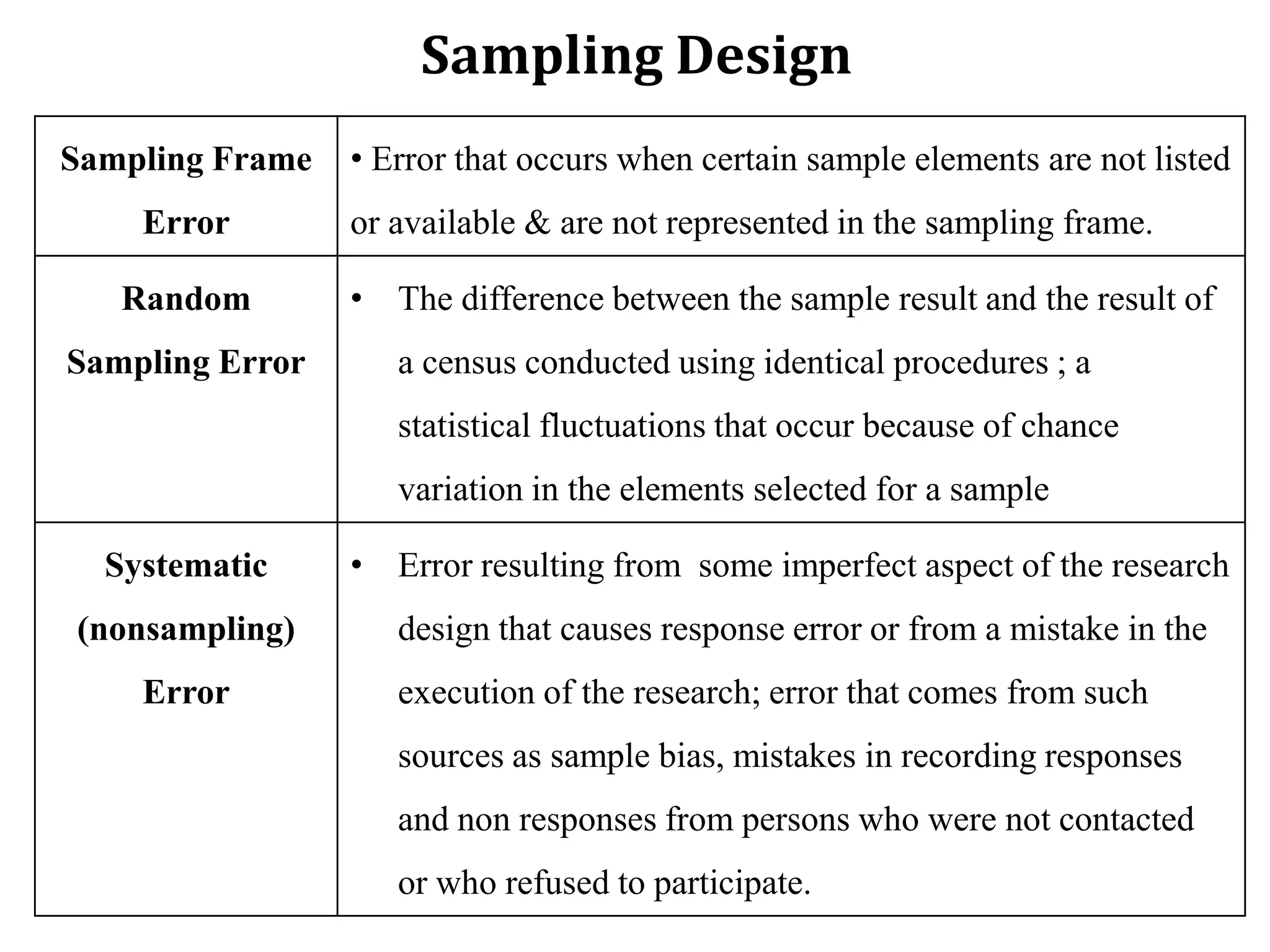
Sampling Frame
Error
• Error that occurs when certain sample elements are not listed
or available & are not represented in the sampling frame.
Random
Sampling Error
• The difference between the sample result and the result of
a census conducted using identical procedures ; a
statistical fluctuations that occur because of chance
variation in the elements selected for a sample
Systematic
(nonsampling)
Error
• Error resulting from some imperfect aspect of the research
design that causes response error or from a mistake in the
execution of the research; error that comes from such
sources as sample bias, mistakes in recording responses
and non responses from persons who were not contacted
or who refused to participate.
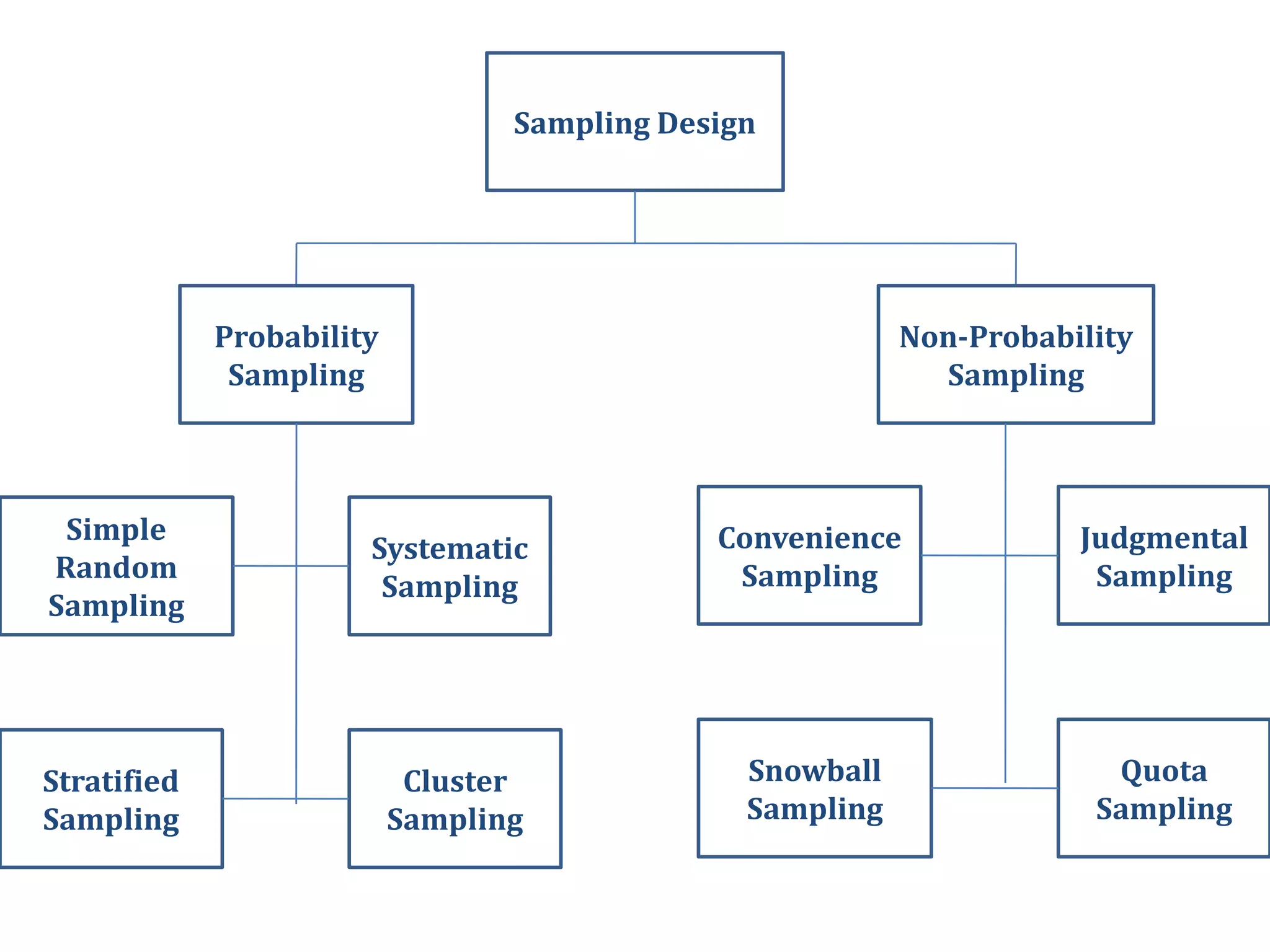
Sampling Design
Non-Probability
Sampling
Probability
Sampling
Simple
Random
Sampling
Systematic
Sampling
Stratified
Sampling
Cluster
Sampling
Convenience
Sampling
Judgmental
Sampling
Snowball
Sampling
Quota
Sampling
Probability Sample Design
 A simple random sample is a sample selected from a population in
such a way that every member of the population has an equal chance
of being selected & the selection of any individual does not influence
the selection of any other, So the personal bias of the investigator will
not be present in sample selected.
Simple Random Sampling
 Every element in the population has both known & equal chance of
being selected in the sample.
 Probability of selection = Sample Size/Population size.
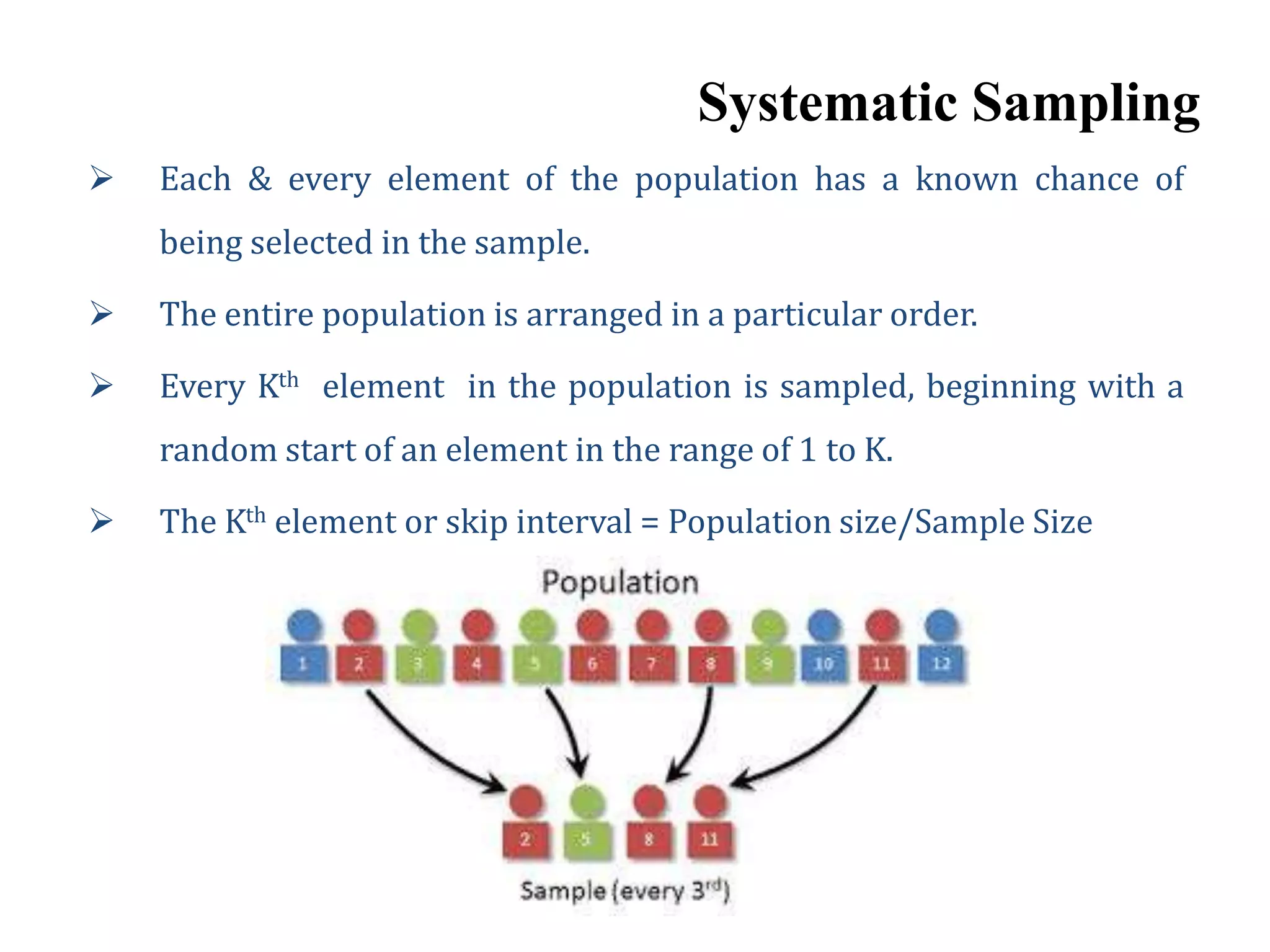
Systematic Sampling
 Each & every element of the population has a known chance of
being selected in the sample.
 The entire population is arranged in a particular order.
 Every Kth element in the population is sampled, beginning with a
random start of an element in the range of 1 to K.
 The Kth element or skip interval = Population size/Sample Size
Stratified Sampling
 Stratification is the process of dividing members of the population into
homogenous subgroups before sampling.
 Dividing the population into various strata increases the
representativeness of the sampling.
 If an element belongs to one stream, it cannot belongs to any other
stratum.
 Then simple random sampling or systematic sampling is applied within
each stratum.
 Example : University students belongs to various class or various
college or various majors.
Cluster Sampling
 Used when it is either impossible or impractical to compile an
exhaustive list of elements that make up the target population.
 Homogenous groupings cannot be done (ideally be as
heterogeneous).
 In this technique, the total population is divided into groups (or
clusters) and a simple random sample of the groups is selected.
 For example : Let’s say the target population in a study was
church members in the US. There is no list of all church in the
country. The researcher could, however, create a list of churches in
the United States, choose a sample of churches, and then obtain lists
of members from those churches
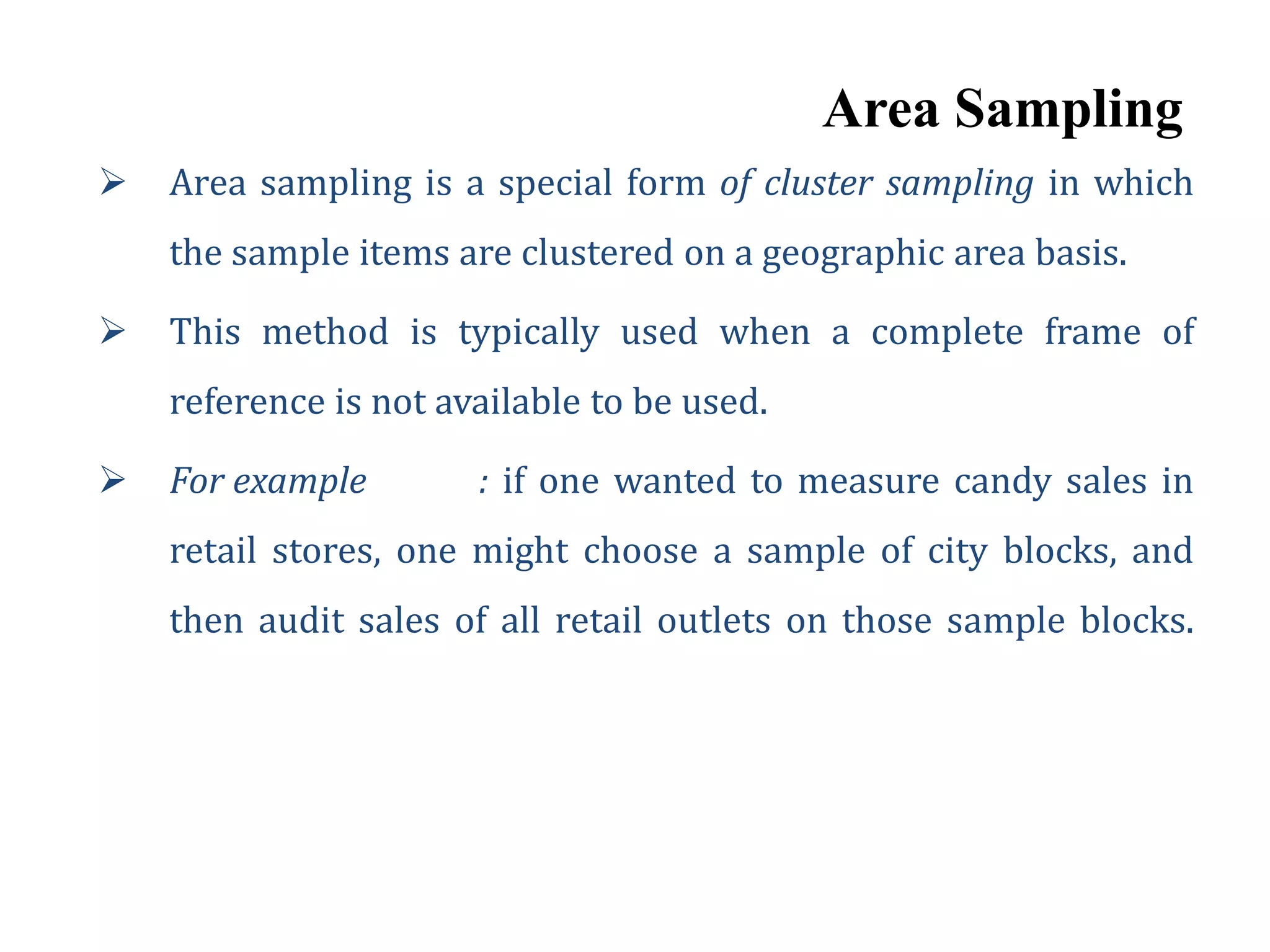
Area Sampling
 Area sampling is a special form of cluster sampling in which
the sample items are clustered on a geographic area basis.
 This method is typically used when a complete frame of
reference is not available to be used.
 For example : if one wanted to measure candy sales in
retail stores, one might choose a sample of city blocks, and
then audit sales of all retail outlets on those sample blocks.
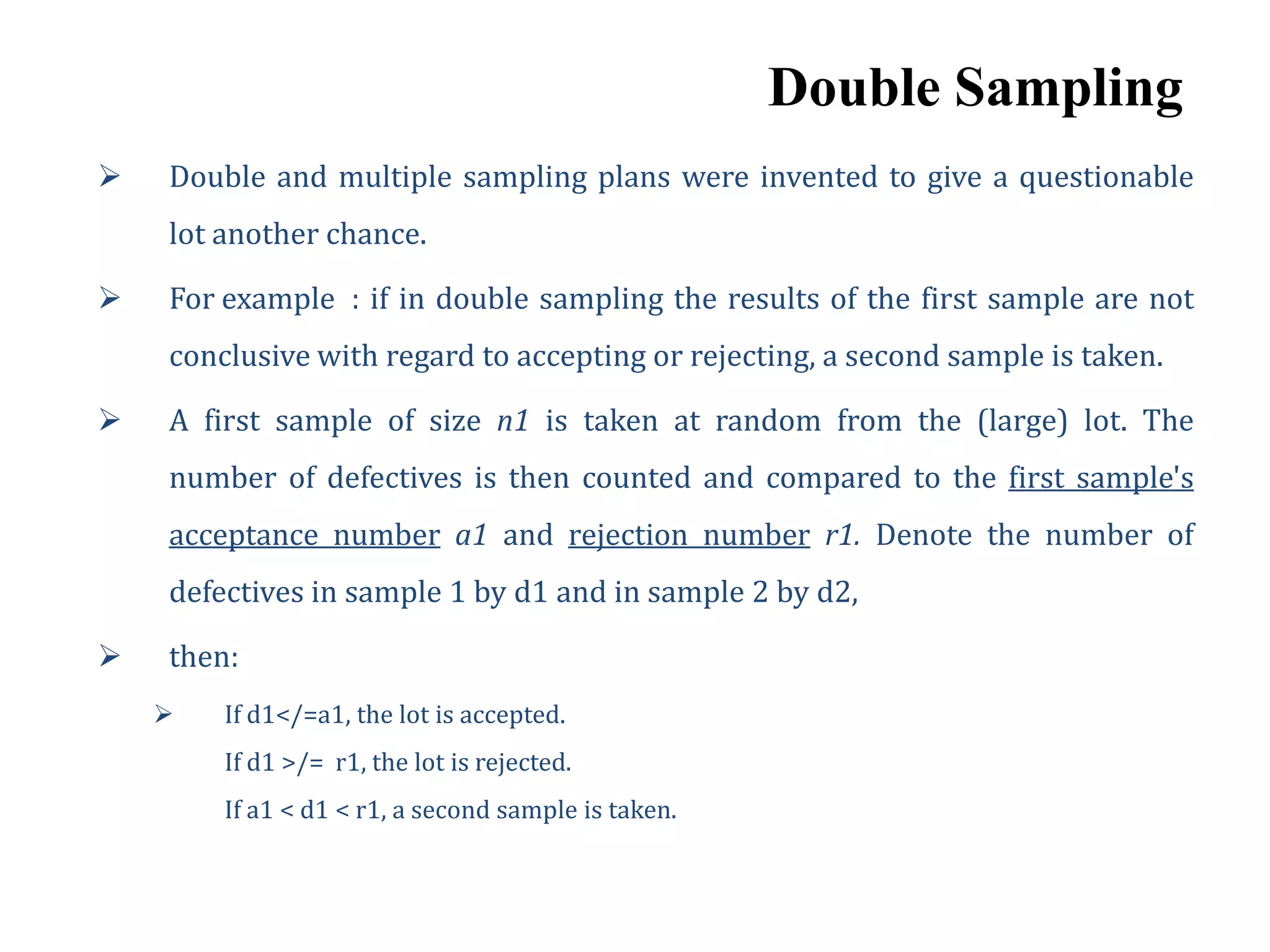
Double Sampling
 Double and multiple sampling plans were invented to give a questionable
lot another chance.
 For example : if in double sampling the results of the first sample are not
conclusive with regard to accepting or rejecting, a second sample is taken.
 A first sample of size n1 is taken at random from the (large) lot. The
number of defectives is then counted and compared to the first sample's
acceptance number a1 and rejection number r1. Denote the number of
defectives in sample 1 by d1 and in sample 2 by d2,
 then:
 If d1</=a1, the lot is accepted.
If d1 >/= r1, the lot is rejected.
If a1 < d1 < r1, a second sample is taken.
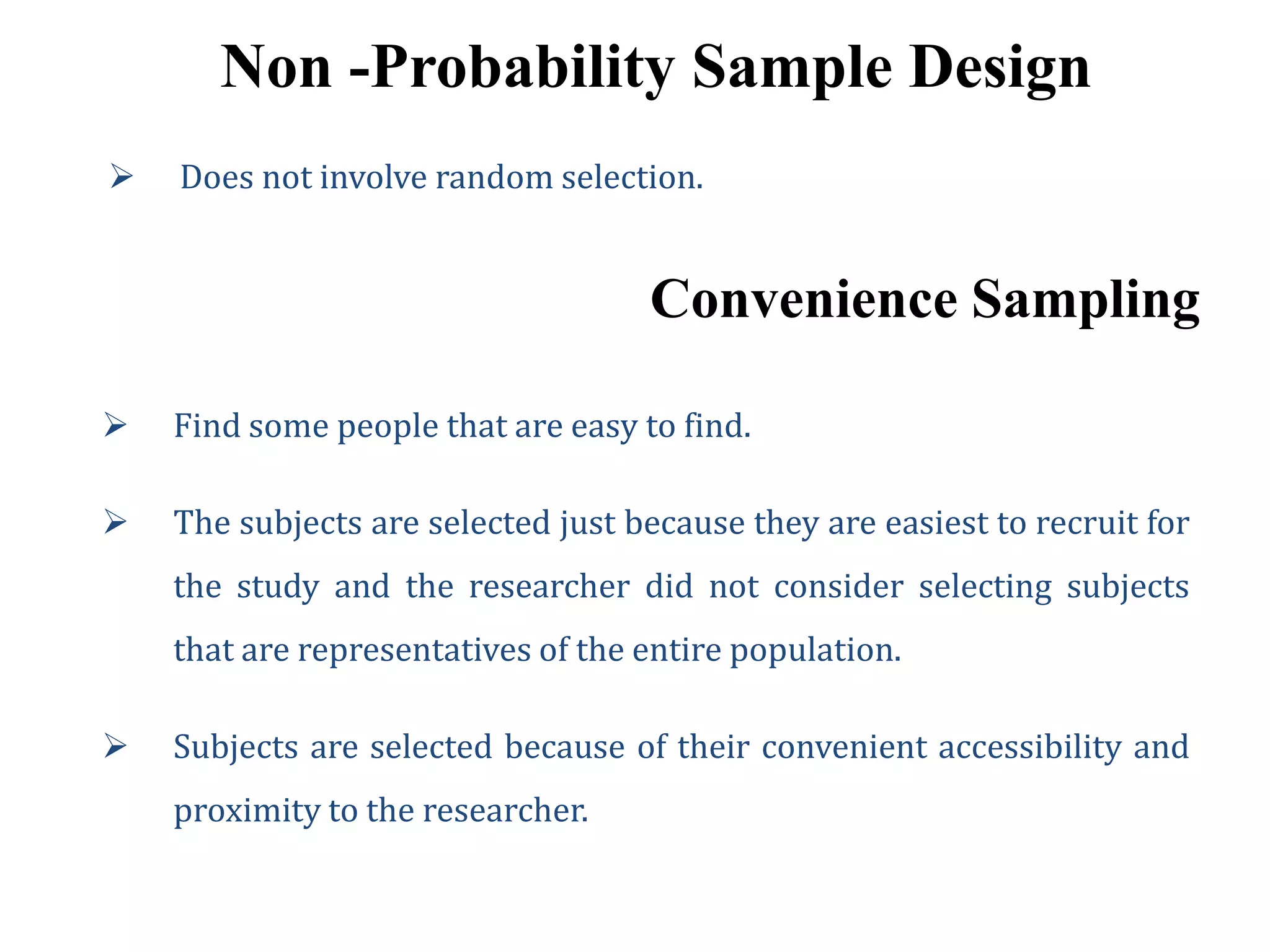
Non -Probability Sample Design
 Does not involve random selection.
Convenience Sampling
 Find some people that are easy to find.
 The subjects are selected just because they are easiest to recruit for
the study and the researcher did not consider selecting subjects
that are representatives of the entire population.
 Subjects are selected because of their convenient accessibility and
proximity to the researcher.
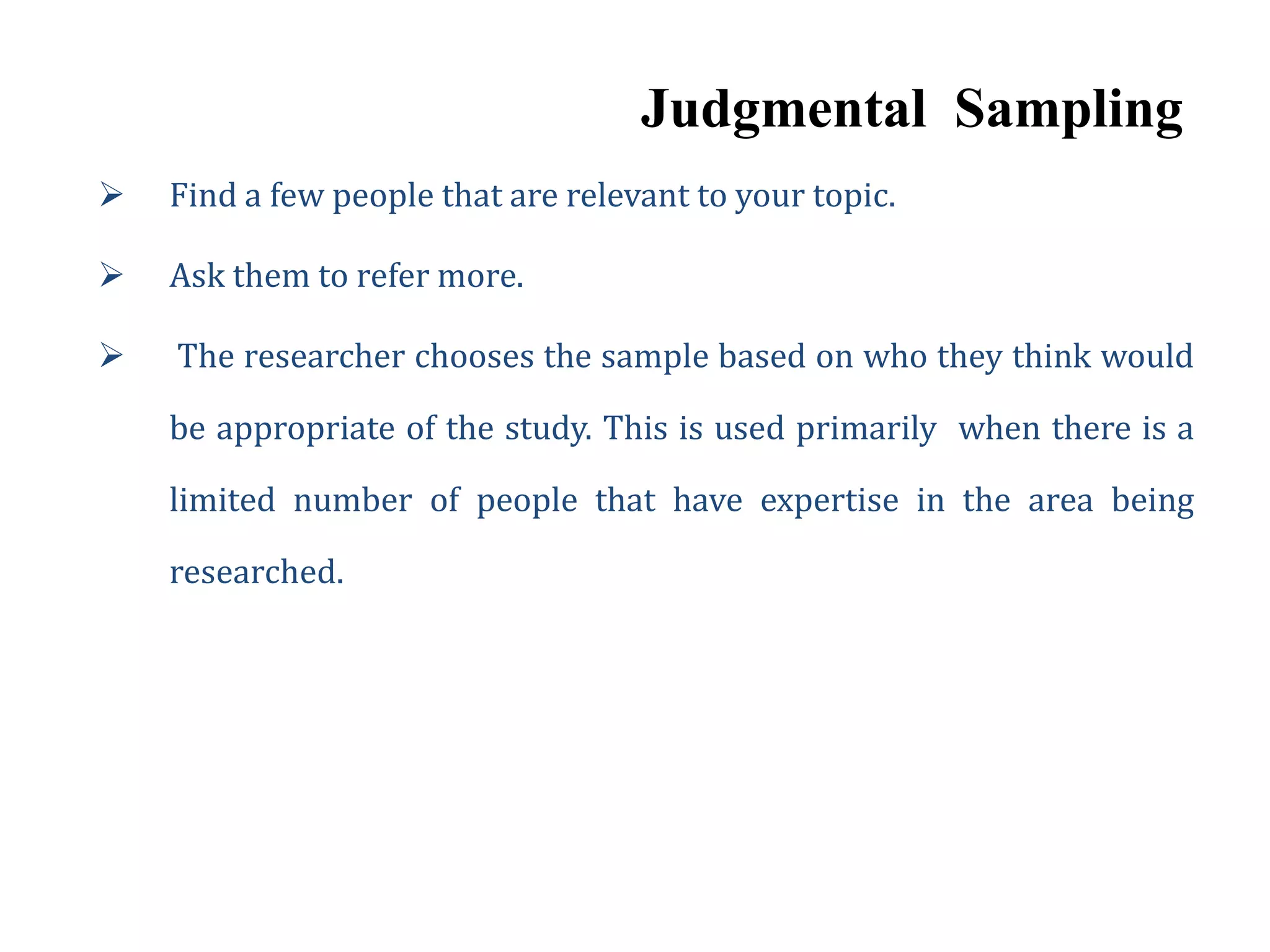
Judgmental Sampling
 Find a few people that are relevant to your topic.
 Ask them to refer more.
 The researcher chooses the sample based on who they think would
be appropriate of the study. This is used primarily when there is a
limited number of people that have expertise in the area being
researched.
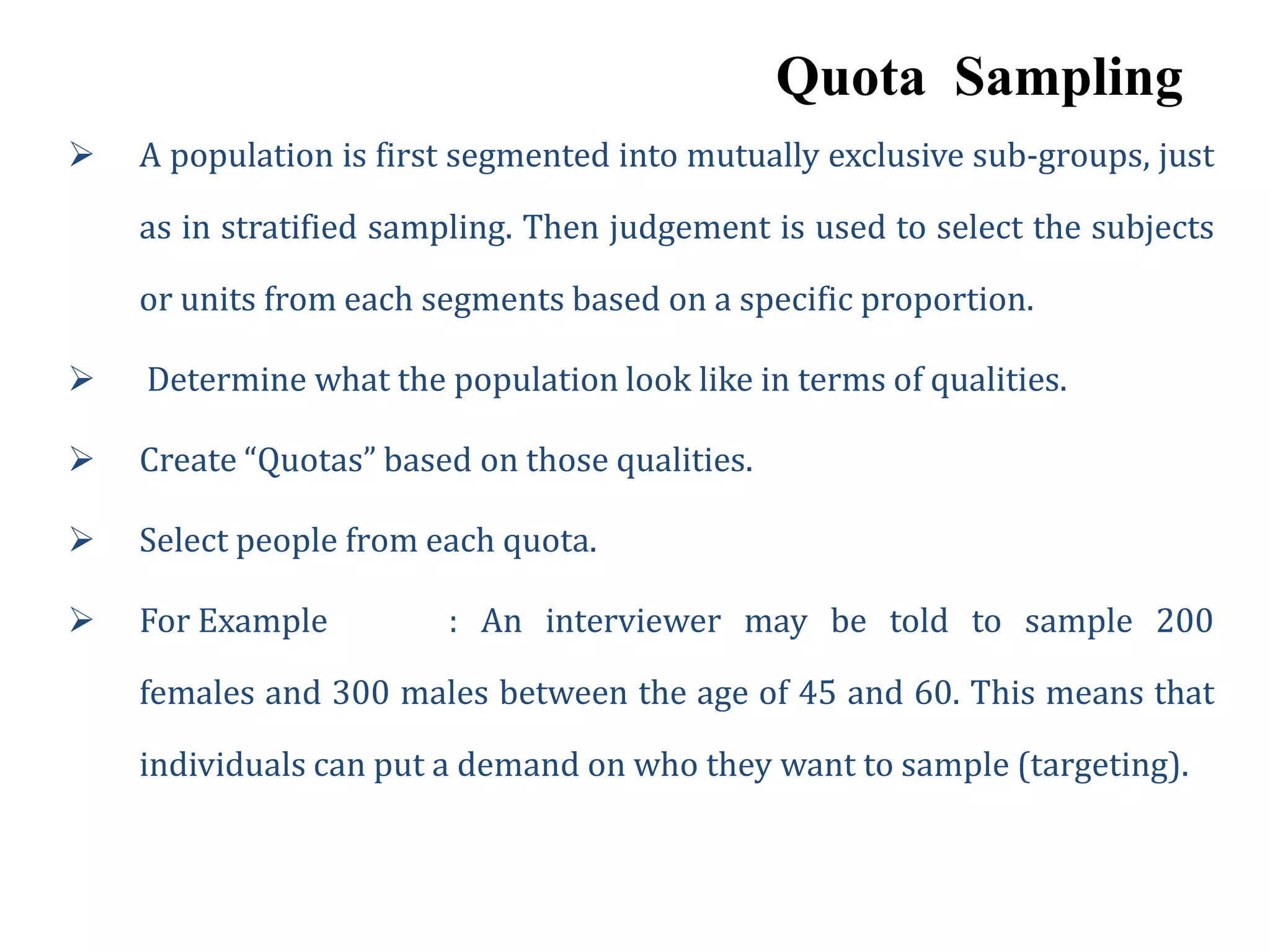
Quota Sampling
 A population is first segmented into mutually exclusive sub-groups, just
as in stratified sampling. Then judgement is used to select the subjects
or units from each segments based on a specific proportion.
 Determine what the population look like in terms of qualities.
 Create “Quotas” based on those qualities.
 Select people from each quota.
 For Example : An interviewer may be told to sample 200
females and 300 males between the age of 45 and 60. This means that
individuals can put a demand on who they want to sample (targeting).
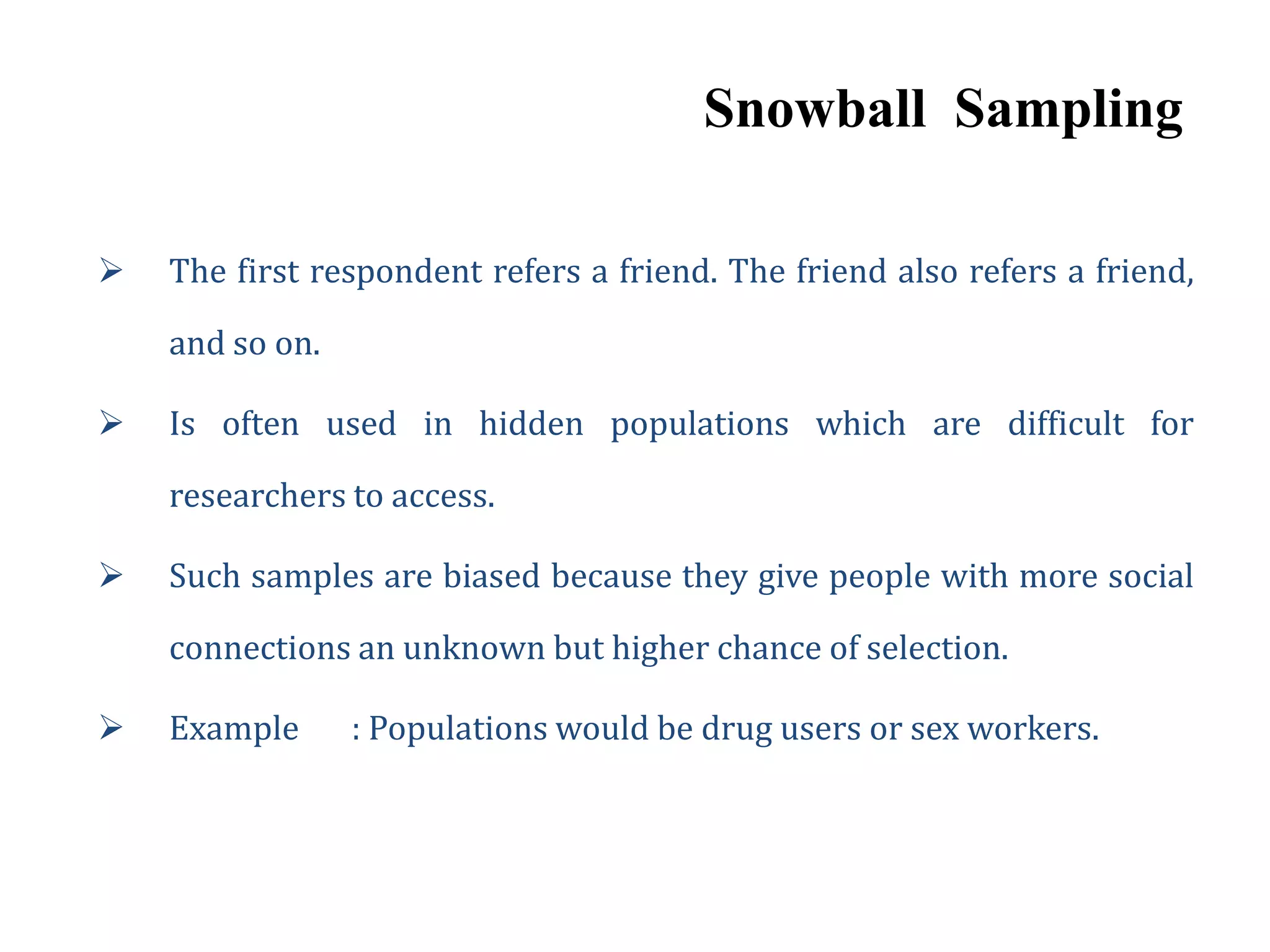
Snowball Sampling
 The first respondent refers a friend. The friend also refers a friend,
and so on.
 Is often used in hidden populations which are difficult for
researchers to access.
 Such samples are biased because they give people with more social
connections an unknown but higher chance of selection.
 Example : Populations would be drug users or sex workers.
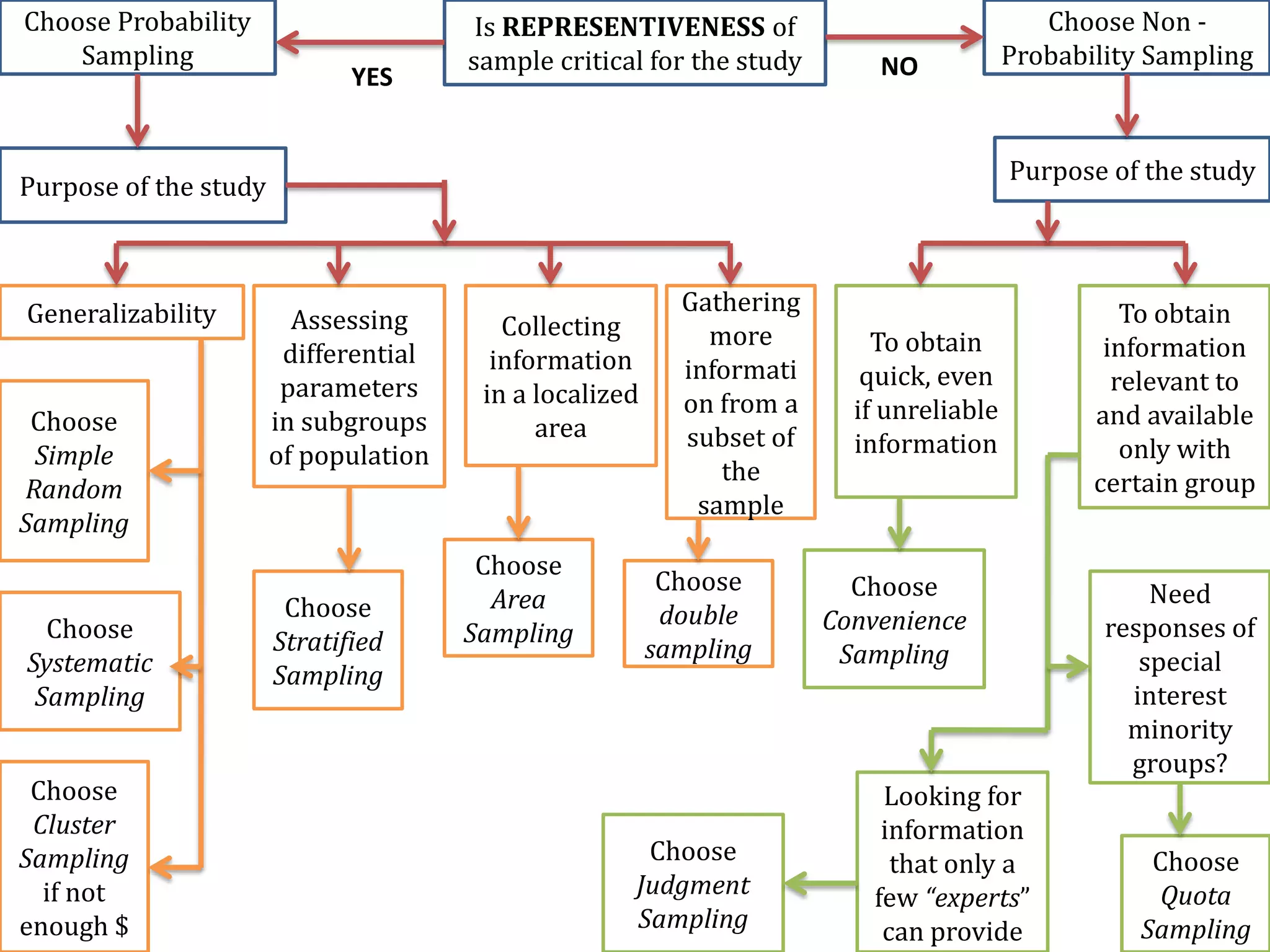
YES NO
Is REPRESENTIVENESS of
sample critical for the study
Choose Probability
Sampling
Choose Non -
Probability Sampling
Purpose of the study
Generalizability
Choose
Simple
Random
Sampling
Choose
Systematic
Sampling
Choose
Cluster
Sampling
if not
enough $
Assessing
differential
parameters
in subgroups
of population
Choose
Stratified
Sampling
Collecting
information
in a localized
area
Choose
Area
Sampling
Gathering
more
informati
on from a
subset of
the
sample
Choose
double
sampling
To obtain
quick, even
if unreliable
information
Choose
Convenience
Sampling
To obtain
information
relevant to
and available
only with
certain group
Looking for
information
that only a
few “experts”
can provide
Need
responses of
special
interest
minority
groups?
Choose
Judgment
Sampling
Choose
Quota
Sampling
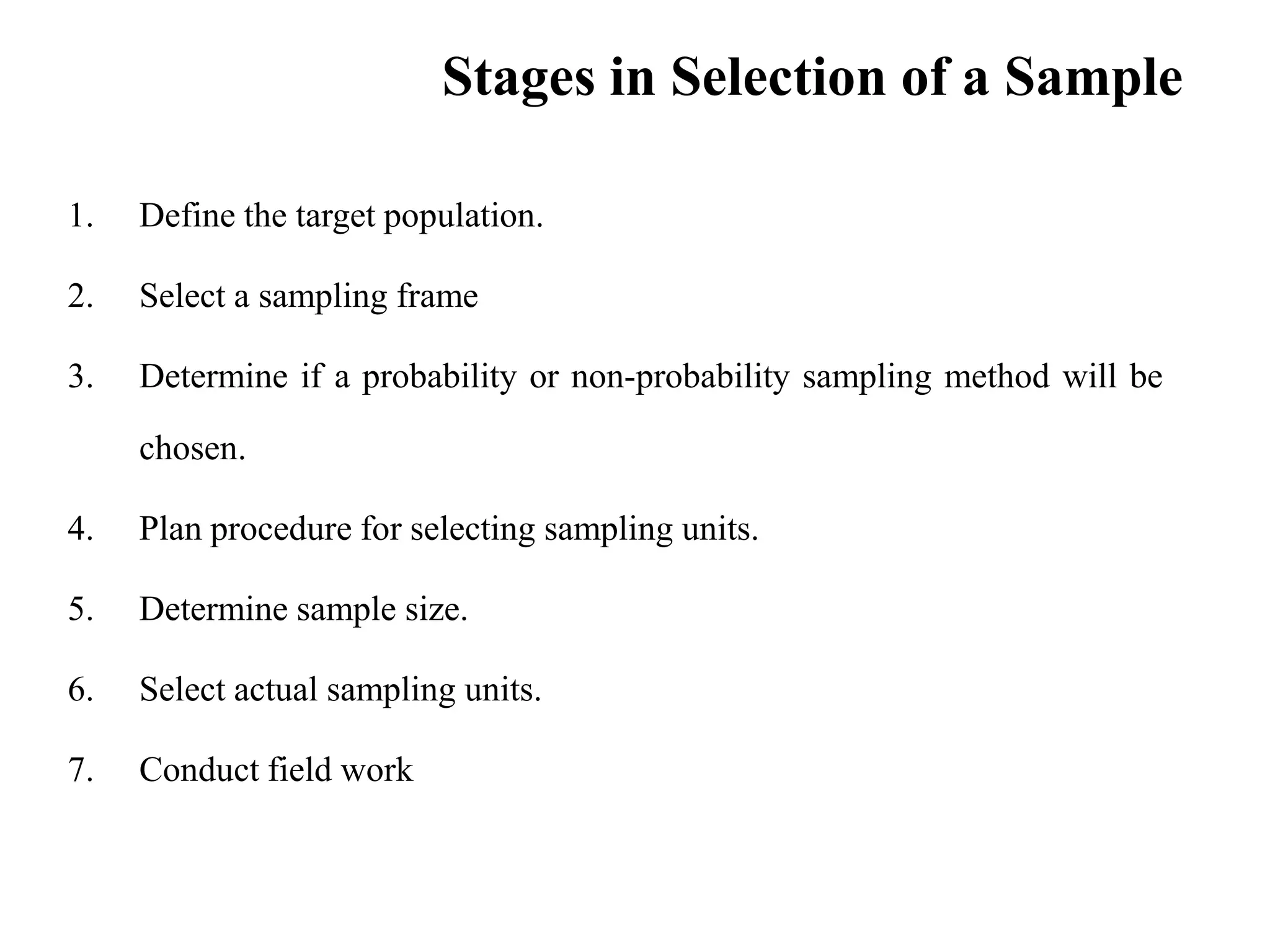
Stages in Selection of a Sample
1. Define the target population.
2. Select a sampling frame
3. Determine if a probability or non-probability sampling method will be
chosen.
4. Plan procedure for selecting sampling units.
5. Determine sample size.
6. Select actual sampling units.
7. Conduct field work

Sampling design

  • 2.
    Sampling Design Sample •A subset, or some part, of a larger population. • A finite subset of a population selected from if which the objective of investigating its population is called sample of that population. Population / Universe • A complete group of entities . • All items in any field of inquiry. Census • An investigation of all the individual elements making up a population. Sampling / Sampling Frame • Sampling may be defined as the process of obtaining information about an entire population by examining only a part of it. In any investigation, if the data are collected from a representative part of the universe, the data is collected by sampling
  • 3.
    Sampling Design Sampling Frame Error •Error that occurs when certain sample elements are not listed or available & are not represented in the sampling frame. Random Sampling Error • The difference between the sample result and the result of a census conducted using identical procedures ; a statistical fluctuations that occur because of chance variation in the elements selected for a sample Systematic (nonsampling) Error • Error resulting from some imperfect aspect of the research design that causes response error or from a mistake in the execution of the research; error that comes from such sources as sample bias, mistakes in recording responses and non responses from persons who were not contacted or who refused to participate.
  • 4.
  • 5.
    Probability Sample Design A simple random sample is a sample selected from a population in such a way that every member of the population has an equal chance of being selected & the selection of any individual does not influence the selection of any other, So the personal bias of the investigator will not be present in sample selected. Simple Random Sampling  Every element in the population has both known & equal chance of being selected in the sample.  Probability of selection = Sample Size/Population size.
  • 6.
    Systematic Sampling  Each& every element of the population has a known chance of being selected in the sample.  The entire population is arranged in a particular order.  Every Kth element in the population is sampled, beginning with a random start of an element in the range of 1 to K.  The Kth element or skip interval = Population size/Sample Size
  • 7.
    Stratified Sampling  Stratificationis the process of dividing members of the population into homogenous subgroups before sampling.  Dividing the population into various strata increases the representativeness of the sampling.  If an element belongs to one stream, it cannot belongs to any other stratum.  Then simple random sampling or systematic sampling is applied within each stratum.  Example : University students belongs to various class or various college or various majors.
  • 8.
    Cluster Sampling  Usedwhen it is either impossible or impractical to compile an exhaustive list of elements that make up the target population.  Homogenous groupings cannot be done (ideally be as heterogeneous).  In this technique, the total population is divided into groups (or clusters) and a simple random sample of the groups is selected.  For example : Let’s say the target population in a study was church members in the US. There is no list of all church in the country. The researcher could, however, create a list of churches in the United States, choose a sample of churches, and then obtain lists of members from those churches
  • 9.
    Area Sampling  Areasampling is a special form of cluster sampling in which the sample items are clustered on a geographic area basis.  This method is typically used when a complete frame of reference is not available to be used.  For example : if one wanted to measure candy sales in retail stores, one might choose a sample of city blocks, and then audit sales of all retail outlets on those sample blocks.
  • 10.
    Double Sampling  Doubleand multiple sampling plans were invented to give a questionable lot another chance.  For example : if in double sampling the results of the first sample are not conclusive with regard to accepting or rejecting, a second sample is taken.  A first sample of size n1 is taken at random from the (large) lot. The number of defectives is then counted and compared to the first sample's acceptance number a1 and rejection number r1. Denote the number of defectives in sample 1 by d1 and in sample 2 by d2,  then:  If d1</=a1, the lot is accepted. If d1 >/= r1, the lot is rejected. If a1 < d1 < r1, a second sample is taken.
  • 11.
    Non -Probability SampleDesign  Does not involve random selection. Convenience Sampling  Find some people that are easy to find.  The subjects are selected just because they are easiest to recruit for the study and the researcher did not consider selecting subjects that are representatives of the entire population.  Subjects are selected because of their convenient accessibility and proximity to the researcher.
  • 12.
    Judgmental Sampling  Finda few people that are relevant to your topic.  Ask them to refer more.  The researcher chooses the sample based on who they think would be appropriate of the study. This is used primarily when there is a limited number of people that have expertise in the area being researched.
  • 13.
    Quota Sampling  Apopulation is first segmented into mutually exclusive sub-groups, just as in stratified sampling. Then judgement is used to select the subjects or units from each segments based on a specific proportion.  Determine what the population look like in terms of qualities.  Create “Quotas” based on those qualities.  Select people from each quota.  For Example : An interviewer may be told to sample 200 females and 300 males between the age of 45 and 60. This means that individuals can put a demand on who they want to sample (targeting).
  • 14.
    Snowball Sampling  Thefirst respondent refers a friend. The friend also refers a friend, and so on.  Is often used in hidden populations which are difficult for researchers to access.  Such samples are biased because they give people with more social connections an unknown but higher chance of selection.  Example : Populations would be drug users or sex workers.
  • 15.
    YES NO Is REPRESENTIVENESSof sample critical for the study Choose Probability Sampling Choose Non - Probability Sampling Purpose of the study Purpose of the study Generalizability Choose Simple Random Sampling Choose Systematic Sampling Choose Cluster Sampling if not enough $ Assessing differential parameters in subgroups of population Choose Stratified Sampling Collecting information in a localized area Choose Area Sampling Gathering more informati on from a subset of the sample Choose double sampling To obtain quick, even if unreliable information Choose Convenience Sampling To obtain information relevant to and available only with certain group Looking for information that only a few “experts” can provide Need responses of special interest minority groups? Choose Judgment Sampling Choose Quota Sampling
  • 16.
    Stages in Selectionof a Sample 1. Define the target population. 2. Select a sampling frame 3. Determine if a probability or non-probability sampling method will be chosen. 4. Plan procedure for selecting sampling units. 5. Determine sample size. 6. Select actual sampling units. 7. Conduct field work