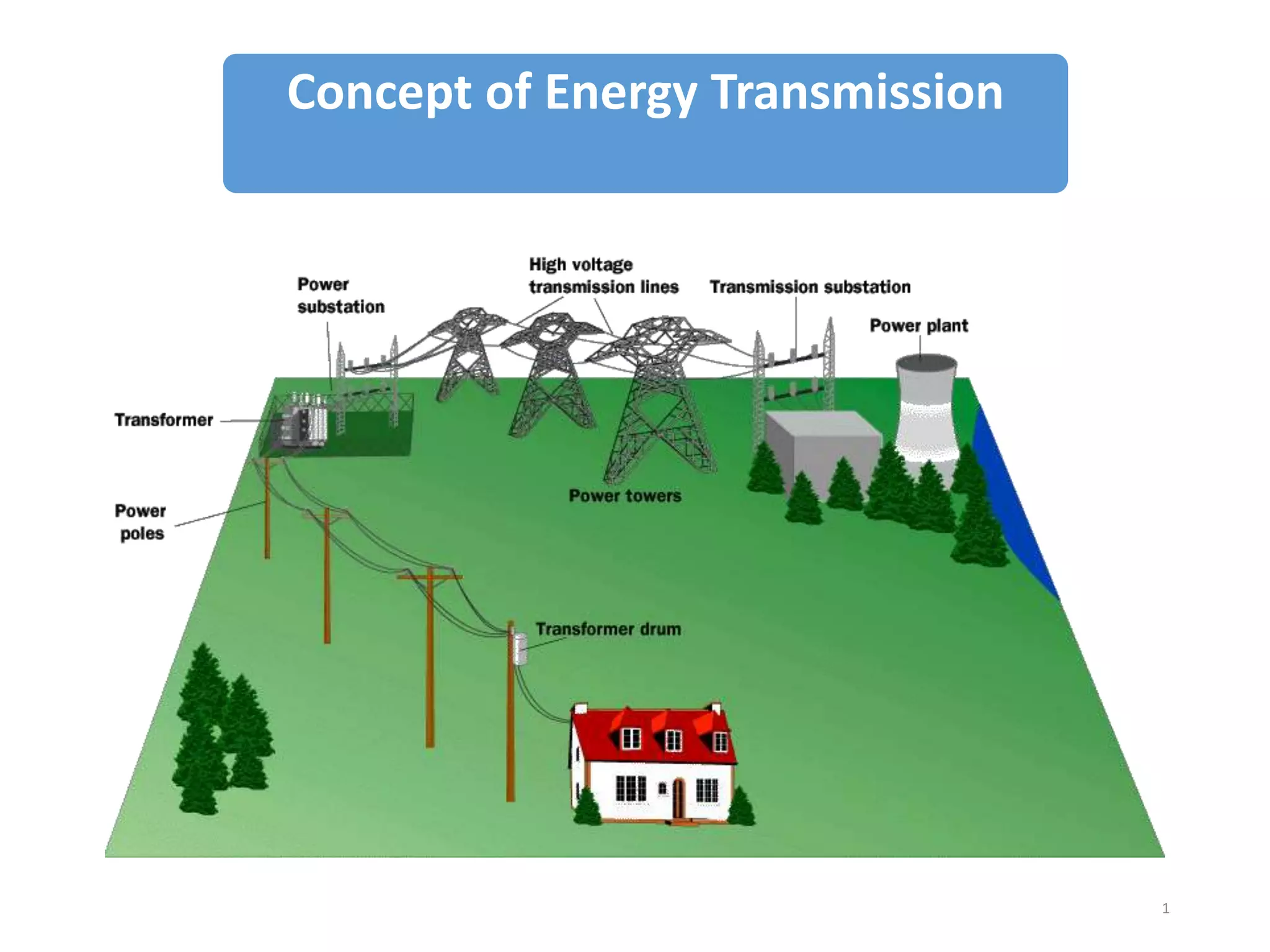
Concept of Energy Transmission

1
Group Members
Madiha
Naeem

Muqadsa
Iftikhar

Zunaib Ali

COMSATS INSTITUTE OF INFORMATION &
TECHNOLOGY, ABBOTTABAD
2
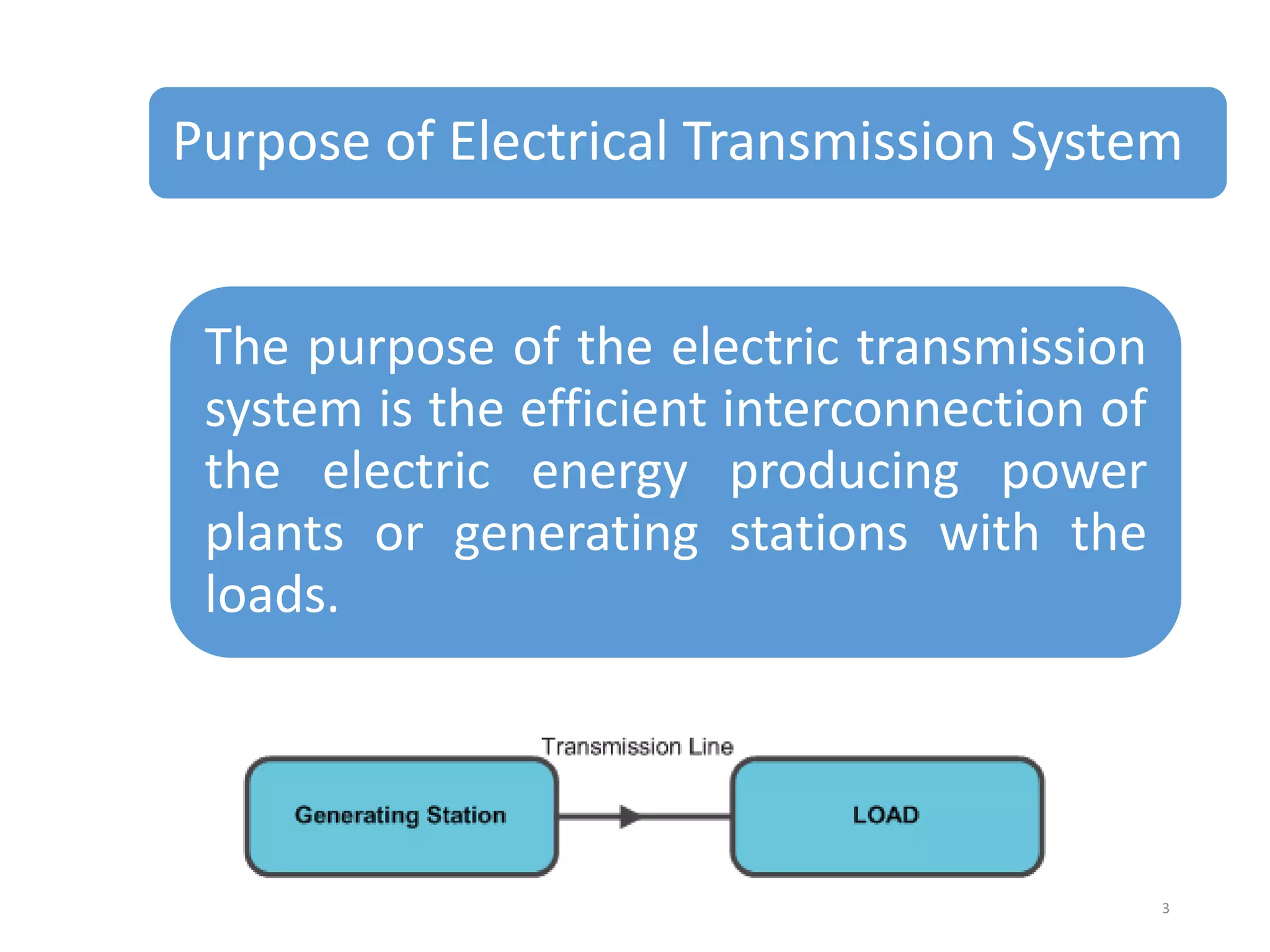
Purpose of Electrical Transmission System
The purpose of the electric transmission
system is the efficient interconnection of
the electric energy producing power
plants or generating stations with the
loads.

3
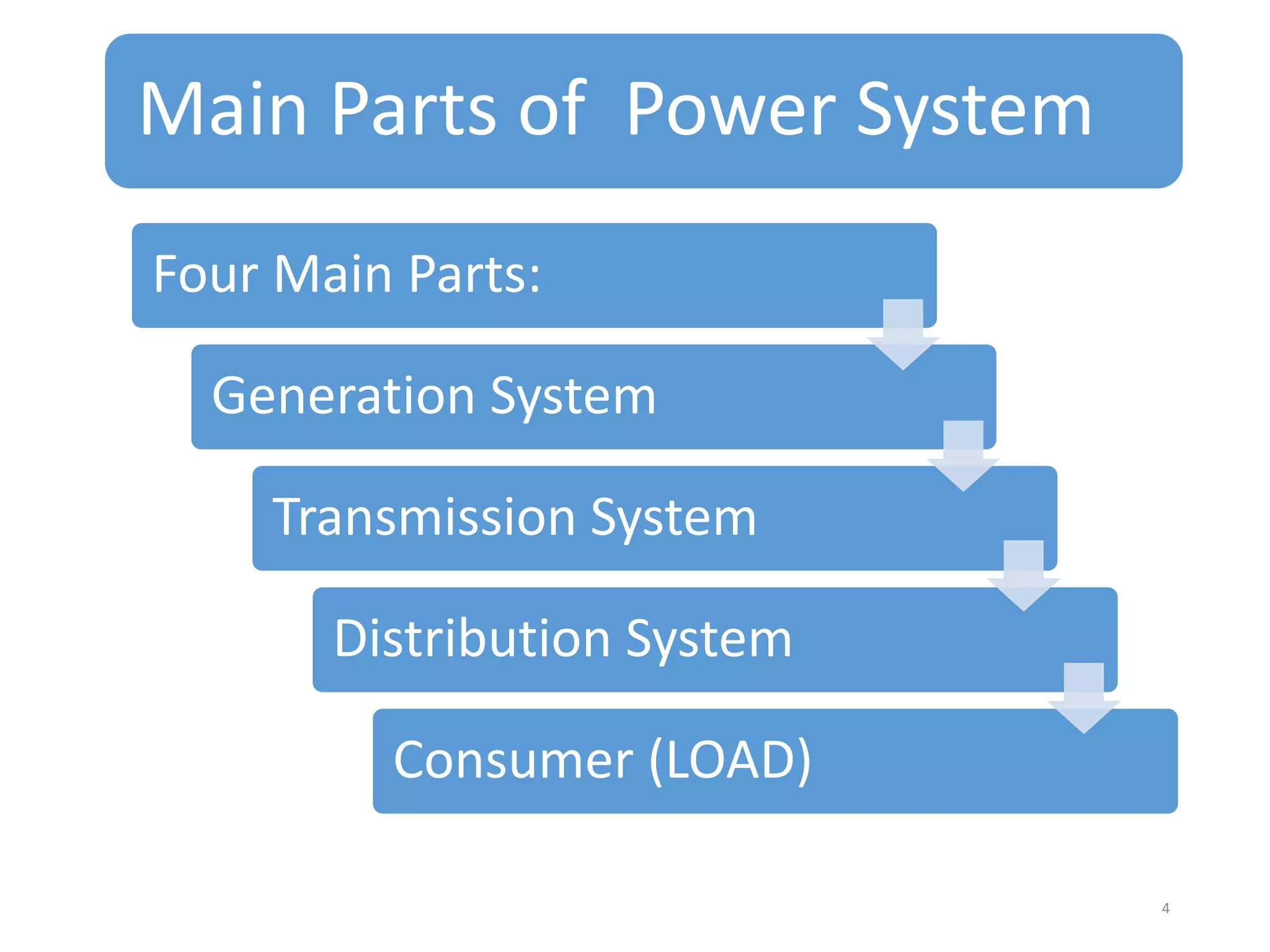
Main Parts of Power System
Four Main Parts:
Generation System
Transmission System
Distribution System
Consumer (LOAD)
4
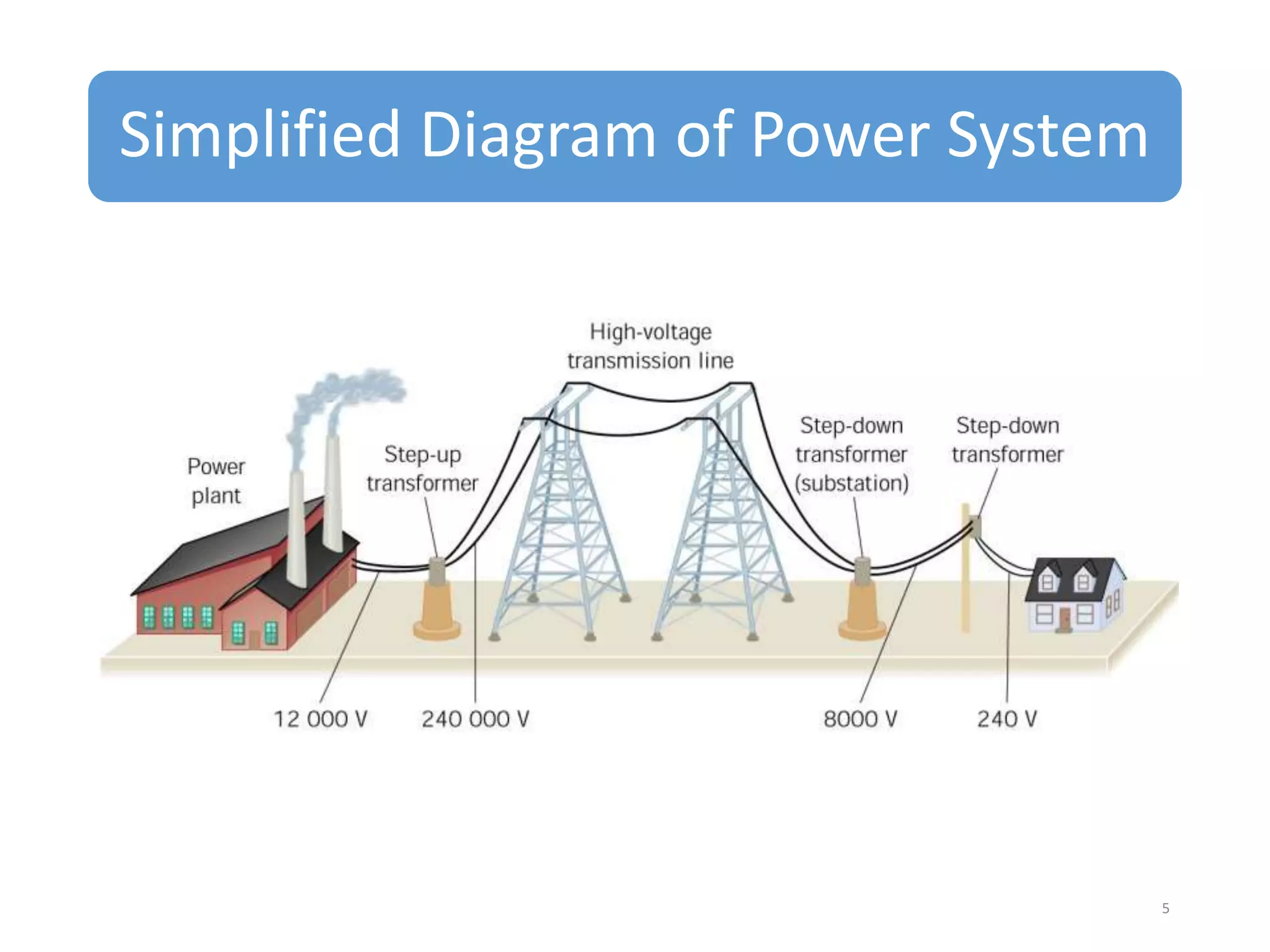
Simplified Diagram of Power System

5
Generating Station
The commonly used power plants are:
Thermal Power Plant
Nuclear Power Plant
Hydro Power Plant
Gas Turbine Power Plant
Combined Cycle Power Plant

6
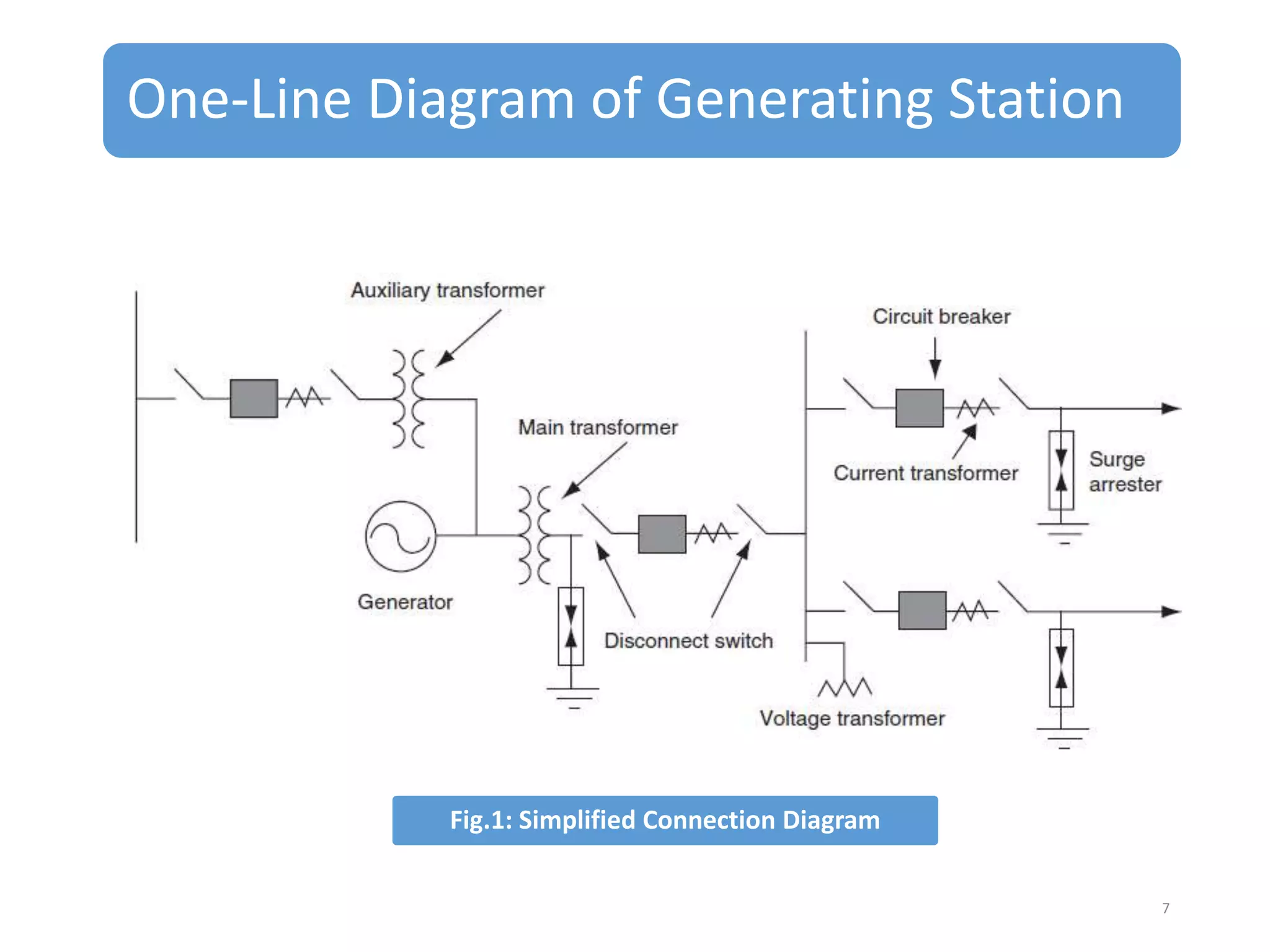
One-Line Diagram of Generating Station

Fig.1: Simplified Connection Diagram
7
Main Parts of Generating Station
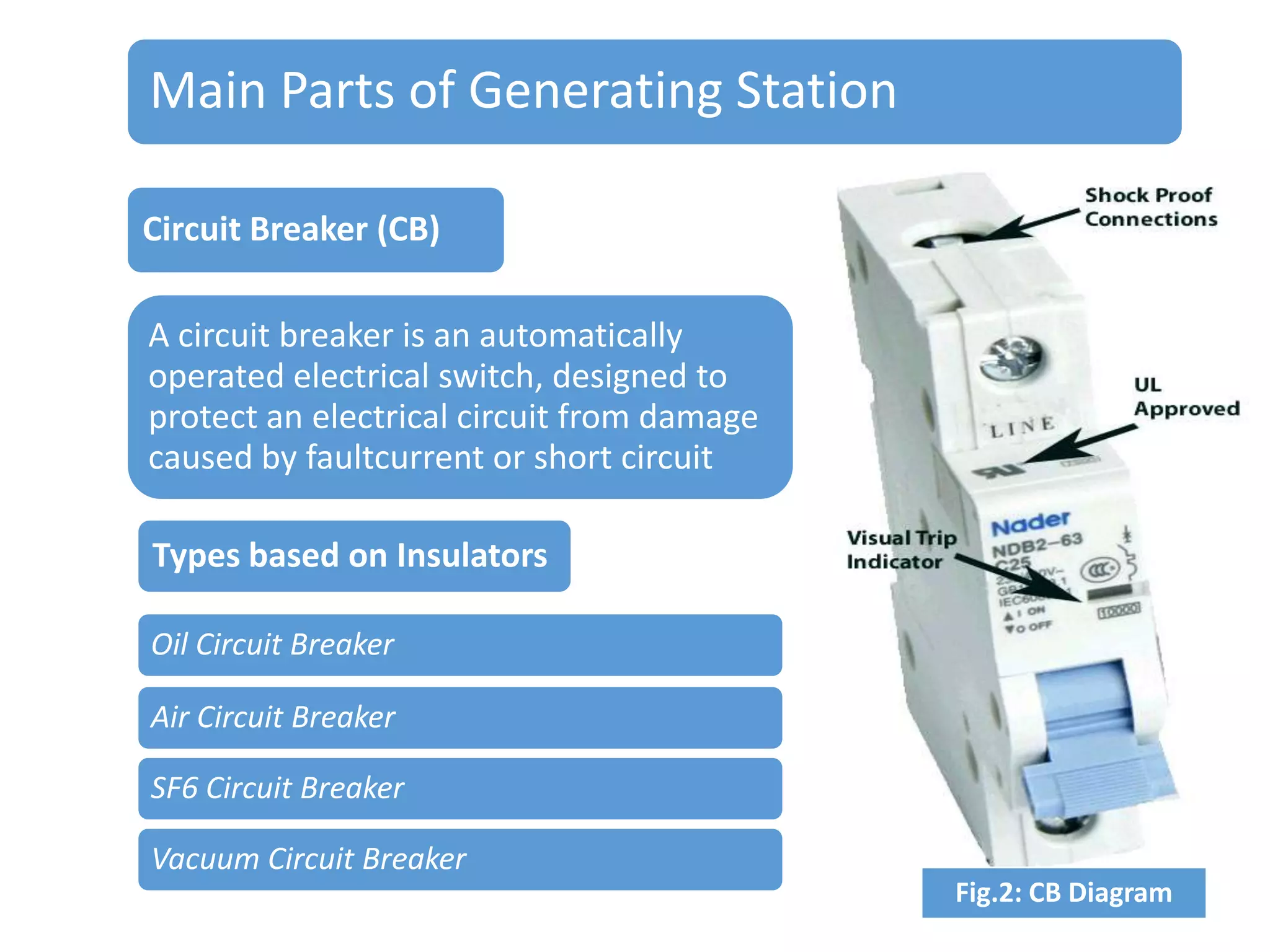
Circuit Breaker (CB)
A circuit breaker is an automatically
operated electrical switch, designed to
protect an electrical circuit from damage
caused by faultcurrent or short circuit
Types based on Insulators
Oil Circuit Breaker
Air Circuit Breaker
SF6 Circuit Breaker
Vacuum Circuit Breaker
Fig.2: CB Diagram
8
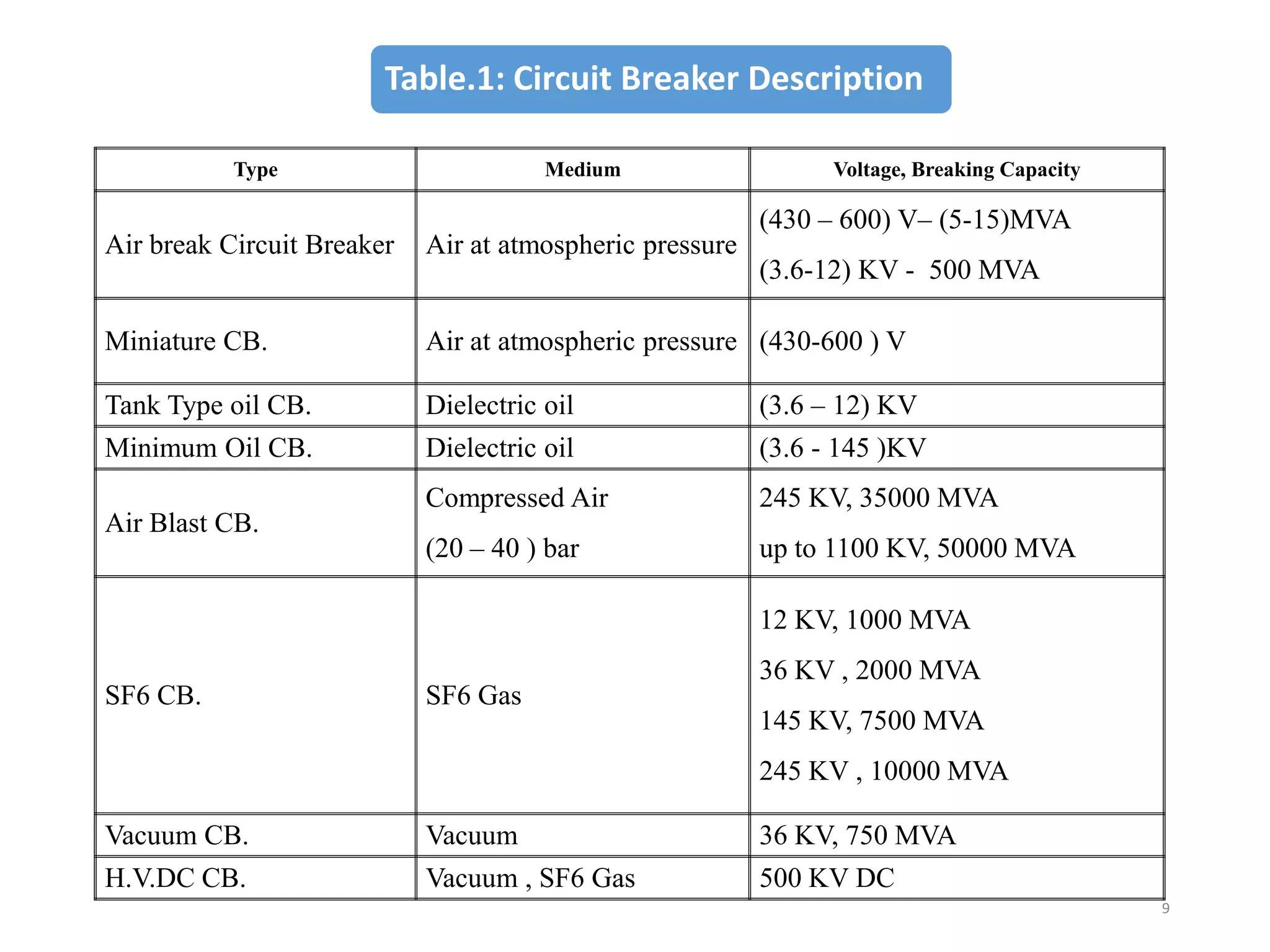
Table.1: Circuit Breaker Description
Type

Medium

Air break Circuit Breaker

Air at atmospheric pressure

Miniature CB.

Air at atmospheric pressure (430-600 ) V

Tank Type oil CB.

Dielectric oil

(3.6 – 12) KV

Minimum Oil CB.

Dielectric oil

(3.6 - 145 )KV

Compressed Air

245 KV, 35000 MVA

(20 – 40 ) bar

up to 1100 KV, 50000 MVA

Air Blast CB.

Voltage, Breaking Capacity

(430 – 600) V– (5-15)MVA
(3.6-12) KV - 500 MVA

12 KV, 1000 MVA
SF6 CB.

SF6 Gas

36 KV , 2000 MVA
145 KV, 7500 MVA
245 KV , 10000 MVA

Vacuum CB.

Vacuum

36 KV, 750 MVA

H.V.DC CB.

Vacuum , SF6 Gas

500 KV DC
9
Main Parts of Generation Station…
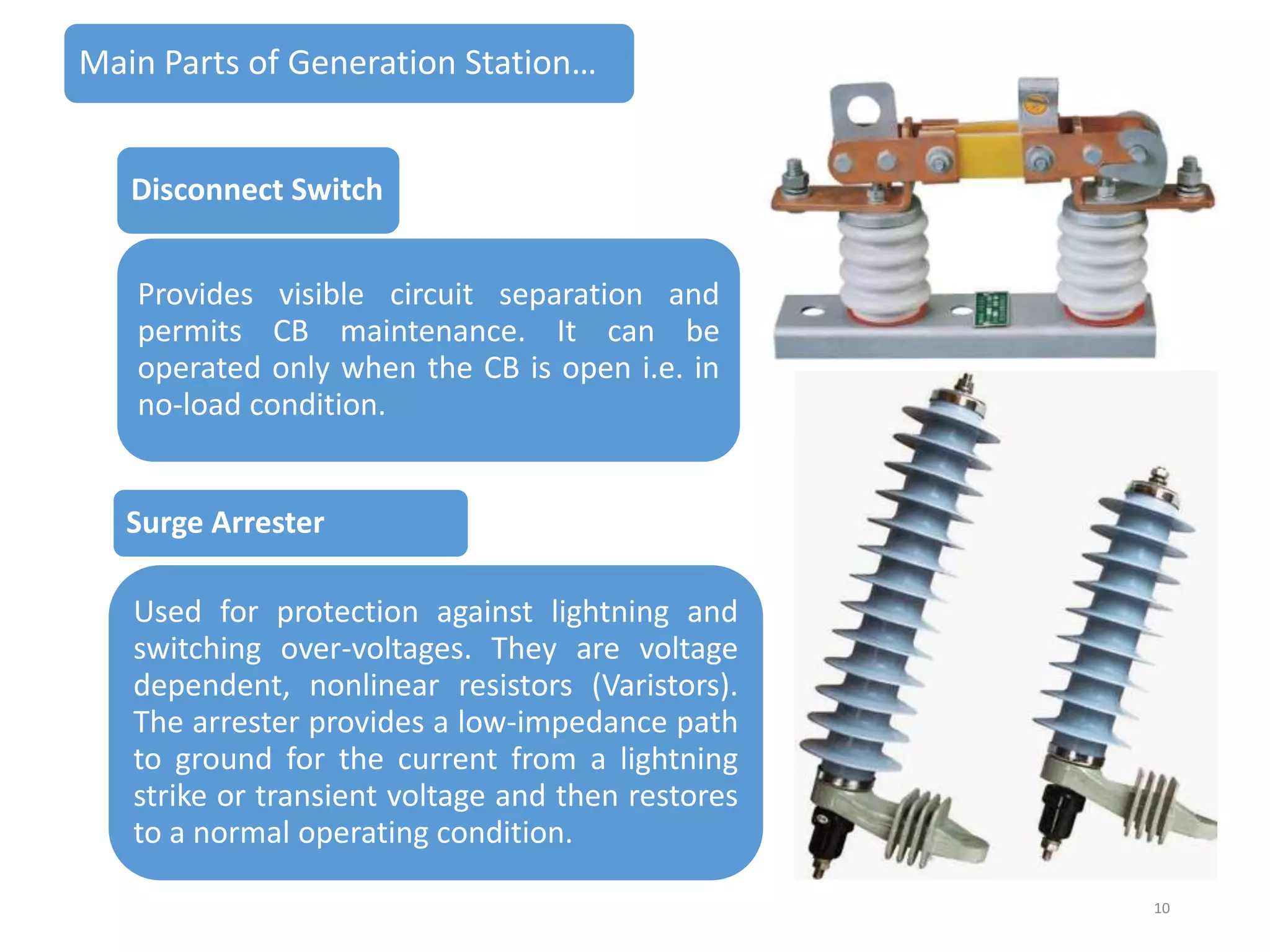
Disconnect Switch
Provides visible circuit separation and
permits CB maintenance. It can be
operated only when the CB is open i.e. in
no-load condition.

Surge Arrester

Used for protection against lightning and
switching over-voltages. They are voltage
dependent, nonlinear resistors (Varistors).
The arrester provides a low-impedance path
to ground for the current from a lightning
strike or transient voltage and then restores
to a normal operating condition.
10
Main Parts of Generation Station…
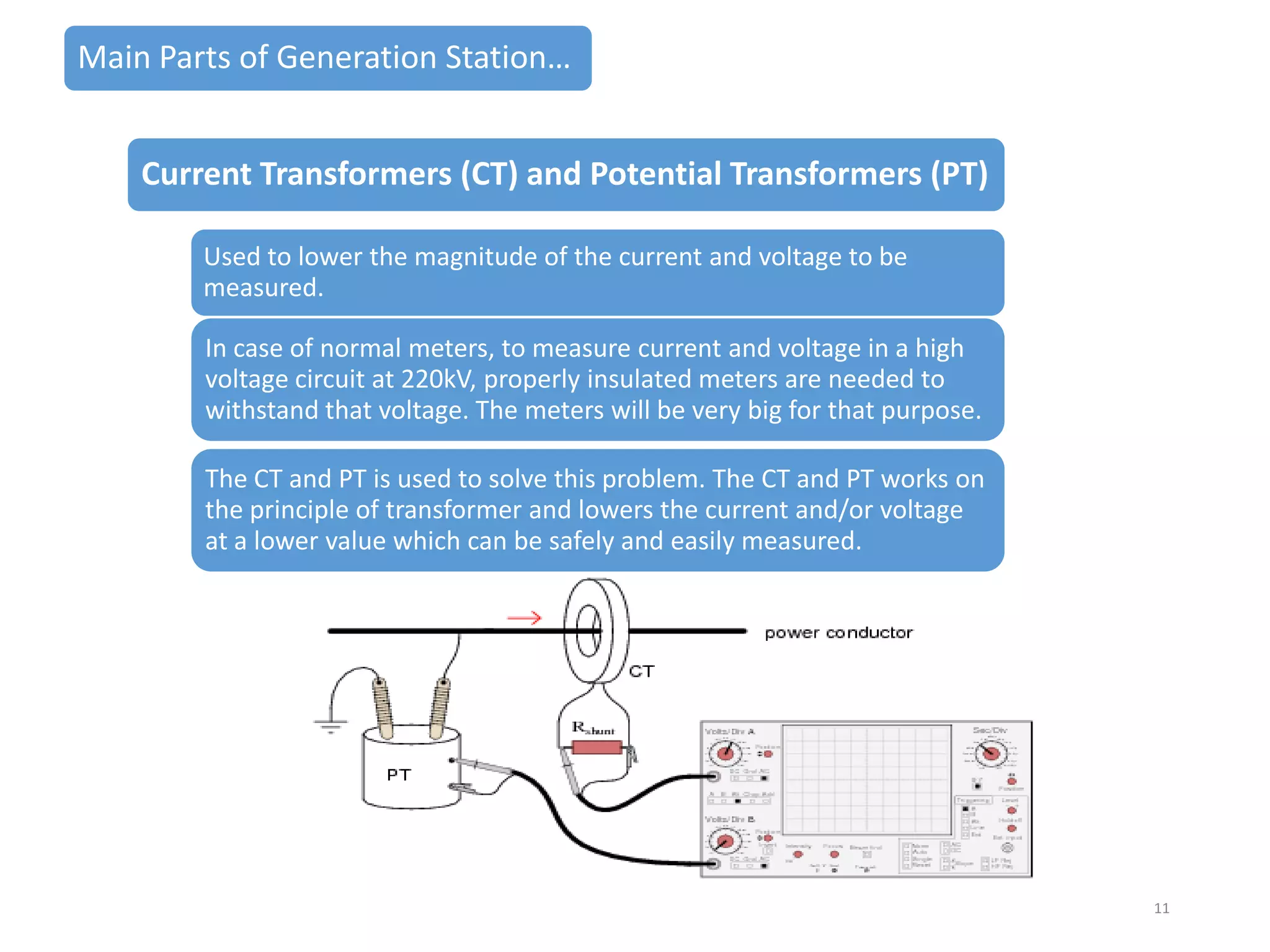
Current Transformers (CT) and Potential Transformers (PT)
Used to lower the magnitude of the current and voltage to be
measured.
In case of normal meters, to measure current and voltage in a high
voltage circuit at 220kV, properly insulated meters are needed to
withstand that voltage. The meters will be very big for that purpose.
The CT and PT is used to solve this problem. The CT and PT works on
the principle of transformer and lowers the current and/or voltage
at a lower value which can be safely and easily measured.

11
12
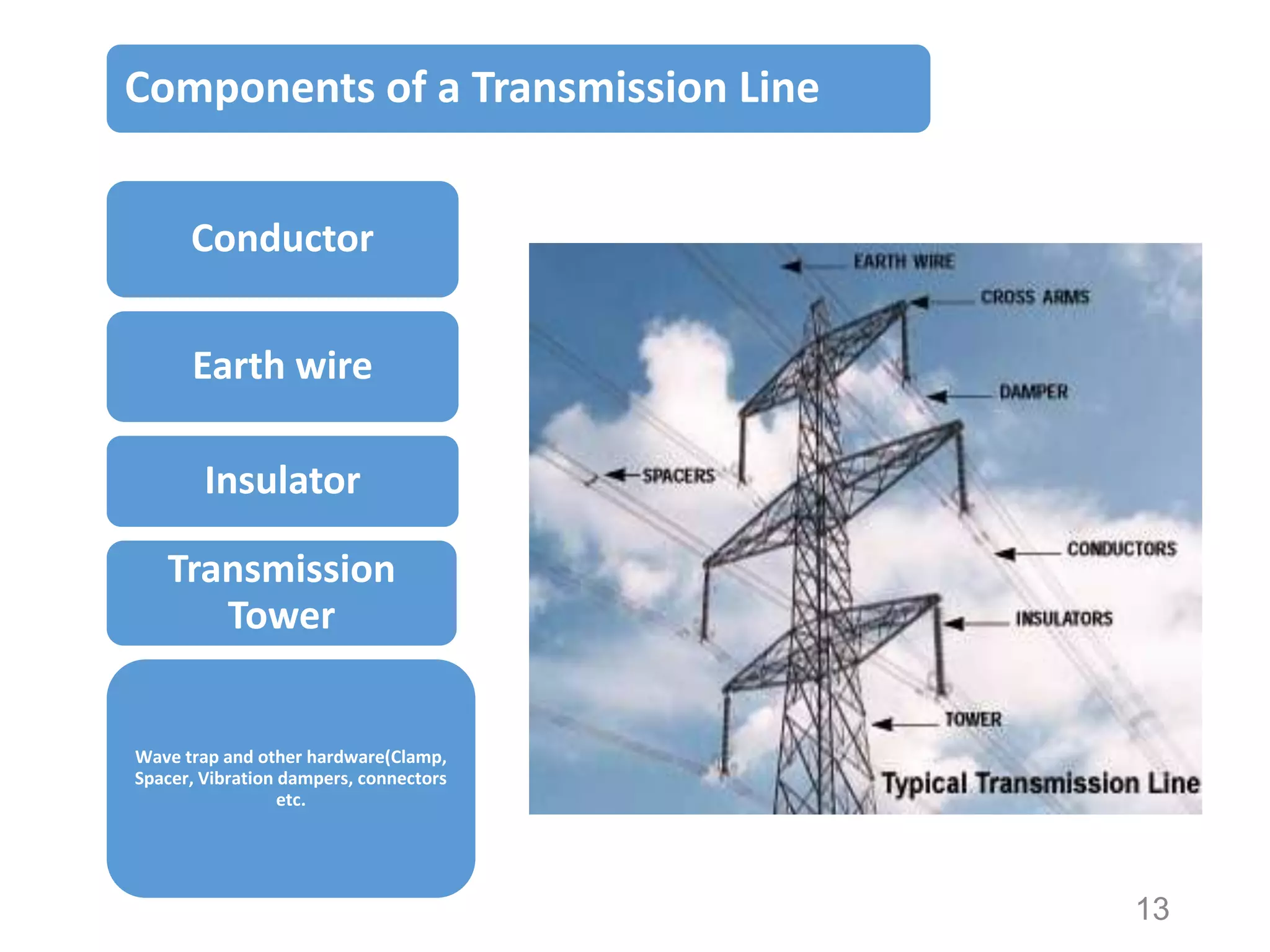
Components of a Transmission Line
Conductor
Earth wire
Insulator
Transmission
Tower

Wave trap and other hardware(Clamp,
Spacer, Vibration dampers, connectors
etc.

13
Design Methodology
• Gather preliminary line design data and available climatic data
• Select reliability level in terms of return period of design
• Calculate climatic loading on components

• Calculate loads related to safety during construction and maintenance
• Select appropriate correction factors, if applicable, to the design components
such as use factor, strength factors related to numbers of components, quality
control, and the characteristic strength.

• Design the components for the above loads and strength.
14
Selection of Transmission Voltage
Standard Voltage: 66,110,132, 220, 400 KV
Tolerances - ±10% up to 220 KV & ±5% for 400 KV

Selection
Criterion
of
Economic
Voltage

• Quantum of power to be
evacuated
• Length of line
• Voltage regulation
• Power loss in Transmission
• Initial and operating cost

15
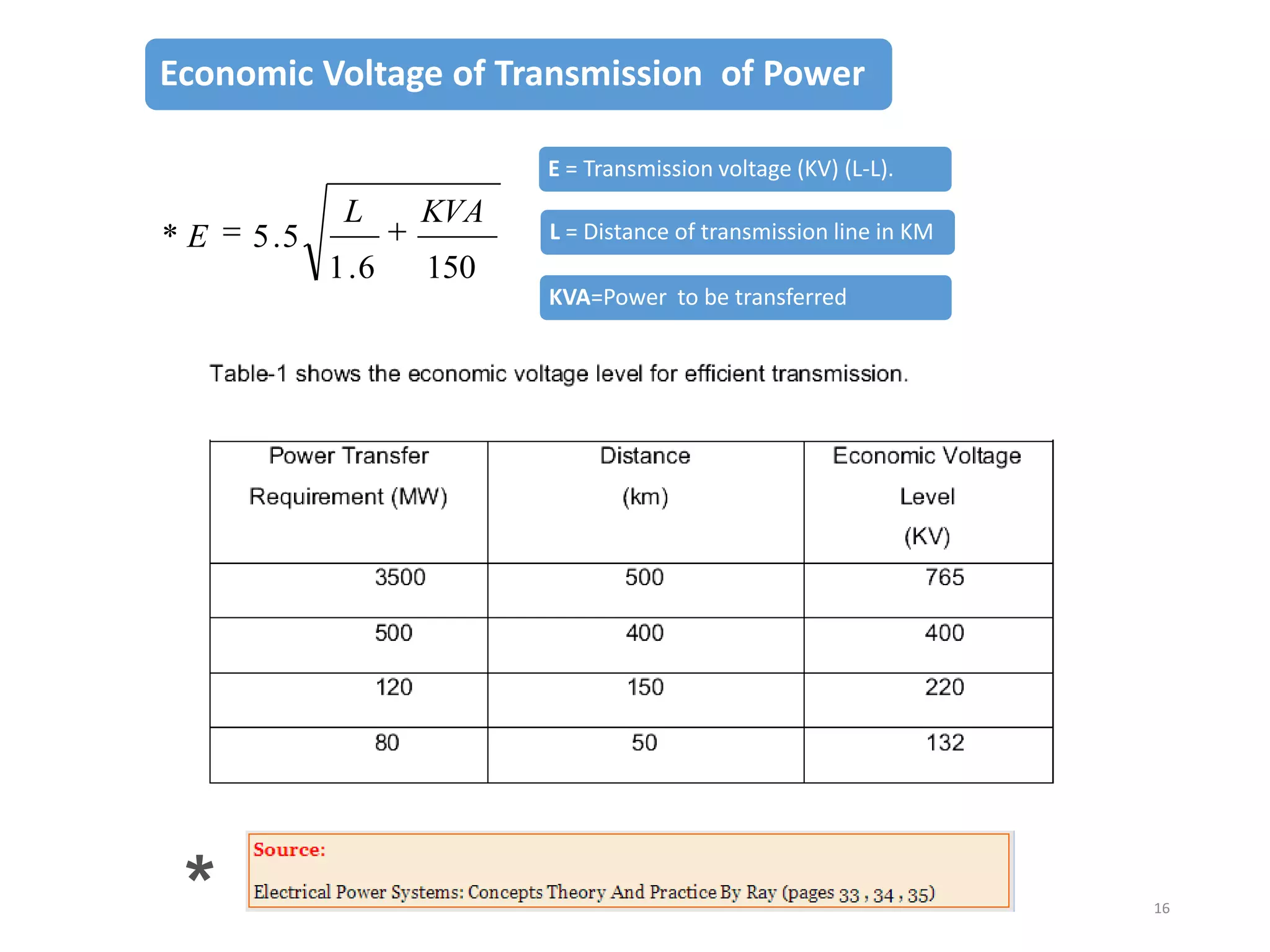
Economic Voltage of Transmission of Power
E = Transmission voltage (KV) (L-L).

5 .5

KVA

1 .6

*E

L

150

L = Distance of transmission line in KM

KVA=Power to be transferred

*

16
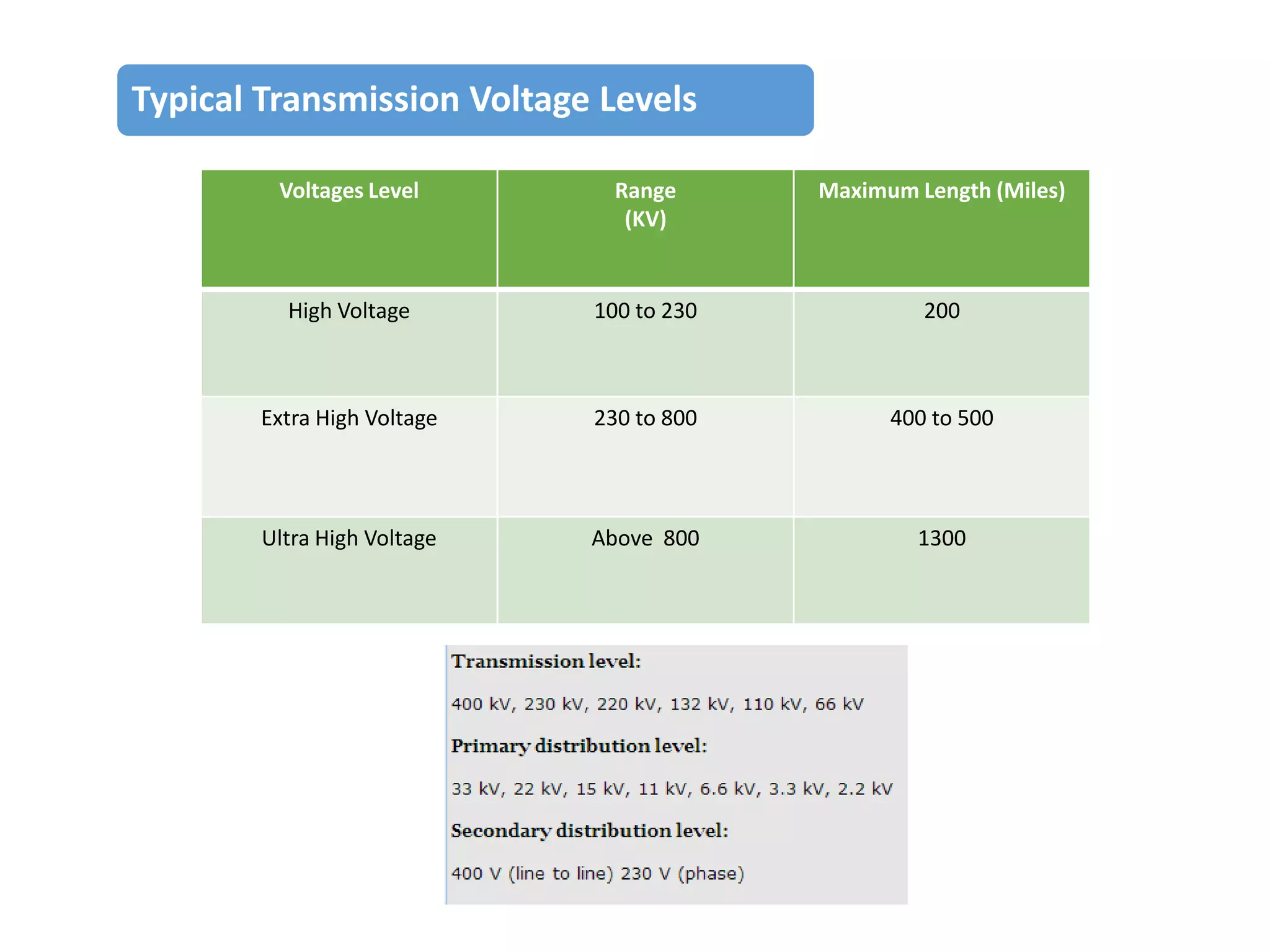
Typical Transmission Voltage Levels
Voltages Level

Range
(KV)

Maximum Length (Miles)

High Voltage

100 to 230

200

Extra High Voltage

230 to 800

400 to 500

Ultra High Voltage

Above 800

1300
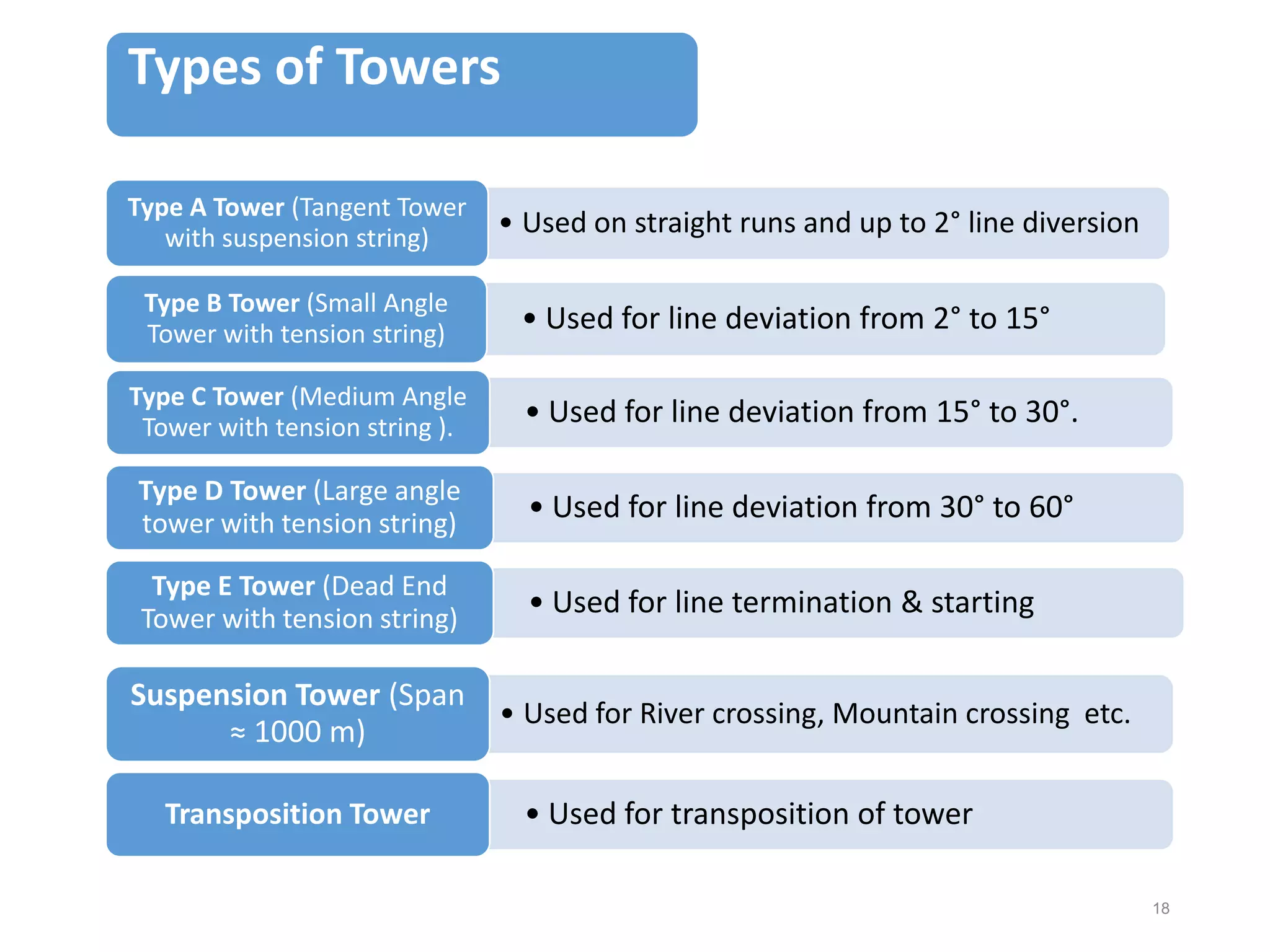
Types of Towers
Type A Tower (Tangent Tower
with suspension string)
Type B Tower (Small Angle
Tower with tension string)

• Used on straight runs and up to 2° line diversion

• Used for line deviation from 2° to 15°

Type C Tower (Medium Angle
Tower with tension string ).

• Used for line deviation from 15° to 30°.

Type D Tower (Large angle
tower with tension string)

• Used for line deviation from 30° to 60°

Type E Tower (Dead End
Tower with tension string)

• Used for line termination & starting

Suspension Tower (Span
≈ 1000 m)
Transposition Tower

• Used for River crossing, Mountain crossing etc.

• Used for transposition of tower
18
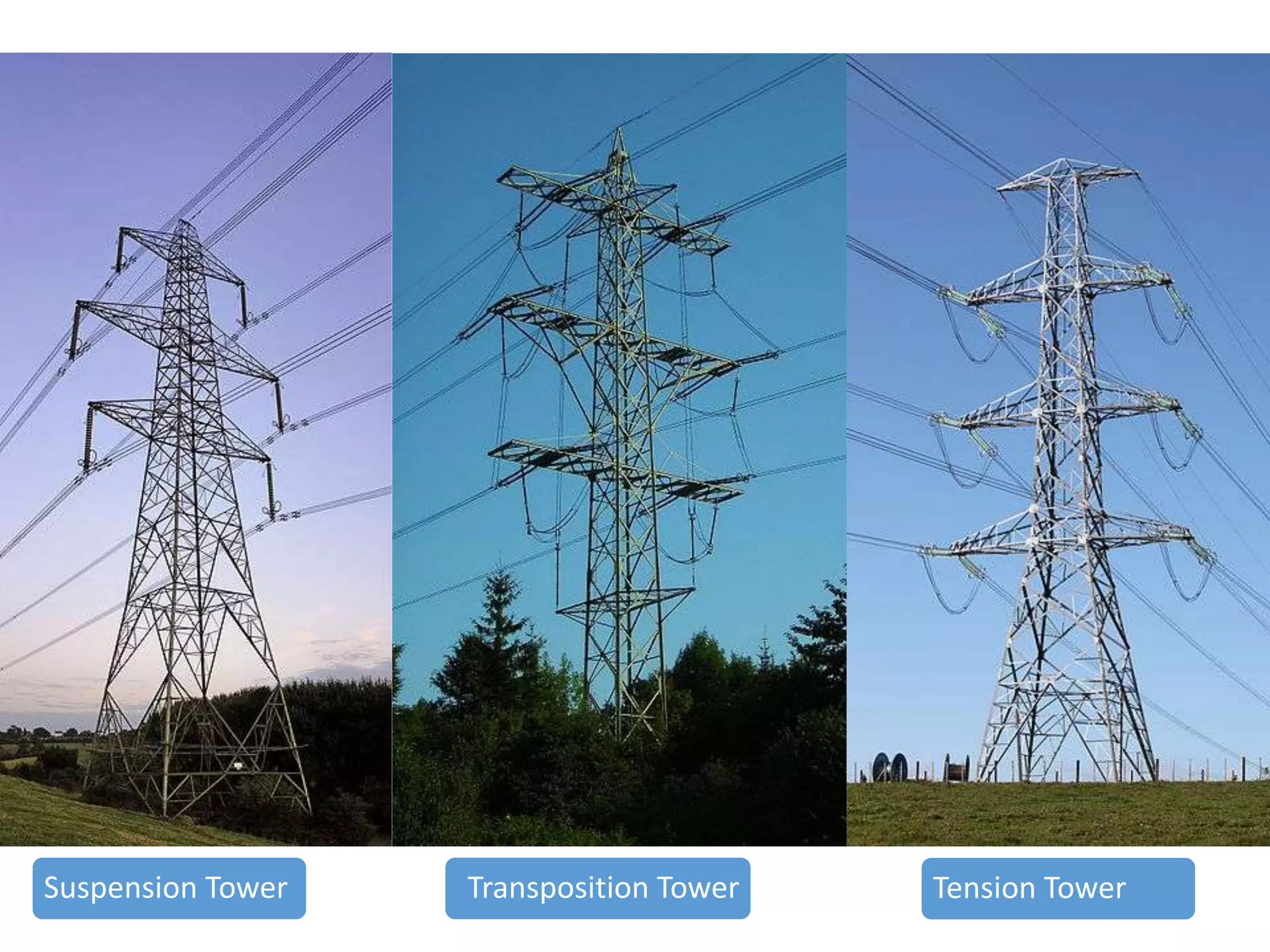
Suspension Tower

Transposition Tower

Tension Tower
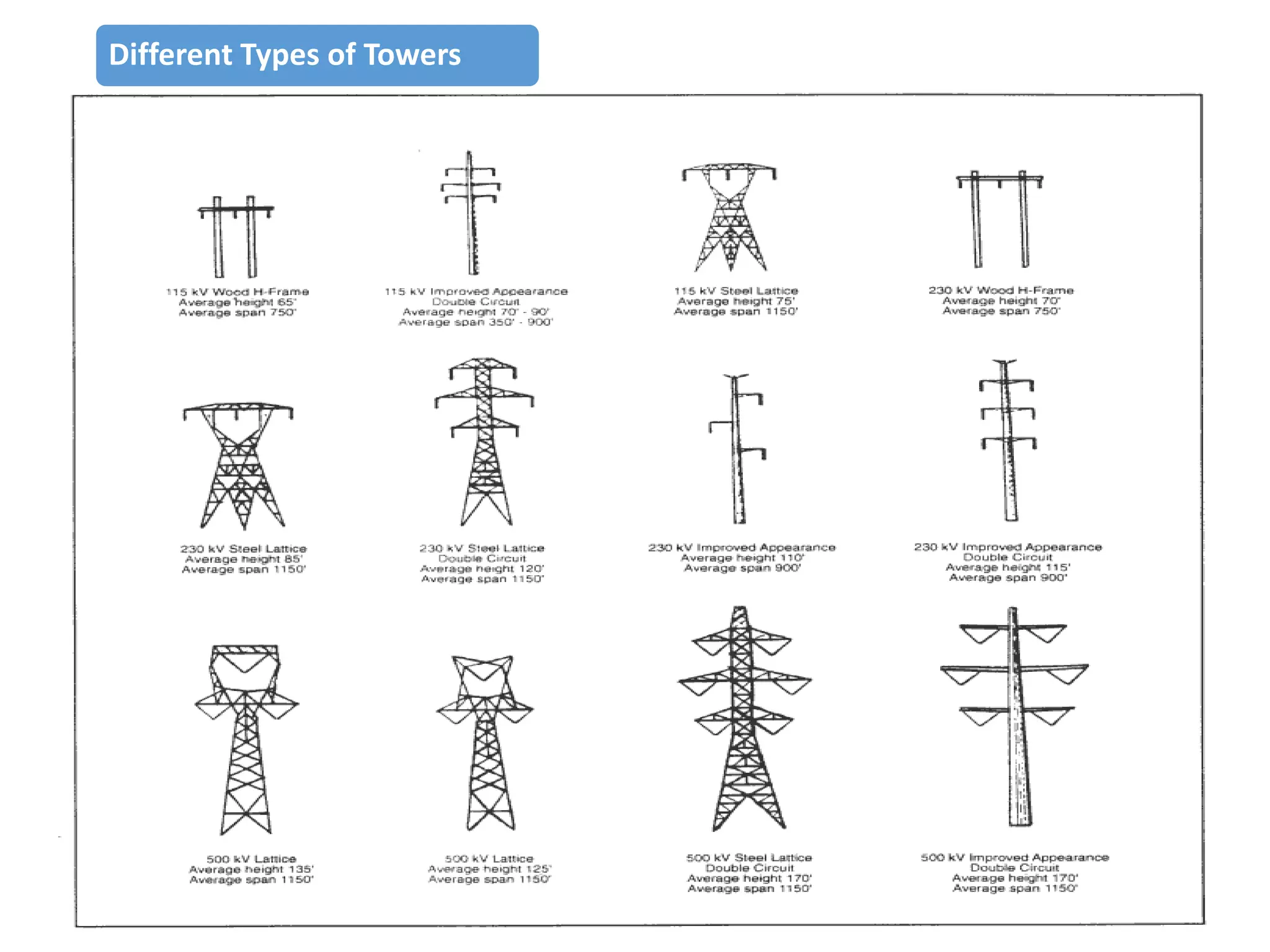
Different Types of Towers

20
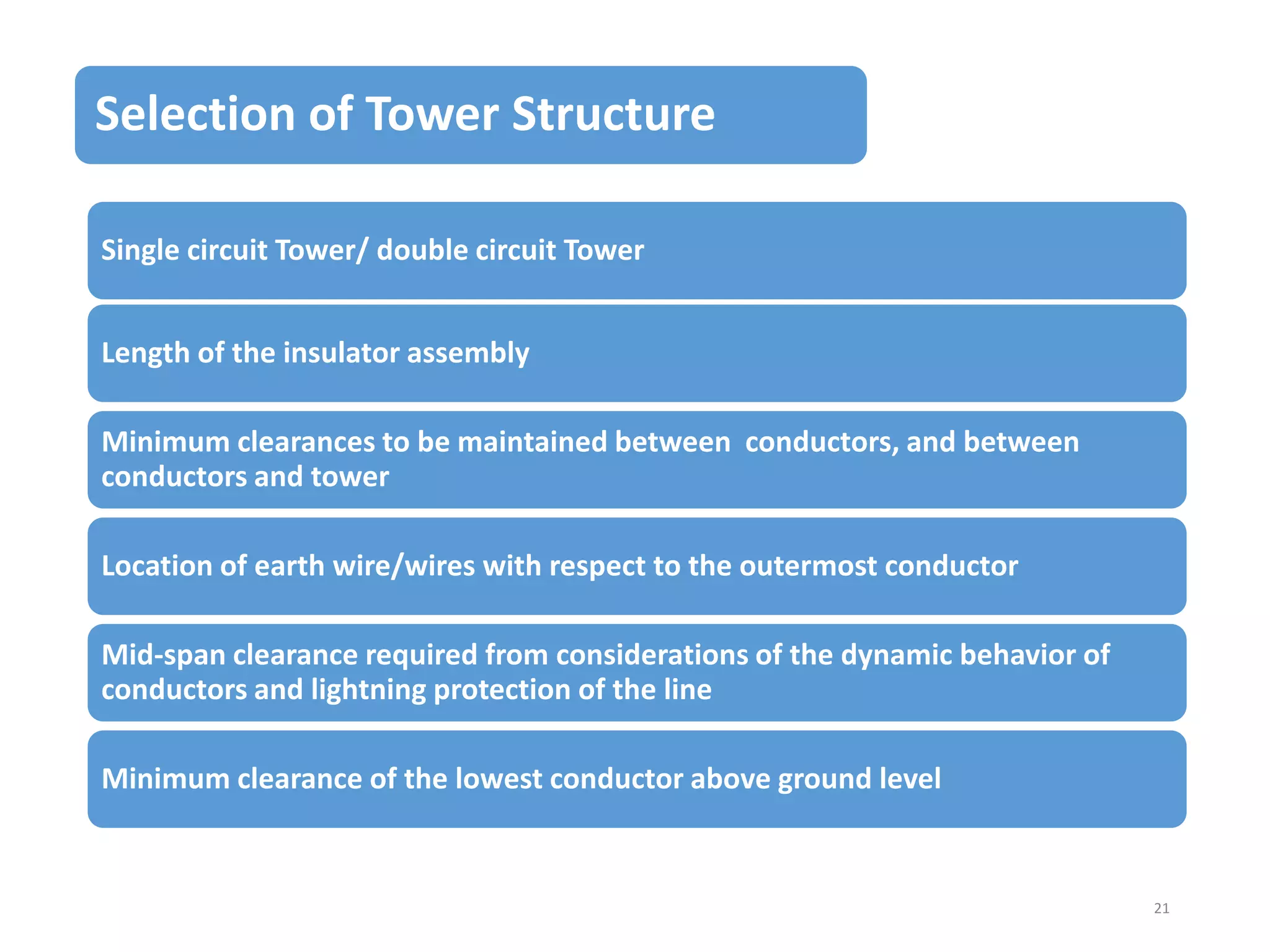
Selection of Tower Structure
Single circuit Tower/ double circuit Tower

Length of the insulator assembly
Minimum clearances to be maintained between conductors, and between
conductors and tower
Location of earth wire/wires with respect to the outermost conductor
Mid-span clearance required from considerations of the dynamic behavior of
conductors and lightning protection of the line
Minimum clearance of the lowest conductor above ground level

21
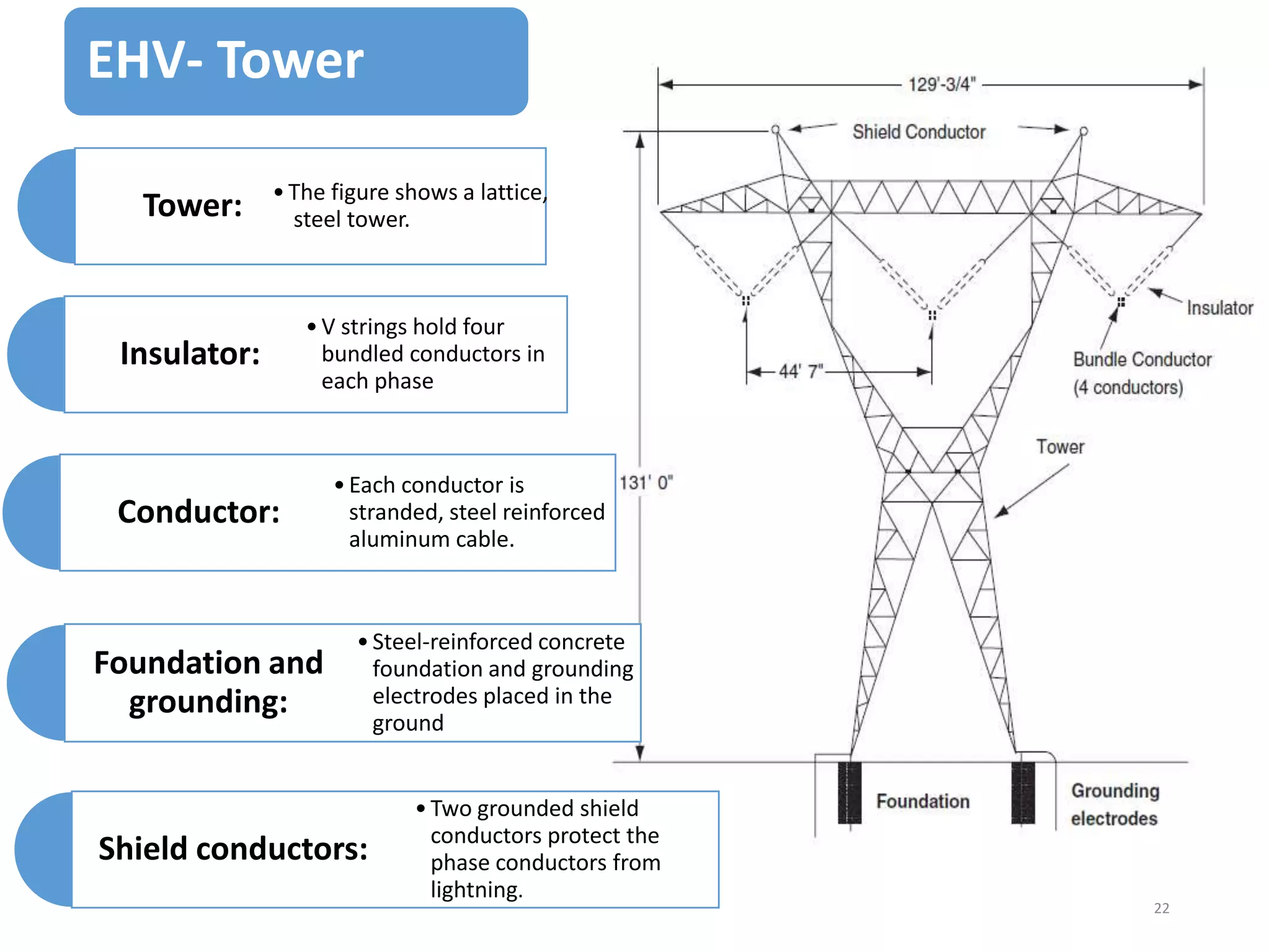
EHV- Tower
Tower:

• The figure shows a lattice,
steel tower.

Insulator:

• V strings hold four
bundled conductors in
each phase

Conductor:

Foundation and
grounding:

• Each conductor is
stranded, steel reinforced
aluminum cable.

• Steel-reinforced concrete
foundation and grounding
electrodes placed in the
ground

Shield conductors:

• Two grounded shield
conductors protect the
phase conductors from
lightning.

22
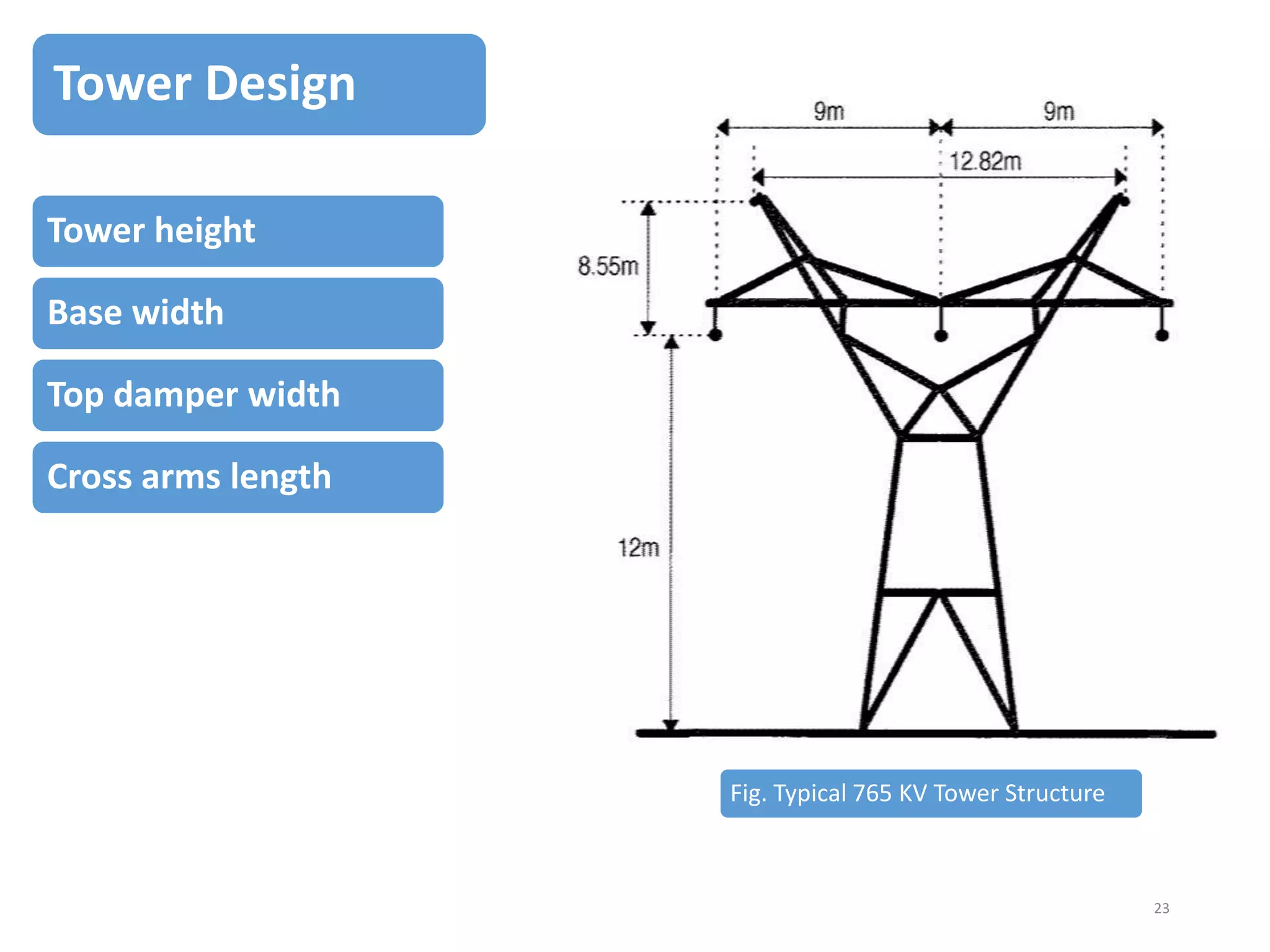
Tower Design
Tower height
Base width
Top damper width
Cross arms length

Fig. Typical 765 KV Tower Structure

23
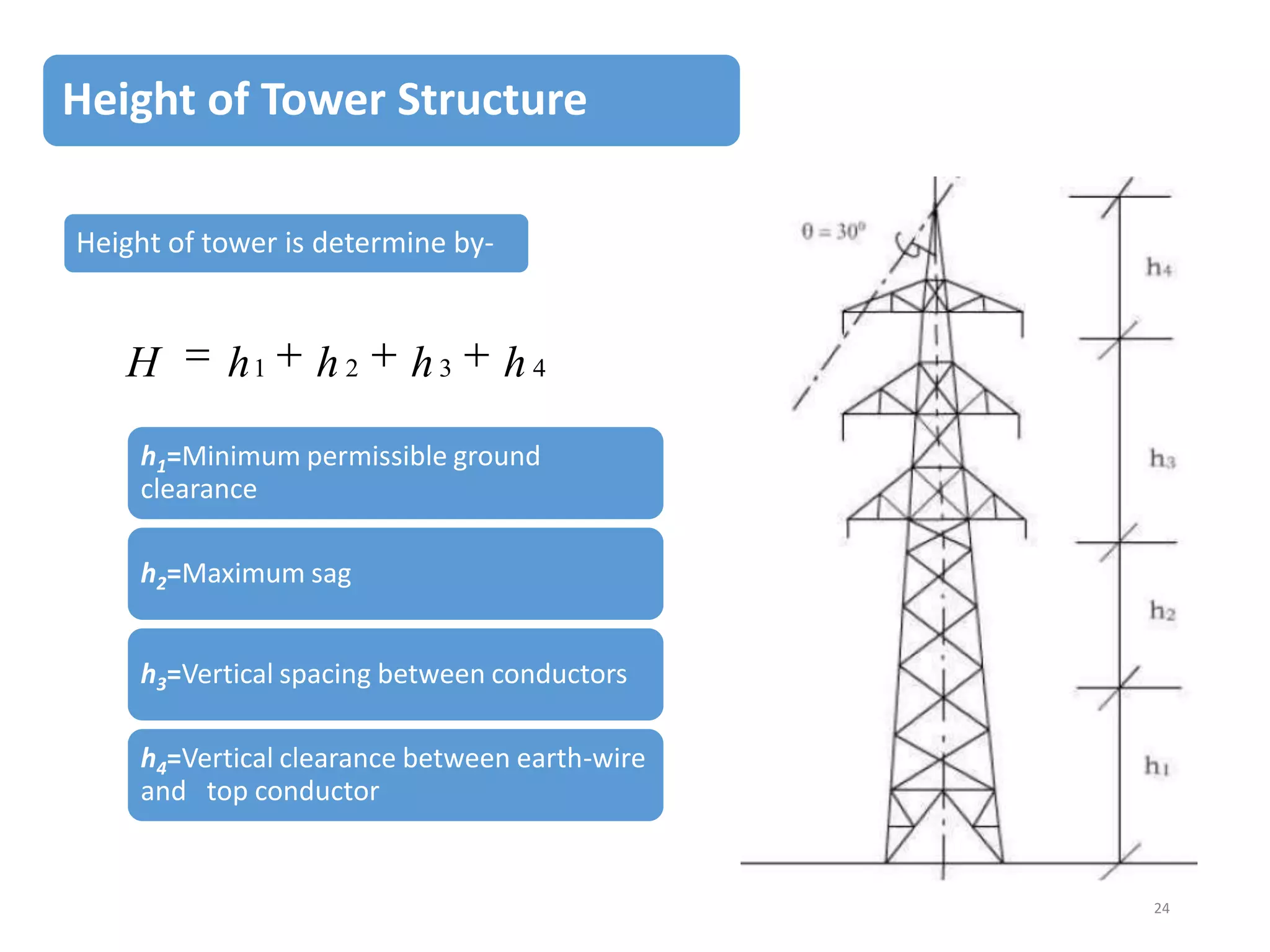
Height of Tower Structure
Height of tower is determine by-

H

h1

h2

h3

h4

h1=Minimum permissible ground
clearance
h2=Maximum sag
h3=Vertical spacing between conductors
h4=Vertical clearance between earth-wire
and top conductor

24
Determination of Base Width
The base width(at the concrete level) is the distance between the centre of
gravity at one corner leg and the centre of gravity of the adjacent corner leg.
A particular base width which gives the minimum total cost of the tower and
foundations
Ryle
Formula

An applied force that causes a structure to turn over
The ratio of base width to total tower height for most towers is generally
about one-fifth to one-tenth.
25

25
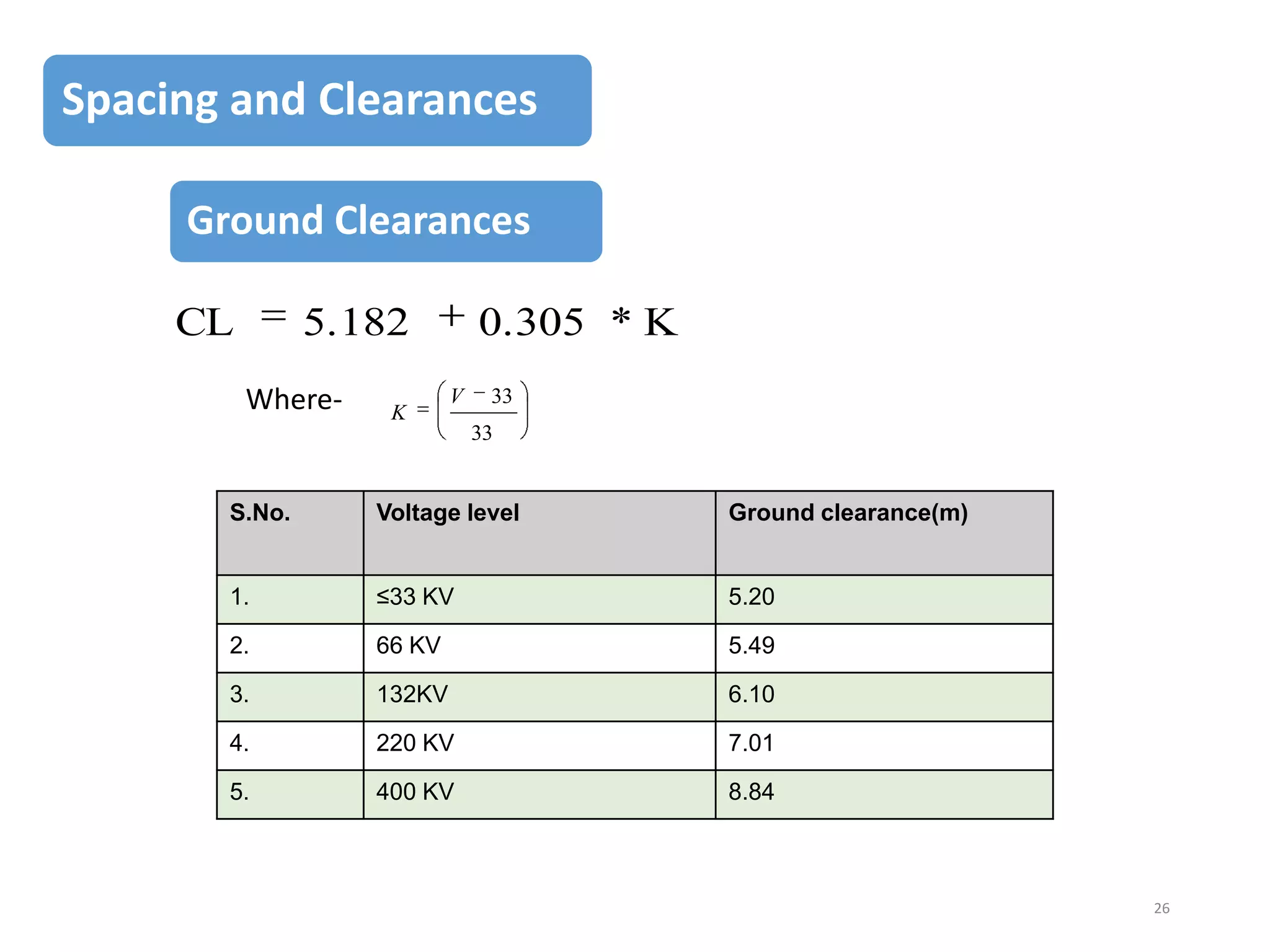
Spacing and Clearances
Ground Clearances
CL

5.182
Where-

K

0.305 * K
V

33
33

S.No.

Voltage level

Ground clearance(m)

1.

≤33 KV

5.20

2.

66 KV

5.49

3.

132KV

6.10

4.

220 KV

7.01

5.

400 KV

8.84

26
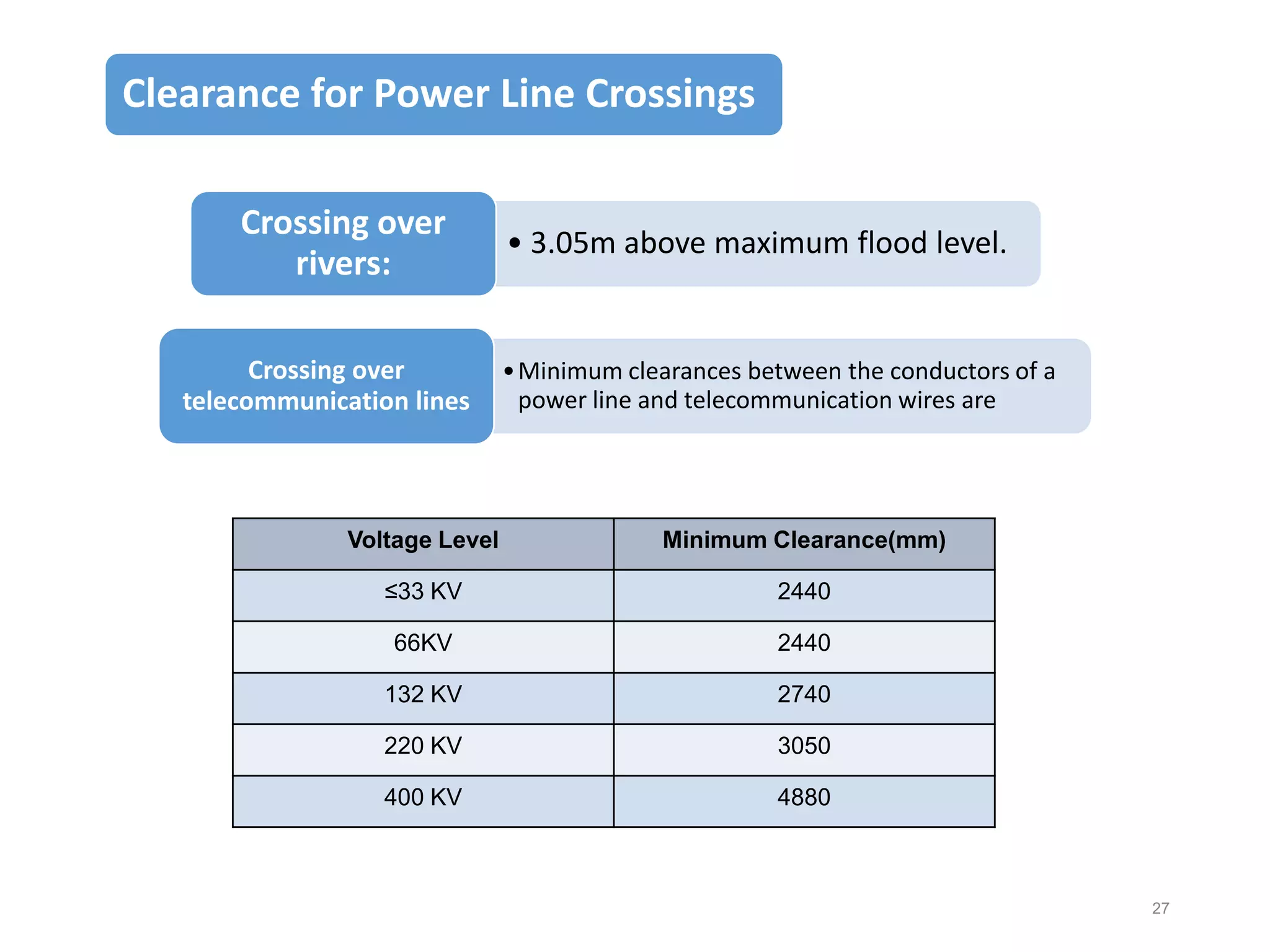
Clearance for Power Line Crossings
Crossing over
rivers:
Crossing over
telecommunication lines

• 3.05m above maximum flood level.

• Minimum clearances between the conductors of a
power line and telecommunication wires are

Voltage Level

Minimum Clearance(mm)

≤33 KV

2440

66KV

2440

132 KV

2740

220 KV

3050

400 KV

4880

27
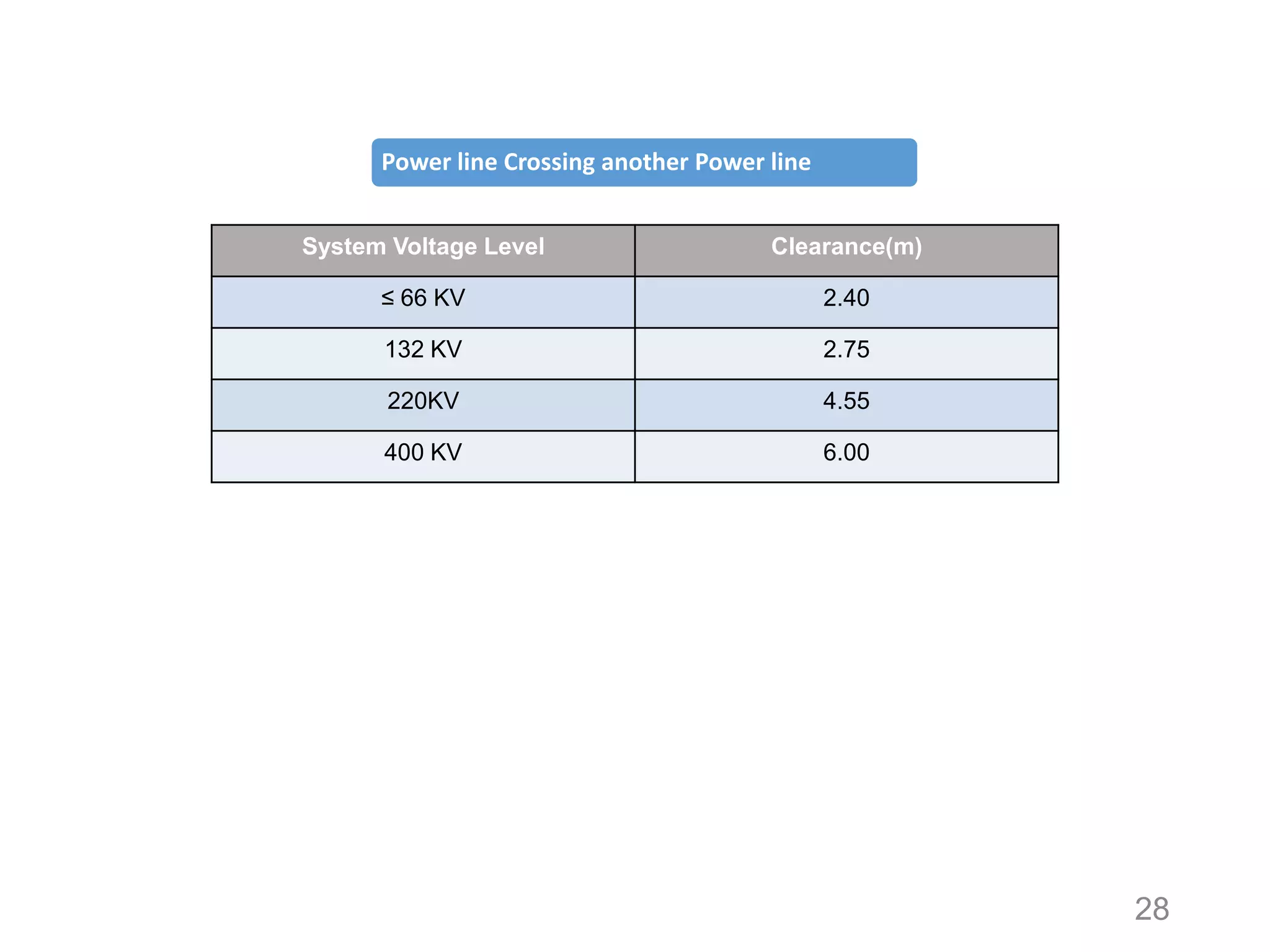
Power line Crossing another Power line
System Voltage Level

Clearance(m)

≤ 66 KV

2.40

132 KV

2.75

220KV

4.55

400 KV

6.00

28
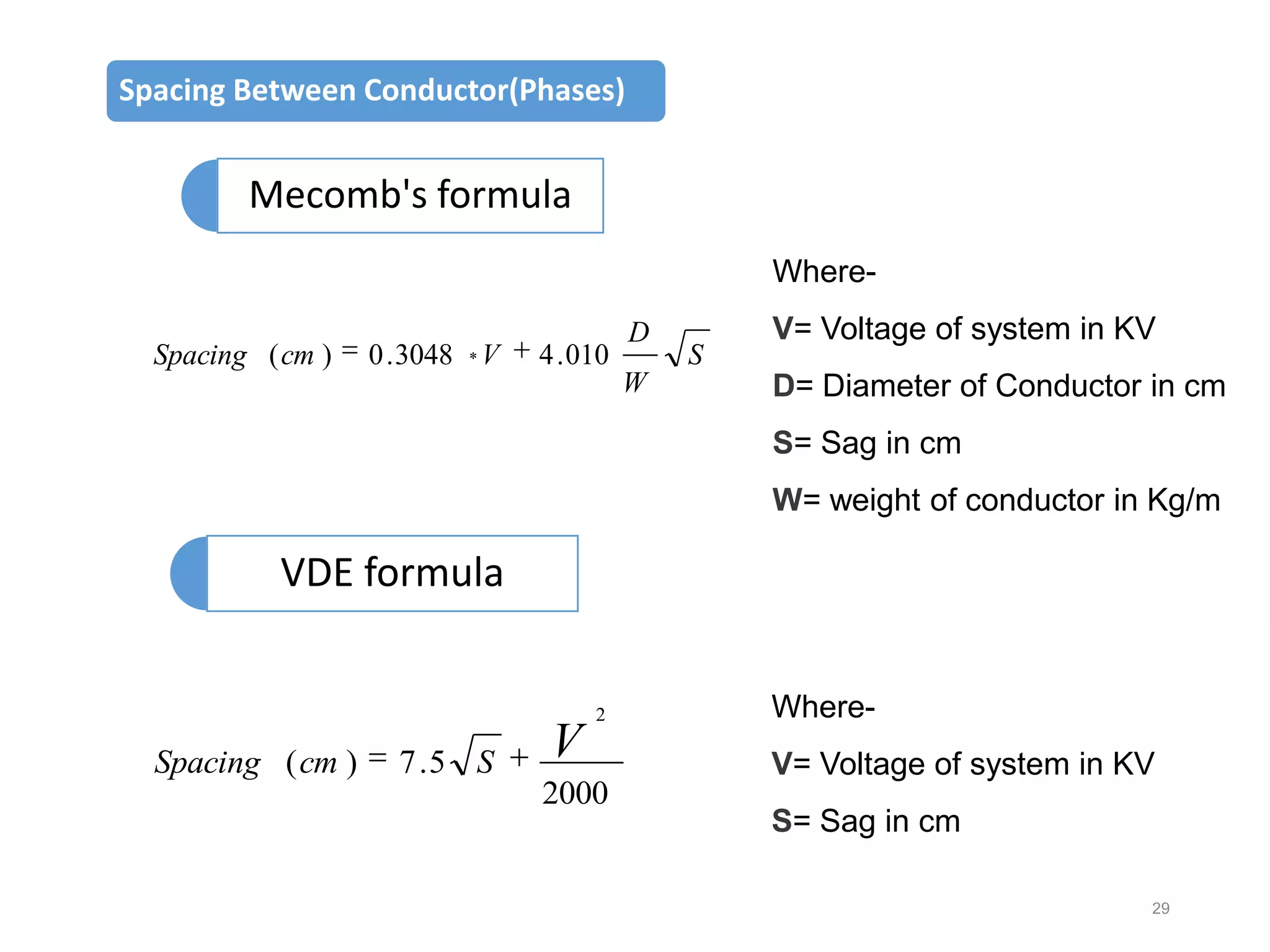
Spacing Between Conductor(Phases)

Mecomb's formula
WhereSpacing ( cm )

0 . 3048 * V

4 . 010

D
W

S

V= Voltage of system in KV
D= Diameter of Conductor in cm
S= Sag in cm
W= weight of conductor in Kg/m

VDE formula

Spacing ( cm )

7 .5 S

V

2

2000

Where-

V= Voltage of system in KV
S= Sag in cm
29
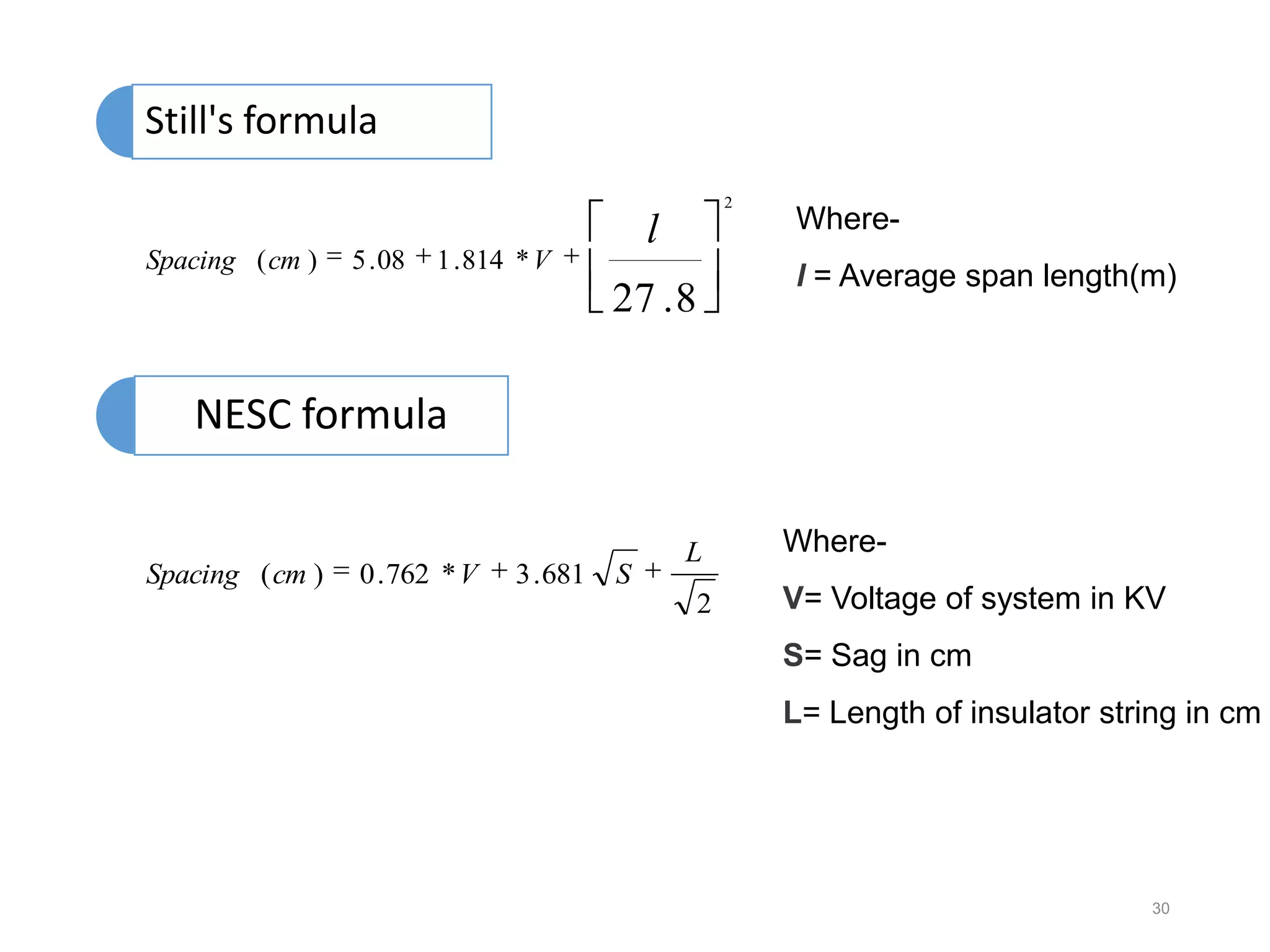
Still's formula
2

Spacing ( cm )

5 . 08

l

1 . 814 * V

Wherel = Average span length(m)

27 . 8

NESC formula

Spacing ( cm )

0 . 762 * V

3 . 681

S

L
2

WhereV= Voltage of system in KV
S= Sag in cm
L= Length of insulator string in cm

30
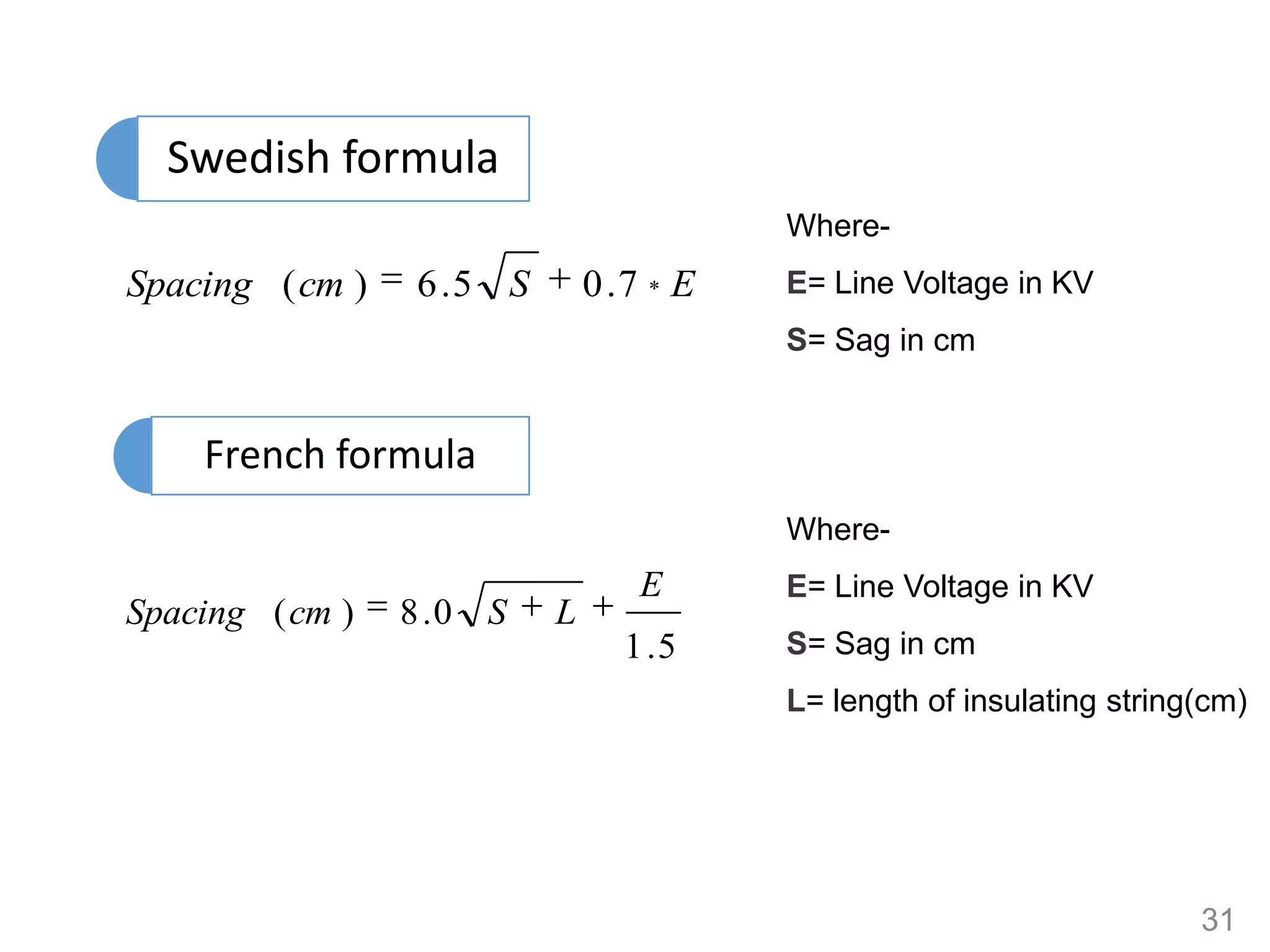
Swedish formula
Where-

Spacing ( cm )

6 .5 S

0 .7 * E

E= Line Voltage in KV
S= Sag in cm

French formula
Where-

Spacing ( cm )

8 .0 S

L

E
1 .5

E= Line Voltage in KV
S= Sag in cm
L= length of insulating string(cm)

31
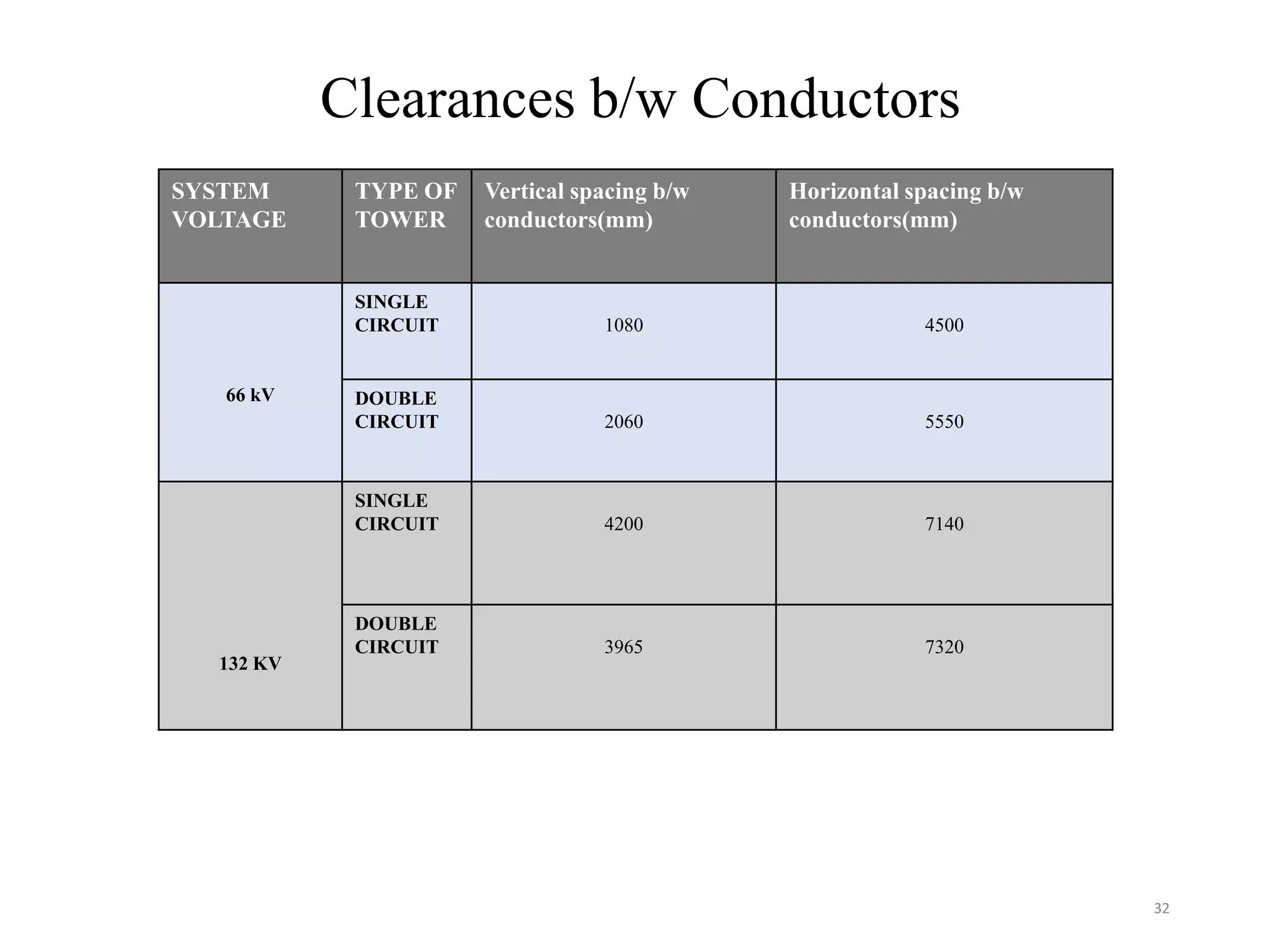
Clearances b/w Conductors
SYSTEM
VOLTAGE

TYPE OF
TOWER

Vertical spacing b/w
conductors(mm)

Horizontal spacing b/w
conductors(mm)

SINGLE
CIRCUIT

132 KV

4500

DOUBLE
CIRCUIT

2060

5550

SINGLE
CIRCUIT

66 kV

1080

4200

7140

DOUBLE
CIRCUIT

3965

7320

32
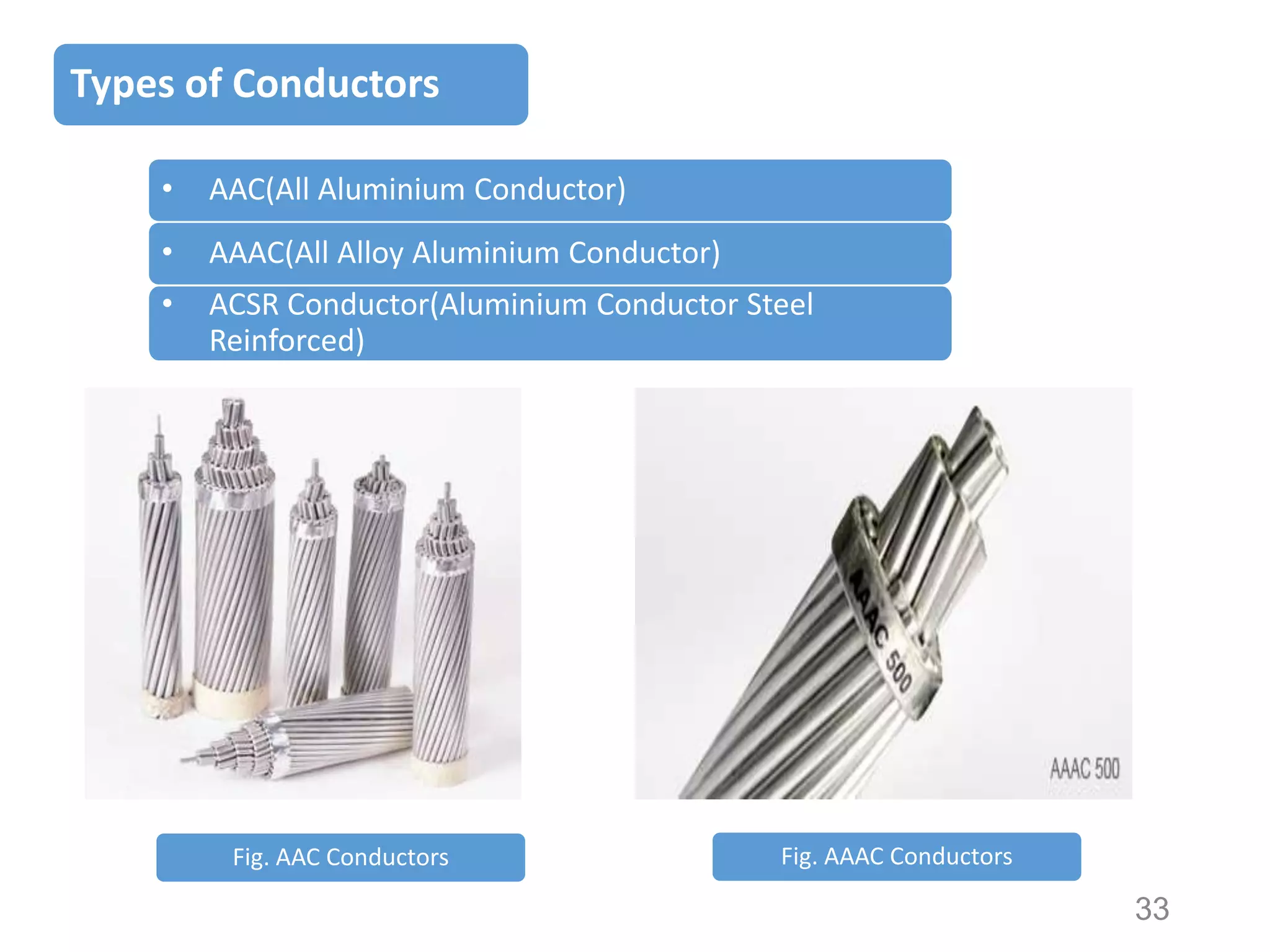
Types of Conductors
•

AAC(All Aluminium Conductor)

•

AAAC(All Alloy Aluminium Conductor)

•

ACSR Conductor(Aluminium Conductor Steel
Reinforced)

Fig. AAC Conductors

Fig. AAAC Conductors

33
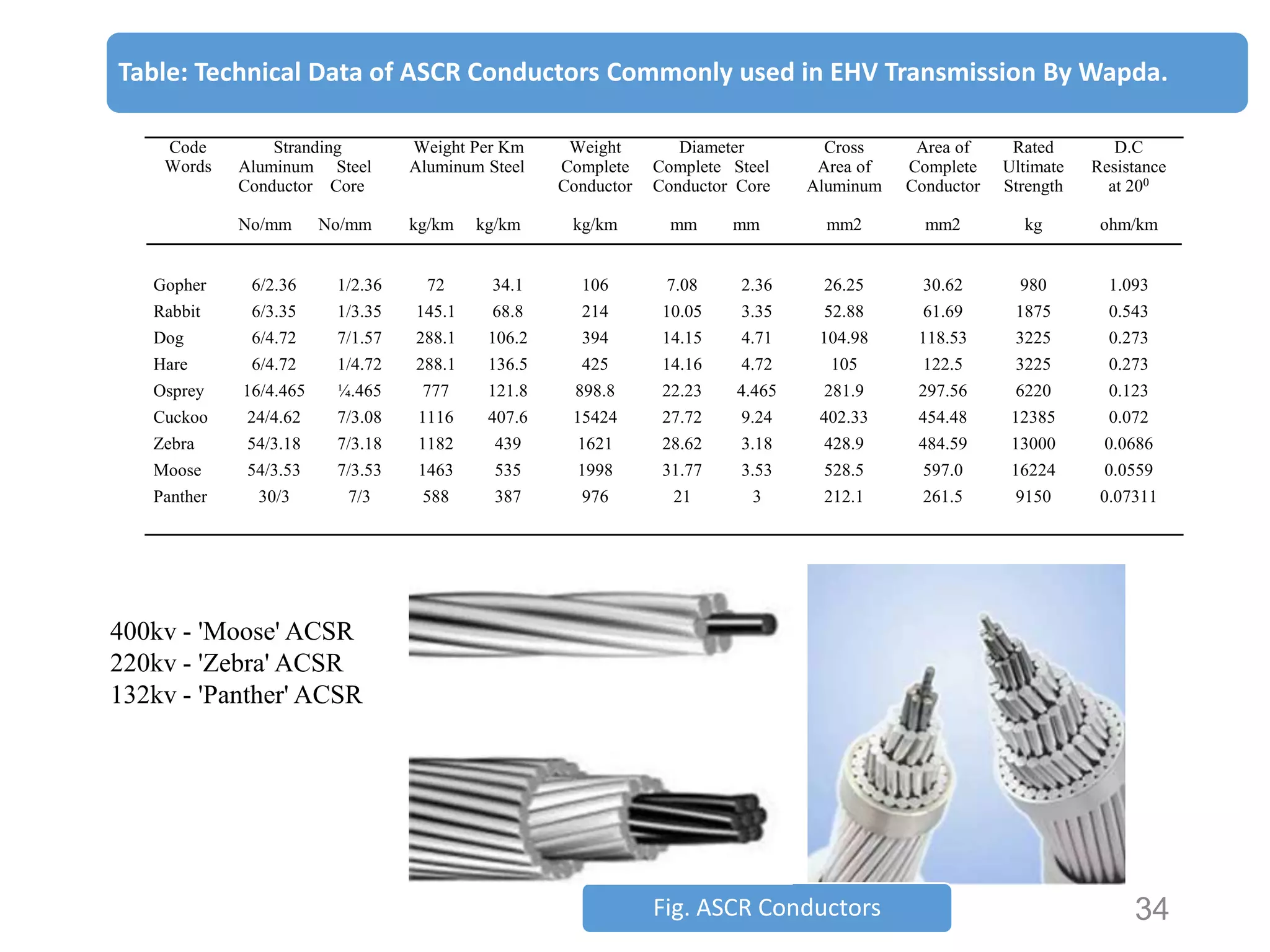
Table: Technical Data of ASCR Conductors Commonly used in EHV Transmission By Wapda.
Code
Words

Stranding
Aluminum Steel
Conductor Core

Weight Per Km
Aluminum Steel

No/mm

kg/km

No/mm

kg/km

Weight
Complete
Conductor
kg/km

Diameter
Complete Steel
Conductor Core
mm

mm

Cross
Area of
Aluminum

Area of
Complete
Conductor

Rated
Ultimate
Strength

D.C
Resistance
at 200

mm2

mm2

kg

ohm/km

Gopher

6/2.36

1/2.36

72

34.1

106

7.08

2.36

26.25

30.62

980

1.093

Rabbit

6/3.35

1/3.35

145.1

68.8

214

10.05

3.35

52.88

61.69

1875

0.543

Dog

6/4.72

7/1.57

288.1

106.2

394

14.15

4.71

104.98

118.53

3225

0.273

Hare

6/4.72

1/4.72

288.1

136.5

425

14.16

4.72

105

122.5

3225

0.273

Osprey

16/4.465

¼.465

777

121.8

898.8

22.23

4.465

281.9

297.56

6220

0.123

Cuckoo

24/4.62

7/3.08

1116

407.6

15424

27.72

9.24

402.33

454.48

12385

0.072

Zebra

54/3.18

7/3.18

1182

439

1621

28.62

3.18

428.9

484.59

13000

0.0686

Moose

54/3.53

7/3.53

1463

535

1998

31.77

3.53

528.5

597.0

16224

0.0559

Panther

30/3

7/3

588

387

976

21

3

212.1

261.5

9150

0.07311

400kv - 'Moose' ACSR
220kv - 'Zebra' ACSR
132kv - 'Panther' ACSR

Fig. ASCR Conductors

34
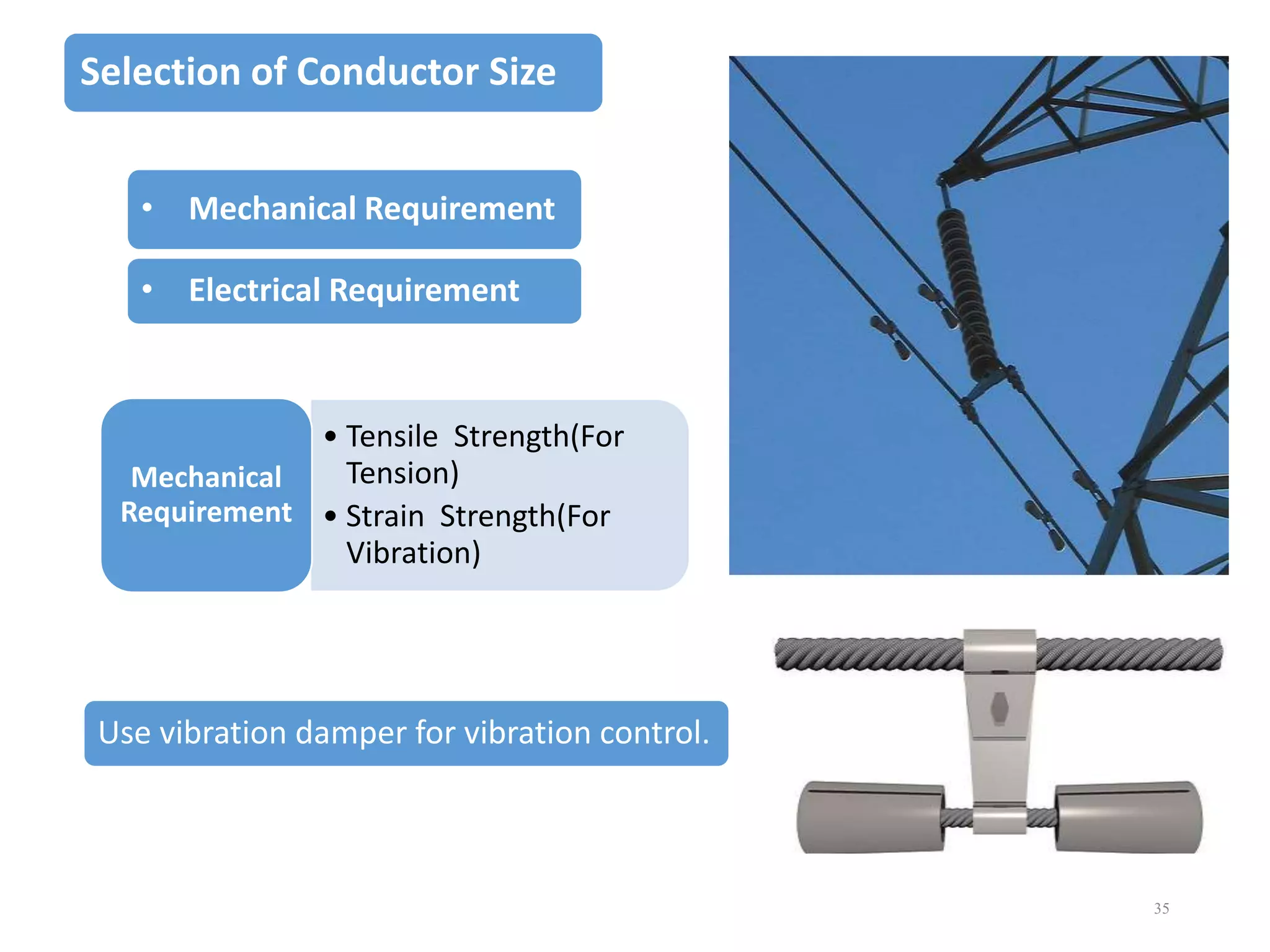
Selection of Conductor Size
• Mechanical Requirement
• Electrical Requirement

• Tensile Strength(For
Tension)
Mechanical
Requirement • Strain Strength(For
Vibration)

Use vibration damper for vibration control.

35
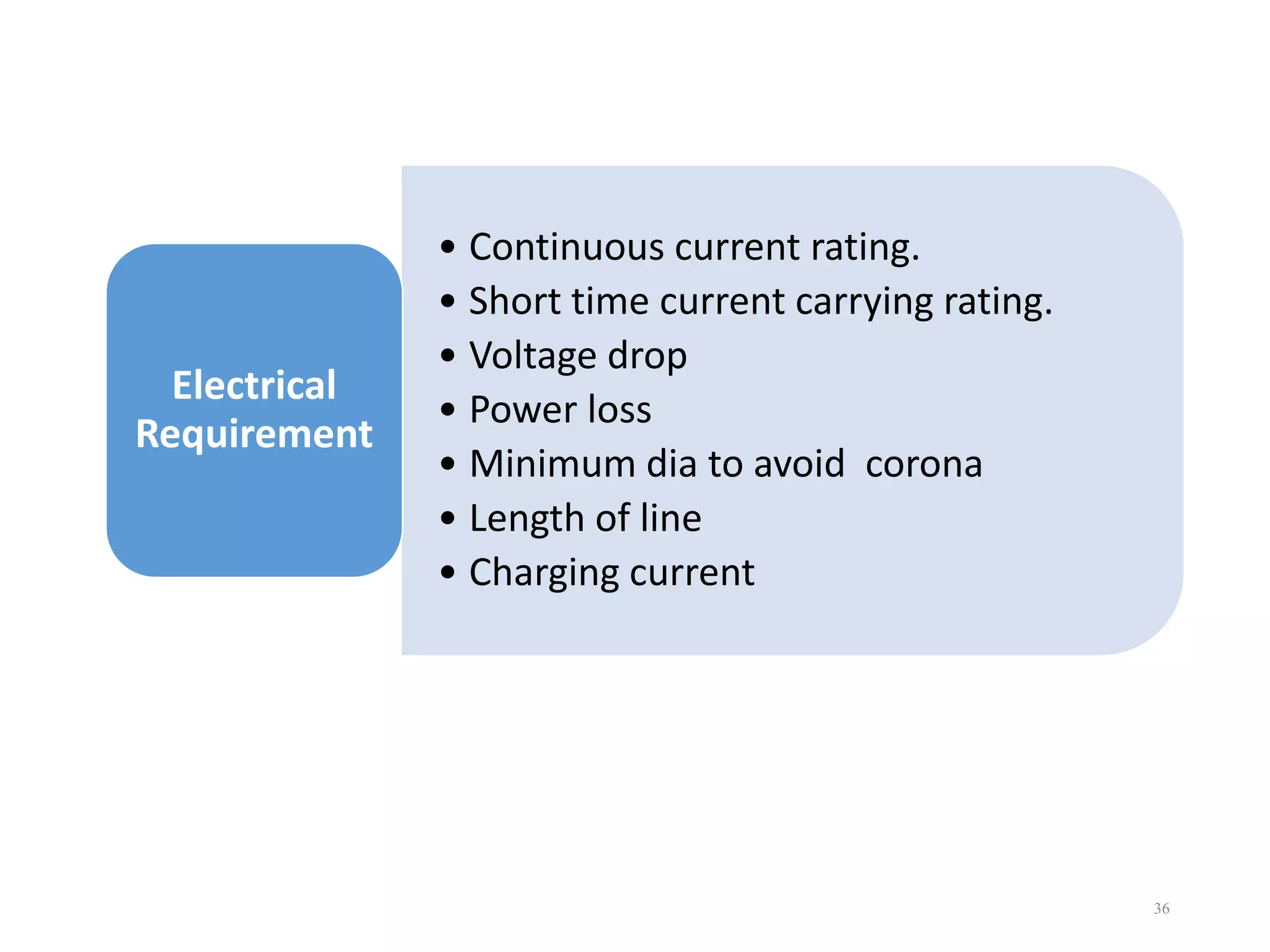
Electrical
Requirement

• Continuous current rating.
• Short time current carrying rating.
• Voltage drop
• Power loss
• Minimum dia to avoid corona
• Length of line
• Charging current

36
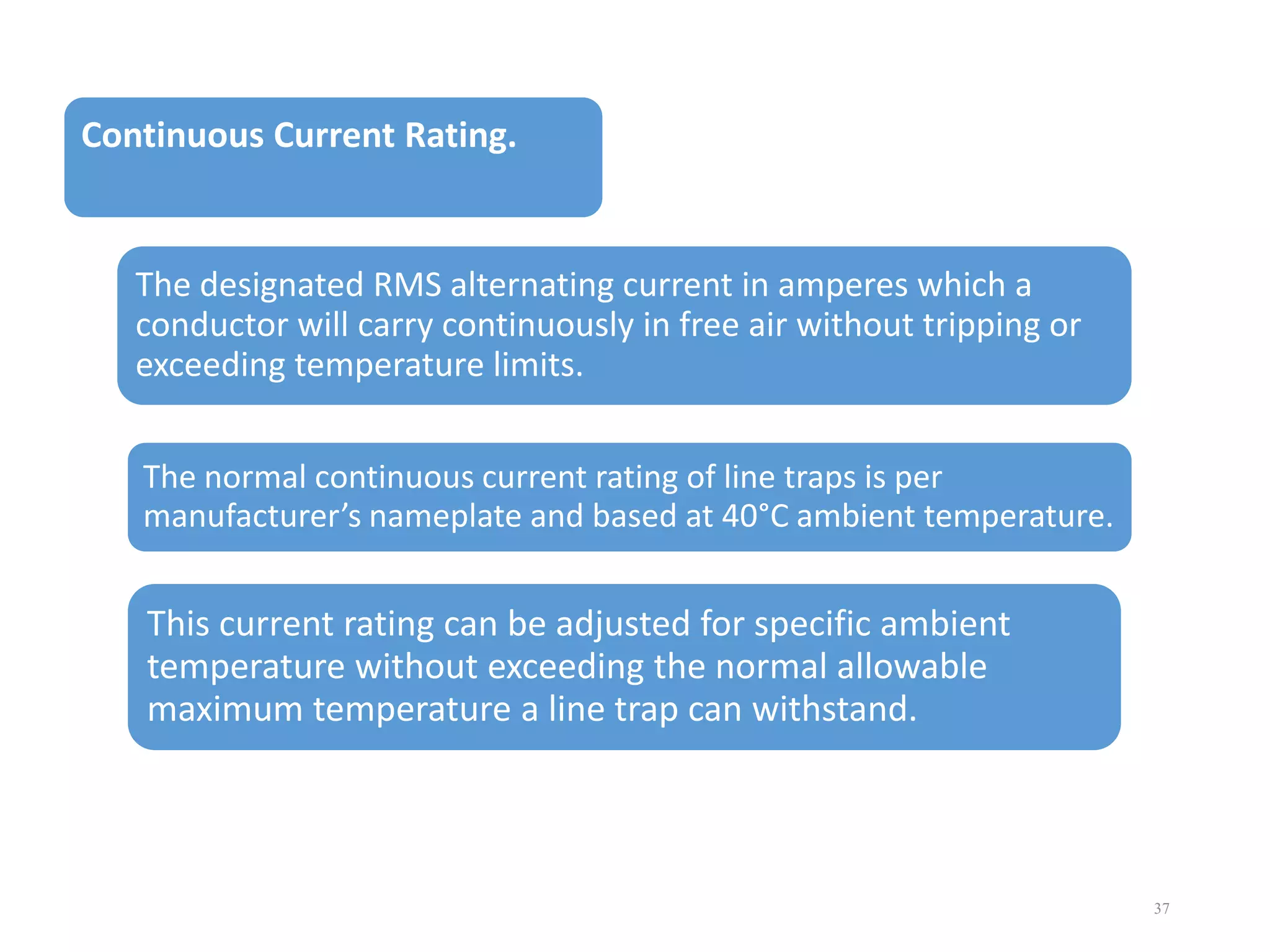
Continuous Current Rating.

The designated RMS alternating current in amperes which a
conductor will carry continuously in free air without tripping or
exceeding temperature limits.
The normal continuous current rating of line traps is per
manufacturer’s nameplate and based at 40°C ambient temperature.

This current rating can be adjusted for specific ambient
temperature without exceeding the normal allowable
maximum temperature a line trap can withstand.

37
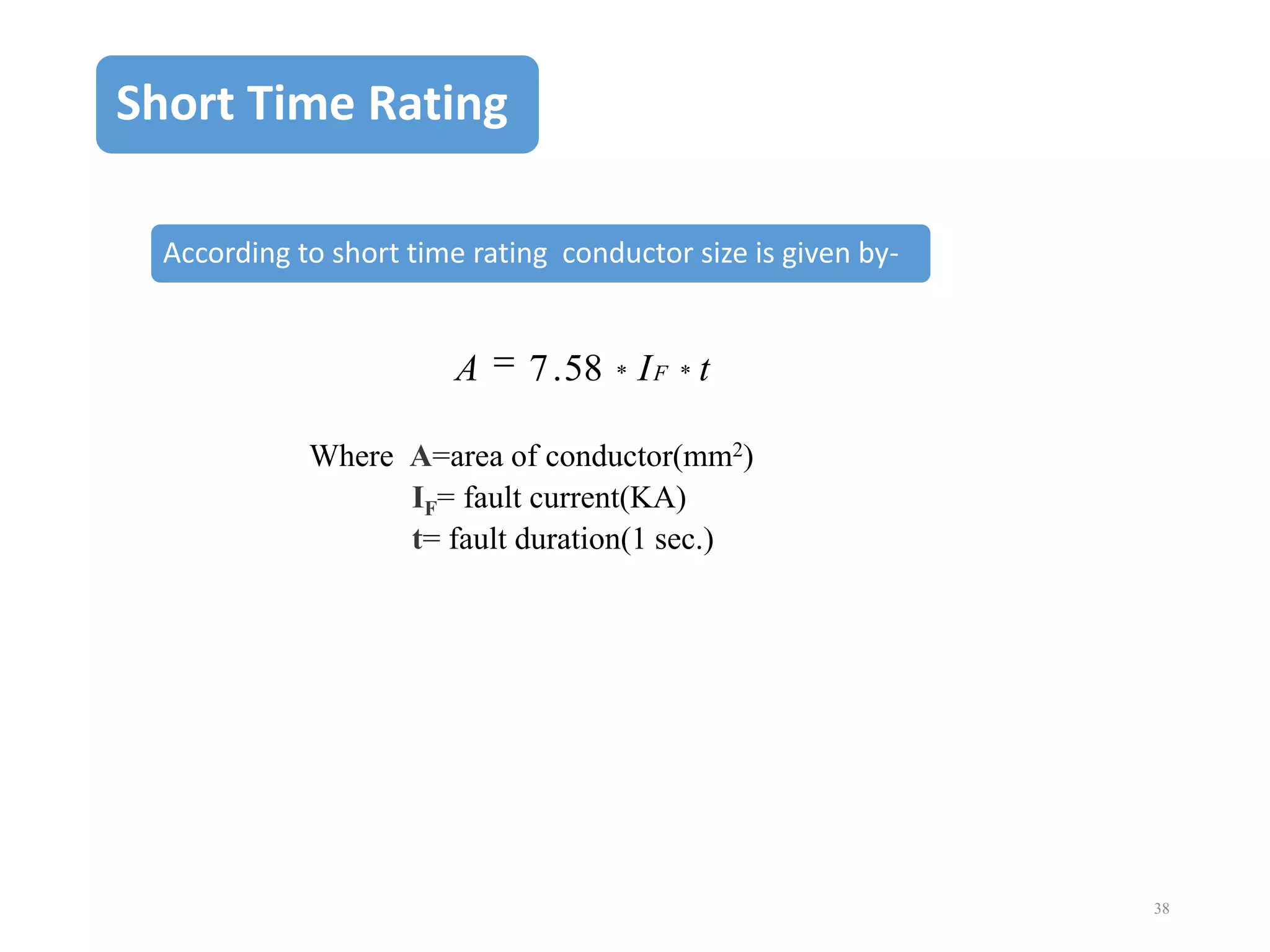
Short Time Rating
According to short time rating conductor size is given by-

A

7 . 58 * I F * t

Where A=area of conductor(mm2)
IF= fault current(KA)
t= fault duration(1 sec.)

38
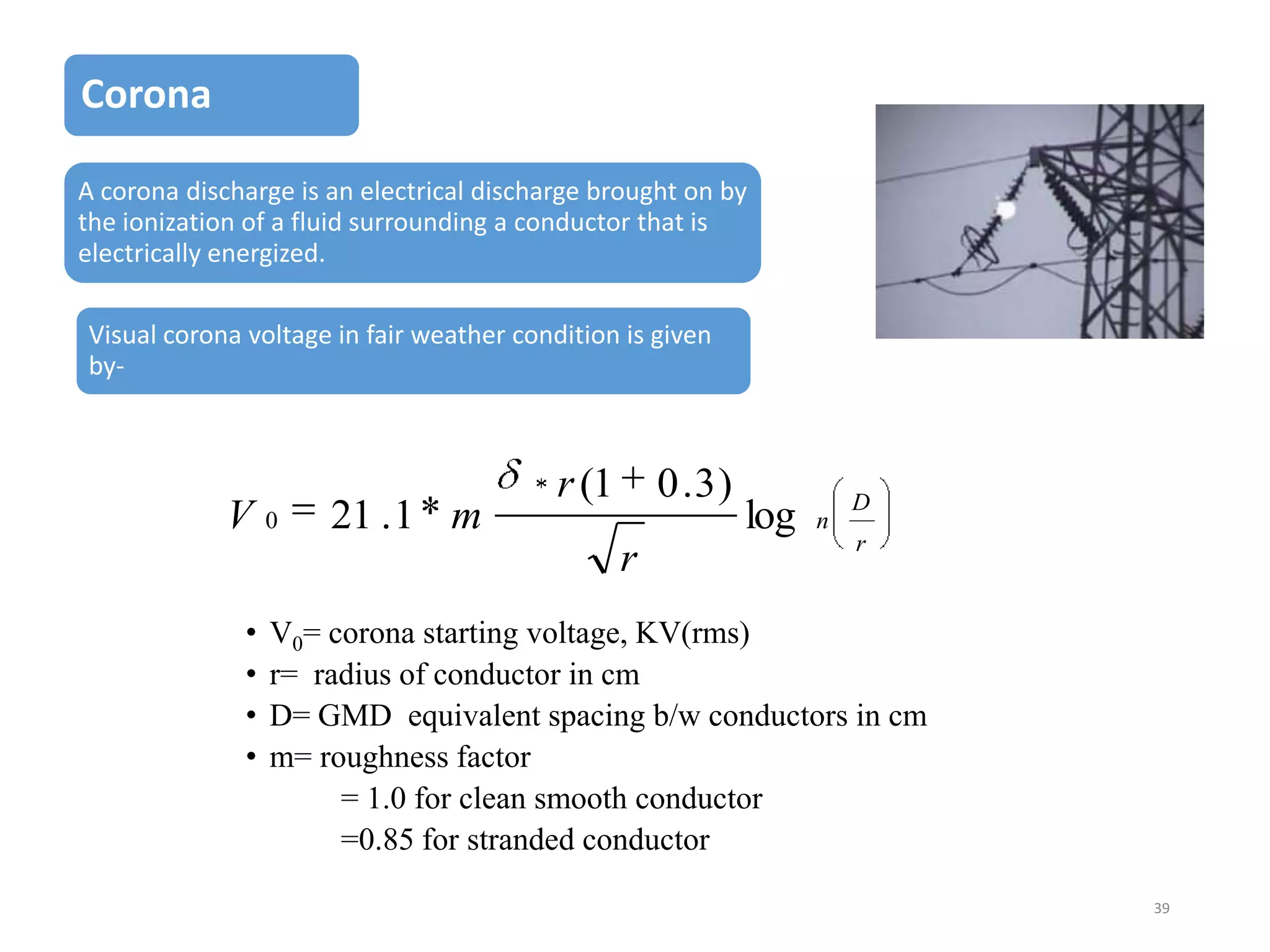
Corona
A corona discharge is an electrical discharge brought on by
the ionization of a fluid surrounding a conductor that is
electrically energized.
Visual corona voltage in fair weather condition is given
by-

V

0

21 . 1 m

r (1

0 .3)
r

•
•
•
•

log

n

D
r

V0= corona starting voltage, KV(rms)
r= radius of conductor in cm
D= GMD equivalent spacing b/w conductors in cm
m= roughness factor
= 1.0 for clean smooth conductor
=0.85 for stranded conductor
39
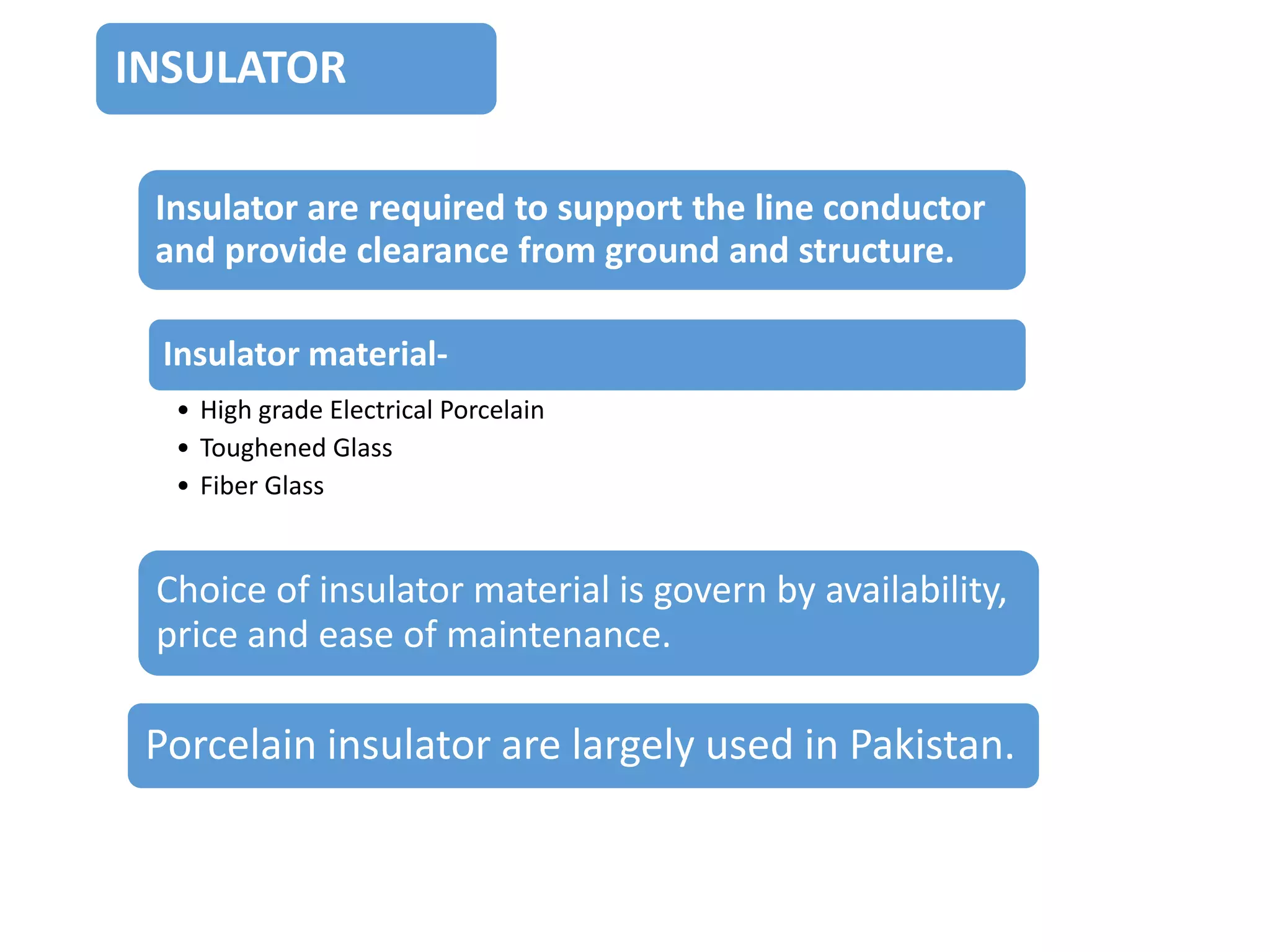
INSULATOR
Insulator are required to support the line conductor
and provide clearance from ground and structure.
Insulator material• High grade Electrical Porcelain
• Toughened Glass
• Fiber Glass

Choice of insulator material is govern by availability,
price and ease of maintenance.

Porcelain insulator are largely used in Pakistan.
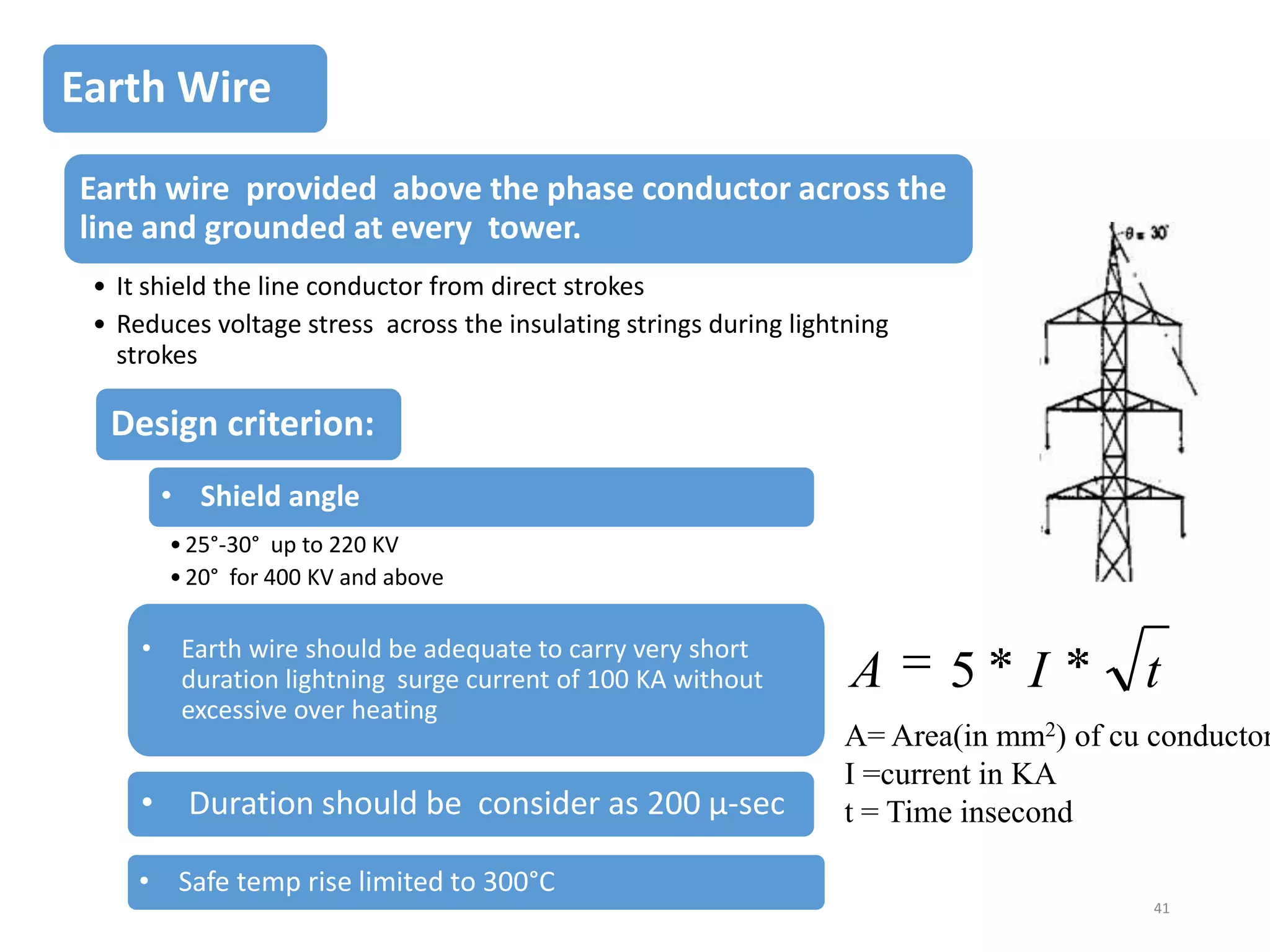
Earth Wire
Earth wire provided above the phase conductor across the
line and grounded at every tower.
• It shield the line conductor from direct strokes
• Reduces voltage stress across the insulating strings during lightning
strokes

Design criterion:
• Shield angle
• 25°-30° up to 220 KV
• 20° for 400 KV and above

•

Earth wire should be adequate to carry very short
duration lightning surge current of 100 KA without
excessive over heating

• Duration should be consider as 200 µ-sec

A

5 I

t

A= Area(in mm2) of cu conductor
I =current in KA
t = Time insecond

• Safe temp rise limited to 300°C
41
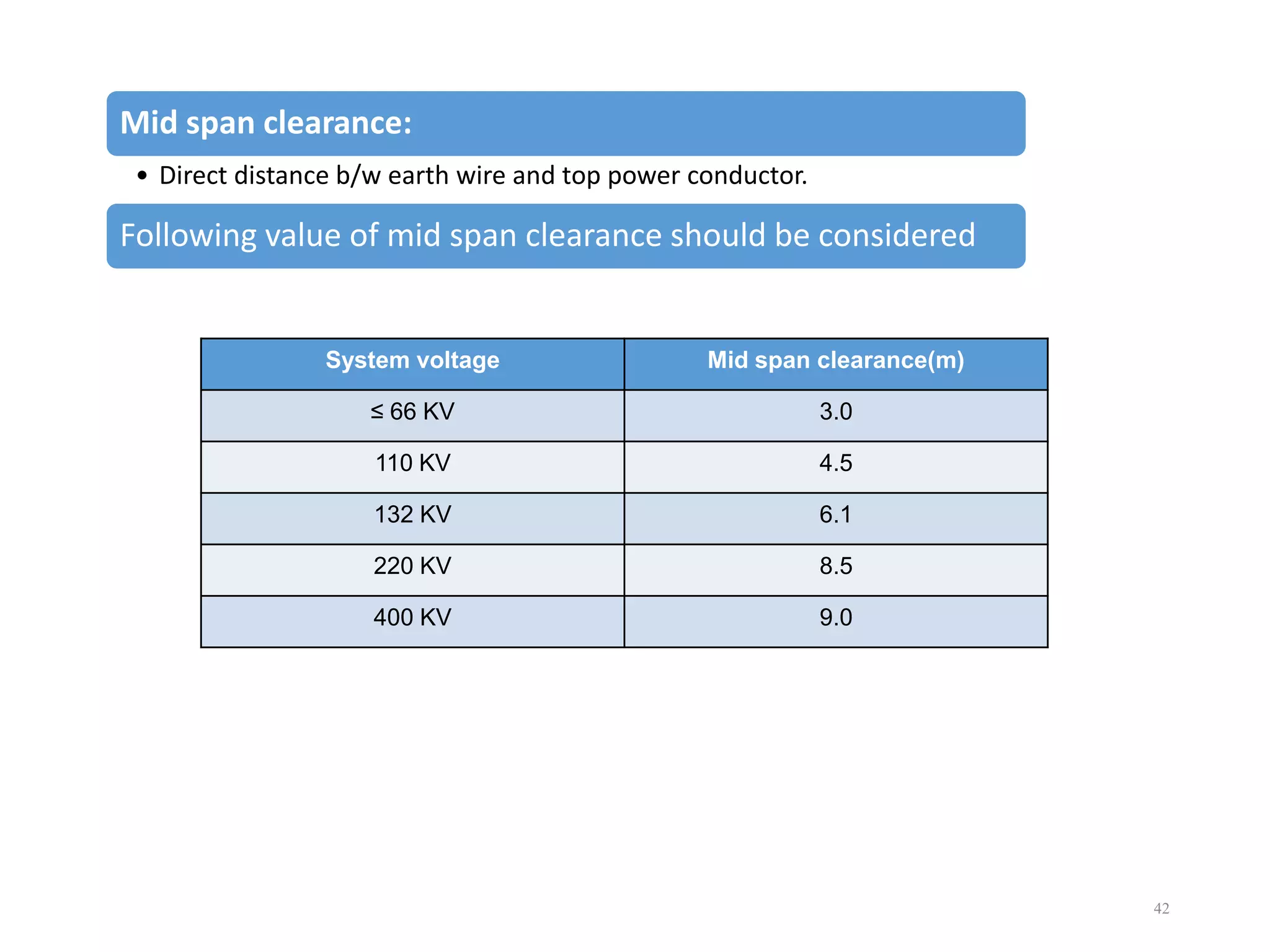
Mid span clearance:
• Direct distance b/w earth wire and top power conductor.

Following value of mid span clearance should be considered

System voltage

Mid span clearance(m)

≤ 66 KV

3.0

110 KV

4.5

132 KV

6.1

220 KV

8.5

400 KV

9.0

42
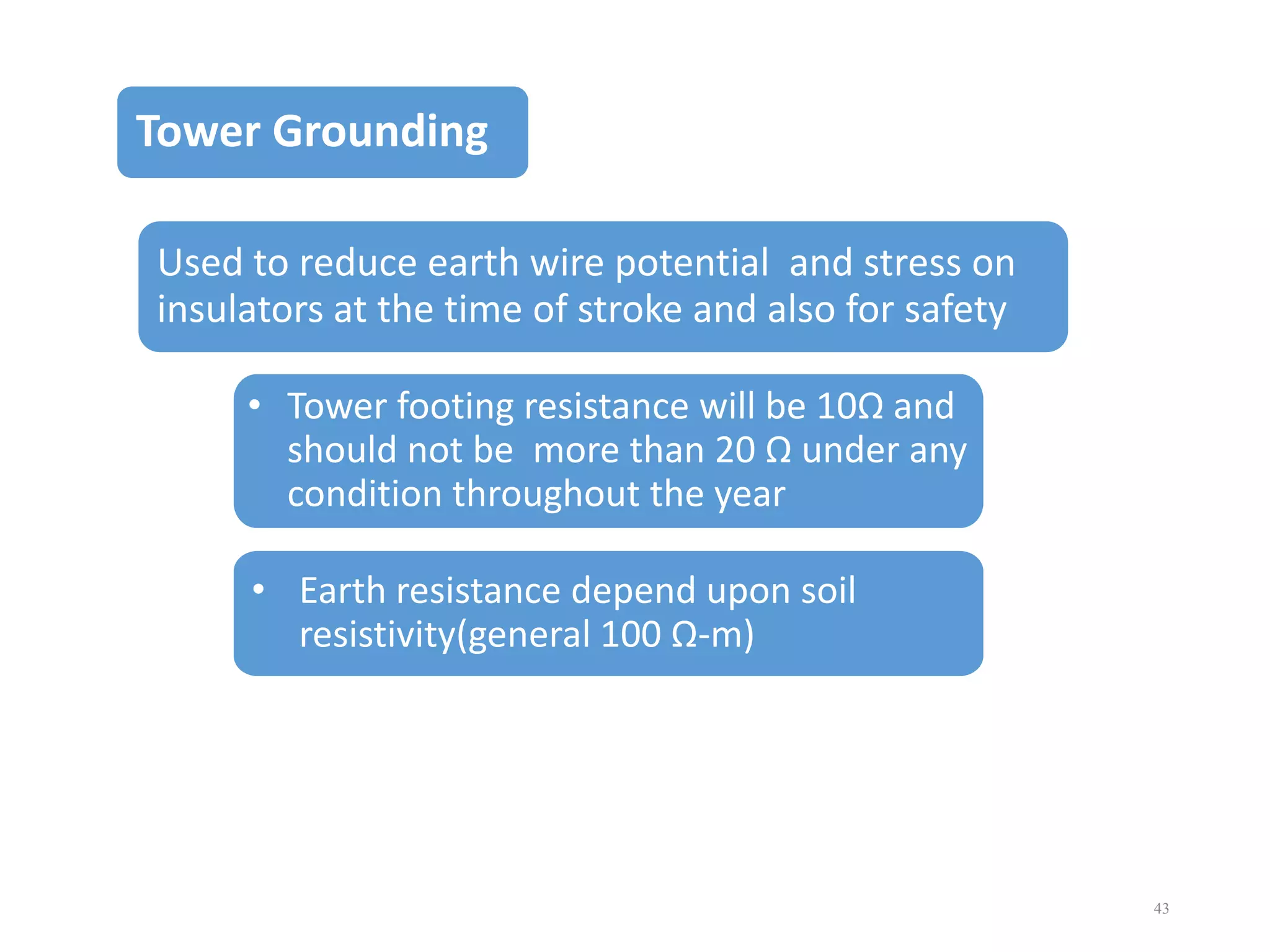
Tower Grounding
Used to reduce earth wire potential and stress on
insulators at the time of stroke and also for safety
• Tower footing resistance will be 10Ω and
should not be more than 20 Ω under any
condition throughout the year
• Earth resistance depend upon soil
resistivity(general 100 Ω-m)

43
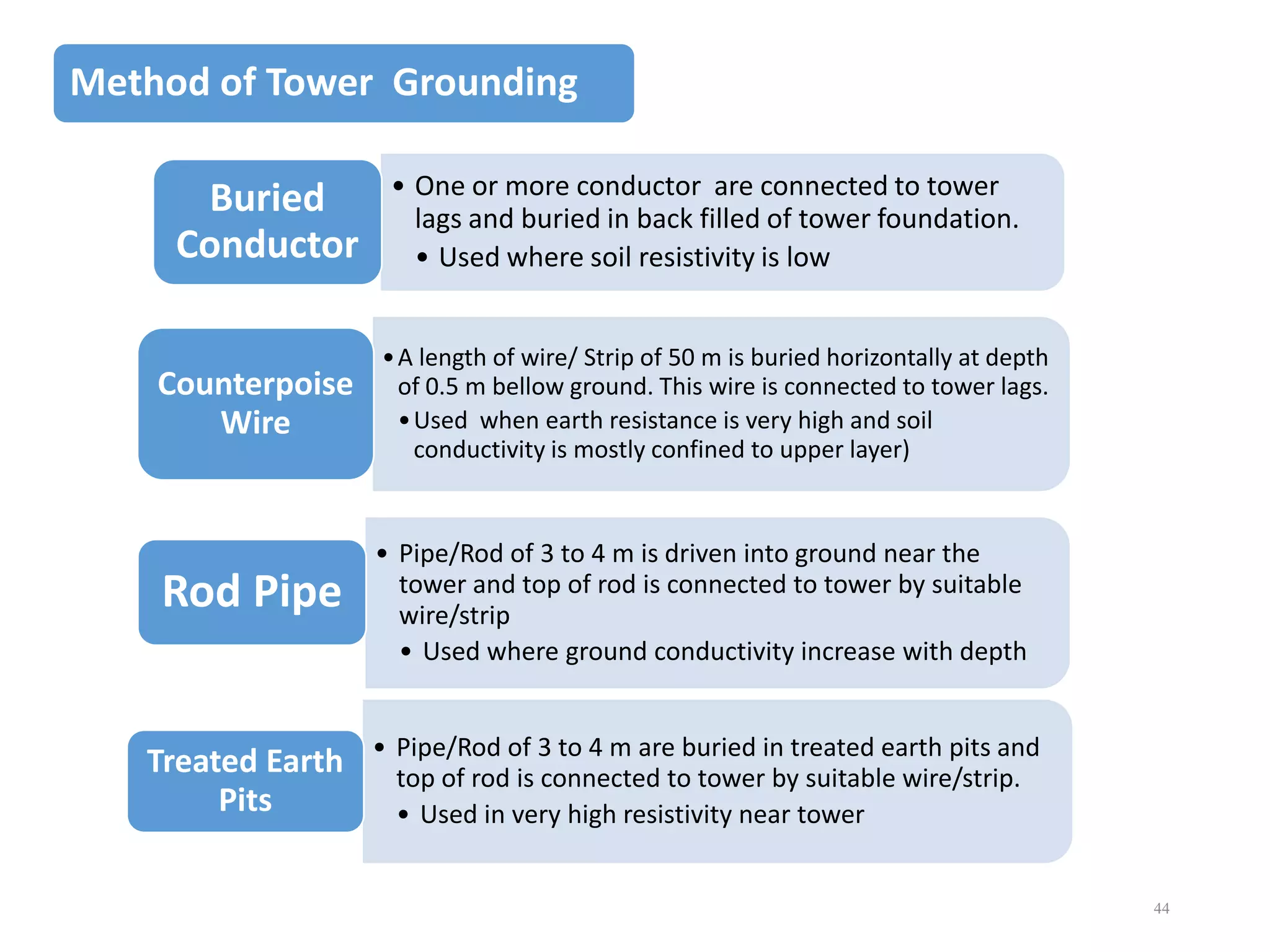
Method of Tower Grounding
Buried
Conductor

• One or more conductor are connected to tower
lags and buried in back filled of tower foundation.
• Used where soil resistivity is low

Counterpoise
Wire

• A length of wire/ Strip of 50 m is buried horizontally at depth
of 0.5 m bellow ground. This wire is connected to tower lags.
• Used when earth resistance is very high and soil
conductivity is mostly confined to upper layer)

Rod Pipe

• Pipe/Rod of 3 to 4 m is driven into ground near the
tower and top of rod is connected to tower by suitable
wire/strip
• Used where ground conductivity increase with depth

Treated Earth
Pits

• Pipe/Rod of 3 to 4 m are buried in treated earth pits and
top of rod is connected to tower by suitable wire/strip.
• Used in very high resistivity near tower

44
45

Concept of energy transmission & distribution

  • 1.
    Concept of EnergyTransmission 1
  • 2.
    Group Members Madiha Naeem Muqadsa Iftikhar Zunaib Ali COMSATSINSTITUTE OF INFORMATION & TECHNOLOGY, ABBOTTABAD 2
  • 3.
    Purpose of ElectricalTransmission System The purpose of the electric transmission system is the efficient interconnection of the electric energy producing power plants or generating stations with the loads. 3
  • 4.
    Main Parts ofPower System Four Main Parts: Generation System Transmission System Distribution System Consumer (LOAD) 4
  • 5.
    Simplified Diagram ofPower System 5
  • 6.
    Generating Station The commonlyused power plants are: Thermal Power Plant Nuclear Power Plant Hydro Power Plant Gas Turbine Power Plant Combined Cycle Power Plant 6
  • 7.
    One-Line Diagram ofGenerating Station Fig.1: Simplified Connection Diagram 7
  • 8.
    Main Parts ofGenerating Station Circuit Breaker (CB) A circuit breaker is an automatically operated electrical switch, designed to protect an electrical circuit from damage caused by faultcurrent or short circuit Types based on Insulators Oil Circuit Breaker Air Circuit Breaker SF6 Circuit Breaker Vacuum Circuit Breaker Fig.2: CB Diagram 8
  • 9.
    Table.1: Circuit BreakerDescription Type Medium Air break Circuit Breaker Air at atmospheric pressure Miniature CB. Air at atmospheric pressure (430-600 ) V Tank Type oil CB. Dielectric oil (3.6 – 12) KV Minimum Oil CB. Dielectric oil (3.6 - 145 )KV Compressed Air 245 KV, 35000 MVA (20 – 40 ) bar up to 1100 KV, 50000 MVA Air Blast CB. Voltage, Breaking Capacity (430 – 600) V– (5-15)MVA (3.6-12) KV - 500 MVA 12 KV, 1000 MVA SF6 CB. SF6 Gas 36 KV , 2000 MVA 145 KV, 7500 MVA 245 KV , 10000 MVA Vacuum CB. Vacuum 36 KV, 750 MVA H.V.DC CB. Vacuum , SF6 Gas 500 KV DC 9
  • 10.
    Main Parts ofGeneration Station… Disconnect Switch Provides visible circuit separation and permits CB maintenance. It can be operated only when the CB is open i.e. in no-load condition. Surge Arrester Used for protection against lightning and switching over-voltages. They are voltage dependent, nonlinear resistors (Varistors). The arrester provides a low-impedance path to ground for the current from a lightning strike or transient voltage and then restores to a normal operating condition. 10
  • 11.
    Main Parts ofGeneration Station… Current Transformers (CT) and Potential Transformers (PT) Used to lower the magnitude of the current and voltage to be measured. In case of normal meters, to measure current and voltage in a high voltage circuit at 220kV, properly insulated meters are needed to withstand that voltage. The meters will be very big for that purpose. The CT and PT is used to solve this problem. The CT and PT works on the principle of transformer and lowers the current and/or voltage at a lower value which can be safely and easily measured. 11
  • 12.
  • 13.
    Components of aTransmission Line Conductor Earth wire Insulator Transmission Tower Wave trap and other hardware(Clamp, Spacer, Vibration dampers, connectors etc. 13
  • 14.
    Design Methodology • Gatherpreliminary line design data and available climatic data • Select reliability level in terms of return period of design • Calculate climatic loading on components • Calculate loads related to safety during construction and maintenance • Select appropriate correction factors, if applicable, to the design components such as use factor, strength factors related to numbers of components, quality control, and the characteristic strength. • Design the components for the above loads and strength. 14
  • 15.
    Selection of TransmissionVoltage Standard Voltage: 66,110,132, 220, 400 KV Tolerances - ±10% up to 220 KV & ±5% for 400 KV Selection Criterion of Economic Voltage • Quantum of power to be evacuated • Length of line • Voltage regulation • Power loss in Transmission • Initial and operating cost 15
  • 16.
    Economic Voltage ofTransmission of Power E = Transmission voltage (KV) (L-L). 5 .5 KVA 1 .6 *E L 150 L = Distance of transmission line in KM KVA=Power to be transferred * 16
  • 17.
    Typical Transmission VoltageLevels Voltages Level Range (KV) Maximum Length (Miles) High Voltage 100 to 230 200 Extra High Voltage 230 to 800 400 to 500 Ultra High Voltage Above 800 1300
  • 18.
    Types of Towers TypeA Tower (Tangent Tower with suspension string) Type B Tower (Small Angle Tower with tension string) • Used on straight runs and up to 2° line diversion • Used for line deviation from 2° to 15° Type C Tower (Medium Angle Tower with tension string ). • Used for line deviation from 15° to 30°. Type D Tower (Large angle tower with tension string) • Used for line deviation from 30° to 60° Type E Tower (Dead End Tower with tension string) • Used for line termination & starting Suspension Tower (Span ≈ 1000 m) Transposition Tower • Used for River crossing, Mountain crossing etc. • Used for transposition of tower 18
  • 19.
  • 20.
  • 21.
    Selection of TowerStructure Single circuit Tower/ double circuit Tower Length of the insulator assembly Minimum clearances to be maintained between conductors, and between conductors and tower Location of earth wire/wires with respect to the outermost conductor Mid-span clearance required from considerations of the dynamic behavior of conductors and lightning protection of the line Minimum clearance of the lowest conductor above ground level 21
  • 22.
    EHV- Tower Tower: • Thefigure shows a lattice, steel tower. Insulator: • V strings hold four bundled conductors in each phase Conductor: Foundation and grounding: • Each conductor is stranded, steel reinforced aluminum cable. • Steel-reinforced concrete foundation and grounding electrodes placed in the ground Shield conductors: • Two grounded shield conductors protect the phase conductors from lightning. 22
  • 23.
    Tower Design Tower height Basewidth Top damper width Cross arms length Fig. Typical 765 KV Tower Structure 23
  • 24.
    Height of TowerStructure Height of tower is determine by- H h1 h2 h3 h4 h1=Minimum permissible ground clearance h2=Maximum sag h3=Vertical spacing between conductors h4=Vertical clearance between earth-wire and top conductor 24
  • 25.
    Determination of BaseWidth The base width(at the concrete level) is the distance between the centre of gravity at one corner leg and the centre of gravity of the adjacent corner leg. A particular base width which gives the minimum total cost of the tower and foundations Ryle Formula An applied force that causes a structure to turn over The ratio of base width to total tower height for most towers is generally about one-fifth to one-tenth. 25 25
  • 26.
    Spacing and Clearances GroundClearances CL 5.182 Where- K 0.305 * K V 33 33 S.No. Voltage level Ground clearance(m) 1. ≤33 KV 5.20 2. 66 KV 5.49 3. 132KV 6.10 4. 220 KV 7.01 5. 400 KV 8.84 26
  • 27.
    Clearance for PowerLine Crossings Crossing over rivers: Crossing over telecommunication lines • 3.05m above maximum flood level. • Minimum clearances between the conductors of a power line and telecommunication wires are Voltage Level Minimum Clearance(mm) ≤33 KV 2440 66KV 2440 132 KV 2740 220 KV 3050 400 KV 4880 27
  • 28.
    Power line Crossinganother Power line System Voltage Level Clearance(m) ≤ 66 KV 2.40 132 KV 2.75 220KV 4.55 400 KV 6.00 28
  • 29.
    Spacing Between Conductor(Phases) Mecomb'sformula WhereSpacing ( cm ) 0 . 3048 * V 4 . 010 D W S V= Voltage of system in KV D= Diameter of Conductor in cm S= Sag in cm W= weight of conductor in Kg/m VDE formula Spacing ( cm ) 7 .5 S V 2 2000 Where- V= Voltage of system in KV S= Sag in cm 29
  • 30.
    Still's formula 2 Spacing (cm ) 5 . 08 l 1 . 814 * V Wherel = Average span length(m) 27 . 8 NESC formula Spacing ( cm ) 0 . 762 * V 3 . 681 S L 2 WhereV= Voltage of system in KV S= Sag in cm L= Length of insulator string in cm 30
  • 31.
    Swedish formula Where- Spacing (cm ) 6 .5 S 0 .7 * E E= Line Voltage in KV S= Sag in cm French formula Where- Spacing ( cm ) 8 .0 S L E 1 .5 E= Line Voltage in KV S= Sag in cm L= length of insulating string(cm) 31
  • 32.
    Clearances b/w Conductors SYSTEM VOLTAGE TYPEOF TOWER Vertical spacing b/w conductors(mm) Horizontal spacing b/w conductors(mm) SINGLE CIRCUIT 132 KV 4500 DOUBLE CIRCUIT 2060 5550 SINGLE CIRCUIT 66 kV 1080 4200 7140 DOUBLE CIRCUIT 3965 7320 32
  • 33.
    Types of Conductors • AAC(AllAluminium Conductor) • AAAC(All Alloy Aluminium Conductor) • ACSR Conductor(Aluminium Conductor Steel Reinforced) Fig. AAC Conductors Fig. AAAC Conductors 33
  • 34.
    Table: Technical Dataof ASCR Conductors Commonly used in EHV Transmission By Wapda. Code Words Stranding Aluminum Steel Conductor Core Weight Per Km Aluminum Steel No/mm kg/km No/mm kg/km Weight Complete Conductor kg/km Diameter Complete Steel Conductor Core mm mm Cross Area of Aluminum Area of Complete Conductor Rated Ultimate Strength D.C Resistance at 200 mm2 mm2 kg ohm/km Gopher 6/2.36 1/2.36 72 34.1 106 7.08 2.36 26.25 30.62 980 1.093 Rabbit 6/3.35 1/3.35 145.1 68.8 214 10.05 3.35 52.88 61.69 1875 0.543 Dog 6/4.72 7/1.57 288.1 106.2 394 14.15 4.71 104.98 118.53 3225 0.273 Hare 6/4.72 1/4.72 288.1 136.5 425 14.16 4.72 105 122.5 3225 0.273 Osprey 16/4.465 ¼.465 777 121.8 898.8 22.23 4.465 281.9 297.56 6220 0.123 Cuckoo 24/4.62 7/3.08 1116 407.6 15424 27.72 9.24 402.33 454.48 12385 0.072 Zebra 54/3.18 7/3.18 1182 439 1621 28.62 3.18 428.9 484.59 13000 0.0686 Moose 54/3.53 7/3.53 1463 535 1998 31.77 3.53 528.5 597.0 16224 0.0559 Panther 30/3 7/3 588 387 976 21 3 212.1 261.5 9150 0.07311 400kv - 'Moose' ACSR 220kv - 'Zebra' ACSR 132kv - 'Panther' ACSR Fig. ASCR Conductors 34
  • 35.
    Selection of ConductorSize • Mechanical Requirement • Electrical Requirement • Tensile Strength(For Tension) Mechanical Requirement • Strain Strength(For Vibration) Use vibration damper for vibration control. 35
  • 36.
    Electrical Requirement • Continuous currentrating. • Short time current carrying rating. • Voltage drop • Power loss • Minimum dia to avoid corona • Length of line • Charging current 36
  • 37.
    Continuous Current Rating. Thedesignated RMS alternating current in amperes which a conductor will carry continuously in free air without tripping or exceeding temperature limits. The normal continuous current rating of line traps is per manufacturer’s nameplate and based at 40°C ambient temperature. This current rating can be adjusted for specific ambient temperature without exceeding the normal allowable maximum temperature a line trap can withstand. 37
  • 38.
    Short Time Rating Accordingto short time rating conductor size is given by- A 7 . 58 * I F * t Where A=area of conductor(mm2) IF= fault current(KA) t= fault duration(1 sec.) 38
  • 39.
    Corona A corona dischargeis an electrical discharge brought on by the ionization of a fluid surrounding a conductor that is electrically energized. Visual corona voltage in fair weather condition is given by- V 0 21 . 1 m r (1 0 .3) r • • • • log n D r V0= corona starting voltage, KV(rms) r= radius of conductor in cm D= GMD equivalent spacing b/w conductors in cm m= roughness factor = 1.0 for clean smooth conductor =0.85 for stranded conductor 39
  • 40.
    INSULATOR Insulator are requiredto support the line conductor and provide clearance from ground and structure. Insulator material• High grade Electrical Porcelain • Toughened Glass • Fiber Glass Choice of insulator material is govern by availability, price and ease of maintenance. Porcelain insulator are largely used in Pakistan.
  • 41.
    Earth Wire Earth wireprovided above the phase conductor across the line and grounded at every tower. • It shield the line conductor from direct strokes • Reduces voltage stress across the insulating strings during lightning strokes Design criterion: • Shield angle • 25°-30° up to 220 KV • 20° for 400 KV and above • Earth wire should be adequate to carry very short duration lightning surge current of 100 KA without excessive over heating • Duration should be consider as 200 µ-sec A 5 I t A= Area(in mm2) of cu conductor I =current in KA t = Time insecond • Safe temp rise limited to 300°C 41
  • 42.
    Mid span clearance: •Direct distance b/w earth wire and top power conductor. Following value of mid span clearance should be considered System voltage Mid span clearance(m) ≤ 66 KV 3.0 110 KV 4.5 132 KV 6.1 220 KV 8.5 400 KV 9.0 42
  • 43.
    Tower Grounding Used toreduce earth wire potential and stress on insulators at the time of stroke and also for safety • Tower footing resistance will be 10Ω and should not be more than 20 Ω under any condition throughout the year • Earth resistance depend upon soil resistivity(general 100 Ω-m) 43
  • 44.
    Method of TowerGrounding Buried Conductor • One or more conductor are connected to tower lags and buried in back filled of tower foundation. • Used where soil resistivity is low Counterpoise Wire • A length of wire/ Strip of 50 m is buried horizontally at depth of 0.5 m bellow ground. This wire is connected to tower lags. • Used when earth resistance is very high and soil conductivity is mostly confined to upper layer) Rod Pipe • Pipe/Rod of 3 to 4 m is driven into ground near the tower and top of rod is connected to tower by suitable wire/strip • Used where ground conductivity increase with depth Treated Earth Pits • Pipe/Rod of 3 to 4 m are buried in treated earth pits and top of rod is connected to tower by suitable wire/strip. • Used in very high resistivity near tower 44
  • 45.

Editor's Notes

  • #21 Different types of towers
  • #24 Fig. Typical 400 KV tower structure
  • #25 Height of tower is determine by-
  • #27 Where-
  • #30 asf
  • #38 I1=current rating for temp rise