Electrical Engineering
EPM2221
Lectures: Dr. Sayed Ahmed Zaki,
Electrical Power Engineering Department
Faculty of Engineering
Cairo University
ECONOMICS DESIGN OF
POWER TRANSMISSION
2
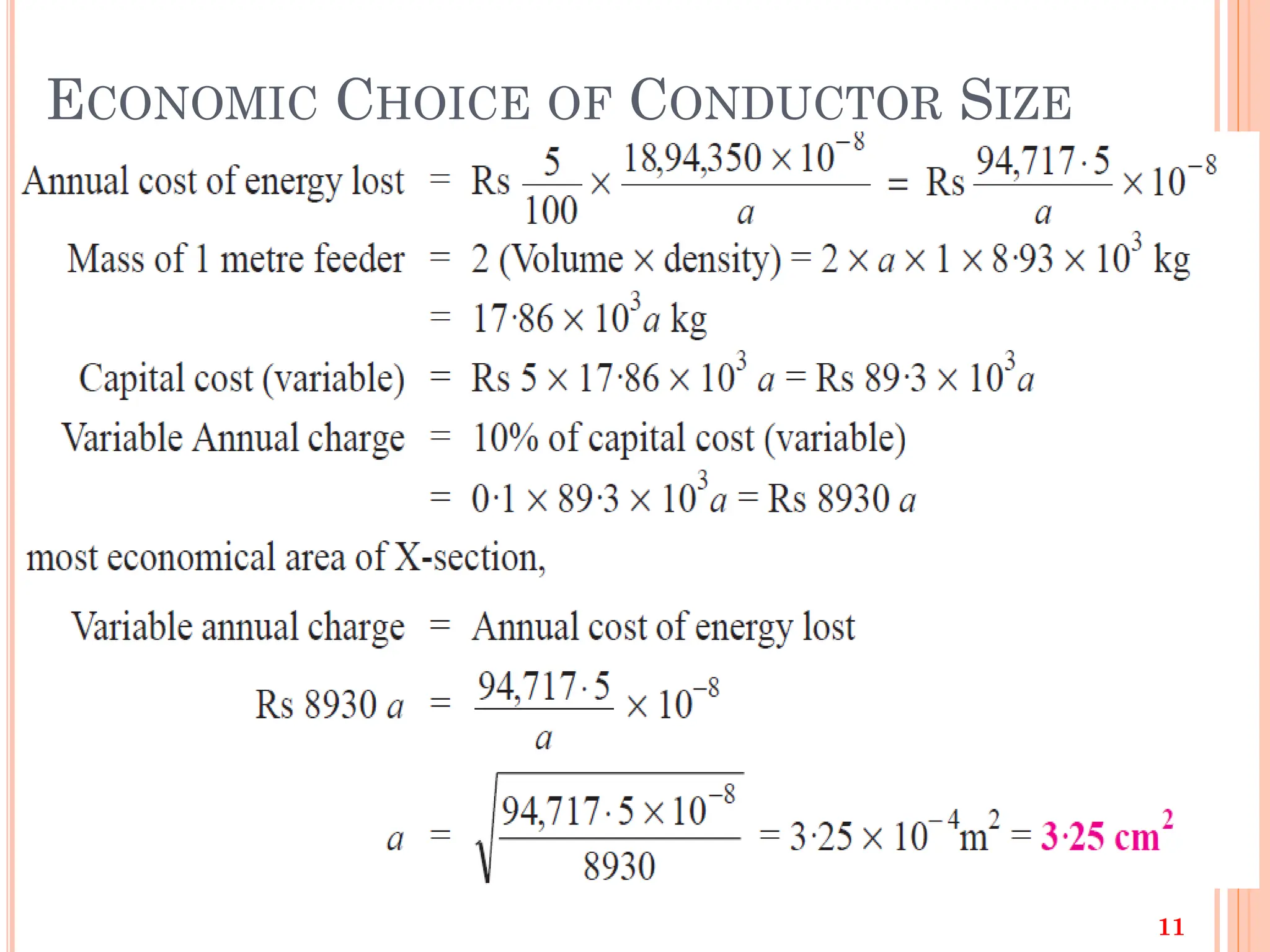
ECONOMIC CHOICE OF CONDUCTOR SIZE
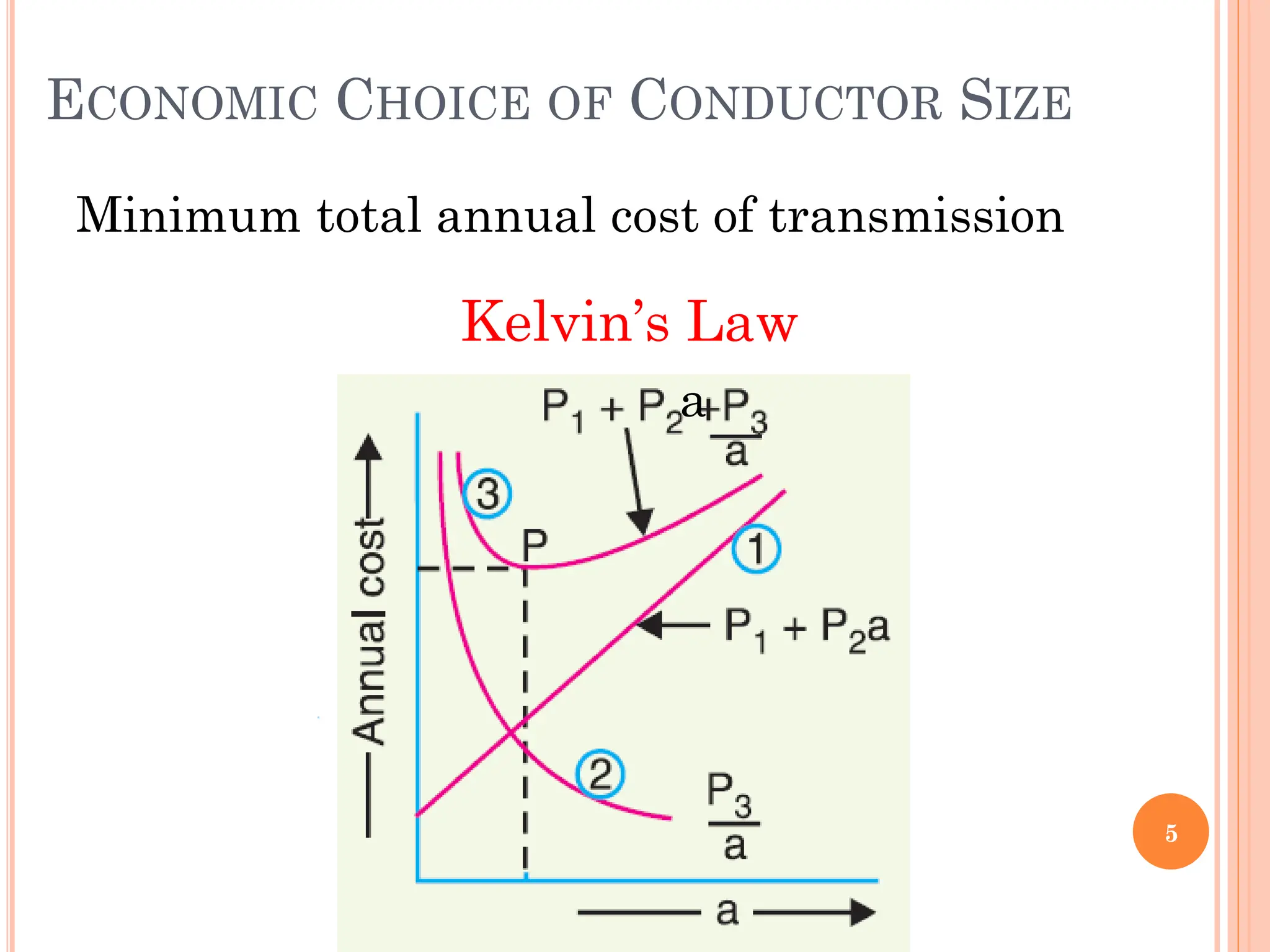
Minimum total annual cost of transmission
Kelvin’s Law
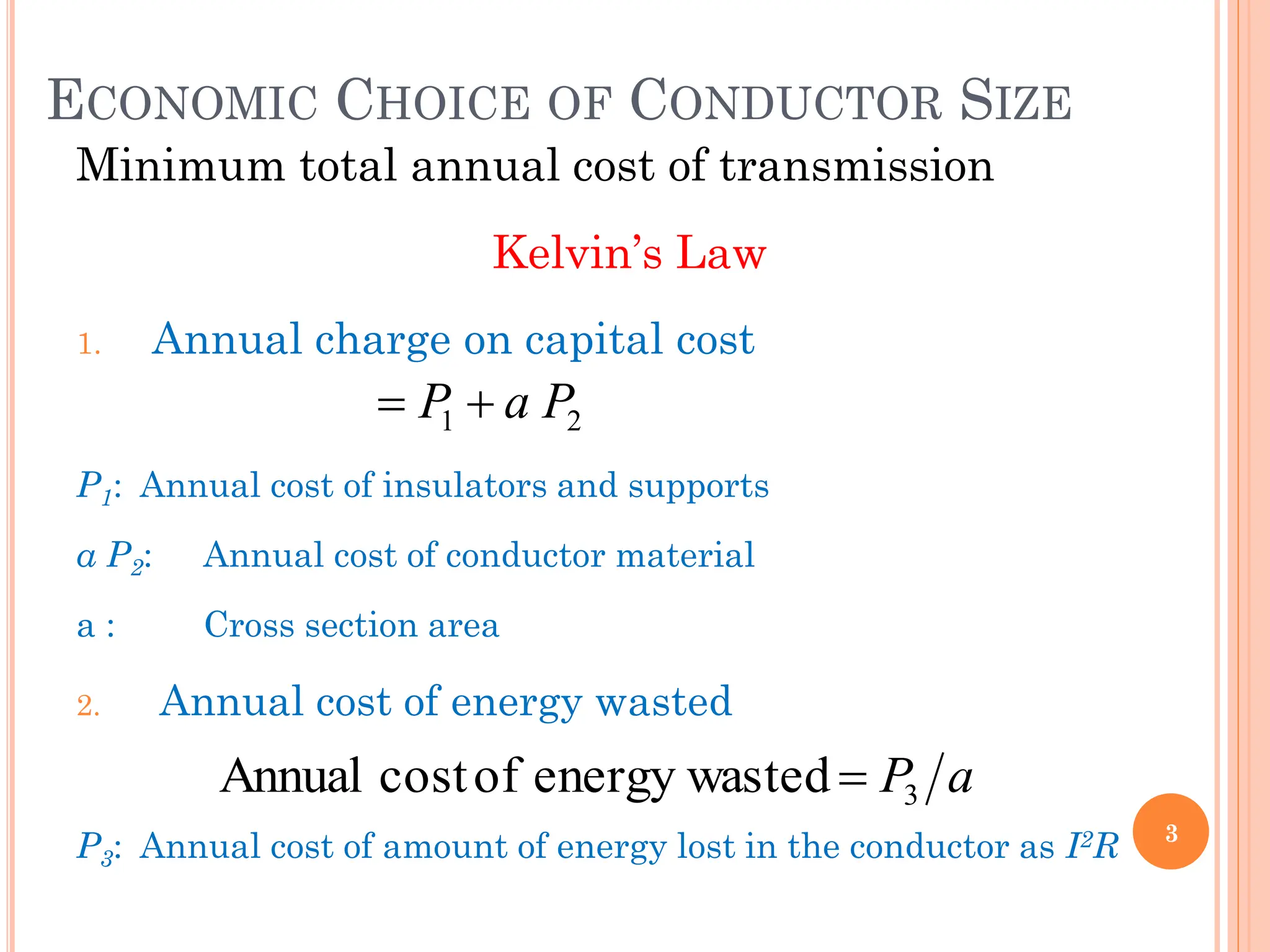
1. Annual charge on capital cost
P1: Annual cost of insulators and supports
a P2: Annual cost of conductor material
a : Cross section area
2. Annual cost of energy wasted
P3: Annual cost of amount of energy lost in the conductor as I2R 3
2
1 P
a
P 

a
P3
ted
energy was
of
cost
Annual 
ECONOMIC CHOICE OF CONDUCTOR SIZE
Minimum total annual cost of transmission
Kelvin’s Law
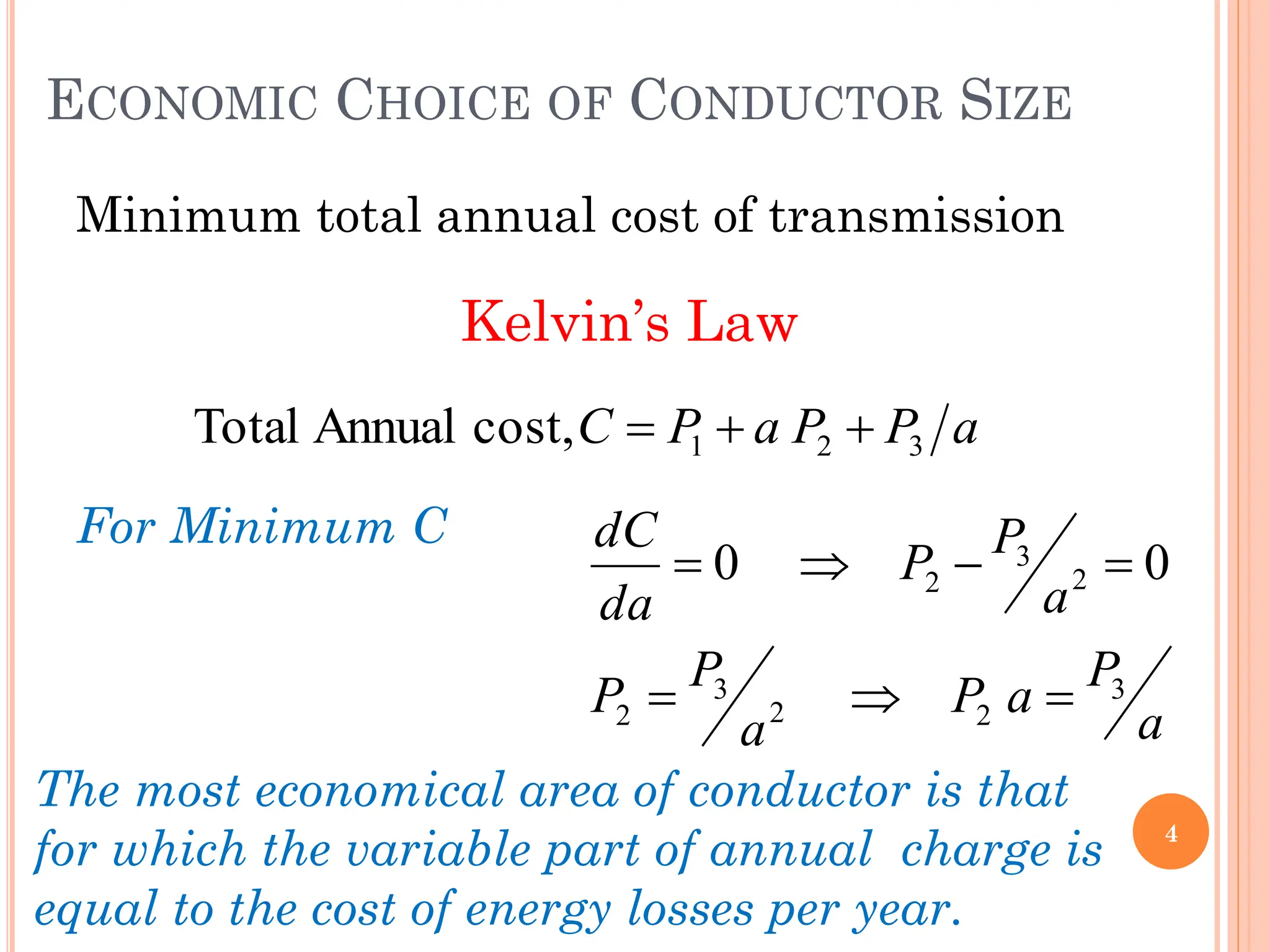
For Minimum C
4
a
P
P
a
P
C 3
2
1
cost,
Annual
Total 


a
P
a
P
a
P
P
a
P
P
da
dC
3
2
2
3
2
2
3
2 0
0







The most economical area of conductor is that
for which the variable part of annual charge is
equal to the cost of energy losses per year.
ECONOMIC CHOICE OF CONDUCTOR SIZE
Minimum total annual cost of transmission
Kelvin’s Law
5
a
ECONOMIC CHOICE OF CONDUCTOR SIZE
6
ECONOMIC CHOICE OF CONDUCTOR SIZE
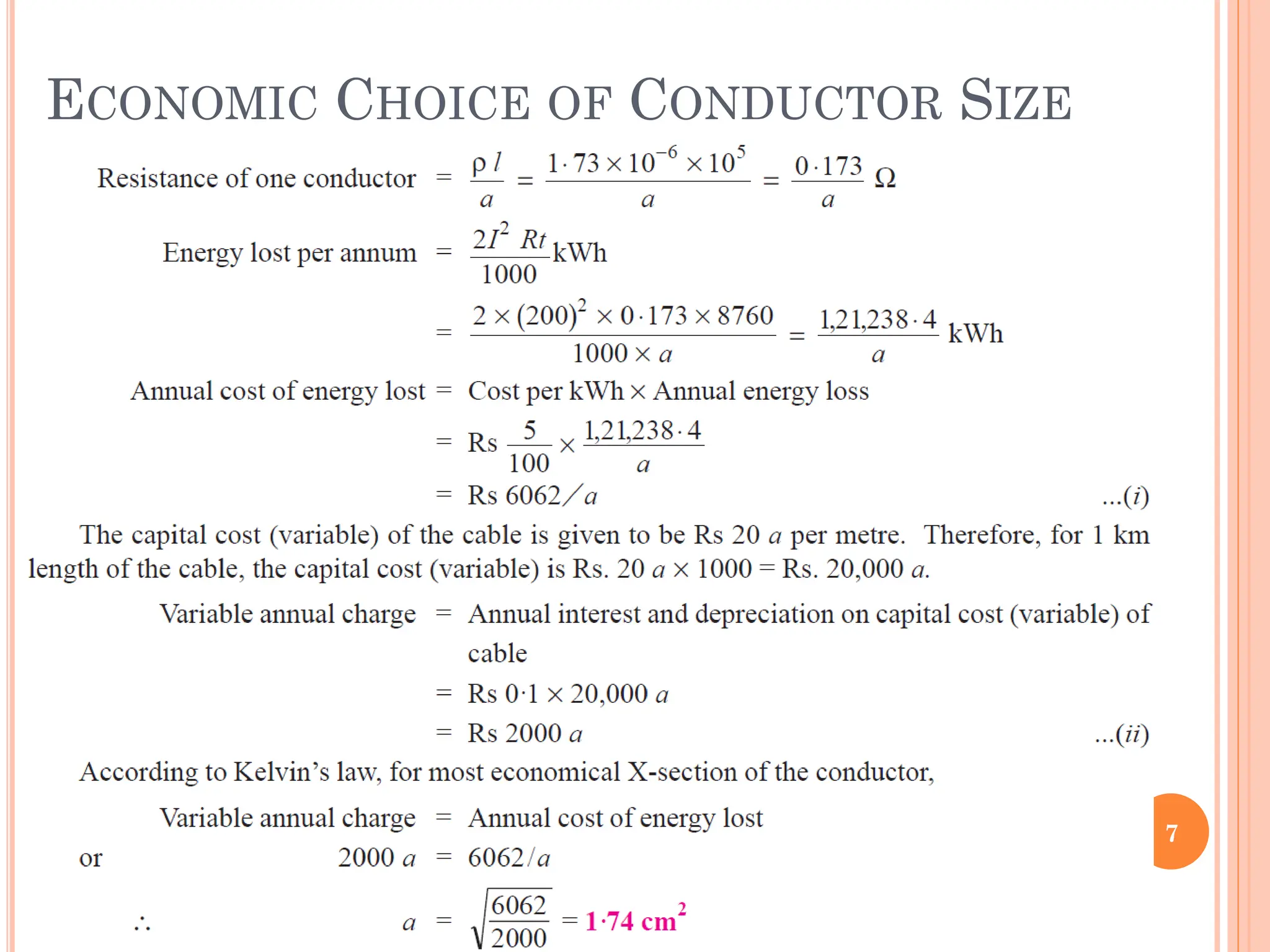
7
ECONOMIC CHOICE OF CONDUCTOR SIZE
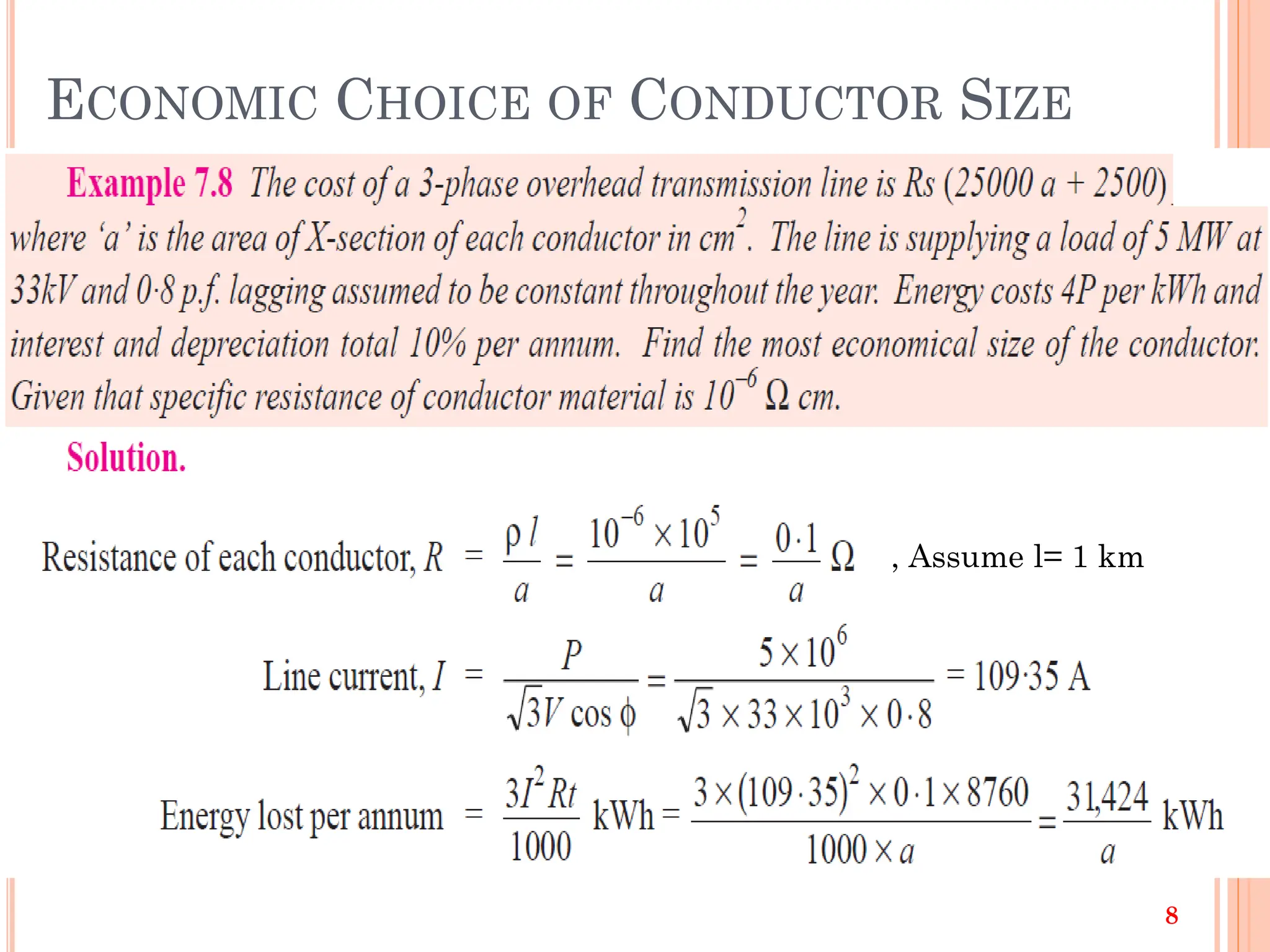
8
, Assume l= 1 km
ECONOMIC CHOICE OF CONDUCTOR SIZE
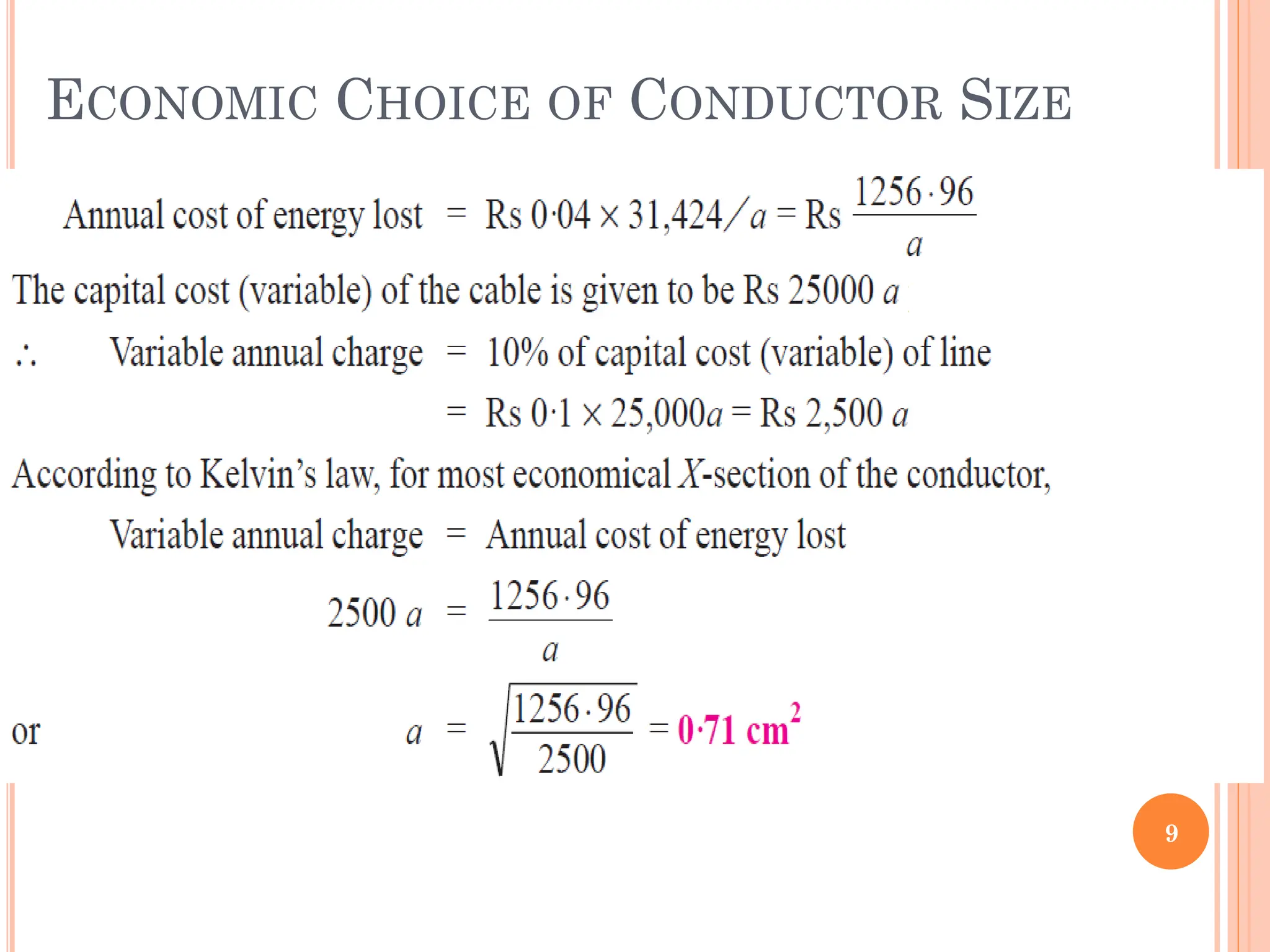
9
ECONOMIC CHOICE OF CONDUCTOR SIZE
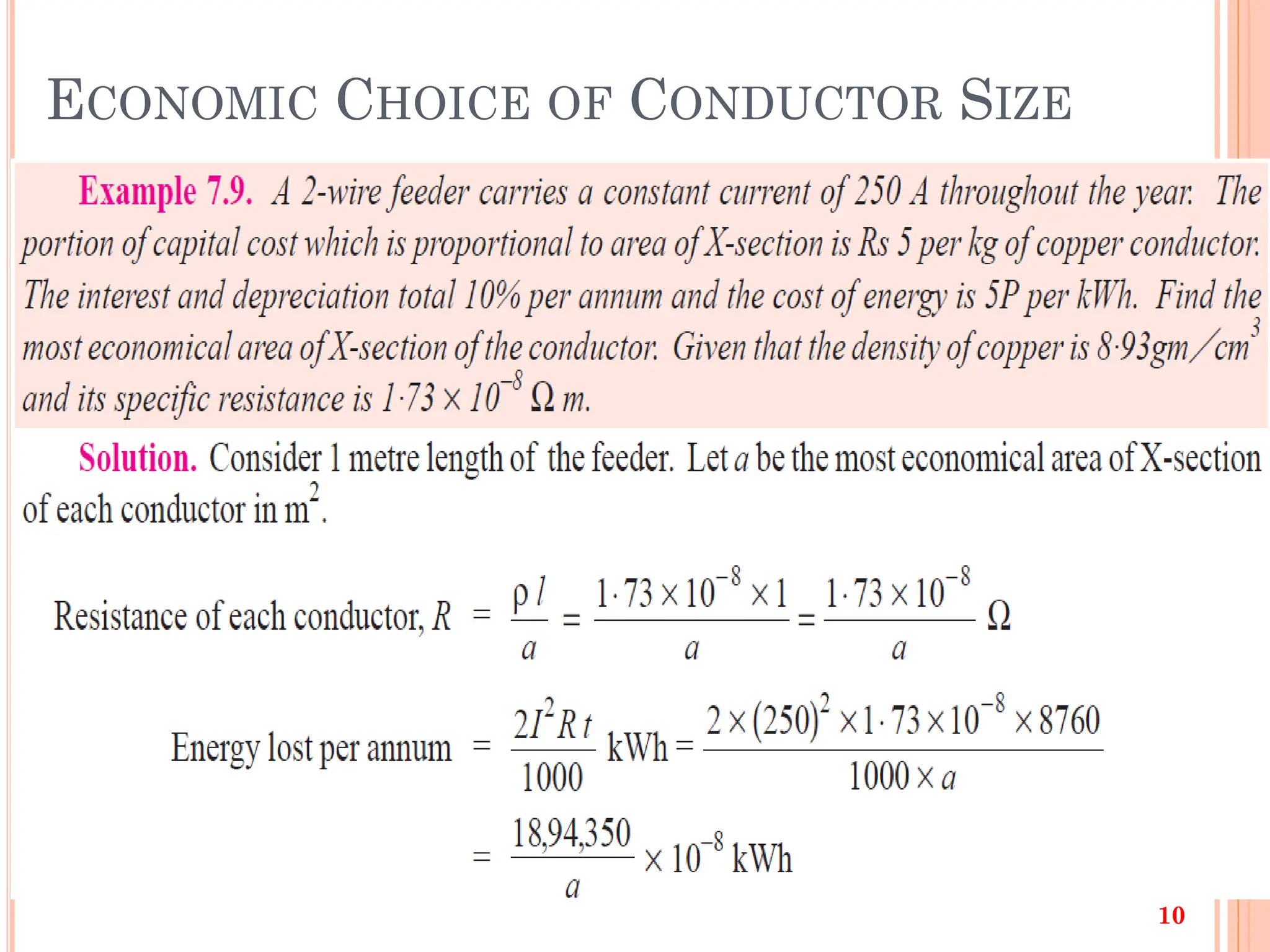
10
ECONOMIC CHOICE OF CONDUCTOR SIZE
11
OBJECTIVES
12
Upon completing this part, the student should be able to:
 Learn typical construction of electrical power systems
 List and describe the different types of transmission systems
 List and describe the different elements and materials of
transmission systems
 Determine the economic choice of conductor size
 Determine the economical transmission voltage
 Describe the various aspects of mechanical design
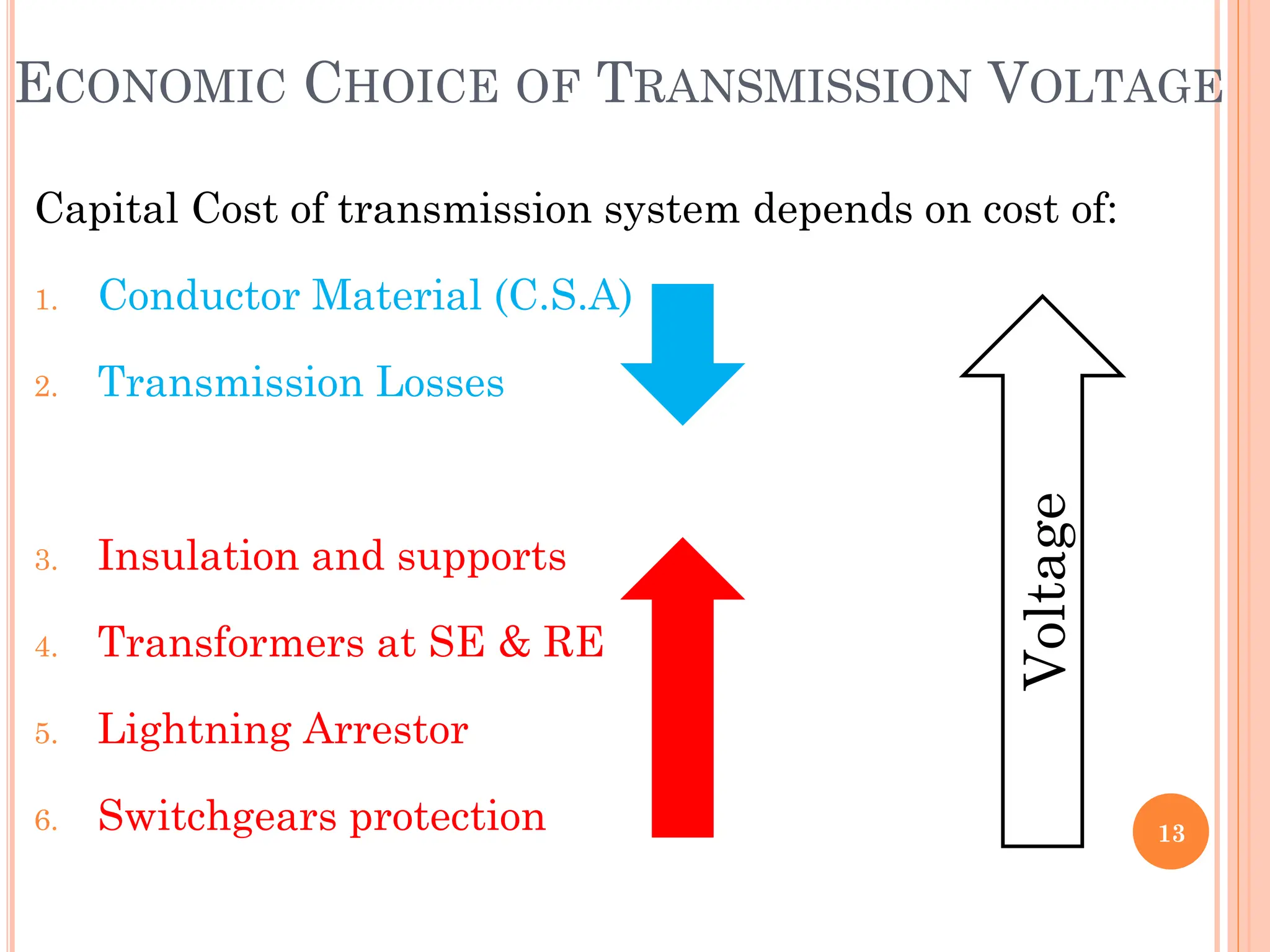
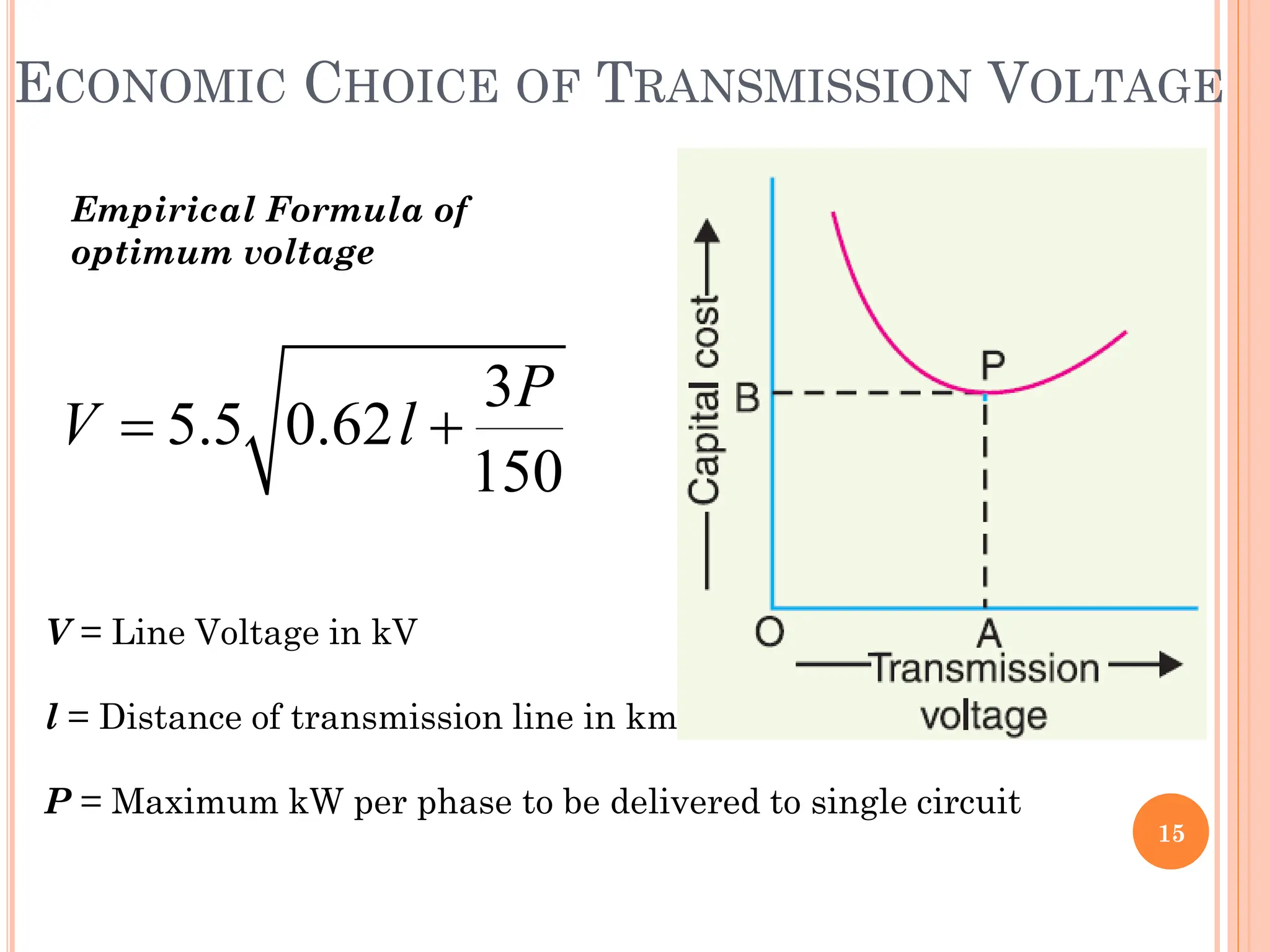
ECONOMIC CHOICE OF TRANSMISSION VOLTAGE
Capital Cost of transmission system depends on cost of:
1. Conductor Material (C.S.A)
2. Transmission Losses
3. Insulation and supports
4. Transformers at SE & RE
5. Lightning Arrestor
6. Switchgears protection 13
Voltage
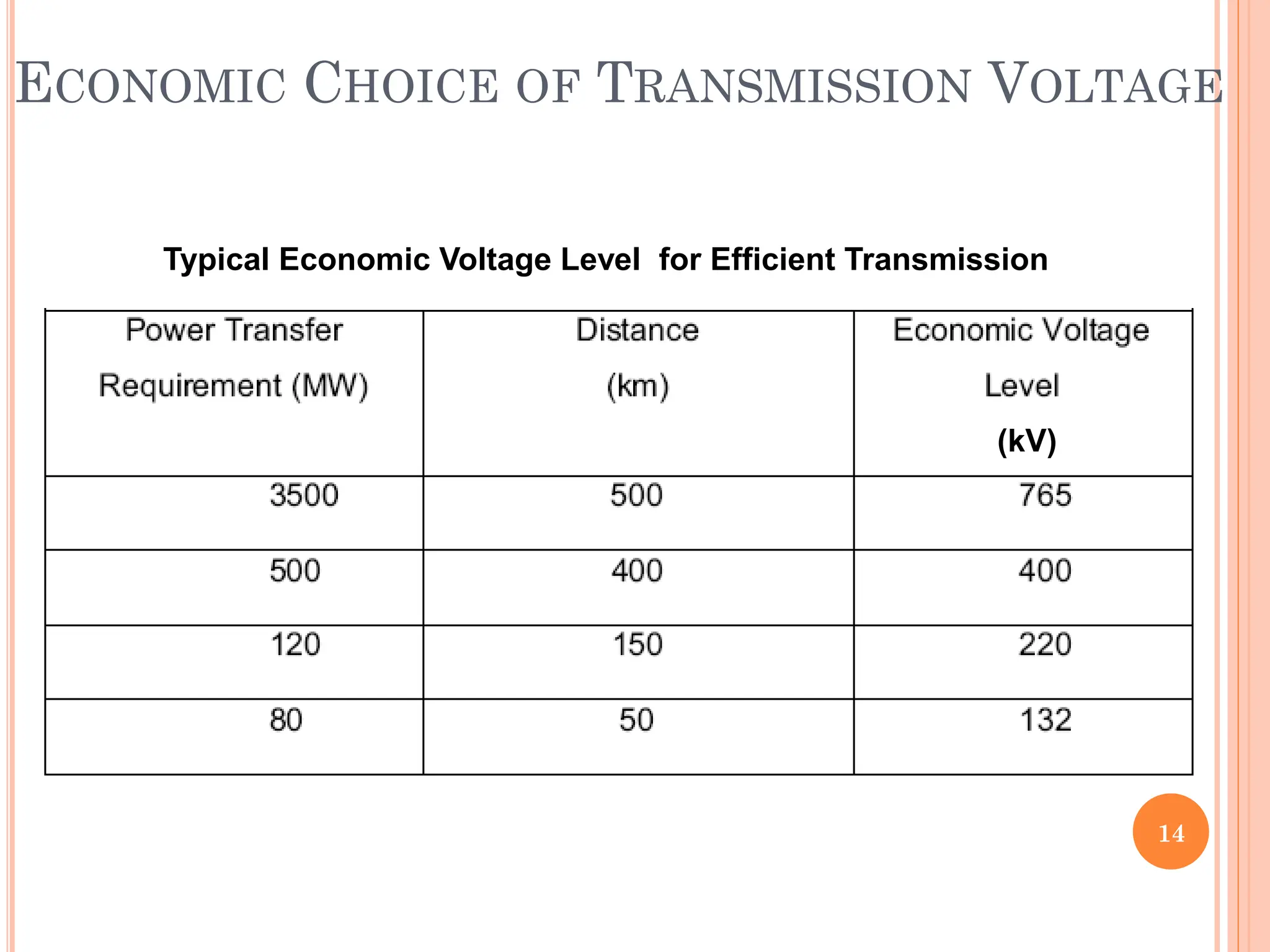
ECONOMIC CHOICE OF TRANSMISSION VOLTAGE
14
(kV)
Typical Economic Voltage Level for Efficient Transmission
ECONOMIC CHOICE OF TRANSMISSION VOLTAGE
15
3
5.5 0.62
5
1 0
P
V l
 
V = Line Voltage in kV
l = Distance of transmission line in km
P = Maximum kW per phase to be delivered to single circuit
Empirical Formula of
optimum voltage
MECHANICAL DESIGN OF
POWER TRANSMISSION
16
SAG IN OVERHEAD LINES
17
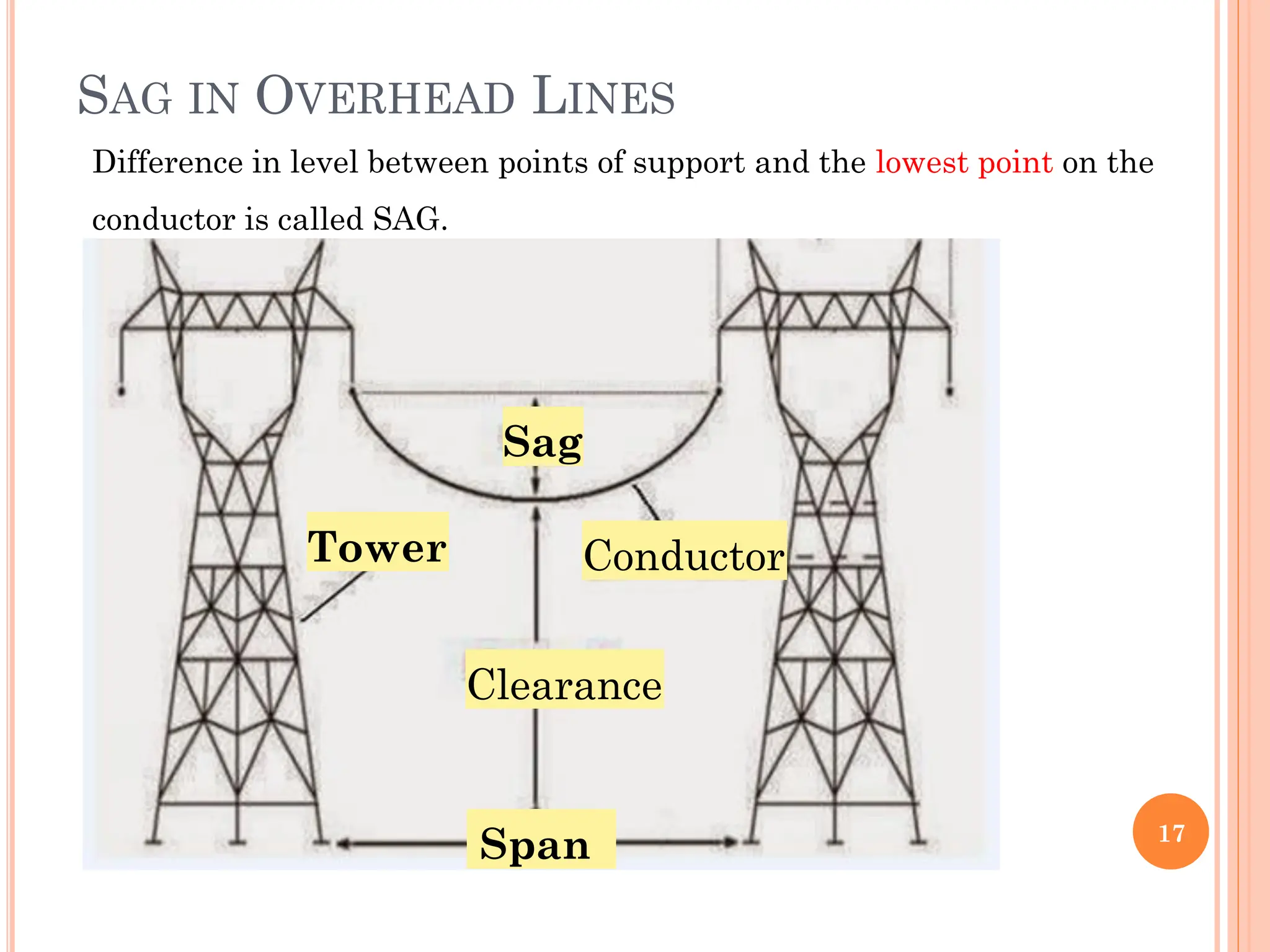
Sag
Conductor
Clearance
Tower
Span
Difference in level between points of support and the lowest point on the
conductor is called SAG.
SAG IN OVERHEAD LINES
18
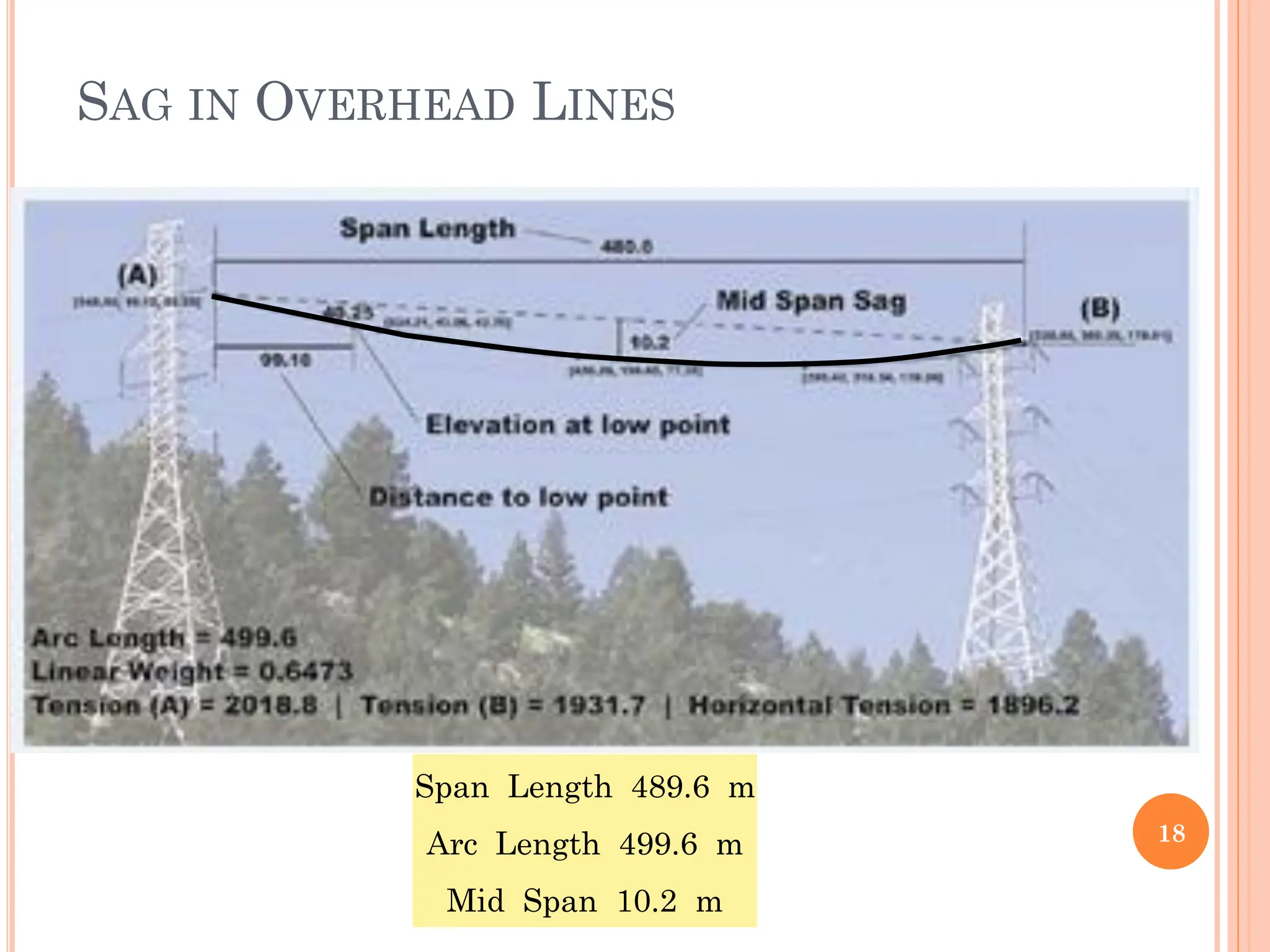
Span Length 489.6 m
Arc Length 499.6 m
Mid Span 10.2 m
SAG IN OVERHEAD LINES
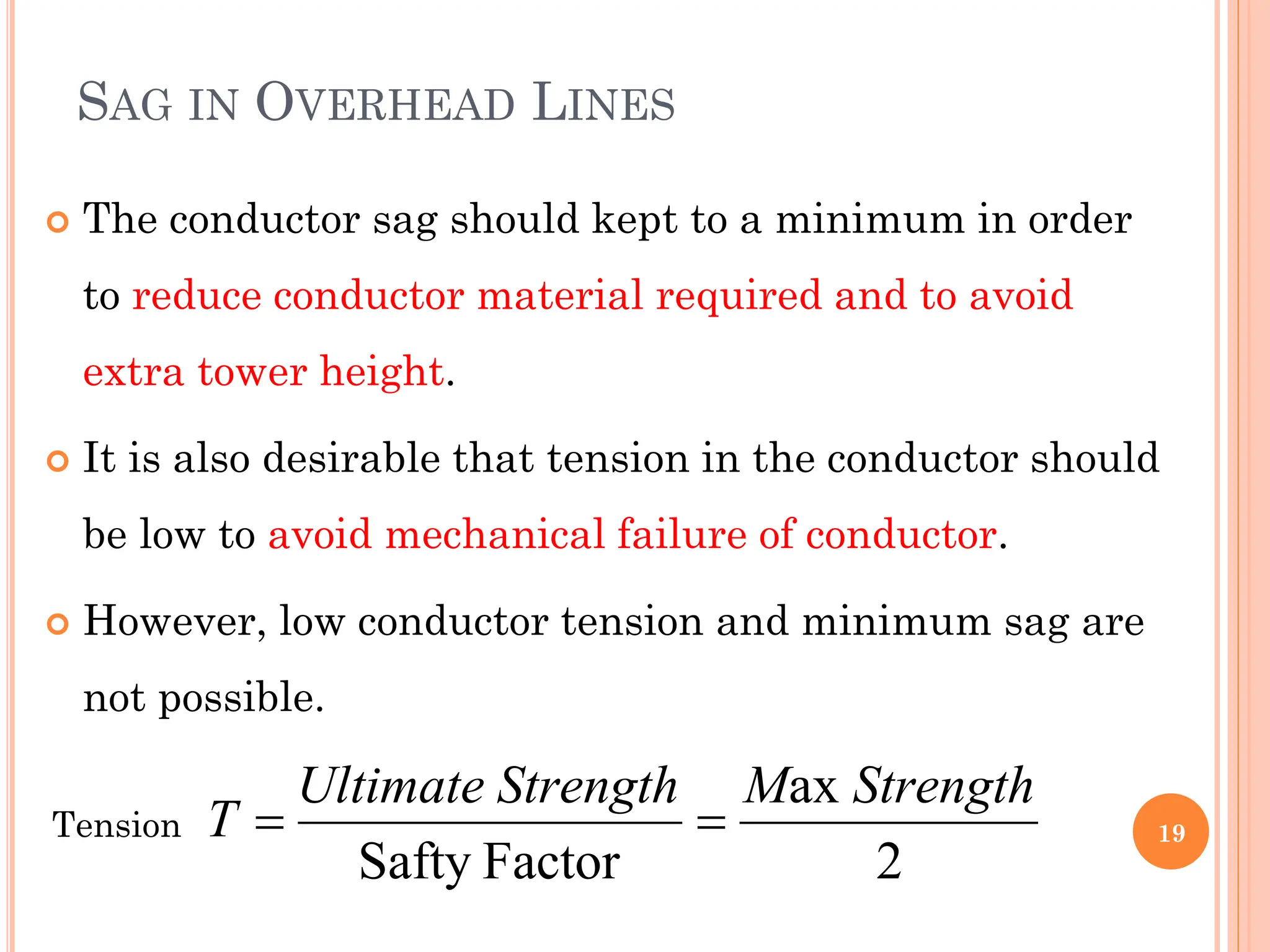
 The conductor sag should kept to a minimum in order
to reduce conductor material required and to avoid
extra tower height.
 It is also desirable that tension in the conductor should
be low to avoid mechanical failure of conductor.
 However, low conductor tension and minimum sag are
not possible.
19
2
ax
Factor
Safty
Strength
M
Strength
Ultimate
T 

Tension
SAG CALCULATION
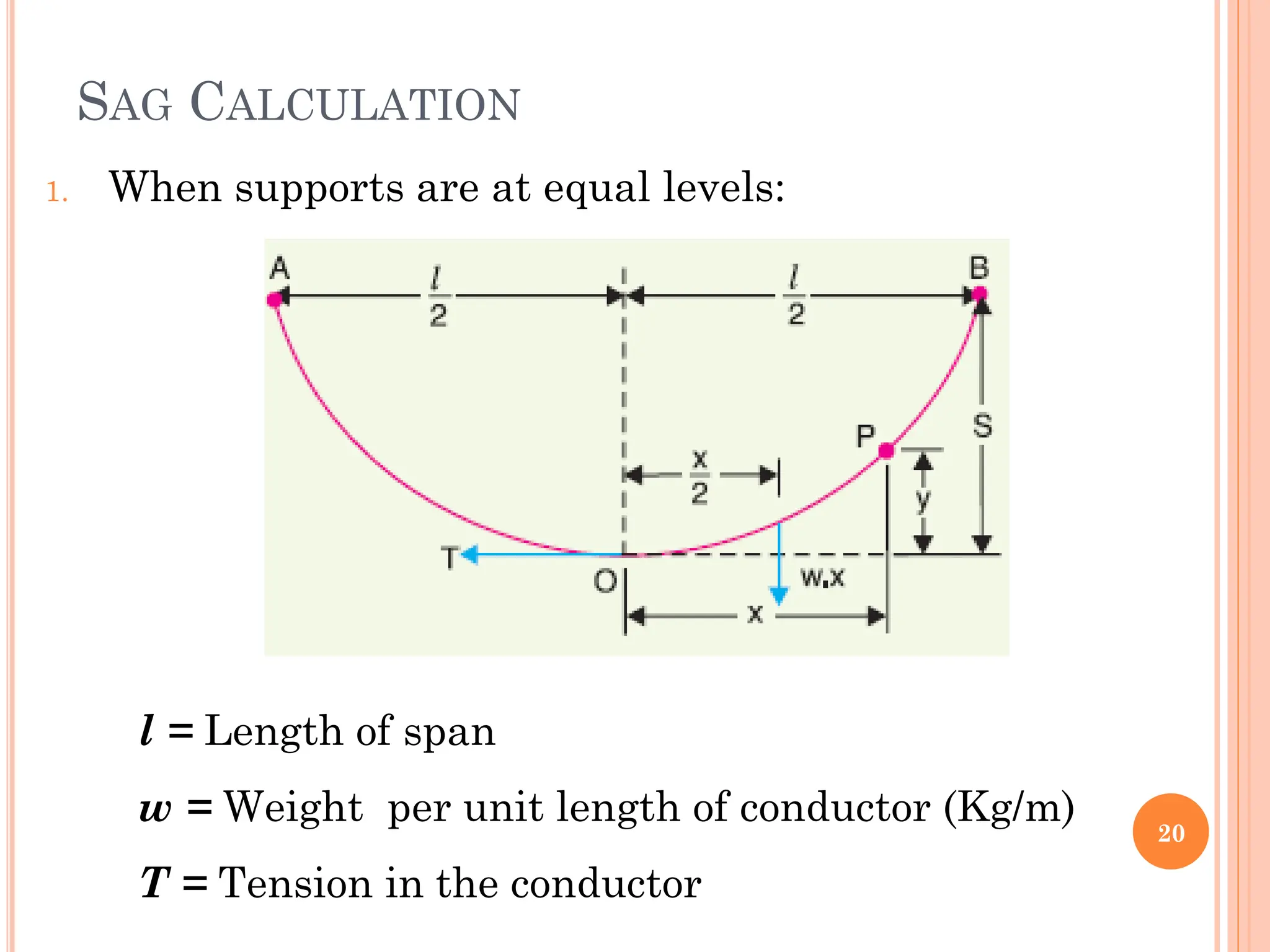
1. When supports are at equal levels:
20
l = Length of span
w = Weight per unit length of conductor (Kg/m)
T = Tension in the conductor
SAG CALCULATION
1. When supports are at equal levels:
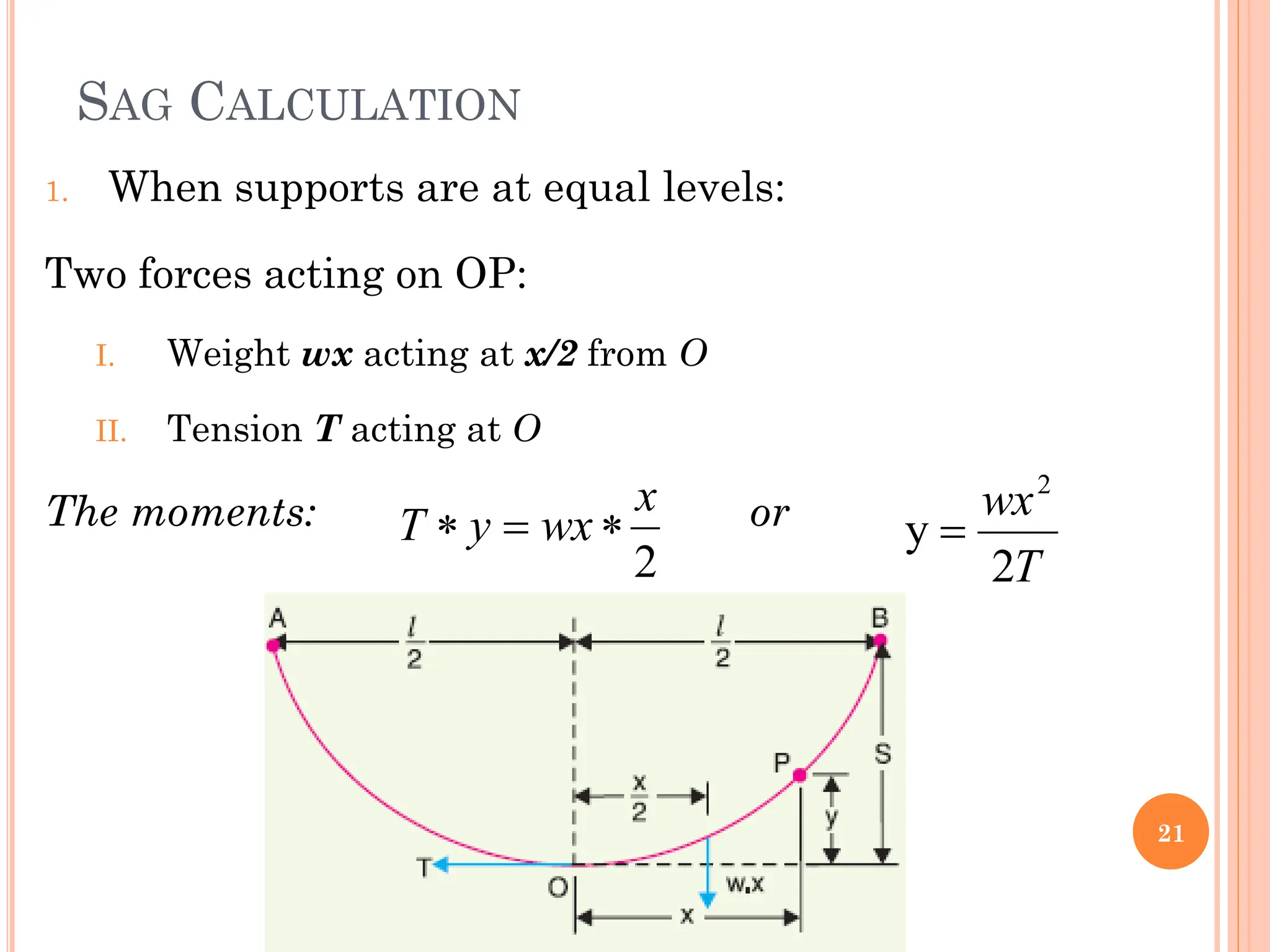
Two forces acting on OP:
I. Weight wx acting at x/2 from O
II. Tension T acting at O
The moments: or
21
2
x
wx
y
T 


T
wx
2
y
2

SAG CALCULATION
1. When supports are at equal levels:
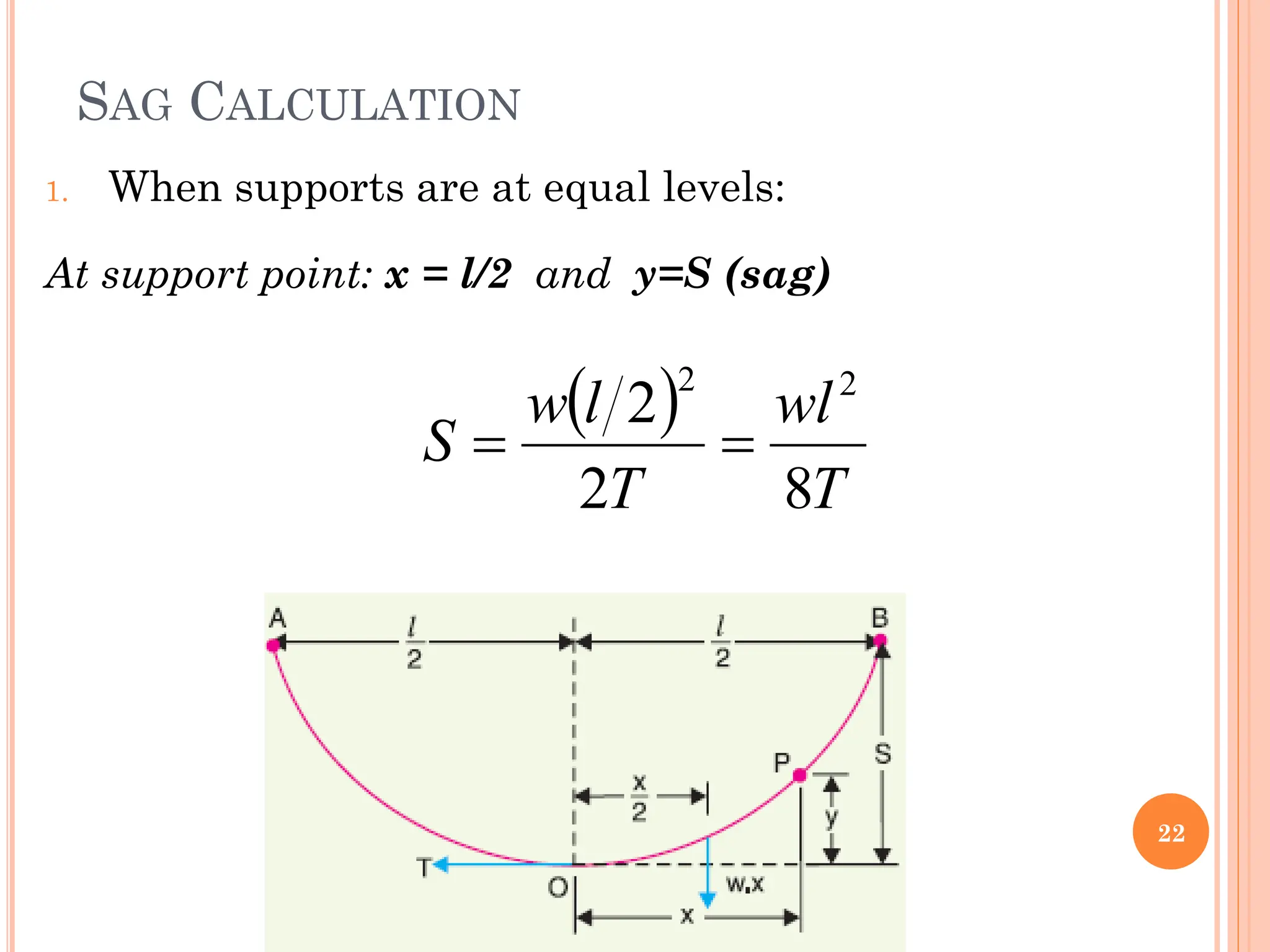
At support point: x = l/2 and y=S (sag)
22
 
T
wl
T
l
w
S
8
2
2 2
2


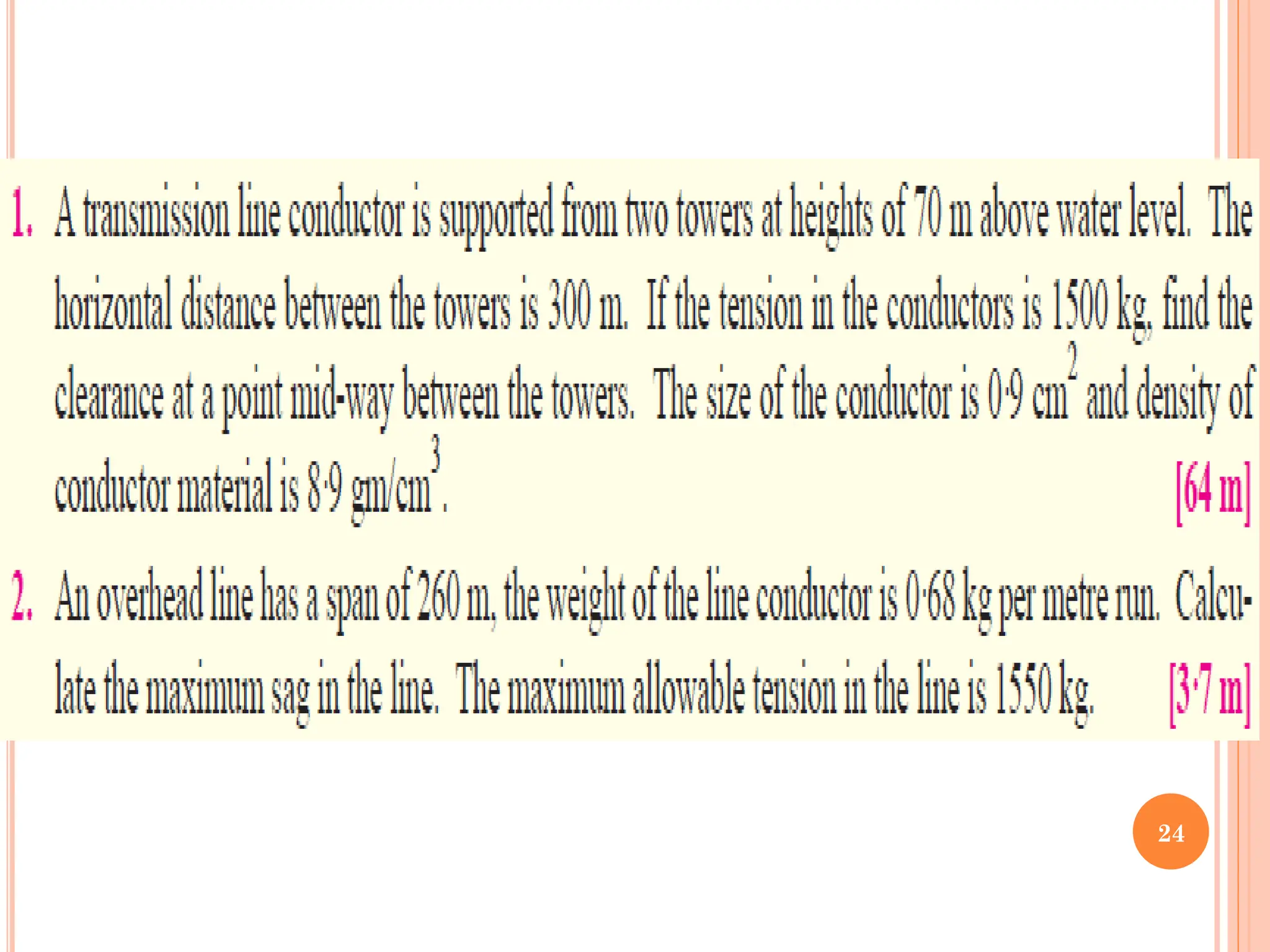
23
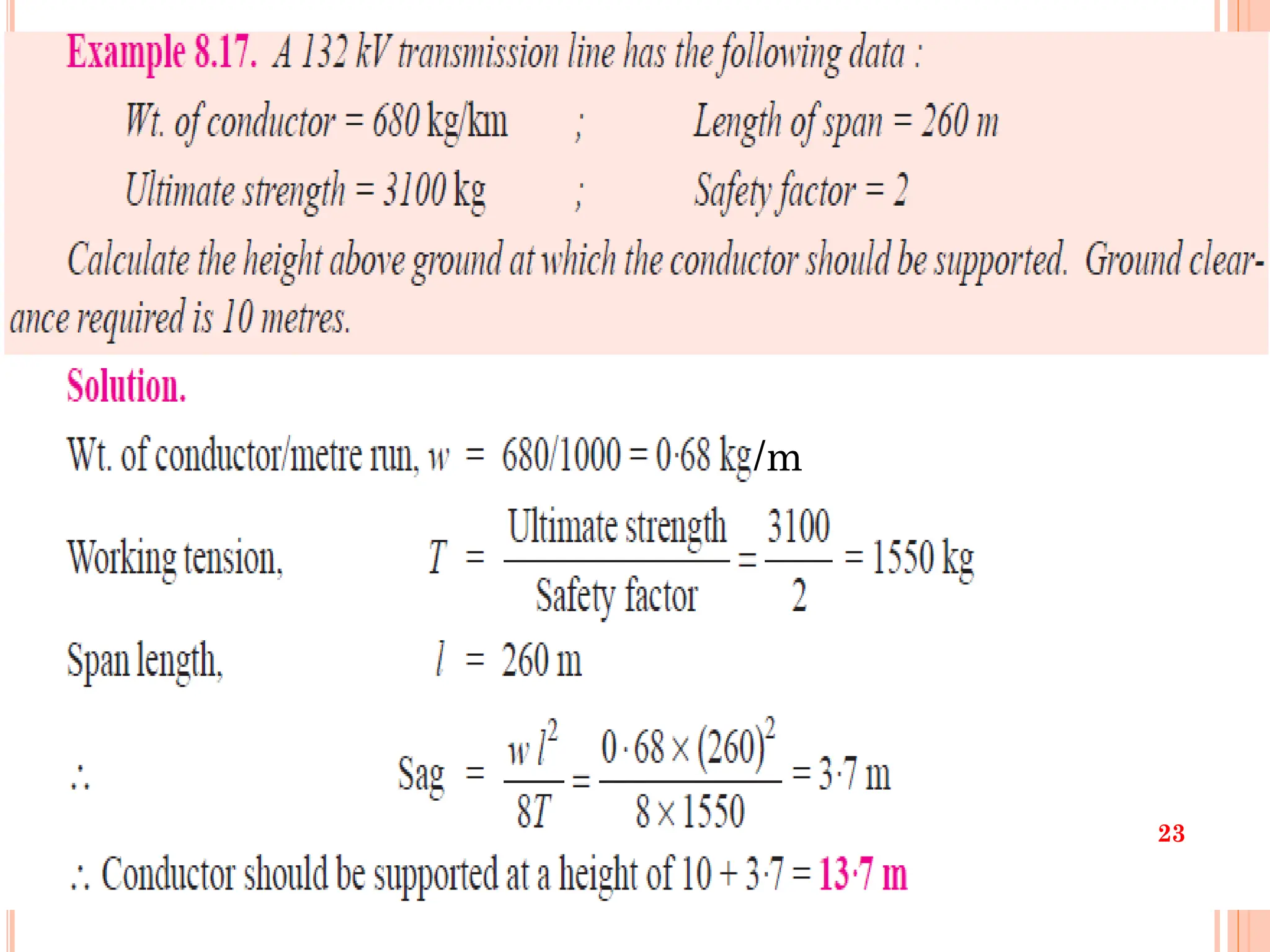
/m
24
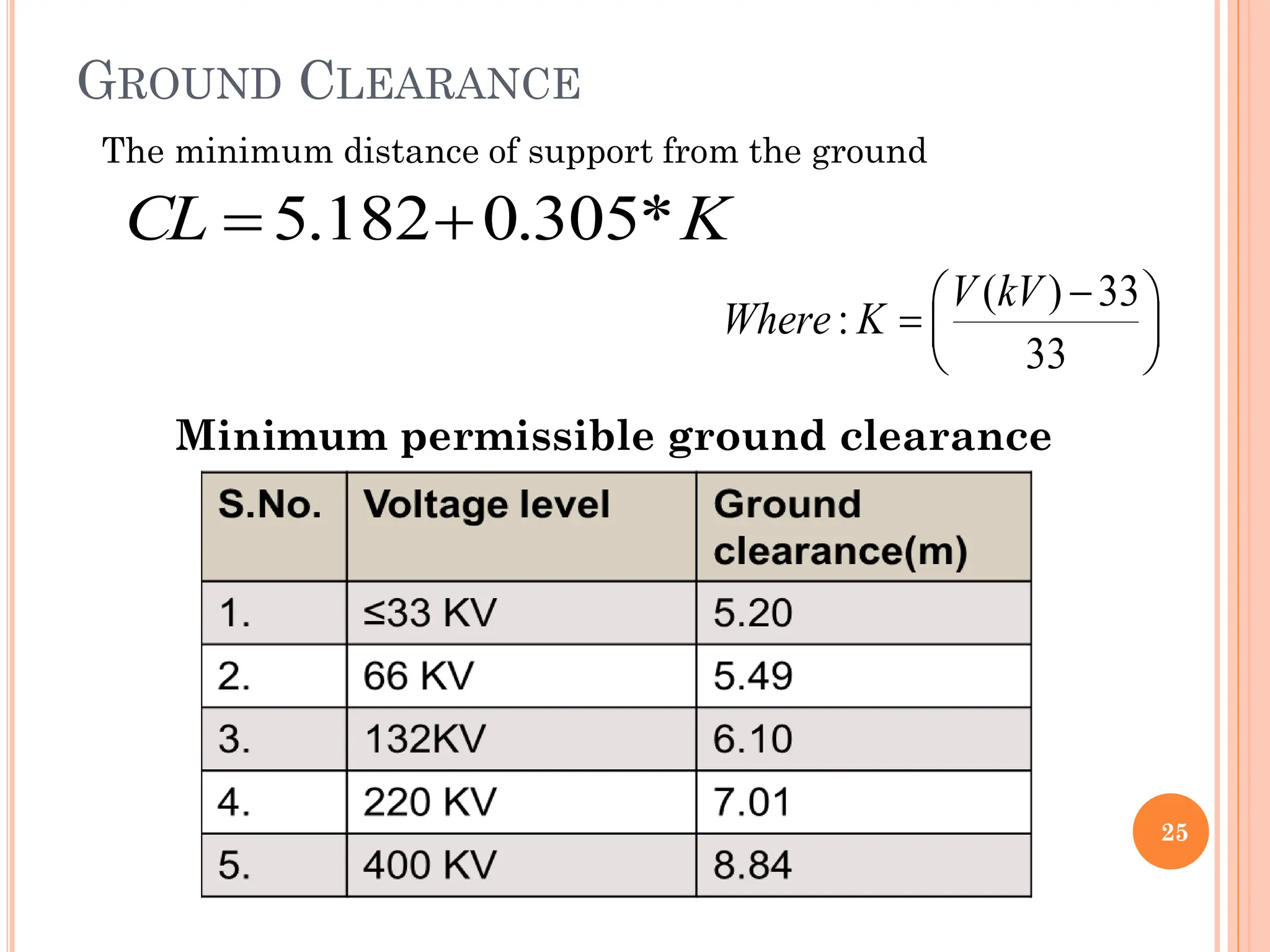
25
( ) 33
:
33
V kV
Where K

 
  
 
GROUND CLEARANCE
K
CL *
305
.
0
182
.
5 

Minimum permissible ground clearance
The minimum distance of support from the ground
26
CLEARANCE FOR POWER LINE CROSSINGS
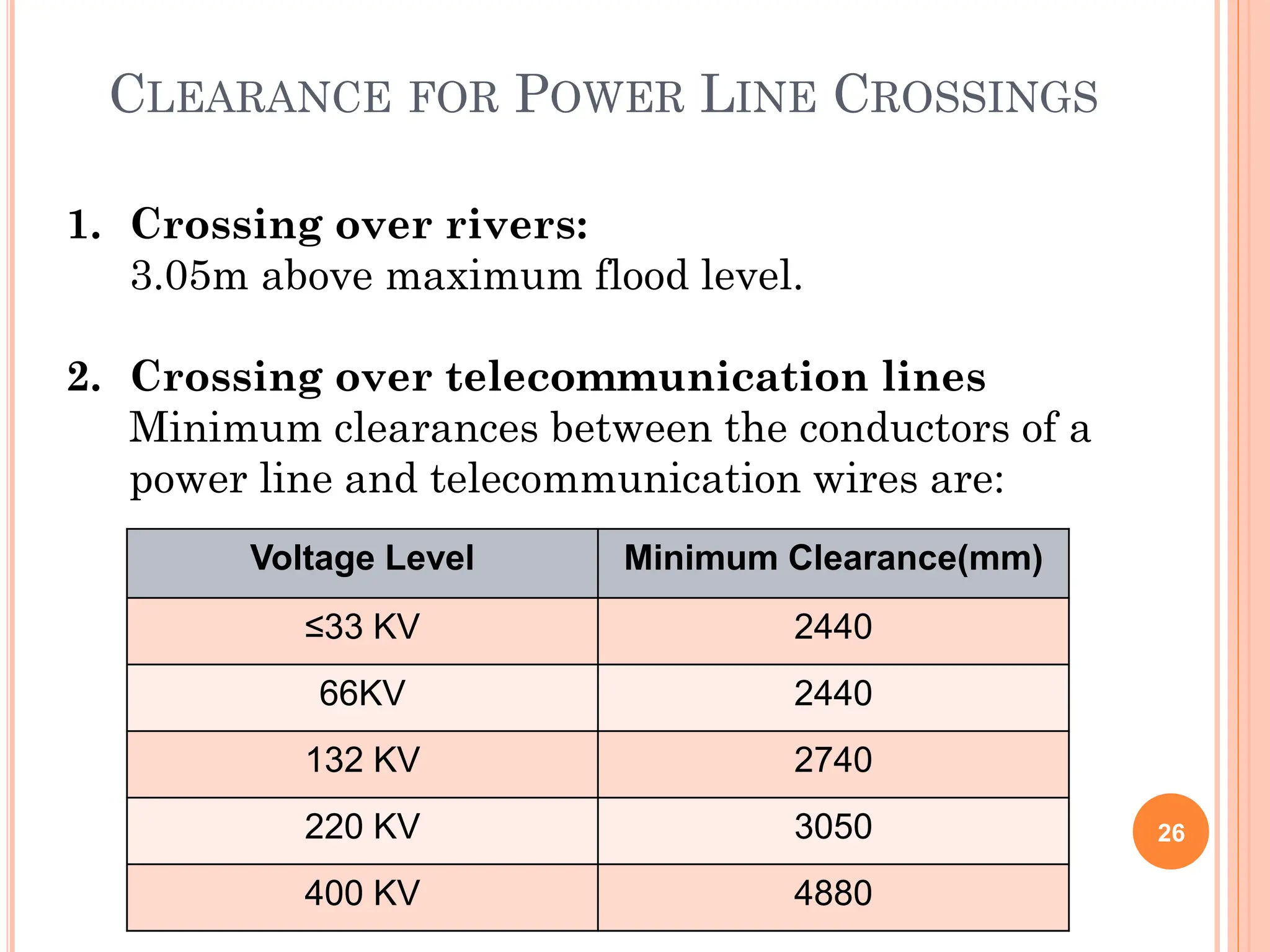
1. Crossing over rivers:
3.05m above maximum flood level.
2. Crossing over telecommunication lines
Minimum clearances between the conductors of a
power line and telecommunication wires are:
Voltage Level Minimum Clearance(mm)
≤33 KV 2440
66KV 2440
132 KV 2740
220 KV 3050
400 KV 4880
SPACING BETWEEN CONDUCTORS (PHASES)
27
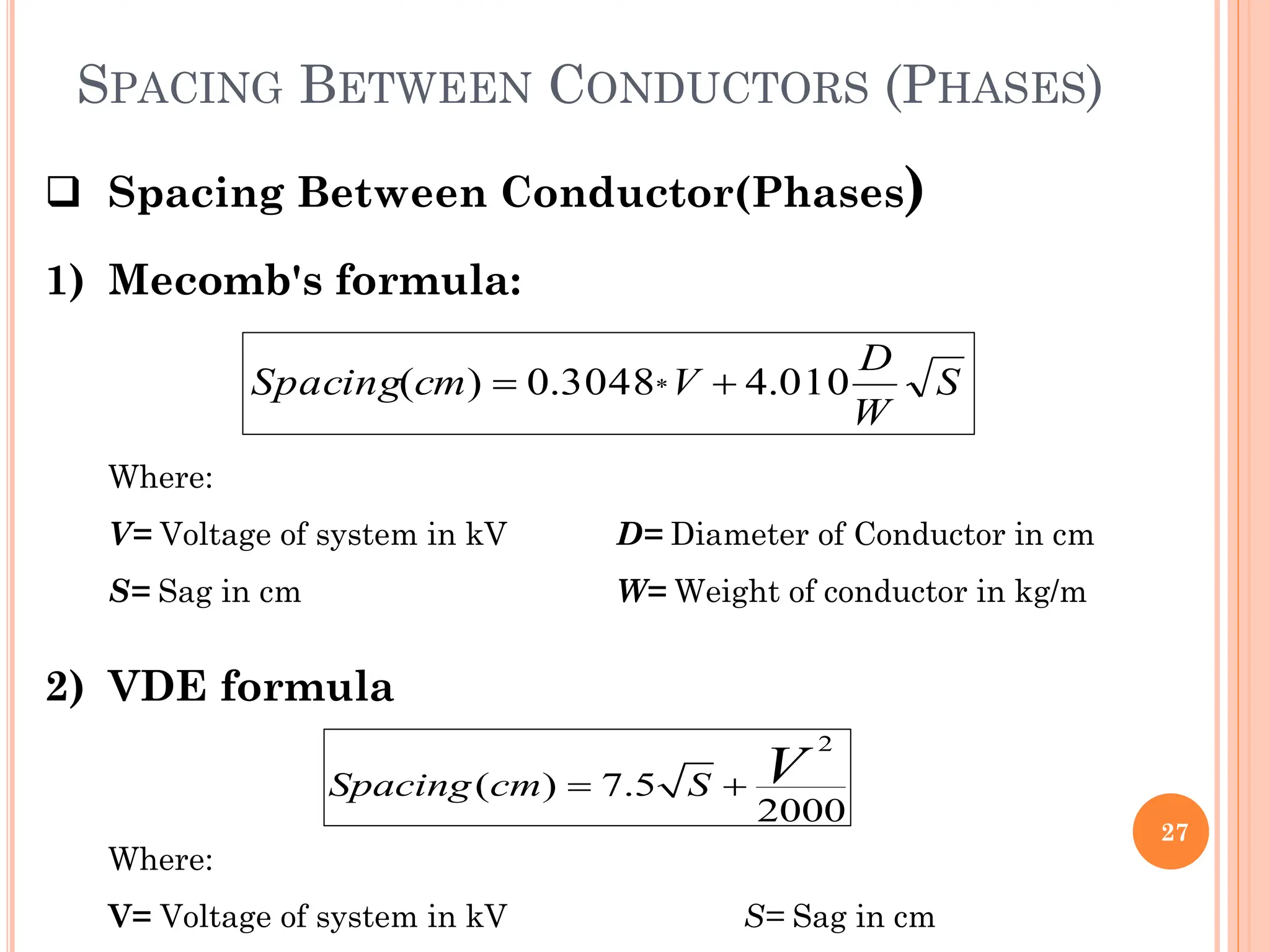
 Spacing Between Conductor(Phases)
1) Mecomb's formula:
2) VDE formula
S
W
D
V
cm
Spacing 010
.
4
3048
.
0
)
( * 

Where:
V= Voltage of system in kV D= Diameter of Conductor in cm
S= Sag in cm W= Weight of conductor in kg/m
2
( ) 7.5
2000
Spacing cm S V
 
Where:
V= Voltage of system in kV S= Sag in cm
SPACING BETWEEN CONDUCTORS (PHASES)
28
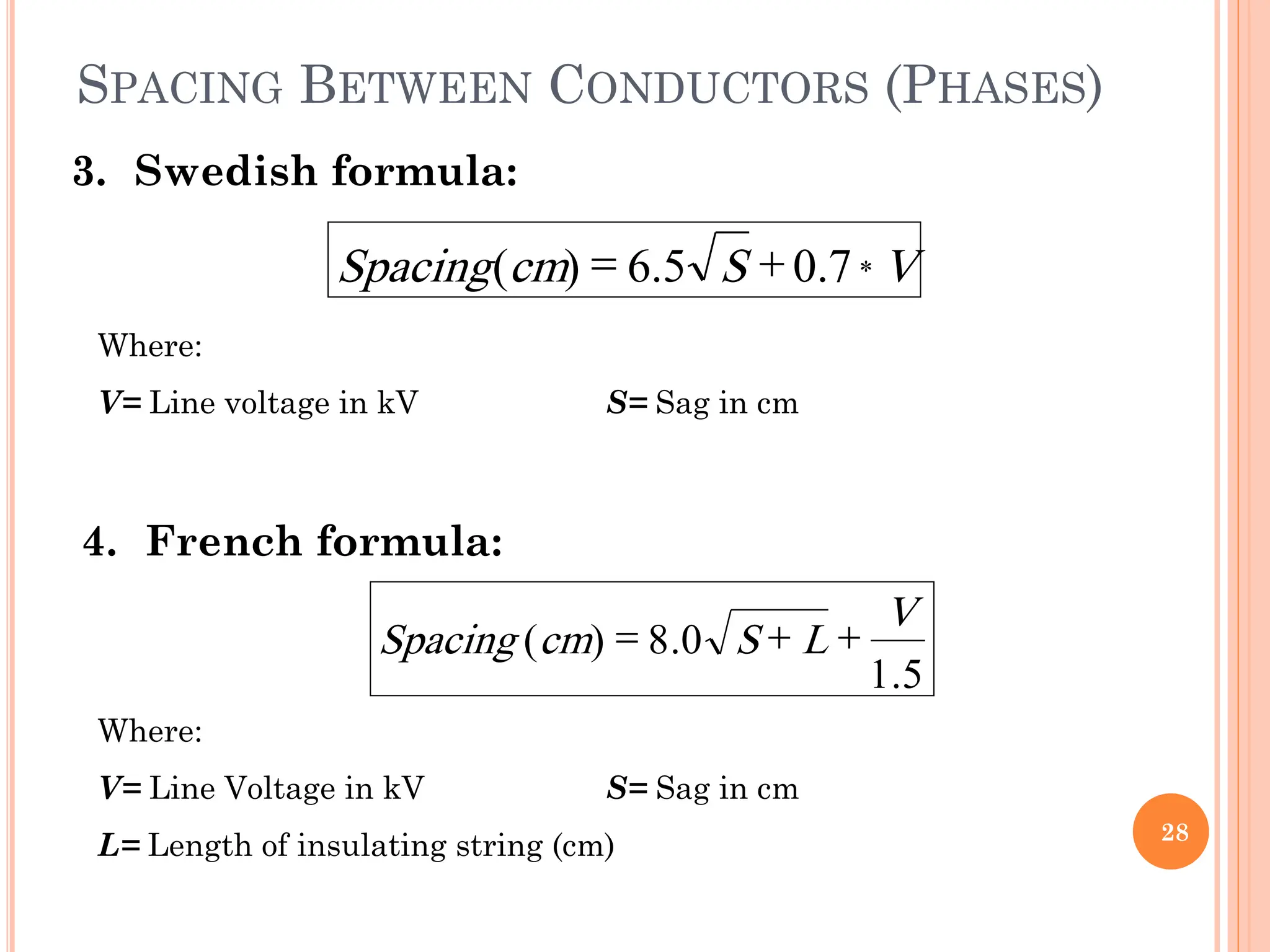
3. Swedish formula:
Where:
V= Line voltage in kV S= Sag in cm
4. French formula:
Where:
V= Line Voltage in kV S= Sag in cm
L= Length of insulating string (cm)
V
S
cm
Spacing *
7
.
0
5
.
6
)
( 

5
.
1
0
.
8
)
(
V
L
S
cm
Spacing 


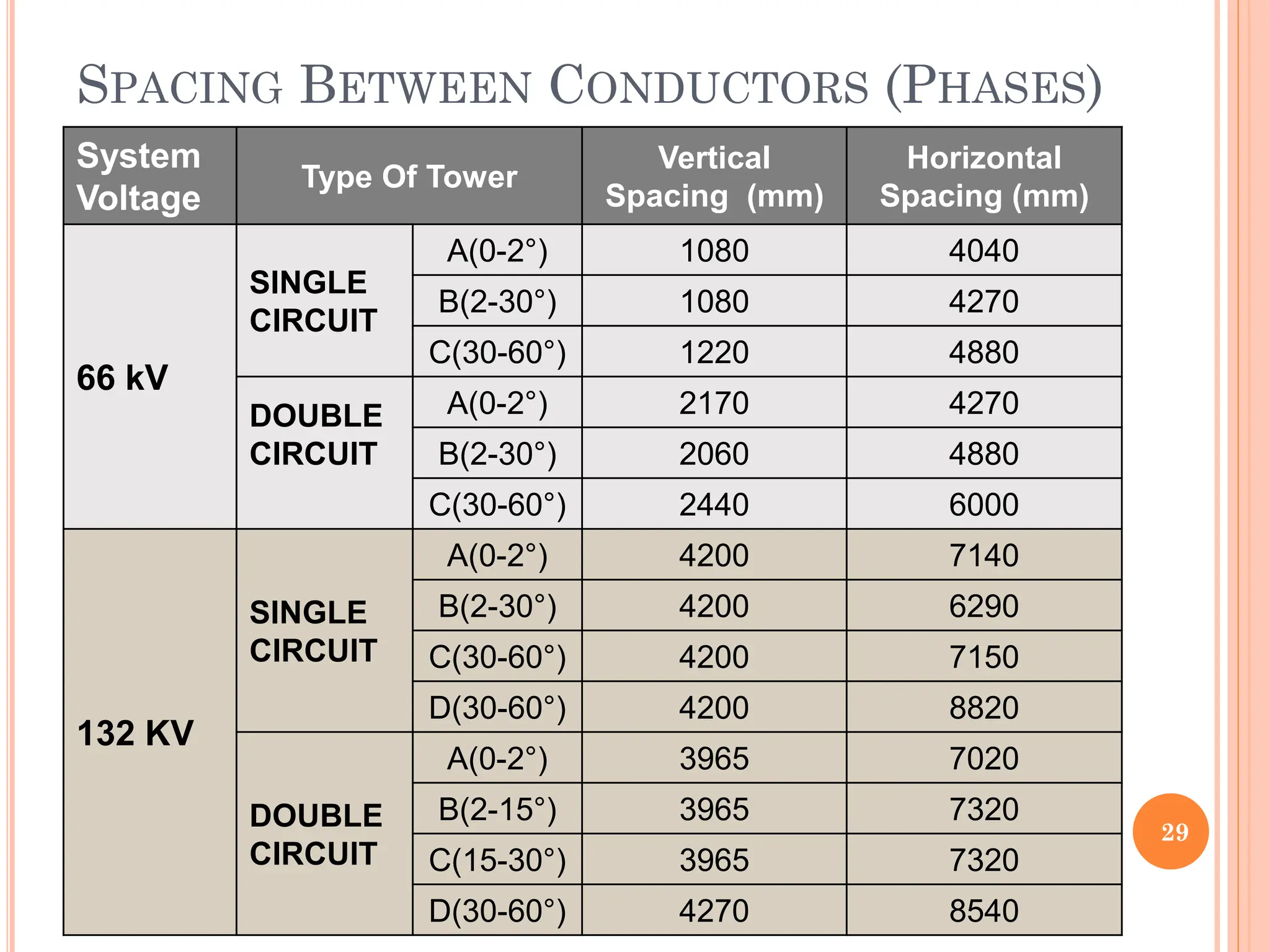
SPACING BETWEEN CONDUCTORS (PHASES)
29
System
Voltage
Type Of Tower
Vertical
Spacing (mm)
Horizontal
Spacing (mm)
66 kV
SINGLE
CIRCUIT
A(0-2°) 1080 4040
B(2-30°) 1080 4270
C(30-60°) 1220 4880
DOUBLE
CIRCUIT
A(0-2°) 2170 4270
B(2-30°) 2060 4880
C(30-60°) 2440 6000
132 KV
SINGLE
CIRCUIT
A(0-2°) 4200 7140
B(2-30°) 4200 6290
C(30-60°) 4200 7150
D(30-60°) 4200 8820
DOUBLE
CIRCUIT
A(0-2°) 3965 7020
B(2-15°) 3965 7320
C(15-30°) 3965 7320
D(30-60°) 4270 8540

Lec 2-circuits Transmission Line_2(modified).pdf

  • 1.
    Electrical Engineering EPM2221 Lectures: Dr.Sayed Ahmed Zaki, Electrical Power Engineering Department Faculty of Engineering Cairo University
  • 2.
  • 3.
    ECONOMIC CHOICE OFCONDUCTOR SIZE Minimum total annual cost of transmission Kelvin’s Law 1. Annual charge on capital cost P1: Annual cost of insulators and supports a P2: Annual cost of conductor material a : Cross section area 2. Annual cost of energy wasted P3: Annual cost of amount of energy lost in the conductor as I2R 3 2 1 P a P   a P3 ted energy was of cost Annual 
  • 4.
    ECONOMIC CHOICE OFCONDUCTOR SIZE Minimum total annual cost of transmission Kelvin’s Law For Minimum C 4 a P P a P C 3 2 1 cost, Annual Total    a P a P a P P a P P da dC 3 2 2 3 2 2 3 2 0 0        The most economical area of conductor is that for which the variable part of annual charge is equal to the cost of energy losses per year.
  • 5.
    ECONOMIC CHOICE OFCONDUCTOR SIZE Minimum total annual cost of transmission Kelvin’s Law 5 a
  • 6.
    ECONOMIC CHOICE OFCONDUCTOR SIZE 6
  • 7.
    ECONOMIC CHOICE OFCONDUCTOR SIZE 7
  • 8.
    ECONOMIC CHOICE OFCONDUCTOR SIZE 8 , Assume l= 1 km
  • 9.
    ECONOMIC CHOICE OFCONDUCTOR SIZE 9
  • 10.
    ECONOMIC CHOICE OFCONDUCTOR SIZE 10
  • 11.
    ECONOMIC CHOICE OFCONDUCTOR SIZE 11
  • 12.
    OBJECTIVES 12 Upon completing thispart, the student should be able to:  Learn typical construction of electrical power systems  List and describe the different types of transmission systems  List and describe the different elements and materials of transmission systems  Determine the economic choice of conductor size  Determine the economical transmission voltage  Describe the various aspects of mechanical design
  • 13.
    ECONOMIC CHOICE OFTRANSMISSION VOLTAGE Capital Cost of transmission system depends on cost of: 1. Conductor Material (C.S.A) 2. Transmission Losses 3. Insulation and supports 4. Transformers at SE & RE 5. Lightning Arrestor 6. Switchgears protection 13 Voltage
  • 14.
    ECONOMIC CHOICE OFTRANSMISSION VOLTAGE 14 (kV) Typical Economic Voltage Level for Efficient Transmission
  • 15.
    ECONOMIC CHOICE OFTRANSMISSION VOLTAGE 15 3 5.5 0.62 5 1 0 P V l   V = Line Voltage in kV l = Distance of transmission line in km P = Maximum kW per phase to be delivered to single circuit Empirical Formula of optimum voltage
  • 16.
  • 17.
    SAG IN OVERHEADLINES 17 Sag Conductor Clearance Tower Span Difference in level between points of support and the lowest point on the conductor is called SAG.
  • 18.
    SAG IN OVERHEADLINES 18 Span Length 489.6 m Arc Length 499.6 m Mid Span 10.2 m
  • 19.
    SAG IN OVERHEADLINES  The conductor sag should kept to a minimum in order to reduce conductor material required and to avoid extra tower height.  It is also desirable that tension in the conductor should be low to avoid mechanical failure of conductor.  However, low conductor tension and minimum sag are not possible. 19 2 ax Factor Safty Strength M Strength Ultimate T   Tension
  • 20.
    SAG CALCULATION 1. Whensupports are at equal levels: 20 l = Length of span w = Weight per unit length of conductor (Kg/m) T = Tension in the conductor
  • 21.
    SAG CALCULATION 1. Whensupports are at equal levels: Two forces acting on OP: I. Weight wx acting at x/2 from O II. Tension T acting at O The moments: or 21 2 x wx y T    T wx 2 y 2 
  • 22.
    SAG CALCULATION 1. Whensupports are at equal levels: At support point: x = l/2 and y=S (sag) 22   T wl T l w S 8 2 2 2 2  
  • 23.
  • 24.
  • 25.
    25 ( ) 33 : 33 VkV Where K         GROUND CLEARANCE K CL * 305 . 0 182 . 5   Minimum permissible ground clearance The minimum distance of support from the ground
  • 26.
    26 CLEARANCE FOR POWERLINE CROSSINGS 1. Crossing over rivers: 3.05m above maximum flood level. 2. Crossing over telecommunication lines Minimum clearances between the conductors of a power line and telecommunication wires are: Voltage Level Minimum Clearance(mm) ≤33 KV 2440 66KV 2440 132 KV 2740 220 KV 3050 400 KV 4880
  • 27.
    SPACING BETWEEN CONDUCTORS(PHASES) 27  Spacing Between Conductor(Phases) 1) Mecomb's formula: 2) VDE formula S W D V cm Spacing 010 . 4 3048 . 0 ) ( *   Where: V= Voltage of system in kV D= Diameter of Conductor in cm S= Sag in cm W= Weight of conductor in kg/m 2 ( ) 7.5 2000 Spacing cm S V   Where: V= Voltage of system in kV S= Sag in cm
  • 28.
    SPACING BETWEEN CONDUCTORS(PHASES) 28 3. Swedish formula: Where: V= Line voltage in kV S= Sag in cm 4. French formula: Where: V= Line Voltage in kV S= Sag in cm L= Length of insulating string (cm) V S cm Spacing * 7 . 0 5 . 6 ) (   5 . 1 0 . 8 ) ( V L S cm Spacing   
  • 29.
    SPACING BETWEEN CONDUCTORS(PHASES) 29 System Voltage Type Of Tower Vertical Spacing (mm) Horizontal Spacing (mm) 66 kV SINGLE CIRCUIT A(0-2°) 1080 4040 B(2-30°) 1080 4270 C(30-60°) 1220 4880 DOUBLE CIRCUIT A(0-2°) 2170 4270 B(2-30°) 2060 4880 C(30-60°) 2440 6000 132 KV SINGLE CIRCUIT A(0-2°) 4200 7140 B(2-30°) 4200 6290 C(30-60°) 4200 7150 D(30-60°) 4200 8820 DOUBLE CIRCUIT A(0-2°) 3965 7020 B(2-15°) 3965 7320 C(15-30°) 3965 7320 D(30-60°) 4270 8540