Wherever the art of medicine is loved,
there is also a love of humanity.
– Hippocrates
Yahyia Khalfan Mohammed Al-Abri
90440
Junior

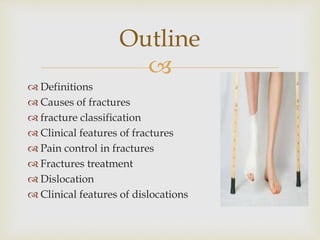
 Definitions
 Causes of fractures
 fracture classification
 Clinical features of fractures
 Pain control in fractures
 Fractures treatment
 Dislocation
 Clinical features of dislocations
Outline

 What is fracture?
 Is a break in the structural continuity of bone.
 What is dislocation?
 The joint surface is completely displaced and are no
longer in contact.
Definitions

 Sudden trauma.
 Most common
 Direct vs indirect
 Stress and fatigue fractures.
 Most in tibia , fibula , and metatarsal.
 Pathological fractures
 osteoporosis , osteogenesis imperfecta ,Paget's disease
,bone cyst and metastasis.
Causes of fractures

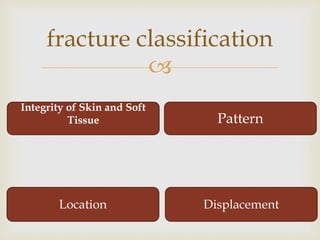
fracture classification
Displacement
Pattern
Location
Integrity of Skin and Soft
Tissue

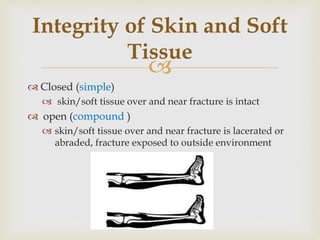
 Closed (simple)
 skin/soft tissue over and near fracture is intact
 open (compound )
 skin/soft tissue over and near fracture is lacerated or
abraded, fracture exposed to outside environment
Integrity of Skin and Soft
Tissue

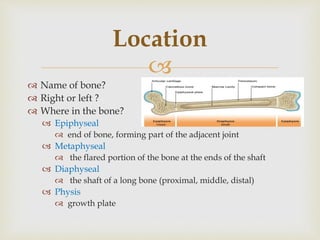
 Name of bone?
 Right or left ?
 Where in the bone?
 Epiphyseal
 end of bone, forming part of the adjacent joint
 Metaphyseal
 the flared portion of the bone at the ends of the shaft
 Diaphyseal
 the shaft of a long bone (proximal, middle, distal)
 Physis
 growth plate
Location

Pattern
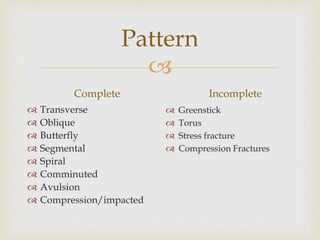
Complete
 Transverse
 Oblique
 Butterfly
 Segmental
 Spiral
 Comminuted
 Avulsion
 Compression/impacted
Incomplete
 Greenstick
 Torus
 Stress fracture
 Compression Fractures
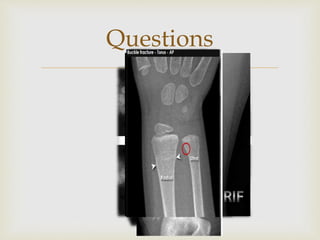
Orientation/Fracture Pattern
Transverse ObliqueButterfly SegmentalSpiral
Comminuted/
multi-fragmentaryAvulsion Compression/impactedGreen-stick Torus

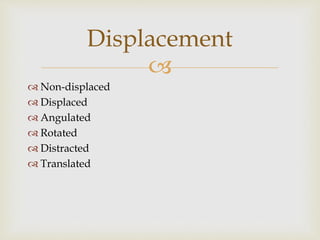
Questions

 Non-displaced
 Displaced
 Angulated
 Rotated
 Distracted
 Translated
Displacement

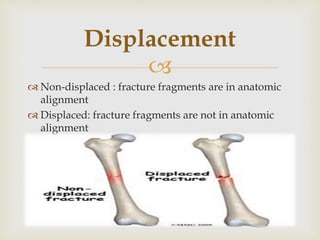
 Non-displaced : fracture fragments are in anatomic
alignment
 Displaced: fracture fragments are not in anatomic
alignment
Displacement

Displacement
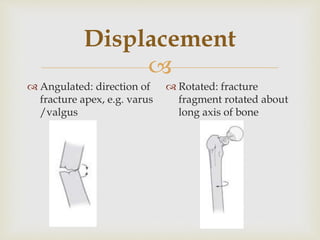
 Angulated: direction of
fracture apex, e.g. varus
/valgus
 Rotated: fracture
fragment rotated about
long axis of bone

 Distracted : fracture fragments are separated by a
gap
 Translated percentage of overlapping bone at
fracture site
Displacement

Sign and
symptoms
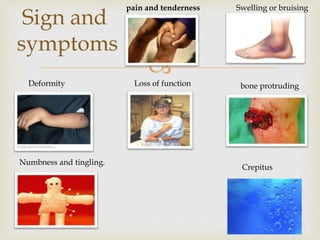
pain and tenderness Swelling or bruising
Deformity Loss of function bone protruding
Numbness and tingling.
Crepitus

 History
 History of injury followed by inability to use the injured limb.
 Age and mechanism of injury.
 If fracture occurs with trivial trauma suspect pathological lesion.
 Pain, swelling and bruising are common symptoms but they do not
distinguish a fracture form soft tissue injury.
 Deformity more suggestive
 Symptoms of associated injury( numbness or loss of movement , skin
pallor or cyanosis, blood in the urine, difficulty with breathing or
transit lose of consciousness) get distract by the main injury.
 Pervious injury or musculoskeletal problems( confusion with the x-
ray)
 General medical history (preparation for anesthesia or operation)
Clinical features( history)

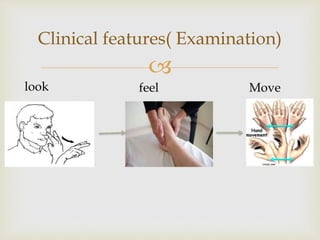
Clinical features( Examination)
look feel Move

 Look:
 Swelling, bruising and deformity
 skin is intact?
 posture of the distal extremity and the color of the skin
(for tell-tale signs of nerve or vessel damage).
 Feel:
 Palpate for tenderness
 Test for vascular and peripheral nerve abnormalities
 Move:
 Crepitus and abnormal movement
Examination

 Crepitus and abnormal movement should be tested
for only in unconscious patient. Usually it is more
important to ask if the patient can move the joint
distal to the injury.
Move

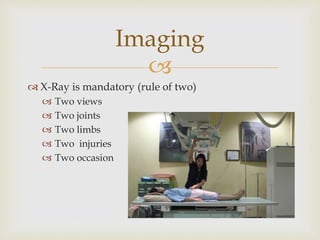
 X-Ray is mandatory (rule of two)
 Two views
 Two joints
 Two limbs
 Two injuries
 Two occasion
Imaging

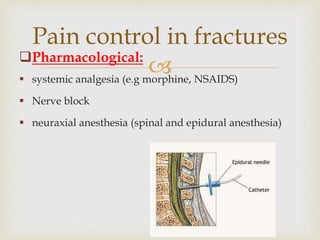
Pain control in fractures
Pharmacological:
 systemic analgesia (e.g morphine, NSAIDS)
 Nerve block
 neuraxial anesthesia (spinal and epidural anesthesia)

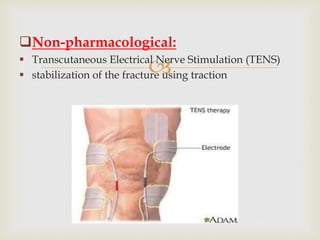
Non-pharmacological:
 Transcutaneous Electrical Nerve Stimulation (TENS)
 stabilization of the fracture using traction

 The general aim of early fracture management is to
control hemorrhage, provide pain relief, prevent
ischemia-reperfusion injury, and remove potential
sources of contamination (foreign body and
nonviable tissues)
Fracture treatment

Fractures treatment
Reduce
Hold
Exercise

Reduce (Closed reduction )
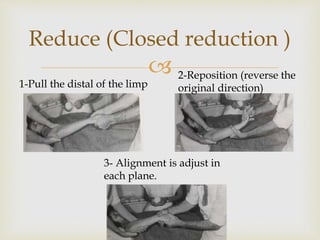
1-Pull the distal of the limp
2-Reposition (reverse the
original direction)
3- Alignment is adjust in
each plane.

 Open reduction
 Operative reduction
When to use it??
 When closed reduction failed
 When there is large articular fragment that needs
accurate positioning
 Avulsion fracture
 When an operation needed for associated injuries
 Arterial damage
Reduce (open reduction )
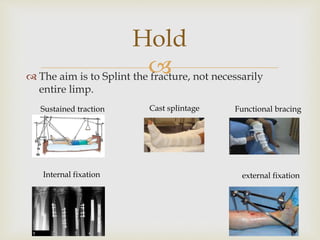
 The aim is to Splint the fracture, not necessarily
entire limp.
Hold
Sustained traction Cast splintage Functional bracing
Internal fixation external fixation

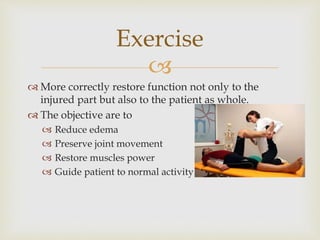
 More correctly restore function not only to the
injured part but also to the patient as whole.
 The objective are to
 Reduce edema
 Preserve joint movement
 Restore muscles power
 Guide patient to normal activity
Exercise

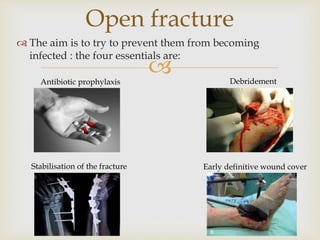
 The aim is to try to prevent them from becoming
infected : the four essentials are:
Open fracture
Early definitive wound coverStabilisation of the fracture
DebridementAntibiotic prophylaxis

Common site of
dislocations
 The most commonly
dislocated is the shoulder
joint.[13]
 Elbow: Posterior dislocation,
90% of all elbow
dislocations[14]
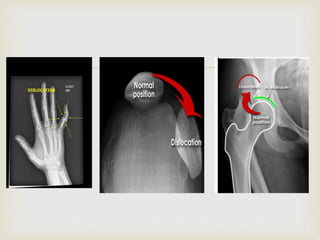
 Wrist: Lunate and Perilunate
dislocation most common[15]
 Finger: Interphalangeal (IP)
or metacarpophalangeal
(MCP) joint dislocations[16]
 Hip: Posterior and anterior
dislocation of hip

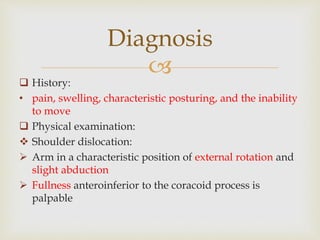
Diagnosis
 History:
• pain, swelling, characteristic posturing, and the inability
to move
 Physical examination:
 Shoulder dislocation:
 Arm in a characteristic position of external rotation and
slight abduction
 Fullness anteroinferior to the coracoid process is
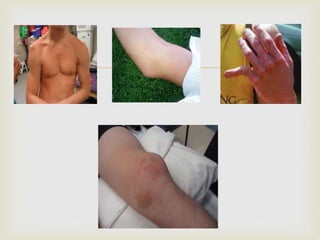
palpable

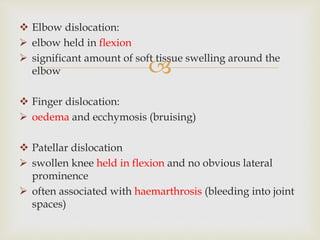
 Elbow dislocation:
 elbow held in flexion
 significant amount of soft tissue swelling around the
elbow
 Finger dislocation:
 oedema and ecchymosis (bruising)
 Patellar dislocation
 swollen knee held in flexion and no obvious lateral
prominence
 often associated with haemarthrosis (bleeding into joint
spaces)

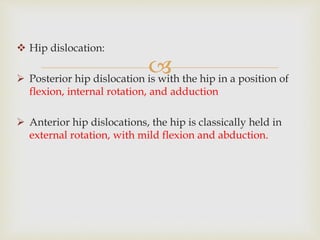
 Hip dislocation:
 Posterior hip dislocation is with the hip in a position of
flexion, internal rotation, and adduction
 Anterior hip dislocations, the hip is classically held in
external rotation, with mild flexion and abduction.


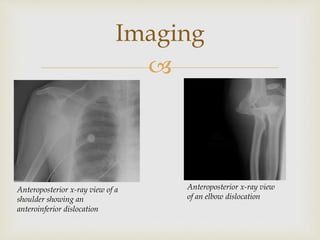
Imaging
Anteroposterior x-ray view of a
shoulder showing an
anteroinferior dislocation
Anteroposterior x-ray view
of an elbow dislocation


 Comprehensive medical reference and review for the
Medical Council of Canada.
 Apley's concise system of orthopaedics and fracture
 Medscape
 radiologymasterclass.co.uk
 Pain Management Interventions for Hip
Fracture(http://www.ncbi.nlm.nih.gov/books/NBK
56661/)
References

Fractures and dislocations

  • 1.
    Wherever the artof medicine is loved, there is also a love of humanity. – Hippocrates
  • 2.
    Yahyia Khalfan MohammedAl-Abri 90440 Junior
  • 3.
      Definitions  Causesof fractures  fracture classification  Clinical features of fractures  Pain control in fractures  Fractures treatment  Dislocation  Clinical features of dislocations Outline
  • 4.
      What isfracture?  Is a break in the structural continuity of bone.  What is dislocation?  The joint surface is completely displaced and are no longer in contact. Definitions
  • 5.
      Sudden trauma. Most common  Direct vs indirect  Stress and fatigue fractures.  Most in tibia , fibula , and metatarsal.  Pathological fractures  osteoporosis , osteogenesis imperfecta ,Paget's disease ,bone cyst and metastasis. Causes of fractures
  • 6.
  • 7.
      Closed (simple) skin/soft tissue over and near fracture is intact  open (compound )  skin/soft tissue over and near fracture is lacerated or abraded, fracture exposed to outside environment Integrity of Skin and Soft Tissue
  • 8.
      Name ofbone?  Right or left ?  Where in the bone?  Epiphyseal  end of bone, forming part of the adjacent joint  Metaphyseal  the flared portion of the bone at the ends of the shaft  Diaphyseal  the shaft of a long bone (proximal, middle, distal)  Physis  growth plate Location
  • 9.
     Pattern Complete  Transverse  Oblique Butterfly  Segmental  Spiral  Comminuted  Avulsion  Compression/impacted Incomplete  Greenstick  Torus  Stress fracture  Compression Fractures
  • 10.
    Orientation/Fracture Pattern Transverse ObliqueButterflySegmentalSpiral Comminuted/ multi-fragmentaryAvulsion Compression/impactedGreen-stick Torus
  • 11.
  • 12.
      Non-displaced  Displaced Angulated  Rotated  Distracted  Translated Displacement
  • 13.
      Non-displaced :fracture fragments are in anatomic alignment  Displaced: fracture fragments are not in anatomic alignment Displacement
  • 14.
     Displacement  Angulated: directionof fracture apex, e.g. varus /valgus  Rotated: fracture fragment rotated about long axis of bone
  • 15.
      Distracted :fracture fragments are separated by a gap  Translated percentage of overlapping bone at fracture site Displacement
  • 16.
     Sign and symptoms pain andtenderness Swelling or bruising Deformity Loss of function bone protruding Numbness and tingling. Crepitus
  • 17.
      History  Historyof injury followed by inability to use the injured limb.  Age and mechanism of injury.  If fracture occurs with trivial trauma suspect pathological lesion.  Pain, swelling and bruising are common symptoms but they do not distinguish a fracture form soft tissue injury.  Deformity more suggestive  Symptoms of associated injury( numbness or loss of movement , skin pallor or cyanosis, blood in the urine, difficulty with breathing or transit lose of consciousness) get distract by the main injury.  Pervious injury or musculoskeletal problems( confusion with the x- ray)  General medical history (preparation for anesthesia or operation) Clinical features( history)
  • 18.
  • 19.
      Look:  Swelling,bruising and deformity  skin is intact?  posture of the distal extremity and the color of the skin (for tell-tale signs of nerve or vessel damage).  Feel:  Palpate for tenderness  Test for vascular and peripheral nerve abnormalities  Move:  Crepitus and abnormal movement Examination
  • 20.
      Crepitus andabnormal movement should be tested for only in unconscious patient. Usually it is more important to ask if the patient can move the joint distal to the injury. Move
  • 21.
      X-Ray ismandatory (rule of two)  Two views  Two joints  Two limbs  Two injuries  Two occasion Imaging
  • 22.
     Pain control infractures Pharmacological:  systemic analgesia (e.g morphine, NSAIDS)  Nerve block  neuraxial anesthesia (spinal and epidural anesthesia)
  • 23.
     Non-pharmacological:  Transcutaneous ElectricalNerve Stimulation (TENS)  stabilization of the fracture using traction
  • 24.
      The generalaim of early fracture management is to control hemorrhage, provide pain relief, prevent ischemia-reperfusion injury, and remove potential sources of contamination (foreign body and nonviable tissues) Fracture treatment
  • 25.
  • 26.
     Reduce (Closed reduction) 1-Pull the distal of the limp 2-Reposition (reverse the original direction) 3- Alignment is adjust in each plane.
  • 27.
      Open reduction Operative reduction When to use it??  When closed reduction failed  When there is large articular fragment that needs accurate positioning  Avulsion fracture  When an operation needed for associated injuries  Arterial damage Reduce (open reduction )
  • 28.
     The aimis to Splint the fracture, not necessarily entire limp. Hold Sustained traction Cast splintage Functional bracing Internal fixation external fixation
  • 29.
      More correctlyrestore function not only to the injured part but also to the patient as whole.  The objective are to  Reduce edema  Preserve joint movement  Restore muscles power  Guide patient to normal activity Exercise
  • 30.
      The aimis to try to prevent them from becoming infected : the four essentials are: Open fracture Early definitive wound coverStabilisation of the fracture DebridementAntibiotic prophylaxis
  • 31.
     Common site of dislocations The most commonly dislocated is the shoulder joint.[13]  Elbow: Posterior dislocation, 90% of all elbow dislocations[14]  Wrist: Lunate and Perilunate dislocation most common[15]  Finger: Interphalangeal (IP) or metacarpophalangeal (MCP) joint dislocations[16]  Hip: Posterior and anterior dislocation of hip
  • 32.
     Diagnosis  History: • pain,swelling, characteristic posturing, and the inability to move  Physical examination:  Shoulder dislocation:  Arm in a characteristic position of external rotation and slight abduction  Fullness anteroinferior to the coracoid process is palpable
  • 33.
      Elbow dislocation: elbow held in flexion  significant amount of soft tissue swelling around the elbow  Finger dislocation:  oedema and ecchymosis (bruising)  Patellar dislocation  swollen knee held in flexion and no obvious lateral prominence  often associated with haemarthrosis (bleeding into joint spaces)
  • 34.
      Hip dislocation: Posterior hip dislocation is with the hip in a position of flexion, internal rotation, and adduction  Anterior hip dislocations, the hip is classically held in external rotation, with mild flexion and abduction.
  • 35.
  • 36.
     Imaging Anteroposterior x-ray viewof a shoulder showing an anteroinferior dislocation Anteroposterior x-ray view of an elbow dislocation
  • 37.
  • 38.
      Comprehensive medicalreference and review for the Medical Council of Canada.  Apley's concise system of orthopaedics and fracture  Medscape  radiologymasterclass.co.uk  Pain Management Interventions for Hip Fracture(http://www.ncbi.nlm.nih.gov/books/NBK 56661/) References

Editor's Notes

  • #6 Most fractures are caused by sudden and excessive force, which may be direct or indirect. With direct force the bone breaks at the point of impact and the surrounding soft tissues are also damaged. With indirect force the bone breaks at a distance from where the force is applied: a common example is a fracture of the femoral neck due to a blow on the bended knee; soft-tissue damage at the fracture site is not inevitable.
  • #9 Picture for questions
  • #11 Orientation/Fracture Pattern (Figure 6) • transverse: fracture line perpendicular to long axis of bone; direct high energy force • oblique: angular fracture line; angular or rotational force • butterfly: fracture site fragment which looks like a butterfly • segmental: a separate segment of bone bordered by fracture lines; high energy • spiral: complex, multi-planar fracture line; rotational force, low energy • comminuted/multi-fragmentary: more than 2 fracture fragments • intra-articular: fracture line crosses articular cartilage and enters joint • avulsion: tendon or ligament tears/pulls fragment off bone; often in children, high energy • compression/impacted: impaction of bone, e.g. vertebrae, proximal tibia • torus: a buckle fracture of one cortex, often in children (Figure 51, OR38) • green-stick: an incomplete fracture of one cortex, often in children (Figure 51, OR38) • pathologic: fracture through bone weakened by disease/tumour
  • #12 1- transvers Tibial shaft stress fractures Spiral fracture with butterfly fragments
  • #14 Displacement (Figure 6) • nondisplaced: fracture fragments are in anatomic alignment • displaced: fracture fragments are not in anatomic alignment • • angulated: direction of fracture apex, e.g. varus/valgus • translated: percentage of overlapping bone at fracture site • rotated: fracture fragment rotated about long axis of bone
  • #17 . in the injured area. In open fractures, from the skin. Severe pain and tenderness , but the bone is not sensitive to pain !!? The bone tissue itself not contains nociceptors, however bone fracture is painful for several reasons: Breaking of the periosteum, with or without endosteum, as both contain multiple nociceptors. Edema of nearby soft tissues caused by bleeding of torn periosteal blood vessels evokes pressure pain. Muscle spasms trying to hold bone fragments in place
  • #18 Beaware the fracture maybe a way from the site of injury. Note on page 329
  • #22 Perarticular fractures
  • #24 TENS uses electrodes to apply electrical energy to peripheral nerves to treat acute and chronic musculoskeletal pain. Electrical stimulation can be administered at varying amplitudes and frequencies, depending on the indication
  • #26 The treatment of the fractures consist of manipulation to improve the positon of the fragment followed by splintage to hold them together , joint movemnt
  • #29 Methods Functional bracing external fixation
  • #31 / gentamicin Early definitive wound cover
  • #33 http://www.nlm.nih.gov/medlineplus/ency/article/000014.htm
  • #38 Shoulder dislocation In standard AP views, the humeral head rests anteroinferiorly to the coracoid in anterior shoulder dislocations.(see image) -------------------------------- Elbow dislocation Dislocations are posterior in more than 90% of cases In a posterior dislocation, these show the radius and ulna lying posterior to the distal humerus.(see image)