ELBOW DISLOCATION
Dr. HARSHA NANDINI TALASILA
M.S ORTHO
• Incidence :11 to 28%of elbow injuries
• POSTERIOR DISLOCATION is common
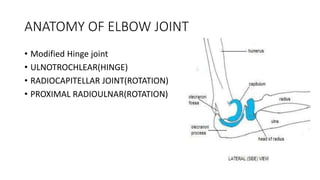
ANATOMY OF ELBOW JOINT
• Modified Hinge joint
• ULNOTROCHLEAR(HINGE)
• RADIOCAPITELLAR JOINT(ROTATION)
• PROXIMAL RADIOULNAR(ROTATION)
CAPSULOLIGAMENTOUS ANATOMY
The static soft tissue stabilizers
• the anterior and posterior joint capsule
• the medial and LCL complexes.
• The collateral ligament complexes are medial and lateral capsular
thickenings
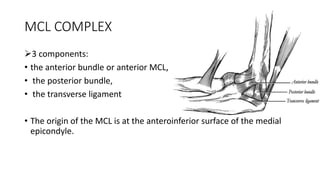
MCL COMPLEX
3 components:
• the anterior bundle or anterior MCL,
• the posterior bundle,
• the transverse ligament
• The origin of the MCL is at the anteroinferior surface of the medial
epicondyle.

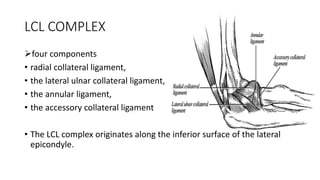
LCL COMPLEX
four components
• radial collateral ligament,
• the lateral ulnar collateral ligament,
• the annular ligament,
• the accessory collateral ligament
• The LCL complex originates along the inferior surface of the lateral
epicondyle.
STABILITY OF ELBOW JOINT
ANTERO-POSTERIOR
TROCHLEAR-OLECRANON PROCESS :during extension.
RADIO-CAPITELLAR,CORONOID FOSSA,BICEPS-TRICEPS-BRACHIALIS:
during flexion.
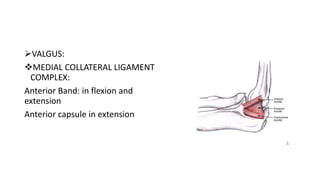
VALGUS:
MEDIAL COLLATERAL LIGAMENT
COMPLEX:
Anterior Band: in flexion and
extension
Anterior capsule in extension
VARUS:
The lateral ulnar collateral ligament is static stabilizer
Anconeus : dynamic stabilizer
NORMAL ROM
FLEXION:0-150 degrees
SUPINATION:80 degrees
PRONATION: 85 degrees
MECHANISM OF INJURY
• Fall on outstretched hand or elbow: levering force to unlock the
olecranon from the trochlea
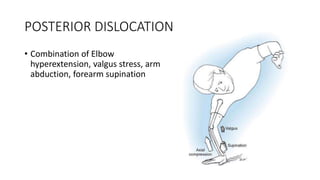
POSTERIOR DISLOCATION
• Combination of Elbow
hyperextension, valgus stress, arm
abduction, forearm supination
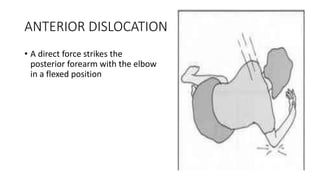
ANTERIOR DISLOCATION
• A direct force strikes the
posterior forearm with the elbow
in a flexed position
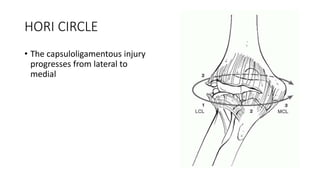
HORI CIRCLE
• The capsuloligamentous injury
progresses from lateral to
medial
CLINICAL FEATURES
• Pain and Swelling of the elbow
• Careful neurovascular assessment must be done.
• 3 point bony relationship is lost.
ASSOSCIATED INJURIES
• Radial head
• Coronoid process of ulna
• Ulnar nerve
• Anterior interosseous branch of median nerve
• Brachial artery
RADIOGRAPHIC EVALUATION
• AP AND LATERAL VIEW
• VALGUS STRESS VIEW:30degrees elbow flexion,full forearm pronation
To see MCL ligamentous complex injury
CLASSIFICATION
• Simple: no assosciated fractures or ligamentous injuries
• Complex: assosciated with ligamentous injury
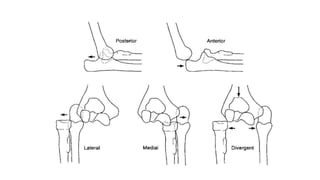
BASED ON DIRECTION
• POSTERIOR
• POSTERIOMEDIAL
• ANTERIOR
• LATERAL
• MEDIAL
FRACTURE-DISLOCATION
• Assosciated radial head fractures
• Medial and lateral epicondyle fractures
• Coronoid process
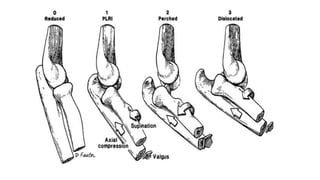
ELBOW INSTABILITY
• MORREY’S INSTABILITY SCALE:
1. Type 1:posterolateral rotational instability: lateral ulnar collateral
ligament disrupted.
2. Type 2: perched condyles, Varus instability, lateral ulnar collateral
ligament,anterior and posterior capsule disrupted
3. Type 3a: posterior dislocation : valgus instability; lateral ulnar
collateral, anterior and posterior capsule and posterior MCL
disrupted
4. Type 3b: posterior dislocation: lateral ulnar collateral, anterior and
posterior capsule and posterior MCL and anterior MCL disrupted
TREATMENT
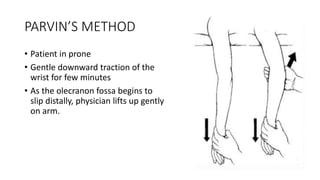
PARVIN’S METHOD
• Patient in prone
• Gentle downward traction of the
wrist for few minutes
• As the olecranon fossa begins to
slip distally, physician lifts up gently
on arm.
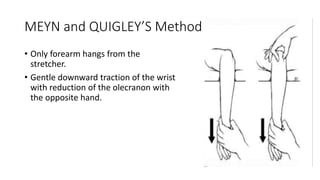
MEYN and QUIGLEY’S Method
• Only forearm hangs from the
stretcher.
• Gentle downward traction of the wrist
with reduction of the olecranon with
the opposite hand.
• Elbows that are stable through out ROM : splint at 90degrees flexion
for 3 to 5 days followed by placement of hinged orthoses ,which
allows for a protected full ROM.
• Subluxation or impending dislocation at 30 degrees or more flexion
indicates instability and surgical stabilization is needed.
• If instability is present in less than 30 degrees of elbow flexion, one
should pronate the forearm and reassess the stability.
• If pronation confers elbow stability, the extremity should be splinted
with the elbow flexed 90degrees and the forearm pronated for 3 to 5
days followed by hinged orthoses that maintains forearm pronation.
• Elbows that sublux in less than 30 degrees of flexion and full forearm
pronation : splint the elbow in flexion at 90 degrees and forearm
pronated ,followed by placement of hinged orthoses with forearm
rotational control and an extension block
OPERATIVE MANAGEMENT
• INDICATIONS:
1. When the elbow cannot be held in a concentrically reduced
position, redislocates before post reduction x-rays, dislocates later
in spite of splint immobilization, the dislocation is deemed unstable.
2. A large displaced coronoid fragment.
3. Radial head fractures.
• Open reduction and repair of the soft tissues
• Lateral collateral ligament is reattached using suture anchors or bone
tunnels
• If instability is present after LCL repair then MCL repair must be
addressed.
• If persistent instability is present: HINGED EXTERNAL FIXATION is
done.
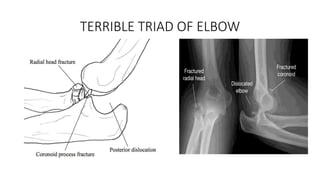
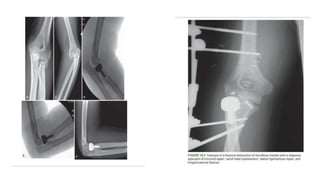
TERRIBLE TRIAD OF ELBOW
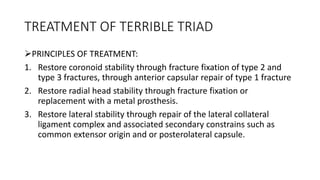
TREATMENT OF TERRIBLE TRIAD
PRINCIPLES OF TREATMENT:
1. Restore coronoid stability through fracture fixation of type 2 and
type 3 fractures, through anterior capsular repair of type 1 fracture
2. Restore radial head stability through fracture fixation or
replacement with a metal prosthesis.
3. Restore lateral stability through repair of the lateral collateral
ligament complex and associated secondary constrains such as
common extensor origin and or posterolateral capsule.
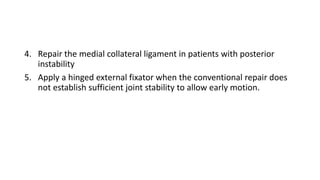
4. Repair the medial collateral ligament in patients with posterior
instability
5. Apply a hinged external fixator when the conventional repair does
not establish sufficient joint stability to allow early motion.
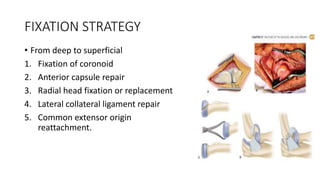
FIXATION STRATEGY
• From deep to superficial
1. Fixation of coronoid
2. Anterior capsule repair
3. Radial head fixation or replacement
4. Lateral collateral ligament repair
5. Common extensor origin
reattachment.
COMPLICATIONS
• Loss of motion(stiffness of elbow)
• Neurologic compromise: ulnar nerve
Exploration is done if there is no recovery after 3months
• Vascular injury: brachial artery
• Compartment syndrome( Volkmann contracture )
• Persistent instability/ redislocation
• Arthrosis
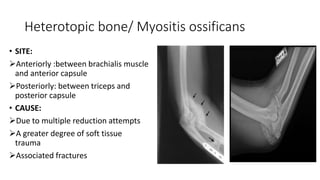
Heterotopic bone/ Myositis ossificans
• SITE:
Anteriorly :between brachialis muscle
and anterior capsule
Posteriorly: between triceps and
posterior capsule
• CAUSE:
Due to multiple reduction attempts
A greater degree of soft tissue
trauma
Associated fractures
• REFERENCES:
• Kenneth A Egol, Kenneth J Koval,Joseph D Zuckerman Handbook of
fractures.
• Campbell’s Operative Orthopaedics,volume 3,13th edition
THANK YOU

Elbow dislocation

  • 1.
    ELBOW DISLOCATION Dr. HARSHANANDINI TALASILA M.S ORTHO
  • 2.
    • Incidence :11to 28%of elbow injuries • POSTERIOR DISLOCATION is common
  • 3.
    ANATOMY OF ELBOWJOINT • Modified Hinge joint • ULNOTROCHLEAR(HINGE) • RADIOCAPITELLAR JOINT(ROTATION) • PROXIMAL RADIOULNAR(ROTATION)
  • 4.
    CAPSULOLIGAMENTOUS ANATOMY The staticsoft tissue stabilizers • the anterior and posterior joint capsule • the medial and LCL complexes. • The collateral ligament complexes are medial and lateral capsular thickenings
  • 5.
    MCL COMPLEX 3 components: •the anterior bundle or anterior MCL, • the posterior bundle, • the transverse ligament • The origin of the MCL is at the anteroinferior surface of the medial epicondyle.
  • 6.
    LCL COMPLEX four components •radial collateral ligament, • the lateral ulnar collateral ligament, • the annular ligament, • the accessory collateral ligament • The LCL complex originates along the inferior surface of the lateral epicondyle.
  • 7.
    STABILITY OF ELBOWJOINT ANTERO-POSTERIOR TROCHLEAR-OLECRANON PROCESS :during extension. RADIO-CAPITELLAR,CORONOID FOSSA,BICEPS-TRICEPS-BRACHIALIS: during flexion.
  • 8.
    VALGUS: MEDIAL COLLATERAL LIGAMENT COMPLEX: AnteriorBand: in flexion and extension Anterior capsule in extension
  • 9.
    VARUS: The lateral ulnarcollateral ligament is static stabilizer Anconeus : dynamic stabilizer
  • 10.
  • 11.
    MECHANISM OF INJURY •Fall on outstretched hand or elbow: levering force to unlock the olecranon from the trochlea
  • 12.
    POSTERIOR DISLOCATION • Combinationof Elbow hyperextension, valgus stress, arm abduction, forearm supination
  • 13.
    ANTERIOR DISLOCATION • Adirect force strikes the posterior forearm with the elbow in a flexed position
  • 14.
    HORI CIRCLE • Thecapsuloligamentous injury progresses from lateral to medial
  • 15.
    CLINICAL FEATURES • Painand Swelling of the elbow • Careful neurovascular assessment must be done. • 3 point bony relationship is lost.
  • 16.
    ASSOSCIATED INJURIES • Radialhead • Coronoid process of ulna • Ulnar nerve • Anterior interosseous branch of median nerve • Brachial artery
  • 17.
    RADIOGRAPHIC EVALUATION • APAND LATERAL VIEW • VALGUS STRESS VIEW:30degrees elbow flexion,full forearm pronation To see MCL ligamentous complex injury
  • 18.
    CLASSIFICATION • Simple: noassosciated fractures or ligamentous injuries • Complex: assosciated with ligamentous injury
  • 19.
    BASED ON DIRECTION •POSTERIOR • POSTERIOMEDIAL • ANTERIOR • LATERAL • MEDIAL
  • 21.
    FRACTURE-DISLOCATION • Assosciated radialhead fractures • Medial and lateral epicondyle fractures • Coronoid process
  • 22.
    ELBOW INSTABILITY • MORREY’SINSTABILITY SCALE: 1. Type 1:posterolateral rotational instability: lateral ulnar collateral ligament disrupted. 2. Type 2: perched condyles, Varus instability, lateral ulnar collateral ligament,anterior and posterior capsule disrupted 3. Type 3a: posterior dislocation : valgus instability; lateral ulnar collateral, anterior and posterior capsule and posterior MCL disrupted 4. Type 3b: posterior dislocation: lateral ulnar collateral, anterior and posterior capsule and posterior MCL and anterior MCL disrupted
  • 24.
  • 25.
    PARVIN’S METHOD • Patientin prone • Gentle downward traction of the wrist for few minutes • As the olecranon fossa begins to slip distally, physician lifts up gently on arm.
  • 26.
    MEYN and QUIGLEY’SMethod • Only forearm hangs from the stretcher. • Gentle downward traction of the wrist with reduction of the olecranon with the opposite hand.
  • 27.
    • Elbows thatare stable through out ROM : splint at 90degrees flexion for 3 to 5 days followed by placement of hinged orthoses ,which allows for a protected full ROM. • Subluxation or impending dislocation at 30 degrees or more flexion indicates instability and surgical stabilization is needed.
  • 28.
    • If instabilityis present in less than 30 degrees of elbow flexion, one should pronate the forearm and reassess the stability. • If pronation confers elbow stability, the extremity should be splinted with the elbow flexed 90degrees and the forearm pronated for 3 to 5 days followed by hinged orthoses that maintains forearm pronation. • Elbows that sublux in less than 30 degrees of flexion and full forearm pronation : splint the elbow in flexion at 90 degrees and forearm pronated ,followed by placement of hinged orthoses with forearm rotational control and an extension block
  • 29.
    OPERATIVE MANAGEMENT • INDICATIONS: 1.When the elbow cannot be held in a concentrically reduced position, redislocates before post reduction x-rays, dislocates later in spite of splint immobilization, the dislocation is deemed unstable. 2. A large displaced coronoid fragment. 3. Radial head fractures.
  • 30.
    • Open reductionand repair of the soft tissues • Lateral collateral ligament is reattached using suture anchors or bone tunnels • If instability is present after LCL repair then MCL repair must be addressed. • If persistent instability is present: HINGED EXTERNAL FIXATION is done.
  • 31.
  • 32.
    TREATMENT OF TERRIBLETRIAD PRINCIPLES OF TREATMENT: 1. Restore coronoid stability through fracture fixation of type 2 and type 3 fractures, through anterior capsular repair of type 1 fracture 2. Restore radial head stability through fracture fixation or replacement with a metal prosthesis. 3. Restore lateral stability through repair of the lateral collateral ligament complex and associated secondary constrains such as common extensor origin and or posterolateral capsule.
  • 33.
    4. Repair themedial collateral ligament in patients with posterior instability 5. Apply a hinged external fixator when the conventional repair does not establish sufficient joint stability to allow early motion.
  • 34.
    FIXATION STRATEGY • Fromdeep to superficial 1. Fixation of coronoid 2. Anterior capsule repair 3. Radial head fixation or replacement 4. Lateral collateral ligament repair 5. Common extensor origin reattachment.
  • 36.
    COMPLICATIONS • Loss ofmotion(stiffness of elbow) • Neurologic compromise: ulnar nerve Exploration is done if there is no recovery after 3months • Vascular injury: brachial artery • Compartment syndrome( Volkmann contracture ) • Persistent instability/ redislocation • Arthrosis
  • 37.
    Heterotopic bone/ Myositisossificans • SITE: Anteriorly :between brachialis muscle and anterior capsule Posteriorly: between triceps and posterior capsule • CAUSE: Due to multiple reduction attempts A greater degree of soft tissue trauma Associated fractures
  • 38.
    • REFERENCES: • KennethA Egol, Kenneth J Koval,Joseph D Zuckerman Handbook of fractures. • Campbell’s Operative Orthopaedics,volume 3,13th edition
  • 39.