Human Immunodeficiency Virus/AIDS
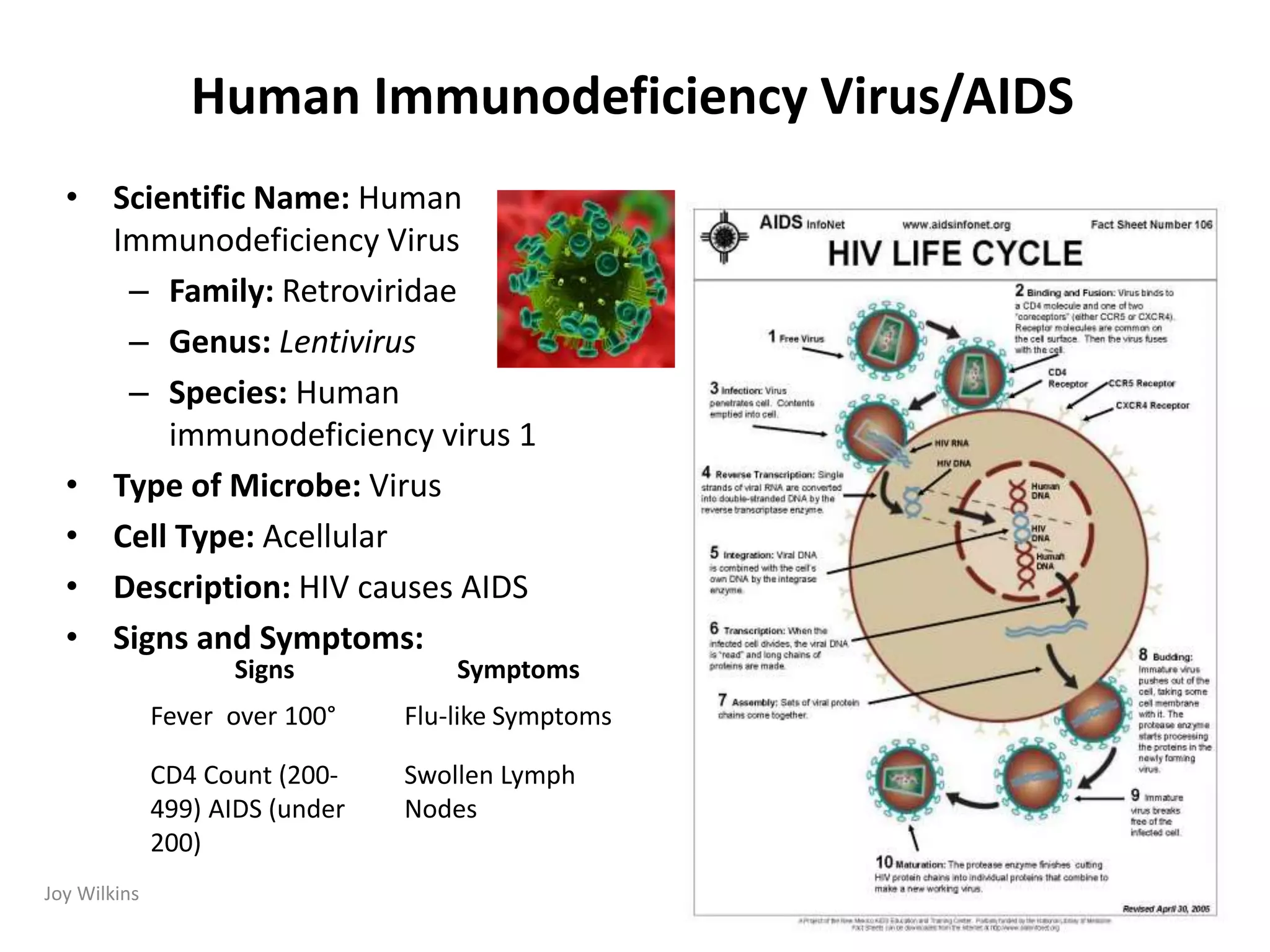
• Scientific Name: Human
Immunodeficiency Virus
– Family: Retroviridae
– Genus: Lentivirus
– Species: Human
immunodeficiency virus 1
• Type of Microbe: Virus
• Cell Type: Acellular
• Description: HIV causes AIDS
• Signs and Symptoms:
Joy Wilkins
Signs Symptoms
Fever over 100° Flu-like Symptoms
CD4 Count (200-
499) AIDS (under
200)
Swollen Lymph
Nodes
Specifics of the Virus
• Structure:
• Enveloped Ribonucleic Acid
retrovirus
• Two copies of the single
strand Ribonucleic Acid
• Antiretroviral Medications:
• Resistant Medications:
– Entry/ Fusion Inhibitors:
» Selzentry
– Integrase Inhibitors:
» Isentress
• Susceptible Medications:
– Crixivan
• Mechanisms of Action:
– Entry Inhibitors: Block the
attachment of gp120 to the
CD4/CCR5 receptor
– Integrase Inhibitor: Prevent the
binding of the host cell DNA,
terminates replication.
• Affected Processes and
Structures:
– Dendritic Cells and
Macrophages
• Type of Virus:
– Ribonucleic Acid
• Cell Infection Preference:
– CD4/T-Cells
• Vaccine Development:
– None
• Metabolism and Drug Interaction:
– Cardiovascular disease
– Bone Health
– Hyperglycemia
Our America: Are You at Risk?
• Physical and Chemical requirements for Microbe Advancement:
– Temperature, Nutrients, PH, Oxygen Availability
• Groups of People Most at Risk:
– African Americans
– Homosexual and Bisexual Men
– Substance Abusers
– Inmates
• Common Co-Infections:
– Hepatitis B Virus
– Hepatitis C Virus
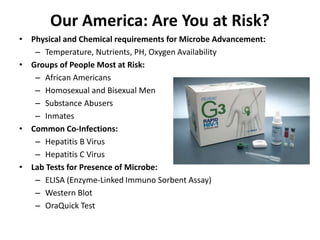
• Lab Tests for Presence of Microbe:
– ELISA (Enzyme-Linked Immuno Sorbent Assay)
– Western Blot
– OraQuick Test
The Awful Statistics
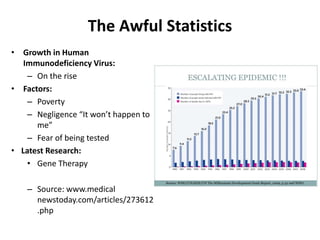
• Growth in Human
Immunodeficiency Virus:
– On the rise
• Factors:
– Poverty
– Negligence “It won’t happen to
me”
– Fear of being tested
• Latest Research:
• Gene Therapy
– Source: www.medical
newstoday.com/articles/273612
.php
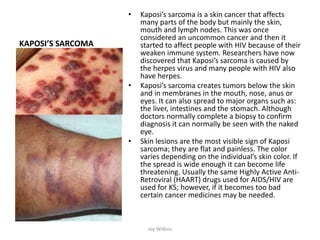
KAPOSI’S SARCOMA
• Kaposi’s sarcoma is a skin cancer that affects
many parts of the body but mainly the skin,
mouth and lymph nodes. This was once
considered an uncommon cancer and then it
started to affect people with HIV because of their
weaken immune system. Researchers have now
discovered that Kaposi’s sarcoma is caused by
the herpes virus and many people with HIV also
have herpes.
• Kaposi’s sarcoma creates tumors below the skin
and in membranes in the mouth, nose, anus or
eyes. It can also spread to major organs such as:
the liver, intestines and the stomach. Although
doctors normally complete a biopsy to confirm
diagnosis it can normally be seen with the naked
eye.
• Skin lesions are the most visible sign of Kaposi
sarcoma; they are flat and painless. The color
varies depending on the individual’s skin color. If
the spread is wide enough it can become life
threatening. Usually the same Highly Active Anti-
Retroviral (HAART) drugs used for AIDS/HIV are
used for KS; however, if it becomes too bad
certain cancer medicines may be needed.
Joy Wilkins

HIV, AIDS, Kaposi's Sarcoma

  • 1.
    Human Immunodeficiency Virus/AIDS •Scientific Name: Human Immunodeficiency Virus – Family: Retroviridae – Genus: Lentivirus – Species: Human immunodeficiency virus 1 • Type of Microbe: Virus • Cell Type: Acellular • Description: HIV causes AIDS • Signs and Symptoms: Joy Wilkins Signs Symptoms Fever over 100° Flu-like Symptoms CD4 Count (200- 499) AIDS (under 200) Swollen Lymph Nodes
  • 2.
    Specifics of theVirus • Structure: • Enveloped Ribonucleic Acid retrovirus • Two copies of the single strand Ribonucleic Acid • Antiretroviral Medications: • Resistant Medications: – Entry/ Fusion Inhibitors: » Selzentry – Integrase Inhibitors: » Isentress • Susceptible Medications: – Crixivan • Mechanisms of Action: – Entry Inhibitors: Block the attachment of gp120 to the CD4/CCR5 receptor – Integrase Inhibitor: Prevent the binding of the host cell DNA, terminates replication. • Affected Processes and Structures: – Dendritic Cells and Macrophages • Type of Virus: – Ribonucleic Acid • Cell Infection Preference: – CD4/T-Cells • Vaccine Development: – None • Metabolism and Drug Interaction: – Cardiovascular disease – Bone Health – Hyperglycemia
  • 3.
    Our America: AreYou at Risk? • Physical and Chemical requirements for Microbe Advancement: – Temperature, Nutrients, PH, Oxygen Availability • Groups of People Most at Risk: – African Americans – Homosexual and Bisexual Men – Substance Abusers – Inmates • Common Co-Infections: – Hepatitis B Virus – Hepatitis C Virus • Lab Tests for Presence of Microbe: – ELISA (Enzyme-Linked Immuno Sorbent Assay) – Western Blot – OraQuick Test
  • 4.
    The Awful Statistics •Growth in Human Immunodeficiency Virus: – On the rise • Factors: – Poverty – Negligence “It won’t happen to me” – Fear of being tested • Latest Research: • Gene Therapy – Source: www.medical newstoday.com/articles/273612 .php
  • 5.
    KAPOSI’S SARCOMA • Kaposi’ssarcoma is a skin cancer that affects many parts of the body but mainly the skin, mouth and lymph nodes. This was once considered an uncommon cancer and then it started to affect people with HIV because of their weaken immune system. Researchers have now discovered that Kaposi’s sarcoma is caused by the herpes virus and many people with HIV also have herpes. • Kaposi’s sarcoma creates tumors below the skin and in membranes in the mouth, nose, anus or eyes. It can also spread to major organs such as: the liver, intestines and the stomach. Although doctors normally complete a biopsy to confirm diagnosis it can normally be seen with the naked eye. • Skin lesions are the most visible sign of Kaposi sarcoma; they are flat and painless. The color varies depending on the individual’s skin color. If the spread is wide enough it can become life threatening. Usually the same Highly Active Anti- Retroviral (HAART) drugs used for AIDS/HIV are used for KS; however, if it becomes too bad certain cancer medicines may be needed. Joy Wilkins