Anesthesia for orthopaedic
replacement surgeries


     Prof.Dr.K.BALAKRISHNAN,
              Chennai.
Introduction
   Some of the common joint
    replacement surgeries are
    1. Hip replacement
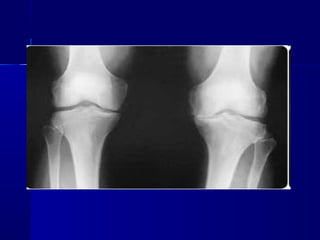
    2. Knee replacement
    3. Shoulder replacement
    4. Elbow replacement
   Total knee replacement (TKR)
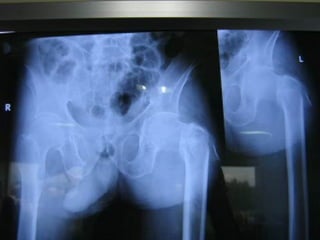
    and hip fracture coming for
    replacement are the two most
    common surgical procedures
    after the sixth decade of life.
   Most of the patients have
    degenerative joint disease,
    commonly osteoarthritis (OA).
   Other conditions requiring knee
    or hip replacement are injury to
    the neck of femur or knee joint,
    knee deformity, rheumatoid
    arthritis and gout.
   Joint replacement is performed
    to relieve pain and morbidity.
The challenge….
   Decreased organ function and
    reserve
   Co-morbid conditions
   Consequences of polypharmacy
Challenges have been
converted into good
outcomes…
   Better understanding on
    pathophysiology of aging
   Better pharmacotherapy
   Safer anaesthetic techniques
   Improvements in monitoring
   Multimodal analgesia and site
    specific analgesia
   Physiotherapy and early
    ambulation
Pain is the first enemy to
mankind….
  And anaesthesiologists are
          mankind’s guardian angels.
The straw that breaks the camel’s back may be
a very small one when the camel is nearing the
              end of it’s journey !
Pre-operative concerns

   Associated injuries
   Cause for the fall
   Difficulty in assessing cardio
    respiratory reserve
   Osteoarthritis- Medications-NSAIDs
Pre-operative
    concerns….
   Pre-renal azotaemia
   DVT prophylaxis
   Diabetes Mellitus
   The emotional significance of
    fracture to the geriatric patient must
    also be considered.
Preoperative Preparation
   Evaluation of the functional
    cardiovascular reserves may be
    difficult due to the bedridden
    state, the confusion
    encountered, and the fracture.
    Simple steps (e.g., auscultation,
    ECG, and chest x-ray) can
    detect acute decompensation.
   Echocardio­graphy if feasible at the
    bedside and can give useful
    information about left ventricular and
    valvular function.
   Evaluation of electrolytes and blood
    count is required; anemia or
    electrolyte disturbances should be
    addressed prior to anesthesia
    induction.
Prophylaxis against DVT
   Prophylaxis against deep vein
    thrombosis after lowerlimb joint
    surgery is done with low
    molecular weight heparin
    starting either post operatively
    or 12 hours preoperatively .
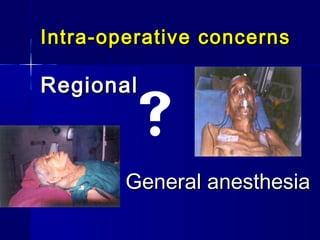
Intra-operative concerns

Regional
        
        General anesthesia
The choice of anaesthesia is
   determined by:
i) surgical factors
ii) Patients factors
iii) Estimates of risk associated
   with anaesthesia techniques
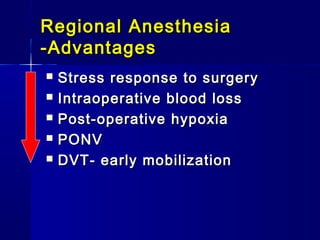
Regional Anesthesia
-Advantages
   Stress response to surgery
   Intraoperative blood loss
   Post-operative hypoxia
   PONV
   DVT- early mobilization
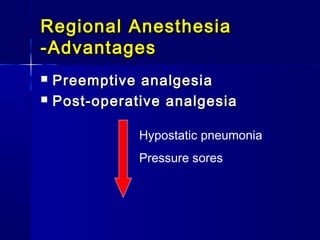
Regional Anesthesia
-Advantages
   Preemptive analgesia
   Post-operative analgesia

               Hypostatic pneumonia
               Pressure sores
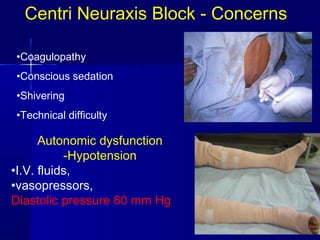
Centri Neuraxis Block - Concerns

•Coagulopathy
•Conscious sedation
•Shivering
•Technical difficulty

      Autonomic dysfunction
           -Hypotension
•I.V. fluids,
•vasopressors,
Diastolic pressure 60 mm Hg
Regional anesthesia
techniques
 - Spinal
 - Epidural anesthesia
 - Combined spinal epidural
 anaesthesia
 - Femoral and Sciatic nerve blocks
 (especially in patients with fixed
 cardiac output in whom a neuraxial
 block is not preferred due to possible
 haemodynamic changes specifically
 profound hypotension).
   The alternative option in fixed
    cardiac output states include
    segmental epidural, here the titrated
    doses of local anaesthetic
    administration and just blocking the
    segments involved offers the benefits
    of regional anaesthesia in critically ill
    patients and at the same time
    provides stable haemodynamics.
General anesthesia
      -Pre-operative beta
         blockade
      CAD
      Hypertension
      Diabetes mellitus
      Hypercholesterolemia
      Renal dysfunction
      Goal: Heart rate between 60-70.
General anesthesia
      -Pre-Oxygenation
   100% Oxygen
   8 deep breaths
   Oxygen flow 10 L per min
General anesthesia
      -Choice of Anesthetic
   agent
Short acting and less lipid soluble drugs


               •   Propofol
               •   Fentanyl
               •   Rocuronium
               •   Atracurium
               •   Sevoflurane
               •   Isoflurane
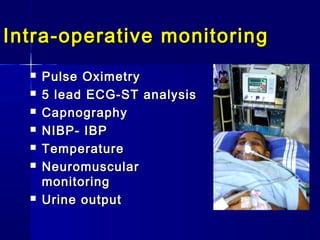
Intra-operative monitoring
     Pulse Oximetry
     5 lead ECG-ST analysis
     Capnography
     NIBP- IBP
     Temperature
     Neuromuscular
      monitoring
     Urine output
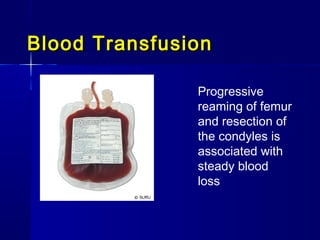
Blood Transfusion

               Progressive
               reaming of femur
               and resection of
               the condyles is
               associated with
               steady blood
               loss
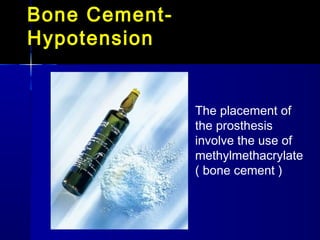
Bone Cement-
Hypotension


               The placement of
               the prosthesis
               involve the use of
               methylmethacrylate
               ( bone cement )
   The cementing can cause
    hemodynamic fluctuations
   These fluctuations are related to
    the vasodilatory and mast-cell
    degranulating properties of the
    monomeric form of
    methylmethacrylate
Bone Cement
implantation syndrome

  Bone cement implantation
  syndrome (BCIS) is poorly understood.
  It is an important cause of
  intraoperative mortality and morbidity
  in patients undergoing cemented hip
  arthroplasty and may also be seen in
  the postoperative period in a milder
  form causing hypoxia and confusion.
implantation syndrome -
Treatment

  BCIS may be reversible with prompt basic life
  support and treatment to maintain both coronary
  perfusion pressure and right heart function.

  Administer fluid volumes to augment right
  ventricular preload. Direct acting vasopressors,
  such as phenylephrine and norepinephrine can
  be titrated to restore adequate aortic perfusion

  To improve ventricular contractility and function
  administer inotropes such as dobutamine.
Fat embolism
   The high incidence of fat
    embolism with femoral neck
    fracture repair and cemented
    endoprosthesis may contribute
    to pulmonary dysfunction
Tourniquet in knee
replacement
Tourniquet inflation:
i)  may precipitate heart failure
ii) may cause hypotension after release of
    tourniquet
due to:
a)  Release of acid products
b)  Affected limb getting filled with blood
c)  Blood loss
Post-operative care
   Immediate postoperative care
    should be directed to supporting
    oxygenation, controlling pain,
    and facilitating the patient's
    return to the baseline mental
    status by emphasizing
    orientation.
Post-operative concerns

           Pain
           Pain
          Pain
         Pain
        Pain
Postoperative pain therapy is best a
 multimodal approach.
 - local anaesthetic infusions through
 perineural catheters supplemented
 with analgesics including a
 combination of paracetamol, tramadol,
 NSAID(when there is no
 contraindication) and opioids.
PRINCIPLES

No.1: Start with low dose
       Avoid long acting drugs
 
No.2: Use standing dose regimens
        
No.3: Repeated reassessment of pain relief
 
No.4: Repeated reassessment of side effects
 
No.5: Educate/inspire the care giver
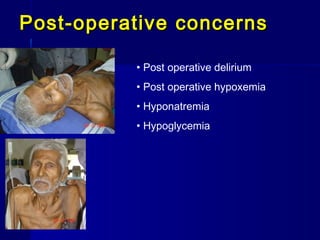
Post-operative concerns

          • Post operative delirium
          • Post operative hypoxemia
          • Hyponatremia
          • Hypoglycemia
Early Mobilisation

Psychological support

Peri-operative Sepsis

Peri- operative Antibiotics
Conclusion
   Geriatric patients for joint
    replacement surgeries offer a great
    challenge to the anaesthesiologists.

   A careful preoperative examination,
    preoperative optimization, safe
    intraoperative anaesthetic
    techniques, good postoperative pain
    relief, good postoperative followup
    with rehabilitation would aid in
    decreasing the morbidity in these
    patients.
Anaesthesia for orthopaedic replacement surgeries

Anaesthesia for orthopaedic replacement surgeries

  • 1.
    Anesthesia for orthopaedic replacementsurgeries Prof.Dr.K.BALAKRISHNAN, Chennai.
  • 2.
    Introduction  Some of the common joint replacement surgeries are 1. Hip replacement 2. Knee replacement 3. Shoulder replacement 4. Elbow replacement
  • 5.
    Total knee replacement (TKR) and hip fracture coming for replacement are the two most common surgical procedures after the sixth decade of life.
  • 6.
    Most of the patients have degenerative joint disease, commonly osteoarthritis (OA).
  • 7.
    Other conditions requiring knee or hip replacement are injury to the neck of femur or knee joint, knee deformity, rheumatoid arthritis and gout.
  • 8.
    Joint replacement is performed to relieve pain and morbidity.
  • 9.
    The challenge….  Decreased organ function and reserve  Co-morbid conditions  Consequences of polypharmacy
  • 11.
    Challenges have been convertedinto good outcomes…  Better understanding on pathophysiology of aging  Better pharmacotherapy  Safer anaesthetic techniques  Improvements in monitoring  Multimodal analgesia and site specific analgesia  Physiotherapy and early ambulation
  • 12.
    Pain is thefirst enemy to mankind…. And anaesthesiologists are mankind’s guardian angels.
  • 13.
    The straw thatbreaks the camel’s back may be a very small one when the camel is nearing the end of it’s journey !
  • 14.
    Pre-operative concerns  Associated injuries  Cause for the fall  Difficulty in assessing cardio respiratory reserve  Osteoarthritis- Medications-NSAIDs
  • 15.
    Pre-operative concerns….  Pre-renal azotaemia  DVT prophylaxis  Diabetes Mellitus  The emotional significance of fracture to the geriatric patient must also be considered.
  • 16.
    Preoperative Preparation  Evaluation of the functional cardiovascular reserves may be difficult due to the bedridden state, the confusion encountered, and the fracture. Simple steps (e.g., auscultation, ECG, and chest x-ray) can detect acute decompensation.
  • 17.
    Echocardio­graphy if feasible at the bedside and can give useful information about left ventricular and valvular function.  Evaluation of electrolytes and blood count is required; anemia or electrolyte disturbances should be addressed prior to anesthesia induction.
  • 18.
    Prophylaxis against DVT  Prophylaxis against deep vein thrombosis after lowerlimb joint surgery is done with low molecular weight heparin starting either post operatively or 12 hours preoperatively .
  • 19.
    Intra-operative concerns Regional  General anesthesia
  • 20.
    The choice ofanaesthesia is determined by: i) surgical factors ii) Patients factors iii) Estimates of risk associated with anaesthesia techniques
  • 21.
    Regional Anesthesia -Advantages  Stress response to surgery  Intraoperative blood loss  Post-operative hypoxia  PONV  DVT- early mobilization
  • 22.
    Regional Anesthesia -Advantages  Preemptive analgesia  Post-operative analgesia Hypostatic pneumonia Pressure sores
  • 23.
    Centri Neuraxis Block- Concerns •Coagulopathy •Conscious sedation •Shivering •Technical difficulty Autonomic dysfunction -Hypotension •I.V. fluids, •vasopressors, Diastolic pressure 60 mm Hg
  • 24.
    Regional anesthesia techniques -Spinal - Epidural anesthesia - Combined spinal epidural anaesthesia - Femoral and Sciatic nerve blocks (especially in patients with fixed cardiac output in whom a neuraxial block is not preferred due to possible haemodynamic changes specifically profound hypotension).
  • 25.
    The alternative option in fixed cardiac output states include segmental epidural, here the titrated doses of local anaesthetic administration and just blocking the segments involved offers the benefits of regional anaesthesia in critically ill patients and at the same time provides stable haemodynamics.
  • 26.
    General anesthesia -Pre-operative beta blockade  CAD  Hypertension  Diabetes mellitus  Hypercholesterolemia  Renal dysfunction  Goal: Heart rate between 60-70.
  • 27.
    General anesthesia -Pre-Oxygenation  100% Oxygen  8 deep breaths  Oxygen flow 10 L per min
  • 28.
    General anesthesia -Choice of Anesthetic agent Short acting and less lipid soluble drugs • Propofol • Fentanyl • Rocuronium • Atracurium • Sevoflurane • Isoflurane
  • 29.
    Intra-operative monitoring  Pulse Oximetry  5 lead ECG-ST analysis  Capnography  NIBP- IBP  Temperature  Neuromuscular monitoring  Urine output
  • 30.
    Blood Transfusion Progressive reaming of femur and resection of the condyles is associated with steady blood loss
  • 31.
    Bone Cement- Hypotension The placement of the prosthesis involve the use of methylmethacrylate ( bone cement )
  • 32.
    The cementing can cause hemodynamic fluctuations  These fluctuations are related to the vasodilatory and mast-cell degranulating properties of the monomeric form of methylmethacrylate
  • 33.
    Bone Cement implantation syndrome Bone cement implantation syndrome (BCIS) is poorly understood. It is an important cause of intraoperative mortality and morbidity in patients undergoing cemented hip arthroplasty and may also be seen in the postoperative period in a milder form causing hypoxia and confusion.
  • 34.
    implantation syndrome - Treatment BCIS may be reversible with prompt basic life support and treatment to maintain both coronary perfusion pressure and right heart function. Administer fluid volumes to augment right ventricular preload. Direct acting vasopressors, such as phenylephrine and norepinephrine can be titrated to restore adequate aortic perfusion To improve ventricular contractility and function administer inotropes such as dobutamine.
  • 35.
    Fat embolism  The high incidence of fat embolism with femoral neck fracture repair and cemented endoprosthesis may contribute to pulmonary dysfunction
  • 36.
    Tourniquet in knee replacement Tourniquetinflation: i) may precipitate heart failure ii) may cause hypotension after release of tourniquet due to: a) Release of acid products b) Affected limb getting filled with blood c) Blood loss
  • 37.
    Post-operative care  Immediate postoperative care should be directed to supporting oxygenation, controlling pain, and facilitating the patient's return to the baseline mental status by emphasizing orientation.
  • 38.
    Post-operative concerns Pain Pain Pain Pain Pain
  • 39.
    Postoperative pain therapyis best a multimodal approach. - local anaesthetic infusions through perineural catheters supplemented with analgesics including a combination of paracetamol, tramadol, NSAID(when there is no contraindication) and opioids.
  • 40.
    PRINCIPLES No.1: Start withlow dose Avoid long acting drugs   No.2: Use standing dose regimens   No.3: Repeated reassessment of pain relief   No.4: Repeated reassessment of side effects   No.5: Educate/inspire the care giver
  • 41.
    Post-operative concerns • Post operative delirium • Post operative hypoxemia • Hyponatremia • Hypoglycemia
  • 42.
  • 43.
    Conclusion  Geriatric patients for joint replacement surgeries offer a great challenge to the anaesthesiologists.  A careful preoperative examination, preoperative optimization, safe intraoperative anaesthetic techniques, good postoperative pain relief, good postoperative followup with rehabilitation would aid in decreasing the morbidity in these patients.