Basilar skull fracture
Blowout fracture - a fracture of the walls or floor of the orbit
A severe blow to the orbit (as from a baseball) may cause the contents
of the orbital cavity to explode downward through the floor of the orbit
into the maxillary sinus. Damage to the infraorbital nerve, resulting in
altered sensation to the skin of the cheek, upper lip, and gum, may
occur.
Mandibular fracture
Nasal fracture
Fractures of the nasal bones, because of the prominence of the nose,
are the most common facial fractures; the overlying skin may also be
lacerated. Although most are simple fractures and are reduced under
local anesthesia, some are associated with severe injuries to the nasal
septum and require careful treatment under general anesthesia.
Le Fort fracture of skull - facial fractures
involving the maxillary bone and surrounding
structures in a usually bilateral and either
horizontal, pyramidal or transverse way.
Maxillofacial fractures usually occur as the
result of massive facial trauma. There is
extensive facial swelling, midface mobility of
the underlying bone on palpation, malocclusion
of the teeth with anterior open bite, and
possibly leakage of cerebrospinal fluid
Cervical fracture
Fracture of C1, including Jefferson fracture
Fracture of C2, including Hangman's fracture
Flexion teardrop fracture - a fracture of the anteroinferior aspect
of a cervical vertebral
Clay-shoveler fracture - fracture through the spinous
process of a vertebra occurring at any of the lower cervical
or upper thoracic vertebrae
Burst fracture - in which a vertebra breaks from a high-
energy axial load
Compression fracture - a collapse of a vertebra, often in
the form of wedge fractures due to larger compression
anteriorly.
Chance fracture - compression injury to the anterior portion
of a vertebral body with concomitant distraction injury to
posterior elements
Holdsworth fracture - an unstable fracture dislocation of
the thoracolumbar junction of the spine
Rib fracture
Sternal fracture
Shoulder fracture
Clavicle fracture
Classification is based on fracture location:
– Fracture located at medial, middle (most common), or distal third of
the clavicle.
Clinical Features
• Pain in the shoulder region
• May or may not have an obvious deformity
Scapular fracture
Scapular fractures commonly occur in association with other serious
injuries. The diagnosis
often is easily missed on the initial exam.
• Mechanism typically is a direct blow to the shoulder usually after a
significant, highvelocity trauma (MVA, motorcycle accident).
• Associated with other significant injuries such as rib fractures,
pulmonary contusions, pneumothorax/hemothorax.
• Fracture sites: glenoid, glenoid rim, coracoid, scapular neck and
body, acromion
Arm fracture
Humerus fracture (fracture of upper arm)
Holstein-Lewis fracture - a fracture of the distal third
of the humerus resulting in entrapment of the radial
nerve.
Posadas fracture – transcondylar fracture of the
elbow
Four-Part Classification
One-part humeral fracture: nondisplaced,
impacted fractures. All parts still in alignment.
Two-part humeral fracture: one fragment is
displaced with respect to the other three.
Three-part humeral fracture: two fragments are
displaced.
Four-part humeral fracture: all fragments are
displaced.
Radius fracture
Essex-Lopresti fracture - a fracture of the radial
head with concomitant dislocation of the distal radio-ulnar
joint with disruption of the interosseous membrane.
Radial Head Fracture
• Dislocations of the elbow are commonly associated with radial
head fractures
Classification
• Type I: nondisplaced
• Type II: marginal radial head fracture, minimal displacement
• Type III: comminuted fracture
Distal radius fracture
 Galeazzi fracture - a fracture of the radius with
dislocation of the distal radioulnar joint
 Colles' fracture - a distal fracture of the radius with
dorsal (posterior) displacement of the wrist and hand
 Smith's fracture - a distal fracture of the radius with
volar (ventral) displacement of the wrist and hand
 Barton's fracture - an intra-articular fracture of the distal
radius with dislocation of the radiocarpal joint
Ulnar fracture
Monteggia fracture - a fracture of the proximal third of the ulna
with the dislocation of the head of the radius
Hume fracture - a fracture of the olecranon with an
associated anterior dislocation of the radial head
Night Stick fracture – fracture of the shaft of the ulna
Olecranon Fracture
• Direct blow to the elbow such as a fall onto the elbow with the elbow
flexed.
• Fall on an outstretched arm in association with a dislocation.
Classification
• Nondisplaced
• Displaced
Clinical Features
• Swelling and ecchymosis with an obvious deformity.
• Pain on gentle range of motion.
• Numbness and paresthesias with radiation distally to the fourth and
fifth digits with ulnar nerve involvement.
SCAPHOID FRACTURE
General
• One of the most common fractures of the wrist
comprising 70% of carpal bone fractures.
Mechanism of Injury
• A fall or blow on a hyperextended (dorsiflexed) wrist.
• Osteonecrosis of the bone may develop secondary to
its blood supply.
• The majority of the blood supply is to the distal 1/3 of
the bone. Therefore, the middle and proximal portion of
the bone have a large nonunion rate (1/3 developing
osteonecrosis).
HAMATE FRACTURES
General
• Body fractures often from direct trauma.
• Fractures of the hook of the hamate can occur at end swing while
holding a racquet, bat,
or club.
Clinical Features
• Ulnar and palmar wrist pain with racquet, bat, or club swing.
• Pain over the hook of the hamate.
• Pain over the dorsoulnar hamate.
TRAPEZIUM FRACTURES
General
• Isolated fractures are rare.
• May occur when the base of the thumb metacarpal is forced by axial
load into the trapezium.
• Can occur also as an avulsion fracture.
Rolando fracture - a comminuted intra-
articular fracture through the base of the
first metacarpal bone
Bennett's fracture - a fracture of the base of the first
metacarpal bone which extends into
the carpometacarpal (CMC) joint.
Boxer's fracture - a fracture at the neck of
a metacarpal
Pelvic fracture
Duverney fracture - an isolated pelvic fracture
involving only the iliac wing.
HIP FRACTURES
General
• Osteoporosis of the hip carries increased incidence of
fracture.
• Osteoporosis of the hip is associated with both fixed
and modifiable risk factors.
– Fixed risk factors include age, sex, and race.
Approximately 60% of hip fractures occur in patients >
75 years of age.
Females have higher incidence of hip fracture than
males.
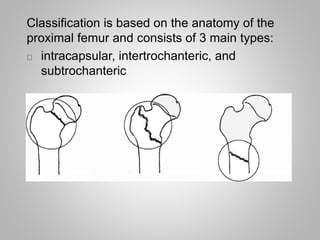
Classification is based on the anatomy of the
proximal femur and consists of 3 main types:
intracapsular, intertrochanteric, and
subtrochanteric
INTRACAPSULAR OR FEMORAL NECK
FRACTURES
• Morbidity associated with the fracture involves
disruption of the blood vessels to the femoral head
causing necrosis.
• Postoperatively, complications can include a nonunion
or osteonecrosis.
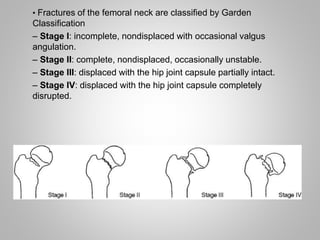
• Fractures of the femoral neck are classified by Garden
Classification
– Stage I: incomplete, nondisplaced with occasional valgus
angulation.
– Stage II: complete, nondisplaced, occasionally unstable.
– Stage III: displaced with the hip joint capsule partially intact.
– Stage IV: displaced with the hip joint capsule completely
disrupted.
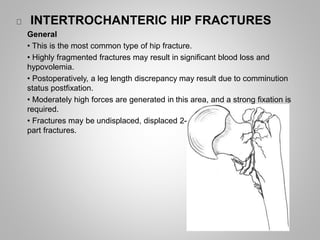
INTERTROCHANTERIC HIP FRACTURES
General
• This is the most common type of hip fracture.
• Highly fragmented fractures may result in significant blood loss and
hypovolemia.
• Postoperatively, a leg length discrepancy may result due to comminution
status postfixation.
• Moderately high forces are generated in this area, and a strong fixation is
required.
• Fractures may be undisplaced, displaced 2-part fractures, or unstable 3-
part fractures.
SUBTROCHANTERIC HIP FRACTURES
General
• This region is subjected to very high mechanical
stresses and is the most difficult to stabilize
surgically.
• Fractures may be simple, fragmented, or
comminuted.
Patella fracture
Crus fracture
Tibia fracture
Bumper fracture - a fracture of
the lateral tibial plateau caused by a
forced valgus applied to the knee
Segond fracture - an avulsion fracture of
the lateral tibial condyle
Gosselin fracture - a fractures of the
tibial plafond into anterior and posterior fragments
Toddler's fracture - an undisplaced and spiral
fracture of the distal third to distal half of the tibia
Fibular fracture
Maisonneuve fracture - a spiral fracture of the
proximal third of the fibula associated with a tear
of the distal tibiofibular syndesmosis and the
interosseous membrane.
Le Fort fracture of ankle - a vertical fracture of
the antero-medial part of
the distal fibula with avulsion of the anterior
tibiofibular ligament.
Bosworth fracture - a fracture with an associated
fixed posterior dislocation of the proximal fibular
fragment which becomes trapped behind
the posterior tibial tubercle. The injury is caused
by severe external rotation of the ankle.[10]
Trimalleolar fracture - involving the lateral
malleolus, medial malleolus and the distal
posterior aspect of the tibia
Bimalleolar fracture - involving the lateral
malleolus and the medial malleolus.
Pott's fracture
Foot fracture
Lisfranc fracture - in which one or all of
the metatarsals are displaced from the tarsus
Jones fracture - a fracture of the proximal end of
the fifth metatarsal
March fracture - a fracture of the distal third of one
of the metatarsals occurring because of recurrent
stress
Nutcracker fracture: cuboid fracture
Calcaneal fracture

FRACTURE (Sites)

  • 2.
    Basilar skull fracture Blowoutfracture - a fracture of the walls or floor of the orbit A severe blow to the orbit (as from a baseball) may cause the contents of the orbital cavity to explode downward through the floor of the orbit into the maxillary sinus. Damage to the infraorbital nerve, resulting in altered sensation to the skin of the cheek, upper lip, and gum, may occur. Mandibular fracture Nasal fracture Fractures of the nasal bones, because of the prominence of the nose, are the most common facial fractures; the overlying skin may also be lacerated. Although most are simple fractures and are reduced under local anesthesia, some are associated with severe injuries to the nasal septum and require careful treatment under general anesthesia.
  • 3.
    Le Fort fractureof skull - facial fractures involving the maxillary bone and surrounding structures in a usually bilateral and either horizontal, pyramidal or transverse way. Maxillofacial fractures usually occur as the result of massive facial trauma. There is extensive facial swelling, midface mobility of the underlying bone on palpation, malocclusion of the teeth with anterior open bite, and possibly leakage of cerebrospinal fluid
  • 5.
    Cervical fracture Fracture ofC1, including Jefferson fracture Fracture of C2, including Hangman's fracture Flexion teardrop fracture - a fracture of the anteroinferior aspect of a cervical vertebral Clay-shoveler fracture - fracture through the spinous process of a vertebra occurring at any of the lower cervical or upper thoracic vertebrae Burst fracture - in which a vertebra breaks from a high- energy axial load Compression fracture - a collapse of a vertebra, often in the form of wedge fractures due to larger compression anteriorly. Chance fracture - compression injury to the anterior portion of a vertebral body with concomitant distraction injury to posterior elements Holdsworth fracture - an unstable fracture dislocation of the thoracolumbar junction of the spine
  • 6.
    Rib fracture Sternal fracture Shoulderfracture Clavicle fracture Classification is based on fracture location: – Fracture located at medial, middle (most common), or distal third of the clavicle. Clinical Features • Pain in the shoulder region • May or may not have an obvious deformity Scapular fracture Scapular fractures commonly occur in association with other serious injuries. The diagnosis often is easily missed on the initial exam. • Mechanism typically is a direct blow to the shoulder usually after a significant, highvelocity trauma (MVA, motorcycle accident). • Associated with other significant injuries such as rib fractures, pulmonary contusions, pneumothorax/hemothorax. • Fracture sites: glenoid, glenoid rim, coracoid, scapular neck and body, acromion
  • 7.
    Arm fracture Humerus fracture(fracture of upper arm) Holstein-Lewis fracture - a fracture of the distal third of the humerus resulting in entrapment of the radial nerve. Posadas fracture – transcondylar fracture of the elbow
  • 8.
    Four-Part Classification One-part humeralfracture: nondisplaced, impacted fractures. All parts still in alignment. Two-part humeral fracture: one fragment is displaced with respect to the other three. Three-part humeral fracture: two fragments are displaced. Four-part humeral fracture: all fragments are displaced.
  • 10.
    Radius fracture Essex-Lopresti fracture- a fracture of the radial head with concomitant dislocation of the distal radio-ulnar joint with disruption of the interosseous membrane. Radial Head Fracture • Dislocations of the elbow are commonly associated with radial head fractures Classification • Type I: nondisplaced • Type II: marginal radial head fracture, minimal displacement • Type III: comminuted fracture
  • 12.
    Distal radius fracture Galeazzi fracture - a fracture of the radius with dislocation of the distal radioulnar joint  Colles' fracture - a distal fracture of the radius with dorsal (posterior) displacement of the wrist and hand  Smith's fracture - a distal fracture of the radius with volar (ventral) displacement of the wrist and hand  Barton's fracture - an intra-articular fracture of the distal radius with dislocation of the radiocarpal joint
  • 14.
    Ulnar fracture Monteggia fracture- a fracture of the proximal third of the ulna with the dislocation of the head of the radius Hume fracture - a fracture of the olecranon with an associated anterior dislocation of the radial head Night Stick fracture – fracture of the shaft of the ulna Olecranon Fracture • Direct blow to the elbow such as a fall onto the elbow with the elbow flexed. • Fall on an outstretched arm in association with a dislocation. Classification • Nondisplaced • Displaced Clinical Features • Swelling and ecchymosis with an obvious deformity. • Pain on gentle range of motion. • Numbness and paresthesias with radiation distally to the fourth and fifth digits with ulnar nerve involvement.
  • 15.
    SCAPHOID FRACTURE General • Oneof the most common fractures of the wrist comprising 70% of carpal bone fractures. Mechanism of Injury • A fall or blow on a hyperextended (dorsiflexed) wrist. • Osteonecrosis of the bone may develop secondary to its blood supply. • The majority of the blood supply is to the distal 1/3 of the bone. Therefore, the middle and proximal portion of the bone have a large nonunion rate (1/3 developing osteonecrosis).
  • 16.
    HAMATE FRACTURES General • Bodyfractures often from direct trauma. • Fractures of the hook of the hamate can occur at end swing while holding a racquet, bat, or club. Clinical Features • Ulnar and palmar wrist pain with racquet, bat, or club swing. • Pain over the hook of the hamate. • Pain over the dorsoulnar hamate. TRAPEZIUM FRACTURES General • Isolated fractures are rare. • May occur when the base of the thumb metacarpal is forced by axial load into the trapezium. • Can occur also as an avulsion fracture.
  • 17.
    Rolando fracture -a comminuted intra- articular fracture through the base of the first metacarpal bone Bennett's fracture - a fracture of the base of the first metacarpal bone which extends into the carpometacarpal (CMC) joint. Boxer's fracture - a fracture at the neck of a metacarpal
  • 18.
    Pelvic fracture Duverney fracture- an isolated pelvic fracture involving only the iliac wing. HIP FRACTURES General • Osteoporosis of the hip carries increased incidence of fracture. • Osteoporosis of the hip is associated with both fixed and modifiable risk factors. – Fixed risk factors include age, sex, and race. Approximately 60% of hip fractures occur in patients > 75 years of age. Females have higher incidence of hip fracture than males.
  • 19.
    Classification is basedon the anatomy of the proximal femur and consists of 3 main types: intracapsular, intertrochanteric, and subtrochanteric
  • 20.
    INTRACAPSULAR OR FEMORALNECK FRACTURES • Morbidity associated with the fracture involves disruption of the blood vessels to the femoral head causing necrosis. • Postoperatively, complications can include a nonunion or osteonecrosis.
  • 21.
    • Fractures ofthe femoral neck are classified by Garden Classification – Stage I: incomplete, nondisplaced with occasional valgus angulation. – Stage II: complete, nondisplaced, occasionally unstable. – Stage III: displaced with the hip joint capsule partially intact. – Stage IV: displaced with the hip joint capsule completely disrupted.
  • 22.
    INTERTROCHANTERIC HIP FRACTURES General •This is the most common type of hip fracture. • Highly fragmented fractures may result in significant blood loss and hypovolemia. • Postoperatively, a leg length discrepancy may result due to comminution status postfixation. • Moderately high forces are generated in this area, and a strong fixation is required. • Fractures may be undisplaced, displaced 2-part fractures, or unstable 3- part fractures.
  • 23.
    SUBTROCHANTERIC HIP FRACTURES General •This region is subjected to very high mechanical stresses and is the most difficult to stabilize surgically. • Fractures may be simple, fragmented, or comminuted.
  • 24.
    Patella fracture Crus fracture Tibiafracture Bumper fracture - a fracture of the lateral tibial plateau caused by a forced valgus applied to the knee Segond fracture - an avulsion fracture of the lateral tibial condyle Gosselin fracture - a fractures of the tibial plafond into anterior and posterior fragments Toddler's fracture - an undisplaced and spiral fracture of the distal third to distal half of the tibia
  • 25.
    Fibular fracture Maisonneuve fracture- a spiral fracture of the proximal third of the fibula associated with a tear of the distal tibiofibular syndesmosis and the interosseous membrane. Le Fort fracture of ankle - a vertical fracture of the antero-medial part of the distal fibula with avulsion of the anterior tibiofibular ligament. Bosworth fracture - a fracture with an associated fixed posterior dislocation of the proximal fibular fragment which becomes trapped behind the posterior tibial tubercle. The injury is caused by severe external rotation of the ankle.[10]
  • 26.
    Trimalleolar fracture -involving the lateral malleolus, medial malleolus and the distal posterior aspect of the tibia Bimalleolar fracture - involving the lateral malleolus and the medial malleolus. Pott's fracture
  • 27.
    Foot fracture Lisfranc fracture- in which one or all of the metatarsals are displaced from the tarsus Jones fracture - a fracture of the proximal end of the fifth metatarsal March fracture - a fracture of the distal third of one of the metatarsals occurring because of recurrent stress Nutcracker fracture: cuboid fracture Calcaneal fracture