Amanda Kharsamai
FRACTURE
INTRODUCTION
 A fracture is a disruption of continuity of a bone.
 Fracture occur when a bone is subjected to stress greater
than it can absorb.
 Fracture may caused by direct blows, crushing forces,
sudden twisting motions, and extreme muscle contractions.
When the bone is broken, adjacent structures are also
affected, resulting in soft tissue edema, haemorrhage, into
the muscle and joints, joint dislocations, ruptured tendons,
severed nerves, and damaged blood vessels
DEFINITION
 “A fracture is a complete or partial disruption in the
continuity of bone structure and is defined according to
its type and extend.”
TYPES OF BONES
Bones are classified as long, short, irregular, flat and sesamoid.
Long bone: these are consist of a shaft and two extremities. As the name
suggests, these bones are longer than they are wide. Examples include the
femur, tibia, and fibula.
Short , irregular, flat and sesamoid bones: these have no shafts or extremities
and are diverse in shape and size. Examples include:
 Short bones--- carpel( wrist)
 Irregular bones--- vertebrae and some skull bones
 Flat bones--- sternum, ribs, and skull bones
 Sesamoid bone--- patella (knee cap)
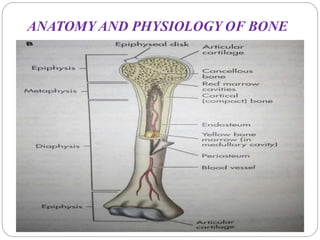
ANATOMY AND PHYSIOLOGY OF BONE
FUNCTIONS OF BONE
The functions of bone include:
 Framework of the body.
 Attachment to muscles and tendons.
 Movement of body
 Protecting the organs they contain.
 Hemopoeisis, the production of blood cells in red bone marrow.
 Mineral storage, especially calcium phosphate
TYPES OF FRACTURE
 Avulsion: a fracture in which a fragment of bone has been pulled
away by a tendon and its attachment.
 Communited: a fracture in which bone has splinted into several
fragments.
 Compression: a fracture in which bone has been compressed
( vertebral column).
 Depressed: a fracture in which fragments are driven inward (skull
and facial bone).
 Epiphysial: a fracture through the epiphysial.
 Greensstick: a fracture in which one side of a bone is broken and
the other side is bent.
Impacted: a fracture in which bone fragment is driven into another
bone fragment.
Oblique: a fracture occurring at an angle across the bone.
Pathologic: a fracture that occur through an area of diseased bone(
eg. Osteoporosis, bone cyst, bony metastasis, tumor).
Simple: a fracture that remains contained, with no disruption of the
skin integrity.
Spiral: a fracture that twist around the shaft of the bone.
Stress: a fracture that result from repeated loading of bone and
muscle.
Transverse: a fracture that is straight across the bone shaft.
 Longitudinal: a fracture that is fracture in which the fracture line
runs along the longitudinal axis of the bone.
 Open: a fracture in which the skin or mucous membrane wound
extends to the fractured bone. Open fractures are graded
according to the following criteria:
 Grade I is a clean wound less than 1 cm long.
 Grade ii is a larger wound without extensive soft tissue damage.
 Grade iii is highly contaminated, has extensive soft tissue
damage , and is the most severe.
 Closed: a fracture is that one doesnot cause a break in the skin
ETIOLOGY AND RISK
FACTORS
 Falls or automobile accident.
 As people age, two factors make their risk of fracture greater : weaker
bone and a greater risk of falling.
 Children, who tend to have more physically active lifestyles and than
adults, are also prone to fracture.
 People with underlying illness and conditions(osteoporosis, bone
tumor) that may weaken their bones have a higher risk of fractures.
 Stress fracture, which result from repeated stresses strains, commonly
found among professional sports people, are also common causes of
fracture
CLINICAL MANIFESTATIONS
 Pain
 Edema and swelling
 Muscle spasm
 Decreased movement
 Deformity (abnormal position of extremity)
 Ecchymosis/ contusion
 Tenderness
 Protrusion of the affected area at an unusual angle
 Inability to put weight on the injured area
 Bleeding in open fracture
 Crepitation (audible crunching sensation)
INVESTIGATIONS
 History and complete physical examination : causes of fracture, signs
and symptoms of fracture.
 X-Ray : to detect place of fracture.
 CT Scan: to detect extention of fracture
 MRI: to get detailed information
 Blood test is done to identify hb, haematocrit
 Arthoscopy : to detect joint involvement.
 Angiography : to detect blood vessel injury
 Nerve conduction and electromyogram: to detect associated nerve
injury.
MANAGEMENT
 Emergency management
 Immobilization
 Adequate splinting
 Bandaging
 Cover the wound if open fracture with sterile dressing
 Thorough evaluation
 Remove cloth from unaffected area to affected area
 The fracture part is moved as little as possible to avoid more
damage.
Collaborative management
1. FRACTURE REDUCTION
 Closed reduction: it is a non surgical, manual realignment of
bone fragments to their previous anatomic position. Closed
reduction is usually performed while the patient is under local or
general anaesthesia.
 Open reduction: it is the correction of the bone alignment
through a surgical incision. It usually includes internal fixation of
the fracture with the use of wires, screws, pins, plates,
intramedullary rods, or nails.
2. TRACTION: traction is the application of a pulling force to
an injured or diseased part of the body or an extremities
while counter traction is to
1. Prevent or reduce muscle spasm,
2. Immobilize a joint or part of the body.
3. Reduce a fracture or dislocation and
4. Treat a pathologic joint condition.
3. FRACTURE IMMOBILIZATION:
a. Cast : a cast is a temporary circumferential device. Casting
is a common treatment following closed reduction.
4. DRUG THERAPY:
 Central and peripheral muscle relaxants, such as carisoprodol,
cyclobezapine, or methocarbamol may be prescribed for relief
of pain associated with muscle spasm.
 In an open fracture the threat of tetanus can be reduced with
tetanus and diphtheria toxoid or tetanus immunoglobulin. Bone
penetrating antibiotics, such as a cephalosporin are used
prophylactically.
5. NUTRITIONAL THERAPY: The patient’s dietary
requirements must include protein, vitamins(specially B,C,D)
and calcium, phosphorus and magnesium to ensure optimal soft
tissue and one healing.
SURGICAL MANAGEMENT
 Pre- operative care
- a thorough history and physical examination to be done
- to detect and adequately addressing all other injuries, including
the co-morbidities and pre-existing medical conditions and to
keep under control
- prophylactic antibiotics should be administered prior to the
surgery
- to ask the patient if he/she has any allergy to any kind of drugs
- patient with open fractures should be given appropriate
antibiotic prophylaxis
 a. EXTERNAL FIXATION: An external fixator is a
metallic device composed of metal pins that are
inserted into the bone and attached to external rods to
stabilize the fracture while it heals.
 b. INTERNAL FIXATION: internal fixation devices
( pins, plates, metal) are surgically inserted at the time
of realignment.
 Post-operative care
Post operative care refers to the assessment, diagnosis and
evaluation of the outcome. The ultimate goal of post-operative
care is to prevent further complications such as infection, to help
in healing of the surgical wound and help in rehabilitation of the
patient post surgery
 The anaesthetic drugs used during the surgery may cause nausea
for the first 24 hours
 Patient should start with clear liquid diet
 Pain should be managed
 The surgical wound should be kept clean and dry
 Wound should be kept dry for 48 hours
 Check the surgical site for any sign of infection like redness and
increase in pain
 The wound should not be submerged in a bath tub or pool until
the sutures are removed.
NURSING MANAGEMENT
Nursing Assessment
Assessment of the fractured area includes the following:
 Close fracture. The patient with close fracture is assessed for
absence of opening in the skin at the fracture site.
 Open fracture. The patient with open fracture is assessed for
risk for osteomyelitis, tetanus, and gas gangrene.
 The fractured site is assessed for signs and symptoms of
infection.
Diagnosis
Based on the assessment data gathered, the nursing
diagnoses developed include:
 Acute pain related to fracture, soft tissue injury, and
muscle spasm.
 Impaired physical mobility related to fracture.
 Risk for infection related to opening in the skin in
an open fracture.
Nursing Interventions : Nursing care of a patient with fracture include
 The nurse should instruct the patient regarding proper methods to control
edema and pain.
 Teach exercises to maintain the health of the unaffected muscles and to
increase the strength of muscles needed for transferring and for using assistive
devices.
 Modify the home environment to promote safety such as removing any
obstruction in the walking paths around the house.
 Wound management. Wound irrigation and debridement are initiated as soon
as possible.
 Elevate extremity. The affected extremity is elevated to minimize edema.
 Signs of infection. The patient must be assessed for presence of signs and
symptoms of infection.
COMPLICATIONS
1. Delayed healing of bone
2. Delayed union of bone fragments
3. Deformity of the bone
4. Shock
5. Fat embolism
6. Venous thromboemboli
7. Compartment syndrome

FRACTURE.pptx

  • 1.
  • 2.
    INTRODUCTION  A fractureis a disruption of continuity of a bone.  Fracture occur when a bone is subjected to stress greater than it can absorb.  Fracture may caused by direct blows, crushing forces, sudden twisting motions, and extreme muscle contractions. When the bone is broken, adjacent structures are also affected, resulting in soft tissue edema, haemorrhage, into the muscle and joints, joint dislocations, ruptured tendons, severed nerves, and damaged blood vessels
  • 3.
    DEFINITION  “A fractureis a complete or partial disruption in the continuity of bone structure and is defined according to its type and extend.”
  • 4.
    TYPES OF BONES Bonesare classified as long, short, irregular, flat and sesamoid. Long bone: these are consist of a shaft and two extremities. As the name suggests, these bones are longer than they are wide. Examples include the femur, tibia, and fibula. Short , irregular, flat and sesamoid bones: these have no shafts or extremities and are diverse in shape and size. Examples include:  Short bones--- carpel( wrist)  Irregular bones--- vertebrae and some skull bones  Flat bones--- sternum, ribs, and skull bones  Sesamoid bone--- patella (knee cap)
  • 5.
  • 6.
    FUNCTIONS OF BONE Thefunctions of bone include:  Framework of the body.  Attachment to muscles and tendons.  Movement of body  Protecting the organs they contain.  Hemopoeisis, the production of blood cells in red bone marrow.  Mineral storage, especially calcium phosphate
  • 7.
  • 8.
     Avulsion: afracture in which a fragment of bone has been pulled away by a tendon and its attachment.  Communited: a fracture in which bone has splinted into several fragments.  Compression: a fracture in which bone has been compressed ( vertebral column).  Depressed: a fracture in which fragments are driven inward (skull and facial bone).  Epiphysial: a fracture through the epiphysial.  Greensstick: a fracture in which one side of a bone is broken and the other side is bent.
  • 9.
    Impacted: a fracturein which bone fragment is driven into another bone fragment. Oblique: a fracture occurring at an angle across the bone. Pathologic: a fracture that occur through an area of diseased bone( eg. Osteoporosis, bone cyst, bony metastasis, tumor). Simple: a fracture that remains contained, with no disruption of the skin integrity. Spiral: a fracture that twist around the shaft of the bone. Stress: a fracture that result from repeated loading of bone and muscle. Transverse: a fracture that is straight across the bone shaft.
  • 10.
     Longitudinal: afracture that is fracture in which the fracture line runs along the longitudinal axis of the bone.  Open: a fracture in which the skin or mucous membrane wound extends to the fractured bone. Open fractures are graded according to the following criteria:  Grade I is a clean wound less than 1 cm long.  Grade ii is a larger wound without extensive soft tissue damage.  Grade iii is highly contaminated, has extensive soft tissue damage , and is the most severe.  Closed: a fracture is that one doesnot cause a break in the skin
  • 12.
    ETIOLOGY AND RISK FACTORS Falls or automobile accident.  As people age, two factors make their risk of fracture greater : weaker bone and a greater risk of falling.  Children, who tend to have more physically active lifestyles and than adults, are also prone to fracture.  People with underlying illness and conditions(osteoporosis, bone tumor) that may weaken their bones have a higher risk of fractures.  Stress fracture, which result from repeated stresses strains, commonly found among professional sports people, are also common causes of fracture
  • 13.
  • 14.
     Pain  Edemaand swelling  Muscle spasm  Decreased movement  Deformity (abnormal position of extremity)  Ecchymosis/ contusion  Tenderness  Protrusion of the affected area at an unusual angle  Inability to put weight on the injured area  Bleeding in open fracture  Crepitation (audible crunching sensation)
  • 15.
    INVESTIGATIONS  History andcomplete physical examination : causes of fracture, signs and symptoms of fracture.  X-Ray : to detect place of fracture.  CT Scan: to detect extention of fracture  MRI: to get detailed information  Blood test is done to identify hb, haematocrit  Arthoscopy : to detect joint involvement.  Angiography : to detect blood vessel injury  Nerve conduction and electromyogram: to detect associated nerve injury.
  • 16.
    MANAGEMENT  Emergency management Immobilization  Adequate splinting  Bandaging  Cover the wound if open fracture with sterile dressing  Thorough evaluation  Remove cloth from unaffected area to affected area  The fracture part is moved as little as possible to avoid more damage.
  • 17.
    Collaborative management 1. FRACTUREREDUCTION  Closed reduction: it is a non surgical, manual realignment of bone fragments to their previous anatomic position. Closed reduction is usually performed while the patient is under local or general anaesthesia.  Open reduction: it is the correction of the bone alignment through a surgical incision. It usually includes internal fixation of the fracture with the use of wires, screws, pins, plates, intramedullary rods, or nails.
  • 18.
    2. TRACTION: tractionis the application of a pulling force to an injured or diseased part of the body or an extremities while counter traction is to 1. Prevent or reduce muscle spasm, 2. Immobilize a joint or part of the body. 3. Reduce a fracture or dislocation and 4. Treat a pathologic joint condition. 3. FRACTURE IMMOBILIZATION: a. Cast : a cast is a temporary circumferential device. Casting is a common treatment following closed reduction.
  • 20.
    4. DRUG THERAPY: Central and peripheral muscle relaxants, such as carisoprodol, cyclobezapine, or methocarbamol may be prescribed for relief of pain associated with muscle spasm.  In an open fracture the threat of tetanus can be reduced with tetanus and diphtheria toxoid or tetanus immunoglobulin. Bone penetrating antibiotics, such as a cephalosporin are used prophylactically. 5. NUTRITIONAL THERAPY: The patient’s dietary requirements must include protein, vitamins(specially B,C,D) and calcium, phosphorus and magnesium to ensure optimal soft tissue and one healing.
  • 21.
    SURGICAL MANAGEMENT  Pre-operative care - a thorough history and physical examination to be done - to detect and adequately addressing all other injuries, including the co-morbidities and pre-existing medical conditions and to keep under control - prophylactic antibiotics should be administered prior to the surgery - to ask the patient if he/she has any allergy to any kind of drugs - patient with open fractures should be given appropriate antibiotic prophylaxis
  • 22.
     a. EXTERNALFIXATION: An external fixator is a metallic device composed of metal pins that are inserted into the bone and attached to external rods to stabilize the fracture while it heals.  b. INTERNAL FIXATION: internal fixation devices ( pins, plates, metal) are surgically inserted at the time of realignment.
  • 23.
     Post-operative care Postoperative care refers to the assessment, diagnosis and evaluation of the outcome. The ultimate goal of post-operative care is to prevent further complications such as infection, to help in healing of the surgical wound and help in rehabilitation of the patient post surgery  The anaesthetic drugs used during the surgery may cause nausea for the first 24 hours  Patient should start with clear liquid diet  Pain should be managed  The surgical wound should be kept clean and dry  Wound should be kept dry for 48 hours  Check the surgical site for any sign of infection like redness and increase in pain  The wound should not be submerged in a bath tub or pool until the sutures are removed.
  • 24.
    NURSING MANAGEMENT Nursing Assessment Assessmentof the fractured area includes the following:  Close fracture. The patient with close fracture is assessed for absence of opening in the skin at the fracture site.  Open fracture. The patient with open fracture is assessed for risk for osteomyelitis, tetanus, and gas gangrene.  The fractured site is assessed for signs and symptoms of infection.
  • 25.
    Diagnosis Based on theassessment data gathered, the nursing diagnoses developed include:  Acute pain related to fracture, soft tissue injury, and muscle spasm.  Impaired physical mobility related to fracture.  Risk for infection related to opening in the skin in an open fracture.
  • 26.
    Nursing Interventions :Nursing care of a patient with fracture include  The nurse should instruct the patient regarding proper methods to control edema and pain.  Teach exercises to maintain the health of the unaffected muscles and to increase the strength of muscles needed for transferring and for using assistive devices.  Modify the home environment to promote safety such as removing any obstruction in the walking paths around the house.  Wound management. Wound irrigation and debridement are initiated as soon as possible.  Elevate extremity. The affected extremity is elevated to minimize edema.  Signs of infection. The patient must be assessed for presence of signs and symptoms of infection.
  • 27.
    COMPLICATIONS 1. Delayed healingof bone 2. Delayed union of bone fragments 3. Deformity of the bone 4. Shock 5. Fat embolism 6. Venous thromboemboli 7. Compartment syndrome