FRACTURES & DISLOCATIONS-
GENERAL PRINCIPLES
DR.SUNIL KUMAR
ASST.PROFESSOR
DEPTOF GEN.SURGERY
MNR MEDICAL COLLEGE ,SANGAREDDY
11-11-2018
• A fracture is a break in the continuity of a
bone.
Classification
• on the basis of aetiology,
• the relationship of the fracture with the
external environment,
• the displacement of the fracture, and the
pattern of the fracture.
ON THE BASIS OF AETIOLOGY
Traumatic fracture:
• A fracture sustained due to trauma is called a traumatic
fracture.
• Normal bone can withstand considerable force, and
breaks only when subjected to excessive force.
• Most fractures seen in day-to-day practice fall into this
category
e.g., fractures caused by a fall,
road traffic accident,
fight etc.
Pathological fracture:
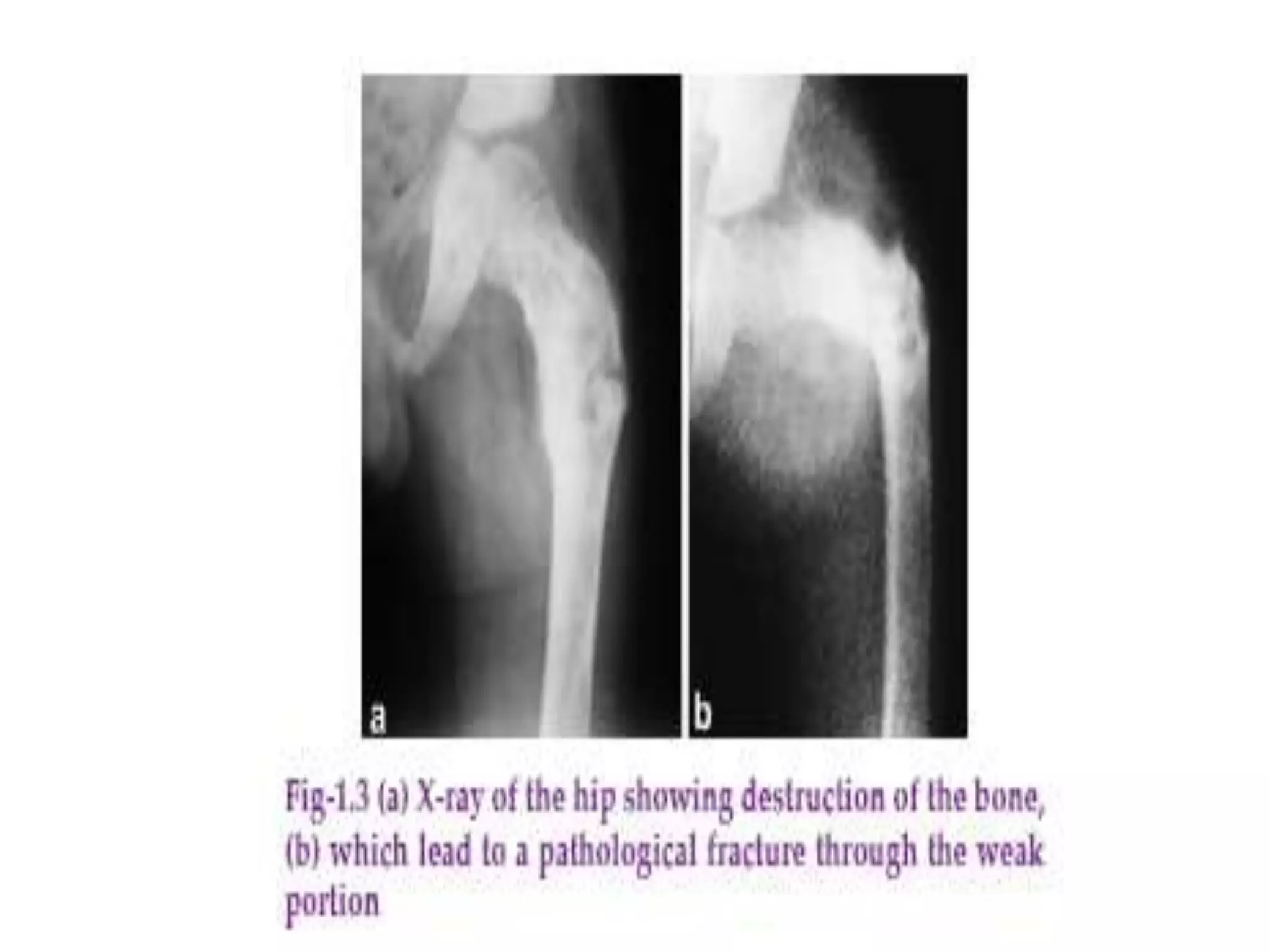
A fracture through a bone which has been made
weak by some underlying disease is called a
pathological fracture.
• A trivial or no force may be required to cause
such a fracture
• e.g., a fracture through a bone weakened by
metastasis.
• Although, traumatic fractures have a predictable
and generally successful outcome, pathological
fractures often go into non-union.
Stress Fracture
• This is a special type of fracture sustained due
to chronic repetitive injury (stress) causing a
break in bony trabeculae.
• These often present as only pain and may not
be visible on X-rays.
ON THE BASIS OF DISPLACEMENTS
Undisplaced fracture:
• These fractures are easy to identify by the
absence of significant displacement.
Displaced fracture:
• The factors responsible for displacement are:
• (i) the fracturing force;
• (ii) the muscle pull on the fracture fragments;
and
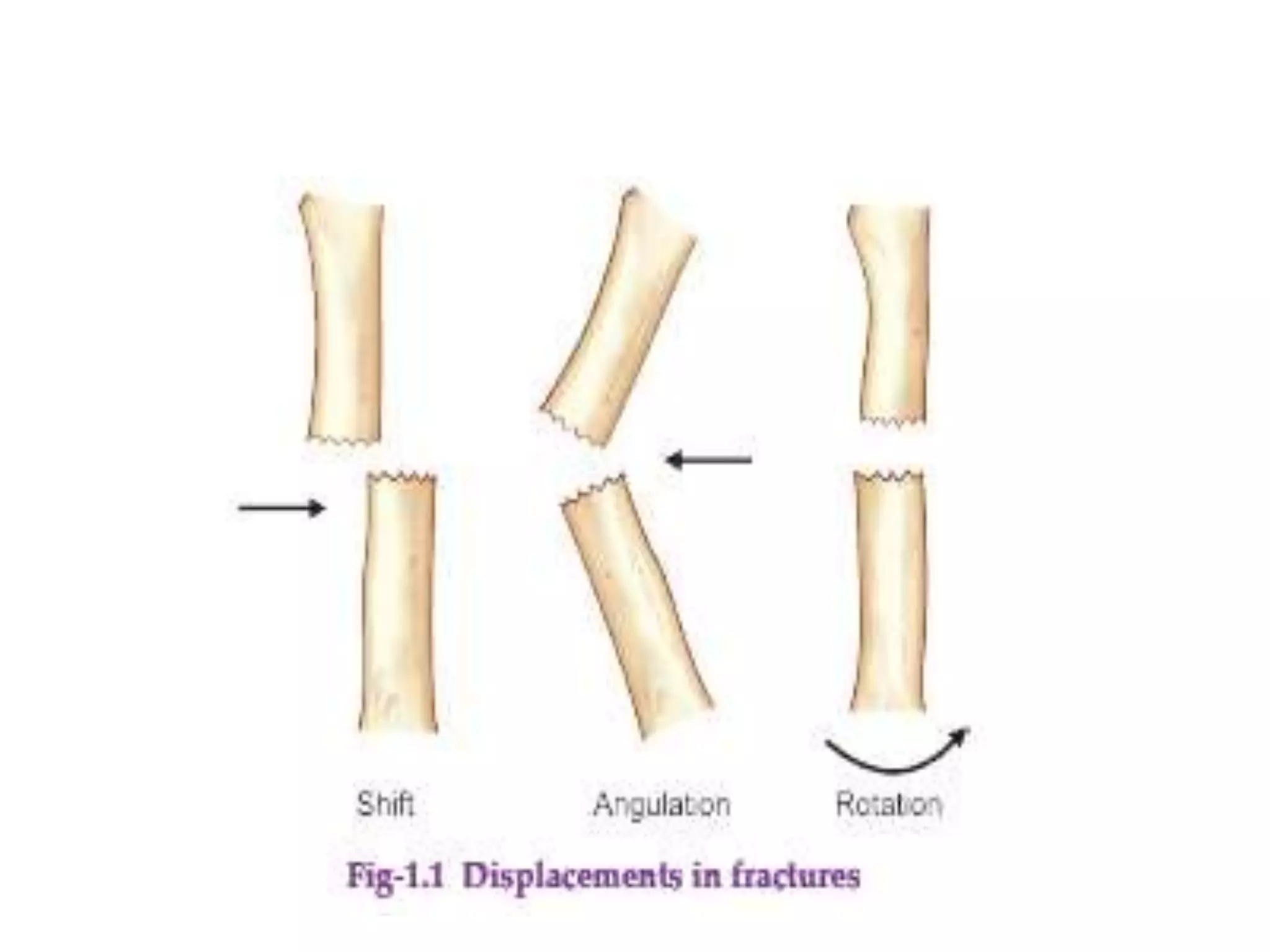
• (iii) the gravity. While describing the
displacements of a fracture, conventionally, it
is the displacement of the distal fragment in
relation to the proximal fragment which is
mentioned.
• The displacement can be in the form of shift,
angulation or rotation (Fig-1.1).
ON THE BASIS OF RELATIONSHIP WITH
EXTERNAL ENVIRONMENT
Closed fracture:
• A fracture not communicating with the external
environment, i.e., the overlying skin and other
soft tissues are intact, is called a closed fracture.
• Open fracture: A fracture with break in the
overlying skin and soft tissues, leading to the
fracture communicating with the external
environment, is called an open fracture.
• A fracture may be open from within or outside,
the so called internally or externally open
fracture respectively.
a) Internally open (from within): The sharp fracture
end pierces the skin from within, resulting in an
open fracture.
b) Externally open (open from outside): The object
causing the fracture lacerates the skin and soft
tissues over the bone, as it breaks the bone,
resulting in an open fracture.
• Exposure of an open fracture to the external
environment makes it prone to infection. This risk
is more in externally open fracture.
ON THE BASIS OF COMPLEXITY OF
TREATMENT
Simple fracture:
• A fracture in two pieces, usually easy to treat,
is called simple fracture,
• e.g. A transverse fracture of humerus.
Complex fracture:
A fracture in multiple pieces, usually difficult to
treat, is called complex fracture,
e.g. a communited fracture of tibia.
ON THE BASIS OF QUANTUM OF FORCE
CAUSING FRACTURE
• High-velocity injury: These are fractures
sustained as a result of severe trauma force,
as in traffic accidents.
• In these fractures, there is severe soft tissue
injury (periosteal and muscle injury).
• There is extensive devascularisation of
fracture ends.
• Such fractures are often unstable, and slow to
heal.
LOW-VELOCITY INJURY
• These fractures are sustained as a result of mild
trauma force, as in a fall.
• There is little associated soft tissue injury, and
hence these fractures often heal predictably.
• Lately, there is a change in the pattern of
fractures due to shift from low-velocity to high-
velocity injuries.
• More complex fractures, which are difficult to
treat.
ON THE BASIS OF PATTERN
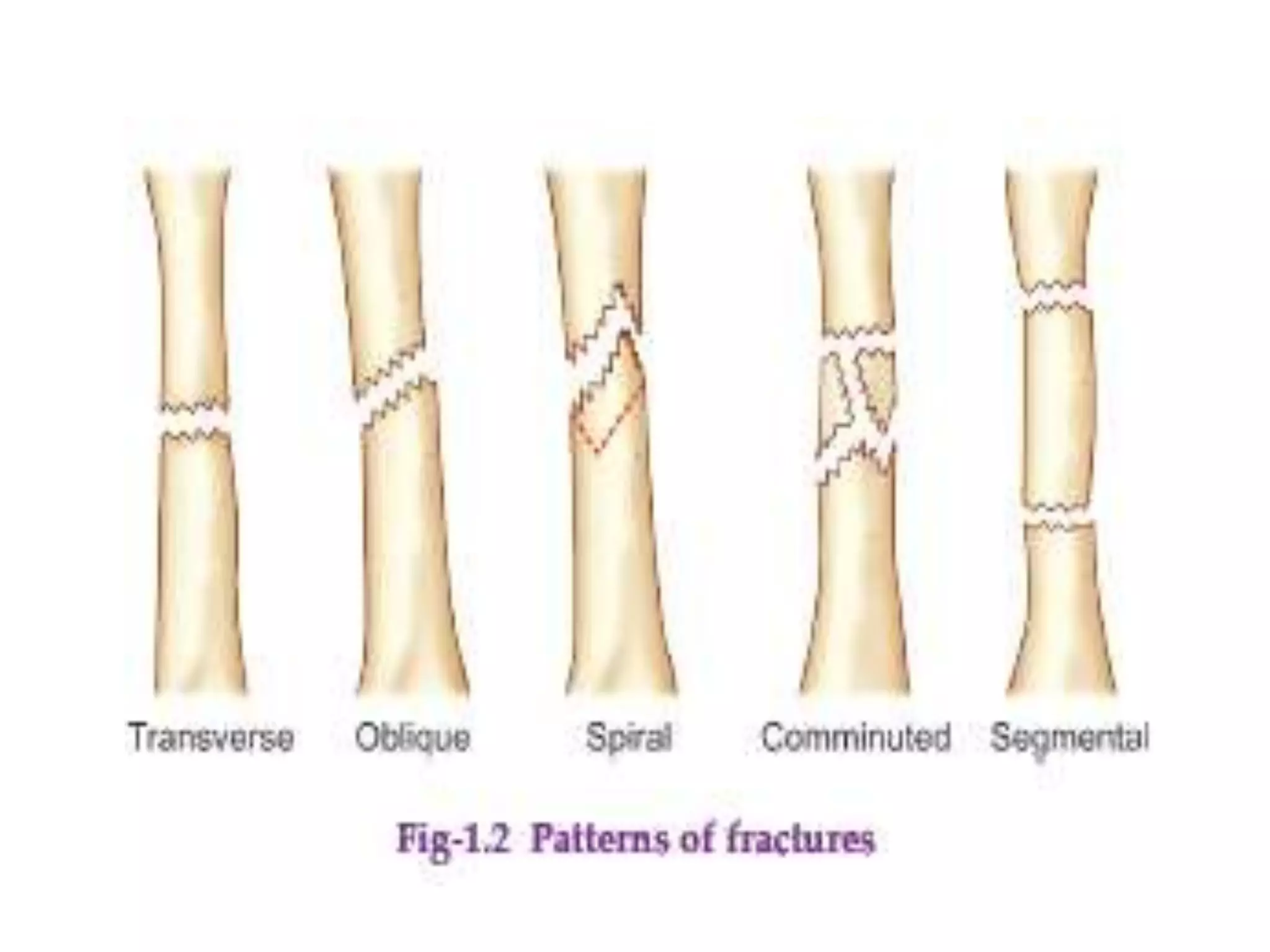
Transverse fracture:
• In this fracture, the fracture line is
perpendicular to the long axis of the bone.
• Such a fracture is caused by a tapping or
bending force (Fig-1.2).
Oblique fracture
• In this fracture, the fracture line is oblique.
• Such a fracture is caused by a bending force
which, in addition, has a component along the
long axis of the bone.
Spiral fracture:
• In this fracture, the fracture line runs spirally in
more than one plane.
• Such a fracture is caused by a primarily twisting
force.
Comminuted fracture:
• This is a fracture with multiple fragments.
• It is caused by a crushing or compression force
along the long axis of the bone.
SEGMENTAL FRACTURE
• In this type, there are two fractures in one
bone, but at different levels.
• A fracture may have a combination of two or
more patterns.
• For example, it may be a comminuted but
primarily a transverse fracture.
FRACTURES WITH EPONYMS
• Some fractures are better known by names,
mostly of those who first described them.
Monteggia fracture-dislocation:
• Fracture of the proximal third of the ulna,
with dislocation of the head of the radius.
Galeazzi fracture-dislocation:
• Fracture of the distal third of the radius with
dislocation of the distal radio-ulnar joint.
Night-stick fracture:
• Isolated fracture of the shaft of the ulna,
sustained while trying to ward off a stick blow.
Colles’ fracture:
• A fracture occurring in adults, at the cortico-
cancellous junction of the distal end of the
radius with dorsal tilt and other displacements
.
Smith's fracture
• A fracture occurring in adults, at the cortico-
cancellous junction of the distal end of the
radius with ventral tilt and other
displacements (reverse of Colles').
Barton's fracture (Marginal fracture):
• Intra-articular fractures through the distal
articular surface of the radius, taking a margin,
anterior or posterior, of the distal radius with
the carpals, displaced anteriorly or posteriorly
.
Chauffeur fracture:
• An intra-articular, oblique fracture of the
styloid process of the radius.
Bennett's fracture-dislocation:
• It is an oblique, intraarticular fracture of the
base of the first metacarpal with subluxation
of the trapezio-metacarpal joint.
Boxers' fracture:
• It is a ventrally displaced fracture through the
neck of the 5th metacarpal, usually occurs in
boxers.
Side-swipe fracture:
• It is an elbow injury sustained when one's
elbow, projecting out of a car, is ‘side swept’
by another vehicle.
• It has a combination of fractures of the distal
end of the humerus with fractures of proximal
ends of radius and/or ulna.
• It is also called baby car fracture.
Bumper fracture:
• It is a comminuted, depressed fracture of the
lateral condyle of the tibia.
Pott's fracture: Bimalleolar ankle fracture.
Cotton's fracture: Trimalleolar ankle fracture.
Massonaise's fracture:
• It is a type of ankle fracture in which fracture
of the neck of the fibula occurs.
Pilon fracture:
• It is a comminuted intra-articular fracture of
the distal end of the tibia.
Aviator's fracture: Fracture of neck of the talus.
Chopart fracture-dislocation: A fracture-
dislocation through inter-tarsal joints.
Jone's fracture:
Avulsion fracture of the base of the 5th
metatarsal.
Rolando fracture: Fracture of the base of the
first metacarpal (extra-articular).
Jefferson’s fracture: Fracture of the first cervical
vertebra.
• Whiplash injury: Cervical spine injury where
sudden flexion followed by hyperextension
takes place.
• Chance fracture: Also called seat belt fracture,
the fracture line runs horizontally through the
body of the vertebra, through and through, to
the posterior elements
• March fracture: Fatigue fracture of the shaft
of 2nd or 3rd metatarsal.
• Burst fracture: It is a comminuted fracture of
the vertebral body where fragments ‘‘burst
out’’ in different directions.
• Clay-Shoveller fracture: It is an avulsion
fracture of spinous process of one or more of
the lower cervical or upper thoracic vertebrae.
• Hangman's fracture: It is a fracture through
the pedicle and lamina of C2 vertebra, with
subluxation of C2 over C3, sustained in
hanging.
• Dashboard fracture: A fracture of posterior lip
of the acetabulum, often associated with
posterior dislocation of the hip.
• Straddle fracture: Bilateral superior and
inferior pubic rami fractures.
• Malgaigne's fracture: A type of pelvis fracture
in which there is a combination of fractures,
pubic rami anteriorly and sacro-iliac joint or
ilium posteriorly, on the same side.
• Mallet finger: A finger flexed at the DIP joint
due to avulsion or rupture of extensor tendon
at the base of the distal phalanx.
PATHOLOGICAL FRACTURES
• A fracture is termed pathological when it occurs
in a bone made weak by some disease (Fig-1.3).
• Often, the bone breaks as a result of a trivial
trauma, or even spontaneously.
CAUSES
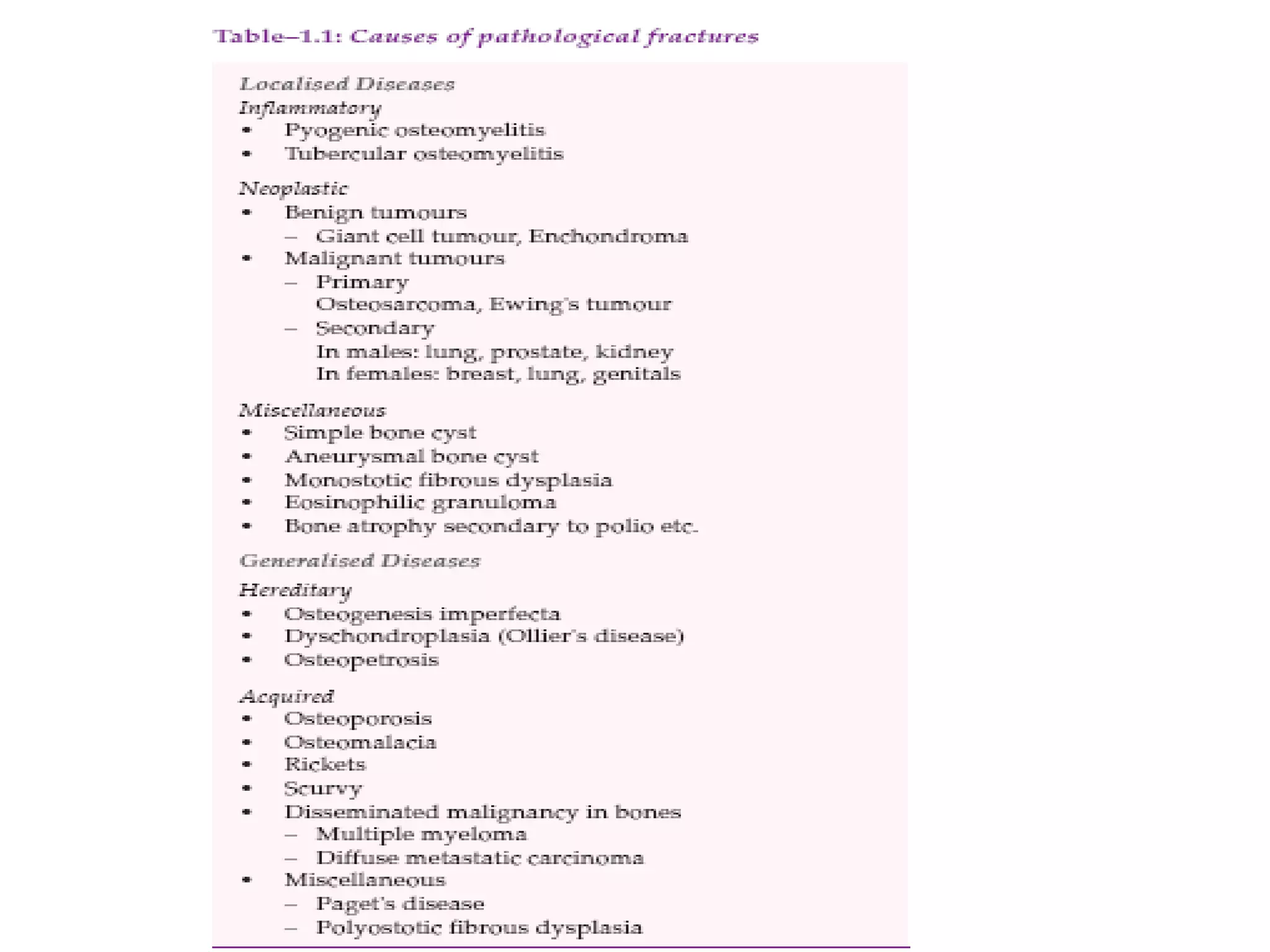
• A bone may be rendered weak by a disease
localised to that particular bone, or by a
generalised bone disorder. Table–1.1 gives some
of the common causes of pathological fractures.
• Osteoporosis is the commonest cause of
pathological fracture.
• The bones most often affected are the
vertebral bodies (thoracic and lumbar).
• Other common fractures associated with
osteoporosis are fracture of the neck of the
femur and Colles' fracture.
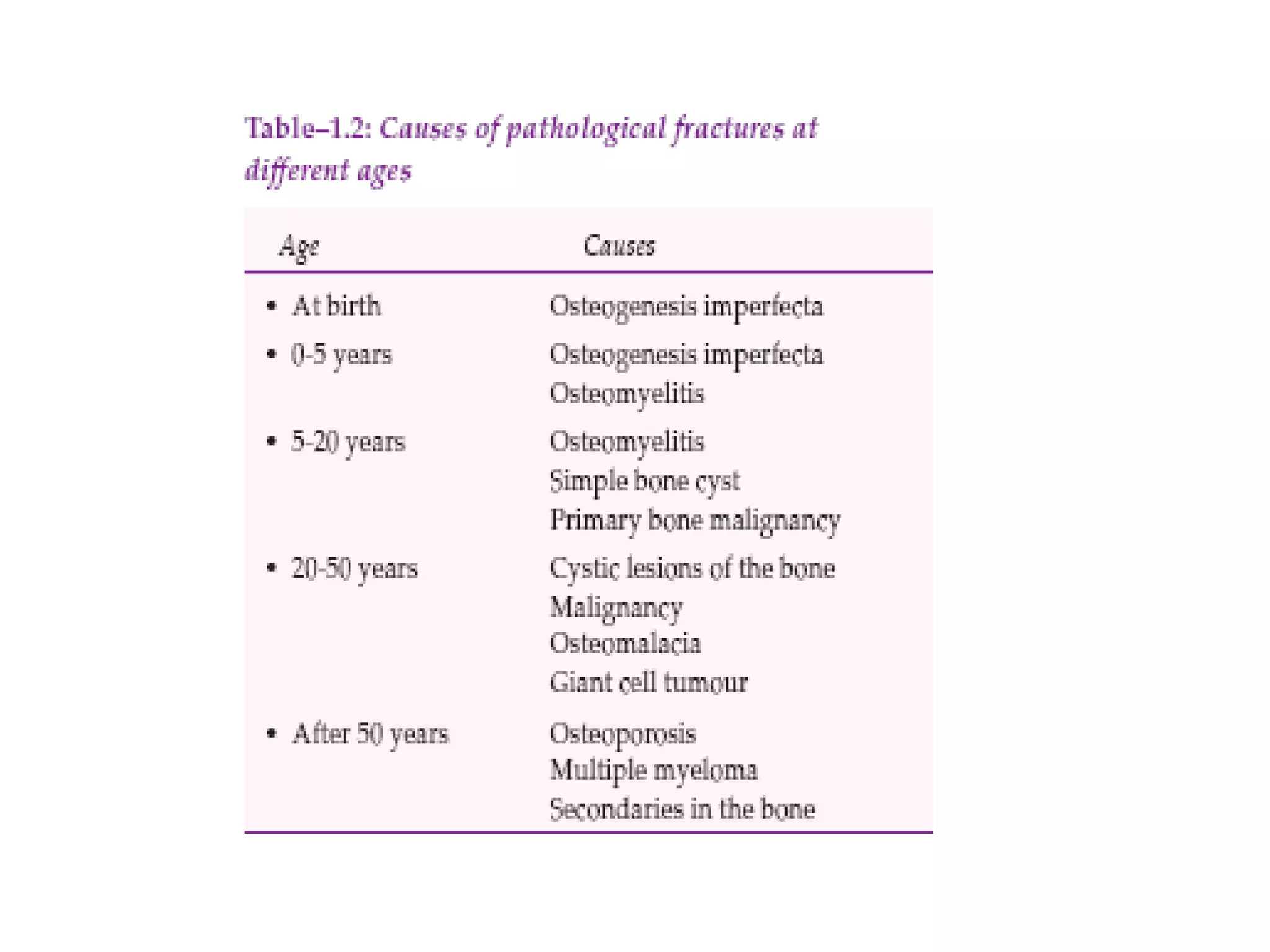
• A local or circumscribed lesion of the bone,
responsible for a pathological fracture, may be
due to varying causes in different age groups
(Table–1.2).
• In children, it is commonly due to chronic
osteomyelitis or a bone cyst.
• In adults, it is often due to a bone cyst or giant
cell tumour.
• In elderly people, metastatic tumour is a
frequent cause.
DIAGNOSIS
• A fracture sustained without a significant
trauma should arouse suspicion of a
pathological fracture.
• The patient may be a diagnosed case of a
disease known to produce pathological
fractures (e.g., a known case of malignancy).
• At times, the patient may present with a
pathological fracture, the cause of which is
determined only after a detailed work up.
TREATMENT
• Treatment of a pathological fracture consists of:
• (i) detecting the underlying cause of the fracture;
• (ii) making an assessment of the capacity of the
fracture to unite, based on the nature of the
underlying disease.
• A fracture in a bone affected by a generalised
disorder like Paget's disease, osteogenesis
imperfecta or osteoporosis is expected to unite
with conventional methods of treatment.
• Fractures occurring in osteomyelitic bones
often take a long time, and sometimes fail to
unite despite best efforts.
• Fractures through metastatic bone lesions
often do not unite at all, though the union
may occur if the malignancy has been brought
under control with chemotherapy or
radiotherapy.
• With the availability of facilities for internal fixation,
more and more pathological fractures are now treated
operatively with an aim to:
• (i) enhance the process of union by bone grafting (e.g.
in bone cyst or benign tumour);
• or (ii) mobilise the patient by surgical stabilisation of
the fracture.
• Achieving stable fixation in these fractures is difficult
because of the bone defect caused by the underlying
pathology.
• The defect may have to be filled using bone grafts or
bone cement
DISLOCATION
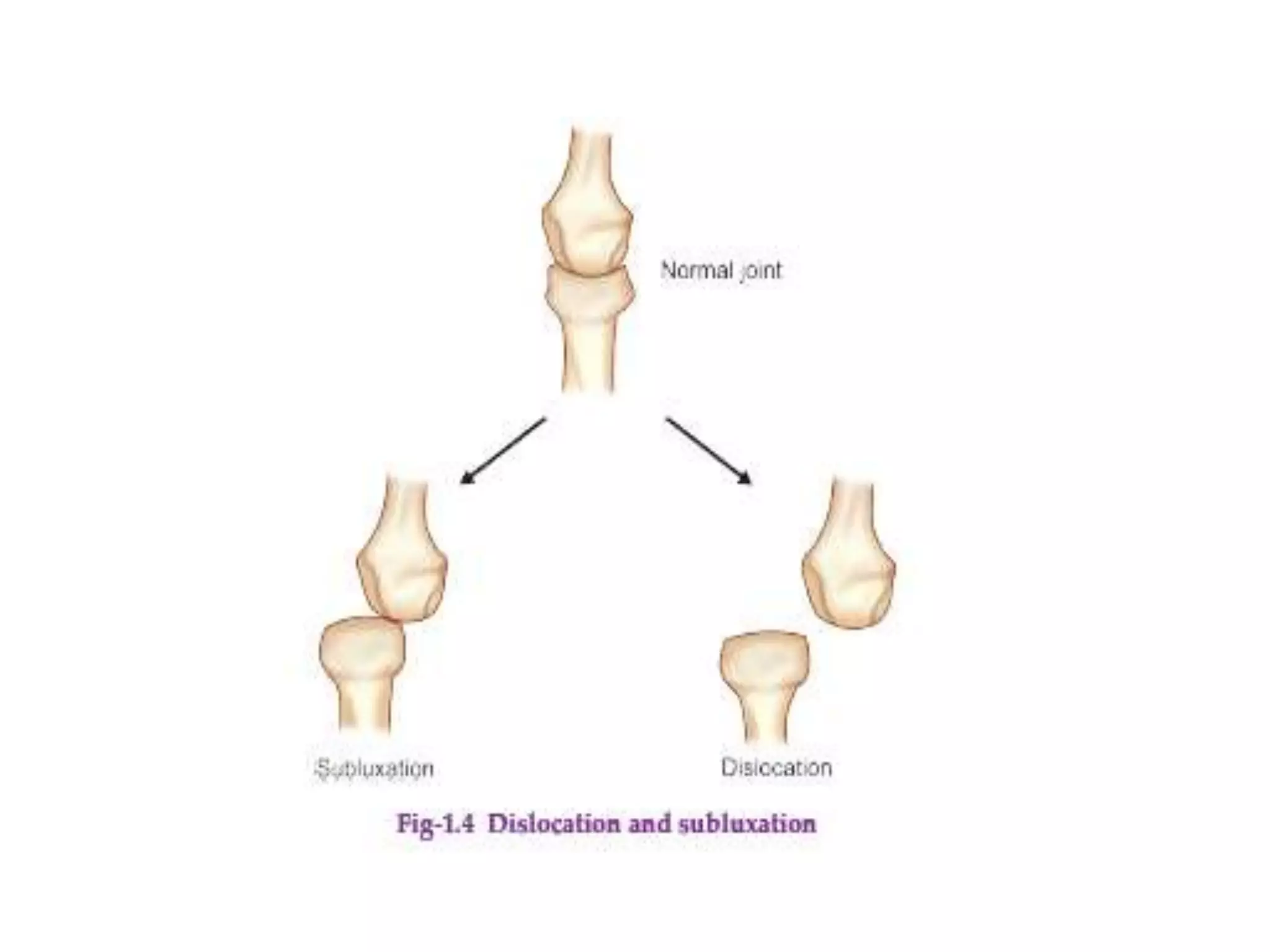
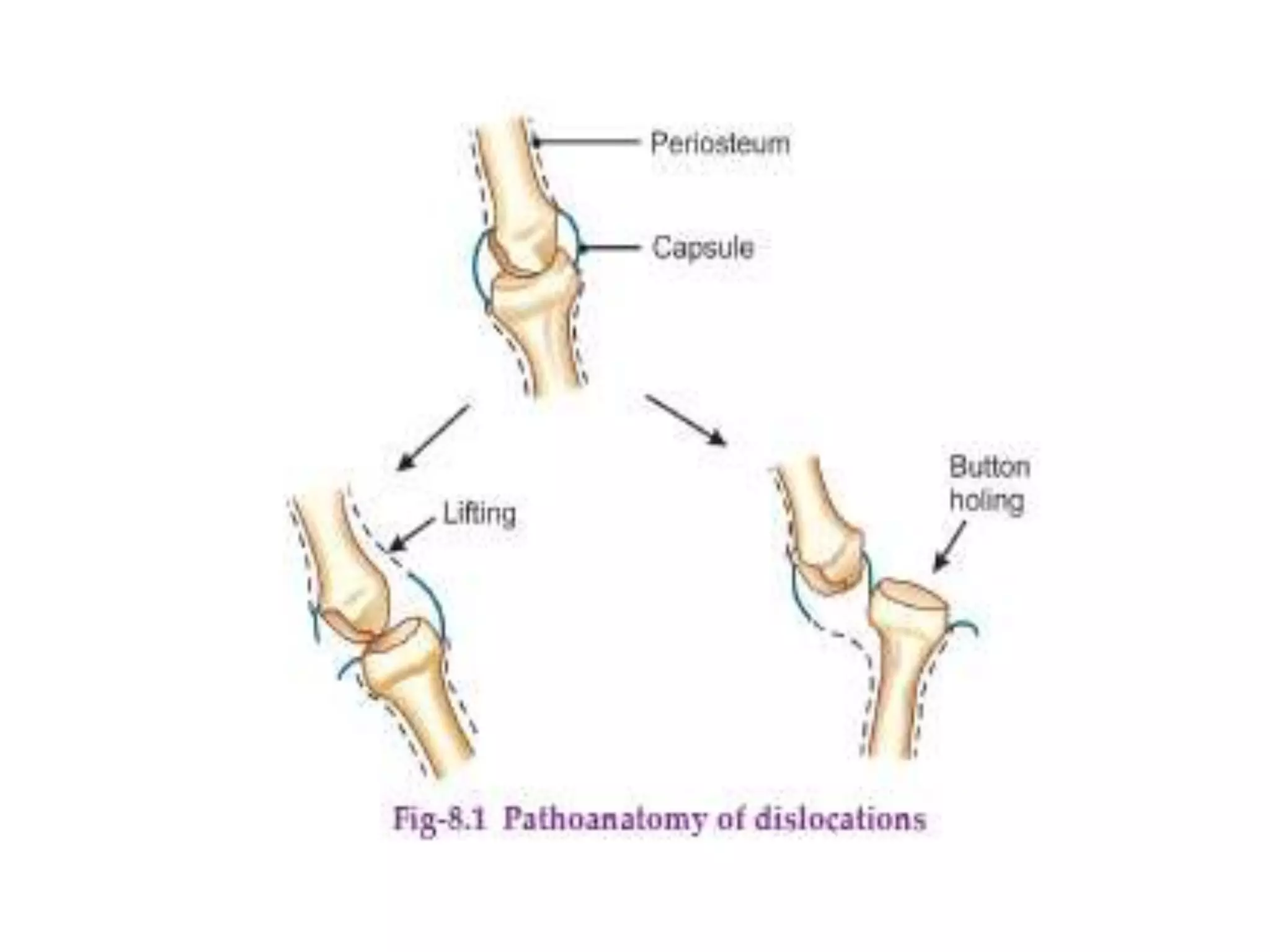
• A joint is dislocated when its articular surfaces
are completely displaced, one from the other,
so that all contact between them is lost ( Fig-
1.4).
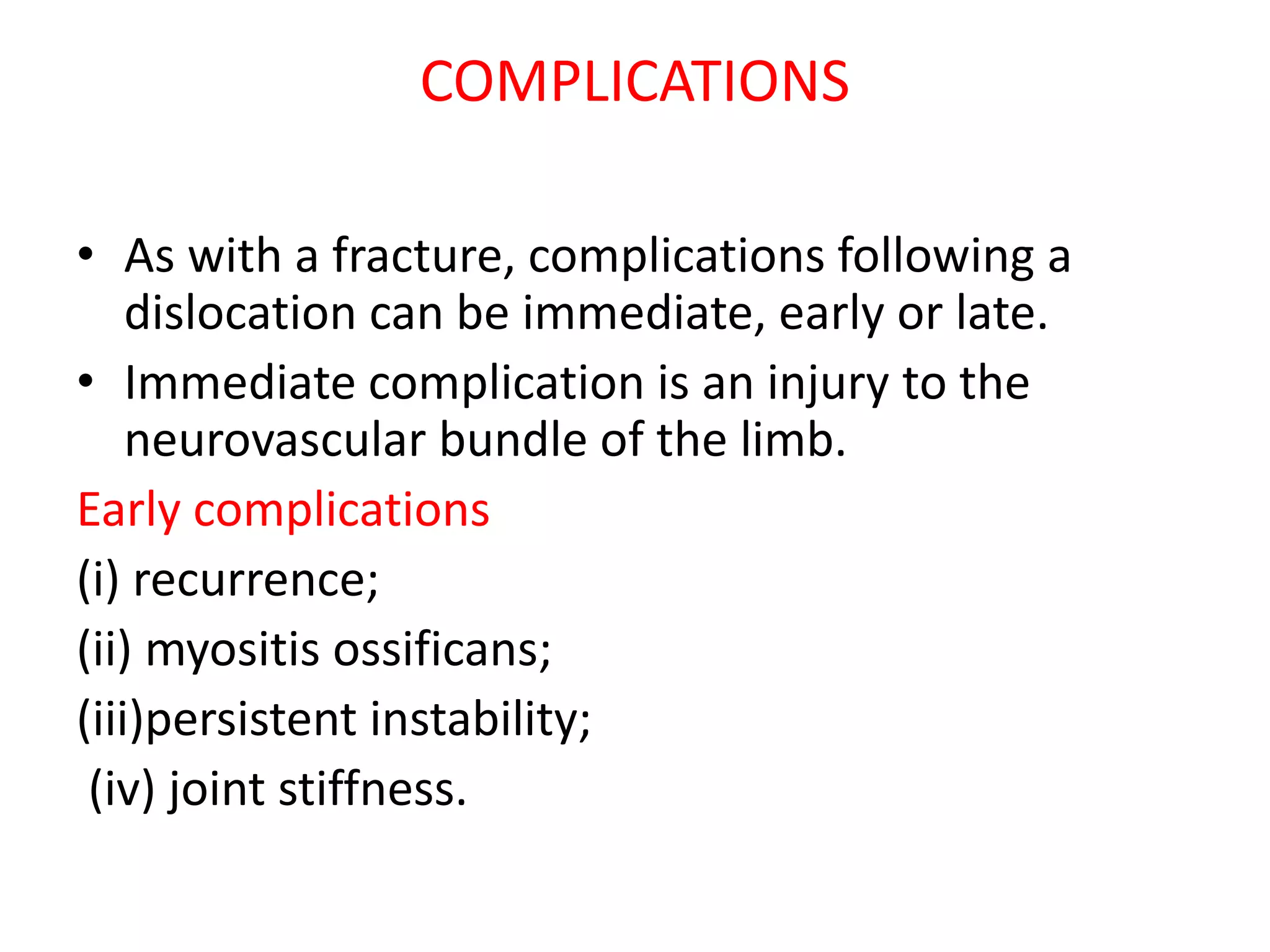
COMPLICATIONS
• As with a fracture, complications following a
dislocation can be immediate, early or late.
• Immediate complication is an injury to the
neurovascular bundle of the limb.
Early complications
(i) recurrence;
(ii) myositis ossificans;
(iii)persistent instability;
(iv) joint stiffness.
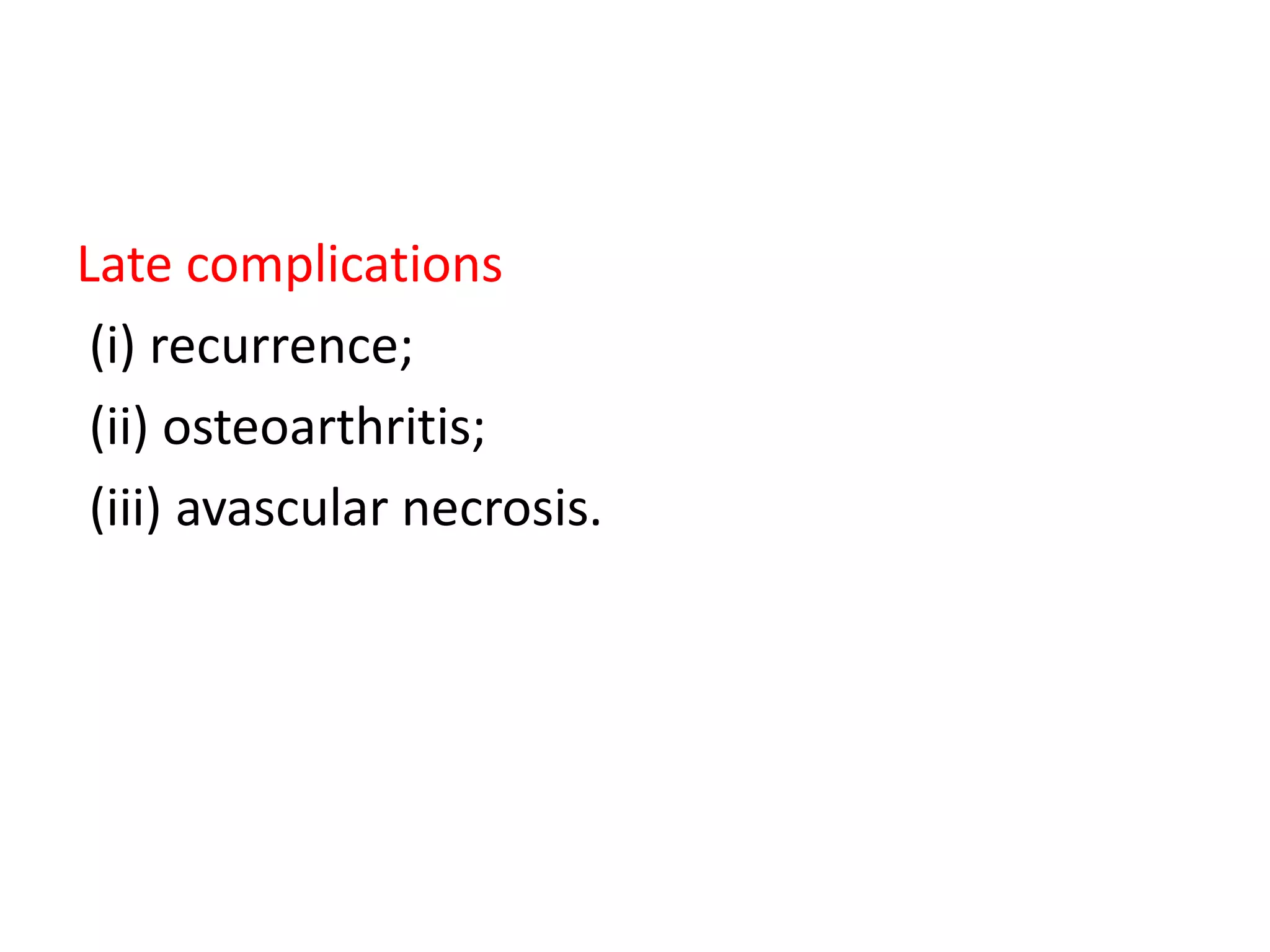
Late complications
(i) recurrence;
(ii) osteoarthritis;
(iii) avascular necrosis.
TREATMENT
• Treatment of a dislocation or subluxation
depends upon its type, as discussed below:
• Acute traumatic dislocation: In acute
traumatic dislocation, an urgent reduction of
the dislocation is of paramount importance.
• Often it is possible to do so by conservative
methods, although sometimes operative
reduction may be required.
a) Conservative methods: A dislocation may be
reduced by closed manipulative manoeuvres.
• Reduction of a dislocated joint is one of the most
gratifying jobs an orthopaedic surgeon is called
upon to do, as it produces instant pain relief to
the patient.
• Prolonged traction may be required for reducing
some dislocations.
b) Operative methods: Operative reduction may be
required in some cases.
Following are some of the indications:
• Failure of closed reduction, often because the
dislocation is detected late.
• Fracture-dislocation:
(i) if the fracture has produced significant incongruity of
the joint surfaces;
(ii) a loose piece of bone is lying within the joint;
(iii) the dislocation is difficult to maintain by closed
treatment.
OLD UNREDUCED DISLOCATIONS
• This often needs operative reduction. In some
cases, if the function of the dislocated joint is
good, nothing needs to be done.
• Recurrent dislocations; An individual episode
is treated like a traumatic dislocation.
• For prevention of recurrences, reconstructive
procedures are required.
THANK YOU

Fractures & dislocations general principles

  • 1.
    FRACTURES & DISLOCATIONS- GENERALPRINCIPLES DR.SUNIL KUMAR ASST.PROFESSOR DEPTOF GEN.SURGERY MNR MEDICAL COLLEGE ,SANGAREDDY 11-11-2018
  • 2.
    • A fractureis a break in the continuity of a bone. Classification • on the basis of aetiology, • the relationship of the fracture with the external environment, • the displacement of the fracture, and the pattern of the fracture.
  • 3.
    ON THE BASISOF AETIOLOGY Traumatic fracture: • A fracture sustained due to trauma is called a traumatic fracture. • Normal bone can withstand considerable force, and breaks only when subjected to excessive force. • Most fractures seen in day-to-day practice fall into this category e.g., fractures caused by a fall, road traffic accident, fight etc.
  • 4.
    Pathological fracture: A fracturethrough a bone which has been made weak by some underlying disease is called a pathological fracture. • A trivial or no force may be required to cause such a fracture • e.g., a fracture through a bone weakened by metastasis. • Although, traumatic fractures have a predictable and generally successful outcome, pathological fractures often go into non-union.
  • 5.
    Stress Fracture • Thisis a special type of fracture sustained due to chronic repetitive injury (stress) causing a break in bony trabeculae. • These often present as only pain and may not be visible on X-rays.
  • 6.
    ON THE BASISOF DISPLACEMENTS Undisplaced fracture: • These fractures are easy to identify by the absence of significant displacement. Displaced fracture: • The factors responsible for displacement are: • (i) the fracturing force; • (ii) the muscle pull on the fracture fragments; and
  • 7.
    • (iii) thegravity. While describing the displacements of a fracture, conventionally, it is the displacement of the distal fragment in relation to the proximal fragment which is mentioned. • The displacement can be in the form of shift, angulation or rotation (Fig-1.1).
  • 9.
    ON THE BASISOF RELATIONSHIP WITH EXTERNAL ENVIRONMENT Closed fracture: • A fracture not communicating with the external environment, i.e., the overlying skin and other soft tissues are intact, is called a closed fracture. • Open fracture: A fracture with break in the overlying skin and soft tissues, leading to the fracture communicating with the external environment, is called an open fracture. • A fracture may be open from within or outside, the so called internally or externally open fracture respectively.
  • 10.
    a) Internally open(from within): The sharp fracture end pierces the skin from within, resulting in an open fracture. b) Externally open (open from outside): The object causing the fracture lacerates the skin and soft tissues over the bone, as it breaks the bone, resulting in an open fracture. • Exposure of an open fracture to the external environment makes it prone to infection. This risk is more in externally open fracture.
  • 11.
    ON THE BASISOF COMPLEXITY OF TREATMENT Simple fracture: • A fracture in two pieces, usually easy to treat, is called simple fracture, • e.g. A transverse fracture of humerus. Complex fracture: A fracture in multiple pieces, usually difficult to treat, is called complex fracture, e.g. a communited fracture of tibia.
  • 12.
    ON THE BASISOF QUANTUM OF FORCE CAUSING FRACTURE • High-velocity injury: These are fractures sustained as a result of severe trauma force, as in traffic accidents. • In these fractures, there is severe soft tissue injury (periosteal and muscle injury). • There is extensive devascularisation of fracture ends. • Such fractures are often unstable, and slow to heal.
  • 13.
    LOW-VELOCITY INJURY • Thesefractures are sustained as a result of mild trauma force, as in a fall. • There is little associated soft tissue injury, and hence these fractures often heal predictably. • Lately, there is a change in the pattern of fractures due to shift from low-velocity to high- velocity injuries. • More complex fractures, which are difficult to treat.
  • 14.
    ON THE BASISOF PATTERN Transverse fracture: • In this fracture, the fracture line is perpendicular to the long axis of the bone. • Such a fracture is caused by a tapping or bending force (Fig-1.2).
  • 16.
    Oblique fracture • Inthis fracture, the fracture line is oblique. • Such a fracture is caused by a bending force which, in addition, has a component along the long axis of the bone.
  • 17.
    Spiral fracture: • Inthis fracture, the fracture line runs spirally in more than one plane. • Such a fracture is caused by a primarily twisting force. Comminuted fracture: • This is a fracture with multiple fragments. • It is caused by a crushing or compression force along the long axis of the bone.
  • 18.
    SEGMENTAL FRACTURE • Inthis type, there are two fractures in one bone, but at different levels. • A fracture may have a combination of two or more patterns. • For example, it may be a comminuted but primarily a transverse fracture.
  • 19.
    FRACTURES WITH EPONYMS •Some fractures are better known by names, mostly of those who first described them. Monteggia fracture-dislocation: • Fracture of the proximal third of the ulna, with dislocation of the head of the radius. Galeazzi fracture-dislocation: • Fracture of the distal third of the radius with dislocation of the distal radio-ulnar joint.
  • 20.
    Night-stick fracture: • Isolatedfracture of the shaft of the ulna, sustained while trying to ward off a stick blow. Colles’ fracture: • A fracture occurring in adults, at the cortico- cancellous junction of the distal end of the radius with dorsal tilt and other displacements .
  • 21.
    Smith's fracture • Afracture occurring in adults, at the cortico- cancellous junction of the distal end of the radius with ventral tilt and other displacements (reverse of Colles').
  • 22.
    Barton's fracture (Marginalfracture): • Intra-articular fractures through the distal articular surface of the radius, taking a margin, anterior or posterior, of the distal radius with the carpals, displaced anteriorly or posteriorly . Chauffeur fracture: • An intra-articular, oblique fracture of the styloid process of the radius.
  • 23.
    Bennett's fracture-dislocation: • Itis an oblique, intraarticular fracture of the base of the first metacarpal with subluxation of the trapezio-metacarpal joint. Boxers' fracture: • It is a ventrally displaced fracture through the neck of the 5th metacarpal, usually occurs in boxers.
  • 24.
    Side-swipe fracture: • Itis an elbow injury sustained when one's elbow, projecting out of a car, is ‘side swept’ by another vehicle. • It has a combination of fractures of the distal end of the humerus with fractures of proximal ends of radius and/or ulna. • It is also called baby car fracture.
  • 25.
    Bumper fracture: • Itis a comminuted, depressed fracture of the lateral condyle of the tibia. Pott's fracture: Bimalleolar ankle fracture. Cotton's fracture: Trimalleolar ankle fracture. Massonaise's fracture: • It is a type of ankle fracture in which fracture of the neck of the fibula occurs.
  • 26.
    Pilon fracture: • Itis a comminuted intra-articular fracture of the distal end of the tibia. Aviator's fracture: Fracture of neck of the talus. Chopart fracture-dislocation: A fracture- dislocation through inter-tarsal joints.
  • 27.
    Jone's fracture: Avulsion fractureof the base of the 5th metatarsal. Rolando fracture: Fracture of the base of the first metacarpal (extra-articular). Jefferson’s fracture: Fracture of the first cervical vertebra.
  • 28.
    • Whiplash injury:Cervical spine injury where sudden flexion followed by hyperextension takes place. • Chance fracture: Also called seat belt fracture, the fracture line runs horizontally through the body of the vertebra, through and through, to the posterior elements
  • 29.
    • March fracture:Fatigue fracture of the shaft of 2nd or 3rd metatarsal. • Burst fracture: It is a comminuted fracture of the vertebral body where fragments ‘‘burst out’’ in different directions. • Clay-Shoveller fracture: It is an avulsion fracture of spinous process of one or more of the lower cervical or upper thoracic vertebrae.
  • 30.
    • Hangman's fracture:It is a fracture through the pedicle and lamina of C2 vertebra, with subluxation of C2 over C3, sustained in hanging. • Dashboard fracture: A fracture of posterior lip of the acetabulum, often associated with posterior dislocation of the hip. • Straddle fracture: Bilateral superior and inferior pubic rami fractures.
  • 31.
    • Malgaigne's fracture:A type of pelvis fracture in which there is a combination of fractures, pubic rami anteriorly and sacro-iliac joint or ilium posteriorly, on the same side. • Mallet finger: A finger flexed at the DIP joint due to avulsion or rupture of extensor tendon at the base of the distal phalanx.
  • 32.
    PATHOLOGICAL FRACTURES • Afracture is termed pathological when it occurs in a bone made weak by some disease (Fig-1.3). • Often, the bone breaks as a result of a trivial trauma, or even spontaneously. CAUSES • A bone may be rendered weak by a disease localised to that particular bone, or by a generalised bone disorder. Table–1.1 gives some of the common causes of pathological fractures.
  • 36.
    • Osteoporosis isthe commonest cause of pathological fracture. • The bones most often affected are the vertebral bodies (thoracic and lumbar). • Other common fractures associated with osteoporosis are fracture of the neck of the femur and Colles' fracture.
  • 37.
    • A localor circumscribed lesion of the bone, responsible for a pathological fracture, may be due to varying causes in different age groups (Table–1.2). • In children, it is commonly due to chronic osteomyelitis or a bone cyst. • In adults, it is often due to a bone cyst or giant cell tumour. • In elderly people, metastatic tumour is a frequent cause.
  • 38.
    DIAGNOSIS • A fracturesustained without a significant trauma should arouse suspicion of a pathological fracture. • The patient may be a diagnosed case of a disease known to produce pathological fractures (e.g., a known case of malignancy).
  • 39.
    • At times,the patient may present with a pathological fracture, the cause of which is determined only after a detailed work up.
  • 40.
    TREATMENT • Treatment ofa pathological fracture consists of: • (i) detecting the underlying cause of the fracture; • (ii) making an assessment of the capacity of the fracture to unite, based on the nature of the underlying disease. • A fracture in a bone affected by a generalised disorder like Paget's disease, osteogenesis imperfecta or osteoporosis is expected to unite with conventional methods of treatment.
  • 41.
    • Fractures occurringin osteomyelitic bones often take a long time, and sometimes fail to unite despite best efforts. • Fractures through metastatic bone lesions often do not unite at all, though the union may occur if the malignancy has been brought under control with chemotherapy or radiotherapy.
  • 42.
    • With theavailability of facilities for internal fixation, more and more pathological fractures are now treated operatively with an aim to: • (i) enhance the process of union by bone grafting (e.g. in bone cyst or benign tumour); • or (ii) mobilise the patient by surgical stabilisation of the fracture. • Achieving stable fixation in these fractures is difficult because of the bone defect caused by the underlying pathology. • The defect may have to be filled using bone grafts or bone cement
  • 43.
    DISLOCATION • A jointis dislocated when its articular surfaces are completely displaced, one from the other, so that all contact between them is lost ( Fig- 1.4).
  • 48.
    COMPLICATIONS • As witha fracture, complications following a dislocation can be immediate, early or late. • Immediate complication is an injury to the neurovascular bundle of the limb. Early complications (i) recurrence; (ii) myositis ossificans; (iii)persistent instability; (iv) joint stiffness.
  • 49.
    Late complications (i) recurrence; (ii)osteoarthritis; (iii) avascular necrosis.
  • 50.
    TREATMENT • Treatment ofa dislocation or subluxation depends upon its type, as discussed below: • Acute traumatic dislocation: In acute traumatic dislocation, an urgent reduction of the dislocation is of paramount importance. • Often it is possible to do so by conservative methods, although sometimes operative reduction may be required.
  • 51.
    a) Conservative methods:A dislocation may be reduced by closed manipulative manoeuvres. • Reduction of a dislocated joint is one of the most gratifying jobs an orthopaedic surgeon is called upon to do, as it produces instant pain relief to the patient. • Prolonged traction may be required for reducing some dislocations.
  • 52.
    b) Operative methods:Operative reduction may be required in some cases. Following are some of the indications: • Failure of closed reduction, often because the dislocation is detected late. • Fracture-dislocation: (i) if the fracture has produced significant incongruity of the joint surfaces; (ii) a loose piece of bone is lying within the joint; (iii) the dislocation is difficult to maintain by closed treatment.
  • 53.
    OLD UNREDUCED DISLOCATIONS •This often needs operative reduction. In some cases, if the function of the dislocated joint is good, nothing needs to be done. • Recurrent dislocations; An individual episode is treated like a traumatic dislocation. • For prevention of recurrences, reconstructive procedures are required.
  • 54.