



DIAGNOSTIC ASSESSMENT
Reflections on Practice
Pedagogical Meeting, Fkih Ben Saleh Directorate
In collaboration with MATE, Fkih Ben Saleh Branch
Outline
1. The place of assessment in the curriculm
2. Diagnostic assessment definition
3. The difference between evaluation,
measurement and assessment;
4. Assessment tools;
5. Assessment types;
6. The content of assessment;
7. The benefits of diagnostic assessment;
8. Examples from a diagnostic test;
9. Remedial work plan
The Place of Assessment in the Curriculum
 The components of the curriculum are as
follows:
 Goals;
 Content;
 Methodology;
 Assessment.
What is assessment?
What is Assessment?
Assessment is the
process of gathering
data about the student’s
performance, knowledge
or interests using
different tools.
What is diagnostic
assessment?
What is Diagnostic Assessment?
“Diagnostic assessment is
today’s means of
understanding how to
modify tomorrow’s
instruction.”
Tomilinson (1999:10)
What is the difference
between evaluation,
assessment and
measurment?
The difference between measurment,
assessment and evaluation
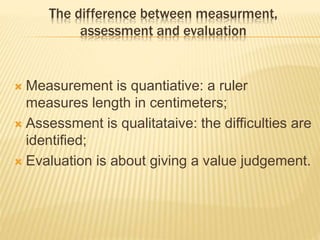
 Measurement is quantiative: a ruler
measures length in centimeters;
 Assessment is qualitataive: the difficulties are
identified;
 Evaluation is about giving a value judgement.
Qualities of a Good Measurment Tool
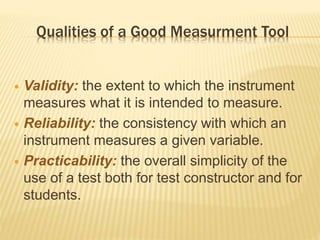
 Validity: the extent to which the instrument
measures what it is intended to measure.
 Reliability: the consistency with which an
instrument measures a given variable.
 Practicability: the overall simplicity of the
use of a test both for test constructor and for
students.
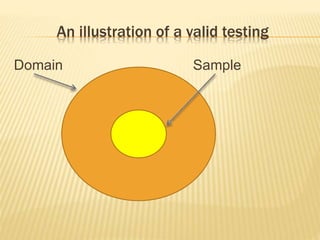
Domain Sample
An illustration of a valid testing
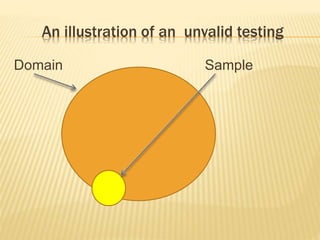
Domain Sample
An illustration of an unvalid testing
How do we assess?
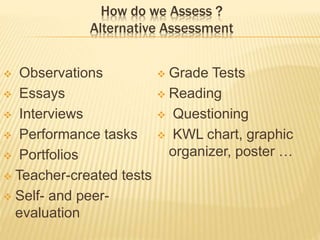
How do we Assess ?
Alternative Assessment
 Observations
 Essays
 Interviews
 Performance tasks
 Portfolios
 Teacher-created tests
 Self- and peer-
evaluation
 Grade Tests
 Reading
 Questioning
 KWL chart, graphic
organizer, poster …
When do we assess?
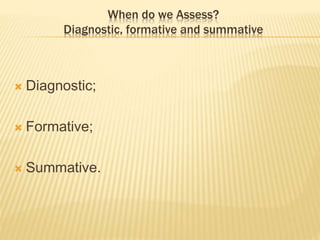
When do we Assess?
Diagnostic, formative and summative
 Diagnostic;
 Formative;
 Summative.
What do we assess?
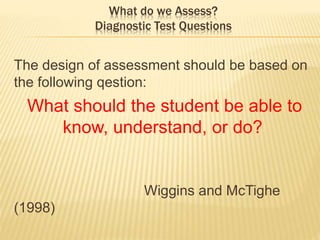
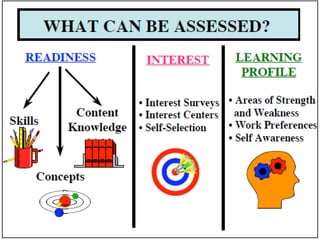
What do we Assess?
Diagnostic Test Questions
The design of assessment should be based on
the following qestion:
What should the student be able to
know, understand, or do?
Wiggins and McTighe
(1998)
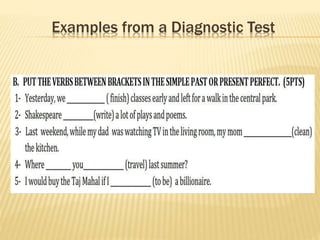
Examples from a Diagnostic Test
 State three of your interests.
 State three of your strenghts and
weaknesses.
 What are the difficulties in learning English?
The objectives of diagnostic assessment
The Objectives of Diagnostic Assessment
 The removal of learning difficulties;
 The enhancement of learning;
 The learning styles of the students.
The benefits of diagnostic assessment
 Individualize instruction;
 Identify the misconcptions students have
about the subject;
 Identify the students’ level in the language;
 Give timely descreptive feedback.
The Benefits of Diagnostic Assessment
Remedial Work Plan
 Error analysis;
 Error Identification;
 Error classification;
 Error treatment or corrective feedback;
 More practice in the identified areas by
designing activities in the problematic areas
before teaching new content.
Prompt and Recast for Pornounciation
 Prompt is an out-put pushing technique;
 Recast is out-put reformulation;
SUMMARY
In brief, the current presentation dealt with
diagnostic assessment as one of the
components of the currculum. It has tackled
the time of conducting diagnostic assessment,
the procedures, the content, the benefits, and
the remedial work activities.
Bibliography
Bachman, L. and Palmer, A. (2010). Language Assessment in
Practice. Oxford: Oxford University Press.
Tomlinson, C. (1999) The differentiated classroom: Responding
to the needs of all learners. Alexandria, VA: ASCD.
.
Wiggins, G., & McTighe, J.(1998). Understanding by design.
Alexandria, VA: Association for Supervision and Curriculum
Development.
William, D. (2011). What is assessment for learning. Studies in
Educational Evaluation, 37(1), 3-14.
Wyatt-Smith, C. and Cumming, J. (eds) (2009) Educational
Assessment in the 21st Century. Dordrecht: Springer
Thank you for your attention 
Questions
Questions
A) When scores are given to students, is it?
1) Measurement;
2) Assessment;
3) Evaluation.
Questions
B) When a test measures what it is supposed
to measure, is it?
1) Valid;
2) Reliable;
3) Both.
Questions
 The pace of learning is measured by:
1) Criterion and norm referenced tests;
2) Objective and subjective tests;
3) Formative tests.
Questions
 The concept of 'washback effect' is used to refer
to
1) A- the effect of not having enough prior
knowledge on text comprehension
2) B- the effect of an assessment procedure on
learning and teaching
3) C- the negative effect of thinking about one's
past on learning
4) D- the positive effects of memorizing
vocabulary on language performance
Questions
 Can we conduct diagnostic assessments for
third year middle school students?
Glossary
 Washback effect: the effect of an assessment on
teaching and learning.
 Measurement is conducted in the form of a test. It is
quantiative.
 Assessment can be quantitiative and qualitative. It
includes measurment.
 Evaluation contains quantitative information,
qualitative and value judgement.
 Assessment of learning for students to be graded and
promoted
 Assessment for learning in order to identify the
learning difficulties and enhance learning.

Diagnostic assessment

  • 1.
    DIAGNOSTIC ASSESSMENT Reflections onPractice Pedagogical Meeting, Fkih Ben Saleh Directorate In collaboration with MATE, Fkih Ben Saleh Branch
  • 2.
    Outline 1. The placeof assessment in the curriculm 2. Diagnostic assessment definition 3. The difference between evaluation, measurement and assessment; 4. Assessment tools; 5. Assessment types; 6. The content of assessment; 7. The benefits of diagnostic assessment; 8. Examples from a diagnostic test; 9. Remedial work plan
  • 3.
    The Place ofAssessment in the Curriculum  The components of the curriculum are as follows:  Goals;  Content;  Methodology;  Assessment.
  • 4.
  • 5.
    What is Assessment? Assessmentis the process of gathering data about the student’s performance, knowledge or interests using different tools.
  • 6.
  • 7.
    What is DiagnosticAssessment? “Diagnostic assessment is today’s means of understanding how to modify tomorrow’s instruction.” Tomilinson (1999:10)
  • 8.
    What is thedifference between evaluation, assessment and measurment?
  • 9.
    The difference betweenmeasurment, assessment and evaluation  Measurement is quantiative: a ruler measures length in centimeters;  Assessment is qualitataive: the difficulties are identified;  Evaluation is about giving a value judgement.
  • 10.
    Qualities of aGood Measurment Tool  Validity: the extent to which the instrument measures what it is intended to measure.  Reliability: the consistency with which an instrument measures a given variable.  Practicability: the overall simplicity of the use of a test both for test constructor and for students.
  • 11.
  • 12.
    Domain Sample An illustrationof an unvalid testing
  • 13.
    How do weassess?
  • 15.
    How do weAssess ? Alternative Assessment  Observations  Essays  Interviews  Performance tasks  Portfolios  Teacher-created tests  Self- and peer- evaluation  Grade Tests  Reading  Questioning  KWL chart, graphic organizer, poster …
  • 16.
    When do weassess?
  • 17.
    When do weAssess? Diagnostic, formative and summative  Diagnostic;  Formative;  Summative.
  • 19.
    What do weassess?
  • 20.
    What do weAssess? Diagnostic Test Questions The design of assessment should be based on the following qestion: What should the student be able to know, understand, or do? Wiggins and McTighe (1998)
  • 22.
    Examples from aDiagnostic Test
  • 23.
    Examples from aDiagnostic Test  State three of your interests.  State three of your strenghts and weaknesses.  What are the difficulties in learning English?
  • 24.
    The objectives ofdiagnostic assessment
  • 25.
    The Objectives ofDiagnostic Assessment  The removal of learning difficulties;  The enhancement of learning;  The learning styles of the students.
  • 26.
    The benefits ofdiagnostic assessment
  • 27.
     Individualize instruction; Identify the misconcptions students have about the subject;  Identify the students’ level in the language;  Give timely descreptive feedback. The Benefits of Diagnostic Assessment
  • 28.
    Remedial Work Plan Error analysis;  Error Identification;  Error classification;  Error treatment or corrective feedback;  More practice in the identified areas by designing activities in the problematic areas before teaching new content.
  • 30.
    Prompt and Recastfor Pornounciation  Prompt is an out-put pushing technique;  Recast is out-put reformulation;
  • 31.
    SUMMARY In brief, thecurrent presentation dealt with diagnostic assessment as one of the components of the currculum. It has tackled the time of conducting diagnostic assessment, the procedures, the content, the benefits, and the remedial work activities.
  • 32.
    Bibliography Bachman, L. andPalmer, A. (2010). Language Assessment in Practice. Oxford: Oxford University Press. Tomlinson, C. (1999) The differentiated classroom: Responding to the needs of all learners. Alexandria, VA: ASCD. . Wiggins, G., & McTighe, J.(1998). Understanding by design. Alexandria, VA: Association for Supervision and Curriculum Development. William, D. (2011). What is assessment for learning. Studies in Educational Evaluation, 37(1), 3-14. Wyatt-Smith, C. and Cumming, J. (eds) (2009) Educational Assessment in the 21st Century. Dordrecht: Springer
  • 33.
    Thank you foryour attention 
  • 34.
  • 35.
    Questions A) When scoresare given to students, is it? 1) Measurement; 2) Assessment; 3) Evaluation.
  • 36.
    Questions B) When atest measures what it is supposed to measure, is it? 1) Valid; 2) Reliable; 3) Both.
  • 37.
    Questions  The paceof learning is measured by: 1) Criterion and norm referenced tests; 2) Objective and subjective tests; 3) Formative tests.
  • 38.
    Questions  The conceptof 'washback effect' is used to refer to 1) A- the effect of not having enough prior knowledge on text comprehension 2) B- the effect of an assessment procedure on learning and teaching 3) C- the negative effect of thinking about one's past on learning 4) D- the positive effects of memorizing vocabulary on language performance
  • 39.
    Questions  Can weconduct diagnostic assessments for third year middle school students?
  • 40.
    Glossary  Washback effect:the effect of an assessment on teaching and learning.  Measurement is conducted in the form of a test. It is quantiative.  Assessment can be quantitiative and qualitative. It includes measurment.  Evaluation contains quantitative information, qualitative and value judgement.  Assessment of learning for students to be graded and promoted  Assessment for learning in order to identify the learning difficulties and enhance learning.