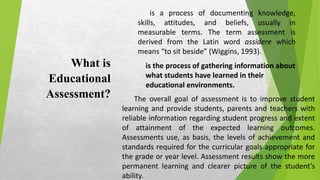
What is
Educational
Assessment?
is a process of documenting knowledge,
skills, attitudes, and beliefs, usually in
measurable terms. The term assessment is
derived from the Latin word assidere which
means “to sit beside” (Wiggins, 1993).
is the process of gathering information about
what students have learned in their
educational environments.
The overall goal of assessment is to improve student
learning and provide students, parents and teachers with
reliable information regarding student progress and extent
of attainment of the expected learning outcomes.
Assessments use, as basis, the levels of achievement and
standards required for the curricular goals appropriate for
the grade or year level. Assessment results show the more
permanent learning and clearer picture of the student’s
ability.
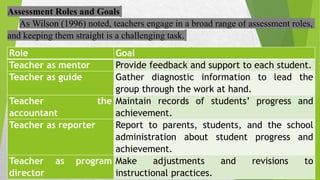
Assessment Roles and Goals
As Wilson (1996) noted, teachers engage in a broad range of assessment roles,
and keeping them straight is a challenging task.
Role Goal
Teacher as mentor Provide feedback and support to each student.
Teacher as guide Gather diagnostic information to lead the
group through the work at hand.
Teacher the
accountant
Maintain records of students’ progress and
achievement.
Teacher as reporter Report to parents, students, and the school
administration about student progress and
achievement.
Teacher as program
director
Make adjustments and revisions to
instructional practices.
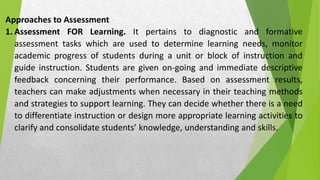
Approaches to Assessment
1. Assessment FOR Learning. It pertains to diagnostic and formative
assessment tasks which are used to determine learning needs, monitor
academic progress of students during a unit or block of instruction and
guide instruction. Students are given on-going and immediate descriptive
feedback concerning their performance. Based on assessment results,
teachers can make adjustments when necessary in their teaching methods
and strategies to support learning. They can decide whether there is a need
to differentiate instruction or design more appropriate learning activities to
clarify and consolidate students’ knowledge, understanding and skills.
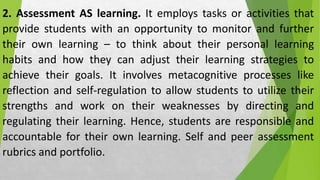
2. Assessment AS learning. It employs tasks or activities that
provide students with an opportunity to monitor and further
their own learning – to think about their personal learning
habits and how they can adjust their learning strategies to
achieve their goals. It involves metacognitive processes like
reflection and self-regulation to allow students to utilize their
strengths and work on their weaknesses by directing and
regulating their learning. Hence, students are responsible and
accountable for their own learning. Self and peer assessment
rubrics and portfolio.
3. Assessment OF learning. It is summative and done at the end
of a unit, task, process or period. Its purpose is to provide
evidence of a student’s level of achievement in relation to
curricular outcomes. Unit tests and final projects are typical
examples of summative assessment. It is used for grading,
evaluation and reporting purposes. Evaluative feedback on the
student’s proficiency level is given to the student concerned,
likewise to his/her parents and other stakeholders. This
provides the foundation for decisions on student’s placement
and promotion.
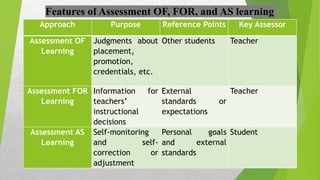
Approach Purpose Reference Points Key Assessor
Assessment OF
Learning
Judgments about
placement,
promotion,
credentials, etc.
Other students Teacher
Assessment FOR
Learning
Information for
teachers’
instructional
decisions
External
standards or
expectations
Teacher
Assessment AS
Learning
Self-monitoring
and self-
correction or
adjustment
Personal goals
and external
standards
Student
Features of Assessment OF, FOR, and AS learning
Types of Assessment Procedures (Talledo, 2021)
1. As to Format of Assessment
FIXED-CHOICE TEST. This is an assessment used to measure
knowledge and skills effectively and efficiently. Examples are the
multiple choice test, matching type, true or false, etc.
COMPLEX-PERFORMANCE ASSESSMENT. This is an
assessment procedure which is used to measure the performance of
the learner in contexts and on problems valued in their own right.
Examples are the hands-on laboratory experiment, projects, essays,
portfolios, oral presentations, dance performance, cooking
performances, etc.
2. As to Role of Assessment in the Classroom Instruction
There are at least four types of assessment when it is done to transfer
learning in the classrooms. There are two types of assessment which could be
done at the beginning of instruction.
PLACEMENT ASSESSMENT is concerned with the entry performance
and typically focuses on the questions as follows:
 Does the learner possess the knowledge and skills needed to begin the
planned instruction?
 To what extent has the learner already developed the understanding and
skills that are the goals of planned objectives?
 To what extent do the student’s interest, work habits, and personality
indicate that one mode of instruction might be better than another?
DIAGNOSTIC ASSESSMENT is a type of assessment given at the
beginning of instruction or during instruction. This aims to identify the strengths
and weaknesses of the students regarding the topics to be discussed. The
following are the purposes of diagnostic assessment:
 To determine the level of competence of the students
 To identify the students who already have knowledge about the lesson
 To determine the causes of learning problems that cannot be revealed by
formative assessment
 To formulate a plan for remedial action
Diagnostic assessment is likened to a medical doctor. It diagnoses the
competencies which are weak in a learner. Accurate diagnosis leads to
appropriate teaching measures and intervention program but a single
misdiagnosis can also have potentially disastrous consequences. This is
manifested in the movie “Every Child is Special.”
During instruction, FORMATIVE ASSESSMENT is administered.
This is a type of assessment used to monitor the learning progress of
the students. All activities done during instruction to help assess
learning are under formative assessment type. It is good to note that
scores or performances classified as formative are not necessarily
recorded. The following are the purposes of this type:
 To provide immediate feedback to both student and teacher regarding
the success and failures of learning
 To identify the learning errors that are in need of correction
 To provide teachers with information on how to modify instruction
 To improve instruction and instruction.
SUMMATIVE ASSESSMENT is a type of assessment usually
given at the end of the course or unit. These are assessment activities
given by the teacher during periodical or quarterly exams. Results of
this type of assessment should be recorded because it takes a certain
percentage in the total grade of the learner. The purposes are:
 To determine the extent to which the instructional objectives have
been met
 To certify student mastery of the intended learning outcomes as well
as use it for assigning grades
 To provide information for judging appropriateness of the
instructional objectives
 To determine the effectiveness of instruction.
SUMMATIVE ASSESSMENT is a type of assessment usually
given at the end of the course or unit. These are assessment activities
given by the teacher during periodical or quarterly exams. Results of
this type of assessment should be recorded because it takes a certain
percentage in the total grade of the learner. The purposes are:
 To determine the extent to which the instructional objectives have
been met
 To certify student mastery of the intended learning outcomes as well
as use it for assigning grades
 To provide information for judging appropriateness of the
instructional objectives
 To determine the effectiveness of instruction.
3. As to Methods of Interpreting the Results
There are two methods of assessment as regards to interpreting the
results.
NORM-REFERENCED INTERPRETATION is used to describe
the student’s performance according to relative position in some known
group. It is assumed that the level of performance of learners does not
vary much from one class to another in this method of interpretation.
Example: Eva ranks 7th in a class of 40.
CRITERION-REFERENCED INTERPRETATION is used to
describe the student’s performance according to a specified domain of
clearly defined learning tasks. This method is used when the teacher
wants to determine how well the students have gained specific
knowledge or skills in a certain learning content.
Example: James can accurately divide two digit-number by a one-
digit number.
Principles of Assessment (McAlpine, 2002)
There are a variety of issues that must be taken into consideration
when planning an assessment strategy within higher education. It is
important to start with the understanding that assessment is a form of
communication. This communication can be to a variety of sources, to
the students (feedback on their learning), to the lecturer (feedback on
their teaching), to the curriculum designer (feedback on the
curriculum), to administrators (feedback on the use of resources) and to
employers (quality of job applicants).
There are five main points to consider when designing any assessment to ensure
that the communication is as meaningful, useful and honest as possible.
1. The purpose of the assessment and whether the task fulfils that purpose
An essential starting point is to be aware of the reasons why you are assessing
the students, and how to design an assessment that will fulfil your needs. To do
this, it is important to consider the decisions you are going to make, the
information you need to gather to make those decisions, and what methods are the
most effective for gathering that information.
2. The validity and reliability of the assessment that you are constructing
To ensure that the communication is as honest as possible, it is crucial to make
sure that the assessment is both valid – in that it tests a relevant skill or ability,
and that is reliable – in that the same result would be achieved if you repeated the
assessment.

3. The referencing of the assessment
To make the assessment meaningful, it is important to compare the candidates’
abilities with a common measure. The most common comparisons made are with
other candidates, with objective criteria, or with the candidates’ own performance
in another area. Through careful consideration of the purposes of the assessment,
the most appropriate frame should be clear.
4. The construction quality of assessment items
To ensure useful assessment, the assessment items must be constructed to an
appropriate quality. Judging the quality of items can be complicated but, as a
starting point, consider the difficulty level of the items. In general, a good
assessment ought to be at about the difficulty level of the average candidate. Also
consider how well the assessment differentiates between the candidates – to
provide maximum information the assessment ought to separate out the candidates
as much as possible.
5. The grading of assessment
Grades awarded are very concise summaries of students’ abilities.
They are generally designed for purposes out with the institution and,
therefore, they should be clear and easily understood by a lay audience.
The grading of the assessment is often related to the referencing of the
assessment, and as such the two should be considered in tandem.
Principles of Assessment (DepEd Order No. 31, s. 2020)
1.Assessment should be holistic and authentic in capturing the
attainment of most essential learning competencies.
2.Assessment is integral for understanding student learning and
development.
3.A variety of assessment strategies is necessary, with formative
assessment taking priority to inform teaching and promote growth
and mastery.
4.Assessment and feedback should be a shared responsibility among
teachers, learners, and their families.
5.Assessment and grading should have a positive impact on learning.
Principles of Assessment of Learning (Talledo, 2021)
1. Teaching and learning is never complete without assessment.
This means that assessment is an integral part of the teaching – learning
process. We need to test how far the learners have learned, either before, during,
or after instruction, in line with our objectives. Thus, if learners are made to
realize about this, negative attitudes about assessment will be minimized since
the quizzes and tests will be just “usual” to them. They will come to realize the
purpose of assessment, that is, to check how far they have learned.
2. Assessment tool and objectives must be collinear.
The test/quiz or any assessment techniques must be in line with the objectives.
This is also includes the type of assessment appropriate for a certain objective.
This is like a teacher who has an objective about “Delivering the poem
“Anabelle Lee.” Which is more appropriate tool: let the students write down
completely the poem, or let them deliver the poem? Reflect.
3. Assessment results should be fed back to the students.
This is one of the mortal sins of some of the teachers. They will give quizzes,
tests, projects, etc. yet they fail to return those to the students, or to just inform
the grade/score the students acquired. The purpose of assessment is to give
learners a feedback to what extent their learning is. How will the learners learn
this if the teacher will not give their scores or return their papers?
4. In assessment, consider the learners’multiple intelligences and learning styles.
The traditional paper and pencil test puts verbally and linguistically intelligent
students at the advantage. Let us take into account the learners multiple
intelligence and learning styles in assessment. Give various assessment
techniques in order to cater individual differences.
5. It is wise to give some positive feedback as well as constructive criticisms.
Do not forget to praise the students on a job well done. This can boost their morale to study
and appreciate the value of success. Further, let us give them some constructive criticisms on
the areas they need to improve. Remember that the biggest room in the world is the room for
improvement.
6. Emphasize self-assessment.
Assessment must be intra-comparative rather than inter-comparative. In short, if learning is
as well a personal process, then, let the learners assess their performance in their own against
a criteria. Let them be aware of and reflect on their progress. Rather than comparing
themselves with other people, let them compare their “then” self to their “now” self.
Competitive nature of learning must be between the students and their own prior
performance. One thing more, always remember that self-assessment must also be in line
with teacher assessment. This can avoid overestimation or underestimation of students’
performance on themselves.
7. Build the culture of success in the classroom.
Avoid the bell curve mentality, or the belief that it is normal that some students
pass while some fail. Have that mentality that ALL learners can achieve.
8. Never use assessment as a disciplinary action or a punishment.
This distorts the true purpose of assessment. This will enkindle the negative
attitudes toward assessment.
9. Assessment should be communicated regularly and clearly to parents.
Take note however the importance of accountability, transparency, and
confidentiality.
10. Emphasize on real world application that favors realistic performances over
out of context drill items.
Hence, assessment must focus on real life application, as well as developing
higher ordered thinking skills such as analyzing, evaluating and most of all
creating.
What-is-Educational-Assessment.pptx

What-is-Educational-Assessment.pptx

  • 1.
    What is Educational Assessment? is aprocess of documenting knowledge, skills, attitudes, and beliefs, usually in measurable terms. The term assessment is derived from the Latin word assidere which means “to sit beside” (Wiggins, 1993). is the process of gathering information about what students have learned in their educational environments. The overall goal of assessment is to improve student learning and provide students, parents and teachers with reliable information regarding student progress and extent of attainment of the expected learning outcomes. Assessments use, as basis, the levels of achievement and standards required for the curricular goals appropriate for the grade or year level. Assessment results show the more permanent learning and clearer picture of the student’s ability.
  • 2.
    Assessment Roles andGoals As Wilson (1996) noted, teachers engage in a broad range of assessment roles, and keeping them straight is a challenging task. Role Goal Teacher as mentor Provide feedback and support to each student. Teacher as guide Gather diagnostic information to lead the group through the work at hand. Teacher the accountant Maintain records of students’ progress and achievement. Teacher as reporter Report to parents, students, and the school administration about student progress and achievement. Teacher as program director Make adjustments and revisions to instructional practices.
  • 3.
    Approaches to Assessment 1.Assessment FOR Learning. It pertains to diagnostic and formative assessment tasks which are used to determine learning needs, monitor academic progress of students during a unit or block of instruction and guide instruction. Students are given on-going and immediate descriptive feedback concerning their performance. Based on assessment results, teachers can make adjustments when necessary in their teaching methods and strategies to support learning. They can decide whether there is a need to differentiate instruction or design more appropriate learning activities to clarify and consolidate students’ knowledge, understanding and skills.
  • 4.
    2. Assessment ASlearning. It employs tasks or activities that provide students with an opportunity to monitor and further their own learning – to think about their personal learning habits and how they can adjust their learning strategies to achieve their goals. It involves metacognitive processes like reflection and self-regulation to allow students to utilize their strengths and work on their weaknesses by directing and regulating their learning. Hence, students are responsible and accountable for their own learning. Self and peer assessment rubrics and portfolio.
  • 5.
    3. Assessment OFlearning. It is summative and done at the end of a unit, task, process or period. Its purpose is to provide evidence of a student’s level of achievement in relation to curricular outcomes. Unit tests and final projects are typical examples of summative assessment. It is used for grading, evaluation and reporting purposes. Evaluative feedback on the student’s proficiency level is given to the student concerned, likewise to his/her parents and other stakeholders. This provides the foundation for decisions on student’s placement and promotion.
  • 6.
    Approach Purpose ReferencePoints Key Assessor Assessment OF Learning Judgments about placement, promotion, credentials, etc. Other students Teacher Assessment FOR Learning Information for teachers’ instructional decisions External standards or expectations Teacher Assessment AS Learning Self-monitoring and self- correction or adjustment Personal goals and external standards Student Features of Assessment OF, FOR, and AS learning
  • 7.
    Types of AssessmentProcedures (Talledo, 2021) 1. As to Format of Assessment FIXED-CHOICE TEST. This is an assessment used to measure knowledge and skills effectively and efficiently. Examples are the multiple choice test, matching type, true or false, etc. COMPLEX-PERFORMANCE ASSESSMENT. This is an assessment procedure which is used to measure the performance of the learner in contexts and on problems valued in their own right. Examples are the hands-on laboratory experiment, projects, essays, portfolios, oral presentations, dance performance, cooking performances, etc.
  • 8.
    2. As toRole of Assessment in the Classroom Instruction There are at least four types of assessment when it is done to transfer learning in the classrooms. There are two types of assessment which could be done at the beginning of instruction. PLACEMENT ASSESSMENT is concerned with the entry performance and typically focuses on the questions as follows:  Does the learner possess the knowledge and skills needed to begin the planned instruction?  To what extent has the learner already developed the understanding and skills that are the goals of planned objectives?  To what extent do the student’s interest, work habits, and personality indicate that one mode of instruction might be better than another?
  • 9.
    DIAGNOSTIC ASSESSMENT isa type of assessment given at the beginning of instruction or during instruction. This aims to identify the strengths and weaknesses of the students regarding the topics to be discussed. The following are the purposes of diagnostic assessment:  To determine the level of competence of the students  To identify the students who already have knowledge about the lesson  To determine the causes of learning problems that cannot be revealed by formative assessment  To formulate a plan for remedial action Diagnostic assessment is likened to a medical doctor. It diagnoses the competencies which are weak in a learner. Accurate diagnosis leads to appropriate teaching measures and intervention program but a single misdiagnosis can also have potentially disastrous consequences. This is manifested in the movie “Every Child is Special.”
  • 10.
    During instruction, FORMATIVEASSESSMENT is administered. This is a type of assessment used to monitor the learning progress of the students. All activities done during instruction to help assess learning are under formative assessment type. It is good to note that scores or performances classified as formative are not necessarily recorded. The following are the purposes of this type:  To provide immediate feedback to both student and teacher regarding the success and failures of learning  To identify the learning errors that are in need of correction  To provide teachers with information on how to modify instruction  To improve instruction and instruction.
  • 11.
    SUMMATIVE ASSESSMENT isa type of assessment usually given at the end of the course or unit. These are assessment activities given by the teacher during periodical or quarterly exams. Results of this type of assessment should be recorded because it takes a certain percentage in the total grade of the learner. The purposes are:  To determine the extent to which the instructional objectives have been met  To certify student mastery of the intended learning outcomes as well as use it for assigning grades  To provide information for judging appropriateness of the instructional objectives  To determine the effectiveness of instruction.
  • 12.
    SUMMATIVE ASSESSMENT isa type of assessment usually given at the end of the course or unit. These are assessment activities given by the teacher during periodical or quarterly exams. Results of this type of assessment should be recorded because it takes a certain percentage in the total grade of the learner. The purposes are:  To determine the extent to which the instructional objectives have been met  To certify student mastery of the intended learning outcomes as well as use it for assigning grades  To provide information for judging appropriateness of the instructional objectives  To determine the effectiveness of instruction.
  • 13.
    3. As toMethods of Interpreting the Results There are two methods of assessment as regards to interpreting the results. NORM-REFERENCED INTERPRETATION is used to describe the student’s performance according to relative position in some known group. It is assumed that the level of performance of learners does not vary much from one class to another in this method of interpretation. Example: Eva ranks 7th in a class of 40.
  • 14.
    CRITERION-REFERENCED INTERPRETATION isused to describe the student’s performance according to a specified domain of clearly defined learning tasks. This method is used when the teacher wants to determine how well the students have gained specific knowledge or skills in a certain learning content. Example: James can accurately divide two digit-number by a one- digit number.
  • 15.
    Principles of Assessment(McAlpine, 2002) There are a variety of issues that must be taken into consideration when planning an assessment strategy within higher education. It is important to start with the understanding that assessment is a form of communication. This communication can be to a variety of sources, to the students (feedback on their learning), to the lecturer (feedback on their teaching), to the curriculum designer (feedback on the curriculum), to administrators (feedback on the use of resources) and to employers (quality of job applicants).
  • 16.
    There are fivemain points to consider when designing any assessment to ensure that the communication is as meaningful, useful and honest as possible. 1. The purpose of the assessment and whether the task fulfils that purpose An essential starting point is to be aware of the reasons why you are assessing the students, and how to design an assessment that will fulfil your needs. To do this, it is important to consider the decisions you are going to make, the information you need to gather to make those decisions, and what methods are the most effective for gathering that information. 2. The validity and reliability of the assessment that you are constructing To ensure that the communication is as honest as possible, it is crucial to make sure that the assessment is both valid – in that it tests a relevant skill or ability, and that is reliable – in that the same result would be achieved if you repeated the assessment.
  • 17.
    3. The referencingof the assessment To make the assessment meaningful, it is important to compare the candidates’ abilities with a common measure. The most common comparisons made are with other candidates, with objective criteria, or with the candidates’ own performance in another area. Through careful consideration of the purposes of the assessment, the most appropriate frame should be clear. 4. The construction quality of assessment items To ensure useful assessment, the assessment items must be constructed to an appropriate quality. Judging the quality of items can be complicated but, as a starting point, consider the difficulty level of the items. In general, a good assessment ought to be at about the difficulty level of the average candidate. Also consider how well the assessment differentiates between the candidates – to provide maximum information the assessment ought to separate out the candidates as much as possible.
  • 18.
    5. The gradingof assessment Grades awarded are very concise summaries of students’ abilities. They are generally designed for purposes out with the institution and, therefore, they should be clear and easily understood by a lay audience. The grading of the assessment is often related to the referencing of the assessment, and as such the two should be considered in tandem.
  • 19.
    Principles of Assessment(DepEd Order No. 31, s. 2020) 1.Assessment should be holistic and authentic in capturing the attainment of most essential learning competencies. 2.Assessment is integral for understanding student learning and development. 3.A variety of assessment strategies is necessary, with formative assessment taking priority to inform teaching and promote growth and mastery. 4.Assessment and feedback should be a shared responsibility among teachers, learners, and their families. 5.Assessment and grading should have a positive impact on learning.
  • 20.
    Principles of Assessmentof Learning (Talledo, 2021) 1. Teaching and learning is never complete without assessment. This means that assessment is an integral part of the teaching – learning process. We need to test how far the learners have learned, either before, during, or after instruction, in line with our objectives. Thus, if learners are made to realize about this, negative attitudes about assessment will be minimized since the quizzes and tests will be just “usual” to them. They will come to realize the purpose of assessment, that is, to check how far they have learned. 2. Assessment tool and objectives must be collinear. The test/quiz or any assessment techniques must be in line with the objectives. This is also includes the type of assessment appropriate for a certain objective. This is like a teacher who has an objective about “Delivering the poem “Anabelle Lee.” Which is more appropriate tool: let the students write down completely the poem, or let them deliver the poem? Reflect.
  • 21.
    3. Assessment resultsshould be fed back to the students. This is one of the mortal sins of some of the teachers. They will give quizzes, tests, projects, etc. yet they fail to return those to the students, or to just inform the grade/score the students acquired. The purpose of assessment is to give learners a feedback to what extent their learning is. How will the learners learn this if the teacher will not give their scores or return their papers? 4. In assessment, consider the learners’multiple intelligences and learning styles. The traditional paper and pencil test puts verbally and linguistically intelligent students at the advantage. Let us take into account the learners multiple intelligence and learning styles in assessment. Give various assessment techniques in order to cater individual differences.
  • 22.
    5. It iswise to give some positive feedback as well as constructive criticisms. Do not forget to praise the students on a job well done. This can boost their morale to study and appreciate the value of success. Further, let us give them some constructive criticisms on the areas they need to improve. Remember that the biggest room in the world is the room for improvement. 6. Emphasize self-assessment. Assessment must be intra-comparative rather than inter-comparative. In short, if learning is as well a personal process, then, let the learners assess their performance in their own against a criteria. Let them be aware of and reflect on their progress. Rather than comparing themselves with other people, let them compare their “then” self to their “now” self. Competitive nature of learning must be between the students and their own prior performance. One thing more, always remember that self-assessment must also be in line with teacher assessment. This can avoid overestimation or underestimation of students’ performance on themselves.
  • 23.
    7. Build theculture of success in the classroom. Avoid the bell curve mentality, or the belief that it is normal that some students pass while some fail. Have that mentality that ALL learners can achieve. 8. Never use assessment as a disciplinary action or a punishment. This distorts the true purpose of assessment. This will enkindle the negative attitudes toward assessment. 9. Assessment should be communicated regularly and clearly to parents. Take note however the importance of accountability, transparency, and confidentiality. 10. Emphasize on real world application that favors realistic performances over out of context drill items. Hence, assessment must focus on real life application, as well as developing higher ordered thinking skills such as analyzing, evaluating and most of all creating.