B.Ed. II Year
Paper II
Assessment for Learning
Main Points of Discussion
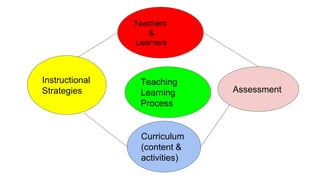
Components of teaching learning process
Concept of Assessment
Types of Assessment
Principles of Assessment
Importance of Assessment
Teaching
Learning
Process
Instructional
Strategies Assessment
Teachers
&
Learners
Curriculum
(content &
activities)
Concept
of
Assessment
Assessment
The term ‘Assessment’ comes from Latin ‘ad
sedere’,which means to sit down beside' Assessment is
primarily concerned with providing guidance and feedback
to the learner.
Assessment is an integral part of education process.
It is used by teachers to collect information about what
and how their students are learning. It involves identifying
the strength and weaknesses of pupil.
Assessment is a process by which information is obtained
relative to some known objective or goal.
Assessment data may be numerical or quantitative like
marks or scores and qualitative like interest in learning
concepts, involvement in subject related activities.
On the basis of assessment data, steps can be taken for
facilitating/enhancing learning, remove learning difficulties
of students.
Definition of Assessment
Erwin (1991)
Assessment is the systematic basis for making
inferences about the learning and development of
students. It is the process of defining, selecting,
collecting, analysing, interpreting and using
information to increase students learning and
development,”
Types of Assessment
Formative Assessment
It is an essential part of teaching and learning. It is
conducted by teachers during the learning process in order
to modify teaching and learning activities to improve
student attainment. The goal of a formative assessment is
to monitor student learning to provide ongoing feedback
that can help students identify their strength and weakness
and target areas that need work
Summative Assessment
It is usually conducted at the end of a learning programme. It is
the final measurement of what was learnt. Summative
assessment should include formative assessment evaluations
and a final overall assessment of whether learners have
achieved the learning outcomes for the programme.
Summative assessment are used to evaluate student learning,
skill acquisition and academic achievement at the end of a unit,
course, semester or school year.
Work Integrated or Authentic Assessment
This type of assessment is where the tasks and situations are closely
associated with what you experience. It helps to develop student’s skills and
capabilities along with educational development.According to Grant Wiggins
(1998), an assignment is authentic if it
● is realistic.
● requires judgment and innovation.
● asks the student to “do” the subject.
● replicates or simulates the contexts in which adults are “tested” in the
workplace or in civic or personal life.
Diagnostic Assessment
Diagnostic assessments is a form of pre-assessment that
allows teacher to determine individual strengths,weakness,
knowledge and skills prior to instruction. Besides, it looks
backward rather than looking forward. It primarily used to
diagnose learner difficulties and to guide lesson and
curriculum planning.
Dynamic Assessment
It measures what students can achieve when teaches about
unfamiliar topic or field. An example can be teaching students
Spanish for a short while. It helps to see how students who do
not have any prior knowledge adopt it.
It can be helpful to review the potential for students who have a
mainly underprivileged backdrop. Frequently it is used in
advance of the main body of teaching.
It gives confidence students to unite elements of their learning
from different parts of a plan and to show their build up
knowledge and thoughtful of a topic or subject area.
It basically enables students to show their talents and skills. And it
shows how in-depth knowledge they have about the subject.
Basically, it helps in measuring the capacity to apply knowledge to
understand the subject.
Synoptic Assessment
Criterion-referenced Assessment
The performance of every student is judged by a specific
principle. It should be strictly seen that other student’s
performance should not be taken into account.
In addition, the teacher should avoid normative thinking because
it can affect judgment. Apart from that, the teacher should assure
reliability and validity.
Ipsative C
It measures the performance of the student in comparison
to his previous performance. Also, it helps in keeping in
check how well they are undertaking their tasks.Many
informal and practical learning experiences are assessed in
this way such as music teaching,sports teaching and
computer games.
Principles of Assessment
● Validity: Validity ensures that assessment tasks and
associated criteria effectively measure student attainment of
the intended learning outcomes at the appropriate level.
● Authentic: Authentic assessment are relevant and reflect what
the students will do in the real world.All the work is the
learner’s own.
● Reliability: A reliable assessment consistently gives the
same result under identical circumstances.
● Fair and minimise bias: assessments are fair to all learners
irrespective of their characteristics (for example, age, gender,
etc).
● Explicit and Accessible information : clear, accurate,
consistent and timely information on assessment tasks and
procedure should be made available to students, staff and
examiners.
● Appropriateness : The type of assessment used must be
suitable for ‘what’ it is that is being assessed, i.e. fit for purpose.It
would not be appropriate, eg, to assess a dental student’s ability
to fill a tooth cavity, via a multiple choice or written exam. These
assessments may effectively measure a student’s knowledge
about a skill, and even their knowledge and understanding of how
that skill can be applied.
● Transparency : Transparent assessment clearly sets out
expectations for students with clear task descriptions, criteria and
standards.
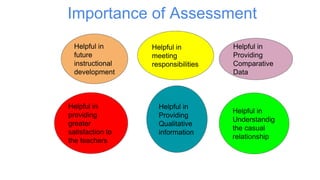
Importance of Assessment
Helpful in
Providing
Qualitative
information
Helpful in
future
instructional
development
Helpful in
Providing
Comparative
Data
Helpful in
providing
greater
satisfaction to
the teachers
Helpful in
Understandig
the casual
relationship
Helpful in
meeting
responsibilities
● Helpful in Providing Qualitative information : It helps
faculty to determine how they might improve course or
programmes through changes in curriculum, teaching
methodologies, course materials or other area.
● Helpful in Providing Comparative Data : Comparative
Data can give teachers an valuable information on how
well their students are meeting the learning outcomes for
their course.
● Helpful in future instructional development :
Assessment can offer a large view of students need and
accomplishment. So faculty can identify directions for
future instructional development.
● Helpful in providing greater satisfaction to the
teachers : An assessment can provide
evidence,that faculty can make a difference in
student learning.
● Helpful in meeting responsibilities : Through
assessment, educators meet responsibilities to
students.
● Helpful in Understanding the casual relationship
:Assessment helps teachers to understand the
casual relationship between their actions (teaching)
and outcomes (learning).
Assessment

Assessment

  • 1.
    B.Ed. II Year PaperII Assessment for Learning
  • 3.
    Main Points ofDiscussion Components of teaching learning process Concept of Assessment Types of Assessment Principles of Assessment Importance of Assessment
  • 4.
  • 5.
  • 6.
    Assessment The term ‘Assessment’comes from Latin ‘ad sedere’,which means to sit down beside' Assessment is primarily concerned with providing guidance and feedback to the learner. Assessment is an integral part of education process. It is used by teachers to collect information about what and how their students are learning. It involves identifying the strength and weaknesses of pupil. Assessment is a process by which information is obtained relative to some known objective or goal.
  • 7.
    Assessment data maybe numerical or quantitative like marks or scores and qualitative like interest in learning concepts, involvement in subject related activities. On the basis of assessment data, steps can be taken for facilitating/enhancing learning, remove learning difficulties of students.
  • 8.
    Definition of Assessment Erwin(1991) Assessment is the systematic basis for making inferences about the learning and development of students. It is the process of defining, selecting, collecting, analysing, interpreting and using information to increase students learning and development,”
  • 9.
    Types of Assessment FormativeAssessment It is an essential part of teaching and learning. It is conducted by teachers during the learning process in order to modify teaching and learning activities to improve student attainment. The goal of a formative assessment is to monitor student learning to provide ongoing feedback that can help students identify their strength and weakness and target areas that need work
  • 10.
    Summative Assessment It isusually conducted at the end of a learning programme. It is the final measurement of what was learnt. Summative assessment should include formative assessment evaluations and a final overall assessment of whether learners have achieved the learning outcomes for the programme. Summative assessment are used to evaluate student learning, skill acquisition and academic achievement at the end of a unit, course, semester or school year.
  • 11.
    Work Integrated orAuthentic Assessment This type of assessment is where the tasks and situations are closely associated with what you experience. It helps to develop student’s skills and capabilities along with educational development.According to Grant Wiggins (1998), an assignment is authentic if it ● is realistic. ● requires judgment and innovation. ● asks the student to “do” the subject. ● replicates or simulates the contexts in which adults are “tested” in the workplace or in civic or personal life.
  • 12.
    Diagnostic Assessment Diagnostic assessmentsis a form of pre-assessment that allows teacher to determine individual strengths,weakness, knowledge and skills prior to instruction. Besides, it looks backward rather than looking forward. It primarily used to diagnose learner difficulties and to guide lesson and curriculum planning.
  • 13.
    Dynamic Assessment It measureswhat students can achieve when teaches about unfamiliar topic or field. An example can be teaching students Spanish for a short while. It helps to see how students who do not have any prior knowledge adopt it. It can be helpful to review the potential for students who have a mainly underprivileged backdrop. Frequently it is used in advance of the main body of teaching.
  • 14.
    It gives confidencestudents to unite elements of their learning from different parts of a plan and to show their build up knowledge and thoughtful of a topic or subject area. It basically enables students to show their talents and skills. And it shows how in-depth knowledge they have about the subject. Basically, it helps in measuring the capacity to apply knowledge to understand the subject. Synoptic Assessment
  • 15.
    Criterion-referenced Assessment The performanceof every student is judged by a specific principle. It should be strictly seen that other student’s performance should not be taken into account. In addition, the teacher should avoid normative thinking because it can affect judgment. Apart from that, the teacher should assure reliability and validity.
  • 16.
    Ipsative C It measuresthe performance of the student in comparison to his previous performance. Also, it helps in keeping in check how well they are undertaking their tasks.Many informal and practical learning experiences are assessed in this way such as music teaching,sports teaching and computer games.
  • 17.
    Principles of Assessment ●Validity: Validity ensures that assessment tasks and associated criteria effectively measure student attainment of the intended learning outcomes at the appropriate level. ● Authentic: Authentic assessment are relevant and reflect what the students will do in the real world.All the work is the learner’s own. ● Reliability: A reliable assessment consistently gives the same result under identical circumstances.
  • 18.
    ● Fair andminimise bias: assessments are fair to all learners irrespective of their characteristics (for example, age, gender, etc). ● Explicit and Accessible information : clear, accurate, consistent and timely information on assessment tasks and procedure should be made available to students, staff and examiners.
  • 19.
    ● Appropriateness :The type of assessment used must be suitable for ‘what’ it is that is being assessed, i.e. fit for purpose.It would not be appropriate, eg, to assess a dental student’s ability to fill a tooth cavity, via a multiple choice or written exam. These assessments may effectively measure a student’s knowledge about a skill, and even their knowledge and understanding of how that skill can be applied. ● Transparency : Transparent assessment clearly sets out expectations for students with clear task descriptions, criteria and standards.
  • 20.
    Importance of Assessment Helpfulin Providing Qualitative information Helpful in future instructional development Helpful in Providing Comparative Data Helpful in providing greater satisfaction to the teachers Helpful in Understandig the casual relationship Helpful in meeting responsibilities
  • 21.
    ● Helpful inProviding Qualitative information : It helps faculty to determine how they might improve course or programmes through changes in curriculum, teaching methodologies, course materials or other area. ● Helpful in Providing Comparative Data : Comparative Data can give teachers an valuable information on how well their students are meeting the learning outcomes for their course. ● Helpful in future instructional development : Assessment can offer a large view of students need and accomplishment. So faculty can identify directions for future instructional development.
  • 22.
    ● Helpful inproviding greater satisfaction to the teachers : An assessment can provide evidence,that faculty can make a difference in student learning. ● Helpful in meeting responsibilities : Through assessment, educators meet responsibilities to students. ● Helpful in Understanding the casual relationship :Assessment helps teachers to understand the casual relationship between their actions (teaching) and outcomes (learning).