WELCOME TO OUR
PRESENTATION
Instructor: Truong Vien, MA
Members:
H Văn Kétồ
Lê Th Bìnhị
Ngô Th Th oị ả
Lý Th Thùy Dungị
Đào Th Ngânị
Nguy n Th B pễ ị ấ
DEFINITION OF SUBJECTIVE AND OBJECTIVE TESTSI
II
III
HOW TO DESIGNIV
CONTENT
GAMEV
PURPOSES
CHARACTERISTIC
a) Subjective test
Arikunto (2007) states that Subjective test is generally a test
which needs answers in form of essay, explanation or description.
DEFINITION
(KET)
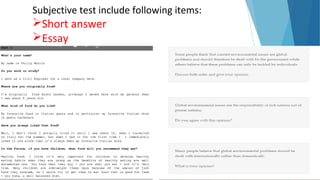
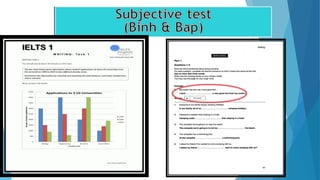
Subjective test include following items:
Short answer
Essay
Objective test
Wiersma and Jurs (1990)
said that Objective test
items are items that can be
objectively scored items on
which person select a
response from the list of
options.
Why does teacher give student tests?
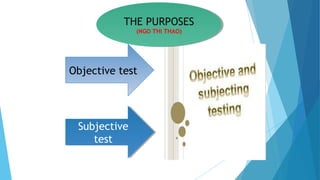
THE PURPOSES
(NGO THI THAO)
THE PURPOSES
(NGO THI THAO)
Objective test
Subjective
test
Subjective
test
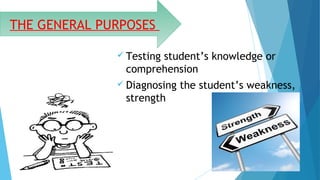
 Testing student’s knowledge or
comprehension
 Diagnosing the student’s weakness,
strength
THE GENERAL PURPOSES
 Evaluating the effectiveness of the
syllabus, the methods and materials that he
or she is using.
 Using to test structures, vocabulary,
comprehension and sound discrimination
OBJECTIVE TEST
 Checking on factual and procedural
knowledge.
Multiple-choice
items
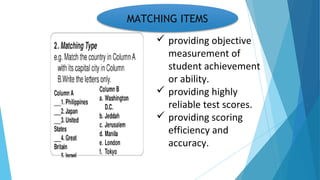
 providing objective
measurement of
student achievement
or ability.
 providing highly
reliable test scores.
 providing scoring
efficiency and
accuracy.
MATCHING ITEMS
 True-false test can
be used when the
test-designer wishes
to measure a
student’s ability to
identify whether
statements of fact
are accurate or not.
TRUE-FALSE TEST
 Subjective test are used to test ideas,
culture, coherence and creativity
 To give an overall evaluation of the
student’s mastery of language
 Teachers who ask subjective questions
must care about whether you are gaining a
deep understanding.
SUBJECTIVE TESTSUBJECTIVE TEST
 Subjective test are used to test ideas,
culture, coherence and creativity
 giving an overall evaluation of the
student’s mastery of language
SUBJECTIVE TEST
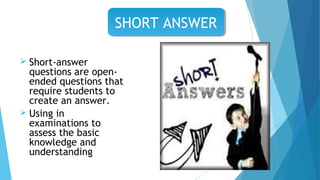
 Short-answer
questions are open-
ended questions that
require students to
create an answer.
 Using in
examinations to
assess the basic
knowledge and
understanding
SHORT ANSWERSHORT ANSWER
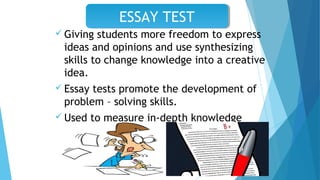
 Giving students more freedom to express
ideas and opinions and use synthesizing
skills to change knowledge into a creative
idea.
 Essay tests promote the development of
problem – solving skills.
 Used to measure in-depth knowledge
especially in a restricted subject matter
area.
ESSAY TESTESSAY TEST
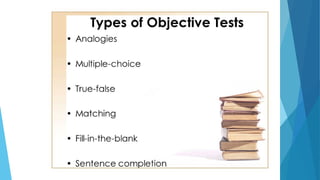
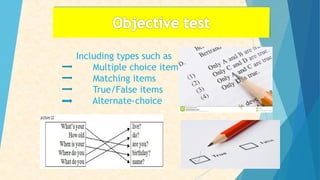
Including types such as
Multiple choice items
Matching items
True/False items
Alternate-choice
*Single correct response.
*Subjective judgment of the scorer do not
influence an individual’s score.
*Guessing is a distinct possibility.
*Typically assess lower-level skills such as
knowledge, comprehension, and application.

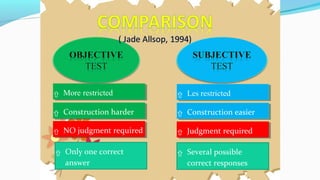
More restricted

More restricted

Construction harder

Construction harder

NO judgment required

NO judgment required

Several possible
correct responses

Judgment required

Judgment required

Construction easier

Construction easier

Les restricted

Les restricted

Only one correct
answer
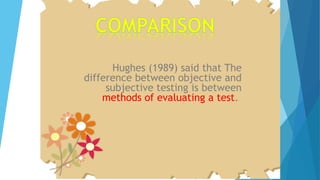
Hughes (1989) said that The
difference between objective and
subjective testing is between
methods of evaluating a test.
HOW TO DESIGN
Ngan & Dung
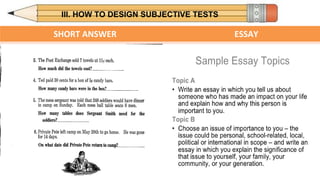
III. HOW TO DESIGN SUBJECTIVE TESTS
SUBJECTIVE TEST
SHORT ANSWER ESSAY
III. HOW TO DESIGN SUBJECTIVE TESTS
SHORT ANSWER ESSAY
APPLICATION, SYNTHESIS, ANALYSIS, AND
EVALUATION LEVELS
APPLICATION, SYNTHESIS AND
EVALUATION LEVELS
III. HOW TO DESIGN SUBJECTIVE TESTS
ADVANTAGESADVANTAGES
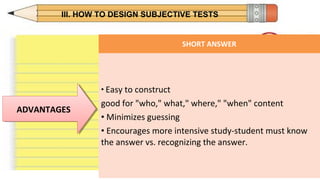
SHORT ANSWER
• Easy to construct
good for "who," what," where," "when" content
• Minimizes guessing
• Encourages more intensive study-student must know
the answer vs. recognizing the answer.
III. HOW TO DESIGN SUBJECTIVE TESTS
ADVANTAGESADVANTAGES
SHORT ANSWER ESSAY
• Easy to construct
good for "who," what," where,"
"when" content
• Minimizes guessing
• Encourages more intensive
study-student must know the
answer vs. recognizing the
answer.
• Students less likely to guess
• Easy to construct
• Stimulates more study
• Allows students to
demonstrate ability to organize
knowledge, express opinions,
show originality.
III. HOW TO DESIGN SUBJECTIVE TESTS
DISADVANTAGESDISADVANTAGES
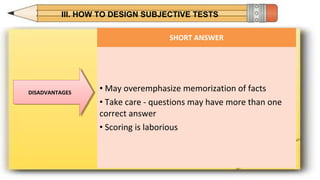
SHORT ANSWER
• May overemphasize memorization of facts
• Take care - questions may have more than one
correct answer
• Scoring is laborious
III. HOW TO DESIGN SUBJECTIVE TESTS
ADVANTAGESADVANTAGES
SHORT ANSWER ESSAY
• Easy to construct
good for "who," what," where,"
"when" content
• Minimizes guessing
• Encourages more intensive
study-student must know the
answer vs. recognizing the
answer.
• Students less likely to guess
• Easy to construct
• Stimulates more study
• Allows students to
demonstrate ability to organize
knowledge, express opinions,
show originality.
III. HOW TO DESIGN SUBJECTIVE TESTS
TIPS FOR GOOD WRITTINGTIPS FOR GOOD WRITTING
SHORT ANSWER
• When using with definitions: supply term, not the
definition-for a better judge of student knowledge.
• For numbers, indicate the degree of precision/units
expected.
III. HOW TO DESIGN SUBJECTIVE TESTS
TIPS FOR GOOD WRITTINGTIPS FOR GOOD WRITTING
SHORT ANSWER
• When using with definitions: supply term, not the
definition-for a better judge of student knowledge.
• For numbers, indicate the degree of precision/units
expected.
III. HOW TO DESIGN SUBJECTIVE TESTS
GOOD FOR:GOOD FOR:
SHORT ANSWER ESSAY
APPLICATION, SYNTHESIS,
ANALYSIS, AND
EVALUATION LEVELS
APPLICATION, SYNTHESIS
AND EVALUATION
LEVELS
III. HOW TO DESIGN SUBJECTIVE TESTS
ADVANTAGESADVANTAGES
ESSAY
• Students less likely to guess
• Easy to construct
• Stimulates more study
• Allows students to demonstrate ability to organize
knowledge, express opinions, show originality.
III. HOW TO DESIGN SUBJECTIVE TESTS
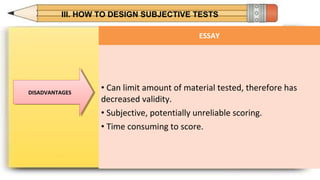
DISADVANTAGESDISADVANTAGES
ESSAY
• Can limit amount of material tested, therefore has
decreased validity.
• Subjective, potentially unreliable scoring.
• Time consuming to score.
III. HOW TO DESIGN SUBJECTIVE TESTS
DISADVANTAGESDISADVANTAGES
ESSAY
• Can limit amount of material tested, therefore has
decreased validity.
• Subjective, potentially unreliable scoring.
• Time consuming to score.
III. HOW TO DESIGN SUBJECTIVE TESTS
DISADVANTAGESDISADVANTAGES
ESSAY
• Can limit amount of material tested, therefore has
decreased validity.
• Subjective, potentially unreliable scoring.
• Time consuming to score.
III. HOW TO DESIGN SUBJECTIVE TESTS
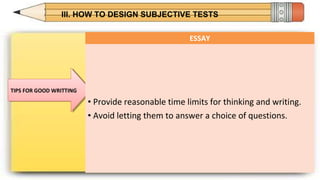
TIPS FOR GOOD WRITTINGTIPS FOR GOOD WRITTING
ESSAY
• Provide reasonable time limits for thinking and writing.
• Avoid letting them to answer a choice of questions.
III. HOW TO DESIGN SUBJECTIVE TESTS
TIPS FOR GOOD
WRITTING
TIPS FOR GOOD
WRITTING
ESSAY
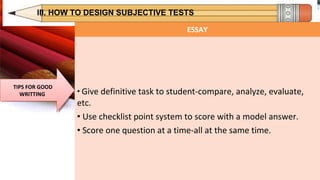
• Give definitive task to student-compare, analyze, evaluate,
etc.
• Use checklist point system to score with a model answer.
• Score one question at a time-all at the same time.
III. HOW TO DESIGN SUBJECTIVE TESTS
SHORT ANSWER ESSAY
APPLICATION, SYNTHESIS, ANALYSIS, AND
EVALUATION LEVELS
APPLICATION, SYNTHESIS AND
EVALUATION LEVELS
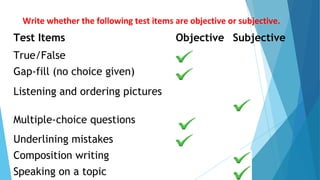
Test Items Objective Subjective
True/False
Gap-fill (no choice given)
Listening and ordering pictures
Multiple-choice questions
Underlining mistakes
Composition writing
Speaking on a topic
Write whether the following test items are objective or subjective.
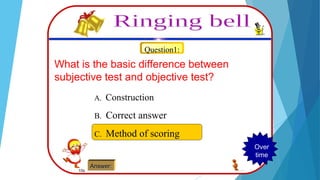
GameGame
Question1:
What is the basic difference between
subjective test and objective test?
A. Construction
B. Correct answer
C. Method of scoring
Answer:Answer:
123456789Over
time
10s
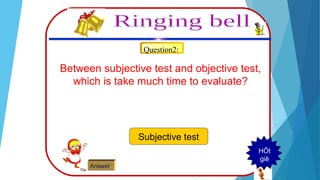
Question2:
Between subjective test and objective test,
which is take much time to evaluate?
Subjective test
AnswerAnswer
123456789HÕt
giê
10s
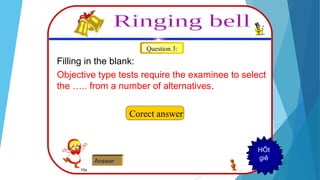
Question 3:
Filling in the blank:
Objective type tests require the examinee to select
the ….. from a number of alternatives.
Corect answer
AnswerAnswer
123456789
HÕt
giê
10s
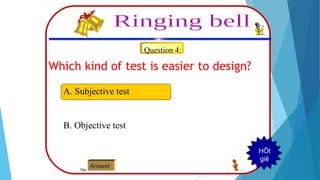
Question 4:
A. Subjective test
B. Objective test
AnswerAnswer
123456789HÕt
giê
10s
Which kind of test is easier to design?
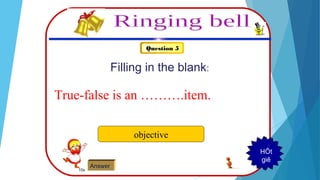
Question 5
Filling in the blank:
True-false is an ……….item.
objective
AnswerAnswer
123456789HÕt
giê
10s
Subjective vs Objective test