
Sidi Mohamed Ben Abdallah
University
Faculty of Arts and Human
Sciences
Dhar Mehraz, Fez
Applied Language
Studies and Research
in Higher Education
Master Program
Teaching Grammar in the Postmethod
Era
Academic Year: 2015/2016
Presented by:
Mohamed Benhima
Supervised by:
Dr. Ouakrime
Mohamed
Outline
Introduction……………………………………………………..……
• I. Background
• II. Definitions
• III. Ratioales
• IV. Post-method parameters to teaching grammar
• V. Post-method frameworks to teaching grammar
• VI. The implications of teaching grammar in the post
method era
• VII. The role of grammar in the post-method
predicament
• VIII. Criticism
• Conclusion…………………………………………………………
Bibiliography ……………………………………………………..
I. Background
• Grammar has played a distinctive role in the
history of language teaching methods:
• Grammar translation;
• Direct method;
• Audiolingualism;
• Cognitive-code method;
• TPR (Total Physical Approach);
• Functional-notional method;
• Communicative method;
• Lexical approach;
• Task-based, content-based, project-based.
I. Background
• Thus, controversies over the way grammar
should be taught have often revolved
around: whether grammar should be taught
in an inductive way or a deductive way, and
implicit or an expliciti way, in context or in
isolation, fluency and accuracy.
• These issues have remained vexing questions
in the history of teaching approaches.
Cont.
• It was until the advent of the post-
method condition (Pica, 1999) that these
dichotomies in teaching have been
substituted by continuums, which in turn
have led to a reconceptulization of the
approach, the nature of language
learning and the nature of language
teaching.
II. Definitions
• A redefinition of language:
• Language as system; language is viewed as a set
of phohological, syntactic and semantic rules.
• Language as discourse; There are three macro-
functions of language: the ideational, the
interpersonal, and the textual.
• Language as ideology: Ideology is “a systematic
body of ideas, organized from a particular point
of view” (Kress & Hodge, 1979, p. 6).
III. Rationales
Classroom oriented research has proven that:
• 1) Teachers who claim to teach grammar as
prescribed by a certain method do not conform to
its theoretical principles or classroom procedures;
• 2) Teachers who claim to follow different
approaches in teaching grammar often use the
same classroom procedures all along;
• 3) Teachers who claim to follow the same approach
in teaching grammar often use different
procedures;
• 4) Teachers develop and follow in their classroom a
carefully crafted sequence of grammar activities not
necessarily followed by any method.
IV. Post-method parameters to
teaching grammar
• The parameter of particularity;
• The parameter of possibility;
• The parameter of practicality;
V. Post-method frameworks to
teaching grammar
• The Macro-strategic framework;
• (a) Maximize learning opportunities
• (b) Facilitate negotiated interaction,
• (c) Minimize perceptual mismatches,
• (d) Activate intuitive heuristics,
• (e) Foster language awareness,
• (f) Contextualize linguistic input,
• (g) Integrate language skills,
• (h) Promote learner autonomy,
• (i) Raise cultural consciousness,
• (j) Ensure social relevance.
• The Three-dimensional framework
• The Explicit-Implicit ;
• The Analytic-Experiential ;
• The Theoretical-Experiential ;
VI. The implications of teaching
grammar in the post-method era
• According to Lrseen-Freeman (2001),
grammar can be taught through a focus on:
• Form : e.g, give-up = verb + particle;
• Meaning : to stop doing something);
• Use: he gave after many trials. (surrender);
VII. The role of teaching grammar in
the post-method predicament
• Pedagogical barriers;
• Ideological barriers;
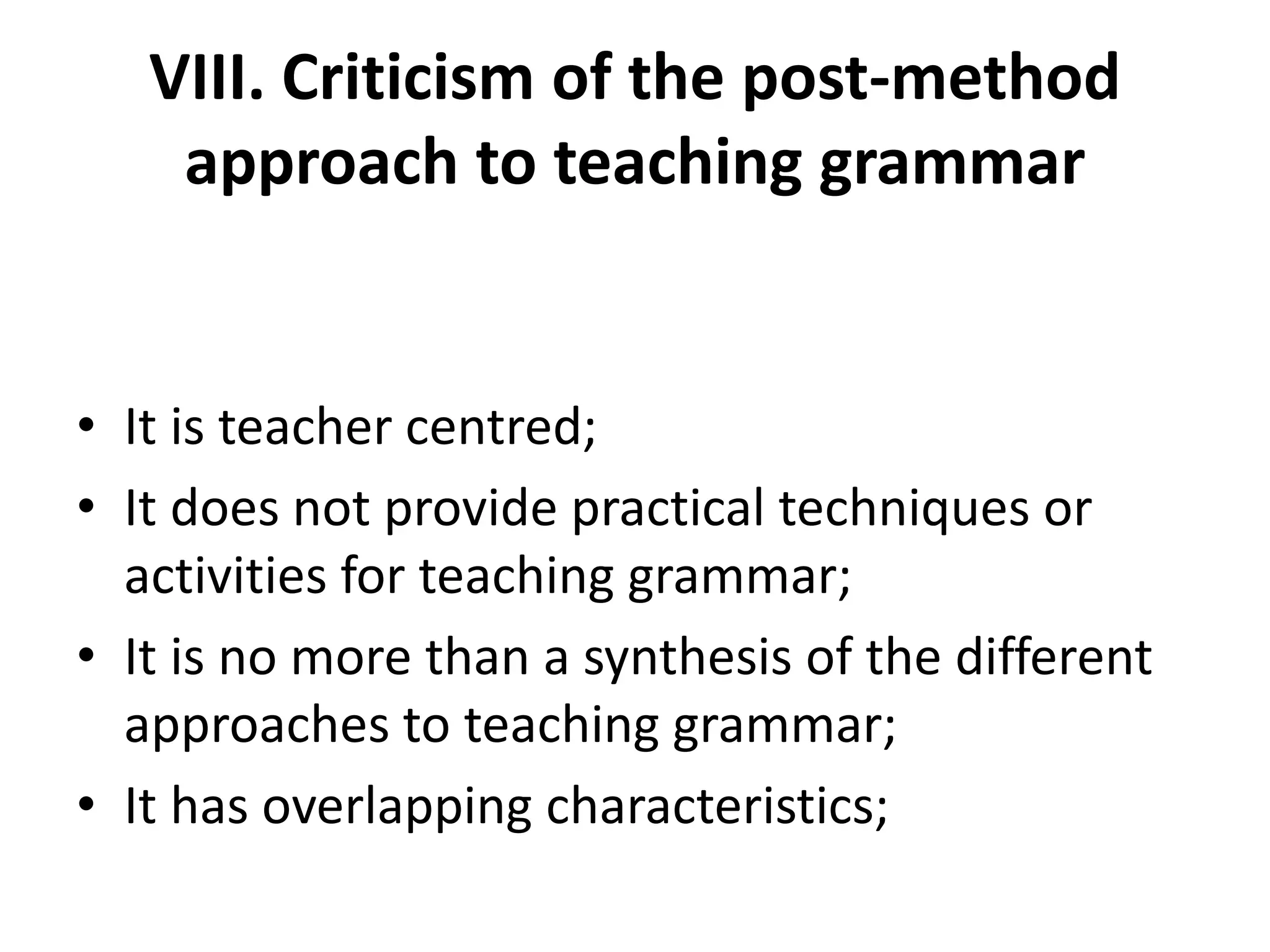
VIII. Criticism of the post-method
approach to teaching grammar
• It is teacher centred;
• It does not provide practical techniques or
activities for teaching grammar;
• It is no more than a synthesis of the different
approaches to teaching grammar;
• It has overlapping characteristics;
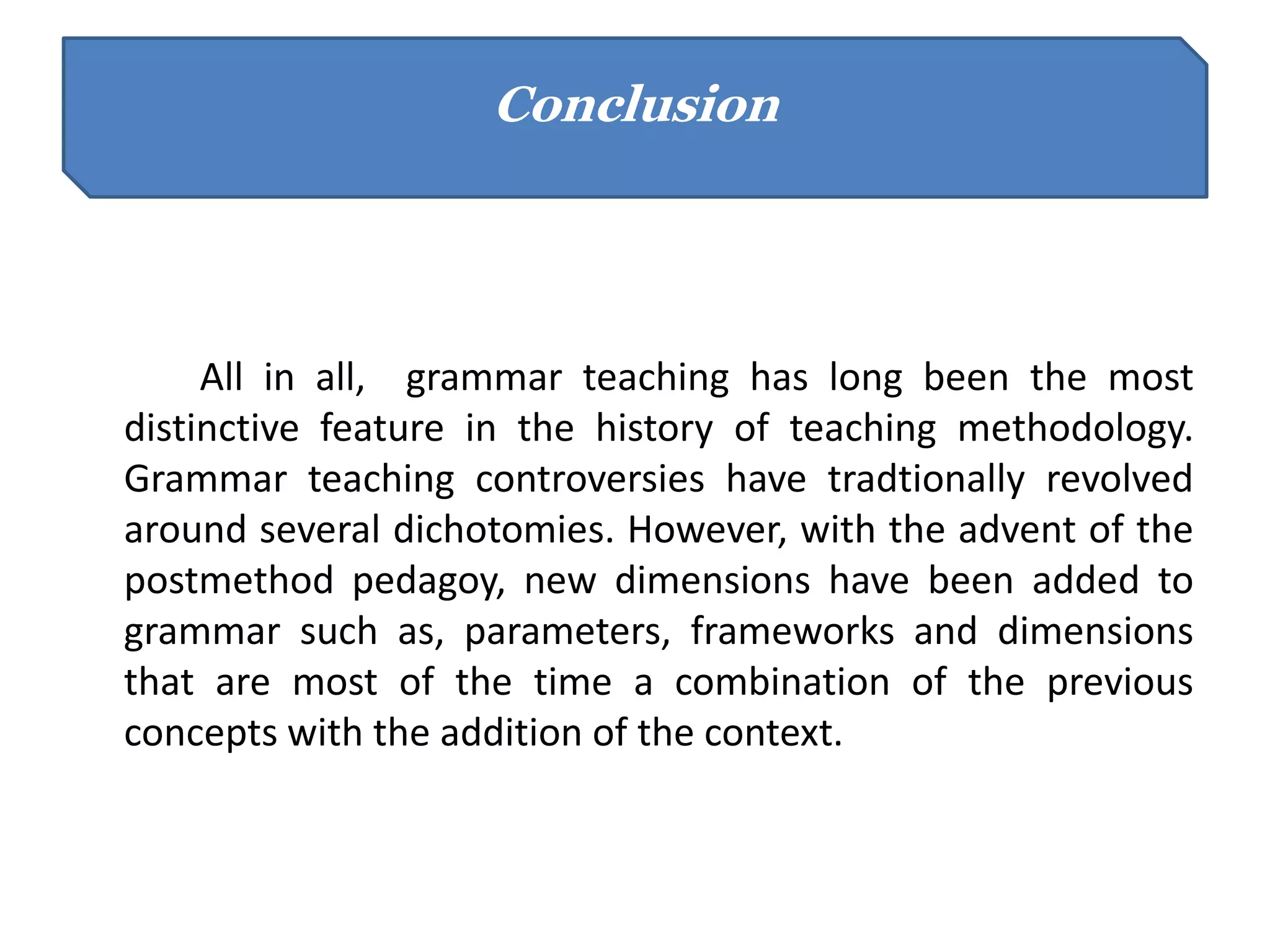
All in all, grammar teaching has long been the most
distinctive feature in the history of teaching methodology.
Grammar teaching controversies have tradtionally revolved
around several dichotomies. However, with the advent of the
postmethod pedagoy, new dimensions have been added to
grammar such as, parameters, frameworks and dimensions
that are most of the time a combination of the previous
concepts with the addition of the context.
Conclusion
Bibliography
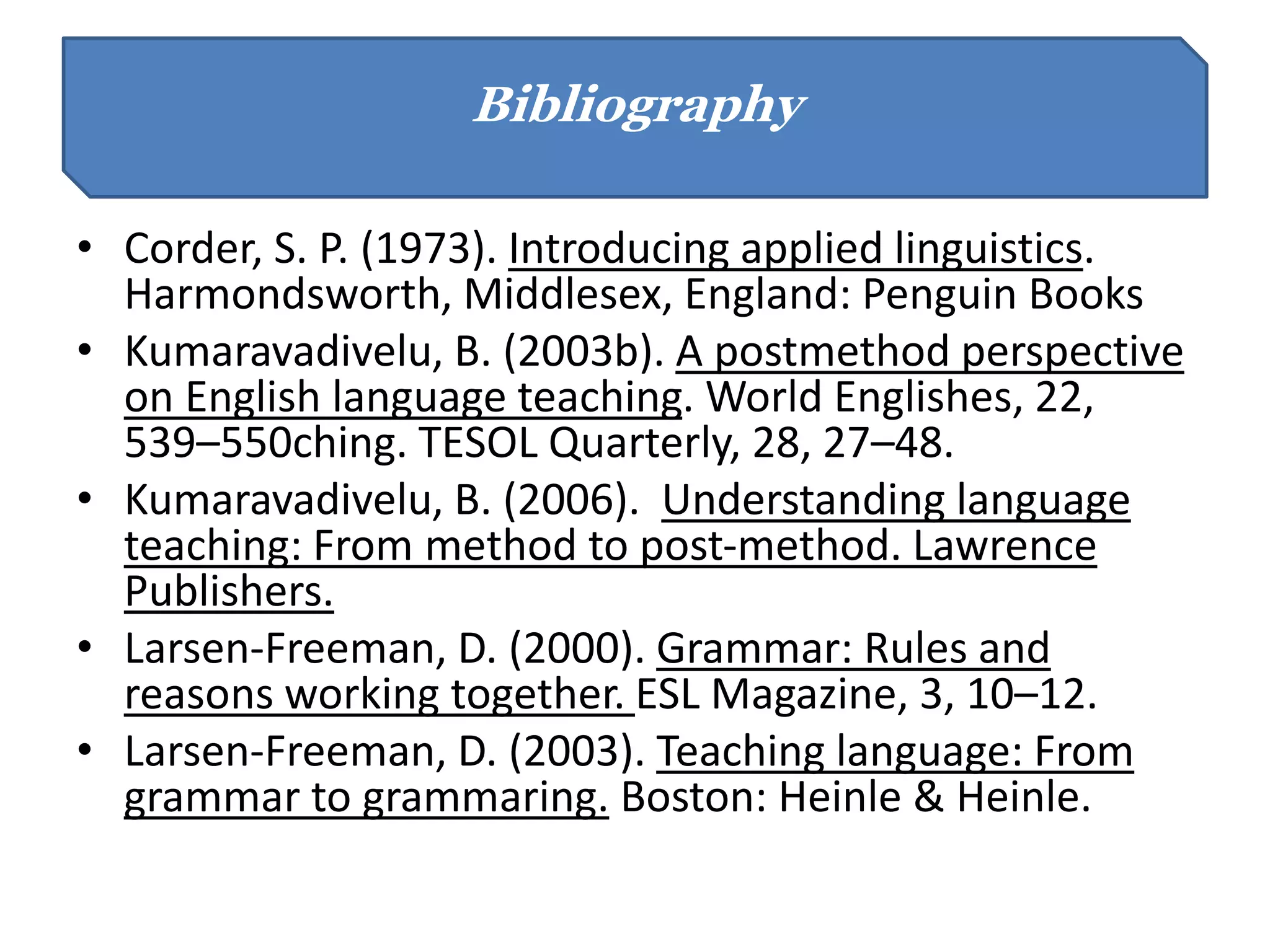
• Corder, S. P. (1973). Introducing applied linguistics.
Harmondsworth, Middlesex, England: Penguin Books
• Kumaravadivelu, B. (2003b). A postmethod perspective
on English language teaching. World Englishes, 22,
539–550ching. TESOL Quarterly, 28, 27–48.
• Kumaravadivelu, B. (2006). Understanding language
teaching: From method to post-method. Lawrence
Publishers.
• Larsen-Freeman, D. (2000). Grammar: Rules and
reasons working together. ESL Magazine, 3, 10–12.
• Larsen-Freeman, D. (2003). Teaching language: From
grammar to grammaring. Boston: Heinle & Heinle.
2015 /2016

Teachig Grammar in the post-method era

  • 1.
    Sidi Mohamed BenAbdallah University Faculty of Arts and Human Sciences Dhar Mehraz, Fez Applied Language Studies and Research in Higher Education Master Program Teaching Grammar in the Postmethod Era Academic Year: 2015/2016 Presented by: Mohamed Benhima Supervised by: Dr. Ouakrime Mohamed
  • 2.
    Outline Introduction……………………………………………………..…… • I. Background •II. Definitions • III. Ratioales • IV. Post-method parameters to teaching grammar • V. Post-method frameworks to teaching grammar • VI. The implications of teaching grammar in the post method era • VII. The role of grammar in the post-method predicament • VIII. Criticism • Conclusion………………………………………………………… Bibiliography ……………………………………………………..
  • 3.
    I. Background • Grammarhas played a distinctive role in the history of language teaching methods: • Grammar translation; • Direct method; • Audiolingualism; • Cognitive-code method; • TPR (Total Physical Approach); • Functional-notional method; • Communicative method; • Lexical approach; • Task-based, content-based, project-based.
  • 4.
    I. Background • Thus,controversies over the way grammar should be taught have often revolved around: whether grammar should be taught in an inductive way or a deductive way, and implicit or an expliciti way, in context or in isolation, fluency and accuracy. • These issues have remained vexing questions in the history of teaching approaches.
  • 5.
    Cont. • It wasuntil the advent of the post- method condition (Pica, 1999) that these dichotomies in teaching have been substituted by continuums, which in turn have led to a reconceptulization of the approach, the nature of language learning and the nature of language teaching.
  • 6.
    II. Definitions • Aredefinition of language: • Language as system; language is viewed as a set of phohological, syntactic and semantic rules. • Language as discourse; There are three macro- functions of language: the ideational, the interpersonal, and the textual. • Language as ideology: Ideology is “a systematic body of ideas, organized from a particular point of view” (Kress & Hodge, 1979, p. 6).
  • 7.
    III. Rationales Classroom orientedresearch has proven that: • 1) Teachers who claim to teach grammar as prescribed by a certain method do not conform to its theoretical principles or classroom procedures; • 2) Teachers who claim to follow different approaches in teaching grammar often use the same classroom procedures all along; • 3) Teachers who claim to follow the same approach in teaching grammar often use different procedures; • 4) Teachers develop and follow in their classroom a carefully crafted sequence of grammar activities not necessarily followed by any method.
  • 8.
    IV. Post-method parametersto teaching grammar • The parameter of particularity; • The parameter of possibility; • The parameter of practicality;
  • 9.
    V. Post-method frameworksto teaching grammar • The Macro-strategic framework; • (a) Maximize learning opportunities • (b) Facilitate negotiated interaction, • (c) Minimize perceptual mismatches, • (d) Activate intuitive heuristics, • (e) Foster language awareness, • (f) Contextualize linguistic input, • (g) Integrate language skills, • (h) Promote learner autonomy, • (i) Raise cultural consciousness, • (j) Ensure social relevance.
  • 10.
    • The Three-dimensionalframework • The Explicit-Implicit ; • The Analytic-Experiential ; • The Theoretical-Experiential ;
  • 11.
    VI. The implicationsof teaching grammar in the post-method era • According to Lrseen-Freeman (2001), grammar can be taught through a focus on: • Form : e.g, give-up = verb + particle; • Meaning : to stop doing something); • Use: he gave after many trials. (surrender);
  • 12.
    VII. The roleof teaching grammar in the post-method predicament • Pedagogical barriers; • Ideological barriers;
  • 13.
    VIII. Criticism ofthe post-method approach to teaching grammar • It is teacher centred; • It does not provide practical techniques or activities for teaching grammar; • It is no more than a synthesis of the different approaches to teaching grammar; • It has overlapping characteristics;
  • 14.
    All in all,grammar teaching has long been the most distinctive feature in the history of teaching methodology. Grammar teaching controversies have tradtionally revolved around several dichotomies. However, with the advent of the postmethod pedagoy, new dimensions have been added to grammar such as, parameters, frameworks and dimensions that are most of the time a combination of the previous concepts with the addition of the context. Conclusion
  • 15.
    Bibliography • Corder, S.P. (1973). Introducing applied linguistics. Harmondsworth, Middlesex, England: Penguin Books • Kumaravadivelu, B. (2003b). A postmethod perspective on English language teaching. World Englishes, 22, 539–550ching. TESOL Quarterly, 28, 27–48. • Kumaravadivelu, B. (2006). Understanding language teaching: From method to post-method. Lawrence Publishers. • Larsen-Freeman, D. (2000). Grammar: Rules and reasons working together. ESL Magazine, 3, 10–12. • Larsen-Freeman, D. (2003). Teaching language: From grammar to grammaring. Boston: Heinle & Heinle.
  • 16.