IABP
INTRA-AORTIC BALLOON COUNTERPULSATION
Dr. VISHAL VANANI
JASLOK HOSPITAL AND RESEARCH CENTRE
APRIL 2015
HISTORY
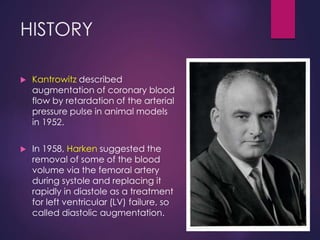
 Kantrowitz described
augmentation of coronary blood
flow by retardation of the arterial
pressure pulse in animal models
in 1952.
 In 1958, Harken suggested the
removal of some of the blood
volume via the femoral artery
during systole and replacing it
rapidly in diastole as a treatment
for left ventricular (LV) failure, so
called diastolic augmentation.
HISTORY
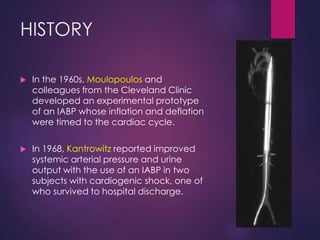
 In the 1960s, Moulopoulos and
colleagues from the Cleveland Clinic
developed an experimental prototype
of an IABP whose inflation and deflation
were timed to the cardiac cycle.
 In 1968, Kantrowitz reported improved
systemic arterial pressure and urine
output with the use of an IABP in two
subjects with cardiogenic shock, one of
who survived to hospital discharge.
HISTORY
 Balloon catheters were 15 French and needed
to be surgically grafted into the femoral arteries.
 Percutaneous IABs in sizes 8.5-9.5 French (rather
than 15 French used earlier) were introduced in
1979, and shortly after this, Bergman and
colleagues described the first percutaneous
insertion of IABP.
 The first prefolded IAB was developed in 1986.
CARDIAC PHYSIOLOGY
PRELOAD
 Preload refers to the amount of stretch on the
ventricular myocardium prior to contraction.
 Starling’s law described how an increase of volume
in the ventricle at the end of diastole resulted in an
increase in the volume of blood pumped out.
 Preload is often referred to as “filling pressure”.
 Factors affecting preload include:
 Aortic insufficiency
 Circulating blood volume
 Mitral valve disease
 Some medications (i.e. Vasoconstrictors, vasodilators)
AFTERLOAD
 Afterload is the resistance that the heart must overcome in
order to eject the blood volume from the left ventricle
 Afterload takes several forms:
 The mass of blood that must be moved, measured by the
hematocrit
 Aortic end diastolic pressure (AEDP).
 Arteriole resistance
 Afterload can be affected by:
 Aortic stenosis
 Arterial vasoconstrictors and vasodilators
 Hypertension
 Peripheral arterial constriction
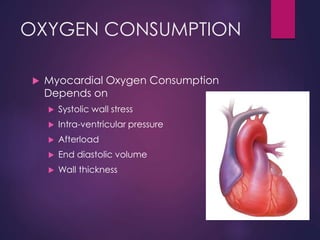
OXYGEN CONSUMPTION
 Myocardial Oxygen Consumption
Depends on
 Systolic wall stress
 Intra-ventricular pressure
 Afterload
 End diastolic volume
 Wall thickness
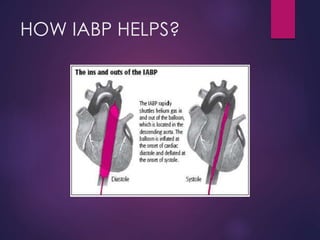
HOW IABP HELPS?
IABP – HOW IT WORKS
 A flexibile catheter – into the descending aorta.
 Correct positioning – Important
 When inflated, the balloon blocks 85-90% of the aorta.
 This balloon displaces the blood that is in the aorta.
 This is known as counter pulsation
 This sudden inflation moves blood superiorly and inferiorly
to the balloon.
 When the balloon is suddenly deflated, the pressure
within the aorta drops quickly.
WHY HELIUM?
 Helium:
 Low Density
 Soluble
IABP – HOW IT HELPS
 Inflation of the balloon occurs at the onset of
diastole.
 At that point, maximum aortic blood volume is
available for displacement because the left ventricle
has just finished contracting and is beginning to
relax, and the aortic valve is closed.
 The pressure wave that is created by inflation forces
blood superiorly into the coronary arteries.
 This helps perfuse the heart.
 Blood is also forced inferiorly increasing perfusion to
distal organs (brain, kidneys, tissues, etc.)
IAB INFLATION
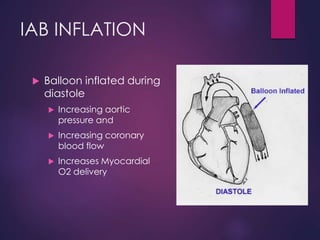
 Balloon inflated during
diastole
 Increasing aortic
pressure and
 Increasing coronary
blood flow
 Increases Myocardial
O2 delivery
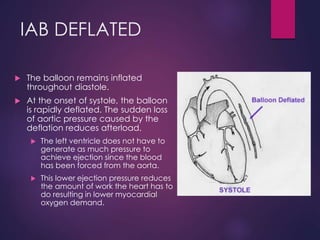
IAB DEFLATED
 The balloon remains inflated
throughout diastole.
 At the onset of systole, the balloon
is rapidly deflated. The sudden loss
of aortic pressure caused by the
deflation reduces afterload.
 The left ventricle does not have to
generate as much pressure to
achieve ejection since the blood
has been forced from the aorta.
 This lower ejection pressure reduces
the amount of work the heart has to
do resulting in lower myocardial
oxygen demand.
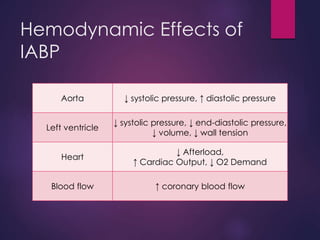
Hemodynamic Effects of
IABP
Aorta ↓ systolic pressure, ↑ diastolic pressure
Left ventricle
↓ systolic pressure, ↓ end-diastolic pressure,
↓ volume, ↓ wall tension
Heart
↓ Afterload,
↑ Cardiac Output, ↓ O2 Demand
Blood flow ↑ coronary blood flow
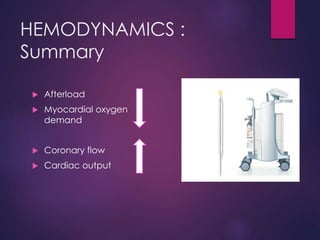
HEMODYNAMICS :
Summary
 Afterload
 Myocardial oxygen
demand
 Coronary flow
 Cardiac output
INDICATIONS
 Refractory unstable angina
 Persistent myocardial
ischemia (preop or postop)
 Acute myocardial infarction
 Complications of acute MI
 Cardiogenic shock
 Refractory LV failure
 Acute MR and VSD
 Support for high-risk
catheterization or failed PCI
 Refractory ventricular
arrhythmias
 As a bridge to cardiac
transplantation
 Support during transport
 Preoperative IABP (high-risk
patients)
 Cardiac surgery, High risk
CABG
 Weaning from
cardiopulmonary bypass
 Postcardiotomy LV systolic
failure unresponsive to
inotropes
CONTRAINDICATIONS
 Severe aortic insufficiency
 Dissecting aortic aneurysm
 Descending thoracic aortic
atheroma
 Aorto-iliac-femoral occlusive
disease
 Lower extremity ischemia
 Dynamic LVOTO
 Chronic end-stage heart
disease with no anticipation
of recovery
 Aortic stents
 End-stage cardiomyopathies
 Severe atherosclerosis
 End stage terminal disease
 Abdominal aortic aneurysm
 Uncontrolled sepsis
 Severe peripheral vascular
disease
 Major arterial reconstruction
surgery
 Blood dyscrasias
(Thrombocytopenia)
COMPLICATIONS
 Transient loss of peripheral
pulse
 Limb ischaemia
 Thromboembolism
 Compartment syndrome
 Retroperitoneal hematoma
 Local vascular injury—false
aneurysm, haematoma,
bleeding from the wound
 Aortic perforation and/or
dissection
 Cardiac tamponade
 Thrombocytopenia
 Infection / sepsis
 Malpositioning causing
cerebral or renal
compromise
 Renal failure and bowel
ischemia
 Heparin induced
thrombocytopenia
 Balloon rupture (can cause
gas embolus)
 Balloon entrapment
HOW TO INTRODUCE
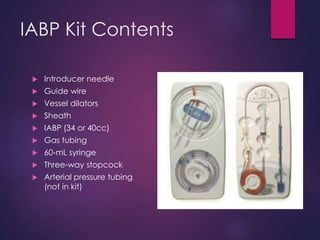
IABP Kit Contents
 Introducer needle
 Guide wire
 Vessel dilators
 Sheath
 IABP (34 or 40cc)
 Gas tubing
 60-mL syringe
 Three-way stopcock
 Arterial pressure tubing
(not in kit)
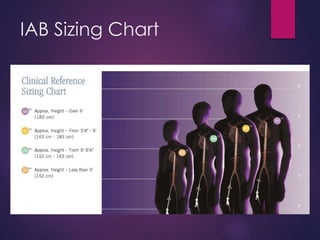
IAB Sizing Chart
INSERTION TECHNIQUE
 Percutaneous
 Sheath less
 With Sheath
 Surgical insertion
 Femoral cut down
 Trans-thoracic
 The IABP device has two major components:
1. A double-lumen 8.0-9.5 French catheter with a 25-50 ml
balloon attached at its distal end; and
2. A console with a pump to drive the balloon.
 The balloon is made of polyethylene and is inflated with
gas driven by the pump.
POSITIONING
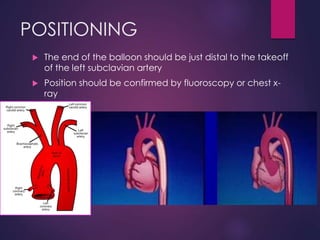
 The end of the balloon should be just distal to the takeoff
of the left subclavian artery
 Position should be confirmed by fluoroscopy or chest x-
ray
HOW TO ADJUST IABP
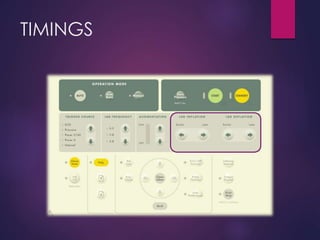
OPERATION MODE
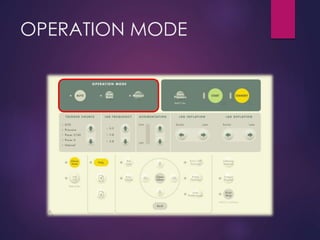
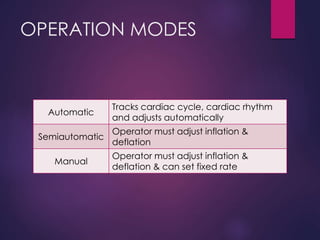
OPERATION MODES
Automatic
Tracks cardiac cycle, cardiac rhythm
and adjusts automatically
Semiautomatic
Operator must adjust inflation &
deflation
Manual
Operator must adjust inflation &
deflation & can set fixed rate
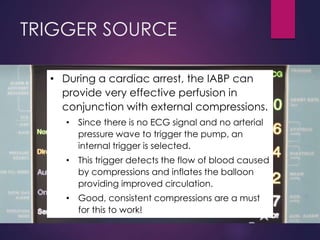
TRIGGER SOURCE
• During a cardiac arrest, the IABP can
provide very effective perfusion in
conjunction with external compressions.
• Since there is no ECG signal and no arterial
pressure wave to trigger the pump, an
internal trigger is selected.
• This trigger detects the flow of blood caused
by compressions and inflates the balloon
providing improved circulation.
• Good, consistent compressions are a must
for this to work!
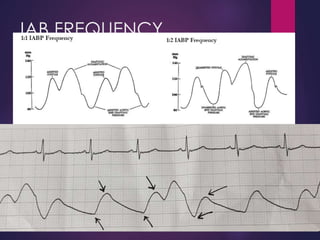
IAB FREQUENCY
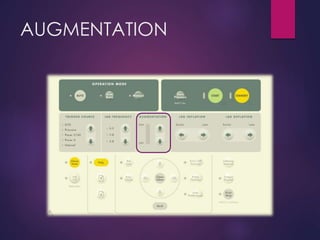
AUGMENTATION
TIMINGS
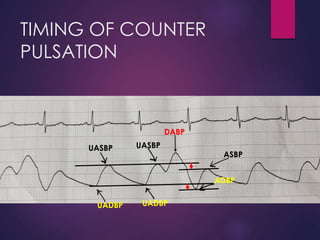
TIMING OF COUNTER
PULSATION
UASBP UASBP
ADBP
UADBPUADBP
ASBP
DABP
INTRAAORTIC BALLOON
COUNTERPULSATION
 Timing of inflation:
• First identify the dicrotic notch (when the aortic valve
closes)
 If inflation is too early the balloon inflates before the
aortic valve closes and pumps blood backwards into
the LV, and ↑ LVEDV & LVEDP, Increased left ventricular
wall stress or afterload, Aortic regurgitation, Increased
MV02 demand.
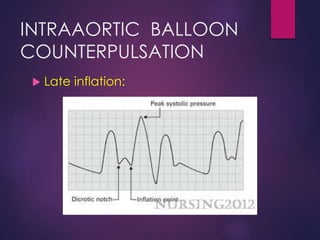
• If inflation is too late there will be sup-optimal coronary
perfusion
INTRAAORTIC BALLOON
COUNTERPULSATION
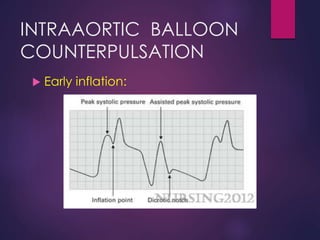
 Early inflation:
INTRAAORTIC BALLOON
COUNTERPULSATION
 Late inflation:
INTRAAORTIC BALLOON
COUNTERPULSATION
 Timing of deflation:
• If deflation is too early there will be inadequate afterload
reduction and sub-optimal coronary perfusion
• If deflation is too late the balloon remains inflated too
long, causing ↑ afterload because the heart is trying to
pump against an inflated balloon
INTRAAORTIC BALLOON
COUNTERPULSATION
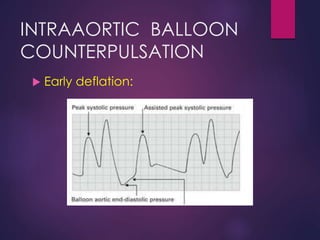
 Early deflation:
EARLY DEFLATION
 Waveform Characteristics:
 Assisted aortic end diastolic pressure may be ≤ the
unassisted aortic end diastolic pressure.
 Assisted systolic pressure may rise.
 Physiologic Effects:
 Sub-optimal coronary perfusion.
 Potential for retrograde coronary and carotid blood
flow.
 Sub-optimal after load reduction & Increased MV02
demand.
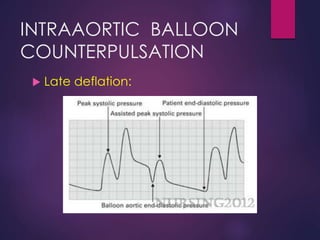
INTRAAORTIC BALLOON
COUNTERPULSATION
 Late deflation:
LATE DEFLATION
 Waveform Characteristics:
 Assisted aortic end diastolic pressure may be equal to
the unassisted aortic end diastolic pressure.
 Rate of rise of assisted systole is prolonged.
 Diastolic augmentation may appear widened.
 Physiologic Effects:
 Afterload reduction is essentially absent.
 Increased MV02 consumption due to
 The left ventricle ejecting against a greater resistance
 IAB may impede left ventricular ejection and increase
the afterload
MAINTENANCE CARE
 Ankle flexion and extension one to two hourly
 Use pressure relieving mattress
 Change ECG electrodes daily.
 Change occlusive dressing daily
 Secure balloon catheter at several points
along the limb.
OBSERVATIONS
 Observe hourly at catheter insertion site
 For signs of bleeding
 Signs of infection
 Signs of blood in sheath
 If blood or brown dust is observed within the
lumen, immediately place the IABP on
'Standby'.
 The catheter will have to be removed
immediately.
OBSERVATIONS
 Check hourly for left radial pulse
 Put SaO2 probe on left hand
 Assess the limb distal to the insertion
 One hourly Observe and record peripheral
pulses, capillary refill, skin, temperature
 Observe the waveform to ascertain that the
timing is correct
WEANING of IABP
 Timing of weaning
 Patient should be stable for 24-48 hours
 Decreasing inotropic support
 Decreasing pump ratio
 From 1:1 to 1:2 or 1:3
 Decrease augmentation
 Monitor patient closely
 If patient becomes unstable, weaning should
be immediately discontinued
IABP REMOVAL
 Discontinue heparin six hours prior
 Check platelets and coagulation factors
 Deflate the balloon
 Apply manual pressure above and below IABP
insertion site
 Remove balloon while alternating pressure
above and below insertion site to expel clots
 Apply constant pressure to the insertion site for a
minimum of 30 minutes
 Check distal pulses frequently
KEY POINTS
 The primary goal of intra-aortic balloon pump (IABP)
treatment is to increase myocardial oxygen supply and
decrease myocardial oxygen demand.
 Decreased urine output after the insertion of IABP can
occur because of juxta-renal balloon positioning.
 Haemolysis from mechanical damage to red blood cells
can reduce the haematocrit by up to 5%.
 Suboptimal timing of inflation and deflation of the
balloon produces haemodynamic instability.
 An IABP is thrombogenic; always anticoagulate the
patient.
 Never switch the balloon off while in situ.
….THANK YOU….

IABP

  • 1.
    IABP INTRA-AORTIC BALLOON COUNTERPULSATION Dr.VISHAL VANANI JASLOK HOSPITAL AND RESEARCH CENTRE APRIL 2015
  • 2.
    HISTORY  Kantrowitz described augmentationof coronary blood flow by retardation of the arterial pressure pulse in animal models in 1952.  In 1958, Harken suggested the removal of some of the blood volume via the femoral artery during systole and replacing it rapidly in diastole as a treatment for left ventricular (LV) failure, so called diastolic augmentation.
  • 3.
    HISTORY  In the1960s, Moulopoulos and colleagues from the Cleveland Clinic developed an experimental prototype of an IABP whose inflation and deflation were timed to the cardiac cycle.  In 1968, Kantrowitz reported improved systemic arterial pressure and urine output with the use of an IABP in two subjects with cardiogenic shock, one of who survived to hospital discharge.
  • 4.
    HISTORY  Balloon catheterswere 15 French and needed to be surgically grafted into the femoral arteries.  Percutaneous IABs in sizes 8.5-9.5 French (rather than 15 French used earlier) were introduced in 1979, and shortly after this, Bergman and colleagues described the first percutaneous insertion of IABP.  The first prefolded IAB was developed in 1986.
  • 5.
  • 6.
    PRELOAD  Preload refersto the amount of stretch on the ventricular myocardium prior to contraction.  Starling’s law described how an increase of volume in the ventricle at the end of diastole resulted in an increase in the volume of blood pumped out.  Preload is often referred to as “filling pressure”.  Factors affecting preload include:  Aortic insufficiency  Circulating blood volume  Mitral valve disease  Some medications (i.e. Vasoconstrictors, vasodilators)
  • 7.
    AFTERLOAD  Afterload isthe resistance that the heart must overcome in order to eject the blood volume from the left ventricle  Afterload takes several forms:  The mass of blood that must be moved, measured by the hematocrit  Aortic end diastolic pressure (AEDP).  Arteriole resistance  Afterload can be affected by:  Aortic stenosis  Arterial vasoconstrictors and vasodilators  Hypertension  Peripheral arterial constriction
  • 8.
    OXYGEN CONSUMPTION  MyocardialOxygen Consumption Depends on  Systolic wall stress  Intra-ventricular pressure  Afterload  End diastolic volume  Wall thickness
  • 9.
  • 10.
    IABP – HOWIT WORKS  A flexibile catheter – into the descending aorta.  Correct positioning – Important  When inflated, the balloon blocks 85-90% of the aorta.  This balloon displaces the blood that is in the aorta.  This is known as counter pulsation  This sudden inflation moves blood superiorly and inferiorly to the balloon.  When the balloon is suddenly deflated, the pressure within the aorta drops quickly.
  • 11.
    WHY HELIUM?  Helium: Low Density  Soluble
  • 12.
    IABP – HOWIT HELPS  Inflation of the balloon occurs at the onset of diastole.  At that point, maximum aortic blood volume is available for displacement because the left ventricle has just finished contracting and is beginning to relax, and the aortic valve is closed.  The pressure wave that is created by inflation forces blood superiorly into the coronary arteries.  This helps perfuse the heart.  Blood is also forced inferiorly increasing perfusion to distal organs (brain, kidneys, tissues, etc.)
  • 13.
    IAB INFLATION  Ballooninflated during diastole  Increasing aortic pressure and  Increasing coronary blood flow  Increases Myocardial O2 delivery
  • 14.
    IAB DEFLATED  Theballoon remains inflated throughout diastole.  At the onset of systole, the balloon is rapidly deflated. The sudden loss of aortic pressure caused by the deflation reduces afterload.  The left ventricle does not have to generate as much pressure to achieve ejection since the blood has been forced from the aorta.  This lower ejection pressure reduces the amount of work the heart has to do resulting in lower myocardial oxygen demand.
  • 15.
    Hemodynamic Effects of IABP Aorta↓ systolic pressure, ↑ diastolic pressure Left ventricle ↓ systolic pressure, ↓ end-diastolic pressure, ↓ volume, ↓ wall tension Heart ↓ Afterload, ↑ Cardiac Output, ↓ O2 Demand Blood flow ↑ coronary blood flow
  • 16.
    HEMODYNAMICS : Summary  Afterload Myocardial oxygen demand  Coronary flow  Cardiac output
  • 17.
    INDICATIONS  Refractory unstableangina  Persistent myocardial ischemia (preop or postop)  Acute myocardial infarction  Complications of acute MI  Cardiogenic shock  Refractory LV failure  Acute MR and VSD  Support for high-risk catheterization or failed PCI  Refractory ventricular arrhythmias  As a bridge to cardiac transplantation  Support during transport  Preoperative IABP (high-risk patients)  Cardiac surgery, High risk CABG  Weaning from cardiopulmonary bypass  Postcardiotomy LV systolic failure unresponsive to inotropes
  • 18.
    CONTRAINDICATIONS  Severe aorticinsufficiency  Dissecting aortic aneurysm  Descending thoracic aortic atheroma  Aorto-iliac-femoral occlusive disease  Lower extremity ischemia  Dynamic LVOTO  Chronic end-stage heart disease with no anticipation of recovery  Aortic stents  End-stage cardiomyopathies  Severe atherosclerosis  End stage terminal disease  Abdominal aortic aneurysm  Uncontrolled sepsis  Severe peripheral vascular disease  Major arterial reconstruction surgery  Blood dyscrasias (Thrombocytopenia)
  • 19.
    COMPLICATIONS  Transient lossof peripheral pulse  Limb ischaemia  Thromboembolism  Compartment syndrome  Retroperitoneal hematoma  Local vascular injury—false aneurysm, haematoma, bleeding from the wound  Aortic perforation and/or dissection  Cardiac tamponade  Thrombocytopenia  Infection / sepsis  Malpositioning causing cerebral or renal compromise  Renal failure and bowel ischemia  Heparin induced thrombocytopenia  Balloon rupture (can cause gas embolus)  Balloon entrapment
  • 20.
  • 21.
    IABP Kit Contents Introducer needle  Guide wire  Vessel dilators  Sheath  IABP (34 or 40cc)  Gas tubing  60-mL syringe  Three-way stopcock  Arterial pressure tubing (not in kit)
  • 22.
  • 23.
    INSERTION TECHNIQUE  Percutaneous Sheath less  With Sheath  Surgical insertion  Femoral cut down  Trans-thoracic
  • 24.
     The IABPdevice has two major components: 1. A double-lumen 8.0-9.5 French catheter with a 25-50 ml balloon attached at its distal end; and 2. A console with a pump to drive the balloon.  The balloon is made of polyethylene and is inflated with gas driven by the pump.
  • 25.
    POSITIONING  The endof the balloon should be just distal to the takeoff of the left subclavian artery  Position should be confirmed by fluoroscopy or chest x- ray
  • 26.
  • 27.
  • 28.
    OPERATION MODES Automatic Tracks cardiaccycle, cardiac rhythm and adjusts automatically Semiautomatic Operator must adjust inflation & deflation Manual Operator must adjust inflation & deflation & can set fixed rate
  • 29.
    TRIGGER SOURCE • Duringa cardiac arrest, the IABP can provide very effective perfusion in conjunction with external compressions. • Since there is no ECG signal and no arterial pressure wave to trigger the pump, an internal trigger is selected. • This trigger detects the flow of blood caused by compressions and inflates the balloon providing improved circulation. • Good, consistent compressions are a must for this to work!
  • 30.
  • 31.
  • 32.
  • 33.
    TIMING OF COUNTER PULSATION UASBPUASBP ADBP UADBPUADBP ASBP DABP
  • 34.
    INTRAAORTIC BALLOON COUNTERPULSATION  Timingof inflation: • First identify the dicrotic notch (when the aortic valve closes)  If inflation is too early the balloon inflates before the aortic valve closes and pumps blood backwards into the LV, and ↑ LVEDV & LVEDP, Increased left ventricular wall stress or afterload, Aortic regurgitation, Increased MV02 demand. • If inflation is too late there will be sup-optimal coronary perfusion
  • 35.
  • 36.
  • 37.
    INTRAAORTIC BALLOON COUNTERPULSATION  Timingof deflation: • If deflation is too early there will be inadequate afterload reduction and sub-optimal coronary perfusion • If deflation is too late the balloon remains inflated too long, causing ↑ afterload because the heart is trying to pump against an inflated balloon
  • 38.
  • 39.
    EARLY DEFLATION  WaveformCharacteristics:  Assisted aortic end diastolic pressure may be ≤ the unassisted aortic end diastolic pressure.  Assisted systolic pressure may rise.  Physiologic Effects:  Sub-optimal coronary perfusion.  Potential for retrograde coronary and carotid blood flow.  Sub-optimal after load reduction & Increased MV02 demand.
  • 40.
  • 41.
    LATE DEFLATION  WaveformCharacteristics:  Assisted aortic end diastolic pressure may be equal to the unassisted aortic end diastolic pressure.  Rate of rise of assisted systole is prolonged.  Diastolic augmentation may appear widened.  Physiologic Effects:  Afterload reduction is essentially absent.  Increased MV02 consumption due to  The left ventricle ejecting against a greater resistance  IAB may impede left ventricular ejection and increase the afterload
  • 42.
    MAINTENANCE CARE  Ankleflexion and extension one to two hourly  Use pressure relieving mattress  Change ECG electrodes daily.  Change occlusive dressing daily  Secure balloon catheter at several points along the limb.
  • 43.
    OBSERVATIONS  Observe hourlyat catheter insertion site  For signs of bleeding  Signs of infection  Signs of blood in sheath  If blood or brown dust is observed within the lumen, immediately place the IABP on 'Standby'.  The catheter will have to be removed immediately.
  • 44.
    OBSERVATIONS  Check hourlyfor left radial pulse  Put SaO2 probe on left hand  Assess the limb distal to the insertion  One hourly Observe and record peripheral pulses, capillary refill, skin, temperature  Observe the waveform to ascertain that the timing is correct
  • 45.
    WEANING of IABP Timing of weaning  Patient should be stable for 24-48 hours  Decreasing inotropic support  Decreasing pump ratio  From 1:1 to 1:2 or 1:3  Decrease augmentation  Monitor patient closely  If patient becomes unstable, weaning should be immediately discontinued
  • 46.
    IABP REMOVAL  Discontinueheparin six hours prior  Check platelets and coagulation factors  Deflate the balloon  Apply manual pressure above and below IABP insertion site  Remove balloon while alternating pressure above and below insertion site to expel clots  Apply constant pressure to the insertion site for a minimum of 30 minutes  Check distal pulses frequently
  • 47.
    KEY POINTS  Theprimary goal of intra-aortic balloon pump (IABP) treatment is to increase myocardial oxygen supply and decrease myocardial oxygen demand.  Decreased urine output after the insertion of IABP can occur because of juxta-renal balloon positioning.  Haemolysis from mechanical damage to red blood cells can reduce the haematocrit by up to 5%.  Suboptimal timing of inflation and deflation of the balloon produces haemodynamic instability.  An IABP is thrombogenic; always anticoagulate the patient.  Never switch the balloon off while in situ.
  • 48.