Cannulation
techniques during
CPB
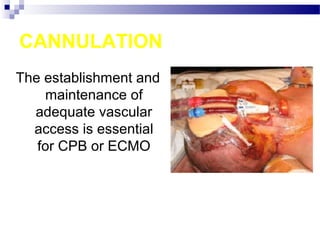
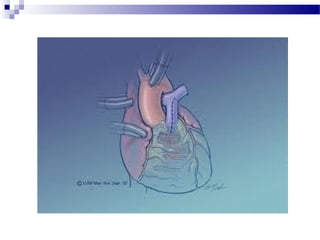
CANNULATION
The establishment and
maintenance of
adequate vascular
access is essential
for CPB or ECMO
Introduction
 Primary function of cpb to divert blood from
heart and lungs.
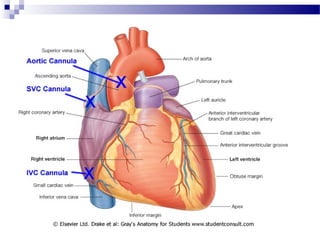
 Blood is drained by gravity siphonage through
svc/ivc/RA
 To return the blood to the systemic arterial
system.
 Blood returned through aortic cannula placed in
the ascending aorta.
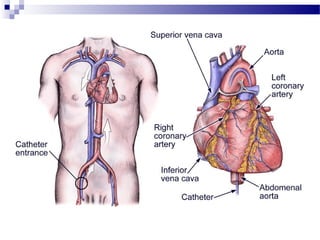
 Peripheral cannulation using femoral or other
means used when central cannulation is not
possible.
Venous cannulation
 Principle
1) Gravity siphonage
2) Vacuum assisted venous drainage.
Gravity drain
 Two constraints
1) Venous reservoir – below the
level of patient
2) The lines must be filled with
blood or fluid.
Gravity drain contd.,
The amount of venous drainage is determined by
1) Pressure in central vein(Pt.
blood volume)
2) The height difference b/w pt. `
and top of blood level in
venous reservoir.
3) Resistance in venous cannulas
Venous drainage
 Venous drainage is affected by
1) Intravascular volume and venous
compliance.
2) Sympathetic tone
3) Venous chattering/fluttering
Venous cannula
 Bi caval
 Single atrial
 Cavo atrial
 Proper positioning is critical
Other approaches
 Femoral /iliac
 Open/percutaneous
 Indications
-Emergency purpose
 Special cannulas- long, ultrathin & wire
reinforced
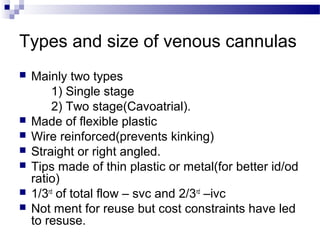
Types and size of venous cannulas
 Mainly two types
1) Single stage
2) Two stage(Cavoatrial).
 Made of flexible plastic
 Wire reinforced(prevents kinking)
 Straight or right angled.
 Tips made of thin plastic or metal(for better id/od
ratio)
 1/3rd
of total flow – svc and 2/3rd
–ivc
 Not ment for reuse but cost constraints have led
to resuse.
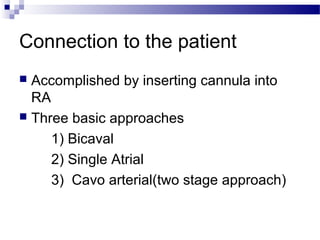
Connection to the patient
 Accomplished by inserting cannula into
RA
 Three basic approaches
1) Bicaval
2) Single Atrial
3) Cavo arterial(two stage approach)
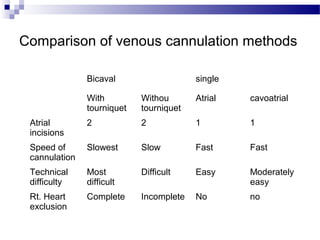
Comparison of venous cannulation methods
Bicaval single
With
tourniquet
Withou
tourniquet
Atrial cavoatrial
Atrial
incisions
2 2 1 1
Speed of
cannulation
Slowest Slow Fast Fast
Technical
difficulty
Most
difficult
Difficult Easy Moderately
easy
Rt. Heart
exclusion
Complete Incomplete No no
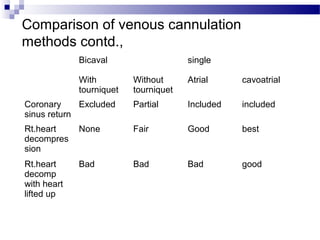
Comparison of venous cannulation
methods contd.,
Bicaval single
With
tourniquet
Without
tourniquet
Atrial cavoatrial
Coronary
sinus return
Excluded Partial Included included
Rt.heart
decompres
sion
None Fair Good best
Rt.heart
decomp
with heart
lifted up
Bad Bad Bad good
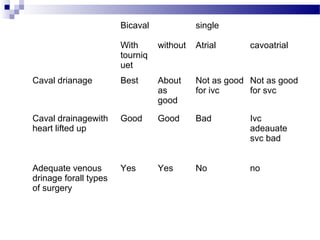
Bicaval single
With
tourniq
uet
without Atrial cavoatrial
Caval drianage Best About
as
good
Not as good
for ivc
Not as good
for svc
Caval drainagewith
heart lifted up
Good Good Bad Ivc
adeauate
svc bad
Adequate venous
drinage forall types
of surgery
Yes Yes No no
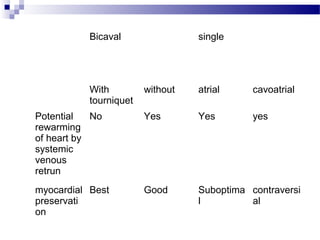
Bicaval single
With
tourniquet
without atrial cavoatrial
Potential
rewarming
of heart by
systemic
venous
retrun
No Yes Yes yes
myocardial
preservati
on
Best Good Suboptima
l
contraversi
al
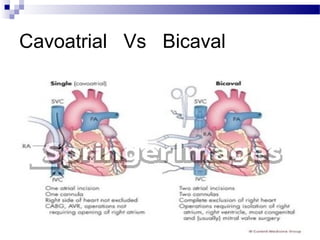
Cavoatrial Vs Bicaval
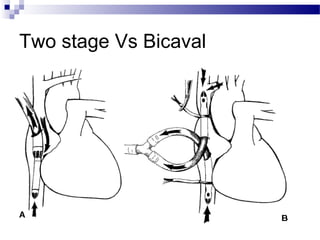
Two stage Vs Bicaval
Persistent LSVC
 LSVC present in .3% to .5% of population
 LSVC usually drains into coronary sinus and
than into the RA.
 In some cases LSVCdrains into LA
 LSVC should be suspected when large coronary
sinus is noted on echo.
 Suspect LSCV when Rsvc small
 Left innominate vein small or absent
Solution
 Use cardiotomy suction in the coronary
sinus
 Cannulate LSVC
Augmented venous drainage
 To reduce circuit volume
 Three methods:
1) Roller pump
2) Kinetic pump
3) VAVD
Precautions
 Regulation of negative pressure
 Not to exceed – 60 to – 100 mmhg
 20 mmhg is enough
 Vacuum applied after initiation of CPB
Complications of augmented return
 Hemolysis due to excessive – ve
pressure.
 Collapse of venous structures possible
 Aspiration of macro and micro air
 Presence of PFO can cause air embolism.
Complication associated with
venous drainage
 Atrial dysrhymias
 Bleeding of the atrium
 Air embolization (low arterial pressure could
cause systemic embolization with potential right
to left shunts)
 Malposition of tips(inserting the tip into
azygos,innominate or hepatic veins or across an
ASD into left heart)
 Caval tapes may occlude venous lines
Causes of low venous return
 Inadequate height
 Malposition of venous cannulas
 Obstruction or excess resistance
 Inadequate venous pressure(venodilation or
hypovolemia)
 Kinks, airlocks or insertion of PA balloon
catheter into a cannula.
 During rewarming tendency for kinking is
more(softening of tubes)
 Surgical manuplation.
Causes of low venous return
contd.,
 Low venous pressure
 Hypovolemia
 Drug induced venous dilation
 Small cannula
 Excessive flow resistance
 Partial obstruction causes of venous
return causes RV distension and
contractility impairment
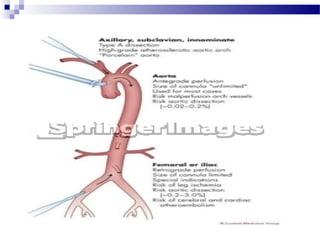
Arterial cannulation
 Sites
1. Proximal aorta
2. Innominate artery
3. Distal aortic arch
4. Femoral
5. External illiac
6. Subclavian and axillary artery
Choice of cannula
 Influenced by
1. The planned operation
2. The distribution of atherosclerotic disease
Arterial cannulation
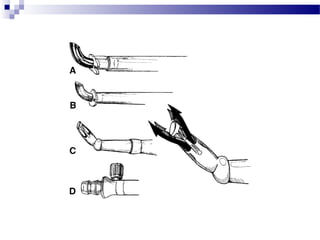
 Cannulas
Available in different types
1) Rt angled tips
2) Tapered
3) Flanges
 Narrowest part of ECC.
Hemodynamic charecteristics
 Pressure drop
 Performance index(pressure gradient versus OD
at any given flow)
 The use of thin metal or hard plastic for the tip
provides the best id/od ratio
 Pressure gradients exceeding 100 mmhg are
associated with excessive hemolysis and protien
denaturation
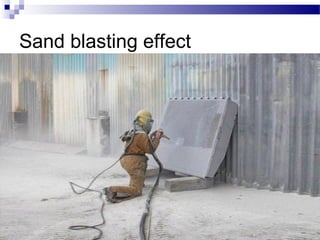
 Jetting effect produced by small cannulas may
damage the ineterior aortic wall,dislodge
atheroemboli(sandblasting) and cause
dissection
Connection to the patient
 Ascending Aorta
 Femoral artery
 Abdominal aorta
 Auxillary artery
 Left common carotid artery(LCCA)
 LV apex
Ascending Aorta
 Advantages ease,safe and no additional
inscision.
 Optimal BP during cannulation – 70 to 80
mmhg(mean) systolic – 100
 If pressure too high – greater chance of tear
and dissection
 If pressure too low - Aorta tend to collapse,
difficult to make inscision and greater risk of
tear
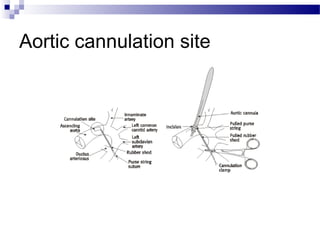
Aortic cannulation site
Ascending aorta contd.,
 After cannulation confirm intraluminal
placement by noting pulsatile flow in the
systemic line pressure.
 CPB line pressure approx = radial artery
 Proper position of cannula tip is
important(1 to 2 cms into aorta)
 Directed towards middle of tranverse arch
Potential complications
 Atherosclerosis with or without
calcification
 Atherosclerosis is a risk factor for
perioperative aortic dissection and post op
renal dysfunction
 Inabillity to introduce cannula
 Intramural placement
 Dislodgement of atheroemboli
 Air embolism from the cannula
Complication contd.,
 Persistent bleeding around the cannula.
 Malposition of the tip to retrograde position
or even across the aortic valve.
 malposition against vessel wall or into the
aortic arch vessels
 Obstruction of aorta infants
 Aortic dissection and high cpb line
pressure
Complications summary
 Difficult insertion
 Bleeding
 Tear in the aortic wall
 Malposition of cannula tip
 Atheromatous emboli
 Failure to remove all air from arterial line
 Injury to aortic back wall
Contd.,
 Inadequate or excessive cerebral blood
flow
 Inadvertent decannulation
 Aortic disection
Points to be observed during aortic
cannulation
 High systemic line pressure
 High pressure in radial artery
 Asymmetric coolling of the neck
 Facial edema,dilated pupils
 Before cpb radial artery catheter may
reveal sudden damping
 Sand blasting effect
Sand blasting effect
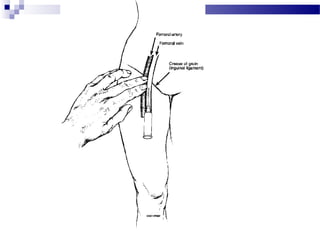
Femoral artery
 Indications
1) Aneurysm in ascending aorta
2) no space avilable
3) Severe calcification
4) Re-do surgeries
Femoral artery complications
 Truma to cannulated vessel
 Late stenosis
 Infection
 Embollization
 Limb ischemia
 retrograde arterial dissection
Abdominal aorta
 cannulating the abdominal aorta through a
graft is reported.
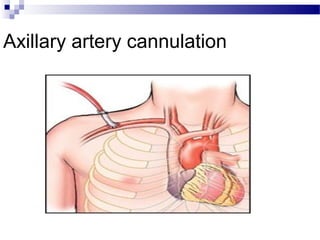
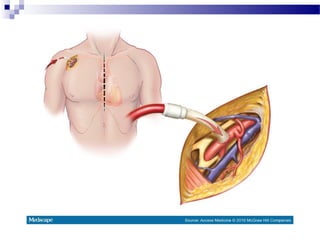
Auxillary artery cannulation
 Performed either directly or through an
attached 8mm graft.
 Advantages
1. Less likely to have atheroscleorosis
2. Has good collateral flow
3. Decreases the risk of ischemic
complications
4. Healing is better and wound
complications are less
Advantages of auxillary artery
cannulation contd.,
 Its antegrade flow also reduces the
chances of cerebral atheroembolization
 Used for establishing deep hypothermia
before repair of type A aortic dissection
 Rt.auxillary artery is more favoured.
Complications of auxillary artery
cannulation.
 Auxillary artery injury,thrombosis
 Ischemia or compartmental syndrome in
the arm
 Poor perfusion due to high resistance due
to small artery or local dissection
Axillary artery cannulation
Innominate artery
 Eliminates the need of second incision
 7 to 8 mm cannula directed towards the
aortic arch
Left common carotid artery(LCCA)
 Approach through extrathoracic incision in
the neck and 8 mm graft sutured end to
side and 22fr cannula inserted
 Used for selective perfusion of the brain at
10 to 15 ml/kg/min at 15 degrees
centrigrade.
 Perfusion pressure < 80 mmhg(Needle
placed in common caroted artery)
Left ventricular apex
 Cannulating the LV apex and passing the
cannula across the aortic valve in the
aortic root is reported.
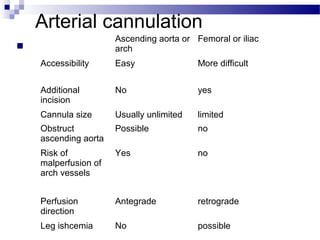
Arterial cannulation

Ascending aorta or
arch
Femoral or iliac
Accessibility Easy More difficult
Additional
incision
No yes
Cannula size Usually unlimited limited
Obstruct
ascending aorta
Possible no
Risk of
malperfusion of
arch vessels
Yes no
Perfusion
direction
Antegrade retrograde
Leg ishcemia No possible
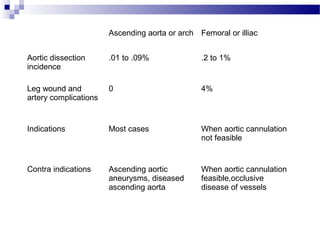
Ascending aorta or arch Femoral or illiac
Aortic dissection
incidence
.01 to .09% .2 to 1%
Leg wound and
artery complications
0 4%
Indications Most cases When aortic cannulation
not feasible
Contra indications Ascending aortic
aneurysms, diseased
ascending aorta
When aortic cannulation
feasible,occlusive
disease of vessels

cannulation techniques during cpb

  • 1.
  • 2.
    CANNULATION The establishment and maintenanceof adequate vascular access is essential for CPB or ECMO
  • 3.
    Introduction  Primary functionof cpb to divert blood from heart and lungs.  Blood is drained by gravity siphonage through svc/ivc/RA  To return the blood to the systemic arterial system.  Blood returned through aortic cannula placed in the ascending aorta.  Peripheral cannulation using femoral or other means used when central cannulation is not possible.
  • 6.
    Venous cannulation  Principle 1)Gravity siphonage 2) Vacuum assisted venous drainage.
  • 7.
    Gravity drain  Twoconstraints 1) Venous reservoir – below the level of patient 2) The lines must be filled with blood or fluid.
  • 8.
    Gravity drain contd., Theamount of venous drainage is determined by 1) Pressure in central vein(Pt. blood volume) 2) The height difference b/w pt. ` and top of blood level in venous reservoir. 3) Resistance in venous cannulas
  • 9.
    Venous drainage  Venousdrainage is affected by 1) Intravascular volume and venous compliance. 2) Sympathetic tone 3) Venous chattering/fluttering
  • 10.
    Venous cannula  Bicaval  Single atrial  Cavo atrial  Proper positioning is critical
  • 11.
    Other approaches  Femoral/iliac  Open/percutaneous  Indications -Emergency purpose  Special cannulas- long, ultrathin & wire reinforced
  • 12.
    Types and sizeof venous cannulas  Mainly two types 1) Single stage 2) Two stage(Cavoatrial).  Made of flexible plastic  Wire reinforced(prevents kinking)  Straight or right angled.  Tips made of thin plastic or metal(for better id/od ratio)  1/3rd of total flow – svc and 2/3rd –ivc  Not ment for reuse but cost constraints have led to resuse.
  • 13.
    Connection to thepatient  Accomplished by inserting cannula into RA  Three basic approaches 1) Bicaval 2) Single Atrial 3) Cavo arterial(two stage approach)
  • 14.
    Comparison of venouscannulation methods Bicaval single With tourniquet Withou tourniquet Atrial cavoatrial Atrial incisions 2 2 1 1 Speed of cannulation Slowest Slow Fast Fast Technical difficulty Most difficult Difficult Easy Moderately easy Rt. Heart exclusion Complete Incomplete No no
  • 15.
    Comparison of venouscannulation methods contd., Bicaval single With tourniquet Without tourniquet Atrial cavoatrial Coronary sinus return Excluded Partial Included included Rt.heart decompres sion None Fair Good best Rt.heart decomp with heart lifted up Bad Bad Bad good
  • 16.
    Bicaval single With tourniq uet without Atrialcavoatrial Caval drianage Best About as good Not as good for ivc Not as good for svc Caval drainagewith heart lifted up Good Good Bad Ivc adeauate svc bad Adequate venous drinage forall types of surgery Yes Yes No no
  • 17.
    Bicaval single With tourniquet without atrialcavoatrial Potential rewarming of heart by systemic venous retrun No Yes Yes yes myocardial preservati on Best Good Suboptima l contraversi al
  • 18.
  • 19.
    Two stage VsBicaval
  • 20.
    Persistent LSVC  LSVCpresent in .3% to .5% of population  LSVC usually drains into coronary sinus and than into the RA.  In some cases LSVCdrains into LA  LSVC should be suspected when large coronary sinus is noted on echo.  Suspect LSCV when Rsvc small  Left innominate vein small or absent
  • 21.
    Solution  Use cardiotomysuction in the coronary sinus  Cannulate LSVC
  • 22.
    Augmented venous drainage To reduce circuit volume  Three methods: 1) Roller pump 2) Kinetic pump 3) VAVD
  • 23.
    Precautions  Regulation ofnegative pressure  Not to exceed – 60 to – 100 mmhg  20 mmhg is enough  Vacuum applied after initiation of CPB
  • 24.
    Complications of augmentedreturn  Hemolysis due to excessive – ve pressure.  Collapse of venous structures possible  Aspiration of macro and micro air  Presence of PFO can cause air embolism.
  • 25.
    Complication associated with venousdrainage  Atrial dysrhymias  Bleeding of the atrium  Air embolization (low arterial pressure could cause systemic embolization with potential right to left shunts)  Malposition of tips(inserting the tip into azygos,innominate or hepatic veins or across an ASD into left heart)  Caval tapes may occlude venous lines
  • 26.
    Causes of lowvenous return  Inadequate height  Malposition of venous cannulas  Obstruction or excess resistance  Inadequate venous pressure(venodilation or hypovolemia)  Kinks, airlocks or insertion of PA balloon catheter into a cannula.  During rewarming tendency for kinking is more(softening of tubes)  Surgical manuplation.
  • 27.
    Causes of lowvenous return contd.,  Low venous pressure  Hypovolemia  Drug induced venous dilation  Small cannula  Excessive flow resistance  Partial obstruction causes of venous return causes RV distension and contractility impairment
  • 28.
    Arterial cannulation  Sites 1.Proximal aorta 2. Innominate artery 3. Distal aortic arch 4. Femoral 5. External illiac 6. Subclavian and axillary artery
  • 29.
    Choice of cannula Influenced by 1. The planned operation 2. The distribution of atherosclerotic disease
  • 30.
    Arterial cannulation  Cannulas Availablein different types 1) Rt angled tips 2) Tapered 3) Flanges  Narrowest part of ECC.
  • 31.
    Hemodynamic charecteristics  Pressuredrop  Performance index(pressure gradient versus OD at any given flow)  The use of thin metal or hard plastic for the tip provides the best id/od ratio  Pressure gradients exceeding 100 mmhg are associated with excessive hemolysis and protien denaturation  Jetting effect produced by small cannulas may damage the ineterior aortic wall,dislodge atheroemboli(sandblasting) and cause dissection
  • 32.
    Connection to thepatient  Ascending Aorta  Femoral artery  Abdominal aorta  Auxillary artery  Left common carotid artery(LCCA)  LV apex
  • 35.
    Ascending Aorta  Advantagesease,safe and no additional inscision.  Optimal BP during cannulation – 70 to 80 mmhg(mean) systolic – 100  If pressure too high – greater chance of tear and dissection  If pressure too low - Aorta tend to collapse, difficult to make inscision and greater risk of tear
  • 36.
  • 37.
    Ascending aorta contd., After cannulation confirm intraluminal placement by noting pulsatile flow in the systemic line pressure.  CPB line pressure approx = radial artery  Proper position of cannula tip is important(1 to 2 cms into aorta)  Directed towards middle of tranverse arch
  • 39.
    Potential complications  Atherosclerosiswith or without calcification  Atherosclerosis is a risk factor for perioperative aortic dissection and post op renal dysfunction  Inabillity to introduce cannula  Intramural placement  Dislodgement of atheroemboli  Air embolism from the cannula
  • 40.
    Complication contd.,  Persistentbleeding around the cannula.  Malposition of the tip to retrograde position or even across the aortic valve.  malposition against vessel wall or into the aortic arch vessels  Obstruction of aorta infants  Aortic dissection and high cpb line pressure
  • 41.
    Complications summary  Difficultinsertion  Bleeding  Tear in the aortic wall  Malposition of cannula tip  Atheromatous emboli  Failure to remove all air from arterial line  Injury to aortic back wall
  • 42.
    Contd.,  Inadequate orexcessive cerebral blood flow  Inadvertent decannulation  Aortic disection
  • 43.
    Points to beobserved during aortic cannulation  High systemic line pressure  High pressure in radial artery  Asymmetric coolling of the neck  Facial edema,dilated pupils  Before cpb radial artery catheter may reveal sudden damping  Sand blasting effect
  • 44.
  • 45.
    Femoral artery  Indications 1)Aneurysm in ascending aorta 2) no space avilable 3) Severe calcification 4) Re-do surgeries
  • 48.
    Femoral artery complications Truma to cannulated vessel  Late stenosis  Infection  Embollization  Limb ischemia  retrograde arterial dissection
  • 49.
    Abdominal aorta  cannulatingthe abdominal aorta through a graft is reported.
  • 50.
    Auxillary artery cannulation Performed either directly or through an attached 8mm graft.  Advantages 1. Less likely to have atheroscleorosis 2. Has good collateral flow 3. Decreases the risk of ischemic complications 4. Healing is better and wound complications are less
  • 51.
    Advantages of auxillaryartery cannulation contd.,  Its antegrade flow also reduces the chances of cerebral atheroembolization  Used for establishing deep hypothermia before repair of type A aortic dissection  Rt.auxillary artery is more favoured.
  • 52.
    Complications of auxillaryartery cannulation.  Auxillary artery injury,thrombosis  Ischemia or compartmental syndrome in the arm  Poor perfusion due to high resistance due to small artery or local dissection
  • 53.
  • 55.
    Innominate artery  Eliminatesthe need of second incision  7 to 8 mm cannula directed towards the aortic arch
  • 56.
    Left common carotidartery(LCCA)  Approach through extrathoracic incision in the neck and 8 mm graft sutured end to side and 22fr cannula inserted  Used for selective perfusion of the brain at 10 to 15 ml/kg/min at 15 degrees centrigrade.  Perfusion pressure < 80 mmhg(Needle placed in common caroted artery)
  • 57.
    Left ventricular apex Cannulating the LV apex and passing the cannula across the aortic valve in the aortic root is reported.
  • 58.
    Arterial cannulation  Ascending aortaor arch Femoral or iliac Accessibility Easy More difficult Additional incision No yes Cannula size Usually unlimited limited Obstruct ascending aorta Possible no Risk of malperfusion of arch vessels Yes no Perfusion direction Antegrade retrograde Leg ishcemia No possible
  • 59.
    Ascending aorta orarch Femoral or illiac Aortic dissection incidence .01 to .09% .2 to 1% Leg wound and artery complications 0 4% Indications Most cases When aortic cannulation not feasible Contra indications Ascending aortic aneurysms, diseased ascending aorta When aortic cannulation feasible,occlusive disease of vessels