The
In and Outs
Of The
Ventricular Assist Device
By: Nicholas Todd
Objectives
• Define Ventricle Assist Device
• Identify hemodynamic differences in patients with a VAD
• List VAD related complication
• Demonstrate how to assess a patient with a VAD
• Describe how to treat VAD complications
• Identify VAD resources that can be utilized when caring
for these patients
What is a VAD?
• A left ventricular assist device (LVAD) is a pump that is
used for patients who have reached end-stage heart
failure or awaiting a heart transplant. The LVAD’s are
surgically implanted and are attached to the left ventricle
and aorta. The LVAD is a battery-operated, mechanical
pump, which then helps the left ventricle pump blood to
the rest of the body.
Ventricular Assist Device (VAD)
• A mechanical pump that is surgically attached to
one of the heart’s ventricles to augment or replace
native ventricular function
• Can be used for the left (LVAD), right (RVAD), or
both ventricles (BiVAD)
• Are powered by external power sources that connect
to the implanted pump via a percutaneous lead
(driveline) that exits the body on the right abdomen
• Pump output flow will be non-pulsatile
Indications for VAD
 Bridge to transplant (BTT)
• Most common
• Allow rehab from severe
CHF while awaiting a
donor heart
 “Destination” therapy (DT)
• Permanent device, instead
of transplant
• Currently only in
transplant-ineligible
patients
 Bridge to recovery (BTR)
• Unload heart, allow
“reverse remodeling”
• Can be short term or
long term
 Bridge to candidacy (BTC)/
Bridge to decision (BTD)
• When eligibility unclear
at implant
• Not true “indication” but
for many pts
VAD Setup
 Continuous-flow devices
• Impeller (spinning turbine-like rotor blade) propels blood continuously
forward into systemic circulation.
• Axial flow: blood leaves impeller blades in the same direction as it enters
(think fan or boat motor propeller).
 Most implanted devices are LVADs only
 LVAD’s are quite and cannot be heard outside of the patient’s body.
Assess VAD status by auscultation over the apex of the LV. The VAD
should have a continuous, smooth humming sound.
 The Patient may have a weak, irregular, or non-palpable pulse
 The Patient may have a narrow pulse pressure and may not be
measurable with automated blood pressure monitors. This is due to
the continuous forward outflow from the VAD. Recommended use of
a Doppler and a manual B/P cuff to obtain B/P.
 The Mean Arterial Pressure is the key in monitoring hemodynamics.
Ideal range is 65-90 mmHg.
VAD Key Parameters
 Flow:
• Measured in liters per minute
• Correlates with pump speed (speed=flow,
↓speed=↓flow)
• Dependent on Preload and Afterload
 Speed:
• How fast the impeller of the internal pump spins
• Measured in revolutions per minute (rpm)
• Flow speed is set and determined by VAD clinical
team and usually cannot be manipulated outside of
the hospital
VAD Key Parameters
 Power:
• The amount of power the VAD consumes to
continually run at a set speed
• Sudden or gradual sustained increases in the power
can indicate thrombus inside the VAD
 Pulsatility Index (PI):
• A measure of the pressure differential inside the
internal VAD pump during the native heart’s cardiac
cycle
• Varies by patient
• Indicates volume status, right ventricle function, and
native heart contractility
VAD Key Parameters
 The device parameters are displayed
numerically on the VAD console or controller
 Will vary with each individual patient a VAD
device
VAD Parameters
Parameters for VAD devices vary with each
device model
Patients and their care givers know the
expectable parameter ranges and goals for
their specific device
Contact the VAD Coordinator at the
implanting medical center, they will be your
best resource when treating a VAD patient.
Basic VAD Management
 VADs are:
 Preload-dependent
 EKG-independent
 Afterload-sensitive
 Anticoagulated
 Prone to:
• infection
• bleeding
• thrombosis/stroke
•mechanical malfunction
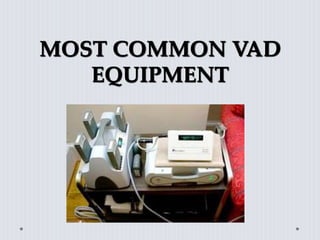
MOST COMMON VAD
EQUIPMENT
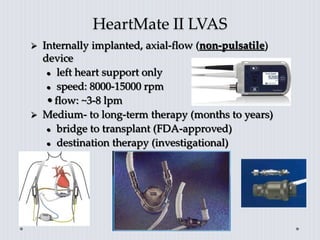
HeartMate II LVAS
 Internally implanted, axial-flow (non-pulsatile)
device
 left heart support only
 speed: 8000-15000 rpm
•flow: ~3-8 lpm
 Medium- to long-term therapy (months to years)
 bridge to transplant (FDA-approved)
 destination therapy (investigational)
VAD ISSUES
Problems And Complications
 Major VAD Complications
 Bleeding
 Thrombosis
 Infection
•sepsis is leading cause of death in long-term
VAD support
 RV dysfunction/failure
 Suckdown (low preload causes a nonpulsatle
VAD to collapse the ventricle)
 Device failure/malfunction (highly variable by
device type)
 Hemolysis (the VAD destroys blood cells)
Problems And Complications
 Other Common Issues
 Arrhythmias
•A patient can be in a lethal arrhythmia and be
asymptomatic. Treat the patient not the monitor.
•Do not cardiovert/ defib. unless the patient is
unstable with the arrhythmia.
•Do not initiate chest compressions unless
instructed by a physician or VAD coordinator.
Chest compressions can disrupt the implanted
equipment causing bleeding and death
•Electrical shock from cardiovert/ defib. will not
damage any of the VAD equipment
Problems And Complications
 Other Common Issues
 Hypertension
•High afterload can limit VAD flow/ output
•Do not administer antihypertensive
medications or nitrates unless instructed
by a physician or VAD Coordinator
 Hypotension/ loss of Preload
•All VADs are preload dependent. A loss or
reduction in preload will compromise
VAD function and limit flow/ output
Problems And Complications
 Other Common Issues
 Depression/ Adjustment Disorders
•Living with a VAD is difficult to
management for a lot of patients.
•A large percentage of patients experience
symptoms of depression
 Portability/ Ergonomics
•The external VAD equipment is heavy and
cumbersome limiting a patient’s mobility
and greatly impacting their quality of life.
Problems And Complications
 Bleeding & Thrombosis
 Careful control of anticoagulation is
imperative
•Patients are often on both anticoagulants
and platelet inhibitors
•Device thrombosis
 Typically revealed by increased power
and signs and symptoms of hemolysis
Problems And Complications
 Bleeding & Thrombosis Treatment
• Assess for signs and symptoms of
bleeding
• Neuro Assessment to rule out CVA
• Initiate IV therapy and administer
fluid slowly to maintain preload
• Device Thrombus is treated with low
dose lytics and/ or increasing
anticoagulation therapy
Problems And Complications
 Infection
• The leading cause of mortality in VAD
patients
• Higher incidence in pulsatile VADs
• The driveline provides direct access into
the body and into the blood stream
• Often recurrent and difficult to treat
Problems And Complications
 Suckdown
 LV collapse due to
hypovolemia/hypotension or VAD
overdrive
 Indicators: hypotension, PVCs/VT,
low VAD flows.
Problems And Complications
 Treating Suckdown
• Initiate a peripheral IV and slowly
give volume to increase preload
• Assess for signs and symptoms of
bleeding and sepsis
Problems And Complications
 Device Failure
 This is a true emergency requiring immediate
transport to the implanting VAD center
 Patients & caregivers are trained to
identify signs and symptoms of device
failure
 May require the VAD to be replaced
Problems And Complications
 Hemolysis
 Blood cells are destroyed as they
travel through the VAD
Problems And Complications
 Treating Hemolysis
• Initiate a peripheral IV and slowly
give volume
• If thrombus is suspected to be
causing hemolysis, administer lytics
and anticoagulants as able/ ordered
Alarms
 All VAD devices typically have two
distingue alarms to indicate a problem
and it’s severity
• Advisory Alarms
• Critical/ Hazardous Alarms
Alarms
 Advisory Alarms are intermittent beeping sounds
that have a corresponding YELLOW light that
illuminates on the system controller
• Not critical but the device requires attention
• Likely due to low battery, cable disconnected,
or device not functioning properly.
Alarms
 Hazardous or Critical alarms are a loud,
continuous, shrill sound that have a
corresponding RED light that illuminates on
the system controller
• Indicating the device needs immediate
attention
• Often because the pump has stopped or a
problem is detected with the system
controller
• Most likely intervention required is to
change out the system controller
Field Management
All VADs are dependent on adequate preload in
order to maintain proper functioning
Volume resuscitation in an unstable VAD
patient is the first line of therapy before
vasopressors but be cautious with fluid as to not
over load the right ventricle in L VADs only.
Field Management
Nitrates can be detrimental to a VAD patient
because of the reduction in preload
• Results in decreased pump efficiency
• Consult with medical control before
administering nitrates per protocol
Field Management
Initiate IV therapy with all VAD patients if
possible
• Use aseptic technique due to the
patient’s increased risks of infection
Field Management
VAD patients are susceptible to other injuries
unrelated to the VAD
Contact the VAD Coordinator, they are your
most valuable resource when encountering
these patients
Consult with medical control about transport
Patient Transport
This is emergency, resource and protocol driven decision
making
VAD patients require unique care that not all medical
centers are equipped to handle. Transport to the
implanting center when able or the closest VAD center
Make sure when transporting to bring all VAD related
equipment
Secure VAD batteries and the controller to prevent
dropping or damage. If batteries need to be changed
during transport, change one at a time system will alarm
during battery change but this is normal and will stop.
Make sure to keep all cables tangle and kink free
Pre-Planning For Transport
Medical Control
• Inquire ahead of time the level of knowledge/
comfort with your medical directors regarding the
management of VAD patient
Know Transport Options
• Air vs. Ground
• Know your tertiary facilities and their ability to
management VAD patients
Things To Remember
EMS can walk into just about any situation
Depending on the individuals- the family may not be
able to handle the emergency
Listen to the family members that can handle the
emergency and “assist” them with whatever they need
The only resources/ tools you can truly rely on are the
ones you bring to the call
Follow-up and educate yourself to new technologies
that keep entering into the industry
Things To Remember
Ask for the contact number for the managing
center’s VAD Coordinator as soon as you arrive, this
should be on the person or close by. This is the
coordinator they work very closely with and will be
your best resource
Family, friends, co-workers- listen to them for
direction, they should be educated/ trained to assist
with most VAD related complications
911 activation may not be for a VAD related
emergency
Things To Remember
Emergency bag containing back-up VAD supplies
needs to stay with the patient at all times. Should
contain extra batteries and the spare system
controller
Ask the family for any trouble shooting guidelines
that maybe available. This often includes various
alarms and interventions
Remember that the family/ friends are not
emergency responders or maybe too upset to assist
you
If a VAD patient calls 911 it will not be for
something simple like a battery change. VAD related
emergencies are serious life threatening events
Additional resources materials and
information please visit:
www.thoratec.com
www.jarvikheart.com
www.umm.edu/heart/index.htm
THANK YOU FOR YOUR
TIME !!!!

Vad presentatioin

  • 1.
    The In and Outs OfThe Ventricular Assist Device By: Nicholas Todd
  • 2.
    Objectives • Define VentricleAssist Device • Identify hemodynamic differences in patients with a VAD • List VAD related complication • Demonstrate how to assess a patient with a VAD • Describe how to treat VAD complications • Identify VAD resources that can be utilized when caring for these patients
  • 3.
    What is aVAD? • A left ventricular assist device (LVAD) is a pump that is used for patients who have reached end-stage heart failure or awaiting a heart transplant. The LVAD’s are surgically implanted and are attached to the left ventricle and aorta. The LVAD is a battery-operated, mechanical pump, which then helps the left ventricle pump blood to the rest of the body.
  • 4.
    Ventricular Assist Device(VAD) • A mechanical pump that is surgically attached to one of the heart’s ventricles to augment or replace native ventricular function • Can be used for the left (LVAD), right (RVAD), or both ventricles (BiVAD) • Are powered by external power sources that connect to the implanted pump via a percutaneous lead (driveline) that exits the body on the right abdomen • Pump output flow will be non-pulsatile
  • 5.
    Indications for VAD Bridge to transplant (BTT) • Most common • Allow rehab from severe CHF while awaiting a donor heart  “Destination” therapy (DT) • Permanent device, instead of transplant • Currently only in transplant-ineligible patients  Bridge to recovery (BTR) • Unload heart, allow “reverse remodeling” • Can be short term or long term  Bridge to candidacy (BTC)/ Bridge to decision (BTD) • When eligibility unclear at implant • Not true “indication” but for many pts
  • 6.
    VAD Setup  Continuous-flowdevices • Impeller (spinning turbine-like rotor blade) propels blood continuously forward into systemic circulation. • Axial flow: blood leaves impeller blades in the same direction as it enters (think fan or boat motor propeller).  Most implanted devices are LVADs only  LVAD’s are quite and cannot be heard outside of the patient’s body. Assess VAD status by auscultation over the apex of the LV. The VAD should have a continuous, smooth humming sound.  The Patient may have a weak, irregular, or non-palpable pulse  The Patient may have a narrow pulse pressure and may not be measurable with automated blood pressure monitors. This is due to the continuous forward outflow from the VAD. Recommended use of a Doppler and a manual B/P cuff to obtain B/P.  The Mean Arterial Pressure is the key in monitoring hemodynamics. Ideal range is 65-90 mmHg.
  • 7.
    VAD Key Parameters Flow: • Measured in liters per minute • Correlates with pump speed (speed=flow, ↓speed=↓flow) • Dependent on Preload and Afterload  Speed: • How fast the impeller of the internal pump spins • Measured in revolutions per minute (rpm) • Flow speed is set and determined by VAD clinical team and usually cannot be manipulated outside of the hospital
  • 8.
    VAD Key Parameters Power: • The amount of power the VAD consumes to continually run at a set speed • Sudden or gradual sustained increases in the power can indicate thrombus inside the VAD  Pulsatility Index (PI): • A measure of the pressure differential inside the internal VAD pump during the native heart’s cardiac cycle • Varies by patient • Indicates volume status, right ventricle function, and native heart contractility
  • 9.
    VAD Key Parameters The device parameters are displayed numerically on the VAD console or controller  Will vary with each individual patient a VAD device
  • 10.
    VAD Parameters Parameters forVAD devices vary with each device model Patients and their care givers know the expectable parameter ranges and goals for their specific device Contact the VAD Coordinator at the implanting medical center, they will be your best resource when treating a VAD patient.
  • 11.
    Basic VAD Management VADs are:  Preload-dependent  EKG-independent  Afterload-sensitive  Anticoagulated  Prone to: • infection • bleeding • thrombosis/stroke •mechanical malfunction
  • 12.
  • 13.
    HeartMate II LVAS Internally implanted, axial-flow (non-pulsatile) device  left heart support only  speed: 8000-15000 rpm •flow: ~3-8 lpm  Medium- to long-term therapy (months to years)  bridge to transplant (FDA-approved)  destination therapy (investigational)
  • 14.
  • 15.
    Problems And Complications Major VAD Complications  Bleeding  Thrombosis  Infection •sepsis is leading cause of death in long-term VAD support  RV dysfunction/failure  Suckdown (low preload causes a nonpulsatle VAD to collapse the ventricle)  Device failure/malfunction (highly variable by device type)  Hemolysis (the VAD destroys blood cells)
  • 16.
    Problems And Complications Other Common Issues  Arrhythmias •A patient can be in a lethal arrhythmia and be asymptomatic. Treat the patient not the monitor. •Do not cardiovert/ defib. unless the patient is unstable with the arrhythmia. •Do not initiate chest compressions unless instructed by a physician or VAD coordinator. Chest compressions can disrupt the implanted equipment causing bleeding and death •Electrical shock from cardiovert/ defib. will not damage any of the VAD equipment
  • 17.
    Problems And Complications Other Common Issues  Hypertension •High afterload can limit VAD flow/ output •Do not administer antihypertensive medications or nitrates unless instructed by a physician or VAD Coordinator  Hypotension/ loss of Preload •All VADs are preload dependent. A loss or reduction in preload will compromise VAD function and limit flow/ output
  • 18.
    Problems And Complications Other Common Issues  Depression/ Adjustment Disorders •Living with a VAD is difficult to management for a lot of patients. •A large percentage of patients experience symptoms of depression  Portability/ Ergonomics •The external VAD equipment is heavy and cumbersome limiting a patient’s mobility and greatly impacting their quality of life.
  • 19.
    Problems And Complications Bleeding & Thrombosis  Careful control of anticoagulation is imperative •Patients are often on both anticoagulants and platelet inhibitors •Device thrombosis  Typically revealed by increased power and signs and symptoms of hemolysis
  • 20.
    Problems And Complications Bleeding & Thrombosis Treatment • Assess for signs and symptoms of bleeding • Neuro Assessment to rule out CVA • Initiate IV therapy and administer fluid slowly to maintain preload • Device Thrombus is treated with low dose lytics and/ or increasing anticoagulation therapy
  • 21.
    Problems And Complications Infection • The leading cause of mortality in VAD patients • Higher incidence in pulsatile VADs • The driveline provides direct access into the body and into the blood stream • Often recurrent and difficult to treat
  • 22.
    Problems And Complications Suckdown  LV collapse due to hypovolemia/hypotension or VAD overdrive  Indicators: hypotension, PVCs/VT, low VAD flows.
  • 23.
    Problems And Complications Treating Suckdown • Initiate a peripheral IV and slowly give volume to increase preload • Assess for signs and symptoms of bleeding and sepsis
  • 24.
    Problems And Complications Device Failure  This is a true emergency requiring immediate transport to the implanting VAD center  Patients & caregivers are trained to identify signs and symptoms of device failure  May require the VAD to be replaced
  • 25.
    Problems And Complications Hemolysis  Blood cells are destroyed as they travel through the VAD
  • 26.
    Problems And Complications Treating Hemolysis • Initiate a peripheral IV and slowly give volume • If thrombus is suspected to be causing hemolysis, administer lytics and anticoagulants as able/ ordered
  • 27.
    Alarms  All VADdevices typically have two distingue alarms to indicate a problem and it’s severity • Advisory Alarms • Critical/ Hazardous Alarms
  • 28.
    Alarms  Advisory Alarmsare intermittent beeping sounds that have a corresponding YELLOW light that illuminates on the system controller • Not critical but the device requires attention • Likely due to low battery, cable disconnected, or device not functioning properly.
  • 29.
    Alarms  Hazardous orCritical alarms are a loud, continuous, shrill sound that have a corresponding RED light that illuminates on the system controller • Indicating the device needs immediate attention • Often because the pump has stopped or a problem is detected with the system controller • Most likely intervention required is to change out the system controller
  • 30.
    Field Management All VADsare dependent on adequate preload in order to maintain proper functioning Volume resuscitation in an unstable VAD patient is the first line of therapy before vasopressors but be cautious with fluid as to not over load the right ventricle in L VADs only.
  • 31.
    Field Management Nitrates canbe detrimental to a VAD patient because of the reduction in preload • Results in decreased pump efficiency • Consult with medical control before administering nitrates per protocol
  • 32.
    Field Management Initiate IVtherapy with all VAD patients if possible • Use aseptic technique due to the patient’s increased risks of infection
  • 33.
    Field Management VAD patientsare susceptible to other injuries unrelated to the VAD Contact the VAD Coordinator, they are your most valuable resource when encountering these patients Consult with medical control about transport
  • 34.
    Patient Transport This isemergency, resource and protocol driven decision making VAD patients require unique care that not all medical centers are equipped to handle. Transport to the implanting center when able or the closest VAD center Make sure when transporting to bring all VAD related equipment Secure VAD batteries and the controller to prevent dropping or damage. If batteries need to be changed during transport, change one at a time system will alarm during battery change but this is normal and will stop. Make sure to keep all cables tangle and kink free
  • 35.
    Pre-Planning For Transport MedicalControl • Inquire ahead of time the level of knowledge/ comfort with your medical directors regarding the management of VAD patient Know Transport Options • Air vs. Ground • Know your tertiary facilities and their ability to management VAD patients
  • 36.
    Things To Remember EMScan walk into just about any situation Depending on the individuals- the family may not be able to handle the emergency Listen to the family members that can handle the emergency and “assist” them with whatever they need The only resources/ tools you can truly rely on are the ones you bring to the call Follow-up and educate yourself to new technologies that keep entering into the industry
  • 37.
    Things To Remember Askfor the contact number for the managing center’s VAD Coordinator as soon as you arrive, this should be on the person or close by. This is the coordinator they work very closely with and will be your best resource Family, friends, co-workers- listen to them for direction, they should be educated/ trained to assist with most VAD related complications 911 activation may not be for a VAD related emergency
  • 38.
    Things To Remember Emergencybag containing back-up VAD supplies needs to stay with the patient at all times. Should contain extra batteries and the spare system controller Ask the family for any trouble shooting guidelines that maybe available. This often includes various alarms and interventions Remember that the family/ friends are not emergency responders or maybe too upset to assist you If a VAD patient calls 911 it will not be for something simple like a battery change. VAD related emergencies are serious life threatening events
  • 39.
    Additional resources materialsand information please visit: www.thoratec.com www.jarvikheart.com www.umm.edu/heart/index.htm
  • 40.
    THANK YOU FORYOUR TIME !!!!