Dr. Isman Firdaus, SpJP(K), FIHA, FESC, FAPSIC,FSCAI
Email: ismanf@yahoo.com
Position and Organization :
• Critical care and Interventional Cardiologist Consultant National Cardiovascular Center,
Harapan Kita Hospital
• Executive Board Member of Indonesian Heart Association (IHA)
• Excutive Board Member of WG Acute Cardiac Care-IHA
• Member of Acute Cardiac Care Association-European Society of Cardiology (ACCA-ESC).
• Member of European Association of Percutaneous Coronary Intervention (EAPCI-ESC)
• Member of European Rescucitation Council (ERC)
• Fellow of European Society of Cardiology (FESC)
• Fellows of Asia Pacific Society of Interventional Cardiologist (FAPSIC)
• Fellow of Society Catheterization Angiography and Intervention (FSCAI)
• Asia Pacific advisory board of Heart Failure
Pekerjaan :
• Staf Pengajar Departemen Kardiologi Fakultas Kedokteran UI
• Cardiovascular intensivist-intervensionist consultant RS Jantung Harapan Kita
Curricullum Vitae
Intra Aortic Balloon Pump:
Basic Principle
Isman Firdaus, MD, FIHA, FAPSIC, FESC, FSCAI
National Cardiovascular Center Harapan Kita
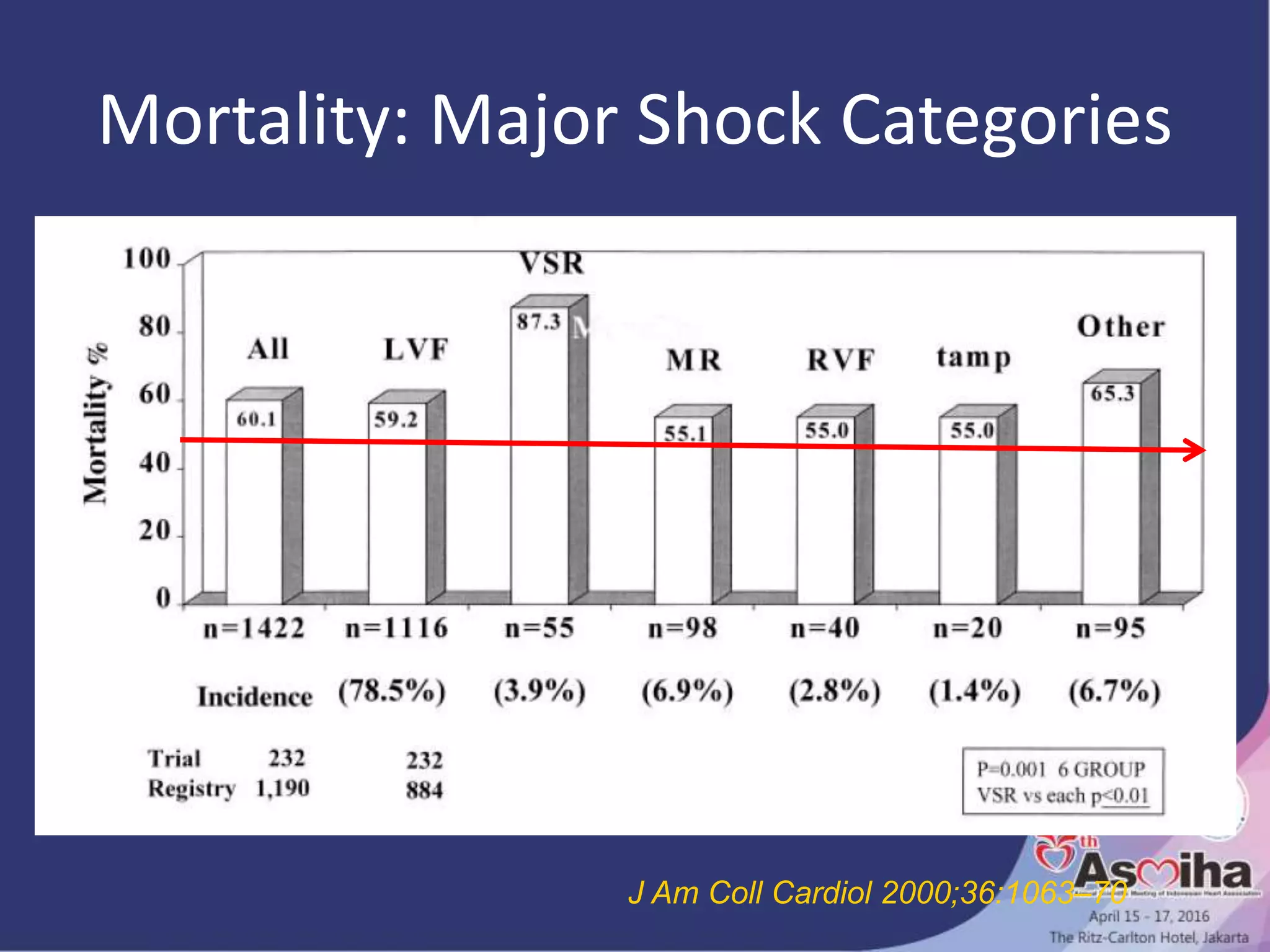
Mortality: Major Shock Categories
J Am Coll Cardiol 2000;36:1063–70
Intra-aortic Balloon Pump
(IABP)
• IABP first successfully used by Kantrowitz et al. in
1967
• Able to reverse pharmacologically refractory Post MI
cardiogenic shock using this technique
• Kantrowitz et al. Initial clinical experience with
intraaortic balloon pumping in cardiogenic shock.
JAMA 203:135, 1968
Basics of Cardiac Physiology
• Determinants of myocardial O2 delivery
• Determinants of myocardial O2 consumption
• Determinants of Cardiac Output
• Windkessel Effect
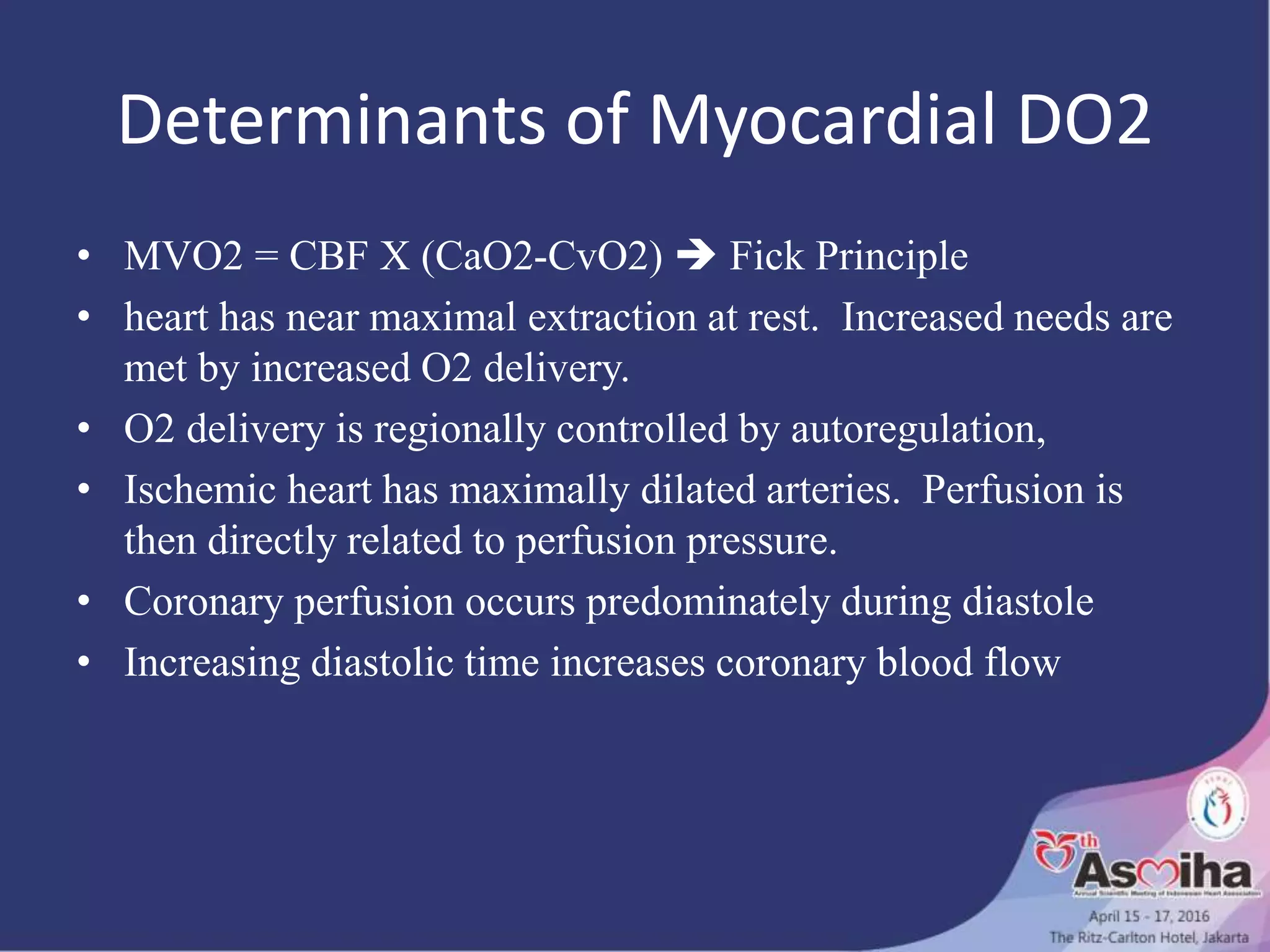
Determinants of Myocardial DO2
• MVO2 = CBF X (CaO2-CvO2)  Fick Principle
• heart has near maximal extraction at rest. Increased needs are
met by increased O2 delivery.
• O2 delivery is regionally controlled by autoregulation,
• Ischemic heart has maximally dilated arteries. Perfusion is
then directly related to perfusion pressure.
• Coronary perfusion occurs predominately during diastole
• Increasing diastolic time increases coronary blood flow
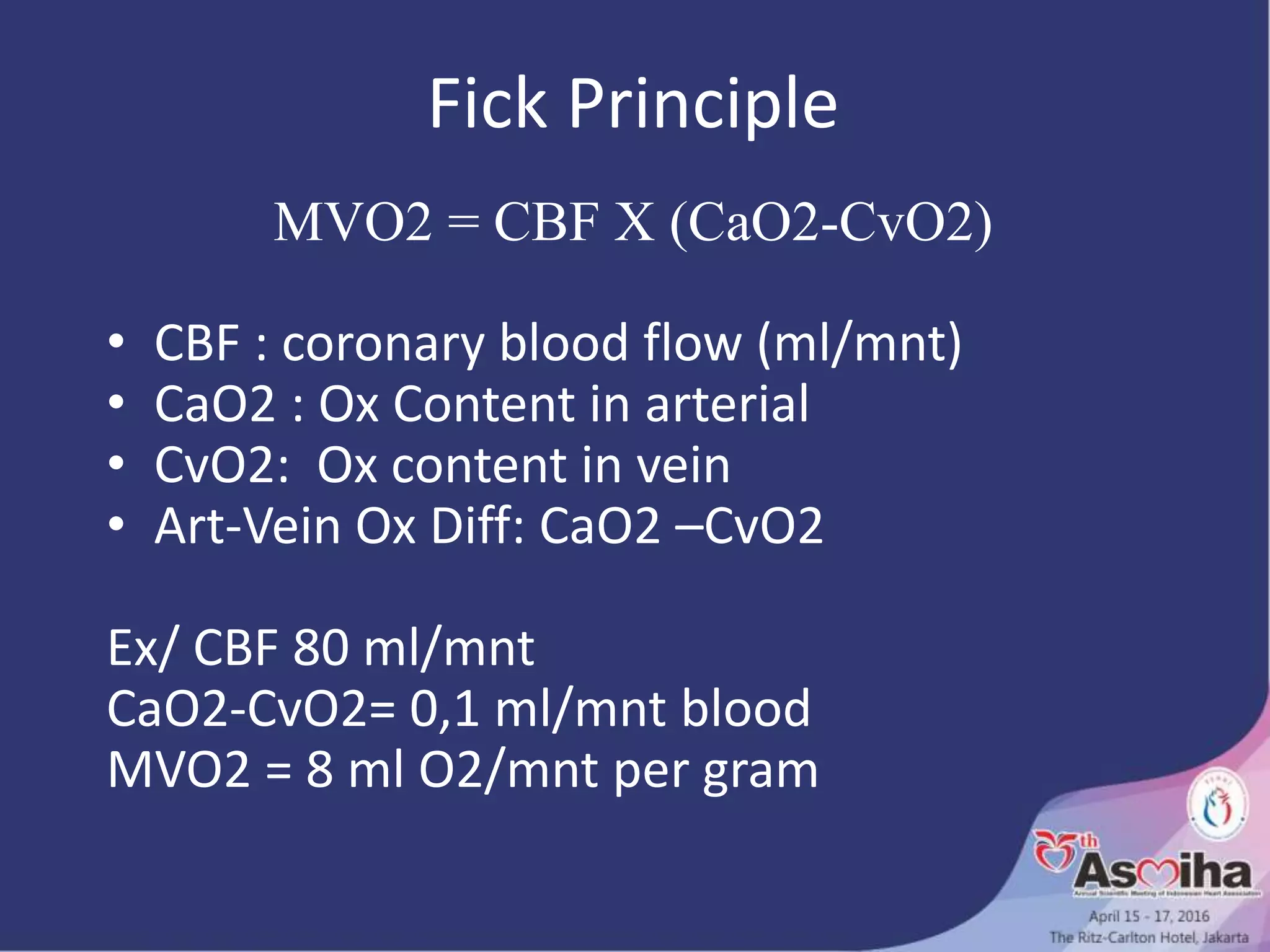
Fick Principle
MVO2 = CBF X (CaO2-CvO2)
• CBF : coronary blood flow (ml/mnt)
• CaO2 : Ox Content in arterial
• CvO2: Ox content in vein
• Art-Vein Ox Diff: CaO2 –CvO2
Ex/ CBF 80 ml/mnt
CaO2-CvO2= 0,1 ml/mnt blood
MVO2 = 8 ml O2/mnt per gram
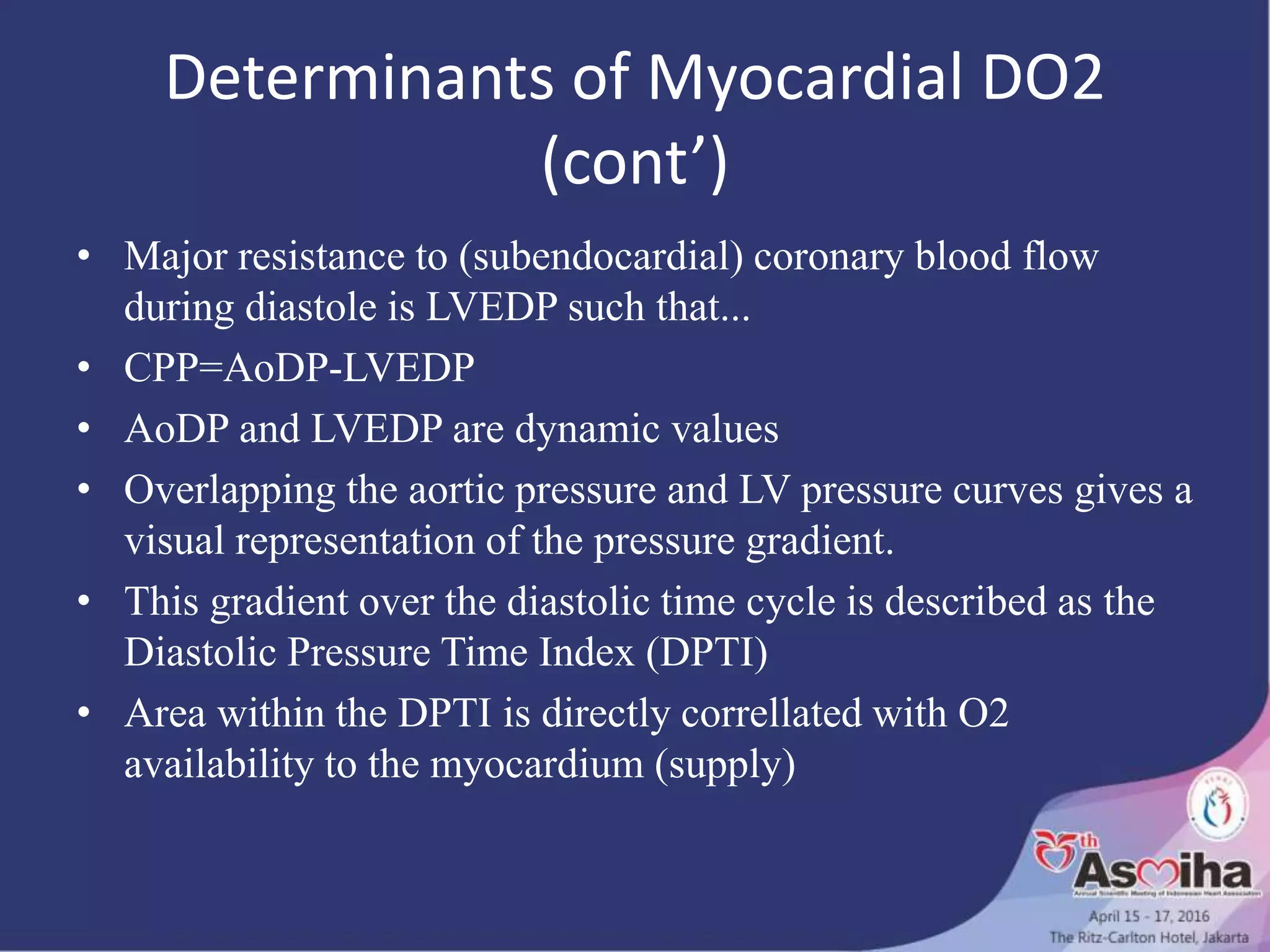
Determinants of Myocardial DO2
(cont’)
• Major resistance to (subendocardial) coronary blood flow
during diastole is LVEDP such that...
• CPP=AoDP-LVEDP
• AoDP and LVEDP are dynamic values
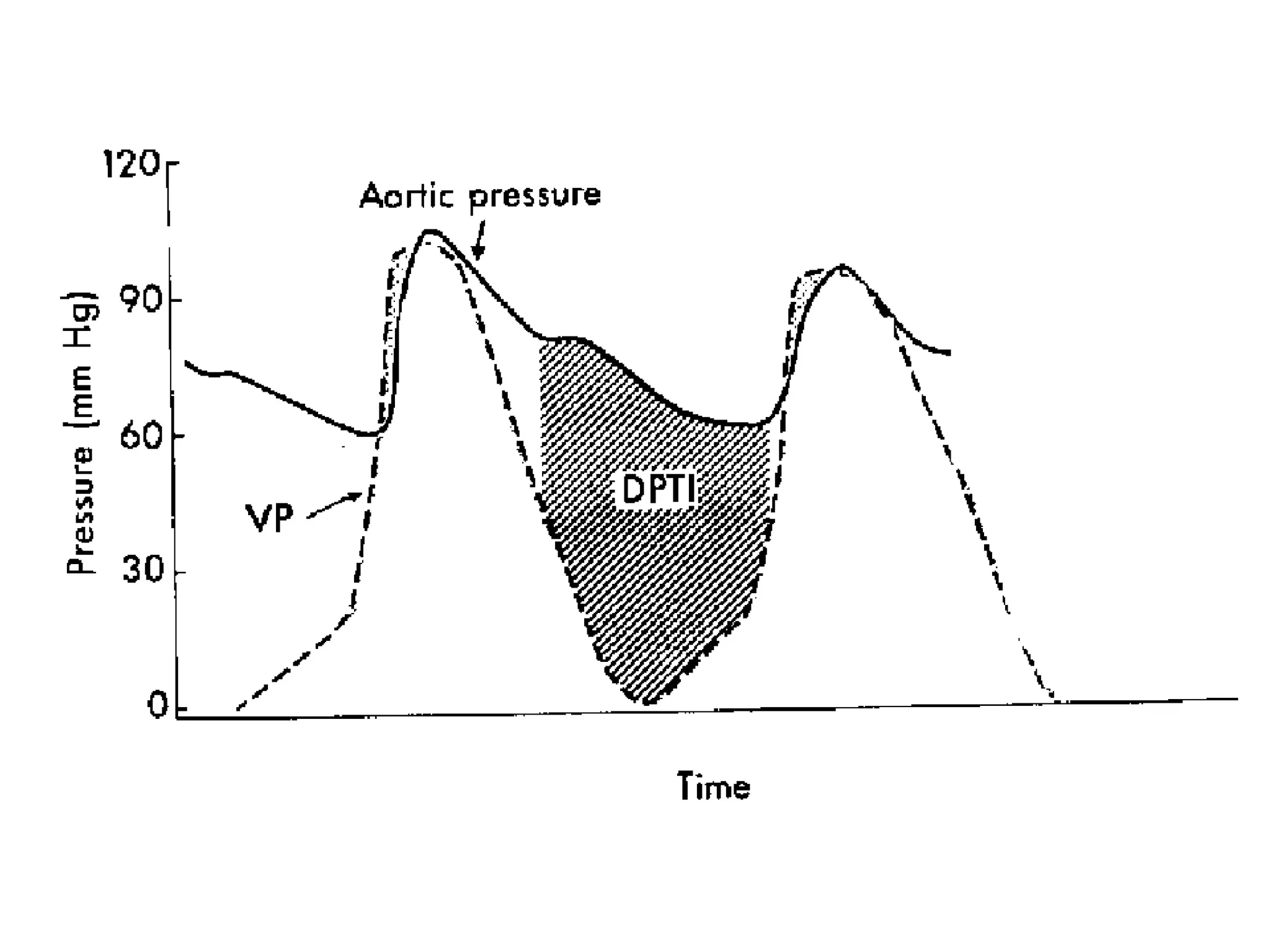
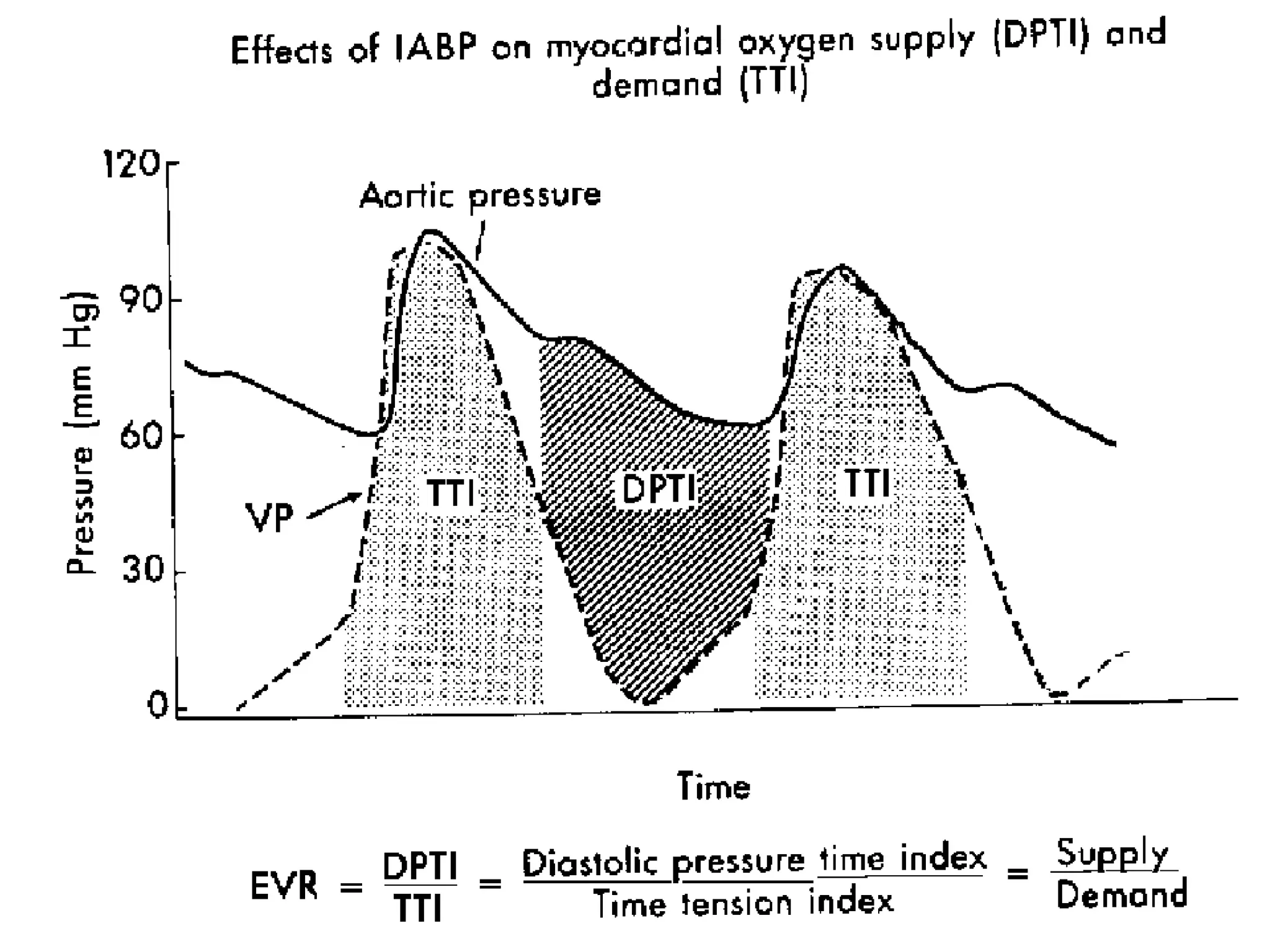
• Overlapping the aortic pressure and LV pressure curves gives a
visual representation of the pressure gradient.
• This gradient over the diastolic time cycle is described as the
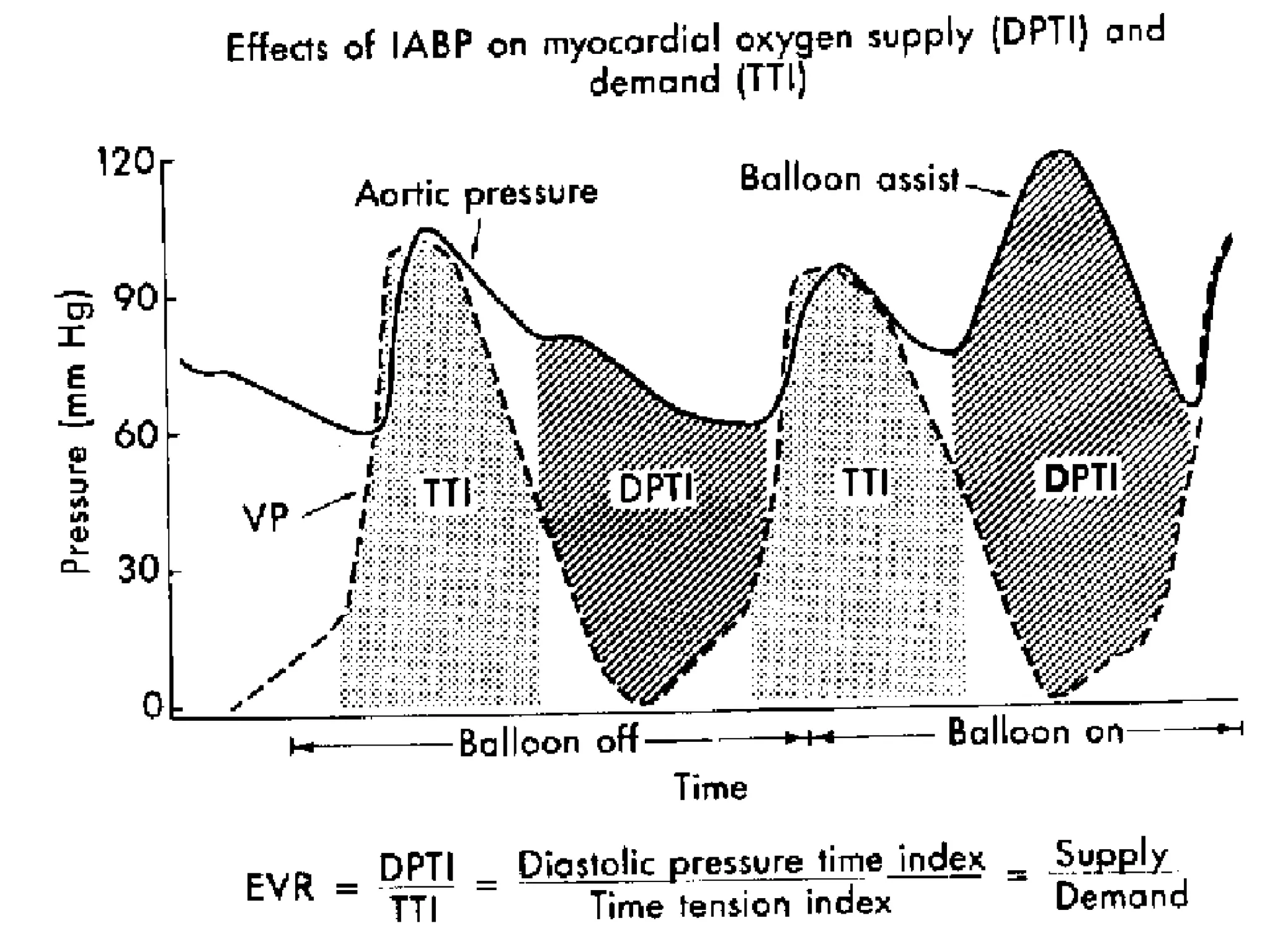
Diastolic Pressure Time Index (DPTI)
• Area within the DPTI is directly correllated with O2
availability to the myocardium (supply)
Determinants of MVO2
• HR, contractility, wall tension (50% of MVO2 at rest).
• Laplace’s law T=Pr/2h
• Intraventricular pressure is a modifiable variable.
• IVP greatest during systole (LVSP).
• LVSP is a dynamic value continually changing throughout
systole and altering wall tension as this occurs.
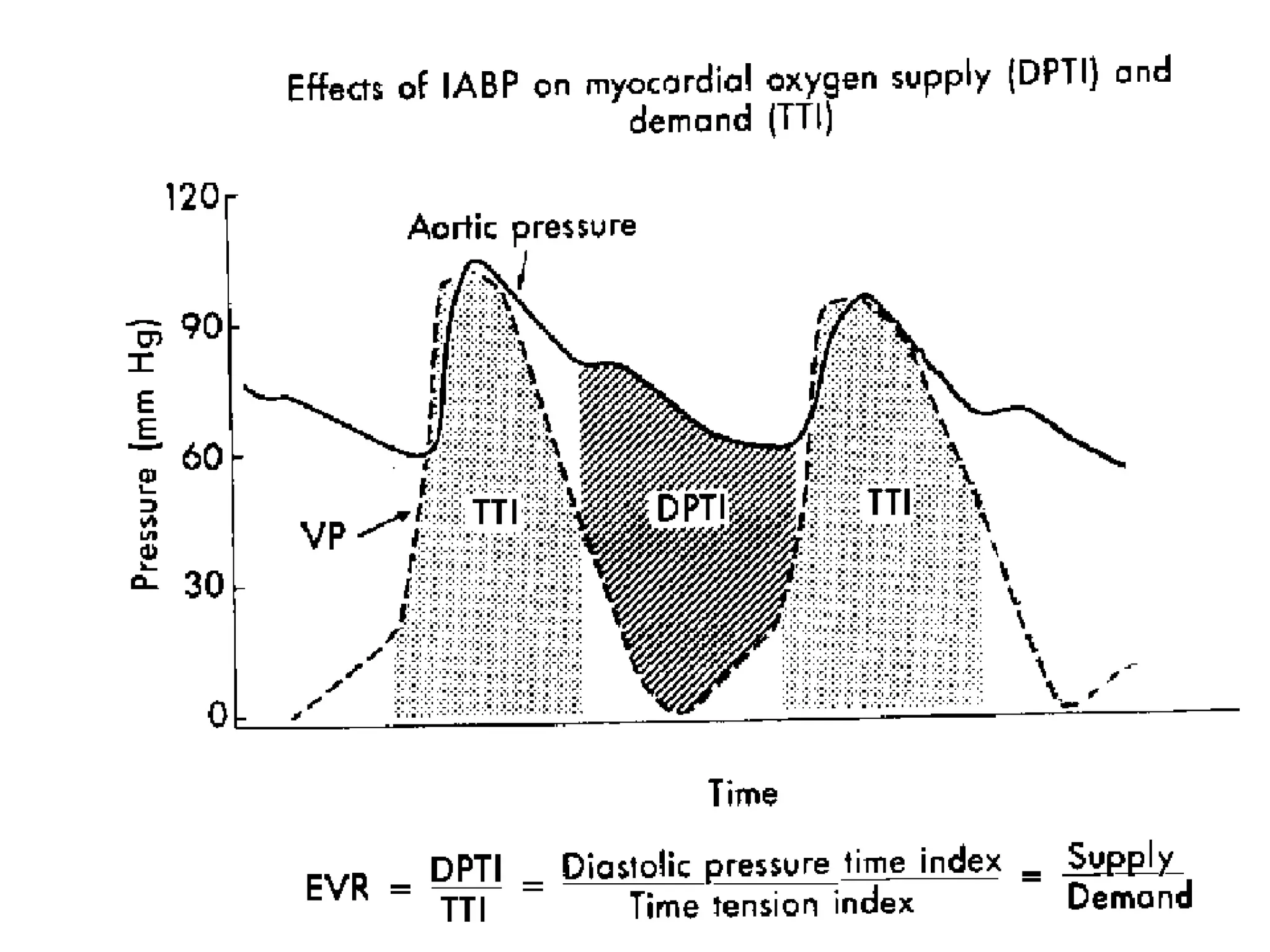
• Area under the LVSP tracing is represented by the Tension
Time Index (TTI) and is directly correllated to wall tension
and MVO2.
Determinants of MVO2
(cont’)
• Increasing systole time (HR) or peak LV systolic pressure
increases the TTI and subsequently MVO2
• Conversely, lowering the AoEDP (decreased afterload)
decreases the pressure the LV must overcome to eject blood
and lowers the TTI
• The Endocardial Viability Ratio relates the relationship
between myocardial O2 supply and demand and is defined by
EVR=DPTI/TTI (supply/demand).
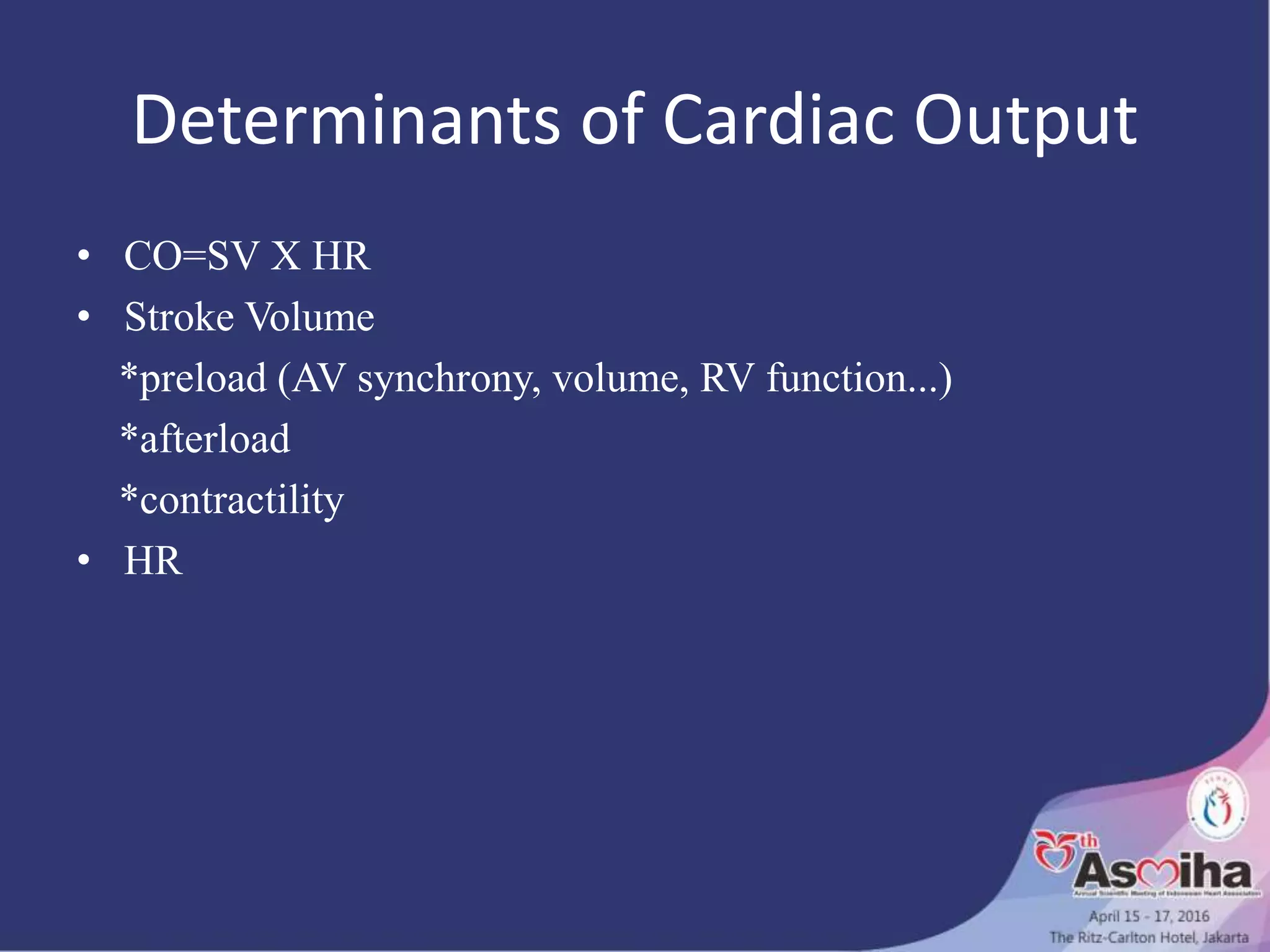
Determinants of Cardiac Output
• CO=SV X HR
• Stroke Volume
*preload (AV synchrony, volume, RV function...)
*afterload
*contractility
• HR
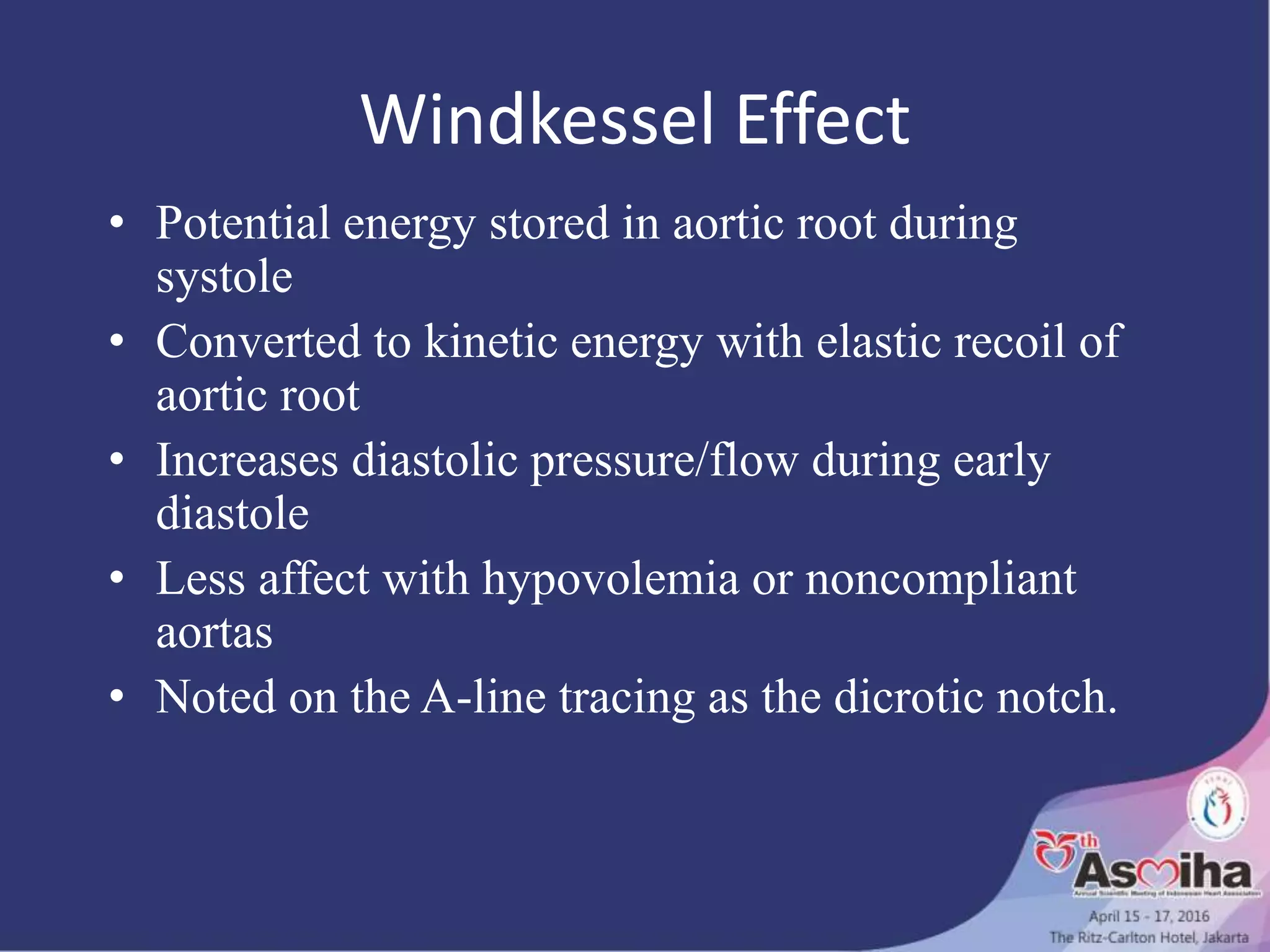
Windkessel Effect
• Potential energy stored in aortic root during
systole
• Converted to kinetic energy with elastic recoil of
aortic root
• Increases diastolic pressure/flow during early
diastole
• Less affect with hypovolemia or noncompliant
aortas
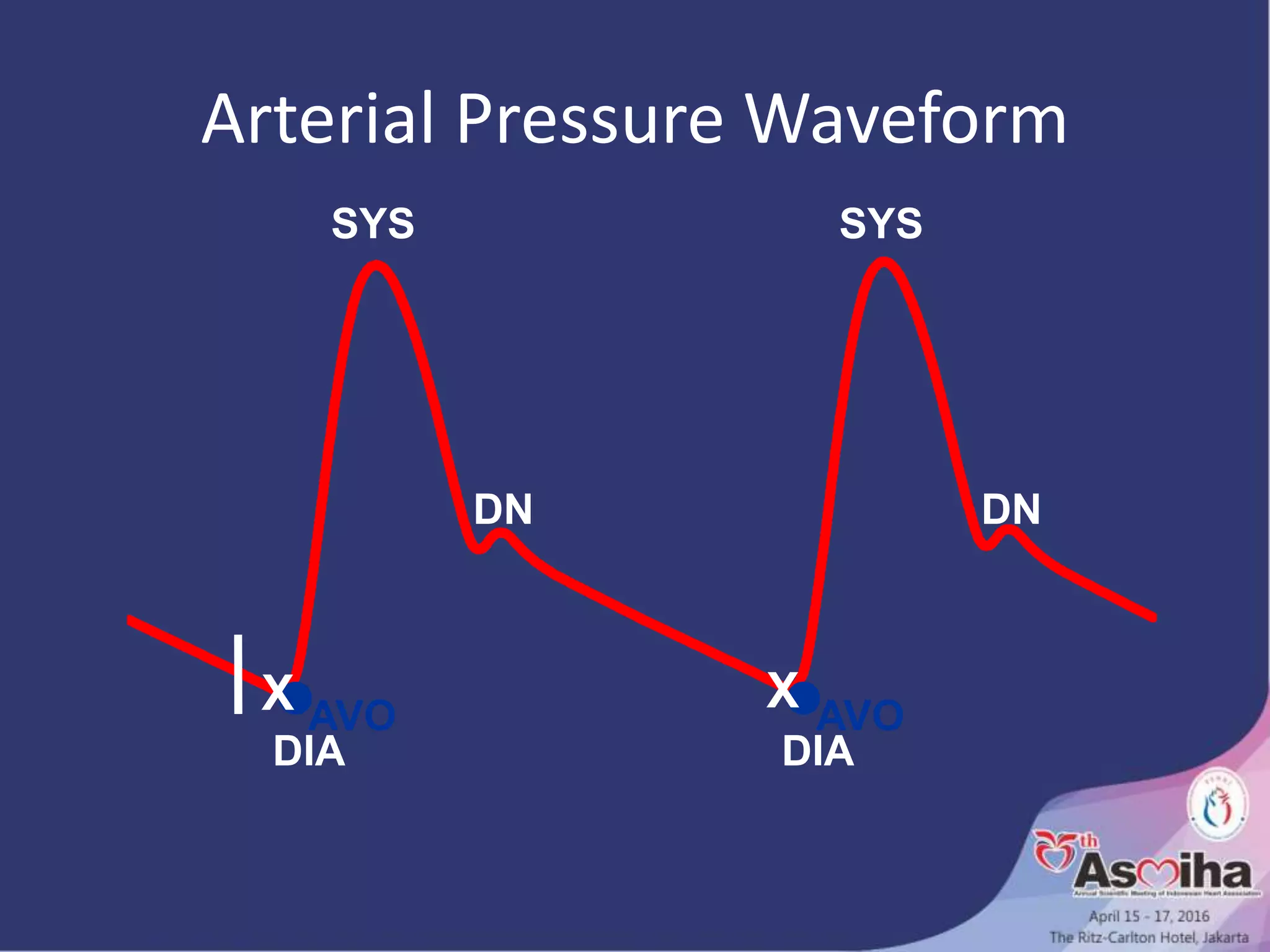
• Noted on the A-line tracing as the dicrotic notch.
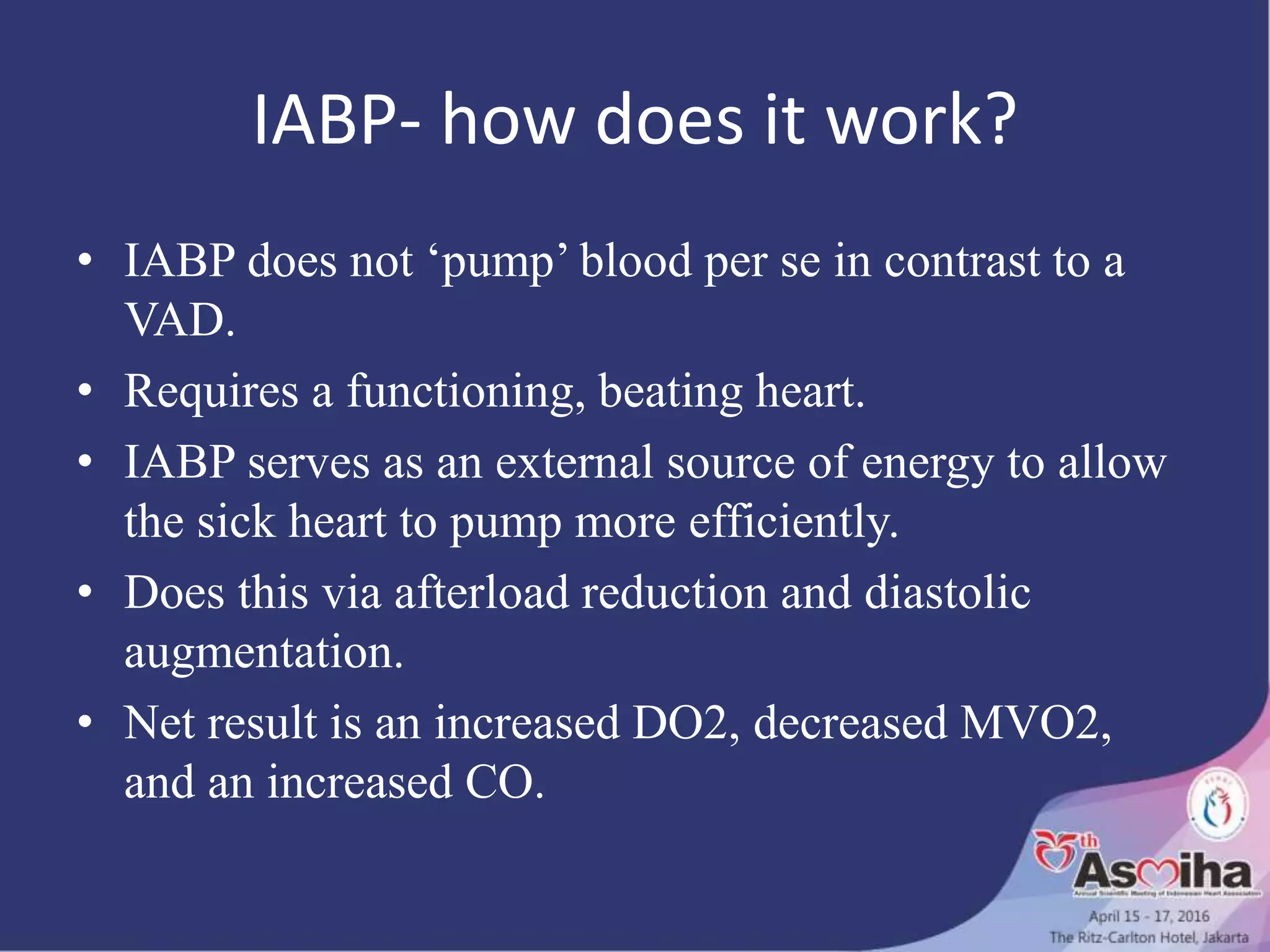
IABP- how does it work?
• IABP does not ‘pump’ blood per se in contrast to a
VAD.
• Requires a functioning, beating heart.
• IABP serves as an external source of energy to allow
the sick heart to pump more efficiently.
• Does this via afterload reduction and diastolic
augmentation.
• Net result is an increased DO2, decreased MVO2,
and an increased CO.
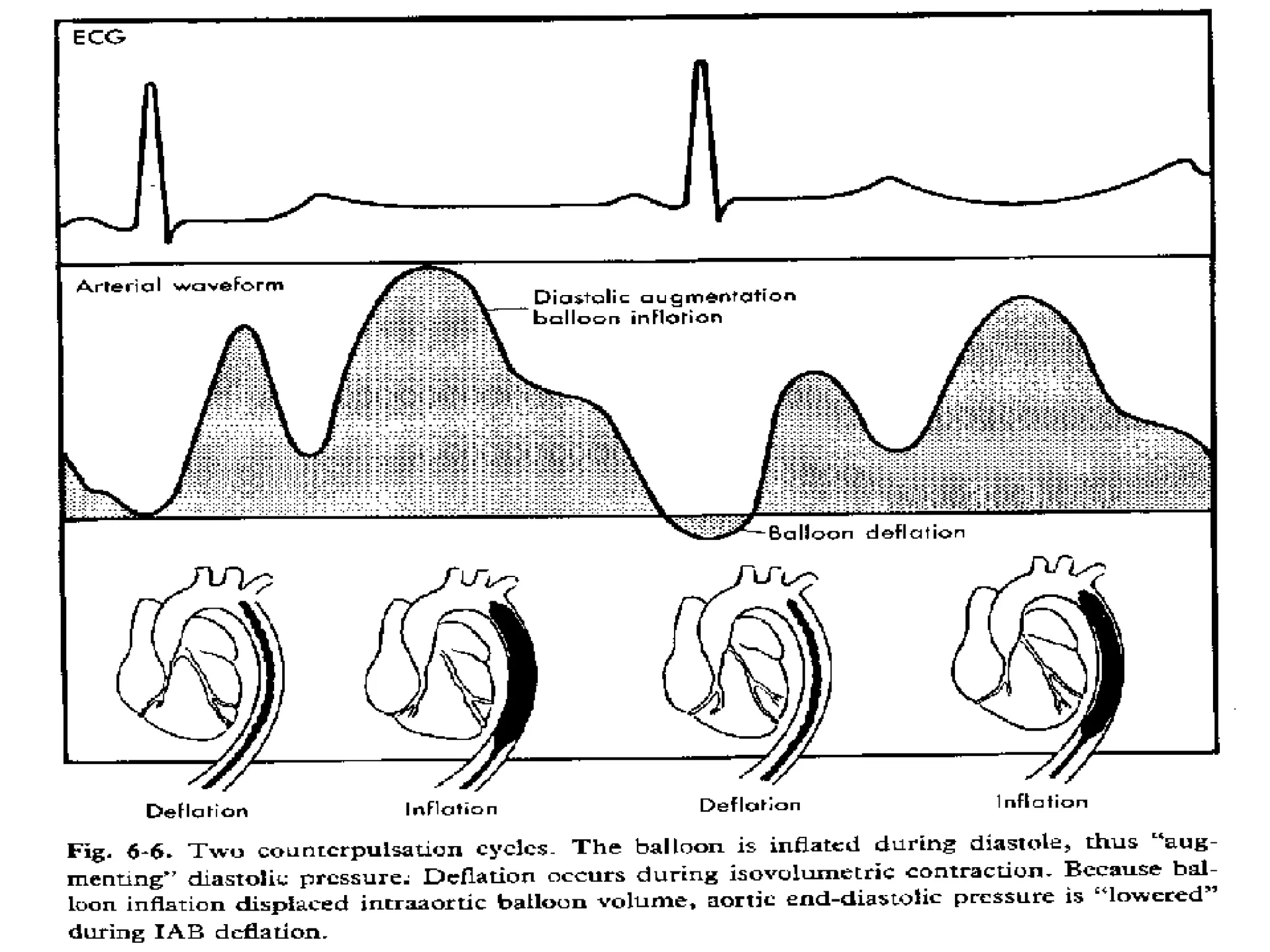
Concepts of Counterpulsation
• The balloon is phasically pulsed in counterpulsation
to the patient’s cardiac cycle (IABC)
• IABP has no ‘inotropic’ action; does not directly
increase contractility.
• Primarily benefits the left ventricle, although the
diastolic augmentation may improve coronary flow to
both ventricals.
Components
• Double lumen catheter with a distal sausage shaped non-
thrombogenic polyurethane balloon with standard 30-40cc
displacement volumes.
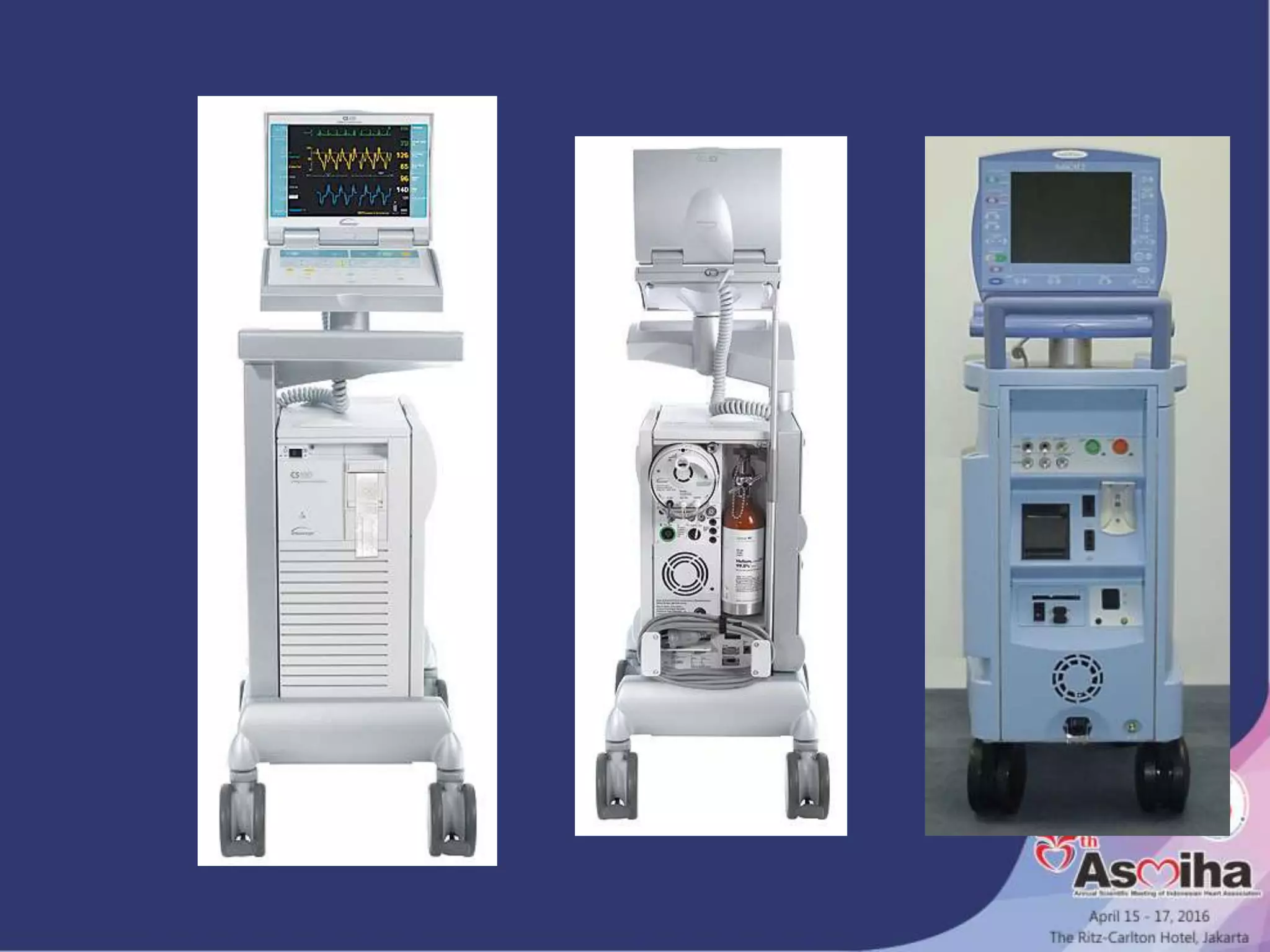
• Pump, equipped with a console display to view the ECG,
aortic and balloon pressure waveforms.
• Central lumen extends to the catheter tip. Serves as a
transducer to measure aortic pressure.
• Central lumen is concentric with and situated inside the helium
channel which is used for balloon inflation.
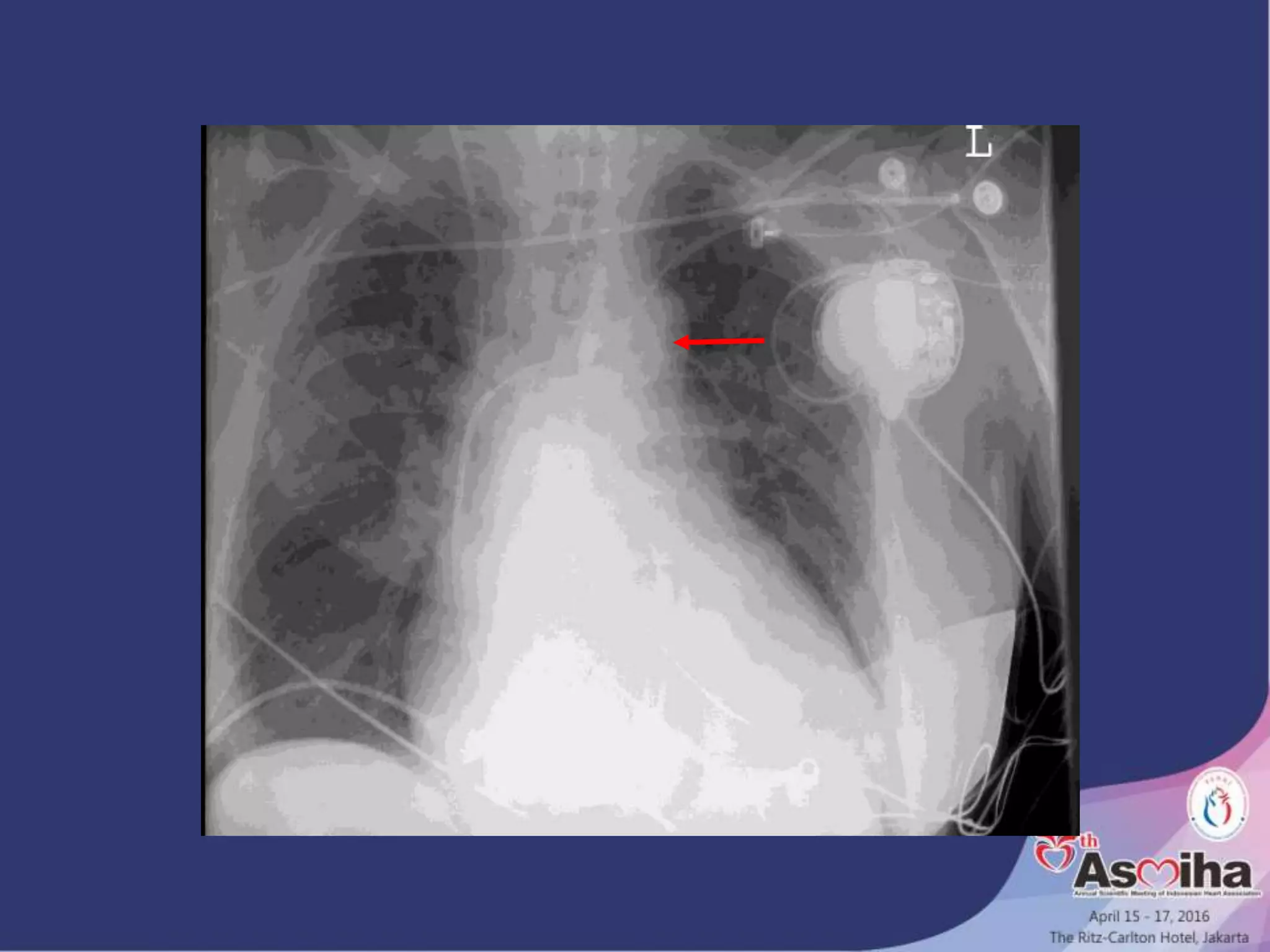
Placement
• Placed percutaneously or surgically with or without a sheath
via the femoral artery.
• Advanced into aorta under flouroscopy until the tip is about
1cm distal to the origin of the left subclavian a.
• Cathater locations more proximal than this compromise flow
to the vessels of the aortic arch.
• More distal locations attenuate the hemodynamic benefits of
the IABP and can potentially compromise renal blood flow.
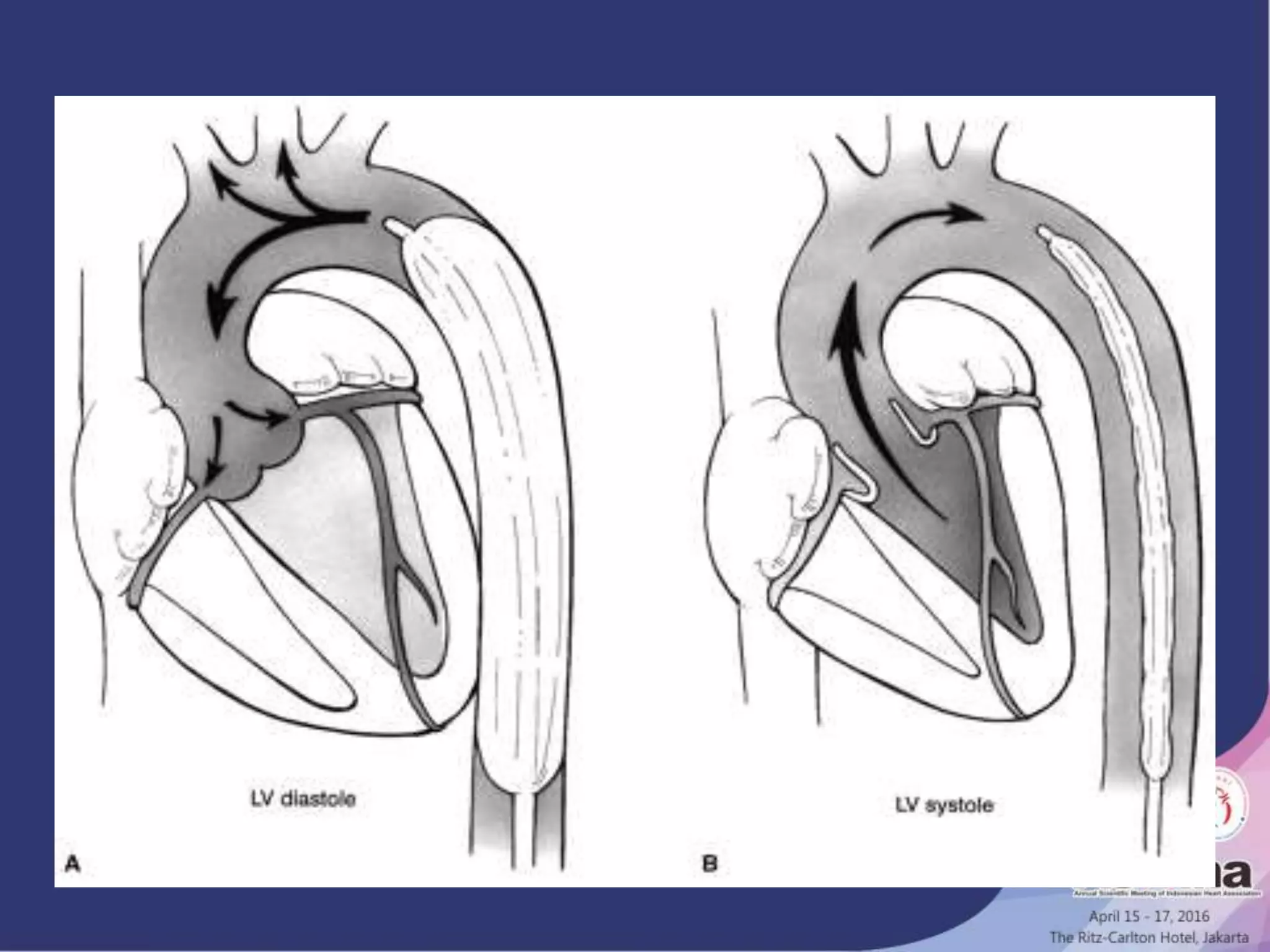
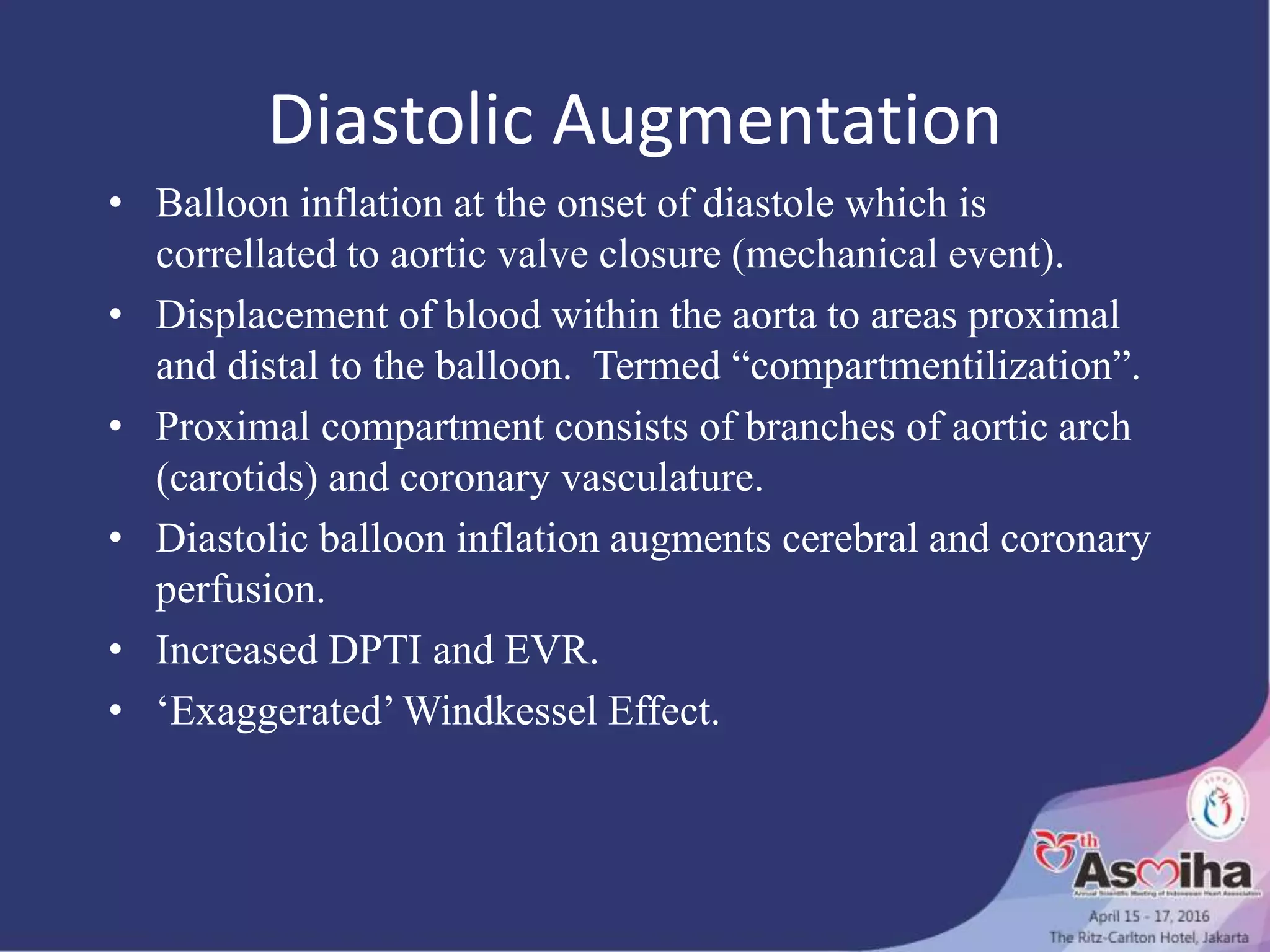
Diastolic Augmentation
• Balloon inflation at the onset of diastole which is
correllated to aortic valve closure (mechanical event).
• Displacement of blood within the aorta to areas proximal
and distal to the balloon. Termed “compartmentilization”.
• Proximal compartment consists of branches of aortic arch
(carotids) and coronary vasculature.
• Diastolic balloon inflation augments cerebral and coronary
perfusion.
• Increased DPTI and EVR.
• ‘Exaggerated’ Windkessel Effect.
Afterload Reduction
• Optimal balloon deflation occurs just prior to the opening
of the aortic valve; during early isovolemic contraction.
• Abruptly decreases intraaortic volume
• AoEDP is acutely decreased (afterload reduction).
• AoV opens sooner during cardiac cycle lending more time
for ventricular ejection
• Overall result is a larger SV (CO).
• A lower peak LVSP decreases the TTI which leads to a
decrease MVO2 and an icrease in the EVR.
Determinants of IABP efficiency
• Ideal balloon volume causes maximal emptying of LV without
causing retrograde flow from the coronary vasculature and
vessels of the aortic arch.
• Balloon should occlude 75-90% of the aortic cross-sectional
area during inflation.
• CO2 vs Helium
• Efficiency if IABC is critically dependent on the timing of
both inflation and deflation.
• Improper timing can worsen a patient’s condition.
IABP Timing
• IABP requires a trigger to determine systole and diastole.
• ECG or arterial waveform.
• ECG directly from the patient to the pump or the pump can
slave off the bedside monitor.
• T-wave default. Electrical index of diastole. Deflation occurs
prior to the next QRS (during PR interval).
• Timing is manually fine-tuned according to the aortic pressure
waveform (more representative of mechanical events).
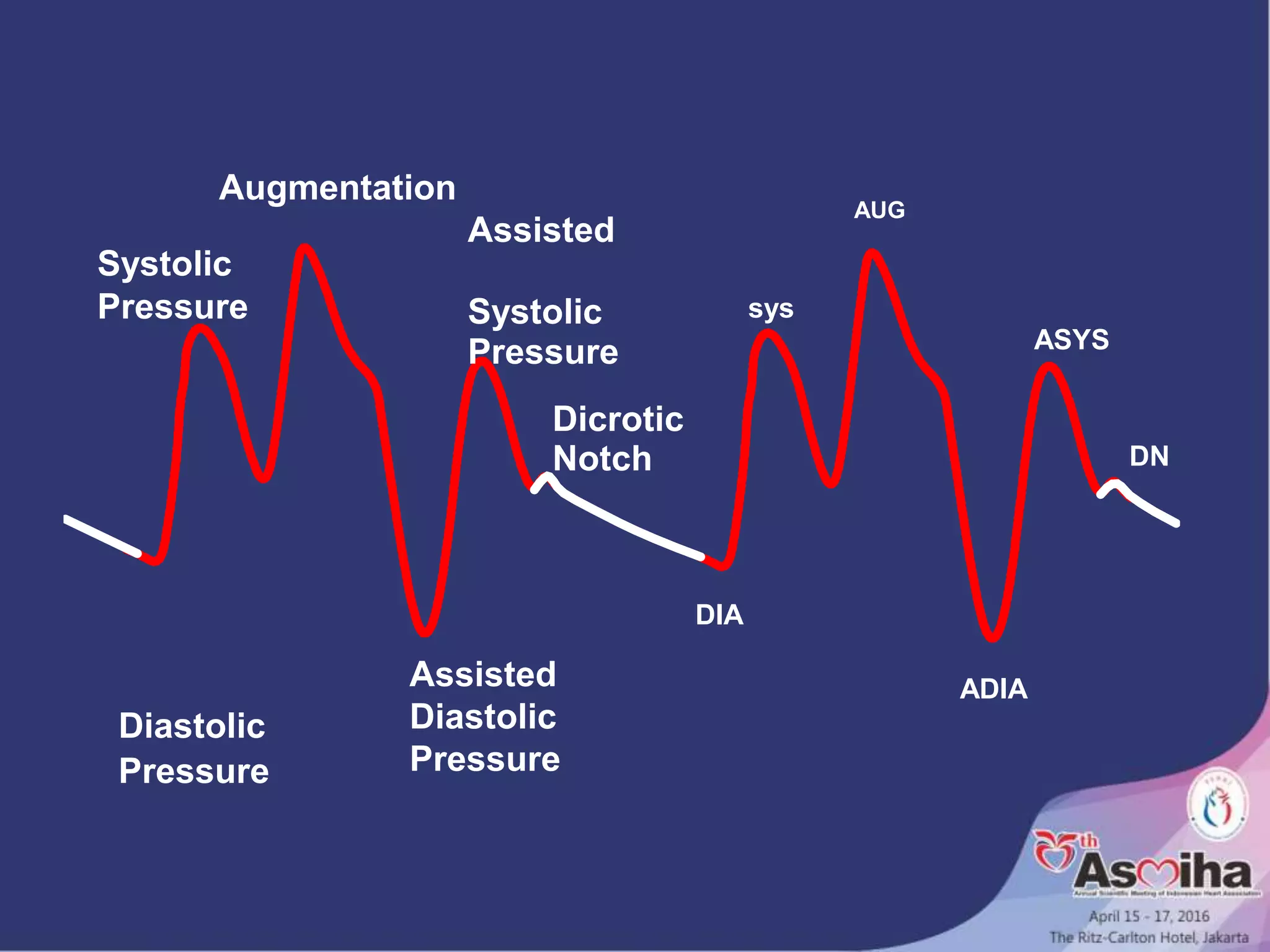
Arterial Pressure Waveform
SYS SYS
DN DN
AVO AVOX
DIA DIA
X
ASYS
AUG
sys
DIA
ADIA
DN
Diastolic
Pressure
Dicrotic
Notch
Assisted
Systolic
Pressure
Systolic
Pressure
Augmentation
Assisted
Diastolic
Pressure
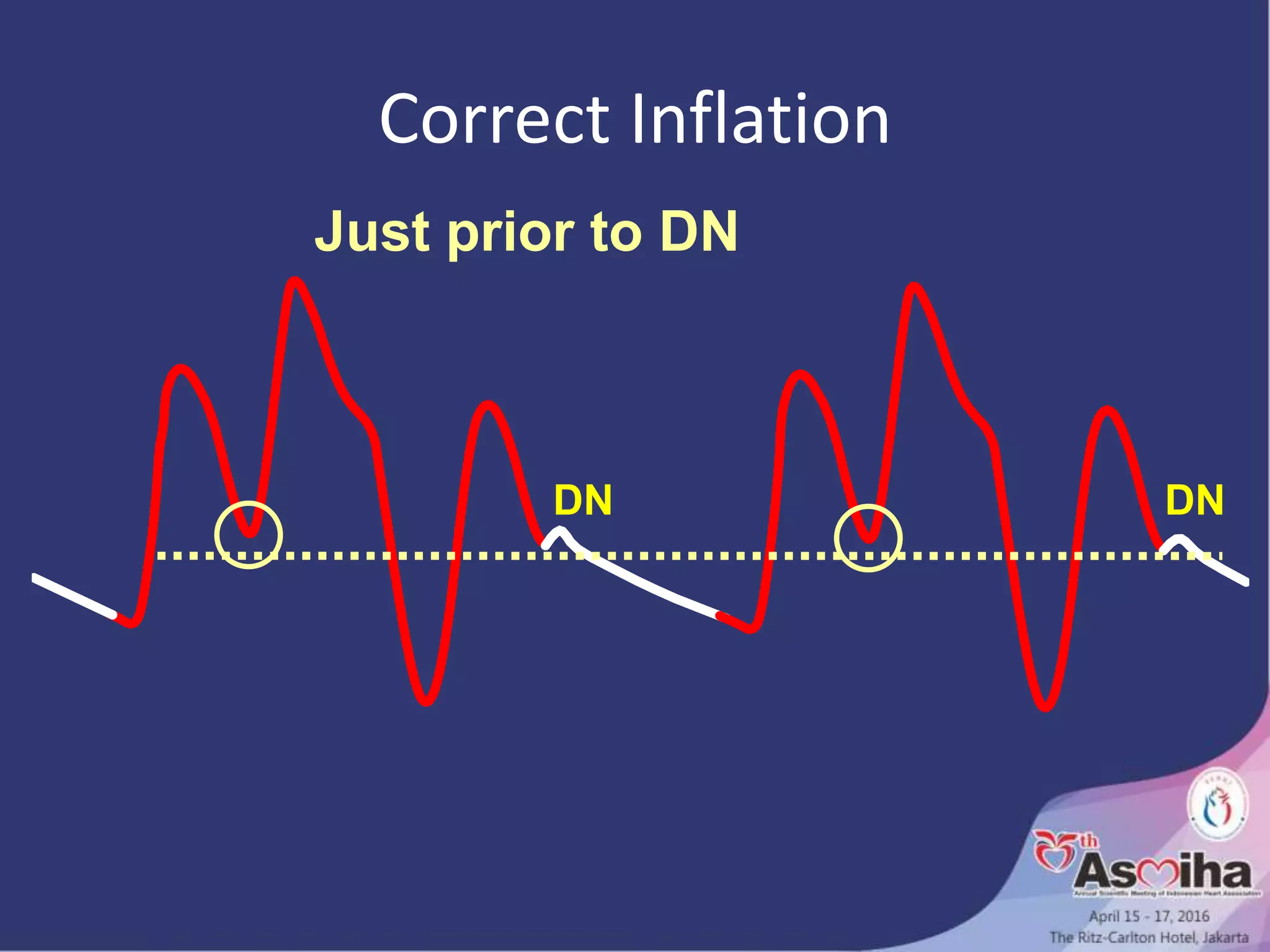
DN DN
Correct Inflation
Just prior to DN
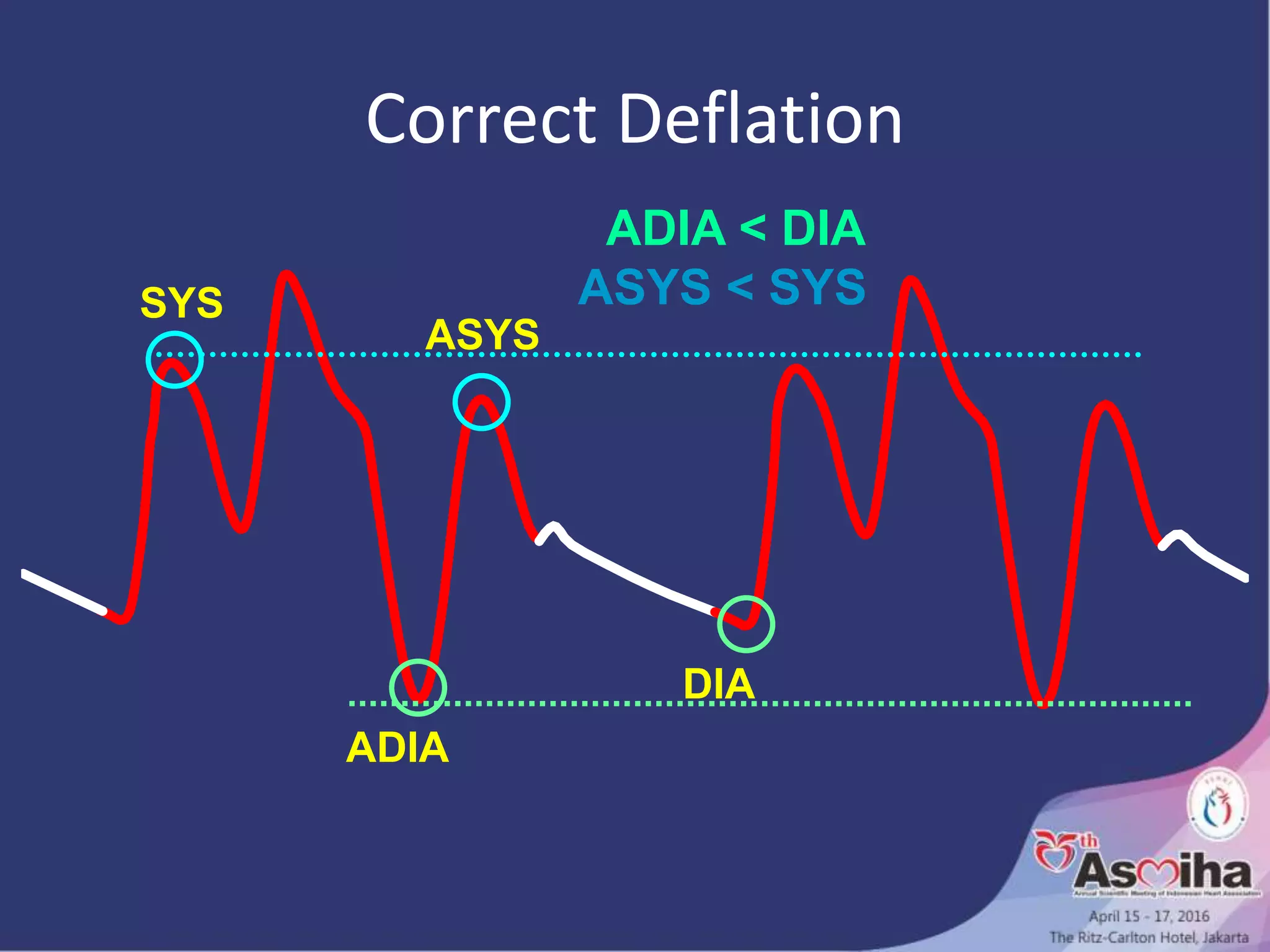
Correct Deflation
ADIA < DIA
ASYS < SYSSYS
ASYS
ADIA
DIA
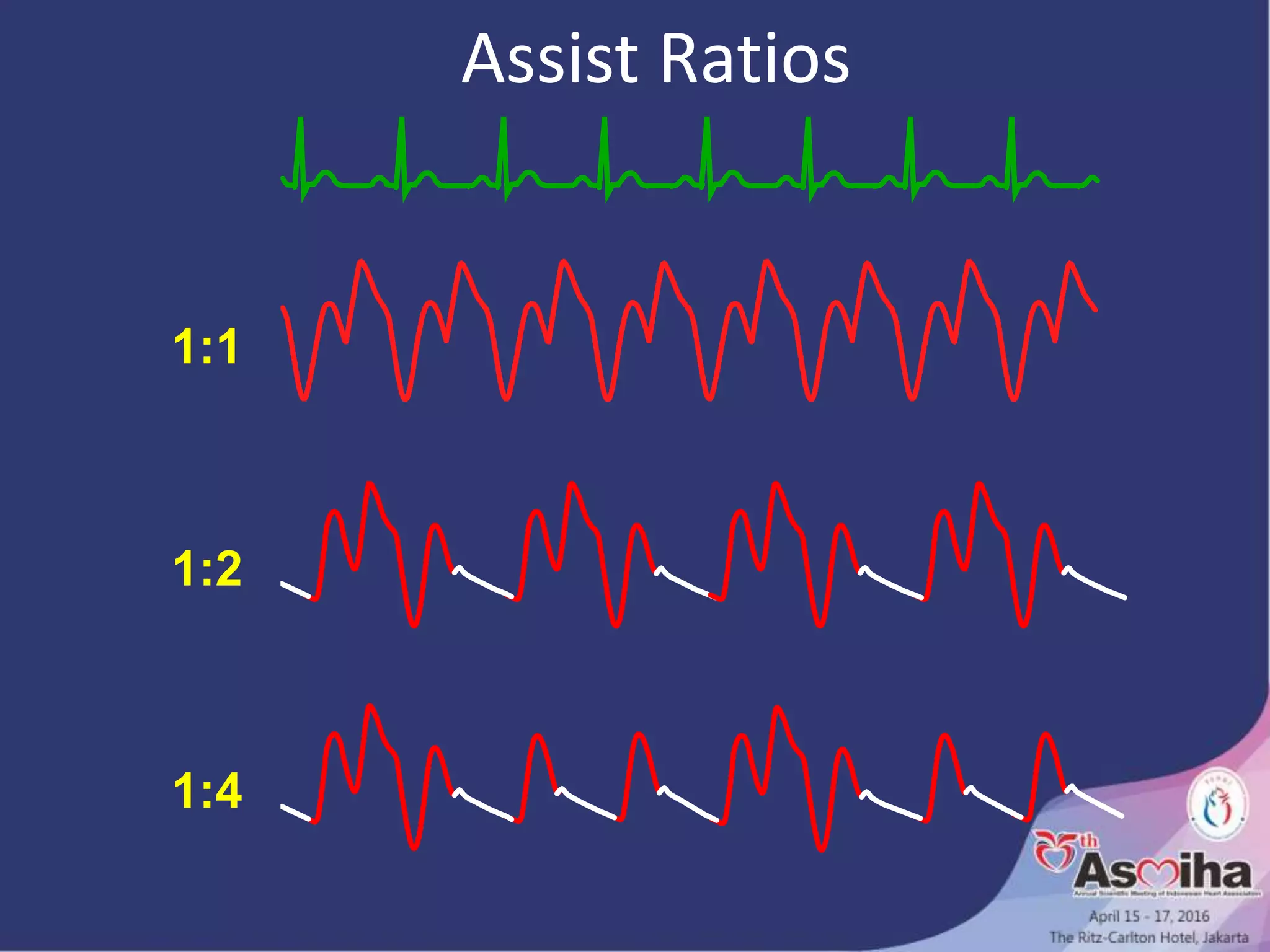
Assist Ratios
1:1
1:2
1:4
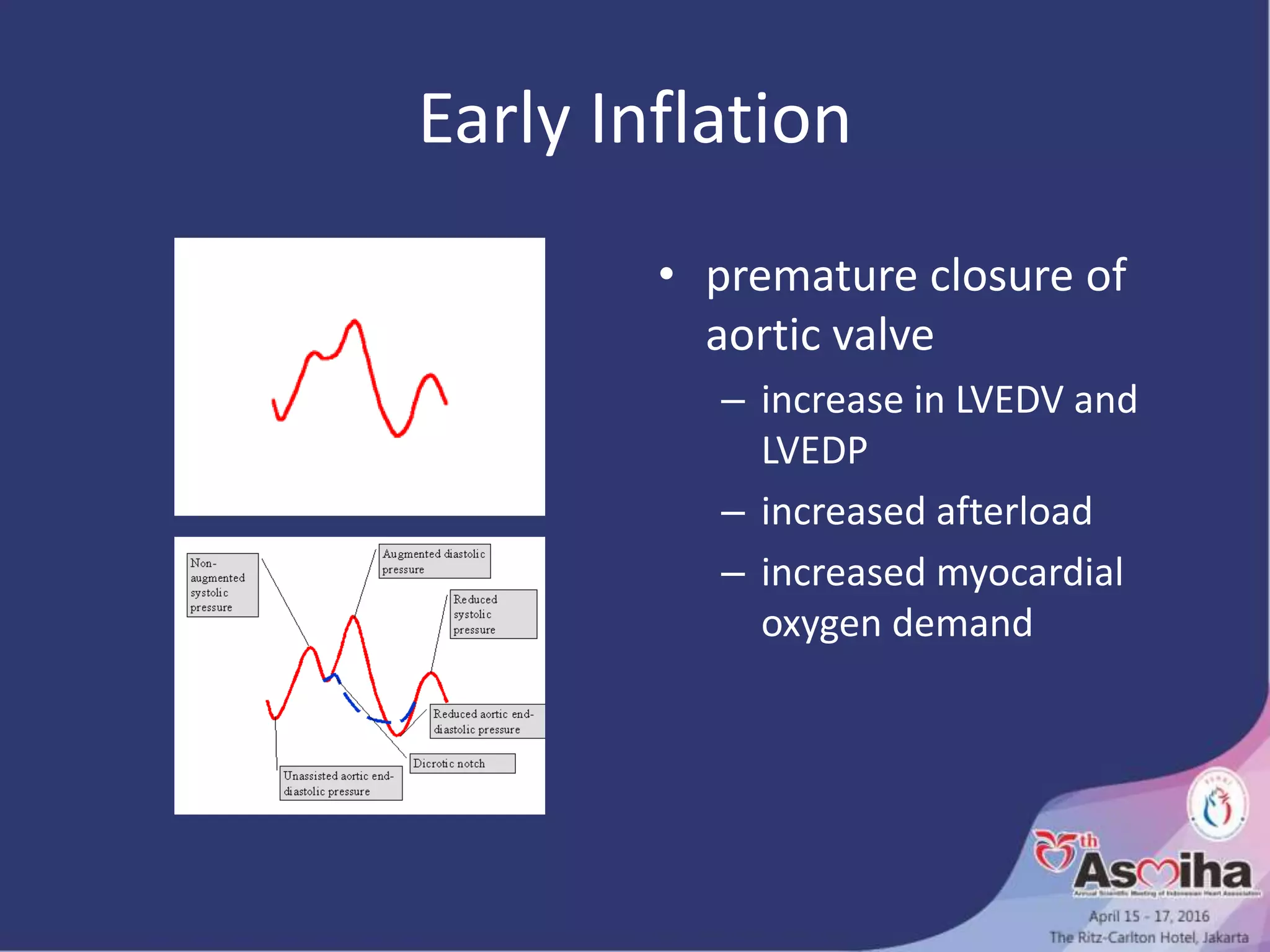
Early Inflation
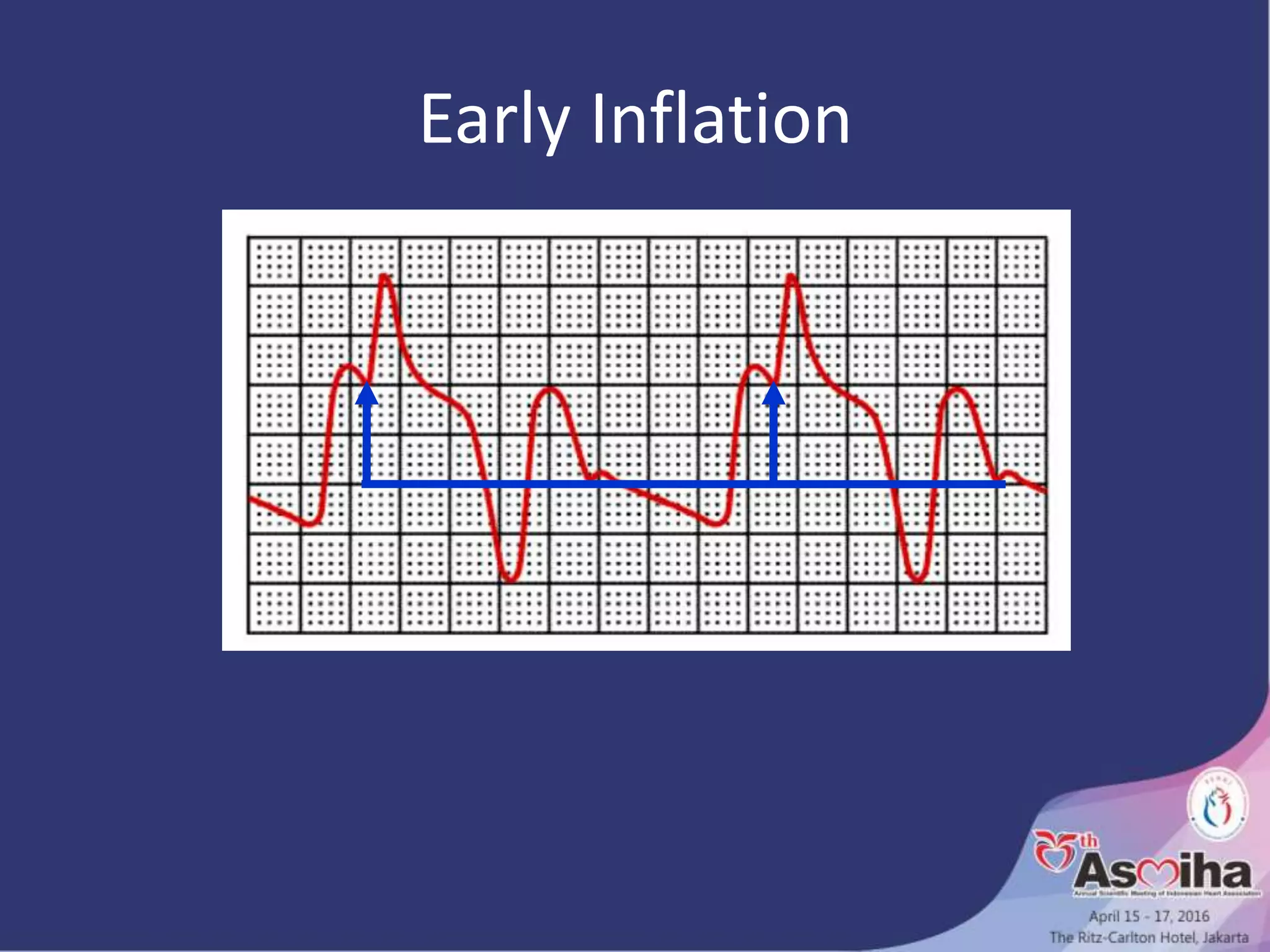
• premature closure of
aortic valve
– increase in LVEDV and
LVEDP
– increased afterload
– increased myocardial
oxygen demand
Early Inflation
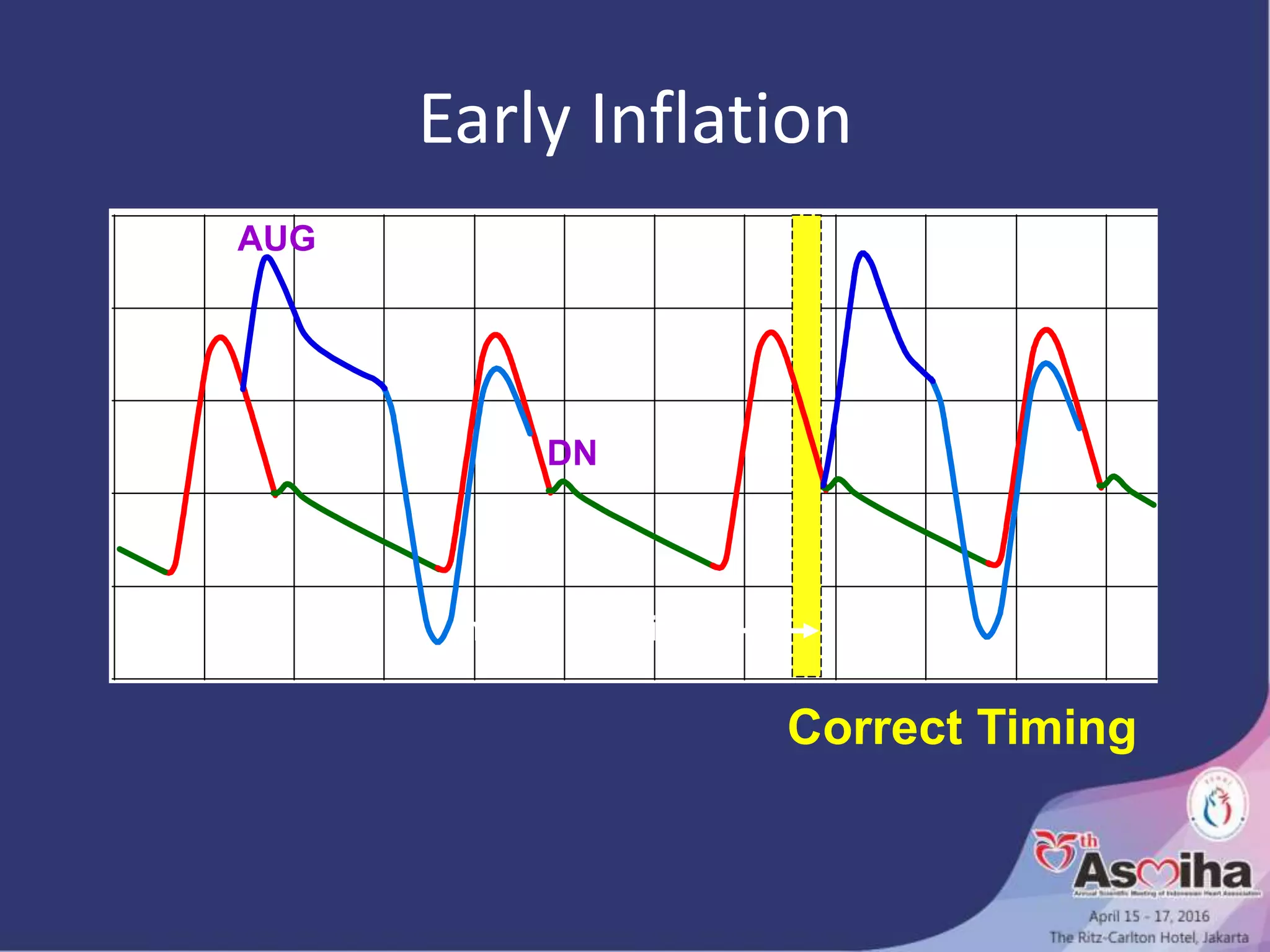
Early Inflation
Correct Timing
AUG
DN
move inflation
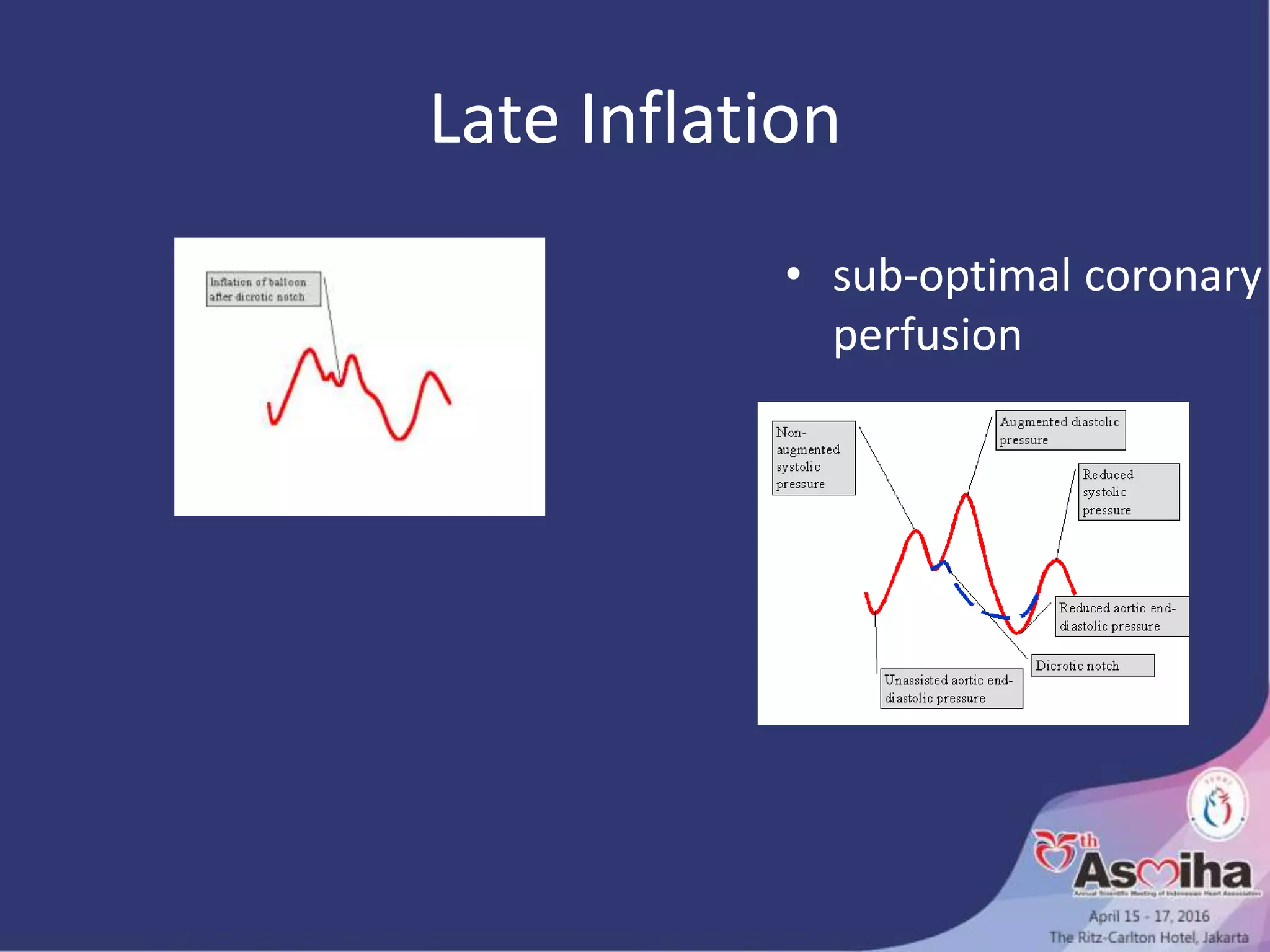
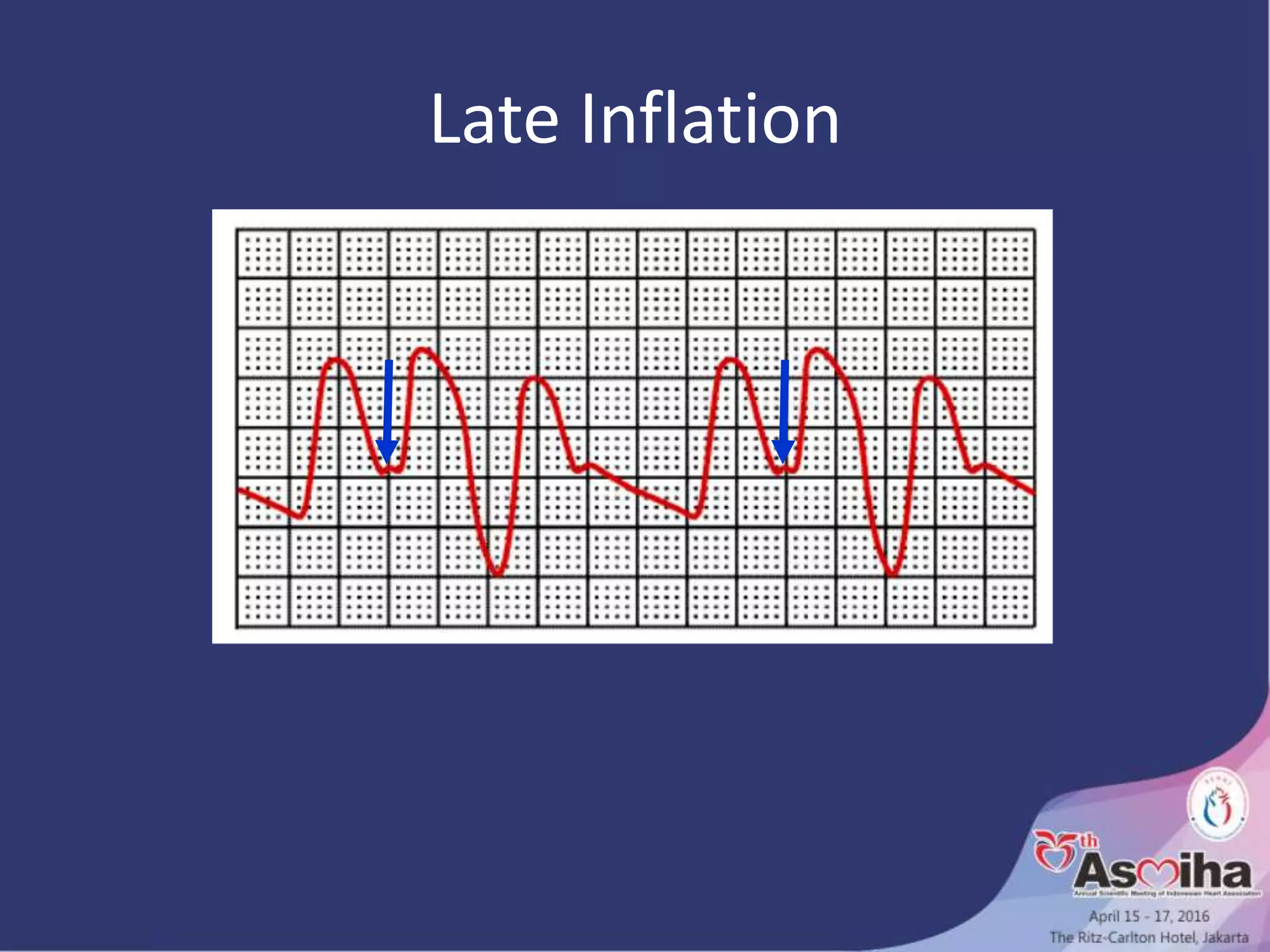
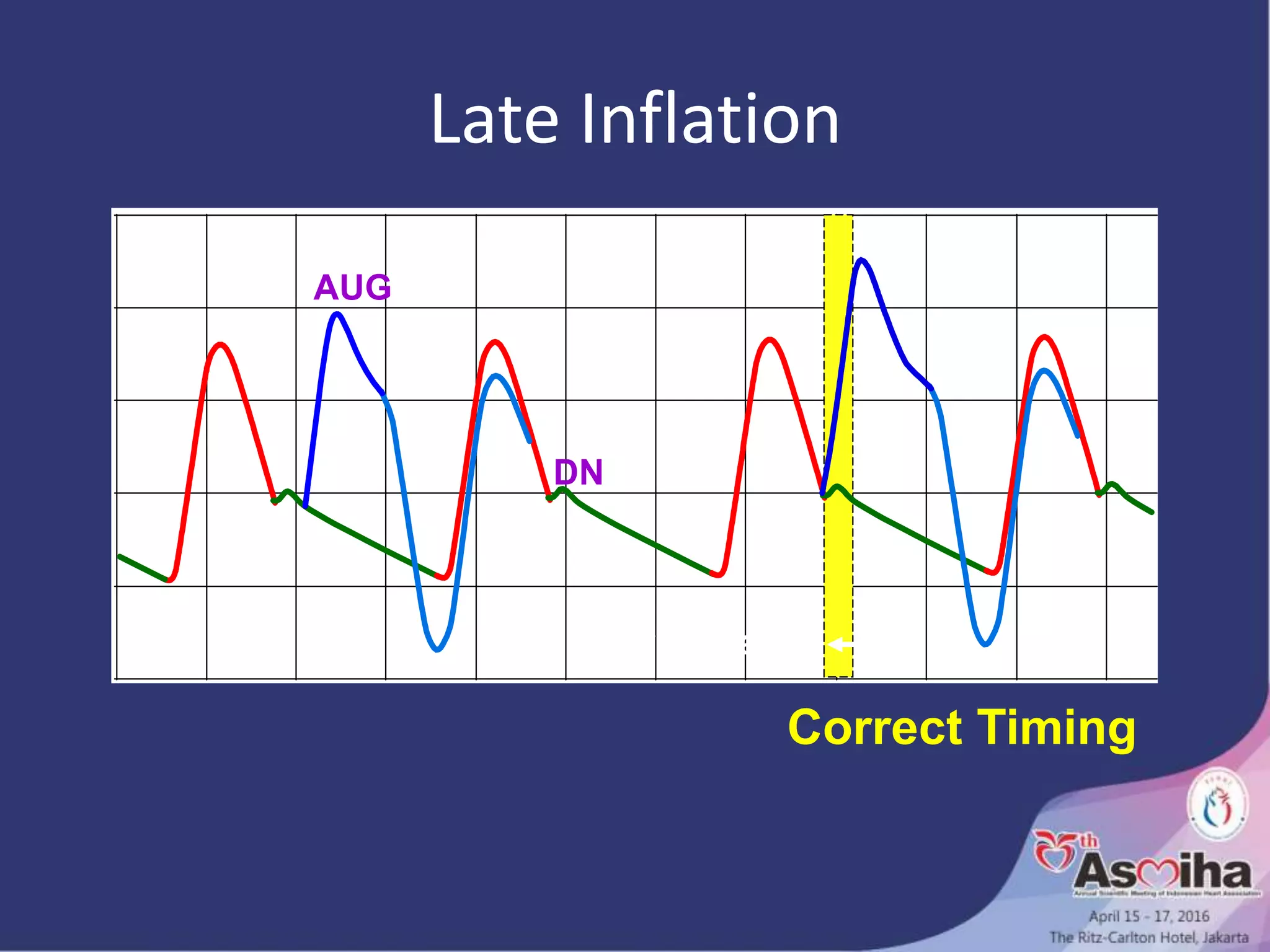
Late Inflation
• sub-optimal coronary
perfusion
Late Inflation
Late Inflation
Correct Timing
AUG
DN
move inflation
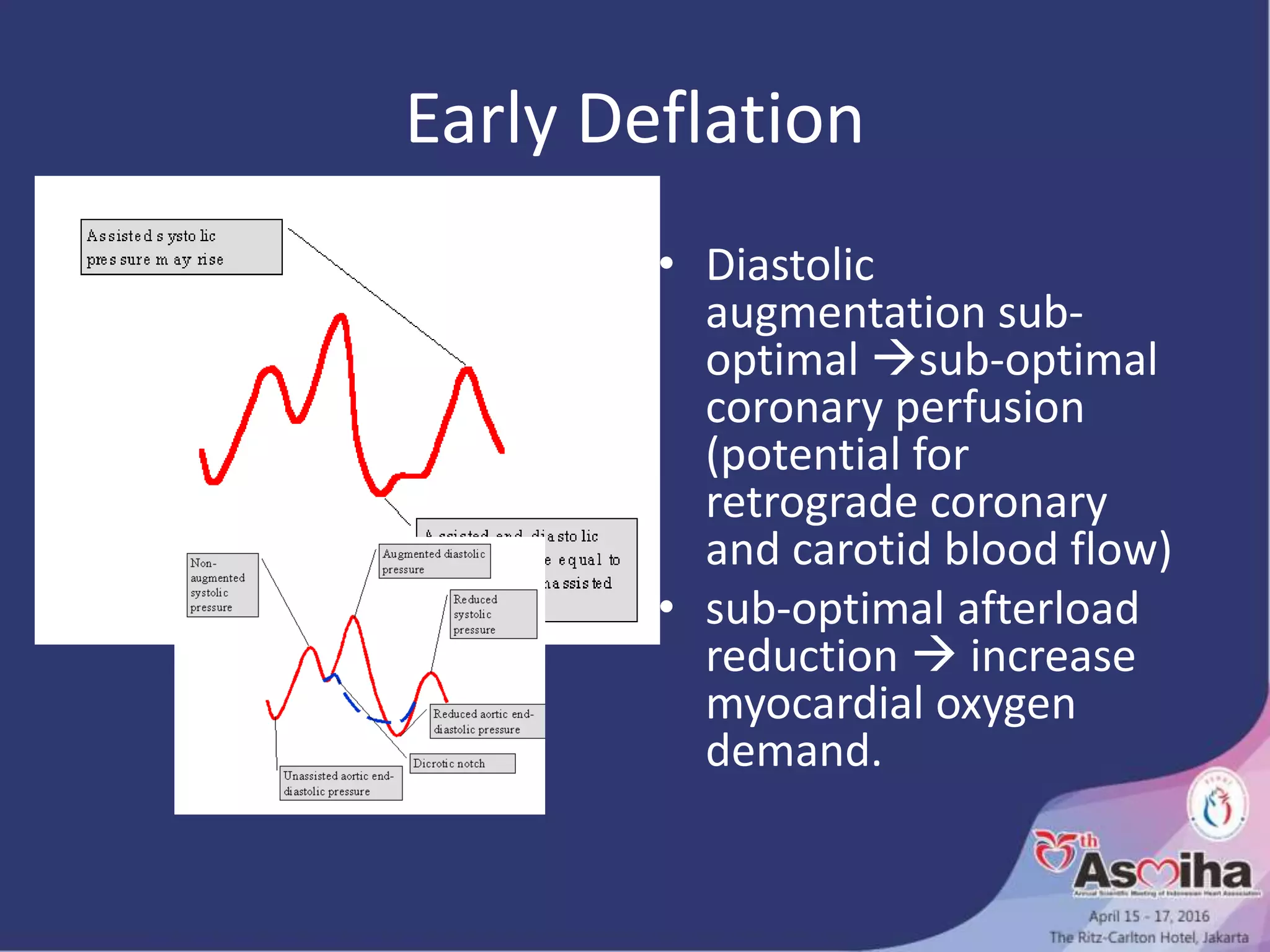
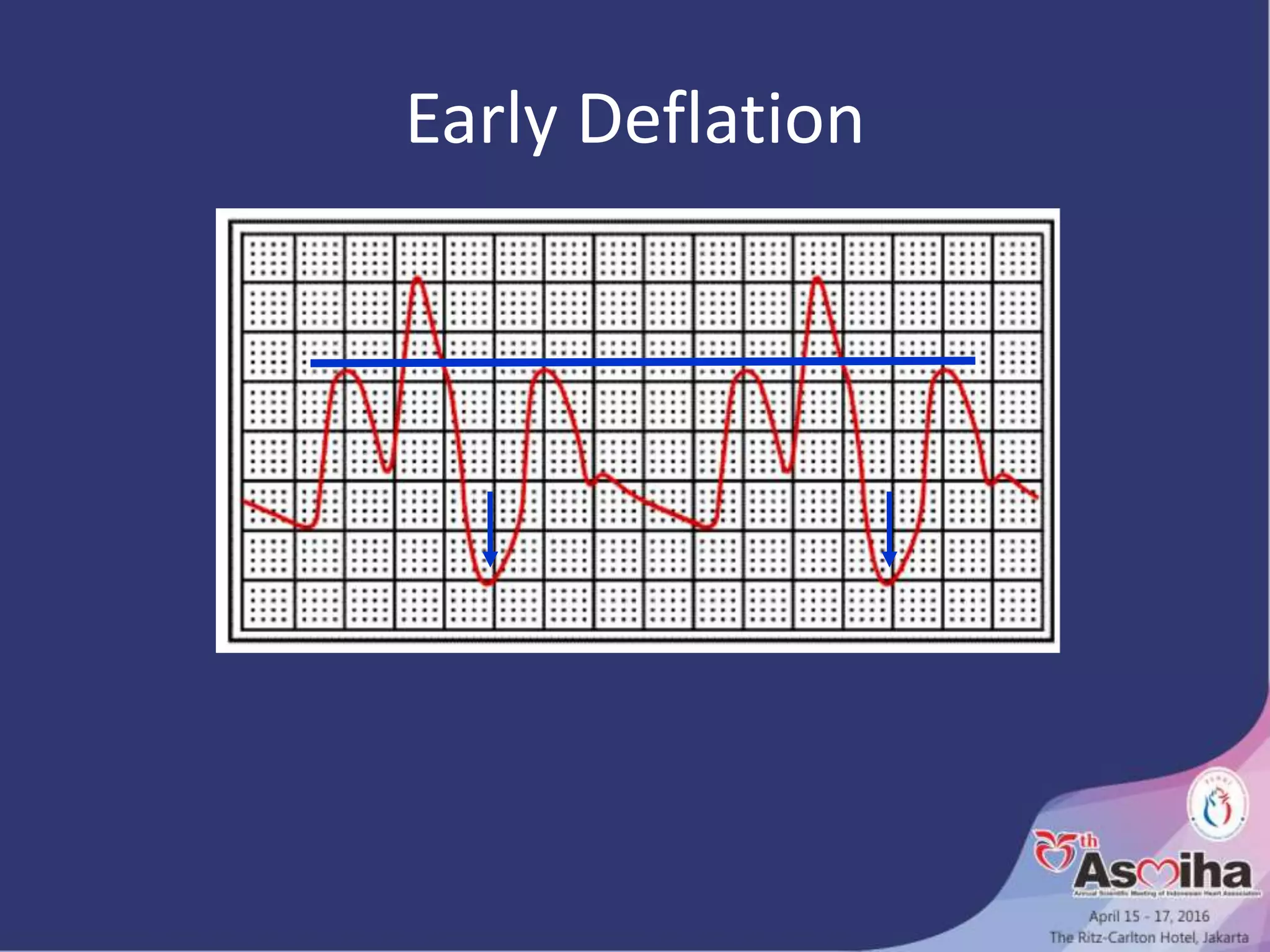
Early Deflation
• Diastolic
augmentation sub-
optimal sub-optimal
coronary perfusion
(potential for
retrograde coronary
and carotid blood flow)
• sub-optimal afterload
reduction  increase
myocardial oxygen
demand.
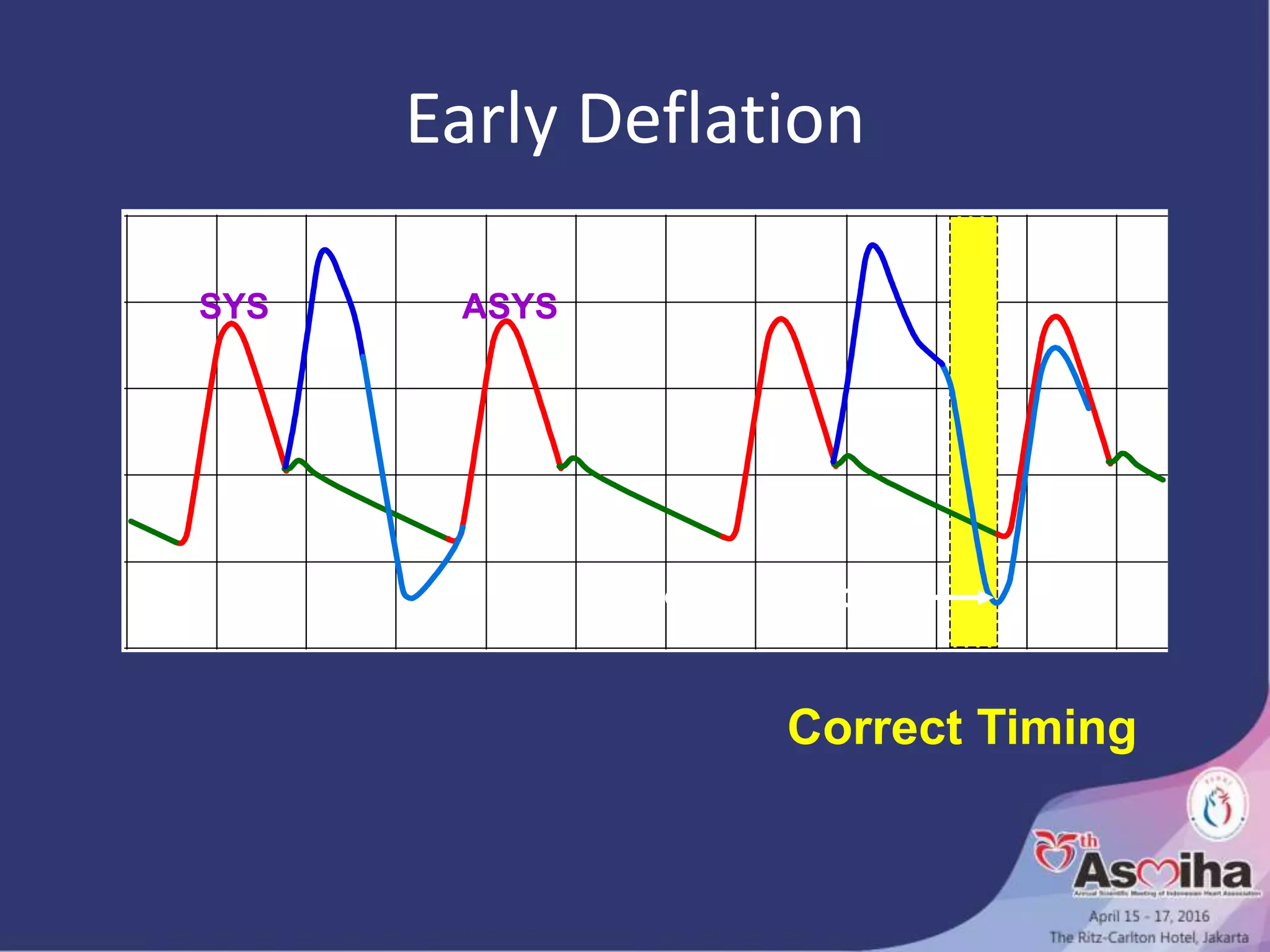
Early Deflation
move deflation
SYS ASYS
Early Deflation
Correct Timing
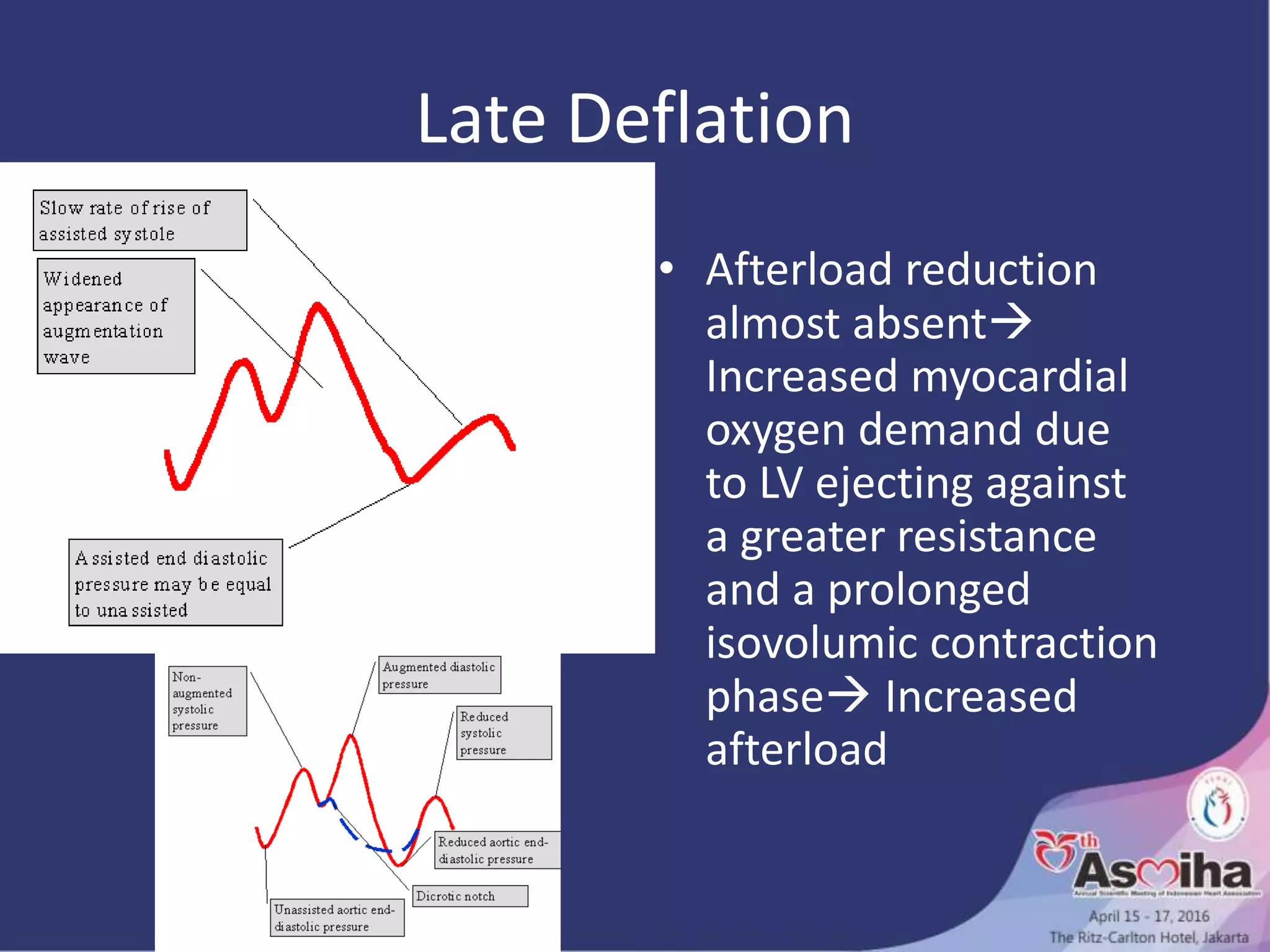
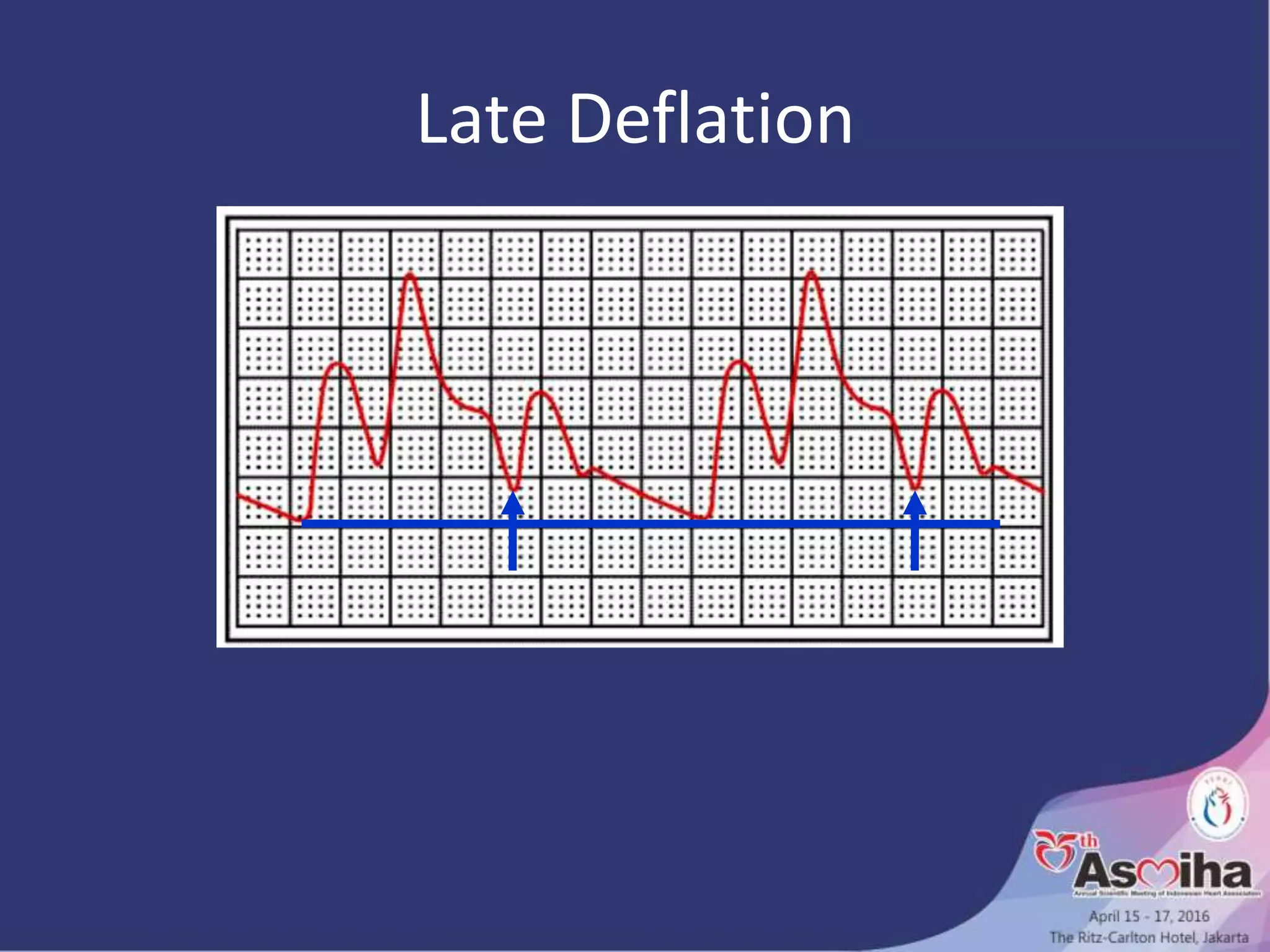
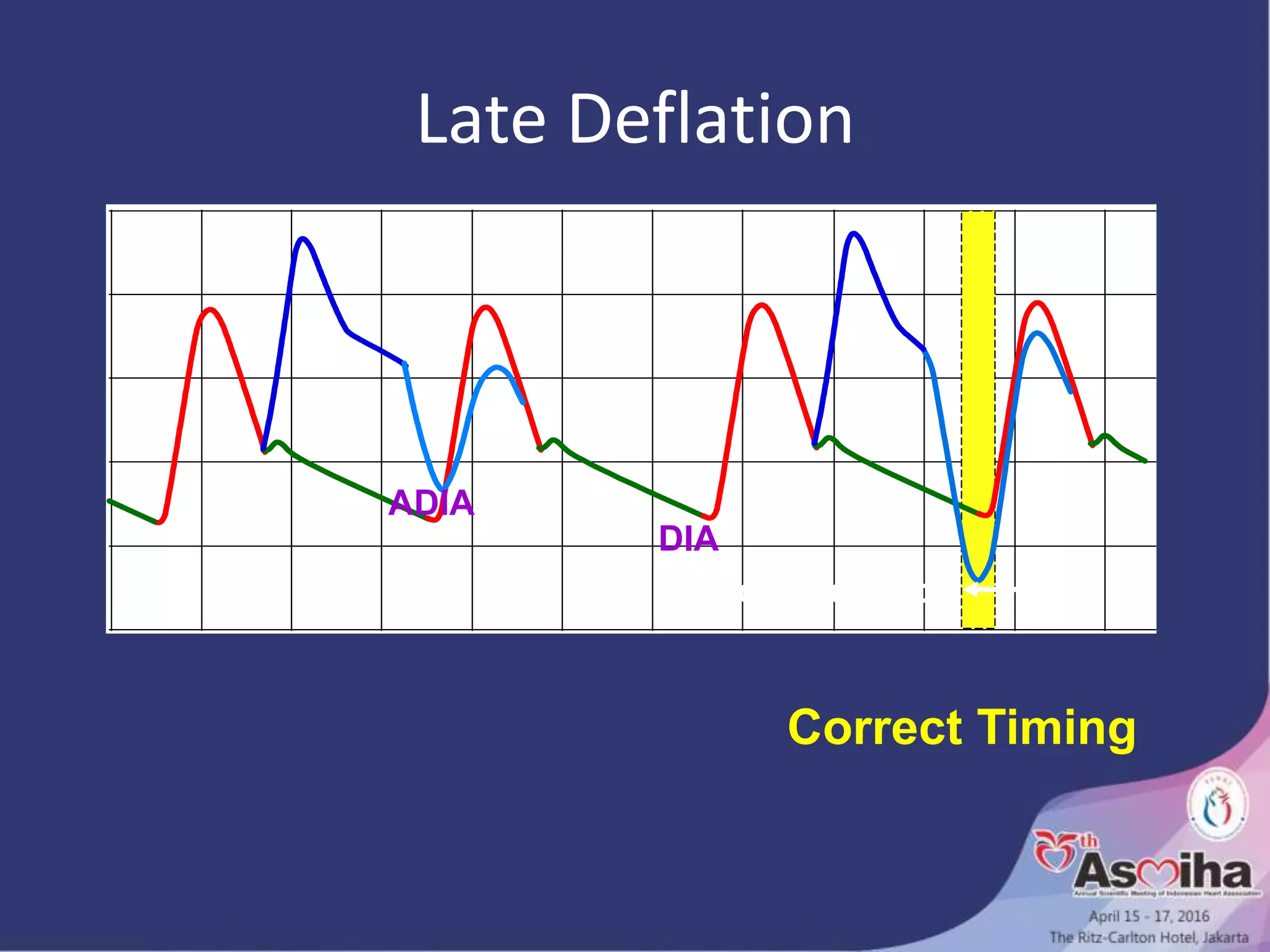
Late Deflation
• Afterload reduction
almost absent
Increased myocardial
oxygen demand due
to LV ejecting against
a greater resistance
and a prolonged
isovolumic contraction
phase Increased
afterload
Late Deflation
move deflation
ADIA
DIA
Late Deflation
Correct Timing
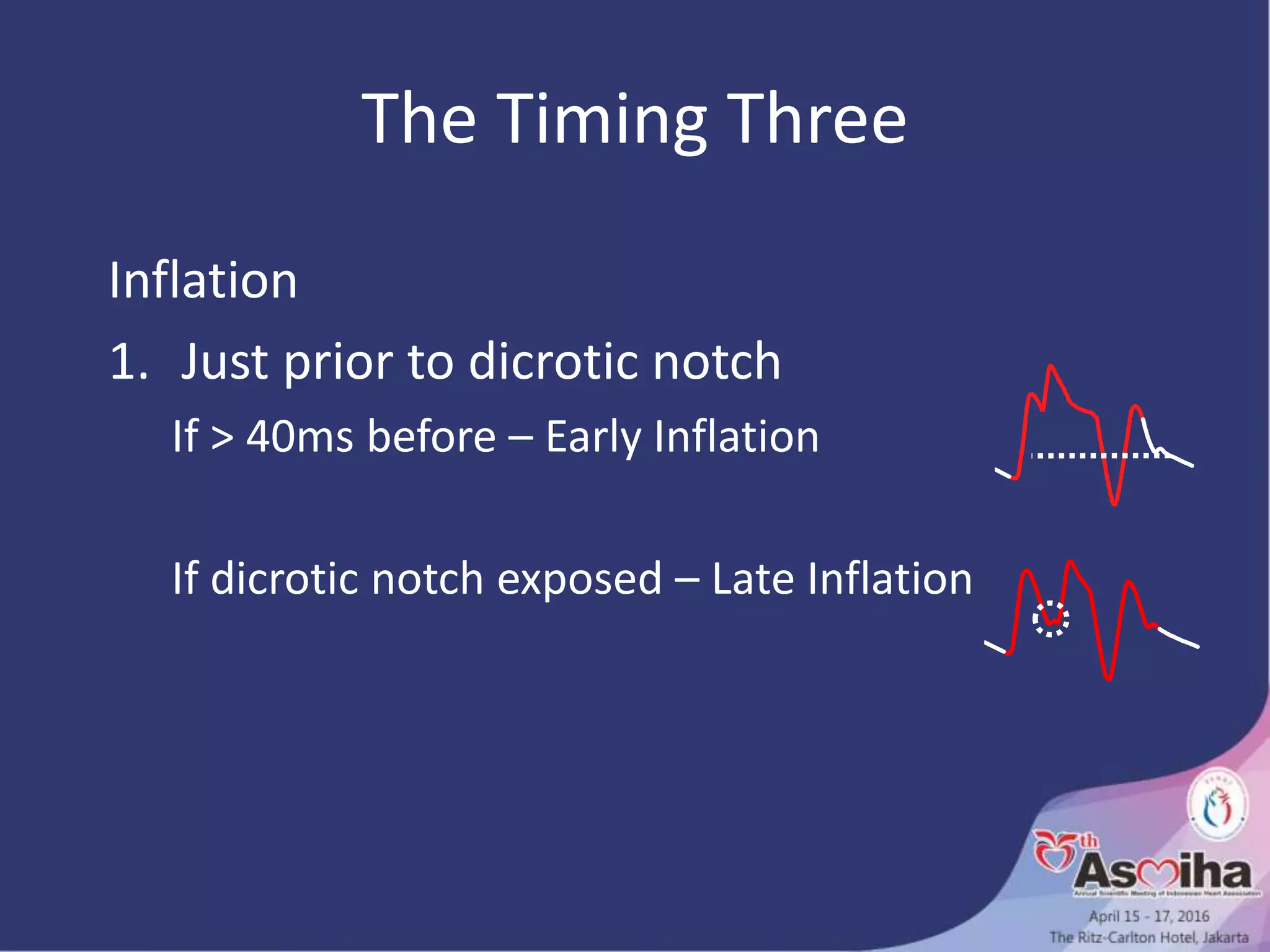
The Timing Three
Inflation
1. Just prior to dicrotic notch
If > 40ms before – Early Inflation
If dicrotic notch exposed – Late Inflation
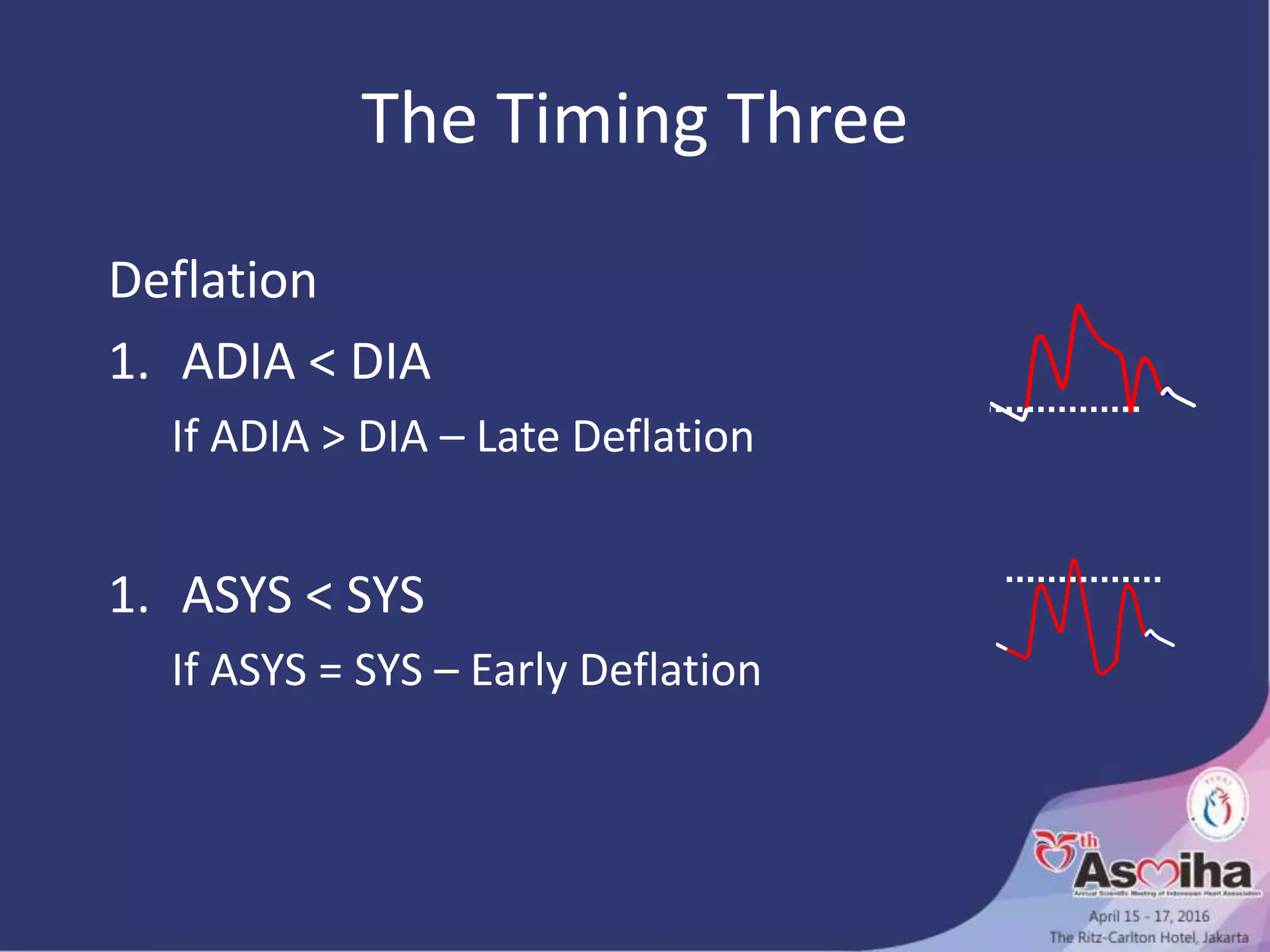
The Timing Three
Deflation
1. ADIA < DIA
If ADIA > DIA – Late Deflation
1. ASYS < SYS
If ASYS = SYS – Early Deflation
Limitations of IABC
• Heart Rate
• Arrhythmias (non-sinus rhythms)
• Hypovolemia
Effects of IABP on BP
• Normal BP has two reference points- SBP & DBP
• With a pump set at 1:2 you have 5 different reference
points.
• Net effect:
*SBP following an augmented beat will be lower than SBP
following an unassisted beat.
*AoEDP following an augmented beat will be lower than
AoEDP following an unassisted beat.
*Peak diastolic augmented pressure will be integrated into
the pressure reading on the arterial line. Overall BP as
read by A-line (number you see) should increase.
Weaning
• Frequency ratio weaning (1:1, 1:2, 1:3,
etc.).
• Volume weaning (more physiologic?)
Risk of IABC
• Reported complication rates vary, but in general
range about 20-30% of all IABP’s placed.
• Factors which predispose to a higher complication
rate include age, pre-existing vascular disease,
duration of IABC, DM, HTN, obesity, and
vasopressor therapy.
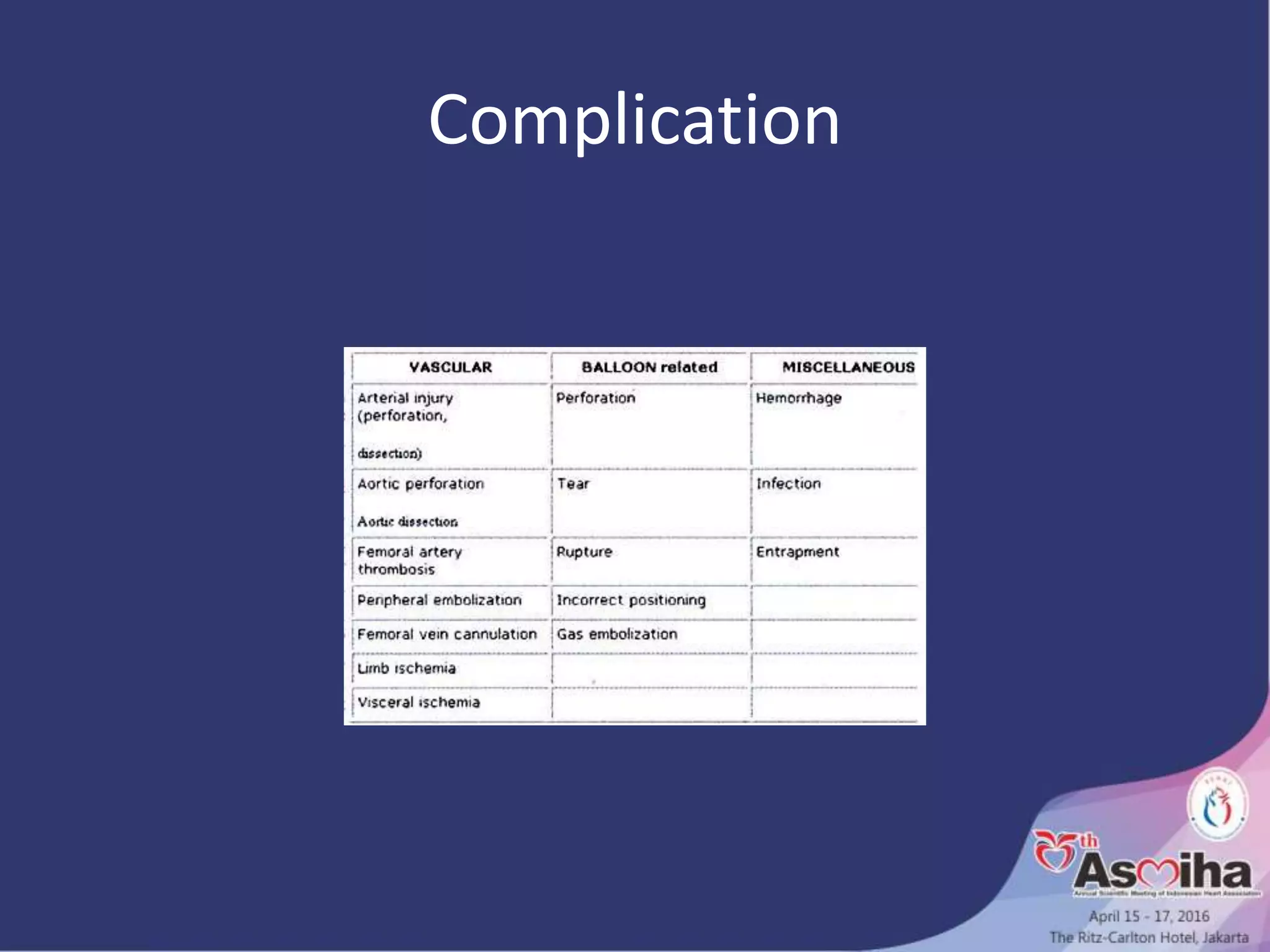
Complication
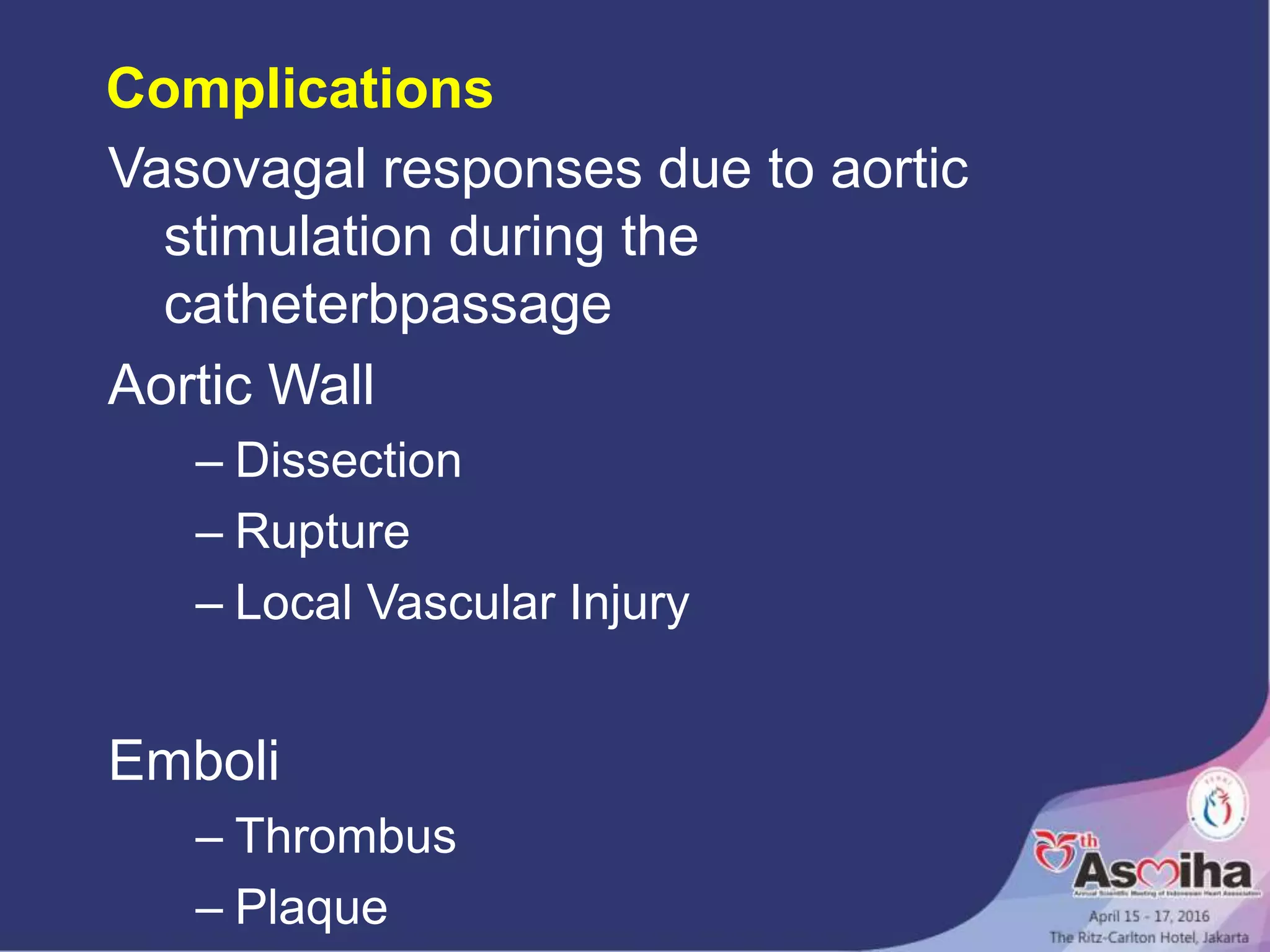
Complications
Vasovagal responses due to aortic
stimulation during the
catheterbpassage
Aortic Wall
– Dissection
– Rupture
– Local Vascular Injury
Emboli
– Thrombus
– Plaque
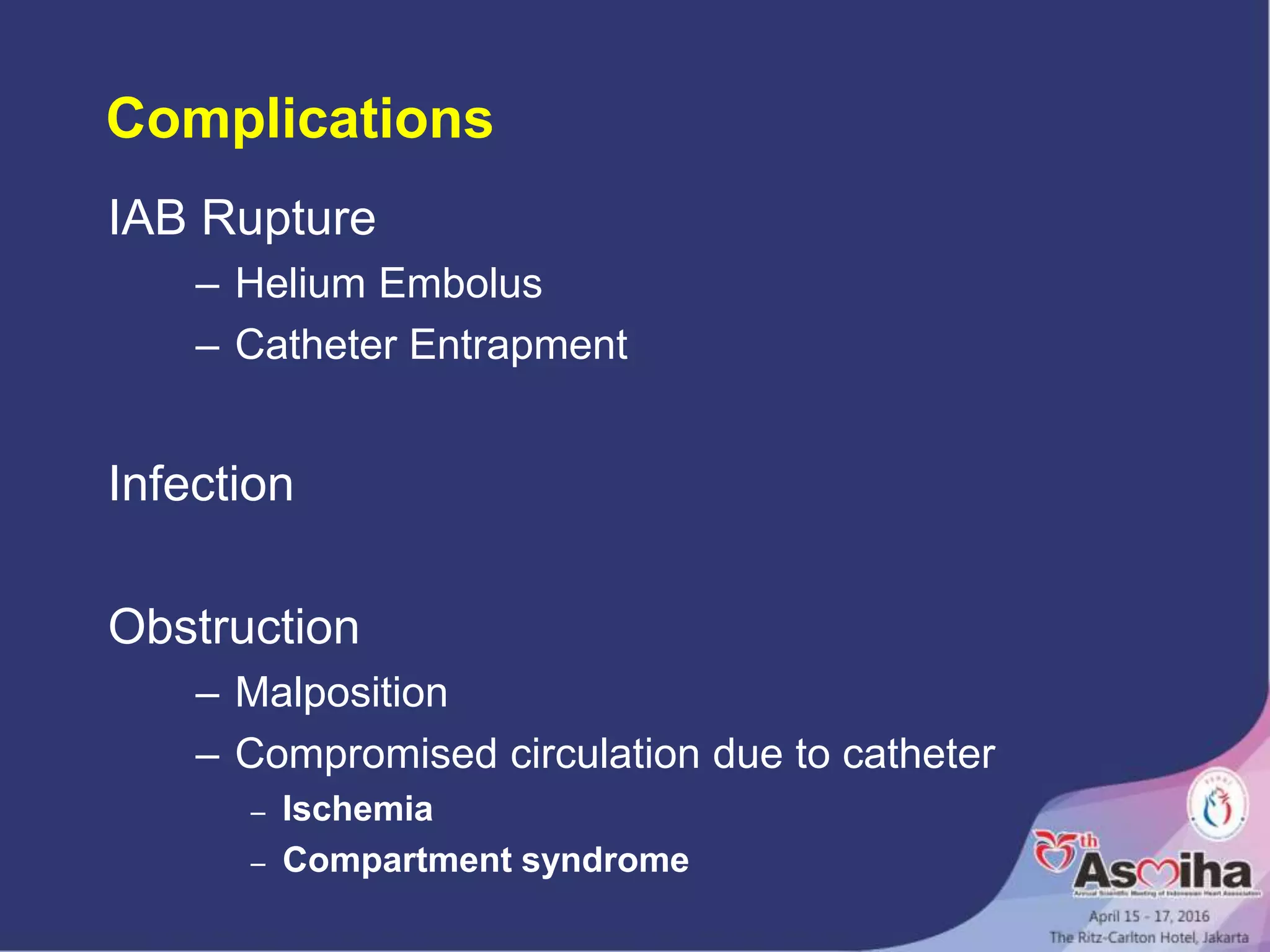
Complications
IAB Rupture
– Helium Embolus
– Catheter Entrapment
Infection
Obstruction
– Malposition
– Compromised circulation due to catheter
– Ischemia
– Compartment syndrome
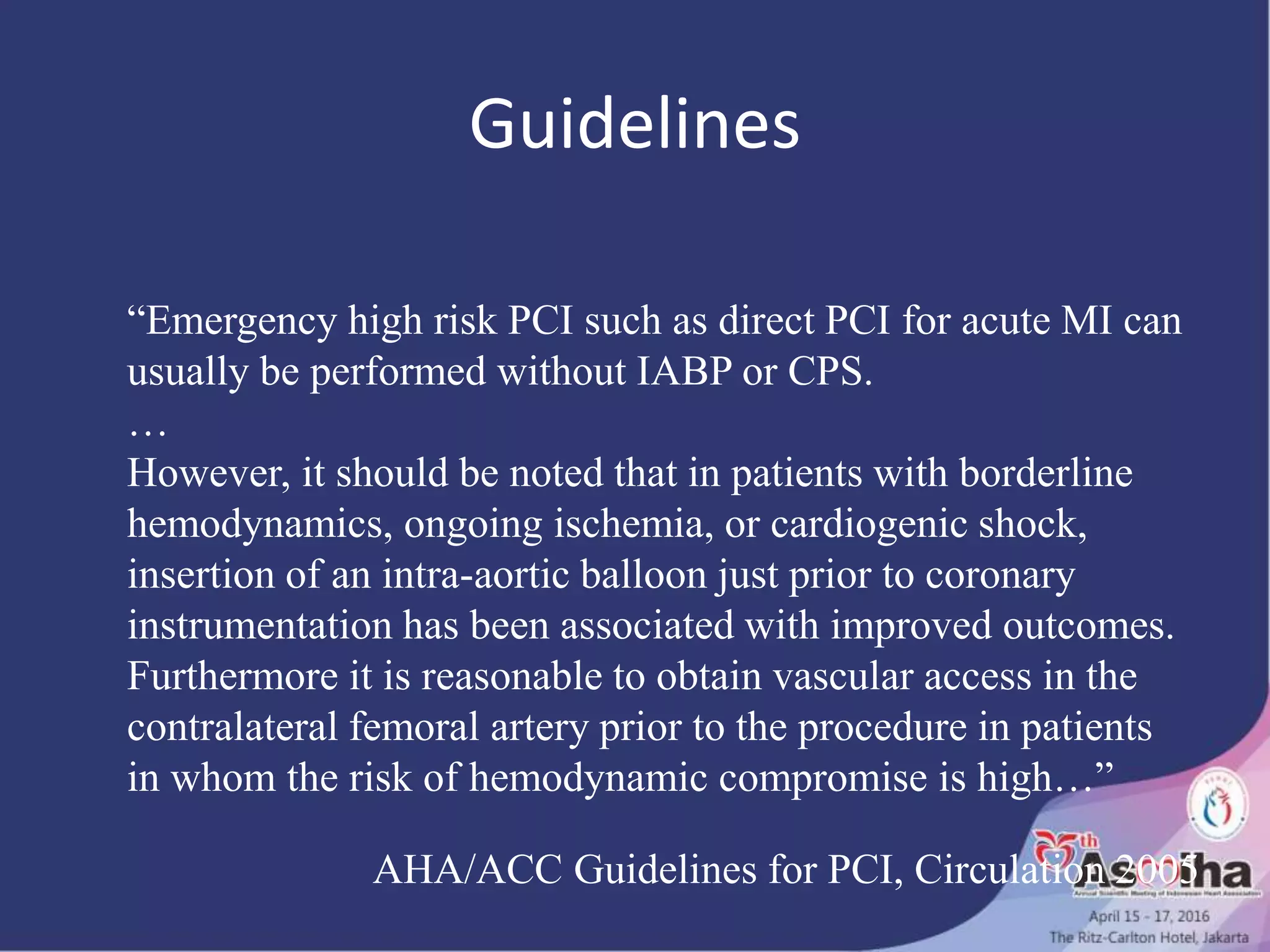
Guidelines
“Emergency high risk PCI such as direct PCI for acute MI can
usually be performed without IABP or CPS.
…
However, it should be noted that in patients with borderline
hemodynamics, ongoing ischemia, or cardiogenic shock,
insertion of an intra-aortic balloon just prior to coronary
instrumentation has been associated with improved outcomes.
Furthermore it is reasonable to obtain vascular access in the
contralateral femoral artery prior to the procedure in patients
in whom the risk of hemodynamic compromise is high…”
AHA/ACC Guidelines for PCI, Circulation 2005
Summary
• Intra-Aortic Balloon Pump is an excellent tool for the
management of hemodynamically unstable patients especially
in the setting of acute MI
• Understanding the Cardiac Physiology is important
(determinants of myocardial O2 delivery, O2 consumption,
cardiac output and Windkessel effect)
• Timing of IABP will influence the outcome
• IABP therapy will remain the mainstay of temporary
mechanical cardiovascular support for years ahead.

Iabp principle, hemodynamic, timing, weaning 2016 background asmiha,isman edit

  • 1.
    Dr. Isman Firdaus,SpJP(K), FIHA, FESC, FAPSIC,FSCAI Email: ismanf@yahoo.com Position and Organization : • Critical care and Interventional Cardiologist Consultant National Cardiovascular Center, Harapan Kita Hospital • Executive Board Member of Indonesian Heart Association (IHA) • Excutive Board Member of WG Acute Cardiac Care-IHA • Member of Acute Cardiac Care Association-European Society of Cardiology (ACCA-ESC). • Member of European Association of Percutaneous Coronary Intervention (EAPCI-ESC) • Member of European Rescucitation Council (ERC) • Fellow of European Society of Cardiology (FESC) • Fellows of Asia Pacific Society of Interventional Cardiologist (FAPSIC) • Fellow of Society Catheterization Angiography and Intervention (FSCAI) • Asia Pacific advisory board of Heart Failure Pekerjaan : • Staf Pengajar Departemen Kardiologi Fakultas Kedokteran UI • Cardiovascular intensivist-intervensionist consultant RS Jantung Harapan Kita Curricullum Vitae
  • 2.
    Intra Aortic BalloonPump: Basic Principle Isman Firdaus, MD, FIHA, FAPSIC, FESC, FSCAI National Cardiovascular Center Harapan Kita
  • 3.
    Mortality: Major ShockCategories J Am Coll Cardiol 2000;36:1063–70
  • 4.
    Intra-aortic Balloon Pump (IABP) •IABP first successfully used by Kantrowitz et al. in 1967 • Able to reverse pharmacologically refractory Post MI cardiogenic shock using this technique • Kantrowitz et al. Initial clinical experience with intraaortic balloon pumping in cardiogenic shock. JAMA 203:135, 1968
  • 5.
    Basics of CardiacPhysiology • Determinants of myocardial O2 delivery • Determinants of myocardial O2 consumption • Determinants of Cardiac Output • Windkessel Effect
  • 6.
    Determinants of MyocardialDO2 • MVO2 = CBF X (CaO2-CvO2)  Fick Principle • heart has near maximal extraction at rest. Increased needs are met by increased O2 delivery. • O2 delivery is regionally controlled by autoregulation, • Ischemic heart has maximally dilated arteries. Perfusion is then directly related to perfusion pressure. • Coronary perfusion occurs predominately during diastole • Increasing diastolic time increases coronary blood flow
  • 7.
    Fick Principle MVO2 =CBF X (CaO2-CvO2) • CBF : coronary blood flow (ml/mnt) • CaO2 : Ox Content in arterial • CvO2: Ox content in vein • Art-Vein Ox Diff: CaO2 –CvO2 Ex/ CBF 80 ml/mnt CaO2-CvO2= 0,1 ml/mnt blood MVO2 = 8 ml O2/mnt per gram
  • 8.
    Determinants of MyocardialDO2 (cont’) • Major resistance to (subendocardial) coronary blood flow during diastole is LVEDP such that... • CPP=AoDP-LVEDP • AoDP and LVEDP are dynamic values • Overlapping the aortic pressure and LV pressure curves gives a visual representation of the pressure gradient. • This gradient over the diastolic time cycle is described as the Diastolic Pressure Time Index (DPTI) • Area within the DPTI is directly correllated with O2 availability to the myocardium (supply)
  • 10.
    Determinants of MVO2 •HR, contractility, wall tension (50% of MVO2 at rest). • Laplace’s law T=Pr/2h • Intraventricular pressure is a modifiable variable. • IVP greatest during systole (LVSP). • LVSP is a dynamic value continually changing throughout systole and altering wall tension as this occurs. • Area under the LVSP tracing is represented by the Tension Time Index (TTI) and is directly correllated to wall tension and MVO2.
  • 12.
    Determinants of MVO2 (cont’) •Increasing systole time (HR) or peak LV systolic pressure increases the TTI and subsequently MVO2 • Conversely, lowering the AoEDP (decreased afterload) decreases the pressure the LV must overcome to eject blood and lowers the TTI • The Endocardial Viability Ratio relates the relationship between myocardial O2 supply and demand and is defined by EVR=DPTI/TTI (supply/demand).
  • 14.
    Determinants of CardiacOutput • CO=SV X HR • Stroke Volume *preload (AV synchrony, volume, RV function...) *afterload *contractility • HR
  • 15.
    Windkessel Effect • Potentialenergy stored in aortic root during systole • Converted to kinetic energy with elastic recoil of aortic root • Increases diastolic pressure/flow during early diastole • Less affect with hypovolemia or noncompliant aortas • Noted on the A-line tracing as the dicrotic notch.
  • 16.
    IABP- how doesit work? • IABP does not ‘pump’ blood per se in contrast to a VAD. • Requires a functioning, beating heart. • IABP serves as an external source of energy to allow the sick heart to pump more efficiently. • Does this via afterload reduction and diastolic augmentation. • Net result is an increased DO2, decreased MVO2, and an increased CO.
  • 17.
    Concepts of Counterpulsation •The balloon is phasically pulsed in counterpulsation to the patient’s cardiac cycle (IABC) • IABP has no ‘inotropic’ action; does not directly increase contractility. • Primarily benefits the left ventricle, although the diastolic augmentation may improve coronary flow to both ventricals.
  • 18.
    Components • Double lumencatheter with a distal sausage shaped non- thrombogenic polyurethane balloon with standard 30-40cc displacement volumes. • Pump, equipped with a console display to view the ECG, aortic and balloon pressure waveforms. • Central lumen extends to the catheter tip. Serves as a transducer to measure aortic pressure. • Central lumen is concentric with and situated inside the helium channel which is used for balloon inflation.
  • 20.
    Placement • Placed percutaneouslyor surgically with or without a sheath via the femoral artery. • Advanced into aorta under flouroscopy until the tip is about 1cm distal to the origin of the left subclavian a. • Cathater locations more proximal than this compromise flow to the vessels of the aortic arch. • More distal locations attenuate the hemodynamic benefits of the IABP and can potentially compromise renal blood flow.
  • 23.
    Diastolic Augmentation • Ballooninflation at the onset of diastole which is correllated to aortic valve closure (mechanical event). • Displacement of blood within the aorta to areas proximal and distal to the balloon. Termed “compartmentilization”. • Proximal compartment consists of branches of aortic arch (carotids) and coronary vasculature. • Diastolic balloon inflation augments cerebral and coronary perfusion. • Increased DPTI and EVR. • ‘Exaggerated’ Windkessel Effect.
  • 25.
    Afterload Reduction • Optimalballoon deflation occurs just prior to the opening of the aortic valve; during early isovolemic contraction. • Abruptly decreases intraaortic volume • AoEDP is acutely decreased (afterload reduction). • AoV opens sooner during cardiac cycle lending more time for ventricular ejection • Overall result is a larger SV (CO). • A lower peak LVSP decreases the TTI which leads to a decrease MVO2 and an icrease in the EVR.
  • 27.
    Determinants of IABPefficiency • Ideal balloon volume causes maximal emptying of LV without causing retrograde flow from the coronary vasculature and vessels of the aortic arch. • Balloon should occlude 75-90% of the aortic cross-sectional area during inflation. • CO2 vs Helium • Efficiency if IABC is critically dependent on the timing of both inflation and deflation. • Improper timing can worsen a patient’s condition.
  • 28.
    IABP Timing • IABPrequires a trigger to determine systole and diastole. • ECG or arterial waveform. • ECG directly from the patient to the pump or the pump can slave off the bedside monitor. • T-wave default. Electrical index of diastole. Deflation occurs prior to the next QRS (during PR interval). • Timing is manually fine-tuned according to the aortic pressure waveform (more representative of mechanical events).
  • 29.
    Arterial Pressure Waveform SYSSYS DN DN AVO AVOX DIA DIA X
  • 30.
  • 31.
  • 32.
    Correct Deflation ADIA <DIA ASYS < SYSSYS ASYS ADIA DIA
  • 33.
  • 34.
    Early Inflation • prematureclosure of aortic valve – increase in LVEDV and LVEDP – increased afterload – increased myocardial oxygen demand
  • 35.
  • 36.
  • 37.
  • 38.
  • 39.
  • 40.
    Early Deflation • Diastolic augmentationsub- optimal sub-optimal coronary perfusion (potential for retrograde coronary and carotid blood flow) • sub-optimal afterload reduction  increase myocardial oxygen demand.
  • 41.
  • 42.
    move deflation SYS ASYS EarlyDeflation Correct Timing
  • 43.
    Late Deflation • Afterloadreduction almost absent Increased myocardial oxygen demand due to LV ejecting against a greater resistance and a prolonged isovolumic contraction phase Increased afterload
  • 44.
  • 45.
  • 46.
    The Timing Three Inflation 1.Just prior to dicrotic notch If > 40ms before – Early Inflation If dicrotic notch exposed – Late Inflation
  • 47.
    The Timing Three Deflation 1.ADIA < DIA If ADIA > DIA – Late Deflation 1. ASYS < SYS If ASYS = SYS – Early Deflation
  • 48.
    Limitations of IABC •Heart Rate • Arrhythmias (non-sinus rhythms) • Hypovolemia
  • 49.
    Effects of IABPon BP • Normal BP has two reference points- SBP & DBP • With a pump set at 1:2 you have 5 different reference points. • Net effect: *SBP following an augmented beat will be lower than SBP following an unassisted beat. *AoEDP following an augmented beat will be lower than AoEDP following an unassisted beat. *Peak diastolic augmented pressure will be integrated into the pressure reading on the arterial line. Overall BP as read by A-line (number you see) should increase.
  • 50.
    Weaning • Frequency ratioweaning (1:1, 1:2, 1:3, etc.). • Volume weaning (more physiologic?)
  • 51.
    Risk of IABC •Reported complication rates vary, but in general range about 20-30% of all IABP’s placed. • Factors which predispose to a higher complication rate include age, pre-existing vascular disease, duration of IABC, DM, HTN, obesity, and vasopressor therapy.
  • 52.
  • 53.
    Complications Vasovagal responses dueto aortic stimulation during the catheterbpassage Aortic Wall – Dissection – Rupture – Local Vascular Injury Emboli – Thrombus – Plaque
  • 54.
    Complications IAB Rupture – HeliumEmbolus – Catheter Entrapment Infection Obstruction – Malposition – Compromised circulation due to catheter – Ischemia – Compartment syndrome
  • 55.
    Guidelines “Emergency high riskPCI such as direct PCI for acute MI can usually be performed without IABP or CPS. … However, it should be noted that in patients with borderline hemodynamics, ongoing ischemia, or cardiogenic shock, insertion of an intra-aortic balloon just prior to coronary instrumentation has been associated with improved outcomes. Furthermore it is reasonable to obtain vascular access in the contralateral femoral artery prior to the procedure in patients in whom the risk of hemodynamic compromise is high…” AHA/ACC Guidelines for PCI, Circulation 2005
  • 56.
    Summary • Intra-Aortic BalloonPump is an excellent tool for the management of hemodynamically unstable patients especially in the setting of acute MI • Understanding the Cardiac Physiology is important (determinants of myocardial O2 delivery, O2 consumption, cardiac output and Windkessel effect) • Timing of IABP will influence the outcome • IABP therapy will remain the mainstay of temporary mechanical cardiovascular support for years ahead.

Editor's Notes

  • #57 In summary, I do think that IABP is an excellent tool, especially in the setting of acute MI. There is an indicator that it is underused. For the second part: progress in technology promises new surgical treatment options. I do think that this is an important development and we should encourage our surgical clleagues to participate. After all, the surgeons should be pleased to ….