
What Do Academics and Educators
Do on Social Media and Networks?
What Do Their Experiences Tell Us
About Identity and the Web?
George Veletsianos, PhD
Canada Research Chair
Associate Professor
School of Education and Technology

Canadian Institute of Distance Education Research Webinar, November 2013
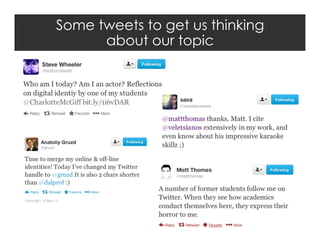
Some tweets to get us thinking
about our topic
My research
Students’, Instructors’, and Scholars’
experiences and practices with emerging
technologies in digital environments
(e.g., social networks, open scholarship,
open courses/experiences)

To improve environments and practices
Emerging Technologies
•  May or may not be new technologies
•  Evolving, “coming into being”
•  Go through “hype cycles”
•  Not yet fully understood
•  Not yet fully researched
•  Potentially disruptive (but potential is unfulfilled)
(Veletsianos, 2010)
In this presentation
Explore the activities and practices that
academics/scholars enact when they use
social media and online networks for
scholarship.
Focus on 3 issues:
(a)  Open Practices.
(b)  Personal-professional tensions.
(c)  Identity.
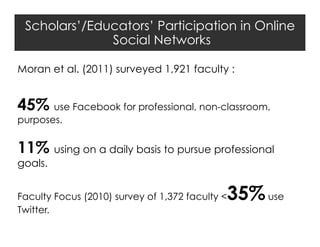
Scholars’/Educators’ Participation in Online
Social Networks
Moran et al. (2011) surveyed 1,921 faculty :

45% use Facebook for professional, non-classroom,
purposes.

11% using on a daily basis to pursue professional
goals.

35% use

Faculty Focus (2010) survey of 1,372 faculty <
Twitter.
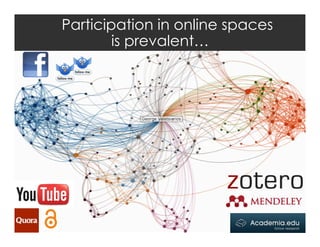
Participation in online spaces
is prevalent…
But
The ways that emerging technologies and
social media are used and experienced by
researchers and educators are poorly
understood and inadequately researched
So, we have a lot of unanswered
questions
• 
• 
• 
• 
• 
• 

How and why do they use these tools?
What are their motivations, challenges, outcomes?
What does participation look like?
Does use vary by academic rank?
What is their experience like?
What is the reality like? (c.f., Selwyn, potential vs.
realities)
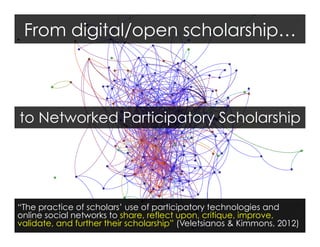
From digital/open scholarship…

to Networked Participatory Scholarship

“The practice of scholars’ use of participatory technologies and
online social networks to share, reflect upon, critique, improve,
validate, and further their scholarship” (Veletsianos & Kimmons, 2012)
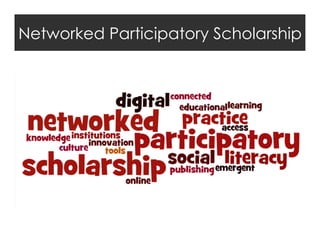
Networked Participatory Scholarship
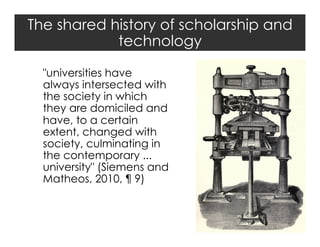
The shared history of scholarship and
technology
"universities have
always intersected with
the society in which
they are domiciled and
have, to a certain
extent, changed with
society, culminating in
the contemporary ...
university" (Siemens and
Matheos, 2010, ¶ 9)
My research on these issues
•  Individual
•  Collaborative

•  Royce Kimmons: http://www.kimmons.me
•  Kasey Ford
•  In the works: Andy Coverdale, Amy Collier, (You?)

•  Largely qualitative
•  Data

–  Interviews
–  focus groups
–  Naturalistic social media data (e.g., tweets 
ethnographic data collection methods)

•  Analytic methods

–  Grounded theory
–  Basic interpretive
–  Phenomenology
1. Open Practices
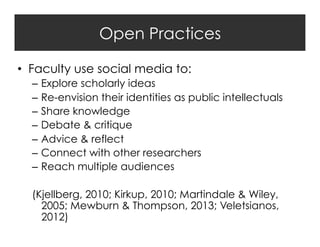
Open Practices
•  Faculty use social media to:
–  Explore scholarly ideas
–  Re-envision their identities as public intellectuals
–  Share knowledge
–  Debate & critique
–  Advice & reflect
–  Connect with other researchers
–  Reach multiple audiences
(Kjellberg, 2010; Kirkup, 2010; Martindale & Wiley,
2005; Mewburn & Thompson, 2013; Veletsianos,
2012)
What scholarly activities do individuals
enact on social media?
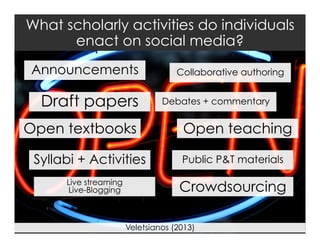
What scholarly activities do individuals
enact on social media?
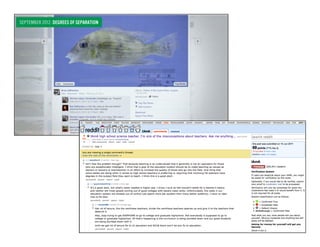
Announcements

Draft papers
Open textbooks
Syllabi + Activities
Live streaming
Live-Blogging

Collaborative authoring
Debates + commentary

Open teaching
Public P&T materials

Crowdsourcing
Veletsianos (2013)
These acts/activities question academic
traditions & the status quo
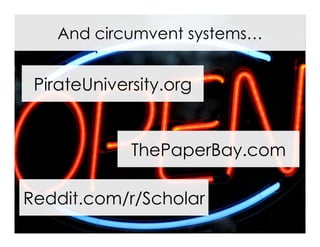
And circumvent systems…

PirateUniversity.org

ThePaperBay.com
Reddit.com/r/Scholar
On open practices and “sharing”
What do we share?
Vulnerabilities (e.g., areas of personal
growth)
Struggles (e.g., a divorce)
Passions (e.g., soccer, knitting)
Mundane details of our life
“Hang out” ... “Mess around” … (c.f., Ito et
al, 2013)
 Unrelated to the profession, but…
What is the value of these activities?
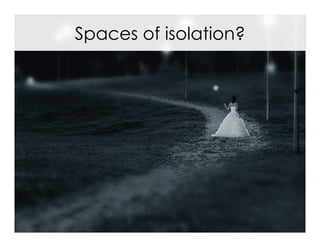
Spaces of isolation?
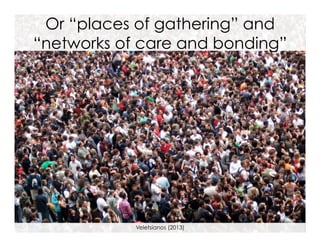
Or “places of gathering” and
“networks of care and bonding”

Veletsianos (2013)
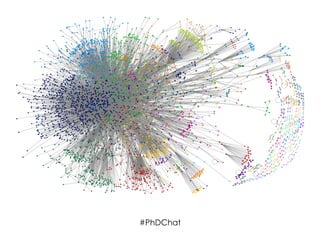
#PhDChat
2. Personal-Professional Tensions
Personal-professional tensions
Web 2.0 sites largely used for personal
rather than educational reasons (Luckin et
al., 2009; Selwyn, 2009).
Researchers of Tomorrow project (2010):
young researchers (doctoral students born
between 1982 and 1994) are not utilizing
social networking technologies for
scholarship
Is this surprising?
Personal-professional tensions
“My position [as a professor] is building a community of
teachers that I talk to ... where you can share, and so
[participation in these spaces] makes total sense.”

Veletsianos & Kimmons (2013)
Personal-professional tensions
“My position [as a professor] is building a community of
teachers that I talk to ... where you can share, and so
[participation in these spaces] makes total sense.”
“I made it [Facebook] this hybrid space ... and
sometimes it's really annoying. … I keep thinking I should
be writing or looking at data, and I'm doing this! … I
think that I created the conundrum that I live in now.”
Personal-professional tensions
“My position [as a professor] is building a community of
teachers that I talk to ... where you can share, and so
[participation in these spaces] makes total sense.”
“I made it [Facebook] this hybrid space ... and
sometimes it's really annoying. … I keep thinking I should
be writing or looking at data, and I'm doing this! … I
think that I created the conundrum that I live in now.”
“All the [expletive] is not really worth it. … I think that it's
okay for students to not know everything about their
professor. … [These practices] add to the complexity of
those who struggle with the home-work balance and
the ... technology pull. … I don't have time for you. “
3. Identity
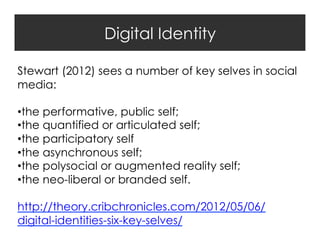
Digital Identity
Stewart (2012) sees a number of key selves in social
media:
• the performative, public self;
• the quantified or articulated self;
• the participatory self
• the asynchronous self;
• the polysocial or augmented reality self;
• the neo-liberal or branded self.
http://theory.cribchronicles.com/2012/05/06/
digital-identities-six-key-selves/
Digital Identity
We create it
 Intentional web presence
Lowenthal & Dunlap (2012)
It is created and/or structured for us
Acceptable Identity Fragments (Kimmons
& Veletsianos, under review)
On Environments & Determinism
“We shape our buildings, and afterwards our
buildings shape us.” (Churchill, 1943)
“We shape our tools and thereafter our tools
shape us” (McLuhan, 1994).
Emerging technologies shape and are being
shaped by … practice (Veletsianos, 2010).
When our identity is (partly) structured
for us….
We need to be mindful that:
-  Technology is not neutral
(especially because frequently repurpose
technologies developed for non-educational
purposes that may have different value/belief
systems)
Identity
A constellation of interconnected acceptable
identity fragments
Each fragment is
•  Intentional
•  Authentic
•  Transitional
•  Incomplete
•  Socially-constructed
•  Socially-responsive
(Kimmons & Veletsianos, under review)
Identity
Educator participation in SNS is
•  Neither fully representative of authentic
identity
•  Nor dramaturgical

(Kimmons & Veletsianos, under review)
In closing…
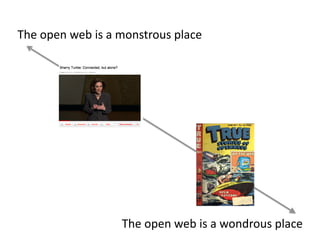
The	
  open	
  web	
  is	
  a	
  monstrous	
  place	
  

The	
  open	
  web	
  is	
  a	
  wondrous	
  place	
  
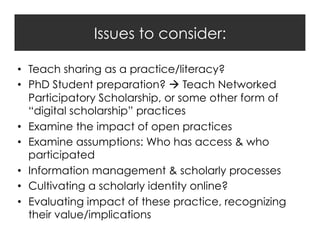
Issues to consider:
•  Teach sharing as a practice/literacy?
•  PhD Student preparation?  Teach Networked
Participatory Scholarship, or some other form of
“digital scholarship” practices
•  Examine the impact of open practices
•  Examine assumptions: Who has access & who
participated
•  Information management & scholarly processes
•  Cultivating a scholarly identity online?
•  Evaluating impact of these practice, recognizing
their value/implications
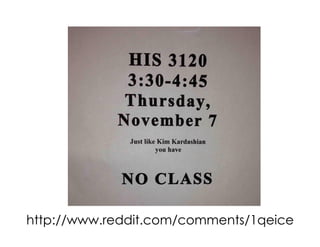
http://www.reddit.com/comments/1qeice
Tonight at 9pm EST Bonnie Stewart is leading
“Building a Networked Identity” for
#wweopen13 –
Join at: http://www.tinyurl.com/pten8yw
Thank you!
This presentation is
available on
www.slideshare.com/
veletsianos

www.veletsianos.com
@veletsianos on Twitter
veletsianos@gmail.com
Related work

Available at http://www.veletsianos/publications
Kimmons, R., and Veletsianos, G. (under review). Teacher professionalization in the age of social
networking sites.
Kimmons, R., and Veletsianos, G. (under review). The fragmented educator 2.0: Social networking sites,
acceptable identity fragments, and the identity constellation.
Veletsianos, G. (2013). Open Practices and Identity: Evidence from Researchers and Educators’ Social
Media Participation. British Journal of Educational Technology, 44(3), 639-651.
Veletsianos, G. (2010). A Definition of Emerging Technologies for Education. In G. Veletsianos (Ed.),
Emerging Technologies in Distance Education (pp. 3-22). Edmonton, AB: Athabasca University Press
.
Veletsianos, G. & Kimmons, R. (2013). Scholars and Faculty Members Lived Experiences in Online Social
Networks. The Internet and Higher Education,16(1), 43-50.
Veletsianos, G. & Kimmons, R. (2012). Assumptions and Challenges of Open Scholarship. The
International Review Of Research In Open And Distance Learning,13(4), 166-189
Veletsianos, G. (2012). Higher Education Scholars’ Participation and Practices on Twitter. Journal of
Computer Assisted Learning, 28(4), 336-349.
Veletsianos, G. & Kimmons, R. (2012). Networked Participatory Scholarship: Emergent Techno-Cultural
Pressures Toward Open and Digital Scholarship in Online Networks. Computers & Education, 58(2),
766-774.
Image attribution
•  Fairy tale http://browse.deviantart.com/art/fairy-tale-134701049
•  Open http://www.flickr.com/photos/matthileo/4826783509/
•  Crowd http://www.flickr.com/photos/18378655@N00/613445810

Unless otherwise noted by the original images, content is provided under a CC Attribution
Non-Commercial Share Alike license (http://creativecommons.org/licenses/by-nc-sa/
3.0/).

What Do Academics and Educators Do on Social Media and Networks? What Do Their Experiences Tell Us About Identity and the Web?

  • 1.
    What Do Academicsand Educators Do on Social Media and Networks? What Do Their Experiences Tell Us About Identity and the Web? George Veletsianos, PhD Canada Research Chair Associate Professor School of Education and Technology Canadian Institute of Distance Education Research Webinar, November 2013
  • 2.
    Some tweets toget us thinking about our topic
  • 3.
    My research Students’, Instructors’,and Scholars’ experiences and practices with emerging technologies in digital environments (e.g., social networks, open scholarship, open courses/experiences) To improve environments and practices
  • 4.
    Emerging Technologies •  Mayor may not be new technologies •  Evolving, “coming into being” •  Go through “hype cycles” •  Not yet fully understood •  Not yet fully researched •  Potentially disruptive (but potential is unfulfilled) (Veletsianos, 2010)
  • 5.
    In this presentation Explorethe activities and practices that academics/scholars enact when they use social media and online networks for scholarship. Focus on 3 issues: (a)  Open Practices. (b)  Personal-professional tensions. (c)  Identity.
  • 6.
    Scholars’/Educators’ Participation inOnline Social Networks Moran et al. (2011) surveyed 1,921 faculty : 45% use Facebook for professional, non-classroom, purposes. 11% using on a daily basis to pursue professional goals. 35% use Faculty Focus (2010) survey of 1,372 faculty < Twitter.
  • 7.
    Participation in onlinespaces is prevalent…
  • 8.
    But The ways thatemerging technologies and social media are used and experienced by researchers and educators are poorly understood and inadequately researched
  • 9.
    So, we havea lot of unanswered questions •  •  •  •  •  •  How and why do they use these tools? What are their motivations, challenges, outcomes? What does participation look like? Does use vary by academic rank? What is their experience like? What is the reality like? (c.f., Selwyn, potential vs. realities)
  • 10.
    From digital/open scholarship… toNetworked Participatory Scholarship “The practice of scholars’ use of participatory technologies and online social networks to share, reflect upon, critique, improve, validate, and further their scholarship” (Veletsianos & Kimmons, 2012)
  • 11.
  • 12.
    The shared historyof scholarship and technology "universities have always intersected with the society in which they are domiciled and have, to a certain extent, changed with society, culminating in the contemporary ... university" (Siemens and Matheos, 2010, ¶ 9)
  • 13.
    My research onthese issues •  Individual •  Collaborative •  Royce Kimmons: http://www.kimmons.me •  Kasey Ford •  In the works: Andy Coverdale, Amy Collier, (You?) •  Largely qualitative •  Data –  Interviews –  focus groups –  Naturalistic social media data (e.g., tweets  ethnographic data collection methods) •  Analytic methods –  Grounded theory –  Basic interpretive –  Phenomenology
  • 14.
  • 15.
    Open Practices •  Facultyuse social media to: –  Explore scholarly ideas –  Re-envision their identities as public intellectuals –  Share knowledge –  Debate & critique –  Advice & reflect –  Connect with other researchers –  Reach multiple audiences (Kjellberg, 2010; Kirkup, 2010; Martindale & Wiley, 2005; Mewburn & Thompson, 2013; Veletsianos, 2012)
  • 16.
    What scholarly activitiesdo individuals enact on social media?
  • 17.
    What scholarly activitiesdo individuals enact on social media? Announcements Draft papers Open textbooks Syllabi + Activities Live streaming Live-Blogging Collaborative authoring Debates + commentary Open teaching Public P&T materials Crowdsourcing Veletsianos (2013)
  • 19.
    These acts/activities questionacademic traditions & the status quo
  • 20.
  • 22.
    On open practicesand “sharing” What do we share? Vulnerabilities (e.g., areas of personal growth) Struggles (e.g., a divorce) Passions (e.g., soccer, knitting) Mundane details of our life “Hang out” ... “Mess around” … (c.f., Ito et al, 2013)  Unrelated to the profession, but… What is the value of these activities?
  • 23.
  • 24.
    Or “places ofgathering” and “networks of care and bonding” Veletsianos (2013)
  • 25.
  • 26.
  • 27.
    Personal-professional tensions Web 2.0sites largely used for personal rather than educational reasons (Luckin et al., 2009; Selwyn, 2009). Researchers of Tomorrow project (2010): young researchers (doctoral students born between 1982 and 1994) are not utilizing social networking technologies for scholarship Is this surprising?
  • 28.
    Personal-professional tensions “My position[as a professor] is building a community of teachers that I talk to ... where you can share, and so [participation in these spaces] makes total sense.” Veletsianos & Kimmons (2013)
  • 29.
    Personal-professional tensions “My position[as a professor] is building a community of teachers that I talk to ... where you can share, and so [participation in these spaces] makes total sense.” “I made it [Facebook] this hybrid space ... and sometimes it's really annoying. … I keep thinking I should be writing or looking at data, and I'm doing this! … I think that I created the conundrum that I live in now.”
  • 30.
    Personal-professional tensions “My position[as a professor] is building a community of teachers that I talk to ... where you can share, and so [participation in these spaces] makes total sense.” “I made it [Facebook] this hybrid space ... and sometimes it's really annoying. … I keep thinking I should be writing or looking at data, and I'm doing this! … I think that I created the conundrum that I live in now.” “All the [expletive] is not really worth it. … I think that it's okay for students to not know everything about their professor. … [These practices] add to the complexity of those who struggle with the home-work balance and the ... technology pull. … I don't have time for you. “
  • 31.
  • 32.
    Digital Identity Stewart (2012)sees a number of key selves in social media: • the performative, public self; • the quantified or articulated self; • the participatory self • the asynchronous self; • the polysocial or augmented reality self; • the neo-liberal or branded self. http://theory.cribchronicles.com/2012/05/06/ digital-identities-six-key-selves/
  • 33.
    Digital Identity We createit  Intentional web presence Lowenthal & Dunlap (2012) It is created and/or structured for us Acceptable Identity Fragments (Kimmons & Veletsianos, under review)
  • 34.
    On Environments &Determinism “We shape our buildings, and afterwards our buildings shape us.” (Churchill, 1943) “We shape our tools and thereafter our tools shape us” (McLuhan, 1994). Emerging technologies shape and are being shaped by … practice (Veletsianos, 2010).
  • 35.
    When our identityis (partly) structured for us…. We need to be mindful that: -  Technology is not neutral (especially because frequently repurpose technologies developed for non-educational purposes that may have different value/belief systems)
  • 36.
    Identity A constellation ofinterconnected acceptable identity fragments Each fragment is •  Intentional •  Authentic •  Transitional •  Incomplete •  Socially-constructed •  Socially-responsive (Kimmons & Veletsianos, under review)
  • 37.
    Identity Educator participation inSNS is •  Neither fully representative of authentic identity •  Nor dramaturgical (Kimmons & Veletsianos, under review)
  • 38.
  • 39.
    The  open  web  is  a  monstrous  place   The  open  web  is  a  wondrous  place  
  • 40.
    Issues to consider: • Teach sharing as a practice/literacy? •  PhD Student preparation?  Teach Networked Participatory Scholarship, or some other form of “digital scholarship” practices •  Examine the impact of open practices •  Examine assumptions: Who has access & who participated •  Information management & scholarly processes •  Cultivating a scholarly identity online? •  Evaluating impact of these practice, recognizing their value/implications
  • 41.
  • 42.
    Tonight at 9pmEST Bonnie Stewart is leading “Building a Networked Identity” for #wweopen13 – Join at: http://www.tinyurl.com/pten8yw
  • 43.
    Thank you! This presentationis available on www.slideshare.com/ veletsianos www.veletsianos.com @veletsianos on Twitter veletsianos@gmail.com
  • 44.
    Related work Available athttp://www.veletsianos/publications Kimmons, R., and Veletsianos, G. (under review). Teacher professionalization in the age of social networking sites. Kimmons, R., and Veletsianos, G. (under review). The fragmented educator 2.0: Social networking sites, acceptable identity fragments, and the identity constellation. Veletsianos, G. (2013). Open Practices and Identity: Evidence from Researchers and Educators’ Social Media Participation. British Journal of Educational Technology, 44(3), 639-651. Veletsianos, G. (2010). A Definition of Emerging Technologies for Education. In G. Veletsianos (Ed.), Emerging Technologies in Distance Education (pp. 3-22). Edmonton, AB: Athabasca University Press . Veletsianos, G. & Kimmons, R. (2013). Scholars and Faculty Members Lived Experiences in Online Social Networks. The Internet and Higher Education,16(1), 43-50. Veletsianos, G. & Kimmons, R. (2012). Assumptions and Challenges of Open Scholarship. The International Review Of Research In Open And Distance Learning,13(4), 166-189 Veletsianos, G. (2012). Higher Education Scholars’ Participation and Practices on Twitter. Journal of Computer Assisted Learning, 28(4), 336-349. Veletsianos, G. & Kimmons, R. (2012). Networked Participatory Scholarship: Emergent Techno-Cultural Pressures Toward Open and Digital Scholarship in Online Networks. Computers & Education, 58(2), 766-774.
  • 45.
    Image attribution •  Fairytale http://browse.deviantart.com/art/fairy-tale-134701049 •  Open http://www.flickr.com/photos/matthileo/4826783509/ •  Crowd http://www.flickr.com/photos/18378655@N00/613445810 Unless otherwise noted by the original images, content is provided under a CC Attribution Non-Commercial Share Alike license (http://creativecommons.org/licenses/by-nc-sa/ 3.0/).