Social Media & Society Conference
July 2016, London, UK
Scholars' Imagined Audiences and their
Impact on Social Media Participation
George Veletsianos, PhD
Canada Research Chair & Associate Professor
Royal Roads University
Victoria, BC
Ash Shaw
Royal Roads University & University of British Columbia
Victoria, BC & Vancouver BC
Networked Scholarship, or
Networked Participatory Scholarship:
“scholars’ use of participatory technologies and
online social networks to share, reflect upon,
critique, improve, validate, and further their
scholarship” (Veletsianos & Kimmons, 2012)
•  A non-deterministic perspective
A bit of theory:
Networked Scholarship
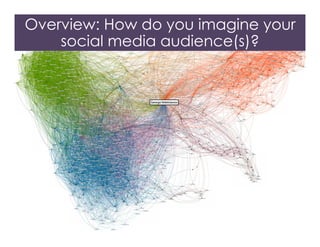
Overview: How do you imagine your
social media audience(s)?
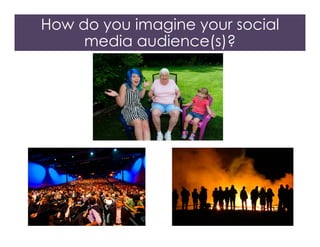
How do you imagine your social
media audience(s)?
Motivation
Imagined audiences: “mental conceptualization of
the people with whom we are communicating”
(Litt, 2012)
Imagined audiences shape social media practices
(Marwick & boyd, 2011).
This phenomenon is largely unexplored in relation to
scholars’ social media practices
Relevant Literature
How do imagined audiences affect social media
users?
•  Marwick & boyd (2011): Some consciously tweet
to cultivate a persona. Others reported tweeting
“for themselves.”
•  Brake (2012): most considered a specific
audience of friends and family when deciding
what to blog
•  Litt (2015): ~1/2 had a specific audience in mind.
For the rest: audience = more indefinite/abstract.
Relevance to academics/faculty?
Academics are increasingly using social media and
are frequently encouraged to develop a social
media presence
Research Questions
We examined
•  how do scholars conceptualize their audiences
when participating on social media?
•  how does this conceptualization shape the ways
in which they participate and express themselves
online?
Methods
•  Interviews
•  Invited 5 bloggers, posted invitations on personal
blogs/FB/Twitter channels, snowball sampling
•  42 completed a consent form
•  16 interviewed
•  Transcripts analyzed using the constant
comparative method (Glaser & Strauss, 1967)
•  Limitations: 1-time interviews, sample
representativeness
Participants
Age: 29 - 57 (mean = 41.6; S.D = 8.1; median = 40.5).
12 self-identified as F, 3 as M, & 1 as transgender.
Education or educational technology (10),
humanities (3), social sciences exclusive of
education (2), and nursing (1).
Lived in the United States (8), Canada (3), the
United Kingdom (3), Australia (1), and Egypt (1).
Results: How do they conceptualize
their audiences?
Identified 4 specific (at times overlapping) groups:
•  academics,
•  family and friends,
•  groups related to one’s profession,
•  individuals who shared commonalities with them.
Incompatibility between certain groups
à When seen as problematic (context collapse).
Solution: attempt to keep audiences separate
à  At times, seen as potentially beneficial
Solution: allow contexts to collapse
[“context collusion” – Davis & Jurgenson, 2014]
Results: How do they conceptualize
their audiences?
Known vs. Unknown
Known: Individuals known personally and well
(online & offline)
Unknown: Audiences that scholars understood but
knew little about.
Strategies used to gain understanding of audience:
•  examining hashtags followers used
•  identifying when followers followed them
•  (limited use of) social network analysis
Results: How does audience
conceptualization impact participation?
Scholars used their understanding of their audience
to guide their decisions around whatto
share & whereto share such information.
Results: How does audience
conceptualization impact participation?
Filtering
Motivated by concerns around how posting would
reflect on themselves or others.
Filtering took a number of forms, most frequently:
•  Avoiding posting something for fear of offending
or alienating others
•  Posting to a particular platform (eg FB pereived
more personal than Twitter) or audience
•  Conscious of tone, language, and emotion
•  Controversial topics: political views, sexuality,
social justice, and religion.
Implications 1/2
Previous research: social media users are not
concerned about their audience’s reaction to posts
This study: all participants concerned & make
conscious decisions about restricting/amending
posts
Implications 2/2
Previous research: Identified misalignment between
actual and imagined audiences
This study: identifies misalignment between the
audiences scholars imagine and the audiences
institutions imagine their scholars encountering.
Conclusion
Recognizing that scholars participating online are
not merely disembodied personas aiming to amass
citations and followers can enable researchers to
make better sense of the negotiated relationship
between digital audiences and scholars.
Thank you!
Research available at:
http://www.veletsianos/
publications
This presentation:
www.slideshare.com/
veletsianos
Contact:
veletsianos@gmail.com
@veletsianos on Twitter
Audience https://flic.kr/p/5YxihJ
Audience @ LeWeb 11 Les Docks-9306 https://flic.kr/p/aUh4TP
Audience https://flic.kr/p/8HxA8E
Family https://flic.kr/p/oF8Hd2
Colleagues https://flic.kr/p/7xEgDw
Nightmare - 10 https://flic.kr/p/cLzoCj
146a Diplo and Skrillex at Burning Man 2014 Opulent Temple -
https://flic.kr/p/oZH672
CC-Licensed images

Scholars imagined audiences

  • 1.
    Social Media &Society Conference July 2016, London, UK Scholars' Imagined Audiences and their Impact on Social Media Participation George Veletsianos, PhD Canada Research Chair & Associate Professor Royal Roads University Victoria, BC Ash Shaw Royal Roads University & University of British Columbia Victoria, BC & Vancouver BC
  • 2.
    Networked Scholarship, or NetworkedParticipatory Scholarship: “scholars’ use of participatory technologies and online social networks to share, reflect upon, critique, improve, validate, and further their scholarship” (Veletsianos & Kimmons, 2012) •  A non-deterministic perspective A bit of theory: Networked Scholarship
  • 3.
    Overview: How doyou imagine your social media audience(s)?
  • 4.
    How do youimagine your social media audience(s)?
  • 5.
    Motivation Imagined audiences: “mentalconceptualization of the people with whom we are communicating” (Litt, 2012) Imagined audiences shape social media practices (Marwick & boyd, 2011). This phenomenon is largely unexplored in relation to scholars’ social media practices
  • 6.
    Relevant Literature How doimagined audiences affect social media users? •  Marwick & boyd (2011): Some consciously tweet to cultivate a persona. Others reported tweeting “for themselves.” •  Brake (2012): most considered a specific audience of friends and family when deciding what to blog •  Litt (2015): ~1/2 had a specific audience in mind. For the rest: audience = more indefinite/abstract.
  • 7.
    Relevance to academics/faculty? Academicsare increasingly using social media and are frequently encouraged to develop a social media presence
  • 8.
    Research Questions We examined • how do scholars conceptualize their audiences when participating on social media? •  how does this conceptualization shape the ways in which they participate and express themselves online?
  • 9.
    Methods •  Interviews •  Invited5 bloggers, posted invitations on personal blogs/FB/Twitter channels, snowball sampling •  42 completed a consent form •  16 interviewed •  Transcripts analyzed using the constant comparative method (Glaser & Strauss, 1967) •  Limitations: 1-time interviews, sample representativeness
  • 10.
    Participants Age: 29 -57 (mean = 41.6; S.D = 8.1; median = 40.5). 12 self-identified as F, 3 as M, & 1 as transgender. Education or educational technology (10), humanities (3), social sciences exclusive of education (2), and nursing (1). Lived in the United States (8), Canada (3), the United Kingdom (3), Australia (1), and Egypt (1).
  • 11.
    Results: How dothey conceptualize their audiences? Identified 4 specific (at times overlapping) groups: •  academics, •  family and friends, •  groups related to one’s profession, •  individuals who shared commonalities with them. Incompatibility between certain groups à When seen as problematic (context collapse). Solution: attempt to keep audiences separate à  At times, seen as potentially beneficial Solution: allow contexts to collapse [“context collusion” – Davis & Jurgenson, 2014]
  • 12.
    Results: How dothey conceptualize their audiences? Known vs. Unknown Known: Individuals known personally and well (online & offline) Unknown: Audiences that scholars understood but knew little about. Strategies used to gain understanding of audience: •  examining hashtags followers used •  identifying when followers followed them •  (limited use of) social network analysis
  • 13.
    Results: How doesaudience conceptualization impact participation? Scholars used their understanding of their audience to guide their decisions around whatto share & whereto share such information.
  • 14.
    Results: How doesaudience conceptualization impact participation? Filtering Motivated by concerns around how posting would reflect on themselves or others. Filtering took a number of forms, most frequently: •  Avoiding posting something for fear of offending or alienating others •  Posting to a particular platform (eg FB pereived more personal than Twitter) or audience •  Conscious of tone, language, and emotion •  Controversial topics: political views, sexuality, social justice, and religion.
  • 15.
    Implications 1/2 Previous research:social media users are not concerned about their audience’s reaction to posts This study: all participants concerned & make conscious decisions about restricting/amending posts
  • 16.
    Implications 2/2 Previous research:Identified misalignment between actual and imagined audiences This study: identifies misalignment between the audiences scholars imagine and the audiences institutions imagine their scholars encountering.
  • 17.
    Conclusion Recognizing that scholarsparticipating online are not merely disembodied personas aiming to amass citations and followers can enable researchers to make better sense of the negotiated relationship between digital audiences and scholars.
  • 18.
    Thank you! Research availableat: http://www.veletsianos/ publications This presentation: www.slideshare.com/ veletsianos Contact: veletsianos@gmail.com @veletsianos on Twitter
  • 19.
    Audience https://flic.kr/p/5YxihJ Audience @LeWeb 11 Les Docks-9306 https://flic.kr/p/aUh4TP Audience https://flic.kr/p/8HxA8E Family https://flic.kr/p/oF8Hd2 Colleagues https://flic.kr/p/7xEgDw Nightmare - 10 https://flic.kr/p/cLzoCj 146a Diplo and Skrillex at Burning Man 2014 Opulent Temple - https://flic.kr/p/oZH672 CC-Licensed images