Open Scholarship: Social Media,
Participation, and Online Networks
George Veletsianos, PhD
Canada Research Chair
Associate Professor
School of Education and Technology

Athabasca University, Faculty of Health Disciplines, Edmonton, Feb 2014
Gist of the argument
The world is complex and the future is unknown
Society embraced increases in connectedness,
participation, and openness (Wiley & Hilton,
2009)
Historically, educational institutions have
reflected the societies which house them
How can scholarship (teaching, learning,
research) reflect connectedness,
participation, and openness?
Connectedness and Networks
Participation & Participatory Cultures
Openness
•  A guiding belief. A value that lies on a continuum.
•  “open entry for study” to “open resources” to
“open teaching” to “open participation” (Weller,
2013)
•  In terms of content, “open” allows users to reuse,
revise, remix, and redistribute (Wiley, 2009)
Examples
A research paper, textbook, or book published
under an open access license
A syllabus or learning activity published with an
open license
Teaching an open course
Source code, blog posts, photographs, essays, and
so on.
Opportunities
Open practices may
“broaden access to education and knowledge,
reduce costs,
enhance the impact and reach of scholarship and
education,
and foster the development of more equitable,
effective, efficient, and transparent scholarly and
educational processes”
(Veletsianos & Kimmons, 2013)
Challenges
Learners, faculty members, staff, and administrators
need to develop an understanding of openness,
participatory cultures, and digital literacies.
Technology both shapes and is shaped by practice.
Technology is not neutral & has embedded values.
New dilemmas (e,g., information management)
New business models
Openwashing (Wiley 2013; Weller, 2013; Watters, 2013)
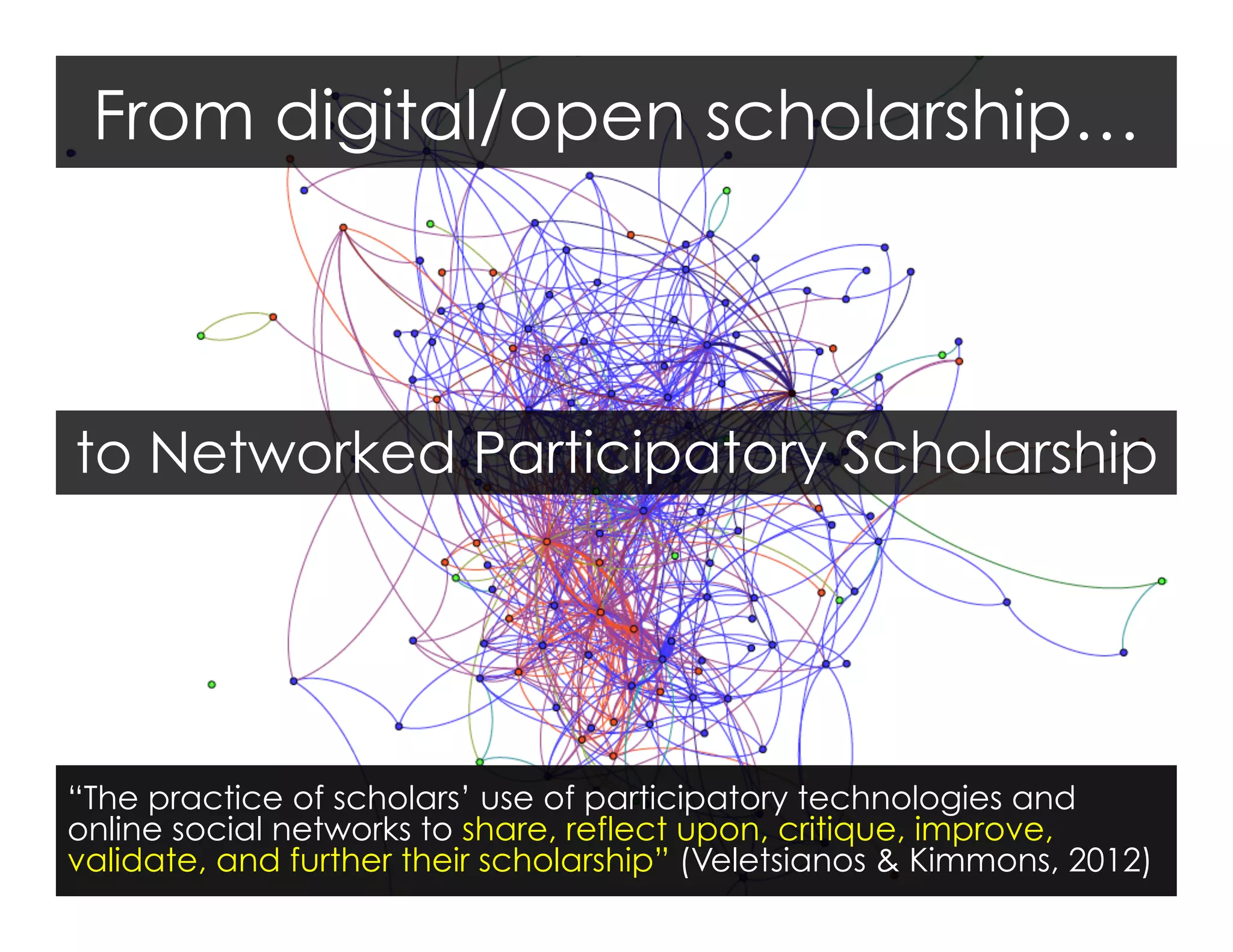
From digital/open scholarship…

to Networked Participatory Scholarship

“The practice of scholars’ use of participatory technologies and
online social networks to share, reflect upon, critique, improve,
validate, and further their scholarship” (Veletsianos & Kimmons, 2012)
Networked Participatory Scholarship
What are open networks like?
•  What happens in these environments?
•  What do learners & educators do?
Networks of knowledge creation
•  Using online networks to create and
disseminate knowledge
Networks of tension
“I made it [Facebook] this hybrid space ...
and sometimes it's really annoying. … I
keep thinking I should be writing or looking
at data, and I'm doing this! … I think that I
created the conundrum that I live in now.”
Networks of care & vulnerability
•  Caring for one another online
•  Congregate, learn from each other,
support each other, and commiserate over
work, education, and life challenges.
Networks of conflict and circumvention
•  Academics routinely post their papers
online
Networks of conflict and circumvention
•  Academics routinely post their papers online
•  Elsevier takedown notices (late 2013)
•  Scholars already have systems/tools in place
to circumvent restrictions
–  Innocuous

•  Institutional repositories
•  Publishing under Open Access

–  Not so innocuous
• 
• 
• 
• 

Pirateuniversity.org
Thepaperbay.com
Dropbox links
#icanhazpdf
Fragmented networks
•  Expression of identity online appears to
consist of a constellation of acceptable
identity fragments.
(Kimmons & Veletsianos, 2014)
Fragmented networks
•  shaped their participation in social
networking sites in a manner that they
believed to be “acceptable” to their
audiences,
•  viewed this participation to be a direct
expression of “identity” or their sense of self,
•  felt this expression to only represent a small
“fragment” of their complete identities.
•  Online participation = real & fragmented=
NOT a facade
Transparent networks
•  Scholars and students making activities/
practices transparent
Transparent networks
•  Scholars and students making activities/
practices transparent
What does all this mean for our
institutions?
“Sharing:” A literacy to teach/
embrace
•  What would our courses look like if we
shared more?
–  What if “sharing” and “open” were the default,
and we “closed” was the option?
Perceptions of the Web

The	
  open	
  web	
  is	
  a	
  
monstrous	
  place	
  

The	
  open	
  web	
  is	
  a	
  
wondrous	
  place	
  
Courses as participatory cultures
•  Activities/assignments should ask students
to produce material (e.g., content,
products, tools) that can benefit local
communities and society.
•  Students as producers, not simply
consumers of information & knowledge
•  These materials should be published online
under open licenses
–  E.g., e-books
What does “open” look like in health
disciplines?
Thank you!
www.veletsianos.com
www.veletsianos.com/publications
@veletsianos on Twitter
veletsianos@gmail.com
These slides: www.slideshare.com/veletsianos

Open Scholarship: Social Media, Participation, and Online Networks

  • 1.
    Open Scholarship: SocialMedia, Participation, and Online Networks George Veletsianos, PhD Canada Research Chair Associate Professor School of Education and Technology Athabasca University, Faculty of Health Disciplines, Edmonton, Feb 2014
  • 2.
    Gist of theargument The world is complex and the future is unknown Society embraced increases in connectedness, participation, and openness (Wiley & Hilton, 2009) Historically, educational institutions have reflected the societies which house them How can scholarship (teaching, learning, research) reflect connectedness, participation, and openness?
  • 3.
  • 4.
  • 5.
    Openness •  A guidingbelief. A value that lies on a continuum. •  “open entry for study” to “open resources” to “open teaching” to “open participation” (Weller, 2013) •  In terms of content, “open” allows users to reuse, revise, remix, and redistribute (Wiley, 2009)
  • 6.
    Examples A research paper,textbook, or book published under an open access license A syllabus or learning activity published with an open license Teaching an open course Source code, blog posts, photographs, essays, and so on.
  • 7.
    Opportunities Open practices may “broadenaccess to education and knowledge, reduce costs, enhance the impact and reach of scholarship and education, and foster the development of more equitable, effective, efficient, and transparent scholarly and educational processes” (Veletsianos & Kimmons, 2013)
  • 8.
    Challenges Learners, faculty members,staff, and administrators need to develop an understanding of openness, participatory cultures, and digital literacies. Technology both shapes and is shaped by practice. Technology is not neutral & has embedded values. New dilemmas (e,g., information management) New business models Openwashing (Wiley 2013; Weller, 2013; Watters, 2013)
  • 9.
    From digital/open scholarship… toNetworked Participatory Scholarship “The practice of scholars’ use of participatory technologies and online social networks to share, reflect upon, critique, improve, validate, and further their scholarship” (Veletsianos & Kimmons, 2012)
  • 10.
  • 11.
    What are opennetworks like? •  What happens in these environments? •  What do learners & educators do?
  • 12.
    Networks of knowledgecreation •  Using online networks to create and disseminate knowledge
  • 13.
    Networks of tension “Imade it [Facebook] this hybrid space ... and sometimes it's really annoying. … I keep thinking I should be writing or looking at data, and I'm doing this! … I think that I created the conundrum that I live in now.”
  • 14.
    Networks of care& vulnerability •  Caring for one another online •  Congregate, learn from each other, support each other, and commiserate over work, education, and life challenges.
  • 16.
    Networks of conflictand circumvention •  Academics routinely post their papers online
  • 17.
    Networks of conflictand circumvention •  Academics routinely post their papers online •  Elsevier takedown notices (late 2013) •  Scholars already have systems/tools in place to circumvent restrictions –  Innocuous •  Institutional repositories •  Publishing under Open Access –  Not so innocuous •  •  •  •  Pirateuniversity.org Thepaperbay.com Dropbox links #icanhazpdf
  • 18.
    Fragmented networks •  Expressionof identity online appears to consist of a constellation of acceptable identity fragments. (Kimmons & Veletsianos, 2014)
  • 19.
    Fragmented networks •  shapedtheir participation in social networking sites in a manner that they believed to be “acceptable” to their audiences, •  viewed this participation to be a direct expression of “identity” or their sense of self, •  felt this expression to only represent a small “fragment” of their complete identities. •  Online participation = real & fragmented= NOT a facade
  • 20.
    Transparent networks •  Scholarsand students making activities/ practices transparent
  • 21.
    Transparent networks •  Scholarsand students making activities/ practices transparent
  • 22.
    What does allthis mean for our institutions?
  • 23.
    “Sharing:” A literacyto teach/ embrace •  What would our courses look like if we shared more? –  What if “sharing” and “open” were the default, and we “closed” was the option?
  • 24.
    Perceptions of theWeb The  open  web  is  a   monstrous  place   The  open  web  is  a   wondrous  place  
  • 25.
    Courses as participatorycultures •  Activities/assignments should ask students to produce material (e.g., content, products, tools) that can benefit local communities and society. •  Students as producers, not simply consumers of information & knowledge •  These materials should be published online under open licenses –  E.g., e-books
  • 26.
    What does “open”look like in health disciplines?
  • 27.
    Thank you! www.veletsianos.com www.veletsianos.com/publications @veletsianos onTwitter veletsianos@gmail.com These slides: www.slideshare.com/veletsianos