web 2.0: trendy nonsense? Steven Warburton King’s College London [email_address]
where are we now?
identifying trends social nature of learning social-constructivism and situated learning negotiated meaning through dialogue collaboration, community and creativity socio-technical and cultural changes ambient technology, ubiquitous computing fluidity between individual, group, community and networks web-natives, digital natives, net generation web 2.0 read/write web -> consumer becomes producer complexity, emergent behaviour and emergent classifications the rise of social software
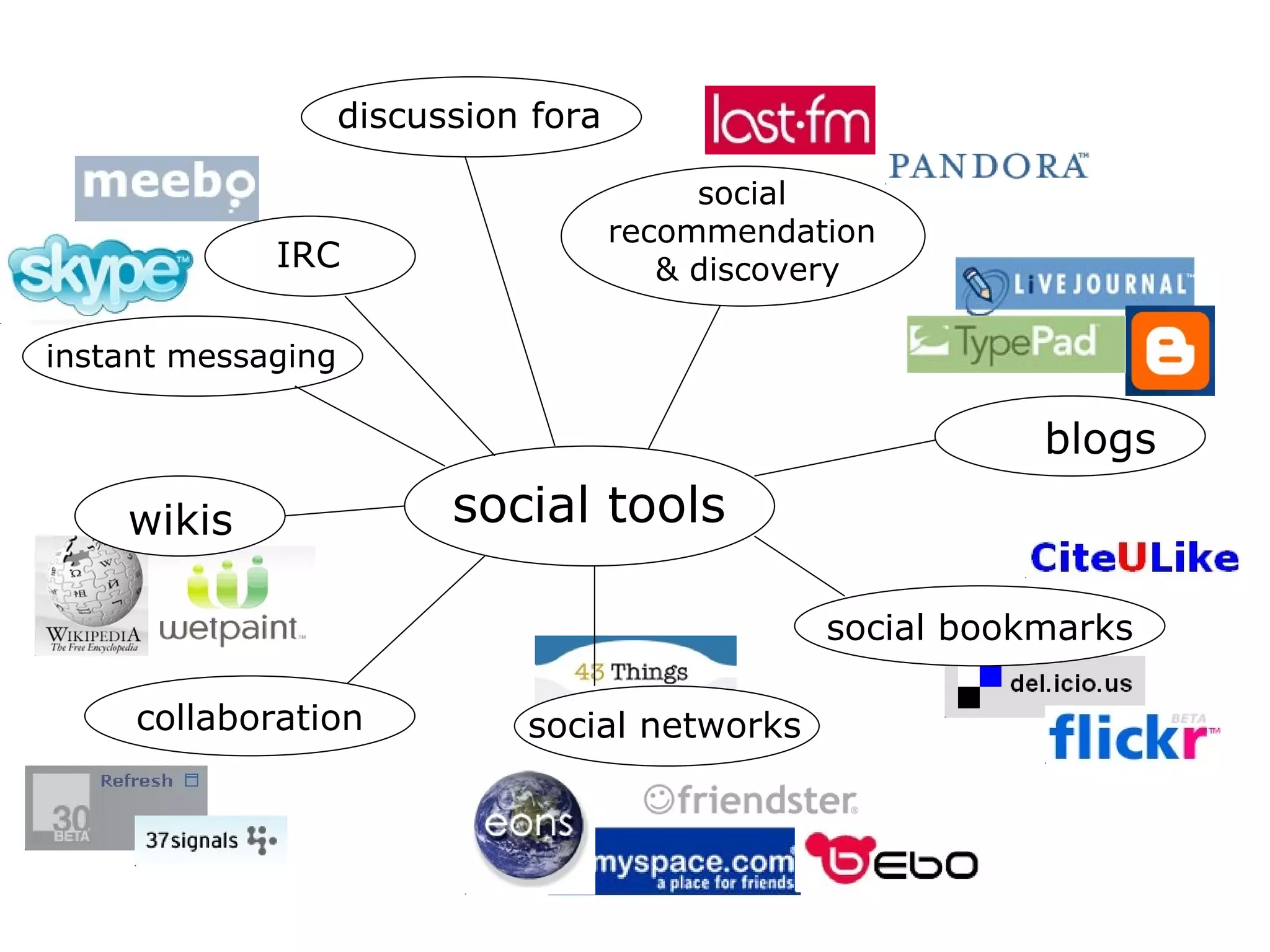
social tools social bookmarks IRC blogs discussion fora social networks instant messaging wikis collaboration social  recommendation  & discovery
e-learning: dominant models, developments and drivers reusable learning objects quality frameworks standards (SCORM, LOM, QTI) digital repositories (silos) scripted learning activities (IMS LD) content delivery and assessment driven (VLE) a hierarchical industrial model that can respond to increasing student numbers and pressures on staff time
web 2.0 in education what is the problem to which web 2.0 technologies are posited as a solution? how does the rhetoric of web 2.0 stand up to close scrutiny? what questions are these technologies asking of ‘us’, our values, our teaching and our institutions
problematising web 2.0
consumers  becoming producers blogs, wikis, YouTube, podcasts, slideshare, del.icio.us and so on inevitably leads to:  mass amateurisation information rich but knowledge poor  incoherence information overload not what I know but who I know or where to find it? open systems = chaos?
collaboration: individual, group, community and networks what are our motives for collaboration and cooperation? what conditions support strong community formation? emergent behaviours (critical mass) groups vs. networks or groups to communities in networks what happens to: trust identity (work on the self)  and shared purpose
Stephen Downes whiteboard brain dump on the essence of group vs. network
personalisation personal = choice = problematic (how do we know how to make these choices?) personal = private = problematic (institutions should respect privacy?) there is a distinct lack of clarity between between customisation and personalisation?
next generation - what generation? where is the evidence for next generation learners? where are the next generation tutors the student body is always in a state of change unlike our academics?
formal and informal learning spaces  in a web 2.0 world of disruption and the blurring of formal and informal how do students: develop critical self awareness? judge value and quality (disciplinary knowledge boundaries, assessment)? develop intellectual tools? engage in purposeful activities (metacognition, competencies)?
what are the ethical issues raised by web 2.0? personal - implies freedom from censorship public domain vs. respect for student privacy risk - exposing and sharing our thinking traces - e.g. permanence of blogs posts  student visibility / invisibility (the quiet learner) tracking as control identity - adding personal spin, managing reputation what are our responsibilities, where are we accountable?
does a web 2.0 approach work in practice?  evaluating wikis: introducing new tools does not change practice  wikis conflict with traditional assumptions about authorship and intellectual property: why share?: receiving credit for contributions, selfish motive?  consent: contributions being revised or deleted content knowledge can be improved, but this takes time quality can be maintained if versions ready for quality assessment are identified students can be reluctant to contribute to wikis  visual and design options are limited - wikis are not presentation software are wikis easy to use? they require network literacy: writing in a distributed, collaborative environment source: a variety of case studies, see  http://del.icio.us/stevenw/wiki-workshop-2006-11
the floodgates are open how do we respond?  architecture or ecology? do these technologies support our underpinning educational values?
what do institutions say?
we are afraid, very afraid there seem to be two recurring themes: fear of losing  control  by levelling the authority structures fear of losing  control  by levelling authority structures is web 2.0 is going to put me out of a job?
we have seen it all before institutional weariness at having to keep pace with constant technological innovation when pedagogy has barely shifted? where is the evidence for the rhetoric of the Internet being applicable to education? the bubble will burst, these technologies will be socialised and tamed (but to what?) - a natural evolution
are we looking at a paradigm shift? one that is individual, institutional, cultural or?
closed and open systems, hierarchies vs. networks, nupedia to wikipedia Brooks Law (1975) As the number of programmers  N  rises, the work performed also scales as  N , but the complexity and vulnerability to mistakes rises as  N squared “ Conceptual integrity in turn dictates that design must proceed from one mind, or a very small number of agreeing resonant minds” Linus’ Law “ Given enough eyeballs, all bugs are shallow” (Linus Torvalds) or Given a large enough beta-tester and co-developer base, almost every problem will be characterised quickly and the fix obvious to someone.
what do we see in the future? what questions do we need to ask?
key ideas appropriation: understanding the use of technologies as being a locally situated phenomenon and a process of negotiation of meaning occurs at these sites context: a particular technology (wiki) used in an educational activity or context is  not  the same as the technology (wiki) used to collaborate and document a workshop
learner at centre context ( pedagogical approach )? collaborative networked e-learning? formal or informal setting? mixed mode or distance education? expectations personalised social software networked collaborative creative learner motivation experience & competencies time negotiation of meaning

Web 2.0: trendy nonsense?

  • 1.
    web 2.0: trendynonsense? Steven Warburton King’s College London [email_address]
  • 2.
  • 3.
    identifying trends socialnature of learning social-constructivism and situated learning negotiated meaning through dialogue collaboration, community and creativity socio-technical and cultural changes ambient technology, ubiquitous computing fluidity between individual, group, community and networks web-natives, digital natives, net generation web 2.0 read/write web -> consumer becomes producer complexity, emergent behaviour and emergent classifications the rise of social software
  • 4.
    social tools socialbookmarks IRC blogs discussion fora social networks instant messaging wikis collaboration social recommendation & discovery
  • 5.
    e-learning: dominant models,developments and drivers reusable learning objects quality frameworks standards (SCORM, LOM, QTI) digital repositories (silos) scripted learning activities (IMS LD) content delivery and assessment driven (VLE) a hierarchical industrial model that can respond to increasing student numbers and pressures on staff time
  • 6.
    web 2.0 ineducation what is the problem to which web 2.0 technologies are posited as a solution? how does the rhetoric of web 2.0 stand up to close scrutiny? what questions are these technologies asking of ‘us’, our values, our teaching and our institutions
  • 7.
  • 8.
    consumers becomingproducers blogs, wikis, YouTube, podcasts, slideshare, del.icio.us and so on inevitably leads to: mass amateurisation information rich but knowledge poor incoherence information overload not what I know but who I know or where to find it? open systems = chaos?
  • 9.
    collaboration: individual, group,community and networks what are our motives for collaboration and cooperation? what conditions support strong community formation? emergent behaviours (critical mass) groups vs. networks or groups to communities in networks what happens to: trust identity (work on the self) and shared purpose
  • 10.
    Stephen Downes whiteboardbrain dump on the essence of group vs. network
  • 11.
    personalisation personal =choice = problematic (how do we know how to make these choices?) personal = private = problematic (institutions should respect privacy?) there is a distinct lack of clarity between between customisation and personalisation?
  • 12.
    next generation -what generation? where is the evidence for next generation learners? where are the next generation tutors the student body is always in a state of change unlike our academics?
  • 13.
    formal and informallearning spaces in a web 2.0 world of disruption and the blurring of formal and informal how do students: develop critical self awareness? judge value and quality (disciplinary knowledge boundaries, assessment)? develop intellectual tools? engage in purposeful activities (metacognition, competencies)?
  • 14.
    what are theethical issues raised by web 2.0? personal - implies freedom from censorship public domain vs. respect for student privacy risk - exposing and sharing our thinking traces - e.g. permanence of blogs posts student visibility / invisibility (the quiet learner) tracking as control identity - adding personal spin, managing reputation what are our responsibilities, where are we accountable?
  • 15.
    does a web2.0 approach work in practice? evaluating wikis: introducing new tools does not change practice wikis conflict with traditional assumptions about authorship and intellectual property: why share?: receiving credit for contributions, selfish motive? consent: contributions being revised or deleted content knowledge can be improved, but this takes time quality can be maintained if versions ready for quality assessment are identified students can be reluctant to contribute to wikis visual and design options are limited - wikis are not presentation software are wikis easy to use? they require network literacy: writing in a distributed, collaborative environment source: a variety of case studies, see http://del.icio.us/stevenw/wiki-workshop-2006-11
  • 16.
    the floodgates areopen how do we respond? architecture or ecology? do these technologies support our underpinning educational values?
  • 17.
  • 18.
    we are afraid,very afraid there seem to be two recurring themes: fear of losing control by levelling the authority structures fear of losing control by levelling authority structures is web 2.0 is going to put me out of a job?
  • 19.
    we have seenit all before institutional weariness at having to keep pace with constant technological innovation when pedagogy has barely shifted? where is the evidence for the rhetoric of the Internet being applicable to education? the bubble will burst, these technologies will be socialised and tamed (but to what?) - a natural evolution
  • 20.
    are we lookingat a paradigm shift? one that is individual, institutional, cultural or?
  • 21.
    closed and opensystems, hierarchies vs. networks, nupedia to wikipedia Brooks Law (1975) As the number of programmers N rises, the work performed also scales as N , but the complexity and vulnerability to mistakes rises as N squared “ Conceptual integrity in turn dictates that design must proceed from one mind, or a very small number of agreeing resonant minds” Linus’ Law “ Given enough eyeballs, all bugs are shallow” (Linus Torvalds) or Given a large enough beta-tester and co-developer base, almost every problem will be characterised quickly and the fix obvious to someone.
  • 22.
    what do wesee in the future? what questions do we need to ask?
  • 23.
    key ideas appropriation:understanding the use of technologies as being a locally situated phenomenon and a process of negotiation of meaning occurs at these sites context: a particular technology (wiki) used in an educational activity or context is not the same as the technology (wiki) used to collaborate and document a workshop
  • 24.
    learner at centrecontext ( pedagogical approach )? collaborative networked e-learning? formal or informal setting? mixed mode or distance education? expectations personalised social software networked collaborative creative learner motivation experience & competencies time negotiation of meaning