Connectivism:
Social networked learning
               George Siemens, PhD
                September 12, 2012
                       Buenos Aires
“…the fundamental task of education is to
  enculturate youth into this knowledge-
  creating civilization and to help them find a
  place in it…traditional educational practices –
  with its emphasis on knowledge transmission
  – as well as newer constructivist methods
  both appear to be limited in scope if not
  entirely missing the point”

 Scardamalia and Bereiter (2006, Cambridge Handbook of Learning Sciences)
The growing influence of networks as a
 model for understanding the world…
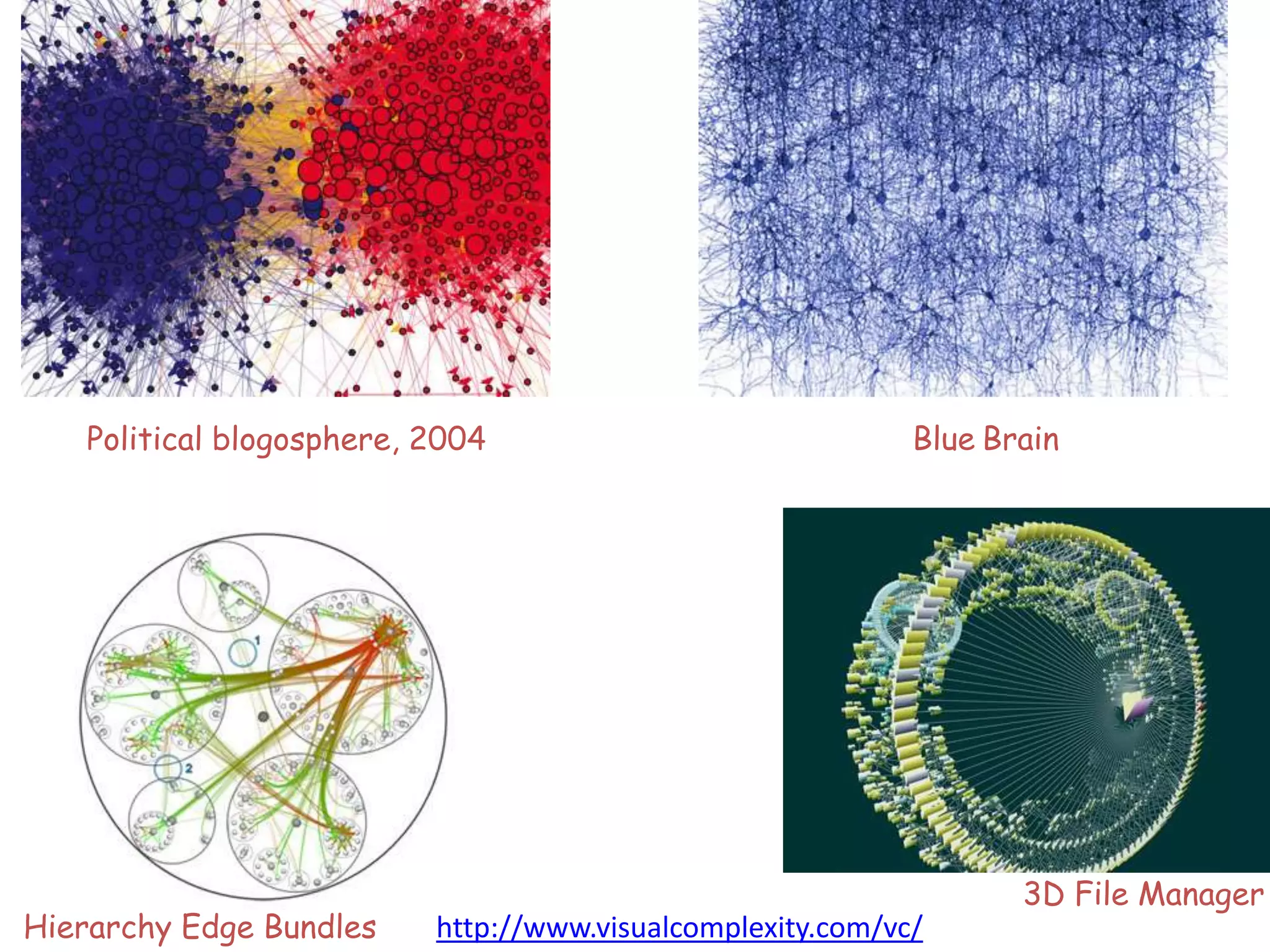
Political blogosphere, 2004                              Blue Brain


                                                                   3D File Manager
Hierarchy Edge Bundles    http://www.visualcomplexity.com/vc/
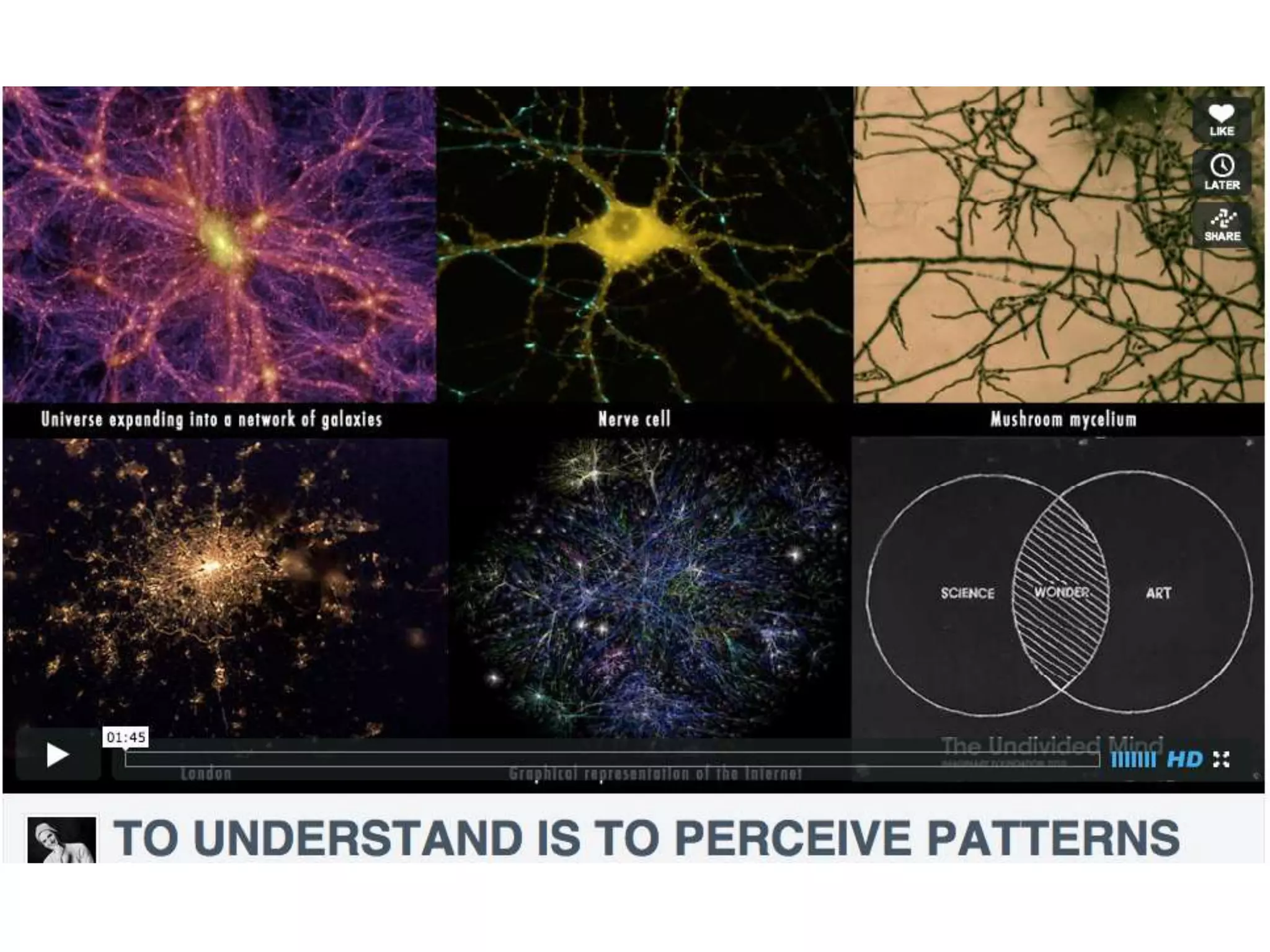
Recognition of complexity and
networks as underpinning attributes
    of social, science, education
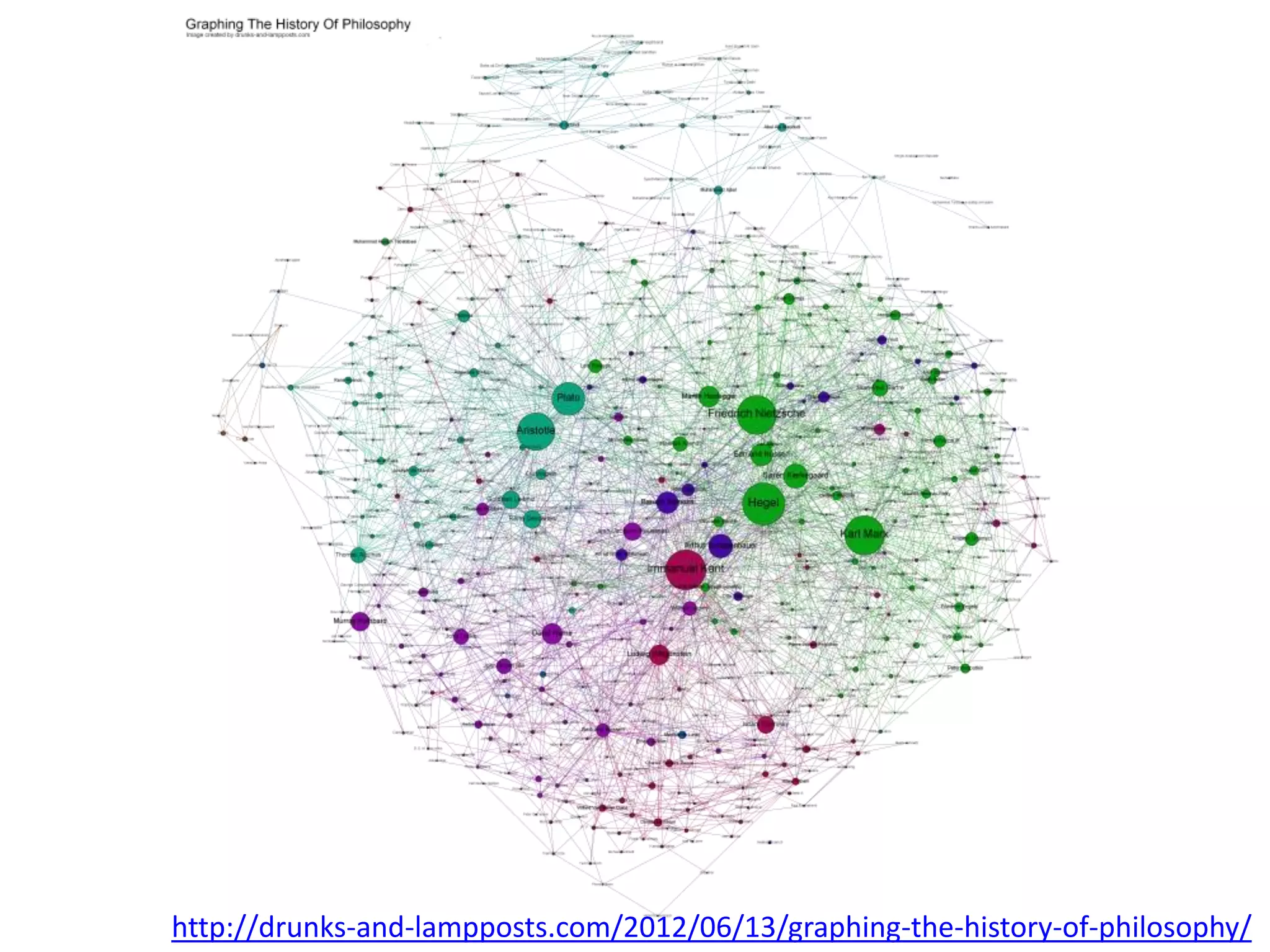
http://drunks-and-lampposts.com/2012/06/13/graphing-the-history-of-philosophy/
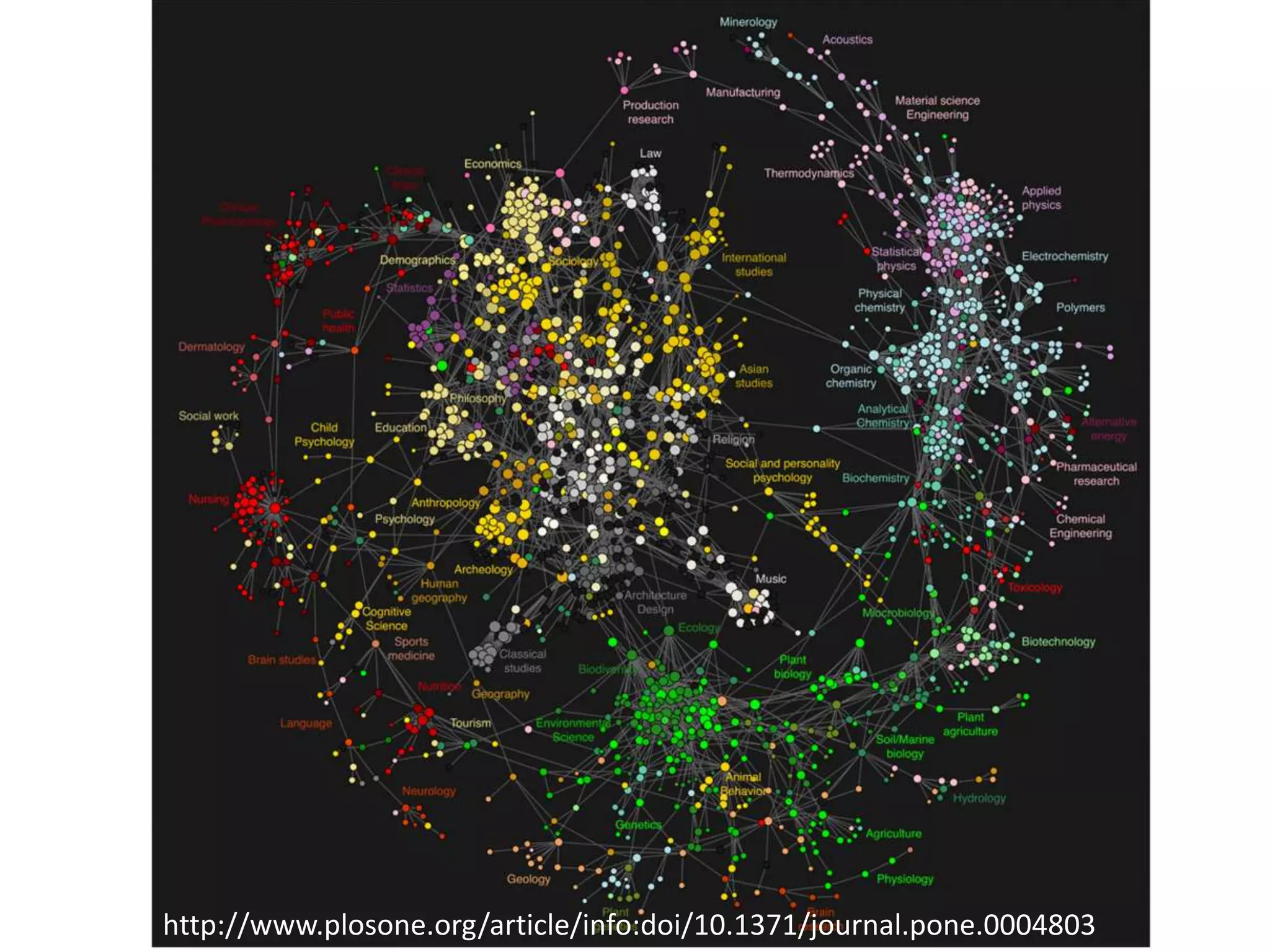
http://www.plosone.org/article/info:doi/10.1371/journal.pone.0004803
Making the world’s knowledge
          relatable
http://linkeddata.org/
Wellman (2002)
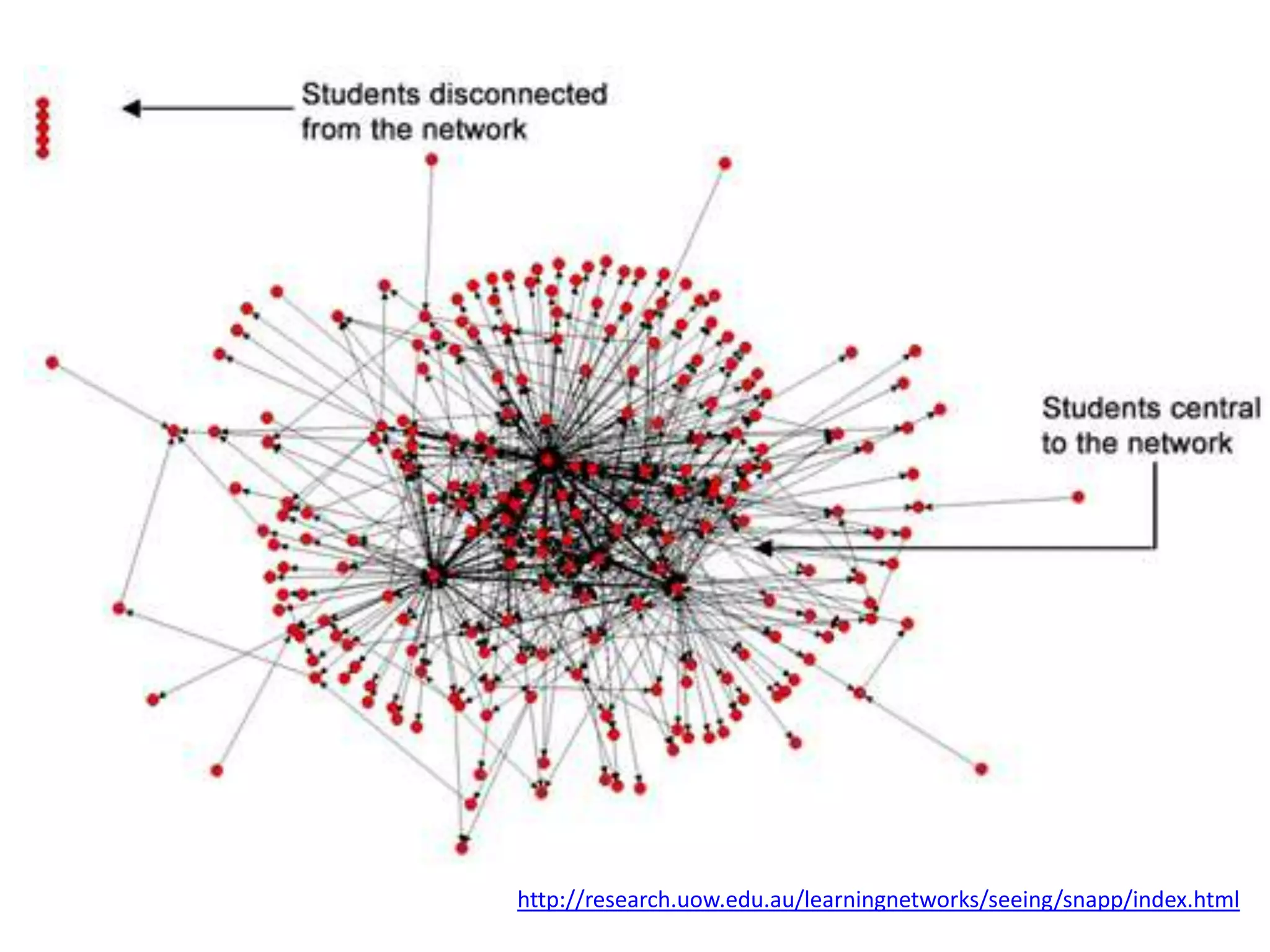
http://research.uow.edu.au/learningnetworks/seeing/snapp/index.html
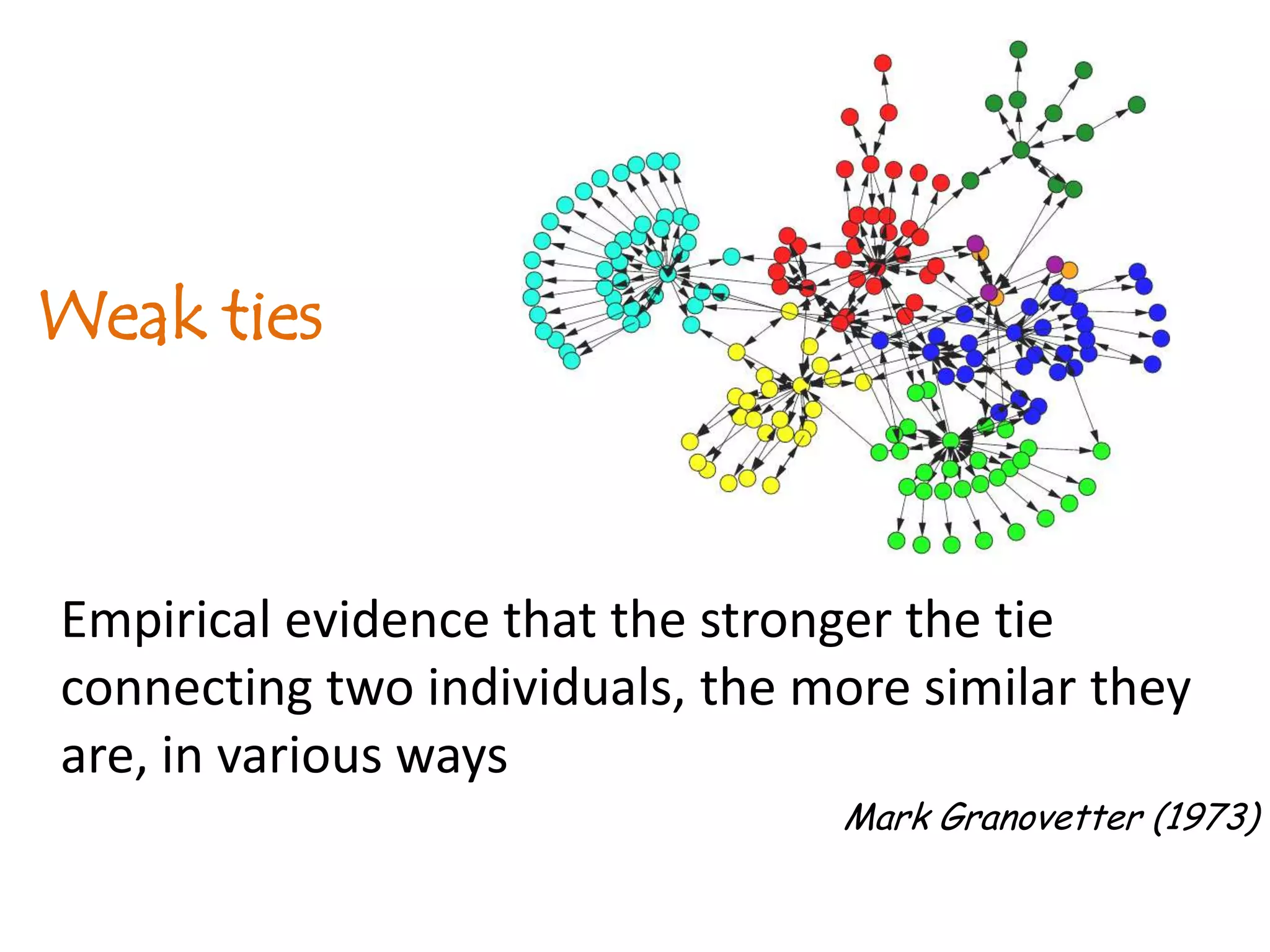
Weak ties


Empirical evidence that the stronger the tie
connecting two individuals, the more similar they
are, in various ways
                                 Mark Granovetter (1973)
Connectivism:

1. Knowledge is networked and distributed

2. The experience of learning is one of forming
   new neural, conceptual and external networks

3. Occurs in complex, chaotic, shifting spaces

4. Increasingly aided by technology
Participatory Pedagogies
                              (Collis & Moonen, 2008)
                                         (Askins, 2008)
                           (Harvard Law School, 2008)
http://edition.cnn.com/2012/06/20/opinion/opinion-alec-ross-tech-politics/index.html
Externalization of thought and
           concepts
…so that it can be analyzed,
interpreted, tested, evaluated
Knowledge relatedness and conceptual errors
are often not made explicit (tests don’t always
surface these errors)
http://www.learner.org/resources/series28.html
Blurring the physical and virtual worlds
All the world is data. And so are we. And all
                of our actions.


                   http://www.hoganphoto.com/batsto_grist_mill.htm
Breakups (via status changes)
“In today’s networked world, learners are
placing greater value on knowing where to
find information than on knowing the
information themselves.”
                  2010 New Zealand, Australia Horizon Report
But, making the transition to a
“connection” as the unit of analysis in
        learning is not easy
The existing model of education
        restricts change
Co-evolution of individual and related network
                                         Lazer, 2000
Networked information
doesn’t have a centre
Fragmentation is a new reality.
  Our learning models experience
      Fragmentary need to embrace
               (reflect) it.
• Conversations, content, context not (only)
  shaped by the school/educator
• Learners are in control
So we (socially) create temporary
             centres:
So we (technologically) create
    temporary centres:
Temporary Centres
Technological sensemaking systems
Visualization
Big Data
Analytics
Recommender systems
Automated discovery
Predictive models
Coherence is an orientation about the meaning
and value of information elements based on
how they are connected, structured, and related
                                    Antonovsky 1993
“orientation about the meaning and value of
information elements based on how they are
connected, structured, and related”
                                 (Antonovsky 1993)
Agents in a system possess only partial
information
                                (Miller and Page 2007)
…to make sense and act meaningfully requires
connections to be formed between agents
In language and discourse, coherence relations
are “meaning relations that connect discourse
segments”
                                (Kamalski et al. 2008)
Knowledge development, learning, is (should
be) concerned with learners understanding
relationships, not simply memorizing facts.

i.e. naming nodes is “low level” knowledge
activity, understanding node connectivity, and
implications of changes in network structure,
consists of deeper, coherent, learning
Existing coherence forming systems

Books
Newspapers
TV news programs
Magazines

(anything that is structured and that the end
user can’t speak into and alter)
Knowledge in pieces


                  diSessa, 1993
As we become connected globally,
new knowledge configurations will
            arise
Massive Open Online Courses
What does this mean to you as an
               educator?
Importance of learners creating artifacts that reflect how
they view a concept/discipline

Assisting learners in thinking in networks (relationship
between concepts)

Teaching and learning in networks…

Opening the classroom: the global learner

Exporting, not only importing, education
Content is fragmented (not confined to a course)
Knowledge is generative
Coherence is learner-formed, instructor guided
Distributed, multi-spaced interactions
Foster autonomous, self-regulated learners
Complex tasks require
greater engagement and
focus than what
 weak attention ties permit
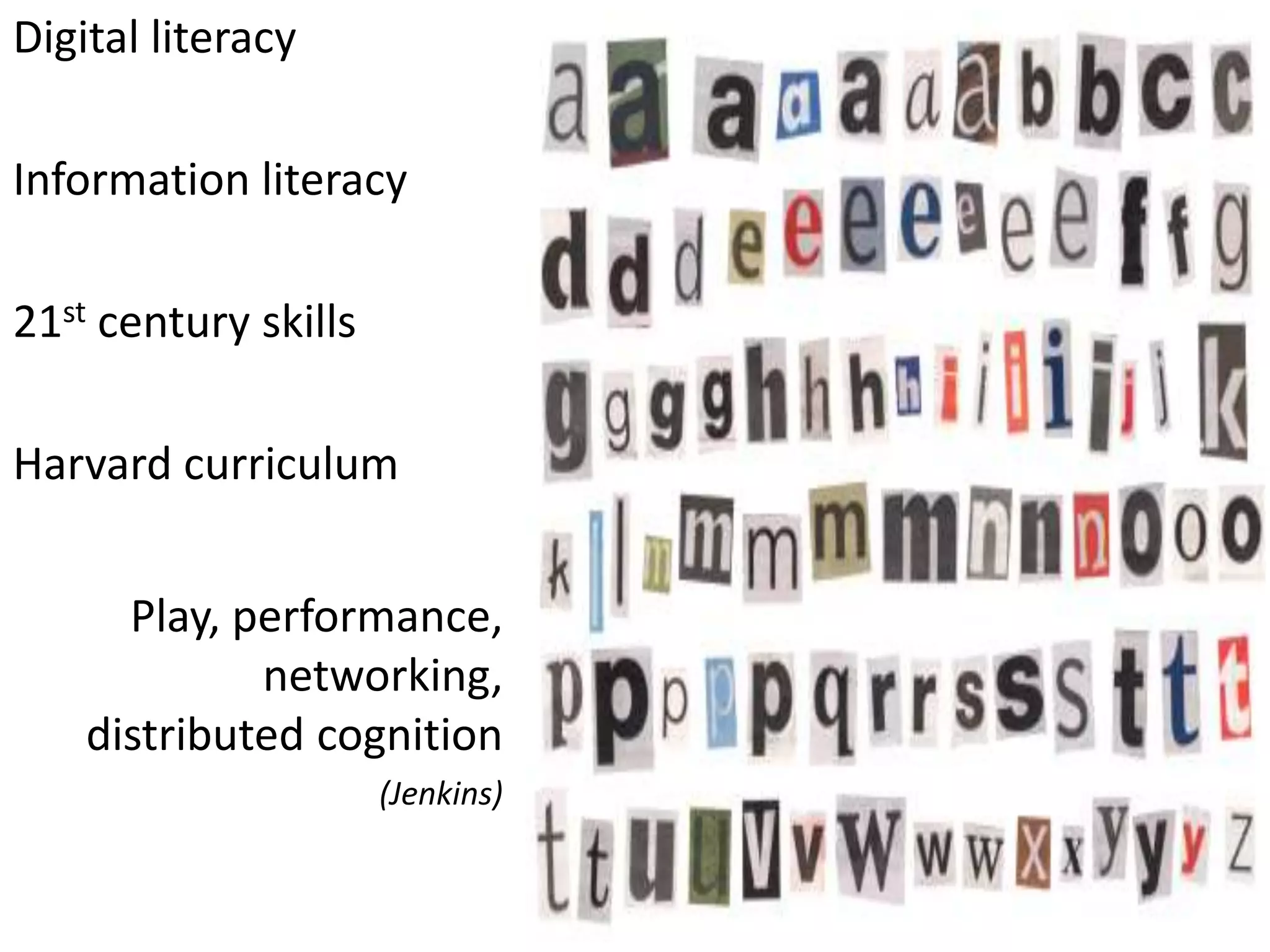
Digital literacy

Information literacy

21st century skills

Harvard curriculum


      Play, performance,
             networking,
    distributed cognition
                      (Jenkins)
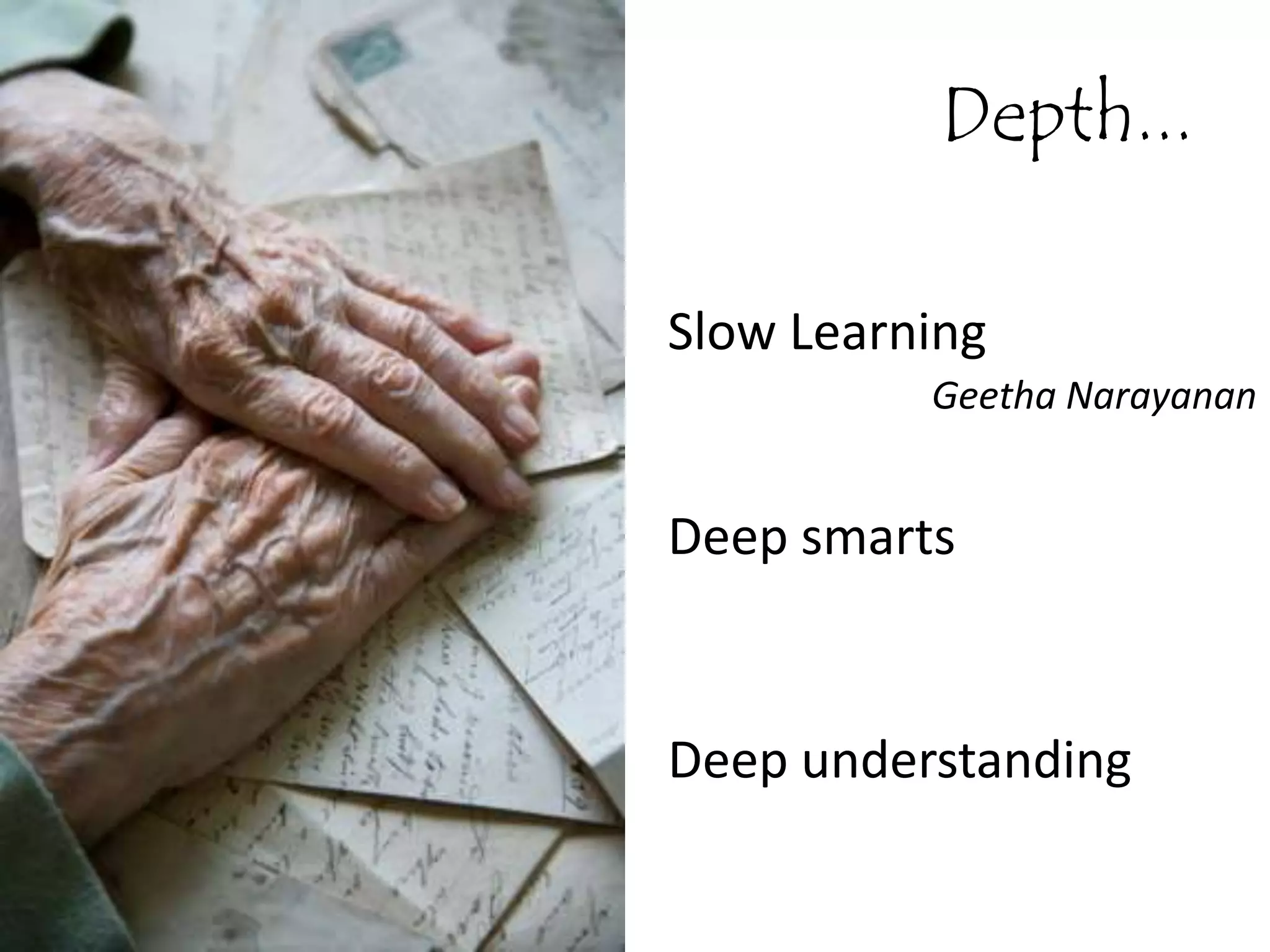
Depth...

Slow Learning
          Geetha Narayanan


Deep smarts


Deep understanding
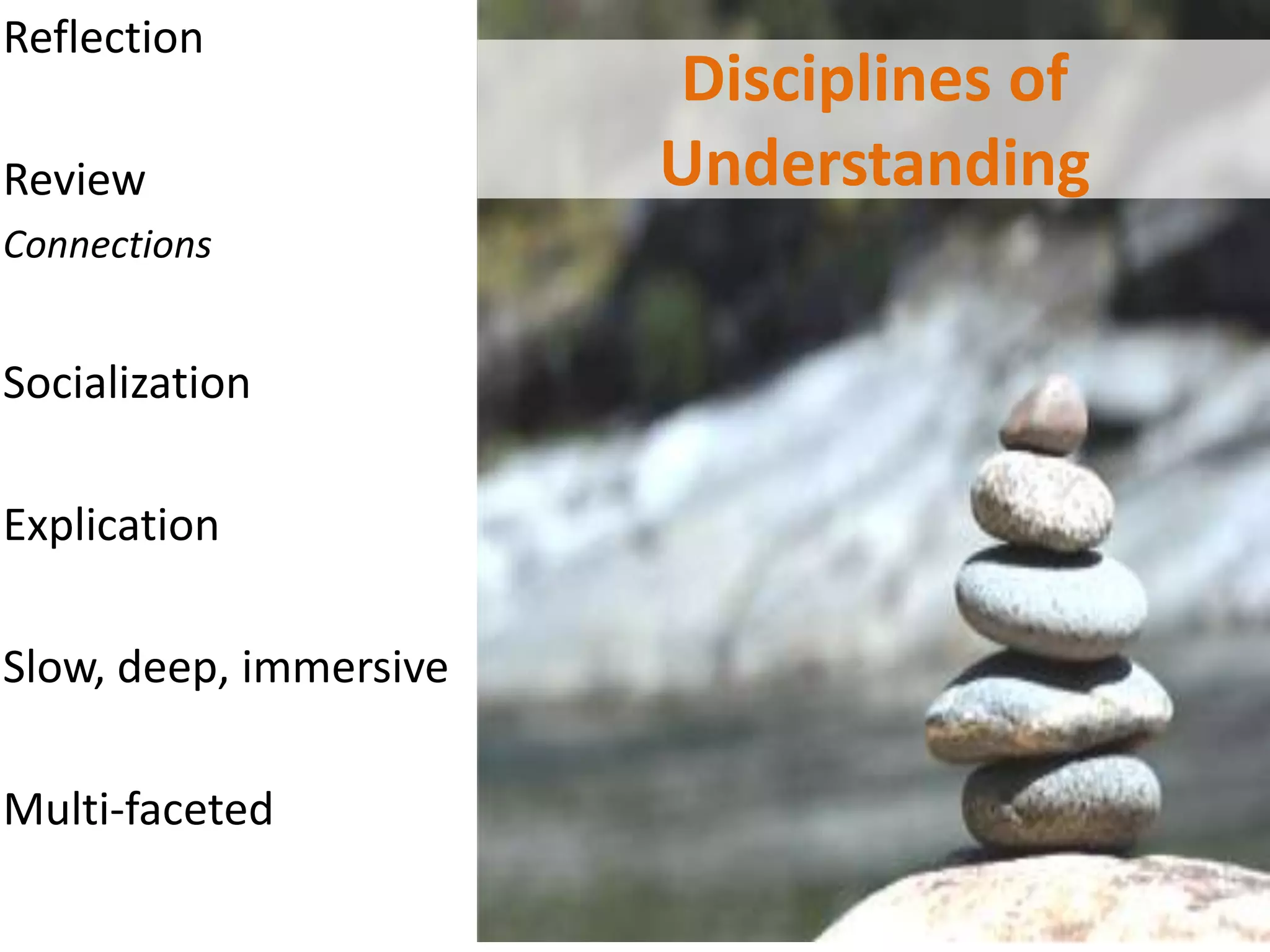
Reflection
                        Disciplines of
Review                  Understanding
Connections


Socialization

Explication

Slow, deep, immersive

Multi-faceted
http://open.mooc.ca/


   Starts September 10, 2012
http://edfuture.net/


 October 8-November 16, 2012
http://lakconference.org
gsiemens @
  gmail
  Twitter
  Skype
  FB
  Wherever

www.elearnspace.org

www.connectivism.ca

www.learninganalytics.net

Connectivism: social networked learning

Editor's Notes

  • #6 http://vimeo.com/34182381
  • #13 http://www.youtube.com/watch?feature=player_embedded&v=bWxHC_8yBrc
  • #14 Barry Wellman: Pp. 10-25 in Digital Cities II: Computational and Sociological Approaches, edited by Makoto Tanabe, Peter van den Besselaar and Toru Ishida. Berlin: Springer, 2002.
  • #16 http://www.si.umich.edu/~rfrost/courses/SI110/readings/In_Out_and_Beyond/Granovetter.pdf
  • #17 Builds on the foundation of how we engage with others and how we interact with the world to suggest that knowledge (in its many forms and representations) is networked in nature and a particular state of knowing is a particular manner of connectedness.
  • #19 http://www3.interscience.wiley.com/journal/119879431/abstract?CRETRY=1&SRETRY=0http://www.law.harvard.edu/students/orgs/crcl/current.html
  • #20 http://www.youtube.com/watch?v=nJmGrNdJ5Gw
  • #41 Antonovsky, A. (1993) ‘The structure and properties of the sense of coherence scale.’ Social Science & Medicine 36, (6) 725-733
  • #42 Miller, J. H., and Page, S. E (2007). Complex adaptive systems: An introduction to computational models of social life. Princeton: Princeton University Press
  • #43 Kamalski, J., Sanders, T., and Lentz, L. (2008) ‘Coherence marking, prior knowledge, and comprehension of informative and persuasive texts: sorting things out.’ Discourse Processes 45, 323-345
  • #46 diSessa, A. A. (1993). Toward an epistemology of physics. Cognition and Instruction 10(2 & 3): 105-225.
  • #53 http://www.fas.harvard.edu/%7Esecfas/Harvard_FAS_Vote_Establishing_New_Program_in_General_Education.pdf - Harvard new curriculumhttp://www.digitallearning.macfound.org/atf/cf/%7B7E45C7E0-A3E0-4B89-AC9C-E807E1B0AE4E%7D/JENKINS_WHITE_PAPER.PDF - Confronting the challenges of participatory culture
  • #54 http://kt.flexiblelearning.net.au/tkt2007/?page_id=33