AECT Conference, November 2015
Indianapolis, IN
Crafting a Research Agenda
George Veletsianos, PhD
Canada Research Chair in Innovative Learning & Technology
Associate Professor
School of Education and Technology
Victoria, British Columbia, Canada
What comes to mind when you
hear the term “research agenda?”
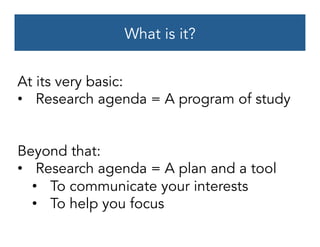
What is it?
At its very basic:
•  Research agenda = A program of study
Beyond that:
•  Research agenda = A plan and a tool
•  To communicate your interests
•  To help you focus
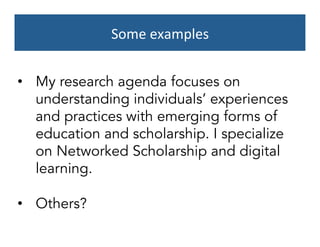
Some	
  examples	
  
•  My research agenda focuses on
understanding individuals’ experiences
and practices with emerging forms of
education and scholarship. I specialize
on Networked Scholarship and digital
learning.
•  Others?
How do I define my Research Agenda?
What are you passionate about?
What do you want to be studying/
researching?
What is the one theme that describes your
research?
What does a “liberating” Research
Agenda looks like?
It is specific, but flexible.
It balances breadth, depth, and focus
without being too broad.
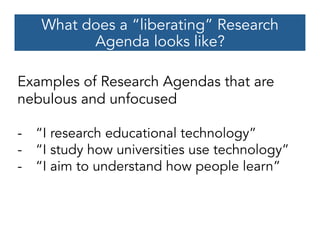
What does a “liberating” Research
Agenda looks like?
Examples of Research Agendas that are
nebulous and unfocused
-  “I research educational technology”
-  “I study how universities use technology”
-  “I aim to understand how people learn”
Refining your focus
A topic? A method? An approach? A
participant group?
Examples:
Open Textbooks (within which one may study:
adoption, impact, experiences, etc)
Online learning experiences (within which one
may study: students, faculty, early adopters,
over time, etc)
Refining your focus
Improving STEM education (within which
one may conduct d&d, DBR, etc)
Sidenote: Broad enough à e.g., Studying
Engineering or Math fits within the research
agenda
Refining your focus
A step-by-step example (broad à specific)
“I study open textbooks”
Refining your focus
A step-by-step example (broad à specific)
“I study the use of open textbooks”
Refining your focus
A step-by-step example (broad à specific)
“I study the use of open textbooks in
higher education”
Refining your focus
A step-by-step example (broad à specific)
“I study the integration of open textbooks
in higher education”
Refining your focus
A step-by-step example (broad à specific)
“I study the integration of open textbooks
in higher education”
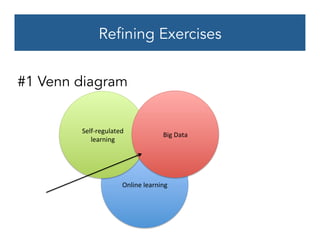
Online	
  learning	
  
Refining Exercises
#1 Venn diagram
Self-­‐regulated	
  
learning	
  
Big	
  Data	
  
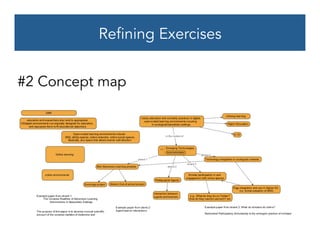
Refining Exercises
#2 Concept map
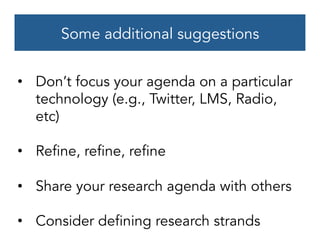
Some additional suggestions
•  Don’t focus your agenda on a particular
technology (e.g., Twitter, LMS, Radio,
etc)
•  Refine, refine, refine
•  Share your research agenda with others
•  Consider defining research strands
Thank	
  you!	


Research	
  available	
  at:	
  
hAp://www.veletsianos/
publicaEons	


This	
  presentaEon:	
  
www.slideshare.com/veletsianos	


Contact:	
  	
  
veletsianos@gmail.com	
  
@veletsianos	
  on	
  TwiAer	


Crafting a research agenda

  • 1.
    AECT Conference, November2015 Indianapolis, IN Crafting a Research Agenda George Veletsianos, PhD Canada Research Chair in Innovative Learning & Technology Associate Professor School of Education and Technology Victoria, British Columbia, Canada
  • 2.
    What comes tomind when you hear the term “research agenda?”
  • 3.
    What is it? Atits very basic: •  Research agenda = A program of study Beyond that: •  Research agenda = A plan and a tool •  To communicate your interests •  To help you focus
  • 4.
    Some  examples   • My research agenda focuses on understanding individuals’ experiences and practices with emerging forms of education and scholarship. I specialize on Networked Scholarship and digital learning. •  Others?
  • 5.
    How do Idefine my Research Agenda? What are you passionate about? What do you want to be studying/ researching? What is the one theme that describes your research?
  • 6.
    What does a“liberating” Research Agenda looks like? It is specific, but flexible. It balances breadth, depth, and focus without being too broad.
  • 7.
    What does a“liberating” Research Agenda looks like? Examples of Research Agendas that are nebulous and unfocused -  “I research educational technology” -  “I study how universities use technology” -  “I aim to understand how people learn”
  • 8.
    Refining your focus Atopic? A method? An approach? A participant group? Examples: Open Textbooks (within which one may study: adoption, impact, experiences, etc) Online learning experiences (within which one may study: students, faculty, early adopters, over time, etc)
  • 9.
    Refining your focus ImprovingSTEM education (within which one may conduct d&d, DBR, etc) Sidenote: Broad enough à e.g., Studying Engineering or Math fits within the research agenda
  • 10.
    Refining your focus Astep-by-step example (broad à specific) “I study open textbooks”
  • 11.
    Refining your focus Astep-by-step example (broad à specific) “I study the use of open textbooks”
  • 12.
    Refining your focus Astep-by-step example (broad à specific) “I study the use of open textbooks in higher education”
  • 13.
    Refining your focus Astep-by-step example (broad à specific) “I study the integration of open textbooks in higher education”
  • 14.
    Refining your focus Astep-by-step example (broad à specific) “I study the integration of open textbooks in higher education”
  • 15.
    Online  learning   RefiningExercises #1 Venn diagram Self-­‐regulated   learning   Big  Data  
  • 16.
  • 17.
    Some additional suggestions • Don’t focus your agenda on a particular technology (e.g., Twitter, LMS, Radio, etc) •  Refine, refine, refine •  Share your research agenda with others •  Consider defining research strands
  • 18.
    Thank  you!       Research  available  at:   hAp://www.veletsianos/ publicaEons         This  presentaEon:   www.slideshare.com/veletsianos     Contact:     veletsianos@gmail.com   @veletsianos  on  TwiAer