Elizabeth Brown
Scholarly Communications and Library Grants Officer
Binghamton University Libraries

New Concepts in teaching and learning: E-texts, open educational
resources and more
November 4, 2011
Limitations to making content open


Michelle Hawkins-Thiel: http://www.flickr.com/photos/hawkins-thiel/2515183032/

Sarah Cool: http://perceptivetravel.com/blog/2007/05/13/writing-project-wrap-up/finding-the-good-ones-courtesy-sarah-cool-at-flickrs-creative-commons/
The Goal


Jonathan Nerdtrek: http://nerdtrek.com/iron-man-movie-computer/
Five Steps
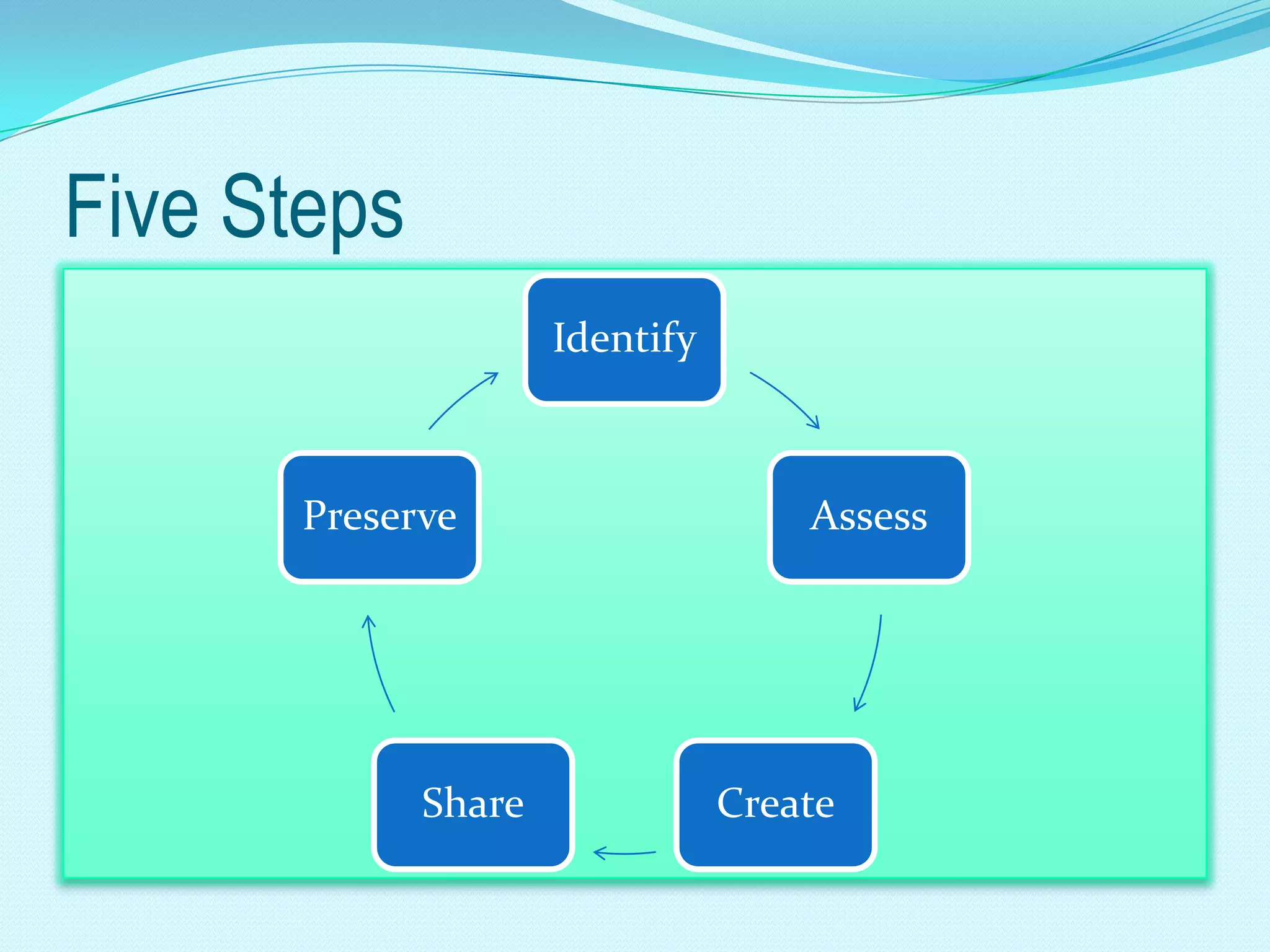
                     Identify


      Preserve                      Assess


             Share              Create
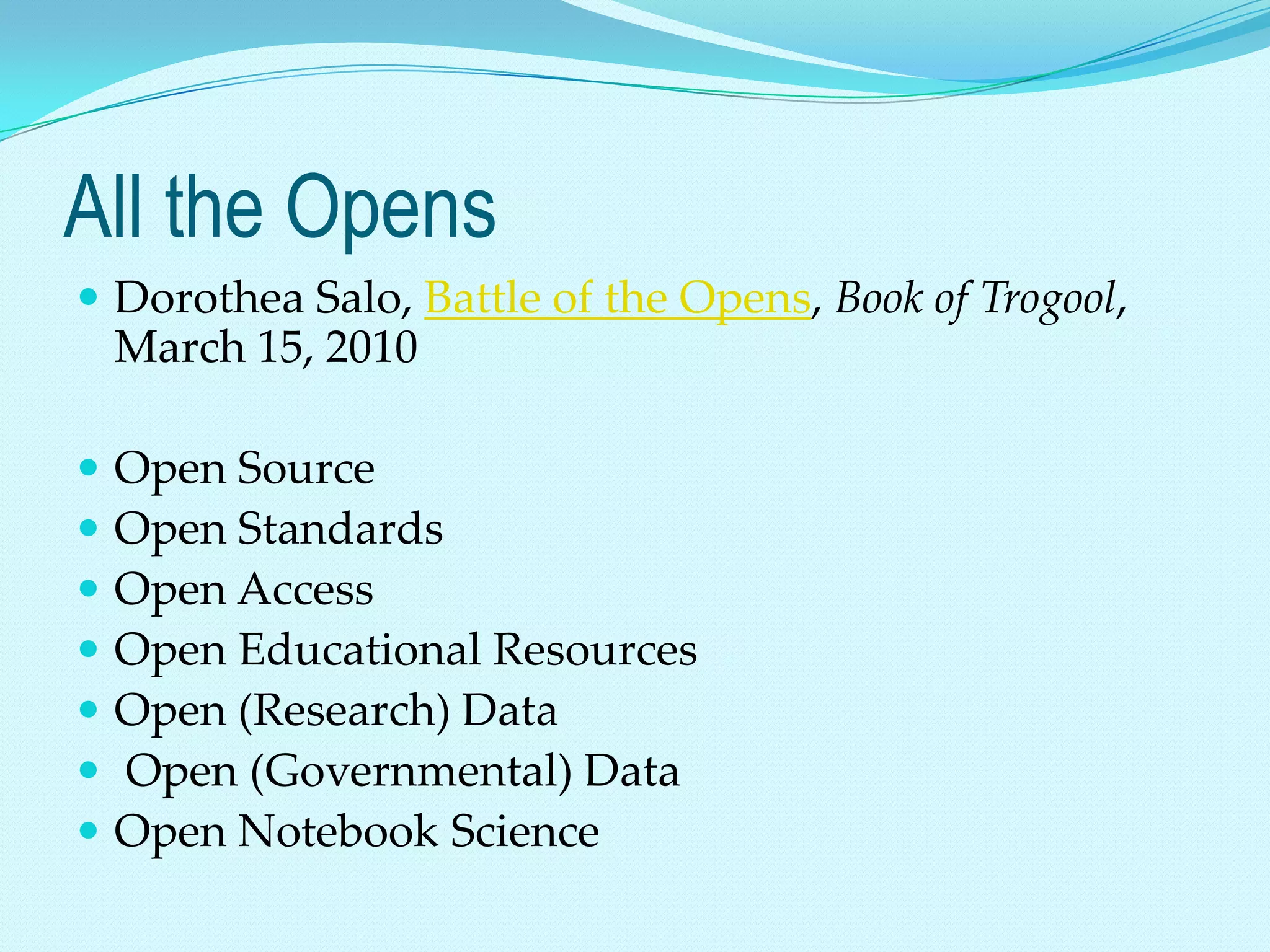
The Five Steps Explained
1. Identify open content
2. Assess the value of the information
3. Create open content
4. Share open content with peers
5. Preserve open content on the web and locally
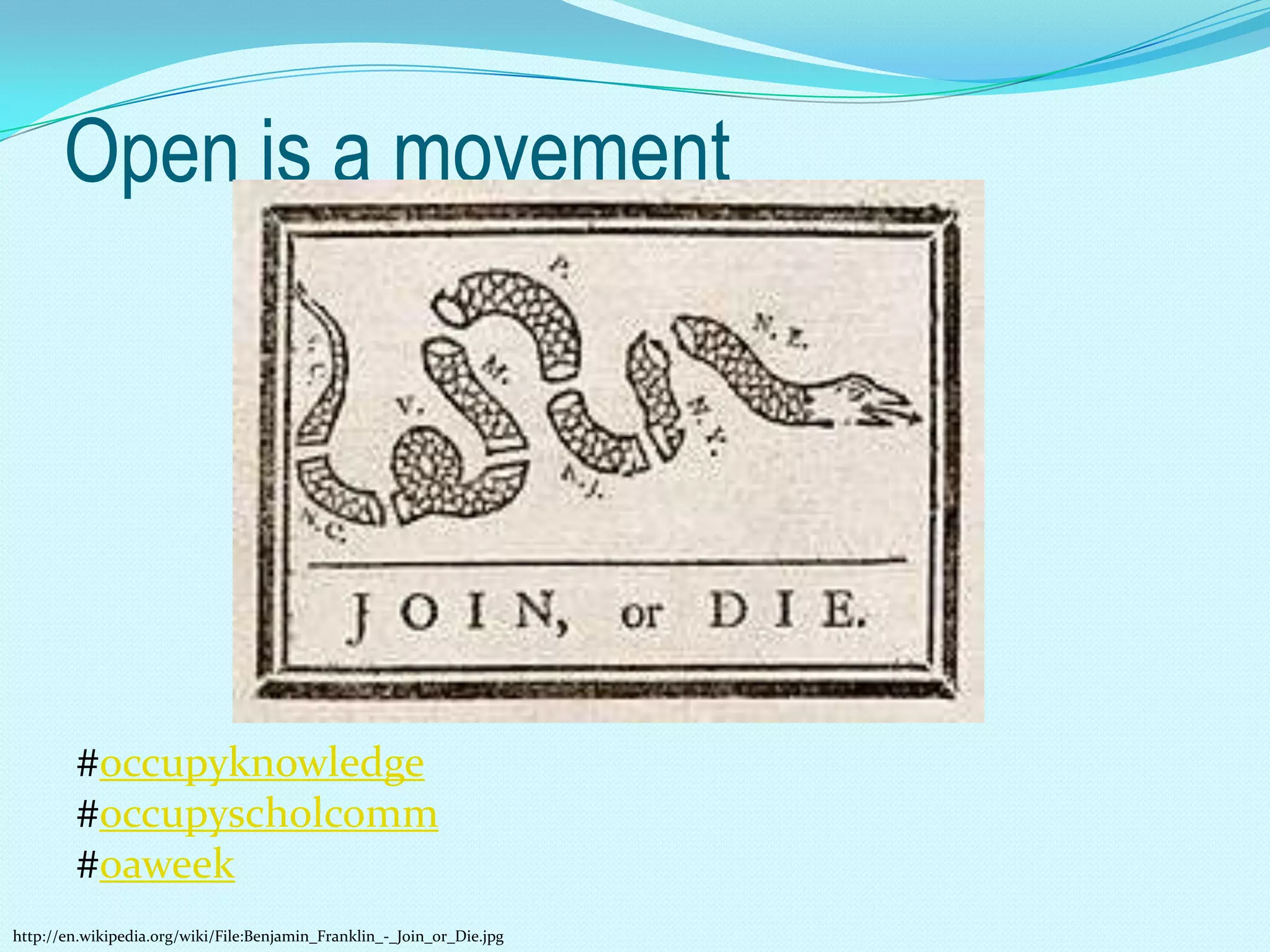
All the Opens
 Dorothea Salo, Battle of the Opens, Book of Trogool,
    March 15, 2010

   Open Source
   Open Standards
   Open Access
   Open Educational Resources
   Open (Research) Data
   Open (Governmental) Data
   Open Notebook Science
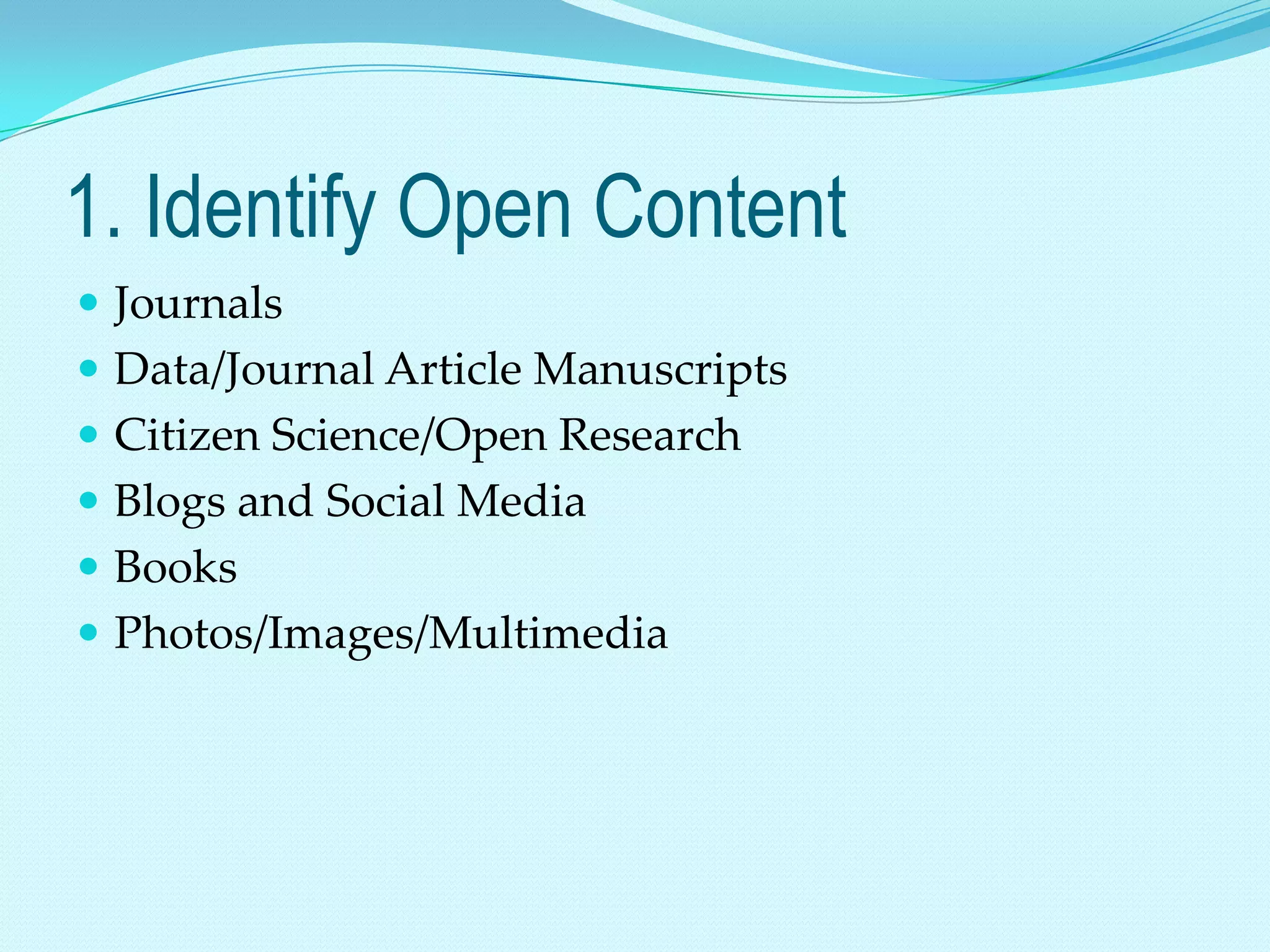
Open is a movement


        #occupyknowledge
        #occupyscholcomm
        #oaweek
http://en.wikipedia.org/wiki/File:Benjamin_Franklin_-_Join_or_Die.jpg
1. Identify Open Content
 Journals
 Data/Journal Article Manuscripts
 Citizen Science/Open Research
 Blogs and Social Media
 Books
 Photos/Images/Multimedia
Open Access Journal Collections
 Directory of Open Access Journals (DOAJ)
 Highwire Press
 Public Library of Science (PLoS)
 BioMedCentral
 PubMedCentral
 J-Stage
 Royal Society
 JSTOR
 Hindawi
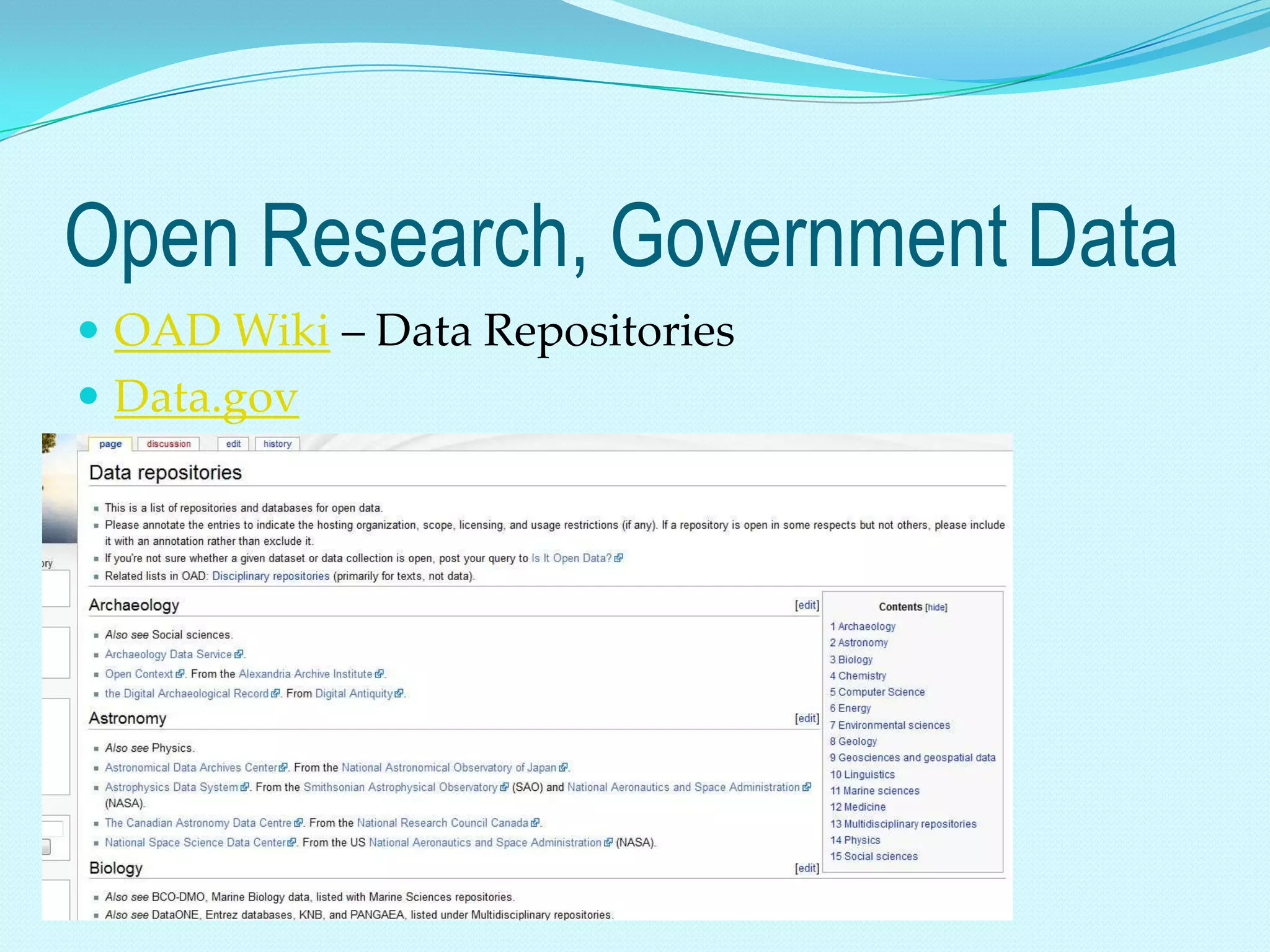
Open Research, Government Data
 OAD Wiki – Data Repositories
 Data.gov
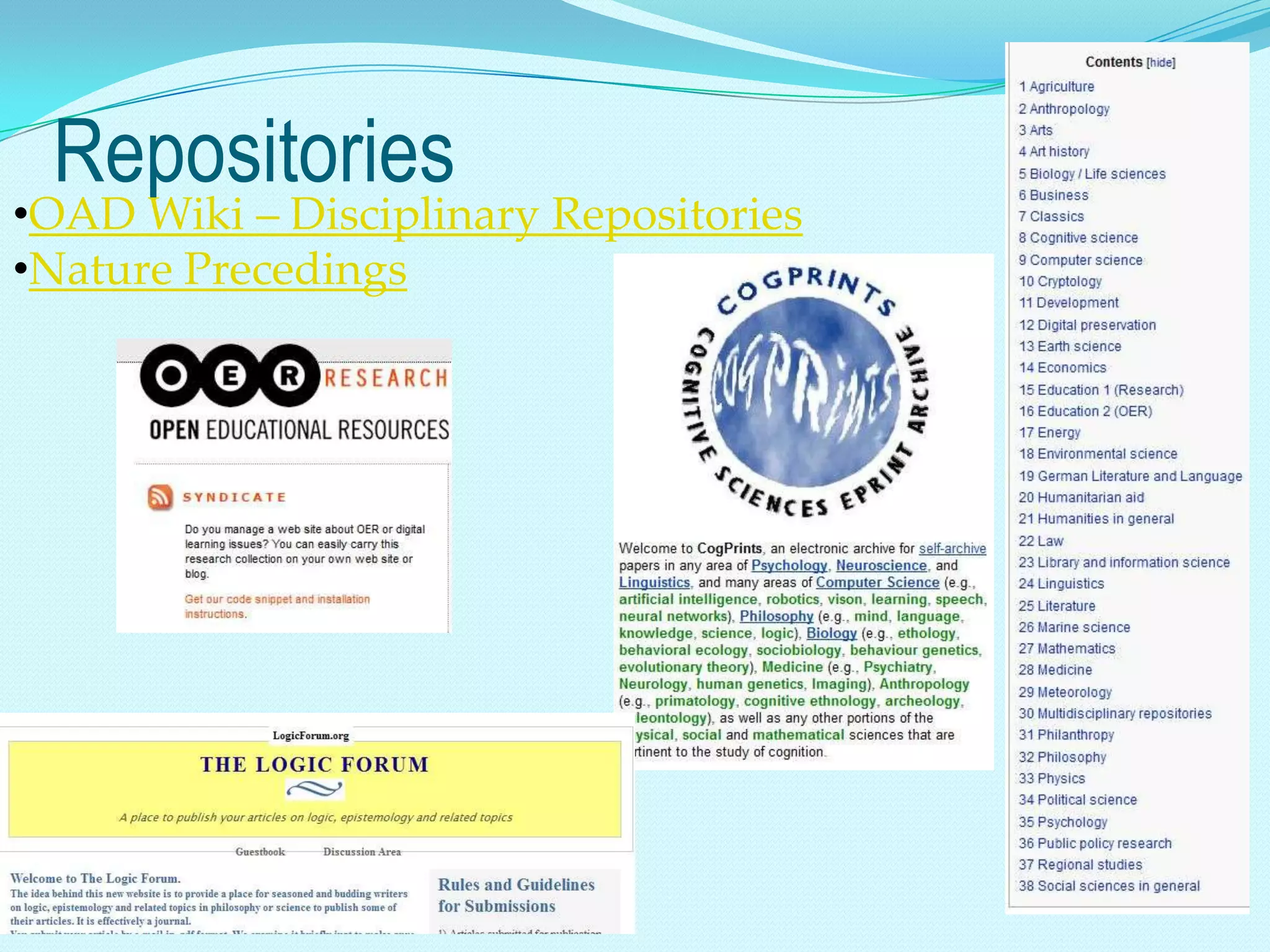
Repositories
•OAD Wiki – Disciplinary Repositories
•Nature Precedings
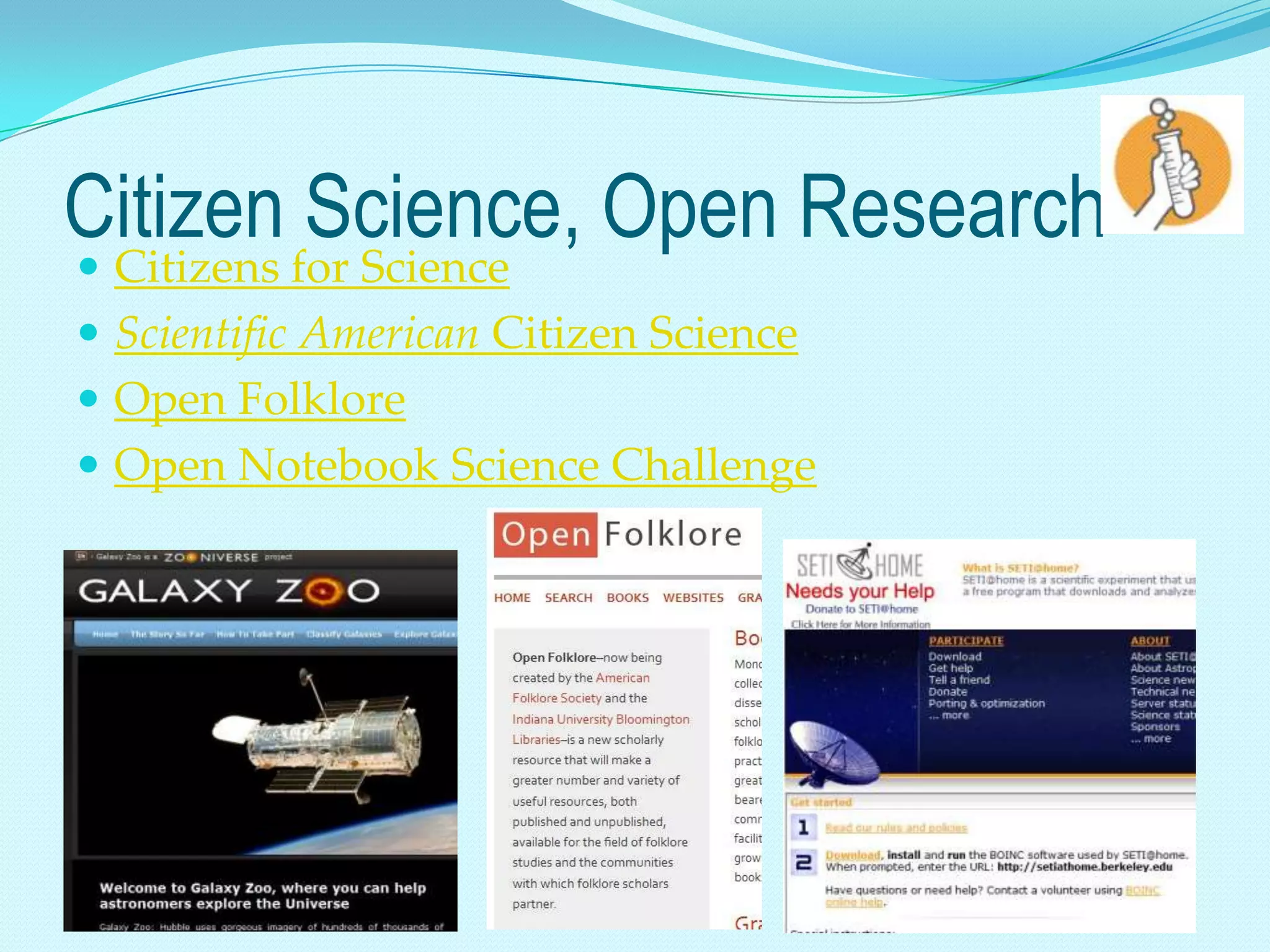
Citizen Science, Open Research
 Citizens for Science
 Scientific American Citizen Science
 Open Folklore
 Open Notebook Science Challenge
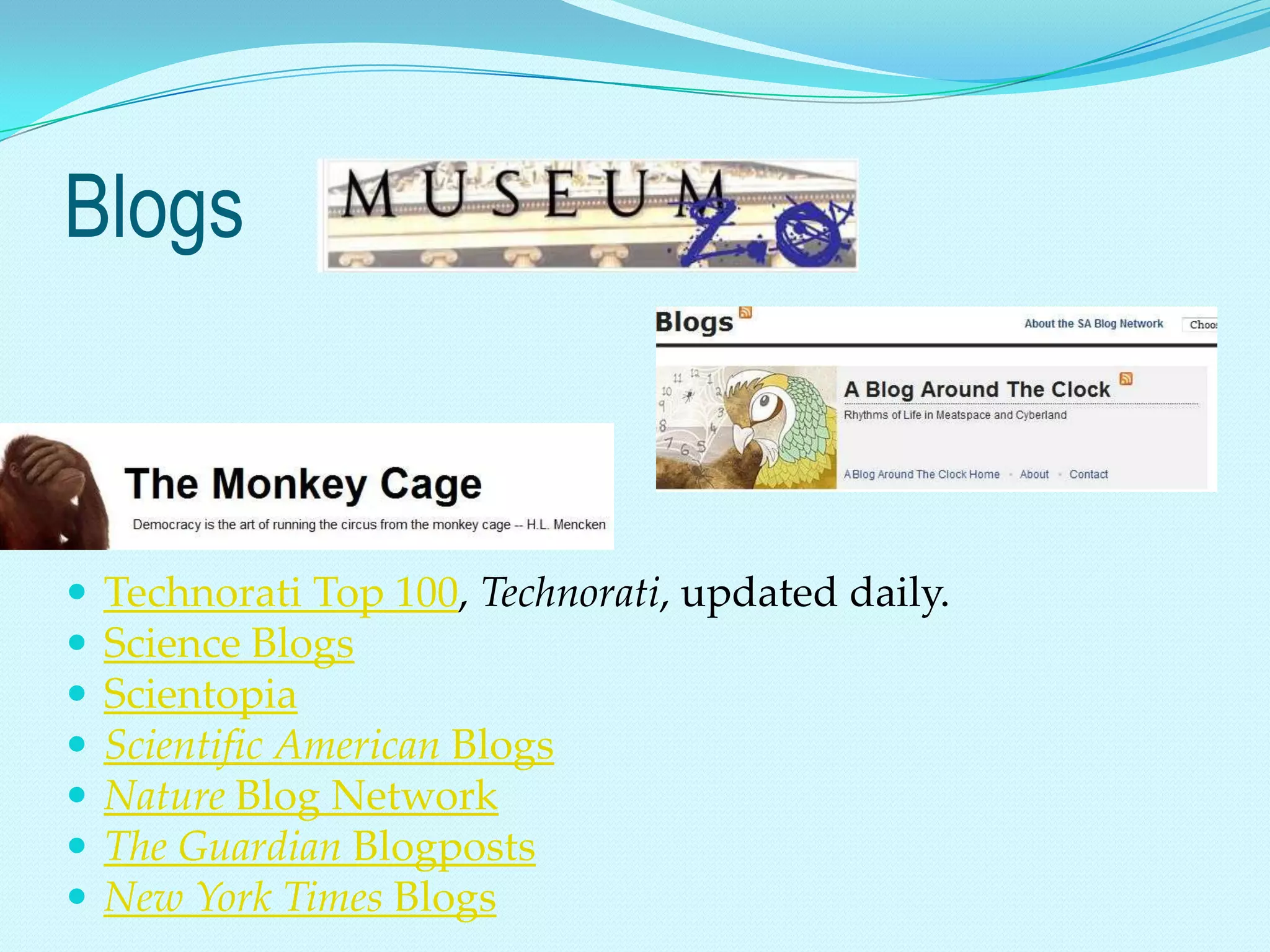
Blogs


   Technorati Top 100, Technorati, updated daily.
   Science Blogs
   Scientopia
   Scientific American Blogs
   Nature Blog Network
   The Guardian Blogposts
   New York Times Blogs
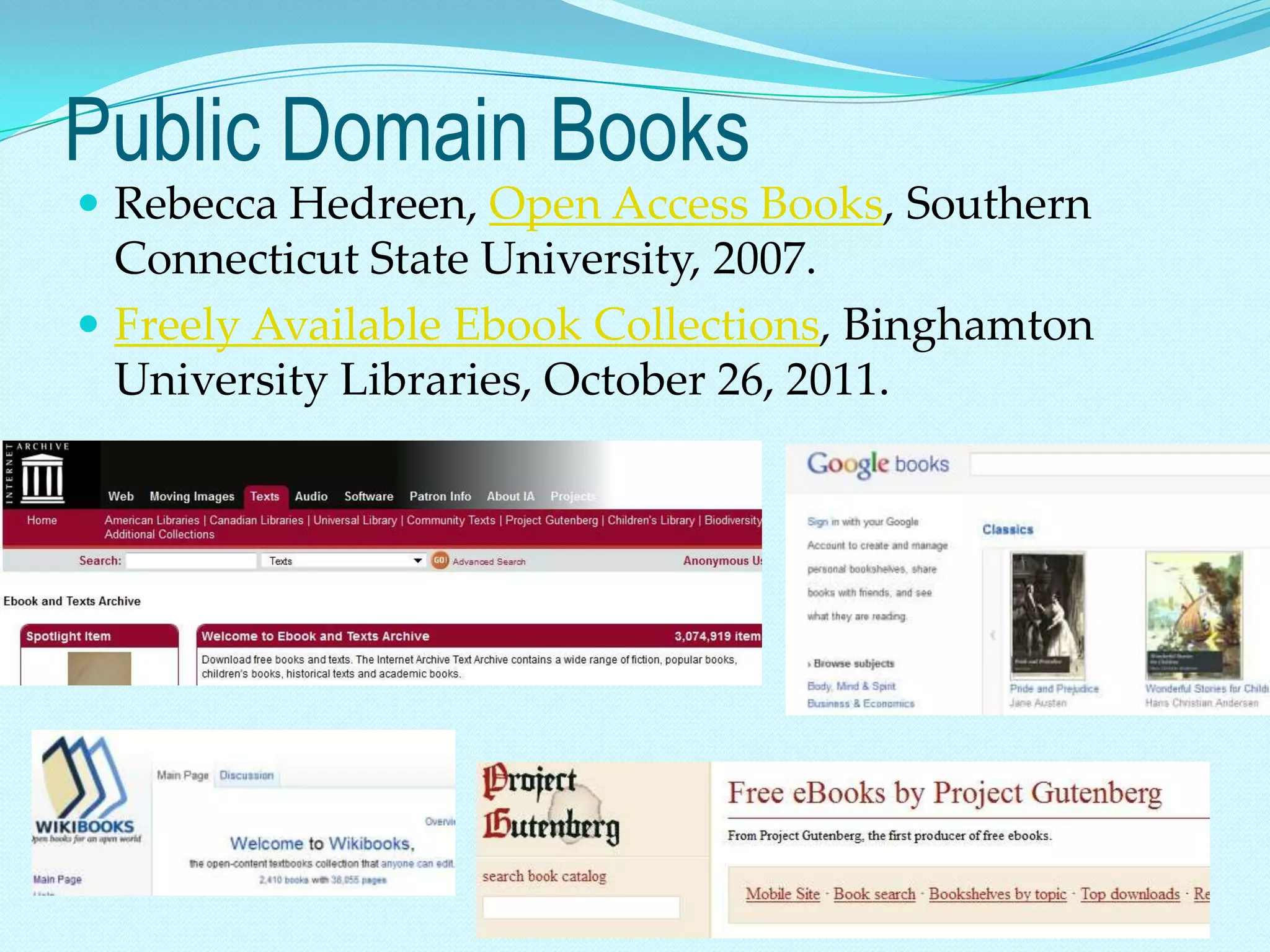
Public Domain Books
 Rebecca Hedreen, Open Access Books, Southern
  Connecticut State University, 2007.
 Freely Available Ebook Collections, Binghamton
  University Libraries, October 26, 2011.
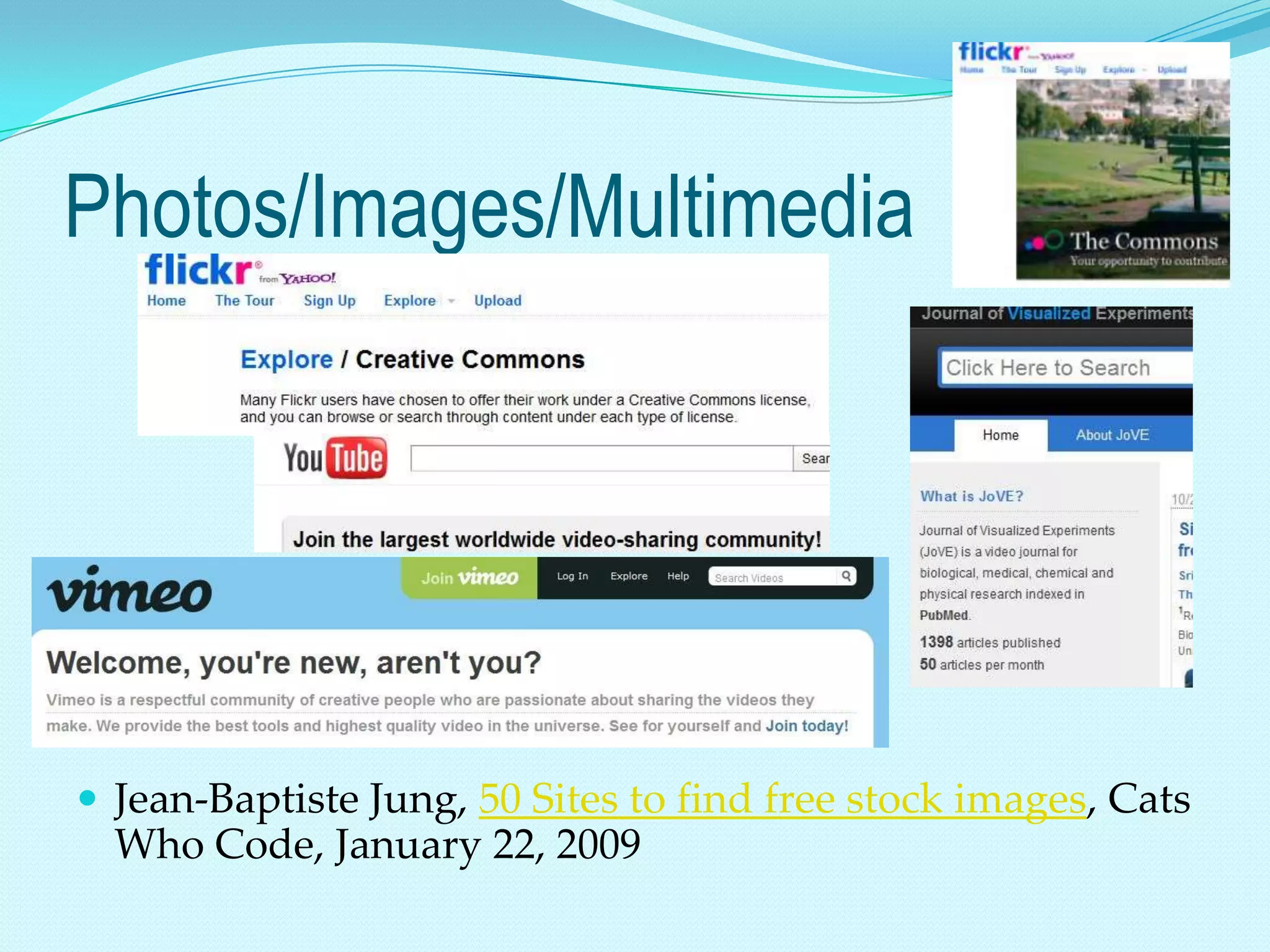
Photos/Images/Multimedia


 Jean-Baptiste Jung, 50 Sites to find free stock images, Cats
  Who Code, January 22, 2009
2. Assess
 Alternative Metrics
 Social Media Data, Analysis
 Copyright – can I use it?
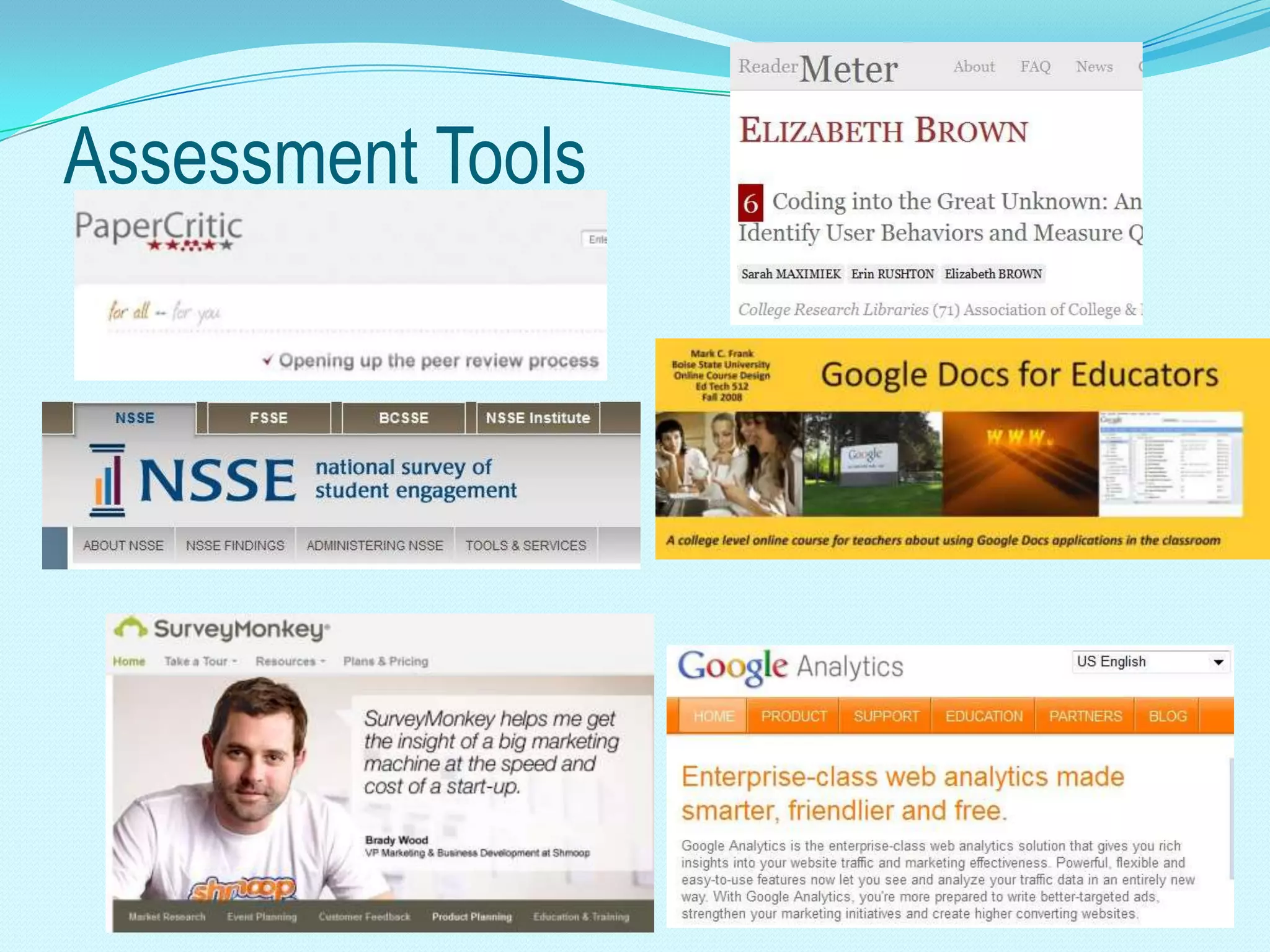
 Assessment Tools
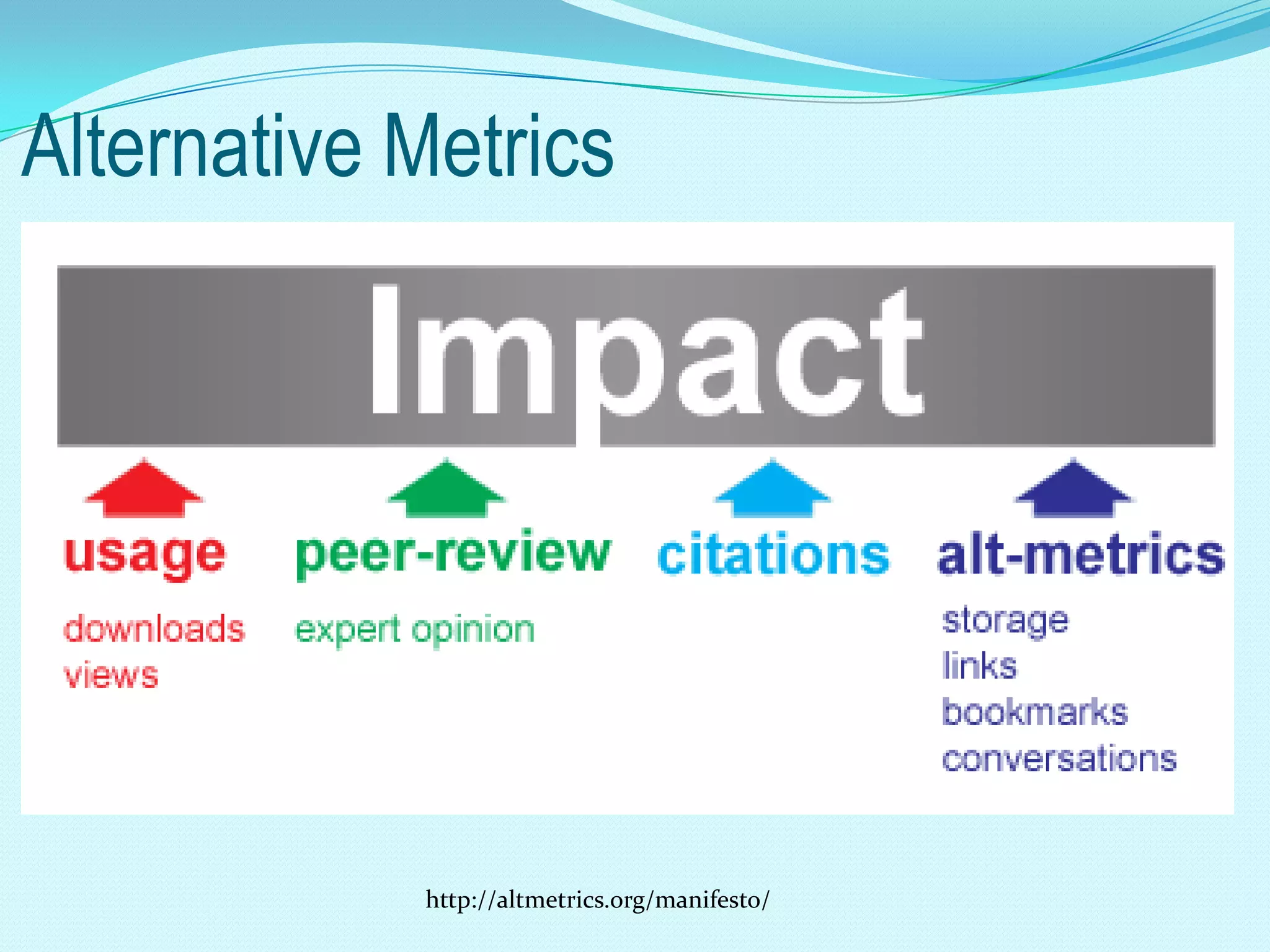
Alternative Metrics


            http://altmetrics.org/manifesto/
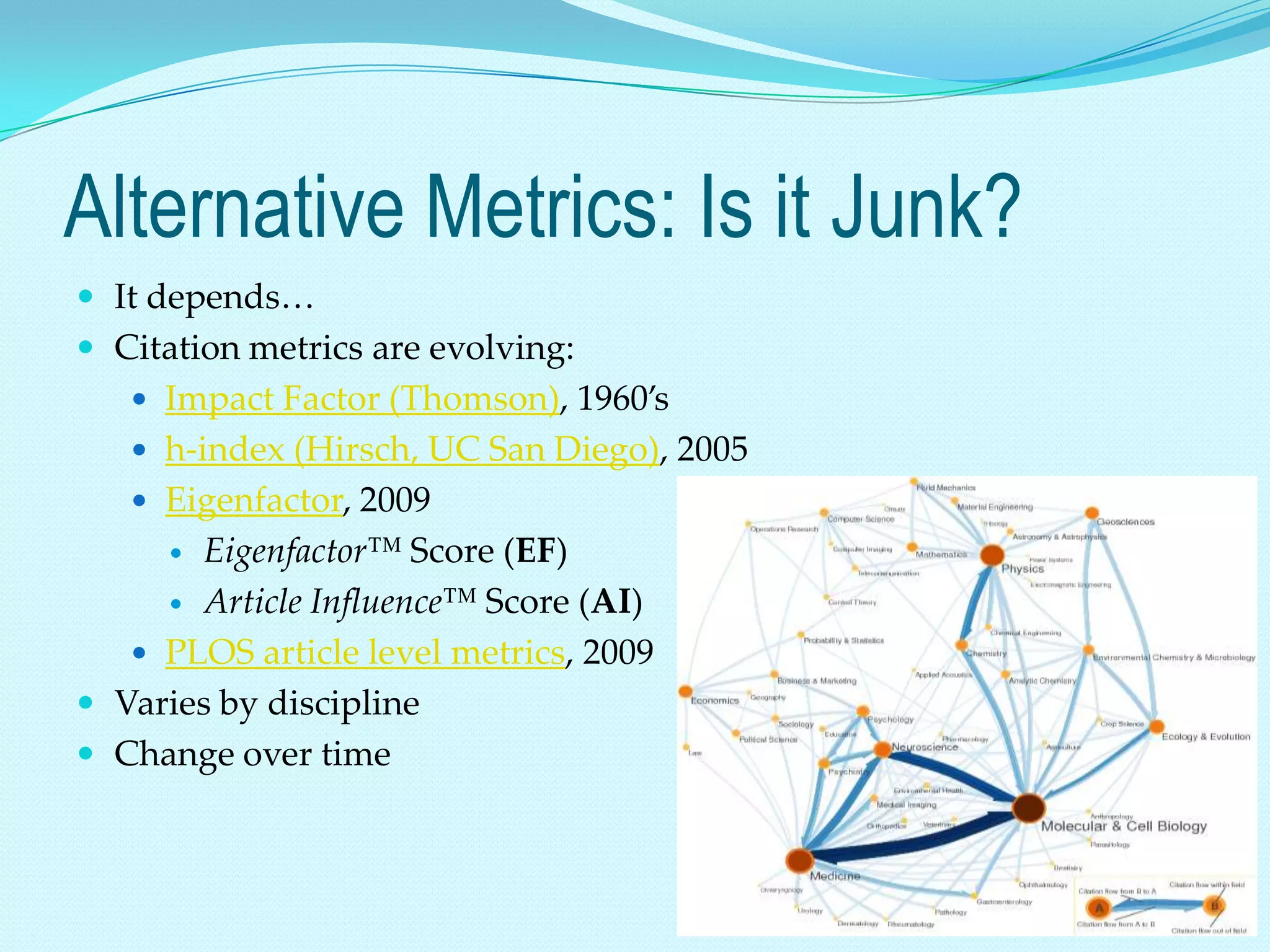
Alternative Metrics: Is it Junk?
 It depends…
 Citation metrics are evolving:
    Impact Factor (Thomson), 1960’s
    h-index (Hirsch, UC San Diego), 2005
    Eigenfactor, 2009
      Eigenfactor™ Score (EF)
      Article Influence™ Score (AI)

    PLOS article level metrics, 2009
 Varies by discipline
 Change over time
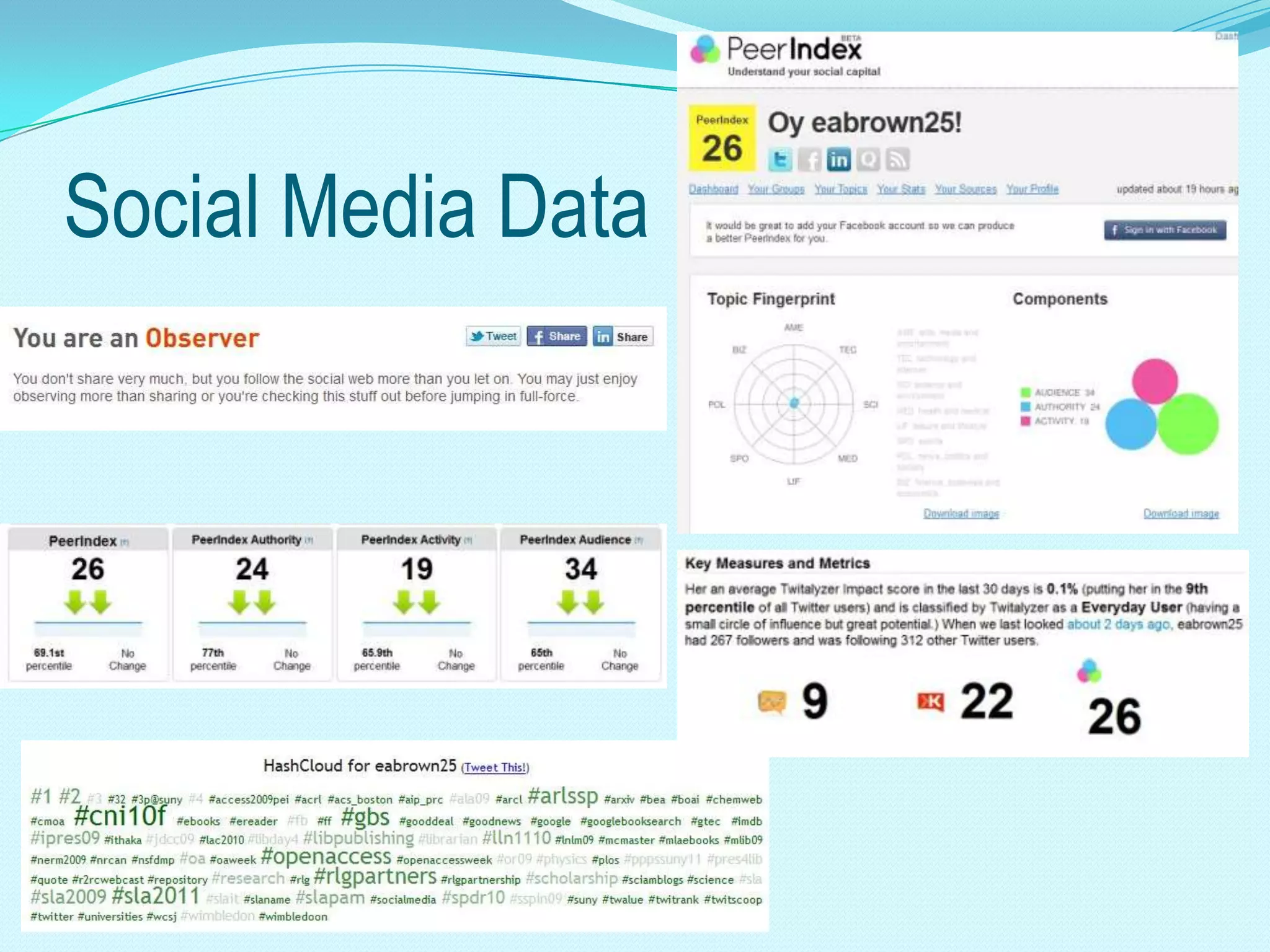
Social Media Data
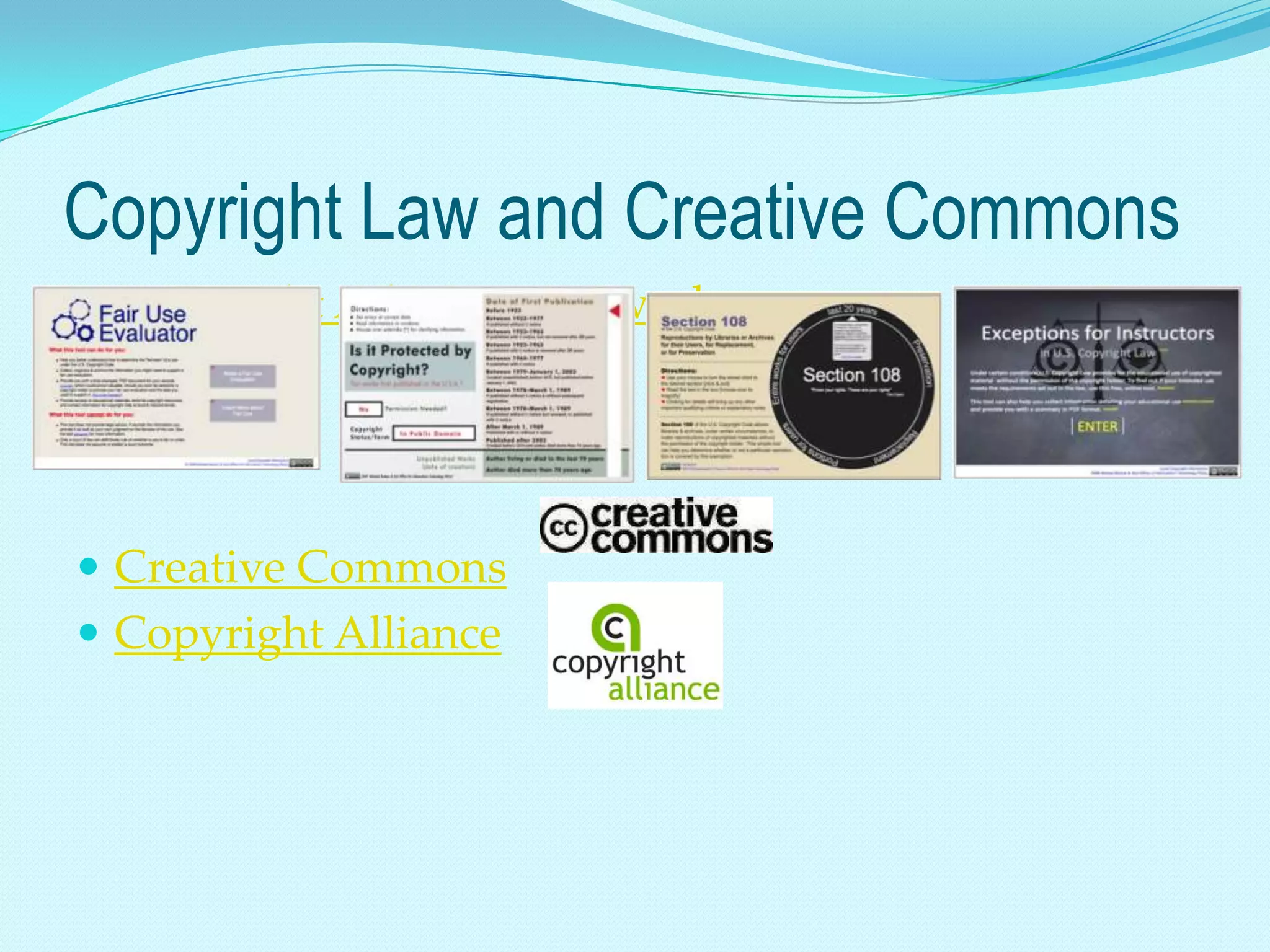
Copyright Law and Creative Commons
 Copyright Advisory Network


 Creative Commons
 Copyright Alliance
Assessment Tools
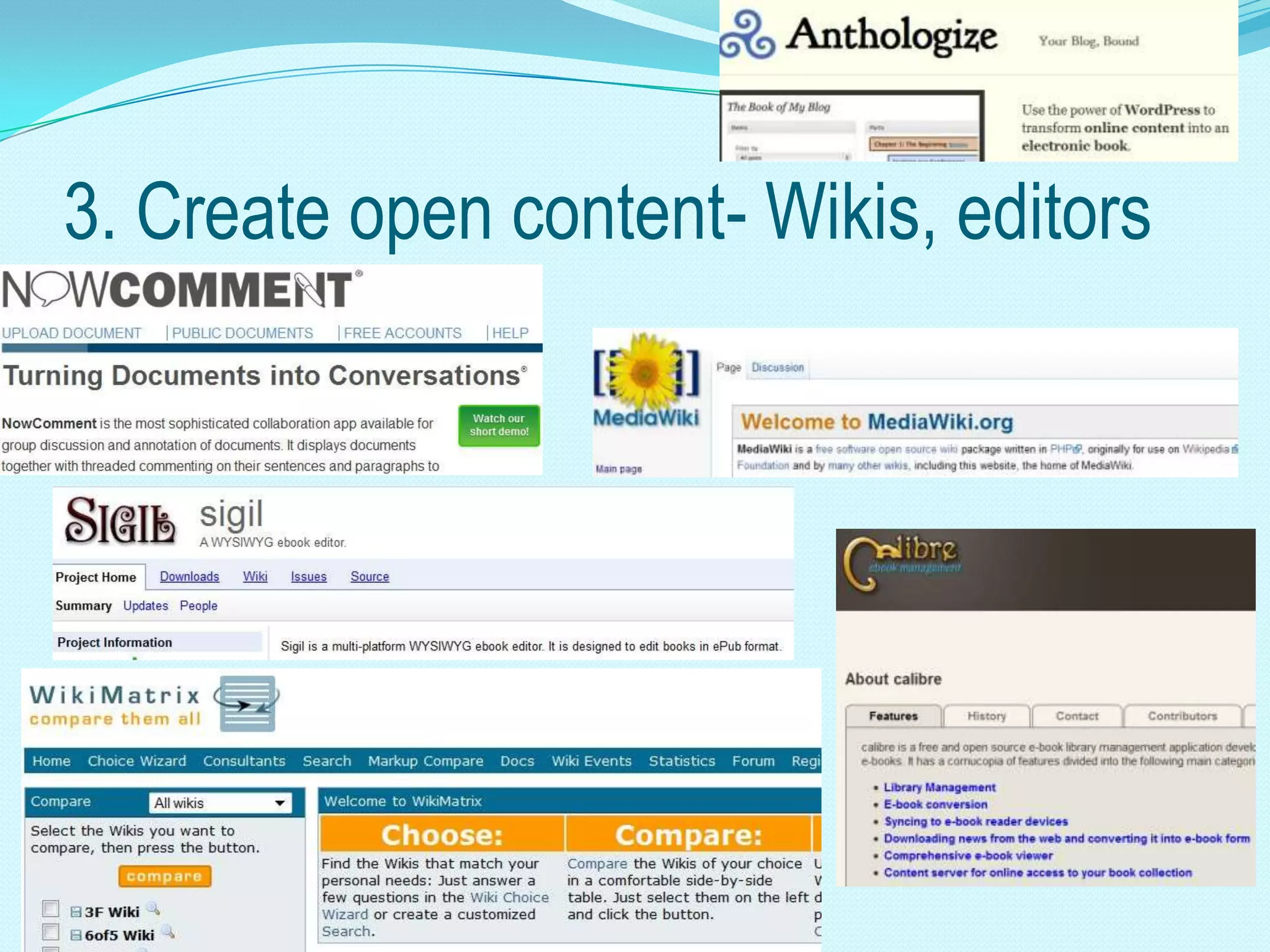
3. Create open content- Wikis, editors
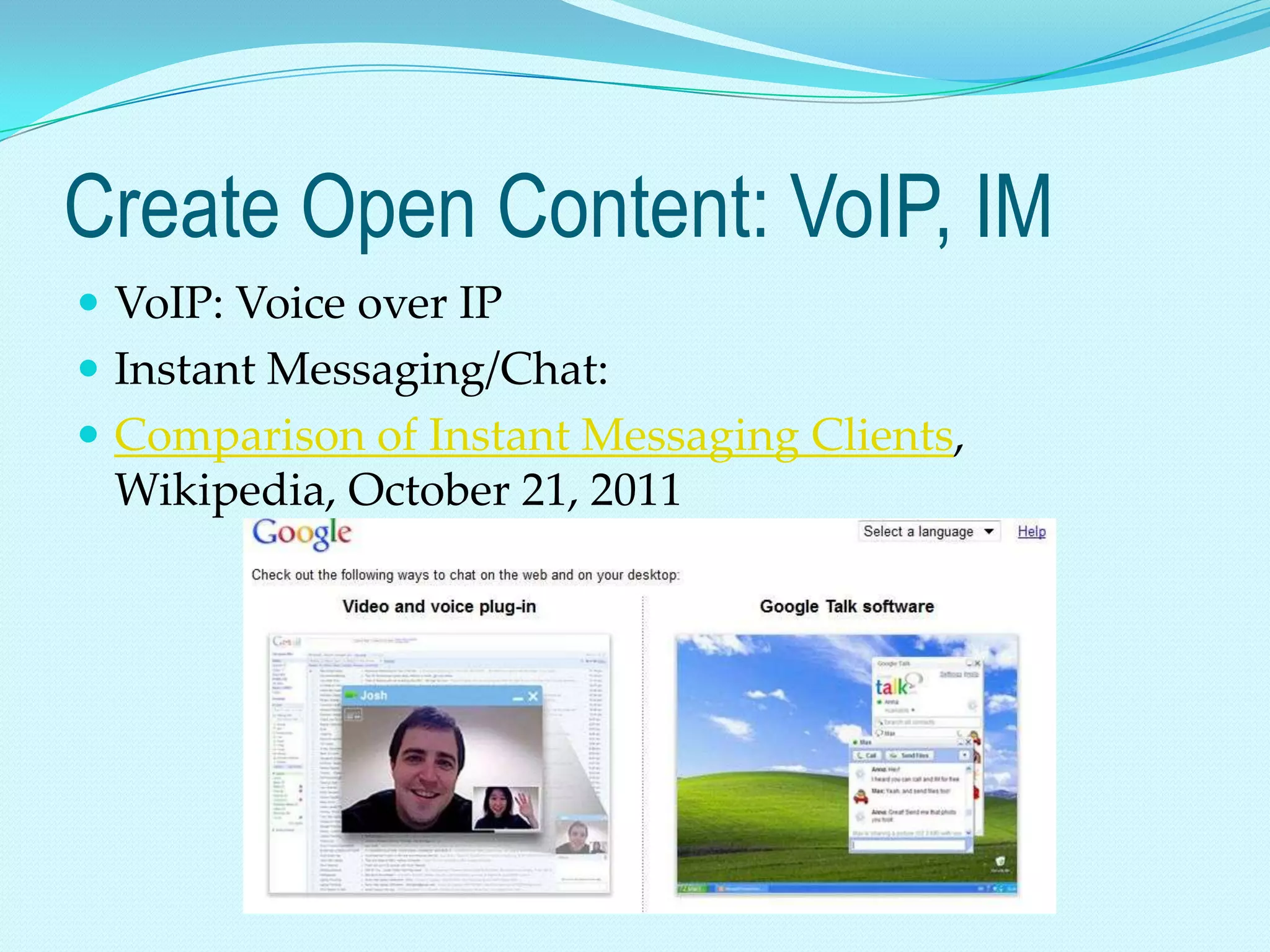
Create Open Content: VoIP, IM
 VoIP: Voice over IP
 Instant Messaging/Chat:
 Comparison of Instant Messaging Clients,
 Wikipedia, October 21, 2011
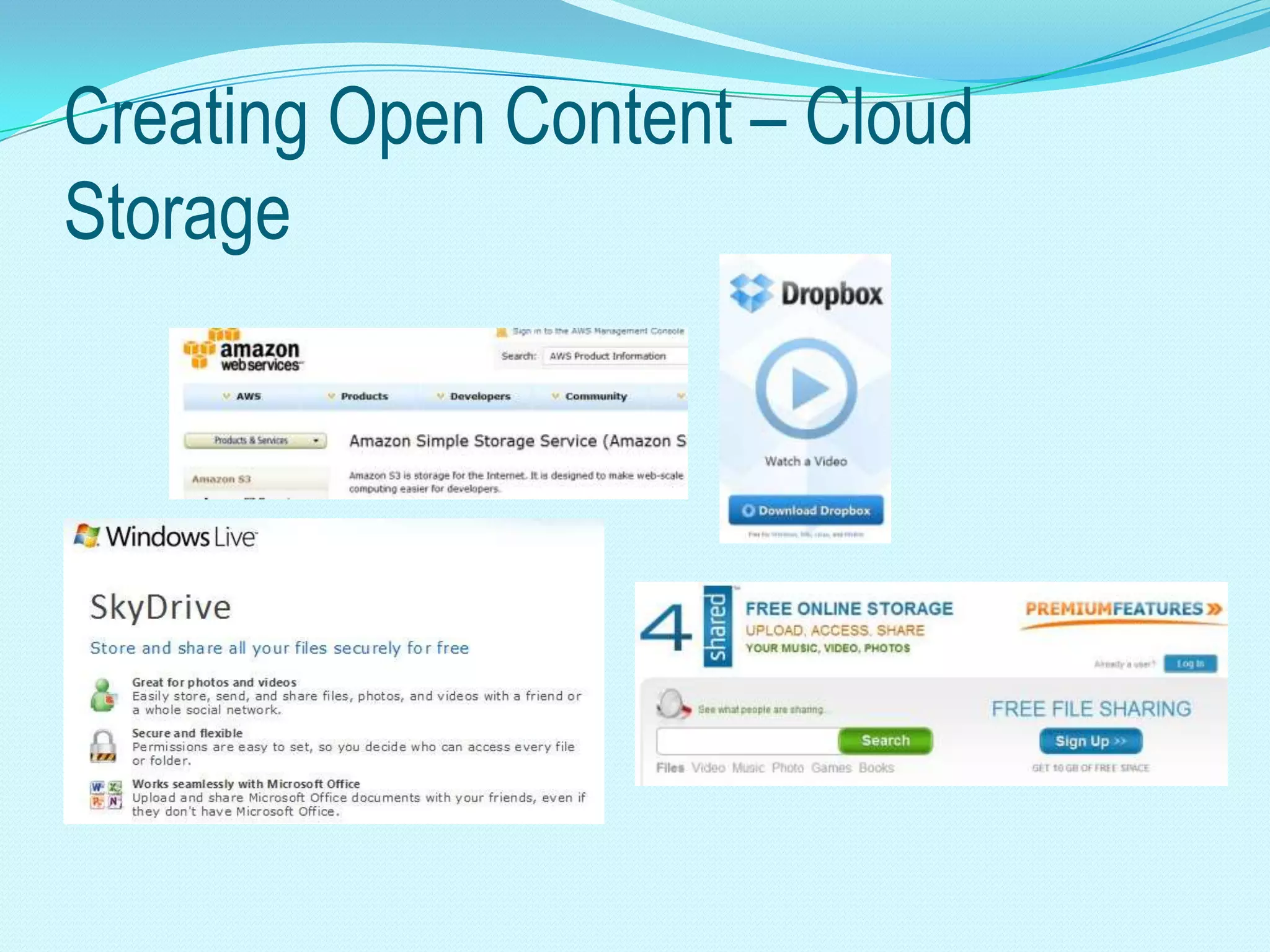
Creating Open Content – Cloud
Storage
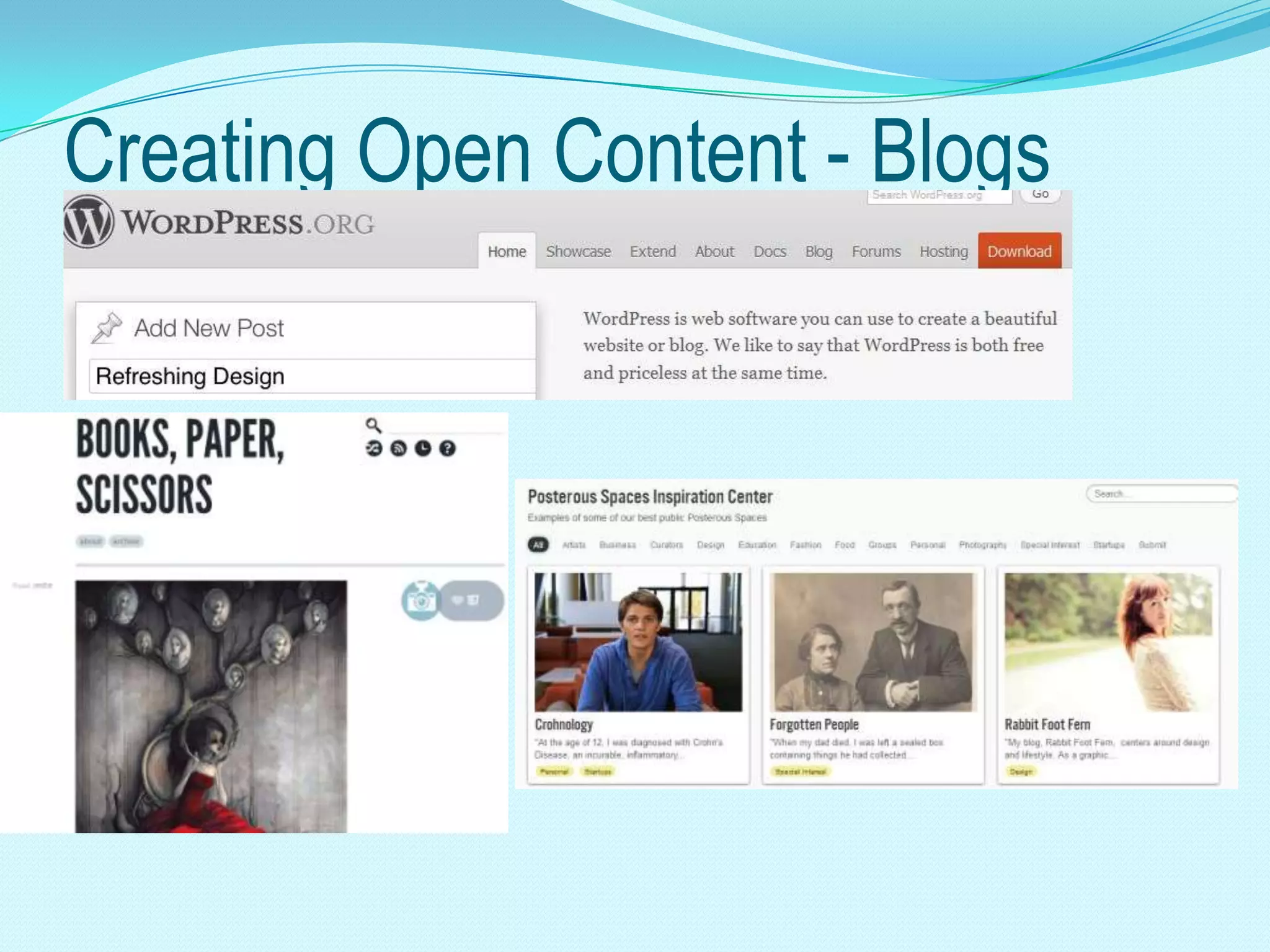
Creating Open Content - Blogs
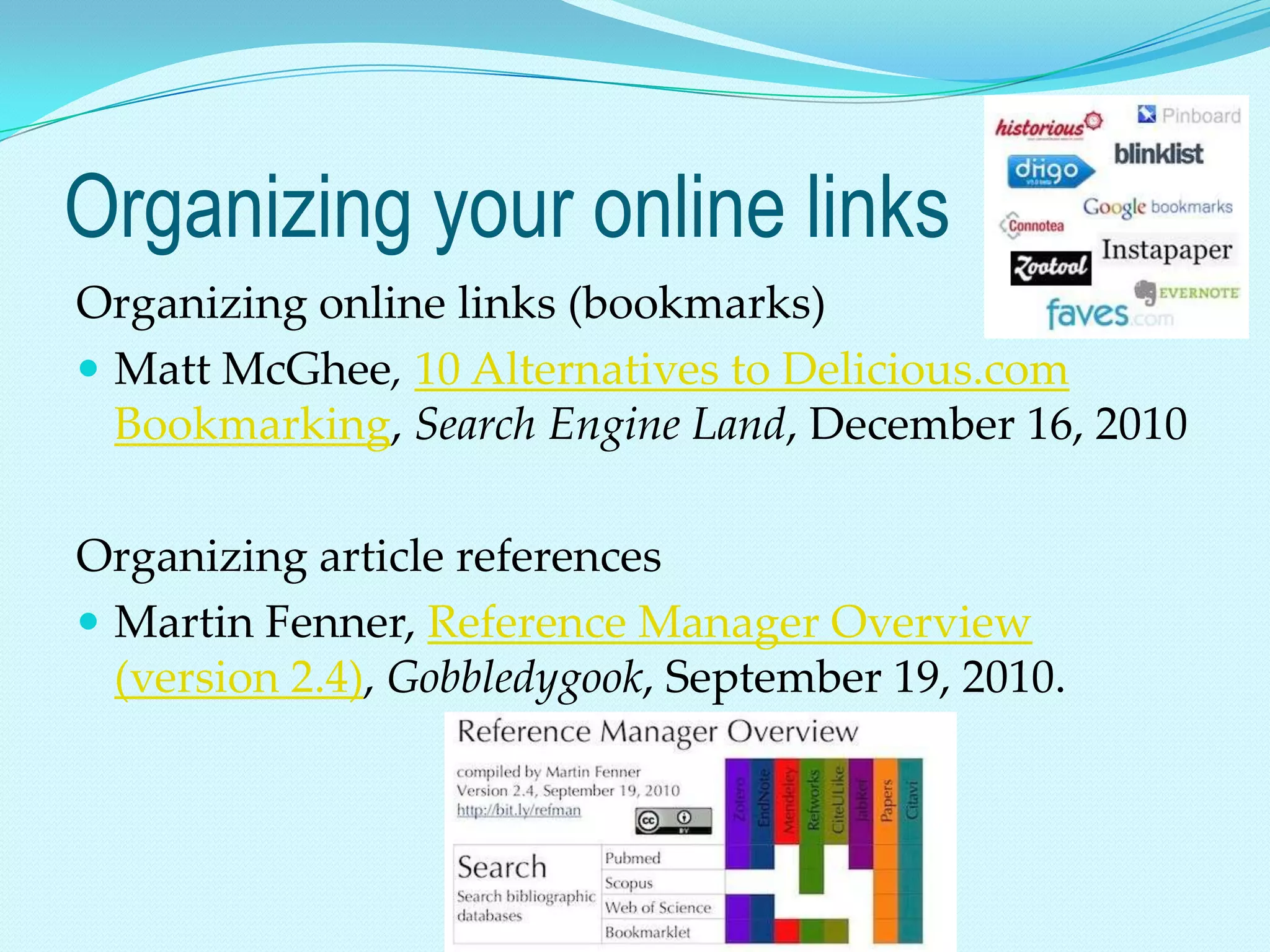
Organizing your online links
Organizing online links (bookmarks)
 Matt McGhee, 10 Alternatives to Delicious.com
  Bookmarking, Search Engine Land, December 16, 2010

Organizing article references
 Martin Fenner, Reference Manager Overview
  (version 2.4), Gobbledygook, September 19, 2010.
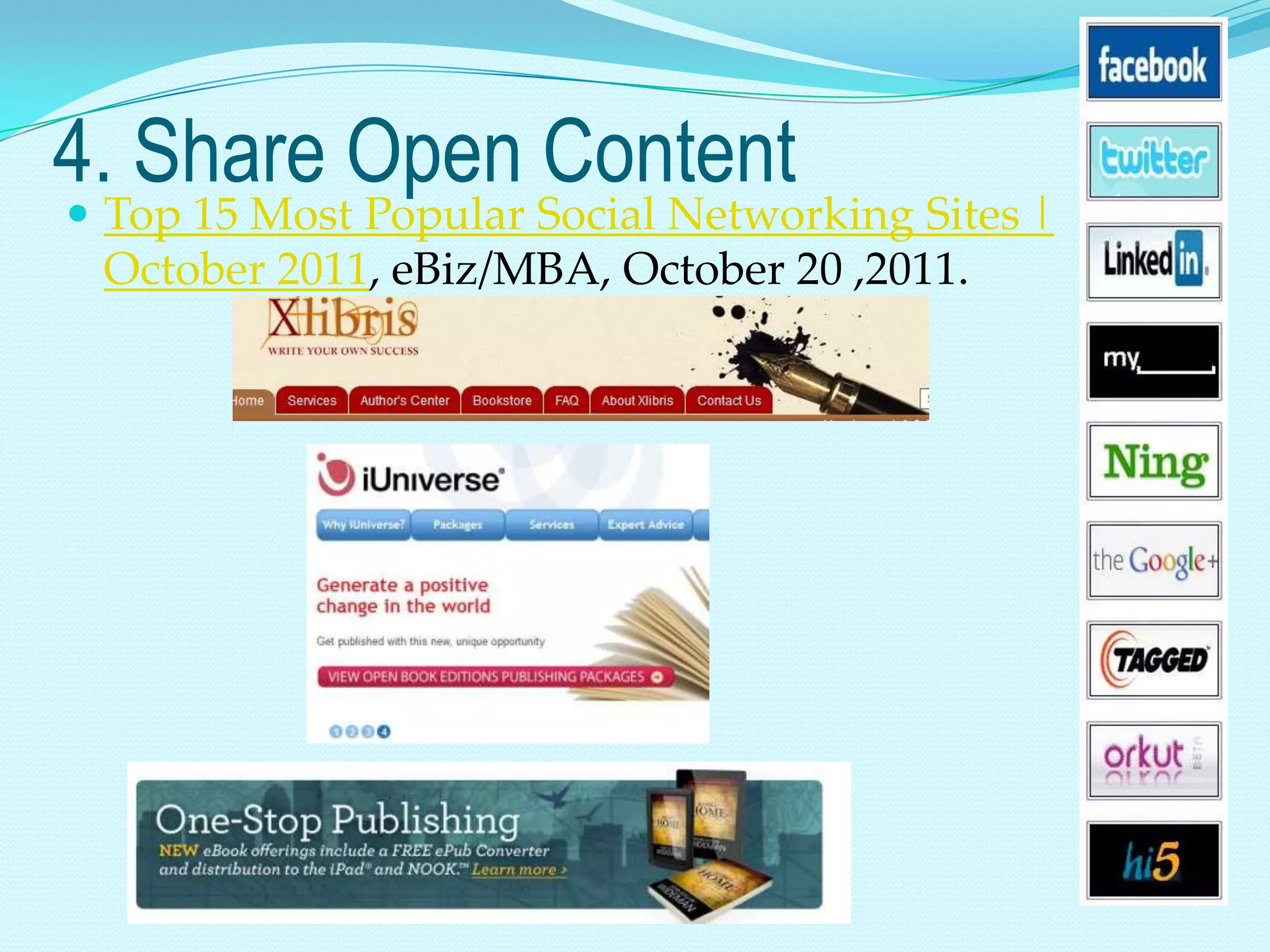
4. Share Open Content
 Top 15 Most Popular Social Networking Sites |
 October 2011, eBiz/MBA, October 20 ,2011.
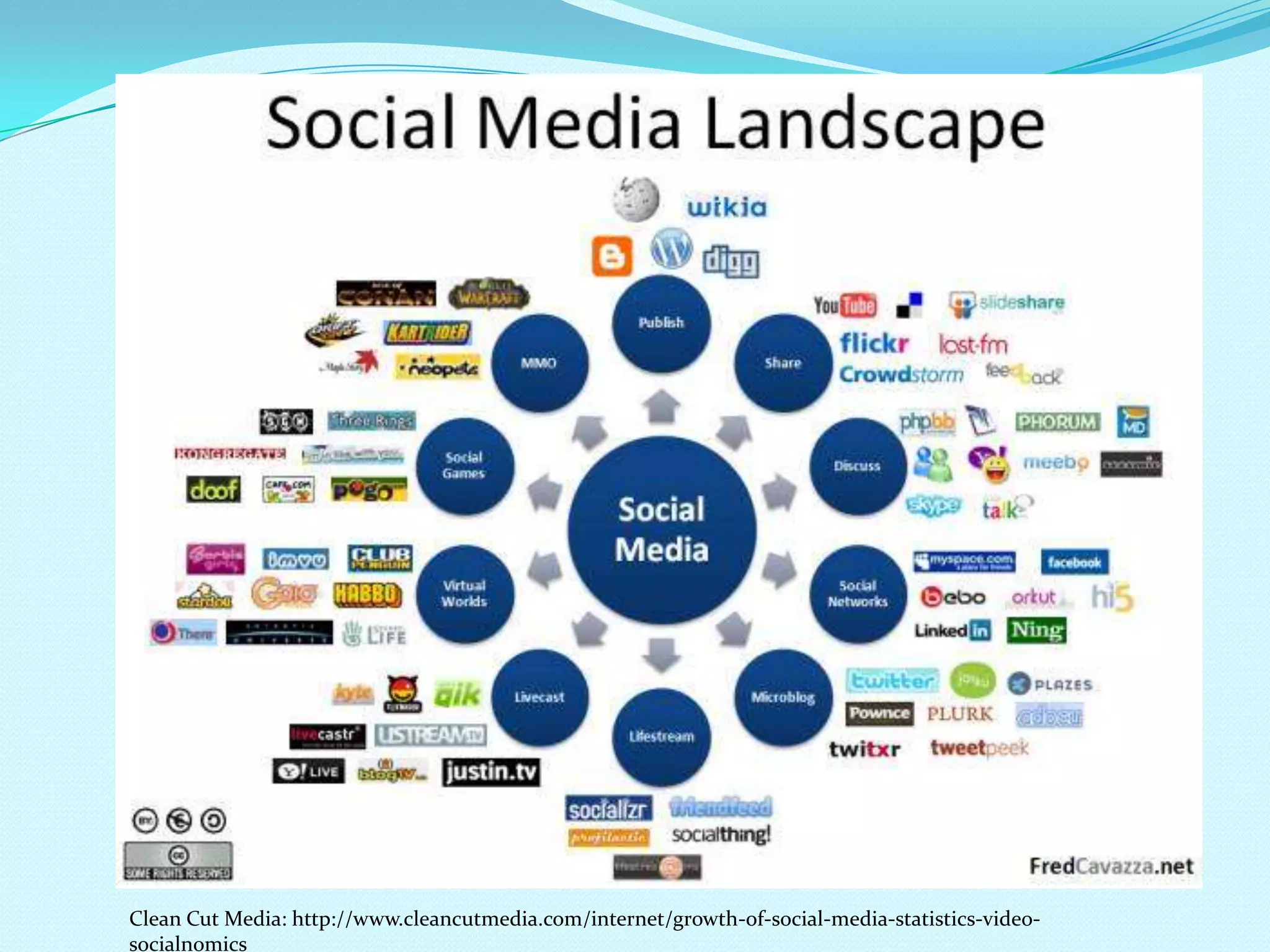
Clean Cut Media: http://www.cleancutmedia.com/internet/growth-of-social-media-statistics-video-
socialnomics
5. Preserve
 Self-publishing
 Cloud Storage
 Campus data storage
 Library digital repository


 Think REDUNANCY
Making, Using Open Content requires
planning
 What tools are available?
 What do I need to create myself?
 How much time do I have?
 Is this enriching the classroom experience/course?
What is your final product?
 Portfolio
 E-textbook
 Curriculum Guide
 Tutorial
 Peer-Reviewed article, monograph


 Catalyst for future projects
 Build on content
Open is an iterative process
 Build content from one semester to the next
 Create a continuously evolving organism
 Explore concepts more deeply
Additional Advice
 Consider starting small
 Keep student abilities in mind
 Some areas easier to incorporate open content
 Technology evolves quickly!
 Colleagues may need data to be convinced of
 success.
Sources
 Jason Fitzpatrick, Five Best Blogging Platforms, Lifehacker, June 10,
    2010.
   Alex Wilhelm, The Five Best Blogging Platforms you haven’t heard
    of, The Next Web, September 7, 2011.
   Mark Sample, Create Your Own E-Book with Open-Source Sigil,
    Chronicle of Higher Education, October 11, 2011.
   London School of Economics and Political Science Impact of Social
    Sciences, Available now: a guide to using Twitter in university
    research, teaching, and impact activities, September 29, 2011.
   Guy Kawasaki, Ten Ways to Use LinkedIn, How to Change the
    World, January 4, 2007.
   Lauren Dugan, 5 Twitter metrics beyond follow count, March 10,
    2011.
   Edudemic, The 100 Best Web 2.0 Classroom Tools Chosen by You,
    November 2, 2011.
Case Studies
 Bodie, Matthew T. , Open Access in Law Teaching: A New
    Approach to Legal Education, 10 Lewis & Clark L. Rev. 885
    (2006)
   Campbell AM (2004) Open Access: A PLoS for Education. PLoS
    Biol 2(5): e145. doi:10.1371/journal.pbio.0020145
   Michael Verhaart, Stephanie Day, Joyce Seitzinger, Using Open
    Education Resources (OERs) in Blended Teaching: Is it worth
    it?, 2011
   K. A. Garrett, P. D. Esker, and A. H. Sparks, An Introduction to
    the R Programming Environment, 2008.
   Hsinchun Chen; Xin Li; Chau, M.; Yi-Jen Ho; Chunju Tseng; ,
    "Using Open Web APIs in Teaching Web Mining," Education,
    IEEE Transactions on , vol.52, no.4, pp.482-490, Nov. 2009
    doi: 10.1109/TE.2008.930509
More Case Studies
 MS Mustafa, J Montgomery, HR Atta, OPEN ACCESS: A
  novel educational tool for teaching ocular ultrasound,
  Clinical Opthamology, 21 June 2011.
 Harry E. Pence and Barbara Losoff, Going beyond the
  textbook: The need to integrate open access primary
  literature into the Chemistry curriculum, Chem Cent J.
  2011; 5: 18, published online 2011 April 6.
  doi:10.1186/1752-153X-5-18
 50 Awesome Ways to Use Skype in the Classroom,
  TeachingDegrees.org, 2009.
 An Open Access toolkit to support bibliometrics training
  and awareness, NDLR, Ireland, 2010-2011.
Thank You / Credits
 Title image: Poppy Thomas-Hill
 (http://www.flickr.com/photos/pinkpoppyimages/6254575807/in/pool-809956@N25/)


 Presentation Link: http://www.slideshare.net/ebrown

5 steps to using open access in the classroom 11 9 2011

  • 1.
    Elizabeth Brown Scholarly Communicationsand Library Grants Officer Binghamton University Libraries New Concepts in teaching and learning: E-texts, open educational resources and more November 4, 2011
  • 2.
    Limitations to makingcontent open Michelle Hawkins-Thiel: http://www.flickr.com/photos/hawkins-thiel/2515183032/ Sarah Cool: http://perceptivetravel.com/blog/2007/05/13/writing-project-wrap-up/finding-the-good-ones-courtesy-sarah-cool-at-flickrs-creative-commons/
  • 3.
    The Goal Jonathan Nerdtrek:http://nerdtrek.com/iron-man-movie-computer/
  • 4.
    Five Steps Identify Preserve Assess Share Create
  • 5.
    The Five StepsExplained 1. Identify open content 2. Assess the value of the information 3. Create open content 4. Share open content with peers 5. Preserve open content on the web and locally
  • 6.
    All the Opens Dorothea Salo, Battle of the Opens, Book of Trogool, March 15, 2010  Open Source  Open Standards  Open Access  Open Educational Resources  Open (Research) Data  Open (Governmental) Data  Open Notebook Science
  • 7.
    Open is amovement #occupyknowledge #occupyscholcomm #oaweek http://en.wikipedia.org/wiki/File:Benjamin_Franklin_-_Join_or_Die.jpg
  • 8.
    1. Identify OpenContent  Journals  Data/Journal Article Manuscripts  Citizen Science/Open Research  Blogs and Social Media  Books  Photos/Images/Multimedia
  • 9.
    Open Access JournalCollections  Directory of Open Access Journals (DOAJ)  Highwire Press  Public Library of Science (PLoS)  BioMedCentral  PubMedCentral  J-Stage  Royal Society  JSTOR  Hindawi
  • 10.
    Open Research, GovernmentData  OAD Wiki – Data Repositories  Data.gov
  • 11.
    Repositories •OAD Wiki –Disciplinary Repositories •Nature Precedings
  • 12.
    Citizen Science, OpenResearch  Citizens for Science  Scientific American Citizen Science  Open Folklore  Open Notebook Science Challenge
  • 13.
    Blogs  Technorati Top 100, Technorati, updated daily.  Science Blogs  Scientopia  Scientific American Blogs  Nature Blog Network  The Guardian Blogposts  New York Times Blogs
  • 14.
    Public Domain Books Rebecca Hedreen, Open Access Books, Southern Connecticut State University, 2007.  Freely Available Ebook Collections, Binghamton University Libraries, October 26, 2011.
  • 15.
    Photos/Images/Multimedia  Jean-Baptiste Jung,50 Sites to find free stock images, Cats Who Code, January 22, 2009
  • 16.
    2. Assess  AlternativeMetrics  Social Media Data, Analysis  Copyright – can I use it?  Assessment Tools
  • 17.
    Alternative Metrics http://altmetrics.org/manifesto/
  • 18.
    Alternative Metrics: Isit Junk?  It depends…  Citation metrics are evolving:  Impact Factor (Thomson), 1960’s  h-index (Hirsch, UC San Diego), 2005  Eigenfactor, 2009  Eigenfactor™ Score (EF)  Article Influence™ Score (AI)  PLOS article level metrics, 2009  Varies by discipline  Change over time
  • 19.
  • 20.
    Copyright Law andCreative Commons  Copyright Advisory Network  Creative Commons  Copyright Alliance
  • 21.
  • 22.
    3. Create opencontent- Wikis, editors
  • 23.
    Create Open Content:VoIP, IM  VoIP: Voice over IP  Instant Messaging/Chat:  Comparison of Instant Messaging Clients, Wikipedia, October 21, 2011
  • 24.
    Creating Open Content– Cloud Storage
  • 25.
  • 26.
    Organizing your onlinelinks Organizing online links (bookmarks)  Matt McGhee, 10 Alternatives to Delicious.com Bookmarking, Search Engine Land, December 16, 2010 Organizing article references  Martin Fenner, Reference Manager Overview (version 2.4), Gobbledygook, September 19, 2010.
  • 27.
    4. Share OpenContent  Top 15 Most Popular Social Networking Sites | October 2011, eBiz/MBA, October 20 ,2011.
  • 28.
    Clean Cut Media:http://www.cleancutmedia.com/internet/growth-of-social-media-statistics-video- socialnomics
  • 29.
    5. Preserve  Self-publishing Cloud Storage  Campus data storage  Library digital repository  Think REDUNANCY
  • 30.
    Making, Using OpenContent requires planning  What tools are available?  What do I need to create myself?  How much time do I have?  Is this enriching the classroom experience/course?
  • 31.
    What is yourfinal product?  Portfolio  E-textbook  Curriculum Guide  Tutorial  Peer-Reviewed article, monograph  Catalyst for future projects  Build on content
  • 32.
    Open is aniterative process  Build content from one semester to the next  Create a continuously evolving organism  Explore concepts more deeply
  • 33.
    Additional Advice  Considerstarting small  Keep student abilities in mind  Some areas easier to incorporate open content  Technology evolves quickly!  Colleagues may need data to be convinced of success.
  • 34.
    Sources  Jason Fitzpatrick,Five Best Blogging Platforms, Lifehacker, June 10, 2010.  Alex Wilhelm, The Five Best Blogging Platforms you haven’t heard of, The Next Web, September 7, 2011.  Mark Sample, Create Your Own E-Book with Open-Source Sigil, Chronicle of Higher Education, October 11, 2011.  London School of Economics and Political Science Impact of Social Sciences, Available now: a guide to using Twitter in university research, teaching, and impact activities, September 29, 2011.  Guy Kawasaki, Ten Ways to Use LinkedIn, How to Change the World, January 4, 2007.  Lauren Dugan, 5 Twitter metrics beyond follow count, March 10, 2011.  Edudemic, The 100 Best Web 2.0 Classroom Tools Chosen by You, November 2, 2011.
  • 35.
    Case Studies  Bodie,Matthew T. , Open Access in Law Teaching: A New Approach to Legal Education, 10 Lewis & Clark L. Rev. 885 (2006)  Campbell AM (2004) Open Access: A PLoS for Education. PLoS Biol 2(5): e145. doi:10.1371/journal.pbio.0020145  Michael Verhaart, Stephanie Day, Joyce Seitzinger, Using Open Education Resources (OERs) in Blended Teaching: Is it worth it?, 2011  K. A. Garrett, P. D. Esker, and A. H. Sparks, An Introduction to the R Programming Environment, 2008.  Hsinchun Chen; Xin Li; Chau, M.; Yi-Jen Ho; Chunju Tseng; , "Using Open Web APIs in Teaching Web Mining," Education, IEEE Transactions on , vol.52, no.4, pp.482-490, Nov. 2009 doi: 10.1109/TE.2008.930509
  • 36.
    More Case Studies MS Mustafa, J Montgomery, HR Atta, OPEN ACCESS: A novel educational tool for teaching ocular ultrasound, Clinical Opthamology, 21 June 2011.  Harry E. Pence and Barbara Losoff, Going beyond the textbook: The need to integrate open access primary literature into the Chemistry curriculum, Chem Cent J. 2011; 5: 18, published online 2011 April 6. doi:10.1186/1752-153X-5-18  50 Awesome Ways to Use Skype in the Classroom, TeachingDegrees.org, 2009.  An Open Access toolkit to support bibliometrics training and awareness, NDLR, Ireland, 2010-2011.
  • 37.
    Thank You /Credits  Title image: Poppy Thomas-Hill (http://www.flickr.com/photos/pinkpoppyimages/6254575807/in/pool-809956@N25/)  Presentation Link: http://www.slideshare.net/ebrown

Editor's Notes

  • #8 Open Access and other open movements have advocates and they feel strongly about these causes. Like the patriots of the American Revolution, they feel that publishing is broken and only radical change can create change in the system.
  • #18 Scholars, though, also care about the impact of their work, not just how it is published. The Open movement has created more metrics and groups like altmetrics.org that advocate for weblinks, bookmarks and online conversations on research to help measure impact for tenure and promotion decisions.
  • #29 Open tools have also created a way for people to share content online. This picture shows the many different ways you can create and share content with your peers. More tools are appearing daily.