The Open Research Agenda
Open Education 2016 #opened16
Richmond, VA.
November 2016
Dr. Rob Farrow
@philosopher1978
• Award-winning research into open education
• Strategies for building worldwide open education research capacity
• Available for research & consultancy (short & long term)
• Current projects include:
oerhub.net
What is the Open Research Agenda?
Simple consultation and sharing exercise
Invitation to share thoughts about research priorities in open education
Results are discussed at conferences and workshops
That discussion then becomes part of the following presentation
Promoting an open research culture
The hope is that we will become better able to anticipate research needs
and funding opportunities as well as find potential collaborators
What is the Open Research Agenda?

Community consultation exercise to better understand research priorities of
practitioners
Intended to identify patterns across countries and stakeholders
‘ Flipping’ the conference format

Stealing research ideas
Setting the agenda ourselves
consultation form
tinyurl.com/2016ORA
Survey Methodology
Country (main residence)
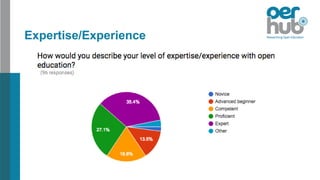
Self-perception of OER expertise (adapted from Dreyfus & Dreyfus (1980)
model of skill acquisition)
Role (choose from list or free text)
Context of work/study (based on International Standard Classification of
Education (UNESCO, 2011))
Perception of research priorities (free text)
Most important research questions (free text)
As at 31 October 2016:
• 91 survey responses
• Respondents from 24 countries across 5 continents:
Australia, Bangladesh, Brazil, Canada, Chile, Croatia, Ecuador,
Ethiopia, Germany, India, Ireland, Macedonia, Malta, Mexico, New
Zealand, Portugal, South Africa, The Netherlands, United Kingdom
• Approximately a further 90 participants in discussion (3 expert
meetings; 3 conferences; 1 webinar)
Survey Sample Overview
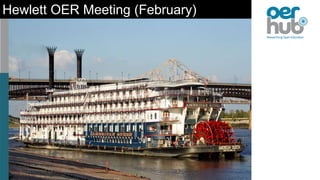
Hewlett OER Meeting (February)
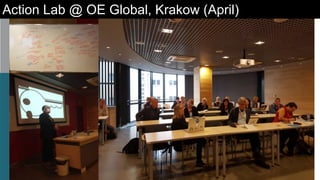
Action Lab @ OE Global, Krakow (April)
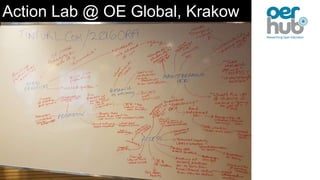
Action Lab @ OE Global, Krakow
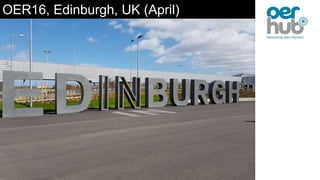
OER16, Edinburgh, UK (April)
Global OER Graduate Network (May)
Computers and Learning Research Group
Annual Conference (June)
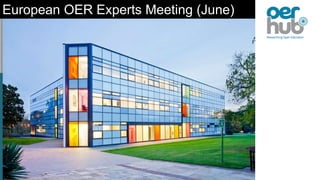
European OER Experts Meeting (June)
OERu Expert Meeting (October)
Open Education 2016 (November)
Summary of Results
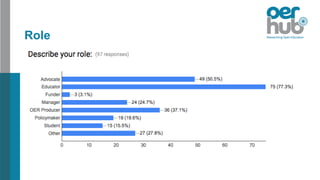
Role
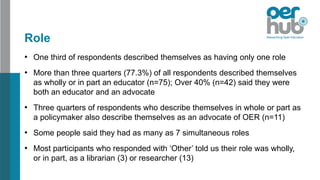
• One third of respondents described themselves as having only one role
• More than three quarters (77.3%) of all respondents described themselves
as wholly or in part an educator (n=75); Over 40% (n=42) said they were
both an educator and an advocate
• Three quarters of respondents who describe themselves in whole or part as
a policymaker also describe themselves as an advocate of OER (n=11)
• Some people said they had as many as 7 simultaneous roles
• Most participants who responded with ‘Other’ told us their role was wholly,
or in part, as a librarian (3) or researcher (13)
Role
Expertise/Experience
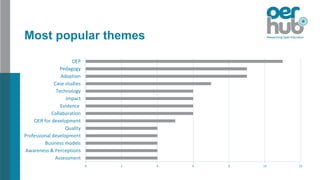
What are the most important areas for open
education research over the next year?
Most popular themes
0 2 4 6 8 10 12
Assessment
Awareness & Perceptions
Business models
Professional development
Quality
OER for development
Collaboration
Evidence
Impact
Technology
Case studies
Adoption
Pedagogy
OEP
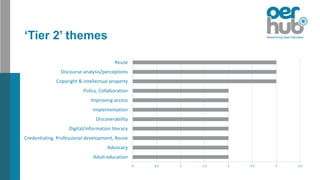
‘Tier 2’ themes
0 0.5 1 1.5 2 2.5 3 3.5
Adult education
Advocacy
Credentialing, Professional development, Reuse
Digital/information literacy
Discoverability
Implementation
Improving access
Policy, Collaboration
Copyright & intellectual property
Discourse analysis/perceptions
Reuse
Least popular themes
Accessibility
Ethics
Formal recognition of OER
Global North/South Innovation (marginalised voices)
Lifelong learning
MOOC
Non-formal learning
OER Creation Open Data
Social mission of open education
+ all the others not mentioned…
Open practices and pedagogies
• OER for lifelong learning and professional
development
• Policy development
• Benefits of ‘non-disposable assignments’
• Local/National platforms for teachers
• Networked learning
• OER for language development
• “Open pedagogy”
• Citation and cataloguing protocols
• Integration of OER into curriculum
• Creating assessment tools
• Micro-credentialling
• Recognition of prior learning
• Sustainable business models
OER impact research • Measuring the influence of
the use of OER and OEP on
learning outcomes and
institutions
• More empirical studies with
wider focus than purely on
open textbook efficacy
• A wider range of research
methods (including
qualitative approaches)
• Quantifying the return on
investment from going open
• Scant mention of student
cost savings
Promoting adoption and adaptation
• Factors affecting adoption of individual OER
• Qualitative descriptions of adaptation
• Barriers to remix and sharing (& implications for design)
• Barriers to institutional adoption
• Strategies for easing implementation by faculty
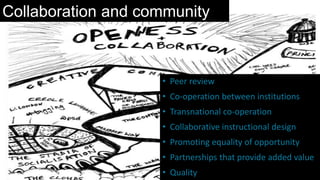
Collaboration and community
• Peer review
• Co-operation between institutions
• Transnational co-operation
• Collaborative instructional design
• Promoting equality of opportunity
• Partnerships that provide added value
• Quality
Technology and infrastructure
• Sustainable OER ecosystem
• Ways of cataloguing and sharing OER
(e.g. shared database)
• Linked open data for education
• Open digital badging
• Geographical hubs for sharing OER
• Using OER with VLEs
• Beyond repositories
• Interoperability
Ethical issues
• Privacy, security and trust in online
learning
• Ownership of (student) data and ‘safe
spaces’
• Access & accessibility vs. remixable
resources
• Appropriate literacies
• Being ethical ‘in the open’
• Some conflation with ethical issues in
e-learning more gnenerally
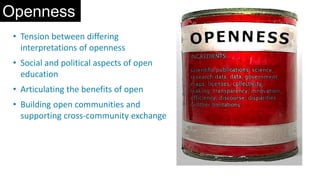
Openness
• Tension between differing
interpretations of openness
• Social and political aspects of open
education
• Articulating the benefits of open
• Building open communities and
supporting cross-community exchange
What are the most pressing questions that
need to be answered?
Reflections on this approach
It’s quite hard to get people to do anything!
Envisaged breakdowns of role, level of expertise have been problematic
because of multiple roles and most identifying as expert
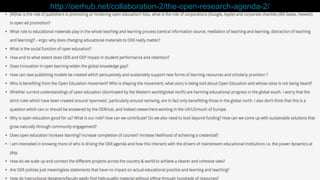
http://oerhub.net/collaboration-2/the-open-research-agenda-2/
“Messes are complex, multi-dimensional, intractable,
dynamic problems that can only be partially addressed
and partially resolved.”
(Brydon-Miller et al., 2003:21)
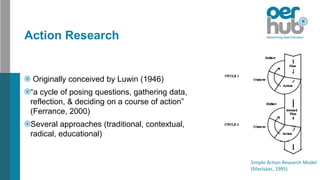
Action Research
Originally conceived by Luwin (1946)
“a cycle of posing questions, gathering data,
reflection, & deciding on a course of action”
(Ferrance, 2000)
Several approaches (traditional, contextual,
radical, educational)
Simple Action Research Model
(MacIsaac, 1995)
Participatory Action Research (Freire)
Blackall & Hegarty (2012:69) identify four key aspects to Participatory Action
Research (PAR) which are relevant to the worldwide OER community:
The explicit aim to engage all stakeholders […] in describing the problems
Asking those stakeholders to research the problem and propose solutions
Empowering those stakeholders to carry out their plans
Repeating the cycle, reflecting on lessons learned and publishing the
research
Suggestions for future research
Holistic case studies which include a focus on efficacy and cost savings but also provide
(balanced) qualitative data regarding the impact on persons and practices
Detailed case studies of open pedagogy (including theoretical perspective)
Studies of the narrative on ‘open’ (e.g. discourse analysis) – there are ever more voices in
this space with differing interpretations
Business analysis -> generate sustainable business models
How can a more holistic OER ecosystem be achieved? OER World Map?
Sociology/psychology of conversion, persuasion, and culture change
Sharing best/effective practices: institutions, educators, learners
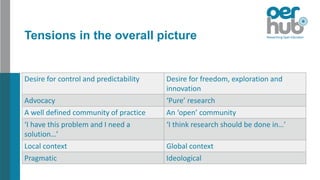
Tensions in the overall picture
Desire for control and predictability Desire for freedom, exploration and
innovation
Advocacy ‘Pure’ research
A well defined community of practice An ‘open’ community
‘I have this problem and I need a
solution…’
‘I think research should be done in…’
Local context Global context
Pragmatic Ideological
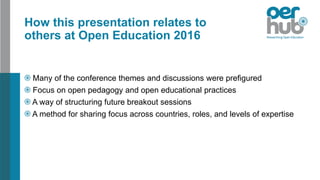
How this presentation relates to
others at Open Education 2016
Many of the conference themes and discussions were prefigured
Focus on open pedagogy and open educational practices
A way of structuring future breakout sessions
A method for sharing focus across countries, roles, and levels of expertise
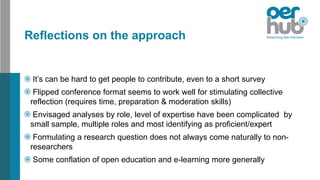
Reflections on the approach
It’s can be hard to get people to contribute, even to a short survey
Flipped conference format seems to work well for stimulating collective
reflection (requires time, preparation & moderation skills)
Envisaged analyses by role, level of expertise have been complicated by
small sample, multiple roles and most identifying as proficient/expert
Formulating a research question does not always come naturally to non-
researchers
Some conflation of open education and e-learning more generally
What’s next?
Final presentation at Open Education 2016 (Nov)
Publish report/paper with results
Identify possibilities for future work & collaboration
Get feedback. Repeat?
22222
consultation form
tinyurl.com/2016ORA
Image credits
https://upload.wikimedia.org/wikipedia/commons/5/59/American_Queen_Eads_Bridge.jpg
"Life is Sharing" (CC-BY 2.0 Generic, Alan Levine)
“Open” Chuck Coker
https://upload.wikimedia.org/wikipedia/commons/4/41/Richmond,_Virginia_downtown.jpg
https://www.flickr.com/photos/caveman_92223/4016133284/
https://commons.wikimedia.org/wiki/File:Water_drop_impact_on_a_water-surface_-_(5).jpg
http://www.thebluediamondgallery.com/pictures/webinar.jpg
http://www.thebluediamondgallery.com/highlighted/a/advocacy.html CC-BY-SA 3.0
http://creativecommons.org/licenses/by-sa/3.0/
https://pixabay.com/static/uploads/photo/2012/11/07/10/14/quality-65060_960_720.jpg
https://pixabay.com/static/uploads/photo/2014/04/02/10/16/key-303320_960_720.png
https://static.pexels.com/photos/4316/technology-computer-chips-gigabyte.jpg
https://upload.wikimedia.org/wikipedia/commons/thumb/b/b8/Openness.jpg/377px-Openness.jpg
https://upload.wikimedia.org/wikipedia/commons/8/84/Openness_and_Collaboration.png

The Open Research Agenda

  • 1.
    The Open ResearchAgenda Open Education 2016 #opened16 Richmond, VA. November 2016 Dr. Rob Farrow @philosopher1978
  • 2.
    • Award-winning researchinto open education • Strategies for building worldwide open education research capacity • Available for research & consultancy (short & long term) • Current projects include: oerhub.net
  • 3.
    What is theOpen Research Agenda? Simple consultation and sharing exercise Invitation to share thoughts about research priorities in open education Results are discussed at conferences and workshops That discussion then becomes part of the following presentation Promoting an open research culture The hope is that we will become better able to anticipate research needs and funding opportunities as well as find potential collaborators
  • 4.
    What is theOpen Research Agenda?  Community consultation exercise to better understand research priorities of practitioners Intended to identify patterns across countries and stakeholders ‘ Flipping’ the conference format  Stealing research ideas Setting the agenda ourselves
  • 5.
  • 6.
    Survey Methodology Country (mainresidence) Self-perception of OER expertise (adapted from Dreyfus & Dreyfus (1980) model of skill acquisition) Role (choose from list or free text) Context of work/study (based on International Standard Classification of Education (UNESCO, 2011)) Perception of research priorities (free text) Most important research questions (free text)
  • 7.
    As at 31October 2016: • 91 survey responses • Respondents from 24 countries across 5 continents: Australia, Bangladesh, Brazil, Canada, Chile, Croatia, Ecuador, Ethiopia, Germany, India, Ireland, Macedonia, Malta, Mexico, New Zealand, Portugal, South Africa, The Netherlands, United Kingdom • Approximately a further 90 participants in discussion (3 expert meetings; 3 conferences; 1 webinar) Survey Sample Overview
  • 8.
  • 9.
    Action Lab @OE Global, Krakow (April)
  • 10.
    Action Lab @OE Global, Krakow
  • 11.
  • 12.
    Global OER GraduateNetwork (May)
  • 13.
    Computers and LearningResearch Group Annual Conference (June)
  • 14.
    European OER ExpertsMeeting (June)
  • 15.
  • 16.
  • 17.
  • 18.
  • 19.
    • One thirdof respondents described themselves as having only one role • More than three quarters (77.3%) of all respondents described themselves as wholly or in part an educator (n=75); Over 40% (n=42) said they were both an educator and an advocate • Three quarters of respondents who describe themselves in whole or part as a policymaker also describe themselves as an advocate of OER (n=11) • Some people said they had as many as 7 simultaneous roles • Most participants who responded with ‘Other’ told us their role was wholly, or in part, as a librarian (3) or researcher (13) Role
  • 20.
  • 21.
    What are themost important areas for open education research over the next year?
  • 22.
    Most popular themes 02 4 6 8 10 12 Assessment Awareness & Perceptions Business models Professional development Quality OER for development Collaboration Evidence Impact Technology Case studies Adoption Pedagogy OEP
  • 23.
    ‘Tier 2’ themes 00.5 1 1.5 2 2.5 3 3.5 Adult education Advocacy Credentialing, Professional development, Reuse Digital/information literacy Discoverability Implementation Improving access Policy, Collaboration Copyright & intellectual property Discourse analysis/perceptions Reuse
  • 24.
    Least popular themes Accessibility Ethics Formalrecognition of OER Global North/South Innovation (marginalised voices) Lifelong learning MOOC Non-formal learning OER Creation Open Data Social mission of open education + all the others not mentioned…
  • 25.
    Open practices andpedagogies • OER for lifelong learning and professional development • Policy development • Benefits of ‘non-disposable assignments’ • Local/National platforms for teachers • Networked learning • OER for language development • “Open pedagogy” • Citation and cataloguing protocols • Integration of OER into curriculum • Creating assessment tools • Micro-credentialling • Recognition of prior learning • Sustainable business models
  • 26.
    OER impact research• Measuring the influence of the use of OER and OEP on learning outcomes and institutions • More empirical studies with wider focus than purely on open textbook efficacy • A wider range of research methods (including qualitative approaches) • Quantifying the return on investment from going open • Scant mention of student cost savings
  • 27.
    Promoting adoption andadaptation • Factors affecting adoption of individual OER • Qualitative descriptions of adaptation • Barriers to remix and sharing (& implications for design) • Barriers to institutional adoption • Strategies for easing implementation by faculty
  • 28.
    Collaboration and community •Peer review • Co-operation between institutions • Transnational co-operation • Collaborative instructional design • Promoting equality of opportunity • Partnerships that provide added value • Quality
  • 29.
    Technology and infrastructure •Sustainable OER ecosystem • Ways of cataloguing and sharing OER (e.g. shared database) • Linked open data for education • Open digital badging • Geographical hubs for sharing OER • Using OER with VLEs • Beyond repositories • Interoperability
  • 30.
    Ethical issues • Privacy,security and trust in online learning • Ownership of (student) data and ‘safe spaces’ • Access & accessibility vs. remixable resources • Appropriate literacies • Being ethical ‘in the open’ • Some conflation with ethical issues in e-learning more gnenerally
  • 31.
    Openness • Tension betweendiffering interpretations of openness • Social and political aspects of open education • Articulating the benefits of open • Building open communities and supporting cross-community exchange
  • 32.
    What are themost pressing questions that need to be answered?
  • 33.
    Reflections on thisapproach It’s quite hard to get people to do anything! Envisaged breakdowns of role, level of expertise have been problematic because of multiple roles and most identifying as expert http://oerhub.net/collaboration-2/the-open-research-agenda-2/
  • 35.
    “Messes are complex,multi-dimensional, intractable, dynamic problems that can only be partially addressed and partially resolved.” (Brydon-Miller et al., 2003:21)
  • 36.
    Action Research Originally conceivedby Luwin (1946) “a cycle of posing questions, gathering data, reflection, & deciding on a course of action” (Ferrance, 2000) Several approaches (traditional, contextual, radical, educational) Simple Action Research Model (MacIsaac, 1995)
  • 37.
    Participatory Action Research(Freire) Blackall & Hegarty (2012:69) identify four key aspects to Participatory Action Research (PAR) which are relevant to the worldwide OER community: The explicit aim to engage all stakeholders […] in describing the problems Asking those stakeholders to research the problem and propose solutions Empowering those stakeholders to carry out their plans Repeating the cycle, reflecting on lessons learned and publishing the research
  • 38.
    Suggestions for futureresearch Holistic case studies which include a focus on efficacy and cost savings but also provide (balanced) qualitative data regarding the impact on persons and practices Detailed case studies of open pedagogy (including theoretical perspective) Studies of the narrative on ‘open’ (e.g. discourse analysis) – there are ever more voices in this space with differing interpretations Business analysis -> generate sustainable business models How can a more holistic OER ecosystem be achieved? OER World Map? Sociology/psychology of conversion, persuasion, and culture change Sharing best/effective practices: institutions, educators, learners
  • 39.
    Tensions in theoverall picture Desire for control and predictability Desire for freedom, exploration and innovation Advocacy ‘Pure’ research A well defined community of practice An ‘open’ community ‘I have this problem and I need a solution…’ ‘I think research should be done in…’ Local context Global context Pragmatic Ideological
  • 40.
    How this presentationrelates to others at Open Education 2016 Many of the conference themes and discussions were prefigured Focus on open pedagogy and open educational practices A way of structuring future breakout sessions A method for sharing focus across countries, roles, and levels of expertise
  • 41.
    Reflections on theapproach It’s can be hard to get people to contribute, even to a short survey Flipped conference format seems to work well for stimulating collective reflection (requires time, preparation & moderation skills) Envisaged analyses by role, level of expertise have been complicated by small sample, multiple roles and most identifying as proficient/expert Formulating a research question does not always come naturally to non- researchers Some conflation of open education and e-learning more generally
  • 42.
    What’s next? Final presentationat Open Education 2016 (Nov) Publish report/paper with results Identify possibilities for future work & collaboration Get feedback. Repeat?
  • 43.
  • 44.
    Image credits https://upload.wikimedia.org/wikipedia/commons/5/59/American_Queen_Eads_Bridge.jpg "Life isSharing" (CC-BY 2.0 Generic, Alan Levine) “Open” Chuck Coker https://upload.wikimedia.org/wikipedia/commons/4/41/Richmond,_Virginia_downtown.jpg https://www.flickr.com/photos/caveman_92223/4016133284/ https://commons.wikimedia.org/wiki/File:Water_drop_impact_on_a_water-surface_-_(5).jpg http://www.thebluediamondgallery.com/pictures/webinar.jpg http://www.thebluediamondgallery.com/highlighted/a/advocacy.html CC-BY-SA 3.0 http://creativecommons.org/licenses/by-sa/3.0/ https://pixabay.com/static/uploads/photo/2012/11/07/10/14/quality-65060_960_720.jpg https://pixabay.com/static/uploads/photo/2014/04/02/10/16/key-303320_960_720.png https://static.pexels.com/photos/4316/technology-computer-chips-gigabyte.jpg https://upload.wikimedia.org/wikipedia/commons/thumb/b/b8/Openness.jpg/377px-Openness.jpg https://upload.wikimedia.org/wikipedia/commons/8/84/Openness_and_Collaboration.png

Editor's Notes

  • #6 The form is super short – intended to encourage participation
  • #8 Survey designed to prompt open-ended, authentic and qualitatively rich responses
  • #17 Held at University of Highlands and Islands (Inverness)
  • #18 Held at University of Highlands and Islands (Inverness)
  • #19  Note that what follows is a summary of the survey data plus the reflections of the various groups from the F2F sessions
  • #21 POINT 4 – Only 1 ‘pure’ policymaker (may be of interest) Note that the envisaged breakdown of responses by role is made difficult by this finding
  • #22 Overall, those who provided data through the survey consider themselves to be on the whole ‘expert’ and ‘proficient’
  • #24 May be reflective of sample – lots of educators
  • #25 May be reflective of sample – lots of educators
  • #26 May be reflective of sample – lots of educators
  • #27 citation and cataloguing protocols; integration of OER into curriculum; creating assessment tools; micro-credentialling and recognition of prior learning; sustainable business models; OER for lifelong learning and professional development; policy development; benefits of ‘non-disposable assignments’;
  • #28 measuring the influence of the use of OER and OEP on learning outcomes and institutions; more studies that do not focus on textbooks;
  • #29 factors affecting adoption of individual OER; qualitative descriptions of adaptation; barriers to remix and sharing (& implications for design); strategies for easing implementation by faculty’
  • #30 Equality of opportunity = widening participation, working against privilege/neo-colonialism
  • #31 peer review; co-operation between higher education institutes; importance of quality for education;
  • #32 The most frequent request was for an improved technology ecosystem that would make it easier to create, find, share, and evaluate OER
  • #33 rivacy, security and trust in online learning; ownership of (student) data and ‘safe spaces’; access & accessibility vs remixable resources;
  • #34 social and political aspects of open education; quantifying the return on investment from going open; articulating the benefits of open; building open communities and supporting cross-community exchange; tension between differing interpretations of openness
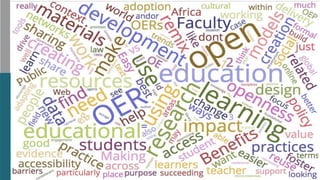
  • #37 Tag Cloud - All – Most important research areas
  • #39 http://web.net/robrien/papers/arfinal.html www.alliance.brown.edu/pubs/themes_ed/act_research.pdf
  • #41 3 It’s easy to defer to the idea of ‘being practical’ but this can limit ambition
  • #46 The form is super short – intended to encourage participation