+
An Introduction to
Qualitative Research
For Teaching in Senior High School
presented by Jean Lee C. Patindol, 12/10/16
+
Qualitative Research
 An APPROACH to research that “emphasizes the qualities of
entities, processes and meanings that are not experimentally
examined or measured in terms of quantity, amount, intensity or
frequency” (Denzin and Lincoln, 2008)
 Quality refers to a thing’s essence or ambiance
 Refers to the meanings, concepts, definitions, characteristics,
metaphors, symbols and description of things (Berg, 2007)
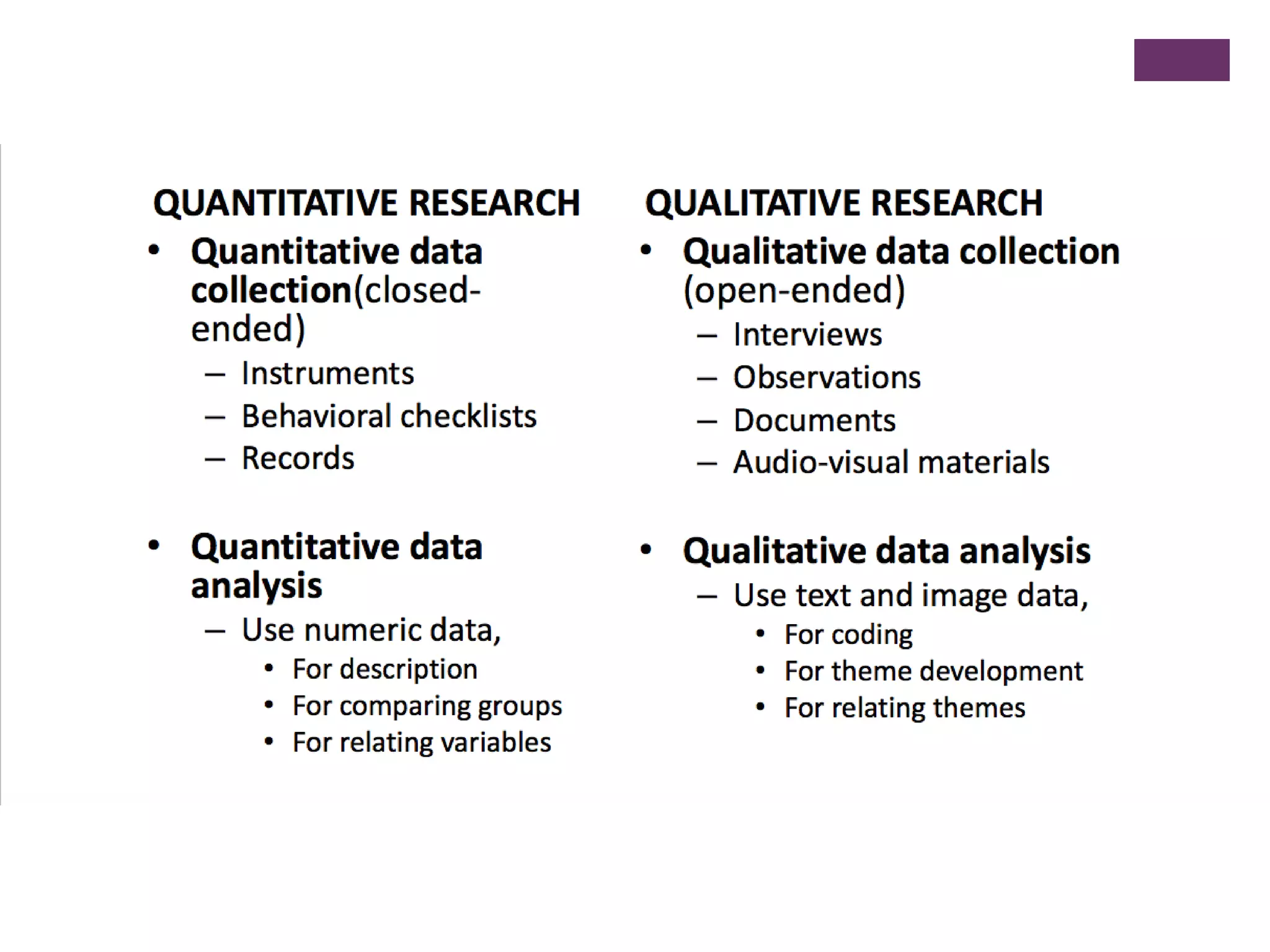
 The research questions often stress how social experience is
created and given meaning
+
How We Make Sense of the World
+
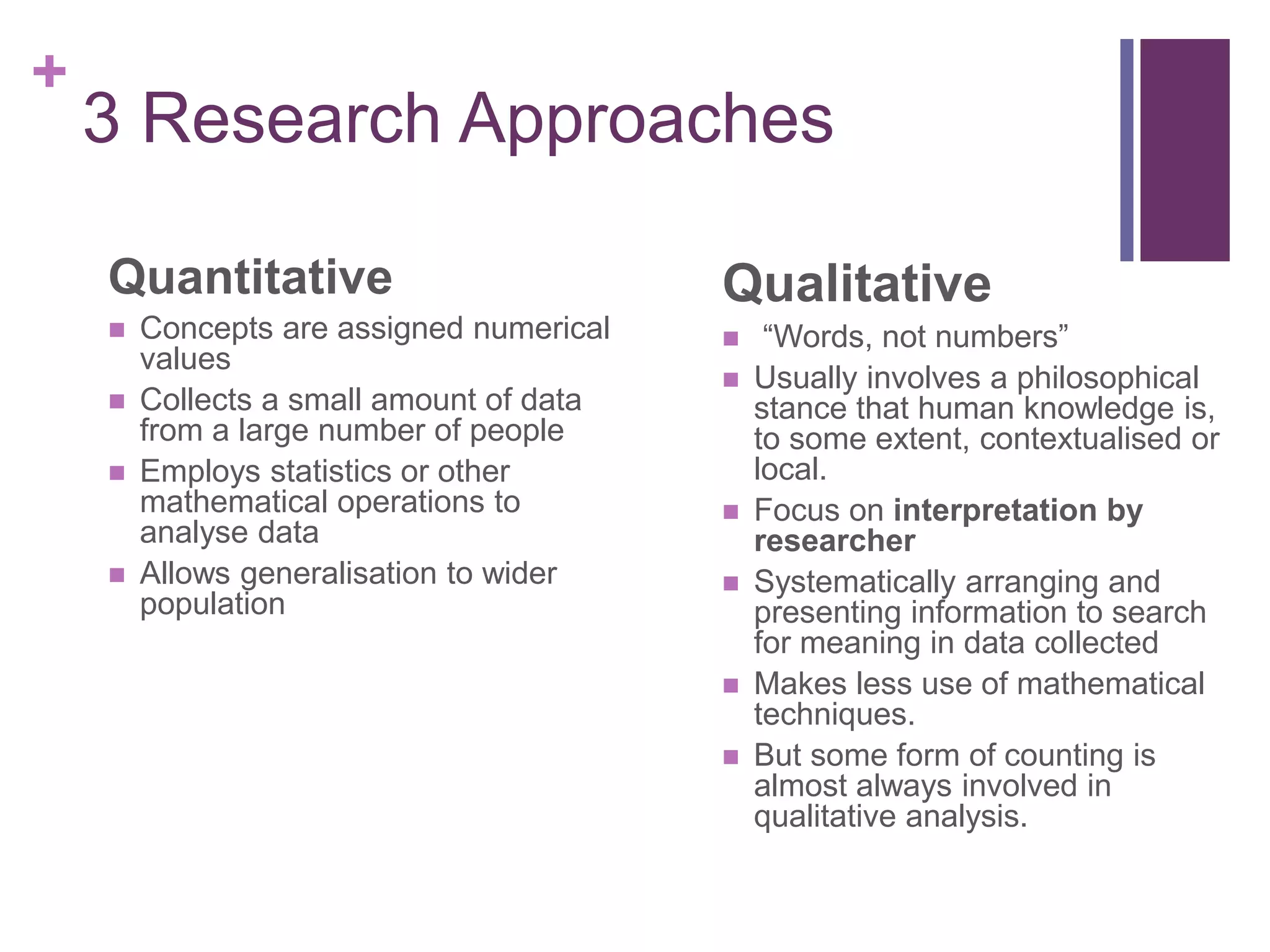
3 Research Approaches
Qualitative
 “Words, not numbers”
 Usually involves a philosophical
stance that human knowledge is,
to some extent, contextualised or
local.
 Focus on interpretation by
researcher
 Systematically arranging and
presenting information to search
for meaning in data collected
 Makes less use of mathematical
techniques.
 But some form of counting is
almost always involved in
qualitative analysis.
Quantitative
 Concepts are assigned numerical
values
 Collects a small amount of data
from a large number of people
 Employs statistics or other
mathematical operations to
analyse data
 Allows generalisation to wider
population
+
Three Research Approaches
 Mixed Methods (core characteristics)
 Do you have a quantitative database? (close-ended)
 Do you have a qualitative database? (open-ended)
 Do you plan on bringing 2 databases together? (integration)
What design and procedures will you use? (methodology)
+
Strengths of Quantitative Research
 It can deal with large numbers of cases
 It is capable of examining complex patterns of interactions
between variables
 It can make possible the verification of the presence of cause
and effect relationships between variables
+
Weaknesses of Quantitative
Research
 Lack of in-depth information
 Ignores individual perspectives and experiences
 Limited with topics we know little about
 Can be built on pre-existing biases of the researcher
 The case of questionnaires:
 Language used
 Ordering of questions
 Forced response formats; what if ‘it depends…’?
 Missing data
 Sampling issues
 Response rates
 Lies, lies and damn statistics; torturing your data until it confesses
+
Strengths of Qualitative Research
Research done in natural settings
Emphasis on informant interpretations and
meanings
Seek deep understanding of informant’s
world
 “Thick Description” (Clifford Geertz)
Humanising research process by raising the
role of the researched
High levels of flexibility in research process
+
Weaknesses of Qualitative
Research
 Problems of reliability - The difficulty of replicating findings
 “Subjectivity” of nature of data collection and analysis
 Observations may be selectively reported making it impossible to
gauge the extent to which they are typical
 Risk of collecting meaningless and useless information from
participants.
 Problems of objectivity vs detachment (particularly in participant
observation but also applies to other methods)
 Problems of ethics: Entering the personal world of the participant
 Very time consuming
+
When to Use a Mixed Methods
Approach
 A purely quantitative approach or a purely qualitative approach
is insufficient to fully understand the problem
 We need to explore before we administer instruments
 We need to explain our statistical results by talking to people
 We need to see if our quantitative results and our qualitative
results match
 We need to enhance our experiments by talking with people
 We need to develop new instruments by gathering qualitative
data
+
Which Approach to Use?
Choose your approach and
methods based on your
research problem.
+ Five Common Designs in
Qualitative Research
+
1. Narrative Research
 Narrative research: begins with the experiences as expressed
in lived and told stories of individuals
 Can take the form of biographical studies, life histories or oral
histories.
 Collecting stories and “re-storying” them
+
Example abstract
 In my research, which has involved collecting
womens accounts of becoming mothers, I am
seeking to understand how women make sense
of events throughout the process of child
bearing, constructing these events into
episodes, and thereby (apparently) maintaining
unity within their lives
Miller, T. (2000). Losing the plot: narrative construction and
longitudinal childbirth research. Qualitative Health Research, 10,
309-323.
+
2. Phenomenological research
 Describes the meaning for several individuals of their lived
experience of a certain phenomena.
 Can center around basic broad questions: “what have you
experienced in terms of the phenomena?” and “what
contexts have influenced your experience of the
phenomena?”
 “to determine what an experience means for the persons who
have had the experience and are able to provide a
comprehensive description of it. From the individual
descriptions, general or universal meanings are derived, in
other words, the essences of structures of the experience.”
(Moustakas, 1994)
+
Example abstract
Given the intricacies of power and gender in
the academy, what are doctoral advisement
relationships between women advisors and
women advisees really like?
Heinrich, K. T. (1995). Doctoral advisement
relationships between women. Journal of
Higher Education. 66, pp. 447-469.
+
3. Grounded theory research
 Employed in situations where it is perceived as necessary to go
beyond description and generate theory.
 The intent of grounded theory is to generate or discover a
theory that relates to a particular situation. If little is known
about a topic, grounded theories especially useful.
 Don’t do a literature review in the beginning
 Use of the constant comparative method
 Can lead to follow up quantitative research
+
Example abstract
 The primary purpose of this article is to present
a grounded theory of academic change that is
based on research based by two major research
questions: What are the major sources of
academic change? What are the major
processes through which academic change
occurs?
Conrad, C.F. (1978). A grounded theory of
academic change. Sociology of Education, 51,
101-112.
+
4. Ethnographic research
 This kind of research focuses on an entire cultural group:
describes their shared patterns of values, behavior, language
and culture…
 Field work as method of data collection.
+
Example abstract
This article examines how the work and the
talk of stadium employees reinforce certain
meanings of baseball in society, and it
reveals how this work and talk create and
maintain ballpark culture
Trujillo, N. (1992). Interpreting (the work and
talk of) baseball. Western Journal of
Communication, 56, 350-371.
+
5. Case study research
 This kind of research involves the study of an issue explored
through one or two cases within a setting or context.
 A case study is an exploration of a “bounded system” or a
case (or multiple cases) over time through detailed, in-depth
data collection involving multiple sources of information rich in
context.
 The context of the case involves situating the case within its
setting. which may be physical, social, historical and/or
economic.
+
Example abstract
 The purpose of this study was to take a look into education
through the eyes of three teachers who are facing their final year
as professional educators. The overarching goal was to determine
how they have seen children, teachers, administration, policy, and
testing change across the thirty year span of their work as
teachers in Texas’ public schools. Through their comments they
give a considerable amount of insight into the transformation
education has experienced in the last three decades. But
unexpectedly, they reveal as much about our changing society
than they do education itself.
Project submitted in EDCI 690, Summer 2005, Texas A&M University.
+
References
 Center for Teaching, Research and Learning, Research Support
Group at the Social Science Research Lab.,American University. (n.d.)
“Qualitative research introduction.”
http://www.american.edu/provost/ctrl/researchsupportgroup.cfm
 Creswell, J. (2007). Qualitative Inquiry and Research Design:
Choosing Among Five Approaches. Thousand Oaks, CA: Sage.
 Dodge,B. “Qualitative research: The 5 traditions”. Department of
Applied Health Science, Indiana University.
http://phhp.ufl.edu/~bdodge/
 Pini, Barbara. (n.d.) “An introduction to qualitative research”. John
Curtin Institute for Public Policy, Curtin University of Techonology.
 Viruru, Radhika. (n.d.) “An introduction to qualitative research”.
Department of Psychological Sciences, Quatar University
+
Ethics in qualitative research
+
Principles of Research Involving Human Subjects
1. Respect for persons
 treating others as autonomous agents having rights and freedom
not a means to an end
 free, voluntary and informed consent privacy and confidentiality
2. Beneficence
 research should be for the good of the subject either directly or
indirectly through benefiting society
 possible benefits are maximised and risks minimised
 impasse often develops between social good and individual rights
3. Justice
 benefits and harms are to be distributed fairly
 vulnerable groups such as cognitively impaired and mentally ill,
their above average rates of institutionalisation and their
dependency on others, have made them a convenient subject pool
for research
 who should participate in research poses significant challenges to
policy formation
+
Key Ethical Concepts
 Protection of participant
 Informed consent
 Use of deception
 Debriefing participants
 Right to withdraw
 Privacy and confidentiality
+
Protection of Participants
1. Ensure minimal risk
 must apply the cost-benefit-ratio
 risks unlikely to be greater than any encountered in
normal lifestyle
 must minimise negative outcomes
2. Strategies
 obtain advice from professionals
 screen vulnerable participants
 monitor unforeseen negative events
 debrief participants about research
 conduct long-term follow-ups
 have counselling or support available
+
Informed Consent
Rests on 4 elements
 competence, information, understanding of that
information and voluntariness
 but… cannot be established in many important areas of
research e.g. critically ill, demented, minors
Social contract
 rests on a mutually agreed contract
 must reveal all aspects that might influence the decision
to participate
Strategies
 inform of the general aims of the project
 associated costs and benefits
 consent forms
+
Use of Deception
 Subjects are not given an opportunity to provide their informed consent
to participation before data collection.
 Examples include covert observation or subject knows they are participating in
research but not the nature of the research.
 Problems
 deprives participant of the right to informed consent
 but… providing all information is likely to influence behavior and
therefore results
 should be avoided if possible
 Guidelines governing deception in research:
 no more than minimal risk to subjects
 rights and welfare of the subjects will not be affected
 research cannot practicably be carried out without the
deception
 where appropriate, subjects are provided pertinent information
about the research after participation (debriefing)
+
Debriefing Participants
Rationale
 traditional solution to deception problems
 participation considered an educational experience
Strategies
 give all information needed and requested
 discuss their experience of the research
 provide contact details
+
Right to Withdraw
 Rights
 can withdraw consent without any penalty
 can request data be destroyed
 Controversy
 use of captive audiences (e.g. students, military, prisoners,
employees)
 use of incentives
+
Privacy & Confidentiality
 Avoid the use of sensitive questions
 Do not record names if possible
 Code questionnaires
 Warn prior to data collection what identifying
information will be kept
 Explain confidentiality procedures
+
Research ethics and the Internet
 Dilemma based on three facts:
 Informed consent is not required for data to be collected from the public
domain (naturalistic observation).
 The internet is a public domain
 Many online communications (email; discussion groups, chat rooms,
newsgroups etc) cultivates an expectation of privacy
 The ease and attractiveness of Internet research renders the medium
vulnerable to misuse.
 Guidelines:
 When subjects are recruited online, need secure server, secure protection
of information during the study and removal of the records upon study
completion
 When using data from online discussion groups, removal of any references
to identity, web site or group, location and time of post is necessary for
confidentiality
+
Research with vulnerable populations –
An EXTENSIVE methodological literature exists
on undertaking research with specific
populations and the ethics and practice of
research with these populations. For example:
 Indigenous people
 Youth
 People with disabilities
 Migrants
 The aged
+
“I want to understand the world from
your point of view. I want to
understand the meaning of your
experience, to walk in your shoes,
to feel things as you feel them, to
explain things as you explain them.
Will you become my teacher and
help me understand?”
- James P. Spradley

Introduction to qualitative research for shs teaching

  • 1.
    + An Introduction to QualitativeResearch For Teaching in Senior High School presented by Jean Lee C. Patindol, 12/10/16
  • 2.
    + Qualitative Research  AnAPPROACH to research that “emphasizes the qualities of entities, processes and meanings that are not experimentally examined or measured in terms of quantity, amount, intensity or frequency” (Denzin and Lincoln, 2008)  Quality refers to a thing’s essence or ambiance  Refers to the meanings, concepts, definitions, characteristics, metaphors, symbols and description of things (Berg, 2007)  The research questions often stress how social experience is created and given meaning
  • 3.
    + How We MakeSense of the World
  • 4.
    + 3 Research Approaches Qualitative “Words, not numbers”  Usually involves a philosophical stance that human knowledge is, to some extent, contextualised or local.  Focus on interpretation by researcher  Systematically arranging and presenting information to search for meaning in data collected  Makes less use of mathematical techniques.  But some form of counting is almost always involved in qualitative analysis. Quantitative  Concepts are assigned numerical values  Collects a small amount of data from a large number of people  Employs statistics or other mathematical operations to analyse data  Allows generalisation to wider population
  • 5.
    + Three Research Approaches Mixed Methods (core characteristics)  Do you have a quantitative database? (close-ended)  Do you have a qualitative database? (open-ended)  Do you plan on bringing 2 databases together? (integration) What design and procedures will you use? (methodology)
  • 6.
    + Strengths of QuantitativeResearch  It can deal with large numbers of cases  It is capable of examining complex patterns of interactions between variables  It can make possible the verification of the presence of cause and effect relationships between variables
  • 7.
    + Weaknesses of Quantitative Research Lack of in-depth information  Ignores individual perspectives and experiences  Limited with topics we know little about  Can be built on pre-existing biases of the researcher  The case of questionnaires:  Language used  Ordering of questions  Forced response formats; what if ‘it depends…’?  Missing data  Sampling issues  Response rates  Lies, lies and damn statistics; torturing your data until it confesses
  • 8.
    + Strengths of QualitativeResearch Research done in natural settings Emphasis on informant interpretations and meanings Seek deep understanding of informant’s world  “Thick Description” (Clifford Geertz) Humanising research process by raising the role of the researched High levels of flexibility in research process
  • 9.
    + Weaknesses of Qualitative Research Problems of reliability - The difficulty of replicating findings  “Subjectivity” of nature of data collection and analysis  Observations may be selectively reported making it impossible to gauge the extent to which they are typical  Risk of collecting meaningless and useless information from participants.  Problems of objectivity vs detachment (particularly in participant observation but also applies to other methods)  Problems of ethics: Entering the personal world of the participant  Very time consuming
  • 10.
    + When to Usea Mixed Methods Approach  A purely quantitative approach or a purely qualitative approach is insufficient to fully understand the problem  We need to explore before we administer instruments  We need to explain our statistical results by talking to people  We need to see if our quantitative results and our qualitative results match  We need to enhance our experiments by talking with people  We need to develop new instruments by gathering qualitative data
  • 12.
    + Which Approach toUse? Choose your approach and methods based on your research problem.
  • 13.
    + Five CommonDesigns in Qualitative Research
  • 14.
    + 1. Narrative Research Narrative research: begins with the experiences as expressed in lived and told stories of individuals  Can take the form of biographical studies, life histories or oral histories.  Collecting stories and “re-storying” them
  • 15.
    + Example abstract  Inmy research, which has involved collecting womens accounts of becoming mothers, I am seeking to understand how women make sense of events throughout the process of child bearing, constructing these events into episodes, and thereby (apparently) maintaining unity within their lives Miller, T. (2000). Losing the plot: narrative construction and longitudinal childbirth research. Qualitative Health Research, 10, 309-323.
  • 16.
    + 2. Phenomenological research Describes the meaning for several individuals of their lived experience of a certain phenomena.  Can center around basic broad questions: “what have you experienced in terms of the phenomena?” and “what contexts have influenced your experience of the phenomena?”  “to determine what an experience means for the persons who have had the experience and are able to provide a comprehensive description of it. From the individual descriptions, general or universal meanings are derived, in other words, the essences of structures of the experience.” (Moustakas, 1994)
  • 17.
    + Example abstract Given theintricacies of power and gender in the academy, what are doctoral advisement relationships between women advisors and women advisees really like? Heinrich, K. T. (1995). Doctoral advisement relationships between women. Journal of Higher Education. 66, pp. 447-469.
  • 18.
    + 3. Grounded theoryresearch  Employed in situations where it is perceived as necessary to go beyond description and generate theory.  The intent of grounded theory is to generate or discover a theory that relates to a particular situation. If little is known about a topic, grounded theories especially useful.  Don’t do a literature review in the beginning  Use of the constant comparative method  Can lead to follow up quantitative research
  • 19.
    + Example abstract  Theprimary purpose of this article is to present a grounded theory of academic change that is based on research based by two major research questions: What are the major sources of academic change? What are the major processes through which academic change occurs? Conrad, C.F. (1978). A grounded theory of academic change. Sociology of Education, 51, 101-112.
  • 20.
    + 4. Ethnographic research This kind of research focuses on an entire cultural group: describes their shared patterns of values, behavior, language and culture…  Field work as method of data collection.
  • 21.
    + Example abstract This articleexamines how the work and the talk of stadium employees reinforce certain meanings of baseball in society, and it reveals how this work and talk create and maintain ballpark culture Trujillo, N. (1992). Interpreting (the work and talk of) baseball. Western Journal of Communication, 56, 350-371.
  • 22.
    + 5. Case studyresearch  This kind of research involves the study of an issue explored through one or two cases within a setting or context.  A case study is an exploration of a “bounded system” or a case (or multiple cases) over time through detailed, in-depth data collection involving multiple sources of information rich in context.  The context of the case involves situating the case within its setting. which may be physical, social, historical and/or economic.
  • 23.
    + Example abstract  Thepurpose of this study was to take a look into education through the eyes of three teachers who are facing their final year as professional educators. The overarching goal was to determine how they have seen children, teachers, administration, policy, and testing change across the thirty year span of their work as teachers in Texas’ public schools. Through their comments they give a considerable amount of insight into the transformation education has experienced in the last three decades. But unexpectedly, they reveal as much about our changing society than they do education itself. Project submitted in EDCI 690, Summer 2005, Texas A&M University.
  • 24.
    + References  Center forTeaching, Research and Learning, Research Support Group at the Social Science Research Lab.,American University. (n.d.) “Qualitative research introduction.” http://www.american.edu/provost/ctrl/researchsupportgroup.cfm  Creswell, J. (2007). Qualitative Inquiry and Research Design: Choosing Among Five Approaches. Thousand Oaks, CA: Sage.  Dodge,B. “Qualitative research: The 5 traditions”. Department of Applied Health Science, Indiana University. http://phhp.ufl.edu/~bdodge/  Pini, Barbara. (n.d.) “An introduction to qualitative research”. John Curtin Institute for Public Policy, Curtin University of Techonology.  Viruru, Radhika. (n.d.) “An introduction to qualitative research”. Department of Psychological Sciences, Quatar University
  • 25.
  • 26.
    + Principles of ResearchInvolving Human Subjects 1. Respect for persons  treating others as autonomous agents having rights and freedom not a means to an end  free, voluntary and informed consent privacy and confidentiality 2. Beneficence  research should be for the good of the subject either directly or indirectly through benefiting society  possible benefits are maximised and risks minimised  impasse often develops between social good and individual rights 3. Justice  benefits and harms are to be distributed fairly  vulnerable groups such as cognitively impaired and mentally ill, their above average rates of institutionalisation and their dependency on others, have made them a convenient subject pool for research  who should participate in research poses significant challenges to policy formation
  • 27.
    + Key Ethical Concepts Protection of participant  Informed consent  Use of deception  Debriefing participants  Right to withdraw  Privacy and confidentiality
  • 28.
    + Protection of Participants 1.Ensure minimal risk  must apply the cost-benefit-ratio  risks unlikely to be greater than any encountered in normal lifestyle  must minimise negative outcomes 2. Strategies  obtain advice from professionals  screen vulnerable participants  monitor unforeseen negative events  debrief participants about research  conduct long-term follow-ups  have counselling or support available
  • 29.
    + Informed Consent Rests on4 elements  competence, information, understanding of that information and voluntariness  but… cannot be established in many important areas of research e.g. critically ill, demented, minors Social contract  rests on a mutually agreed contract  must reveal all aspects that might influence the decision to participate Strategies  inform of the general aims of the project  associated costs and benefits  consent forms
  • 30.
    + Use of Deception Subjects are not given an opportunity to provide their informed consent to participation before data collection.  Examples include covert observation or subject knows they are participating in research but not the nature of the research.  Problems  deprives participant of the right to informed consent  but… providing all information is likely to influence behavior and therefore results  should be avoided if possible  Guidelines governing deception in research:  no more than minimal risk to subjects  rights and welfare of the subjects will not be affected  research cannot practicably be carried out without the deception  where appropriate, subjects are provided pertinent information about the research after participation (debriefing)
  • 31.
    + Debriefing Participants Rationale  traditionalsolution to deception problems  participation considered an educational experience Strategies  give all information needed and requested  discuss their experience of the research  provide contact details
  • 32.
    + Right to Withdraw Rights  can withdraw consent without any penalty  can request data be destroyed  Controversy  use of captive audiences (e.g. students, military, prisoners, employees)  use of incentives
  • 33.
    + Privacy & Confidentiality Avoid the use of sensitive questions  Do not record names if possible  Code questionnaires  Warn prior to data collection what identifying information will be kept  Explain confidentiality procedures
  • 34.
    + Research ethics andthe Internet  Dilemma based on three facts:  Informed consent is not required for data to be collected from the public domain (naturalistic observation).  The internet is a public domain  Many online communications (email; discussion groups, chat rooms, newsgroups etc) cultivates an expectation of privacy  The ease and attractiveness of Internet research renders the medium vulnerable to misuse.  Guidelines:  When subjects are recruited online, need secure server, secure protection of information during the study and removal of the records upon study completion  When using data from online discussion groups, removal of any references to identity, web site or group, location and time of post is necessary for confidentiality
  • 35.
    + Research with vulnerablepopulations – An EXTENSIVE methodological literature exists on undertaking research with specific populations and the ethics and practice of research with these populations. For example:  Indigenous people  Youth  People with disabilities  Migrants  The aged
  • 36.
    + “I want tounderstand the world from your point of view. I want to understand the meaning of your experience, to walk in your shoes, to feel things as you feel them, to explain things as you explain them. Will you become my teacher and help me understand?” - James P. Spradley