CHAPTER 1
1 THE PROBLEM AND ITS SETTING
Background of the Study
Statement of the Problem
Statement of Null Hypothesis
Theoretical and Conceptual
Framework
Significance of the Study
Definition of Terms
CHAPTER 2
2 REVIEW OF RELATED LITERATURE
BACKGROUND OF
THE STUDY
BACKGROUND OF THE STUDY
 This part of research includes
information which would focus attention
on the importance and validity of the
problem.
 It is the general orientation to the
problem area.
 A brief rationale to justify the problem
must be provided
 This is the present state of knowledge
regarding the problem.
 Answer these questions:
1. What facets of the problem (phenomenon)
are known?
2. What need further investigation?
3. What approaches have been used
previously in research of the problem?
GOOD BACKGROUND
The researcher can state the
antecedents of the study, the
reasons why this topic is
proposed relative to previous
studies.
BACKGROUND INCLUDES:
Discussion of the problem in
general and the specific
situations as observed and
experienced by the researcher
(macro to micro approach);
Concepts and ideas related to
the problem including
clarification of important
terminologies; and
Discussion of the existing or
present conditions and what
is aimed to be in the future or
the gap to be filled – in by the
research.
GROUP DISCUSSION
 Discuss with your group in making
RATIONALE or BACKGROUND OF
YOUR STUDY.
 Leaders must assign members
 Leaders should monitor its members
 The score will be reflected according to
its group performance.
RATIONALE MAKING
In making Rationale it should be the
dependent variables will be
discussed.
I must have 4 paragraphs
Each paragraph should contain 5-7
sentences
PARAGRAPHS:
1st Paragraph – Global
2nd Paragraph – National
3rd Paragraph – Local
4th Paragraph - Urgency
RATIONALE:
 1st, 2nd , 3rd Paragraphs – Problem situations
on DV or main variable, rationale on the
conduct of the study
 4th Paragraph – Urgency, research gap,
assumption, re-connection of IV with DV,
contribution of the study
Statement of the
Problem or
Research
Objectives
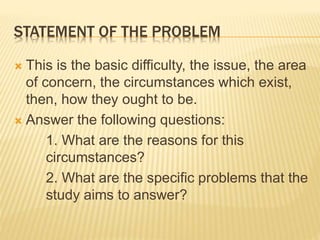
STATEMENT OF THE PROBLEM
 This is the basic difficulty, the issue, the area
of concern, the circumstances which exist,
then, how they ought to be.
 Answer the following questions:
1. What are the reasons for this
circumstances?
2. What are the specific problems that the
study aims to answer?
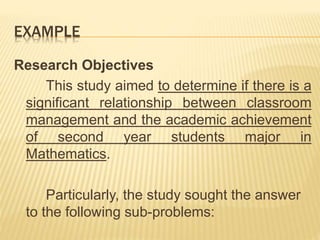
EXAMPLE
Research Objectives
This study aimed to determine if there is a
significant relationship between classroom
management and the academic achievement
of second year students major in
Mathematics.
Particularly, the study sought the answer
to the following sub-problems:
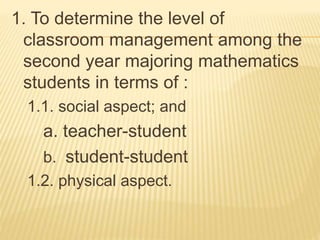
1. To determine the level of
classroom management among the
second year majoring mathematics
students in terms of :
1.1. social aspect; and
a. teacher-student
b. student-student
1.2. physical aspect.
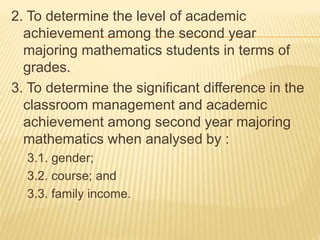
2. To determine the level of academic
achievement among the second year
majoring mathematics students in terms of
grades.
3. To determine the significant difference in the
classroom management and academic
achievement among second year majoring
mathematics when analysed by :
3.1. gender;
3.2. course; and
3.3. family income.
4. To determine if there is a significant
relationship between classroom
management and academic achievement
among second year majoring mathematics
students.
STATEMENT OF THE NULL HYPOTHESIS
The null hypotheses are derived from the
following sub-problems:
1.There is no significant difference in the level
of classroom management and academic
achievement among the second year
majoring mathematics when classified
according to age, gender, course, andfamily
income.
2. There is no significant relationship between
classroom management and the academic
achievement among the second year major
in mathematics students.
Theoritical and
Conceptual
Framework
Theoritical Framework
This study is anchored on the theory of William
Glasser on Classroom management (2002) which
states that classroom management is an effective blueprint
to help teachers organize and maintain a successful
learning environment, in social and physical aspects.
The said theory calls for teachers to instruct students how to
make good choices and take responsibility for their
behavior. The teacher-student interaction and
student-student interaction makes an effective
classroom management which results in a smooth-running
where learning can occur. Teachers manage the classroom
by foreseeing and preventing problems featuring space,
density, seating arrangement, noises, visual and
temperature.
CONCEPTUAL FRAMEWORK
Classroom Management
•Social Aspect
*Teacher to Student
*Student to student
•Physical Aspect
Academic Achievements
•Grades
•Moderator
Gender
Course
Family Income
Independent Variable Dependent Variable
Fig. 1: Conceptual Paradigm showing the variables of the study

Chapter 1 research content

  • 1.
    CHAPTER 1 1 THEPROBLEM AND ITS SETTING Background of the Study Statement of the Problem Statement of Null Hypothesis Theoretical and Conceptual Framework Significance of the Study Definition of Terms
  • 2.
    CHAPTER 2 2 REVIEWOF RELATED LITERATURE
  • 3.
  • 4.
    BACKGROUND OF THESTUDY  This part of research includes information which would focus attention on the importance and validity of the problem.  It is the general orientation to the problem area.  A brief rationale to justify the problem must be provided
  • 5.
     This isthe present state of knowledge regarding the problem.  Answer these questions: 1. What facets of the problem (phenomenon) are known? 2. What need further investigation? 3. What approaches have been used previously in research of the problem?
  • 6.
    GOOD BACKGROUND The researchercan state the antecedents of the study, the reasons why this topic is proposed relative to previous studies.
  • 7.
    BACKGROUND INCLUDES: Discussion ofthe problem in general and the specific situations as observed and experienced by the researcher (macro to micro approach);
  • 8.
    Concepts and ideasrelated to the problem including clarification of important terminologies; and
  • 9.
    Discussion of theexisting or present conditions and what is aimed to be in the future or the gap to be filled – in by the research.
  • 10.
    GROUP DISCUSSION  Discusswith your group in making RATIONALE or BACKGROUND OF YOUR STUDY.  Leaders must assign members  Leaders should monitor its members  The score will be reflected according to its group performance.
  • 11.
    RATIONALE MAKING In makingRationale it should be the dependent variables will be discussed. I must have 4 paragraphs Each paragraph should contain 5-7 sentences
  • 12.
    PARAGRAPHS: 1st Paragraph –Global 2nd Paragraph – National 3rd Paragraph – Local 4th Paragraph - Urgency
  • 13.
    RATIONALE:  1st, 2nd, 3rd Paragraphs – Problem situations on DV or main variable, rationale on the conduct of the study  4th Paragraph – Urgency, research gap, assumption, re-connection of IV with DV, contribution of the study
  • 14.
    Statement of the Problemor Research Objectives
  • 15.
    STATEMENT OF THEPROBLEM  This is the basic difficulty, the issue, the area of concern, the circumstances which exist, then, how they ought to be.  Answer the following questions: 1. What are the reasons for this circumstances? 2. What are the specific problems that the study aims to answer?
  • 16.
    EXAMPLE Research Objectives This studyaimed to determine if there is a significant relationship between classroom management and the academic achievement of second year students major in Mathematics. Particularly, the study sought the answer to the following sub-problems:
  • 17.
    1. To determinethe level of classroom management among the second year majoring mathematics students in terms of : 1.1. social aspect; and a. teacher-student b. student-student 1.2. physical aspect.
  • 18.
    2. To determinethe level of academic achievement among the second year majoring mathematics students in terms of grades. 3. To determine the significant difference in the classroom management and academic achievement among second year majoring mathematics when analysed by : 3.1. gender; 3.2. course; and 3.3. family income.
  • 19.
    4. To determineif there is a significant relationship between classroom management and academic achievement among second year majoring mathematics students.
  • 20.
    STATEMENT OF THENULL HYPOTHESIS The null hypotheses are derived from the following sub-problems: 1.There is no significant difference in the level of classroom management and academic achievement among the second year majoring mathematics when classified according to age, gender, course, andfamily income.
  • 21.
    2. There isno significant relationship between classroom management and the academic achievement among the second year major in mathematics students.
  • 22.
  • 23.
    Theoritical Framework This studyis anchored on the theory of William Glasser on Classroom management (2002) which states that classroom management is an effective blueprint to help teachers organize and maintain a successful learning environment, in social and physical aspects. The said theory calls for teachers to instruct students how to make good choices and take responsibility for their behavior. The teacher-student interaction and student-student interaction makes an effective classroom management which results in a smooth-running where learning can occur. Teachers manage the classroom by foreseeing and preventing problems featuring space, density, seating arrangement, noises, visual and temperature.
  • 24.
    CONCEPTUAL FRAMEWORK Classroom Management •SocialAspect *Teacher to Student *Student to student •Physical Aspect Academic Achievements •Grades •Moderator Gender Course Family Income Independent Variable Dependent Variable Fig. 1: Conceptual Paradigm showing the variables of the study