INQUIRY,
INVESTIGATION
AND
IMMERSION
QUARTER 3-MODULE
1
An INQUIRY is an
investigation made by
asking questions rather
than by inspection, or
by study of available
evidence: an inquiry
into a proposed bond
issue.
Immersion refers to the
deep-level personal
involvement of the
researcher with the
object of study.
An INVESTIGATION is a
systematic, minute, and
thorough attempt to
learn the facts about
something complex or
hidden; it is often formal
and official: an
investigation of a bank
failure.
Research is
careful and
sustained
investigation.
Brainstorming for
Research Topics
T H E O R I E S D E E N X O N
I R X E S E A P R O B L E M S
N R P C I N T E R E S T H Q U
T Z E E D F H C G S U W V V A
U E R R I P H I L O S O P H Y
I R I U A X E A E L B B O A S
T M E T O D U L S E I S S O T
I H N A A R D I S S U E S U U
O G C R H C O Z O V I R D P D
N A E E N E D A N M I V C L I
O C S T C K D T S O W A N Q E
U A R I A N E I T E D T U C S
A T V L I O N O R E S I E A R
C D I S F U N N Z X E O E W Y
A P N O I T A S R E V N O C M
THEORIES
PROBLEMS
PHILOSOPHY
STUDIES
SPECIALIZATION
INTEREST
NEEDS
ADVICE
INTUITION
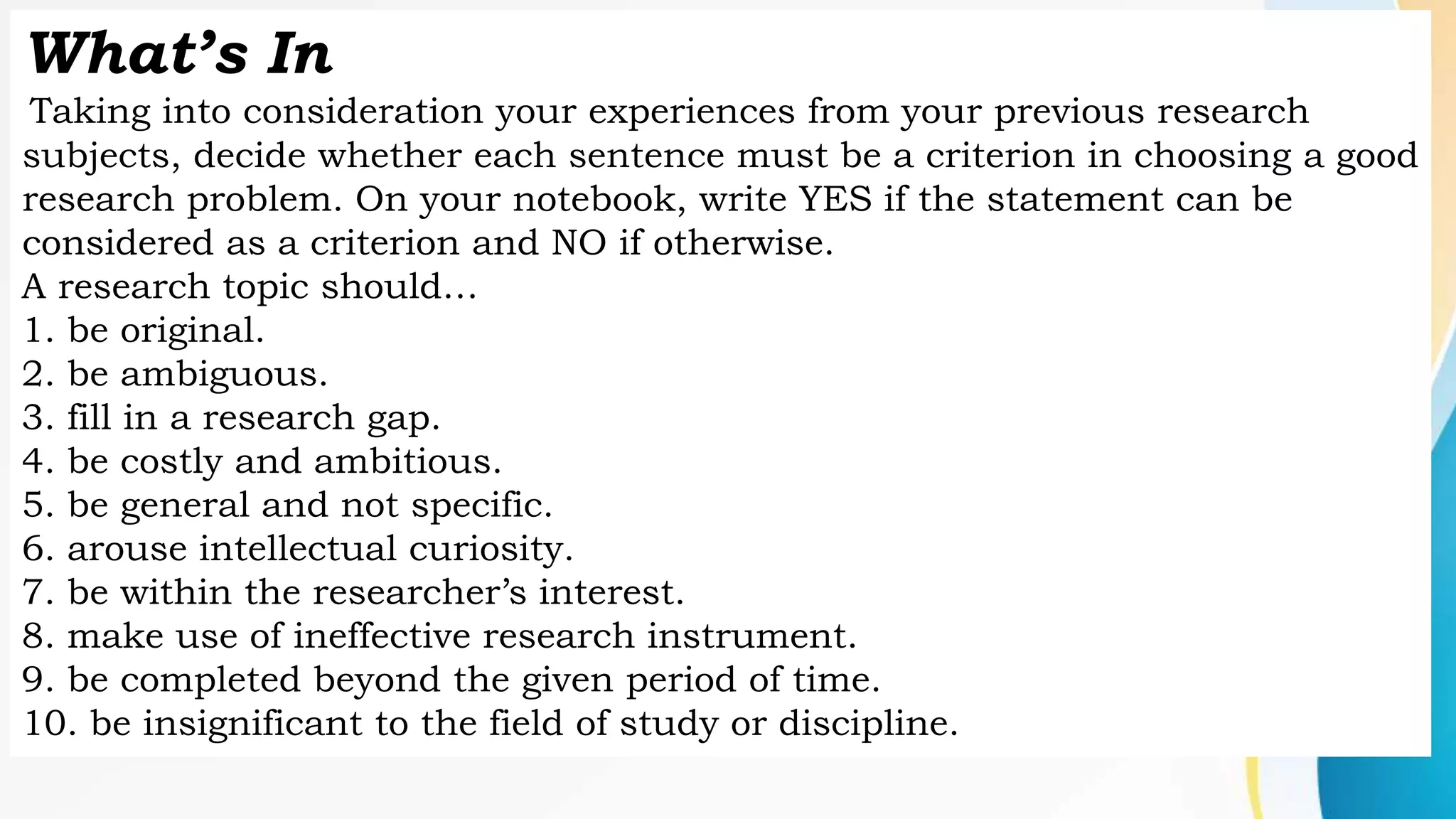
What’s In
Taking into consideration your experiences from your previous research
subjects, decide whether each sentence must be a criterion in choosing a good
research problem. On your notebook, write YES if the statement can be
considered as a criterion and NO if otherwise.
A research topic should…
1. be original.
2. be ambiguous.
3. fill in a research gap.
4. be costly and ambitious.
5. be general and not specific.
6. arouse intellectual curiosity.
7. be within the researcher’s interest.
8. make use of ineffective research instrument.
9. be completed beyond the given period of time.
10. be insignificant to the field of study or discipline.
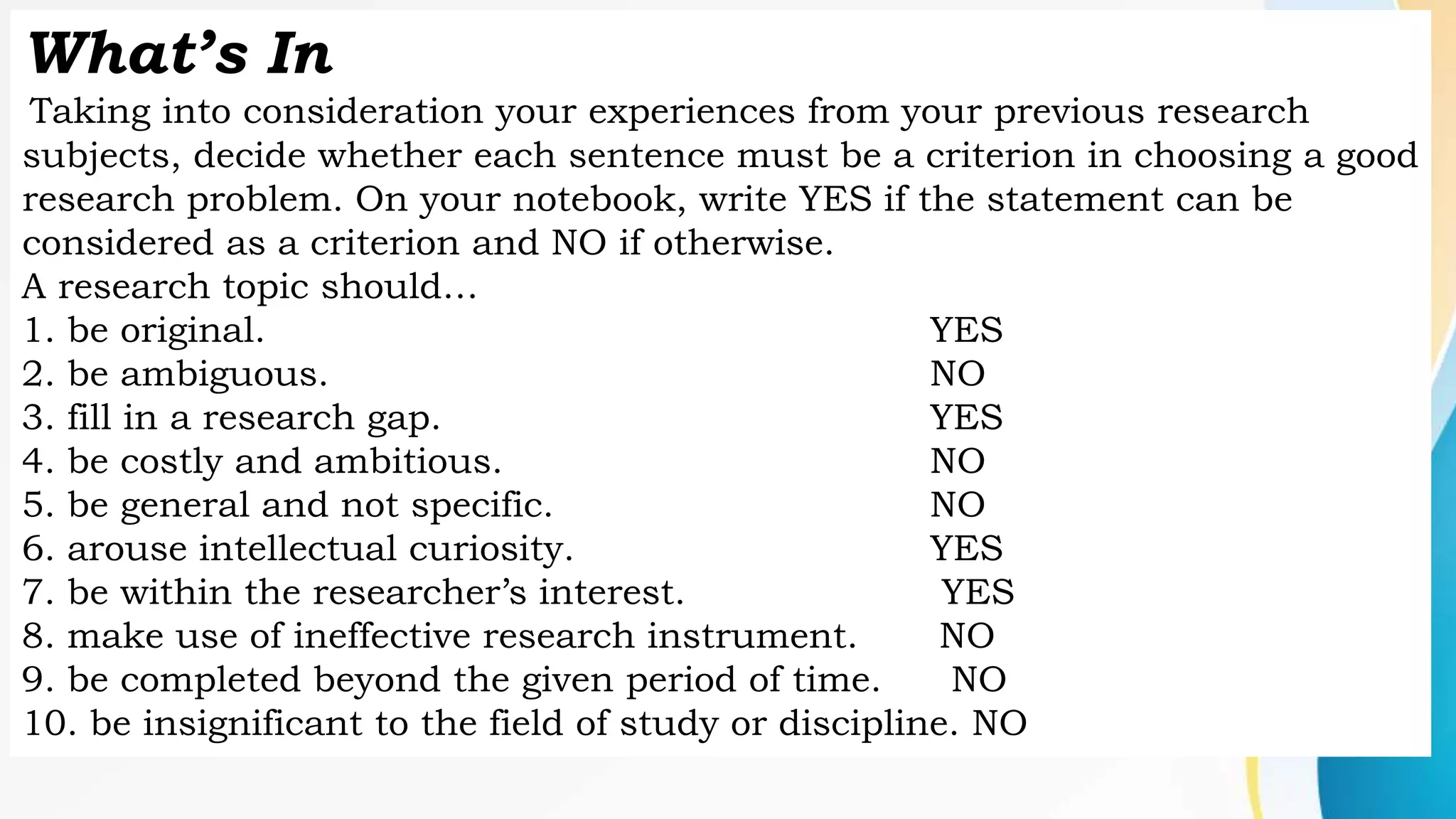
What’s In
Taking into consideration your experiences from your previous research
subjects, decide whether each sentence must be a criterion in choosing a good
research problem. On your notebook, write YES if the statement can be
considered as a criterion and NO if otherwise.
A research topic should…
1. be original. YES
2. be ambiguous. NO
3. fill in a research gap. YES
4. be costly and ambitious. NO
5. be general and not specific. NO
6. arouse intellectual curiosity. YES
7. be within the researcher’s interest. YES
8. make use of ineffective research instrument. NO
9. be completed beyond the given period of time. NO
10. be insignificant to the field of study or discipline. NO
1. INTEREST IN THE SUBJECT MATTER
Being interested in a topic is usually due to the
richness of your stock knowledge about it or
because of its familiarity to you. Curiosity about
an issue/topic is one of the factors that motivate
a person to unravel the unknown in a topic.
Thus, the researcher’s interest increases the
possibility of the success of the study.
One of the things that you should do is to collect a lot
of information on your topic of interest. This enables
you to find evidences that would support your topic.
You must ensure that your sources come from a wide
variety of literature such as books, journal,
periodicals, online articles, etc. Hence, going to the
library and surfing the internet are some of the
activities that you should do as a researcher.
2. RICHNESS OF AVAILABLE SOURCES OR
SUPPORTING EVIDENCES
3. TIMELINESS AND RELEVANCE OF THE TOPIC
Your topic should be relevant and timely. A topic is
relevant if it serves as an instrument in improving
the society or if it answers or solves current issues
which are some of the reasons why research is
conducted.
4. LIMITATIONS OF THE SUBJECT
Aside from your interest, you must also
consider the significance of the topic in your
track and strand. Remember that research is
conducted to contribute something valuable
to a particular area or discipline.
5. PERSONAL RESOURCES
Prior to finalizing your chosen topic, you must
assess your research abilities as a student. You
may do so by taking your financial capability,
health condition, personal qualifications and
trainings as a researcher, needed facilities and
time allotment into account. It is important that
all of these aspects are considered in order for
you to guarantee the accomplishment of your
research.
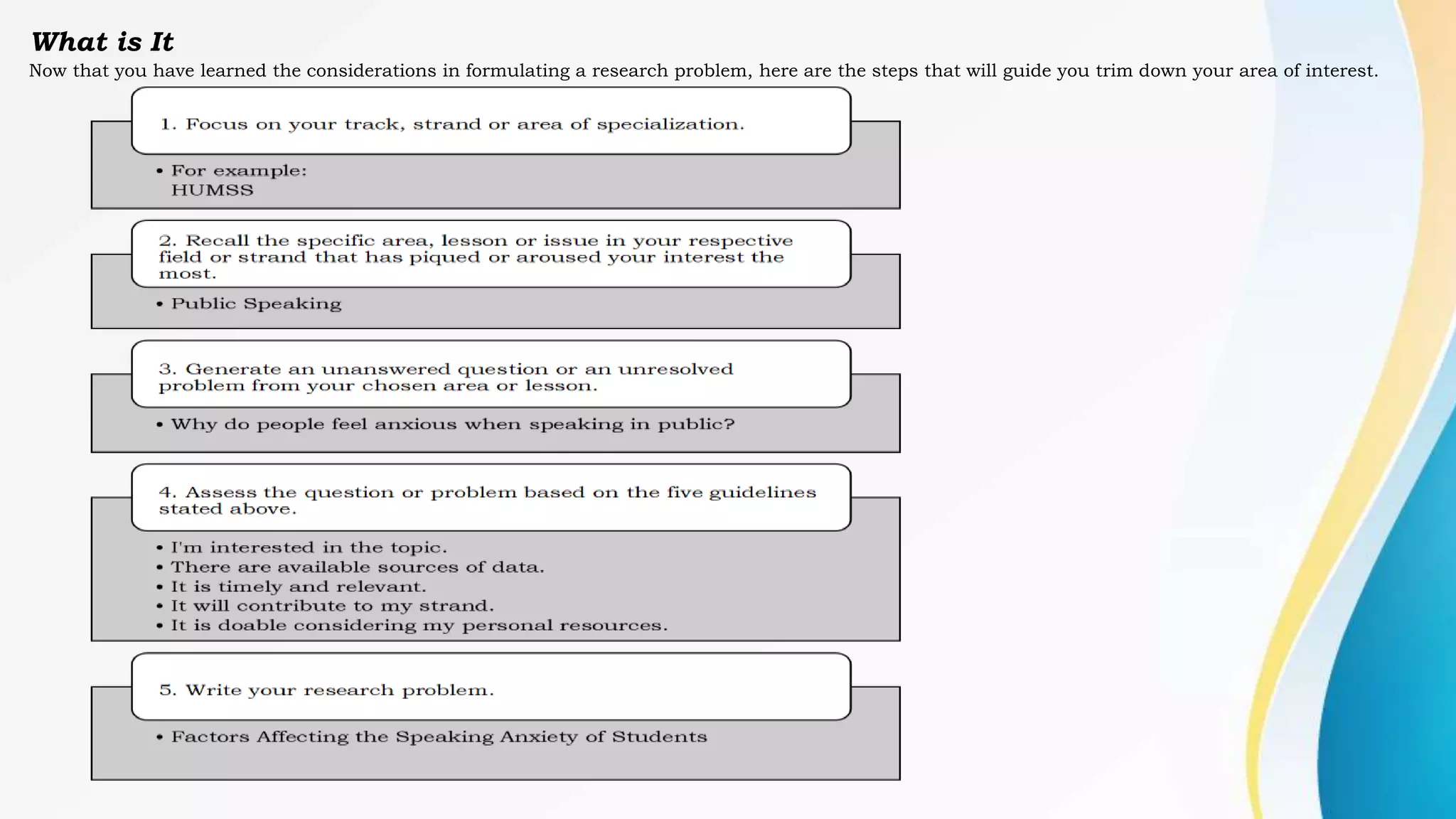
What is It
Now that you have learned the considerations in formulating a research problem, here are the steps that will guide you trim down your area of interest.
When formulating an effective research title,
take the following guidelines into consideration:
1. Indicate accurately the subject and scope of the study.
2. The title must be limited to 10 to 15 substantive words.
Conjunctions (and, but, because), prepositions (in, on,
at) and articles (the, a, an) are not counted.
3. Do not include analysis of, study of, an investigation of
and the like.
4. The title must be in the phrase form.
Avoid title that gives too much information.
A
1.This refers to the researcher’s abilities, financial
capacity, resources in terms of instruments, facilities
and time frame.
2.This refers to the social applicability and
appropriateness of the topic to the current situation.
3.This refers to an individual’s interest in a topic
driven by his or her schema about it.
4.This refers to the availability of needed resources
as evidence for the topic.
5.This refers to the topic’s contribution to a particular
field or discipline.
B
a.limitations of the subject
b.personal resources
c.interest in the subject matter
d.timeliness and relevance
e.richness of available resources
or supporting evidences of
appropriateness
f.intellectual ability
What’s More
A. Match the following descriptions in column A to their respective guidelines
in choosing a research topic in column B. Write the letter of the correct
answer on your notebook.
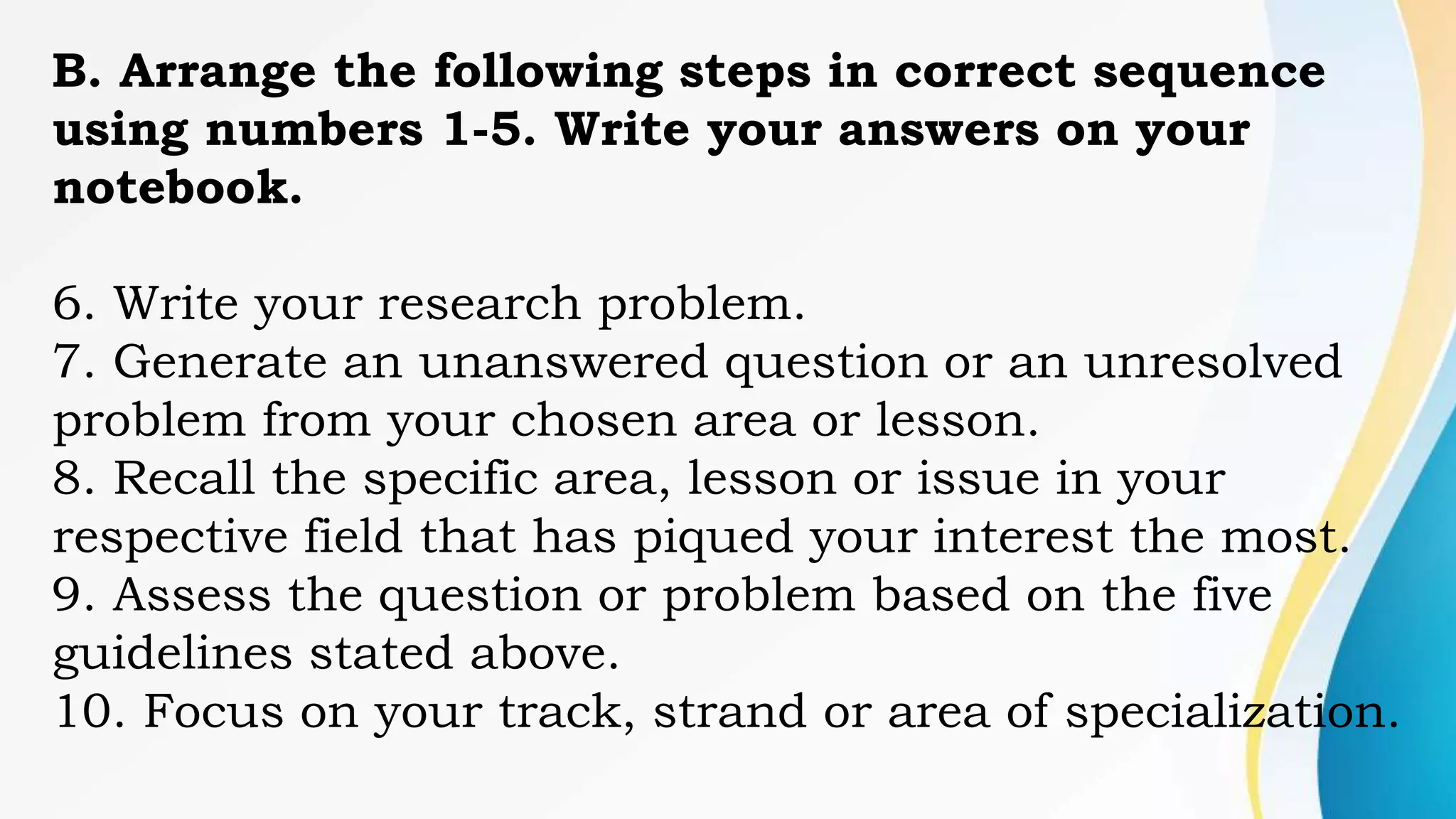
B. Arrange the following steps in correct sequence
using numbers 1-5. Write your answers on your
notebook.
6. Write your research problem.
7. Generate an unanswered question or an unresolved
problem from your chosen area or lesson.
8. Recall the specific area, lesson or issue in your
respective field that has piqued your interest the most.
9. Assess the question or problem based on the five
guidelines stated above.
10. Focus on your track, strand or area of specialization.
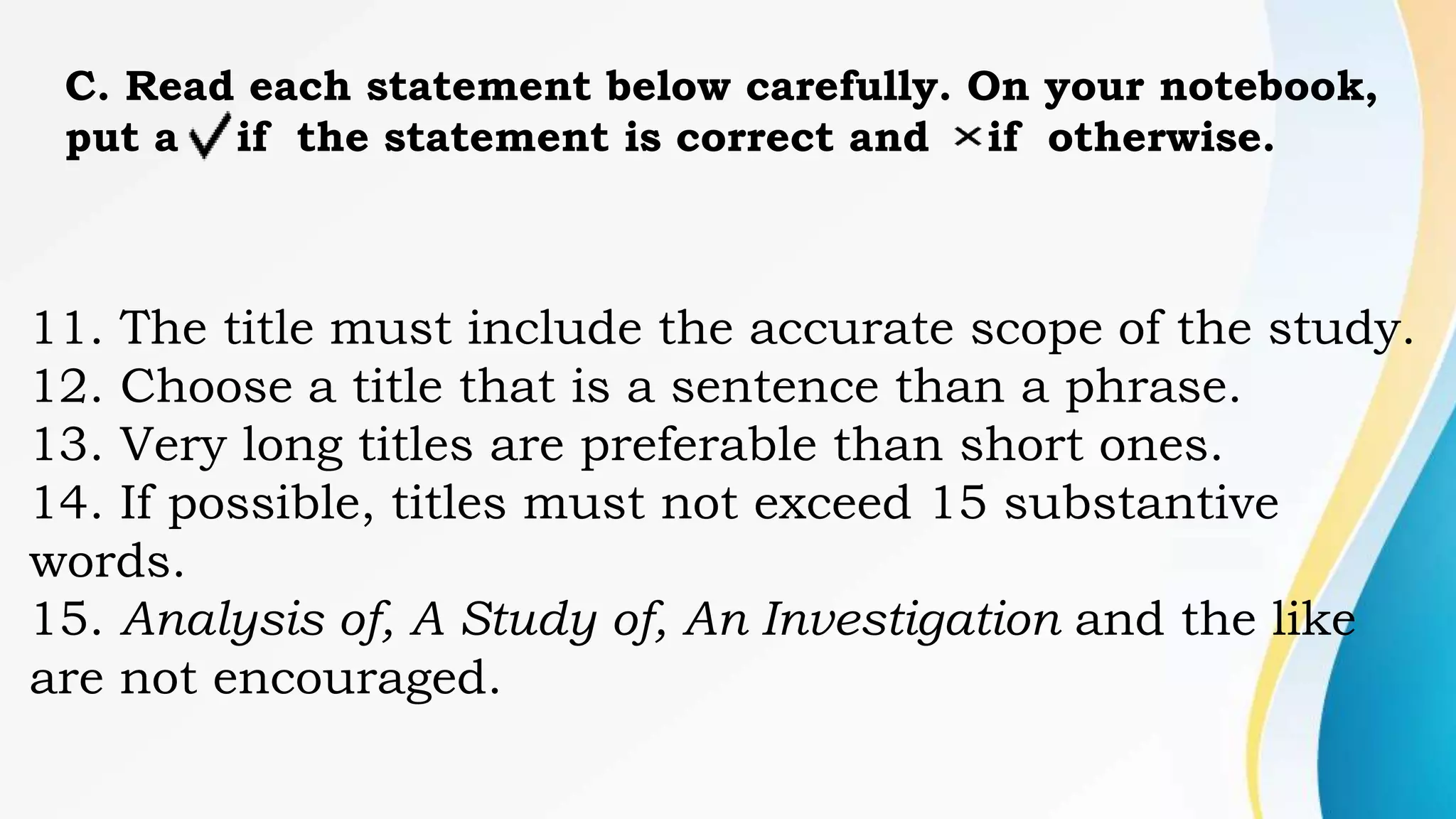
11. The title must include the accurate scope of the study.
12. Choose a title that is a sentence than a phrase.
13. Very long titles are preferable than short ones.
14. If possible, titles must not exceed 15 substantive
words.
15. Analysis of, A Study of, An Investigation and the like
are not encouraged.
C. Read each statement below carefully. On your notebook,
put a if the statement is correct and if otherwise.
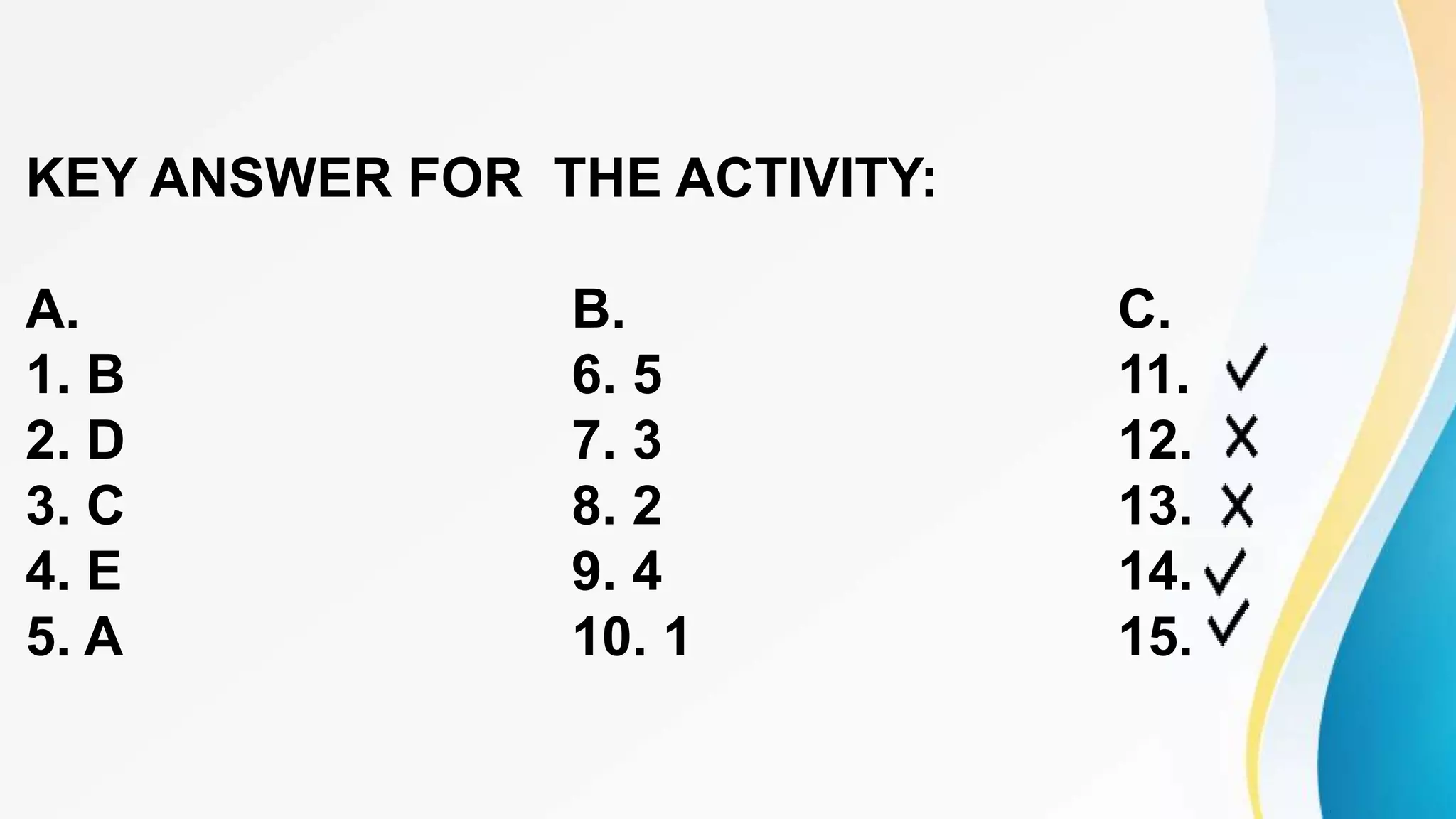
KEY ANSWER FOR THE ACTIVITY:
A. B. C.
1. B 6. 5 11.
2. D 7. 3 12.
3. C 8. 2 13.
4. E 9. 4 14.
5. A 10. 1 15.
INQUIRY,
INVESTIGATION
AND
IMMERSION
QUARTER3: MODULE 2
Identifying the
Problem and Asking
the Questions
What I Know
Identify the basic parts of a research paper described in each statement. Choose your answers
from the word bank below and write them on your notebook.
Introduction Notes in Chapter 1 Significance of the Study
Scope and Delimitation Definition of Terms Conceptual Framework
Statement of the Problem Hypothesis
This part…
1. serves as the plan or the blueprint of the study.
2. includes definitions of words operationally used in the study.
3. serves as an overview of the research topic under investigation.
4. sets the parameters of the study which narrow down the scope of inquiry.
5. states the concrete terms that a researcher expects to happen in the study.
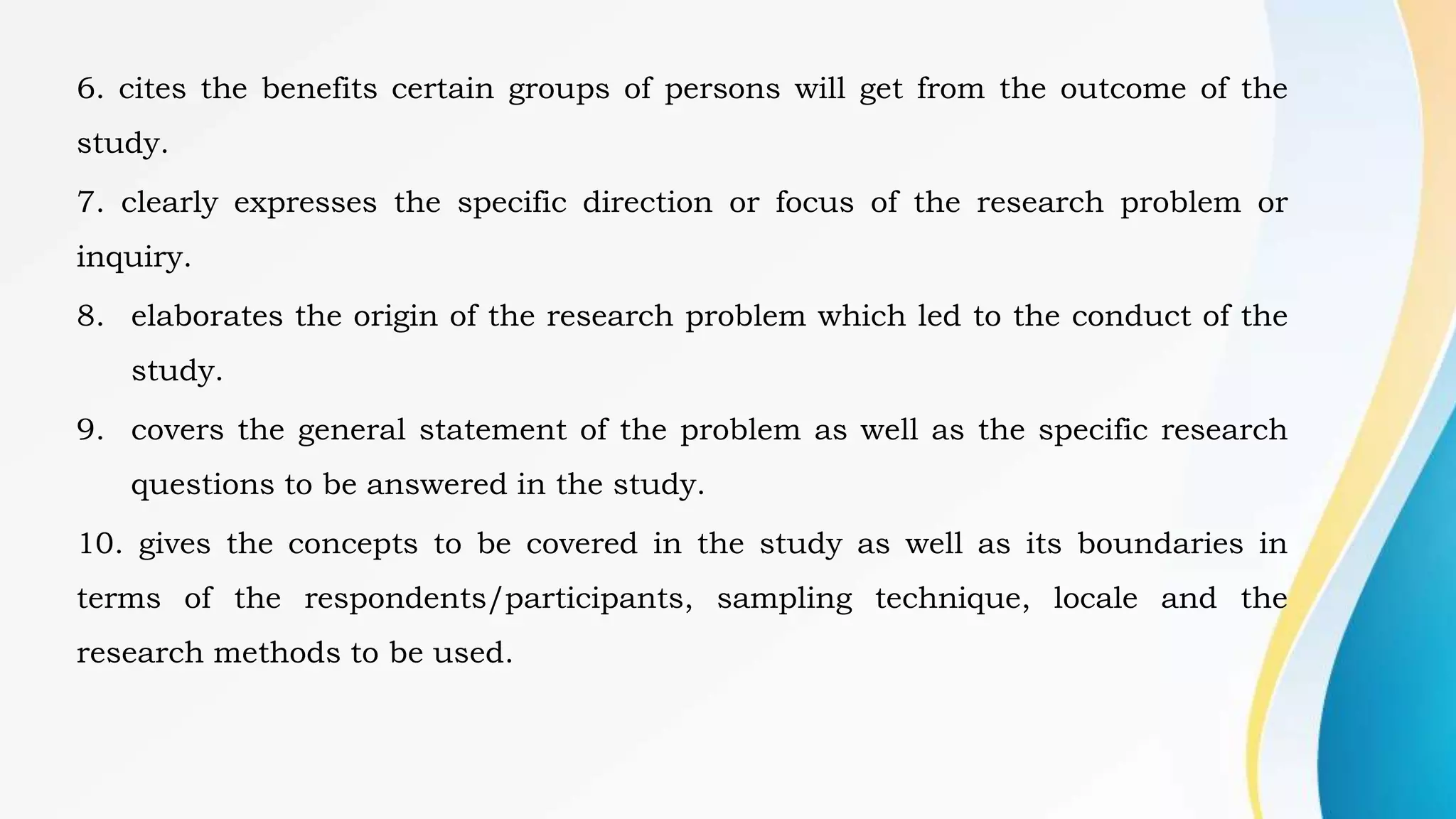
6. cites the benefits certain groups of persons will get from the outcome of the
study.
7. clearly expresses the specific direction or focus of the research problem or
inquiry.
8. elaborates the origin of the research problem which led to the conduct of the
study.
9. covers the general statement of the problem as well as the specific research
questions to be answered in the study.
10. gives the concepts to be covered in the study as well as its boundaries in
terms of the respondents/participants, sampling technique, locale and the
research methods to be used.
1. Conceptual Framework
2. Definition of Terms
3. Introduction
4. Scope and Delimitation
5. Hypothesis
6. Significance of the Study
7. Statement of the Problem
8. Introduction
9. Statement of the Problem
10.Scope and Delimitation
Starting a research investigation is similar to embarking on a
journey. First, you have to project a clear picture of your
destination. You have already accomplished this initial step
as you have trimmed down your area of interest into a
specific research problem in the previous module. The next
step is to strategize how to arrive at the destination.
One way to strategize is to pinpoint all the factors and
considerations that may affect the route towards your goal.
This module discusses these contributing elements which will
also serve as the bedrock of your study.
What’s In
One of the purposes of research is to address the pressing
issues in the society. As a student who is a keen observer
and is aware of the local, national or international affairs, list
down three crucial concerns and propose a solution for each.
Write your answers on your notebook. (5 points each) For
example:
Problem 1 (Local): Diesel price hike
Proposed Solution: Used Cooking Oil as a
Substitute for Diesel
Problem
1: Local Issue
2: National Issue 3. International Issue
Proposed
Solution
What’s New
Read the given research scenario carefully and answer the questions
that follow. Choose the letter of the best answer. Write your answers
on your notebook.
A group of student-researchers from Jose C. Payumo Jr. Memorial High
School intends to conduct a study on the effectiveness of the Tobacco
Free Generation (TFG) program inDinalupihan,Bataan.Medical doctors,
nurses and volunteers in Singapore started the said program in 2016
and was adopted by Bataan in the same year. TFG founder, Dr. Koong
HengNung,considered Bataan as the first province in the Philippines to
adopt this campaign. Accordingto Koong (2018), TFG aims to educate
and encourage the youths to be part of the tobacco free generation.
1. Where is the locale of the study?
A. Bataan
B. Dinalupihan
C. Philippines
D. Singapore
2. What is the objective of the study in the given selection?
A. to uncover the history of the TFG program
B. to measure the effectiveness of the TFG policies
C. to identify the effects of the TFG to the community
D. to solicit the experiences of smokers and non-smokers
3. Who do you think should be the respondents of the study?
A. residents of Dinalupihan
B. medical doctors and nurses C. founder of the TFG program
D. All of the above.
4. Who do you think will benefit from this study?
A. community
B. local government
C. future researchers
D. All of the above.
5. Why do you think there is a need to conduct this study?
A. to gauge the status of the program
B. to see whether the program needs revision
C. to measure the compliance level of the residents
D. All of the above.
B, B, A,A,D
What is It
Now that you have clearly formulated a research
problem, the next step is to accomplish the baseline of
your research paper. You must explain the context of
your study by giving its background. This may aid you in
identifying your specific questions for your statement of
the problem as well as your hypothesis. There is also a
need to list down the beneficiaries of your research which
will be presented in the significance of the study. You
must also set the boundaries of your study by writing
your scope and delimitation.
A definition of terms must also be furnished to facilitate
understanding of your study. These parts are discussed as
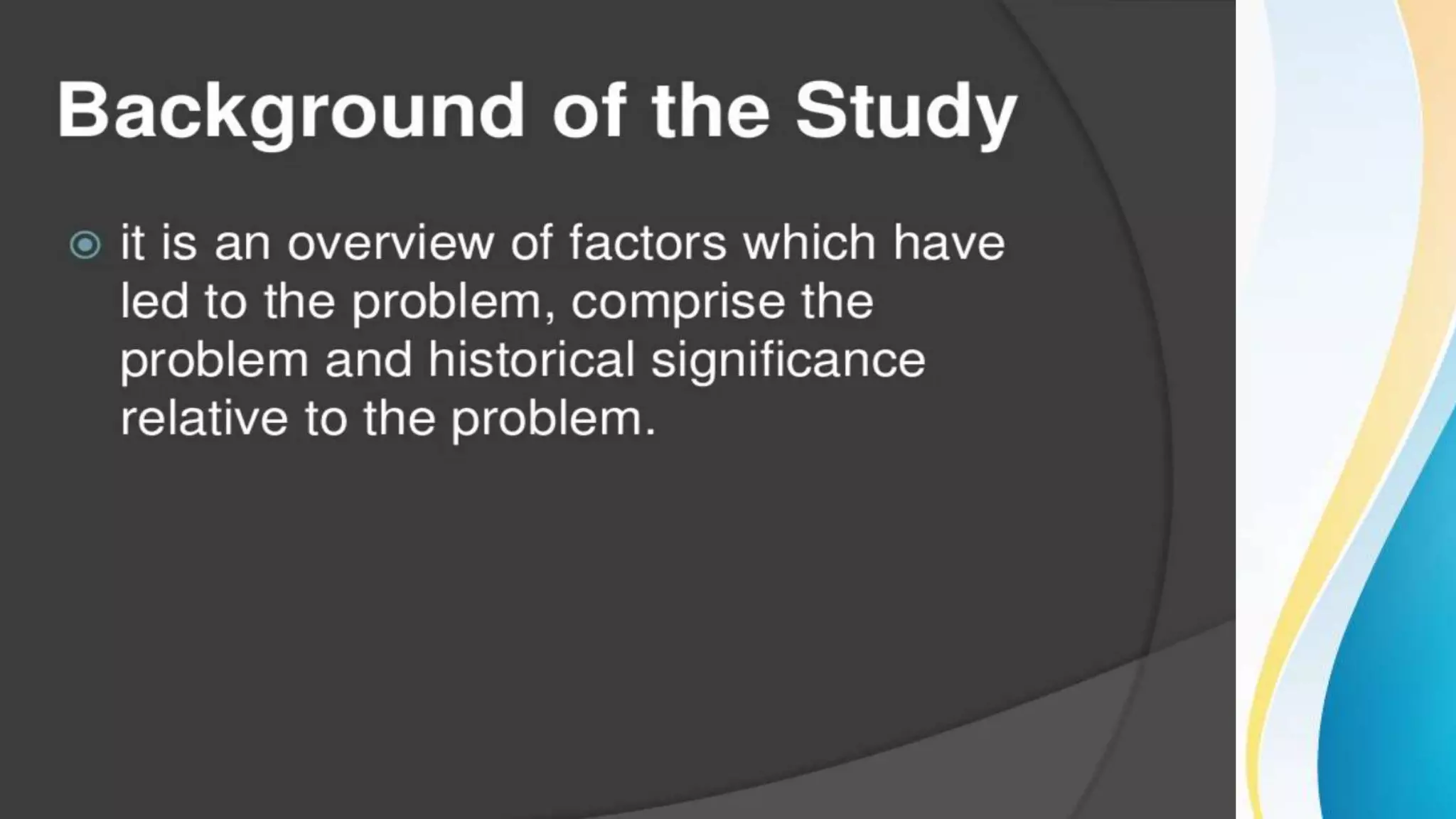
follows: A. The background of the study is an explanation of the
context of study which involves the current data or status of the
problem, existing studies about it and its history that paved
way to the development of the research problem. It explicates
the rationale why you, as a researcher, are conducting the
study. Writing this particular part of the paper may lead you to
your research questions.
As you write the background of the study or introduction, take
into consideration the following guidelines:
It should clearly state the reason for conducting the study.
1. It should move from broad to specific.
2. It should state the current condition of the research problem.
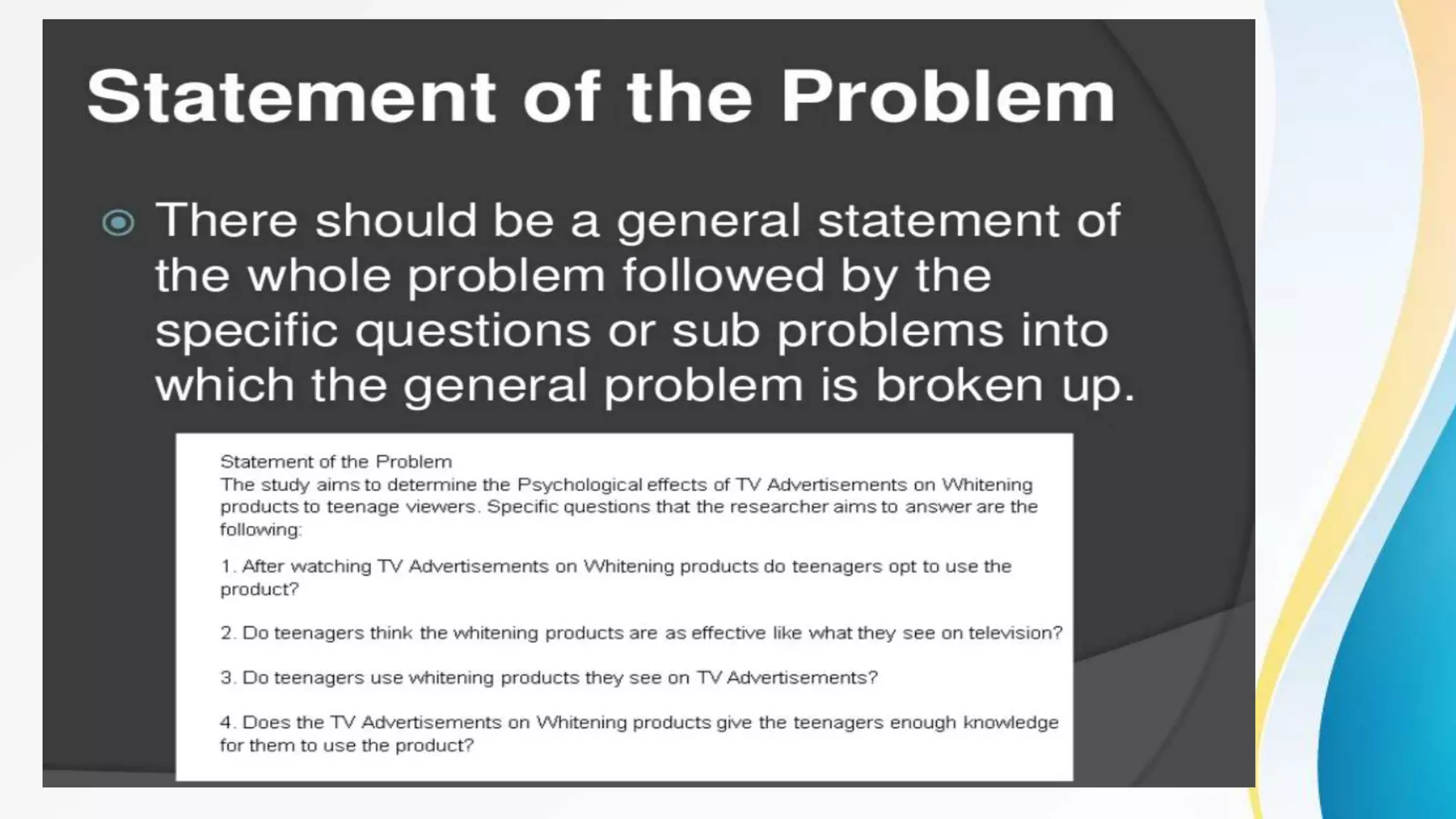
The next part to be accomplished is the statement of the
problem. Aside from being a tool in solving dilemmas in the
society, another purpose of research is to guide people
towards a better understanding of phenomena, human
behavior, human interactions and other events in daily life.
This premise indicates the importance of meticulously
crafting of the research questions as it sets the focus and
drives the course of the study.
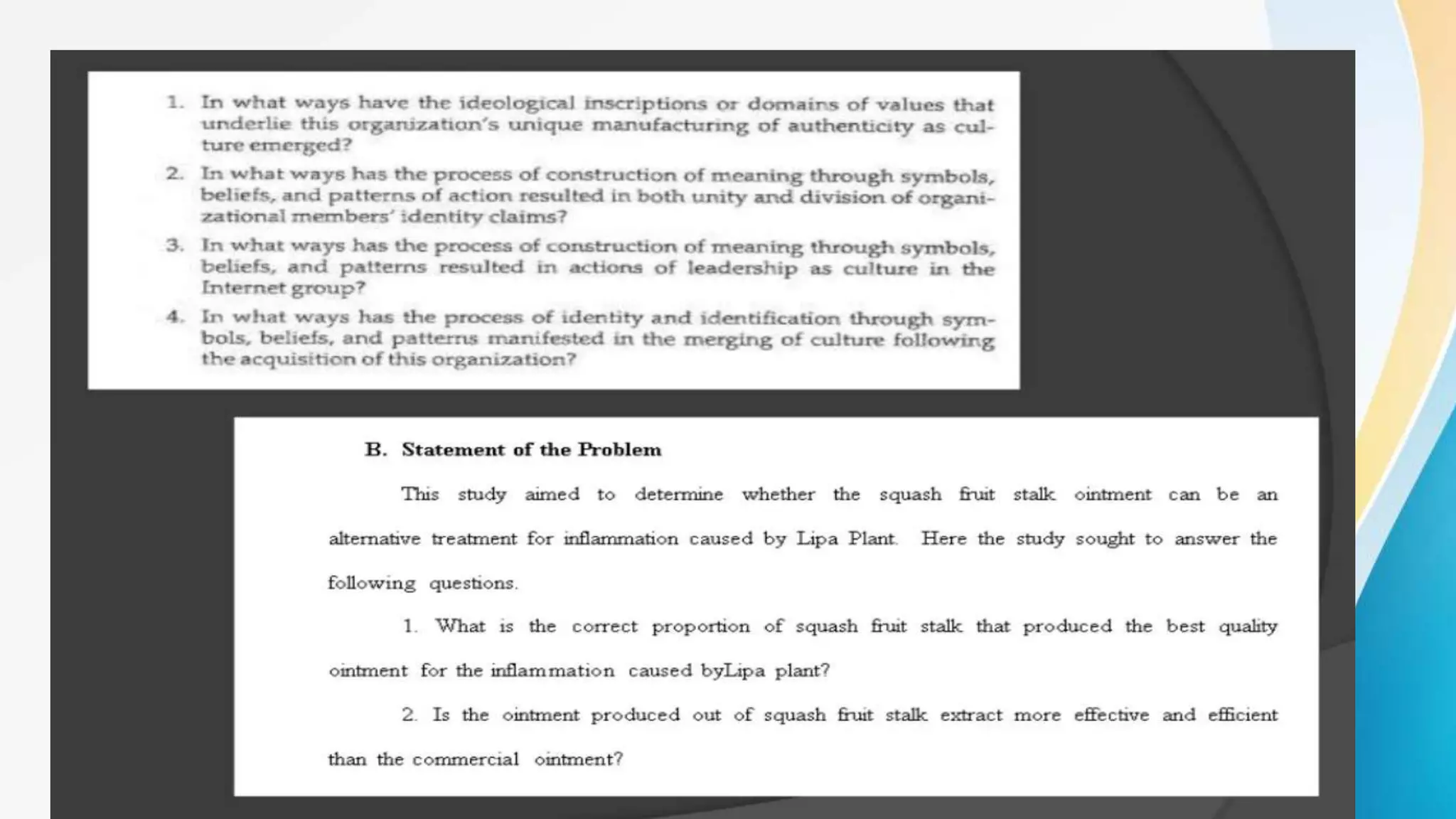
The statement of the problem has two parts:
1.General statement of the problem/Objective
2.Specific research questions
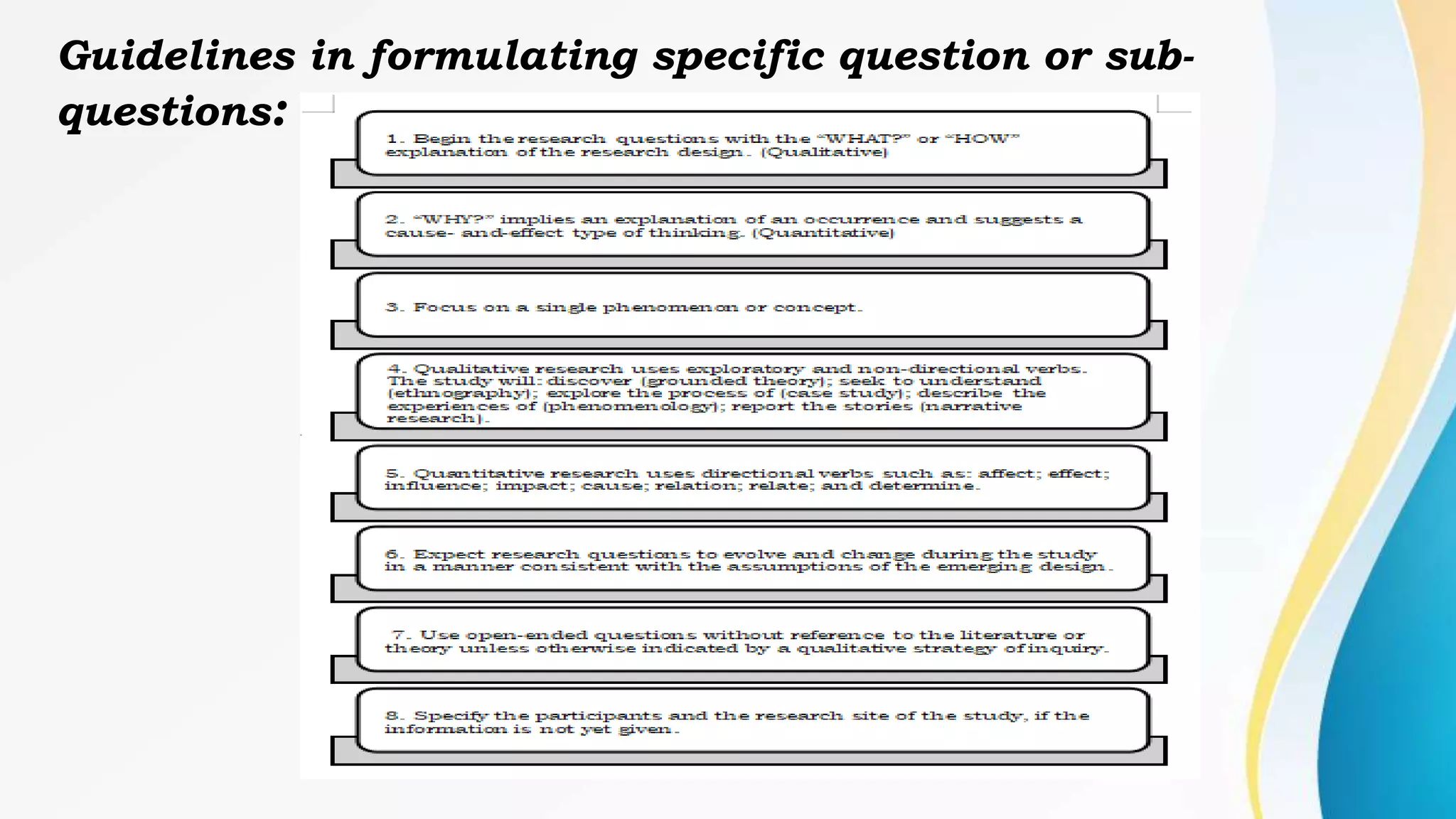
Guidelines in formulating specific question or sub-
questions:
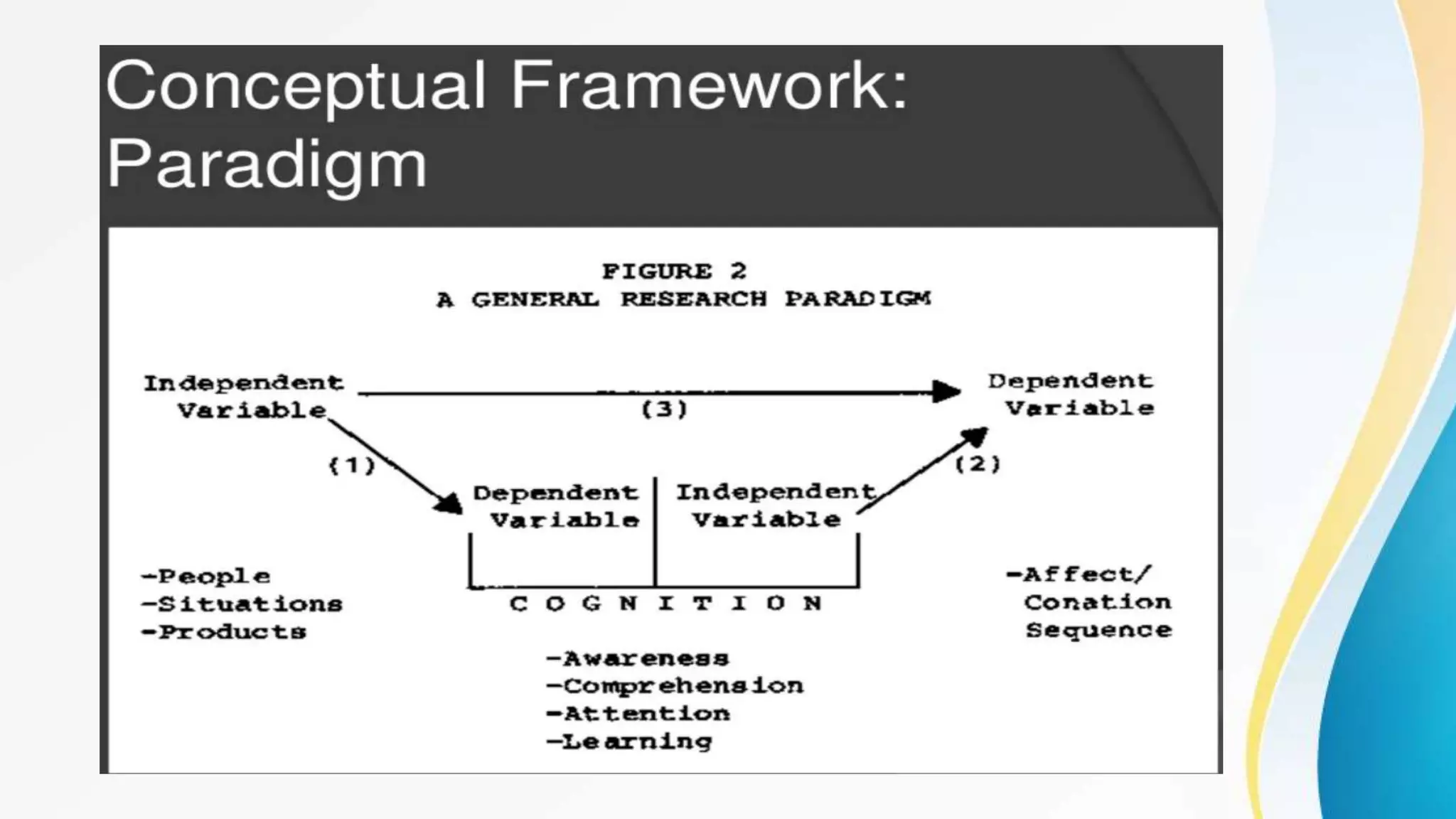
CONCEPTUAL FRAMEWORK EXAMPLES

INQUIRY, INVESTIGATION AND IMMERSION-M1.pptx

  • 1.
  • 2.
    An INQUIRY isan investigation made by asking questions rather than by inspection, or by study of available evidence: an inquiry into a proposed bond issue. Immersion refers to the deep-level personal involvement of the researcher with the object of study. An INVESTIGATION is a systematic, minute, and thorough attempt to learn the facts about something complex or hidden; it is often formal and official: an investigation of a bank failure. Research is careful and sustained investigation.
  • 7.
  • 8.
    T H EO R I E S D E E N X O N I R X E S E A P R O B L E M S N R P C I N T E R E S T H Q U T Z E E D F H C G S U W V V A U E R R I P H I L O S O P H Y I R I U A X E A E L B B O A S T M E T O D U L S E I S S O T I H N A A R D I S S U E S U U O G C R H C O Z O V I R D P D N A E E N E D A N M I V C L I O C S T C K D T S O W A N Q E U A R I A N E I T E D T U C S A T V L I O N O R E S I E A R C D I S F U N N Z X E O E W Y A P N O I T A S R E V N O C M THEORIES PROBLEMS PHILOSOPHY STUDIES SPECIALIZATION INTEREST NEEDS ADVICE INTUITION
  • 9.
    What’s In Taking intoconsideration your experiences from your previous research subjects, decide whether each sentence must be a criterion in choosing a good research problem. On your notebook, write YES if the statement can be considered as a criterion and NO if otherwise. A research topic should… 1. be original. 2. be ambiguous. 3. fill in a research gap. 4. be costly and ambitious. 5. be general and not specific. 6. arouse intellectual curiosity. 7. be within the researcher’s interest. 8. make use of ineffective research instrument. 9. be completed beyond the given period of time. 10. be insignificant to the field of study or discipline.
  • 10.
    What’s In Taking intoconsideration your experiences from your previous research subjects, decide whether each sentence must be a criterion in choosing a good research problem. On your notebook, write YES if the statement can be considered as a criterion and NO if otherwise. A research topic should… 1. be original. YES 2. be ambiguous. NO 3. fill in a research gap. YES 4. be costly and ambitious. NO 5. be general and not specific. NO 6. arouse intellectual curiosity. YES 7. be within the researcher’s interest. YES 8. make use of ineffective research instrument. NO 9. be completed beyond the given period of time. NO 10. be insignificant to the field of study or discipline. NO
  • 11.
    1. INTEREST INTHE SUBJECT MATTER Being interested in a topic is usually due to the richness of your stock knowledge about it or because of its familiarity to you. Curiosity about an issue/topic is one of the factors that motivate a person to unravel the unknown in a topic. Thus, the researcher’s interest increases the possibility of the success of the study.
  • 12.
    One of thethings that you should do is to collect a lot of information on your topic of interest. This enables you to find evidences that would support your topic. You must ensure that your sources come from a wide variety of literature such as books, journal, periodicals, online articles, etc. Hence, going to the library and surfing the internet are some of the activities that you should do as a researcher. 2. RICHNESS OF AVAILABLE SOURCES OR SUPPORTING EVIDENCES
  • 13.
    3. TIMELINESS ANDRELEVANCE OF THE TOPIC Your topic should be relevant and timely. A topic is relevant if it serves as an instrument in improving the society or if it answers or solves current issues which are some of the reasons why research is conducted.
  • 14.
    4. LIMITATIONS OFTHE SUBJECT Aside from your interest, you must also consider the significance of the topic in your track and strand. Remember that research is conducted to contribute something valuable to a particular area or discipline.
  • 15.
    5. PERSONAL RESOURCES Priorto finalizing your chosen topic, you must assess your research abilities as a student. You may do so by taking your financial capability, health condition, personal qualifications and trainings as a researcher, needed facilities and time allotment into account. It is important that all of these aspects are considered in order for you to guarantee the accomplishment of your research.
  • 16.
    What is It Nowthat you have learned the considerations in formulating a research problem, here are the steps that will guide you trim down your area of interest.
  • 17.
    When formulating aneffective research title, take the following guidelines into consideration: 1. Indicate accurately the subject and scope of the study. 2. The title must be limited to 10 to 15 substantive words. Conjunctions (and, but, because), prepositions (in, on, at) and articles (the, a, an) are not counted. 3. Do not include analysis of, study of, an investigation of and the like. 4. The title must be in the phrase form. Avoid title that gives too much information.
  • 18.
    A 1.This refers tothe researcher’s abilities, financial capacity, resources in terms of instruments, facilities and time frame. 2.This refers to the social applicability and appropriateness of the topic to the current situation. 3.This refers to an individual’s interest in a topic driven by his or her schema about it. 4.This refers to the availability of needed resources as evidence for the topic. 5.This refers to the topic’s contribution to a particular field or discipline. B a.limitations of the subject b.personal resources c.interest in the subject matter d.timeliness and relevance e.richness of available resources or supporting evidences of appropriateness f.intellectual ability What’s More A. Match the following descriptions in column A to their respective guidelines in choosing a research topic in column B. Write the letter of the correct answer on your notebook.
  • 19.
    B. Arrange thefollowing steps in correct sequence using numbers 1-5. Write your answers on your notebook. 6. Write your research problem. 7. Generate an unanswered question or an unresolved problem from your chosen area or lesson. 8. Recall the specific area, lesson or issue in your respective field that has piqued your interest the most. 9. Assess the question or problem based on the five guidelines stated above. 10. Focus on your track, strand or area of specialization.
  • 20.
    11. The titlemust include the accurate scope of the study. 12. Choose a title that is a sentence than a phrase. 13. Very long titles are preferable than short ones. 14. If possible, titles must not exceed 15 substantive words. 15. Analysis of, A Study of, An Investigation and the like are not encouraged. C. Read each statement below carefully. On your notebook, put a if the statement is correct and if otherwise.
  • 21.
    KEY ANSWER FORTHE ACTIVITY: A. B. C. 1. B 6. 5 11. 2. D 7. 3 12. 3. C 8. 2 13. 4. E 9. 4 14. 5. A 10. 1 15.
  • 22.
  • 23.
    Identifying the Problem andAsking the Questions
  • 24.
    What I Know Identifythe basic parts of a research paper described in each statement. Choose your answers from the word bank below and write them on your notebook. Introduction Notes in Chapter 1 Significance of the Study Scope and Delimitation Definition of Terms Conceptual Framework Statement of the Problem Hypothesis This part… 1. serves as the plan or the blueprint of the study. 2. includes definitions of words operationally used in the study. 3. serves as an overview of the research topic under investigation. 4. sets the parameters of the study which narrow down the scope of inquiry. 5. states the concrete terms that a researcher expects to happen in the study.
  • 25.
    6. cites thebenefits certain groups of persons will get from the outcome of the study. 7. clearly expresses the specific direction or focus of the research problem or inquiry. 8. elaborates the origin of the research problem which led to the conduct of the study. 9. covers the general statement of the problem as well as the specific research questions to be answered in the study. 10. gives the concepts to be covered in the study as well as its boundaries in terms of the respondents/participants, sampling technique, locale and the research methods to be used.
  • 26.
    1. Conceptual Framework 2.Definition of Terms 3. Introduction 4. Scope and Delimitation 5. Hypothesis 6. Significance of the Study 7. Statement of the Problem 8. Introduction 9. Statement of the Problem 10.Scope and Delimitation
  • 27.
    Starting a researchinvestigation is similar to embarking on a journey. First, you have to project a clear picture of your destination. You have already accomplished this initial step as you have trimmed down your area of interest into a specific research problem in the previous module. The next step is to strategize how to arrive at the destination. One way to strategize is to pinpoint all the factors and considerations that may affect the route towards your goal. This module discusses these contributing elements which will also serve as the bedrock of your study.
  • 28.
    What’s In One ofthe purposes of research is to address the pressing issues in the society. As a student who is a keen observer and is aware of the local, national or international affairs, list down three crucial concerns and propose a solution for each. Write your answers on your notebook. (5 points each) For example: Problem 1 (Local): Diesel price hike Proposed Solution: Used Cooking Oil as a Substitute for Diesel
  • 29.
    Problem 1: Local Issue 2:National Issue 3. International Issue Proposed Solution
  • 30.
    What’s New Read thegiven research scenario carefully and answer the questions that follow. Choose the letter of the best answer. Write your answers on your notebook. A group of student-researchers from Jose C. Payumo Jr. Memorial High School intends to conduct a study on the effectiveness of the Tobacco Free Generation (TFG) program inDinalupihan,Bataan.Medical doctors, nurses and volunteers in Singapore started the said program in 2016 and was adopted by Bataan in the same year. TFG founder, Dr. Koong HengNung,considered Bataan as the first province in the Philippines to adopt this campaign. Accordingto Koong (2018), TFG aims to educate and encourage the youths to be part of the tobacco free generation. 1. Where is the locale of the study? A. Bataan B. Dinalupihan C. Philippines D. Singapore 2. What is the objective of the study in the given selection? A. to uncover the history of the TFG program B. to measure the effectiveness of the TFG policies C. to identify the effects of the TFG to the community D. to solicit the experiences of smokers and non-smokers 3. Who do you think should be the respondents of the study? A. residents of Dinalupihan B. medical doctors and nurses C. founder of the TFG program D. All of the above. 4. Who do you think will benefit from this study? A. community B. local government C. future researchers D. All of the above. 5. Why do you think there is a need to conduct this study? A. to gauge the status of the program B. to see whether the program needs revision C. to measure the compliance level of the residents D. All of the above. B, B, A,A,D
  • 32.
    What is It Nowthat you have clearly formulated a research problem, the next step is to accomplish the baseline of your research paper. You must explain the context of your study by giving its background. This may aid you in identifying your specific questions for your statement of the problem as well as your hypothesis. There is also a need to list down the beneficiaries of your research which will be presented in the significance of the study. You must also set the boundaries of your study by writing your scope and delimitation.
  • 33.
    A definition ofterms must also be furnished to facilitate understanding of your study. These parts are discussed as follows: A. The background of the study is an explanation of the context of study which involves the current data or status of the problem, existing studies about it and its history that paved way to the development of the research problem. It explicates the rationale why you, as a researcher, are conducting the study. Writing this particular part of the paper may lead you to your research questions. As you write the background of the study or introduction, take into consideration the following guidelines: It should clearly state the reason for conducting the study. 1. It should move from broad to specific. 2. It should state the current condition of the research problem.
  • 39.
    The next partto be accomplished is the statement of the problem. Aside from being a tool in solving dilemmas in the society, another purpose of research is to guide people towards a better understanding of phenomena, human behavior, human interactions and other events in daily life. This premise indicates the importance of meticulously crafting of the research questions as it sets the focus and drives the course of the study. The statement of the problem has two parts: 1.General statement of the problem/Objective 2.Specific research questions
  • 41.
    Guidelines in formulatingspecific question or sub- questions:
  • 54.